There was a short-lived but intense international armed conflict (IAC) between Iran and the United States in June 2025. US attacks on Iran’s nuclear facilities during the night of 21 to 22 June 2025 (codenamed Operation Midnight Hammer) 1D. Vergun, ‘Defense Agency Contributed Toward Operation Midnight Hammer Success’, DOD News, United States (US) Department of Defense, 10 July 2025. were followed by a riposte by Iran on a US military base in Qatar on 23 June. The IAC was related to, but distinct from, an IAC between Iran and Israel that took place on 13–24 June 2025. That conflict is addressed in a separate entry. The conflict between Iran and the United States represents a significant escalation of the long-standing enmity between the two nations that dates back to the 1979 Islamic Revolution in Iran and the Iran hostages crisis.2‘History of US-Iran relations: From the 1953 regime change to Trump strikes’, Explainer, Al Jazeera, 23 June 2025.
Following attacks by Iran and Israel on each other’s territory in October 2024, tensions surrounding Iran’s nuclear activities erupted once again into an IAC in June 2025. Israel has long alleged that Iran is developing nuclear weapons whereas Iran has argued that its nuclear programme is purely peaceful in nature.3L. Lam, S. Ferreira Santos, J. Lukiv, and N. Williams, ‘Israel-Iran: How did latest conflict start and where could it lead?’, BBC News, 13 June 2025 (Updated 19 June 2025). On 21 June, the United States initiated an overnight bombing campaign on Iranian nuclear facilities. The bombing involved more than 125 US aircraft and 75 precision-guided munitions.4T. Mackintosh and N. Yousif, ‘What we know about US strikes on three Iranian nuclear sites’, BBC News, 22 June 2025 (Updated 23 June 2025); and ‘History of US-Iran relations: From the 1953 regime change to Trump strikes’, Explainer, Al Jazeera, 23 June 2025.
The IAC between Iran and Israel and the IAC between Iran and the United States were closely related, but were nonetheless distinct armed conflicts. That is so, despite Dorothy Shea, the US Permanent Representative to the UN in New York Security Council, telling the Council that the US strikes ‘sought to … aid our ally Israel in our inherent right of collective self-defense consistent with the UN Charter’.5Agence France-Presse, ‘Iran tells UN emergency meeting that US has “waged a war” under “absurd pretext”’, accessed 21 July 2025. Since the cessation of active hostilities between Israel and Iran on 24 June 2025, discussions between Iran and the United States about Iran’s nuclear programme have continued, but with the apparent risk of further hostilities should those discussions not result in a negotiated settlement.
On 12 June 2025, the Board of Governors of the International Atomic Energy Agency (IAEA) adopted a resolution on Iran’s safeguards obligations.6 ‘NPT Safeguards Agreement with the Islamic Republic of Iran’, IAEA Board of Governors Resolution GOV/2025/38, Vienna, 12 June 2025. The resolution, which was supported by 19 of the 35 members of the Board, stated that Iran had ‘failed to provide the co-operation required under its Safeguards Agreement, impeding Agency verification activities, sanitizing locations, and repeatedly failing to provide the Agency with technically credible explanations for the presence of uranium particles of anthropogenic origin at several undeclared locations in Iran or information on the current location(s) of nuclear material and/or of contaminated equipment’. 7‘NPT Safeguards Agreement with the Islamic Republic of Iran’, IAEA Board of Governors Resolution GOV/2025/38, Vienna, 12 June 2025, para (e). This was the first time in 20 years that the IAEA Board of Governors had formally declared Iran to be in breach of its nuclear non-proliferation obligations.8B. Bell and D. Gritten, ‘Global watchdog finds Iran failing to meet nuclear obligations’, BBC News, 12 June 2025.
On the morning of 13 June, Iranian state television reported a first volley of Israeli strikes, with residential areas in the capital, Tehran, said to have been hit.9L. Lam, S. Ferreira Santos, J. Lukiv, and N. Williams, ‘Israel-Iran: How did latest conflict start and where could it lead?’, BBC News, 13 June 2025 (Updated 19 June 2025). This marked the beginning of the IAC between Iran and Israel that lasted for 12 days.
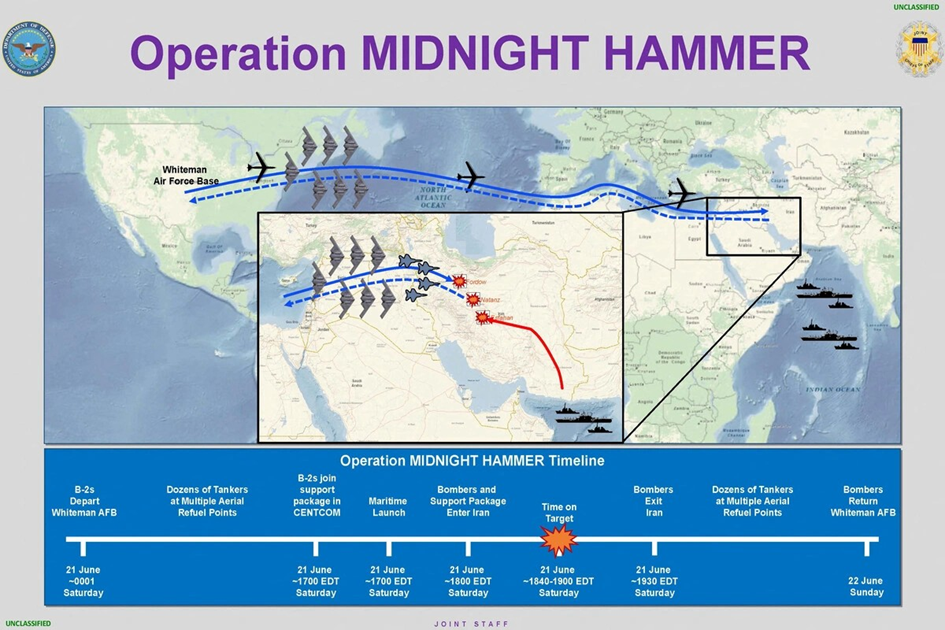
Eight days after the IAC between Iran and Israel erupted, Operation Midnight Hammer saw US attacks on Iran’s three principal nuclear facilities where uranium was being enriched. The attacks lasted for only 25 minutes but inflicted significant damage on the facilities at Fordo, Isfahan, and Natanz.10 T. Mackintosh and N. Yousif, ‘What we know about US strikes on three Iranian nuclear sites’, BBC News, 22 June 2025 (Updated 23 June 2025). Twelve GBU-57 Massive Ordnance Penetrators (MOPs) – better known colloquially as ‘bunker-buster bombs’ – were dropped by six B-2 bombers on the Fordo site, a facility buried deep below a mountain outside Tehran. Navy submarines fired 30 cruise missiles against the sites at Natanz and Isfahan while one B-2 bomber also dropped two bunker-busting bombs on Natanz.11 F. Fassihi, D. E. Sanger and A. Boxerman, ‘What to Know About the U.S. Strike on Iran and the Israel-Iran Cease-Fire’, The New York Times, 12 June 2025 (Updated 24 June 2025).
In the immediate aftermath of the strikes, a spokesperson for the US Department of Defense claimed that all three sites had sustained ‘extremely severe damage’, although the extent of the damage to Iran’s nuclear programme was not immediately clear. The conflict marked the first time that the United States had struck Iranian territory directly, and the first real-world use of the US ‘bunker busters’, said to be the only munitions that could reach Iran’s deeply buried nuclear sites. 12Council on Foreign Relations, ‘1953–2025 U.S. Relations With Iran’, undated but accessed 21 July 2025. The Iranian Atomic Energy Organization called the bombing of the three nuclear sites a ‘barbaric violation’ of international law.13 T. Mackintosh and N. Yousif, ‘What we know about US strikes on three Iranian nuclear sites’, BBC News, 22 June 2025 (Updated 23 June 2025).
International armed conflict between Iran and the United States (late June 2025)
Both Iran and the United States are party to the four Geneva Conventions of 1949 but neither is a State Party to the 1977 Additional Protocol I (which regulates the conduct of hostilities in international armed conflict), although Iran has signed it. Customary IHL on the conduct of hostilities is applicable to the IAC between the two States.
An international armed conflict See Article 2 common to the four Geneva Conventions. occurs when one or more States resort to armed force against another State, regardless of the motives for or the intensity of the violence.1ICTY, The Prosecutor v. Dusko Tadic: Decision on the Defence Motion for Interlocutory Appeal on Jurisdiction, Judgment (Appeals Chamber), Case No IT-94-1-AR72, 2 October 1995, para 70 ; ICRC, 2016 Commentary, paras 218–19; ICRC, How is the term “armed conflict” defined in international humanitarian law?, Opinion Paper, 2024, pp 9–10. On the night of 21–22 June 2025, Operation Midnight Hammer involved the use by the United States of B-2 stealth bombers and submarines to strike Iranian nuclear installations in Esfahan, Fordo, and Natanz.2D. Daoud and A. Sharawi, ‘Iranian drone and missile attacks against Israel: June 22, 2025’, Long War Journal, FDD, 22 June 2025. The United States’s initiation of Operation Midnight Hammer on 21 June was the start of the IAC with Iran. The use of force employed by the United States clearly meets the test set out in the Tadić judgment by the Appeals Chamber of the International Criminal Tribunal for the former Yugoslavia (ICTY) for the existence of an IAC.
The IAC in June 2025 was not a continuation of the hostilities between Iran and the United States five years earlier. In 2020, during Donald Trump’s first presidential term, the United States killed General Qassem Soleimani, the head of the elite Quds Force of Iran’s Islamic Revolutionary Guard Corps (IRGC), in a drone strike in Baghdad. In 2019, the US administration had declared the Quds Force to be a foreign terrorist organisation. Iran responded to the assassination of General Soleimani with strikes on US assets in Iraq.3‘Qasem Soleimani: US kills top Iranian general in Baghdad air strike’, BBC News, 3 January 2020.
On 23 June, in an apparently contrived retaliation for the US strikes on its nuclear facilities, 4N. Paton Walsh, ‘A weakened Tehran lashes out performatively against US airbases to save face’, CNN, 23 June 2025. Iran launched missiles against Al Udeid Air Base in Qatar. The attack, codenamed Operation Glad Tidings of Victory (Operation Bashayer Al-Fath in Farsi), did not cause any casualties.5‘Axios: Iran launches six missiles toward US bases in Qatar’, Reuters, 23 June 2025. Reportedly, Iran had, however, coordinated the attacks on the air base with Qatari officials and gave advanced notice that attacks were coming to minimize casualties. As The New York Times reported, officials had also said that Iran needed to strike back at the United States for symbolic reasons, but at the same time proceed in a way that allowed all sides an exit ramp. They described it as a similar strategy to 2020, when Iran gave Iraq advance warning before firing ballistic missiles at an American base in Iraq after the assassination of General Suleimani.6F. Fassihi, D. E. Sanger, and A. Boxerman, ‘What to Know About the U.S. Strike on Iran and the Israel-Iran Cease-Fire’, The New York Times, 12 June 2025 (Updated 24 June 2025).
On 24 June 2025, a ceasefire was agreed between Iran and Israel, reportedly with US support.7F. Fassihi, D. E. Sanger, and A. Boxerman, ‘What to Know About the U.S. Strike on Iran and the Israel-Iran Cease-Fire’, The New York Times, 12 June 2025 (Updated 24 June 2025). Although there was no formal ceasefire between Iran and the United States, an IAC is deemed to have ended with the general close of military operations, which includes not only the cessation of active hostilities, but also the end of ‘military movements of a bellicose nature, including those that reform, reorganize or reconstitute, so that the likelihood of the resumption of hostilities can reasonably be discarded’.8ICRC, 2016 Commentary, para 278; ICRC, How is the term “armed conflict” defined in international humanitarian law?, Opinion Paper, 2024, p 10.
According to the updated ICRC Commentary, ‘Even in the absence of active hostilities, such military operations having a continuing nexus with the international armed conflict will justify maintaining the classification of the situation as an international armed conflict.’ 9ICRC, 2016 Commentary, para 279. At the time of writing, however, no further military action had been conducted by either party since 23 June. RULAC is therefore treating the IAC as having ended. If, however, related action were to occur in future, it might be considered a continuation of this IAC.
- 1ICTY, The Prosecutor v. Dusko Tadic: Decision on the Defence Motion for Interlocutory Appeal on Jurisdiction, Judgment (Appeals Chamber), Case No IT-94-1-AR72, 2 October 1995, para 70 ; ICRC, 2016 Commentary, paras 218–19; ICRC, How is the term “armed conflict” defined in international humanitarian law?, Opinion Paper, 2024, pp 9–10.
- 2D. Daoud and A. Sharawi, ‘Iranian drone and missile attacks against Israel: June 22, 2025’, Long War Journal, FDD, 22 June 2025.
- 3‘Qasem Soleimani: US kills top Iranian general in Baghdad air strike’, BBC News, 3 January 2020.
- 4N. Paton Walsh, ‘A weakened Tehran lashes out performatively against US airbases to save face’, CNN, 23 June 2025.
- 5‘Axios: Iran launches six missiles toward US bases in Qatar’, Reuters, 23 June 2025.
- 6F. Fassihi, D. E. Sanger, and A. Boxerman, ‘What to Know About the U.S. Strike on Iran and the Israel-Iran Cease-Fire’, The New York Times, 12 June 2025 (Updated 24 June 2025).
- 7F. Fassihi, D. E. Sanger, and A. Boxerman, ‘What to Know About the U.S. Strike on Iran and the Israel-Iran Cease-Fire’, The New York Times, 12 June 2025 (Updated 24 June 2025).
- 8ICRC, 2016 Commentary, para 278; ICRC, How is the term “armed conflict” defined in international humanitarian law?, Opinion Paper, 2024, p 10.
- 9ICRC, 2016 Commentary, para 279.
State Parties
- Iran
- United States
- 1D. Vergun, ‘Defense Agency Contributed Toward Operation Midnight Hammer Success’, DOD News, United States (US) Department of Defense, 10 July 2025.
- 2‘History of US-Iran relations: From the 1953 regime change to Trump strikes’, Explainer, Al Jazeera, 23 June 2025.
- 3L. Lam, S. Ferreira Santos, J. Lukiv, and N. Williams, ‘Israel-Iran: How did latest conflict start and where could it lead?’, BBC News, 13 June 2025 (Updated 19 June 2025).
- 4T. Mackintosh and N. Yousif, ‘What we know about US strikes on three Iranian nuclear sites’, BBC News, 22 June 2025 (Updated 23 June 2025); and ‘History of US-Iran relations: From the 1953 regime change to Trump strikes’, Explainer, Al Jazeera, 23 June 2025.
- 5Agence France-Presse, ‘Iran tells UN emergency meeting that US has “waged a war” under “absurd pretext”’, accessed 21 July 2025.
- 6‘NPT Safeguards Agreement with the Islamic Republic of Iran’, IAEA Board of Governors Resolution GOV/2025/38, Vienna, 12 June 2025.
- 7‘NPT Safeguards Agreement with the Islamic Republic of Iran’, IAEA Board of Governors Resolution GOV/2025/38, Vienna, 12 June 2025, para (e).
- 8B. Bell and D. Gritten, ‘Global watchdog finds Iran failing to meet nuclear obligations’, BBC News, 12 June 2025.
- 9L. Lam, S. Ferreira Santos, J. Lukiv, and N. Williams, ‘Israel-Iran: How did latest conflict start and where could it lead?’, BBC News, 13 June 2025 (Updated 19 June 2025).
- 10T. Mackintosh and N. Yousif, ‘What we know about US strikes on three Iranian nuclear sites’, BBC News, 22 June 2025 (Updated 23 June 2025).
- 11F. Fassihi, D. E. Sanger and A. Boxerman, ‘What to Know About the U.S. Strike on Iran and the Israel-Iran Cease-Fire’, The New York Times, 12 June 2025 (Updated 24 June 2025).
- 12Council on Foreign Relations, ‘1953–2025 U.S. Relations With Iran’, undated but accessed 21 July 2025.
- 13T. Mackintosh and N. Yousif, ‘What we know about US strikes on three Iranian nuclear sites’, BBC News, 22 June 2025 (Updated 23 June 2025).