Conflict Overview
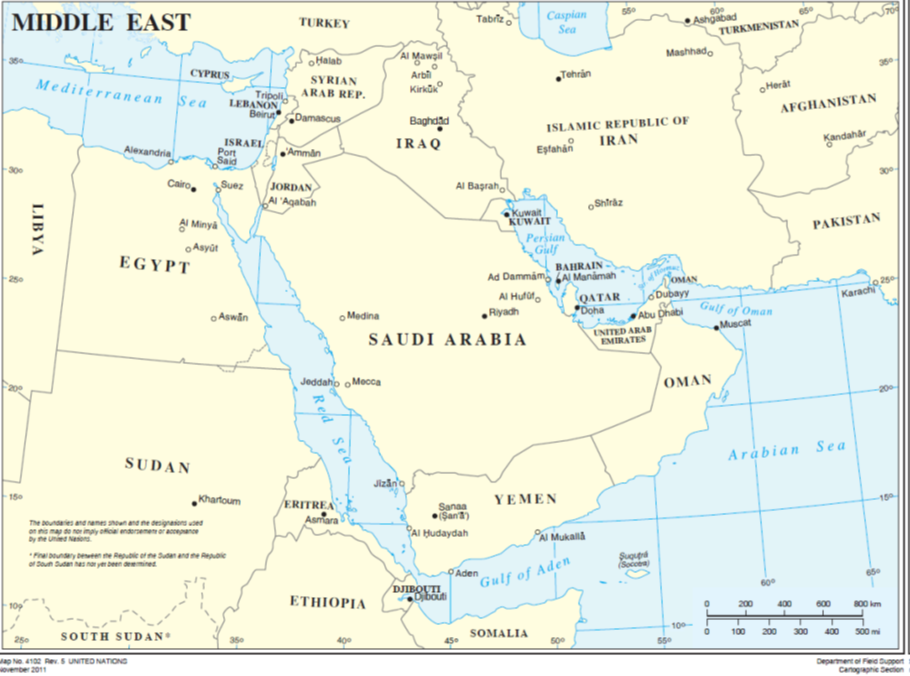
The armed conflicts between Iran and Israel and the United States (US) and numerous other States in the Gulf and beyond began in late February and early March 2026 and were ongoing at time of writing. These conflicts follow decades of animosity between the parties that ensued from the Iranian Revolution in 1979.
Short-lived international armed conflicts between Iran and Israel and Iran and the United States in June 2025 were reported upon previously by IHL in Focus. The strikes arose from fears that Iran was developing nuclear weapons – a claim Iran has consistently rejected – as well as its financial and military support for armed groups across the Middle East, notably Hamas, Hezbollah, and the Houthis.1See eg: K. Robinson and W. Merrow, ‘Iran’s Regional Armed Network’, Council on Foreign Relations, Updated 15 April 2024; and P. Loft, ‘Iran’s influence in the Middle East’, Research Briefing, House of Commons Library, London, 25 July 2024.
Key Events in 2026
On 28 February 2026, Israel and the United States initiated coordinated bombings against Iran. Those bombings had ended with a two-week ceasefire agreed on 7 April 2026. The force used by both Israel and the United States clearly met the threshold set forth in the decision of the International Criminal Tribunal for the former Yugoslavia in Tadić regarding the existence of an international armed conflict (IAC).2International Criminal Tribunal for the former Yugoslavia, Prosecutor v Dusko Tadić, Decision on the Defence Motion for Interlocutory Appeal on Jurisdiction (Appeals Chamber) (Case No IT-94-1-AR72), 2 October 1995, para 70. See also International Committee of the Red Cross (ICRC), ‘How is the term “armed conflict” defined in international humanitarian law?’, Opinion Paper, Geneva, 2024, pp 9–10. Responding to the attacks the same day, Iran launched missiles against Bahrain, Jordan, Kuwait, Qatar, Saudi Arabia, and the United Arab Emirates (UAE). In each case, this initiated a separate IAC between Iran and the State being attacked.
On 1 March 2026, Iran launched missiles against Oman giving rise to a further IAC between Iran and Oman. The same day, and possibly acting through Hezbollah3D. Sabbagh, ‘Hezbollah said to have launched drone that struck UK RAF airbase in Cyprus’, The Guardian, 2 March 2026. as its proxy,4Overall control by a State of a proxy armed group requires material support and a role in organizing, coordinating, or planning the military actions of the military group (direction of military strategy. International Criminal Tribunal for the former Yugoslavia (ICTY) Prosecutor v Tadić, Judgment (Appeals Chamber), 15 July 1999, para 145; International Criminal Court, Prosecutor v Lubanga, Judgment (Trial Chamber), 14 March 2012, para 541. Iran launched an attack from Lebanon against one of the two United Kingdom (UK) Sovereign Base Areas on Cyprus,5On 1 March, the Royal Air Force (RAF) Akrotiri base in Cyprus was hit by a missile fired from a drone. The means of warfare used in the attack was reportedly an Iranian Shahed-3 drone. It followed Iran’s announcement that it would target the UK bases in Cyprus. Other drones heading for the base were intercepted. There were no reported casualties. The British Sovereign Base Areas of Akrotiri and Dhekelia comprise those parts of Cyprus which stayed under British jurisdiction and remained British sovereign territory when the 1960 Treaty of Establishment created the independent Republic of Cyprus. S. Fella, ‘The UK Sovereign Base Areas in Cyprus: Status and recent developments’, Research Briefing No 10540, House of Commons Library, London, 3 March 2026, pp 2–3. thereby giving rise to an IAC between Iran and the United Kingdom from that date onward. On 20 March 2026, in a phone call with his UK counterpart, Yvette Cooper, Iran’s Minister for Foreign Affairs, Abbas Araghchi, warned that it viewed the United Kingdom’s choice to let the United States use British bases as ‘participation in aggression’.6K. Whannel, ‘Iran warns UK letting US use bases is “participation in aggression”’, BBC, 20 March 2026.
On 4 March 2026, Iran launched missiles against Syria, giving rise to another IAC. This IAC between Iran and Syria was ongoing at time of writing. On 23 March 2026, Iraqi armed factions aligned with Iran targeted the ‘Kharab al-Jir’ base in Syria’s Hasakah province in the far north-east of the country, a military facility from which US forces withdrew in February 2026. The attack was launched from the Iraqi border town of Rabia, near Hasakah city, using Grad rockets.7M. Ali and M. Amen, ‘Pro-Iran Iraqi militias expand attacks into Syria, targeting “Kharab al-Jir” base’, The New Arab, 25 March 2026. On 31 March 2026, explosions were heard in Damascus as, according to reports on Syrian State television, Israeli air defence systems intercepted Iranian missiles.8‘Explosions heard in Syria’s Damascus result of Israel intercepting Iranian missiles, state TV says’, Reuters, 31 March 2026.
On 5 March 2026 – and despite its denials, claiming a false flag operation – Iran is believed to have launched missiles against the airport in an exclave of Azerbaijan (Nakhchivan).9K. Khalilova, ‘Azerbaijan furious with Iran as war spills over its border’, BBC, 6 March 2026; ‘Azerbaijan vows retaliation after Iran’s “terrorist” drone strikes’, Le Monde, 5 March 2026. This gave rise to a further separate IAC between Iran and Azerbaijan that was short-lived. Azerbaijan threatened to respond with military force, but had not done so at time of writing.10See eg: ‘Azerbaijan threatens “Iron Fist” in response to Iranian drone attack’, 5 March 2026.
On 5 March 2026, Iran launched an attack against Iraqi territory, which included action against Iranian Kurdish armed groups in northern Iraq, bringing into existence an IAC between Iran and Iraq.11‘Iran targets Kurdish groups in Iraq, begins wave of attacks on Israel’, Al Jazeera, 5 March 2026. On 24 March 2026, an airstrike in Iraq’s Anbar province on a headquarters of the pro-Iran Popular Mobilisation Forces, killed at least ten people during a commanders’ meeting.12‘Deadly air attack hits pro-Iran Popular Mobilisation Forces in Iraq’, Al Jazeera, 24 March 2026. Potentially, the various strikes also gave rise to a new non-international armed conflict (NIAC). It is more likely, however, that as of early April 2026, the threshold of intensity between Iran and dissident Iranian armed groups in Iraq had not been met.
Iranian attacks against Israel and US forces in the region have continued, as have missile and drone strikes against Bahrain, Jordan, Kuwait, Oman, Qatar, Saudi Arabia, and the UAE. A few examples of the use of force follow. On 25 March, for instance, Saudi Arabia’s Ministry of Defence declared it had intercepted and destroyed three drones in the east of the country. Kuwaiti National Guard spokesperson Jadaan Fadel said Kuwait had downed six drones in the early morning of 25 March. The previous night, a drone strike hit Kuwait’s airport, causing a fire. Bahrain’s defence force said that its air defence systems ‘continue to confront successive waves of Iranian terrorist aggressions’. It said that 153 missiles and 331 drones had been intercepted and destroyed as of that date since hostilities began on 28 February.13‘Drones intercepted in Gulf states as Israel says missiles fired towards it’, BBC, 25 March 2026. Jordan was again hit by ballistic missiles and drone strikes on 25 March 2026.14‘Jordan Hit by Ballistic Missiles and Drones in Past 24 Hours, Military Says’, Qatar News Agency, 25 March 2026.
On 1 March 2026, Iran had launched a series of drone strikes against Oman, targeting the port of Duqm, which is said to be used by the United States. The attacks also included a strike on the oil tanker Skylight, which was flying the flag of Palau, near Khasab. Preliminary reports indicated that four crew members sustained injuries of varying severity and were transferred for medical treatment.15‘Drones strike Duqm port, oil tanker near Khasab’, Muscat Daily, 1 March 2026. The attack on the Skylight was an attack directed against a civilian object.
The following day, Iranian Minister for Foreign Affairs Araghchi claimed that the attacks on Oman were not Iran’s decision, but were mounted by Iranian military units acting independently, based on general instructions that have been given to them prior to the outbreak of armed conflict.16Arya Mishra, ‘“Not our choice”: Iran minister Araghchi on Oman strike, says military units now “independent”’, Hindustan Times, 2 March 2026. Iran’s military claimed that it had not ordered any strike on Omani territory, declaring that Oman remains a ‘friend and neighbour’.17Anadolu Agency, ‘Iran rejects any military attack on Oman amid Gulf conflict’, Daily Sabah, 3 March 2026. This assertion of friendship does not, however, affect the classification of the conflict. Moreover, attacks against Oman continued. On 29 March 2026, Oman said it was investigating ‘cowardly attacks’ for which no one had yet claimed responsibility after a foreign worker was reported as having been injured in a drone strike on the southern port of Salalah.18D. Jordan, ‘Iranian attacks across Gulf continue as major industrial sites hit’, BBC, 29 March 2026.
On 19 March, the Council of the International Maritime Organization (IMO) issued a declaration in which it ‘strongly condemned the egregious attacks by the Islamic Republic of Iran against the territories, including the territorial waters, of Bahrain, Kuwait, Oman, Qatar, Saudi Arabia, the United Arab Emirates and Jordan, which constitute a breach of international law’; and ‘strongly condemned the threats and attacks against vessels and purported closure of the Strait of Hormuz by the Islamic Republic of Iran, adversely affecting merchant and commercial vessels and threatening the safety and welfare of seafarers’.19Council of the IMO, ‘Summary of Decisions’, IMO doc C/ES.36/D, 19 March 2026, Declaration paras 7 and 8. In a statement on 25 March 2026, the Permanent Mission of Iran to the United Nations in New York declared that vessels may avail of ‘safe passage’ through the Strait of Hormuz, ‘provided that they neither participate in nor support acts of aggression against Iran and fully comply with the declared safety and security regulations’.20J. Power, ‘Iran says “non-hostile” ships can pass safely through Strait of Hormuz’, Al Jazeera, 25 March 2026.
On 24 March, the United States presented a fifteen-point peace deal to Iran via Pakistan.21A. Rasgon, J. E. Barnes, and F. Fassihi, ‘United States Said to Have Sent Iran a Plan to End the Middle East War’, The New York Times, 24 March 2026. The plan was not made public, but was claimed by media via a leak of information to include the following elements: a 30-day ceasefire; the dismantling of Iran’s nuclear facilities in Natanz, Isfahan and Fordow; a permanent commitment from Iran to never develop nuclear weapons; the handover of Iran’s stockpile of already enriched uranium to the International Atomic Energy Agency (IAEA), and a commitment from Iran to allow the IAEA to monitor all elements of the country’s remaining nuclear infrastructure and no longer to enrich uranium within the country; limits on the range and number of Iran’s missiles; an end to Iran’s support for regional proxies; an end to Iranian strikes on regional energy facilities; the reopening of the Strait of Hormuz; and removal of all sanctions imposed on Iran, alongside the ending of the UN mechanism that allows sanctions to be reimposed; and provision of US support for electricity generation at Iran’s Bushehr civil nuclear plant.22S. Shamim, ‘US-Iran mediation: What are each side’s demands – and is a deal possible?’, Al Jazeera, 25 March 2026.
Iranian officials informally derided the proposals as ‘maximalist’ and ‘unreasonable’.23‘Iran calls US proposal to end war “maximalist, unreasonable”’, Al Jazeera, 25 March 2026. On 26 March, the Iranian Revolutionary Guard Corps (IRGC) responded with its own proposed peace agreement. This involved the demand that the United States close all of its bases in the Gulf and pay reparations for the attacks against Iran; a guarantee there would be no further attacks; and an end to Israel’s operation against Hezbollah in Lebanon.24S. Nakhoul, L. Bassam, and M. Gebeily, ‘Iran wants Lebanon included in any ceasefire, sources say’, Reuters, 25 March 2026. Other demands included that all sanctions on Iran be lifted; that Iran be permitted to collect fees from ships travelling through the Strait of Hormuz; and that no constraints be imposed on Iran’s missile programme.25‘Iran’s counter-offer after US submits peace plan’, Daily Telegraph, 26 March 2026. Neither proposal would be acceptable to the other parties.
On 29 March 2026, the Houthis in Yemen fired a missile at Israel.26J. Borger, ‘Houthi forces enter Iran conflict with missile attacks on Israeli military sites’, The Guardian, 29 March 2026. This was the first such attack they had launched since the conclusion of the ceasefire in Gaza in October 2025.27R. Suleiman, Reuters, and Associated Press, ‘Yemen’s Houthis Join Iran War, Consider Closing Red Sea Shipping Route’, Haaretz, 29 March 2026. A volley of missiles from the Houthis at military sites in Israel followed later on 29 March, all of which were intercepted by Israeli defences. Yahya Saree, spokesperson for the Yemeni Armed Forces – the Houthi military – said the group had conducted ‘a barrage of cruise missiles and drones’ targeting ‘several vital military sites’ belonging to Israel. He added that the strikes ‘coincided’ with that of Iran and Hezbollah’s respective military operations, and that it ‘successfully achieved its objectives’, adding that further attacks would be mounted in the coming days ‘until the criminal enemy ceases its attacks and aggression’.28‘Houthis confirm second missile attack on Israel’, BBC, 29 March 2026. The renewed violence between the Houthis and Israel may have revived the NIAC that existed up to the Gaza ceasefire. This issue is addressed in detail in the IHL in Focus entry for Yemen.
Yemen’s Internationally Recognised Government (IRG) accused Iran of dragging the nation into conflict. In a statement, the Presidential Leadership Council that constitutes the IRG, and which largely governs from Aden, said ‘the involvement of the Houthi militias in defending the Iranian regime’ shows that Iran is ‘pushing its agents to open other fronts’ in order to reduce political pressure on itself. The Council warned that this would exacerbate poor humanitarian and living conditions ‘in a country already suffering from one of the worst humanitarian crises in the world’.29‘Yemen’s internationally-recognised government accuses Iran of dragging country into conflict’, BBC.
In early April 2026, Bahrain, which was chairing the UN Security Council, sought the adoption of a resolution allowing the use of force to open the Straits of Hormuz. The resolution was, however, opposed by China, at the least to the extent that it allowed for the use of ‘all defensive measures necessary’ to do so – code for the use of force. Bahrain’s Minister for Foreign Affairs, Abdullatif bin Rashid Al Zayani, told the Council that Bahrain looked forward to a ‘unified position from this esteemed council’.30D. Brunnstrom and J. Irish, ‘UN Hormuz vote now expected next week; China opposes authorization of force’, Reuters, 2 April 2026. When the revised text of the draft resolution was put before the Council on 7 April 2026, however, both China and Russia vetoed its adoption.31D. Brunnstrom, ‘China and Russia veto UN resolution on protecting Hormuz shipping’, Reuters, 7 April 2026.
The vote followed a declaration by President Trump in the morning that, unless his demand to open the Strait of Hormuz was fulfilled by nightfall, ‘a whole civilization will die tonight, never to be brought back again’.32‘U.S., Iran and Israel Agree to Cease-Fire’, The New York Times, 7 April 2026 (Updated 8 April 2026). The president’s words were widely condemned. Retired US admiral Michael Smith, who commanded a carrier strike group in the US navy, told The Guardian: ‘I have to hope that this is bluster, and a negotiating tactic on his part. He must understand that those types of threats themselves are likely war crimes.’33G. Chidi, ‘Retired military officers call Trump’s threats against Iran “likely war crimes”’, The Guardian, 7 April 2026.
The threat to kill a ‘civilization’ in a day implied use of nuclear weapons, even if the word was not used, according to Shawn Harris, a retired army general running for Congress as a Democrat in a Georgia run-off.34Chidi, ‘Retired military officers call Trump’s threats against Iran “likely war crimes”’. When asked by the Agence France-Presse news agency whether President Trump was prepared to use a nuclear weapon, White House Press Secretary Karoline Leavitt said in a statement: ‘Only the President knows where things stand and what he will do.’35‘US denies nuclear plan as deadline on threat to Iran “civilisation” looms’, Al Jazeera, 7 April 2026.
Ninety minutes before the expiry of the president’s threat, a ceasefire between Iran and the United States was agreed through the mediation of Pakistan. According to an Iranian State broadcaster cited by the BBC, the ten-point plan involved the following elements:
- Complete cessation of the war on Iraq, Lebanon, and Yemen.
- Complete and permanent cessation of the war on Iran with no time limit.
- Ending all conflicts in the region in their entirety.
- Reopening the Strait of Hormuz.
- Establishing a protocol and conditions to ensure freedom and security of navigation in the Strait of Hormuz.
- Full payment of compensation for reconstruction costs to Iran.
- Full commitment to lifting sanctions on Iran.
- Release of Iranian funds and frozen assets held by the United States.
- Iran fully commits to not seeking possession of any nuclear weapons.
- Immediate ceasefire takes effect on all fronts immediately upon approval of the above conditions.36‘Iran and US agree to conditional two-week ceasefire and opening of Hormuz strait’, BBC, 8 April 2026.
Conflict Classification and Applicable Law
The following armed conflicts were either ongoing since the end of February and early March 2026 or had ended at the time of writing:
- Iran v Israel and the United States (from 28 February 2026; ongoing)
- Iran v Azerbaijan (from 5 March 2026; conflict ended)
- Iran v Bahrain (from 28 February 2026; ongoing)
- Iran v Iraq (from 6 March 2026; ongoing)
- Iran v Jordan (from 28 February 2026; ongoing)
- Iran v Kuwait (from 28 February 2026; ongoing)
- Iran v Oman (from 1 March 2026; ongoing)
- Iran v Qatar (from 28 February 2026; ongoing)
- Iran v Saudi Arabia (from 28 February 2026; ongoing)
- Iran v Syria (from 4 March 2026; ongoing)
- Iran v UAE (from 28 February 2026; ongoing)
- Iran v United Kingdom (from 1 March 2026, initially via Hezbollah as proxy; arguably ongoing)
The armed conflicts are all regulated by customary international humanitarian law (IHL), in particular Hague Law rules governing the conduct of hostilities. Even though Bahrain, Iraq, Kuwait, Saudi Arabia, Syria, the UAE, and the United Kingdom are all States Parties to Additional Protocol I of 1977, the Protocol does not apply directly to any of the identified IACs as both adverse parties must have adhered to it for this to occur.37Art 1(3), Protocol Additional to the Geneva Conventions of 12 August 1949, and relating to the Protection of Victims of International Armed Conflicts; adopted at Geneva, 8 June 1977; entered into force, 7 December 1978; referring to Common Article 2 of the Geneva Conventions of 1949: ‘the present Convention shall apply to all cases of declared war or of any other armed conflict which may arise between two or more of the High Contracting Parties’. Iran and the United States are signatories (but not States Parties), while Israel has not signed the Protocol.
There is also a possible NIAC between Israel and the Houthis in Yemen. This armed conflict is governed by customary IHL on the conduct of hostilities, in particular the principles of distinction and proportionality in attack, underpinned by the duty to take precautions in attack.
Neither Iran, nor Israel, nor the United States is a State Party to the Rome Statute of the International Criminal Court.38Rome Statute of the International Criminal Court; adopted at Rome, 17 July 1998; entered into force, 1 July 2002 (ICC Statute). Israel and the United States both signed the Statute but then declared that they would not be ratifying. Bahrain, Kuwait, Oman, Syria, and Yemen are signatories but not States Parties to the Rome Statute. Azerbaijan and Iraq are non-signatory States along with Iran.
Among other concerned States, Jordan and the United Kingdom are both States Parties to the Rome Statute. The use of force on the territory of Jordan and the United Kingdom (and specifically the UK Sovereign Base Areas in Cyprus)39In a communication received on 11 March 2010, the United Kingdom informed the UN Secretary-General – the depositary of the ICC Statute — that it wished the United Kingdom’s ratification of the Statute to be extended to territories for whose international relations the United Kingdom is responsible including the ‘Sovereign Base Areas of Akrotiri and Dhekelia’. The United Kingdom considered ‘the extension of the aforesaid Statute … to take effect from the date of deposit of this notification’. therefore comes within the jurisdiction of the International Criminal Court – to the extent that, for instance, any war crime may have been committed.
Compliance with IHL
Overview
While the Israeli and US attacks against Iran beginning on 28 February 2026 were manifest acts of aggression40See eg: Marc Weller, ‘UK arguments for US operations from its bases blur the line between lawful self-defence and unlawful war on Iran’, Chatham House, London, 6 March 2026; ; Adil Ahmad Haque, ‘Aggression by the United States and Israel, Misdirected Self-Defense by Iran, and Collective Self-Defense of Gulf States’, Just Security, 2 March 2026; Tom Dannenbaum and Rebecca Hamilton, ‘Aggression, Plain and Simple: A Response to Shany and Cohen on the Attack on Iran’, Just Security, 9 March 2026; António Guterres, ‘Statement by the Secretary-General on Iran’, United Nations, New York, 28 February 2026. – serious violations of the prohibition of inter-State use of force under jus ad bellum – compliance with the rules of IHL is adjudged separately and without prejudice to any such determination.41US Department of Defense, Department of Defense Law of War Manual, 2015 (Updated July 2023), §3.5.1. IHL thus applies in parallel to the rules of jus ad bellum to govern the conduct of Iran, Israel and the United States and others in the respective armed conflicts. Applicable rules include the principles of distinction and proportionality in attack, both of which appear to have been violated on multiple occasions by the principal protagonists.
On 27 March 2026, in a rare public declaration on the lack of compliance with IHL in specific armed conflicts, the President of the International Committee of the Red Cross (ICRC), Mirjana Spoljaric Egger, warned of serious violations of international law in the Middle East conflict and called for an end to attacks on essential infrastructure:
Indiscriminate attacks on essential services can constitute a serious breach of international humanitarian law because they affect people that are protected under these laws. They create an environment where nowhere is safe anymore.42L. Fleischmann and D. McCabe, ‘Exclusive: “No one benefits from a war without rules”, Red Cross chief tells Euronews’, Euronews, 27 March 2026.
At the beginning of April 2026, more than 100 United States-based international lawyers wrote an open letter declaring that the US strikes on Iran violated the UN Charter and ‘may be war crimes’. They stated their concern that the fundamental rules of IHL ‘may have been violated, including in the context of reported strikes on civilians and civilian objects such as political leaders who have no military role, oil and gas infrastructure, including South Pars gas field, and water desalination plants’.43T. Dannenbaum, R. Hamilton, A. A. Haque, O. A. Hathaway, and G. Rona, ‘Over 100 International Law Experts Warn: U.S. Strikes on Iran Violate UN Charter and May Be War Crimes’, Just Security, 2 April 2026.
Civilian Objects Under Attack
Under customary IHL, attacks may only be directed against military objectives. Attacks must not be directed against civilian objects.44ICRC, Customary IHL Rule 7: ‘The Principle of Distinction between Civilian Objects and Military Objectives’. Civilian objects are all objects that are not military objectives45ICRC, Customary IHL Rule 9: ‘Definition of Civilian Objects’. and, as such, are protected against attack.46ICRC, Customary IHL Rule 10: ‘Civilian Objects’ Loss of Protection from Attack’. Military objectives are those objects which, by their nature, location, purpose or use, make an effective contribution to military action.47ICRC, Customary IHL Rule 8: ‘Definition of Military Objectives’. In addition, the object’s partial or total destruction, capture, or neutralisation must offer a definite military advantage in the prevailing circumstances.
The US attack on a school in Minab (28 February 2026)
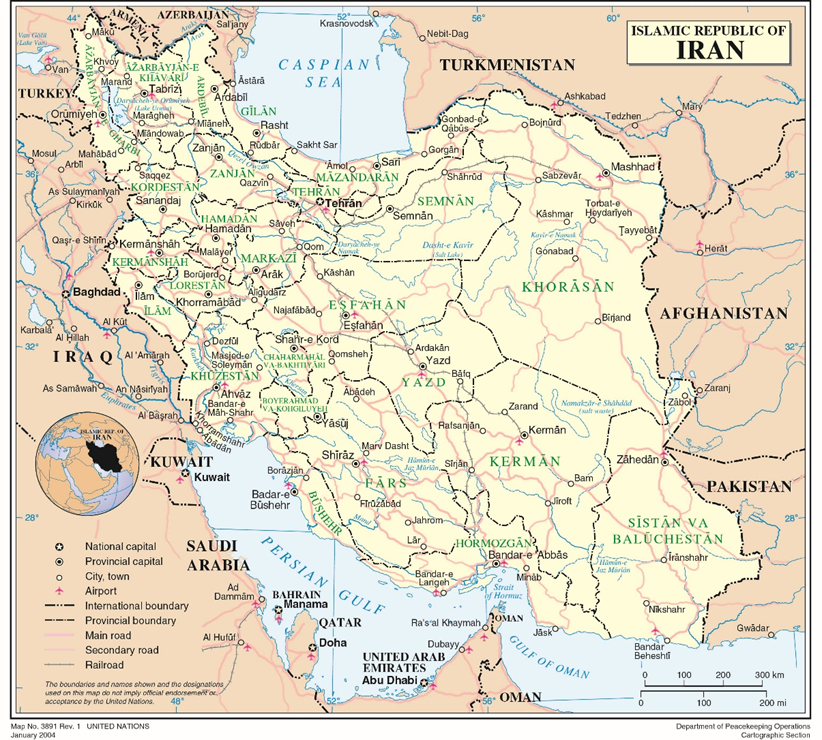
On 28 February 2026, on the first day of the attacks launched by the United States and Israel against Iran, up to three missiles struck the Shajareh Tayyebeh Girls’ School in Minab during the school’s morning session.48T. McClure and D. Parent, ‘Minab school bombing: how the worst mass casualty event of the Iran war unfolded – a visual guide’, The Guardian, 3 March 2026. Although the number has not been independently verified, local authorities claimed that 175 people were killed in the attack, mostly girls aged between seven and twelve years. The school was located near a base belonging to the IRGC. Video footage verified by The New York Times showed a US cruise missile striking an Iranian naval base next to the school that day.49M. Browne and J. Ismay, ‘U.S. Tomahawk Hit Naval Base Beside Iranian School, Video Shows’, The New York Times, 8 March 2026 (Updated 11 March 2026).
US President Donald Trump blamed Iran for the explosion at the school. But when a New York Times reporter pressed the president as to why he was the only official in his administration blaming Iran, he admitted: ‘Because I just don’t know enough about it.’50Ibid. In fact, the BGM-109 Tomahawk Land Attack Missile (TLAM) believed to have hit the school was almost certainly fired by the United States.51M. Hunter, T. Tarrant, M. Mulligan, C. Da Silva, and S. Pinson, ‘Images taken near Iranian school hit in deadly strikes show fragments of U.S.-made missile’, NBC News, 10 March 2026. This cruise missile has a circular error probable (CEP) of ten metres.52A. Parsch, ‘Raytheon (General Dynamics) AGM/BGM/RGM/UGM-109 Tomahawk’, Designation-systems.net, Last updated 22 December 2024. 1 CEP is the radius within which around half of all munitions targeted at the same spot would be expected to land. 3 CEP – 30 metres – would cover around 95% of all such firings.
According to Joseph Orenstein, a retired US Army Lieutenant Colonel and Judge Advocate with more than twenty-eight years’ experience, after the first missile strike,
parents began receiving calls from the school indicating that children had survived and were sheltering inside. Before civilian rescue efforts could reach the compound, two additional strikes followed. Whether targeting officers were aware of the first strike’s outcome before the second and third missiles were released is a factual question the investigation must resolve. If they were aware, or if the subsequent strikes were pre-programmed without human reassessment, this raises a separate and serious precautionary concern, including with respect to the obligation to take ‘constant care’ to spare the civilian population and civilian objects.53J. N. Orenstein, ‘When Intelligence Fails: A Legal Targeting Analysis of the Minab School Strike’, Just Security, 26 March 2026.
The strikes thus raise grave concerns as to compliance with the principle of distinction and the requirement to take all feasible precautions to verify the target is a lawful military objective.54ICRC, Customary IHL Rule 15: ‘Principle of Precautions in Attack’. Internal investigations in the United States, which were still ongoing at the time of writing, were said to have indicated that the attack was the result of a mistake by the US military in using outdated intelligence.55E. Mitchell, ‘US faulted in Iran school strike in initial Pentagon review: Report’, The Hill, 11 March 2026. The Defense Intelligence Agency is said to have labelled the school building as a military objective on the basis that the site was originally part of an adjacent IRGC naval base. But the school had been separated from that base between 2013 and 2016, fenced off, repainted in bright colours, and converted entirely to civilian educational use. The school building had not been a military facility for ten years and was not a military objective on 28 February 2026. Its civilian character was ‘visible, documented, and verifiable’.56Orenstein, ‘When Intelligence Fails: A Legal Targeting Analysis of the Minab School Strike’.
The high degree of accuracy of TLAM missiles means that the strike on the school building is unlikely to have been unintended. The US action thus indicates at the least gross negligence in its targeting decisions – more than sufficient to find a serious violation of IHL – but not necessarily constituting commission of a war crime. Under customary law, war crimes are serious violations of IHL that are committed either intentionally or recklessly.57ICTY, Prosecutor v Delalić, Judgment (Trial Chamber), 16 November 1998, para 437; ICRC, Commentary on Article 85 of Additional Protocol I, 1987, para. 3474.
On 27 March 2026, the UN Human Rights Council met in emergency session to discuss the attack. The debate in the Council had been called by Iran to discuss the tragedy. Speaking before the Council, the UN Special Rapporteur on the right to education, Farida Shaheed, said: ‘If journalists and civil society groups, using only open source access, could relatively quickly establish the school was separated from the wider compound and visibly marked, the US military, with all its tools at its disposal, surely could have done so prior to the attack. They had an obligation to do so.’58‘UN rights chief urges US to conclude probe into deadly Iran school attack’, Al Jazeera, 27 March 2026.
There must also be an investigation that is effective, impartial, timely, and transparent.59The Minnesota Protocol on the Investigation of Potentially Unlawful Death (2016), Office of the UN High Commissioner for Human Rights, New York/Geneva, 2017, paras 21–33. In Orenstein’s words, ‘A thorough, independent, and publicly disclosed investigation is not optional. It is the law.’60Orenstein, ‘When Intelligence Fails: A Legal Targeting Analysis of the Minab School Strike’. The UN High Commissioner for Human Rights, Volker Türk called upon the United States to conclude its internal inquiry as soon as possible and publish the results. ‘There must be justice for the terrible harm done’, he said by video link after he had held meetings with US officials in Washington earlier in the week of 23 March.61‘UN rights chief urges US to conclude probe into deadly Iran school attack’, Al Jazeera, 27 March 2026.
Alleged US attack on Lamerd (28 February 2026)
Hours after the strike on the girl’s school in Minab, US missiles hit residential buildings and a sports hall and adjacent elementary school about 300 metres apart in Lamerd, a city in Fars province in the south-west of Iran. The sports hall was being used at the time of the strikes by a female volleyball team, according to Amir Saeid Iravani, the Permanent Representative of Iran to the United Nations in New York.62C. Triebert and J. Ismay, ‘New U.S. Missile Hit Iranian Sports Hall and School, Analysis Shows’, The New York Times, 29 March 2026. Twenty-one people are reported to have been killed in the strikes.63M. Thomas, S. Jalaliand, and S. Sardarizadeh, ‘Video shows US missile likely used in deadly strike on Iranian town, experts say’, BBC Verify, 27 March 2026. An additional hundred people were injured, Mr Iravani said.64Triebert and Ismay, ‘New U.S. Missile Hit Iranian Sports Hall and School, Analysis Shows’.
The munition believed to have been used in that attack is the Precision Strike Missile (PrSM), a surface-to-surface missile with a unitary high-explosive warhead and a range of some 500 kilometres. Described by its manufacturer, Lockheed Martin, as a weapon that ‘engages threats with proven pin-point accuracy’,65Lockheed Martin, ‘Precision Strike Missile (PrSM)’, undated but accessed 1 April 2026. the PrSM entered service in the US military in December 2023.66Lockheed Martin, ‘Lockheed Martin Delivers First Precision Strike Missiles to US Army’, News release, Dallas, 11 December 2023. According to the US Department of War, the conflict with Iran is the first time the United States has used this munition.67Thomas et al, ‘Video shows US missile likely used in deadly strike on Iranian town, experts say’. Although confirmed data on the PrSM munition are scarce, one military authority claimed that: ‘Under normal conditions, the GPS system allows for precision guidance with an expected sub-meter CEP’.68‘PrSM Precision Strike Missile’, ArmyRecognition.com, 6 March 2026.
The intended target of the strike on the sports hall and school may have been an adjacent IRGC compound, although that building appeared to be undamaged on high-resolution satellite imagery reviewed by The New York Times on 9 March. According to archival satellite images, the sports hall and school had been walled off from the IRGC base for at least fifteen years prior to the attacks.69Triebert and Ismay, ‘New U.S. Missile Hit Iranian Sports Hall and School, Analysis Shows’.
Speaking to The New York Times, Captain Tim Hawkins, a spokesperson for US Central Command, said in a statement: ‘We’re aware of the reports and are looking into them. U.S. forces do not indiscriminately target [sic] civilians, unlike the Iranian regime.’70Triebert and Ismay, ‘New U.S. Missile Hit Iranian Sports Hall and School, Analysis Shows’. The United States subsequently denied that it was one of their munitions that had hit the civilian objects, claiming instead that it was an Iranian missile that had misfired: ‘The munition depicted in the video appears to be twice as long, consistent with the dimensions and silhouette of an Iranian Hoveyzeh cruise missile.’71US Central Command (CENTCOM), ‘CENTCOM Refutes Media Claims of U.S. Strikes in Lamerd, Iran’, Press release, 31 March 2026. This claim is, however, strongly contested. BBC Verify reports that six experts who examined footage of the strike and who all commented independently, contested the US suggestion, citing the missile’s visual features, the way it exploded, its trajectory, and the number of strikes in the area as the basis for their analysis.72M. Thomas, S. Sardarizadeh, and S. Jalali, ‘Experts dispute US account of deadly Iran sports hall strike in Lamerd’, BBC Verify, 3 April 2026.
Iranian attack on Palm Jumeirah Fairmont Hotel in Dubai (28 February 2026)
On 28 February 2026, an Iranian drone or missile strike hit the ‘Fairmont The Palm’ hotel on Dubai’s Palm Jumeirah, causing a significant fire.73W. Christou and A. Giuffrida, ‘Explosions rock Dubai, Bahrain, Jordan and Kuwait as war spreads across Middle East’, The Guardian, 1 March 2026. Four people were injured in a car park near the hotel.74R. Abdulrahim, ‘Can the “Dubai Dream” Survive the War? Residents Say Life Goes On.’, The New York Times, 30 March 2026. Without evidence that US military personnel or other lawful targets were present in the hotel at the time, this was either an attack directed against a civilian object or an indiscriminate attack. In either eventuality, it would appear that a war crime was committed. There was a potentially significant economic impact from the strike. An academic who lived in Dubai for 20 years told the BBC that even if the damage was not huge, buildings such as the Fairmont hotel are symbols of ‘a spectacular city where wealthy people can safely invest their money’. Yasser Elsheshtawy, professor of architecture at Columbia University, said: ‘It will suffer for years to come.’75A. Davies and G. Pomeroy, ‘“I saw missiles being intercepted’: Influencers tell of shock as Iran hits Dubai’s luxury landmarks’, BBC, 3 March 2026.
Alleged US attack on a desalination plant, Qeshm Island (7 March 2026)
On 7 March 2026, writing on social media platform X, Iranian Minister for Foreign Affairs Araghchi accused the United States of striking a freshwater desalination plant on Qeshm Island (Iran). He claimed the attack had disrupted water supplies to thirty villages and declared it ‘a dangerous move with grave consequences’. He said that the United States ‘set this precedent, not Iran’.76‘The U.S. committed a blatant and desperate crime by attacking a freshwater desalination plant on Qeshm Island’, Post by Seyed Abbas Araghchi, @araghchi, 7 March 2026. In response, the United States denied responsibility for the attack, as did Israel.77M. Rojanasakul, C. Brown, and H. Tabuchi, ‘War in Iran Has Put Middle East Water Supplies at Risk’, The New York Times, 14 March 2026. Yet on 30 March 2026, President Trump threatened to ‘obliterate’ Iran’s power infrastructure, oil wells, and ‘possibly all desalination plants’.78AFP, ‘Iranian media says desalination plant on Gulf island non-functional after airstrikes’, The Times of Israel, 31 March 2026.
Iran had an increasingly serious water crisis prior to the conflicts. As of the beginning of December 2025, some twenty provinces had not seen a drop of rain since the supposed start of the rainy season at the end of September. Kaveh Madani, director of the UN University Institute for Water, Environment and Health, who previously served as deputy head of Iran’s Department of Environment, described the nation as being in ‘water bankruptcy’, extracting from its rivers, lakes and wetlands, and its underground aquifers, at a much faster rate than they were being replenished.79L. Paddison, ‘Taps may run dry in this country, where the water crisis is so severe it can be seen from space’, CNN, 1 December 2025.
It is a customary IHL rule applicable in all armed conflict that: ‘Attacking, destroying, removing or rendering useless objects indispensable to the survival of the civilian population is prohibited.’ Such objects include drinking water installations and supplies.80ICRC, Customary IHL Rule 54: ‘Attacks against Objects Indispensable to the Survival of the Civilian Population’. This prohibition does not apply to such objects when they are used by the enemy as sustenance solely for the members of its armed forces or in direct support of military action, provided that ‘in no event shall actions against these objects be taken which may be expected to leave the civilian population with such inadequate food or water as to cause its starvation or force its movement’.81Art 54(3), Additional Protocol I of 1977, reflecting customary law.
Iranian attack on a water desalination plant in Bahrain (8 March 2026)
The following day, Iran is believed to have attacked a water desalination plant in Bahrain. The Bahraini Ministry of the Interior blamed an Iranian drone for ‘material damage’ to the plant, although its national water and electricity authority said that water supplies had not been affected.82Rojanasakul et al, ‘War in Iran Has Put Middle East Water Supplies at Risk’. Bahrain is said to derive more than ninety per cent of its drinking water supplies from its network of desalination facilities.83D. Michel, ‘Could Iran Disrupt the Gulf Countries’ Desalinated Water Supplies?’, Center for Strategic and International Studies, 19 March 2026. Water desalination plants and other water installations may not be made the object of reprisals.84Art 54(4), Additional Protocol I of 1977. See also Art 52, Additional Protocol 1 and ICRC, Customary IHL Rules 54 and 147.
The International Energy Agency has observed that desalinated water supplies most of the daily water needs in Bahrain, Kuwait, Oman, Qatar, and Saudi Arabia.85G. Headley, ‘Trump’s threat against Iran desalination plants would be a war crime, legal experts say’, Small Wars Journal, 31 March 2026. The World Bank has stated that nearly forty-four per cent of global desalination capacity is concentrated in the Gulf Cooperation Council market, creating a ‘vulnerability of extraordinary scale’.86N. Kowsar and A. Nader, ‘Targeting Iran’s Fragile Water Infrastructure Puts the Whole Region in Danger’, Foreign Policy, 9 March 2026.
Iranian attack on data centres in the UAE (1 March 2026)
On 1 March 2026, the IRGC used Shahed-136 drones to strike two data centres in the UAE – managed by Amazon Web Services (AWS) – causing fires and power outages.87R. Raman and L. McMahon, ‘Amazon says drones damaged three facilities in UAE and Bahrain’, The Guardian, 3 March 2026. Iranian State TV claimed that the IRGC had launched the attack ‘to identify the role of these centres in supporting the enemy’s military and intelligence activities’.
Whether there was any military impact remains unclear, but, aside from the damage inflicted on what ostensibly would be civilian objects, there was a significant economic impact on civilians. The strikes critically impaired two of three cloud availability zones in the UAE region (ME-CENTRAL-1), resulting in the failure of standard redundancy models. Outages were reported by Abu Dhabi Commercial Bank, Emirates NBD, First Abu Dhabi Bank, payments platforms Hubpay and Alaan, data cloud company Snowflake, and the ride-hailing platform Careem. Recovery, AWS warned, would be prolonged.88M. Abuwasel, ‘The Legal and Policy Fallout from Data Center Strikes in the Middle East War’, Tech Policy Press, 12 March 2026. Millions of people in Dubai and Abu Dhabi were unable to pay for a taxi, order food, or check their bank balance on their mobile applications.89D. Boffey, ‘“It means missile defence on datacentres”: drone strikes raise doubts over Gulf as AI superpower’, The Guardian, 7 March 2026; B. Montgomery, ‘Datacenters are becoming a target in warfare for the first time’, The Guardian, 10 March 2026.
Writing on Tech Policy Press, Mahmoud Abuwasel, a partner at the local law firm Wasel & Wasel, observed that:
Increasingly, governments require that certain government services and sensitive public sector data be physically hosted within their borders to ensure digital sovereignty. Consequently, data center providers have limited geographic options if they wish to operate in these lucrative markets; they must build physical facilities locally. … This mandate travels aggressively down the supply chain. Other government tenderers, including defense contractors, civil accounting firms, logistics providers, and IT vendors, must also host their data locally to be eligible to bid for government contracts. By intertwining civilian enterprise data with sovereign government workloads in localized server farms, policymakers and tech platforms inadvertently elevate these facilities to high-value military targets.
With respect to the AWS servers in the UAE, Amazon is the primary cloud provider for Claude Code. This has been used by the US Department of War in its military operations ‘for mission-critical applications, such as intelligence analysis, modeling and simulation, operational planning, cyber operations, and more.’90Anthropic, ‘Statement from Dario Amodei on our discussions with the Department of War’, 26 February 2026. Furthermore, it is affirmed that ‘reports suggest that Claude Code remained in use during Operation Epic Fury and, therefore, presumably relied on Amazon data centers’.91K. Klonowska and M. Schmitt, ‘Iranian Attacks on the Amazon Data Centers: A Legal Analysis’, Just Security, 12 March 2026.
If the data centres were not being employed for military purposes, ‘and would not almost certainly be so used in the future’, the strikes would have violated the IHL prohibition on attacking civilian objects.92Klonowska and Schmitt, ‘Iranian Attacks on the Amazon Data Centers: A Legal Analysis’. More likely is that the data centres were a lawful military objective in the circumstances prevailing at the time. Such a conclusion leads to consideration of the rule of proportionality in attack. In this regard, mere inconveniences or temporary disruptions do not ‘count’. Thus, the fact that civilians in Dubai had trouble accessing their banking data would not need to be considered in the proportionality analysis ‘unless that inability eventually led to physical consequences, such as severe hunger’.93Klonowska and Schmitt, ‘Iranian Attacks on the Amazon Data Centers: A Legal Analysis’, citing US Department of Defense (now War), Department of Defense Law of War Manual, para 5.12.1.2. On the balance of probabilities, the Iranian attack was neither directed at a civilian object, nor indiscriminate in nature, nor disproportionate.
Israeli attack on the gas fields at South Pars (18 March 2026)
On 18 March 2026, an Israeli air raid targeted treatment facilities at Asaluyeh, the onshore processing hub for Iran’s largest natural gas field at South Pars. The gas field accounts for about seventy per cent of the gas Iran uses.94J. Jacobo, ‘What to know about South Pars, the largest natural gas field in the world and lifeline for Iran, after Israeli strike’, ABCNews, 20 March 2026. The governor of Asaluyeh confirmed that the facilities were ‘taken offline’ to control fires, without disclosing any production losses. Israeli military sources acknowledged that the operation was targeting Iran’s gas infrastructure.95M. Al-Hashemi, ‘Israel’s Strike on North Field–South Pars: Energy War and Global Risk’, Middle East Council on Foreign Affairs, 19 March 2026.
The Pars gas field, located offshore in the Persian Gulf, is one of the world’s largest natural gas reserves. The gas field, which is shared between Iran and Qatar (which calls its part of the field the North Dome), contains an estimated almost 51 billion cubic meters of usable gas, said to be enough to supply the world’s needs for thirteen years.96H. Regan and I. Kottasová, ‘What is the South Pars gas field and why is Israel’s attack an escalation?’, CNN, 19 March 2026; ‘Iran’s giant South Pars gas field at the centre of Gulf war escalation’, Reuters, 19 March 2026. A spokesperson for the Qatari Ministry of Foreign Affairs wrote in a post on social media platform X that: ‘The Israeli targeting of facilities linked to Iran’s South Pars field, an extension of Qatar’s North Field, is a dangerous & irresponsible step amid the current military escalation in the region.’97Post on X by Dr Majed Al Ansari, @majedalansari, 18 March 2026.
One commentator claimed that the conflict was moving toward an ‘energy-for-energy’ escalation in which ‘critical infrastructure becomes the primary target’.98M. Al-Hashemi, ‘Israel’s Strike on North Field–South Pars: Energy War and Global Risk’. US President Donald Trump first claimed that the United States ‘knew nothing’ about the Israeli attack. He then said he had cautioned Israel against it.99I. Kershner, ‘Israeli Officials Said U.S. Was Told About South Pars Attack’, The New York Times, 19 March 2026 (Updated 22 March 2026). He wrote on Truth Social, his social media platform: ‘NO MORE ATTACKS WILL BE MADE BY ISRAEL pertaining to this extremely important and valuable South Pars Field unless Iran unwisely decides to attack a very innocent, in this case, Qatar’.100Jacobo, ‘What to know about South Pars, the largest natural gas field in the world and lifeline for Iran, after Israeli strike.
The Qatari spokesperson declared that: ‘Targeting energy infrastructure constitutes a threat to global energy security, as well as to the peoples of the region & its environment’.101Post on X by Dr Majed Al Ansari, 18 March 2026. Indeed, although the cessation of hostilities between the various parties could lead to gas and oil shipments resuming within a matter of months, the significant damage inflicted on production infrastructure is said to potentially have an impact lasting far longer.102P. Beaumont, ‘Middle East war: why tit-for-tat attacks on gasfields are a major escalation’, The Guardian, 19 March 2026.
US and Israeli attacks on Iranian universities
Both the United States and Israel have targeted Iranian universities in the current conflict. The semi-official Iranian news agency Fars reported in late March 2026 that twenty universities and dormitories had been attacked.103E. Solomon and S. Mahoozi, ‘Iran Condemns Attacks on Its Universities, Warns of Retaliation’, The New York Times, 30 March 2026 The attacks included one on the Iran University of Science and Technology in Tehran on 28 March 2026. The New York Times reported that an entire building was reduced to rubble by the strike, while other classrooms were littered with shards of glass and debris.104E. Solomon and S. Mahoozi, ‘Iran Condemns Attacks on Its Universities, Warns of Retaliation’, The New York Times, 30 March 2026 The strike is not believed to have caused any casualties.105Agence France-Presse, ‘Iran’s Revolutionary Guard threatens US universities in the Middle East’, Le Monde, 29 March 2026.
Unless the facility is being used for military purposes, an intentional attack against an educational institution is a serious violation of IHL. The IRGC said that it would target US- and Israeli-affiliated universities in the Middle East in response to the strikes.106A. Pourahmadi, ‘Universities become new frontline as the US-Israel war against Iran escalates’, CNN, 31 March 2026.
Iranian attacks on shipping in the Strait of Hormuz
Under customary IHL, enemy warships can be targeted at any time and in any place on the high seas in an IAC. Merchant vessels belonging to the enemy can be targeted if they refuse to be captured.107See generally S. Haines, ‘Naval Warfare’, Chap 11 in S. Casey-Maslen with S. Haines, Hague Law Interpreted: The Conduct of Hostilities under the Law of Armed Conflict, Hart, Oxford, 2018. A vessel flying an enemy flag has enemy character.108San Remo Manual on International Law Applicable to Armed Conflicts at Sea, San Remo, Italy, 12 June 1994 (hereafter, San Remo Manual), Rule 112. Neutral merchant vessels can be targeted if they refuse to be boarded and searched for contraband. A vessel flying a neutral flag is assumed to be neutral,109San Remo Manual, Rule 113. but if the commander of a belligerent warship suspects that despite its flag it does have enemy character, the right of visit and search may be exercised.110San Remo Manual, Rule 114.
If a neutral merchant vessel subject to capture cannot be taken as prize at sea, it may be destroyed, although every effort must be made to avoid doing so. It should not be destroyed without there being entire satisfaction that it can neither be sent into a belligerent port, nor diverted, nor properly released. Destruction can only be ordered if the safety of passengers and crew is assured, if documents relating to the captured vessel are safeguarded and, if feasible, if the personal effects of the passengers and crew are saved. It should not be destroyed simply for carrying contraband, unless by value, weight, volume or freight the contraband forms more than half its cargo. Destruction will be subject to subsequent adjudication.111San Remo Manual, Rule 151.
If US or Israeli warships (or those belonging to any other party to an IAC with Iran) were to escort merchant vessels in the Strait of Hormuz, the escorted ships may be considered as enemy merchant vessels and military objectives.112San Remo Manual, Rule 60(d). As is the case on land,113ICRC, Customary IHL Rule 8: ‘Definition of Military Objectives’. insofar as objects are concerned, military objectives are limited to those objects which by their nature, location, purpose or use make an effective contribution to military action and whose total or partial destruction, capture or neutralization, in the circumstances ruling at the time, offers a definite military advantage.114San Remo Manual, Rule 40.
Oil which is shipped through the Strait of Hormuz on board a tanker which flies a neutral flag might turn the merchant vessel into a military objective if the oil is destined to be partly used by an enemy’s military. Iran can thus target such tankers that transport oil to Israel or the United States for this oil to be used by their army to support their military campaign.115A. Lott, ‘The Legality of Iran’s Closure of the Strait of Hormuz’, EJIL: Talk!, 10 March 2026. In other circumstances than those outlined above as permissible, Iranian attacks on merchant vessels in the Strait of Hormuz are attacks on civilian objects and likely war crimes. Citing Lloyd’s List Intelligence, Al Jazeera reported that, as of the beginning of April, twenty-three attacks had been directed against commercial vessels in the Gulf since US-Israeli strikes on Iran began on 28 February, with eleven crew members killed.116‘UK-led coalition of 40 countries vows action on Hormuz Strait closure’, Al Jazeera, 2 April 2026.
Civilians under Attack
Under customary IHL, civilians enjoy general protection from the effects of hostilities, unless and for such time as they directly participate in hostilities.117ICRC, Customary IHL Rule 6: ‘Civilians’ Loss of Protection from Attack’. Accordingly, parties to any armed conflict must at all times distinguish between combatants and civilians, and are prohibited from directing attacks against civilians.118ICRC, Customary IHL Rule 1: ‘The Principle of Distinction between Civilians and Combatants’. In case of doubt, persons should be treated as civilians.119ICRC, Customary IHL Rule 6: ‘Civilians’ Loss of Protection from Attack’. The United States has accepted – after earlier denials – that this is a rule of customary law. US Department of Defense, Department of Defense Law of War Manual, §5.4.3.4. Civilians may be incidentally affected by attacks against lawful targets. However, such attacks must not be disproportionate,120ICRC, Customary IHL Rule 14: ‘Proportionality in Attack’. and the attacker must take all feasible precautions to avoid or, in any event to minimize, incidental civilian impact.121ICRC, Customary IHL Rule 15: ‘Principle of Precautions in Attack’.
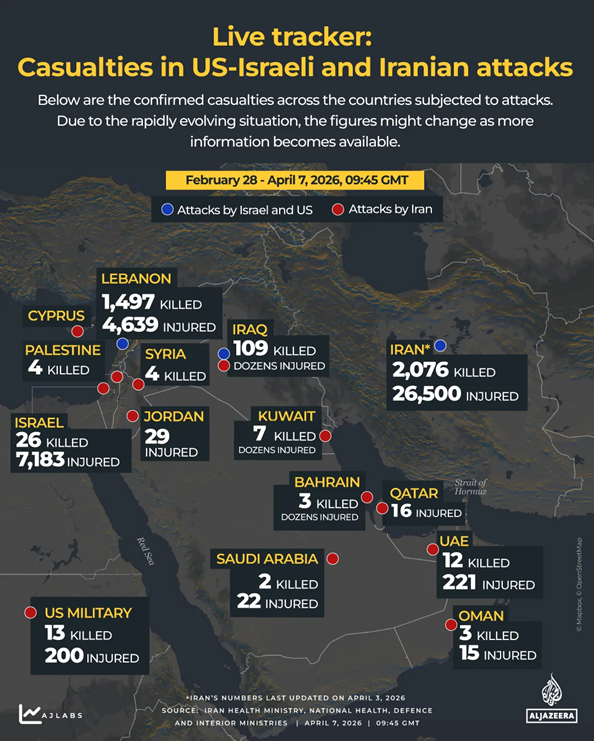
By the time of the ceasefire came into effect on 8 April 2026, more than 2,000 fatalities and 26,500 injured were reported in Iran as the result of the US and Israeli attacks. The figures were collated by Al Jazeera using data from the Iranian authorities. The other victims of the conflicts are also depicted in Figure 1 below.
In addition to its widespread use of indiscriminate missiles, Iran has used cluster munitions against Israel on numerous occasions. Sometimes wrongly characterized as ‘inherently indiscriminate’ weapons,122See eg: Human Rights Watch, ‘Iran: Unlawful Cluster Munition Strikes on Israel’, News release, Beirut, 29 March 2026. Human Rights Watch claimed in the release that since ‘Cluster munition bomblets are dispersed over a wide area’, this makes them ‘unlawfully indiscriminate in violation of the laws of war’. use of cluster munitions by Iran has nevertheless been largely indiscriminate in practice. Human Rights Watch thus confirmed three separate Iranian attacks involving cluster munitions that affected population centres in Israel, including two incidents that resulted in civilian deaths near Tel Aviv, killing two men in Yehud on 9 March and an older man and woman in Ramat Gan on 18 March 2026.123Human Rights Watch, ‘Iran: Unlawful Cluster Munition Strikes on Israel’.
The IDF, which has used cluster munitions extensively in the past, especially across great swathes of territory in southern Lebanon in 2006, declared on 18 March 2026 that:
Cluster munitions are held by law-abiding militaries and they have legitimate uses. Historically, militaries designed cluster munitions to strike multiple targets spread across a battlefield, like troops in open terrain. However, when these weapons are intentionally used against civilians in densely populated cities, the same wide-area effect that makes them effective on the battlefield now applies to innocent people.124IDF, ‘From Weapon to War Crime: The IRGC’s Use of Cluster Missiles Against Israeli Civilians’, 18 March 2026.
Protection of Persons in the Power of the Enemy
Under customary IHL, special protection is afforded to several categories of civilians or persons hors de combat who face a specific risk of harm, such as women, children, refugees, and IDPs.125ICRC, Customary IHL Rules 134–138: ‘Chapter 39. Other Persons Afforded Specific Protection’. IHL provides certain fundamental guarantees for anyone who is in the power of a party to a conflict, prohibiting torture and other inhumane or degrading treatment, arbitrary detention, and unfair trials.
The Iranian authorities have seemingly taken advantage of the situation of armed conflict to commit serious violations of international human rights law. According to Soran Mansournia, co-founder of the Washington DC-based Hiwa Freedom Foundation, on 18 March 2026 in Chabahar, a city in south-eastern Iran, at least five inmates — all members of Iran’s minority ethnic Baluch population — were shot to death after they protested against being left without food for four days. ‘The injured were beaten, and medical care was withheld, even though they were asking only for the bare minimum: food and safety’, claimed Mr Mansournia.126R. Saberi and F. Jamalpour, ‘Under the cover of war, Iran quietly executes jailed protesters’, The Sunday Times, 28 March 2026.
These violations come on top of the illegal killings of thousands of unarmed protesters in January 2026.127See eg: G. Golshiri, ‘The Iranian protesters killed by regime gunfire on January 8’, Le Monde, 11 February 2026; T. McClure and D. Parent, ‘Disappeared bodies, mass burials and “30,000 dead”: what is the truth of Iran’s death toll?’, The Guardian, 27 January 2026. Mr Mansournia warned that the regime was like a ‘wounded snake seeking revenge’. He feared it could result in mass executions. ‘If the war ends but the regime remains in place, the danger is that human rights abuses will become less visible internationally, while becoming even more severe inside the country.’ Indeed, the IRGC has sent text messages to citizens warning that anyone who protests will face ‘a blow even stronger than that of January 8’.128Saberi and Jamalpour, ‘Under the cover of war, Iran quietly executes jailed protesters’.
Although serious violations of international law, these are not IHL violations, owing to lack of a sufficient nexus to the conflict. Reflecting customary law, the Rome Statute requires that, for instance, an element of the war crime of wilful killing in an IAC is that: ‘The conduct took place in the context of and was associated with an international armed conflict.’129Elements of Crime for Article 8(2)(a)(i) of the ICC Statute: ‘War crime of wilful killing’, ‘Official Records of the Assembly of States Parties to the Rome Statute of the International Criminal Court, First session, New York, 3–10 September 2002’.
The International Criminal Tribunal for the former Yugoslavia (ICTY) has held that unlawful conduct is sufficiently related to an armed conflict when the existence of the conflict has played a substantial part in the perpetrator’s decision or ability to commit it, the manner in which it was committed, or the purpose for which it was committed.130ICTY, Prosecutor v Kunarac et al, Judgment (Appeals Chamber) (Case Nos. IT-96-23 and IT-96-23/1-A), 12 June 2002, para. 58. Indicative factors of the requisite link include the status of the perpetrator (for example, whether they had a combatant/fighter role); the apparent alignment of the unlawful conduct with the aim of a party to the conflict; or the fact that the conduct was part of, or committed in the context of, the perpetrator’s official duties.131ICTY, Prosecutor v Kunarac et al, Judgment (Appeals Chamber), para. 59.
- 1See eg: K. Robinson and W. Merrow, ‘Iran’s Regional Armed Network’, Council on Foreign Relations, Updated 15 April 2024; and P. Loft, ‘Iran’s influence in the Middle East’, Research Briefing, House of Commons Library, London, 25 July 2024.
- 2International Criminal Tribunal for the former Yugoslavia, Prosecutor v Dusko Tadić, Decision on the Defence Motion for Interlocutory Appeal on Jurisdiction (Appeals Chamber) (Case No IT-94-1-AR72), 2 October 1995, para 70. See also International Committee of the Red Cross (ICRC), ‘How is the term “armed conflict” defined in international humanitarian law?’, Opinion Paper, Geneva, 2024, pp 9–10.
- 3D. Sabbagh, ‘Hezbollah said to have launched drone that struck UK RAF airbase in Cyprus’, The Guardian, 2 March 2026.
- 4Overall control by a State of a proxy armed group requires material support and a role in organizing, coordinating, or planning the military actions of the military group (direction of military strategy. International Criminal Tribunal for the former Yugoslavia (ICTY) Prosecutor v Tadić, Judgment (Appeals Chamber), 15 July 1999, para 145; International Criminal Court, Prosecutor v Lubanga, Judgment (Trial Chamber), 14 March 2012, para 541.
- 5On 1 March, the Royal Air Force (RAF) Akrotiri base in Cyprus was hit by a missile fired from a drone. The means of warfare used in the attack was reportedly an Iranian Shahed-3 drone. It followed Iran’s announcement that it would target the UK bases in Cyprus. Other drones heading for the base were intercepted. There were no reported casualties. The British Sovereign Base Areas of Akrotiri and Dhekelia comprise those parts of Cyprus which stayed under British jurisdiction and remained British sovereign territory when the 1960 Treaty of Establishment created the independent Republic of Cyprus. S. Fella, ‘The UK Sovereign Base Areas in Cyprus: Status and recent developments’, Research Briefing No 10540, House of Commons Library, London, 3 March 2026, pp 2–3.
- 6K. Whannel, ‘Iran warns UK letting US use bases is “participation in aggression”’, BBC, 20 March 2026.
- 7M. Ali and M. Amen, ‘Pro-Iran Iraqi militias expand attacks into Syria, targeting “Kharab al-Jir” base’, The New Arab, 25 March 2026.
- 8‘Explosions heard in Syria’s Damascus result of Israel intercepting Iranian missiles, state TV says’, Reuters, 31 March 2026.
- 9K. Khalilova, ‘Azerbaijan furious with Iran as war spills over its border’, BBC, 6 March 2026; ‘Azerbaijan vows retaliation after Iran’s “terrorist” drone strikes’, Le Monde, 5 March 2026.
- 10See eg: ‘Azerbaijan threatens “Iron Fist” in response to Iranian drone attack’, 5 March 2026.
- 11‘Iran targets Kurdish groups in Iraq, begins wave of attacks on Israel’, Al Jazeera, 5 March 2026.
- 12‘Deadly air attack hits pro-Iran Popular Mobilisation Forces in Iraq’, Al Jazeera, 24 March 2026.
- 13‘Drones intercepted in Gulf states as Israel says missiles fired towards it’, BBC, 25 March 2026.
- 14‘Jordan Hit by Ballistic Missiles and Drones in Past 24 Hours, Military Says’, Qatar News Agency, 25 March 2026.
- 15‘Drones strike Duqm port, oil tanker near Khasab’, Muscat Daily, 1 March 2026.
- 16Arya Mishra, ‘“Not our choice”: Iran minister Araghchi on Oman strike, says military units now “independent”’, Hindustan Times, 2 March 2026.
- 17Anadolu Agency, ‘Iran rejects any military attack on Oman amid Gulf conflict’, Daily Sabah, 3 March 2026.
- 18D. Jordan, ‘Iranian attacks across Gulf continue as major industrial sites hit’, BBC, 29 March 2026.
- 19Council of the IMO, ‘Summary of Decisions’, IMO doc C/ES.36/D, 19 March 2026, Declaration paras 7 and 8.
- 20J. Power, ‘Iran says “non-hostile” ships can pass safely through Strait of Hormuz’, Al Jazeera, 25 March 2026.
- 21A. Rasgon, J. E. Barnes, and F. Fassihi, ‘United States Said to Have Sent Iran a Plan to End the Middle East War’, The New York Times, 24 March 2026.
- 22S. Shamim, ‘US-Iran mediation: What are each side’s demands – and is a deal possible?’, Al Jazeera, 25 March 2026.
- 23‘Iran calls US proposal to end war “maximalist, unreasonable”’, Al Jazeera, 25 March 2026.
- 24S. Nakhoul, L. Bassam, and M. Gebeily, ‘Iran wants Lebanon included in any ceasefire, sources say’, Reuters, 25 March 2026.
- 25‘Iran’s counter-offer after US submits peace plan’, Daily Telegraph, 26 March 2026.
- 26J. Borger, ‘Houthi forces enter Iran conflict with missile attacks on Israeli military sites’, The Guardian, 29 March 2026.
- 27R. Suleiman, Reuters, and Associated Press, ‘Yemen’s Houthis Join Iran War, Consider Closing Red Sea Shipping Route’, Haaretz, 29 March 2026.
- 28‘Houthis confirm second missile attack on Israel’, BBC, 29 March 2026.
- 29
- 30D. Brunnstrom and J. Irish, ‘UN Hormuz vote now expected next week; China opposes authorization of force’, Reuters, 2 April 2026.
- 31D. Brunnstrom, ‘China and Russia veto UN resolution on protecting Hormuz shipping’, Reuters, 7 April 2026.
- 32‘U.S., Iran and Israel Agree to Cease-Fire’, The New York Times, 7 April 2026 (Updated 8 April 2026).
- 33G. Chidi, ‘Retired military officers call Trump’s threats against Iran “likely war crimes”’, The Guardian, 7 April 2026.
- 34Chidi, ‘Retired military officers call Trump’s threats against Iran “likely war crimes”’.
- 35‘US denies nuclear plan as deadline on threat to Iran “civilisation” looms’, Al Jazeera, 7 April 2026.
- 36‘Iran and US agree to conditional two-week ceasefire and opening of Hormuz strait’, BBC, 8 April 2026.
- 37Art 1(3), Protocol Additional to the Geneva Conventions of 12 August 1949, and relating to the Protection of Victims of International Armed Conflicts; adopted at Geneva, 8 June 1977; entered into force, 7 December 1978; referring to Common Article 2 of the Geneva Conventions of 1949: ‘the present Convention shall apply to all cases of declared war or of any other armed conflict which may arise between two or more of the High Contracting Parties’.
- 38Rome Statute of the International Criminal Court; adopted at Rome, 17 July 1998; entered into force, 1 July 2002 (ICC Statute).
- 39In a communication received on 11 March 2010, the United Kingdom informed the UN Secretary-General – the depositary of the ICC Statute — that it wished the United Kingdom’s ratification of the Statute to be extended to territories for whose international relations the United Kingdom is responsible including the ‘Sovereign Base Areas of Akrotiri and Dhekelia’. The United Kingdom considered ‘the extension of the aforesaid Statute … to take effect from the date of deposit of this notification’.
- 40See eg: Marc Weller, ‘UK arguments for US operations from its bases blur the line between lawful self-defence and unlawful war on Iran’, Chatham House, London, 6 March 2026; ; Adil Ahmad Haque, ‘Aggression by the United States and Israel, Misdirected Self-Defense by Iran, and Collective Self-Defense of Gulf States’, Just Security, 2 March 2026; Tom Dannenbaum and Rebecca Hamilton, ‘Aggression, Plain and Simple: A Response to Shany and Cohen on the Attack on Iran’, Just Security, 9 March 2026; António Guterres, ‘Statement by the Secretary-General on Iran’, United Nations, New York, 28 February 2026.
- 41US Department of Defense, Department of Defense Law of War Manual, 2015 (Updated July 2023), §3.5.1.
- 42L. Fleischmann and D. McCabe, ‘Exclusive: “No one benefits from a war without rules”, Red Cross chief tells Euronews’, Euronews, 27 March 2026.
- 43T. Dannenbaum, R. Hamilton, A. A. Haque, O. A. Hathaway, and G. Rona, ‘Over 100 International Law Experts Warn: U.S. Strikes on Iran Violate UN Charter and May Be War Crimes’, Just Security, 2 April 2026.
- 44ICRC, Customary IHL Rule 7: ‘The Principle of Distinction between Civilian Objects and Military Objectives’.
- 45
- 46
- 47ICRC, Customary IHL Rule 8: ‘Definition of Military Objectives’. In addition, the object’s partial or total destruction, capture, or neutralisation must offer a definite military advantage in the prevailing circumstances.
- 48T. McClure and D. Parent, ‘Minab school bombing: how the worst mass casualty event of the Iran war unfolded – a visual guide’, The Guardian, 3 March 2026.
- 49M. Browne and J. Ismay, ‘U.S. Tomahawk Hit Naval Base Beside Iranian School, Video Shows’, The New York Times, 8 March 2026 (Updated 11 March 2026).
- 50Ibid.
- 51M. Hunter, T. Tarrant, M. Mulligan, C. Da Silva, and S. Pinson, ‘Images taken near Iranian school hit in deadly strikes show fragments of U.S.-made missile’, NBC News, 10 March 2026.
- 52A. Parsch, ‘Raytheon (General Dynamics) AGM/BGM/RGM/UGM-109 Tomahawk’, Designation-systems.net, Last updated 22 December 2024. 1 CEP is the radius within which around half of all munitions targeted at the same spot would be expected to land. 3 CEP – 30 metres – would cover around 95% of all such firings.
- 53J. N. Orenstein, ‘When Intelligence Fails: A Legal Targeting Analysis of the Minab School Strike’, Just Security, 26 March 2026.
- 54
- 55E. Mitchell, ‘US faulted in Iran school strike in initial Pentagon review: Report’, The Hill, 11 March 2026.
- 56
- 57ICTY, Prosecutor v Delalić, Judgment (Trial Chamber), 16 November 1998, para 437; ICRC, Commentary on Article 85 of Additional Protocol I, 1987, para. 3474.
- 58‘UN rights chief urges US to conclude probe into deadly Iran school attack’, Al Jazeera, 27 March 2026.
- 59The Minnesota Protocol on the Investigation of Potentially Unlawful Death (2016), Office of the UN High Commissioner for Human Rights, New York/Geneva, 2017, paras 21–33.
- 60
- 61‘UN rights chief urges US to conclude probe into deadly Iran school attack’, Al Jazeera, 27 March 2026.
- 62C. Triebert and J. Ismay, ‘New U.S. Missile Hit Iranian Sports Hall and School, Analysis Shows’, The New York Times, 29 March 2026.
- 63M. Thomas, S. Jalaliand, and S. Sardarizadeh, ‘Video shows US missile likely used in deadly strike on Iranian town, experts say’, BBC Verify, 27 March 2026.
- 64Triebert and Ismay, ‘New U.S. Missile Hit Iranian Sports Hall and School, Analysis Shows’.
- 65Lockheed Martin, ‘Precision Strike Missile (PrSM)’, undated but accessed 1 April 2026.
- 66Lockheed Martin, ‘Lockheed Martin Delivers First Precision Strike Missiles to US Army’, News release, Dallas, 11 December 2023.
- 67
- 68‘PrSM Precision Strike Missile’, ArmyRecognition.com, 6 March 2026.
- 69Triebert and Ismay, ‘New U.S. Missile Hit Iranian Sports Hall and School, Analysis Shows’.
- 70Triebert and Ismay, ‘New U.S. Missile Hit Iranian Sports Hall and School, Analysis Shows’.
- 71US Central Command (CENTCOM), ‘CENTCOM Refutes Media Claims of U.S. Strikes in Lamerd, Iran’, Press release, 31 March 2026.
- 72M. Thomas, S. Sardarizadeh, and S. Jalali, ‘Experts dispute US account of deadly Iran sports hall strike in Lamerd’, BBC Verify, 3 April 2026.
- 73W. Christou and A. Giuffrida, ‘Explosions rock Dubai, Bahrain, Jordan and Kuwait as war spreads across Middle East’, The Guardian, 1 March 2026.
- 74R. Abdulrahim, ‘Can the “Dubai Dream” Survive the War? Residents Say Life Goes On.’, The New York Times, 30 March 2026.
- 75A. Davies and G. Pomeroy, ‘“I saw missiles being intercepted’: Influencers tell of shock as Iran hits Dubai’s luxury landmarks’, BBC, 3 March 2026.
- 76‘The U.S. committed a blatant and desperate crime by attacking a freshwater desalination plant on Qeshm Island’, Post by Seyed Abbas Araghchi, @araghchi, 7 March 2026.
- 77M. Rojanasakul, C. Brown, and H. Tabuchi, ‘War in Iran Has Put Middle East Water Supplies at Risk’, The New York Times, 14 March 2026.
- 78AFP, ‘Iranian media says desalination plant on Gulf island non-functional after airstrikes’, The Times of Israel, 31 March 2026.
- 79L. Paddison, ‘Taps may run dry in this country, where the water crisis is so severe it can be seen from space’, CNN, 1 December 2025.
- 80ICRC, Customary IHL Rule 54: ‘Attacks against Objects Indispensable to the Survival of the Civilian Population’.
- 81Art 54(3), Additional Protocol I of 1977, reflecting customary law.
- 82Rojanasakul et al, ‘War in Iran Has Put Middle East Water Supplies at Risk’.
- 83D. Michel, ‘Could Iran Disrupt the Gulf Countries’ Desalinated Water Supplies?’, Center for Strategic and International Studies, 19 March 2026.
- 84Art 54(4), Additional Protocol I of 1977. See also Art 52, Additional Protocol 1 and ICRC, Customary IHL Rules 54 and 147.
- 85G. Headley, ‘Trump’s threat against Iran desalination plants would be a war crime, legal experts say’, Small Wars Journal, 31 March 2026.
- 86N. Kowsar and A. Nader, ‘Targeting Iran’s Fragile Water Infrastructure Puts the Whole Region in Danger’, Foreign Policy, 9 March 2026.
- 87R. Raman and L. McMahon, ‘Amazon says drones damaged three facilities in UAE and Bahrain’, The Guardian, 3 March 2026.
- 88M. Abuwasel, ‘The Legal and Policy Fallout from Data Center Strikes in the Middle East War’, Tech Policy Press, 12 March 2026.
- 89D. Boffey, ‘“It means missile defence on datacentres”: drone strikes raise doubts over Gulf as AI superpower’, The Guardian, 7 March 2026; B. Montgomery, ‘Datacenters are becoming a target in warfare for the first time’, The Guardian, 10 March 2026.
- 90Anthropic, ‘Statement from Dario Amodei on our discussions with the Department of War’, 26 February 2026.
- 91K. Klonowska and M. Schmitt, ‘Iranian Attacks on the Amazon Data Centers: A Legal Analysis’, Just Security, 12 March 2026.
- 92Klonowska and Schmitt, ‘Iranian Attacks on the Amazon Data Centers: A Legal Analysis’.
- 93Klonowska and Schmitt, ‘Iranian Attacks on the Amazon Data Centers: A Legal Analysis’, citing US Department of Defense (now War), Department of Defense Law of War Manual, para 5.12.1.2.
- 94J. Jacobo, ‘What to know about South Pars, the largest natural gas field in the world and lifeline for Iran, after Israeli strike’, ABCNews, 20 March 2026.
- 95M. Al-Hashemi, ‘Israel’s Strike on North Field–South Pars: Energy War and Global Risk’, Middle East Council on Foreign Affairs, 19 March 2026.
- 96H. Regan and I. Kottasová, ‘What is the South Pars gas field and why is Israel’s attack an escalation?’, CNN, 19 March 2026; ‘Iran’s giant South Pars gas field at the centre of Gulf war escalation’, Reuters, 19 March 2026.
- 97Post on X by Dr Majed Al Ansari, @majedalansari, 18 March 2026.
- 98M. Al-Hashemi, ‘Israel’s Strike on North Field–South Pars: Energy War and Global Risk’.
- 99I. Kershner, ‘Israeli Officials Said U.S. Was Told About South Pars Attack’, The New York Times, 19 March 2026 (Updated 22 March 2026).
- 100
- 101Post on X by Dr Majed Al Ansari, 18 March 2026.
- 102P. Beaumont, ‘Middle East war: why tit-for-tat attacks on gasfields are a major escalation’, The Guardian, 19 March 2026.
- 103E. Solomon and S. Mahoozi, ‘Iran Condemns Attacks on Its Universities, Warns of Retaliation’, The New York Times, 30 March 2026
- 104E. Solomon and S. Mahoozi, ‘Iran Condemns Attacks on Its Universities, Warns of Retaliation’, The New York Times, 30 March 2026
- 105Agence France-Presse, ‘Iran’s Revolutionary Guard threatens US universities in the Middle East’, Le Monde, 29 March 2026.
- 106A. Pourahmadi, ‘Universities become new frontline as the US-Israel war against Iran escalates’, CNN, 31 March 2026.
- 107See generally S. Haines, ‘Naval Warfare’, Chap 11 in S. Casey-Maslen with S. Haines, Hague Law Interpreted: The Conduct of Hostilities under the Law of Armed Conflict, Hart, Oxford, 2018.
- 108San Remo Manual on International Law Applicable to Armed Conflicts at Sea, San Remo, Italy, 12 June 1994 (hereafter, San Remo Manual), Rule 112.
- 109San Remo Manual, Rule 113.
- 110San Remo Manual, Rule 114.
- 111San Remo Manual, Rule 151.
- 112San Remo Manual, Rule 60(d).
- 113
- 114San Remo Manual, Rule 40.
- 115A. Lott, ‘The Legality of Iran’s Closure of the Strait of Hormuz’, EJIL: Talk!, 10 March 2026.
- 116‘UK-led coalition of 40 countries vows action on Hormuz Strait closure’, Al Jazeera, 2 April 2026.
- 117
- 118
- 119ICRC, Customary IHL Rule 6: ‘Civilians’ Loss of Protection from Attack’. The United States has accepted – after earlier denials – that this is a rule of customary law. US Department of Defense, Department of Defense Law of War Manual, §5.4.3.4.
- 120ICRC, Customary IHL Rule 14: ‘Proportionality in Attack’.
- 121ICRC, Customary IHL Rule 15: ‘Principle of Precautions in Attack’.
- 122See eg: Human Rights Watch, ‘Iran: Unlawful Cluster Munition Strikes on Israel’, News release, Beirut, 29 March 2026. Human Rights Watch claimed in the release that since ‘Cluster munition bomblets are dispersed over a wide area’, this makes them ‘unlawfully indiscriminate in violation of the laws of war’.
- 123Human Rights Watch, ‘Iran: Unlawful Cluster Munition Strikes on Israel’.
- 124IDF, ‘From Weapon to War Crime: The IRGC’s Use of Cluster Missiles Against Israeli Civilians’, 18 March 2026.
- 125
- 126R. Saberi and F. Jamalpour, ‘Under the cover of war, Iran quietly executes jailed protesters’, The Sunday Times, 28 March 2026.
- 127See eg: G. Golshiri, ‘The Iranian protesters killed by regime gunfire on January 8’, Le Monde, 11 February 2026; T. McClure and D. Parent, ‘Disappeared bodies, mass burials and “30,000 dead”: what is the truth of Iran’s death toll?’, The Guardian, 27 January 2026.
- 128Saberi and Jamalpour, ‘Under the cover of war, Iran quietly executes jailed protesters’.
- 129Elements of Crime for Article 8(2)(a)(i) of the ICC Statute: ‘War crime of wilful killing’, ‘Official Records of the Assembly of States Parties to the Rome Statute of the International Criminal Court, First session, New York, 3–10 September 2002’.
- 130ICTY, Prosecutor v Kunarac et al, Judgment (Appeals Chamber) (Case Nos. IT-96-23 and IT-96-23/1-A), 12 June 2002, para. 58.
- 131ICTY, Prosecutor v Kunarac et al, Judgment (Appeals Chamber), para. 59.