Conflict Overview
The armed conflict between Israel and Hezbollah intensified significantly during the reporting period, with the two parties attacking and riposting, firing many thousands of munitions against the other. On 30 July 2024, an Israeli airstrike killed Fuad Shukr, Hezbollah’s most senior military commander. 1Israeli Defence Forces (IDF), ‘The IDF eliminated Hezbollah’s most senior military commander and head of its Strategic Unit, Fuad Shukr “Sayyid Muhsan”’, IDF Announcement, 30 July 2024; E. Fabian and agencies, ‘IDF kills top Hezbollah commander in Beirut in response to deadly Majdal Shams attack’, The Times of Israel, 30 July 2024. Hezbollah retaliated by launching volleys of rockets and drones at Israel, some of which hit Tel Aviv.2 E. Fabian and L. Berman, ‘IDF hits Hezbollah launch sites in Lebanon to thwart major attack on central, north Israel’, The Times of Israel, 25 August 2024; I. Nasser, D. Karni, H. Regan and S. Tanno, ‘Israel intercepts Hezbollah ballistic missile near Tel Aviv in first such attack ’, CNN, 25 September 2024. On 17 and 18 September, thousands of explosive-filled electronic pagers intended for use by Hezbollah members and affiliates, but which appear to have been remotely controlled by Mossad, were detonated by Israel, killing at least 32 people and injuring a further 3,250, 200 of them critically. 3L. Bassam, ‘Hezbollah vows to punish Israel after pager explosions across Lebanon’, Reuters, 18 September 2024; Office of the UN High Commissioner for Human Rights (OHCHR), ‘Exploding pagers and radios: A terrifying violation of international law, say UN experts’, Press release, 19 September 2024; M. Gebeily, J. Pearson, and D. Gauthier-Villars, ‘How Israel’s bulky pager fooled Hezbollah’, Reuters, 16 October 2024.
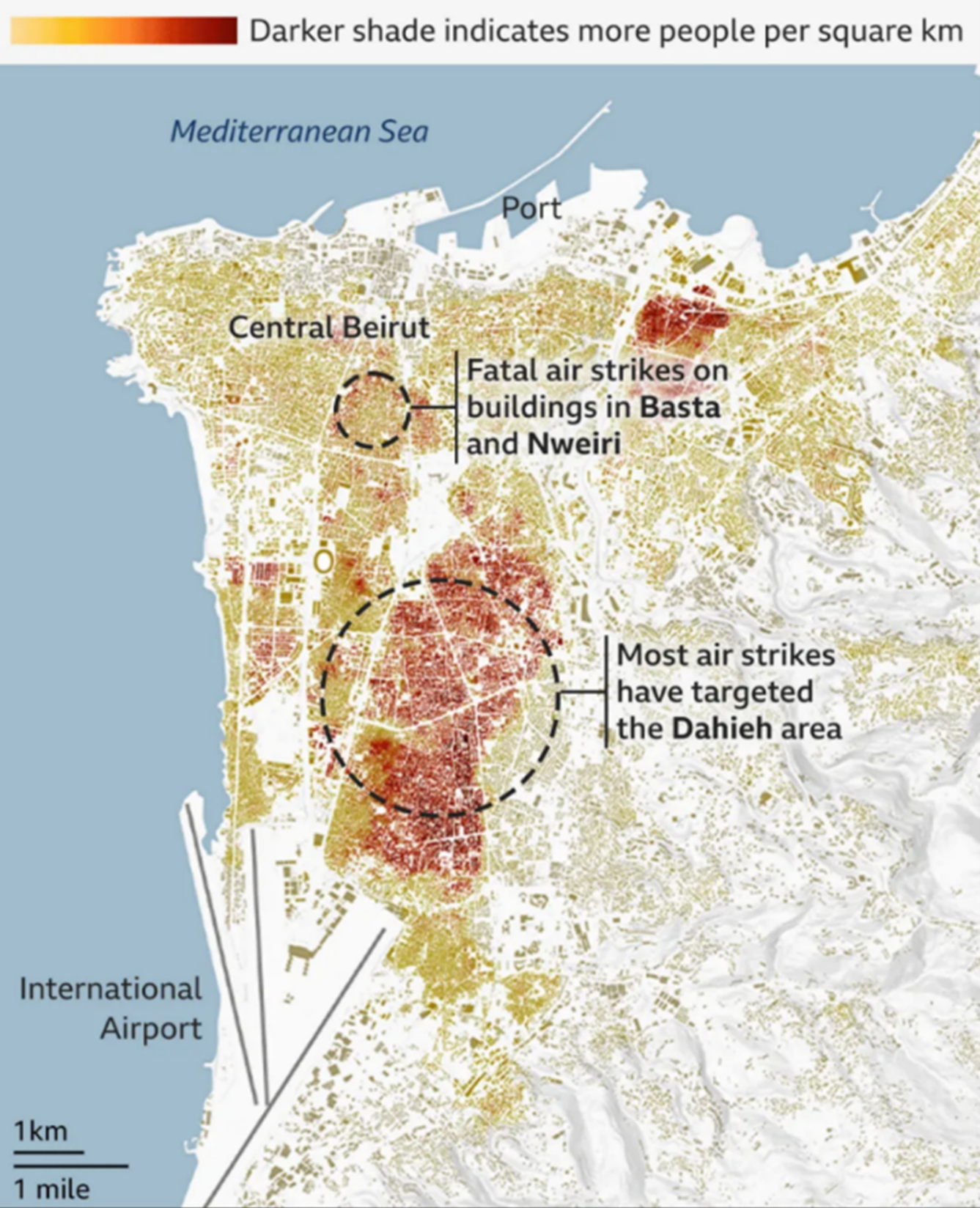
On 27 September 2024, Israel killed Hezbollah’s Secretary General, Hassan Nasrallah, in an air strike on the group’s command centre in Beirut. 4Reuters, ‘Nasrallah led Hezbollah to become regional force’, Reuters, 28 September 2024; M. Lubell and M. Gebeily, ‘Israel kills Hezbollah leader Nasrallah in airstrike’, Reuters, 29 September 2024. Three days later, the Israel Defence Forces (IDF) launched a ground invasion into southern Lebanon.5 G. Wright and M. Moench, ‘Israel launches ground invasion in Lebanon’, BBC News, 1 October 2024; P. Beaumont, A. Roth, and M. Christou, ‘Israeli military says it is carrying out ‘limited’ ground operation targeting Hezbollah in Lebanon’, Reuters, 1 October 2024. Over the course of the following weeks, Israel intensified its air campaign, killing senior Hezbollah figures including Mr Nasrallah’s presumed successor, Hashem Safieddine, and the deputy commander of the group’s elite Radwan forces. Hezbollah continued firing rockets and mortar shells at Israeli territory. One strike in the north-central town of Caesarea hit the home of Israeli prime minister, Benjamin Netanyahu. 6A. Mehvar, L. Nevola, S. H. Ali, N. Khdour, and A. R. Taha,‘Middle East Overview: October 2024’, Armed Conflict Location and Event Data project (ACLED), 7 November 2024; A. Mehvar, M. Shamy, N. Khdour, L. Nevola, and S. H. Ali, ‘Middle East Overview: November 2024’, ACLED, 6 December 2024.
A ceasefire agreement on 26 November 2024 sought to end the non-international armed conflict (NIAC) between Israel and Hezbollah, which began in November 2023. The agreement required Hezbollah to withdraw north of the Litani River and the Lebanese Armed Forces to deploy in the area between the river and the Blue Line – the demarcation line dividing Lebanon from Israel and the Golan Heights drawn by the United Nations (UN) on 7 June 2000. In turn, Israel undertook to withdraw from all Lebanese territory within 60 days of the agreement coming into force. 7J. Deeb, ‘Full text of the ceasefire agreement between Israel and Lebanon’, Middle East Eye, 27 November 2024.
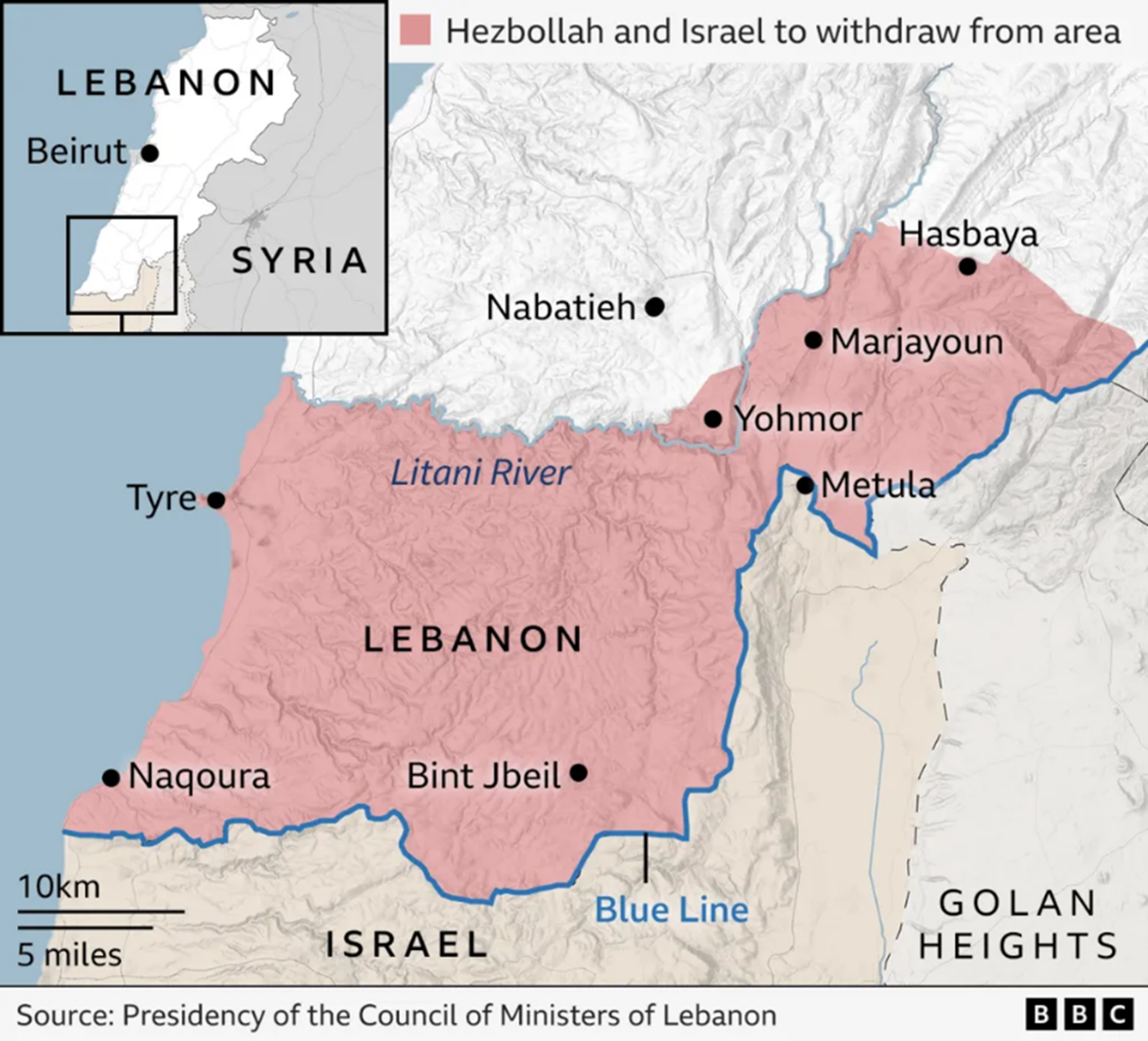
Hostilities continued, however, albeit at a reduced level. On 17 February 2025, the IDF announced it was ‘temporarily’ deploying in five locations across the border in southern Lebanon, claiming that Hezbollah had not complied with its obligations under the ceasefire agreement.8P. Kingsley and E. Ward, ‘Israel Says It Will Keep Troops “Temporarily” in 5 Points in Lebanon’, The New York Times, 17 February 2025; see also ‘Israeli troops “staying indefinitely” in Lebanon border buffer zone, defence minister says’, France 24, 27 February 2025. The IDF were still present in these five locations as of August 2025.9Security Council Report, ‘Lebanon’, August 2025 Monthly Forecast, Posted 30 July 2025. In March 2025, the IDF resumed airstrikes on both Beirut and southern Lebanon.10See, for instance, H. Bachega and M. Moench, ‘Israel conducts first strike on Beirut since Hezbollah ceasefire’, BBC News, 28 March 2025; H. Bachega and E. Rossiter, ‘Four killed in Israeli strike on Beirut, Lebanon says, despite ceasefire’, BBC News, 1 April 2025; E. Fabian, ‘IDF says Hezbollah commander killed by drone strike in southern Lebanon’, The Times of Israel, 6 May 2025; R. Comerford, ‘Israel strikes southern Beirut on eve of religious holiday’, BBC News, 6 June 2025; ‘Israel bombs southern Lebanon amid conflict with Iran and assault on Gaza’, Al Jazeera, 23 June 2025. By early June 2025, Lebanese authorities claimed that Israeli attacks had killed about 4,000 people, many of whom were civilians, and displaced over 1.2 million. Israel claimed that ‘more than 80’ of its soldiers and 47 Israeli civilians had been killed in the hostilities, with 60,000 Israelis displaced from the north of Israel.11Comerford, ‘Israel strikes southern Beirut on eve of religious holiday’.
By the end of June, the situation had reached stalemate, with Israel vowing to strike Lebanon until Hezbollah disarms, and Hezbollah refusing to disarm until Israel ends its air raids and withdraws from southern Lebanon.12AFP, ‘Israel will continue Lebanon strikes if Hezbollah not disarmed, warns Katz’, L’Orient-Le Jour, 6 June 2025; ‘Hezbollah chief says won’t disarm until Israel leaves southern Lebanon’, Al Jazeera, 6 July 2025. In August 2025, however, Lebanon’s government approved a proposal by the United States that combined disarmament of Hezbollah with a complete Israeli military withdrawal from southern Lebanon.13G. Blackburn, ‘Lebanon backs US proposal for Hezbollah to disarm and IDF to withdraw from south’, Euronews, 7 August 2025. The same month, the UN Security Council decided that the UN Interim Force in Lebanon (UNIFIL) would undertake an ‘orderly and safe withdrawal’ of its 10,800 peacekeepers from Lebanon. The withdrawal is intended to begin in December 2026 and will take one year to complete.14UN Security Council Resolution 2790, adopted by unanimous vote in favour on 28 August 2025, operative para 1. UNIFIL was created in 1978 to oversee withdrawal of Israeli troops from the south of the country and has been in Lebanon since then.
A year on from the ceasefire agreement between Lebanon and Israel in November 2024, drone flights by the IDF continued to occur over Lebanese territory in violation of Israeli undertakings.15G. Mavris, ‘Rubble and drones: in the no-go zone between Lebanon and Israel’, Swissinfo, 20 November 2025. More seriously still, the IDF was continuing to bomb Lebanon using drones and conventional combat aircraft. In October 2025, UN experts urged all parties ‘to fully adhere to the cessation of hostilities agreement’ and called for independent investigations and accountability for all violations of international law.16OHCHR, ‘UN experts warn against continued violations of ceasefire in Lebanon and urge protection of civilians’, Press release, Geneva, 17 October 2025
Conflict Classification and Applicable Law
There is an ongoing NIAC between Israel and Hezbollah and an international armed conflict (IAC) between Israel and Lebanon by virtue of Israel’s use of force on Lebanese territory against Hezbollah. In addition, Israel is occupying part of Lebanese territory, which is another form of IAC.
Non-international armed conflict between Israel and Hezbollah
The conflict between Israel and Hezbollah is of a non-international character. Hezbollah (meaning the ‘party of God’ in Arabic) emerged in 1982 following the Israeli invasion of Lebanon as a fighting force during the Lebanese civil war of 1975 and 1990 to resist Israeli attacks. It is a Shi’ite Muslim political party and armed group that has been heavily backed by Iran.17‘What is Hezbollah’, Backgrounder, Council on Foreign Relations, Last updated 29 October 2024. It is well organized and was once one of the world’s most heavily armed non-State armed groups, although its military capabilities have been significantly weakened by Israeli military operations since November 2023.18‘What is Hezbollah and why has it been fighting Israel in Lebanon?’, BBC, 14 February 2025.
Common Article 3 of the four Geneva Conventions of 1949 and customary international humanitarian law (IHL) apply to this NIAC. Since 1997, Lebanon has been a party to Additional Protocol II of 1977, but Israel has neither signed nor acceded to it. Most if not all of the Protocol’s provisions are, however, reflected in customary law.
International armed conflict between Israel and Lebanon
Israel’s use of force against Hezbollah in Lebanon since 8 October 2023 also amounts to an IAC between Israel and Lebanon. There is a long-standing IAC between Israel and Lebanon by virtue of Israel’s belligerent occupation of Lebanese territory. As noted above, Israel is occupying five positions along the Lebanese border – Laboune Hill in Tyre district; Jabal Balat in Bint Jbeil district; Jal al-Deir in Bin Jbeil; a position along the Markaba-Houla road in Marjayoun district; and the Hamames Hill in Marjeyoun.19‘Lebanese army deploys to south as Israel maintains five military positions’, The New Arab, 18 February 2025 (updated 11 March 2025).
In addition to the IDF’s ongoing presence in southern Lebanon, Israel is also occupying the Shebaa Farms, a narrow strip of land adjacent to the Golan Heights in Syria and captured by Israel in the course of the 1967 Six-Day War. Israel purported to annex the Shebaa Farms in 1981 (as part of its annexation of the Golan Heights), but this claim is invalid under international law as accretion of territory by force is not lawful.20Y. Berman, ‘Shebaa Farms – nub of conflict’, Ynet News, 8 October 2006.
The four Geneva Conventions of 1949 and customary IHL governing the conduct of hostilities and belligerent occupation apply. Since 1997, Lebanon has been a party to Additional Protocol I of 1977, but Israel has neither signed nor acceded to it. Many of the Protocol’s provisions are, however, reflected in customary law.
Compliance with IHL
Overview
Both Hezbollah and Israel have breached customary rules of IHL governing the conduct of hostilities in the targets of their attack and/or the means of warfare they chose to employ. Both have targeted civilians and civilian objects in their attacks. Hezbollah consistently conducted indiscriminate attacks over populated areas in Israel using highly inaccurate rockets, while Israel attacked medical facilities and ambulances as well as financial institutions, all of which are civilian objects, protected as such. On multiple occasions, Israel conducted indiscriminate attacks in densely populated areas in Lebanon, including through use of white phosphorus munitions.
Civilian Objects under Attack
Both Hezbollah and Israel regularly attacked civilian objects during the period under review. Under customary IHL, attacks may only be directed against military objectives and must not be directed against civilian objects.21International Committee of the Red Cross (ICRC), Customary IHL Rule 7: ‘The Principle of Distinction between Civilian Objects and Military Objectives’. Civilian objects are all objects that are not military objectives.22ICRC, Customary IHL Rule 9: ‘Definition of Civilian Objects’.Military objectives are those objects which, by their nature, location, purpose or use, make an effective contribution to military action. Special protection is afforded to medical facilities, including hospitals and mobile medical units as well as ambulances.23ICRC, Customary IHL Rule 28: ‘Medical Units’. Indiscriminate attacks are unlawful.24ICRC, Customary IHL Rule 11: ‘Indiscriminate Attacks’.
Attacks against health facilities
Medical facilities in Lebanon, including hospitals, were targeted or struck by numerous attacks by the IDF. A report from the World Health Organization (WHO) covering the period from 17 September to 16October 2024 verified twenty-three attacks on healthcare facilities that killed seventy-two health workers and patients and injured a further forty-three.25WHO, ‘Attacks on hospitals and health workers jeopardize provision of health in Lebanon’, 16 October 2024.
Amnesty International investigated four Israeli attacks between 3 and 9 October 2024 that damaged healthcare facilities and medical vehicles. In all four attacks, which, combined, killed nineteen healthcare workers and wounded another eleven, the organization found no evidence that Hezbollah was using the medical units for military purposes. The attacks were therefore considered unlawful under IHL, with Amnesty International calling for an investigation into possible war crimes.26Amnesty International, ‘Lebanon: Israeli attacks on healthcare providers must be investigated as war crimes’, Report, AI Index No MDE 18/9062/2025, 5 March 2025. Human Rights Watch documented three attacks over the same period in which the IDF struck or damaged medical facilities, killing and injuring personnel and patients. It found no evidence that the three facilities were being used for military purposes.27Human Rights Watch, ‘Lebanon: Israeli Attacks on Medics Apparent War Crimes’, 30 October 2024. Human Rights Watch similarly believed that, in their attacks on healthcare facilities and personnel, Israeli forces may have committed war crimes.
One occasion documented by Human Rights Watch concerns an IDF artillery attack on the Martyr Salah Ghandour Hospital in Bint Jbeil on 4 October 2024. In the aftermath, the hospital issued a statement declaring that: ‘This bombardment resulted in the injury of nine medical and nursing staff members, most of whom sustained serious and critical injuries. Following this aggressive assault, the hospital evacuated most of its medical and nursing staff and retained a number of workers to safeguard the hospital’s property.’28MTV Lebanon, ‘A Lebanese Hospital was Bombarded’, 5 October 2024. The IDF claimed on social media site X that Hezbollah had established a command centre inside a mosque ‘near’ the hospital.29Avichay Adraee, IDF Arabic Spokesman, ‘Statement’, posted on X, 5 October 2024. Human Rights Watch found no evidence that Hezbollah was using the hospital for military purposes.30Human Rights Watch, ‘Lebanon: Israeli Attacks on Medics Apparent War Crimes’.
If the hospital was not the primary target of the IDF strikes, the principle of proportionality in attack may have been violated, along with the duty to take all feasible precautions in attack to minimize the incidental harm to civilians and damage to civilian objects.31ICRC, Customary IHL Rule 14: ‘Proportionality in Attack’; Rule 15: ‘Precautions in Attack’. Martyr Salah Ghandour Hospital serves the entire Bint Jbeil district, which has a population of more than 30,000, as well as a portion of the population of the villages and towns of the Tyre and Marjeyoun districts. It was the only private health facility in the region.32The Meir Amit Intelligence and Terrorism Information Center, ‘The Islamic Health Organization: Hezbollah institution providing health services to Hezbollah operatives and the Shiite population in general as a means for gaining influence and creating a Shiite mini-state within Lebanon’, 15 August 2019.
Another attack documented by both Human Rights Watch and Amnesty International, and which also took place on 4 October 2024, concerned an IDF airstrike on ambulances belonging to the Islamic Health Organization. In this incident, which occurred in front of the Marjayoun government hospital, seven paramedics were killed.33‘Four Lebanese Hospitals Suspend Services amid Israeli Bombing’, National News Agency, Lebanon, 5 October 2024. No Israeli claims were made on the specific attack, but a general claim that Hezbollah was using ambulances to transport troops and military material had been made earlier in the day.34A. Adraee, IDF Arabic Spokesman, ‘Statement’, posted on X, 4 October 2024. According to the hospital director, however, the ambulances were bringing in wounded at the time.35National News Agency Lebanon, ‘Four Lebanese Hospitals Suspend Services amid Israeli Bombing’. It is immaterial from the perspective of IHL whether these were wounded civilians or wounded Hezbollah fighters – IHL dictates that the ‘wounded and sick shall be collected and cared for’.36Art 3 common to the four Geneva Conventions of 1949. Furthermore, Human Rights Watch and Amnesty International found no evidence that Hezbollah was using the vehicles for military purposes.
The Islamic Health Organization has been accused of being a civilian branch of Hezbollah.37The Meir Amit Intelligence and Terrorism Information Center, ‘The Islamic Health Organization’.As such, personnel and transports of this organization, assigned exclusively to medical duties and transportation respectively, must be respected and protected in all circumstances, and must not be attacked.38ICRC, Customary IHL Rule 25: ‘Medical Personnel’; Rule 29: ‘Medical Transports’. This is so, irrespective of whether health workers from the Islamic Health Organization may have, in the past, held positions in Hezbollah’s military wing.
Attacks against water infrastructure
Between October 2023 and November 2024, water infrastructure in Lebanon was repeatedly struck, damaged, and frequently rendered inoperable for months by Israeli attacks using air-launched munitions. In a small number of incidents, use of bulldozers was also reported. Attacks against or impacting upon water infrastructure were most frequent in southern communities along the Israeli border in Nabatieh and South governorates, where repeated incidents occurred between October 2023 and November 2024. In these governorates, at least twenty-six water pumping facilities associated with public networks and twenty-eight water pipeline networks were at least moderately damaged after October 2023. Incidents were also reported in Bekaa and Baalbek-Hermel governorates, especially between September and November 2024, although the damage was of a lesser extent.39Action Against Hunger, Insecurity Insight, and Oxfam, ‘When Bombs Turn the Taps Off: The Impact of Conflict on Water Infrastructure in Lebanon, October 2023–April 2025’, Switzerland, August 2025.
According to a World Bank report published in March 2025, approximately 64% of community water supply distribution reservoirs, 46% of water reservoirs, 58% of water pumping stations, and 23% of water treatment plants were either destroyed or partially damaged across the country.40‘Lebanon Rapid Damage and Needs Assessment (RDNA)’, Report, The World Bank, Washington, DC, 2025, p 48.
Under customary IHL, drinking water installations and supplies are among the objects indispensable to the survival of the civilian population. They may not, in principle, be attacked unless they qualify as military objectives. If they do, attacks must respect the principle of proportionality and in no case may such attacks cause the starvation of the civilian population.41ICRC, Customary IHL Rule 53: ‘Starvation as a Method of Warfare’; and Rule 54: ‘Attacks against Objects Indispensable to the Survival of the Civilian Population’. Starving civilians as a method of warfare by depriving them of objects indispensable to their survival is a war crime under customary law.42ICRC, Customary IHL Rule 156: ‘Definition of War Crimes’.
Attacks against financial institutions
Other Israeli attacks involving alleged violations of IHL include those mounted on the night of 20 October 2024 against around thirty offices of the al-Qard al-Hassan charitable foundation, a banking institution reportedly linked to Hezbollah.43W. Christou, ‘Israeli airstrikes on Lebanon hit branches of Hezbollah-linked bank’, The Guardian, 21 October 2024; R. Ruhayem, ‘What is Israel’s strategy in targeting Hezbollah’s civilian network?’, BBC News, 7 November 2024. The IDF justified its attacks on the basis both that al-Qard al-Hassan functioned as ‘a type of Hezbollah’s financial system’, and that it ‘receives funds from Iran, provides loans, and ultimately finances Hezbollah’s terrorism’.44IDF, ‘The Chief of the General Staff in Lebanon: “We are striking in Beirut, and you are dealing with targets here – all of this forms a response against Iran, which funds and sends weapons here.”’, 21 October 2024. The attacks, which were preceded by a forty-minute warning to evacuate surrounding areas, affected residential buildings in the middle of densely populated residential areas.45Amnesty International, ‘Israel/Lebanon: Branches of Hezbollah-affiliated financial institution not military targets’, 22 October 2024. In one instance, an entire building in a southern suburb of Beirut collapsed following an Israeli strike.46Christou, ‘Israeli airstrikes on Lebanon hit branches of Hezbollah-linked bank’.
The attacks appear to be a serious violation of IHL, with financial institutions ordinarily protected under IHL as civilian objects. The UN Special Rapporteur on the promotion and protection of human rights while countering terrorism declared that bombing banks ‘opens the door to “total war” against civilian populations, where fighting is no longer limited to attacking militarily dangerous targets. Such attacks jeopardise the right to life.’47OHCHR, ‘Israel’s military strikes on financial institutions in Lebanon violate international humanitarian law, says expert’, Press release, 23 October 2024. See also Amnesty International, ‘Israel/Lebanon: Branches of Hezbollah-affiliated financial institution not military targets’. Human Rights Watch described the attacks as war crimes. As noted, ‘Designating a civilian institution as a military target because of its affiliation rather than its effective contribution to military action puts all commercial operations at risk during wartime.’48Human Rights Watch, ‘Lebanon: Israeli Strikes on Financial Group are War Crimes’, 23 October 2024.
Attacks against cultural property
Several attacks are reported to have damaged important cultural property. For example, on 6 October 2024, the IDF targeted a neighbourhood in Baalbek, reportedly damaging a wall of the Roman ruins of the city.49National News Agency Lebanon, ‘الوكالةالوطنيةللإعلام- Securityupdate: IsraelienemyraidtargetsAl-BazaliyahtowninnorthernBekaa, airstriketargetshousenearRedCrosscenterinBaalbek, raidonfactoryinShaattownplain’, 1 October 2024; Beirut Urban Lab, ‘Not Collateral Damage but a Deliberate Act of Cultural Erasure’, 20 November 2024. On 9 October 2024, the IDF conducted an airstrike on Saint George church in the town of Derdghaya, destroying the building and killing 8 people.50ACN International, ‘Church struck in strike close to Tyre, Lebanon’, 31 October 2024. Although the IDF claimed the attack on the church was targeting ‘militiamen’,51Asia News, ‘Lebanon: Israeli air force also strikes a church in Derdghaya’, 10 November 2024. there are indications the church was used as a shelter for internally displaced persons.52ACN International, ‘Church struck in strike close to Tyre, Lebanon’. On 13 October 2024, the IDF conducted airstrikes in Kfar Tebnit,53National News Agency Lebanon, ‘الوكالةالوطنيةللإعلام- IsraeliairraidsonNabatiehFawqa, al-Sharqiya, severaltownsinTyre’sdistrict, residentialbuildinginSheikhRaghebHarb’sHospitalinToul, areabetweentownsofArnoun& KfarTibnit, al-Khiyam, Qana, AlmaShaab, Dhaira, Maifadoun’, 13 October 2024. damaging the Ottoman-era mosque of the town.54Beirut Urban Lab, ‘Not Collateral Damage but a Deliberate Act of Cultural Erasure’.
Given the risk to cultural property from the fighting, the Committee for the Protection of Cultural Property in the Event of Armed Conflicts placed several sites in Lebanon under the enhanced protection regime established for certain cultural properties by the Second Protocol of 1999 to the 1954 Hague Convention.55UNESCO, ‘Lebanon: 34 cultural properties placed under enhanced protection’, 18 November 2024. Since Israel is not a party to the Protocol, however, this treaty does not directly apply to the armed conflict under review.
But besides enjoying protection from attack to the extent that it is not a military objective, cultural property enjoys specific protection under customary IHL. Property of great importance to the cultural heritage of every people must not be the object of attack unless imperatively required by military necessity; furthermore, each party to the conflict must take special care during military operations to avoid damage to historic monuments (unless they are military objectives).56ICRC, Customary IHL Rule 38: ‘Attacks Against Cultural Property’.
Civilians under Attack
The armed conflicts in Lebanon have resulted in significant casualties among the civilian population. By early July 2025, according to the Lebanese Ministry of Health (whose figures do not distinguish civilians and fighters), Israeli operations against Hezbollah in Lebanon had killed around 4,000 people. Many of the dead were thought to be civilians.57Comerford, ‘Israel strikes southern Beirut on eve of religious holiday’; E. Ward, ‘Israel Launches New Ground Incursion in Lebanon, Raising Fears for Truce’, The New York Times, 6 July 2025. Of the total victims, 250 were killed in the months following the ceasefire agreement between Israel and Hezbollah while a further 600 were wounded.58Ward, ‘Israel Launches New Ground Incursion in Lebanon, Raising Fears for Truce’, The New York Times; ‘Hezbollah chief says won’t disarm until Israel leaves southern Lebanon’, Al Jazeera, 6 July 2025. Israeli authorities reported the death of forty-seven civilians from Hezbollah attacks on its territory.59Comerford, ‘Israel strikes southern Beirut on eve of religious holiday’.
In a statement released on 30 September 2024, UN legal experts accused both parties of having launched indiscriminate attacks, declaring that Israeli airstrikes in densely populated areas, ‘where residential buildings are being levelled to the ground and people are given unrealistically short evacuation orders before homes are bombed, fail the tests of distinction, proportionality, precaution and necessity under international humanitarian law’.60OHCHR, ‘UN experts alarmed by Israel-Lebanon conflict, strongly condemn escalation and urge immediate protection for civilians’, Press release, 30 September 2024.
In multiple instances, Hezbollah’s use of inaccurate rockets amounted to indiscriminate attacks – a serious violation of IHL. In one such case on 27 July 2024, an attack seemingly launched by the group hit the Druze village of Majdal Shams in the Israeli-occupied Golan Heights. The strike hit a football pitch in the village, killing twelve children and youths between ten and twenty years of age.61UN Secretary-General, ‘Note to correspondents: In response to questions on the attack in the Israeli-occupied Golan’, 28 July 2024; E. Fabian, ‘12 children killed as Hezbollah rocket hits soccer field, sparking wider war fears’, The Times of Israel, 27 July 2024. A medic with the Magen David Adom ambulance service, said: ‘We witnessed great destruction when we arrived at the soccer field, as well as items that were on fire. There were casualties on the grass and the scene was gruesome.’ Ziv Medical Center in Safed said later it had admitted thirty-two wounded from the attack.62Fabian, ‘12 children killed as Hezbollah rocket hits soccer field, sparking wider war fears’. Israel accused Hezbollah of conducting the attack.63IDF, ‘Hezbollah Rocket Hits a Soccer Field in the Druze Village of Majdal Shams’, 27 July 2024.
Israeli experts maintained in the media that Hezbollah ‘was most likely aiming at a nearby army base on Mount Hermon and did not intentionally target the village’, but that the civilian harm was due to the use of inaccurate rockets.64Kershner and Ward, ‘Netanyahu Vows “Severe” Response to Deadly Rocket Attack Tied to Hezbollah’. This indicates that an indiscriminate weapon may have been used.65ICRC, Customary IHL Rule 71: ‘Weapons That Are by Nature Indiscriminate’. It was later claimed that the missile in question was an Iranian-made Falaq-1 rocket with a 50-kilogram high-explosive warhead.66Fabian, ‘12 children killed as Hezbollah rocket hits soccer field, sparking wider war fears’. Hezbollah denied any involvement in the strike on the village, but had earlier reported launching a volley rockets, including a Falaq-1, at Israeli positions.67M. Lubell, M. Gebeily and L. Bassam, ‘Israel says Hezbollah rocket kills 12 at football ground, vows response’, Reuters, 28 July 2024, http://bit.ly/3HVXzh1; Kershner and Ward, ‘Netanyahu Vows “Severe” Response to Deadly Rocket Attack Tied to Hezbollah’. The Falaq-1 is an unguided rocket developed in the 1990s, one of a series of weapons said to be ‘not accurate’ with a ‘margin of error of up to three kilometres’68.‘What we know about Hezbollah’s weapons arsenal’, France 24, 29 July 2024.
Attacks against journalists
Continuing a trend in the previous reporting period, numerous casualties among journalists were recorded as a result of Israeli aerial bombings and artillery strikes. In a particularly serious incident on 25 October 2024, three journalists were killed and four others injured in an attack on a complex of guesthouses housing eighteen reporters in the southern Lebanese town of Hasbaya.69W. Christou, ‘Three journalists killed by Israeli airstrike in southern Lebanon’, The Guardian, 25 October 2024; ‘Deadly Israeli strike on journalists in Lebanon prompts global condemnation’, Reuters, 27 October 2024. The attack was described as the deadliest on journalists since the conflict in Lebanon began.70J. Prentis, ‘Three journalists killed by Israeli attack on south Lebanon’, The National, 25 October 2024. Following the strike, Lebanon filed a complaint before the UN Security Council, denouncing the ‘repeated Israeli targeting of media crews’.A71hlulBayt News Agency, ‘Lebanon files complaint to UNSC over deadly Israeli strike on journalists’, ABNA 24, 28 October 2024. Senior UN officials in Lebanon expressed alarm at the attacks, recalling that journalists are protected under IHL and calling on all parties in armed conflict to ‘uphold their obligations under international humanitarian law’.72UN News, ‘UN alarmed by Israeli strike in southern Lebanon that killed journalists’, News release, 25 October 2024.
In another significant incident on 26 November 2024, Lebanon’s National News Agency reported that the IDF ‘opened fire on a group of journalists covering the return of southern Lebanese residents and the Israeli withdrawal from the southern town of Khiyam’.73‘Israeli forces open fire on journalists in Khiyam, two injured’, National News Agency, 27 November 2024. The attack wounded one journalist working for the Associated Press and another employed by Sputnik.74S. Zhang, ‘Israel Fired on Journalists in Lebanon Just Hours After Ceasefire Began’, Truthout, 27 November 2024. According to testimonies by the journalists themselves, ‘[i]t was clear that we were journalists’, and ‘a drone [was seen] hovering above Khiam just before the gunfire began’.75‘Israeli gunfire injures journalists in Khiam as ceasefire takes hold in South Lebanon’, The New Arab, 27 November 2024.
These attacks raise serious concerns in relation to compliance with the rules on targeting and the specific protection afforded to journalists under customary IHL.76ICRC, Customary IHL Rule 34: ‘Journalists’. This is particularly the case for the incident in Hasbaya, which has been thoroughly documented. The IDF declared that, on that night, ‘following intelligence information’, they struck ‘a Hezbollah military structure in Hasbaya’ at a time when ‘terrorists were located inside’. They said that a review was being conducted after reports emerged that journalists had been hit.77Agence France Presse, ‘Israel Army Says Strike That Killed Journalists In Lebanon ‘Under Review’’, Barron’s, 25 October 2024. An investigation by Human Rights Watch found ‘no evidence of fighting, military forces, or military activity in the immediate area at the time of the attack’.78Human Rights Watch, ‘Lebanon: US Arms Used in Israeli Strike on Journalists’, News release, 25 November 2024.
The journalists at the compound worked in at least seven different media outlets, including Al Jazeera and Sky News Arabia. Two of the journalists killed in the attack worked for Al Mayadeen TV, which is described as being ‘politically allied with Hezbollah’ or ‘a pro-Hezbollah outlet’. A third journalist worked for Al Manar TV, which is owned by Hezbollah.79Christou, ‘Three journalists killed by Israeli airstrike in southern Lebanon’; Human Rights Watch, ‘Lebanon: US Arms Used in Israeli Strike on Journalists’.
The Beirut office of Al Mayadeen TV had been targeted in an Israeli strike a few days earlier in which one person had been killed and another five injured.C80ommittee to Protect Journalists, ‘Journalists face Israeli strikes, displacement, attacks as war escalates in Lebanon’, Report, 29 October 2024; ‘Israeli strike on Beirut suburbs destroys office used by Al-Mayadeen broadcaster – security source’, Reuters, 23 October 2024. Israel does not appear to have attempted to justify the strike on the basis of the affiliation of the media outlet – but even if that were the case, this would not represent a valid justification for the attack. As the International Committee of the Red Cross (ICRC) has made clear, under customary IHL: ‘Civilian journalists engaged in professional missions in areas of armed conflict must be respected and protected as long as they are not taking a direct part in hostilities’.81ICRC, Customary IHL Rule 34. There is no evidence indicating that the journalists killed in the strike had forfeited their protection as civilians under IHL. That they were working for media outlets affiliated with, or endorsing, an armed group that is fighting Israel does not meet the criteria for ‘direct participation in hostilities’.82Interpretive Guidance on the Notion of Direct Participation in Hostilities under International Humanitarian Law, Report, ICRC, May 2009, p 46.
Attacks against UN peacekeepers
UNIFIL is not a party to any of the armed conflicts in Lebanon. Between July 2024 and June 2025, however, UNIFIL peacekeepers were attacked by Israel on numerous occasions.83‘Israel suspected of using white phosphorus on UN peacekeepers in Lebanon: Report’, Middle East Eye, 22 October 2024; S. Zhang, ‘Israel Injured UN Peacekeepers in Lebanon With White Phosphorus, Report Finds’, Truthout, 22 October 2024; T. Morris, ‘The Targeting of UN Peacekeepers in Light of the Attacks on UNIFIL’, Blog post, Opinio Juris, 4 November 2024. Hezbollah also conducted indiscriminate attacks affecting UNIFIL. Deliberate attacks against peacekeepers violate IHL and are likely to constitute war crimes.84ICRC, Customary IHL Rule 33: ‘Personnel and Objects Involved in a Peacekeeping Mission’.
Most of the attacks against the UN peacekeepers occurred in October and November 2024.85See, eg, ‘Israeli military says it opened fire near UNIFIL base in southern Lebanon’, Reuters, 10 October 2024. At the beginning of its invasion of Lebanon in October, the IDF established positions close to UNIFIL missions, despite regular warnings by UNIFIL not to do so, as the force feared it would compromise the safety of their personnel and buildings.86UNIFIL, ‘UNIFIL Statement (6 October 2024)’, 6 October 2024. On 9 October, the IDF fired on UNIFIL’s Ras Naqoura and Labbouneh bases, disabling the security cameras in the Labbouneh base.87UNIFIL, ‘UNIFIL statement (10 October 2024)’, 10 October 2024. The next day, the IDF again targeted the Labbouneh base, damaging vehicles and communication systems.88Ibid.The IDF hit UNIFIL’s Naqoura headquarters with a shell fired from a Merkava tank that struck an observation tower, causing two UNIFIL observers to fall and suffer injuries.89Ibid.
On 13 October 2024, IDF tanks destroyed the gates of UNIFIL’s position in Ramyah to force their way into the base, which was followed by a demand that the base turn off their lights.90UNIFIL, ‘UNIFIL Statement (13 October 2024)’, 13 October 2024. Later that day, the nearby firing of munitions, including of white phosphorus, led to the injury of 15 peacekeepers.91R. Jalabi, ‘Israel launched a dozen attacks on UN troops in Lebanon, says leaked report’, Financial Times, 23 October 2024. On 13 May 2025, months after the ceasefire between Israel and Hezbollah entered into force, UNIFIL accused the IDF of directing fire at the perimeter of one of its peacekeeping positions in south Lebanon.92‘Israeli gunfire hits perimeter of UN peacekeeping post in Lebanon, UNIFIL says’, Reuters, 14 May 2025.
Israel has put forward different arguments to justify several of these incidents. In relation to the events at Ramyah, the IDF explained that it encroached on the UNIFIL base to evacuate soldiers who had been seriously wounded by an anti-tank missile, and that the operation had been conducted while it was in ‘continuous contact’ with UNIFIL.93A. Phillips, ‘UN says Israeli tanks forced entry into base in south Lebanon’, BBC News, 13 October 2024; B. McKernan, ‘UN mission says Israeli tanks forcibly entered base in southern Lebanon’, The Guardian, 13 October 2024. On certain occasions, Israel has criticized Hezbollah for the group’s placing of its military forces and installations near UNIFIL bases. For instance, in November 2024, the IDF claimed that it had found a Hezbollah training centre equipped with missile launchers 200 metres away from a UNIFIL base.94‘UN peacekeepers say Israel’s destruction of their property breaches international law’, Reuters, 8 November 2024; ‘IDF discovers Hezbollah terror training center next to UNIFIL post’, The Jerusalem Post, 8 November 2024. After the ceasefire came into effect, Israel’s ambassador to the UN maintained that ‘Hezbollah’s ongoing military build-up was at times close to UN peacekeeping bases and patrols in southern Lebanon’.95‘Israeli envoy to UN accuses Hezbollah of trying to rebuild, with help from Iran’, The Times of Israel, 14 January 2025.
Since the beginning of the armed conflict, Israel has repeatedly called on UNIFIL to vacate their positions on the Blue Line. Such demands do not, however, justify the targeting of UNIFIL personnel and objects, nor do they exempt the IDF from taking constant care to spare peacekeepers in the conduct of their military operations. Under customary IHL, peacekeeping forces are protected from attack, unless and for such time as they take a direct part in hostilities. Furthermore, UNIFIL may use necessary and proportionate force to defend its forces against unlawful attacks without this amounting to direct participation in hostilities.96UNIFIL, ‘UNIFIL statement (25 October 2024)’; ‘UNIFIL statement (8 November 2024)’; C. Gallagher and B. Roche, ‘Ireland and Unifil reject Israel’s request to remove peacekeepers from Lebanese border outpost’, The Irish Times, 4 October 2024. Strikes against military objectives located close to UNIFIL bases must in all instances comply with the rules of proportionality in attack and requiring all feasible precautions to be taken to minimize incidental harm to peacekeepers.97Morris, ‘The Targeting of UN Peacekeepers in Light of the Attacks on UNIFIL’; Interpretive Guidance on the Notion of Direct Participation in Hostilities under International Humanitarian Law, p 61.
Serious concerns have been raised about Hezbollah’s use of indiscriminate rockets and Israel’s use of white phosphorus as well as the Israeli attacks conducted remotely through pagers destined for Hezbollah members. These issues are discussed below.
Use of indiscriminate rockets by Hezbollah
Hezbollah consistently used indiscriminate rockets that could not be accurately directed against a military objective against Israel during the reporting period. On 1 November 2024, for instance, two separate Hezbollah rocket attacks killed seven people in northern Israel. An Israeli farmer and four Thai agricultural workers were killed when rockets landed near Metula, a town on the border with Lebanon. Later in the day, an Israeli woman and her adult son were killed in an olive grove near Kibbutz Afek, on the outskirts of Haifa. Hezbollah said it had fired barrages of rockets towards the Krayot area north of Haifa and at Israeli forces south of the Lebanese town of Khiam, which is across the border from Metula.98D. Gritten, ‘Seven killed in Israel in deadliest Hezbollah rocket strikes in months’, BBC News, 1 November 2024.
On 30 October 2024, Lieutenant-General Sean Clancy, the head of the Irish military contingent in UNIFIL, said one of the force’s bases in southern Lebanon that houses Irish troops was hit by a rocket fired by Hezbollah towards Israel. The rocket landed inside an unoccupied area of Camp Shamrock, which is seven kilometres from the Israeli border. Although the attack caused minimal damage on the ground and no casualties, it had indiscriminate effects. The Irish Prime Minister, Simon Harris, said: ‘Thankfully everyone is safe but it is completely unacceptable that this happened. Peacekeepers are protected under international law and the onus is on all sides to ensure that protection.’99Ibid.
Use of white phosphorus by Israel
White phosphorus (sometimes called yellow phosphorus) is a white to yellow waxy solid that produces dense white smoke containing mixed phosphorus oxides.100WHO, “White phosphorus”, 15 January 2024. It ignites spontaneously in air at temperatures above 30°C, continuing to burn until it is either fully oxidized or it is deprived of oxygen.101UN Office for Disarmament Affairs, ‘The Regulation of Incendiary Weapons under International Humanitarian Law’, Report, Geneva, 2024, p 14. As WHO has stated, white phosphorus can cause ‘deep and severe burns, penetrating through bone, reignite during or after initial treatment due to the contact with oxygen and affect medical personnel through secondary exposure’. In severe cases of exposure, ‘delayed systemic effects can include cardiovascular effects and collapse, as well as renal and hepatic damage and depressed consciousness and coma. Death may occur from shock, hepatic or renal failure, central nervous system or myocardial damage.’102WHO, ‘White phosphorus’, 15 January 2024.
There are increasing calls for the formal prohibition of use of white phosphorus against combatants, at least in areas with a concentration of civilians. 103See, eg, ‘Human Rights in Palestine and Other Occupied Arab Territories: Report of the United Nations Fact-Finding Mission on the Gaza Conflict’, UN Doc A/HRC/12/48, 25 September 2009, paras 48, 890, 896–901; Human Rights Watch, ‘Lebanon: Israel’s White Phosphorous Use Risks Civilian Harm’, 5 June 2024; Human Rights Watch. ‘Beyond Burning. The Ripple Effects of Incendiary Weapons and Increasing Calls for International Action’, 7 November 2024. Its anti-personnel use against civilians or against a civilian object, including an area of land, is already unlawful and a war crime.
Since 1 July 2024, Israel has used white phosphorus munitions on several hundred occasions in Lebanon.104J. Salhani, ‘Israel’s buffer zone, created by bombing Lebanon with white phosphorous’, Al Jazeera, 5 December 2024; M. Gebeily, ‘Lebanese farmers dig for answers on Israel’s white phosphorus use’, Reuters, 3 July 2024; A. Asmar, ‘Fires erupt in Lebanese town after Israel strikes with white phosphorus bombs’, Anadolu Ajansi, 12 August 2024; ‘Israel suspected of using white phosphorus on UN peacekeepers in Lebanon: Report’, Middle East Eye, 22 October 2024. After an almost daily firing of white phosphorus in July, August, September, and November 2024, Israel ceased using these munitions in December 2024 following the entry into force of the ceasefire agreement.105‘Israel sees more to do on Lebanon ceasefire as deadline nears’, Reuters, 24 January 2025. Israel, which has admitted to using white phosphorus, claims that it does so in compliance with IHL.106Z. Khalil, ‘Israel admits possession of munitions containing white phosphorus’, Anadolu Ajansi, 12 December 2023. It considers use of white phosphorus in urban areas as lawful under ‘special circumstances’, but has not revealed what it believes those conditions to be.107E. Fabian, ‘Army in response to white phosphorus report: IDF only uses legal weaponry’, The Times of Israel, 11 December 2023; B’Tselem, ‘HCJ dismisses petition demanding the military cease use of white phosphorous’, 14 July 2013.
Although it did not do so frequently, Israel did use white phosphorus over densely populated areas on several occasions, leading to the death and injury of civilians. For example, on 2 October 2024, Israel attacked an office of the Islamic Health Organization in Bachoura, a populated neighbourhood of Beirut. The weapons used included, among others, white phosphorus. The attack killed nine people, seven of whom were paramedics, and injured fourteen others.108N. Houssari, ‘Israel attacks Lebanese army’, Arabnews, 3 October 2024; M. Abdallah, M. Sejaan, T. Chaaban, S Abdallah, G. Hamadi and S. Abou Al Joud,‘Death toll from Israeli strike on Bachoura rises to 6 killed and 7 injured; southern suburbs of Beirut bombarded’, L’Orient Today, 3 October 2024; ‘Israeli attack on a high-rise building in central Beirut kills nine people’, Al Jazeera, 3 October 2024; Wion, ‘Israel-Hezbollah Conflict: Israel Accused of Using White Phosphorus Bombs in Beirut’, 3 October 2024; ‘Dozens killed in new Israeli airstrikes in Lebanon and Gaza as some nations ramp up Lebanon evacuation plans’, CBS News, 3 October 2024. It is unclear whether any of the victims were Hezbollah fighters. If Israel were using white phosphorus in densely populated areas without directing it at specific military objectives, as seems to have occurred on a number of occasions, these would qualify as indiscriminate attacks.109ICRC, Customary IHL Rule 12: ‘Definition of Indiscriminate Attacks’.
The pager attacks
Between 17 and 18 September 2024, a coordinated series of explosions targeted Hezbollah members through explosives hidden in hundreds of pagers and a number of walkie-talkies.110A. Cohen and Y. Shany, ‘“Well, It Depends”: The Explosive Pagers Attack Revisited’, Articles of War, Lieber Institute, 11 October 2024. The attacks, later acknowledged by Israel to have been the work of Mossad,111L. Berman, ‘Mossad Chief Says Hezbollah Pager Operation Was “Turning Point” in War against the Terror Group’, Times of Israel, 25 February 2025; R. Berg, ‘Ex-Israeli Agents Reveal How Hezbollah Pager Attacks Were Carried Out’, BBC News, 23 December 2024; ‘Israeli PM’s Office Confirms Netanyahu Approved Lebanon Pager Attacks’, France 24, 11 November 2024; ‘Israel’s PM Acknowledges Approval of Hezbollah Pager Attack’, Deutsche Welle, 11 November 2024. killed at least 37 people, including at least two children,112Human Rights Watch, ‘Lebanon: Exploding Pagers Harmed Hezbollah, Civilians’, 18 September 2024. and wounded more than 3,000.113Amnesty International, ‘Lebanon: Establish International Investigation into Deadly Attacks Using Exploding Portable Devices’, 20 September 2024. The victims, many of whom were seriously injured, included an unknown number of civilians.114B. Mroue, ‘Hezbollah Members among Hundreds Wounded after Pagers Explode across Lebanon and Syria, Officials Say’, PBS News, 17 September 2024. The pagers reportedly exploded in streets, shops, and supermarkets, and even close by a funeral (for victims of earlier attacks, including a child), causing panic among the civilian population.115C. Gubash, Y. Talmazan, and S. Pinson, ‘Doctors overwhelmed by blast injuries as civilian impact of device explosions sparks outcry’, NBC News, 19 September 2024; J. Rizkallah and D. Estrin, ‘Another wave of blasts hits Lebanon, as Hezbollah reels from pager explosions’, NPR, 18 September 2024.
The explosions took place across different parts of Lebanon, including Beirut, along with towns in the central Beqaa Valley.116J. Salhani, ‘Exploding Pagers, Psychological Warfare: Israel’s Attack on Hezbollah’, Al Jazeera, 18 September 2024; Amnesty International, ‘Lebanon: Establish International Investigation’; D. Gritten, ‘Death Toll from Hezbollah Pager Explosions in Lebanon Rises to 12’, BBC News, 18 September 2024. A small number of detonations from the communication devices also occurred in Syria.117The Syrian Observatory for Human Rights (OSDH) reported that at least fourteen people were injured in Syria. See J.-P. Rémy and H. Sallon,‘Lebanon Rocked by Pager Attack Targeting Hezbollah Members’, Le Monde, 18 September 2024. An ophthalmologist at Mount Lebanon University Hospital in Beirut told the media that between 60 and 70 per cent of the patients he treated had to have at least one eye removed. ‘Some of the patients, we had to remove both eyes. It kills me.’118Amnesty International, ‘Lebanon: Establish International Investigation’.
The operation raises serious concerns about compliance with IHL rules on the conduct of hostilities, in particular on targeting. The pagers and radios were distributed mainly among individuals associated with Hezbollah, which comprises both civilians and military members.119OHCHR, ‘Exploding Pagers and Radios: A Terrifying Violation of International Law, Say UN Experts’. Indeed, reports indicate that those killed in the attacks were not only fighters, but also medical and administrative personnel affiliated with Hezbollah, and other civilians.120Human Rights Watch, ‘Lebanon: Exploding Pagers Harmed Hezbollah, Civilians’, 18 September 2024; Amnesty International, ‘Lebanon: Establish International Investigation’. Association with Hezbollah does not per se render a person a lawful target under IHL. Only members of an armed group who take a direct part in hostilities may be lawfully targeted.121Interpretive Guidance on the Notion of Direct Participation in Hostilities under International Humanitarian Law, ICRC. The foreseeable consequences of the pager attacks suggests that they may have been indiscriminate by nature. Moreover, as the attackers could not control who would be nearby those holding the devices at the time of detonation, even where the attacks were lawfully directed against a military member of the group, they may have been expected to cause excessive incidental civilian harm and thus constitute a disproportionate attack.122Amnesty International, ‘Lebanon: Establish International Investigation’; OHCHR, ‘Exploding Pagers and Radios: A Terrifying Violation of International Law, Say UN Experts’.
Finally, it has been suggested that the operation contravened obligations binding Israel under the Amended Protocol on Prohibitions or Restrictions on the Use of Mines, Booby-Traps and Other Devices of 1996, annexed to theConvention on Certain Conventional Weapons. The Protocol, to which both Israel and Lebanon are party, explicitly applies to non-international armed conflicts.123Art 1(2)-(3), Protocol on Prohibitions or Restrictions on the Use of Mines, Booby-Traps and Other Devices as amended on 3 May 1996 annexed to the Convention on Certain Conventional Weapons; adopted at Geneva, 3 May 1996; entered into force, 3 December 1998 (1996 Amended Protocol II). Israel adhered to the 1996 Amended Protocol II in 2000 while Lebanon did so in 2017. It is asserted that the weapons used in the attack fall under the definitions of ‘booby-traps’ or ‘other devices’ in the Protocol.124Art 2(4), 1996 Amended Protocol II. Article 7(2) of the Protocol prohibits the use of ‘booby-traps or other devices in the form of apparently harmless portable objects which are specifically designed and constructed to contain explosive material’.125See W. Boothby, ‘Exploding Pagers and the Law’, Blog post, Articles of War, Lieber Institute, 18 September 2024; B. Finucane, ‘Article 7(2) of Amended Protocol II on Conventional Weapons and the Lebanon Pager Explosions’, Blog post, Just Security, 25 September 2024; OHCHR, ‘Exploding Pagers and Radios: A Terrifying Violation of International Law, Say UN Experts’.
However, the Protocol primarily governs explosive munitions that are activated by the victim. Its definition of a booby-trap – in Article 2(4) – reflects this: ‘any device or material which is designed, constructed, or adapted to kill or injure, and which functions unexpectedly when a person disturbs or approaches an apparently harmless object or performs an apparently safe act’. Article 2(5) defines ‘other devices’ as ‘manually-emplaced munitions and devices including improvised explosive devices designed to kill, injure or damage and which are activated manually, by remote control or automatically after a lapse of time.’ If it was a decision by Israeli agents and not the actions of the victims (or a time delay) that caused the bombs to detonate, the pager devices were not, strictly speaking, booby-traps falling within the scope of Amended Protocol II of 1996.126For a different interpretation see, eg, Finucane, ‘Article 7(2) of Amended Protocol II on Conventional Weapons and the Lebanon Pager Explosions’, Blog post, Just Security.
Forced displacement
By June 2025, more than 1.2 million individuals were said to have been displaced across Lebanon, most within and from the south.UN Office for the Coordination of Humanitarian Affairs (OCHA), 127‘Lebanon: Flash Update #53 – Escalation of Hostilities in Lebanon, as of 2 January 2025’, 6 January 2025; Comerford, ‘Israel strikes southern Beirut on eve of religious holiday’. The intensification of hostilities between the IDF and Hezbollah in southern Lebanon played a significant role in this displacement. In some areas, entire communities evacuated in the face of frequent airstrikes, artillery shelling and drone attacks. Local authorities and humanitarian responders reported the destruction of homes, schools, and healthcare infrastructure, which rendered entire areas uninhabitable.128Human Rights Watch, ‘Lebanon: Destruction of Infrastructure Preventing Returns’, 17 February 2025.
Between October 2024 and February 2025, residents of towns such as Aitaroun, Alma Shaab, Rmeish, and Yarine fled following repeated airstrikes and shelling that reportedly destroyed homes, schools, and healthcare facilities.129United Nations Development Programme (UNDP), ‘Gaza War: Preliminary Findings on the Socio-Economic and Environmental Impact on Lebanon’, 18 December 2023, p 19; and T. Chaaban, M. Abdallah, S. Abdallah, N. Frakes, I. Kovic, G. Hamadi and Y. Malka, ‘Israel Bombed Jnah in Beirut’s Southern Suburbs; Al-Mayadeen Office in Beirut Targeted: Day 383 of the Lebanon and Gaza Wars’, L’Orient Today, 23 October 2024. Agricultural livelihoods were among the hardest hit: in the districts of Bent Jbeil, Marjayoun, Nabatieh and Tyre, approximately 95 per cent of agricultural households were forced to abandon their land and means of subsistence.130The World Bank, ‘Lebanon Rapid Damage and Needs Assessment (RDNA)’, March 2025. In Sidon, continued bombardments led to chaotic evacuations, compounded by the lack of safe exit routes.OCHA, ‘Lebanon: Flash Update #53 – Escalation of Hostilities in Lebanon, as of 2 January 2025’. 131See also: ‘Lebanon’s Sidon population flee under Israeli bombings: “It’s a nightmare. We don’t know where to go”’, Le Monde, 24 September 2024. Displacement has also placed additional strain on host communities and relief efforts, with overcrowded shelters facing shortages of food, water, and medical services.132UN Population Fund (UNFPA) Lebanon, ‘Lebanon Situation Report #6 – January 2025’, March 2025.
In September 2024, Israel’s ambassador to the United Nations said that Hezbollah had fired more than 8,000 rockets toward Israel since 8 October 2023, with more than 70,000 Israelis ‘forced to flee their homes, becoming refugees in their own land’.133T. Suter, ‘Hezbollah has fired more than 8,000 rockets toward Israel since Oct. 7: Ambassador’, The Hill, 22 September 2024.
The pattern and scale of these displacements raise serious concerns as to compliance with IHL. Both Israel and Hezbollah have a duty to prevent displacement resulting from their use of unlawful means or methods of warfare – such as the targeting of civilian persons and objects or indiscriminate attacks, including those using inherently indiscriminate weapons.134Principle 5 of the UN Guiding Principles on Internal Displacement provides: ‘All authorities and international actors shall respect and ensure respect for their obligations under international law, including human rights and humanitarian law, in all circumstances, so as to prevent and avoid conditions that might lead to displacement of persons.’ See also discussion in ICRC, Customary IHL Rule 129: ‘The Act of Displacement’. Moreover, IHL prohibits forced displacement of the civilian population unless the security of the civilians concerned or for imperative military necessity demand it.135ICRC, Customary IHL Rule 129: ‘The Act of Displacement’. The prohibition is especially stringent in occupied territories, where deportation or forcible transfer of civilians by the Occupying Power is generally prohibited.136Art 49, Geneva Convention IV of 1949. Thus, forced displacement from areas in Lebanon under the control of Israel (the Occupying Power) also requires careful scrutiny under the law of belligerent occupation.
The nature and extent of forced displacement in Lebanon during the reporting period may, in certain instances, also have amounted to crimes against humanity.137International Rescue Committee, ‘Seven Weeks of Escalating Attacks in Lebanon: An Urgent Call for an Unconditional and Permanent Ceasefire, Protection of Civilians and Adherence to International Humanitarian Law’, Press Release, Beirut, 8 November 2024. Crimes against humanity are certain unlawful acts conducted as part of a widespread or systematic attack directed against any civilian population. One such predicate offence, as defined in the Rome Statute of the International Criminal Court and reflecting customary international criminal law, is ‘forcible transfer of population’.138Art 7(1)(d), Rome Statute of the International Criminal Court; adopted at Rome, 17 July 1998; entered into force, 1 July 2002. The Statute explains that this means ‘forced displacement of the persons concerned by expulsion or other coercive acts from the area in which they are lawfully present, without grounds permitted under international law’.139Art 7(2)(d), Rome Statute of the International Criminal Court.
- 1Israeli Defence Forces (IDF), ‘The IDF eliminated Hezbollah’s most senior military commander and head of its Strategic Unit, Fuad Shukr “Sayyid Muhsan”’, IDF Announcement, 30 July 2024; E. Fabian and agencies, ‘IDF kills top Hezbollah commander in Beirut in response to deadly Majdal Shams attack’, The Times of Israel, 30 July 2024
- 2E. Fabian and L. Berman, ‘IDF hits Hezbollah launch sites in Lebanon to thwart major attack on central, north Israel’, The Times of Israel, 25 August 2024; I. Nasser, D. Karni, H. Regan and S. Tanno, ‘Israel intercepts Hezbollah ballistic missile near Tel Aviv in first such attack ’, CNN, 25 September 2024.
- 3L. Bassam, ‘Hezbollah vows to punish Israel after pager explosions across Lebanon’, Reuters, 18 September 2024; Office of the UN High Commissioner for Human Rights (OHCHR), ‘Exploding pagers and radios: A terrifying violation of international law, say UN experts’, Press release, 19 September 2024; M. Gebeily, J. Pearson, and D. Gauthier-Villars, ‘How Israel’s bulky pager fooled Hezbollah’, Reuters, 16 October 2024.
- 4Reuters, ‘Nasrallah led Hezbollah to become regional force’, Reuters, 28 September 2024; M. Lubell and M. Gebeily, ‘Israel kills Hezbollah leader Nasrallah in airstrike’, Reuters, 29 September 2024.
- 5G. Wright and M. Moench, ‘Israel launches ground invasion in Lebanon’, BBC News, 1 October 2024; P. Beaumont, A. Roth, and M. Christou, ‘Israeli military says it is carrying out ‘limited’ ground operation targeting Hezbollah in Lebanon’, Reuters, 1 October 2024.
- 6A. Mehvar, L. Nevola, S. H. Ali, N. Khdour, and A. R. Taha,‘Middle East Overview: October 2024’, Armed Conflict Location and Event Data project (ACLED), 7 November 2024; A. Mehvar, M. Shamy, N. Khdour, L. Nevola, and S. H. Ali, ‘Middle East Overview: November 2024’, ACLED, 6 December 2024.
- 7J. Deeb, ‘Full text of the ceasefire agreement between Israel and Lebanon’, Middle East Eye, 27 November 2024.
- 8P. Kingsley and E. Ward, ‘Israel Says It Will Keep Troops “Temporarily” in 5 Points in Lebanon’, The New York Times, 17 February 2025; see also ‘Israeli troops “staying indefinitely” in Lebanon border buffer zone, defence minister says’, France 24, 27 February 2025.
- 9Security Council Report, ‘Lebanon’, August 2025 Monthly Forecast, Posted 30 July 2025.
- 10See, for instance, H. Bachega and M. Moench, ‘Israel conducts first strike on Beirut since Hezbollah ceasefire’, BBC News, 28 March 2025; H. Bachega and E. Rossiter, ‘Four killed in Israeli strike on Beirut, Lebanon says, despite ceasefire’, BBC News, 1 April 2025; E. Fabian, ‘IDF says Hezbollah commander killed by drone strike in southern Lebanon’, The Times of Israel, 6 May 2025; R. Comerford, ‘Israel strikes southern Beirut on eve of religious holiday’, BBC News, 6 June 2025; ‘Israel bombs southern Lebanon amid conflict with Iran and assault on Gaza’, Al Jazeera, 23 June 2025.
- 11Comerford, ‘Israel strikes southern Beirut on eve of religious holiday’.
- 12AFP, ‘Israel will continue Lebanon strikes if Hezbollah not disarmed, warns Katz’, L’Orient-Le Jour, 6 June 2025; ‘Hezbollah chief says won’t disarm until Israel leaves southern Lebanon’, Al Jazeera, 6 July 2025.
- 13G. Blackburn, ‘Lebanon backs US proposal for Hezbollah to disarm and IDF to withdraw from south’, Euronews, 7 August 2025.
- 14UN Security Council Resolution 2790, adopted by unanimous vote in favour on 28 August 2025, operative para 1.
- 15G. Mavris, ‘Rubble and drones: in the no-go zone between Lebanon and Israel’, Swissinfo, 20 November 2025.
- 16OHCHR, ‘UN experts warn against continued violations of ceasefire in Lebanon and urge protection of civilians’, Press release, Geneva, 17 October 2025
- 17‘What is Hezbollah’, Backgrounder, Council on Foreign Relations, Last updated 29 October 2024.
- 18‘What is Hezbollah and why has it been fighting Israel in Lebanon?’, BBC, 14 February 2025.
- 19‘Lebanese army deploys to south as Israel maintains five military positions’, The New Arab, 18 February 2025 (updated 11 March 2025).
- 20Y. Berman, ‘Shebaa Farms – nub of conflict’, Ynet News, 8 October 2006.
- 21International Committee of the Red Cross (ICRC), Customary IHL Rule 7: ‘The Principle of Distinction between Civilian Objects and Military Objectives’.
- 22ICRC, Customary IHL Rule 9: ‘Definition of Civilian Objects’.Military objectives are those objects which, by their nature, location, purpose or use, make an effective contribution to military action.
- 23
- 24
- 25WHO, ‘Attacks on hospitals and health workers jeopardize provision of health in Lebanon’, 16 October 2024.
- 26Amnesty International, ‘Lebanon: Israeli attacks on healthcare providers must be investigated as war crimes’, Report, AI Index No MDE 18/9062/2025, 5 March 2025.
- 27Human Rights Watch, ‘Lebanon: Israeli Attacks on Medics Apparent War Crimes’, 30 October 2024.
- 28MTV Lebanon, ‘A Lebanese Hospital was Bombarded’, 5 October 2024.
- 29Avichay Adraee, IDF Arabic Spokesman, ‘Statement’, posted on X, 5 October 2024.
- 30Human Rights Watch, ‘Lebanon: Israeli Attacks on Medics Apparent War Crimes’.
- 31
- 32The Meir Amit Intelligence and Terrorism Information Center, ‘The Islamic Health Organization: Hezbollah institution providing health services to Hezbollah operatives and the Shiite population in general as a means for gaining influence and creating a Shiite mini-state within Lebanon’, 15 August 2019.
- 33‘Four Lebanese Hospitals Suspend Services amid Israeli Bombing’, National News Agency, Lebanon, 5 October 2024.
- 34A. Adraee, IDF Arabic Spokesman, ‘Statement’, posted on X, 4 October 2024.
- 35National News Agency Lebanon, ‘Four Lebanese Hospitals Suspend Services amid Israeli Bombing’.
- 36Art 3 common to the four Geneva Conventions of 1949.
- 37The Meir Amit Intelligence and Terrorism Information Center, ‘The Islamic Health Organization’.
- 38
- 39Action Against Hunger, Insecurity Insight, and Oxfam, ‘When Bombs Turn the Taps Off: The Impact of Conflict on Water Infrastructure in Lebanon, October 2023–April 2025’, Switzerland, August 2025.
- 40‘Lebanon Rapid Damage and Needs Assessment (RDNA)’, Report, The World Bank, Washington, DC, 2025, p 48.
- 41ICRC, Customary IHL Rule 53: ‘Starvation as a Method of Warfare’; and Rule 54: ‘Attacks against Objects Indispensable to the Survival of the Civilian Population’.
- 42
- 43W. Christou, ‘Israeli airstrikes on Lebanon hit branches of Hezbollah-linked bank’, The Guardian, 21 October 2024; R. Ruhayem, ‘What is Israel’s strategy in targeting Hezbollah’s civilian network?’, BBC News, 7 November 2024.
- 44
- 45Amnesty International, ‘Israel/Lebanon: Branches of Hezbollah-affiliated financial institution not military targets’, 22 October 2024.
- 46Christou, ‘Israeli airstrikes on Lebanon hit branches of Hezbollah-linked bank’.
- 47OHCHR, ‘Israel’s military strikes on financial institutions in Lebanon violate international humanitarian law, says expert’, Press release, 23 October 2024. See also Amnesty International, ‘Israel/Lebanon: Branches of Hezbollah-affiliated financial institution not military targets’.
- 48Human Rights Watch, ‘Lebanon: Israeli Strikes on Financial Group are War Crimes’, 23 October 2024.
- 49National News Agency Lebanon, ‘الوكالةالوطنيةللإعلام- Securityupdate: IsraelienemyraidtargetsAl-BazaliyahtowninnorthernBekaa, airstriketargetshousenearRedCrosscenterinBaalbek, raidonfactoryinShaattownplain’, 1 October 2024; Beirut Urban Lab, ‘Not Collateral Damage but a Deliberate Act of Cultural Erasure’, 20 November 2024.
- 50ACN International, ‘Church struck in strike close to Tyre, Lebanon’, 31 October 2024.
- 51Asia News, ‘Lebanon: Israeli air force also strikes a church in Derdghaya’, 10 November 2024.
- 52ACN International, ‘Church struck in strike close to Tyre, Lebanon’.
- 53National News Agency Lebanon, ‘الوكالةالوطنيةللإعلام- IsraeliairraidsonNabatiehFawqa, al-Sharqiya, severaltownsinTyre’sdistrict, residentialbuildinginSheikhRaghebHarb’sHospitalinToul, areabetweentownsofArnoun& KfarTibnit, al-Khiyam, Qana, AlmaShaab, Dhaira, Maifadoun’, 13 October 2024.
- 54Beirut Urban Lab, ‘Not Collateral Damage but a Deliberate Act of Cultural Erasure’.
- 55UNESCO, ‘Lebanon: 34 cultural properties placed under enhanced protection’, 18 November 2024.
- 56
- 57Comerford, ‘Israel strikes southern Beirut on eve of religious holiday’; E. Ward, ‘Israel Launches New Ground Incursion in Lebanon, Raising Fears for Truce’, The New York Times, 6 July 2025.
- 58Ward, ‘Israel Launches New Ground Incursion in Lebanon, Raising Fears for Truce’, The New York Times; ‘Hezbollah chief says won’t disarm until Israel leaves southern Lebanon’, Al Jazeera, 6 July 2025.
- 59Comerford, ‘Israel strikes southern Beirut on eve of religious holiday’.
- 60OHCHR, ‘UN experts alarmed by Israel-Lebanon conflict, strongly condemn escalation and urge immediate protection for civilians’, Press release, 30 September 2024.
- 61UN Secretary-General, ‘Note to correspondents: In response to questions on the attack in the Israeli-occupied Golan’, 28 July 2024; E. Fabian, ‘12 children killed as Hezbollah rocket hits soccer field, sparking wider war fears’, The Times of Israel, 27 July 2024.
- 62Fabian, ‘12 children killed as Hezbollah rocket hits soccer field, sparking wider war fears’.
- 63IDF, ‘Hezbollah Rocket Hits a Soccer Field in the Druze Village of Majdal Shams’, 27 July 2024.
- 64Kershner and Ward, ‘Netanyahu Vows “Severe” Response to Deadly Rocket Attack Tied to Hezbollah’.
- 65
- 66Fabian, ‘12 children killed as Hezbollah rocket hits soccer field, sparking wider war fears’.
- 67M. Lubell, M. Gebeily and L. Bassam, ‘Israel says Hezbollah rocket kills 12 at football ground, vows response’, Reuters, 28 July 2024, http://bit.ly/3HVXzh1; Kershner and Ward, ‘Netanyahu Vows “Severe” Response to Deadly Rocket Attack Tied to Hezbollah’
- 68.‘What we know about Hezbollah’s weapons arsenal’, France 24, 29 July 2024.
- 69W. Christou, ‘Three journalists killed by Israeli airstrike in southern Lebanon’, The Guardian, 25 October 2024; ‘Deadly Israeli strike on journalists in Lebanon prompts global condemnation’, Reuters, 27 October 2024.
- 70J. Prentis, ‘Three journalists killed by Israeli attack on south Lebanon’, The National, 25 October 2024.
- 71hlulBayt News Agency, ‘Lebanon files complaint to UNSC over deadly Israeli strike on journalists’, ABNA 24, 28 October 2024.
- 72UN News, ‘UN alarmed by Israeli strike in southern Lebanon that killed journalists’, News release, 25 October 2024.
- 73‘Israeli forces open fire on journalists in Khiyam, two injured’, National News Agency, 27 November 2024.
- 74S. Zhang, ‘Israel Fired on Journalists in Lebanon Just Hours After Ceasefire Began’, Truthout, 27 November 2024.
- 75‘Israeli gunfire injures journalists in Khiam as ceasefire takes hold in South Lebanon’, The New Arab, 27 November 2024.
- 76
- 77Agence France Presse, ‘Israel Army Says Strike That Killed Journalists In Lebanon ‘Under Review’’, Barron’s, 25 October 2024.
- 78Human Rights Watch, ‘Lebanon: US Arms Used in Israeli Strike on Journalists’, News release, 25 November 2024.
- 79Christou, ‘Three journalists killed by Israeli airstrike in southern Lebanon’; Human Rights Watch, ‘Lebanon: US Arms Used in Israeli Strike on Journalists’.
- 80ommittee to Protect Journalists, ‘Journalists face Israeli strikes, displacement, attacks as war escalates in Lebanon’, Report, 29 October 2024; ‘Israeli strike on Beirut suburbs destroys office used by Al-Mayadeen broadcaster – security source’, Reuters, 23 October 2024.
- 81ICRC, Customary IHL Rule 34.
- 82Interpretive Guidance on the Notion of Direct Participation in Hostilities under International Humanitarian Law, Report, ICRC, May 2009, p 46.
- 83‘Israel suspected of using white phosphorus on UN peacekeepers in Lebanon: Report’, Middle East Eye, 22 October 2024; S. Zhang, ‘Israel Injured UN Peacekeepers in Lebanon With White Phosphorus, Report Finds’, Truthout, 22 October 2024; T. Morris, ‘The Targeting of UN Peacekeepers in Light of the Attacks on UNIFIL’, Blog post, Opinio Juris, 4 November 2024.
- 84
- 85See, eg, ‘Israeli military says it opened fire near UNIFIL base in southern Lebanon’, Reuters, 10 October 2024.
- 86UNIFIL, ‘UNIFIL Statement (6 October 2024)’, 6 October 2024.
- 87UNIFIL, ‘UNIFIL statement (10 October 2024)’, 10 October 2024.
- 88Ibid
- 89Ibid.
- 90UNIFIL, ‘UNIFIL Statement (13 October 2024)’, 13 October 2024.
- 91R. Jalabi, ‘Israel launched a dozen attacks on UN troops in Lebanon, says leaked report’, Financial Times, 23 October 2024
- 92‘Israeli gunfire hits perimeter of UN peacekeeping post in Lebanon, UNIFIL says’, Reuters, 14 May 2025.
- 93A. Phillips, ‘UN says Israeli tanks forced entry into base in south Lebanon’, BBC News, 13 October 2024; B. McKernan, ‘UN mission says Israeli tanks forcibly entered base in southern Lebanon’, The Guardian, 13 October 2024.
- 94‘UN peacekeepers say Israel’s destruction of their property breaches international law’, Reuters, 8 November 2024; ‘IDF discovers Hezbollah terror training center next to UNIFIL post’, The Jerusalem Post, 8 November 2024.
- 95‘Israeli envoy to UN accuses Hezbollah of trying to rebuild, with help from Iran’, The Times of Israel, 14 January 2025.
- 96UNIFIL, ‘UNIFIL statement (25 October 2024)’; ‘UNIFIL statement (8 November 2024)’; C. Gallagher and B. Roche, ‘Ireland and Unifil reject Israel’s request to remove peacekeepers from Lebanese border outpost’, The Irish Times, 4 October 2024.
- 97Morris, ‘The Targeting of UN Peacekeepers in Light of the Attacks on UNIFIL’; Interpretive Guidance on the Notion of Direct Participation in Hostilities under International Humanitarian Law, p 61.
- 98D. Gritten, ‘Seven killed in Israel in deadliest Hezbollah rocket strikes in months’, BBC News, 1 November 2024.
- 99Ibid.
- 100WHO, “White phosphorus”, 15 January 2024.
- 101UN Office for Disarmament Affairs, ‘The Regulation of Incendiary Weapons under International Humanitarian Law’, Report, Geneva, 2024, p 14.
- 102WHO, ‘White phosphorus’, 15 January 2024.
- 103See, eg, ‘Human Rights in Palestine and Other Occupied Arab Territories: Report of the United Nations Fact-Finding Mission on the Gaza Conflict’, UN Doc A/HRC/12/48, 25 September 2009, paras 48, 890, 896–901; Human Rights Watch, ‘Lebanon: Israel’s White Phosphorous Use Risks Civilian Harm’, 5 June 2024; Human Rights Watch. ‘Beyond Burning. The Ripple Effects of Incendiary Weapons and Increasing Calls for International Action’, 7 November 2024.
- 104J. Salhani, ‘Israel’s buffer zone, created by bombing Lebanon with white phosphorous’, Al Jazeera, 5 December 2024; M. Gebeily, ‘Lebanese farmers dig for answers on Israel’s white phosphorus use’, Reuters, 3 July 2024; A. Asmar, ‘Fires erupt in Lebanese town after Israel strikes with white phosphorus bombs’, Anadolu Ajansi, 12 August 2024; ‘Israel suspected of using white phosphorus on UN peacekeepers in Lebanon: Report’, Middle East Eye, 22 October 2024.
- 105‘Israel sees more to do on Lebanon ceasefire as deadline nears’, Reuters, 24 January 2025.
- 106Z. Khalil, ‘Israel admits possession of munitions containing white phosphorus’, Anadolu Ajansi, 12 December 2023
- 107E. Fabian, ‘Army in response to white phosphorus report: IDF only uses legal weaponry’, The Times of Israel, 11 December 2023; B’Tselem, ‘HCJ dismisses petition demanding the military cease use of white phosphorous’, 14 July 2013.
- 108N. Houssari, ‘Israel attacks Lebanese army’, Arabnews, 3 October 2024; M. Abdallah, M. Sejaan, T. Chaaban, S Abdallah, G. Hamadi and S. Abou Al Joud,‘Death toll from Israeli strike on Bachoura rises to 6 killed and 7 injured; southern suburbs of Beirut bombarded’, L’Orient Today, 3 October 2024; ‘Israeli attack on a high-rise building in central Beirut kills nine people’, Al Jazeera, 3 October 2024; Wion, ‘Israel-Hezbollah Conflict: Israel Accused of Using White Phosphorus Bombs in Beirut’, 3 October 2024; ‘Dozens killed in new Israeli airstrikes in Lebanon and Gaza as some nations ramp up Lebanon evacuation plans’, CBS News, 3 October 2024.
- 109
- 110A. Cohen and Y. Shany, ‘“Well, It Depends”: The Explosive Pagers Attack Revisited’, Articles of War, Lieber Institute, 11 October 2024.
- 111L. Berman, ‘Mossad Chief Says Hezbollah Pager Operation Was “Turning Point” in War against the Terror Group’, Times of Israel, 25 February 2025; R. Berg, ‘Ex-Israeli Agents Reveal How Hezbollah Pager Attacks Were Carried Out’, BBC News, 23 December 2024; ‘Israeli PM’s Office Confirms Netanyahu Approved Lebanon Pager Attacks’, France 24, 11 November 2024; ‘Israel’s PM Acknowledges Approval of Hezbollah Pager Attack’, Deutsche Welle, 11 November 2024.
- 112Human Rights Watch, ‘Lebanon: Exploding Pagers Harmed Hezbollah, Civilians’, 18 September 2024.
- 113Amnesty International, ‘Lebanon: Establish International Investigation into Deadly Attacks Using Exploding Portable Devices’, 20 September 2024.
- 114B. Mroue, ‘Hezbollah Members among Hundreds Wounded after Pagers Explode across Lebanon and Syria, Officials Say’, PBS News, 17 September 2024.
- 115C. Gubash, Y. Talmazan, and S. Pinson, ‘Doctors overwhelmed by blast injuries as civilian impact of device explosions sparks outcry’, NBC News, 19 September 2024; J. Rizkallah and D. Estrin, ‘Another wave of blasts hits Lebanon, as Hezbollah reels from pager explosions’, NPR, 18 September 2024.
- 116J. Salhani, ‘Exploding Pagers, Psychological Warfare: Israel’s Attack on Hezbollah’, Al Jazeera, 18 September 2024; Amnesty International, ‘Lebanon: Establish International Investigation’; D. Gritten, ‘Death Toll from Hezbollah Pager Explosions in Lebanon Rises to 12’, BBC News, 18 September 2024.
- 117
- 118Amnesty International, ‘Lebanon: Establish International Investigation’.
- 119OHCHR, ‘Exploding Pagers and Radios: A Terrifying Violation of International Law, Say UN Experts’.
- 120Human Rights Watch, ‘Lebanon: Exploding Pagers Harmed Hezbollah, Civilians’, 18 September 2024; Amnesty International, ‘Lebanon: Establish International Investigation’.
- 121Interpretive Guidance on the Notion of Direct Participation in Hostilities under International Humanitarian Law, ICRC.
- 122Amnesty International, ‘Lebanon: Establish International Investigation’; OHCHR, ‘Exploding Pagers and Radios: A Terrifying Violation of International Law, Say UN Experts’.
- 123Art 1(2)-(3), Protocol on Prohibitions or Restrictions on the Use of Mines, Booby-Traps and Other Devices as amended on 3 May 1996 annexed to the Convention on Certain Conventional Weapons; adopted at Geneva, 3 May 1996; entered into force, 3 December 1998 (1996 Amended Protocol II). Israel adhered to the 1996 Amended Protocol II in 2000 while Lebanon did so in 2017.
- 124
- 125See W. Boothby, ‘Exploding Pagers and the Law’, Blog post, Articles of War, Lieber Institute, 18 September 2024; B. Finucane, ‘Article 7(2) of Amended Protocol II on Conventional Weapons and the Lebanon Pager Explosions’, Blog post, Just Security, 25 September 2024; OHCHR, ‘Exploding Pagers and Radios: A Terrifying Violation of International Law, Say UN Experts’.
- 126For a different interpretation see, eg, Finucane, ‘Article 7(2) of Amended Protocol II on Conventional Weapons and the Lebanon Pager Explosions’, Blog post, Just Security.
- 127‘Lebanon: Flash Update #53 – Escalation of Hostilities in Lebanon, as of 2 January 2025’, 6 January 2025; Comerford, ‘Israel strikes southern Beirut on eve of religious holiday’.
- 128Human Rights Watch, ‘Lebanon: Destruction of Infrastructure Preventing Returns’, 17 February 2025.
- 129United Nations Development Programme (UNDP), ‘Gaza War: Preliminary Findings on the Socio-Economic and Environmental Impact on Lebanon’, 18 December 2023, p 19; and T. Chaaban, M. Abdallah, S. Abdallah, N. Frakes, I. Kovic, G. Hamadi and Y. Malka, ‘Israel Bombed Jnah in Beirut’s Southern Suburbs; Al-Mayadeen Office in Beirut Targeted: Day 383 of the Lebanon and Gaza Wars’, L’Orient Today, 23 October 2024.
- 130The World Bank, ‘Lebanon Rapid Damage and Needs Assessment (RDNA)’, March 2025.
- 131See also: ‘Lebanon’s Sidon population flee under Israeli bombings: “It’s a nightmare. We don’t know where to go”’, Le Monde, 24 September 2024.
- 132UN Population Fund (UNFPA) Lebanon, ‘Lebanon Situation Report #6 – January 2025’, March 2025.
- 133T. Suter, ‘Hezbollah has fired more than 8,000 rockets toward Israel since Oct. 7: Ambassador’, The Hill, 22 September 2024.
- 134Principle 5 of the UN Guiding Principles on Internal Displacement provides: ‘All authorities and international actors shall respect and ensure respect for their obligations under international law, including human rights and humanitarian law, in all circumstances, so as to prevent and avoid conditions that might lead to displacement of persons.’ See also discussion in ICRC, Customary IHL Rule 129: ‘The Act of Displacement’.
- 135ICRC, Customary IHL Rule 129: ‘The Act of Displacement’.
- 136Art 49, Geneva Convention IV of 1949
- 137International Rescue Committee, ‘Seven Weeks of Escalating Attacks in Lebanon: An Urgent Call for an Unconditional and Permanent Ceasefire, Protection of Civilians and Adherence to International Humanitarian Law’, Press Release, Beirut, 8 November 2024.
- 138Art 7(1)(d), Rome Statute of the International Criminal Court; adopted at Rome, 17 July 1998; entered into force, 1 July 2002.
- 139Art 7(2)(d), Rome Statute of the International Criminal Court.