During the reporting period there were multiple armed conflicts ongoing in Yemen. At least one international armed conflict (IAC) took place:
- Yemen v Israel
At least two non-international armed conflicts (NIACs) took place to which Yemen was a party:
- Yemen v Houthis (also called Ansar Allah)
- Yemen v Al-Qaeda in the Arabian Peninsula (AQAP)
Additionally, at least two other NIACs unfolded on Yemen’s territory:
- United States and United Kingdom v Houthis
- Israel v Houthis
Yemen is a State Party to the four Geneva Conventions of 1949 and Additional Protocols I and II of 1977. While Israel is a party to the Geneva Conventions, it is not party to Additional Protocol I or II. Accordingly, only the Geneva Conventions of 1949 and customary international humanitarian law (IHL) apply to the IAC between Yemen and Israel.
The NIAC between Yemen and the Houthis continues to meet the additional requirements of Article 1(1) of Additional Protocol II, meaning that, in addition to the rules of customary IHL, this treaty is applicable to that conflict. The three other NIACs to which the Yemen is a party are ruled by Common Article 3 to the Geneva Conventions of 1949 and customary IHL.
Additional Protocol II does not apply to the NIACs between organized armed groups who are not fighting the territorial State (Yemen in this case), as Article 1(1) of the Protocol is limited to situations where the territorial State is in a fighting relationship with a non-State armed group or a dissident armed group.1A. Bellal and S. Casey-Maslen, ‘The Additional Protocols to the Geneva Conventions in Context’, Oxford University Press, 2022, para 1.44. Common Article 3 to the Geneva Conventions and customary IHL applies to these situations.
In the course of a lightning offensive in December 2025, the Southern Transitional Council (STC) took over control of most of the south-east of Yemen in pursuit of southern independence.2‘A lightning advance by separatists has reshaped Yemen’s civil war’, The Economist, 30 December 2025. However, the STC was dissolved by mid-January 2026, after the Yemen internationally recognized government (IRG), supported by Saudi Arabia, retook Hadramout (see above). As a result, the NIAC between the IRG and the STC ceased before the end of the reporting period.
The Republic of Yemen in its current form was constituted in 1990 by the unification of the Yemen Arab Republic (North Yemen), backed by the United States (US) and Saudi Arabia, and the People’s Democratic Republic of Yemen (South Yemen), supported by what was the Union of Soviet Socialist Republics (USSR). Following this merger, a military officer, Ali Abdullah Saleh, who had been the president of North Yemen since 1978, became the president of the newly unified republic. His authoritarian rule fuelled divisions along cultural, religious, and geographic lines, laying the foundation for heightened tensions in the population and, ultimately, for conflict.3M.-C. Heinze and S. Sons, ‘Jemen’, Bundeszentrale für Politische Bildung, 26 September 2024; K. Brouillette, ‘The War in Yemen Part 1: Background and Main Actors’, Alliance for Civic Engagement, 5 December 2022; Y. Saba, ‘Who is fighting in Yemen?’, Reuters, 2 January 2026; A. Orkaby, ‘Yemen: A Civil War Centuries in the Making’, Origins, Ohio State University, April 2019; K. Robinson, ‘Yemen’s Tragedy: War, Stalemate, and Suffering’, Council on Foreign Relations, Updated 1 May 2023.
In 1994, four years after the establishment of the Republic of Yemen, forces aligned with the former South Yemen attempted to create a break-away State and gain independence, but were eventually defeated by the unified government’s troops.4K. Robinson, ‘Yemen’s Tragedy: War, Stalemate, and Suffering’, Council on Foreign Relations, Updated 1 May 2023; Y. Saba, ‘Who is fighting in Yemen?’, Reuters, 2 January 2026; M.-C. Heinze and S. Sons, ‘Jemen’, Bundeszentrale für Politische Bildung, 26 September 2024. In the aftermath, numerous South Yemeni civil and military officials were removed from their positions and replaced by North Yemenis.5M.-C. Heinze and S. Sons, ‘Jemen’, Bundeszentrale für Politische Bildung, 26 September 2024; ‘In the Name of Unity: The Yemeni Government’s Brutal Response to Southern Movement Protests’, Human Rights Watch, 15 December 2009. In 2007, the Southern Movement calling for secession resurfaced and demanded greater autonomy for the southern regions of Yemen.6K. Robinson, ‘Yemen’s Tragedy: War, Stalemate, and Suffering’, Council on Foreign Relations, Updated 1 May 2023; J. Heibach, ‘Die Zukunft des Südjemen und der Übergangsrat des Südens’, German Institute for Global and Area Studies, 2021; M.-C. Heinze and S. Sons, ‘Jemen’, Bundeszentrale für Politische Bildung, 26 September 2024.
In parallel to these developments, Saleh pitted the tribes in the north against each other with a view to undermining their ability to act collectively.7S. Raghavan, ‘In Yemen, onetime foes united in opposing President Saleh’, The Washington Post, 25 March 2011; R. Mugahed, ‘Tribes and the State in Yemen’, Sanaa Center, 21 January 2022; M.-C. Heinze and S. Sons, ‘Jemen’, Bundeszentrale für Politische Bildung, 26 September 2024. Despite belonging to the Zaydi Shiites, he focused on marginalizing the group, whose imamate had ruled Yemen for almost one thousand years before the 1962 republican revolution.8P. Salisbury, ‘From Outcasts to Kingmakers’, Foreign Policy, 10 October 2014; M.-C. Heinze and S. Sons, ‘Jemen’, Bundeszentrale für Politische Bildung, 26 September 2024; ‘Zaydi Shi’a in Yemen’, Minority Rights, December 2025; J. R. King, ‘A Marginalized Religious Community in Yemen Enjoys a Revival’, Washington Report on Middle East Affairs, 17 December 2010. In doing so, he aimed to secure his position in Yemen’s government.9M. S. Al-Deen, ‘Federalism in Yemen: A Catalyst for War, the Present Reality, and the Inevitable Future’, Sanaa Center, 28 February 2019; R. Blecua, ‘A revolution within the revolution: the Houthi movement and the new political dynamics in Yemen’, Real Instituto El Cano, 24 March 2015. Saleh successfully weakened the Zaydis, in part by encouraging Saudi Arabia, which shares a border with the traditional Zaydi stronghold, the Sa’da Province, to disseminate its brand of faith, Wahhabism, in Yemen.10M.-C. Heinze and S. Sons, ‘Jemen’, Bundeszentrale für Politische Bildung, 26 September 2024; F. Al-Muslimi, ‘The Houthi Paradox’, Middle East Institute, 16 January 2024. The campaign against Zaydi Shiites in the early 2000s led to the formation of the Houthis (also known as Ansar Allah), primarily composed of members of this minority group.11‘Zaydi Shi’a in Yemen’, Minority Rights, December 2025; F. Al-Muslimi and A. Baron, ‘The politics driving Yemen’s rising sectarianism’, Sana’a Center, 30 May 2016; M.-C. Heinze and S. Sons, ‘Jemen’, Bundeszentrale für Politische Bildung, 26 September 2024. Heavy and prolonged fighting between the Houthis and forces aligned with Saleh broke out in Sa’da province six times between 2004 and 2010.12M.-C. Heinze and S. Sons, ‘Jemen’, Bundeszentrale für Politische Bildung, 26 September 2024; K. Robinson, ‘Yemen’s Tragedy: War, Stalemate, and Suffering’, Council on Foreign Relations, Updated 1 May 2023; T. Juneau, ‘External intervention and damages to human security in Yemen’, Brookings Institute, 26 March 2025. At the same time, after 2009, Islamist militant groups such as al-Qaeda in the Arabian Peninsula (AQAP) started to surge in Yemen, mounting coordinated attacks against officials affiliated with President Saleh.13K. Robinson, ‘Yemen’s Tragedy: War, Stalemate, and Suffering’, Council on Foreign Relations, Updated 1 May 2023; C. Boucek, ‘The Evolving Terrorist Threat in Yemen’, Combating Terrorism Center at West Point, September 2010; A. Carboni and M. Sulz, ‘The Wartime Transformation of AQAP in Yemen’, ACLED, 14 December 2020.
Early in 2011, building on the popular uprisings in Egypt and Tunisia referred to as the ‘Arab Spring’, protests began in Sana’a, Taiz, and Aden. The protesters demanded Saleh’s resignation after allegations of corruption against him had come to light.14M. S. Al-Deen, ‘Federalism in Yemen: A Catalyst for War, the Present Reality, and the Inevitable Future’, Sanaa Center, 28 February 2019; Y. Saba, ‘Who is fighting in Yemen?’, Reuters, 2 January 2026; K. Robinson, ‘Yemen’s Tragedy: War, Stalemate, and Suffering’, Council on Foreign Relations, Updated 1 May 2023. The Houthis and tribal leaders supported the protests.15L. Winter, ‘Yemen’s Huthi Movement in the Wake of the Arab Spring’, Combating Terrorism Center at West Point, August 2012; S. Arraf, ‘War Report 2017: The Armed Conflict in Yemen: A Complicated Mosaic’, Geneva Academy, October 2017, 2. The escalating violence was not restricted to the capital; the Houthis took advantage of the chaos to seize territory in the north, taking over full control of Sa’ada, al-Jawf, and Hajjah governorates.16H. Lackner, ‘Yemen’s “Peaceful” Transition from Autocracy: Could It Have Succeeded?’, International Institute for Democracy and Electoral Assistance, 2016, 26.
On 21 October 2011, the United Nations (UN) Security Council adopted Resolution 201417UNSC, ‘Resolution 2014’, 21 October 2011, para 4. in support of a mediation initiative brokered by the Gulf Cooperation Council (GCC), a regional political and economic organization with headquarters in Saudi Arabia and supported by the United States.18‘Gulf Cooperation Council’, Britannica, 5 February 2026; ‘About Us’, Gulf Cooperation Council. The Gulf Initiative launched in April 2011 and aimed to bring about a peaceful transition of power in Yemen.19D. A. Alley and A. al-Iryani, ‘A difficult road ahead for Yemen’s political transition’, Foreign Policy, 23 December 2011; UNSC, ‘Resolution 2014’, 21 October 2011, para 4. The transition agreement provided for the resignation of President Saleh, the formation of a government of national unity and democratic reforms followed by democratic elections by 2014, all while preserving the unity, stability, and security of Yemen.20‘Agreement/Gulf Cooperation Council Initiative’, United Nations, 23 November 2011; ‘Agreement on the Implementation Mechanism for the Transition Process in Yemen in Accordance with the Initiative of the Gulf Cooperation Council (GCC)’, United Nations Peacemaker, 5 December 2011; M. S. Al-Deen, ‘Federalism in Yemen: A Catalyst for War, the Present Reality, and the Inevitable Future’, Sanaa Center, 28 February 2019.
On 23 November 2011, after having been granted immunity from prosecution,21UNSC, ‘Resolution 2014’, UN Doc S/Res/2014 (2011), 21 October 2011; Y. Saba, ‘Who is fighting in Yemen?’, Reuters, 2 January 2026; K. Robinson, ‘Yemen’s Tragedy: War, Stalemate, and Suffering’, Council on Foreign Relations, Updated 1 May 2023 President Saleh signed the agreement, transferring power to Vice-President Abdrabbo Mansour Hadi effective 27 February 2012, after the organizations of elections in which Vice-President Hadi was to be the sole candidate.22C. Bennett, ‘The Importance of Regional Cooperation: The GCC Initiative in Yemen’, Planning Ahead for a Postconflict Syria: Lessons from Iraq, Lebanon, and Yemen, 1 December 2013, 10; ‘Yemen’s president Ali Abdullah Saleh cedes power’, BBC, 27 February 2012; M. Jamjoom, ‘Yemen Holds Presidential Election with One Candidate’, CNN, 21 February 2012; Y. Saba, ‘Who is fighting in Yemen?’, Reuters, 2 January 2026; K. Robinson, ‘Yemen’s Tragedy: War, Stalemate, and Suffering’, Council on Foreign Relations, Updated 1 May 2023. A National Dialogue Conference (NDC) sponsored by the United Nations was convened in 2013 to support the transition by drafting a new constitution. The NDC ultimately failed because participants were deadlocked over how power should be distributed and how the ‘southern issue’ was to be resolved.23‘Yemen National Dialogue Conference participants’, The National, 18 March 2013; K. Robinson, ‘Yemen’s Tragedy: War, Stalemate, and Suffering’, Council on Foreign Relations, Updated 1 May 2023; M. S. Al-Deen, ‘Federalism in Yemen: A Catalyst for War, the Present Reality, and the Inevitable Future’, Sanaa Center, 28 February 2019; T. Juneau, ‘External intervention and damages to human security in Yemen’, Brookings Institute, 26 March 2025.
The Houthis and the Southern Movement were excluded from the transition process. In the years that followed, they took advantage of the chaotic situation in Yemen and continued to fight government forces and tribal groups in the north, expanding their control. When the Southern Movement attacked the supporters of the Islah party and tribal militias aligned with the al-Ahmar family, ex-president Saleh joined forces with his former enemies, the Houthis, to seek revenge against those responsible for his ousting.24M. S. Al-Deen, ‘Federalism in Yemen: A Catalyst for War, the Present Reality, and the Inevitable Future’, Sanaa Center, 28 February 2019; S. P. Yadav and S. Carapico, ‘The Breakdown of the GCC Initiative’, Middle East Research and Information Project, 1 December 2014; M. Asseburget al, ‘Mission Impossible: UN Mediation in Libya, Syria and Yemen’, Stiftung Wissenschaft und Politik, 15 October 2018. Supported by Saleh, the Houthis ramped up their military capability and eventually took over the capital Sana’a in September 2014.25‘Yemen’s Houthis expand presence in capital’, Al Jazeera, 22 August 2014; ‘Yemen: Houthi Rebels and Militia Clash in Sanaa’, BBC News, 19 September 2014; M. S. Al-Deen, ‘Federalism in Yemen: A Catalyst for War, the Present Reality, and the Inevitable Future’, Sanaa Center, 28 February 2019; M. Naji and I. Jalal, ‘The Houthi partnership model: Is there a strategy behind the tactics?’, Middle East Institute, 6 June 2023; Y. Saba, ‘Who is fighting in Yemen?’, Reuters, 2 January 2026. The seizing of Sana’a followed a renewed wave of protests demanding a new government, fuel subsidy reforms, and the implementation of the transitional accord.26K. Brouillette, ‘The War in Yemen Part 1: Background and Main Actors’, Alliance for Civic Engagement, 5 December 2022; M. Ghobari, ‘Houthis Tighten Grip on Yemen Capital After Swift Capture, Power-Sharing Deal’, Reuters, 22 September 2014. The Houthis remained aligned with several local tribes and government forces loyal to former president Saleh but the political situation in the capital was unstable.27K. Robinson, ‘Yemen’s Tragedy: War, Stalemate, and Suffering’, Council on Foreign Relations, Updated 1 May 2023; M. Ghobari, ‘Houthis Tighten Grip on Yemen Capital After Swift Capture, Power-Sharing Deal’, Reuters, 22 September 2014.
A UN-brokered peace agreement with the Houthis – the Peace and National Partnership Agreement (PNPA) – was concluded on 21 September 2014.28‘Secretary-General Welcomes Signing of Peace, National Partnership Agreement in Yemen, Expects its Implementation without Delay’, United Nations Meetings Coverage and Press Releases, 21 September 2014; O. Wils and S. Neuweiler, ‘Peace Process Support in Times of Crises: The National Dialogue Support Programme in Yemen 2014-16. A Project Report’, Berghof Foundation, 2018; ‘Yemen: The Peace and National Partnership Agreement’, Jadaliyya Reports, 23 September 2014. The agreement envisaged the inclusion of the Houthis in the government, but it was not implemented and tension in relations with President Hadi re-emerged.29A.L. Alley, ‘Yemen’s Houthi Takeover’, International Crisis Group, 22 December 2014; S. Arraf, ‘Armed Conflicts in Yemen in 2017: An Increasingly Complicated Mosaic’, in A. Bellal (ed), The War Report: Armed Conflicts in 2017, Geneva Academy, 2018, 147. Subsequently, the Houthis expanded their control south to Ibb province and west to al-Hudayda.30A. Baron, ‘Mapping the Yemen conflict (2015)’, European Council on Foreign Relations, 19 October 2015. In early 2015, President Hadi fled to the southern city of Aden after having been placed under house arrest by the Houthis for several months. He resigned in January 2015 due to Houthi pressure,31‘Yemen’s Hadi reclaims presidency’, Deutsche Welle, 22 February 2015; ‘Yemen’s Hadi declares Sanaa ‘occupied capital’’, AA, 1 March 2015; ‘Yemeni President Hadi resigns from office’, Al Arabiya News, 22 January 2015, Updated 20 May 2020 but withdrew his resignation shortly afterwards.32‘Hadi to rescind resignation if Houthis leave Sanaa: Source’, AA, 31 January 2015; M. Ghobari and M. Mukhashaf, ‘Yemen’s Hadi flees to Aden and says he is still president’, CNBC, 21 February 2015 He declared Aden the temporary capital of Yemen in March 2015.33‘Yemen has new ‘temporary capital’’, Deutsche Welle, 21 March 2015; M. Ghobari and M. Mukhashaf, ‘Yemen’s Hadi flees to Aden and says he is still president’, CNBC, 21 February 2015.
During a six-month exile in Saudi Arabia, Hadi requested the Arab League, the GCC, and the United Nations to intervene militarily in Yemen.34‘Yemen asks GCC for military action against Houthis’, Al Arabiya News, 23 March 2015, Updated 20 May 2020; K. Brouillette, ‘The War in Yemen Part 1: Background and Main Actors’, Alliance for Civic Engagement, 5 December 2022; ‘Hadi asks U.N. to back military action by ‘willing countries’’, Al Arabiya News, 25 March 2015, Updated 20 May 2020. In making the request, Hadi alluded to assistance allegedly provided to the Houthis, but did not explicitly cite Iran. He characterized the Houthi seizure of power as an ‘act of aggression’ and placed reliance of support on the right of collective self-defence under Article 51 of the UN Charter, the Charter of the League of Arab States, and the Treaty on Joint Defence. He also requested assistance ‘to confront Al-Qaida and Islamic State in Iraq and the Levant’.35‘Identical letters dated 26 March 2015 from the Permanent Representative of Qatar to the United Nations addressed to the Secretary-General and the President of the Security Council’, UN Doc S/2015/217, 27 March 2015, Annex, 3–4.
In March 2015, a Saudi-led military intervention was launched, dubbed Operation Decisive Storm which aimed to counter Houthi power and reinstate Hadi’s government. The coalition included the United Arab Emirates (UAE), Bahrain, Oman, Kuwait, Qatar, Egypt, Jordan, Morocco, and Sudan.36‘Identical letters dated 26 March 2015 from the Permanent Representative of Qatar to the United Nations addressed to the Secretary-General and the President of the Security Council’, UN Doc S/2015/217, 27 March 2015, Annex, 5; ‘Yemen Air Strikes: A Guide to the Countries Backing Saudi Arabia’, The Guardian, 10 April 2015; S. Arraf, ‘Armed Conflicts in Yemen in 2017: An Increasingly Complicated Mosaic’, in A. Bellal (ed), The War Report: Armed Conflicts in 2017, Geneva Academy, 2018, 149; M. S. Al-Deen, ‘Federalism in Yemen: A Catalyst for War, the Present Reality, and the Inevitable Future’, Sanaa Center, 28 February 2019. Initially, the intervention took the form of air raids and an economic blockade37A. L. Alley, ‘Collapse of the Houthi-Saleh Alliance and the Future of Yemen’s War’, International Crisis Group, 11 January 2018; K. Brouillette, ‘The War in Yemen Part 1: Background and Main Actors’, Alliance for Civic Engagement, 5 December 2022 but in late 2015 ground troops were sent into Yemen.38‘Number of Saudi-led coalition troops in Yemen “rises to 10,000”’, Arabian Business, 8 September 2015; S. Al-Batati and K. Fahim, ‘Foreign Ground Troops Join Yemen Fight’, The New York Times, 3 August 2015; ‘Qatar Sends 1,000 Ground Troops to Yemen Conflict’, Reuters, 7 September 2015; M. Mukhashaf, ‘Sudan Sends Ground Troops to Yemen to Boost Saudi-led Coalition’, Reuters, 18 October 2015; ‘Egypt Sends Up to 800 Ground Troops to Yemen’s War – Egyptian Security Sources’, Reuters, 9 September 2015; ‘Morocco Sends Ground Troops to Fight in Yemen’, Gulf News, 5 December 2015, Updated 15 September 2018.
In July 2015, anti-Houthi forces, supported by the Saudi-led coalition, succeeded in retaking Aden after a battle that had lasted close to three months.39‘Yemen: Saudi-backed forces take Aden port’, Deutsche Welle, 15 July 2015; ‘Yemeni Popular Resistance forces retake Aden airport’, Al Arabiya, 14 July 2015, Updated 20 May 2020; ‘Yemen’s Houthis ‘pushed from last Aden stronghold’’, Al Jazeera, 23 July 2015; M. S. Al-Deen, ‘Federalism in Yemen: A Catalyst for War, the Present Reality, and the Inevitable Future’, Sanaa Center, 28 February 2019. The offensive mounted by the Saudi-led coalition met with fierce resistance from the Houthis.40M. Sulz, ‘Yemen Snapshots: 2015-2019’, ACLED, 19 June 2019; R. Popp, ‘War in Yemen: Revolution and Saudi Intervention’, Center for Security Studies ETH Zurich, June 2015; A. L. Alley, ‘Collapse of the Houthi-Saleh Alliance and the Future of Yemen’s War’, International Crisis Group, 11 January 2018. The escalating violence led the UN Security Council to adopt Resolution 2216 in 2015, which confirmed the international community’s support for President Hadi’s government and called on the Houthis to withdraw from the areas they had seized.41UNSC, ‘Resolution 2216 (2015)’, 14 April 2015, para 1. Resolution 2216 also imposed an arms embargo on the Houthis.42UNSC, ‘Resolution 2216 (2015)’, 14 April 2015, paras 14–17. In 2017, internal tensions between the Houthis and their allies, the Saleh-affiliated forces, worsened. On 4 December 2017, Houthis fighters killed Saleh, after rumours emerged that Saleh was conspiring with the Saudi-led coalition.43A. L. Alley, ‘Collapse of the Houthi-Saleh Alliance and the Future of Yemen’s War’, International Crisis Group, 11 January 2018; M. S. Al-Deen, ‘Federalism in Yemen: A Catalyst for War, the Present Reality, and the Inevitable Future’, Sanaa Center, 28 February 2019.
An agreement reached on 13 December 2018, known as the ‘Hodeidah Agreement’, provided for an immediate cease-fire in the city of Hodeidah, the ports of Hodeidah, Salif and Ras Issa, and the governorate.44‘Letter dated 20 December 2018 from the UN Secretary-General addressed to the President of the Security Council’, UN Doc S/2018/1134, 20 December 2018. The United Nations Mission to support the Hodeidah Agreement (UNMHA) was established by the UN Security Council.45UNSC, ‘Resolution 2452 (2019)’, 16 January 2019, para 1. The same year, the STC was founded to challenge Hadi’s government in the southern regions.46S. Dahlgren, ‘The Southern Transitional Council and the War in Yemen’, Middle East Research and Information Project, 26 April 2018; ‘Yemen: What is the Southern Transitional Council?’, Al Jazeera, 26 April 2020.
In a strategic shift within the Saudi-led coalition, the UAE decided to withdraw its troops from Yemen in 2019. Nonetheless, the UAE retained its influence in the country by establishing a presence in southern Yemen, through support for the separatist STC. This formed part of an overall plan to increase control of maritime zones across the Arabian Peninsula. Saudi Arabia condemned the decision leading to ongoing tensions among the former allies.47Y. Saba, ‘Who is fighting in Yemen?’, Reuters, 2 January 2026; T. Juneau, ‘External intervention and damages to human security in Yemen’, Brookings Institute, 26 March 2025; G. Yıldız, ‘The Saudi-UAE Rift In Yemen And Its Economic Fallout’, Forbes, 30 December 2025; ‘Saudi Arabia expresses concern over UAE pressure on STC, warns against threats to security’, Arab News, 30 December 2025; M.-C. Heinze and S. Sons, ‘Jemen’, Bundeszentrale für Politische Bildung, 26 September 2024. By the beginning of 2022 the fighting between the Houthis and the Saudi-led coalition had escalated. In the context of an attempt to capture Marib, the Houthis carried out direct attacks on Saudi Arabia and, for the first time, on the UAE.48L. Nevola, ‘Beyond Riyadh: Houthi Cross-Border Aerial Warfare (2015-2022)’, ACLED, 17 January 2023; ‘Consultations on Houthi-claimed attack on the UAE’, Security Council Report, 20 January 2022; E. Yeranian, ‘Houthis: Attacks on Abu Dhabi Were Response to UAE Military Actions in Yemen’, Voice of America, 17 January 2022. The UN Security Council strongly condemned the military action and called for de-escalation.49UNSC, ‘Resolution 2624 (2022)’, 22 February 2022, preamble and para 1.
Considering the presence of several actors in the political and military landscape of Yemen, in order to properly classify the conflicts in the State, it is necessary to clarify the respective legal status of the Houthi authorities and the IRG of Yemen based in Aden. Both entities claim for themselves the right to represent the Republic of Yemen in its international relations.
In terms of surface area, the Houthis control approximately one-third of Yemen’s territory, while the Presidential Leadership Council (PLC), the entity that runs the IRG, controls the remaining two-thirds. According to the Sana’a Center for Strategic Studies, of the twenty-one governorates of Yemen, the Houthis have asserted their authority over the totality of Al Bayda, Al Mahwit, Amran, Dhamar, Ibb, Raymah, and Sana’a, while the PLC (including forces of the STC) controls the governorates of Abyan, Aden, Al Mahrah, Hadhramout, Lahij, Shabwah, and Socotra Archipelago. Control over the governorates of Al Hudaydah, Al Jawf, Dhale, Hajjah, Marib, Saada. Taiz is split between the Houthis and the PLC (including forces of the STC and Tareq Saleh’s National Resistance forces). The Houthis also fully control the Sana’a Municipality (Amanat Al Asimaha) which contains the capital of Yemen.50‘Yemen Zones of Control (April 1 – June 30, 2025)’, Sana’a Center for Strategic Studies, July 2025; ‘Yemen (GoY Controlled Areas) (Partial Analysis): May 2025–February 2026’, Integrated Food Security Phase Classification, 18 July 2025, 3; see also, with slight variations, especially concerning the governorate of Lahij, depicted as partially controlled by the Houthis, ‘Interactive Map of Yemen War’, LiveUAmaps.
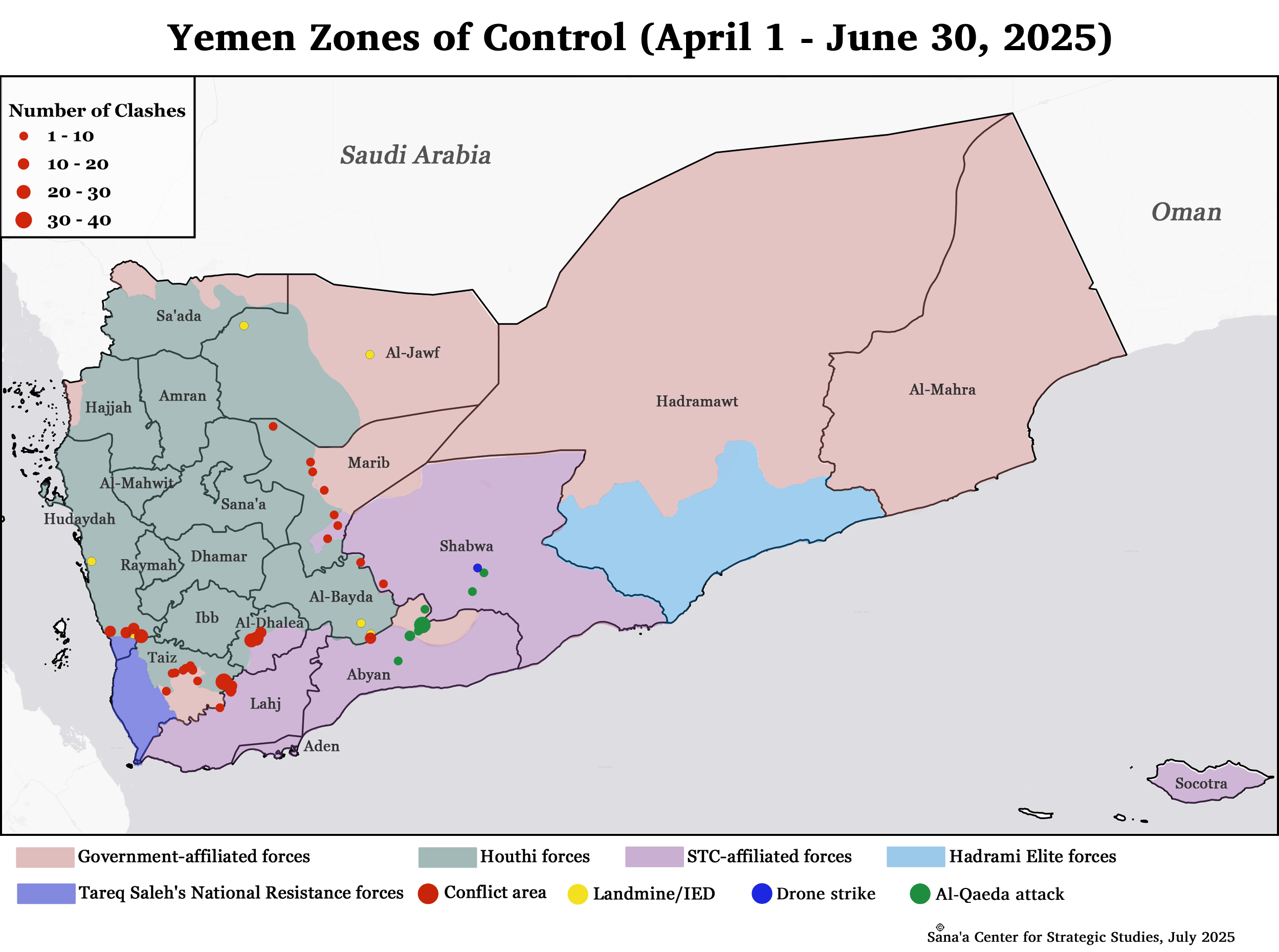
Although the Houthis control a much smaller portion of the territory, more people live in those areas than elsewhere in Yemen.51Public International Law and Policy Group and Resonate! Yemen, ‘Policy Planning White Paper: Governance Under Ansar Allah’, August 2022. According to figures used by the Integrated Food Security Phase Classification (IPC), of a total population of approximately 34.9 million,52‘IPC Global Initiative – Special Brief – Yemen’, Integrated Food Security Phase Classification, 27 June 2025, 11 roughly 24.7 million live in areas controlled by the Houthis, while 10.2 million live in areas controlled by the Government of Yemen.53‘Yemen (GoY Controlled Areas) (Partial Analysis) – May 2025 – February 2026’, Integrated Food Security Phase Classification, 18 July 2025, 3. In other words, roughly seventy-one per cent of the population reside in areas controlled by the Houthis while the remaining twenty-nine per cent live in areas controlled by the IRG.
The policy followed by most States and international organizations is to recognize the authorities based in Aden as the de jure government of Yemen.54S. Batati, ‘US: Hadi-Led Authority Is Yemen’s Only Legitimate Government, but Houthis Cannot Be Ignored’, Arab News, 26 June 2021; ‘Joint Communiqué on International Support for the Government of Yemen’, GOV.UK, 22 January 2025. Thus, in 2015, the UN Security Council not only referred to the Aden-based authorities as the ‘legitimate authorities of Yemen’, but also ‘[d]emand[ed] that the Houthis immediately and unconditionally: … (b) withdraw their forces from government institutions, including in the capital Sana’a, and normalize the security situation in the capital and other provinces, and relinquish government and security institutions’.55UNSC, ‘Resolution 2201 (2015)’, 15 February 2015, paras 8 and 7(b). More recently, the UN Security Council simply referred to the Aden-based authorities as the ‘Government of Yemen’.56UNSC, ‘Resolution 2786 (2025)’, 14 July 2025 2015, fourth preambular para. Although not determinative, the Aden-based authorities have also always been authorized to represent the Republic of Yemen before the United Nations. The current Permanent Representative of the Republic of Yemen, Abdullah Ali Fadhel Al-Saadi, presented his credentials in December 2018.57United Nations, Department for General Assembly and Conference Management, Protocol and Liaison Service, ‘Credentials Presented to the Secretary-General in 2018’, 2018. Unlike other cases where the identity of the entity competent to represent a State is contested, the question of the Houthis’ claim to represent the Republic of Yemen was never even placed on the agenda of the UN General Assembly Credentials Committee.
Several regional bodies refer to the Aden-based authorities as the ‘legitimate Yemeni Government’, including the Gulf Cooperation Council,58‘Final Statement Issued by the Supreme Council in Its 45th Session’, Gulf Cooperation Council, 1 December 2024, para 101 the League of Arab States,59Council of the League of Arab States at Summit Level (29th ordinary Session), Resolution on Situation Development in Yemen, 31 March 2019, para 2; Resolutions of the Council of the League of Arab States at Summit Level (31st ordinary Session), Algiers, the People’s Democratic Republic of Algeria, 1-2 November 2022, 37, para 5(C) the Organization of Islamic Cooperation,60‘Letter dated 10 May 2024 from the Permanent Representative of Mauritania to the United Nations addressed to the Secretary-General and the President of the Security Council: Annex III: Final Communiqué, 15th Islamic Summit Conference (Banjul Summit: Strengthening Unity And Solidarity Through Dialogue For Sustainable Development), Banjul, Republic Of The Gambia, May 4-5, 2024’, UN Doc A/78/879–S/2024/382, 29 May 2024, para 25 and the Non-Aligned Movement.61‘Final Document’ 19th Summit of Heads of State and Government of the Non-Aligned Movement, Kampala, the Republic of Uganda, 19 – 20 January 2024, para 674.
While some States have informally engaged with the Houthis, only Iran appears to explicitly recognize them as the de jure government of Yemen. The move was condemned by the League of Arab States.62‘Arab League Condemns Iran for Handing Yemen Embassy to Houthis’, Arab News, 21 November 2019. Although Syria used to recognize the Houthis as the de jure government of Yemen,63‘Yemen’s Houthi-Led Govt Appoints New Envoy to Syria’, Middle East Monitor, 12 November 2020 it withdrew its recognition in October 2023.64‘Syria Regime “orders Houthis out, Yemen Gov’t in” at Damascus Embassy’, The New Arab, 12 October 2023.
Even States that reportedly have close political relations with the Houthis have always refrained from recognizing the group as the de jure government of Yemen. For instance, the Russian Federation is said to have assisted the Houthis in the context of their attacks against commercial shipping in the Red Sea.65B. Faucon and T. Grove, ‘Russia Provided Targeting Data for Houthi Assault on Global Shipping’, Wall Street Journal, 24 October 2024. In October 2024, however, Russia announced that it would soon reopen its embassy in Aden, nearly ten years after its closure at the outbreak of the civil war.66‘Russia to Reopen Embassy in Yemen’s Aden Early next Year’, Arab News, 8 October 2024. In June 2025, the chairman of the PLC, Rashad Muhammed Al-Alimi, met President Vladimir Putin in Moscow.67B. Toomey, ‘Yemeni President Meets with Russian President despite Russia’s Ongoing Relationship with the Houthis’, FDD’s Long War Journal, 3 June 2025. In recent years, the PLC has been widely seen as the continuator of the previous government led by President Hadi.68Resolutions of the Council of the League of Arab States at Summit Level (31st ordinary Session) ‘Algiers Declaration’, 1-2 November 2022, 79, para 5(C).
Under general international law, the State is represented by the authority that is in effective control of the national territory and national institutions. As the International Committee of the Red Cross (ICRC) has written in its commentary on Article 2 of Geneva Convention III: ‘Under international law, the key condition for the existence of a government is its effectiveness, that is, its ability to exercise effectively functions usually assigned to a government within the confines of a State’s territory’.69‘Commentary on the Third Geneva Convention: Treatment of Prisoners of War’, International Committee of the Red Cross (ed) Vol 1, Cambridge University Press, 2021, para 267. This is so, irrespective of international recognition of that government.70‘Aguilar-Amory and Royal Bank of Canada claims – Tinoco Arbitration (Great Britain v. Costa Rica)’, Reports of International Arbitral Awards, Vol 1, 1923, 381. With respect to IHL, as the ICRC states: ‘The very fact that the said government is effective and in control of most of the territory of the State concerned means that it is the de facto government and its actions have to be treated as the actions of the State it represents with all the consequences this entails for determining the existence of an international armed conflict’.71ICRC, ‘Commentary on the Third Geneva Convention: Treatment of Prisoners of War’, Vol 1, Cambridge University Press, 2021, para 268.
Nevertheless, unless and until a new authority gains control of the overwhelming majority of territory in the course of a NIAC or as a result of an internal coup, there is a presumption that the existing government remains the sovereign.72H. Lauterpacht, ‘Recognition of Governments: I’, Columbia Law Review, 1945, 821–25. In contrast, attempted annexation or the forcible replacement of an existing government by a foreign State in an act of aggression does not displace the sovereign, which continues to enjoy the right of individual and collective self-defence under jus ad bellum. Where there is no clear entity in effective control of most of the territory of the State concerned, the internationally recognized government is to be considered the sovereign.
In the years that followed the takeover of Sana’a by the Houthis, doubts were sometimes expressed by commentators about the effectiveness of the authority of the government headed by President Hadi, considering the exile in Riyadh of officials of the Yemeni government, including President Hadi himself, and because it had received considerable military assistance from Saudi Arabia and the UAE.73K. Daugirdas and J.D. Mortenson, ‘United States Strikes Houthi-Controlled Facilities in Yemen, Reaffirms Limited Support for Saudi-Led Coalition Notwithstanding Growing Concerns About Civilian Casualties’, American Journal of International Law, Vol 111 (2017), 526; O. Corten, ‘Intervention by Invitation: The Expanding Role of the UN Security Council’, in D. Kritsiotis, O. Corten and G. H. Fox, Armed Intervention and Consent, Cambridge University Press, 2023, 123. Some authors also question the validity of any consent he could have expressed regarding a foreign armed intervention in Yemen due to being placed under house arrest in Riyadh in 2018.74O. A. Hathawayet al, ‘The Yemen Crisis and the Law: The Saudi-Led Campaign and U.S. Involvement’, Just Security, 20 February 2018; ‘Yemeni President “under House Arrest” in Saudi Arabia’, Al Jazeera, 7 November 2017.
It should be noted, however, that even when they were at the lowest point of their power, in the weeks following the capture of Sana’a and the resignation of President Hadi in early 2015 (later deemed invalid due to coercion by the Houthis) and before the armed intervention, Hadi’s government continued to control at least some areas of territory and exercise the prerogatives of public authority there. Hostilities continued between forces loyal to President Hadi and the Houthis. Therefore, the situation could not be described as one of complete collapse of governmental authority.75P. Fabri, ‘La licéité de l’intervention de la coalition internationale menée par l’Arabie Saoudite au Yémen au regard des principes de l’interdiction du recours à la force et de non-intervention dans les guerres civiles’, Revue belge de droit international, 2016, 89; T. Tzimas, ‘Legal Evaluation of the Saudi-Led Intervention in Yemen: Consensual Intervention in Cases of Contested Authority and Fragmented States’, Zeitschrift für ausländisches öffentliches Recht und Völkerrecht, 2018, 175; L. Ferro and T. Ruys, ‘The Saudi-Led Military Intervention in Yemen’s Civil War-2015’ in O. Cortenet al (eds), International Law and the Use of Force: A Case-Based Approach, Oxford University Press, 2018, 908.
Although the IRG has lost effective control over large swathes of territory, it still benefits from a presumption that it is the sovereign in Yemen as a matter of international law. The territorial control exercised by the Houthis, as considerable as it is, was not sufficient at the time of writing to reverse this presumption.76T. Tzimas, ‘Legal Evaluation of the Saudi-Led Intervention in Yemen: Consensual Intervention in Cases of Contested Authority and Fragmented States’, Zeitschrift für ausländisches öffentliches Recht und Völkerrecht, 2018, 185; B. Nußberger, ‘Military Strikes in Yemen in 2015: Intervention by Invitation and Self-Defence in the Course of Yemen’s “Model Transitional Process”’, Journal on the Use of Force and International Law, 2017, 140–1; E. Buys and A. Garwood-Gowers, ‘The (Ir)Relevance of Human Suffering: Humanitarian Intervention and Saudi Arabia’s Operation Decisive Storm in Yemen’, Journal of Conflict and Security Law, 2019, 10.
In 2018, Germany treated the conflict as a NIAC despite the armed intervention by Saudi Arabia and other Gulf States.77M. Lobo and S. Talmon, ‘Intervention by Invitation: The German View of Saudi Arabia’s Involvement in the Civil War in Yemen’, GPIL – German Practice in International Law, 20 April 2020. Recently, the Council of the European Union expressed its continued support to the government and the PLC, ‘while underlining the critical importance of unity and of continued presence in the temporary capital Aden’.78Council of the European Union, ‘Council’s Conclusions on Yemen’, Brussels, 20 May 2025, para 3. While the IRG (and some of the various factions composing the PLC) appears to be, to some extent, dependent on foreign military and financial assistance provided by Saudi Arabia and the UAE in particular, it is not entirely subservient to their dictates.
War WATCH is thus of the view that, under general international law, the IRG is the Government of Yemen for the purpose of the application of IHL.
On 1 April 2022, the main warring parties in Yemen’s conflict, namely the Saudi-led coalition and the Houthi movement, agreed to a two-month truce, brokered by UN Special Envoy Hans Grundberg.79‘Yemen’s warring parties agree to two-month truce, UN says’, Al Jazeera, 1 April 2022; UNSC, ‘Verbatim Record 9017th Meeting’, UN Doc S/PV.9017, 14 April 2022, 2–4. The truce was extended twice, until 2 August 2022,80UNSC, ‘Verbatim Record 9063rd Meeting’, UN Doc S/PV.9063, 14 June 2022 and then 2 October 2022.81UNSC, ‘Verbatim Record 9110th Meeting’, UN Doc S/PV.9110, 15 August 2022, 2; V. d’Hauthuille, ‘10 Conflicts to Worry About in 2022: Yemen: Mid-Year Update’, ACLED, 15 August 2022; M.-C. Heinze and S. Sons, ‘Jemen’, Bundeszentrale für Politische Bildung, 26 September 2024. Since then, the parties have failed to agree on a further formal extension of the truce despite repeated attempts.82UNSC, ‘Verbatim Record 9152nd Meeting’, UN Doc S/PV.9152, 13 October 2022, 2; A. Nagi, ‘Catching Up on the Back-Channel Peace Talks in Yemen’, International Crisis Group, 10 October 2023; A. Stark, ‘A Precarious Moment for Yemen’s Truce’, Just Security, 13 December 2023; M.-C. Heinze and S. Sons, ‘Jemen’, Bundeszentrale für Politische Bildung, 26 September 2024. However, the truce generally has been respected in the years that followed and has led to a decrease in violence despite regular episodes of armed confrontation between the parties to the conflict. Civilian harm was significantly reduced.83‘Extending Yemen’s Truce Has Resulted in Improved Humanitarian Conditions, Reduced Civilian Casualties, Special Envoy Tells Security Council’, United Nations Meetings Coverage and Press Releases, 14 June 2022; R. Khelifıet al, ‘Violence in Yemen During the UN-Mediated Truce: April-October 2022’, ACLED, 14 October 2022.
Since the truce, the States participating in the Saudi-led coalition rarely intervene directly in the hostilities.84E. Ardemagni, ‘Saudi Arabia’s New Strategy in Yemen: Border and Proxies’, Arab Gulf States Institute, 19 September 2023; M.-C. Heinze and S. Sons, ‘Jemen’, Bundeszentrale für Politische Bildung, 26 September 2024; V. d’Hauthuille, ‘The UN-Mediated Truce in Yemen: Impacts of the First Two Months’, ACLED, 14 June 2022. Moreover, a dialogue between Saudi-Arabia and the Houthis has been ongoing (see below), first in the form of direct ‘backchannel talks’ and later in negotiations mediated by Oman.85‘Saudi Arabia resumes back-channel talks with Houthis to extend ceasefire in Yemen’, Middle East Monitor, 18 January 2023; ‘Saudi, Omani envoys hold peace talks with Houthi leaders in Yemen’, Al Jazeera, 9 April 2023; M.-C. Heinze and S. Sons, ‘Jemen’, Bundeszentrale für Politische Bildung, 26 September 2024.
On 7 April 2022, in a parallel development, President Hadi announced his intention to step down and hand over power to the PLC which consists of eight members and includes representatives of the STC. Rashad Mohammed Al-Alimi was appointed as president of the PLC. The leader of the Joint Forces on the West Coast – an umbrella organization of various armed factions including the National Resistance Forces (NRF, also known as Guards of the Republic) – Tareq Saleh, the nephew of former president Saleh, was appointed as a member of the PLC.86‘A Presidential Announcement for Transferring Powers to a Presidential Leadership Council’, Official Website of President Dr. Rashad Al-Alimi, 7 April 2022; ‘Pointing to “Escalatory Turn” in Israeli-Houthi Conflict, Top Political, Peacebuilding Official Urges Action to Reverse Dangerous Trajectory, Briefing Security Council’, United Nations Meetings Coverage and Press Releases, 30 December 2024; ‘Yemen President Cedes Powers to Council as Saudi Arabia Pushes to End War’, The Straits Times, 7 April 2022; B. Mahli, ‘Yemen’s Path to Stability: Evaluating the Presidential Leadership Council’s Role and Impact’, Policy Paper, Policy Center for the New South, October 2024; Y. Saba, ‘Who is fighting in Yemen?’, Reuters, 2 January 2026. The PLC was established with the aim of unifying anti-Houthi forces. However, since its inception, the body has been crippled by divisions it was established to resolve.87A. Nasser, ‘Divergent Saudi-Emirati Agendas Cripple Yemen’s Presidential Leadership Council’, Arab Center Washington DC, 15 May 2024; B. Mahli, ‘Yemen’s Path to Stability: Evaluating the Presidential Leadership Council’s Role and Impact’, Policy Paper, Policy Center for the New South, October 2024; Y. Saba, ‘Who is fighting in Yemen?’, Reuters, 2 January 2026.
The ongoing conflict in Yemen has caused a severe humanitarian crisis throughout the country, including cholera outbreaks, medicine shortages, and a threat of famine.88‘Yemen bears world’s highest cholera burden, deepening humanitarian crisis’, UN Office at Geneva, 23 December 2024; ‘IOM Yemen: Acute Diarrhea and Cholera Outbreak in Yemen Exacerbated by Decade of Conflict – IOM Warns’, United Nations Yemen, 21 June 2024; ‘Yemen: Houthis Obstructing Aid, Exacerbating Cholera’, Human Rights Watch, 7 August 2024; ‘Yemen’s Rising Tide of Malnutrition: rends in Malnutrition Admissions at MSF-Supported Facilities in Yemen. Seasonal Patterns 2022-2024’, Médecins Sans Frontières, March 2025; O. Le Poidevin, ‘Yemen humanitarian crisis to worsen in 2026 as funding cut, says UN’, Reuters, 19 January 2026; ‘Yemen Health Emergency’, World Health Organization, 11 April 2024; K. Robinson, ‘Yemen’s Tragedy: War, Stalemate, and Suffering’, Council on Foreign Relations, Updated 1 May 2023. The Internal Displacement Monitoring Centre reported 4.8 million internally displaced persons (IDPs) in Yemen as at the end of 2024.89‘Yemen’, Internal Displacement Monitoring Centre, 14 May 2025.
Divisions within the PLC
Divisions between the IRG and PLC and within the PLC itself surfaced during the reporting period. In August 2023, Al-Maashiq Presidential Palace in Aden was stormed by UAE-backed militias, the Giants Brigade.90A. McKinney and F. Zheng, ‘Gulf of Aden Security Review’, Critical Threats, 15 August 2023; E. Almarshahi, ‘UAE-backed forces storm presidential palace in Aden’, Hodhod Yemen News Agency, 14 August 2023. The action was allegedly the result of a dispute on decisions in the banking industry between the deputy of the PLC, Abu Zara’a al-Mahrami (with whom the Giants Brigade are aligned), and the head of the Aden government, Moeen Abdul-Malik.91A. McKinney and F. Zheng, ‘Gulf of Aden Security Review’, Critical Threats, 15 August 2023; E. Almarshahi, ‘UAE-backed forces storm presidential palace in Aden’, Hodhod Yemen News Agency, 14 August 2023. The Giants Brigade besieged the palace for several hours.92A. McKinney and F. Zheng, ‘Gulf of Aden Security Review’, Critical Threats, 15 August 2023.
In March 2025, Rashad al-Alimi, the leader of the PLC, and his Prime Minister, Ahmed Awad bin Mubarak had a dispute over the sought dismissal of government ministers.93S. Magdy, ‘Yemen’s internationally recognized prime minister resigns over a political dispute’, Associated Press, 3 May 2025; ‘Yemen appoints new prime minister after cabinet resigned, council says’, Reuters, 3 May 2025. Mubarak resigned in May 2025, citing hinderances on his ability to do his job,94S. Magdy, ‘Yemen’s internationally recognized prime minister resigns over a political dispute’, Associated Press, 3 May 2025; ‘Yemen appoints new prime minister after cabinet resigned, council says’, Reuters, 3 May 2025 and Al-Alimi appointed Salem Salen Bin Braik, the PLC Finance Minister, as the new Prime Minister.95‘Yemen government names finance minister, Salem bin Buraik, as new PM’, The New Arab, 4 May 2025; ‘Yemen appoints Salem Saleh Bin Braik as prime minister, council says’, Reuters, 3 May 2025.
Leadership Turnover within the Al-Qaeda in the Arabian Peninsula (AQAP)
AQAP is one of many groups that exists within the global al-Qaeda network, and as such, its hierarchical structure is typical of such groups.96‘Al-Qa’ida in the Arabian Peninsula (AQAP)’, Australian National Security: Australian Government, 22 September 2024; ‘al-Qa’ida in the Arabian Peninsula (AQAP)’, Counter Terrorism Guide, 19 January 2010. Over the years, including during the reporting period, its leadership has changed.
In its early years, Nasir al-Wahishi was the Emir, Sa‘id al-Shahri was the deputy emir, Qasim al-Rimi was the operational commander, and, before his death in 2011, Anwar al-Aulaqi was the group’s most influential ideological figure and propagandist. Ibrahim al-Asiri also played an important role on the group as an explosives expert that masterminded a number of aviation plots and he allegedly died in 2017.97‘al-Qa’ida in the Arabian Peninsula (AQAP)’, Counter Terrorism Guide, 19 January 2010; ‘Al-Qa’ida in the Arabian Peninsula (AQAP)’, Australian National Security: Australian Government, 22 September 2024. When al-Wahishi was killed in 2015, Qasim al-Rimi became the new leader and when he was killed by a US strike in 2020, Khaled Batarfi took over.
In March 2024, AQAP announced that Khaled Saeed Batarfi had died after months of illness. Sa’ad bin ’Atef al-Awlaki, a Yemeni figure with strong tribal ties in Shabwa, became the group’s new leader. He is reportedly popular among younger members.98W. Clough, ‘Houthis Draw Blood in First Commercial Shipping Casualties’, The Yemen Review, Sana’a Center, January-March 2024, 23; J. Gambrell, ‘Al-Qaida’s Yemen branch says leader Khalid al-Batarfi dead in unclear circumstances’, Associated Press, 11 March 2024 and is believed to be a strong military commander. Upon his ascendence, AQAP reactivated its media channels to drive recruitment and encourage attacks, suggesting that al-Awlaki seeks to strengthen AQAP’s organizational capacity and mobilize supporters.99‘Final report of the Panel of Experts on Yemen established pursuant to Security Council resolution 2140 (2014)’, UN Doc S/2024/731, 11 October 2024, 11. In July, the United States put out a $10 million reward for information on al-Awlaki.100‘Rewards for Justice Reward Offer for Information on the Leader of al-Qa’ida in the Arabian Peninsula (AQAP)’, U.S. Department of State, 29 July 2025.
There were a number of unusual deaths among senior AQAP members after al-Awlaki’s took up the leadership position, suggesting that the group was experiencing an internal power struggle. On 15 March 2024, Khaled al-Sana’ani, a drone warfare figure, died in a traffic accident and on 16 March, Ibn al-Madani, the son of senior al-Qaida leader Saif al-Adl, died when a fire broke out at his home. Two weeks later, Abdullah Manea Hadban (Abu Arfaj al-Jawfi) died after being swept away ‘by a flood’. There is speculation that AQAP’s new leadership is eradicating potential rivals in a move to consolidate power.101W. Clough, ‘Houthis Draw Blood in First Commercial Shipping Casualties’, The Yemen Review, Sana’a Center, January–March 2024, 23.
Exacerbating deaths from internal competition are those that occur from drone strikes and in other counterterrorism operations. The United States has been conducting counterterrorism operations in Yemen since the early 2000s.102K. Robinson, ‘Yemen’s Tragedy: War, Stalemate, and Suffering’, Council on Foreign Relations, Updated 1 May 2023; D. Pearlstein, ‘The Yemen War’, Opinio Juris, 18 July 2012; R. Chesney, ‘Reactions to the ACLU Suit: There is Armed Conflict in Yemen, and the US Is Party to it’, Lawfare, 18 July 2012. Frequent US drone strikes have killed a number of other AQAP military leaders and religious and media officials, creating a leadership vacuum, weakening the group’s organizational structure, and reducing its ability to recruit and conduct operations.103‘Al-Qa’ida in the Arabian Peninsula (AQAP)’, Australian National Security: Australian Government, 22 September 2024; ‘Western Raids and ‘Arrows of the East’ create an AQAP Leadership Vacuum’, 23 February 2025; V. d’Hauthuille, ‘Al-Qaeda in the Arabian Peninsula: Sustained Resurgence in Yemen or Signs of Further Decline?’, ACLED, 6 April 2023. al-Qaeda’s central body has attempted to counteract this by sending additional leaders to fill critical roles.104V. d’Hauthuille, ‘Al-Qaeda in the Arabian Peninsula: Sustained Resurgence in Yemen or Signs of Further Decline?’, ACLED, 6 April 2023; ‘Western Raids and ‘Arrows of the East’ create an AQAP Leadership Vacuum’, 23 February 2025.
Houthi Crackdown on Aid Workers
There have been attacks on aid workers in Yemen throughout the reporting period. On 21 July 2023, Moayad Hameidi, a Jordanian national who was the director for the World Food Programme in Taiz province in south-west Yemen, was killed by unknown gunmen.105‘WFP staffer shot and killed in Yemen’, United Nations News, 21 July 2023; ‘WFP statement on the death of a staff member in Yemen’, World Food Programme, 21 July 2023; S. Ganot, ‘Senior Yemeni Officer Assassinated While Investigating UN Official’s Death’, The Media Line, 16 August 2023. According to one source, an assailant drove up on a motorcycle and shot Hameidi while he was having lunch at a restaurant,106‘UN food agency worker killed in Yemen’, Al Jazeera, 21 July 2023 but an alternative account is that mercenaries fired at a UN car, specifically targeting Hameidi.107‘Officer Investigating Assassination of UN Official Killed in Taiz’, Civil Conglomerate for Development and Freedoms, 16 August 2023. On 15 August, Adnan al-Muhya, a senior investigator for Hameidi’s case, was killed by masked gunmen while leaving his house in the Taiz province.108S. Ganot, ‘Senior Yemeni Officer Assassinated While Investigating UN Official’s Death’, The Media Line, 16 August 2023; ‘Officer Investigating Assassination of UN Official Killed in Taiz’, Civil Conglomerate for Development and Freedoms, 16 August 2023; ‘Senior officer assassinated in Taiz’, Yemen Press Agency, 14 August 2023.
In September 2023, a Save the Children staff member, Hisham al-Hakimi was arrested and detained by the Houthis without justification.109‘Save the Children calls for investigation after staff member dies in detention in Yemen’, Save the Children, 26 October 2023; J. Goldberg, ‘“No real protection”: Deaths in Houthi detention raise urgent questions for aid work in Yemen’, The New Humanitarian, 11 March 2025. He died in custody in October 2023 after having been tortured.110‘Save the Children calls for investigation after staff member dies in detention in Yemen’, Save the Children, 26 October 2023; J. Goldberg, ‘“No real protection”: Deaths in Houthi detention raise urgent questions for aid work in Yemen’, The New Humanitarian, 11 March 2025;‘HRITC confirms that the killing of Hisham Al-Hakimi in Sanaa’, Human Rights Information & Training Center, 30 October 2023.
From end-May to June 2024, the Houthis detained and ‘forcibly disappeared’ several staff from NGOs and the United Nations.111J. Gambrell and B. Anwer, ‘Yemen’s Houthi rebels detain 11 UN staffers as well as aid workers in sudden crackdown’, Associated Press, 8 June 2024; ‘Yemen: Houthis Disappear Dozens of UN, Civil Society Staff’, Human Rights Watch, 26 June 2024; ‘Yemen: Houthis Detain UN Staff and Civil Society Representatives’, Human Rights Watch, 7 June 2024; ‘Statement attributable to the Spokesperson for the Secretary-General – on the detention of United Nations and humanitarian personnel in Yemen’, United Nations Yemen, 6 December 2024; ‘UN condemns Houthi seizure of office in Yemen’s Sanaa’, Al Jazeera, 13 August 2024. It was suggested that the Houthis were attempting to frame those arrested as spies112‘Yemen: Houthis Disappear Dozens of UN, Civil Society Staff’, Human Rights Watch, 26 June 2024; ‘UN condemns Houthi seizure of office in Yemen’s Sanaa’, Al Jazeera, 13 August 2024, a suggestion supported by a video of detainees (including a UN staff member), which was released by the Houthis, in which they confessed to being spies. The United Nations rubbished the claims that its staff member was a spy, calling them the result of coercion.113‘UN condemns Houthi seizure of office in Yemen’s Sanaa’, Al Jazeera, 13 August 2024; ‘UN rights chief condemns storming of his office in Yemen’s capital’, United Nations News, 13 August 2024; ‘Yemen: Türk condemns storming of UN Human Rights office in Sana’a, renews call for release of detained staff’, Office of the United Nations High Commissioner for Human Rights (OHCHR), 13 August 2024.
At least sixty people were reportedly arrested, all of whom were Yemenis.114‘Yemen: Houthis Disappear Dozens of UN, Civil Society Staff’, Human Rights Watch, 26 June 2024. According to Human Rights Watch, the Houthis would arrive at a suspect’s house with several armoured cars and armed men and would bang on the door. When the door opened, they would drag the suspect into a separate room and interrogate him.115Yemen: Houthis Disappear Dozens of UN, Civil Society Staff’, Human Rights Watch, 26 June 2024. The houses were also raided and devices such as laptops, phones, and hard drives as well as cash and cars were taken.116‘Yemen: Houthis Disappear Dozens of UN, Civil Society Staff’, Human Rights Watch, 26 June 2024.
Again targeting the UN, on 3 August 2024, the Houthis raided a UN Human Rights Office in Sana’a, seizing documents, furniture, and cars.117‘UN condemns Houthi seizure of office in Yemen’s Sanaa’, Al Jazeera, 13 August 2024; ‘Yemen: Türk condemns storming of UN Human Rights office in Sana’a, renews call for release of detained staff’, OHCHR, 13 August 2024; ‘Yemen’s Houthis Seized UN Rights Office in Sanaa, UN Official Says’, International Center for Transitional Justice, 15 August 2024. Workers were reportedly also forced to hand over the keys to the premises and still had control over it by 13 August 2024.118‘Yemen: Türk condemns storming of UN Human Rights office in Sana’a, renews call for release of detained staff’, United Nations Office of the High Commissioner for Human Rights, 13 August 2024.
Aid workers, particularly those from the United Nations, continued to be targeted by the Houthis in 2025. On 23 January, seven UN staff were detained in Sana’a.119‘Yemen: Houthis Detain More UN Workers’, Human Rights Watch, 4 February 2025; C. Coombs and N. Whalley, ‘Houthi Detentions Leave Stark Choices for Aid Sector’, The Yemen Review, Sana’a Center, 5 February 2025; ‘UN says seven staff detained in Houthi-controlled Yemen, all movement suspended’, Reuters, 25 January 2025. In addition to calling for their immediate release (along with the release of all other detained civil society workers), the United Nations suspended ‘all official movements into and within’ areas in Yemen under Houthi control.120‘UN suspends trips into Houthi-held areas of Yemen after more staff detained’, Al Jazeera, 24 January 2025; ‘UN says seven staff detained in Houthi-controlled Yemen’, The Guardian, 25 January 2025; ‘Strongly Condemning Houthi De Facto Authorities’ Arbitrary Detention of United Nations Personnel in Yemen, Secretary-General Demands Their Immediate, Unconditional Release’, United Nations, Press release, 24 January 2025. The purpose of the ‘pause’ was to give Houthi authorities and the UN time negotiate the release of those detained.121‘UN suspends operations in Yemen’s Houthi stronghold after staff detained’, Al Jazeera, 11 February 2025. In February 2025, it was reported the one of the staff members detained had died while in custody.122A. Smith, ‘WFP says worker died in detention in Houthi-controlled Yemen’, BBC, 11 February 2025.
More UN staff were detained in late August; eleven staff from UNICEF and the World Food Programme were arrested after Houthi raids on their offices.123‘Houthis detain at least 11 UN workers in raids on two agencies in Sana’a’, The Guardian, 31 August 2025; ‘Houthi rebels raid UN premises in Yemen, detain at least 11 people’, Reuters, 1 September 2025; ‘Guterres condemns detention of more UN staff in Yemen’, United Nations News, 1 September 2025. This number was later revised up to nineteen.124N. Jafarnia, ‘New Houthi Arrests of UN Staff’, Human Rights Watch, 8 September 2025; E. M. Lederer, ‘UN ups number of staff detained by Yemen’s Houthis to 19’, Associated Press, 3 September 2025. At least one staff member was released in October 2025.125J. Ward, ‘UN staff member released from Houthi detention in Yemen, UN spokesperson says’, Reuters, 8 October 2025. On 16 September 2025, the UN announced it moved the resident coordinator of Yemen’s office from Sana’a to Aden, a move welcomed by the IRG who considers Aden as Yemen’s interim capital.126‘Yemeni Government Welcomes Relocation of UN Coordinator’s Office from Sana’a to Aden’, Yemen Monitor, 17 September 2025; ‘UN relocates Yemen’s resident coordinator’s office to Aden’, Reuters, 16 September 2025.
This did little to deter Houthi raids on UN staff and offices because at least two dozen more workers were detained in October 2025.127‘Yemen’s Houthis Detain 20 UN Staff in Latest Raid’, International Center for Transitional Justice, 19 October 2025; ‘Yemen’s Houthis detain 20 UN staff in latest raid’, Al Jazeera, 19 October 2025. During this raid, the Houthis seized all communications equipment inside the facility. 128‘Yemen’s Houthis detain 20 UN staff in latest raid’, Al Jazeera, 19 October 2025. By 22 October, twelve UN staffers that had previously been held by the Houthis left Sana’a while fifty-three staffers detained over the years remained in custody.129‘Note to Correspondents: on UN staff in Sana’a, Yemen’, United Nations Secretary-General, 22 October 2025. Despite this, more detentions were recorded in late October with at least six UN staffers arrested by the Houthis, bringing the number of UN staffers held to fifty-nine.130J. Ward, ‘UN staff member detained after Houthis raided offices in Sanaa, UN spokesperson says’, Reuters, 27 October 2025. And, in November 2025, it was reported that the Houthis raided an ICRC office in Sana’a for the first time, confiscating mobile phones and detaining the head of IT for twenty-four hours.131N. Al-Taher, ‘Houthis raid Red Cross offices in Sanaa for first time’, The National News, 12 November 2025; ‘Yemen : Houthi militia Storm ICRC Headquarters in Sana’a’, Yemen Online, 12 November 2025; ‘ICRC Avoids Condemning Houthi Raid on Its Offices in Sana’a’, Yemen Monitor, 15 November 2025.
Release of Prisoners by the Houthis
While simultaneously detaining aid worders, the Houthis were releasing political prisoners and prisoners of war. In July 2024, the Houthis, the PLC, and UN Special Envoy to Yemen, Hans Grundberg, meet in Oman to discuss a major prisoner swap. On the table to be released was Mohamed Qahtan, the leader of a Sunni Islamist party who was detained at the start of Yemen’s civil war in 2013.132‘Yemen’s Houthis Tease Release of Longtime Political Prisoner’, The Media Line, 9 July 2024. He was eventually released on 7 January 2025.133‘Mohammad al-Qahtani freed after decade of arbitrary detention’, MENA Rights Group, 13 March 2019, Updated 13 March 2025; ‘Saudi human rights defender Mohammad al-Qahtani released from prison’, Right Livelihood, 14 January 2025. Also in January 2025, the Houthis unilaterally released 153 prisoners into the custody of the ICRC.134‘Yemen’s Houthi rebels release 153 prisoners of war’, Al Jazeera, 25 January 2025; ‘Yemen’s Houthis release 153 prisoners with Red Cross support’, Reuters, 25 January 2025. In December 2025, the parties agreed to release ‘thousands’ of prisoners from the conflict after talks held in Oman.135‘Yemen’s government, Houthis agree to exchange thousands of prisoners’, Al Jazeera, 23 December 2025; M. Tawfeeq, ‘Yemen’s warring parties agree on biggest prisoner exchange deal so far’, CNN, 23 December 2025; ‘Yemen’s Government, Houthis Agree to Exchange Thousands of Prisoners’, International Center for Transitional Justice, 23 December 2025.
Dialogue between Houthis and Saudi Arabia-led coalition mediated by Oman and UN
As mentioned, Saudi Arabia has been in dialogue with the Houthis since the agreement of a UN-brokered ceasefire in April 2022.136‘Yemen’s warring sides fail to agree extension to UN-backed truce’, Al Jazeera, 3 October 2022. Oman has served as a mediator since the middle of 2022.137‘Saudi, Omani envoys hold peace talks with Houthi leaders in Yemen’, Al Jazeera, 9 April 2023; I. Navarro Milán, ‘Peace Talks in Focus 2022: Report on Trends and Scenarios’, Escola de Cultura de Pau, 2023. In a meeting between the Houthis and Saudi Arabia in Yemen in April 2023, where Omani representatives were present, the two parties came to an understanding that there would be a further six-month truce.138‘Saudi officials visit Yemen’s capital for talks with rebels’, NPR, 10 April 2023; Unit for Political Studies, ‘A Fragile but Enduring Truce in Yemen’, Arab Center for Research & Policy Studies, 29 August 2024; J. Holleis, ‘Despite hope, Yemen peace talks are oversold, experts say’, Deutsche Welle, 13 April 2023. Despite these talks being touted as ‘the closest Yemen has been to real progress towards lasting peace’,139S. Magdy, ‘Saudi officials visit Yemen’s capital for talks with rebels’, Associated Press, 9 April 2023 no formal agreement materialized,140Unit for Political Studies, ‘A Fragile but Enduring Truce in Yemen’, Arab Center for Research & Policy Studies, 29 August 2024; J. Holleis, ‘Despite hope, Yemen peace talks are oversold, experts say’, Deutsche Welle, 13 April 2023 apparently due to the Houthis’ unwillingness to make concessions.141G. Cafiero, ‘Analysis: Fighting recedes, but peace in Yemen remains distant’, Al Jazeera, 7 July 2023. Particular sticking points that came up in all meetings in 2023 were the payments of public sector salaries,142‘Omani delegation in Yemen to reignite peace process’, The Cradle, 18 August 2023; N. Shaker, ‘Can a religious pilgrimage make peace a prospect in Yemen?’, Responsible Statecraft, 14 July 2023; ‘UN, US Continue Shuttle Diplomacy’, The Yemen Review, Sana’a Center, 14 September 2023 who would benefit from Yemen’s oil wealth, and who would bear the costs of rebuilding Yemen. 143G. Cafiero, ‘Analysis: Fighting recedes, but peace in Yemen remains distant’, Al Jazeera, 7 July 2023; ‘Omani delegation in Yemen to reignite peace process’, The Cradle, 18 August 2023.
Despite the lack of an agreement it seemed tensions between the parties were easing when in June 2023, the first flight from Yemen to Saudia Arabia in seven years took place, carrying Yemeni Muslims on pilgrimage to Hajj in Mecca city.144‘Resumption of flights from Yemen to Saudi Arabia seen as ‘positive step’’, The Arab Weekly, 19 June 2023; ‘Yemenis embark on first direct flight to Saudi Arabia since 2016’, Al Jazeera, 18 June 2023. A Houthi delegation also travelled to Hajj for pilgrimage in July 2023.145N. Shaker, ‘Can a religious pilgrimage make peace a prospect in Yemen?’, Responsible Statecraft, 14 July 2023. Yemen’s ambassador to the United Kingdom (UK) labelled the act a ‘political pilgrimage’ that constitutes ‘a turning point’ in a violent journey.146N. Shaker, ‘Can a religious pilgrimage make peace a prospect in Yemen?’, Responsible Statecraft, 14 July 2023.
However, negotiations were again at risk in August, when the Houthis remained steadfast on their desire for Saudi Arabia to foot the bill for public servant salaries in Yemen and threatened to suspend negotiations until this happened.147‘UN, US Continue Shuttle Diplomacy’, The Yemen Review, Sana’a Center, 14 September 2023. In September, the Houthis made their first official visit to Riyadh since 2015 where the parties reportedly discussed, amongst other issues, using Yemeni resources to pay salaries in areas under Houthi control.148I. Navarro Milán, ‘Peace Talks in Focus 2022: Report on Trends and Scenarios’, Escola de Cultura de Pau, 2023, 130; ‘Yemen’s Houthis heading to Riyadh for ceasefire talks with Saudi Arabia’, Al Jazeera, 14 September 2023; P. Wintour, ‘Yemen’s southern leaders say ‘bad’ peace deal cannot be imposed’, The Guardian, 20 September 2023; A. Nagi, ‘Catching Up on the Back-channel Peace Talks in Yemen’, International Crisis Group, 10 October 2023; ‘Houthis Visit Riyadh as Bilateral Talks Move Forward’, The Yemen Review, Sana’a Center, September and October 2023, 6. This meeting was praised by both sides, as well as by other States including the US, the UAE, and Qatar, as being a positive step forward in the negotiations.149P. Wintour, ‘Yemen’s southern leaders say ‘bad’ peace deal cannot be imposed’, The Guardian, 20 September 2023; ‘Houthis Visit Riyadh as Bilateral Talks Move Forward’, The Yemen Review, Sana’a Center, September and October 2023, 6 and 7.
Like several other conflicts in the region, the outbreak of the war in Gaza in October 2023 had an impact on the Yemeni peace process.150I. Navarro Milán, ‘Peace Talks in Focus 2022: Report on Trends and Scenarios’, Escola de Cultura de Pau, 2023, 131; ‘Houthis Visit Riyadh as Bilateral Talks Move Forward’, The Yemen Review, Sana’a Center, September and October 2023, 8; P. Wintour, ‘Houthi attacks on Israel jeopardise Saudi peace efforts in Yemen’, The Guardian, 24 November 2023. The Houthis began striking Israel as well as ships in the Red Sea bound for Israel.151L. Nevola, ‘Middle East Overview: February 2025’, ACLED, 7 February 2025; I. Navarro Milán, ‘Peace Talks in Focus 2022: Report on Trends and Scenarios’, Escola de Cultura de Pau, 2023, 131; P. Wintour, ‘Houthi attacks on Israel jeopardise Saudi peace efforts in Yemen’, The Guardian, 24 November 2023. In response, the United States created an ‘international military cooperation’ to combat Houthi attacks in the Red Sea, pressuring Saudi Arabia to join and delay the peace process with the Houthis.152I. Navarro Milán, ‘Peace Talks in Focus 2022: Report on Trends and Scenarios’, Escola de Cultura de Pau, 2023, 131. There was also speculation that the Houthis were engaging in these attacks to pressure Saudi Arabia in response to the latter attempting to normalize relations with Israel.153‘Houthi Strategy Evolves in Red Sea Attacks’, The Yemen Review, Sana’a Center, November and December 2023, 6.
Tensions boiled into clashes on the Saudi border between Saudia Arabia and the Houthis in October 2023.154‘YCO Situation Update: October 2023’, ACLED, 10 November 2023. On 20 October, Saudi Arabia allegedly intercepted a Houthi missile travelling through the former’s airspace.155‘YCO Situation Update: October 2023’, ACLED, 10 November 2023; S. Dagheret al, ‘Saudi Forces on Alert After Clash With Iran-Backed Houthis’, Bloomberg, 30 October 2023, Updated 31 October 2023. Four days later, the Houthis launched a surprise attack on the Saudi border; four Saudi soldiers and ten Houthi fighters were killed.156‘YCO Situation Update: October 2023’, ACLED, 10 November 2023; S. Dagheret al, ‘Saudi Forces on Alert After Clash With Iran-Backed Houthis’, Bloomberg, 30 October 2023, Updated 31 October 2023. Despite these tensions, Saudia Arabia and the Houthis met again in November to iron out details of the agreement,157‘Middle East & North Africa: Yemen’, International Crisis Group, November 2023. and by the end of December 2023, the Houthis and Saudia Arabia agreed to resume the peace process, with Riyadh calling for restraint and the Houthis making clear that their attacks in the Red Sea did not risk peace talks with Saudi Arabia.158I. Navarro Milán, ‘Peace Talks in Focus 2022: Report on Trends and Scenarios’, Escola de Cultura de Pau, 2023, 131; ‘Houthis Visit Riyadh as Bilateral Talks Move Forward’, The Yemen Review, Sana’a Center, September and October 2023, 8; V. Ali-Khan, ‘Why Saudi Arabia Is Staying on the Sidelines in the Red Sea Conflict’, Foreign Policy, 16 January 2024; A. El Yaakoubi, ‘Yemen’s Houthis say Red Sea attacks do not threaten peace with Riyadh’, Reuters, 11 January 2024.
Despite the apparent success of talks throughout 2023, it was repeatedly emphasized by analysts and by parties in southern Yemen, particular the STC and the PLC, that their exclusion from the talks jeopardized their success,159‘Saudi, Omani envoys hold peace talks with Houthi leaders in Yemen’, Al Jazeera, 9 April 2023; J. Holleis, ‘Despite hope, Yemen peace talks are oversold, experts say’, Deutsche Welle, 13 April 2023; I. Navarro Milán, ‘Peace Talks in Focus 2022: Report on Trends and Scenarios’, Escola de Cultura de Pau, 2023, 131; ‘Yemen’s Houthis heading to Riyadh for ceasefire talks with Saudi Arabia’, Al Jazeera, 14 September 2023; P. Wintour, ‘Yemen’s southern leaders say ‘bad’ peace deal cannot be imposed’, The Guardian, 20 September 2023; ‘Houthis Visit Riyadh as Bilateral Talks Move Forward’, The Yemen Review, Sana’a Center, September and October 2023, 7; F. A. Alasrar, ‘Saudi-Houthi Backchannel Talks Alone Can’t Bring Lasting Peace to Yemen’, Arab Gulf States Institute, 3 March 2023 with STC leader Major General Aidarous al-Zubaidi telling The Guardian that it was better to have low-level violence in Yemen than a ‘bad deal’.160P. Wintour, ‘Yemen’s southern leaders say ‘bad’ peace deal cannot be imposed’, The Guardian, 20 September 2023. These exclusions are, however, perceived by the Houthis as a step towards acknowledging them as the ‘sole legitimate voice of the Yemeni people’.161A. Nagi, ‘Catching Up on the Back-channel Peace Talks in Yemen’, International Crisis Group, 10 October 2023.
Throughout 2024 and most of 2025, Saudi Arabian relations with the Houthis remained mostly peaceful, with only two notable moments of tension. The first was in July 2024 during spats between the Central Bank of Yemen in Aden, controlled by the IRG, and the Central Bank in Sana’a, controlled by the Houthis, when the Central Bank of Yemen called on all banks in Sana’a to relocate to Aden or face punitive consequences (see below). The Houthis saw this as orchestrated by Saudi Arabia and threated to strike key airports in the State.162‘Yemen’s Houthis threaten Saudi Arabia with aerial footage of key airports’, The New Arab, 8 July 2024. The action did not materialize. The second was in April 2025, when there were rumours that Saudi Arabia would join a ground offensive led by anti-Houthi militias (and potentially joined by the US) against the Houthis (see below); Riyadh, however, denied this.163‘UAE, Saudi Arabia deny reports of involvement in talks about land offensive in Yemen’, Reuters, 17 April 2025; B. Faucon and N. A. Youssef, ‘U.S. Strikes Spur Plans for Yemeni Ground War Against Houthis’, The Wall Street Journal, 14 April 2025. Ultimately, Saudia Arabia indicated its commitment to the peace talks, reinforcing this when it refused to be drawn into conflicts between the United States and the Houthis in 2024 and in 2025 (see below).164Unit for Political Studies, ‘A Fragile but Enduring Truce in Yemen’, Arab Center for Research & Policy Studies, 29 August 2024; A. L. Alley, ‘How the Houthis Outlasted America’, Foreign Affairs, 9 May 2025; ‘After relentless US bombing campaign, Yemen’s Houthis are biggest victors of truce’, The Times of Israel, 9 May 2025; M. T. Egea, ‘Saudi defeat in the Yemeni civil war’, 11 June 2024.
Towards the end of 2025, however, Houthi rhetoric against Saudi Arabia grew markedly more hostile. In September, Houthi leader Abdel-Malek al-Houthi accused Riyadh of being in league with Israel and in October the group warned that it would renew cross-border attacks with Saudia Arabia if the latter did not cease their ‘economic strangulation’ of Yemen.165‘Middle East & North Africa: Yemen’, International Crisis Group, October 2025; ‘Mired in financial crisis, the Houthis resume threats to Saudi Arabia’, The Economist, 27 November 2025. The change was apparently driven by a financial crisis the group had been experiencing due to US sanctions, its campaign in the Red Sea, and loss of revenue-generating businesses from US-led strikes.166‘Mired in financial crisis, the Houthis resume threats to Saudi Arabia’, The Economist, 27 November 2025.
Tensions continued in November when the Houthis announced that they had dismantled an espionage network based in Saudi Arabia that allegedly consisted of Saudi, American, and Israeli intelligence services.167B. Toomey, ‘Houthis arrest alleged members of Saudi-American-Israeli spy ring’, FDD’s Long War Journal, 10 November 2025; ‘Yemen Uncovers Spy Cells Linked to US, Israel, and Saudi Intelligence’, The Palestine Chronicle, 8 November 2025; ‘Houthis Announce Dismantling of Espionage Network Linked to US and Israel’, Yemen Monitor, 9 November 2025. The network of operatives were reportedly engaged in identifying Houthi military leaders and well as sites of military importance including weapons productions sites and launching facilities.168B. Toomey, ‘Houthis arrest alleged members of Saudi-American-Israeli spy ring’, FDD’s Long War Journal, 10 November 2025; ‘Yemen Uncovers Spy Cells Linked to US, Israel, and Saudi Intelligence’, The Palestine Chronicle, 8 November 2025. The Houthis called the network an attempt to destabilize Yemen,169‘Yemen Uncovers Spy Cells Linked to US, Israel, and Saudi Intelligence’, The Palestine Chronicle, 8 November 2025; ‘Houthis Announce Dismantling of Espionage Network Linked to US and Israel’, Yemen Monitor, 9 November 2025 further accusing Saudi Arabia of recruiting the operatives.170B. Toomey, ‘Houthis arrest alleged members of Saudi-American-Israeli spy ring’, FDD’s Long War Journal, 10 November 2025.
Central Bank Dispute Between the Houthis and the IRG of Yemen
There are two Central Banks in Yemen – one is controlled by the IRG and is based in Aden (the Central Bank of Yemen (CBY))171‘About the Central Bank of Yemen (CBY)’, Central Bank of Yemen; F. A. Alasrar, ‘U.N.-Brokered Economic Deal in Yemen Eases Pressure on the Houthis’, Arab Gulf States Institute, 5 August 2024; ‘How a new Houthi-minted currency is widening Yemen’s divides’, The New Arab, 8 April 2024 and the other is controlled by the Houthis and is based in Sana’a.172F. A. Alasrar, ‘U.N.-Brokered Economic Deal in Yemen Eases Pressure on the Houthis’, Arab Gulf States Institute, 5 August 2024; ‘How a new Houthi-minted currency is widening Yemen’s divides’, The New Arab, 8 April 2024. Northern and southern Yemen use different currencies with different exchange rates.173F. A. Alasrar, ‘U.N.-Brokered Economic Deal in Yemen Eases Pressure on the Houthis’, Arab Gulf States Institute, 5 August 2024; ‘How a new Houthi-minted currency is widening Yemen’s divides’, The New Arab, 8 April 2024; M. A. Thamer, ‘Coin Rollout Sparks a New War in Yemen’, Carnegie Endowment for International Peace, 21 May 2024; Economic Studies Unit, ‘Struggle for Monetary Sovereignty: Implications and Potential Outcomes of the Houthis Introducing New Metal Currency’, Emirates Policy Center, 18 April 2024; ‘The Economy’, The Yemen Review, Sana’a Center, April–June 2024, 24.
On 30 March 2024, the Houthis announced a plan to circulate a new hundred-riyal coin, not for the purposes of impacting the exchange rate or the Yemeni economy, but simply to replace damaged banknotes that were in circulation.174‘How a new Houthi-minted currency is widening Yemen’s divides’, The New Arab, 8 April 2024; M. A. Thamer, ‘Coin Rollout Sparks a New War in Yemen’, Carnegie Endowment for International Peace, 21 May 2024; Economic Studies Unit, ‘Struggle for Monetary Sovereignty: Implications and Potential Outcomes of the Houthis Introducing New Metal Currency’, Emirates Policy Center, 18 April 2024; ‘The Economy’, The Yemen Review, Sana’a Center, April-June 2024, 23. The move was heavily criticized with experts warning that, in addition to risking peace negotiations, it would economically isolate those in Houthi-controlled areas and exacerbate an already dire economic situation.175‘How a new Houthi-minted currency is widening Yemen’s divides’, The New Arab, 8 April 2024.
Despite an agreement on the issue, the Houthis continued to face financial pressure from US sanctions having been made a Specially Designated Global Terrorist (SDGT) and then a designated Foreign Terrorist Organization (FTO).176S. Lewis and S. Holland, ‘US relists Houthis as terrorists in response to Red Sea attacks’, Reuters, 18 January 2024; ‘Biden admin to relist Houthi rebels as specially designated global terrorists-source’, Reuters, 17 January 2024; ‘The Houthis are again ‘specially designated global terrorists.’ Here’s what that means’, Atlantic Council, 17 January 2024; ‘Terrorist Designation of the Houthis’, US Department of State, 17 January 2024; ‘US designates Yemen’s Houthis as ‘global terrorists’’, Al Jazeera, 17 January 2024, Updated 18 January 2024.
The consequence of such a designation is that US persons are blocked from making or receiving funding, goods or services from such a group and any property of the group that is in the United States or comes under US control is blocked.177‘Executive Order 13224’, US Department of State. The designation can also block from doing business with international institutions.‘The Houthis are again ‘specially designated global terrorists.’ Here’s what that means’, Atlantic Council, 17 January 2024; ‘US designates Yemen’s Houthis as ‘global terrorists’’, Al Jazeera, 17 January 2024, Updated 18 January 2024. This designation came into effect on 16 February 2024.178‘Designation of Ansarallah as a Specially Designated Global Terrorist’, Federal Register, 28 February 2024.
In January 2025, President Donald Trump signed an executive order to start the process of moving the Houthis from the SDGT to the FTO list.179L. Nevola, ‘Middle East Overview: February 2025’, ACLED, 7 February 2025; P. Stewart, ‘Trump designates Yemen’s Houthis as a ‘foreign terrorist organization’’, Reuters, 23 January 2025; D. Gritten, ‘Trump re-designates Yemen’s Houthis as Foreign Terrorist Organisation’, BBC, 23 January 2025; ‘FACT SHEET: President Donald J. Trump Re-designates the Houthis as a Foreign Terrorist Organization’, The White House, 22 January 2025. Although the effects of the designation are the same as that of groups and individuals on the SDGT list, persons doing business with FTOs can be criminally charged, members of FTO groups are automatically unable to enter the United States, and victims of attacks by FTOs can file civil suits against them.180‘The Houthis are again ‘specially designated global terrorists.’ Here’s what that means’, Atlantic Council, 17 January 2024. This designation was finalized on 4 March 2025.181A. L. Alley, ‘How the Houthis Outlasted America’, Foreign Affairs, 9 May 2025; M. Rubio, ‘Designation of Ansarallah as a Foreign Terrorist Organization’, US Department of State, 4 March 2025.
In December 2024, the governor of the Sana’a based Central Bank, Hashem al-Madani, as well as a number of other Houthi members and companies associated with them were sanctioned by the United States for allegedly helping the Houthis buy weapons, launder money, ship ‘illicit Iranian petroleum’.182‘Treasury Maintains Pressure on Houthi Procurement and Financing Schemes’, US Mission to Yemen, 19 December 2024; ‘US imposes more sanctions on Yemen’s Houthis amid escalation with Israel’, Al Jazeera, 19 December 2024. In January 2025, the US imposed sanctions on the Yemen-based Yemen Kuwait Bank for Trade and Investment Y.S.C., alleging that the bank was, among other offences, helping the Houthis access international financial systems and funding their war effort.183Y. K. Fawaz, ‘Looming threat to business leaders in Yemen from US sanctions’, The Arab Weekly, 7 April 2025; ‘US imposes sanctions on Yemeni financial institution in action against Houthis’, Reuters, 17 January 2025; ‘Treasury Increases Financial Pressure on the Houthis’, US Department of the Treasury, 17 January 2025.
In March 2025, it was reported that banks in Sana’a were moving their headquarters to Aden to escape the sanctions.184B. Toomey, ‘New Sanctions Against the Houthis Take Aim at the Terrorist Group’s Banking Sector’, Foundation for Defense of Democracies, 24 April 2025; ‘Sana’a Banks Shift to Aden Amid US Sanctions on Houthis’, Barran Press, 14 March 2025. This angered the Houthis who responded by restricting the movement of bank employees, calling for them to be arrested should they leave Sana’a.185B. Toomey, ‘New Sanctions Against the Houthis Take Aim at the Terrorist Group’s Banking Sector’, Foundation for Defense of Democracies, 24 April 2025. On 17 April 2025, the United States sanctioned the Sana’a-based International Bank of Yemen as well as three of its most senior officials.186T. Bruce, ‘Sanctioning International Bank of Yemen for Supporting the Houthis’, US Department of State, 17 April 2025; ‘Treasury Targets International Bank of Yemen for Support to the Houthis’, US Department of the Treasury, 17 April 2025. Banks in Sana’a were placed in a difficult choice – they needed to leave Sana’a to be able to continue operating but the Houthis were not likely to let that happen.187‘Executive Summary’, The Yemen Review, Sana’a Center, 22 July 2025.
Tensions and Sporadic Clashes in Hadramout Province
While the UAE is part of the Saudi-led coalition that has been fighting in Yemen for years, the two States have diverging visions for Yemen.188A. Nagi, ‘Amid War, Yemen’s New Government Faces Challenges at Home and Abroad’, International Crisis Group, 17 March 2026. The UAE backs the STC who wants the south of Yemen to be an independent State, while Saudi Arabia has supported the PLC that was established in 2022 to manage Yemen and secure a ceasefire for the conflict-ridden-State.189B. Toomey, ‘Southern Transitional Council seizes key areas of Yemen’s Hadramawt Governorate from rival government forces’, FDD’s Long War Journal, 4 December 2025; A. Nagi, ‘Amid War, Yemen’s New Government Faces Challenges at Home and Abroad’, International Crisis Group, 17 March 2026. The STC sits on the PLC and both the STC and the PLC are fighting the Houthis.190A. Nagi, ‘Amid War, Yemen’s New Government Faces Challenges at Home and Abroad’, International Crisis Group, 17 March 2026. During the reporting period, tensions between the two factions grew, eventually boiling over in Hadramout province in southern Yemen.
In July 2023, the STC held its annual Land Day event in Hadramout where it called for the independence movement for southern Yemen to be maintained and warned against attempts to ‘re-empower’ the ‘Yemini-occupying forces’ Hadramout.191‘On July 7th STC in Hadramout organizes a major popular event on the occasion of “Land Day”’, South Arabia Media Agency, 4 July 2023; ‘The Full Statement Issued by Large-scale Mass Rallies of Hadramout on Anniversary of Southern Land Day 7/7’, Southern Transitional Council, 8 July 2023. The speech came amid STC moves seen as an attempt to bring Hadramout under complete STC control – a move the Saudis sought to counter by bringing together tribal figures in the province under the umbrella Hadramout Tribal Alliance (HTA) (also called the Hadramout National Council or Hadramout Tribes Confederacy).192‘Saudi-UAE Spat Comes to a Head in Hadramawt’, The Yemen Review, Sana’a Center, 15 August 2023. The tribes under the HTA rejected the STC attempts to unify Hadramout and separate southern and northern Yemen.193M. Al-Maswari, ‘New Yemeni entity established in Saudi Arabia’, Albawaba, 21 June 2023.
On 12 April 2024, tensions flared when the HTA demanded that Saudi Arabia urgently take steps to support autonomy for Hadramout.194‘Tribal Gathering in Hadramout Calls on Saudi Arabia to Support Autonomy’, South 24, 12 April 2025; ‘Saudi-backed Tribal Alliance of Hadramout declares autonomy’, Yemen Press Agency, 12 April 2025. The Vice President of the STC, Major General Faraj Salmin al-Bahsani, who is also a member of the PLC called for unity in the province.195‘Tribal Gathering in Hadramout Calls on Saudi Arabia to Support Autonomy’, South 24, 12 April 2025. In moving towards autonomy, the HTA had been taking over oil fields in Hadramout since June 2025.196‘UAE-backed militia seizes major Yemeni city after clashes in Hadhramaut’, The Cradle, 3 December 2025.
Everything fell apart for the PLC and its UAE backer in November and December 2025. On 12 November, the STC’s Security Support Forces (SSF), led by Abu Ali al-Hadhrami, attempted to establish a checkpoint in an area dominated by the Saudi-backed HTA and other tribal alliances.197N. Khdouret al, ‘Middle East Overview: December 2025’, ACLED, 8 December 2025. The HTA accused the SSF and the STC of engaging in ‘provocative’ military measures.198‘Struggle for Influence Intensifies in Hadramout: Armed Clashes and Escalating Accusations Between the Tribal Alliance and the STC’, Yemen Monitor, 16 November 2025. There was subsequently a clash between the SSF and HTA tribes in which fourteen people were injured.199N. Khdouret al, ‘Middle East Overview: December 2025’, ACLED, 8 December 2025. Despite attempts to de-escalate, in late November al-Hadrami directly threatened the HTA’s leader, Sheikh Amr bin Habrish al-Aliyi, saying that they would not allow him and the HTA to extend their influence further over Hadramout province.200‘Oil, Loyalties, and Borders in Yemen: Who Is Igniting the Fight in Hadramawt?’, Alestiklal, December 2025. He also threatened the HTA with military action.201‘Tensions Rise Between UAE- and Saudi-Backed Factions in Yemen’s Hadhramaut’, Atlas Press, 29 November 2025; ‘Large-Scale STC Military Deployment Toward Hadhramaut Amid Escalating Tensions’, Yemen Monitor, 26 November 2025. In response, on 25 November, al-Aliyi called for an emergency meeting to take place on 27 November to ‘study the developments that threaten the security and stability of Hadramout’ and to respond to threats from the UAE-backed SSF.202‘“Hadramout Tribal Alliance” calls for emergency meeting to respond to threats by pro-UAE leader’, Yemen Press Agency, 25 November 2025. He warned that the HTA ‘any foreign or non-local military presence’ in the province would be met with force.203Rasheed Al-Haddad, ‘UAE–Saudi Tensions Raise Fears of RSF Model in Yemen’s Hadramout’, Al-Akhabar, 29 November 2025. At the same time, the STC sent heavy reinforcements to Makalla in Hadramout province.204Rasheed Al-Haddad, ‘UAE–Saudi Tensions Raise Fears of RSF Model in Yemen’s Hadramout’, Al-Akhabar, 29 November 2025; ‘Large-Scale STC Military Deployment Toward Hadhramaut Amid Escalating Tensions’, Yemen Monitor, 26 November 2025. At the HTA meeting, al-Aliyi ordered fighters to mobilize on the eastern borders of Hadramout and at oil plateaus205Rasheed Al-Haddad, ‘UAE–Saudi Tensions Raise Fears of RSF Model in Yemen’s Hadramout’, Al-Akhabar, 29 November 2025; ‘Tensions Rise Between UAE- and Saudi-Backed Factions in Yemen’s Hadhramaut’, Atlas Press, 29 November 2025 because, according to HTA intelligence, the UAE was planning for the SSF to seize the oil plateaus in Hadramout to cut Saudi supply lines.206R. Uddin, ‘Yemen’s UAE-backed STC seizes control of city in Hadhramaut offensive’, Middle East Eye, 3 December 2025; Rasheed Al-Haddad, ‘UAE–Saudi Tensions Raise Fears of RSF Model in Yemen’s Hadramout’, Al-Akhabar, 29 November 2025. On 30 November, the HTA announced that it had started protecting the Masila oil fields for ‘external attack[s]’207‘Oil, Loyalties, and Borders in Yemen: Who Is Igniting the Fight in Hadramawt?’, Alestiklal, December 2025 which reportedly led production to stop on 2 December 2025.208B. Toomey, ‘Southern Transitional Council seizes key areas of Yemen’s Hadramawt Governorate from rival government forces’, FDD’s Long War Journal, 4 December 2025. Also on 30 November there was reportedly a clash between the HPF and the SSF near an oil facility in Hadramout.209‘Oil, Loyalties, and Borders in Yemen: Who Is Igniting the Fight in Hadramawt?’, Alestiklal, December 2025.
On 3 December, the STC moved into and seized Seiyun city as well as other military and civilian sites in Hadramout.210‘Who are the groups vying for control in Yemen?’, Al Jazeera, 9 December 2025, Updated 9 January 2026; B. Toomey, ‘Southern Transitional Council seizes key areas of Yemen’s Hadramawt Governorate from rival government forces’, FDD’s Long War Journal, 4 December 2025; R. Uddin, ‘Yemen’s UAE-backed STC seizes control of city in Hadhramaut offensive’, Middle East Eye, 3 December 2025. The move was apparently an attempt to ‘restore stability’ in the region and to protect it from ‘forces alien’ to the province, ostensibly referring to the Saudi-backed HTA.211B. Toomey, ‘Southern Transitional Council seizes key areas of Yemen’s Hadramawt Governorate from rival government forces’, FDD’s Long War Journal, 4 December 2025. During the takeover, there were clashes between the STC (or SSF) and the armed forces of the PLC (and IRG) that operate in Hadramout, specifically the members of the First Military Region.212B. Toomey, ‘Southern Transitional Council seizes key areas of Yemen’s Hadramawt Governorate from rival government forces’, FDD’s Long War Journal, 4 December 2025; R. Uddin, ‘Yemen’s UAE-backed STC seizes control of city in Hadhramaut offensive’, Middle East Eye, 3 December 2025; ‘UAE-backed militia seizes major Yemeni city after clashes in Hadhramaut’, The Cradle, 3 December 2025. At least three people were killed.213R. Uddin, ‘Yemen’s UAE-backed STC seizes control of city in Hadhramaut offensive’, Middle East Eye, 3 December 2025. The STC said that the region had become a ‘breathing space’ for extremist groups,214M. Iskandar, ‘Allies at odds: Yemen’s Hadhramaut has become the latest front in the Saudi–Emirati struggle’, TheCradle, 4 December 2025 going on the accuse the First Military Region of colluding with extremists in the region.215R. Uddin, ‘Yemen’s UAE-backed STC seizes control of city in Hadhramaut offensive’, Middle East Eye, 3 December 2025. As such, the STC was seeking to control all of Hadramout.216‘Yemen’s STC fighting tribal-linked ‘rebels’ in oil-rich Hadhramaut province’, The National News, 3 December 2025.
The conflict is seen by some as clash in the larger tension between Saudi Arabi and the UAE.217M. Iskandar, ‘Allies at odds: Yemen’s Hadhramaut has become the latest front in the Saudi–Emirati struggle’, TheCradle, 4 December 2025. A Saudi delegation arrived on 3 December, demanding the withdrawal of STC forces from Hadramout.218B. Toomey, ‘Southern Transitional Council seizes key areas of Yemen’s Hadramawt Governorate from rival government forces’, FDD’s Long War Journal, 4 December 2025. The STC did not withdraw and on 24 December a clash between the STC and Saudi-backed tribal forces in Hadramout killed two STC fighters.219‘Yemen separatists accuse Saudi Arabia of striking STC forces in Hadramout’, Al Jazeera, 26 December 2025; ‘Southern Yemeni separatists dismiss Saudi call to withdraw from eastern provinces’, Reuters, 26 December 2025. On 25 December, Saudi Arabia repeated its calls for withdrawal and the STC again rejected the call.220‘Southern Yemeni separatists dismiss Saudi call to withdraw from eastern provinces’, Reuters, 26 December 2025; ‘Saudi Arabia demands Yemeni separatists leave seized governorates’, Al Jazeera, 25 December 2025.
On 26 December, warplanes struck twice in the Wadi Nahb region of Hadramout.221‘Yemen separatists accuse Saudi Arabia of striking STC forces in Hadramout’, Al Jazeera, 26 December 2025. The STC blamed Saudi Arabia but the latter did not comment on the strikes.222‘Yemen separatists accuse Saudi Arabia of striking STC forces in Hadramout’, Al Jazeera, 26 December 2025; ‘Southern Yemeni separatists dismiss Saudi call to withdraw from eastern provinces’, Reuters, 26 December 2025. After the strikes, the IRG of Yemen asked Saudi Arabia to ‘take all necessary measures’ to protect civilians in Hadramout,223‘Saudi coalition will counter Yemen separatists undermining de-escalation’, Al Jazeera, 27 December 2025; ‘Yemen’s Saudi-led coalition warns STC against moves in Hadramout’, Reuters, 27 December 2025 and around 15,000 Saudi forces were reportedly on the border waiting for orders.224‘Saudi coalition will counter Yemen separatists undermining de-escalation’, Al Jazeera, 27 December 2025. On 27 December, Saudi Arabia again called on the STC to withdraw.225‘Saudi coalition will counter Yemen separatists undermining de-escalation’, Al Jazeera, 27 December 2025; ‘Yemen’s Saudi-led coalition warns STC against moves in Hadramout’, Reuters, 27 December 2025. With Saudi calls falling on deaf ears, on 2 January 2026 the IRG launched an operation to retake Hadramout, an effort that was reportedly supported by Saudi airstrikes.226A. Elimamet al, ‘Yemen’s southern separatists call for path to independence amid fighting over key region’, Reuters, 3 January 2026. By 4 January 2026, Saudi-backed forces had regained control of Hadramout province,227A. al-Haj and F. Khaled, ‘Saudi-backed forces regain control of Yemen’s Hadramout from UAE-backed separatists’, The Times of Israel, 4 January 2026 and by mid-January, the STC was dissolved.228‘Yemen’s Saudi-backed government retakes southern areas from STC: What next?’, Al Jazeera, 12 January 2026.
Renewal of UNMHA mandate
UNMHA was established in January 2019 with the purpose of supporting the Implementation of the Agreement on the City of Hodeidah and Ports of Hodeidah, Salif and Ras Issa as set out in the Stockholm Agreement.229UNSC, ‘Resolution 2452 (2019)’, 16 January 2019; ‘UNMHA Mandate’, United Nations Mission to Support the Hudaydah Agreement. The Stockholm Agreement is a ceasefire applicable in the city of Hodeidah and the ports of Hodeidah, Salif and Ras Issa.230‘Letter dated 20 December 2018 from the Secretary-General addressed to the President of the Security Council’, UN Doc S/2018/1134, 20 December 2018. In July 2023, the UN Security Council extended UNMHA’s mandate until 14 July 2024,231UNSC, ‘Resolution 2691 (2023)’, 10 July 2023 extending it again in July 2024 until 14 July 2025,232UNSC, ‘Resolution 2742 (2024)’, 8 July 2024 and again in July 2025 until 28 January 2026.233UNSC, ‘Resolution 2786 (2025)’, 14 July 2025.
International armed conflict between Yemen and Israel
Under IHL, an IAC occurs when one or more States resort to armed force against another State, regardless of the motives for the violence.1ICTY, ‘Prosecutorv Dusko Tadić a/k/a “Dule”’, Decision on the Defence Motion for Interlocutory Appeal on Jurisdiction, Appeals Chamber, 2 October 1995, para 70; ‘How is the Term “Armed Conflict” Defined in International Humanitarian Law’, International Committee of the Red Cross, 2024, 9–10. Israel used force by engaging in airstrikes on Yemeni territory for the first time on 20 July 2024 against the port and energy infrastructure of the Red Sea port city of Hodeidah, a Houthi-run city.2‘Israeli strike on Yemeni port caused $20 million in damage, official says’, The Times of Israel, 29 July 2024; ‘Israel says it struck Yemen’s Hodeidah in response to Houthi attacks’, Al Jazeera, 20 July 2024; T. Spender and P. Adams, ‘Israel strikes Houthis in Yemen after drone hits Tel Aviv’, BBC, 21 July 2024. The Israeli Defense Forces (IDF) explained that these air strikes, executed by fighter jets,3‘Israeli strike on Yemeni port caused $20 million in damage, official says’, The Times of Israel, 29 July 2024 were a response to preceding drone and missile attacks launched by the Houthis against Israeli sovereign territory.4R. Mickelsonet al, ‘Israel strikes Yemen port after Houthi rebels attack Tel Aviv’, The Guardian, 20 July 2024; A. Reich, ‘Everything you need to know about Israel-Yemen relations – explainer’, The Jerusalem Post, 14 August 2024.
Israel struck Yemen at the end of September, this time hitting a Houthi stronghold in Hodeidah, 5‘Huge fireball seen as Israel strikes Yemen port’, BBC, 30 September 2024; ‘Israel strikes Yemen as Lebanon attacks continue’, Deutsche Welle, 29 September 2024; ‘Israel strikes Houthi targets in Yemen, killing at least four people’, Reuters, 29 September 2024 and again in December 2024,6P. Beaumont, ‘Israel launches deadly air raids against Yemen after missile attack’, The Guardian, 19 December 2024; ‘Houthis say at least nine killed in Israeli air strikes on Yemen’, Al Jazeera, 19 December 2024 attacking energy infrastructure.7J. Gambrell, ‘Israeli airstrikes hit Yemen’s rebel-held capital and port city after Houthi attack targets Israel’, Associated Press, 19 December 2024. On or around 26 December 2024, the IDFs air force struck the Sana’a International Airport, and Red Sea ports and power stations in Yemen,8‘Israel strikes Yemen’s Sanaa airport, Hodeidah power plant’, Al Jazeera, 26 December 2024 resulting in the UN Secretary-General calling for de-escalation of the conflict.9C.Lennon, ‘UN chief condemns escalation in Yemen as airstrikes hit Sana’a Airport, key infrastructure’, United Nations News, 26 December 2024.
Despite these calls, the IDF again on 10 January 2025 used its air force to strike multiple targets in western Yemen10A. Boxerman and I. Naar, ‘Israel Strikes Houthi-Controlled Ports and a Power Plant in Yemen’, The New York Times, 10 January 2025; ‘IAF Strikes Houthi Targets in Yemen’, IDF Press Release, 10 January 2025 including a power plant. The IDF’s air force launched repeated airstrikes in Yemen targeting air- and seaports throughout May 2025 11‘Israel launches strikes on two Yemen ports’, Al Jazeera, 16 May 2025; D. Karniet al, ‘Israel says it has ‘fully’ disabled Yemen’s main airport in escalating strikes on Houthi rebels’, CNN, 6 May 2025; ‘At least 1 killed, 9 injured in Israeli airstrikes on Yemen’s Houthi-held ports’, Xinhua, 17 May 2025 and again in June.12‘After Israeli strikes on Sanaa, Houthis claim coordinating attacks on Tel Aviv with Iran’, South 24, 15 June 2025.
This use of military force by Israel against Yemen sovereign territory thus triggered an IAC from at least 20 July 2024 and consequently the application of the four Geneva Conventions and relevant Hague law. The fact that the IRG did not permit Israel to use force on its territory explains why this situation triggered an IAC.13P. Wintour, ‘Airstrikes against Houthis are not enough, says Yemeni official’, The Guardian, 15 January 2024.
- 1ICTY, ‘Prosecutorv Dusko Tadić a/k/a “Dule”’, Decision on the Defence Motion for Interlocutory Appeal on Jurisdiction, Appeals Chamber, 2 October 1995, para 70; ‘How is the Term “Armed Conflict” Defined in International Humanitarian Law’, International Committee of the Red Cross, 2024, 9–10.
- 2‘Israeli strike on Yemeni port caused $20 million in damage, official says’, The Times of Israel, 29 July 2024; ‘Israel says it struck Yemen’s Hodeidah in response to Houthi attacks’, Al Jazeera, 20 July 2024; T. Spender and P. Adams, ‘Israel strikes Houthis in Yemen after drone hits Tel Aviv’, BBC, 21 July 2024.
- 3‘Israeli strike on Yemeni port caused $20 million in damage, official says’, The Times of Israel, 29 July 2024
- 4R. Mickelsonet al, ‘Israel strikes Yemen port after Houthi rebels attack Tel Aviv’, The Guardian, 20 July 2024; A. Reich, ‘Everything you need to know about Israel-Yemen relations – explainer’, The Jerusalem Post, 14 August 2024.
- 5‘Huge fireball seen as Israel strikes Yemen port’, BBC, 30 September 2024; ‘Israel strikes Yemen as Lebanon attacks continue’, Deutsche Welle, 29 September 2024; ‘Israel strikes Houthi targets in Yemen, killing at least four people’, Reuters, 29 September 2024
- 6P. Beaumont, ‘Israel launches deadly air raids against Yemen after missile attack’, The Guardian, 19 December 2024; ‘Houthis say at least nine killed in Israeli air strikes on Yemen’, Al Jazeera, 19 December 2024
- 7J. Gambrell, ‘Israeli airstrikes hit Yemen’s rebel-held capital and port city after Houthi attack targets Israel’, Associated Press, 19 December 2024.
- 8‘Israel strikes Yemen’s Sanaa airport, Hodeidah power plant’, Al Jazeera, 26 December 2024
- 9C.Lennon, ‘UN chief condemns escalation in Yemen as airstrikes hit Sana’a Airport, key infrastructure’, United Nations News, 26 December 2024.
- 10A. Boxerman and I. Naar, ‘Israel Strikes Houthi-Controlled Ports and a Power Plant in Yemen’, The New York Times, 10 January 2025; ‘IAF Strikes Houthi Targets in Yemen’, IDF Press Release, 10 January 2025
- 11‘Israel launches strikes on two Yemen ports’, Al Jazeera, 16 May 2025; D. Karniet al, ‘Israel says it has ‘fully’ disabled Yemen’s main airport in escalating strikes on Houthi rebels’, CNN, 6 May 2025; ‘At least 1 killed, 9 injured in Israeli airstrikes on Yemen’s Houthi-held ports’, Xinhua, 17 May 2025
- 12‘After Israeli strikes on Sanaa, Houthis claim coordinating attacks on Tel Aviv with Iran’, South 24, 15 June 2025.
- 13P. Wintour, ‘Airstrikes against Houthis are not enough, says Yemeni official’, The Guardian, 15 January 2024.
Non-international armed conflict between Yemen and the Houthis
Background
The ‘Believing Youth’ movement known the Houthis or Ansar Allah, was founded by Hussein al-Houthi in 1990 as a social and theological Zaydi revivalist movement in the north of Yemen to counter the threat posed by the conversion of many Zaydis to Wahhabism. The Houthi-led insurrection against the central government started in 2004 in the north, after tensions arose between the movement and then President Ali Abdullah Saleh. The Yemeni government received military assistance from Saudi Arabia in the fight against the rebellion. After the death of Hussein al-Houthi in September 2004, his brother Abdul-Malik al-Houthi took over leadership of the movement. A fragile ceasefire was agreed in 2010.1H. Lackner, ‘Yemen’s “Peaceful” Transition from Autocracy: Could It Have Succeeded?’, International Institute for Democracy and Electoral Assistance, 2016, 25–26; H. Stauffer, ‘Situations of Armed Conflict in 2014’ in A. Bellal (ed.), The War Report: Armed Conflict in 2014, Oxford University Press, 2015, 305–06; J. Palik, ‘Ansar Allah (Houthi Rebels)’, in S. N. Romaniuket al,(eds), Handbook of Terrorist and Insurgent Groups: A Global Survey of Threats, Tactics, and Characteristics, CRC Press, 2024, 503–13; E. Davidet al, ‘Opinion on the International Legality of Arms Transfers to Saudi Arabia, the United Arab Emirates and Other Members of the Coalition Militarily Involved in Yemen’, International Peace Information Service, December 2019, 16–19.
This pre-existing NIAC was triggered when the Houthis ousted the Saudi-backed, IRG of then-president Abd Rabbu Mansour Hadi in late 2014.2Y. Saba, ‘Who is fighting in Yemen?’, Reuters, 2 January 2026.
Intensity
Sustained and concerted military operations between Yemen and the Houthis continued throughout the reporting period including during July 2023,3‘Talos Regional Snapshot – 8 July 2023’, Talos, 8 July 2023; ‘Tribal Tension and Mobilization in Al-Jawf’, The Yemen Review, Sana’a Center, June and July 2023, 13; S. Al-Batati, ‘Yemen: Houthis Target Government Troops In Taiz’, Eurasia Review, 31 July 2023; ‘Clashes between the Yemeni army and the Houthis east of Taiz’, Yemen Monitor, 29 July 2023 August,4‘Marib Witnesses Uptick in Fighting, Maneuvers’, The Yemen Review, Sana’a Center, 14 September 2023; ‘Middle East & North Africa: Yemen’, International Crisis Group, September 2023 October,5‘Houthi Missiles and Drones Target Israel’, The Yemen Review, Sana’a Center, 20 November 2023 November,6 ‘Houthi Strategy Evolves in Red Sea Attacks’, The Yemen Review, Sana’a Center, 27 December 2023; ‘Middle East & North Africa: Yemen’, International Crisis Group, November 2023; ‘Yemeni army chief of staff survives car assassination attempt’, Al Arabiya, 7 November 2023; ‘مواجهات عسكرية عنيفة تشعل جبهات الساحل الغربي مجددًا’, Al Ayyam, 13 November 2023 and December 2023,7‘Houthi Strategy Evolves in Red Sea Attacks’, The Yemen Review, Sana’a Center, November and December 2023, 16 and January,8‘Middle East & North Africa: Yemen’, International Crisis Group, January 2024; ‘مقتل عسكريين اثنين من القوات الحكومية اليمنية في قصف للحوثيين بطائرة مسيرة’, Arabic News, 16 January 2024 February,9‘Middle East & North Africa: Yemen’, International Crisis Group, February 2024 March,10W. Clough, ‘Houthis Draw Blood in First Commercial Shipping Casualties’, The Yemen Review, Sana’a Center, January-March 2024, 23 April,11‘Middle East & North Africa: Yemen’, International Crisis Group, April 2024 May,12‘Middle East & North Africa: Yemen’, International Crisis Group, May 2024; ‘هجوم حوثي مباغت على قوات درع الوطن وسقوط قتلى وجرحى’, Al Mashhad News, 12 May 2024; ‘Marib… 6 soldiers of the Giants Forces killed during Houthi attack in “Al-Abdiyah’, Barran Press, 18 May 2024 June,13‘Yemen clashes kill 18 fighters in fresh flare-up, disrupting de facto truce’, The Arab Weekly, 6 June 2024 July,14W. Clough, ‘Karesh Frontlines Focus of Fighting, Hudaydah Floods Force Pause’, The Yemen Review, Sana’a Center, July-September 2024, 24; ‘The Houthis are negotiating in Muscat and fighting in Marib. Killed and wounded in battles with the “giants” south of the province’, Almasdar Online, 1 July 2024 and December 2024,15‘Houthi drone attack kills 6 in Yemen’s Taiz: military official’, Xinhua, 2 December 2024; ‘14 Civilians Killed or Injured in Houthi Drone Attack on Market in Western Taiz’, Barran Press, 1 December 2024 and January,16‘Marib in the Eye of the Storm: Are the Iran-Backed Houthis Beating the Drums of War Again?’, Barran Press, 9 February 2025; ‘Marib Under Military Pressure Again: What Do the Houthis Want?’, South 24, 26 February 2025; W. Clough, ‘Military and Security’, The Yemen Review, Sana’a Center, 21 April 2025 March,17‘Monthly Briefing/ March – 2025’, Mokha Center for Strategic Studies, 6 April 2025; ‘Houthi drone attack kills Yemeni soldier, hurts two others: officials’, TRT World, 25 March 2023; ‘Middle East & North Africa: Yemen’, International Crisis Group, March 2025 and April 2025.18‘Houthis Intensify Attacks in Taiz’, Barran Press, 8 April 2025; ‘Two Children Injured by Houthi Sniper Fire in Taiz, Southwestern Yemen’, Yemen Monitor, 27 April 2025; ‘UAE, Saudi Arabia deny reports of involvement in talks about land offensive in Yemen’, Reuters, 17 April 2025; B. Toomey, ‘Yemeni forces planning ground offensive against the Houthis’, FDD’s Long War Journal, 18 April 2025; ‘Houthi Drone Strike Kills Three Children at Civilian Home in Yemen’, Women Journalists Without Chains, 14 April 2025.
The Houthis escalated attacks against Yemen from July 2023, starting with shelling in the al-Dahle province on 2 July 2023 that killed six soldiers and injured several others.19‘Talos Regional Snapshot – 8 July 2023’, Talos, 8 July 2023. Over the span of two weeks in mid-July, several clashes between the Yemeni Armed Forces and the Houthis transpired in the Al-Garrahi district; three soldiers and five Houthi fighters were killed while forty-seven soldiers and twenty-three Houthi fighters were injured.20‘Tribal Tension and Mobilization in Al-Jawf’, The Yemen Review, Sana’a Center, June and July 2023, 13. Between 15 and 29 March 2024, clashes between the Yemeni Armed Forces (together with support forces) and the Houthis in Al-Dhalea led to major Houthi losses; at least seventy-two fighters were killed and a further 125 were injured. Approximately twenty-eight Yemeni Armed Forces soldiers were killed and sixty-nine were injured.21W. Clough, ‘Houthis Draw Blood in First Commercial Shipping Casualties’, The Yemen Review, Sana’a Center, January-March 2024, 23. Similarly, clashes between Yemen and the Houthis in Al-Abdiyah district south of Marib lasted for several days in May 2024 and killed six soldiers.22‘Marib… 6 soldiers of the Giants Forces killed during Houthi attack in “Al-Abdiyah’, Barran Press, 18 May 2024.
The Houthis attacked a frontline area between Lahij governorate and Houthi-run parts of Taiz province in early June 2024.23‘Yemen clashes kill 18 fighters in fresh flare-up, disrupting de facto truce’, The Arab Weekly, 6 June 2024. Attacks occurred in greater frequency during March,24‘Monthly Briefing/ March – 2025’, Mokha Center for Strategic Studies, 6 April 2025; ‘Houthi drone attack kills Yemeni soldier, hurts two others: officials’, TRT World, 25 March 2023; ‘Middle East & North Africa: Yemen’, International Crisis Group, March 2025 and April 2025.25‘Two Children Injured by Houthi Sniper Fire in Taiz, Southwestern Yemen’, Yemen Monitor, 27 April 2025; ‘Houthis Intensify Attacks in Taiz’, Barran Press, 8 April 2025; ‘UAE, Saudi Arabia deny reports of involvement in talks about land offensive in Yemen’, Reuters, 17 April 2025; B. Toomey, ‘Yemeni forces planning ground offensive against the Houthis’, FDD’s Long War Journal, 18 April 2025; ‘Houthi Drone Strike Kills Three Children at Civilian Home in Yemen’, Women Journalists Without Chains, 14 April 2025
The number of Houthi fighters is estimated to have risen from approximately 220,000 in 2022 to 350,000 in 2024.26‘Final report of the Panel of Experts on Yemen established pursuant to Security Council resolution 2140 (2014)’, UN Doc S/2024/731, 11 October 2024, 11; L.Nevola, ‘The Houthis’ Militarization Machine: ISPI’, ACLED, 17 December 2024. Other sources estimate that reserve forces were at approximately 519,000 fighters by October 2024.27L.Nevola, ‘The Houthis’ Militarization Machine: ISPI’, ACLED, 17 December 2024; N. Rushdi, ‘Al-Aqsa Flood and the Battle of the Promised Conquest: How the Houthis Mobilize Popular Support’, Sana’a Center, 15 April 2024; ‘An armed popular display of the first batch of open courses “Al-Aqsa Flood” in the field of seventy’, Saba Yemen, 2 December 2023; محمد علي الحوثي, X, 7 March 2024; ‘The speech of the leader Abdulmalik Badreddine Al-Houthi on the latest developments of the Israeli aggression in Gaza and Lebanon and the regional and international developments’, Military Media Yemen, 31 October 2024.
The Houthis have access to military grade weaponry such as machine guns, armed drones, mortars, tanks, sniper rifles, and missiles.28‘Two Children Injured by Houthi Sniper Fire in Taiz, Southwestern Yemen’, Yemen Monitor, 27 April 2025; ‘Houthi Missiles and Drones Target Israel’, The Yemen Review, Sana’a Center, 20 November 2023. They have also used improvised explosive devices (IEDs), including car bombs, against the Yemeni Armed Forces.29‘2 killed in bomb blast in Yemen’s Aden’, Xinhua, 16 February 2024.
Attacks initiated by the Houthis are clearly planned and are executed frequently; thus they constitute sustained and concerted military operations as demanded by article 1(1) of Additional Protocol II of 1977.30‘Article 1 – Material field of application’, International Committee of the Red Cross: International Humanitarian Law Databases.
The Office of the UN High Commissioner for Refugees reported that by March 2025 approximately fourteen per cent of the Yemeni population was internally displaced with most displaced multiple times. The frequent use of shelling and drone attacks by the Houthis certainly provokes displacement in the areas concerned.31‘Yemen Humanitarian Crisis’, UNHCR.
The violence and the Houthi threat to international shipping led the UN Security Council to condemn the attacks on ships and the supply of sophisticated weapons to the Houthis by States.32‘Resolution 2768 (2025)’, 15 January 2025.
The intensity of violence generated by the engagements between Yemen and the Houthis satisfies the requirements for a NIAC under IHL.
Organization
The organizational structure of the military wing of the Houthis is sophisticated and tiered. Generally, the military wing consists of different components including naval components, aerial components, and ground components, very much akin to professional armed forces.33B. Dejene, ‘Ansar Allah (Houthi): Understanding the Yemeni Fighters’, Grey Dynamics, 21 April 2024. Other divisions of the armed wing includes the Zaynabiyat and police intelligence bodies which are similar to military police that form part of professional militaries.34‘Final report of the Panel of Experts on Yemen established pursuant to Security Council resolution 2140 (2014)’, UN Doc S/2025/650, 17 October 2025, 3, 10, 27, 29, and 30. Recruitment and training of fighters are facilitated by the General Mobilization Authority of the Ministry of Defence.35‘Final report of the Panel of Experts on Yemen established pursuant to Security Council resolution 2140 (2014)’, UN Doc S/2025/650, 17 October 2025, 228.
The overall command structure of the Houthis’ military wing is centralized and, at the time of reporting, led by Abdulmalik al-Houthi.36‘Final report of the Panel of Experts on Yemen established pursuant to Security Council resolution 2140 (2014)’, UN Doc S/2025/650, 17 October 2025, 228. Command is also tiered and regionalized.37B. Dejene, ‘Ansar Allah (Houthi): Understanding the Yemeni Fighters’, Grey Dynamics, 21 April 2024. At regional level, Military Regional Commands (MRCs) manage military operations in different geographic regions. MRCs are also tiered.38B. Dejene, ‘Ansar Allah (Houthi): Understanding the Yemeni Fighters’, Grey Dynamics, 21 April 2024. This command structure enables the Houthis to mobilize large number of fighters simultaneously across multiple sectors as part of military operations39‘Final report of the Panel of Experts on Yemen established pursuant to Security Council resolution 2140 (2014)’, UN Doc S/2025/650, 17 October 2025, 2, 12, 13 and 18 through a joint coordination mechanism.40‘Final report of the Panel of Experts on Yemen established pursuant to Security Council resolution 2140 (2014)’, UN Doc S/2024/731, 11 October 2024, 9-10. Such planned mobilization is, of course, enabled by stable territorial control.41A. Chughtai and M. A. Hussein, ‘Mapping who controls what in Yemen in 2026’, Al Jazeera, 14 January 2026. This hierarchical organizational structure is akin to responsible command as required by article 1(1) of Additional Protocol II.
Discipline is achieved through controlling fighters enabled by techniques including surveillance, ideological enforcement, repression, and coercion. Fighters are forced to participate in mobilization courses, summer camps, and marches. If they do not participate they are punished by not receiving food or gas for cooking.42‘Final report of the Panel of Experts on Yemen established pursuant to Security Council resolution 2140 (2014)’, UN Doc S/2025/650, 17 October 2025, 11. New recruits must undergo a two week training course called al-Aqsar Flood with weapons training, military drills, and ideological theory part of the curriculum.43L.Nevola, ‘The Houthis’ Militarization Machine: ISPI’, ACLED, 17 December 2024; N. Rushdi, ‘Al-Aqsa Flood and the Battle of the Promised Conquest: How the Houthis Mobilize Popular Support’, Sana’a Center, 15 April 2024; محمد علي الحوثي, X, 7 March 2024; ‘An armed popular display of the first batch of open courses “Al-Aqsa Flood” in the field of seventy’, Saba Yemen, 2 December 2023.
The nature of control over fighters enables the Houthis to, if this non-State actor so wished, implement IHL and specifically Additional Protocol II. Actual implementation of IHL is not required to satisfy this requirement.44A. Bellal and S. Casey-Maslen, The Additional Protocols to the Geneva Conventions in Context, Oxford University Press, 2022, para 1.38.
Territorial control is a requirement of Article 1(1) of Additional Protocol II. The Houthis continued to exercise stable control over territory in northern and north-western Yemen, including the national capital, Sana’a, throughout the reporting period. The Houthis also control several areas on the Yemeni side of the border with Saudi Arabia45‘Who are the groups vying for control in Yemen?’, Al Jazeera, 9 December 2025, Updated 9 January 2026 as well as territory adjacent to the Red Sea including the port of Hodeidah.46A. Chughtai and M. A. Hussein, ‘Mapping who controls what in Yemen in 2026’, Al Jazeera, 14 January 2026. Key locations controlled by the Houthis, such as the port of Hodeidah, enable it to execute carefully planned operations against maritime targets.
Evidence of unity of voice is clear from statements issued by a sophisticated coordinated communication framework.47‘Final report of the Panel of Experts on Yemen established pursuant to Security Council resolution 2140 (2014)’, UN Doc S/2024/731, 11 October 2024, Annex 27. The Houthis also communicate through the Houthi Military Media which is also used as a recruitment tool. Recruitment is additionally driven by engagements at schools, religious services, and universities, although coercion is often employed to recruit fighters.48‘Final report of the Panel of Experts on Yemen established pursuant to Security Council resolution 2140 (2014)’, UN Doc S/2025/650, 17 October 2025, Annex 5. Funds to pay for military activities are raised through weapons smuggling and other illicit activities.49‘Final report of the Panel of Experts on Yemen established pursuant to Security Council resolution 2140 (2014)’, UN Doc S/2025/650, 17 October 2025, 19; B. Dejene, ‘Ansar Allah (Houthi): Understanding the Yemeni Fighters’, Grey Dynamics, 21 April 2024.
It can be deduced from the intensity assessment above and from the military tactics employed by the Houthis that the territory controlled by the Houthis50A. Chughtai and M. A. Hussein, ‘Mapping who controls what in Yemen in 2026’, Al Jazeera, 14 January 2026 clearly facilitates the planning of military operations, which fulfils the final requirement in Article 1(1) of Additional Protocol II that requires the Houthis to be sufficiently organized to launch sustained and concerted attacks.51A. Bellal and S. Casey-Maslen, ‘The Additional Protocols to the Geneva Conventions in Context’, Oxford University Press, 2022, para 1.40; M. M. Bradley, ‘Classifying Non-International Armed Conflicts: The ‘Territorial Control’ Requirement Under Additional Protocol II in an Era of Complex Conflicts’, Journal of International Humanitarian Legal Studies, 9 December 2021.
Clearly, the Houthis are sufficiently organized, as is demanded under article 1(1) of Additional Protocol II.
The Additional Protocol II-type NIAC between Yemen and the Houthis continued throughout the reporting period.
Why the conflict is not an IAC
For classification purposes it is also important to explain why, based on publicly available information, it is immature to qualify the situation between Yemen and the Houthis as an IAC between the Houthis and Iran by proxy. When one State exercises overall control over an organized armed group fighting against another State, the conflict is classified as an IAC.52‘How is the Term “Armed Conflict” Defined in International Humanitarian Law’, International Committee of the Red Cross, 2024, 12. Overall control necessitates more than merely equipping and financing an organized armed group, also demanding that the State assists in the coordination and general planning of the organised armed groups military activities.53ICTY, ‘Prosecutorv Dusko Tadić’, Judgment (Appeals Chamber), 15 July 1999, para 131; ‘How is the Term “Armed Conflict” Defined in International Humanitarian Law’, International Committee of the Red Cross, 2024, 12.
‘Overall control’ does not necessarily mean that the State issues the organized armed group with specific orders or directs its military operations. Simply put, to qualify as overall control, it is necessary to show that Iran has a role in the organization, coordination, or planning of the military actions of the Houthis.54ICTY, ‘Prosecutorv Dusko Tadić’, Judgement, Appeals Chamber, 15 July 1999, para 137.
There were long-standing reports and claims by the IRG and States of the GCC that Iran had been providing material support to the Houthis, especially in the form of funding and weapons, including aerial drones.55‘Final report of the Panel of Experts on Yemen established pursuant to Security Council resolution 2140 (2014)’, UN Doc S/2018/192, 26 January 2016, paras 78–82; M. Saif, ‘Shades of Grey: The Evolving Links between the Houthi and Iran’, CRU Policy Brief, Clingendael Institute, 11 January 2023; N. Carl, ‘Pivot to Offense: How Iran Is Adapting for Modern Conflict and Warfare’, American Enterprise Institute, June 2023, 27–28; K. Robinson, ‘Iran’s Support of the Houthis: What to Know’, Council on Foreign Relations, 24 March 2025; ‘Final report of the Panel of Experts on Yemen established pursuant to Security Council resolution 2140 (2014)’, UN Doc S/2024/731, 11 October 2024, para 109; ‘Iranian Technology Transfers to Yemen’, Conflict Armament Research, March 2017; J. Palik, ‘Ansar Allah (Houthi Rebels)’, in S. N. Romaniuket al,(eds), Handbook of Terrorist and Insurgent Groups: A Global Survey of Threats, Tactics, and Characteristics, CRC Press, 2024, 509. For instance, on 20 April 2015, the IRG wrote to the President of the UN Security Council that ‘it is well known that Iran has fomented the sectarian divide by creating, training and arming the Houthi militias according to its expansionist vision in our region’.56’Letter dated 17 April 2015 from the Permanent Representative of Yemen to the United Nations addressed to the President of the Security Council’, UN Doc S/2015/266, 20 April 2015, 1. In February 2018, a British draft UN Security Council resolution ‘taking note’ of Iran’s non-compliance with the arms embargo was vetoed by the Russian Federation.57’United Kingdom of Great Britain and Northern Ireland: draft resolution’, UN Doc S/2018/156, 27 February 2018; ‘A l’ONU, le veto russe bloque une résolution sur le Yémen épinglant l’Iran’ Le Temps, 27 February 2018, Updated 11 June 2023. The 2019 Riyadh Agreement referred to the Houthis as a ‘terrorist militia backed by the Iranian regime’.58‘Riyadh Agreement’, Language of Peace, 5 November 2019, para 8.
Despite the more or less implicit claims that the Houthis are a ‘proxy’ of Iran, there is no publicly available evidence that Iran exercised any sort of control over the Houthis’ decision-making or over the conduct of their hostilities. Thus, Iran’s provision of weapons to the Houthis was, and remains, insufficient in itself to turn the conflict into an IAC.59ICTY, ‘Prosecutorv Dusko Tadić’, Judgment (Appeals Chamber), 15 July 1999, para 137. Indeed, at the height of the US and Israeli airstrikes, it was reported that Iran ordered its military advisers to leave the country.60A. Makoii, ‘Iran Abandons Houthis under Relentless US Bombardment’, Daily Telegraph, 3 April 2025. Therefore, the classification of the conflict between Yemen and the Houthi’s remains an Additional Protocol II-type NIAC.
- 1H. Lackner, ‘Yemen’s “Peaceful” Transition from Autocracy: Could It Have Succeeded?’, International Institute for Democracy and Electoral Assistance, 2016, 25–26; H. Stauffer, ‘Situations of Armed Conflict in 2014’ in A. Bellal (ed.), The War Report: Armed Conflict in 2014, Oxford University Press, 2015, 305–06; J. Palik, ‘Ansar Allah (Houthi Rebels)’, in S. N. Romaniuket al,(eds), Handbook of Terrorist and Insurgent Groups: A Global Survey of Threats, Tactics, and Characteristics, CRC Press, 2024, 503–13; E. Davidet al, ‘Opinion on the International Legality of Arms Transfers to Saudi Arabia, the United Arab Emirates and Other Members of the Coalition Militarily Involved in Yemen’, International Peace Information Service, December 2019, 16–19.
- 2Y. Saba, ‘Who is fighting in Yemen?’, Reuters, 2 January 2026.
- 3‘Talos Regional Snapshot – 8 July 2023’, Talos, 8 July 2023; ‘Tribal Tension and Mobilization in Al-Jawf’, The Yemen Review, Sana’a Center, June and July 2023, 13; S. Al-Batati, ‘Yemen: Houthis Target Government Troops In Taiz’, Eurasia Review, 31 July 2023; ‘Clashes between the Yemeni army and the Houthis east of Taiz’, Yemen Monitor, 29 July 2023
- 4‘Marib Witnesses Uptick in Fighting, Maneuvers’, The Yemen Review, Sana’a Center, 14 September 2023; ‘Middle East & North Africa: Yemen’, International Crisis Group, September 2023
- 5‘Houthi Missiles and Drones Target Israel’, The Yemen Review, Sana’a Center, 20 November 2023
- 6‘Houthi Strategy Evolves in Red Sea Attacks’, The Yemen Review, Sana’a Center, 27 December 2023; ‘Middle East & North Africa: Yemen’, International Crisis Group, November 2023; ‘Yemeni army chief of staff survives car assassination attempt’, Al Arabiya, 7 November 2023; ‘مواجهات عسكرية عنيفة تشعل جبهات الساحل الغربي مجددًا’, Al Ayyam, 13 November 2023
- 7‘Houthi Strategy Evolves in Red Sea Attacks’, The Yemen Review, Sana’a Center, November and December 2023, 16
- 8‘Middle East & North Africa: Yemen’, International Crisis Group, January 2024; ‘مقتل عسكريين اثنين من القوات الحكومية اليمنية في قصف للحوثيين بطائرة مسيرة’, Arabic News, 16 January 2024
- 9‘Middle East & North Africa: Yemen’, International Crisis Group, February 2024
- 10W. Clough, ‘Houthis Draw Blood in First Commercial Shipping Casualties’, The Yemen Review, Sana’a Center, January-March 2024, 23
- 11‘Middle East & North Africa: Yemen’, International Crisis Group, April 2024
- 12‘Middle East & North Africa: Yemen’, International Crisis Group, May 2024; ‘هجوم حوثي مباغت على قوات درع الوطن وسقوط قتلى وجرحى’, Al Mashhad News, 12 May 2024; ‘Marib… 6 soldiers of the Giants Forces killed during Houthi attack in “Al-Abdiyah’, Barran Press, 18 May 2024
- 13‘Yemen clashes kill 18 fighters in fresh flare-up, disrupting de facto truce’, The Arab Weekly, 6 June 2024
- 14W. Clough, ‘Karesh Frontlines Focus of Fighting, Hudaydah Floods Force Pause’, The Yemen Review, Sana’a Center, July-September 2024, 24; ‘The Houthis are negotiating in Muscat and fighting in Marib. Killed and wounded in battles with the “giants” south of the province’, Almasdar Online, 1 July 2024
- 15‘Houthi drone attack kills 6 in Yemen’s Taiz: military official’, Xinhua, 2 December 2024; ‘14 Civilians Killed or Injured in Houthi Drone Attack on Market in Western Taiz’, Barran Press, 1 December 2024
- 16‘Marib in the Eye of the Storm: Are the Iran-Backed Houthis Beating the Drums of War Again?’, Barran Press, 9 February 2025; ‘Marib Under Military Pressure Again: What Do the Houthis Want?’, South 24, 26 February 2025; W. Clough, ‘Military and Security’, The Yemen Review, Sana’a Center, 21 April 2025
- 17‘Monthly Briefing/ March – 2025’, Mokha Center for Strategic Studies, 6 April 2025; ‘Houthi drone attack kills Yemeni soldier, hurts two others: officials’, TRT World, 25 March 2023; ‘Middle East & North Africa: Yemen’, International Crisis Group, March 2025
- 18‘Houthis Intensify Attacks in Taiz’, Barran Press, 8 April 2025; ‘Two Children Injured by Houthi Sniper Fire in Taiz, Southwestern Yemen’, Yemen Monitor, 27 April 2025; ‘UAE, Saudi Arabia deny reports of involvement in talks about land offensive in Yemen’, Reuters, 17 April 2025; B. Toomey, ‘Yemeni forces planning ground offensive against the Houthis’, FDD’s Long War Journal, 18 April 2025; ‘Houthi Drone Strike Kills Three Children at Civilian Home in Yemen’, Women Journalists Without Chains, 14 April 2025.
- 19‘Talos Regional Snapshot – 8 July 2023’, Talos, 8 July 2023.
- 20‘Tribal Tension and Mobilization in Al-Jawf’, The Yemen Review, Sana’a Center, June and July 2023, 13.
- 21W. Clough, ‘Houthis Draw Blood in First Commercial Shipping Casualties’, The Yemen Review, Sana’a Center, January-March 2024, 23.
- 22‘Marib… 6 soldiers of the Giants Forces killed during Houthi attack in “Al-Abdiyah’, Barran Press, 18 May 2024.
- 23‘Yemen clashes kill 18 fighters in fresh flare-up, disrupting de facto truce’, The Arab Weekly, 6 June 2024.
- 24‘Monthly Briefing/ March – 2025’, Mokha Center for Strategic Studies, 6 April 2025; ‘Houthi drone attack kills Yemeni soldier, hurts two others: officials’, TRT World, 25 March 2023; ‘Middle East & North Africa: Yemen’, International Crisis Group, March 2025
- 25‘Two Children Injured by Houthi Sniper Fire in Taiz, Southwestern Yemen’, Yemen Monitor, 27 April 2025; ‘Houthis Intensify Attacks in Taiz’, Barran Press, 8 April 2025; ‘UAE, Saudi Arabia deny reports of involvement in talks about land offensive in Yemen’, Reuters, 17 April 2025; B. Toomey, ‘Yemeni forces planning ground offensive against the Houthis’, FDD’s Long War Journal, 18 April 2025; ‘Houthi Drone Strike Kills Three Children at Civilian Home in Yemen’, Women Journalists Without Chains, 14 April 2025
- 26‘Final report of the Panel of Experts on Yemen established pursuant to Security Council resolution 2140 (2014)’, UN Doc S/2024/731, 11 October 2024, 11; L.Nevola, ‘The Houthis’ Militarization Machine: ISPI’, ACLED, 17 December 2024.
- 27L.Nevola, ‘The Houthis’ Militarization Machine: ISPI’, ACLED, 17 December 2024; N. Rushdi, ‘Al-Aqsa Flood and the Battle of the Promised Conquest: How the Houthis Mobilize Popular Support’, Sana’a Center, 15 April 2024; ‘An armed popular display of the first batch of open courses “Al-Aqsa Flood” in the field of seventy’, Saba Yemen, 2 December 2023; محمد علي الحوثي, X, 7 March 2024; ‘The speech of the leader Abdulmalik Badreddine Al-Houthi on the latest developments of the Israeli aggression in Gaza and Lebanon and the regional and international developments’, Military Media Yemen, 31 October 2024.
- 28‘Two Children Injured by Houthi Sniper Fire in Taiz, Southwestern Yemen’, Yemen Monitor, 27 April 2025; ‘Houthi Missiles and Drones Target Israel’, The Yemen Review, Sana’a Center, 20 November 2023.
- 29‘2 killed in bomb blast in Yemen’s Aden’, Xinhua, 16 February 2024.
- 30‘Article 1 – Material field of application’, International Committee of the Red Cross: International Humanitarian Law Databases.
- 31‘Yemen Humanitarian Crisis’, UNHCR.
- 32‘Resolution 2768 (2025)’, 15 January 2025.
- 33B. Dejene, ‘Ansar Allah (Houthi): Understanding the Yemeni Fighters’, Grey Dynamics, 21 April 2024.
- 34‘Final report of the Panel of Experts on Yemen established pursuant to Security Council resolution 2140 (2014)’, UN Doc S/2025/650, 17 October 2025, 3, 10, 27, 29, and 30.
- 35‘Final report of the Panel of Experts on Yemen established pursuant to Security Council resolution 2140 (2014)’, UN Doc S/2025/650, 17 October 2025, 228.
- 36‘Final report of the Panel of Experts on Yemen established pursuant to Security Council resolution 2140 (2014)’, UN Doc S/2025/650, 17 October 2025, 228.
- 37B. Dejene, ‘Ansar Allah (Houthi): Understanding the Yemeni Fighters’, Grey Dynamics, 21 April 2024.
- 38B. Dejene, ‘Ansar Allah (Houthi): Understanding the Yemeni Fighters’, Grey Dynamics, 21 April 2024.
- 39‘Final report of the Panel of Experts on Yemen established pursuant to Security Council resolution 2140 (2014)’, UN Doc S/2025/650, 17 October 2025, 2, 12, 13 and 18
- 40‘Final report of the Panel of Experts on Yemen established pursuant to Security Council resolution 2140 (2014)’, UN Doc S/2024/731, 11 October 2024, 9-10.
- 41A. Chughtai and M. A. Hussein, ‘Mapping who controls what in Yemen in 2026’, Al Jazeera, 14 January 2026.
- 42‘Final report of the Panel of Experts on Yemen established pursuant to Security Council resolution 2140 (2014)’, UN Doc S/2025/650, 17 October 2025, 11.
- 43L.Nevola, ‘The Houthis’ Militarization Machine: ISPI’, ACLED, 17 December 2024; N. Rushdi, ‘Al-Aqsa Flood and the Battle of the Promised Conquest: How the Houthis Mobilize Popular Support’, Sana’a Center, 15 April 2024; محمد علي الحوثي, X, 7 March 2024; ‘An armed popular display of the first batch of open courses “Al-Aqsa Flood” in the field of seventy’, Saba Yemen, 2 December 2023.
- 44A. Bellal and S. Casey-Maslen, The Additional Protocols to the Geneva Conventions in Context, Oxford University Press, 2022, para 1.38.
- 45‘Who are the groups vying for control in Yemen?’, Al Jazeera, 9 December 2025, Updated 9 January 2026
- 46A. Chughtai and M. A. Hussein, ‘Mapping who controls what in Yemen in 2026’, Al Jazeera, 14 January 2026.
- 47‘Final report of the Panel of Experts on Yemen established pursuant to Security Council resolution 2140 (2014)’, UN Doc S/2024/731, 11 October 2024, Annex 27.
- 48‘Final report of the Panel of Experts on Yemen established pursuant to Security Council resolution 2140 (2014)’, UN Doc S/2025/650, 17 October 2025, Annex 5.
- 49‘Final report of the Panel of Experts on Yemen established pursuant to Security Council resolution 2140 (2014)’, UN Doc S/2025/650, 17 October 2025, 19; B. Dejene, ‘Ansar Allah (Houthi): Understanding the Yemeni Fighters’, Grey Dynamics, 21 April 2024.
- 50A. Chughtai and M. A. Hussein, ‘Mapping who controls what in Yemen in 2026’, Al Jazeera, 14 January 2026
- 51A. Bellal and S. Casey-Maslen, ‘The Additional Protocols to the Geneva Conventions in Context’, Oxford University Press, 2022, para 1.40; M. M. Bradley, ‘Classifying Non-International Armed Conflicts: The ‘Territorial Control’ Requirement Under Additional Protocol II in an Era of Complex Conflicts’, Journal of International Humanitarian Legal Studies, 9 December 2021.
- 52‘How is the Term “Armed Conflict” Defined in International Humanitarian Law’, International Committee of the Red Cross, 2024, 12.
- 53ICTY, ‘Prosecutorv Dusko Tadić’, Judgment (Appeals Chamber), 15 July 1999, para 131; ‘How is the Term “Armed Conflict” Defined in International Humanitarian Law’, International Committee of the Red Cross, 2024, 12.
- 54ICTY, ‘Prosecutorv Dusko Tadić’, Judgement, Appeals Chamber, 15 July 1999, para 137.
- 55‘Final report of the Panel of Experts on Yemen established pursuant to Security Council resolution 2140 (2014)’, UN Doc S/2018/192, 26 January 2016, paras 78–82; M. Saif, ‘Shades of Grey: The Evolving Links between the Houthi and Iran’, CRU Policy Brief, Clingendael Institute, 11 January 2023; N. Carl, ‘Pivot to Offense: How Iran Is Adapting for Modern Conflict and Warfare’, American Enterprise Institute, June 2023, 27–28; K. Robinson, ‘Iran’s Support of the Houthis: What to Know’, Council on Foreign Relations, 24 March 2025; ‘Final report of the Panel of Experts on Yemen established pursuant to Security Council resolution 2140 (2014)’, UN Doc S/2024/731, 11 October 2024, para 109; ‘Iranian Technology Transfers to Yemen’, Conflict Armament Research, March 2017; J. Palik, ‘Ansar Allah (Houthi Rebels)’, in S. N. Romaniuket al,(eds), Handbook of Terrorist and Insurgent Groups: A Global Survey of Threats, Tactics, and Characteristics, CRC Press, 2024, 509.
- 56’Letter dated 17 April 2015 from the Permanent Representative of Yemen to the United Nations addressed to the President of the Security Council’, UN Doc S/2015/266, 20 April 2015, 1.
- 57’United Kingdom of Great Britain and Northern Ireland: draft resolution’, UN Doc S/2018/156, 27 February 2018; ‘A l’ONU, le veto russe bloque une résolution sur le Yémen épinglant l’Iran’ Le Temps, 27 February 2018, Updated 11 June 2023.
- 58‘Riyadh Agreement’, Language of Peace, 5 November 2019, para 8.
- 59ICTY, ‘Prosecutorv Dusko Tadić’, Judgment (Appeals Chamber), 15 July 1999, para 137.
- 60A. Makoii, ‘Iran Abandons Houthis under Relentless US Bombardment’, Daily Telegraph, 3 April 2025.
Non-international armed conflict between Yemen and Al-Qaeda in the Arabian Peninsula
Background
The predecessor of AQAP, known as the Islamic Jihad Movement (IJM), emerged in the 1990s, recruiting among Arab jihadist volunteers returning from Afghanistan and maintaining ties with Osama bin Laden’s Al-Qaeda in Afghanistan. Islamist movements born of IJM had close links with President Saleh’s regime. The Aden-Abyan Islamic Army (AAIA), which was founded in the late 1990s with IJM remnants, conducted the first major attacks against Western interests in the region against the US warship USSCole in the port of Aden on 12 October 2000. After the 11 September 2001 attacks, President Saleh turned against Al-Qaeda-affiliated jihadist groups. AQAP was founded in 2009 by Nasir al-Wuhayshi as a merger of various Al-Qaeda branches in Yemen and Saudi Arabia. Before the popular uprising of 2011, AQAP was only a marginal, though serious threat, with at most several hundred fighters.1‘Yemen’s al-Qaeda: Expanding the Base’, International Crisis Group: Middle East Report No. 174, 2 February 2017, 3; P. Salisbury, ‘Misunderstanding Yemen’, International Crisis Group, 20 September 2021; R. Malhotra, ‘Al-Qaeda in the Arabian Peninsula (AQAP)’, in S. N. Romaniuket al,(eds), Handbook of Terrorist and Insurgent Groups: A Global Survey of Threats, Tactics, and Characteristics, CRC Press, 2024, 496–97.
Since 2009, the United States has regularly conducted air strikes against AQAP, with the apparent consent of the Government of Yemen. Against the background of the insurgency in Yemen, the United States increased the frequency of their drone strikes and broadened the US mission to include wider support to the government against the insurgency by AQAP. Hence, the United States could be considered a party to the armed conflict opposing the Government of Yemen and AQAP as of at least 2012.2D. Pearlstein, ‘The Yemen War’, Opinio Juris, 18 July 2012; R. Chesney, ‘Reactions to the ACLU Suit: There is Armed Conflict in Yemen, and the US Is Party to it’, Lawfare, 18 July 2012. In 2016, thirty-five airstrikes were reported, and in 2017, about 130 airstrikes were directed at AQAP and militants associated with the self-proclaimed Islamic State. Since then, the frequency of airstrikes has decreased, although they still occur.3M. Zenko and J. Wilson, ‘How Many Bombs Did the United States Drop in 2016?’, Council on Foreign Relations, 5 January 2017; J. Purkiss and J. Serle, ‘Yemen: reported US covert actions 2017’, Bureau of Investigative Journalism; P. Bergenet al, ‘America’s Counterterrorism Wars: The War in Yemen’, New America, Last updated 17 June 2021; L. Hartig and O. Hathaway, ‘Still at War: The United States in Yemen’, Just Security, 24 March 2022; K. Robinson, ‘Yemen’s Tragedy: War, Stalemate, and Suffering’, Council on Foreign Relations, Updated 1 May 2023.
In 2011, AQAP reorganized to take advantage of the security vacuum in Yemen caused by the popular uprising. It sought to distinguish its earlier international terrorist agenda from newly acquired domestic territorial ambitions. AQAP seized control in and around several cities in southern Yemen. This enabled the group to assume control over several towns in the south of Yemen, such as Zinjibar, the capital of the Abyan governorate. In 2011–12, this resulted in several small Islamic emirates being declared by AQAP.4‘Yemen’s al-Qaeda: Expanding the Base’, International Crisis Group: Middle East Report No. 174, 2 February 2017, 6–7; S. Arraf, ‘Armed Conflicts in Yemen in 2017: An Increasingly Complicated Mosaic’ in A. Bellal (ed), The War Report: Armed Conflicts in 2017, Geneva Academy, 2018, 154; A. Carboni and M. Sulz, ‘The wartime transformation of AQAP in Yemen’, ACLED, 14 December 2020. This was accompanied by an outbreak of violence in the south of Yemen between a combination of Yemeni security services and local militias (known as Popular Committees) on the one hand, and AQAP fighters on the other. The situation escalated and the confrontations continued.5S. Haddad, ‘Yemen’, in L. Arimatsu and M. Choudhury (eds), The Legal Classification of the Armed Conflicts in Syria, Yemen and Libya, Chatham House, 2014, 29; N. Al-Dawsari, ‘The Popular Committees of Abyan, Yemen: A necessary evil or an opportunity for security reform’, Middle East Institute, 5 March 2014.
Following the inauguration of President Hadi, AQAP intensified its attacks on government targets. For example, on 21 May 2012, a suicide bomber attacked a military parade in Sana’a killing ninety-six members of the government’s armed forces and wounding over 200 people.6M. Ghobari and T. Finn, ‘Suicide bomber kills 90 in Yemen, al Qaeda vows more attacks’, Reuters, 21 May 2012; S. Haddad, ‘Yemen’, in L. Arimatsu and M. Choudhury (eds), The Legal Classification of the Armed Conflicts in Syria, Yemen and Libya, Chatham House, 2014, 24–25. As a reaction, airstrikes were conducted by the Yemeni Air Force and Navy against AQAP in the south. In May 2012, government forces ousted AQAP from Abyan.7‘Yemen’s al-Qaeda: Expanding the Base’, International Crisis Group: Middle East Report No. 174, 2 February 2017, 7. There has been an armed conflict between IRG forces and AQAP since March 2011.8HRC, ‘Situation of human rights in Yemen, including violations and abuses since September 2014: Detailed findings of the Group of Eminent International and Regional Experts on Yemen’, UN Doc A/HRC/45/CRP.7, 29 September 2020, para 34.
In recent years, AQAP has been weakened and has lost control over previously held regions, resulting in a reduction in its activities and a shift to hit-and-run guerrilla tactics rather than seizing large and populated areas. The fighting has continued at a slow pace, although AQAP entered a phase of retrenchment in which they were less active. A major Houthi offensive in Al-Bayda in 2020 expelled AQAP from its stronghold in Al-Qayfa and pushed it into more marginal, south-eastern parts of the governorate, prompting UN experts to describe AQAP as perhaps at its weakest by the end of 2020. The killing of long-time leader Qasim al-Raymi in a US operation was announced in early 2020. Combined with earlier losses in the top echelon, this deepened a crisis of leadership (see above) and strategy, with analysts highlighting ideological disputes and competition within the wider Al-Qaeda network.9V. d’Hauthuille, ‘Al-Qaeda in the Arabian Peninsula: Sustained Resurgence in Yemen or Signs of Further Decline?’, ACLED, 6 April 2023; Center for Preventative Action, ‘Conflict in Yemen and the Red Sea’, Council for Foreign Relations, 28 February 2026.
Intensity
Attacks between Yemen and AQAP took place during October 2023,10‘انفجار بسيارة مفخخة للقاعدة يستهدف موكب مسؤول في قوات الانتقالي في أبين جنوبي اليمن’, Arabic News, 2 October 2023; ‘YCO Situation Update: October 2023’, ACLED, 10 November 2023; ‘What is the truth about the targeting of Camp Marra in Ataq?’, Southern Vision, 11 October 2023; ‘AQAP claims a missile attack against the largest military camp in Shabwa’, South 24, 10 October 2023; ‘Killed in an ambush targeting the Transitional Forces in Modia’, Al Janoob Al Youm, 22 October 2023 March 2024,11‘An al-Qaida attack in Yemen kills 2 troops loyal to a secessionist group, officials say’, Associated Press, 25 March 2024; A. Lucente, ‘Al-Qaeda attack in Yemen kills 2 members of southern forces’, Al-Monitor, 25 March 2024 April 2024,12‘Explosion kills six south Yemen rebel troops in suspected al-Qaeda attack’, The Jerusalem Post, 30 April 2024; ‘Suspected al-Qaeda explosion kills 6 troops loyal to secessionist group in Yemen’, Al Arabiya, 30 April 2024 and in February 2025.13‘A Prominent Leader In Al Qaeda Killed In Marib’, Yemen Monitor, 8 February 2025; ‘Killed and wounded in the ranks of the transitional militia in violent confrontations in Abyan. Among them is a leader’, Al Mawqae Post, 27 February 2025; ‘Western Raids and ‘Arrows of the East’ create an AQAP Leadership Vacuum’, 23 February 2025.
During October 2023 AQAP used airstrikes and struck a critical Yemeni military base called Marra in Shabwa governorate in south Yemen by missile. This was a critical base from which Yemen launched anti-AQAP operations.14‘AQAP claims a missile attack against the largest military camp in Shabwa’, South 24, 10 October 2023. During February 2025, Yemen (with the United States) launched several airstrikes against AQAP, killing much of AQAP’s leadership.15‘Killed and wounded in the ranks of the transitional militia in violent confrontations in Abyan. Among them is a leader’, Al Mawqae Post, 27 February 2025; ‘Western Raids and ‘Arrows of the East’ create an AQAP Leadership Vacuum’, 23 February 2025.
AQAP’s arsenal consists of weaponized drones, IEDs,16‘Final report of the Panel of Experts on Yemen established pursuant to Security Council resolution 2140 (2014)’, UN Doc S/2025/650, 17 October 2025, 15 vehicle-borne IEDs (VBIEDs),17‘Prominent security commander survives car bombing attack in Abyan’, South 24, 2 October 2023 small arms and light weapons and related ammunition, hand-grenades, landmines, thermobaric rockets, and man-portable air defence systems.18‘Final report of the Panel of Experts on Yemen established pursuant to Security Council resolution 2140 (2014)’, UN Doc S/2024/731, 11 October 2024, 11. During the reporting period, the Yemeni government and support forces responded to this group mostly through air strikes.19‘Killed and wounded in the ranks of the transitional militia in violent confrontations in Abyan. Among them is a leader’, Al Mawqae Post, 27 February 2025; ‘Western Raids and ‘Arrows of the East’ create an AQAP Leadership Vacuum’, 23 February 2025.
Despite a de-escalation of violence generated in the fighting between Yemen and AQAP, this conflict has not ended.
Organization
AQAP operates within the broader global al-Qaeda network and follows a hierarchical structure which is typical of al-Qaeda affiliates.20‘Al-Qa’ida in the Arabian Peninsula (AQAP)’, Australian National Security: Australian Government, 22 September 2024; ‘al-Qa’ida in the Arabian Peninsula (AQAP)’, Counter Terrorism Guide, 19 January 2010. This non-State actor is essentially divided into a political wing, an armed wing, and a religious wing. The Shura Council provides ideological guidance across all AQAP structures.21‘Al-Qa’ida in the Arabian Peninsula (AQAP)’, Australian National Security: Australian Government, 22 September 2024; ‘al-Qa’ida in the Arabian Peninsula (AQAP)’, Counter Terrorism Guide, 19 January 2010. Leadership turnover (see above) is accelerated by counterterrorist operations mostly executed by the United States, hindering the ability to report on the incumbents of top leadership positions as leadership retreats into secrecy in order to survive.22V. d’Hauthuille, ‘Al-Qaeda in the Arabian Peninsula: Sustained Resurgence in Yemen or Signs of Further Decline?’, ACLED, 6 April 2023; ‘Al-Qa’ida in the Arabian Peninsula (AQAP)’, Australian National Security: Australian Government, 22 September 2024; ‘Western Raids and ‘Arrows of the East’ create an AQAP Leadership Vacuum’, 23 February 2025. Internal power struggles at a top level have resulted in assassinations of key leadership figures throughout 2024 leading to further instability as ranks are filled as leaders are killed.23W. Clough, ‘Houthis Draw Blood in First Commercial Shipping Casualties’, The Yemen Review, Sana’a Center, January-March 2024, 23; ‘حضرموت.. وفاة قيادي بالقاعدة في منطقة نفوذ إخواني’, Al-Ayyam, 1 April 2024; ‘Al Qaeda leaders die in mysterious circumstances amid disagreements that plague the organization’, Almontasaf, 2024.
Despite its top tiers being filled with inexperienced leaders, the tiered structure held at time of reporting.24V. d’Hauthuille, ‘Al-Qaeda in the Arabian Peninsula: Sustained Resurgence in Yemen or Signs of Further Decline?’, ACLED, 6 April 2023; ‘Western Raids and ‘Arrows of the East’ create an AQAP Leadership Vacuum’, 23 February 2025. Organizational cohesion is achieved, despite rapid leadership changes, through an extremist interpretation of Sharia law and enforcement of ideological beliefs aligned with al-Qaeda’s global jihadist doctrine.25‘al-Qa’ida in the Arabian Peninsula (AQAP)’, Counter Terrorism Guide, 19 January 2010. AQAP’s ability to release detainees26‘Final report of the Panel of Experts on Yemen established pursuant to Security Council resolution 2140 (2014)’, UN Doc S/2024/731, 11 October 2024, para 11 and tiered organizational structure confirms that it is sufficiently organized to apply IHL.
Operational data published by AQAP indicates that between August 2022 and August 2024 the group claimed to have conducted 139 IED detonations, fifteen drone strikes, seven ambushes, eighteen sniper attacks, sixteen mortar attacks, four rocket launches, and one suicide operation.27‘Suicide car bomb targets Southern forces in Abyan, leaving 16 dead’, South 24, 17 August 2024. Tactics employed by AQAP frequently resemble guerilla and opportunistic terror or suicide-like activities,28V. d’Hauthuille, ‘Al-Qaeda in the Arabian Peninsula: Sustained Resurgence in Yemen or Signs of Further Decline?’, ACLED, 6 April 2023 and on occasion drone strikes. Hit and run tactics against Yemeni Armed Forces is frequently employed – the group uses mountainous terrain as camouflage and a vantage point to execute a quick attack and then retreat into the mountains.29‘Final report of the Panel of Experts on Yemen established pursuant to Security Council resolution 2140 (2014)’, UN Doc S/2023/833, 2 November 2023, 15-16. It is suggested that the Houthis are a logistical and weapons supply partner for AQAP.30‘Final report of the Panel of Experts on Yemen established pursuant to Security Council resolution 2140 (2014)’, UN Doc S/2024/731, 11 October 2024, para 11. AQAP’s fund raising efforts are channelled through crypto currency and digital wallets and often also involves illicit smuggling activities facilitated by the Houthi’s.31‘Final report of the Panel of Experts on Yemen established pursuant to Security Council resolution 2140 (2014)’, UN Doc S/2025/650, 17 October 2025, 19.
AQAP’s ability to negotiate a ceasefire agreement during 2024 with the Houthis32‘Final report of the Panel of Experts on Yemen established pursuant to Security Council resolution 2140 (2014)’, UN Doc S/2024/731, 11 October 2024, 11 as well as the release of detainees in March 202533‘Final report of the Panel of Experts on Yemen established pursuant to Security Council resolution 2140 (2014)’, UN Doc S/2025/650, 17 October 2025, 19 is a further illustration that, despite rapid leadership changes, cohesion and unity of voice remains.
AQAP remained sufficiently organized under IHL throughout the reporting period.
The NIAC between Yemen and AQAP continued throughout the reporting period, albeit at a lessened level of violence.
- 1‘Yemen’s al-Qaeda: Expanding the Base’, International Crisis Group: Middle East Report No. 174, 2 February 2017, 3; P. Salisbury, ‘Misunderstanding Yemen’, International Crisis Group, 20 September 2021; R. Malhotra, ‘Al-Qaeda in the Arabian Peninsula (AQAP)’, in S. N. Romaniuket al,(eds), Handbook of Terrorist and Insurgent Groups: A Global Survey of Threats, Tactics, and Characteristics, CRC Press, 2024, 496–97.
- 2D. Pearlstein, ‘The Yemen War’, Opinio Juris, 18 July 2012; R. Chesney, ‘Reactions to the ACLU Suit: There is Armed Conflict in Yemen, and the US Is Party to it’, Lawfare, 18 July 2012.
- 3M. Zenko and J. Wilson, ‘How Many Bombs Did the United States Drop in 2016?’, Council on Foreign Relations, 5 January 2017; J. Purkiss and J. Serle, ‘Yemen: reported US covert actions 2017’, Bureau of Investigative Journalism; P. Bergenet al, ‘America’s Counterterrorism Wars: The War in Yemen’, New America, Last updated 17 June 2021; L. Hartig and O. Hathaway, ‘Still at War: The United States in Yemen’, Just Security, 24 March 2022; K. Robinson, ‘Yemen’s Tragedy: War, Stalemate, and Suffering’, Council on Foreign Relations, Updated 1 May 2023.
- 4‘Yemen’s al-Qaeda: Expanding the Base’, International Crisis Group: Middle East Report No. 174, 2 February 2017, 6–7; S. Arraf, ‘Armed Conflicts in Yemen in 2017: An Increasingly Complicated Mosaic’ in A. Bellal (ed), The War Report: Armed Conflicts in 2017, Geneva Academy, 2018, 154; A. Carboni and M. Sulz, ‘The wartime transformation of AQAP in Yemen’, ACLED, 14 December 2020.
- 5S. Haddad, ‘Yemen’, in L. Arimatsu and M. Choudhury (eds), The Legal Classification of the Armed Conflicts in Syria, Yemen and Libya, Chatham House, 2014, 29; N. Al-Dawsari, ‘The Popular Committees of Abyan, Yemen: A necessary evil or an opportunity for security reform’, Middle East Institute, 5 March 2014.
- 6M. Ghobari and T. Finn, ‘Suicide bomber kills 90 in Yemen, al Qaeda vows more attacks’, Reuters, 21 May 2012; S. Haddad, ‘Yemen’, in L. Arimatsu and M. Choudhury (eds), The Legal Classification of the Armed Conflicts in Syria, Yemen and Libya, Chatham House, 2014, 24–25.
- 7‘Yemen’s al-Qaeda: Expanding the Base’, International Crisis Group: Middle East Report No. 174, 2 February 2017, 7.
- 8HRC, ‘Situation of human rights in Yemen, including violations and abuses since September 2014: Detailed findings of the Group of Eminent International and Regional Experts on Yemen’, UN Doc A/HRC/45/CRP.7, 29 September 2020, para 34.
- 9V. d’Hauthuille, ‘Al-Qaeda in the Arabian Peninsula: Sustained Resurgence in Yemen or Signs of Further Decline?’, ACLED, 6 April 2023; Center for Preventative Action, ‘Conflict in Yemen and the Red Sea’, Council for Foreign Relations, 28 February 2026.
- 10‘انفجار بسيارة مفخخة للقاعدة يستهدف موكب مسؤول في قوات الانتقالي في أبين جنوبي اليمن’, Arabic News, 2 October 2023; ‘YCO Situation Update: October 2023’, ACLED, 10 November 2023; ‘What is the truth about the targeting of Camp Marra in Ataq?’, Southern Vision, 11 October 2023; ‘AQAP claims a missile attack against the largest military camp in Shabwa’, South 24, 10 October 2023; ‘Killed in an ambush targeting the Transitional Forces in Modia’, Al Janoob Al Youm, 22 October 2023
- 11‘An al-Qaida attack in Yemen kills 2 troops loyal to a secessionist group, officials say’, Associated Press, 25 March 2024; A. Lucente, ‘Al-Qaeda attack in Yemen kills 2 members of southern forces’, Al-Monitor, 25 March 2024
- 12‘Explosion kills six south Yemen rebel troops in suspected al-Qaeda attack’, The Jerusalem Post, 30 April 2024; ‘Suspected al-Qaeda explosion kills 6 troops loyal to secessionist group in Yemen’, Al Arabiya, 30 April 2024
- 13‘A Prominent Leader In Al Qaeda Killed In Marib’, Yemen Monitor, 8 February 2025; ‘Killed and wounded in the ranks of the transitional militia in violent confrontations in Abyan. Among them is a leader’, Al Mawqae Post, 27 February 2025; ‘Western Raids and ‘Arrows of the East’ create an AQAP Leadership Vacuum’, 23 February 2025.
- 14‘AQAP claims a missile attack against the largest military camp in Shabwa’, South 24, 10 October 2023.
- 15‘Killed and wounded in the ranks of the transitional militia in violent confrontations in Abyan. Among them is a leader’, Al Mawqae Post, 27 February 2025; ‘Western Raids and ‘Arrows of the East’ create an AQAP Leadership Vacuum’, 23 February 2025.
- 16‘Final report of the Panel of Experts on Yemen established pursuant to Security Council resolution 2140 (2014)’, UN Doc S/2025/650, 17 October 2025, 15
- 17‘Prominent security commander survives car bombing attack in Abyan’, South 24, 2 October 2023
- 18‘Final report of the Panel of Experts on Yemen established pursuant to Security Council resolution 2140 (2014)’, UN Doc S/2024/731, 11 October 2024, 11.
- 19‘Killed and wounded in the ranks of the transitional militia in violent confrontations in Abyan. Among them is a leader’, Al Mawqae Post, 27 February 2025; ‘Western Raids and ‘Arrows of the East’ create an AQAP Leadership Vacuum’, 23 February 2025.
- 20‘Al-Qa’ida in the Arabian Peninsula (AQAP)’, Australian National Security: Australian Government, 22 September 2024; ‘al-Qa’ida in the Arabian Peninsula (AQAP)’, Counter Terrorism Guide, 19 January 2010.
- 21‘Al-Qa’ida in the Arabian Peninsula (AQAP)’, Australian National Security: Australian Government, 22 September 2024; ‘al-Qa’ida in the Arabian Peninsula (AQAP)’, Counter Terrorism Guide, 19 January 2010.
- 22V. d’Hauthuille, ‘Al-Qaeda in the Arabian Peninsula: Sustained Resurgence in Yemen or Signs of Further Decline?’, ACLED, 6 April 2023; ‘Al-Qa’ida in the Arabian Peninsula (AQAP)’, Australian National Security: Australian Government, 22 September 2024; ‘Western Raids and ‘Arrows of the East’ create an AQAP Leadership Vacuum’, 23 February 2025.
- 23W. Clough, ‘Houthis Draw Blood in First Commercial Shipping Casualties’, The Yemen Review, Sana’a Center, January-March 2024, 23; ‘حضرموت.. وفاة قيادي بالقاعدة في منطقة نفوذ إخواني’, Al-Ayyam, 1 April 2024; ‘Al Qaeda leaders die in mysterious circumstances amid disagreements that plague the organization’, Almontasaf, 2024.
- 24V. d’Hauthuille, ‘Al-Qaeda in the Arabian Peninsula: Sustained Resurgence in Yemen or Signs of Further Decline?’, ACLED, 6 April 2023; ‘Western Raids and ‘Arrows of the East’ create an AQAP Leadership Vacuum’, 23 February 2025.
- 25‘al-Qa’ida in the Arabian Peninsula (AQAP)’, Counter Terrorism Guide, 19 January 2010.
- 26‘Final report of the Panel of Experts on Yemen established pursuant to Security Council resolution 2140 (2014)’, UN Doc S/2024/731, 11 October 2024, para 11
- 27‘Suicide car bomb targets Southern forces in Abyan, leaving 16 dead’, South 24, 17 August 2024.
- 28V. d’Hauthuille, ‘Al-Qaeda in the Arabian Peninsula: Sustained Resurgence in Yemen or Signs of Further Decline?’, ACLED, 6 April 2023
- 29‘Final report of the Panel of Experts on Yemen established pursuant to Security Council resolution 2140 (2014)’, UN Doc S/2023/833, 2 November 2023, 15-16.
- 30‘Final report of the Panel of Experts on Yemen established pursuant to Security Council resolution 2140 (2014)’, UN Doc S/2024/731, 11 October 2024, para 11.
- 31‘Final report of the Panel of Experts on Yemen established pursuant to Security Council resolution 2140 (2014)’, UN Doc S/2025/650, 17 October 2025, 19.
- 32‘Final report of the Panel of Experts on Yemen established pursuant to Security Council resolution 2140 (2014)’, UN Doc S/2024/731, 11 October 2024, 11
- 33‘Final report of the Panel of Experts on Yemen established pursuant to Security Council resolution 2140 (2014)’, UN Doc S/2025/650, 17 October 2025, 19
Non-international armed conflict between the Houthis and the United States and the United Kingdom (and supporting forces)
Background
Following the outbreak of Israel’s war in Gaza, Houthi leader Abdel-Malek al-Houthi stated that should the United States become involved in the Israel-Hamas conflict, the group would respond militarily.1Center for Preventative Action, ‘Conflict in Yemen and the Red Sea’, Council for Foreign Relations, 28 February 2026; ‘Yemen’s Houthis warn they will fire missiles, drones if US intervenes in Gaza conflict’, Reuters, 10 October 2023. The United States reportedly hit fifteen drones and four cruise missiles fired by the Houthis towards Israel in late October 2023.2Center for Preventative Action, ‘Conflict in Yemen and the Red Sea’, Council for Foreign Relations, 28 February 2026; O. Llebermann, ‘Incident involving US warship intercepting missiles near Yemen lasted 9 hours’, CNN, 20 October 2023; M. Motamedi, ‘Why did Yemen’s Houthis launch attack on Israel, will it help Gaza?’, Al Jazeera, 9 November 2023. This is when active engagement between the United States and support forces against the Houthi’s started.
Intensity
In November 2023, the Houthis struck a US drone,3M. Motamedi, ‘Why did Yemen’s Houthis launch attack on Israel, will it help Gaza?’, Al Jazeera, 9 November 2023 and in December 2023, the US (and UK) shot down at least nineteen drones ostensibly fired by the Houthis.4‘US says it shot down four drones in southern Red Sea launched from Houthi-controlled areas in Yemen’, The Guardian, 24 December 2023; ‘US shoots down 4 drones launched from Houthi-controlled areas’, Reuters, 24 December 2023; ‘US, UK say they shot down 15 drones from Yemen’s Houthis over Red Sea’, Al Jazeera, 16 December 2023. The French Navy was also involved in striking Houthi assets, shooting down two drones over the Red Sea on 9 December 2023.5‘French frigate shoots down drones over Red Sea: Military’, Al Jazeera, 10 December 2023. Also on 9 December, the Houthis announced that they would start targeting any and all ships in the Red Sea heading to Israeli ports, a change from their earlier position of only targeting US, UK, and Israeli ships.6M. Alghobari, ‘Yemen’s Houthis warn they will target all ships headed to Israel’, Reuters, 9 December 2023; ‘Houthi Red Sea Attacks: Briefing and Consultations’, Security Council Report, 2 January 2024; Yahya Sare’e, X, 9 December 2023.
On 19 December 2023, the United States announced Operation Prosperity Guardian, an international naval coalition whose purpose was to address the Houthi strikes on naval vessels in the Red Sea.7D. Sabbagh, ‘US announces naval coalition to defend Red Sea shipping from Houthi attacks’, The Guardian, 19 December 2023; F. Al-Goidi, ‘Yemen’s Quagmire: Why Isn’t U.S. Might Winning?’, Middle East Council on Global Affairs, Policy Note, 27 July 2025. While the United Kingdom and a number of other States joined the coalition, Saudi Arabia and Egypt did not.8Unit for Political Studies, ‘A Fragile but Enduring Truce in Yemen’, Arab Center for Research & Policy Studies, 29 August 2024; D. Sabbagh, ‘US announces naval coalition to defend Red Sea shipping from Houthi attacks’, The Guardian, 19 December 2023; F. Al-Goidi, ‘Yemen’s Quagmire: Why Isn’t U.S. Might Winning?’, Middle East Council on Global Affairs, Policy Note, 27 July 2025; P. Rodgers, ‘A Story of Retreat: America’s Military Failure in the Red Sea’, Middle East Monitor, 18 May 2025. Not all of the more than twenty States participating in the coalition have been named, but the list includes Bahrain, Canada, France, Italy, the Netherlands, Norway, the Seychelles, Spain, Australia, Denmark, and New Zealand.9‘UK and international response to Houthis in the Red Sea 2024/25’, UK Parliament House of Commons: Research Briefing, 4 February 2025, 7 25. In a significant escalation on 31 December, US Navy helicopters responded to a distress call from a container ship and fired on four Houthi boats in the Red Sea.10A. Durbin, ‘US Navy helicopters destroy Houthi boats in Red Sea after attempted hijack’, 31 December 2023; ‘US army attacks three Houthi boats in Red Sea, killing at least 10 fighters’, Al Jazeera, 31 December 2023; K. Shalveyet al, ‘US Navy sinks 3 Houthi boats attacking merchant ship in Red Sea, US says’, ABC News, 31 December 2023. Ten Houthi fighters were killed and three boats sunk while the final one escaped.11A. Durbin, ‘US Navy helicopters destroy Houthi boats in Red Sea after attempted hijack’, 31 December 2023; ‘US army attacks three Houthi boats in Red Sea, killing at least 10 fighters’, Al Jazeera, 31 December 2023; K. Shalveyet al, ‘US Navy sinks 3 Houthi boats attacking merchant ship in Red Sea, US says’, ABC News, 31 December 2023.
The United States and United Kingdom escalated their military response to the Houthis with new airstrikes in January 2024.12F. Al-Goidi, ‘Yemen’s Quagmire: Why Isn’t U.S. Might Winning?’, Middle East Council on Global Affairs, Policy Note, 27 July 2025; ‘Yemen Situation Update: February 2024’, ACLED, 4 March 2024; A. L. Alley, ‘How the Houthis Outlasted America’, Foreign Affairs, 9 May 2025; J. Clark, ‘U.S., Partners Launch Additional Strikes Against Houthi Military Targets’, US Department of War, 23 January 2024. Houthi strikes on vessels in the Red Sea which intensified and lasted throughout 2024.13F. Al-Goidi, ‘Yemen’s Quagmire: Why Isn’t U.S. Might Winning?’, Middle East Council on Global Affairs, Policy Note, 27 July 2025; L. Nevola, ‘Middle East Overview: October 2024’, ACLED, 7 November 2024. On 19 February 2024, the European Union launched its own naval operation as a ‘reaction’ to Houthi attacks on ships in the Red Sea.14L. Allardet al, ‘With Operation Aspides, Europe is charting its own course in and around the Red Sea’, Atlantic Council, 7 March 2024; ‘EU launches Red Sea naval mission to protect shipping from Houthi attacks’, Al Jazeera, 19 February 2024; M. G. Jones, ‘EU launches mission Aspides to protect Red Sea vessels from Houthi attacks’, Euro News, 19 February 2024. The group sent warships and airborne early warning systems that had orders only to respond to Houthi attacks and not pre-empt them.15‘EU launches Red Sea naval mission to protect shipping from Houthi attacks’, Al Jazeera, 19 February 2024; M. G. Jones, ‘EU launches mission Aspides to protect Red Sea vessels from Houthi attacks’, Euro News, 19 February 2024. Belgium, France, Germany, Denmark, Italy, Spain, and Greece contributed to the effort with the headquarters based in Greece.16‘EU launches Red Sea naval mission to protect shipping from Houthi attacks’, Al Jazeera, 19 February 2024.
The United States started striking Yemeni territory between February and May 2024,17F. Al-Goidi, ‘Yemen’s Quagmire: Why Isn’t U.S. Might Winning?’, Middle East Council on Global Affairs, Policy Note, 27 July 2025; A. L. Alley, ‘How the Houthis Outlasted America’, Foreign Affairs, 9 May 2025; S. Eissa, ‘Middle East Overview: March 2024’, ACLED, 5 April 2024; S. Eissaet al, ‘Middle East Overview: May 2024’, ACLED, 10 June 2024 and in October and December 2024.18L. Nevola, ‘Middle East Overview: October 2024’, ACLED, 7 November 2024; L. Nevolaet al, ‘Middle East Overview: January 2025’, ACLED, 14 January 2025. In March 2024, the Houthis struck a deal with China and Russia, promising ships from these States safe passage through the Red Sea in exchange for ‘political support’ for the Houthi cause.19‘Houthis agree to ensure safe passage for Chinese, Russian ships in Red Sea — report’, The Times of Israel, 21 March 2024; D. Leven, ‘Russia and China strike deal with Houthis to ensure ship safety: Bloomberg’, Politico, 21 March 2024. In June, the Security Council adopted a resolution condemning the Houthi actions in the Red Sea, calling on the group to immediately cease all attacks.20UNSC, ‘Resolution 2739 (2024)’, UN Doc S/Res/2739 (2024), 27 June 2024. China, Russia, and Algeria abstained.21‘Resolution 2739 (2024)’, Security Council Resolutions, 2024. In August an oil tanker flying under the Greek flag was attacked by Houthi projectiles fired from small boats, forcing the crew to abandon ship.22‘Greek oil tanker on fire and adrift after multiple attacks in Red Sea’, Al Jazeera, 22 August 2024. In a second attack, the ship was set alight by fighters and then abandoned, leaving it damaged and adrift.23‘Greek oil tanker on fire and adrift after multiple attacks in Red Sea’, Al Jazeera, 22 August 2024; A. Elimamet al, ‘Greek-flagged oil tanker on fire after Houthi attack, EU naval mission says’, Reuters, 26 August 2024. The ship was still on fire a few days later and the risk of an oil spill was heightened.24A. Elimamet al, ‘Greek-flagged oil tanker on fire after Houthi attack, EU naval mission says’, Reuters, 26 August 2024. Attempts were made to salvage the ship but were thwarted by Houthi threats25R. Greenall, ‘Tanker attacked by Houthis could be leaking oil – US’, BBC, 28 August 2024 until 28 August when the Houthis agreed to allow the tanker to be towed.26S. Seddon and D. Gritton, ‘Salvage operation for oil tanker in Red Sea not safe, EU mission says’, BBC, 4 September 2024. By the end of September the ship had been successfully salvaged by the EU mission.27S. Chambers, ‘Epic salvage of Sounion tanker complete’, Splash, 10 January 2025; ‘MV Sounion tanker safe following attack in the Red Sea’, EUNAVFOR Operation ASPIDES, 26 September 2024. In late 2024, the United States and the United Kingdom launched an intense campaign of airstrikes labelled as ‘Operation Poseidon’.28Final Report of the Panel of Experts on Yemen established pursuant to Security Council resolution 2140 (2014), UN Doc S/2025/650, 17 October 2025, para 43. See also J. Ismay, ‘U.S. Stealth Bombers Attack Houthi Weapons Caches in Yemenv’, The New York Times, 17 October 2024; A. Rasgon, ‘U.S. Strikes Militant Group in Yemen That Has Kept Up Attacks on Ships’, The New York Times, 31 December 2024.
Houthi strikes eased after the January 2025 Gaza ceasefire came into effect.29F. Al-Goidi, ‘Yemen’s Quagmire: Why Isn’t U.S. Might Winning?’, Middle East Council on Global Affairs, Policy Note, 27 July 2025; L. Nevola, ‘Middle East Overview: February 2025’, ACLED, 7 February 2025; ‘After relentless US bombing campaign, Yemen’s Houthis are biggest victors of truce’, The Times of Israel, 9 May 2025. However, the Houthis restarted their strikes on naval vessels after Israel collapsed the ceasefire in March 2025.30F. Al-Goidi, ‘Yemen’s Quagmire: Why Isn’t U.S. Might Winning?’, Middle East Council on Global Affairs, Policy Note, 27 July 2025; L. Nevola, ‘Middle East Overview: February 2025’, ACLED, 7 February 2025; ‘After relentless US bombing campaign, Yemen’s Houthis are biggest victors of truce’, The Times of Israel, 9 May 2025. As a response, the United States launched Operation Rough Rider against the Houthis.31F. Al-Goidi, ‘Yemen’s Quagmire: Why Isn’t U.S. Might Winning?’, Middle East Council on Global Affairs, Policy Note, 27 July 2025; P. Rodgers, ‘A Story of Retreat: America’s Military Failure in the Red Sea’, Middle East Monitor, 18 May 2025; A. L. Alley, ‘How the Houthis Outlasted America’, Foreign Affairs, 9 May 2025; ‘After relentless US bombing campaign, Yemen’s Houthis are biggest victors of truce’, The Times of Israel, 9 May 2025; S. Eissa, ‘Middle East Overview: April 2025’, ACLED, 4 April 2025. The Operation was particularly intense,32L. Nevolaet al, ‘Middle East Overview: May 2025’, ACLED, 8 May 2025 with two of the more deadly strikes coming in April when a US strike on Hodeidah’s port and airport in Yemen killed more than eighty and one in May killed sixty-eight African migrants at a detention center.33A. L. Alley, ‘How the Houthis Outlasted America’, Foreign Affairs, 9 May 2025; L. Nevolaet al, ‘Middle East Overview: May 2025’, ACLED, 8 May 2025; ‘Yemen’s Houthis claim dozens killed in alleged US airstrike on prison holding African migrants’, CNN, 28 April 2025; ‘US attacks Yemen again after at least 80 people killed in Hodeidah’, Al Jazeera, 19 April 2025. In July, the Houthis struck two Liberian-flagged ships, killing at least four people, injuring a number of others, and detaining six crew members.34‘Yemen: Houthis’ Attacks on Cargo Ships Apparent War Crimes’, Human Rights Watch, 23 July 2025; ‘Houthi attacks on merchant ships in the Red Sea’, Reuters, 10 July 2025; T. Ozberk, ‘Houthis sunk two merchant ships in Red Sea in a week’, Naval News, 10 July 2025. On 27 July, the group reiterated that it would target any ships heading to and from Israeli ports, regardless of their nationality.35‘Yemen’s Houthis threaten to target ships linked to firms dealing with Israeli ports’, Reuters, 27 July 2025.
There were rumours in April 2025 that anti-Houthi armed groups in Yemen were planning to capitalize on the US strikes by launching a ground offensive against the Houthis.36B. Toomey, ‘Yemeni forces planning ground offensive against the Houthis’, FDD’s Long War Journal, 18 April 2025; B. Fauconet al, ‘U.S. Strikes Spur Plans for Yemeni Ground War Against Houthis’, The Wall Street Journal, 14 April 2025. The United States was ‘open to supporting a ground operation led by local forces’ but had not made a decision by mid-April.37B. Toomey, ‘Yemeni forces planning ground offensive against the Houthis’, FDD’s Long War Journal, 18 April 2025; B. Fauconet al, ‘U.S. Strikes Spur Plans for Yemeni Ground War Against Houthis’, The Wall Street Journal, 14 April 2025. Despite its history with the Houthis, Saudi Arabia told the US it would not join a ground offensive.38‘UAE, Saudi Arabia deny reports of involvement in talks about land offensive in Yemen’, Reuters, 17 April 2025; B. Fauconet al, ‘U.S. Strikes Spur Plans for Yemeni Ground War Against Houthis’, The Wall Street Journal, 14 April 2025. And while US and Yemeni officials touted the plan as being proposed by the UAE,39B. Toomey, ‘Yemeni forces planning ground offensive against the Houthis’, FDD’s Long War Journal, 18 April 2025; B. Fauconet al, ‘U.S. Strikes Spur Plans for Yemeni Ground War Against Houthis’, The Wall Street Journal, 14 April 2025 the UAE denied this.40‘UAE, Saudi Arabia deny reports of involvement in talks about land offensive in Yemen’, Reuters, 17 April 2025; B. Toomey, ‘Yemeni forces planning ground offensive against the Houthis’, FDD’s Long War Journal, 18 April 2025.
The offensive never materialized and despite targeting more than 800 Houthi locations in Yemen, Operation Rough Rider did little to cripple the Houthis’ military capabilities.41P. Rodgers, ‘A Story of Retreat: America’s Military Failure in the Red Sea’, Middle East Monitor, 18 May 2025; A. L. Alley, ‘How the Houthis Outlasted America’, Foreign Affairs, 9 May 2025. In fact, the campaign not only demonstrated the limited capabilities of an air campaign to weaken a group like the Houthis but, more importantly, highlighted the group’s capacity to absorb losses, adapt its tactics, and reposition weapons stores.42W. Clough, ‘Military and Security’, The Yemen Review, Sana’a Center, 22 July 2025. The US failure is, it is argued, partly due to the lack of Saudi and UAE help.Unit for Political Studies, 43‘A Fragile but Enduring Truce in Yemen’, Arab Center for Research & Policy Studies, 29 August 2024; P. Rodgers, ‘A Story of Retreat: America’s Military Failure in the Red Sea’, Middle East Monitor, 18 May 2025. On 6 May 2025, the United States announced a ceasefire with the Houthis, reportedly brokered by Oman.44F. Al-Goidi, ‘Yemen’s Quagmire: Why Isn’t U.S. Might Winning?’, Middle East Council on Global Affairs, Policy Note, 27 July 2025; P. Rodgers, ‘A Story of Retreat: America’s Military Failure in the Red Sea’, Middle East Monitor, 18 May 2025; A. L. Alley, ‘How the Houthis Outlasted America’, Foreign Affairs, 9 May 2025; ‘After relentless US bombing campaign, Yemen’s Houthis are biggest victors of truce’, The Times of Israel, 9 May 2025; L. Nevolaet al, ‘Middle East Overview: May 2025’, ACLED, 8 May 2025; S. Hollandet al, ‘Trump announces deal to stop bombing Houthis, end shipping attacks’, Reuters, 6 May 2025. Israel was not part of the deal and while the attacks on US ships stopped, the Houthis continued targeting Israel45P. Rodgers, ‘A Story of Retreat: America’s Military Failure in the Red Sea’, Middle East Monitor, 18 May 2025; A. L. Alley, ‘How the Houthis Outlasted America’, Foreign Affairs, 9 May 2025; ‘After relentless US bombing campaign, Yemen’s Houthis are biggest victors of truce’, The Times of Israel, 9 May 2025; L. Nevolaet al, ‘Middle East Overview: May 2025’, ACLED, 8 May 2025 until November after the renewed Israel-Hamas ceasefire (see above).46A. Rogerset al, ‘Yemen’s Houthis appear to pull back from Red Sea shipping attacks’, Al Jazeera, 11 November 2025; ‘Yemen’s Houthis signal they’ve stopped attacks on Israel and Red Sea shipping’, The Times of Israel, 11 November 2025.
The attacks in the Red Sea were fairly intense. For instance, the US Department of Transportation reported in August 2024 that ‘[s]ince November 1, 2023, there have been at least 88 separate Houthi attacks on commercial vessels and one Houthi seizure of a commercial vessel in these areas, affecting over 55 nations’.47MSCI Advisory, ‘2024-008-Southern Red Sea, Bab el Mandeb Strait, and Gulf of Aden-Houthi Attacks on Commercial Vessels’, US Department of Transportation, 16 August 2024. According to figures provided by the Houthis, total attacks since 7 October 2023 rose from 166 on 11 July 2024, to 228 on 2 October 2025.48‘Revolution Leader : Any Practical Measures or Steps in Confronting Saudi Aggression Are in Battle Context to Support Gaza’, Yemen News Agency, 11 July 2024; ‘Revolution Leader: Our Naval Operations Have Achieved Significant Results in Disrupting Umm al-Rashrash Port and Inflicting Major Losses on Israeli Enemy’, Yemen News Agency, 2 October 2025. According to the Panel of Experts of the UN Security Council, between August 2024 and July 2025, at least twenty-five attacks on merchant vessels occurred in the Red Sea and the Gulf of Aden, significantly affecting regional States and global trade.49‘Final report of the Panel of Experts on Yemen established pursuant to Security Council resolution 2140 (2014)’, UN Doc S/2025/650, 17 October 2025, paras 63–69. The Houthis employed diverse weaponry, including different types of missiles, attack drones, rockets, small arms, grenades, and waterborne IEDs, with vessels typically attacked by small craft followed by one-way attack drones, anti-ship ballistic missiles, and anti-ship cruise missiles, among other weapons.50‘Final report of the Panel of Experts on Yemen established pursuant to Security Council resolution 2140 (2014)’, UN Doc S/2025/650, 17 October 2025, paras 63–69; S. Almosawa, ‘Houthis Issue Ultimatum to Israel: Yemen Will Resume Naval Blockade if Aid Is Not Allowed into Gaza’, Drop Site, 8 March 2025.
Organization
See (above)
The Houthis are sufficiently organized as demanded by IHL.
As the Tadić thresholds of intensity and organization are satisfied for the situation between the US-led coalition and the Houthis, this conflict qualifies as a NIAC.
- 1Center for Preventative Action, ‘Conflict in Yemen and the Red Sea’, Council for Foreign Relations, 28 February 2026; ‘Yemen’s Houthis warn they will fire missiles, drones if US intervenes in Gaza conflict’, Reuters, 10 October 2023.
- 2Center for Preventative Action, ‘Conflict in Yemen and the Red Sea’, Council for Foreign Relations, 28 February 2026; O. Llebermann, ‘Incident involving US warship intercepting missiles near Yemen lasted 9 hours’, CNN, 20 October 2023; M. Motamedi, ‘Why did Yemen’s Houthis launch attack on Israel, will it help Gaza?’, Al Jazeera, 9 November 2023.
- 3M. Motamedi, ‘Why did Yemen’s Houthis launch attack on Israel, will it help Gaza?’, Al Jazeera, 9 November 2023
- 4‘US says it shot down four drones in southern Red Sea launched from Houthi-controlled areas in Yemen’, The Guardian, 24 December 2023; ‘US shoots down 4 drones launched from Houthi-controlled areas’, Reuters, 24 December 2023; ‘US, UK say they shot down 15 drones from Yemen’s Houthis over Red Sea’, Al Jazeera, 16 December 2023.
- 5‘French frigate shoots down drones over Red Sea: Military’, Al Jazeera, 10 December 2023.
- 6M. Alghobari, ‘Yemen’s Houthis warn they will target all ships headed to Israel’, Reuters, 9 December 2023; ‘Houthi Red Sea Attacks: Briefing and Consultations’, Security Council Report, 2 January 2024; Yahya Sare’e, X, 9 December 2023.
- 7D. Sabbagh, ‘US announces naval coalition to defend Red Sea shipping from Houthi attacks’, The Guardian, 19 December 2023; F. Al-Goidi, ‘Yemen’s Quagmire: Why Isn’t U.S. Might Winning?’, Middle East Council on Global Affairs, Policy Note, 27 July 2025.
- 8Unit for Political Studies, ‘A Fragile but Enduring Truce in Yemen’, Arab Center for Research & Policy Studies, 29 August 2024; D. Sabbagh, ‘US announces naval coalition to defend Red Sea shipping from Houthi attacks’, The Guardian, 19 December 2023; F. Al-Goidi, ‘Yemen’s Quagmire: Why Isn’t U.S. Might Winning?’, Middle East Council on Global Affairs, Policy Note, 27 July 2025; P. Rodgers, ‘A Story of Retreat: America’s Military Failure in the Red Sea’, Middle East Monitor, 18 May 2025.
- 9‘UK and international response to Houthis in the Red Sea 2024/25’, UK Parliament House of Commons: Research Briefing, 4 February 2025, 7 25.
- 10A. Durbin, ‘US Navy helicopters destroy Houthi boats in Red Sea after attempted hijack’, 31 December 2023; ‘US army attacks three Houthi boats in Red Sea, killing at least 10 fighters’, Al Jazeera, 31 December 2023; K. Shalveyet al, ‘US Navy sinks 3 Houthi boats attacking merchant ship in Red Sea, US says’, ABC News, 31 December 2023.
- 11A. Durbin, ‘US Navy helicopters destroy Houthi boats in Red Sea after attempted hijack’, 31 December 2023; ‘US army attacks three Houthi boats in Red Sea, killing at least 10 fighters’, Al Jazeera, 31 December 2023; K. Shalveyet al, ‘US Navy sinks 3 Houthi boats attacking merchant ship in Red Sea, US says’, ABC News, 31 December 2023.
- 12F. Al-Goidi, ‘Yemen’s Quagmire: Why Isn’t U.S. Might Winning?’, Middle East Council on Global Affairs, Policy Note, 27 July 2025; ‘Yemen Situation Update: February 2024’, ACLED, 4 March 2024; A. L. Alley, ‘How the Houthis Outlasted America’, Foreign Affairs, 9 May 2025; J. Clark, ‘U.S., Partners Launch Additional Strikes Against Houthi Military Targets’, US Department of War, 23 January 2024.
- 13F. Al-Goidi, ‘Yemen’s Quagmire: Why Isn’t U.S. Might Winning?’, Middle East Council on Global Affairs, Policy Note, 27 July 2025; L. Nevola, ‘Middle East Overview: October 2024’, ACLED, 7 November 2024.
- 14L. Allardet al, ‘With Operation Aspides, Europe is charting its own course in and around the Red Sea’, Atlantic Council, 7 March 2024; ‘EU launches Red Sea naval mission to protect shipping from Houthi attacks’, Al Jazeera, 19 February 2024; M. G. Jones, ‘EU launches mission Aspides to protect Red Sea vessels from Houthi attacks’, Euro News, 19 February 2024.
- 15‘EU launches Red Sea naval mission to protect shipping from Houthi attacks’, Al Jazeera, 19 February 2024; M. G. Jones, ‘EU launches mission Aspides to protect Red Sea vessels from Houthi attacks’, Euro News, 19 February 2024.
- 16‘EU launches Red Sea naval mission to protect shipping from Houthi attacks’, Al Jazeera, 19 February 2024.
- 17F. Al-Goidi, ‘Yemen’s Quagmire: Why Isn’t U.S. Might Winning?’, Middle East Council on Global Affairs, Policy Note, 27 July 2025; A. L. Alley, ‘How the Houthis Outlasted America’, Foreign Affairs, 9 May 2025; S. Eissa, ‘Middle East Overview: March 2024’, ACLED, 5 April 2024; S. Eissaet al, ‘Middle East Overview: May 2024’, ACLED, 10 June 2024
- 18L. Nevola, ‘Middle East Overview: October 2024’, ACLED, 7 November 2024; L. Nevolaet al, ‘Middle East Overview: January 2025’, ACLED, 14 January 2025.
- 19‘Houthis agree to ensure safe passage for Chinese, Russian ships in Red Sea — report’, The Times of Israel, 21 March 2024; D. Leven, ‘Russia and China strike deal with Houthis to ensure ship safety: Bloomberg’, Politico, 21 March 2024.
- 20UNSC, ‘Resolution 2739 (2024)’, UN Doc S/Res/2739 (2024), 27 June 2024.
- 21‘Resolution 2739 (2024)’, Security Council Resolutions, 2024.
- 22‘Greek oil tanker on fire and adrift after multiple attacks in Red Sea’, Al Jazeera, 22 August 2024.
- 23‘Greek oil tanker on fire and adrift after multiple attacks in Red Sea’, Al Jazeera, 22 August 2024; A. Elimamet al, ‘Greek-flagged oil tanker on fire after Houthi attack, EU naval mission says’, Reuters, 26 August 2024.
- 24A. Elimamet al, ‘Greek-flagged oil tanker on fire after Houthi attack, EU naval mission says’, Reuters, 26 August 2024.
- 25R. Greenall, ‘Tanker attacked by Houthis could be leaking oil – US’, BBC, 28 August 2024
- 26S. Seddon and D. Gritton, ‘Salvage operation for oil tanker in Red Sea not safe, EU mission says’, BBC, 4 September 2024.
- 27S. Chambers, ‘Epic salvage of Sounion tanker complete’, Splash, 10 January 2025; ‘MV Sounion tanker safe following attack in the Red Sea’, EUNAVFOR Operation ASPIDES, 26 September 2024.
- 28Final Report of the Panel of Experts on Yemen established pursuant to Security Council resolution 2140 (2014), UN Doc S/2025/650, 17 October 2025, para 43. See also J. Ismay, ‘U.S. Stealth Bombers Attack Houthi Weapons Caches in Yemenv’, The New York Times, 17 October 2024; A. Rasgon, ‘U.S. Strikes Militant Group in Yemen That Has Kept Up Attacks on Ships’, The New York Times, 31 December 2024.
- 29F. Al-Goidi, ‘Yemen’s Quagmire: Why Isn’t U.S. Might Winning?’, Middle East Council on Global Affairs, Policy Note, 27 July 2025; L. Nevola, ‘Middle East Overview: February 2025’, ACLED, 7 February 2025; ‘After relentless US bombing campaign, Yemen’s Houthis are biggest victors of truce’, The Times of Israel, 9 May 2025.
- 30F. Al-Goidi, ‘Yemen’s Quagmire: Why Isn’t U.S. Might Winning?’, Middle East Council on Global Affairs, Policy Note, 27 July 2025; L. Nevola, ‘Middle East Overview: February 2025’, ACLED, 7 February 2025; ‘After relentless US bombing campaign, Yemen’s Houthis are biggest victors of truce’, The Times of Israel, 9 May 2025.
- 31F. Al-Goidi, ‘Yemen’s Quagmire: Why Isn’t U.S. Might Winning?’, Middle East Council on Global Affairs, Policy Note, 27 July 2025; P. Rodgers, ‘A Story of Retreat: America’s Military Failure in the Red Sea’, Middle East Monitor, 18 May 2025; A. L. Alley, ‘How the Houthis Outlasted America’, Foreign Affairs, 9 May 2025; ‘After relentless US bombing campaign, Yemen’s Houthis are biggest victors of truce’, The Times of Israel, 9 May 2025; S. Eissa, ‘Middle East Overview: April 2025’, ACLED, 4 April 2025.
- 32L. Nevolaet al, ‘Middle East Overview: May 2025’, ACLED, 8 May 2025
- 33A. L. Alley, ‘How the Houthis Outlasted America’, Foreign Affairs, 9 May 2025; L. Nevolaet al, ‘Middle East Overview: May 2025’, ACLED, 8 May 2025; ‘Yemen’s Houthis claim dozens killed in alleged US airstrike on prison holding African migrants’, CNN, 28 April 2025; ‘US attacks Yemen again after at least 80 people killed in Hodeidah’, Al Jazeera, 19 April 2025.
- 34‘Yemen: Houthis’ Attacks on Cargo Ships Apparent War Crimes’, Human Rights Watch, 23 July 2025; ‘Houthi attacks on merchant ships in the Red Sea’, Reuters, 10 July 2025; T. Ozberk, ‘Houthis sunk two merchant ships in Red Sea in a week’, Naval News, 10 July 2025.
- 35‘Yemen’s Houthis threaten to target ships linked to firms dealing with Israeli ports’, Reuters, 27 July 2025.
- 36B. Toomey, ‘Yemeni forces planning ground offensive against the Houthis’, FDD’s Long War Journal, 18 April 2025; B. Fauconet al, ‘U.S. Strikes Spur Plans for Yemeni Ground War Against Houthis’, The Wall Street Journal, 14 April 2025.
- 37B. Toomey, ‘Yemeni forces planning ground offensive against the Houthis’, FDD’s Long War Journal, 18 April 2025; B. Fauconet al, ‘U.S. Strikes Spur Plans for Yemeni Ground War Against Houthis’, The Wall Street Journal, 14 April 2025.
- 38‘UAE, Saudi Arabia deny reports of involvement in talks about land offensive in Yemen’, Reuters, 17 April 2025; B. Fauconet al, ‘U.S. Strikes Spur Plans for Yemeni Ground War Against Houthis’, The Wall Street Journal, 14 April 2025.
- 39B. Toomey, ‘Yemeni forces planning ground offensive against the Houthis’, FDD’s Long War Journal, 18 April 2025; B. Fauconet al, ‘U.S. Strikes Spur Plans for Yemeni Ground War Against Houthis’, The Wall Street Journal, 14 April 2025
- 40‘UAE, Saudi Arabia deny reports of involvement in talks about land offensive in Yemen’, Reuters, 17 April 2025; B. Toomey, ‘Yemeni forces planning ground offensive against the Houthis’, FDD’s Long War Journal, 18 April 2025.
- 41P. Rodgers, ‘A Story of Retreat: America’s Military Failure in the Red Sea’, Middle East Monitor, 18 May 2025; A. L. Alley, ‘How the Houthis Outlasted America’, Foreign Affairs, 9 May 2025.
- 42W. Clough, ‘Military and Security’, The Yemen Review, Sana’a Center, 22 July 2025.
- 43‘A Fragile but Enduring Truce in Yemen’, Arab Center for Research & Policy Studies, 29 August 2024; P. Rodgers, ‘A Story of Retreat: America’s Military Failure in the Red Sea’, Middle East Monitor, 18 May 2025.
- 44F. Al-Goidi, ‘Yemen’s Quagmire: Why Isn’t U.S. Might Winning?’, Middle East Council on Global Affairs, Policy Note, 27 July 2025; P. Rodgers, ‘A Story of Retreat: America’s Military Failure in the Red Sea’, Middle East Monitor, 18 May 2025; A. L. Alley, ‘How the Houthis Outlasted America’, Foreign Affairs, 9 May 2025; ‘After relentless US bombing campaign, Yemen’s Houthis are biggest victors of truce’, The Times of Israel, 9 May 2025; L. Nevolaet al, ‘Middle East Overview: May 2025’, ACLED, 8 May 2025; S. Hollandet al, ‘Trump announces deal to stop bombing Houthis, end shipping attacks’, Reuters, 6 May 2025.
- 45P. Rodgers, ‘A Story of Retreat: America’s Military Failure in the Red Sea’, Middle East Monitor, 18 May 2025; A. L. Alley, ‘How the Houthis Outlasted America’, Foreign Affairs, 9 May 2025; ‘After relentless US bombing campaign, Yemen’s Houthis are biggest victors of truce’, The Times of Israel, 9 May 2025; L. Nevolaet al, ‘Middle East Overview: May 2025’, ACLED, 8 May 2025
- 46A. Rogerset al, ‘Yemen’s Houthis appear to pull back from Red Sea shipping attacks’, Al Jazeera, 11 November 2025; ‘Yemen’s Houthis signal they’ve stopped attacks on Israel and Red Sea shipping’, The Times of Israel, 11 November 2025.
- 47MSCI Advisory, ‘2024-008-Southern Red Sea, Bab el Mandeb Strait, and Gulf of Aden-Houthi Attacks on Commercial Vessels’, US Department of Transportation, 16 August 2024.
- 48‘Revolution Leader : Any Practical Measures or Steps in Confronting Saudi Aggression Are in Battle Context to Support Gaza’, Yemen News Agency, 11 July 2024; ‘Revolution Leader: Our Naval Operations Have Achieved Significant Results in Disrupting Umm al-Rashrash Port and Inflicting Major Losses on Israeli Enemy’, Yemen News Agency, 2 October 2025.
- 49‘Final report of the Panel of Experts on Yemen established pursuant to Security Council resolution 2140 (2014)’, UN Doc S/2025/650, 17 October 2025, paras 63–69.
- 50‘Final report of the Panel of Experts on Yemen established pursuant to Security Council resolution 2140 (2014)’, UN Doc S/2025/650, 17 October 2025, paras 63–69; S. Almosawa, ‘Houthis Issue Ultimatum to Israel: Yemen Will Resume Naval Blockade if Aid Is Not Allowed into Gaza’, Drop Site, 8 March 2025.
Non-international armed conflict between Israel and the Houthis
Background
The 7 October 2023 Hamas attack on Israel led to a shift in the dynamics of the conflict in Yemen. Three days after the assault, Yemen’s Houthi leader, Abdel-Malek al-Houthi, threatened that if the United States was to intervene directly in the Hamas-Israel war, his group would take military action in response.1Center for Preventative Action, ‘Conflict in Yemen and the Red Sea’, Council for Foreign Relations, 28 February 2026; ‘Yemen’s Houthis warn they will fire missiles, drones if US intervenes in Gaza conflict’, Reuters, 10 October 2023. In the aftermath of this declaration, cruise missiles and drones were launched towards Israel, by the Houthis, but were intercepted by the USS Carney.2Center for Preventative Action, ‘Conflict in Yemen and the Red Sea’, Council for Foreign Relations, 28 February 2026; O. Llebermann, ‘Incident involving US warship intercepting missiles near Yemen lasted 9 hours’, CNN, 20 October 2023; ‘Deep Dive: Houthis effectively declare war on Israel after drone, missile barrage’, Amwaj Media, 31 October 2023. On 31 October 2023, the Houthis officially announced their ‘entry into the war’ to support Palestinians in the Gaza Strip.3M. Motamedi, ‘Why did Yemen’s Houthis launch attack on Israel, will it help Gaza?’, Al Jazeera, 9 November 2023; Center for Preventative Action, ‘Conflict in Yemen and the Red Sea’, Council for Foreign Relations, 28 February 2026.
Intensity
On 31 October 2023 the Houthis started its attack against Israel by launching ‘a large number’ of missiles and drones towards Israel.4M. El Dahan, ‘Yemen’s Houthis enter Mideast fray, hardening spillover fears’, Reuters, 1 November 2023. Houthi attacks on Israel continued in November 2023,5‘Yemen’s Houthis say they fired ballistic missiles towards Israel’, Al Jazeera, 14 November 2023; ‘Identical letters dated 29 November 2023 from the Permanent Representative of Israel to the United Nations addressed to the Secretary-General and the President of the Security Council’, UN Doc S/2023/928, 30 November 2023 and by the end of December, the Houthis had conducted thirty-four attacks against Israel and ships in the Red Sea.6‘Yemen Situation Update: December 2023’, ACLED, 19 January 2024.
While attacks dwindled after November 2023, they did still happen intermittently.7‘Yemen Situation Update: April 2024’, ACLED, 6 May 2024. In February 2024, the Houthis continued to target Israel, but their attacks were intercepted by Israel’s Iron Dome defense system.8‘Houthis say they fired ballistic missiles at Israel’s Eilat’, Reuters, 2 February 2024; ‘Yemen’s Houthis claim attacks on Israeli, US ships’, Al Jazeera, 20 February 2024; ‘Houthi chief vows to step up Red Sea strikes as group confirms Eilat attack’, The Times of Israel, 24 February 2024. In March, however, the Houthis managed to penetrate Israel’s Iron Dome for the first time, with a missile landing near Eilat.9E. Fabian, ‘In first, IDF confirms Houthi cruise missile hit open area near Eilat on Monday’, The Times of Israel, 19 March 2024; ‘Yemen’s Houthis penetrate Israel’s missile defences in Eilat for first time’, The New Arab, 20 March 2024. Israeli ships were also targeted in February and March.10‘Houthi chief vows to step up Red Sea strikes as group confirms Eilat attack’, The Times of Israel, 24 February 2024; ‘Yemen’s Houthis launch attacks on US, Israeli vessels as warships defend’, Al Jazeera, 25 April 2024. In July, the Houthis struck Tel Aviv, killing one person and injuring ten others.11R. Michaelson, ‘Israel shaken as fatal Houthi drone hits Tel Aviv after interception failure’, The Guardian, 19 July 2024. As a response, Israel struck oil and gas depots in Hodeidah Port in Houthi-controlled Yemen, the first known strike on Yemen by Israel.12R. Michaelsonet al, ‘Israel strikes Yemen port after Houthi rebels attack Tel Aviv’, The Guardian, 20 July 2024; ‘Israel says it struck Yemen’s Hodeidah in response to Houthi attacks’, Al Jazeera, 20 July 2024, Updated 21 July 2024; ‘Israel launches retaliatory strikes against Iran-backed Houthis’, Iran International, 20 July 2024. At least six people died while eighty-seven were injured.13‘Israel says it struck Yemen’s Hodeidah in response to Houthi attacks’, Al Jazeera, 20 July 2024, Updated 21 July 2024. The Houthis responded by targeting Eilat in Israel but their attack was intercepted.14R. Michaelsonet al, ‘Israel strikes Yemen port after Houthi rebels attack Tel Aviv’, The Guardian, 20 July 2024; ‘Israel says it struck Yemen’s Hodeidah in response to Houthi attacks’, Al Jazeera, 20 July 2024, Updated 21 July 2024.
The strikes continued between July and November, with the Houthis taking responsibility for six attacks on Israel, three of which were intercepted.15M. Shamyet al, ‘Middle East Overview: November 2024’, ACLED, 6 December 2024. In December, the Houthis again targeted Israel; while the strike was partially intercepted, some of the missile hit a school in Tel Aviv, killing nine people. 16‘‘Lucky there were no children’: School near Tel Aviv ravaged by Houthi missile warhead’, The Times of Israel, 19 December 2024; D. Gritten, ‘Israel strikes Houthi targets in Yemen after missile attack’, BBC, 19 December 2024. Israel responded, again targeting Hodeidah.17D. Gritten, ‘Israel strikes Houthi targets in Yemen after missile attack’, BBC, 19 December 2024; M. Yanget al, ‘‘Whoever harms Israel will pay a heavy price,’ says Netanyahu in statement’, The Guardian, 19 December 2024.
After an exchange of attacks in early January 2025, hostilities between the two parties was suspended after the January 2025 Gaza ceasefire came into effect.18‘Houthis to halt Israel, Red Sea attacks if Gaza truce comes into force’, Al Jazeera, 18 January 2025. However, in March 2025 the Houthis launched a hypersonic missile at Ben Gurion airport in Israel after Israel unilaterally broke the Gaza ceasefire.19‘Houthis claim missile launch at Israel amid renewed fighting in Gaza’, Al Jazeera, 20 March 2025. Israel intercepted the attack before it entered it’s airspace.20‘Houthis claim missile launch at Israel amid renewed fighting in Gaza’, Al Jazeera, 20 March 2025. The Houthis again struck Ben Gurion airport in May, this time landing the attack not on but close to the airport.21K. Burke, ‘From Yemen, Houthis strike Israel’s Ben Gurion Airport’, Deutsche Welle, 4 May 2025; Mustafa Abu Ganeyeh, ‘Missile fired by Yemen’s Houthis lands near Israel’s main airport’, Reuters, 4 May 2025. Eight people were injured and the group vowed to continue attacks until the war in Gaza came to an end.22K. Burke, ‘From Yemen, Houthis strike Israel’s Ben Gurion Airport’, Deutsche Welle, 4 May 2025. Israel responded, carrying out a series of attacks in Houthi-controlled Yemen throughout May.23J. Diamondet al, ‘Israel strikes targets in Yemen for the first time in months, a day after Houthis attack Tel Aviv airport’, CNN, 5 May 2025; ‘Israel launches strikes on two Yemen ports’, Al Jazeera, 16 May 2025; E. Fabian and S. Wrobel, ‘Israel intercepts Houthi ballistic missile; 2 hurt running for shelter’, The Times of Israel, 13 May 2025. In June, the Houthis fired more missiles, one falling near Hebron and another landing outside Israel’s territory.24B. Toomey, ‘The Houthis join Iran’s attacks on Israel’, FDD’s Long War Journal, 18 June 2025. Also in June, Israel struck Sana’a, targeting Houthi Military Chief of Staff, Muhammad al-Ghamari.25B. Toomey, ‘The Houthis join Iran’s attacks on Israel’, FDD’s Long War Journal, 18 June 2025; E. Fabian, ‘Israeli officials say Houthi military chief targeted in Yemen strike’, The Times of Israel, 15 June 2025; ‘Press Briefing by IDF Spokesperson BG Effie Defrin-June 15, 2025’, IDF Press Release, 15 June 2025. In August, the Houthis used cluster munitions, hitting a backyard in central Israel.26Y. J. Bob, ‘Houthi ballistic missile fired at Israel contained cluster munitions, IDF says’, The Jerusalem Post, 24 August 2025, Updated 25 August 2025; ‘IDF intercepts Houthi missile fired on Friday, fragments fall in central Israeli backyard’, The Jerusalem Post, 22 August 2025, Updated 23 August 2025.
At the end of August, Israel killed the Houthi Prime Minister Ahmed Ghaleb al-Rahwi as well as eleven other leading Houthi figures in a series strike on Sana’a.27J. Pollock and D. Symon, ‘Despite the Gaza ceasefire, the Israel–Houthi conflict may resume’, Chatham House, 24 October 2025, Updated 16 December 2025; ‘Iran-backed Houthis confirm death of PM, ministers in Israeli strike’, Iran International, 30 August 2025; ‘Israel launches latest attacks against Houthis in Yemen’s Sanaa’, Al Jazeera, 28 August 2025; ‘Israel and the Houthis Escalate’, The Soufan Center, 17 September 2025. In response, the Houthis hit Ramon International Airport in Israel on 7 September, injuring two people.28‘Yemen’s Houthis attack Israel’s Ramon Airport in latest escalation’, Iran International, 7 September 2025; ‘Yemen’s Houthis claim responsibility for drone attack on Israeli airport’, Al Jazeera, 7 September 2025; O. Llebermannet al, ‘Sirens fail as Houthi drone hits arrivals hall at Ramon Airport in southern Israel, authorities say’, CNN, 7 September 2025. The rest of September remained intense with the Houthis continuing to respond to the death of their leaders with several strikes and Israel responding in kind.29‘Israel and the Houthis Escalate’, The Soufan Center, 17 September 2025; B. Toomey, ‘Reciprocal attacks between Houthis and Israel continue’, FDD’s Long War Journal, 15 September 2025; Y. Ehab and M. Ghobari, ‘Israel strikes Yemen’s Sanaa after Houthi drone attack on Eilat’, Reuters, 25 September 2025; D. Gritten, ‘Israeli strike on Yemen’s Houthis reportedly kills eight’, BBC, 25 September 2025; R. Sullivanet al, ‘Israel launches series of strikes on Yemen’s Red Sea port of Hodeidah’, Al Jazeera, 16 September 2025; D. Gritten, ‘Israeli strikes in Yemen kill 35 people, Houthis say’, BBC, 11 September 2025; F. Najjar and Reuters, ‘Israeli strikes pound Yemen’s capital as Houthi leader decries Gaza war’, Al Jazeera, 25 September 2025.
The attacks eventually came to an end with the October 2025 Gaza ceasefire.30B. Toomey, ‘Houthis signal pause in attacks on Israel after Gaza ceasefire, detail attacks during the conflict’, FDD’s Long War Journal, 16 October 2025; J. Pollock and D. Symon, ‘Despite the Gaza ceasefire, the Israel–Houthi conflict may resume’, Chatham House, 24 October 2025, Updated 16 December 2025; O. Al Rawhani, ‘After the Gaza cease-fire, what’s next for the Houthis?’, Atlantic Council, 16 October 2025. The Houthis, however, stated that they remained ready to return to violence should ‘the Israeli enemy return to its aggression’.31B. Toomey, ‘Houthis signal pause in attacks on Israel after Gaza ceasefire, detail attacks during the conflict’, FDD’s Long War Journal, 16 October 2025.
From the above assessment, it is clear that the fighting between Israel and the Houthis equated to protracted armed violence and the intensity threshold demanded by IHL was met during the period under review.
Organization
See above.
The Houthis are sufficiently organized as demanded by IHL.
As the Tadić thresholds of intensity and organization are satisfied for the situation between the Israel and the Houthis, this conflict qualifies as a NIAC.
- 1Center for Preventative Action, ‘Conflict in Yemen and the Red Sea’, Council for Foreign Relations, 28 February 2026; ‘Yemen’s Houthis warn they will fire missiles, drones if US intervenes in Gaza conflict’, Reuters, 10 October 2023.
- 2Center for Preventative Action, ‘Conflict in Yemen and the Red Sea’, Council for Foreign Relations, 28 February 2026; O. Llebermann, ‘Incident involving US warship intercepting missiles near Yemen lasted 9 hours’, CNN, 20 October 2023; ‘Deep Dive: Houthis effectively declare war on Israel after drone, missile barrage’, Amwaj Media, 31 October 2023.
- 3M. Motamedi, ‘Why did Yemen’s Houthis launch attack on Israel, will it help Gaza?’, Al Jazeera, 9 November 2023; Center for Preventative Action, ‘Conflict in Yemen and the Red Sea’, Council for Foreign Relations, 28 February 2026.
- 4M. El Dahan, ‘Yemen’s Houthis enter Mideast fray, hardening spillover fears’, Reuters, 1 November 2023.
- 5‘Yemen’s Houthis say they fired ballistic missiles towards Israel’, Al Jazeera, 14 November 2023; ‘Identical letters dated 29 November 2023 from the Permanent Representative of Israel to the United Nations addressed to the Secretary-General and the President of the Security Council’, UN Doc S/2023/928, 30 November 2023
- 6‘Yemen Situation Update: December 2023’, ACLED, 19 January 2024.
- 7‘Yemen Situation Update: April 2024’, ACLED, 6 May 2024.
- 8‘Houthis say they fired ballistic missiles at Israel’s Eilat’, Reuters, 2 February 2024; ‘Yemen’s Houthis claim attacks on Israeli, US ships’, Al Jazeera, 20 February 2024; ‘Houthi chief vows to step up Red Sea strikes as group confirms Eilat attack’, The Times of Israel, 24 February 2024.
- 9E. Fabian, ‘In first, IDF confirms Houthi cruise missile hit open area near Eilat on Monday’, The Times of Israel, 19 March 2024; ‘Yemen’s Houthis penetrate Israel’s missile defences in Eilat for first time’, The New Arab, 20 March 2024.
- 10‘Houthi chief vows to step up Red Sea strikes as group confirms Eilat attack’, The Times of Israel, 24 February 2024; ‘Yemen’s Houthis launch attacks on US, Israeli vessels as warships defend’, Al Jazeera, 25 April 2024.
- 11R. Michaelson, ‘Israel shaken as fatal Houthi drone hits Tel Aviv after interception failure’, The Guardian, 19 July 2024.
- 12R. Michaelsonet al, ‘Israel strikes Yemen port after Houthi rebels attack Tel Aviv’, The Guardian, 20 July 2024; ‘Israel says it struck Yemen’s Hodeidah in response to Houthi attacks’, Al Jazeera, 20 July 2024, Updated 21 July 2024; ‘Israel launches retaliatory strikes against Iran-backed Houthis’, Iran International, 20 July 2024.
- 13‘Israel says it struck Yemen’s Hodeidah in response to Houthi attacks’, Al Jazeera, 20 July 2024, Updated 21 July 2024.
- 14R. Michaelsonet al, ‘Israel strikes Yemen port after Houthi rebels attack Tel Aviv’, The Guardian, 20 July 2024; ‘Israel says it struck Yemen’s Hodeidah in response to Houthi attacks’, Al Jazeera, 20 July 2024, Updated 21 July 2024.
- 15M. Shamyet al, ‘Middle East Overview: November 2024’, ACLED, 6 December 2024.
- 16‘‘Lucky there were no children’: School near Tel Aviv ravaged by Houthi missile warhead’, The Times of Israel, 19 December 2024; D. Gritten, ‘Israel strikes Houthi targets in Yemen after missile attack’, BBC, 19 December 2024.
- 17D. Gritten, ‘Israel strikes Houthi targets in Yemen after missile attack’, BBC, 19 December 2024; M. Yanget al, ‘‘Whoever harms Israel will pay a heavy price,’ says Netanyahu in statement’, The Guardian, 19 December 2024.
- 18‘Houthis to halt Israel, Red Sea attacks if Gaza truce comes into force’, Al Jazeera, 18 January 2025.
- 19‘Houthis claim missile launch at Israel amid renewed fighting in Gaza’, Al Jazeera, 20 March 2025.
- 20‘Houthis claim missile launch at Israel amid renewed fighting in Gaza’, Al Jazeera, 20 March 2025.
- 21K. Burke, ‘From Yemen, Houthis strike Israel’s Ben Gurion Airport’, Deutsche Welle, 4 May 2025; Mustafa Abu Ganeyeh, ‘Missile fired by Yemen’s Houthis lands near Israel’s main airport’, Reuters, 4 May 2025.
- 22K. Burke, ‘From Yemen, Houthis strike Israel’s Ben Gurion Airport’, Deutsche Welle, 4 May 2025.
- 23J. Diamondet al, ‘Israel strikes targets in Yemen for the first time in months, a day after Houthis attack Tel Aviv airport’, CNN, 5 May 2025; ‘Israel launches strikes on two Yemen ports’, Al Jazeera, 16 May 2025; E. Fabian and S. Wrobel, ‘Israel intercepts Houthi ballistic missile; 2 hurt running for shelter’, The Times of Israel, 13 May 2025.
- 24B. Toomey, ‘The Houthis join Iran’s attacks on Israel’, FDD’s Long War Journal, 18 June 2025.
- 25B. Toomey, ‘The Houthis join Iran’s attacks on Israel’, FDD’s Long War Journal, 18 June 2025; E. Fabian, ‘Israeli officials say Houthi military chief targeted in Yemen strike’, The Times of Israel, 15 June 2025; ‘Press Briefing by IDF Spokesperson BG Effie Defrin-June 15, 2025’, IDF Press Release, 15 June 2025.
- 26Y. J. Bob, ‘Houthi ballistic missile fired at Israel contained cluster munitions, IDF says’, The Jerusalem Post, 24 August 2025, Updated 25 August 2025; ‘IDF intercepts Houthi missile fired on Friday, fragments fall in central Israeli backyard’, The Jerusalem Post, 22 August 2025, Updated 23 August 2025.
- 27J. Pollock and D. Symon, ‘Despite the Gaza ceasefire, the Israel–Houthi conflict may resume’, Chatham House, 24 October 2025, Updated 16 December 2025; ‘Iran-backed Houthis confirm death of PM, ministers in Israeli strike’, Iran International, 30 August 2025; ‘Israel launches latest attacks against Houthis in Yemen’s Sanaa’, Al Jazeera, 28 August 2025; ‘Israel and the Houthis Escalate’, The Soufan Center, 17 September 2025.
- 28‘Yemen’s Houthis attack Israel’s Ramon Airport in latest escalation’, Iran International, 7 September 2025; ‘Yemen’s Houthis claim responsibility for drone attack on Israeli airport’, Al Jazeera, 7 September 2025; O. Llebermannet al, ‘Sirens fail as Houthi drone hits arrivals hall at Ramon Airport in southern Israel, authorities say’, CNN, 7 September 2025.
- 29‘Israel and the Houthis Escalate’, The Soufan Center, 17 September 2025; B. Toomey, ‘Reciprocal attacks between Houthis and Israel continue’, FDD’s Long War Journal, 15 September 2025; Y. Ehab and M. Ghobari, ‘Israel strikes Yemen’s Sanaa after Houthi drone attack on Eilat’, Reuters, 25 September 2025; D. Gritten, ‘Israeli strike on Yemen’s Houthis reportedly kills eight’, BBC, 25 September 2025; R. Sullivanet al, ‘Israel launches series of strikes on Yemen’s Red Sea port of Hodeidah’, Al Jazeera, 16 September 2025; D. Gritten, ‘Israeli strikes in Yemen kill 35 people, Houthis say’, BBC, 11 September 2025; F. Najjar and Reuters, ‘Israeli strikes pound Yemen’s capital as Houthi leader decries Gaza war’, Al Jazeera, 25 September 2025.
- 30B. Toomey, ‘Houthis signal pause in attacks on Israel after Gaza ceasefire, detail attacks during the conflict’, FDD’s Long War Journal, 16 October 2025; J. Pollock and D. Symon, ‘Despite the Gaza ceasefire, the Israel–Houthi conflict may resume’, Chatham House, 24 October 2025, Updated 16 December 2025; O. Al Rawhani, ‘After the Gaza cease-fire, what’s next for the Houthis?’, Atlantic Council, 16 October 2025.
- 31B. Toomey, ‘Houthis signal pause in attacks on Israel after Gaza ceasefire, detail attacks during the conflict’, FDD’s Long War Journal, 16 October 2025.
State Parties
- Yemen
- Israel
- United States
- United Kingdom
- Australia
- Bahrain
- Belgium
- Canada
- Denmark
- France
- Greece
- Italy
- Netherlands
- New Zealand
- Norway
- Seychelles
- Spain
Non-State parties
- Houthis (Ansar Allah)
- Al-Qaeda in the Arabian Peninsula (AQAP)
- 1A. Bellal and S. Casey-Maslen, ‘The Additional Protocols to the Geneva Conventions in Context’, Oxford University Press, 2022, para 1.44.
- 2‘A lightning advance by separatists has reshaped Yemen’s civil war’, The Economist, 30 December 2025.
- 3M.-C. Heinze and S. Sons, ‘Jemen’, Bundeszentrale für Politische Bildung, 26 September 2024; K. Brouillette, ‘The War in Yemen Part 1: Background and Main Actors’, Alliance for Civic Engagement, 5 December 2022; Y. Saba, ‘Who is fighting in Yemen?’, Reuters, 2 January 2026; A. Orkaby, ‘Yemen: A Civil War Centuries in the Making’, Origins, Ohio State University, April 2019; K. Robinson, ‘Yemen’s Tragedy: War, Stalemate, and Suffering’, Council on Foreign Relations, Updated 1 May 2023.
- 4K. Robinson, ‘Yemen’s Tragedy: War, Stalemate, and Suffering’, Council on Foreign Relations, Updated 1 May 2023; Y. Saba, ‘Who is fighting in Yemen?’, Reuters, 2 January 2026; M.-C. Heinze and S. Sons, ‘Jemen’, Bundeszentrale für Politische Bildung, 26 September 2024.
- 5M.-C. Heinze and S. Sons, ‘Jemen’, Bundeszentrale für Politische Bildung, 26 September 2024; ‘In the Name of Unity: The Yemeni Government’s Brutal Response to Southern Movement Protests’, Human Rights Watch, 15 December 2009.
- 6K. Robinson, ‘Yemen’s Tragedy: War, Stalemate, and Suffering’, Council on Foreign Relations, Updated 1 May 2023; J. Heibach, ‘Die Zukunft des Südjemen und der Übergangsrat des Südens’, German Institute for Global and Area Studies, 2021; M.-C. Heinze and S. Sons, ‘Jemen’, Bundeszentrale für Politische Bildung, 26 September 2024.
- 7S. Raghavan, ‘In Yemen, onetime foes united in opposing President Saleh’, The Washington Post, 25 March 2011; R. Mugahed, ‘Tribes and the State in Yemen’, Sanaa Center, 21 January 2022; M.-C. Heinze and S. Sons, ‘Jemen’, Bundeszentrale für Politische Bildung, 26 September 2024.
- 8P. Salisbury, ‘From Outcasts to Kingmakers’, Foreign Policy, 10 October 2014; M.-C. Heinze and S. Sons, ‘Jemen’, Bundeszentrale für Politische Bildung, 26 September 2024; ‘Zaydi Shi’a in Yemen’, Minority Rights, December 2025; J. R. King, ‘A Marginalized Religious Community in Yemen Enjoys a Revival’, Washington Report on Middle East Affairs, 17 December 2010.
- 9M. S. Al-Deen, ‘Federalism in Yemen: A Catalyst for War, the Present Reality, and the Inevitable Future’, Sanaa Center, 28 February 2019; R. Blecua, ‘A revolution within the revolution: the Houthi movement and the new political dynamics in Yemen’, Real Instituto El Cano, 24 March 2015.
- 10M.-C. Heinze and S. Sons, ‘Jemen’, Bundeszentrale für Politische Bildung, 26 September 2024; F. Al-Muslimi, ‘The Houthi Paradox’, Middle East Institute, 16 January 2024.
- 11‘Zaydi Shi’a in Yemen’, Minority Rights, December 2025; F. Al-Muslimi and A. Baron, ‘The politics driving Yemen’s rising sectarianism’, Sana’a Center, 30 May 2016; M.-C. Heinze and S. Sons, ‘Jemen’, Bundeszentrale für Politische Bildung, 26 September 2024.
- 12M.-C. Heinze and S. Sons, ‘Jemen’, Bundeszentrale für Politische Bildung, 26 September 2024; K. Robinson, ‘Yemen’s Tragedy: War, Stalemate, and Suffering’, Council on Foreign Relations, Updated 1 May 2023; T. Juneau, ‘External intervention and damages to human security in Yemen’, Brookings Institute, 26 March 2025.
- 13K. Robinson, ‘Yemen’s Tragedy: War, Stalemate, and Suffering’, Council on Foreign Relations, Updated 1 May 2023; C. Boucek, ‘The Evolving Terrorist Threat in Yemen’, Combating Terrorism Center at West Point, September 2010; A. Carboni and M. Sulz, ‘The Wartime Transformation of AQAP in Yemen’, ACLED, 14 December 2020.
- 14M. S. Al-Deen, ‘Federalism in Yemen: A Catalyst for War, the Present Reality, and the Inevitable Future’, Sanaa Center, 28 February 2019; Y. Saba, ‘Who is fighting in Yemen?’, Reuters, 2 January 2026; K. Robinson, ‘Yemen’s Tragedy: War, Stalemate, and Suffering’, Council on Foreign Relations, Updated 1 May 2023.
- 15L. Winter, ‘Yemen’s Huthi Movement in the Wake of the Arab Spring’, Combating Terrorism Center at West Point, August 2012; S. Arraf, ‘War Report 2017: The Armed Conflict in Yemen: A Complicated Mosaic’, Geneva Academy, October 2017, 2.
- 16H. Lackner, ‘Yemen’s “Peaceful” Transition from Autocracy: Could It Have Succeeded?’, International Institute for Democracy and Electoral Assistance, 2016, 26.
- 17UNSC, ‘Resolution 2014’, 21 October 2011, para 4.
- 18‘Gulf Cooperation Council’, Britannica, 5 February 2026; ‘About Us’, Gulf Cooperation Council.
- 19D. A. Alley and A. al-Iryani, ‘A difficult road ahead for Yemen’s political transition’, Foreign Policy, 23 December 2011; UNSC, ‘Resolution 2014’, 21 October 2011, para 4.
- 20‘Agreement/Gulf Cooperation Council Initiative’, United Nations, 23 November 2011; ‘Agreement on the Implementation Mechanism for the Transition Process in Yemen in Accordance with the Initiative of the Gulf Cooperation Council (GCC)’, United Nations Peacemaker, 5 December 2011; M. S. Al-Deen, ‘Federalism in Yemen: A Catalyst for War, the Present Reality, and the Inevitable Future’, Sanaa Center, 28 February 2019.
- 21UNSC, ‘Resolution 2014’, UN Doc S/Res/2014 (2011), 21 October 2011; Y. Saba, ‘Who is fighting in Yemen?’, Reuters, 2 January 2026; K. Robinson, ‘Yemen’s Tragedy: War, Stalemate, and Suffering’, Council on Foreign Relations, Updated 1 May 2023
- 22C. Bennett, ‘The Importance of Regional Cooperation: The GCC Initiative in Yemen’, Planning Ahead for a Postconflict Syria: Lessons from Iraq, Lebanon, and Yemen, 1 December 2013, 10; ‘Yemen’s president Ali Abdullah Saleh cedes power’, BBC, 27 February 2012; M. Jamjoom, ‘Yemen Holds Presidential Election with One Candidate’, CNN, 21 February 2012; Y. Saba, ‘Who is fighting in Yemen?’, Reuters, 2 January 2026; K. Robinson, ‘Yemen’s Tragedy: War, Stalemate, and Suffering’, Council on Foreign Relations, Updated 1 May 2023.
- 23‘Yemen National Dialogue Conference participants’, The National, 18 March 2013; K. Robinson, ‘Yemen’s Tragedy: War, Stalemate, and Suffering’, Council on Foreign Relations, Updated 1 May 2023; M. S. Al-Deen, ‘Federalism in Yemen: A Catalyst for War, the Present Reality, and the Inevitable Future’, Sanaa Center, 28 February 2019; T. Juneau, ‘External intervention and damages to human security in Yemen’, Brookings Institute, 26 March 2025.
- 24M. S. Al-Deen, ‘Federalism in Yemen: A Catalyst for War, the Present Reality, and the Inevitable Future’, Sanaa Center, 28 February 2019; S. P. Yadav and S. Carapico, ‘The Breakdown of the GCC Initiative’, Middle East Research and Information Project, 1 December 2014; M. Asseburget al, ‘Mission Impossible: UN Mediation in Libya, Syria and Yemen’, Stiftung Wissenschaft und Politik, 15 October 2018.
- 25‘Yemen’s Houthis expand presence in capital’, Al Jazeera, 22 August 2014; ‘Yemen: Houthi Rebels and Militia Clash in Sanaa’, BBC News, 19 September 2014; M. S. Al-Deen, ‘Federalism in Yemen: A Catalyst for War, the Present Reality, and the Inevitable Future’, Sanaa Center, 28 February 2019; M. Naji and I. Jalal, ‘The Houthi partnership model: Is there a strategy behind the tactics?’, Middle East Institute, 6 June 2023; Y. Saba, ‘Who is fighting in Yemen?’, Reuters, 2 January 2026.
- 26K. Brouillette, ‘The War in Yemen Part 1: Background and Main Actors’, Alliance for Civic Engagement, 5 December 2022; M. Ghobari, ‘Houthis Tighten Grip on Yemen Capital After Swift Capture, Power-Sharing Deal’, Reuters, 22 September 2014.
- 27K. Robinson, ‘Yemen’s Tragedy: War, Stalemate, and Suffering’, Council on Foreign Relations, Updated 1 May 2023; M. Ghobari, ‘Houthis Tighten Grip on Yemen Capital After Swift Capture, Power-Sharing Deal’, Reuters, 22 September 2014.
- 28‘Secretary-General Welcomes Signing of Peace, National Partnership Agreement in Yemen, Expects its Implementation without Delay’, United Nations Meetings Coverage and Press Releases, 21 September 2014; O. Wils and S. Neuweiler, ‘Peace Process Support in Times of Crises: The National Dialogue Support Programme in Yemen 2014-16. A Project Report’, Berghof Foundation, 2018; ‘Yemen: The Peace and National Partnership Agreement’, Jadaliyya Reports, 23 September 2014.
- 29A.L. Alley, ‘Yemen’s Houthi Takeover’, International Crisis Group, 22 December 2014; S. Arraf, ‘Armed Conflicts in Yemen in 2017: An Increasingly Complicated Mosaic’, in A. Bellal (ed), The War Report: Armed Conflicts in 2017, Geneva Academy, 2018, 147.
- 30A. Baron, ‘Mapping the Yemen conflict (2015)’, European Council on Foreign Relations, 19 October 2015.
- 31‘Yemen’s Hadi reclaims presidency’, Deutsche Welle, 22 February 2015; ‘Yemen’s Hadi declares Sanaa ‘occupied capital’’, AA, 1 March 2015; ‘Yemeni President Hadi resigns from office’, Al Arabiya News, 22 January 2015, Updated 20 May 2020
- 32‘Hadi to rescind resignation if Houthis leave Sanaa: Source’, AA, 31 January 2015; M. Ghobari and M. Mukhashaf, ‘Yemen’s Hadi flees to Aden and says he is still president’, CNBC, 21 February 2015
- 33‘Yemen has new ‘temporary capital’’, Deutsche Welle, 21 March 2015; M. Ghobari and M. Mukhashaf, ‘Yemen’s Hadi flees to Aden and says he is still president’, CNBC, 21 February 2015.
- 34‘Yemen asks GCC for military action against Houthis’, Al Arabiya News, 23 March 2015, Updated 20 May 2020; K. Brouillette, ‘The War in Yemen Part 1: Background and Main Actors’, Alliance for Civic Engagement, 5 December 2022; ‘Hadi asks U.N. to back military action by ‘willing countries’’, Al Arabiya News, 25 March 2015, Updated 20 May 2020.
- 35‘Identical letters dated 26 March 2015 from the Permanent Representative of Qatar to the United Nations addressed to the Secretary-General and the President of the Security Council’, UN Doc S/2015/217, 27 March 2015, Annex, 3–4.
- 36‘Identical letters dated 26 March 2015 from the Permanent Representative of Qatar to the United Nations addressed to the Secretary-General and the President of the Security Council’, UN Doc S/2015/217, 27 March 2015, Annex, 5; ‘Yemen Air Strikes: A Guide to the Countries Backing Saudi Arabia’, The Guardian, 10 April 2015; S. Arraf, ‘Armed Conflicts in Yemen in 2017: An Increasingly Complicated Mosaic’, in A. Bellal (ed), The War Report: Armed Conflicts in 2017, Geneva Academy, 2018, 149; M. S. Al-Deen, ‘Federalism in Yemen: A Catalyst for War, the Present Reality, and the Inevitable Future’, Sanaa Center, 28 February 2019.
- 37A. L. Alley, ‘Collapse of the Houthi-Saleh Alliance and the Future of Yemen’s War’, International Crisis Group, 11 January 2018; K. Brouillette, ‘The War in Yemen Part 1: Background and Main Actors’, Alliance for Civic Engagement, 5 December 2022
- 38‘Number of Saudi-led coalition troops in Yemen “rises to 10,000”’, Arabian Business, 8 September 2015; S. Al-Batati and K. Fahim, ‘Foreign Ground Troops Join Yemen Fight’, The New York Times, 3 August 2015; ‘Qatar Sends 1,000 Ground Troops to Yemen Conflict’, Reuters, 7 September 2015; M. Mukhashaf, ‘Sudan Sends Ground Troops to Yemen to Boost Saudi-led Coalition’, Reuters, 18 October 2015; ‘Egypt Sends Up to 800 Ground Troops to Yemen’s War – Egyptian Security Sources’, Reuters, 9 September 2015; ‘Morocco Sends Ground Troops to Fight in Yemen’, Gulf News, 5 December 2015, Updated 15 September 2018.
- 39‘Yemen: Saudi-backed forces take Aden port’, Deutsche Welle, 15 July 2015; ‘Yemeni Popular Resistance forces retake Aden airport’, Al Arabiya, 14 July 2015, Updated 20 May 2020; ‘Yemen’s Houthis ‘pushed from last Aden stronghold’’, Al Jazeera, 23 July 2015; M. S. Al-Deen, ‘Federalism in Yemen: A Catalyst for War, the Present Reality, and the Inevitable Future’, Sanaa Center, 28 February 2019.
- 40M. Sulz, ‘Yemen Snapshots: 2015-2019’, ACLED, 19 June 2019; R. Popp, ‘War in Yemen: Revolution and Saudi Intervention’, Center for Security Studies ETH Zurich, June 2015; A. L. Alley, ‘Collapse of the Houthi-Saleh Alliance and the Future of Yemen’s War’, International Crisis Group, 11 January 2018.
- 41UNSC, ‘Resolution 2216 (2015)’, 14 April 2015, para 1.
- 42UNSC, ‘Resolution 2216 (2015)’, 14 April 2015, paras 14–17.
- 43A. L. Alley, ‘Collapse of the Houthi-Saleh Alliance and the Future of Yemen’s War’, International Crisis Group, 11 January 2018; M. S. Al-Deen, ‘Federalism in Yemen: A Catalyst for War, the Present Reality, and the Inevitable Future’, Sanaa Center, 28 February 2019.
- 44‘Letter dated 20 December 2018 from the UN Secretary-General addressed to the President of the Security Council’, UN Doc S/2018/1134, 20 December 2018.
- 45UNSC, ‘Resolution 2452 (2019)’, 16 January 2019, para 1.
- 46S. Dahlgren, ‘The Southern Transitional Council and the War in Yemen’, Middle East Research and Information Project, 26 April 2018; ‘Yemen: What is the Southern Transitional Council?’, Al Jazeera, 26 April 2020.
- 47Y. Saba, ‘Who is fighting in Yemen?’, Reuters, 2 January 2026; T. Juneau, ‘External intervention and damages to human security in Yemen’, Brookings Institute, 26 March 2025; G. Yıldız, ‘The Saudi-UAE Rift In Yemen And Its Economic Fallout’, Forbes, 30 December 2025; ‘Saudi Arabia expresses concern over UAE pressure on STC, warns against threats to security’, Arab News, 30 December 2025; M.-C. Heinze and S. Sons, ‘Jemen’, Bundeszentrale für Politische Bildung, 26 September 2024.
- 48L. Nevola, ‘Beyond Riyadh: Houthi Cross-Border Aerial Warfare (2015-2022)’, ACLED, 17 January 2023; ‘Consultations on Houthi-claimed attack on the UAE’, Security Council Report, 20 January 2022; E. Yeranian, ‘Houthis: Attacks on Abu Dhabi Were Response to UAE Military Actions in Yemen’, Voice of America, 17 January 2022.
- 49UNSC, ‘Resolution 2624 (2022)’, 22 February 2022, preamble and para 1.
- 50‘Yemen Zones of Control (April 1 – June 30, 2025)’, Sana’a Center for Strategic Studies, July 2025; ‘Yemen (GoY Controlled Areas) (Partial Analysis): May 2025–February 2026’, Integrated Food Security Phase Classification, 18 July 2025, 3; see also, with slight variations, especially concerning the governorate of Lahij, depicted as partially controlled by the Houthis, ‘Interactive Map of Yemen War’, LiveUAmaps.
- 51Public International Law and Policy Group and Resonate! Yemen, ‘Policy Planning White Paper: Governance Under Ansar Allah’, August 2022.
- 52‘IPC Global Initiative – Special Brief – Yemen’, Integrated Food Security Phase Classification, 27 June 2025, 11
- 53‘Yemen (GoY Controlled Areas) (Partial Analysis) – May 2025 – February 2026’, Integrated Food Security Phase Classification, 18 July 2025, 3.
- 54S. Batati, ‘US: Hadi-Led Authority Is Yemen’s Only Legitimate Government, but Houthis Cannot Be Ignored’, Arab News, 26 June 2021; ‘Joint Communiqué on International Support for the Government of Yemen’, GOV.UK, 22 January 2025.
- 55UNSC, ‘Resolution 2201 (2015)’, 15 February 2015, paras 8 and 7(b).
- 56UNSC, ‘Resolution 2786 (2025)’, 14 July 2025 2015, fourth preambular para.
- 57United Nations, Department for General Assembly and Conference Management, Protocol and Liaison Service, ‘Credentials Presented to the Secretary-General in 2018’, 2018.
- 58‘Final Statement Issued by the Supreme Council in Its 45th Session’, Gulf Cooperation Council, 1 December 2024, para 101
- 59Council of the League of Arab States at Summit Level (29th ordinary Session), Resolution on Situation Development in Yemen, 31 March 2019, para 2; Resolutions of the Council of the League of Arab States at Summit Level (31st ordinary Session), Algiers, the People’s Democratic Republic of Algeria, 1-2 November 2022, 37, para 5(C)
- 60‘Letter dated 10 May 2024 from the Permanent Representative of Mauritania to the United Nations addressed to the Secretary-General and the President of the Security Council: Annex III: Final Communiqué, 15th Islamic Summit Conference (Banjul Summit: Strengthening Unity And Solidarity Through Dialogue For Sustainable Development), Banjul, Republic Of The Gambia, May 4-5, 2024’, UN Doc A/78/879–S/2024/382, 29 May 2024, para 25
- 61‘Final Document’ 19th Summit of Heads of State and Government of the Non-Aligned Movement, Kampala, the Republic of Uganda, 19 – 20 January 2024, para 674.
- 62‘Arab League Condemns Iran for Handing Yemen Embassy to Houthis’, Arab News, 21 November 2019.
- 63‘Yemen’s Houthi-Led Govt Appoints New Envoy to Syria’, Middle East Monitor, 12 November 2020
- 64‘Syria Regime “orders Houthis out, Yemen Gov’t in” at Damascus Embassy’, The New Arab, 12 October 2023.
- 65B. Faucon and T. Grove, ‘Russia Provided Targeting Data for Houthi Assault on Global Shipping’, Wall Street Journal, 24 October 2024.
- 66‘Russia to Reopen Embassy in Yemen’s Aden Early next Year’, Arab News, 8 October 2024.
- 67B. Toomey, ‘Yemeni President Meets with Russian President despite Russia’s Ongoing Relationship with the Houthis’, FDD’s Long War Journal, 3 June 2025.
- 68Resolutions of the Council of the League of Arab States at Summit Level (31st ordinary Session) ‘Algiers Declaration’, 1-2 November 2022, 79, para 5(C).
- 69‘Commentary on the Third Geneva Convention: Treatment of Prisoners of War’, International Committee of the Red Cross (ed) Vol 1, Cambridge University Press, 2021, para 267.
- 70‘Aguilar-Amory and Royal Bank of Canada claims – Tinoco Arbitration (Great Britain v. Costa Rica)’, Reports of International Arbitral Awards, Vol 1, 1923, 381.
- 71ICRC, ‘Commentary on the Third Geneva Convention: Treatment of Prisoners of War’, Vol 1, Cambridge University Press, 2021, para 268.
- 72H. Lauterpacht, ‘Recognition of Governments: I’, Columbia Law Review, 1945, 821–25.
- 73K. Daugirdas and J.D. Mortenson, ‘United States Strikes Houthi-Controlled Facilities in Yemen, Reaffirms Limited Support for Saudi-Led Coalition Notwithstanding Growing Concerns About Civilian Casualties’, American Journal of International Law, Vol 111 (2017), 526; O. Corten, ‘Intervention by Invitation: The Expanding Role of the UN Security Council’, in D. Kritsiotis, O. Corten and G. H. Fox, Armed Intervention and Consent, Cambridge University Press, 2023, 123.
- 74O. A. Hathawayet al, ‘The Yemen Crisis and the Law: The Saudi-Led Campaign and U.S. Involvement’, Just Security, 20 February 2018; ‘Yemeni President “under House Arrest” in Saudi Arabia’, Al Jazeera, 7 November 2017.
- 75P. Fabri, ‘La licéité de l’intervention de la coalition internationale menée par l’Arabie Saoudite au Yémen au regard des principes de l’interdiction du recours à la force et de non-intervention dans les guerres civiles’, Revue belge de droit international, 2016, 89; T. Tzimas, ‘Legal Evaluation of the Saudi-Led Intervention in Yemen: Consensual Intervention in Cases of Contested Authority and Fragmented States’, Zeitschrift für ausländisches öffentliches Recht und Völkerrecht, 2018, 175; L. Ferro and T. Ruys, ‘The Saudi-Led Military Intervention in Yemen’s Civil War-2015’ in O. Cortenet al (eds), International Law and the Use of Force: A Case-Based Approach, Oxford University Press, 2018, 908.
- 76T. Tzimas, ‘Legal Evaluation of the Saudi-Led Intervention in Yemen: Consensual Intervention in Cases of Contested Authority and Fragmented States’, Zeitschrift für ausländisches öffentliches Recht und Völkerrecht, 2018, 185; B. Nußberger, ‘Military Strikes in Yemen in 2015: Intervention by Invitation and Self-Defence in the Course of Yemen’s “Model Transitional Process”’, Journal on the Use of Force and International Law, 2017, 140–1; E. Buys and A. Garwood-Gowers, ‘The (Ir)Relevance of Human Suffering: Humanitarian Intervention and Saudi Arabia’s Operation Decisive Storm in Yemen’, Journal of Conflict and Security Law, 2019, 10.
- 77M. Lobo and S. Talmon, ‘Intervention by Invitation: The German View of Saudi Arabia’s Involvement in the Civil War in Yemen’, GPIL – German Practice in International Law, 20 April 2020.
- 78
- 79‘Yemen’s warring parties agree to two-month truce, UN says’, Al Jazeera, 1 April 2022; UNSC, ‘Verbatim Record 9017th Meeting’, UN Doc S/PV.9017, 14 April 2022, 2–4.
- 80UNSC, ‘Verbatim Record 9063rd Meeting’, UN Doc S/PV.9063, 14 June 2022
- 81UNSC, ‘Verbatim Record 9110th Meeting’, UN Doc S/PV.9110, 15 August 2022, 2; V. d’Hauthuille, ‘10 Conflicts to Worry About in 2022: Yemen: Mid-Year Update’, ACLED, 15 August 2022; M.-C. Heinze and S. Sons, ‘Jemen’, Bundeszentrale für Politische Bildung, 26 September 2024.
- 82UNSC, ‘Verbatim Record 9152nd Meeting’, UN Doc S/PV.9152, 13 October 2022, 2; A. Nagi, ‘Catching Up on the Back-Channel Peace Talks in Yemen’, International Crisis Group, 10 October 2023; A. Stark, ‘A Precarious Moment for Yemen’s Truce’, Just Security, 13 December 2023; M.-C. Heinze and S. Sons, ‘Jemen’, Bundeszentrale für Politische Bildung, 26 September 2024.
- 83‘Extending Yemen’s Truce Has Resulted in Improved Humanitarian Conditions, Reduced Civilian Casualties, Special Envoy Tells Security Council’, United Nations Meetings Coverage and Press Releases, 14 June 2022; R. Khelifıet al, ‘Violence in Yemen During the UN-Mediated Truce: April-October 2022’, ACLED, 14 October 2022.
- 84E. Ardemagni, ‘Saudi Arabia’s New Strategy in Yemen: Border and Proxies’, Arab Gulf States Institute, 19 September 2023; M.-C. Heinze and S. Sons, ‘Jemen’, Bundeszentrale für Politische Bildung, 26 September 2024; V. d’Hauthuille, ‘The UN-Mediated Truce in Yemen: Impacts of the First Two Months’, ACLED, 14 June 2022.
- 85‘Saudi Arabia resumes back-channel talks with Houthis to extend ceasefire in Yemen’, Middle East Monitor, 18 January 2023; ‘Saudi, Omani envoys hold peace talks with Houthi leaders in Yemen’, Al Jazeera, 9 April 2023; M.-C. Heinze and S. Sons, ‘Jemen’, Bundeszentrale für Politische Bildung, 26 September 2024.
- 86‘A Presidential Announcement for Transferring Powers to a Presidential Leadership Council’, Official Website of President Dr. Rashad Al-Alimi, 7 April 2022; ‘Pointing to “Escalatory Turn” in Israeli-Houthi Conflict, Top Political, Peacebuilding Official Urges Action to Reverse Dangerous Trajectory, Briefing Security Council’, United Nations Meetings Coverage and Press Releases, 30 December 2024; ‘Yemen President Cedes Powers to Council as Saudi Arabia Pushes to End War’, The Straits Times, 7 April 2022; B. Mahli, ‘Yemen’s Path to Stability: Evaluating the Presidential Leadership Council’s Role and Impact’, Policy Paper, Policy Center for the New South, October 2024; Y. Saba, ‘Who is fighting in Yemen?’, Reuters, 2 January 2026.
- 87A. Nasser, ‘Divergent Saudi-Emirati Agendas Cripple Yemen’s Presidential Leadership Council’, Arab Center Washington DC, 15 May 2024; B. Mahli, ‘Yemen’s Path to Stability: Evaluating the Presidential Leadership Council’s Role and Impact’, Policy Paper, Policy Center for the New South, October 2024; Y. Saba, ‘Who is fighting in Yemen?’, Reuters, 2 January 2026.
- 88‘Yemen bears world’s highest cholera burden, deepening humanitarian crisis’, UN Office at Geneva, 23 December 2024; ‘IOM Yemen: Acute Diarrhea and Cholera Outbreak in Yemen Exacerbated by Decade of Conflict – IOM Warns’, United Nations Yemen, 21 June 2024; ‘Yemen: Houthis Obstructing Aid, Exacerbating Cholera’, Human Rights Watch, 7 August 2024; ‘Yemen’s Rising Tide of Malnutrition: rends in Malnutrition Admissions at MSF-Supported Facilities in Yemen. Seasonal Patterns 2022-2024’, Médecins Sans Frontières, March 2025; O. Le Poidevin, ‘Yemen humanitarian crisis to worsen in 2026 as funding cut, says UN’, Reuters, 19 January 2026; ‘Yemen Health Emergency’, World Health Organization, 11 April 2024; K. Robinson, ‘Yemen’s Tragedy: War, Stalemate, and Suffering’, Council on Foreign Relations, Updated 1 May 2023.
- 89‘Yemen’, Internal Displacement Monitoring Centre, 14 May 2025.
- 90A. McKinney and F. Zheng, ‘Gulf of Aden Security Review’, Critical Threats, 15 August 2023; E. Almarshahi, ‘UAE-backed forces storm presidential palace in Aden’, Hodhod Yemen News Agency, 14 August 2023.
- 91A. McKinney and F. Zheng, ‘Gulf of Aden Security Review’, Critical Threats, 15 August 2023; E. Almarshahi, ‘UAE-backed forces storm presidential palace in Aden’, Hodhod Yemen News Agency, 14 August 2023.
- 92A. McKinney and F. Zheng, ‘Gulf of Aden Security Review’, Critical Threats, 15 August 2023.
- 93S. Magdy, ‘Yemen’s internationally recognized prime minister resigns over a political dispute’, Associated Press, 3 May 2025; ‘Yemen appoints new prime minister after cabinet resigned, council says’, Reuters, 3 May 2025.
- 94S. Magdy, ‘Yemen’s internationally recognized prime minister resigns over a political dispute’, Associated Press, 3 May 2025; ‘Yemen appoints new prime minister after cabinet resigned, council says’, Reuters, 3 May 2025
- 95‘Yemen government names finance minister, Salem bin Buraik, as new PM’, The New Arab, 4 May 2025; ‘Yemen appoints Salem Saleh Bin Braik as prime minister, council says’, Reuters, 3 May 2025.
- 96‘Al-Qa’ida in the Arabian Peninsula (AQAP)’, Australian National Security: Australian Government, 22 September 2024; ‘al-Qa’ida in the Arabian Peninsula (AQAP)’, Counter Terrorism Guide, 19 January 2010.
- 97‘al-Qa’ida in the Arabian Peninsula (AQAP)’, Counter Terrorism Guide, 19 January 2010; ‘Al-Qa’ida in the Arabian Peninsula (AQAP)’, Australian National Security: Australian Government, 22 September 2024.
- 98W. Clough, ‘Houthis Draw Blood in First Commercial Shipping Casualties’, The Yemen Review, Sana’a Center, January-March 2024, 23; J. Gambrell, ‘Al-Qaida’s Yemen branch says leader Khalid al-Batarfi dead in unclear circumstances’, Associated Press, 11 March 2024
- 99‘Final report of the Panel of Experts on Yemen established pursuant to Security Council resolution 2140 (2014)’, UN Doc S/2024/731, 11 October 2024, 11.
- 100‘Rewards for Justice Reward Offer for Information on the Leader of al-Qa’ida in the Arabian Peninsula (AQAP)’, U.S. Department of State, 29 July 2025.
- 101W. Clough, ‘Houthis Draw Blood in First Commercial Shipping Casualties’, The Yemen Review, Sana’a Center, January–March 2024, 23.
- 102K. Robinson, ‘Yemen’s Tragedy: War, Stalemate, and Suffering’, Council on Foreign Relations, Updated 1 May 2023; D. Pearlstein, ‘The Yemen War’, Opinio Juris, 18 July 2012; R. Chesney, ‘Reactions to the ACLU Suit: There is Armed Conflict in Yemen, and the US Is Party to it’, Lawfare, 18 July 2012.
- 103‘Al-Qa’ida in the Arabian Peninsula (AQAP)’, Australian National Security: Australian Government, 22 September 2024; ‘Western Raids and ‘Arrows of the East’ create an AQAP Leadership Vacuum’, 23 February 2025; V. d’Hauthuille, ‘Al-Qaeda in the Arabian Peninsula: Sustained Resurgence in Yemen or Signs of Further Decline?’, ACLED, 6 April 2023.
- 104V. d’Hauthuille, ‘Al-Qaeda in the Arabian Peninsula: Sustained Resurgence in Yemen or Signs of Further Decline?’, ACLED, 6 April 2023; ‘Western Raids and ‘Arrows of the East’ create an AQAP Leadership Vacuum’, 23 February 2025.
- 105‘WFP staffer shot and killed in Yemen’, United Nations News, 21 July 2023; ‘WFP statement on the death of a staff member in Yemen’, World Food Programme, 21 July 2023; S. Ganot, ‘Senior Yemeni Officer Assassinated While Investigating UN Official’s Death’, The Media Line, 16 August 2023.
- 106‘UN food agency worker killed in Yemen’, Al Jazeera, 21 July 2023
- 107‘Officer Investigating Assassination of UN Official Killed in Taiz’, Civil Conglomerate for Development and Freedoms, 16 August 2023.
- 108S. Ganot, ‘Senior Yemeni Officer Assassinated While Investigating UN Official’s Death’, The Media Line, 16 August 2023; ‘Officer Investigating Assassination of UN Official Killed in Taiz’, Civil Conglomerate for Development and Freedoms, 16 August 2023; ‘Senior officer assassinated in Taiz’, Yemen Press Agency, 14 August 2023.
- 109‘Save the Children calls for investigation after staff member dies in detention in Yemen’, Save the Children, 26 October 2023; J. Goldberg, ‘“No real protection”: Deaths in Houthi detention raise urgent questions for aid work in Yemen’, The New Humanitarian, 11 March 2025.
- 110‘Save the Children calls for investigation after staff member dies in detention in Yemen’, Save the Children, 26 October 2023; J. Goldberg, ‘“No real protection”: Deaths in Houthi detention raise urgent questions for aid work in Yemen’, The New Humanitarian, 11 March 2025;‘HRITC confirms that the killing of Hisham Al-Hakimi in Sanaa’, Human Rights Information & Training Center, 30 October 2023.
- 111J. Gambrell and B. Anwer, ‘Yemen’s Houthi rebels detain 11 UN staffers as well as aid workers in sudden crackdown’, Associated Press, 8 June 2024; ‘Yemen: Houthis Disappear Dozens of UN, Civil Society Staff’, Human Rights Watch, 26 June 2024; ‘Yemen: Houthis Detain UN Staff and Civil Society Representatives’, Human Rights Watch, 7 June 2024; ‘Statement attributable to the Spokesperson for the Secretary-General – on the detention of United Nations and humanitarian personnel in Yemen’, United Nations Yemen, 6 December 2024; ‘UN condemns Houthi seizure of office in Yemen’s Sanaa’, Al Jazeera, 13 August 2024.
- 112‘Yemen: Houthis Disappear Dozens of UN, Civil Society Staff’, Human Rights Watch, 26 June 2024; ‘UN condemns Houthi seizure of office in Yemen’s Sanaa’, Al Jazeera, 13 August 2024
- 113‘UN condemns Houthi seizure of office in Yemen’s Sanaa’, Al Jazeera, 13 August 2024; ‘UN rights chief condemns storming of his office in Yemen’s capital’, United Nations News, 13 August 2024; ‘Yemen: Türk condemns storming of UN Human Rights office in Sana’a, renews call for release of detained staff’, Office of the United Nations High Commissioner for Human Rights (OHCHR), 13 August 2024.
- 114‘Yemen: Houthis Disappear Dozens of UN, Civil Society Staff’, Human Rights Watch, 26 June 2024.
- 115Yemen: Houthis Disappear Dozens of UN, Civil Society Staff’, Human Rights Watch, 26 June 2024.
- 116‘Yemen: Houthis Disappear Dozens of UN, Civil Society Staff’, Human Rights Watch, 26 June 2024.
- 117‘UN condemns Houthi seizure of office in Yemen’s Sanaa’, Al Jazeera, 13 August 2024; ‘Yemen: Türk condemns storming of UN Human Rights office in Sana’a, renews call for release of detained staff’, OHCHR, 13 August 2024; ‘Yemen’s Houthis Seized UN Rights Office in Sanaa, UN Official Says’, International Center for Transitional Justice, 15 August 2024.
- 118‘Yemen: Türk condemns storming of UN Human Rights office in Sana’a, renews call for release of detained staff’, United Nations Office of the High Commissioner for Human Rights, 13 August 2024.
- 119‘Yemen: Houthis Detain More UN Workers’, Human Rights Watch, 4 February 2025; C. Coombs and N. Whalley, ‘Houthi Detentions Leave Stark Choices for Aid Sector’, The Yemen Review, Sana’a Center, 5 February 2025; ‘UN says seven staff detained in Houthi-controlled Yemen, all movement suspended’, Reuters, 25 January 2025.
- 120‘UN suspends trips into Houthi-held areas of Yemen after more staff detained’, Al Jazeera, 24 January 2025; ‘UN says seven staff detained in Houthi-controlled Yemen’, The Guardian, 25 January 2025; ‘Strongly Condemning Houthi De Facto Authorities’ Arbitrary Detention of United Nations Personnel in Yemen, Secretary-General Demands Their Immediate, Unconditional Release’, United Nations, Press release, 24 January 2025.
- 121‘UN suspends operations in Yemen’s Houthi stronghold after staff detained’, Al Jazeera, 11 February 2025.
- 122A. Smith, ‘WFP says worker died in detention in Houthi-controlled Yemen’, BBC, 11 February 2025.
- 123‘Houthis detain at least 11 UN workers in raids on two agencies in Sana’a’, The Guardian, 31 August 2025; ‘Houthi rebels raid UN premises in Yemen, detain at least 11 people’, Reuters, 1 September 2025; ‘Guterres condemns detention of more UN staff in Yemen’, United Nations News, 1 September 2025.
- 124N. Jafarnia, ‘New Houthi Arrests of UN Staff’, Human Rights Watch, 8 September 2025; E. M. Lederer, ‘UN ups number of staff detained by Yemen’s Houthis to 19’, Associated Press, 3 September 2025.
- 125J. Ward, ‘UN staff member released from Houthi detention in Yemen, UN spokesperson says’, Reuters, 8 October 2025.
- 126‘Yemeni Government Welcomes Relocation of UN Coordinator’s Office from Sana’a to Aden’, Yemen Monitor, 17 September 2025; ‘UN relocates Yemen’s resident coordinator’s office to Aden’, Reuters, 16 September 2025.
- 127‘Yemen’s Houthis Detain 20 UN Staff in Latest Raid’, International Center for Transitional Justice, 19 October 2025; ‘Yemen’s Houthis detain 20 UN staff in latest raid’, Al Jazeera, 19 October 2025.
- 128‘Yemen’s Houthis detain 20 UN staff in latest raid’, Al Jazeera, 19 October 2025.
- 129‘Note to Correspondents: on UN staff in Sana’a, Yemen’, United Nations Secretary-General, 22 October 2025.
- 130J. Ward, ‘UN staff member detained after Houthis raided offices in Sanaa, UN spokesperson says’, Reuters, 27 October 2025.
- 131N. Al-Taher, ‘Houthis raid Red Cross offices in Sanaa for first time’, The National News, 12 November 2025; ‘Yemen : Houthi militia Storm ICRC Headquarters in Sana’a’, Yemen Online, 12 November 2025; ‘ICRC Avoids Condemning Houthi Raid on Its Offices in Sana’a’, Yemen Monitor, 15 November 2025.
- 132‘Yemen’s Houthis Tease Release of Longtime Political Prisoner’, The Media Line, 9 July 2024.
- 133‘Mohammad al-Qahtani freed after decade of arbitrary detention’, MENA Rights Group, 13 March 2019, Updated 13 March 2025; ‘Saudi human rights defender Mohammad al-Qahtani released from prison’, Right Livelihood, 14 January 2025.
- 134‘Yemen’s Houthi rebels release 153 prisoners of war’, Al Jazeera, 25 January 2025; ‘Yemen’s Houthis release 153 prisoners with Red Cross support’, Reuters, 25 January 2025.
- 135‘Yemen’s government, Houthis agree to exchange thousands of prisoners’, Al Jazeera, 23 December 2025; M. Tawfeeq, ‘Yemen’s warring parties agree on biggest prisoner exchange deal so far’, CNN, 23 December 2025; ‘Yemen’s Government, Houthis Agree to Exchange Thousands of Prisoners’, International Center for Transitional Justice, 23 December 2025.
- 136‘Yemen’s warring sides fail to agree extension to UN-backed truce’, Al Jazeera, 3 October 2022.
- 137‘Saudi, Omani envoys hold peace talks with Houthi leaders in Yemen’, Al Jazeera, 9 April 2023; I. Navarro Milán, ‘Peace Talks in Focus 2022: Report on Trends and Scenarios’, Escola de Cultura de Pau, 2023.
- 138‘Saudi officials visit Yemen’s capital for talks with rebels’, NPR, 10 April 2023; Unit for Political Studies, ‘A Fragile but Enduring Truce in Yemen’, Arab Center for Research & Policy Studies, 29 August 2024; J. Holleis, ‘Despite hope, Yemen peace talks are oversold, experts say’, Deutsche Welle, 13 April 2023.
- 139S. Magdy, ‘Saudi officials visit Yemen’s capital for talks with rebels’, Associated Press, 9 April 2023
- 140Unit for Political Studies, ‘A Fragile but Enduring Truce in Yemen’, Arab Center for Research & Policy Studies, 29 August 2024; J. Holleis, ‘Despite hope, Yemen peace talks are oversold, experts say’, Deutsche Welle, 13 April 2023
- 141G. Cafiero, ‘Analysis: Fighting recedes, but peace in Yemen remains distant’, Al Jazeera, 7 July 2023.
- 142‘Omani delegation in Yemen to reignite peace process’, The Cradle, 18 August 2023; N. Shaker, ‘Can a religious pilgrimage make peace a prospect in Yemen?’, Responsible Statecraft, 14 July 2023; ‘UN, US Continue Shuttle Diplomacy’, The Yemen Review, Sana’a Center, 14 September 2023
- 143G. Cafiero, ‘Analysis: Fighting recedes, but peace in Yemen remains distant’, Al Jazeera, 7 July 2023; ‘Omani delegation in Yemen to reignite peace process’, The Cradle, 18 August 2023.
- 144‘Resumption of flights from Yemen to Saudi Arabia seen as ‘positive step’’, The Arab Weekly, 19 June 2023; ‘Yemenis embark on first direct flight to Saudi Arabia since 2016’, Al Jazeera, 18 June 2023.
- 145N. Shaker, ‘Can a religious pilgrimage make peace a prospect in Yemen?’, Responsible Statecraft, 14 July 2023.
- 146N. Shaker, ‘Can a religious pilgrimage make peace a prospect in Yemen?’, Responsible Statecraft, 14 July 2023.
- 147‘UN, US Continue Shuttle Diplomacy’, The Yemen Review, Sana’a Center, 14 September 2023.
- 148I. Navarro Milán, ‘Peace Talks in Focus 2022: Report on Trends and Scenarios’, Escola de Cultura de Pau, 2023, 130; ‘Yemen’s Houthis heading to Riyadh for ceasefire talks with Saudi Arabia’, Al Jazeera, 14 September 2023; P. Wintour, ‘Yemen’s southern leaders say ‘bad’ peace deal cannot be imposed’, The Guardian, 20 September 2023; A. Nagi, ‘Catching Up on the Back-channel Peace Talks in Yemen’, International Crisis Group, 10 October 2023; ‘Houthis Visit Riyadh as Bilateral Talks Move Forward’, The Yemen Review, Sana’a Center, September and October 2023, 6.
- 149P. Wintour, ‘Yemen’s southern leaders say ‘bad’ peace deal cannot be imposed’, The Guardian, 20 September 2023; ‘Houthis Visit Riyadh as Bilateral Talks Move Forward’, The Yemen Review, Sana’a Center, September and October 2023, 6 and 7.
- 150I. Navarro Milán, ‘Peace Talks in Focus 2022: Report on Trends and Scenarios’, Escola de Cultura de Pau, 2023, 131; ‘Houthis Visit Riyadh as Bilateral Talks Move Forward’, The Yemen Review, Sana’a Center, September and October 2023, 8; P. Wintour, ‘Houthi attacks on Israel jeopardise Saudi peace efforts in Yemen’, The Guardian, 24 November 2023.
- 151L. Nevola, ‘Middle East Overview: February 2025’, ACLED, 7 February 2025; I. Navarro Milán, ‘Peace Talks in Focus 2022: Report on Trends and Scenarios’, Escola de Cultura de Pau, 2023, 131; P. Wintour, ‘Houthi attacks on Israel jeopardise Saudi peace efforts in Yemen’, The Guardian, 24 November 2023.
- 152I. Navarro Milán, ‘Peace Talks in Focus 2022: Report on Trends and Scenarios’, Escola de Cultura de Pau, 2023, 131.
- 153‘Houthi Strategy Evolves in Red Sea Attacks’, The Yemen Review, Sana’a Center, November and December 2023, 6.
- 154‘YCO Situation Update: October 2023’, ACLED, 10 November 2023.
- 155‘YCO Situation Update: October 2023’, ACLED, 10 November 2023; S. Dagheret al, ‘Saudi Forces on Alert After Clash With Iran-Backed Houthis’, Bloomberg, 30 October 2023, Updated 31 October 2023.
- 156‘YCO Situation Update: October 2023’, ACLED, 10 November 2023; S. Dagheret al, ‘Saudi Forces on Alert After Clash With Iran-Backed Houthis’, Bloomberg, 30 October 2023, Updated 31 October 2023.
- 157‘Middle East & North Africa: Yemen’, International Crisis Group, November 2023.
- 158I. Navarro Milán, ‘Peace Talks in Focus 2022: Report on Trends and Scenarios’, Escola de Cultura de Pau, 2023, 131; ‘Houthis Visit Riyadh as Bilateral Talks Move Forward’, The Yemen Review, Sana’a Center, September and October 2023, 8; V. Ali-Khan, ‘Why Saudi Arabia Is Staying on the Sidelines in the Red Sea Conflict’, Foreign Policy, 16 January 2024; A. El Yaakoubi, ‘Yemen’s Houthis say Red Sea attacks do not threaten peace with Riyadh’, Reuters, 11 January 2024.
- 159‘Saudi, Omani envoys hold peace talks with Houthi leaders in Yemen’, Al Jazeera, 9 April 2023; J. Holleis, ‘Despite hope, Yemen peace talks are oversold, experts say’, Deutsche Welle, 13 April 2023; I. Navarro Milán, ‘Peace Talks in Focus 2022: Report on Trends and Scenarios’, Escola de Cultura de Pau, 2023, 131; ‘Yemen’s Houthis heading to Riyadh for ceasefire talks with Saudi Arabia’, Al Jazeera, 14 September 2023; P. Wintour, ‘Yemen’s southern leaders say ‘bad’ peace deal cannot be imposed’, The Guardian, 20 September 2023; ‘Houthis Visit Riyadh as Bilateral Talks Move Forward’, The Yemen Review, Sana’a Center, September and October 2023, 7; F. A. Alasrar, ‘Saudi-Houthi Backchannel Talks Alone Can’t Bring Lasting Peace to Yemen’, Arab Gulf States Institute, 3 March 2023
- 160P. Wintour, ‘Yemen’s southern leaders say ‘bad’ peace deal cannot be imposed’, The Guardian, 20 September 2023.
- 161A. Nagi, ‘Catching Up on the Back-channel Peace Talks in Yemen’, International Crisis Group, 10 October 2023.
- 162‘Yemen’s Houthis threaten Saudi Arabia with aerial footage of key airports’, The New Arab, 8 July 2024.
- 163‘UAE, Saudi Arabia deny reports of involvement in talks about land offensive in Yemen’, Reuters, 17 April 2025; B. Faucon and N. A. Youssef, ‘U.S. Strikes Spur Plans for Yemeni Ground War Against Houthis’, The Wall Street Journal, 14 April 2025.
- 164Unit for Political Studies, ‘A Fragile but Enduring Truce in Yemen’, Arab Center for Research & Policy Studies, 29 August 2024; A. L. Alley, ‘How the Houthis Outlasted America’, Foreign Affairs, 9 May 2025; ‘After relentless US bombing campaign, Yemen’s Houthis are biggest victors of truce’, The Times of Israel, 9 May 2025; M. T. Egea, ‘Saudi defeat in the Yemeni civil war’, 11 June 2024.
- 165‘Middle East & North Africa: Yemen’, International Crisis Group, October 2025; ‘Mired in financial crisis, the Houthis resume threats to Saudi Arabia’, The Economist, 27 November 2025.
- 166‘Mired in financial crisis, the Houthis resume threats to Saudi Arabia’, The Economist, 27 November 2025.
- 167B. Toomey, ‘Houthis arrest alleged members of Saudi-American-Israeli spy ring’, FDD’s Long War Journal, 10 November 2025; ‘Yemen Uncovers Spy Cells Linked to US, Israel, and Saudi Intelligence’, The Palestine Chronicle, 8 November 2025; ‘Houthis Announce Dismantling of Espionage Network Linked to US and Israel’, Yemen Monitor, 9 November 2025.
- 168B. Toomey, ‘Houthis arrest alleged members of Saudi-American-Israeli spy ring’, FDD’s Long War Journal, 10 November 2025; ‘Yemen Uncovers Spy Cells Linked to US, Israel, and Saudi Intelligence’, The Palestine Chronicle, 8 November 2025.
- 169‘Yemen Uncovers Spy Cells Linked to US, Israel, and Saudi Intelligence’, The Palestine Chronicle, 8 November 2025; ‘Houthis Announce Dismantling of Espionage Network Linked to US and Israel’, Yemen Monitor, 9 November 2025
- 170B. Toomey, ‘Houthis arrest alleged members of Saudi-American-Israeli spy ring’, FDD’s Long War Journal, 10 November 2025.
- 171‘About the Central Bank of Yemen (CBY)’, Central Bank of Yemen; F. A. Alasrar, ‘U.N.-Brokered Economic Deal in Yemen Eases Pressure on the Houthis’, Arab Gulf States Institute, 5 August 2024; ‘How a new Houthi-minted currency is widening Yemen’s divides’, The New Arab, 8 April 2024
- 172F. A. Alasrar, ‘U.N.-Brokered Economic Deal in Yemen Eases Pressure on the Houthis’, Arab Gulf States Institute, 5 August 2024; ‘How a new Houthi-minted currency is widening Yemen’s divides’, The New Arab, 8 April 2024.
- 173F. A. Alasrar, ‘U.N.-Brokered Economic Deal in Yemen Eases Pressure on the Houthis’, Arab Gulf States Institute, 5 August 2024; ‘How a new Houthi-minted currency is widening Yemen’s divides’, The New Arab, 8 April 2024; M. A. Thamer, ‘Coin Rollout Sparks a New War in Yemen’, Carnegie Endowment for International Peace, 21 May 2024; Economic Studies Unit, ‘Struggle for Monetary Sovereignty: Implications and Potential Outcomes of the Houthis Introducing New Metal Currency’, Emirates Policy Center, 18 April 2024; ‘The Economy’, The Yemen Review, Sana’a Center, April–June 2024, 24.
- 174‘How a new Houthi-minted currency is widening Yemen’s divides’, The New Arab, 8 April 2024; M. A. Thamer, ‘Coin Rollout Sparks a New War in Yemen’, Carnegie Endowment for International Peace, 21 May 2024; Economic Studies Unit, ‘Struggle for Monetary Sovereignty: Implications and Potential Outcomes of the Houthis Introducing New Metal Currency’, Emirates Policy Center, 18 April 2024; ‘The Economy’, The Yemen Review, Sana’a Center, April-June 2024, 23.
- 175‘How a new Houthi-minted currency is widening Yemen’s divides’, The New Arab, 8 April 2024.
- 176S. Lewis and S. Holland, ‘US relists Houthis as terrorists in response to Red Sea attacks’, Reuters, 18 January 2024; ‘Biden admin to relist Houthi rebels as specially designated global terrorists-source’, Reuters, 17 January 2024; ‘The Houthis are again ‘specially designated global terrorists.’ Here’s what that means’, Atlantic Council, 17 January 2024; ‘Terrorist Designation of the Houthis’, US Department of State, 17 January 2024; ‘US designates Yemen’s Houthis as ‘global terrorists’’, Al Jazeera, 17 January 2024, Updated 18 January 2024.
- 177‘Executive Order 13224’, US Department of State. The designation can also block from doing business with international institutions.‘The Houthis are again ‘specially designated global terrorists.’ Here’s what that means’, Atlantic Council, 17 January 2024; ‘US designates Yemen’s Houthis as ‘global terrorists’’, Al Jazeera, 17 January 2024, Updated 18 January 2024.
- 178‘Designation of Ansarallah as a Specially Designated Global Terrorist’, Federal Register, 28 February 2024.
- 179L. Nevola, ‘Middle East Overview: February 2025’, ACLED, 7 February 2025; P. Stewart, ‘Trump designates Yemen’s Houthis as a ‘foreign terrorist organization’’, Reuters, 23 January 2025; D. Gritten, ‘Trump re-designates Yemen’s Houthis as Foreign Terrorist Organisation’, BBC, 23 January 2025; ‘FACT SHEET: President Donald J. Trump Re-designates the Houthis as a Foreign Terrorist Organization’, The White House, 22 January 2025.
- 180‘The Houthis are again ‘specially designated global terrorists.’ Here’s what that means’, Atlantic Council, 17 January 2024.
- 181A. L. Alley, ‘How the Houthis Outlasted America’, Foreign Affairs, 9 May 2025; M. Rubio, ‘Designation of Ansarallah as a Foreign Terrorist Organization’, US Department of State, 4 March 2025.
- 182‘Treasury Maintains Pressure on Houthi Procurement and Financing Schemes’, US Mission to Yemen, 19 December 2024; ‘US imposes more sanctions on Yemen’s Houthis amid escalation with Israel’, Al Jazeera, 19 December 2024.
- 183Y. K. Fawaz, ‘Looming threat to business leaders in Yemen from US sanctions’, The Arab Weekly, 7 April 2025; ‘US imposes sanctions on Yemeni financial institution in action against Houthis’, Reuters, 17 January 2025; ‘Treasury Increases Financial Pressure on the Houthis’, US Department of the Treasury, 17 January 2025.
- 184B. Toomey, ‘New Sanctions Against the Houthis Take Aim at the Terrorist Group’s Banking Sector’, Foundation for Defense of Democracies, 24 April 2025; ‘Sana’a Banks Shift to Aden Amid US Sanctions on Houthis’, Barran Press, 14 March 2025.
- 185B. Toomey, ‘New Sanctions Against the Houthis Take Aim at the Terrorist Group’s Banking Sector’, Foundation for Defense of Democracies, 24 April 2025.
- 186T. Bruce, ‘Sanctioning International Bank of Yemen for Supporting the Houthis’, US Department of State, 17 April 2025; ‘Treasury Targets International Bank of Yemen for Support to the Houthis’, US Department of the Treasury, 17 April 2025.
- 187‘Executive Summary’, The Yemen Review, Sana’a Center, 22 July 2025.
- 188A. Nagi, ‘Amid War, Yemen’s New Government Faces Challenges at Home and Abroad’, International Crisis Group, 17 March 2026.
- 189B. Toomey, ‘Southern Transitional Council seizes key areas of Yemen’s Hadramawt Governorate from rival government forces’, FDD’s Long War Journal, 4 December 2025; A. Nagi, ‘Amid War, Yemen’s New Government Faces Challenges at Home and Abroad’, International Crisis Group, 17 March 2026.
- 190A. Nagi, ‘Amid War, Yemen’s New Government Faces Challenges at Home and Abroad’, International Crisis Group, 17 March 2026.
- 191‘On July 7th STC in Hadramout organizes a major popular event on the occasion of “Land Day”’, South Arabia Media Agency, 4 July 2023; ‘The Full Statement Issued by Large-scale Mass Rallies of Hadramout on Anniversary of Southern Land Day 7/7’, Southern Transitional Council, 8 July 2023.
- 192
- 193M. Al-Maswari, ‘New Yemeni entity established in Saudi Arabia’, Albawaba, 21 June 2023.
- 194‘Tribal Gathering in Hadramout Calls on Saudi Arabia to Support Autonomy’, South 24, 12 April 2025; ‘Saudi-backed Tribal Alliance of Hadramout declares autonomy’, Yemen Press Agency, 12 April 2025.
- 195‘Tribal Gathering in Hadramout Calls on Saudi Arabia to Support Autonomy’, South 24, 12 April 2025.
- 196‘UAE-backed militia seizes major Yemeni city after clashes in Hadhramaut’, The Cradle, 3 December 2025.
- 197N. Khdouret al, ‘Middle East Overview: December 2025’, ACLED, 8 December 2025.
- 198‘Struggle for Influence Intensifies in Hadramout: Armed Clashes and Escalating Accusations Between the Tribal Alliance and the STC’, Yemen Monitor, 16 November 2025.
- 199N. Khdouret al, ‘Middle East Overview: December 2025’, ACLED, 8 December 2025.
- 200‘Oil, Loyalties, and Borders in Yemen: Who Is Igniting the Fight in Hadramawt?’, Alestiklal, December 2025.
- 201‘Tensions Rise Between UAE- and Saudi-Backed Factions in Yemen’s Hadhramaut’, Atlas Press, 29 November 2025; ‘Large-Scale STC Military Deployment Toward Hadhramaut Amid Escalating Tensions’, Yemen Monitor, 26 November 2025.
- 202‘“Hadramout Tribal Alliance” calls for emergency meeting to respond to threats by pro-UAE leader’, Yemen Press Agency, 25 November 2025.
- 203Rasheed Al-Haddad, ‘UAE–Saudi Tensions Raise Fears of RSF Model in Yemen’s Hadramout’, Al-Akhabar, 29 November 2025.
- 204Rasheed Al-Haddad, ‘UAE–Saudi Tensions Raise Fears of RSF Model in Yemen’s Hadramout’, Al-Akhabar, 29 November 2025; ‘Large-Scale STC Military Deployment Toward Hadhramaut Amid Escalating Tensions’, Yemen Monitor, 26 November 2025.
- 205Rasheed Al-Haddad, ‘UAE–Saudi Tensions Raise Fears of RSF Model in Yemen’s Hadramout’, Al-Akhabar, 29 November 2025; ‘Tensions Rise Between UAE- and Saudi-Backed Factions in Yemen’s Hadhramaut’, Atlas Press, 29 November 2025
- 206R. Uddin, ‘Yemen’s UAE-backed STC seizes control of city in Hadhramaut offensive’, Middle East Eye, 3 December 2025; Rasheed Al-Haddad, ‘UAE–Saudi Tensions Raise Fears of RSF Model in Yemen’s Hadramout’, Al-Akhabar, 29 November 2025.
- 207‘Oil, Loyalties, and Borders in Yemen: Who Is Igniting the Fight in Hadramawt?’, Alestiklal, December 2025
- 208B. Toomey, ‘Southern Transitional Council seizes key areas of Yemen’s Hadramawt Governorate from rival government forces’, FDD’s Long War Journal, 4 December 2025.
- 209‘Oil, Loyalties, and Borders in Yemen: Who Is Igniting the Fight in Hadramawt?’, Alestiklal, December 2025.
- 210‘Who are the groups vying for control in Yemen?’, Al Jazeera, 9 December 2025, Updated 9 January 2026; B. Toomey, ‘Southern Transitional Council seizes key areas of Yemen’s Hadramawt Governorate from rival government forces’, FDD’s Long War Journal, 4 December 2025; R. Uddin, ‘Yemen’s UAE-backed STC seizes control of city in Hadhramaut offensive’, Middle East Eye, 3 December 2025.
- 211B. Toomey, ‘Southern Transitional Council seizes key areas of Yemen’s Hadramawt Governorate from rival government forces’, FDD’s Long War Journal, 4 December 2025.
- 212B. Toomey, ‘Southern Transitional Council seizes key areas of Yemen’s Hadramawt Governorate from rival government forces’, FDD’s Long War Journal, 4 December 2025; R. Uddin, ‘Yemen’s UAE-backed STC seizes control of city in Hadhramaut offensive’, Middle East Eye, 3 December 2025; ‘UAE-backed militia seizes major Yemeni city after clashes in Hadhramaut’, The Cradle, 3 December 2025.
- 213R. Uddin, ‘Yemen’s UAE-backed STC seizes control of city in Hadhramaut offensive’, Middle East Eye, 3 December 2025.
- 214M. Iskandar, ‘Allies at odds: Yemen’s Hadhramaut has become the latest front in the Saudi–Emirati struggle’, TheCradle, 4 December 2025
- 215R. Uddin, ‘Yemen’s UAE-backed STC seizes control of city in Hadhramaut offensive’, Middle East Eye, 3 December 2025.
- 216‘Yemen’s STC fighting tribal-linked ‘rebels’ in oil-rich Hadhramaut province’, The National News, 3 December 2025.
- 217M. Iskandar, ‘Allies at odds: Yemen’s Hadhramaut has become the latest front in the Saudi–Emirati struggle’, TheCradle, 4 December 2025.
- 218B. Toomey, ‘Southern Transitional Council seizes key areas of Yemen’s Hadramawt Governorate from rival government forces’, FDD’s Long War Journal, 4 December 2025.
- 219‘Yemen separatists accuse Saudi Arabia of striking STC forces in Hadramout’, Al Jazeera, 26 December 2025; ‘Southern Yemeni separatists dismiss Saudi call to withdraw from eastern provinces’, Reuters, 26 December 2025.
- 220‘Southern Yemeni separatists dismiss Saudi call to withdraw from eastern provinces’, Reuters, 26 December 2025; ‘Saudi Arabia demands Yemeni separatists leave seized governorates’, Al Jazeera, 25 December 2025.
- 221‘Yemen separatists accuse Saudi Arabia of striking STC forces in Hadramout’, Al Jazeera, 26 December 2025.
- 222‘Yemen separatists accuse Saudi Arabia of striking STC forces in Hadramout’, Al Jazeera, 26 December 2025; ‘Southern Yemeni separatists dismiss Saudi call to withdraw from eastern provinces’, Reuters, 26 December 2025.
- 223‘Saudi coalition will counter Yemen separatists undermining de-escalation’, Al Jazeera, 27 December 2025; ‘Yemen’s Saudi-led coalition warns STC against moves in Hadramout’, Reuters, 27 December 2025
- 224‘Saudi coalition will counter Yemen separatists undermining de-escalation’, Al Jazeera, 27 December 2025.
- 225‘Saudi coalition will counter Yemen separatists undermining de-escalation’, Al Jazeera, 27 December 2025; ‘Yemen’s Saudi-led coalition warns STC against moves in Hadramout’, Reuters, 27 December 2025.
- 226A. Elimamet al, ‘Yemen’s southern separatists call for path to independence amid fighting over key region’, Reuters, 3 January 2026.
- 227A. al-Haj and F. Khaled, ‘Saudi-backed forces regain control of Yemen’s Hadramout from UAE-backed separatists’, The Times of Israel, 4 January 2026
- 228‘Yemen’s Saudi-backed government retakes southern areas from STC: What next?’, Al Jazeera, 12 January 2026.
- 229UNSC, ‘Resolution 2452 (2019)’, 16 January 2019; ‘UNMHA Mandate’, United Nations Mission to Support the Hudaydah Agreement.
- 230‘Letter dated 20 December 2018 from the Secretary-General addressed to the President of the Security Council’, UN Doc S/2018/1134, 20 December 2018.
- 231UNSC, ‘Resolution 2691 (2023)’, 10 July 2023
- 232UNSC, ‘Resolution 2742 (2024)’, 8 July 2024
- 233UNSC, ‘Resolution 2786 (2025)’, 14 July 2025.