The international armed conflict (IAC) between China and India, which stemmed from a territorial dispute in the Himalayas dating back to the colonial era, ended in late October 2024, when both parties reached an agreement and halted bellicose military movements in the disputed areas, marking the general close of military operations.
Both China and India are States parties to the Geneva Conventions of 1949. However, only China is a State Party to Additional Protocol I of 1977, meaning that the Protocol was not formally applicable to armed conflict between them. Nevertheless, customary international humanitarian law (IHL) remained applicable.
Origins and Context
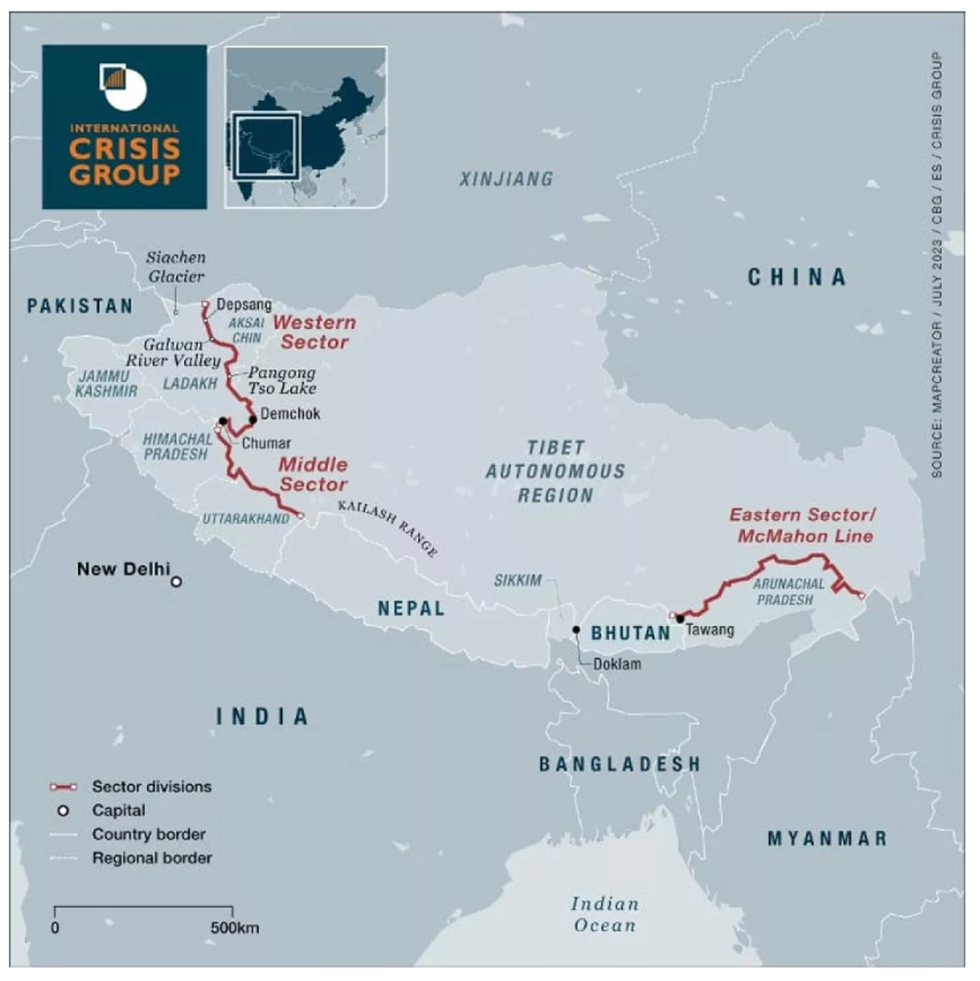
The Sino-Indian frontier in the Himalayas is the longest disputed border in the world and is loosely defined by the so-called ‘Line of Actual Control’ (LAC) (see below). The LAC is a division line that runs from eastern Ladakh (administered by India) and Aksai Chin (administered by China) (western sector) to Tibet (administered by China) and Arunachal Pradesh (administered by India) (eastern sector). It is interrupted in central portions by Nepal and Bhutan, with Sikkim standing between both and remaining contested.1A. Ayres, ‘The China-India Border Dispute: What to Know’, Council on Foreign Relations, 18 June 2020; W. Green, ‘Conflict on the Sino-Indian Border: Background for Congress’, U.S.-China Economic and Security Review Commission, Issue Brief, 2 July 2020, p 2; C. Rossi, ‘Interstitial Space and the High Himalayan Dispute between China and India’, Harvard International Law Journal, Vol. 62, No. 2, Summer 2021, pp 429–31; J.-T. Brethouwer et al, ‘Rising tension in the Himalayas: A geospatial analysis of Chinese border incursions into India’, PLOS ONE, Vol. 17, No. 11, November 2022;International Crisis Group, ‘Thin Ice in the Himalayas: Handling the India-China Border Dispute’, Report 334/Asia Pacific, 14 November 2023. The LAC lacks a mutually agreed-upon alignment or precise length. India estimates it to be approximately 3,488 km, whereas China describes the China–India boundary as roughly 2,000 km.2Embassy of the People’s Republic of China in Nepal, ‘China, India Resume Negotiation on Boundary Issue’, 26 October 2004; Government of India, Ministry of Home Affairs, Press Information Bureau, ‘Terrorism, Infiltration and border transgression should be stopped by the neighbours: Rajnath Singh – Union Home Minister begins three-day visit to border areas of J&K’, 21 September 2015; International Crisis Group, ‘Thin Ice in the Himalayas: Handling the India-China Border Dispute’, Report 334/Asia Pacific, 14 November 2023; ‘India says it reached deal with China on army patrols along disputed border’, Al Jazeera, 21 October 2024.
The western sector has never been officially demarcated. During the colonial period, British officials proposed various conflicting boundaries, such as the Johnson Line of 1865 (later known as the Ardagh-Johnson Line), which designated Aksai Chin as part of Jammu and Kashmir, and the 1899 Macartney-MacDonald proposal, which would have assigned most of the plateau to China. China has not formally accepted this proposal, and subsequent British maps lacked a consistent boundary. After independence, India adopted a boundary similar to the Ardagh-Johnson line, whereas China contended that the boundary had never been clearly defined, resulting in overlapping claims in this remote region.3 M. S. Pardesi, ‘The Legacy of 1962 and China’s India Policy’, Journal of Defence Studies, Vol. 6, No. 4, 2012, p 190; C. Rossi, ‘Interstitial Space and the High Himalayan Dispute between China and India’, Harvard International Law Journal, Vol. 62, No. 2, Summer 2021, pp 432 and 455-7.
The eastern sector was delimited during the 1913-1914 Simla Conference, where British India and Tibet agreed on the McMahon Line, which separates the Indian state of Arunachal Pradesh from Tibet, whereas China ultimately did not ratify the Simla Agreement. India regards this delineation as the inherited international boundary. Conversely, China rejects this assertion, primarily on the grounds that Tibet did not possess the requisite authority to negotiate an international boundary agreement independently of China.4M. S. Pardesi, ‘The Legacy of 1962 and China’s India Policy’, Journal of Defence Studies, Vol. 6, No. 4, 2012, pp 190-1; C. Rossi, ‘Interstitial Space and the High Himalayan Dispute between China and India’, Harvard International Law Journal, Vol. 62, No. 2, Summer 2021, pp 430, 432 and 456.
China’s Annexation of Tibet and Subsequent Events
In 1950-51, the People’s Republic of China (hereinafter China) invaded and annexed Tibet. As a result, the former India-Tibet border, with Tibet acting as a ‘buffer zone’ between China and India, turned into a directly administered China-India military frontier.5M. S. Pardesi, ‘The Legacy of 1962 and China’s India Policy’, Journal of Defence Studies, Vol. 6, No. 4, 2012, p 191; C. Rossi, ‘Interstitial Space and the High Himalayan Dispute between China and India’, Harvard International Law Journal, Vol. 62, No. 2 (Summer 2021), p 455.
In April 1954, India and China concluded the Agreement on Trade and Intercourse between the Tibet Region of China and India, which incorporated the Five Principles of Peaceful Coexistence ( mutual respect for territorial integrity and sovereignty, mutual non-aggression, mutual non-interference in internal affairs, equality and mutual benefit, and peaceful coexistence). This agreement governed trade and pilgrimage activities but did not establish definitive boundary demarcations, although India, through this agreement, acknowledged Chinese sovereignty over Tibet. Subsequently, India issued maps delineating a specific northern frontier, whereas China continued to regard the boundary as undelimited. 6Agreement between the Republic of India and the People’s Republic of China on Trade and Intercourse between Tibet Region of China and India, 29 April 1954; J. S. Jensen, ‘A Game of Chess and a Battle of Wits: India’s Forward Policy Decision in Late 1961’, Journal of Defence Studies, Vol. 6, No. 4 (2012), p 60; M. S. Pardesi, ‘The Legacy of 1962 and China’s India Policy’, Journal of Defence Studies, Vol. 6, No. 4 (2012), p 191; C. Rossi, ‘Interstitial Space and the High Himalayan Dispute between China and India’, Harvard International Law Journal, Vol. 62, No. 2 (Summer 2021), p 461.
However, between 1956 and 1957, China constructed a road linking Xinjiang and Tibet via Aksai Chin, thereby reinforcing its control over the region. India was taken by surprise, becoming aware of the project only after its completion. In 1959, Sino-Indian relations worsened further due to the March 1959 Tibetan uprising and India’s decision to grant asylum to the Dalai Lama.7D. Norbu, ‘Tibet in Sino-Indian Relations: The Centrality of Marginality’, Asian Survey, Vol. 37, No. 11, November 1997, pp 1085-6; J. S. Jensen, ‘A Game of Chess and a Battle of Wits: India’s Forward Policy Decision in Late 1961’, Journal of Defence Studies, Vol. 6, No. 4, 2012, pp 59-61; W. Green, ‘Conflict on the Sino-Indian Border: Background for Congress’, U.S.-China Economic and Security Review Commission, Issue Brief, 2 July 2020, p 2; C. Rossi, ‘Interstitial Space and the High Himalayan Dispute between China and India’, Harvard International Law Journal, Vol. 62, No. 2, Summer 2021, pp 434 and 459. These developments triggered a series of frontier incidents, diplomatic negotiations, and the militarization of the border, culminating in clashes between Indian and Chinese forces in 1959 at Pangong Lake (28 July), Longjiu (26 August), and the Kongka Pass (20 October).8 Note from the Government of India to the Government of China, The Nehru Archive, 13 December 1959; D. Norbu, ‘Tibet in Sino-Indian Relations: The Centrality of Marginality’, Asian Survey, Vol. 37, No. 11, November 1997, p 1086; J. S. Jensen, ‘A Game of Chess and a Battle of Wits: India’s Forward Policy Decision in Late 1961’, Journal of Defence Studies, Vol. 6, No. 4, 2012, pp 57 and 59-61; C. Rossi, ‘Interstitial Space and the High Himalayan Dispute between China and India’, Harvard International Law Journal, Vol. 62, No. 2, Summer 2021, p 434; S. Ganguly, M. S. Pardesi and W. R. Thompson, ‘Positional Issues and the 1962 Sino-Indian War’, The Sino-Indian Rivalry: Implications for Global Order, Cambridge University Press, 2023, p 82
Early 1960s’ Failed Negotiations and India’s Forward Policy
In April 1960, Chinese leader Zhou Enlai visited India and proposed that China would retain Aksai Chin while accepting Indian control in the eastern sector. India rejected this proposal, and subsequent discussions ensued, during which differing perspectives were articulated without reaching any consensus.9J. S. Jensen, ‘A Game of Chess and a Battle of Wits: India’s Forward Policy Decision in Late 1961’, Journal of Defence Studies, Vol. 6, No. 4, 2012, pp 57 and 62. In parallel, China resolved its border disputes with Burma (January 1960) and Nepal (March 1960), raising fears in India that China was aiming at isolating India.10S. Ganguly, M. S. Pardesi and W. R. Thompson, ‘Positional Issues and the 1962 Sino-Indian War’, The Sino-Indian Rivalry: Implications for Global Order, Cambridge University Press, 2023, pp 87-8.
In 1961, India shifted its position to a form of military pressure on China and adopted the ‘Forward Policy’, setting up small posts in disputed areas to assert its claims and block Chinese progress. China responded by establishing counter-posts and encircling Indian positions. This pattern of overlapping deployments was particularly evident in Aksai Chin, in the western sector. China viewed the Indian posts as intrusions into Chinese territory and attempts to undermine its control over Tibet, while India saw the policy as a reaction to ‘Chinese expansionism’.11J. S. Jensen, ‘A Game of Chess and a Battle of Wits: India’s Forward Policy Decision in Late 1961’, Journal of Defence Studies, Vol. 6, No. 4, 2012, pp 55-8 and 62-4; M. S. Pardesi, ‘The Legacy of 1962 and China’s India Policy’, Journal of Defence Studies, Vol. 6, No. 4, 2012, pp 191-2 and 199; S. Ganguly, M. S. Pardesi and W. R. Thompson, ‘Positional Issues and the 1962 Sino-Indian War’, The Sino-Indian Rivalry: Implications for Global Order, Cambridge University Press, 2023, pp 95-6.
1962 Sino-Indian War
Tensions reached a peak on 20 October 1962, when China launched coordinated military offensives in the western sector and across the McMahon Line in the North-East Frontier Agency, presently known as Arunachal Pradesh. Chinese forces rapidly overwhelmed numerous Indian positions, occupied Tawang, and advanced further south in the eastern sector. In the western sector, they dismantled Indian forward posts and established control over Aksai Chin. Between 2,600 and 8,000 Indian soldiers were killed, whereas the number of Chinese military casualties amounted to approximately 720 to 2,000 deaths. Close to 4,000 Indian soldiers were captured by China, while no Chinese soldiers were reportedly captured by India. Subsequently, China and India agreed to a ceasefire and established a de facto 20-km-wide demilitarized zone along the border. China withdrew from most territories captured during the eastern sector offensive but retained control of Aksai Chin in the western sector. The military positions established following the conflict contributed to the delineation of what is now recognized as the LAC, but the parties never agreed on its exact alignment, nor did they reach a peace treaty or a mutually accepted boundary.12W. Green, ‘Conflict on the Sino-Indian Border: Background for Congress’, U.S.-China Economic and Security Review Commission, Issue Brief, 2 July 2020, p 4.
Subsequent Clashes and Standoffs
A series of clashes followed the 1962 Sino-Indian War in the late 1960s and the 1970s. In mid-September 1967, Indian and Chinese forces fought for several days at Nathu La following a disagreement over India’s installation of wire fencing along the Sikkim-Tibet border (central sector), allegedly in response to repeated Chinese incursions. The confrontation involved machine guns, mortars and exchanges of artillery fire, and resulted in significant casualties for both sides. Further fighting occurred at Cho La on 1 October. Eventually, Indian forces repelled Chinese troops and retained their positions. Each State attributed responsibility for initiating the fighting to the other side.13V. Menon and N. Chatterjee, ‘Remembering the war we forgot: 51 years ago, how India gave China a bloody nose’, The Print, 1 October 2018; ‘India-China border tensions: Key dates in decades-long conflict’, Al Jazeera, 17 June 2020; W. Green, ‘Conflict on the Sino-Indian Border: Background for Congress’, U.S.-China Economic and Security Review Commission, Issue Brief, 2 July 2020, p 4. India reported that 80 Indian soldiers and 400 Chinese soldiers were killed.14‘India-China border tensions: Key dates in decades-long conflict’, Al Jazeera, 17 June 2020; W. Green, ‘Conflict on the Sino-Indian Border: Background for Congress’, U.S.-China Economic and Security Review Commission, Issue Brief, 2 July 2020, p 4. Another estimate suggested that 300 Chinese and over 200 Indian soldiers died.15V. Menon and N. Chatterjee, ‘Remembering the war we forgot: 51 years ago, how India gave China a bloody nose’, The Print, 1 October 2018.
On 20 October 1975, another incident occurred, resulting in the deaths of four Indian military personnel near Tulung La (eastern sector). India asserted that Chinese troops ambushed a patrol within Indian territory, while China claimed that Indian personnel crossed the boundary and that Chinese forces acted in self-defense. This incident marked the last fatal border confrontation until June 2020.16S. Shukla, ‘1975 Arunachal ambush — the last time Indian soldiers died in clash with China at LAC’, The Print, 16 June 2020; S. K. Prasad, ‘China and India just had their worst clash in forty-five years. What do we know?’, New Atlanticist, 17 June 2020.
In 1986, Chinese military units established positions at Wangdung in the Sumdorong Chu Valley (Arunachal Pradesh, near Thag La in the eastern sector), an area claimed by India and which had witnessed serious clashes during the 1962 Sino-Indian War. India responded by airlifting forces to nearby elevations, and both nations significantly reinforced their positions through early 1987, raising fears of a second Sino-Indian War.17Indian Army/Bharat Rakshak, ‘The Sumdorong Chu Incident’, 12 October 2006.
Renewed Political Dialogue, Confidence-Building Measures and Border-Management Framework
The Sumdorong Chu Valley standoff persisted into the first half of 1987, but did not escalate into fighting, owing to diplomatic visits and meetings between local commanders in the area (‘flag meetings’). Notably, tensions decreased following the Indian External Affairs Minister’s visit to China in May 1987, during which both sides stated their willingness to continue discussions on the border issue and to ease the situation at the border. Likewise, following Indian Prime Minister Rajiv Gandhi’s visit to China in December 1988, China and India formed a Joint Working Group to discuss boundary issues, including the alignment of the LAC.18Indian Army/Bharat Rakshak, ‘The Sumdorong Chu Incident’, 12 October 2006.
De-escalation advanced further when China and India signed an agreement in September 1993 in which they committed to respect the LAC and to diminish troop deployment along it. 19Agreement on the Maintenance of Peace and Tranquility along the Line of Actual Control in the India-China Border Areas, 7 September 1993; Indian Army/Bharat Rakshak, ‘The Sumdorong Chu Incident’, 12 October 2006. The agreement also provided confidence-building measures, limitation and notification of military exercises, and meetings and channels of communication in case of contingencies or other problems arising along the LAC.20Agreement on the Maintenance of Peace and Tranquility along the Line of Actual Control in the India-China Border Areas, 7 September 1993. Another agreement regarding military confidence-building measures was concluded in November 1996 and pursued the reduction of respective military presence along the LAC. This agreement established restrictions on firing, explosives, large-scale military exercises, combat aircraft, and major armaments near the LAC. Additionally, it outlined provisions for meetings between local commanders (‘flag meetings’), telecommunications, and procedures pertaining to accidental crossings and air intrusions.21Agreement between India and China on Confidence-Building Measures in the Military Field along the Line of Actual Control in the India-China Border Areas, 29 November 1996.
As a result, troops gradually withdrew from the Sumdorong Chu Valley, and by June 1999, no military personnel remained in the valley, with respective posts situated approximately one kilometre apart.22 Indian Army/Bharat Rakshak, ‘The Sumdorong Chu Incident’, 12 October 2006.
Political dialogue and bilateral cooperation continued to progress throughout the 2000s and early 2010s.23L. Zhang, ‘Past Bilateral Border Agreements between China and India and the June 15th Clash’, In Custodia Legis: Law Librarians of Congress, 17 July 2020. On 23 June 2003, China and India adopted the Declaration on Principles for Relations and Comprehensive Cooperation between the Republic of India and the People’s Republic of China, under which they notably agreed to appoint special representatives ‘to explore, from the political perspective of the overall bilateral relationship, the framework of a boundary settlement’. The mechanism of special representatives supplemented earlier technical and diplomatic exchanges.24Declaration on Principles for Relations and Comprehensive Cooperation between the Republic of India and the People’s Republic of China, 23 June 2003. Similarly, on 11 April 2005, both States reached the Agreement on Political Parameters and Guiding Principles for the Settlement of the India-China Boundary Question and the Protocol on the Modalities for the Implementation of Confidence-Building Measures in the Military Field along the Line of Actual Control in the India-China Border Areas. While the Agreement set out considerations for a final boundary settlement, the separate Protocol provided procedures for implementing military confidence-building measures, including steps to manage face-to-face situations between border personnel.25Agreement on Political Parameters and Guiding Principles for the Settlement of the India-China Boundary Question, 11 April 2005; Protocol on the Modalities for the Implementation of Confidence-Building Measures in the Military Field along the Line of Actual Control in the India-China Border Areas, 11 April 2005. On 17 January 2012, the Working Mechanism for Consultation and Coordination was established to create a diplomatic channel that brings together diplomatic and military experts on both sides to address situations affecting peace and tranquillity in the border areas and to complement the existing Special Representatives’ boundary negotiations or military-level mechanisms.26Agreement between the Government of the People’s Republic of China and the Government of the Republic of India on the Establishment of a Working Mechanism for Consultation and Coordination on China-Border Affairs, 17 January 2012; S. Singh Chadha, ‘Negotiating the India-China Standoff: 2020–2024’, Carnegie India, 11 December 2024. On 23 October 2013, China and India signed the Inter-State Border Defence Cooperation Agreement, which set out procedures for patrol encounters, provided for meetings at multiple levels, and enhanced communication. Notably, the agreement stipulated that, in the absence of a shared understanding of the LAC, neither side should follow or tail the other’s patrols.27Inter-State Border Defence Cooperation Agreement between India and China, 23 October 2013; S. Mehta, ‘Impasse at the LAC: An Examination of the 2013, 2014, and 2015 Standoffs’, Carnegie India, 31 August 2023.
These arrangements assisted in averting the escalation of the situation and mitigated the likelihood of armed confrontations between China and India. However, they did not encompass the formal delimitation of the LAC.
Return of Recurrent Confrontations and Standoffs
Because the LAC was not clearly defined, patrols continued entering areas claimed by the other side, leaving the system reliant on fragile self-restraint and communication, and resulting in repeated border standoffs and one clash throughout the 2010s.28S. Mehta, ‘Impasse at the LAC: An Examination of the 2013, 2014, and 2015 Standoffs’, Carnegie India, 31 August 2023.
Between 15 April and 5 May 2013, Indian and Chinese military personnel faced one another at close range following the installation of tents by Chinese troops in Raki Nala (Depsang plains), an area that India regarded as being on its side along the LAC. The involved parties ultimately withdrew without fighting after negotiations that reportedly resolved the issues related to troop deployments by both sides.29‘India says China agrees retreat to de facto border in faceoff deal’, Reuters, 6 May 2013; S. Mehta, ‘Impasse at the LAC: An Examination of the 2013, 2014, and 2015 Standoffs’, Carnegie India, 31 August 2023. In September 2014, a significant standoff took place around Chumar, involving hundreds of Indian and Chinese soldiers, following reports that Chinese troops had entered territory claimed by India. The Chinese troops were said to be building a temporary road in the region. After about three weeks of negotiations and mutual withdrawals, the situation de-escalated.30S. Miglani and F. Bukhari, ‘Chinese and Indian troops in Himalayan standoff’, Reuters, 23 September 2014; S. Mehta, ‘Impasse at the LAC: An Examination of the 2013, 2014, and 2015 Standoffs’, Carnegie India, 31 August 2023. In September 2015, another standoff took place at Burtse (Depsang plains) following Indian troops dismantling a Chinese watchtower-like structure near a patrol line. Local ‘flag meetings’ settled the dispute without any reported fighting.31‘India, China face-off at Burtse in Ladakh’, The Hindu, 13 September 2015; S. Mehta, ‘Impasse at the LAC: An Examination of the 2013, 2014, and 2015 Standoffs’, Carnegie India, 31 August 2023.
On 16 June 2017, China commenced constructing a road in Doklam toward the Jampheri/Zompelri Ridge. Bhutan formally protested that this construction contravened bilateral commitments to uphold the status quo. On 18 June, Indian forces entered the disputed region to stop the work. India contended that unilateral alterations near the trijunction could have significant security repercussions, whereas China, on the other hand, characterized the Indian deployment as an unlawful incursion into Chinese territory. The protracted standoff concluded with an agreed disengagement, publicly announced on 28 August, following a summit of the BRICS nations (a grouping that includes Brazil, Russia, India, China and South Africa). No exchanges of fire or casualties were reported.32Royal Government of Bhutan, Ministry of Foreign Affairs and External Trade, Press Release; T. Wilkes and B. Blanchard, ‘India and China agree to end border standoff at Doklam’, Reuters, 28 August 2017. In parallel, on 15 August 2017, Indian and Chinese soldiers clashed near Pangong Tso, using stones, physical force, and iron rods, following an alleged Chinese incursion in the Pangong lake area, a territory claimed by India. Both sides reported minor injuries, and the incident concluded without any gunfire.33S. Miglani and F. Bukhari, ‘India, China soldiers involved in border altercation: Indian sources’, Reuters, 16 August 2017.
In the aftermath of the Doklam incident (see above), President Xi Jinping and Prime Minister Narendra Modi convened informal summits in Wuhan in April 2018 and near Chennai in October 2019. These meetings temporarily stabilized political relations but did not clarify the LAC.34Eurasian Research Institute, ‘India-China Informal Summit: A Way to Deepen the Dialogue’; V. Prakash, ‘Sino-Indian informal summits: Wuhan, Mahabalipuram and beyond’, The Korea Times, 17 October 2019; Y. Joshi, ‘Noise over Substance – Modi-Xi Summit and Sino-Indian Relations’, Institute of South Asia Studies Insights, 24 October 2019.
China’s Belt and Road Initiative (BRI)
In 2013, China launched its ‘Silk Roads’ strategy, which was rebranded as the ‘One Belt, One Road’ in 2014 and then the ‘Belt and Road Initiative’ (BRI) in 2015, to challenge the current world order and counter US influence. The BRI is a long-term project that aims at building a network of roads, rail routes, oil and natural gas pipelines, and power grids to connect western China to Central Asia, Moscow, Rotterdam and Venice (‘Belt’), as well as a network of ports and other coastal infrastructure to connect China with Southeast Asia, South Asia, East Africa and the Mediterranean (‘Road’).35W. A. Callahan, ‘China’s Belt and Road Initiative and the New Eurasian Order‘, Norwegian Institute of International Affairs, Policy Brief (22/2016), p 1. Analysts described the Himalayas as being a key component of the BRI, especially through projects such as the China-Pakistan Economic Corridor (CPEC), The CPEC, an economic and development initiative promoting bilateral and regional connectivity to improve trade and economic cooperation, was completed in 2006 and has since been rebranded as a key BRI project36CPEC Secretariat, ‘Introduction’; W. A. Callahan, ‘China’s Belt and Road Initiative and the New Eurasian Order‘, Norwegian Institute of International Affairs, Policy Brief (22/2016), p 1; A. R. Singh, R. Katiyar and R. Kumar, ‘India-China relations and the Himalayan Region: Strategic interests and environmental concerns’, International Journal of Political Science and Governance, Vol. 7, No. 8, 2025, p 124. allowing China to project power and influence in South Asia and beyond.37A. R. Singh, R. Katiyar and R. Kumar, ‘India-China relations and the Himalayan Region: Strategic interests and environmental concerns’, International Journal of Political Science and Governance, Vol. 7, No. 8, 2025, pp 123-4.
May-June 2020 Crisis
In April and May 2020, large Chinese and Indian military deployments took place at various sites in eastern Ladakh, such as Pangong Tso, Galwan, Gogra-Hot Springs, and Depsang. India claimed China hindered its traditional patrolling and attempted to alter the existing boundaries, camping on what India claims to be its territory, while China accused India of crossing the LAC and expanding military and infrastructure activities along the border. On 5-6 May, a fistfight and stone-throwing incident occurred near Pangong Tso, resulting in 11 soldiers being injured on both sides.38S. Khalid, ‘‘All-out combat’ feared as India, China engage in border standoff’, Al Jazeera, 28 May 2020; C. Clary and V. Narang, ‘India’s Pangong Pickle: New Delhi’s Options After Its Clash with China’, War in the Rocks, 2 July 2020; W. Green, ‘Conflict on the Sino-Indian Border: Background for Congress’, U.S.-China Economic and Security Review Commission, Issue Brief, 2 July 2020, p 3. Following oral exchanges between senior local commanders, a preliminary agreement to disengage was reached on 6 June 2020. 39‘India, China implementing positive consensus aimed at easing tensions, says Beijing’, The Print, 11 June 2020; C. Clary and V. Narang, ‘India’s Pangong Pickle: New Delhi’s Options After Its Clash with China’, War in the Rocks, 2 July 2020. Nonetheless, another physical confrontation happened at Naku La in northern Sikkim on 9 May, which was reportedly resolved after ‘dialogue and interaction’ at a local level.40‘Indian and Chinese soldiers injured in cross-border fistfight, says Delhi’, The Guardian, 11 May 2020; S. Khalid, ‘‘All-out combat’ feared as India, China engage in border standoff’, Al Jazeera, 28 May 2020.
The fear of full-scale conflict partly came true during the night of 15–16 June 2020, in the Galwan Valley, where troops clashed for hours using stones, iron rods, wooden clubs, and nail-studded weapons. No firearms were reported. India stated that 20 soldiers died, while China eventually confirmed four military fatalities months later. China also captured and held for three days 10 Indian soldiers and asserted sovereignty over the entire Galwan Valley, a stance that significantly changed the status quo. Both sides accused each other of violating the 6 June disengagement agreement (see above) and provoking the clash. On 26 June 2020, both States announced that they would undertake disengagement and de-escalation in the area on the basis of the 6 June agreement.41D. Ghoshal, F. Bukhari and H. Wu, ‘India, China troops clash at Himalayan border, ‘casualties on both sides’’, Reuters, 16 June 2020; ‘China claims sovereignty over Galwan Valley, refuses to comment on Chinese casualties’, The Hindu Business Line, 17 June 2020; S. Aroor, ‘3 separate brawls, ‘outsider’ Chinese troops & more: Most detailed account of the brutal June 15 Galwan battle’, India Today, 22 June 2020; C. Clary and V. Narang, ‘India’s Pangong Pickle: New Delhi’s Options After Its Clash with China’, War in the Rocks, 2 July 2020; W. Green, ‘Conflict on the Sino-Indian Border: Background for Congress’, U.S.-China Economic and Security Review Commission, Issue Brief, 2 July 2020, p 3; ‘China reveals four soldiers killed in June 2020 border clash with India’, Reuters, 19 February 2021.
This was the first deadly border encounter between China and India since 1975 and turned the standoff into a long-lasting interstate crisis.42S. Singh Chadah, ‘Threading the Needle: India’s Path Forward with China’, Carnegie India, 2 July 2026.
On 29-30 August 2020, Indian and Chinese troops manoeuvred for control of strategic heights south of Pangong Tso. Indian forces occupied positions on the Kailash Range, accusing China of breaching the previous consensus reached in June. The contemporary Indian account stated that no direct physical clash occurred during the confrontation.43S. Miglani and D. Ghoshal, ‘-Indian army says thwarts Chinese attempt to occupy hill on disputed border’, Reuters, 21 August 2020. Moreover, on the night of 7 September 2020, shots were fired near a forward position. India said Chinese troops approached an Indian position and fired in the air. China alleged that Indian troops crossed the LAC and fired warning shots. No casualties were reported. This was the first mutually acknowledged use of firearms on the frontier in approximately 45 years.44S. Miglani and Y. L. Tian, ‘-India, China accuse each other of firing in the air on tense border’, Reuters, 8 September 2020; Government of India, Ministry of Defence, ‘Situation Update : Situation in Eastern Ladakh’, Press Release, 8 September 2020.
Convinced that escalation was not in either side’s interest, on 10 September 2020, the foreign ministers of both States met in Moscow and adopted a five-point political consensus encompassing disengagement, maintenance of distance between troops, observance of existing agreements, ongoing dialogue, and the implementation of new confidence-building measures. Nevertheless, numerous soldiers and substantial military equipment remained deployed along the border.45S. Singh Chadha, ‘Negotiating the India-China Standoff: 2020–2024’, Carnegie India, 11 December 2024. On 20 January 2021, Indian and Chinese forces reportedly clashed at Naku La in Sikkim. The Indian Army confirmed a minor engagement that was resolved at the local command level. While injuries were reported, the prevalent casualty figures circulating publicly have not been formally confirmed.46‘India says troops had “minor face-off” with China in Sikkim border area’, Reuters, 25 January 2021; Central Tibetan Administration, ‘India, China Troops Clash At Sikkim Border, 4 Indian, 20 Chinese Soldiers Injured’, 25 January 2021; ‘India, China troops clash at Naku La in Sikkim, injuries on both sides’, Times of India, 25 January 2021.
Subsequent Partial Disengagement and Persisting Tensions
Following the June 2020 standoff, China and India undertook negotiations at the politico-strategic level, through the Working Mechanism for Consultation and Coordination (see above), and at the military level between the two sides’ senior military commanders responsible for eastern Ladakh, to resolve the situation in the border areas and engage the disengagement process along the LAC in the western sector.47S. Singh Chadha, ‘Negotiating the India-China Standoff: 2020–2024’, Carnegie India, 11 December 2024.
As a result, in February 2021, both parties completed a phased disengagement from the northern and southern banks of Pangong Tso, a contested high-altitude lake in the western sector of the LAC, where both China and India had advanced positions in August 2020 (see above). Subsequently, in August 2021, the parties agreed to an additional disengagement at the Gogra Hot Springs area in the western sector of the LAC. Furthermore, between 8 and 12 September 2022, India and China completed a phased and verified disengagement at Gogra-Hot Springs. These arrangements provided for the dismantling of defence structures and the withdrawal of troops, which reduced the likelihood of immediate troop contact and limited patrolling at these sites, creating a series of buffer zones in eastern Ladakh.48S. Miglani, ‘India, China agree to pull back troops from disputed Himalayan lake’, Reuters, 11 February 2021; Government of India, Ministry of Defence, Press Information Bureau, ‘Press release: Disengagement at PP 17A’, 6 August 2021; Government of India, Ministry of Defence, Press Information Bureau, ‘Joint Statement ’, 8 September 2022; ‘Indian and Chinese troops disengaging from western Himalayan area’, Reuters, 9 September 2022; International Crisis Group, ‘Thin Ice in the Himalayas: Handling the India-China Border Dispute’, Report 334/Asia Pacific, 14 November 2023; R. Pandit, ‘China continues LAC infrastructure build-up 4 years into face-off, shows latest sat imagery’, Times of India, 29 April 2024; S. Singh Chadha, ‘Negotiating the India-China Standoff: 2020–2024’, Carnegie India, 11 December 2024.
However, several other disputed areas remained unresolved. Notably, in late September 2021, patrols reportedly engaged in pushing and jostling in the Yangtse region (Tawang sector of Arunachal Pradesh) in the eastern sector of the LAC before local commanders secured disengagement. No injuries or weapons use were reported.49K. Kaushik, ‘Indian, Chinese patrols face-off in Tawang ahead of Corps Commander talks’, The Indian Express, 8 October 2021. The situation in the Yangtse region escalated further on 9 December 2022 when Indian and Chinese troops engaged in close-quarters confrontation. India asserted that Chinese troops attempted to transgress the LAC and alter the status quo, whereas China claimed that Indian troops illegally crossed the line and impeded a routine patrol. Personnel on both sides sustained injuries, with no fatalities reported, and the forces disengaged shortly thereafter.50K. N. Das and S. Ganguly, ‘India reports injuries on both sides in minor border clash with China’, Reuters, 12 December 2022; Government of India, Ministry of Defence, ‘Translation of Raksha Mantri’s Statement in Parliament’, 13 December 2022. Likewise, the issues at Depsang and Demchok in eastern Ladakh (western sector of the LAC), where Chinese troops took up positions in April and May 2022, thereby restricting Indian troops’ ability to patrol certain areas, continued to be disputed until October 2024 (see below).51P. Aguiar, ‘India-China Border Agreement: A Tactical Step, No Strategic Reset’, Geopolitical Monitor, 7 November 2024; S. Singh Chadha, ‘Negotiating the India-China Standoff: 2020–2024’, Carnegie India, 11 December 2024. These regions are important due to their strategic proximity to military facilities and infrastructure.52P. Aguiar, ‘India-China Border Agreement: A Tactical Step, No Strategic Reset’, Geopolitical Monitor, 7 November 2024
More broadly, even though the border seems to have stabilized since 2020, tensions persisted as both sides strengthened their positions by deploying a combined total of 100,000 troops backed by artillery, tanks and fighter jets, and establishing additional infrastructure along the LAC.53International Crisis Group, ‘Thin Ice in the Himalayas: Handling the India-China Border Dispute’, Report 334/Asia Pacific, 14 November 2023; ‘India says it reached deal with China on army patrols along disputed border’, Al Jazeera, 21 October 2024. In particular, China continued to build border infrastructure, notably roads and settlements, and to strengthen military positions along the LAC, including in the buffer zones established after the 2020 partial disengagement in eastern Ladakh and in areas that India considers its own. 54International Crisis Group, ‘Thin Ice in the Himalayas: Handling the India-China Border Dispute’, Report 334/Asia Pacific, 14 November 2023; R. Pandit, ‘China continues LAC infrastructure build-up 4 years into face-off, shows latest sat imagery’, Times of India, 29 April 2024; P. Aguiar, ‘India-China Border Agreement: A Tactical Step, No Strategic Reset’, Geopolitical Monitor, 7 November 2024. Moreover, in response to the 2020 clash, India increased scrutiny of Chinese investment, banned popular Chinese apps such as TikTok, and suspended direct passenger flights between the two countries.55‘India Refusing to Restart Direct Passenger Flights With China’, Asia Financial, 21 June 2024; P. Aguiar, ‘India-China Border Agreement: A Tactical Step, No Strategic Reset’, Geopolitical Monitor, 7 November 2024.
From 2023 until mid-August 2026, there were no reported direct clashes or standoffs between Chinese and Indian troops, aside from one disputed skirmish believed to have occurred in 2026 at Taksing (Arunachal Pradesh) (see below). Since June 2020, both sides have suspended patrolling in several areas along the LAC in eastern Ladakh to avoid new confrontations (see above). Nevertheless, fortified positions and substantial deployments of troops and equipment have remained in place. Furthermore, both countries continue to expand their military infrastructure along the LAC, building roads, bases, and logistical networks that facilitate rapid troop movements to contested zones. In particular, China has continued to develop ‘dual-use’ villages and military outposts near the border, whereas India has undertaken projects such as the Sela Tunnel, which ensures year-round access to its northeastern border areas, and has strengthened its road networks in the region. In parallel, the parties have maintained ongoing military and political dialogue. However, no additional disengagement agreements were announced until October 2024, when China and India reached a breakthrough agreement that initiated the normalization of their relations.56‘China, India must step back from Himalayan border confrontation – Indian minister’, Reuters, 8 June 2023; International Crisis Group, ‘Thin Ice in the Himalayas: Handling the India-China Border Dispute’, Report 334/Asia Pacific, 14 November 2023; K. Kaushik, F. Bukhari and S. Jamkhandikar, ‘India, China reach pact to resolve border conflict, Indian foreign minister says’, Reuters, 21 October 2024; ‘India says it reached deal with China on army patrols along disputed border’, Al Jazeera, 21 October 2024; P. Aguiar, ‘India-China Border Agreement: A Tactical Step, No Strategic Reset’, Geopolitical Monitor, 7 November 2024; S. Singh Chadha, ‘Negotiating the India-China Standoff: 2020–2024’, Carnegie India, 11 December 2024; ‘India won’t reduce troops along China border in winter, army chief says’, Reuters, 13 January 2025; S. Singh Chadah, ‘Threading the Needle: India’s Path Forward with China’, Carnegie India, 2 July 2026; A. Prabal, ‘Indo-China border: Did India give up Arunachal’s ‘Shera 5’ after 2023 skirmish?’, National Herald, 14 August 2026.
Confrontation between Chinese Military and Ladakhi Herders in Kakjun/Skakjung
On 2 January 2024, Chinese troops, accompanied by armoured vehicles, confronted Ladakhi herders in Kakjun/Skakjung (Chushul Valley, Ladakh) in the western sector of the LAC over the denial of access to traditional grazing lands. According to accounts, as Chinese troops directed the herders and their livestock away, a herder threw a stone at an approaching Chinese military vehicle but missed. No injuries or damage were reported, and Indian troops were not present at the time of the incident. After the clash, the herders were forced to move out of the area. According to a local councillor, Chinese personnel had entered about one km into territory claimed by India.57J. Ali, ‘Ladakh: Local Herders Clash With Chinese Soldiers Over Access to Grazing Land’, The Wire, 30 January 2024; B. Masood, ‘Chinese soldiers ask Ladakh shepherds not to graze cattle near LAC, councillor says nomads stood firm’, The Indian Express, 1 February 2024; T. Cheodon and T. Pema, ‘Video captures Chinese soldiers confronting Tibetan herders’, Radio Free Asia, 2 February 2024.
Patrolling Agreement and Completion of Previous Disengagement
Since the confrontation between Chinese military and Ladakhi herders in January 2024, there have been no further incidents of violence. Instead, on 21 October 2024, just before the BRICS summit in Russia, Indian Prime Minster Narendra Modi and Chinese President Xi Jinping, aiming to sustain their economic growth through enhanced peace and security, reached an unpublished agreement on patrolling arrangements along the Line of Actual Control in India-China border areas, including the remaining friction points of Depsang and Demchok in eastern Ladakh, completing the disengagement process that began in 2020 (see above). Under this agreement, both sides will withdraw their troops from their current positions while continuing to patrol on a set schedule and closely monitor contested areas in eastern Ladakh, notably in Depsang and Demchok (see above), to prevent violations and avert direct stand-offs. Civilian grazing has also been restored.58K. Kaushik, F. Bukhari and S. Jamkhandikar, ‘India, China reach pact to resolve border conflict, Indian foreign minister says’, Reuters, 21 October 2024; ‘India says it reached deal with China on army patrols along disputed border’, Al Jazeera, 21 October 2024; S. Haidar, ‘Reached agreement with China on LAC patrolling, resolution of friction points: India’, The Hindu, 22 October 2024; P. Aguiar, ‘India-China Border Agreement: A Tactical Step, No Strategic Reset’, Geopolitical Monitor, 7 November 2024; Government of India, Ministry of Foreign Affairs, ‘Question No- 1199 Recently Signed Border Agreements with China’, Parliament Q & A, 5 December 2024; Government of India, Ministry of Foreign Affairs, ‘Question No- 843 Indo-China Agreement on Border-Related Issues’, Parliament Q & A, 7 February 2025; S. Singh Chadah, ‘Threading the Needle: India’s Path Forward with China’, Carnegie India, 2 July 2026. Consequently, troop numbers have comparatively diminished, and forces have reverted to their pre-April 2020 deployments. Notably, both nations withdrew troops from the face-off positions in Depsang and Demchok by 30 October 2024. However, China and India have sustained a military presence along the border region.59‘India, China complete troops pull-back from border face-off points, Indian official says’, Reuters, 20 October 2024; V. Som, ‘NDTV Exclusive: 1st Images Of Chinese Troops’ Disengagement In Ladakh’, NDTV World News, 25 October 2024; ‘India won’t reduce troops along China border in winter, army chief says’, Reuters, 13 January 2025. Analysts have estimated that between 50,000 and 60,000 troops remain deployed by both parties along the border.60A. N. Dutta, ‘India, China test new trust-building steps at LAC: More cameras, fewer clashes’, The Indian Express, 20 October 2025; S. Singh Chadah, ‘Threading the Needle: India’s Path Forward with China’, Carnegie India, 2 July 2026. Indian patrols have resumed access to Depsang, Demchok and Charding Nullah, and patrols have been coordinated in advance to prevent Indian and Chinese patrols from arriving simultaneously.61 A. N. Dutta and D. Tiwary, ‘India China border agreement: Patrol rights in Depsang Plains, Demchok to be restored, will be closely coordinated’, The Indian Express, 22 October 2024. Previous disengagements undertaken between 2020 and 2022 have continued to apply.62 Government of India, Ministry of External Affairs, ‘Statement by External Affairs Minister, Dr. S. Jaishankar in Lok Sabha’, 3 December 2024. Since the October 2024 Patrolling Agreement, further patrolling arrangements have reportedly been negotiated, and de-escalation has been deemed to be underway by both sides.63S. Singh Chadah, ‘Threading the Needle: India’s Path Forward with China’, Carnegie India, 2 July 2026.
Gradual Normalization of Relations between China and India
Since the Patrolling Agreement was adopted in late October 2024 (see above), numerous military, political, and diplomatic meetings between India and China on the boundary issue, notably the Ladakh standoff, have been held through pre-existing mechanisms (see above), thereby contributing to the normalization of bilateral relations and the maintenance of peace and security along the border.64S. Singh Chadah, ‘Threading the Needle: India’s Path Forward with China’, Carnegie India, 2 July 2026. In parallel, border management protocols and confidence-building measures have been underway to manage border activities, coordinate patrols and avoid standoffs. In particular, meetings between local military commanders that were set up in eastern Ladakh following the 2020 crisis (see above) have been expanded to remaining sectors of the LAC.65Government of India, Ministry of External Affairs, ‘Visit of China’s Foreign Minister and Special Representative on the India-China Boundary Question’, 19 August 2025; Ministry of Foreign Affairs of the People’s Republic of China, ‘Ten Points of Consensus for t he 24th Round of Talks Between the Special Representatives of China and India on the Boundary Question’, 20 August 2025; S. Singh Chadah, ‘Threading the Needle: India’s Path Forward with China’, Carnegie India, 2 July 2026. The special representatives’ mechanism, which had been paused since 2019, was also reactivated in December 2024.66Government of India, Ministry of External Affairs, ‘23rd Meeting of the Special Representatives of India and China’, Press Release, 18 December 2024; Ministry of Foreign Affairs of the People’s Republic of China, ‘Special Representatives on the China-India Boundary Question Meet in Beijing’, 18 December 2024; S. Singh Chadah, ‘Threading the Needle: India’s Path Forward with China’, Carnegie India, 2 July 2026. Furthermore, exchanges have occurred across various additional areas, thereby facilitating the resumption and expansion of the Kailash Mansarovar pilgrimage, border trade, direct flights between the two nations, visa processes, as well as exchanges in business, media, think tanks, and civil society.67Government of India, Ministry of External Affairs, ‘Visit of Foreign Secretary to China’, Press Release, 27 January 2025; Ministry of Foreign Affairs of the People’s Republic of China, ‘The Meeting of the Foreign Secretary-Vice Minister Mechanism between China and India Held in Beijing’, 28 January 2025; M. Mishra, ‘India and China Resume Direct Flights as Modi-Xi Ties Warm Up’, Bloomberg, 26 October 2025; S. Singh Chadah, ‘Threading the Needle: India’s Path Forward with China’, Carnegie India, 2 July 2026. Notably, India removed restrictions and eased Chinese investments in March 2026.68Government of India, Cabinet, Press Information Bureau, ‘Cabinet Approves Changes in Guidelines on Investments from Countries Sharing Land Border with India’, Press Release, 10 March 2026; T. C. A. S. Raghavan, ‘Government Eases FDI Norms for China, Other Countries Sharing Land Border with India’, The Hindu, 10 March 2026; A. Krishnan, ‘India Opens to Chinese Investment: What Amending PN3 Means for India-China Relation’, The India China Newsletter, 11 March 2026; D. Pal, ‘Amending Press Note 3 Was the Easy Part’, Medium, 14 March 2026; A. Kumar and P. Kotasthane, ‘Opening the Doors for Chinese Investment Again, with Caution’, Hindustan Times, 1 April 2026. As a result, economic relations have strengthened, and interdependence has increased.69R. D. Mishra, ‘India’s top trade partner: China regains spot on higher imports’, The Indian Express, 13 May 2024; P. Aguiar, ‘India-China Border Agreement: A Tactical Step, No Strategic Reset’, Geopolitical Monitor, 7 November 2024.
The public narrative in both countries, which was mainly adversarial since 2020, has also been reframed more positively to highlight the advantages of bilateral relations.70S. Singh Chadah, ‘Threading the Needle: India’s Path Forward with China’, Carnegie India, 2 July 2026. For instance, on 31 August 2025, both Chinese and Indian leaders, Prime Minister Narendra Modi and President Xi Jinping, agreed that India and China are development partners, not rivals, during Modi’s first visit to China in seven years.71L. Chen and M. M. Chu, ‘India and China are partners, not rivals, Modi and Xi say’, Reuters, 31 August 2025. On 22 June 2026, India said that ties with China have been normalizing during a top officials’ meeting between both countries in New Delhi.72‘India says ties with China normalising as top officials meet in Delhi’, Reuters, 22 June 2026. Likewise, in late July 2026, Indian Foreign Minister S. Jaishankar pressed China to address issues of market access, trade balance and supply chain predictability, while emphasising that both sides have engaged to ensure peace and tranquillity in the border area and that bilateral trade volume has reached new records, highlighting the shift from a military standoff to the normalization of relations.73‘India presses China to tackle issues of market access, trade balance’, Reuters, 22 July 2026.
According to an Indian fact-finding team, China has gradually denied Indian patrols access and encroached on land at a border patrolling point (Shera-5) after the Indian Army had abandoned it following a 2023 skirmish between China and India. Local communities blamed the central and regional governments for their inaction and for having ‘turned their back on the people at the border’.74A. Prabal, ‘Indo-China border: Did India give up Arunachal’s ‘Shera 5’ after 2023 skirmish?’, National Herald, 14 August 2026; Y. Sharma, ‘How China-India border tensions are rising again over encroachment claims’, Al Jazeera, 17 August 2026. However, the Indian Army deemed the reported tensions ‘incorrect and without any basis’,75S. Sharma and T. Agarwala, ‘India says border peace critical to ties with China amid reports of military tensions’, Reuters, 12 August 2026; A. Prabal, ‘Indo-China border: Did India give up Arunachal’s ‘Shera 5’ after 2023 skirmish?’, National Herald, 14 August 2026; Y. Sharma, ‘How China-India border tensions are rising again over encroachment claims’, Al Jazeera, 17 August 2026. while the Indian Foreign Ministry has stated that it ‘consider[s] [border] issues as most serious and […] the maintenance of peace and tranquillity in these areas is of the utmost importance’ and that the ‘state of border affairs will reflect on the state of our larger bilateral ties’. China’s Foreign Ministry described the ‘China-India border situation [a]s generally stable at the moment’.76S. Sharma and T. Agarwala, ‘India says border peace critical to ties with China amid reports of military tensions’, Reuters, 12 August 2026; A. Prabal, ‘Indo-China border: Did India give up Arunachal’s ‘Shera 5’ after 2023 skirmish?’, National Herald, 14 August 2026; Y. Sharma, ‘How China-India border tensions are rising again over encroachment claims’, Al Jazeera, 17 August 2026. Nevertheless, in late July 2026, when responding to China’s claim that India said that it ‘respects China’s sovereignty’ over Taiwan and Tibet, the Indian Minister of External Affairs stated that China ‘has been in illegal occupation of Indian territory in Jammu & Kashmir and Ladakh since 1963’,77K. Padmanabhan, ‘New Delhi raises Chinese occupation of Indian territory as it counters Beijing’s ‘sovereignty’ claim’, The Print, 24 July 2026. indicating that political tensions persist.
International Armed Conflict Between China and India (ended by October 2024) Ended October 2024
An international armed conflict (IAC) occurs when one or more States resort to armed force against another State, irrespective of the intensity of the violence or the subjective determinations of the States concerned.1ICTY, The Prosecutor v. Dusko Tadic: Decision on the Defence Motion for Interlocutory Appeal on Jurisdiction, Judgment (Appeals Chamber), Case No IT-94-1-AR72, 2 October 1995, para 70; ICRC, 2016 Commentary, paras 218–19; ICRC, How is the term “armed conflict” defined in international humanitarian law?, Opinion Paper, 2024, pp 9–10. In other words, for an IAC to exist, ‘there is no requirement that the use of armed force between the Parties reach a certain level of intensity’.2ICRC, 2016 Commentary, para 236. Therefore, ‘[e]ven minor skirmishes between the armed forces – be they land, air or naval forces – may spark an IAC and lead to the applicability of IHL.’3 ICRC, How is the term “armed conflict” defined in international humanitarian law?, Opinion Paper, 2024, p 9. Likewise, ‘[e]ven if none of the Parties recognizes the existence of a state of war or of an armed conflict, humanitarian law would still apply provided that an armed conflict is in fact in existence. […] The fact that a State does not, for political or other reasons, explicitly refer to the existence of an armed conflict […] in a particular situation does not prevent it from being legally classified as such.’4ICRC, 2016 Commentary, para 213. Conversely, an IAC is deemed to have ended with the general close of military operations, which includes not only the cessation of active hostilities, but also the end of ‘military movements of a bellicose nature, including those that reform, reorganize or reconstitute, so that the likelihood of the resumption of hostilities can reasonably be discarded’.5 ICRC, 2016 Commentary, para 278; ICRC, How is the term “armed conflict” defined in international humanitarian law?, Opinion Paper, 2024, p 10. In particular, according to ICRC’s updated Commentary, ‘the fact of redeploying troops along the border to build up military capacity or mobilizing or deploying troops for defensive or offensive purposes should be regarded as military measures with a view to combat. Even in the absence of active hostilities, such military operations having a continuing nexus with the international armed conflict will justify maintaining the classification of the situation as an international armed conflict.’6 ICRC, 2016 Commentary, para 279.
Several arguments support declassifying the pre-existing IAC between China and India.
Recurrent incidents of violence and stand-offs between Chinese and Indian troops along the disputed border over the past decades were recorded (see above) and amounted to an IAC. However, as detailed above, since the clashes of mid-June 2022 (or the alleged skirmishes of 2023 at the latest), no further hostilities between the two military forces have been reported. Nevertheless, until the implementation of the October 2024 Patrolling Agreement, bellicose military movements, including the deployment of Chinese and Indian troops along the border aimed at enhancing military capacity for defensive and offensive purposes, were documented in the western sector of the LAC. The western sector, compared to other sectors, is considered ‘the center of gravity of the dispute’, recording the largest number of incursions between 2006 and 2020 by far.7 J.-T. Brethouwer et al, ‘Rising tension in the Himalayas: A geospatial analysis of Chinese border incursions into India’, PLOS ONE, Vol. 17, No. 11, November 2022. However, since October 2024, both parties have undertaken to complete their disengagement in the western sector, which began in 2020. Accordingly, both sides withdrew their troops from the conflicting positions. While they maintain a military presence and continue to patrol the area, these patrols are conducted on a set schedule, and contested areas in eastern Ladakh are closely monitored by China and India to avoid further incidents. Furthermore, although a hostile incident was purportedly reported in the eastern sector during the summer of 2026, it is the sole alleged incident within the 2023-2026 period, its very existence has been disputed, and it was never officially acknowledged by either China or India. In parallel, relations between India and China have progressively normalized, and economic exchanges have increased.
Consequently, for the time being, the previous IAC between China and India must be declassified as of the end of October 2024.
- 1ICTY, The Prosecutor v. Dusko Tadic: Decision on the Defence Motion for Interlocutory Appeal on Jurisdiction, Judgment (Appeals Chamber), Case No IT-94-1-AR72, 2 October 1995, para 70; ICRC, 2016 Commentary, paras 218–19; ICRC, How is the term “armed conflict” defined in international humanitarian law?, Opinion Paper, 2024, pp 9–10. ↩︎
- 2
- 3ICRC, How is the term “armed conflict” defined in international humanitarian law?, Opinion Paper, 2024, p 9. ↩︎
- 4
- 5ICRC, 2016 Commentary, para 278; ICRC, How is the term “armed conflict” defined in international humanitarian law?, Opinion Paper, 2024, p 10. ↩︎
- 6
- 7J.-T. Brethouwer et al, ‘Rising tension in the Himalayas: A geospatial analysis of Chinese border incursions into India’, PLOS ONE, Vol. 17, No. 11, November 2022. ↩︎
State Parties
- China
- India
- 1A. Ayres, ‘The China-India Border Dispute: What to Know’, Council on Foreign Relations, 18 June 2020; W. Green, ‘Conflict on the Sino-Indian Border: Background for Congress’, U.S.-China Economic and Security Review Commission, Issue Brief, 2 July 2020, p 2; C. Rossi, ‘Interstitial Space and the High Himalayan Dispute between China and India’, Harvard International Law Journal, Vol. 62, No. 2, Summer 2021, pp 429–31; J.-T. Brethouwer et al, ‘Rising tension in the Himalayas: A geospatial analysis of Chinese border incursions into India’, PLOS ONE, Vol. 17, No. 11, November 2022;International Crisis Group, ‘Thin Ice in the Himalayas: Handling the India-China Border Dispute’, Report 334/Asia Pacific, 14 November 2023. ↩︎
- 2Embassy of the People’s Republic of China in Nepal, ‘China, India Resume Negotiation on Boundary Issue’, 26 October 2004; Government of India, Ministry of Home Affairs, Press Information Bureau, ‘Terrorism, Infiltration and border transgression should be stopped by the neighbours: Rajnath Singh – Union Home Minister begins three-day visit to border areas of J&K’, 21 September 2015; International Crisis Group, ‘Thin Ice in the Himalayas: Handling the India-China Border Dispute’, Report 334/Asia Pacific, 14 November 2023; ‘India says it reached deal with China on army patrols along disputed border’, Al Jazeera, 21 October 2024. ↩︎
- 3M. S. Pardesi, ‘The Legacy of 1962 and China’s India Policy’, Journal of Defence Studies, Vol. 6, No. 4, 2012, p 190; C. Rossi, ‘Interstitial Space and the High Himalayan Dispute between China and India’, Harvard International Law Journal, Vol. 62, No. 2, Summer 2021, pp 432 and 455-7. ↩︎
- 4M. S. Pardesi, ‘The Legacy of 1962 and China’s India Policy’, Journal of Defence Studies, Vol. 6, No. 4, 2012, pp 190-1; C. Rossi, ‘Interstitial Space and the High Himalayan Dispute between China and India’, Harvard International Law Journal, Vol. 62, No. 2, Summer 2021, pp 430, 432 and 456. ↩︎
- 5M. S. Pardesi, ‘The Legacy of 1962 and China’s India Policy’, Journal of Defence Studies, Vol. 6, No. 4, 2012, p 191; C. Rossi, ‘Interstitial Space and the High Himalayan Dispute between China and India’, Harvard International Law Journal, Vol. 62, No. 2 (Summer 2021), p 455. ↩︎
- 6Agreement between the Republic of India and the People’s Republic of China on Trade and Intercourse between Tibet Region of China and India, 29 April 1954; J. S. Jensen, ‘A Game of Chess and a Battle of Wits: India’s Forward Policy Decision in Late 1961’, Journal of Defence Studies, Vol. 6, No. 4 (2012), p 60; M. S. Pardesi, ‘The Legacy of 1962 and China’s India Policy’, Journal of Defence Studies, Vol. 6, No. 4 (2012), p 191; C. Rossi, ‘Interstitial Space and the High Himalayan Dispute between China and India’, Harvard International Law Journal, Vol. 62, No. 2 (Summer 2021), p 461. ↩︎
- 7D. Norbu, ‘Tibet in Sino-Indian Relations: The Centrality of Marginality’, Asian Survey, Vol. 37, No. 11, November 1997, pp 1085-6; J. S. Jensen, ‘A Game of Chess and a Battle of Wits: India’s Forward Policy Decision in Late 1961’, Journal of Defence Studies, Vol. 6, No. 4, 2012, pp 59-61; W. Green, ‘Conflict on the Sino-Indian Border: Background for Congress’, U.S.-China Economic and Security Review Commission, Issue Brief, 2 July 2020, p 2; C. Rossi, ‘Interstitial Space and the High Himalayan Dispute between China and India’, Harvard International Law Journal, Vol. 62, No. 2, Summer 2021, pp 434 and 459. ↩︎
- 8Note from the Government of India to the Government of China, The Nehru Archive, 13 December 1959; D. Norbu, ‘Tibet in Sino-Indian Relations: The Centrality of Marginality’, Asian Survey, Vol. 37, No. 11, November 1997, p 1086; J. S. Jensen, ‘A Game of Chess and a Battle of Wits: India’s Forward Policy Decision in Late 1961’, Journal of Defence Studies, Vol. 6, No. 4, 2012, pp 57 and 59-61; C. Rossi, ‘Interstitial Space and the High Himalayan Dispute between China and India’, Harvard International Law Journal, Vol. 62, No. 2, Summer 2021, p 434; S. Ganguly, M. S. Pardesi and W. R. Thompson, ‘Positional Issues and the 1962 Sino-Indian War’, The Sino-Indian Rivalry: Implications for Global Order, Cambridge University Press, 2023, p 82 ↩︎
- 9J. S. Jensen, ‘A Game of Chess and a Battle of Wits: India’s Forward Policy Decision in Late 1961’, Journal of Defence Studies, Vol. 6, No. 4, 2012, pp 57 and 62. ↩︎
- 10S. Ganguly, M. S. Pardesi and W. R. Thompson, ‘Positional Issues and the 1962 Sino-Indian War’, The Sino-Indian Rivalry: Implications for Global Order, Cambridge University Press, 2023, pp 87-8. ↩︎
- 11J. S. Jensen, ‘A Game of Chess and a Battle of Wits: India’s Forward Policy Decision in Late 1961’, Journal of Defence Studies, Vol. 6, No. 4, 2012, pp 55-8 and 62-4; M. S. Pardesi, ‘The Legacy of 1962 and China’s India Policy’, Journal of Defence Studies, Vol. 6, No. 4, 2012, pp 191-2 and 199; S. Ganguly, M. S. Pardesi and W. R. Thompson, ‘Positional Issues and the 1962 Sino-Indian War’, The Sino-Indian Rivalry: Implications for Global Order, Cambridge University Press, 2023, pp 95-6. ↩︎
- 12W. Green, ‘Conflict on the Sino-Indian Border: Background for Congress’, U.S.-China Economic and Security Review Commission, Issue Brief, 2 July 2020, p 4. ↩︎
- 13V. Menon and N. Chatterjee, ‘Remembering the war we forgot: 51 years ago, how India gave China a bloody nose’, The Print, 1 October 2018; ‘India-China border tensions: Key dates in decades-long conflict’, Al Jazeera, 17 June 2020; W. Green, ‘Conflict on the Sino-Indian Border: Background for Congress’, U.S.-China Economic and Security Review Commission, Issue Brief, 2 July 2020, p 4. ↩︎
- 14‘India-China border tensions: Key dates in decades-long conflict’, Al Jazeera, 17 June 2020; W. Green, ‘Conflict on the Sino-Indian Border: Background for Congress’, U.S.-China Economic and Security Review Commission, Issue Brief, 2 July 2020, p 4. ↩︎
- 15V. Menon and N. Chatterjee, ‘Remembering the war we forgot: 51 years ago, how India gave China a bloody nose’, The Print, 1 October 2018. ↩︎
- 16S. Shukla, ‘1975 Arunachal ambush — the last time Indian soldiers died in clash with China at LAC’, The Print, 16 June 2020; S. K. Prasad, ‘China and India just had their worst clash in forty-five years. What do we know?’, New Atlanticist, 17 June 2020. ↩︎
- 17Indian Army/Bharat Rakshak, ‘The Sumdorong Chu Incident’, 12 October 2006. ↩︎
- 18Indian Army/Bharat Rakshak, ‘The Sumdorong Chu Incident’, 12 October 2006. ↩︎
- 19Agreement on the Maintenance of Peace and Tranquility along the Line of Actual Control in the India-China Border Areas, 7 September 1993; Indian Army/Bharat Rakshak, ‘The Sumdorong Chu Incident’, 12 October 2006. ↩︎
- 20
- 21
- 22Indian Army/Bharat Rakshak, ‘The Sumdorong Chu Incident’, 12 October 2006. ↩︎
- 23L. Zhang, ‘Past Bilateral Border Agreements between China and India and the June 15th Clash’, In Custodia Legis: Law Librarians of Congress, 17 July 2020. ↩︎
- 24
- 25Agreement on Political Parameters and Guiding Principles for the Settlement of the India-China Boundary Question, 11 April 2005; Protocol on the Modalities for the Implementation of Confidence-Building Measures in the Military Field along the Line of Actual Control in the India-China Border Areas, 11 April 2005. ↩︎
- 26Agreement between the Government of the People’s Republic of China and the Government of the Republic of India on the Establishment of a Working Mechanism for Consultation and Coordination on China-Border Affairs, 17 January 2012; S. Singh Chadha, ‘Negotiating the India-China Standoff: 2020–2024’, Carnegie India, 11 December 2024. ↩︎
- 27Inter-State Border Defence Cooperation Agreement between India and China, 23 October 2013; S. Mehta, ‘Impasse at the LAC: An Examination of the 2013, 2014, and 2015 Standoffs’, Carnegie India, 31 August 2023. ↩︎
- 28S. Mehta, ‘Impasse at the LAC: An Examination of the 2013, 2014, and 2015 Standoffs’, Carnegie India, 31 August 2023. ↩︎
- 29‘India says China agrees retreat to de facto border in faceoff deal’, Reuters, 6 May 2013; S. Mehta, ‘Impasse at the LAC: An Examination of the 2013, 2014, and 2015 Standoffs’, Carnegie India, 31 August 2023. ↩︎
- 30S. Miglani and F. Bukhari, ‘Chinese and Indian troops in Himalayan standoff’, Reuters, 23 September 2014; S. Mehta, ‘Impasse at the LAC: An Examination of the 2013, 2014, and 2015 Standoffs’, Carnegie India, 31 August 2023. ↩︎
- 31‘India, China face-off at Burtse in Ladakh’, The Hindu, 13 September 2015; S. Mehta, ‘Impasse at the LAC: An Examination of the 2013, 2014, and 2015 Standoffs’, Carnegie India, 31 August 2023. ↩︎
- 32Royal Government of Bhutan, Ministry of Foreign Affairs and External Trade, Press Release; T. Wilkes and B. Blanchard, ‘India and China agree to end border standoff at Doklam’, Reuters, 28 August 2017. ↩︎
- 33S. Miglani and F. Bukhari, ‘India, China soldiers involved in border altercation: Indian sources’, Reuters, 16 August 2017. ↩︎
- 34Eurasian Research Institute, ‘India-China Informal Summit: A Way to Deepen the Dialogue’; V. Prakash, ‘Sino-Indian informal summits: Wuhan, Mahabalipuram and beyond’, The Korea Times, 17 October 2019; Y. Joshi, ‘Noise over Substance – Modi-Xi Summit and Sino-Indian Relations’, Institute of South Asia Studies Insights, 24 October 2019. ↩︎
- 35W. A. Callahan, ‘China’s Belt and Road Initiative and the New Eurasian Order‘, Norwegian Institute of International Affairs, Policy Brief (22/2016), p 1. ↩︎
- 36CPEC Secretariat, ‘Introduction’; W. A. Callahan, ‘China’s Belt and Road Initiative and the New Eurasian Order‘, Norwegian Institute of International Affairs, Policy Brief (22/2016), p 1; A. R. Singh, R. Katiyar and R. Kumar, ‘India-China relations and the Himalayan Region: Strategic interests and environmental concerns’, International Journal of Political Science and Governance, Vol. 7, No. 8, 2025, p 124. ↩︎
- 37A. R. Singh, R. Katiyar and R. Kumar, ‘India-China relations and the Himalayan Region: Strategic interests and environmental concerns’, International Journal of Political Science and Governance, Vol. 7, No. 8, 2025, pp 123-4. ↩︎
- 38S. Khalid, ‘‘All-out combat’ feared as India, China engage in border standoff’, Al Jazeera, 28 May 2020; C. Clary and V. Narang, ‘India’s Pangong Pickle: New Delhi’s Options After Its Clash with China’, War in the Rocks, 2 July 2020; W. Green, ‘Conflict on the Sino-Indian Border: Background for Congress’, U.S.-China Economic and Security Review Commission, Issue Brief, 2 July 2020, p 3. ↩︎
- 39‘India, China implementing positive consensus aimed at easing tensions, says Beijing’, The Print, 11 June 2020; C. Clary and V. Narang, ‘India’s Pangong Pickle: New Delhi’s Options After Its Clash with China’, War in the Rocks, 2 July 2020. ↩︎
- 40‘Indian and Chinese soldiers injured in cross-border fistfight, says Delhi’, The Guardian, 11 May 2020; S. Khalid, ‘‘All-out combat’ feared as India, China engage in border standoff’, Al Jazeera, 28 May 2020. ↩︎
- 41D. Ghoshal, F. Bukhari and H. Wu, ‘India, China troops clash at Himalayan border, ‘casualties on both sides’’, Reuters, 16 June 2020; ‘China claims sovereignty over Galwan Valley, refuses to comment on Chinese casualties’, The Hindu Business Line, 17 June 2020; S. Aroor, ‘3 separate brawls, ‘outsider’ Chinese troops & more: Most detailed account of the brutal June 15 Galwan battle’, India Today, 22 June 2020; C. Clary and V. Narang, ‘India’s Pangong Pickle: New Delhi’s Options After Its Clash with China’, War in the Rocks, 2 July 2020; W. Green, ‘Conflict on the Sino-Indian Border: Background for Congress’, U.S.-China Economic and Security Review Commission, Issue Brief, 2 July 2020, p 3; ‘China reveals four soldiers killed in June 2020 border clash with India’, Reuters, 19 February 2021. ↩︎
- 42S. Singh Chadah, ‘Threading the Needle: India’s Path Forward with China’, Carnegie India, 2 July 2026. ↩︎
- 43S. Miglani and D. Ghoshal, ‘-Indian army says thwarts Chinese attempt to occupy hill on disputed border’, Reuters, 21 August 2020. ↩︎
- 44S. Miglani and Y. L. Tian, ‘-India, China accuse each other of firing in the air on tense border’, Reuters, 8 September 2020; Government of India, Ministry of Defence, ‘Situation Update : Situation in Eastern Ladakh’, Press Release, 8 September 2020. ↩︎
- 45S. Singh Chadha, ‘Negotiating the India-China Standoff: 2020–2024’, Carnegie India, 11 December 2024. ↩︎
- 46‘India says troops had “minor face-off” with China in Sikkim border area’, Reuters, 25 January 2021; Central Tibetan Administration, ‘India, China Troops Clash At Sikkim Border, 4 Indian, 20 Chinese Soldiers Injured’, 25 January 2021; ‘India, China troops clash at Naku La in Sikkim, injuries on both sides’, Times of India, 25 January 2021. ↩︎
- 47S. Singh Chadha, ‘Negotiating the India-China Standoff: 2020–2024’, Carnegie India, 11 December 2024. ↩︎
- 48S. Miglani, ‘India, China agree to pull back troops from disputed Himalayan lake’, Reuters, 11 February 2021; Government of India, Ministry of Defence, Press Information Bureau, ‘Press release: Disengagement at PP 17A’, 6 August 2021; Government of India, Ministry of Defence, Press Information Bureau, ‘Joint Statement ’, 8 September 2022; ‘Indian and Chinese troops disengaging from western Himalayan area’, Reuters, 9 September 2022; International Crisis Group, ‘Thin Ice in the Himalayas: Handling the India-China Border Dispute’, Report 334/Asia Pacific, 14 November 2023; R. Pandit, ‘China continues LAC infrastructure build-up 4 years into face-off, shows latest sat imagery’, Times of India, 29 April 2024; S. Singh Chadha, ‘Negotiating the India-China Standoff: 2020–2024’, Carnegie India, 11 December 2024. ↩︎
- 49K. Kaushik, ‘Indian, Chinese patrols face-off in Tawang ahead of Corps Commander talks’, The Indian Express, 8 October 2021. ↩︎
- 50K. N. Das and S. Ganguly, ‘India reports injuries on both sides in minor border clash with China’, Reuters, 12 December 2022; Government of India, Ministry of Defence, ‘Translation of Raksha Mantri’s Statement in Parliament’, 13 December 2022. ↩︎
- 51P. Aguiar, ‘India-China Border Agreement: A Tactical Step, No Strategic Reset’, Geopolitical Monitor, 7 November 2024; S. Singh Chadha, ‘Negotiating the India-China Standoff: 2020–2024’, Carnegie India, 11 December 2024. ↩︎
- 52P. Aguiar, ‘India-China Border Agreement: A Tactical Step, No Strategic Reset’, Geopolitical Monitor, 7 November 2024 ↩︎
- 53International Crisis Group, ‘Thin Ice in the Himalayas: Handling the India-China Border Dispute’, Report 334/Asia Pacific, 14 November 2023; ‘India says it reached deal with China on army patrols along disputed border’, Al Jazeera, 21 October 2024. ↩︎
- 54International Crisis Group, ‘Thin Ice in the Himalayas: Handling the India-China Border Dispute’, Report 334/Asia Pacific, 14 November 2023; R. Pandit, ‘China continues LAC infrastructure build-up 4 years into face-off, shows latest sat imagery’, Times of India, 29 April 2024; P. Aguiar, ‘India-China Border Agreement: A Tactical Step, No Strategic Reset’, Geopolitical Monitor, 7 November 2024. ↩︎
- 55‘India Refusing to Restart Direct Passenger Flights With China’, Asia Financial, 21 June 2024; P. Aguiar, ‘India-China Border Agreement: A Tactical Step, No Strategic Reset’, Geopolitical Monitor, 7 November 2024. ↩︎
- 56‘China, India must step back from Himalayan border confrontation – Indian minister’, Reuters, 8 June 2023; International Crisis Group, ‘Thin Ice in the Himalayas: Handling the India-China Border Dispute’, Report 334/Asia Pacific, 14 November 2023; K. Kaushik, F. Bukhari and S. Jamkhandikar, ‘India, China reach pact to resolve border conflict, Indian foreign minister says’, Reuters, 21 October 2024; ‘India says it reached deal with China on army patrols along disputed border’, Al Jazeera, 21 October 2024; P. Aguiar, ‘India-China Border Agreement: A Tactical Step, No Strategic Reset’, Geopolitical Monitor, 7 November 2024; S. Singh Chadha, ‘Negotiating the India-China Standoff: 2020–2024’, Carnegie India, 11 December 2024; ‘India won’t reduce troops along China border in winter, army chief says’, Reuters, 13 January 2025; S. Singh Chadah, ‘Threading the Needle: India’s Path Forward with China’, Carnegie India, 2 July 2026; A. Prabal, ‘Indo-China border: Did India give up Arunachal’s ‘Shera 5’ after 2023 skirmish?’, National Herald, 14 August 2026. ↩︎
- 57J. Ali, ‘Ladakh: Local Herders Clash With Chinese Soldiers Over Access to Grazing Land’, The Wire, 30 January 2024; B. Masood, ‘Chinese soldiers ask Ladakh shepherds not to graze cattle near LAC, councillor says nomads stood firm’, The Indian Express, 1 February 2024; T. Cheodon and T. Pema, ‘Video captures Chinese soldiers confronting Tibetan herders’, Radio Free Asia, 2 February 2024. ↩︎
- 58K. Kaushik, F. Bukhari and S. Jamkhandikar, ‘India, China reach pact to resolve border conflict, Indian foreign minister says’, Reuters, 21 October 2024; ‘India says it reached deal with China on army patrols along disputed border’, Al Jazeera, 21 October 2024; S. Haidar, ‘Reached agreement with China on LAC patrolling, resolution of friction points: India’, The Hindu, 22 October 2024; P. Aguiar, ‘India-China Border Agreement: A Tactical Step, No Strategic Reset’, Geopolitical Monitor, 7 November 2024; Government of India, Ministry of Foreign Affairs, ‘Question No- 1199 Recently Signed Border Agreements with China’, Parliament Q & A, 5 December 2024; Government of India, Ministry of Foreign Affairs, ‘Question No- 843 Indo-China Agreement on Border-Related Issues’, Parliament Q & A, 7 February 2025; S. Singh Chadah, ‘Threading the Needle: India’s Path Forward with China’, Carnegie India, 2 July 2026. ↩︎
- 59‘India, China complete troops pull-back from border face-off points, Indian official says’, Reuters, 20 October 2024; V. Som, ‘NDTV Exclusive: 1st Images Of Chinese Troops’ Disengagement In Ladakh’, NDTV World News, 25 October 2024; ‘India won’t reduce troops along China border in winter, army chief says’, Reuters, 13 January 2025. ↩︎
- 60A. N. Dutta, ‘India, China test new trust-building steps at LAC: More cameras, fewer clashes’, The Indian Express, 20 October 2025; S. Singh Chadah, ‘Threading the Needle: India’s Path Forward with China’, Carnegie India, 2 July 2026. ↩︎
- 61A. N. Dutta and D. Tiwary, ‘India China border agreement: Patrol rights in Depsang Plains, Demchok to be restored, will be closely coordinated’, The Indian Express, 22 October 2024. ↩︎
- 62Government of India, Ministry of External Affairs, ‘Statement by External Affairs Minister, Dr. S. Jaishankar in Lok Sabha’, 3 December 2024. ↩︎
- 63S. Singh Chadah, ‘Threading the Needle: India’s Path Forward with China’, Carnegie India, 2 July 2026. ↩︎
- 64S. Singh Chadah, ‘Threading the Needle: India’s Path Forward with China’, Carnegie India, 2 July 2026. ↩︎
- 65Government of India, Ministry of External Affairs, ‘Visit of China’s Foreign Minister and Special Representative on the India-China Boundary Question’, 19 August 2025; Ministry of Foreign Affairs of the People’s Republic of China, ‘Ten Points of Consensus for t he 24th Round of Talks Between the Special Representatives of China and India on the Boundary Question’, 20 August 2025; S. Singh Chadah, ‘Threading the Needle: India’s Path Forward with China’, Carnegie India, 2 July 2026. ↩︎
- 66Government of India, Ministry of External Affairs, ‘23rd Meeting of the Special Representatives of India and China’, Press Release, 18 December 2024; Ministry of Foreign Affairs of the People’s Republic of China, ‘Special Representatives on the China-India Boundary Question Meet in Beijing’, 18 December 2024; S. Singh Chadah, ‘Threading the Needle: India’s Path Forward with China’, Carnegie India, 2 July 2026. ↩︎
- 67Government of India, Ministry of External Affairs, ‘Visit of Foreign Secretary to China’, Press Release, 27 January 2025; Ministry of Foreign Affairs of the People’s Republic of China, ‘The Meeting of the Foreign Secretary-Vice Minister Mechanism between China and India Held in Beijing’, 28 January 2025; M. Mishra, ‘India and China Resume Direct Flights as Modi-Xi Ties Warm Up’, Bloomberg, 26 October 2025; S. Singh Chadah, ‘Threading the Needle: India’s Path Forward with China’, Carnegie India, 2 July 2026. ↩︎
- 68Government of India, Cabinet, Press Information Bureau, ‘Cabinet Approves Changes in Guidelines on Investments from Countries Sharing Land Border with India’, Press Release, 10 March 2026; T. C. A. S. Raghavan, ‘Government Eases FDI Norms for China, Other Countries Sharing Land Border with India’, The Hindu, 10 March 2026; A. Krishnan, ‘India Opens to Chinese Investment: What Amending PN3 Means for India-China Relation’, The India China Newsletter, 11 March 2026; D. Pal, ‘Amending Press Note 3 Was the Easy Part’, Medium, 14 March 2026; A. Kumar and P. Kotasthane, ‘Opening the Doors for Chinese Investment Again, with Caution’, Hindustan Times, 1 April 2026. ↩︎
- 69R. D. Mishra, ‘India’s top trade partner: China regains spot on higher imports’, The Indian Express, 13 May 2024; P. Aguiar, ‘India-China Border Agreement: A Tactical Step, No Strategic Reset’, Geopolitical Monitor, 7 November 2024. ↩︎
- 70S. Singh Chadah, ‘Threading the Needle: India’s Path Forward with China’, Carnegie India, 2 July 2026. ↩︎
- 71L. Chen and M. M. Chu, ‘India and China are partners, not rivals, Modi and Xi say’, Reuters, 31 August 2025. ↩︎
- 72‘India says ties with China normalising as top officials meet in Delhi’, Reuters, 22 June 2026. ↩︎
- 73‘India presses China to tackle issues of market access, trade balance’, Reuters, 22 July 2026. ↩︎
- 74A. Prabal, ‘Indo-China border: Did India give up Arunachal’s ‘Shera 5’ after 2023 skirmish?’, National Herald, 14 August 2026; Y. Sharma, ‘How China-India border tensions are rising again over encroachment claims’, Al Jazeera, 17 August 2026. ↩︎
- 75S. Sharma and T. Agarwala, ‘India says border peace critical to ties with China amid reports of military tensions’, Reuters, 12 August 2026; A. Prabal, ‘Indo-China border: Did India give up Arunachal’s ‘Shera 5’ after 2023 skirmish?’, National Herald, 14 August 2026; Y. Sharma, ‘How China-India border tensions are rising again over encroachment claims’, Al Jazeera, 17 August 2026. ↩︎
- 76S. Sharma and T. Agarwala, ‘India says border peace critical to ties with China amid reports of military tensions’, Reuters, 12 August 2026; A. Prabal, ‘Indo-China border: Did India give up Arunachal’s ‘Shera 5’ after 2023 skirmish?’, National Herald, 14 August 2026; Y. Sharma, ‘How China-India border tensions are rising again over encroachment claims’, Al Jazeera, 17 August 2026. ↩︎
- 77K. Padmanabhan, ‘New Delhi raises Chinese occupation of Indian territory as it counters Beijing’s ‘sovereignty’ claim’, The Print, 24 July 2026. ↩︎