Conflict Overview
Two non-international armed conflicts persist in Ethiopia, in each case pitting State armed forces against an organized non-State armed group. One conflict involves the Ethiopian National Defence Forces (ENDF) fighting the Oromo Liberation Army (OLA), while the other concerns regular and intense combat between the ENDF and Fano militias in Amhara region. The OLA have also fought Fano militia, but the violence between the two groups has not reached the intensity necessary for a non-international armed conflict (NIAC).
The Oromo Liberation Front (OLF) was formed in 1974 in response to government oppression of ethnic Oromo. The violence spread across the south, centre, and west of Ethiopia. After the OLF concluded a peace agreement with the government in 2018, several factions broke away from the OLF and continued to attack the ENDF, with major clashes in the southern part of Oromia region reported in 2021.1International Crisis Group, ‘Crisis Watch, Ethiopia’, May and October 2021. The following year, the violence intensified and the OLA made territorial advances against Ethiopian army units. In response, the ENDF launched airstrikes against the OLA, some through use of armed drones.2International Crisis Group, ‘Crisis Watch, Ethiopia’, November and December 2021, and January, February, and May 2022.
In January 2023, the OLA released a manifesto according to which they were fighting for ‘the freedom of the Oromo people from political exclusion, economic exploitation, and socio-cultural marginalization’ and for ‘the right of our people to determine their political destiny and establish a responsive government through freely elected representatives’.3OLF-OLA, A Brief Political Manifesto: From Armed Struggle to the Prospect for Peace, January 2023, p 1. Despite two rounds of peace talks in Tanzania later that year, the ENDF and the OLA have continued to confront each other militarily.4See eg: Ethiopia Peace Observatory (EPO), ‘EPO Weekly Update (23 January 2024)’, Armed Conflict Location and Event Data Project (ACLED), 24 January 2024; ‘EPO Weekly Update (30 January 2024)’, ACLED, 31 January 2024; ‘Ethiopia weekly update (2 July 2024)’, ACLED, 4 July 2024; International Crisis Group, ‘Crisis Watch, Ethiopia’, July 2024.
Elsewhere in Ethiopia, tensions had mounted between the ENDF and Fano militia in the north-western Amhara region.5Fano is an Amharic word loosely translated as ‘volunteer fighters’. An underlying cause was the exclusion of Fano forces from the 2022 Cessation of Hostilities Agreement that ended the conflict in Tigray (commonly referred to as the Pretoria Peace Agreement), even though they had fought alongside the ENDF there. Fano were not permitted to participate in the negotiations, reportedly upon the insistence of Ethiopian prime minister, Abiy Ahmed.6G. Kamal, ‘Government Failure and Civil War: Conflict in Ethiopia’s Amhara Region’, Study Report, African Narratives, 22 February 2025, pp 5–6. Other contributing factors to the burgeoning violence included a perception that the federal government was ignoring the political demands of the Amhara people and allegations that it had turned a blind eye to atrocities perpetrated against ethnic Amharas by the OLA in neighbouring Oromia.7D. Endeshaw, ‘Gunfire, protests in Ethiopia’s Amhara over plan to disband regional force’, Reuters, 9 April 2023; ‘Why Ethiopia’s Amhara militiamen are battling the army’, BBC, 16 August 2023; Ethiopian Human Rights Commission (EHRC)/Office of the United Nations High Commissioner for Human Rights (OHCHR), EHRC and OHCHR Report on the Findings of Community Consultations on Transitional Justice with Victims and Affected Populations in Ethiopia, 28 December 2023; and Kamal, ‘Government Failure and Civil War: Conflict in Ethiopia’s Amhara Region’.
But a pivotal event in the escalating violence was the government’s decision in April 2023 to disband regional special forces in Amhara and integrate them into the national army and federal police.8Endeshaw, ‘Gunfire, protests in Ethiopia’s Amhara over plan to disband regional force’. Confrontations escalated swiftly in the aftermath and fanned out across the region. On 3 August, with regional security forces unable to contain the violence, the Amhara authorities requested the intervention of the federal government to restore law and order. The next day, the Ethiopian government declared a state of emergency in the region (and beyond).9ACLED, ‘Amhara Regional Profile’, 8 August 2024.
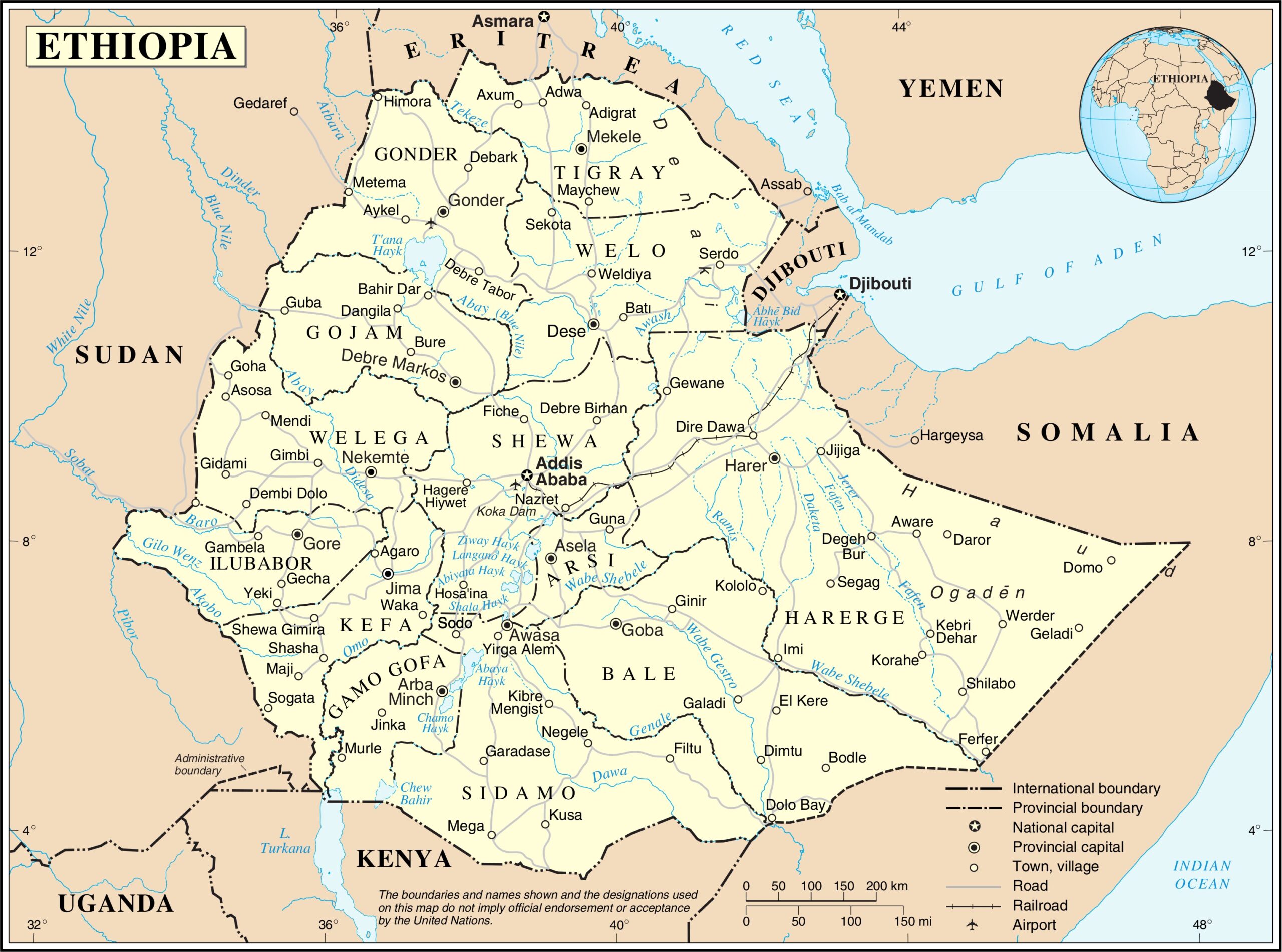
Key Events Since 1 July 2024
Despite the efforts to restore peace to the region, fighting between the ENDF and Fano in Amhara became increasingly intense in 2024,10See eg: EPO, ‘Ethiopia Weekly Update (16 July 2024)’, ACLED, 17 July 2024; and ‘Ethiopia Weekly Update (27 August 2024)’, ACLED, 28 August 2024. with sustained combat between the two parties in and around Gondar, a city in the north that was once the seat of Ethiopian emperors. Fano fighters forced the ENDF out of five districts and the encroaching violence prompted local officials to relocate to the zonal capital, Debre Tabor.11‘Intense fighting erupts in Gondar and surrounding areas’, Ethiopia Observer, 17 September 2024.
After a major military campaign by the ENDF began in October 2024, fighting over the next four months involved summary killings of civilians and widespread damage and destruction of homes and crops. The ENDF attacked Fano forces with drones, with the strikes causing further civilian harm.12EPO, ‘Ethiopia Weekly Update (10 December 2024)’, ACLED, 12 December 2024. Fano fighters and the ENDF clashed again in January 2025, notably during a military operation in which Fano claimed to have killed around 200 government soldiers.13International Crisis Group, ‘Crisis Watch, Ethiopia’, January 2025. Estimates of at least 7,700 conflict deaths in the region between April 2023 and April 2025 have been advanced.14UK government, ‘Country policy and information note: Amhara and Amhara opposition groups, Ethiopia, June 2025’, Guidance, Updated 3 July 2025. A report by African Narratives in February 2025 described the situation in Amhara as ‘no less dangerous than the Tigray conflict’, with the potential to cause Ethiopia to fragment in the future.15Kamal, ‘Government Failure and Civil War: Conflict in Ethiopia’s Amhara Region’, p 2.
On 1 December 2024, the Ethiopian government signed a peace agreement with an OLA splinter group.16G. Tunbridge, ‘Ethiopia signs peace deal with Oromo Liberation Army splinter group’, The Africa Report, 3 December 2024. The group, which comprised several hundred fighters, was led by a former central zone commander, Jaal Sagni Negasa, who had broken away from the OLA in September.17International Crisis Group, ‘Crisis Watch, Ethiopia’, December 2024. While fighters from his faction started coming into rehabilitation camps in January 2025,18EPO, ‘Ethiopia situation update (5 February 2025)’, ACLED, 5 February 2025. the rump OLA continued its struggle against the ENDF.19International Crisis Group, ‘Crisis Watch, Ethiopia’, January 2025.
In Somali region, which has long been restive, at least 294 incidents of inter-clan violence were recorded between 2018 and 2025.20Sahan Research, ‘Deteriorating Human Rights In Ethiopia’s Somali Region’, The Ethiopian Cable, Issue 284, 27 May 2025, in Saxafi Media, 30 May 2025. This violence, which remains below the threshold for a NIAC, followed a long-standing armed conflict in the Ogaden that ended in 2018. Added to the risk of renewed armed conflict were the rising tensions between Ethiopia and Somalia in the second half of 2024. Following a memorandum between the Government of Ethiopia and Somaliland, Birhanu Jula, the ENDF general who oversaw the fighting in Tigray, described the Ogaden National Liberation Front (ONLF) – an erstwhile armed Somali independence movement which is now the leading political party in the region – as agents funded by Egypt and enemies of the Ethiopian State.21A. D. Kalmoy and M. M. Ibrahim, ‘The Political Predicaments of the Somali Region in Ethiopia’, Modern Diplomacy, 5 October 2024. In August, the ONLF had reiterated its call for a peaceful resolution to the security stand-off between federal and regional forces in the region. The ONLF ‘struggles for the right of self-determination of all Somalis under Ethiopian occupation’. The group said it was only a peaceful transition that could end the impasse, which it warned was turning into an inter-ethnic conflict between Somalis and Oromos, the largest ethnic group in Ethiopia.22‘Crisis in Ethiopia’s Somali region taking ethnic twist – ONLF worried’, Africanews, 13 August 2024.
The Humanitarian Situation
According to theInternal Displacement Monitoring Centre (IDMC), most of the 387,000 recorded displacements were in Amhara and Oromia, particularly in the first half of 2024. In Amhara alone, fighting triggered 97,000 movements. The number of people in displacement countrywide as a result of conflict and violence also continued to fall, reaching 2.4 million at the end of 2024. The drop was linked to the 2022 peace agreement on Tigray, which allowed returns despite the violence and insecurity.23IDMC, ‘Ethiopia’ Last updated 14 May 2025.
There is also regular armed violence in Gambella, a region in the south-west of Ethiopia bordering South Sudan, especially between the Anywaa and Nuer communities. These two ethnic groups have been fighting for decades, albeit with varying degrees of intensity. In recent years, the direct involvement of South Sudanese Nuer White Army militia in support of their Ethiopian Nuer and the mobilization of Anywaa youths has aggravated the situation. The dissolution of all regional special forces in April 2023 ‘created a security vacuum that further exacerbated existing local conflicts in the region’ and left populations ‘vulnerable to cross-border attacks and raids by armed militias from South Sudan’.24O. M. Ojulu, ‘Conflict Trends in Gambella State (2018–2024)’, Rift Valley Institute and the Peace Research Facility, Kenya and Ethiopia, February 2025, pp 1, 18. Gambella host more South Sudanese refugees than any other region in Ethiopia, with seven refugee camps, all of which are in Anywaa zone.25Ibid, p 11. In November 2024, a nutrition survey in four conflict and flood-affected woredas of the Gambella region revealed a Global Acute Malnutrition (GAM) prevalence of 17.1 per cent, exceeding the World Health Organization’s ‘critical’ threshold of 15 per cent.26UNICEF Ethiopia, ‘Humanitarian Situation Report No 9, October–November 2024’ ReliefWeb.
In mid-June 2025, a two-day, high-level policy dialogue on forced displacement was convened in Addis Ababa. Organized by the International Organization for Migration (IOM), the Ethiopian Ministries of Justice and Women and Social Affairs, the event focused on enhancing reintegration of Ethiopian returnees displaced by conflict. IOM Ethiopia described the dialogue as marking ‘a critical step in aligning national and regional efforts to ensure returnees are supported in rebuilding their lives with dignity’.27IOM Ethiopia, ‘High-Level Policy Dialogue Concludes with Commitments to Strengthen Support to Ethiopian Returnees’, 20 June 2025.
Conflict Classification and Applicable Law
The armed conflicts between Ethiopia and the OLA in Oromia region and between Ethiopia and the Fano Amhara in the Amhara region are both of a non-international character. Ethiopia is a State Party to the four Geneva Conventions of 1949. Common Article 3 of the Geneva Conventions and customary international humanitarian law (IHL) applies to both conflicts.
Ethiopia is also a State Party to Additional Protocol II of 1977.28Protocol Additional to the Geneva Conventions of 12 August 1949, and relating to the Protection of Victims of Non-International Armed Conflicts (Protocol II); adopted at Geneva, 8 June 1977; entered into force, 7 December 1978. The Protocol applies to the NIAC with the OLA but not to the conflict with the Fano militia, reflecting the fact that the group did not exercise a level of territorial control that would enable it to sustain military operations and implement the Protocol (see further below). The Fano rebellion is characterized by a decentralized and fragmented structure, with several loosely aligned groups, most of which are small and operate autonomously.29L. Karr, ‘Fano Offensive in Ethiopia’s Amhara; Egypt Arms Somalia; Rebel Drones in Mali; Burkina Thwarts Another Coup’, Report, Institute for the Study of War, 26 September 2024. But as the International Committee of the Red Cross (ICRC) has noted, decentralized armed groups comprising fluid alliances of small armed groups that are led by commanders who retain considerable decision-making power can still be a party to a NIAC.30ICRC, ‘The Roots of Restraint in War’, Report, 2018, pp 45–47.
Fano groups have mounted attacks by joining forces effectively, enabling the militias to control several key roads as of July 2024 and, in early September, to encircle the city of Woldiya.31‘Fano force reportedly besieging Woldia City in North Wollo’, Borkena, 7 September 2024; and Karr, ‘Fano Offensive in Ethiopia’s Amhara’. By November, Fano claimed to control more than eighty per cent of the Amhara region.32S. Vera, ‘Who is Fano? Inside Ethiopia’s Amhara rebellion’, The New Humanitarian, 12 November 2024. That said, Fano militias have only briefly controlled urban centres, and only controlled other areas on a temporary basis.33A. Necho and Y. Debebe, ‘Briefing Paper: Understanding the Fano Insurgency in Ethiopia’s Amhara Region’, Rift Valley Institute/Peace Research Facility, February 2024; ‘Fano forces withdraw from Gondar City after two days of fighting’, Borkena; and Karr, ‘Fano Offensive in Ethiopia’s Amhara. On 19 March 2025, four Fano militias – Amhara Fano in Gojam, Gondar, Shewa, and Wello – launched a coordinated operation called Andinet (translating from the Amharic term for ‘unity’), targeting ENDF bases in Amhara region.34EPO, ‘Ethiopia situation update (2 April 2025)’, 2 April 2025.
Ethiopia is not a State Party to the Rome Statute of the International Criminal Court.
Compliance with IHL
Overview
During the reporting period, there were consistent reports of attacks on civilians and civilian objects by the ENDF and the two non-State armed groups confronting it. The armed conflict between the Ethiopian military and Fano militia in Amhara region involved the widespread commission of war crimes in 2024, according to Human Rights Watch. Atrocities included summary execution of Amharan civilians.35Human Rights Watch, ‘Ethiopia’, World Report 2025. The OLA has also frequently attacked civilians and civilian objects.36EPO, ‘Ethiopia Weekly Update (5 November 2024)’, ACLED, 6 November 2024.
In its report on human rights in Ethiopia for 2024, the United States (US) Department of State’s Bureau of Democracy, Human Rights, and Labor said that the government took only ‘limited steps’ to ‘identify and punish officials who committed human rights abuses’. The government claims to have prosecuted lower-level officers for abuses, but details of such prosecutions were ‘scant’. The government is also said to have prosecuted members of some non-State armed groups.37US Department of State, ‘Ethiopia’, Country Reports on Human Rights Practices for 2024, Bureau of Democracy, Human Rights, and Labor, Washington DC, June 2025, p 2. The United Nations (UN) Human Rights Council’s decision in October 2023 not to renew the mandate of the International Commission of Human Rights Experts on Ethiopia has limited international monitoring of the situation across the country, and independent journalists have been granted little access to the conflict-affected regions, including Amhara.38Human Rights Watch, ‘Ethiopia: Army Attacks Health Care in Amhara Conflict’, News release, 3 July 2024.
Civilian Objects under Attack
All three parties to armed conflict – the Ethiopian National Defence Forces (ENDF), the OLA, and Fano militia – have regularly attacked civilian objects in their conduct of hostilities. Under customary IHL, attacks may only be directed against military objectives and must not be directed against civilian objects.39ICRC, Customary IHL Rule 7: ‘The Principle of Distinction between Civilian Objects and Military Objectives’. Civilian objects are all objects that are not military objectives.40ICRC, Customary IHL Rule 9: ‘Definition of Civilian Objects’. Special protection is afforded to medical units such as hospitals and other medical facilities.41ICRC, Customary IHL Rule 28: ‘Medical Units’. Military objectives are those objects which, by their nature, location, purpose or use, make an effective contribution to military action.42ICRC, Customary IHL Rule 8: ‘Definition of Military Objectives’. In addition, the object’s partial or total destruction, capture, or neutralisation must offer a definite military advantage in the prevailing circumstances.
Attacks against medical facilities
Despite the special protection afforded to them by IHL, a particular feature of the conflict in Amhara has been attacks against medical facilities. Human Rights Watch has documented persistent attacks on the healthcare system in the region that amount to war crimes.43Human Rights Watch, ‘Ethiopia: Army Attacks Health Care in Amhara Conflict’. At least 969 medical facilities had been affected in the region as of October 2024, with many forced to stop operating, leaving millions without access to basic healthcare.442024 study by the Forum for Higher Education Institutions in Amhara Region reported in S. Sahlu, ‘Amhara universities forum raises alarm over rising sexual violence, disease outbreaks amid conflict’, The Reporter, 21 October 2024. Human Rights Watch Africa described the violence against medical facilities and personnel as having an ‘immediate’ humanitarian impact.45‘Employees are fleeing the region, supplies have a hard time making it to hospitals, and civilians are too scared to go for treatment.’Vera, ‘Who is Fano? Inside Ethiopia’s Amhara rebellion’, The New Humanitarian. ‘So long as the government feels no pressure to hold abusive forces to account, such atrocities are likely to continue.’46Human Rights Watch, ‘Ethiopia: Army Attacks Health Care in Amhara Conflict’.
Attacks against humanitarian aid
Humanitarian workers have also been attacked in Amhara region, with six killed and eleven kidnapped by unidentified groups amid the growing chaos in 2024. The New Humanitarian noted in November 2024 that on UN access maps, ‘virtually the whole of Amhara is deemed at-risk – undermining the aid response to drought and displacement’. The media outlet cited a spokesperson for the World Food Programme (WFP) who warned that the ongoing insecurity threatened the agency’s ability to ‘support almost half a million vulnerable people in the region’.47Vera, ‘Who is Fano? Inside Ethiopia’s Amhara rebellion’, The New Humanitarian.
In research published in 2025, an Ethiopian academic, Alene Agegnehu Waga, reported on his study of compliance by the Tigray People’s Liberation Front and the OLA with international human rights norms. He specifically noted the OLA’s lack of cooperation with humanitarian agencies and its blockage of aid delivery, which exacerbated the suffering of affected populations.48A. A. Waga, ‘Conflicted commitments: Assessing human rights adherence of Ethiopia’s rebel groups’, Social Sciences & Humanities Open, Vol 11 (2025), 101320.
In his global report on the six grave violations against children in 2024, the UN Secretary-General expressed his grave concern at incidents of the denial of humanitarian access. He urged ‘all parties to allow and facilitate safe, timely and unimpeded humanitarian access and to safeguard humanitarian personnel from attacks’. He called on the Government of Ethiopia to hold perpetrators accountable for grave violations against children ‘and to provide assistance to children, following an intersectional approach’.49‘Children and armed conflict: Report of the Secretary-General’, UN Doc A/79/878-S/2025/247, 17 June 2025, para 275.
Civilians under Attack
The parties to the two NIACs have both targeted civilians and launched indiscriminate attacks affecting the civilian population. The Ethiopian Armed Forces have conducted regular drone strikes, which have killed and maimed scores of civilians.
There has been a particular targeting of healthcare professionals. In a report of July 2024 entitled ‘If the Soldier Dies, It’s on You’, Human Rights Watch details the widespread attacks on medical professionals in the Amhara conflict. The report documents the devastation of the healthcare system in thirteen towns in the Awi, North Gojjam, West Gojjam, North Gonder, South Gonder, and South Wollo zones of Amhara since the onset of conflict in the region in August 2023. The organization found that the ENDF had committed serious violations of IHL that might amount to war crimes.50Human Rights Watch, ‘If the Soldier Dies, It’s on You’, Report, 3 July 2024. In one hospital, soldiers seized an ambulance, accusing doctors of having used it to provide treatment to injured Fano fighters (which IHL requires them to do). A doctor from South Gonder zone said: ‘People who have nothing to do with the war are dying. Health professionals are targeted, tortured, arrested, killed. We want to be free to give treatment to whoever needs it.’51Ibid.
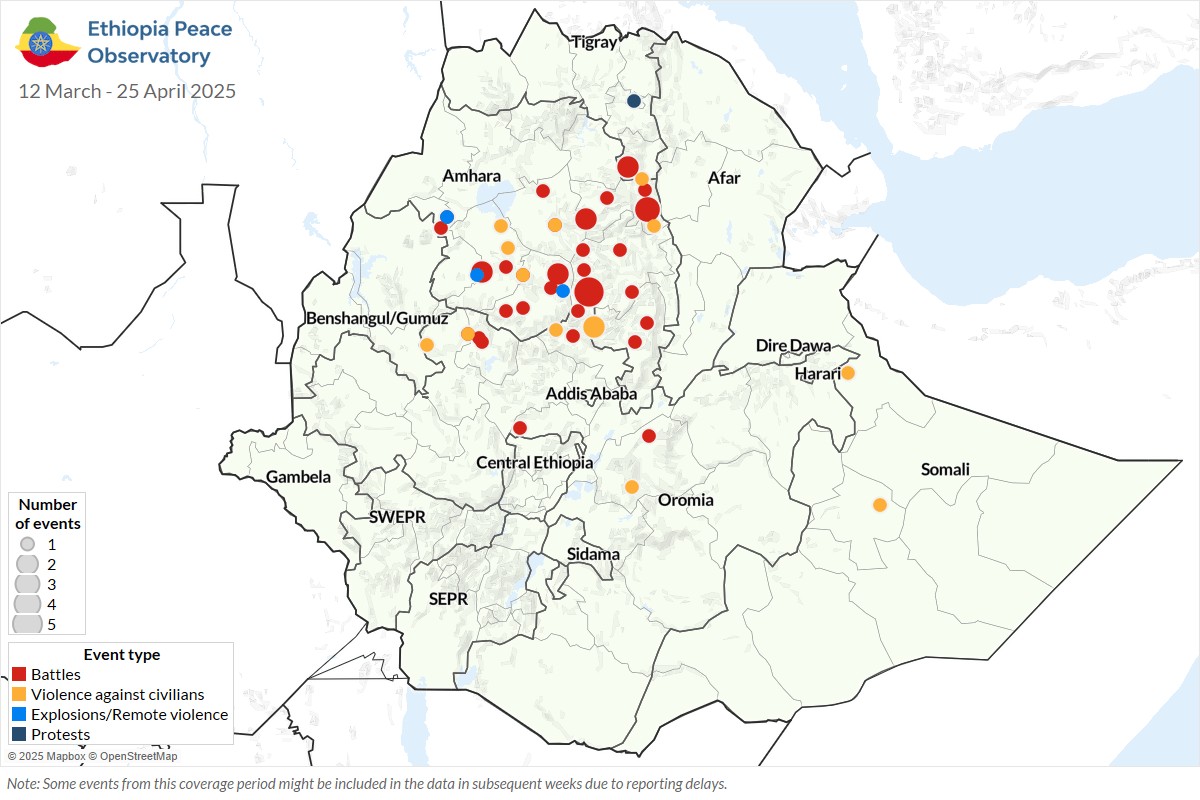
Use of armed drones
The government’s reliance on armed drones has seen significant loss of civilian life. That is so, even though, when used correctly, drones can target military objectives accurately and without incidental loss of life. But in the twelve months to November 2024, munitions launched from Ethiopia’s Turkish and Chinese-made drones were said to have killed more than 300 civilians in Amhara region alone (with some civil society groups claiming a far higher death toll). A New Humanitarian journalist who witnessed at first hand the consequences of a drone strike that hit the grounds of the local high school in the town of Afessa on 18 October 2024 wrote:
Dead livestock lay scattered around the impact crater, and flies and street dogs – tearing at the carcasses – seemed to have taken over the compound. Among the casualties were two Fano fighters, but also four children – the youngest just seven years old. At least eight other civilians were injured, some critically.52Vera, ‘Who is Fano? Inside Ethiopia’s Amhara rebellion’, The New Humanitarian.
Two Fano units, consisting of dozens of fighters, had apparently been present in the school compound but had left before the drone arrived. If the strike did not violate the IHL principle of distinction, it could have breached the principle of proportionality in attack.53ICRC, Customary IHL Rule 14: ‘Proportionality in Attack’. The survivors were treated in poor conditions in a mud-and-straw house as fear of another strike precluded their transport to the local health post. A doctor treating the injured said that one woman had a fractured back and skull and a man had lost too much blood. ‘They need to get to a real hospital, but the roads are bad, and ambulances are targeted by drones.’54Vera, ‘Who is Fano? Inside Ethiopia’s Amhara rebellion’, The New Humanitarian.
On 5 November 2024, civilian casualties resulted from multiple drone strikes that hit a marketplace, an elementary school, and a health centre in Zibist town in Debub Achefer woreda, West Gojam zone, killing at least forty-three people. This marked the deadliest single airstrike since the conflict in Amhara began. Thirteen children and several pregnant women, including health workers, were reportedly among those killed.55ACLED, ‘Ethiopia Weekly Update (12 November 2024)’, ReliefWeb, 14 November 2024.
On 17 April 2025, the ENDF launched a drone strike in the town of Gedeb in the Enarj Enawga woreda of the East Gojam zone that is said to have killed more than 100. Following the strike, government forces moved into the town, which had been under the control of a Fano militia since August 2023.56‘Eyewitnesses say “over 100 people killed” in drone strike in eastern Gojam’, BBC Amharic, 23 April 2025. Eyewitnesses claimed that the strike targeted civilians who were building a fence for a primary school, and that no Fano militia were on the move during the strike. The head of the woreda administration, however, claimed that the drone strike was aimed at Fano militia, not civilians.57ACLED, ‘Ethiopia situation update (30 April 2025)’, April 2025.
Protection of Persons in the Power of the Enemy
Violence against civilians was widespread during the reporting period. In the context of the NIAC between federal government forces and Fano militia in Amhara, the Ethiopia Human Rights Commission (EHRC) reported that at least 115 civilians were killed between September and December 2024 alone, while emphasizing the figures were probably an undercount due to the difficult working environment.58Civil society organizations’ Submission to the 83rd Ordinary Session of the African Commission on Human and People’s Rights on Ongoing Human Rights Violations in the Federal Democratic Republic of Ethiopia, 31 March 2025. Non-State armed groups have regularly abducted civilians, including children, sometimes for ransom and sometimes to force their recruitment. The Ethiopian authorities have also arbitrarily arrested and detained thousands of civilians alleging their complicity in the acts of the two rebel groups.
Murder of civilians
A number of murders took place after the victims had been abducted during attacks on a locality. On 30 October 2024, owing to suspicions about the local population supporting the government, during its attacks the OLA are said to have killed thirty-eight civilians and burnt down homes in Bitisi, Dereba, and Kure, and other areas in Birbirsa Gali kebele, eighteen kilometres east of the city of Meki in East Shewa. The attack was described as the deadliest in Oromia since November 2022.59EPO, ‘Ethiopia Weekly Update (5 November 2024)’, ACLED, 6 November 2024.
The serious violations of IHL in Amhara region persisted in 2025. On 21 May, OLA fighters are said to have clashed with the ENDF after the militants attacked civilians in Anger Meti town in Kemashi zone, resulting in the deaths of at least eighteen civilians and injuries to at least ten others. The dead included twelve children aged between two and fourteen.60The militants also reportedly abducted three civilians, burned down more than 100 civilian homes and other properties, and looted 50,000 kilograms of food. On 4 June, in Angodeche Hula Arboye kebele in the Arsi zone of Oromia, OLA fighters shot and killed three civilians, including an Orthodox Christian monk, and wounded two others.61ACLED, Ethiopia situation update (11 June 2025). After the attack, the group reportedly looted livestock and abducted an unspecified number of civilians, including the wife and mother of the kebele administrator. A few days later, however, eleven abductees were released. Telegram, @tikvahethiopia, 1 June 2025 (Amharic), cited by EPO, ‘Ethiopia Weekly Update (5 November 2024)’.
Abduction and hostage-taking
Hostage-taking is strictly prohibited under IHL,62ICRC, Customary IHL Rule 96: ‘Hostage-Taking’. but has been a regular feature of the conduct of the OLA and Fano militia. While in control of Feres Bet town in the West Gojjam zone, Fano fighters held some thirty government officials and seventy ordinary civilians hostage for two months, demanding a ransom for their safe release. On 5 December, Fano fighters are said to have executed the hostages as the fighters withdrew after clashing with the ENDF.63EPO, ‘Ethiopia Weekly Update (10 December 2024)’, ACLED, 12 December 2024.
The EHRC reported that, in the year from June 2024 to June 2025, the OLA continued kidnapping passengers traveling to Addis Ababa, demanding huge ransoms and killing those who were unable to pay.64EHRC, ‘Annual Ethiopia Human Rights Situation Report, June 2024 to June 2025’, Addis Ababa, Executive Summary, updated 22 August 2025, pp 2 and 3. On 7 August 2024, BBC Amharic reported kidnappers, whom the victims referred to as ‘OLA fighters’, tortured captives to force the payment of ransom. The abductors received ransom payments between 100,000 birr (€600) and 500,000 birr (€3,000), while continuing to torture those who were not able to make the payments, threatening to kill them. Journalists talked to released victims who said the kidnappers killed two men and committed sexual assault against others.65US Department of State, ‘Ethiopia’, Country Reports on Human Rights Practices for 2024, p 25.
Between 7 and 12 April 2025,ACLED recorded retaliatory attacks by the OLA in Haro Limu woreda in East Wollega zone that are said to have killed at least eighteen civilians. The attacks were linked with the killing of an OLA senior commander by the ENDF on 4 April, along with an unspecified number of OLA fighters in the woreda. The commander was a key senior figure in the OLA who had participated in the peace talks with the Ethiopian government in Tanzania in 2023.66ACLED, ‘Ethiopia situation update (30 April 2025)’ 30 April 2025.
Several days after he was killed, OLA affiliates began targeting the families of former group members, accusing them of helping the government to undertake the operation. On 7 April, OLA fighters removed a former member from his home along with five of his family members – four men and a twelve-year-old boy – and killed them in Dhiba forest, in Garba Gudina kebele of Haro Limu woreda. On 12 April, the OLA returned and abducted five more civilians, including the wife and two children of the same former affiliate, aged ten and seven, respectively, and killed them in Dhiba forest. A similar attack on 8 April in neighbouring Surge kebele saw OLA fighters attack and kill eight of the family of another former OLA member.67Ibid.
Conflict-related sexual and gender-based violence
Violations of IHL in the conflicts also have gender-specific elements. The New Humanitarian reported in November 2024 that more than 5,000 women in Amhara region had sought medical treatment after suffering sexual abuse.68Vera, ‘Who is Fano? Inside Ethiopia’s Amhara rebellion’, The New Humanitarian. This number, already shocking, represents only a fraction of the real toll according to the Forum for Higher Education Institutions in Amhara Region, a coalition of Ethiopian civil society bodies and universities.69Cited in Sahlu, ‘Amhara universities forum raises alarm over rising sexual violence, disease outbreaks amid conflict’.
Amnesty International noted a ‘surge in reports of sexual violence against women and girls’ in 2024. The rape and murder of seven-year-old Heaven Awot, whose body was also mutilated by her attacker, in the city of Bahir Dar in Amhara region in August 2024 provoked outrage around the country ‘and became emblematic of the prevalence of sexual violence against women and girls’.70Amnesty International, ‘Ethiopia 2024’, 2025. Although the perpetrator was not affiliated to an armed force or group, its brutality against a child displaced from the Tigray conflict was particularly shocking. Heaven’s aunt found her body at the entrance of her home, her body strangled and mutilated. Her genitalia was completely torn and damaged so badly that one could see her spinal cord through it. The Addis Standard newspaper published an editorial in which it declared that ‘the rising tide of this gruesome violence is not just a tragic byproduct’ of the conflicts in Amhara, Oromia, and Tigray ‘but a deliberate strategy of war emboldened by the government’s failure to hold perpetrators accountable’.71‘Rising sexual violence against women and girls is seeping into what’s left of the Ethiopian social fabric. Without accountability, the worst is yet to come’, Editorial, Addis Standard, 23 August 2024.
Subsequently, a report by Physicians for Human Rights and the Organisation for Justice and Accountability in the Horn of Africa, published in July 2025, likewise claimed that the silence over crimes of grave sexual violence committed during the conflict in Tigray had enabled the spread of similar atrocities to other conflict zones. The report, ‘You Will Never Be Able to Give Birth’, documented the systematic abuse committed, predominantly, by Ethiopian soldiers and their Eritrean and militia allies during the 2020–22 conflict in Tigray, and how a lack of accountability led to revenge attacks in the neighbouring Amhara and Afar regions. Survivors identified perpetrators from military groups who, when committing sexual and reproductive violence for the actions of Amhara and Afar forces in the Tigray conflict, expressed the desire for revenge.72Physicians for Human Rights and Organisation for Justice and Accountability in the Horn of Africa, ‘“You Will Never Be Able to Give Birth”: Conflict-Related Sexual and Reproductive Violence in Ethiopia’, Report, July 2025.
What is more, sexual violence survivors are facing more than the physical and psychological trauma from what happened to them given the extremely limited access to healthcare to start a complicated path to recovery. This is, in part, the result of cuts in US foreign aid in 2025. A co-author of the report, who asked to remain anonymous for security reasons, told The New Humanitarian: ‘With conflict currently escalating in Amhara and tensions between Ethiopia and Eritrea rising, breaking this cycle is vital not only for survivors, but for the future of Ethiopia and sustainable peace in the Horn of Africa.’73‘Silence over sexual violence in Ethiopia enables yet more abuse, says report’, The New Humanitarian, 31 July 2025.
Arbitrary deprivation of liberty
In January 2025, Amnesty International reported on a four-month-long campaign of mass arbitrary arrests of ethnic Amhara across the country for alleged affiliation with Fano militias. On 28 September 2024, the ENDF and Amhara regional security forces had rounded up thousands of people across Amhara region and brought them to four mass detention centres. Members of the judiciary, including judges, as well as prosecutors and academics were among the people targeted. Four judicial staff were released in October 2024 and in January 2025, authorities released hundreds of people, including three judges, women, older persons, and individuals suffering from chronic health problems, but thousands remained arbitrarily detained. Amnesty International’s Regional Director for East and Southern Africa, said:
The international silence over the mass and arbitrary detention of thousands of people in Amhara region is beyond shameful. Ethiopia’s development partners, as well as African and global human rights bodies, must use their influence to publicly call for the release of all arbitrarily detained people. The world must stop turning a blind eye to Ethiopia’s human rights crisis as the Ethiopian government continues to trample on the rule of law.74Amnesty International, ‘Ethiopia: Urgent international action needed to end mass arbitrary detentions in the Amhara Region’, News release, 28 January 2025.
Arbitrary deprivation of liberty is prohibited under IHL as it is under international human rights law.75ICRC, Customary IHL Rule 99: ‘Deprivation of liberty’. Moreover, as the US Department of State observed, the Constitution of Ethiopia and federal law prohibit arbitrary arrest and detention and provide for the right of any person to challenge the lawfulness of their arrest or detention in court (‘habeas corpus’). But, it said, the government ‘generally did not observe these requirements’.76US Department of State, ‘Ethiopia’, Country Reports on Human Rights Practices for 2024, p 20.
Child recruitment
All parties to the armed conflicts in Ethiopia are believed to have recruited children. IHL prohibits the recruitment of children under fifteen years of age. In January 2025, the EHRC issued a press release accusing the authorities of having detained and forced children as young as eleven years of age into the security forces.77EHRC, Press release, 24 January 2025; and see Civil society organizations’ Submission to the 83rd Ordinary Session of the African Commission on Human and People’s Rights, p 2. This is a serious violation of Ethiopia’s international legal obligations – specifically Additional Protocol II of 1977 (which sets the minimum age at fifteen years) and the 2000 Optional Protocol to the Convention on the Rights of the Child on the involvement of children in armed conflict.78ICRC, Customary IHL Rule 136: ‘Recruitment of Child Soldiers’; and Rule 156: ‘Definition of War Crimes’; Art 4(3)(c), Additional Protocol II of 1977; Optional Protocol to the Convention on the Rights of the Child on the involvement of children in armed conflict; adopted at New York, 25 May 2000; entered into force, 12 February 2002. Ethiopia adhered to the Optional Protocol in 2014. In adhering to the Optional Protocol, Ethiopia declared that ‘in accordance with Article 3(2)’, the Government of Ethiopia stated ‘that the minimum age at which it will permit voluntary recruitment into its national armed forces is 18 years old’.79Declaration of Ethiopia, UN Treaty Collection webpage for the Optional Protocol.
The UN Secretary-General, reporting on the six grave violations against children worldwide in 2024, declared that the UN had verified the abduction in Ethiopia of 189 children (66 boys, 84 girls, and 39 whose sex was unknown). The majority of the perpetrators (107) were not identified, but 49 confirmed abductions were by the ENDF.80‘Children and armed conflict: Report of the Secretary-General’, 17 June 2025, para 271. A fifteen-year-old boy told the EHRC: ‘When we came back from school, an individual took us into a Bajaj [auto rickshaw], saying that he will give 25,000 Birr [equivalent to $198] to those who join the defence force. [They] then took us to an auditorium. … But after we entered, we could not leave.’ Some parents say they were forced to pay for the return of their sons.81E. Geremew, ‘Report says Ethiopia forces military recruitment, including minors’, Voice of America, 10 January 2025.
Persons with disabilities
It is not known precisely how many people are living with disabilities in Ethiopia, although the National Survey on Persons with Disabilities presented in July 2025, which was based on data gathered from over 40,000 individuals in all major regions of the country, including Amhara and Oromia, calculated that 9.9 million people nationwide reported ‘some difficulty’ in at least two physical domains or ‘a lot of difficulty’ or ‘cannot do at all’ in any single domain. Regionally, Tigray had the highest household prevalence at 30.1 per cent, followed by Amhara at 25.8 per cent, and Gambella at 22 per cent. Dr Kaleab Kebede, senior researcher at the Policy Studies Institute that conducted the study, called for regional equity in disability policy implementation. Noting that Tigray and Amhara had the highest burden of disability prevalence, he urged the federal government to allocate additional, targeted resources to enhance inclusive service provision in those regions.82Policy Studies Institute, ‘National Survey on Persons with Disabilities in Ethiopia’, News release, 13 July 2025.
In 2024, the ICRC provided emergency and surgical care to more than 23,400 war wounded in Amhara, Oromia, and Somali regions. Of the almost 12,000 people who benefited from services at the physical rehabilitation centres supported by the organization, 2,089 had wounds caused by weapons and 207 were the victims of unexploded ordnance.83ICRC, ‘Ethiopia Facts and Figures, January–December 2024’, Report, Addis Ababa, February 2025, p 1. Humanity & Inclusion (HI), which has been working in Ethiopia since 1986, supported conflict-affected IDPs and host communities in the most affected woredas of Amhara (Guba Lafto and Habru),84HI, ‘Country sheet – Ethiopia’, Fact sheet, 2024, p 9. and children with disabilities displaced from Oromia, providing school-based disability-responsive equipment and materials and assistive learning aids.85Ibid, p 2.
- 1International Crisis Group, ‘Crisis Watch, Ethiopia’, May and October 2021.
- 2International Crisis Group, ‘Crisis Watch, Ethiopia’, November and December 2021, and January, February, and May 2022.
- 3OLF-OLA, A Brief Political Manifesto: From Armed Struggle to the Prospect for Peace, January 2023, p 1.
- 4See eg: Ethiopia Peace Observatory (EPO), ‘EPO Weekly Update (23 January 2024)’, Armed Conflict Location and Event Data Project (ACLED), 24 January 2024; ‘EPO Weekly Update (30 January 2024)’, ACLED, 31 January 2024; ‘Ethiopia weekly update (2 July 2024)’, ACLED, 4 July 2024; International Crisis Group, ‘Crisis Watch, Ethiopia’, July 2024.
- 5Fano is an Amharic word loosely translated as ‘volunteer fighters’.
- 6G. Kamal, ‘Government Failure and Civil War: Conflict in Ethiopia’s Amhara Region’, Study Report, African Narratives, 22 February 2025, pp 5–6.
- 7D. Endeshaw, ‘Gunfire, protests in Ethiopia’s Amhara over plan to disband regional force’, Reuters, 9 April 2023; ‘Why Ethiopia’s Amhara militiamen are battling the army’, BBC, 16 August 2023; Ethiopian Human Rights Commission (EHRC)/Office of the United Nations High Commissioner for Human Rights (OHCHR), EHRC and OHCHR Report on the Findings of Community Consultations on Transitional Justice with Victims and Affected Populations in Ethiopia, 28 December 2023; and Kamal, ‘Government Failure and Civil War: Conflict in Ethiopia’s Amhara Region’.
- 8Endeshaw, ‘Gunfire, protests in Ethiopia’s Amhara over plan to disband regional force’.
- 9ACLED, ‘Amhara Regional Profile’, 8 August 2024.
- 10See eg: EPO, ‘Ethiopia Weekly Update (16 July 2024)’, ACLED, 17 July 2024; and ‘Ethiopia Weekly Update (27 August 2024)’, ACLED, 28 August 2024.
- 11‘Intense fighting erupts in Gondar and surrounding areas’, Ethiopia Observer, 17 September 2024.
- 12EPO, ‘Ethiopia Weekly Update (10 December 2024)’, ACLED, 12 December 2024.
- 13International Crisis Group, ‘Crisis Watch, Ethiopia’, January 2025.
- 14UK government, ‘Country policy and information note: Amhara and Amhara opposition groups, Ethiopia, June 2025’, Guidance, Updated 3 July 2025.
- 15Kamal, ‘Government Failure and Civil War: Conflict in Ethiopia’s Amhara Region’, p 2.
- 16G. Tunbridge, ‘Ethiopia signs peace deal with Oromo Liberation Army splinter group’, The Africa Report, 3 December 2024.
- 17International Crisis Group, ‘Crisis Watch, Ethiopia’, December 2024.
- 18EPO, ‘Ethiopia situation update (5 February 2025)’, ACLED, 5 February 2025.
- 19International Crisis Group, ‘Crisis Watch, Ethiopia’, January 2025.
- 20Sahan Research, ‘Deteriorating Human Rights In Ethiopia’s Somali Region’, The Ethiopian Cable, Issue 284, 27 May 2025, in Saxafi Media, 30 May 2025.
- 21A. D. Kalmoy and M. M. Ibrahim, ‘The Political Predicaments of the Somali Region in Ethiopia’, Modern Diplomacy, 5 October 2024.
- 22‘Crisis in Ethiopia’s Somali region taking ethnic twist – ONLF worried’, Africanews, 13 August 2024.
- 23IDMC, ‘Ethiopia’ Last updated 14 May 2025.
- 24O. M. Ojulu, ‘Conflict Trends in Gambella State (2018–2024)’, Rift Valley Institute and the Peace Research Facility, Kenya and Ethiopia, February 2025, pp 1, 18.
- 25Ibid, p 11.
- 26UNICEF Ethiopia, ‘Humanitarian Situation Report No 9, October–November 2024’ ReliefWeb.
- 27IOM Ethiopia, ‘High-Level Policy Dialogue Concludes with Commitments to Strengthen Support to Ethiopian Returnees’, 20 June 2025.
- 28
- 29L. Karr, ‘Fano Offensive in Ethiopia’s Amhara; Egypt Arms Somalia; Rebel Drones in Mali; Burkina Thwarts Another Coup’, Report, Institute for the Study of War, 26 September 2024.
- 30ICRC, ‘The Roots of Restraint in War’, Report, 2018, pp 45–47.
- 31‘Fano force reportedly besieging Woldia City in North Wollo’, Borkena, 7 September 2024; and Karr, ‘Fano Offensive in Ethiopia’s Amhara’.
- 32S. Vera, ‘Who is Fano? Inside Ethiopia’s Amhara rebellion’, The New Humanitarian, 12 November 2024.
- 33A. Necho and Y. Debebe, ‘Briefing Paper: Understanding the Fano Insurgency in Ethiopia’s Amhara Region’, Rift Valley Institute/Peace Research Facility, February 2024; ‘Fano forces withdraw from Gondar City after two days of fighting’, Borkena; and Karr, ‘Fano Offensive in Ethiopia’s Amhara.
- 34EPO, ‘Ethiopia situation update (2 April 2025)’, 2 April 2025.
- 35Human Rights Watch, ‘Ethiopia’, World Report 2025.
- 36EPO, ‘Ethiopia Weekly Update (5 November 2024)’, ACLED, 6 November 2024.
- 37US Department of State, ‘Ethiopia’, Country Reports on Human Rights Practices for 2024, Bureau of Democracy, Human Rights, and Labor, Washington DC, June 2025, p 2.
- 38Human Rights Watch, ‘Ethiopia: Army Attacks Health Care in Amhara Conflict’, News release, 3 July 2024.
- 39ICRC, Customary IHL Rule 7: ‘The Principle of Distinction between Civilian Objects and Military Objectives’.
- 40
- 41
- 42ICRC, Customary IHL Rule 8: ‘Definition of Military Objectives’. In addition, the object’s partial or total destruction, capture, or neutralisation must offer a definite military advantage in the prevailing circumstances.
- 43Human Rights Watch, ‘Ethiopia: Army Attacks Health Care in Amhara Conflict’.
- 442024 study by the Forum for Higher Education Institutions in Amhara Region reported in S. Sahlu, ‘Amhara universities forum raises alarm over rising sexual violence, disease outbreaks amid conflict’, The Reporter, 21 October 2024.
- 45‘Employees are fleeing the region, supplies have a hard time making it to hospitals, and civilians are too scared to go for treatment.’Vera, ‘Who is Fano? Inside Ethiopia’s Amhara rebellion’, The New Humanitarian.
- 46Human Rights Watch, ‘Ethiopia: Army Attacks Health Care in Amhara Conflict’.
- 47Vera, ‘Who is Fano? Inside Ethiopia’s Amhara rebellion’, The New Humanitarian.
- 48A. A. Waga, ‘Conflicted commitments: Assessing human rights adherence of Ethiopia’s rebel groups’, Social Sciences & Humanities Open, Vol 11 (2025), 101320.
- 49‘Children and armed conflict: Report of the Secretary-General’, UN Doc A/79/878-S/2025/247, 17 June 2025, para 275.
- 50Human Rights Watch, ‘If the Soldier Dies, It’s on You’, Report, 3 July 2024.
- 51Ibid.
- 52Vera, ‘Who is Fano? Inside Ethiopia’s Amhara rebellion’, The New Humanitarian.
- 53
- 54Vera, ‘Who is Fano? Inside Ethiopia’s Amhara rebellion’, The New Humanitarian.
- 55ACLED, ‘Ethiopia Weekly Update (12 November 2024)’, ReliefWeb, 14 November 2024.
- 56‘Eyewitnesses say “over 100 people killed” in drone strike in eastern Gojam’, BBC Amharic, 23 April 2025.
- 57ACLED, ‘Ethiopia situation update (30 April 2025)’, April 2025.
- 58
- 59EPO, ‘Ethiopia Weekly Update (5 November 2024)’, ACLED, 6 November 2024.
- 60The militants also reportedly abducted three civilians, burned down more than 100 civilian homes and other properties, and looted 50,000 kilograms of food.
- 61ACLED, Ethiopia situation update (11 June 2025). After the attack, the group reportedly looted livestock and abducted an unspecified number of civilians, including the wife and mother of the kebele administrator. A few days later, however, eleven abductees were released. Telegram, @tikvahethiopia, 1 June 2025 (Amharic), cited by EPO, ‘Ethiopia Weekly Update (5 November 2024)’.
- 62
- 63EPO, ‘Ethiopia Weekly Update (10 December 2024)’, ACLED, 12 December 2024.
- 64EHRC, ‘Annual Ethiopia Human Rights Situation Report, June 2024 to June 2025’, Addis Ababa, Executive Summary, updated 22 August 2025, pp 2 and 3.
- 65US Department of State, ‘Ethiopia’, Country Reports on Human Rights Practices for 2024, p 25.
- 66ACLED, ‘Ethiopia situation update (30 April 2025)’ 30 April 2025.
- 67Ibid.
- 68Vera, ‘Who is Fano? Inside Ethiopia’s Amhara rebellion’, The New Humanitarian.
- 69Cited in Sahlu, ‘Amhara universities forum raises alarm over rising sexual violence, disease outbreaks amid conflict’.
- 70Amnesty International, ‘Ethiopia 2024’, 2025.
- 71‘Rising sexual violence against women and girls is seeping into what’s left of the Ethiopian social fabric. Without accountability, the worst is yet to come’, Editorial, Addis Standard, 23 August 2024.
- 72Physicians for Human Rights and Organisation for Justice and Accountability in the Horn of Africa, ‘“You Will Never Be Able to Give Birth”: Conflict-Related Sexual and Reproductive Violence in Ethiopia’, Report, July 2025.
- 73‘Silence over sexual violence in Ethiopia enables yet more abuse, says report’, The New Humanitarian, 31 July 2025.
- 74Amnesty International, ‘Ethiopia: Urgent international action needed to end mass arbitrary detentions in the Amhara Region’, News release, 28 January 2025.
- 75
- 76US Department of State, ‘Ethiopia’, Country Reports on Human Rights Practices for 2024, p 20.
- 77EHRC, Press release, 24 January 2025; and see Civil society organizations’ Submission to the 83rd Ordinary Session of the African Commission on Human and People’s Rights, p 2.
- 78ICRC, Customary IHL Rule 136: ‘Recruitment of Child Soldiers’; and Rule 156: ‘Definition of War Crimes’; Art 4(3)(c), Additional Protocol II of 1977; Optional Protocol to the Convention on the Rights of the Child on the involvement of children in armed conflict; adopted at New York, 25 May 2000; entered into force, 12 February 2002. Ethiopia adhered to the Optional Protocol in 2014.
- 79Declaration of Ethiopia, UN Treaty Collection webpage for the Optional Protocol.
- 80‘Children and armed conflict: Report of the Secretary-General’, 17 June 2025, para 271.
- 81E. Geremew, ‘Report says Ethiopia forces military recruitment, including minors’, Voice of America, 10 January 2025.
- 82Policy Studies Institute, ‘National Survey on Persons with Disabilities in Ethiopia’, News release, 13 July 2025.
- 83ICRC, ‘Ethiopia Facts and Figures, January–December 2024’, Report, Addis Ababa, February 2025, p 1.
- 84HI, ‘Country sheet – Ethiopia’, Fact sheet, 2024, p 9.
- 85Ibid, p 2.