Between 2023 and early 2026, an ongoing non-international armed conflict (NIAC) took place between India and the Communist Party of India-Maoist (CPI-Maoist, often called the Naxalites), which was declassified at the end of March 2026. Conversely, the situations opposing India against separatist groups in Indian-administered Jammu and Kashmir (J&K), India against the insurgency in the North East Region (NER), and Meiteis against Kukis/Kuki-Zo did not reach the requisite thresholds to be considered armed conflict during the reporting period (to end May 2026).
India has also taken part in international armed conflicts (IAC) with its neighbours: Pakistan and China.
India is a State Party to the four Geneva Conventions of 1949. All parties to the NIACs that have taken place in India are bound by Article 3 common to the 1949 Geneva Conventions, as well as by customary international humanitarian law applicable to NIACs. India is not a State Party to Additional Protocol II of 1977.
The Communist Party of India-Maoist (CPI-Maoist)
Origin and evolution
Ideologically rooted in the 1946 peasant uprising in Telangana, various ‘Left Wing Extremist’ (LWE) groups have engaged in insurgency since the 1960s. Over the decades, they have regrouped, aiming to establish a communist State across central and eastern India, from Jharkhand to Maharashtra. The area, also known as the ‘red corridor’ because of the prevalence of the LWE groups, is mineral-rich, with dense forests and challenging terrain. It covers more than one third of the nation.1S. Sobhan, ‘India: 60 Years of Maoist insurgency and its human cost’, Deutsche Welle, 14 February 2025; S. Bagchi, ‘After decades of bloodshed, is India winning its war against Maoists?’, BBC, 28 May 2025; V. Tiwari, J. Purohit and A. Jain, ‘How India’s war against Maoists is affecting its people’, BBC Hindi, 27 September 2025; D. Tikekar and R. Mogul, ‘Some of the world’s last Maoist rebels are in India. Their decades-long rebellion is in its death throes’, CNN World, 2 June 2026. In 1967 in Naxalbari, a small village in West Bengal, the peasant movement – also known as the Naxalites after the district where their armed campaign started – drew inspiration from Communist movements in China and Russia and fought for land rights and social justice for marginalized tribal communities.2S. Sobhan, ‘India: 60 Years of Maoist insurgency and its human cost’, Deutsche Welle, 14 February 2025; D. Tikekar and R. Mogul, ‘Some of the world’s last Maoist rebels are in India. Their decades-long rebellion is in its death throes’, CNN World, 2 June 2026. China has supported the movement since its origins, but, it is said, did not directly arm the Maoists in India.3D. Tikekar and R. Mogul, ‘Some of the world’s last Maoist rebels are in India. Their decades-long rebellion is in its death throes’, CNN World, 2 June 2026.
The Communist Party of India-Maoist (CPI-Maoist), considered by the government of India as the LWE archetype and responsible for most of the violence,4 Government of India, Ministry of Home Affairs, Annual Report 2022–23, para 2.28; Government of India, Ministry of Home Affairs, ‘Left Wing Extremist Division’, 18 December 2025. was formally established in 2004 through the merger of key Marxist-Leninist groups.5S. Bagchi, ‘After decades of bloodshed, is India winning its war against Maoists?’, BBC, 28 May 2025; Government of India, Ministry of Home Affairs, ‘Left Wing Extremist Division’, 18 December 2025. Since the early 2000s, violence intensified, with the CPI-Maoists gaining significant territorial control across India, reportedly exerting influence over 92,000 square kilometres by 2007.6S. Prasanna, ‘Red Belt, Green Hunt, Grey Law: India’s Naxalite-Maoist Insurgency and the Law of Non-International Armed Conflict’, UCLA Law Review, Vol. 63, 2016); D. Tikekar and R. Mogul, ‘Some of the world’s last Maoist rebels are in India. Their decades-long rebellion is in its death throes’, CNN World, 2 June 2026. The CPI-Maoist carried out hit-and-run attacks against police stations and strategic infrastructure, such as roads, railways, bridges, communication facilities, as well as schools, cinemas, libraries and medical facilities. They raided police stations to steal weapons.7Government of India, Ministry of Home Affairs, Annual Report 2022–23, para 2.36; D. Tikekar and R. Mogul, ‘Some of the world’s last Maoist rebels are in India. Their decades-long rebellion is in its death throes’, CNN World, 2 June 2026. They attacked the security and police forces with various types of weapons and strategies, prompting a significant armed response from the government. Between 2000 and 2025, confrontations between the Government of India and the CPI-Maoist, and attacks by the CPI-Maoist, occurred at a sustained level, claiming more than 12,000 lives.8 S. Sobhan, ‘India: 60 Years of Maoist insurgency and its human cost’, Deutsche Welle, 14 February 2025; South Asia Terrorism Portal (SATP)/Institute for Conflict Management (ICM), ‘Datasheet – Maoist Insurgency: Yearly Fatalities’, 2 May 2026. For instance, in 2010, in one of the most notorious incidents, the Maoist-CPI ambushed and killed seventy-six security forces personnel in Chhattisgrah.9D. Tikekar and R. Mogul, ‘Some of the world’s last Maoist rebels are in India. Their decades-long rebellion is in its death throes’, CNN World, 2 June 2026. The CPI-Maoist often kidnapped people. This included a large-scale abduction of 250 villagers in 2015 for one-day captivity.10‘Chhattisgarh ‘hostage’ crisis: Maoists kill 1 tribal, others allowed to return home’, The Indian Express, 10 May 2015. They benefited from the local tribal community support, with those communities feeling often marginalized by India and exposed to violence and extortion by local forest officials.11 Tikekar and R. Mogul, ‘Some of the world’s last Maoist rebels are in India. Their decades-long rebellion is in its death throes’, CNN World, 2 June 2026.
The violence resulted in more than 70,000 individuals being displaced in areas affected by the conflict by 2015,12Norwegian Refugee Council (NRC)/Internal Displacement Monitoring Centre (IDMC), ‘Internal displacement in India (April 2015)’, 20 April 2015. See also: ‘No legal status: how India is ignoring its thousands of displaced citizens’, The Guardian, 11 August 2016. out of a total of 612,000 internally displaced persons (IDP) due to conflict and violence in India.13IDMC, Global Internal Displacement Database (GIDD), 5 May 2026. Both the security forces and Maoist-CPI have been accused of exactions, including abductions, torture and rape.14D. Tikekar and R. Mogul, ‘Some of the world’s last Maoist rebels are in India. Their decades-long rebellion is in its death throes’, CNN World, 2 June 2026. Civil society further accused Indian security forces of conducting numerous extrajudicial killings of Maoists, often justified as acts of self-defence or claimed as violent ‘encounters’.15D. Tikekar and R. Mogul, ‘Some of the world’s last Maoist rebels are in India. Their decades-long rebellion is in its death throes’, CNN World, 2 June 2026.
The Indian government’s response
In 2006, the Indian Ministry of Home Affairs created a Left Wing Extremist division to address the insurgency ‘in a holistic manner’, covering security, development, rights and entitlements of local communities, governance and public perception, with a view to enhancing the capacity of state governments to fight the CPI-Maoist in a concerted manner.16Government of India, Ministry of Home Affairs, Annual Report 2022-23, paras 1.21, 2.22, 2.33, 2.35-36 and 2.45; Government of India, Ministry of Home Affairs, Annual Report 2023–24, para 2.18; Government of India, Ministry of Home Affairs, ‘Left Wing Extremist Division’, 18 December 2025. In 2008, India formed the DRG to fight the Maoists. The DRG, comprising local Adivasis and surrendered Maoists, helped security forces track rebel tactics and hideouts.17N. Sahoo and A. Ghosal’, ‘Combating Maoist Insurgency: A Spotlight on Chhattisgarh’s DRG Model’, Observer Research Foundation, 8 August 2025; V. Tiwari, J. Purohit and A. Jain, ‘How India’s war against Maoists is affecting its people’, BBC Hindi, 27 September 2025; D. Tikekar and R. Mogul, ‘Some of the world’s last Maoist rebels are in India. Their decades-long rebellion is in its death throes’, CNN World, 2 June 2026. In 2009, Prime Minister Manmohan declared the Maoists the ‘single biggest internal security challenge to the Indian state’.18D. Tikekar and R. Mogul, ‘Some of the world’s last Maoist rebels are in India. Their decades-long rebellion is in its death throes’, CNN World, 2 June 2026. The Indian government’s multifaceted strategy expanded in 2015 with the adoption of a ‘National Policy and Action Plan to address LWE’.19 Government of India, Ministry of Home Affairs, Annual Report 2022–23, para 2.19; Government of India, Ministry of Home Affairs, ‘Rajya Sabah: Starred question no. *58’, February 2026, p 2.
Within this framework, the central government has undertaken several initiatives, including the deployment of Central Armed Police Forces;20Government of India, Ministry of Home Affairs, ‘Left Wing Extremist Division’, 18 December 2025; Government of India, Ministry of Home Affairs, Annual Report 2022-23, paras 2.20, 7.27. establishment of Counter Insurgency and Anti-Terrorism schools; 21Government of India, Ministry of Home Affairs, ‘Left Wing Extremist Division’, 18 December 2025. modernisation and upgradation of the State Police and their Intelligence apparatus; reimbursement of security-related expenditure under the Security-related Expenditure scheme; furnishing of helicopters for anti-LWE operations; assistance in training of state police; sharing of intelligence; facilitating of inter-State coordination; assistance in community policing and civic action programmes.22Government of India, Ministry of Home Affairs, Annual Report 2022–23, paras 2.20, 2.33, 2.35, 2.45 and 11.5; Government of India, Ministry of Home Affairs, Annual Report 2023–24, paras 2.18 and 2.31; Government of India, Ministry of Home Affairs, ‘Left Wing Extremist Division’, 18 December 2025. It has also established a monitoring mechanism,23Government of India, Ministry of Home Affairs, Annual Report 2022–23, para 2.34; Government of India, Ministry of Home Affairs, Annual Report 2023–24, para 2.32; Government of India, Ministry of Home Affairs, ‘Left Wing Extremist Division’, 18 December 2025. progressively deployed India Reserve (IR) Battalions to LWE-affected states to strengthen its security and social responses,24 Government of India, Ministry of Home Affairs, Annual Report 2022-23, para 2.32; Government of India, Ministry of Home Affairs, Annual Report 2023-24, paras 2.19 and 2.30; Government of India, Ministry of Home Affairs, ‘Left Wing Extremist Division’, 18 December 2025. and developed initiatives to improve basic infrastructure.25Government of India, Ministry of Home Affairs, Annual Report 2022–23, paras 2.21 and 2.35; Government of India, Ministry of Home Affairs, Annual Report 2023–24, paras 2.20 and 2.33; Government of India, Ministry of Home Affairs, ‘Left Wing Extremist Division’, 18 December 2025.
Additionally, the Indian government has launched incentive programmes to encourage Maoist cadres’ surrender. In particular, within these schemes, Maoists who surrender receive a grant whose amount will depend on their rank, subject to a probation period. Financial incentives are also given for surrendered weapons, with varying compensation rates depending on the weapon category. Surrendered Maoist cadres also benefit from training and reintegration measures. Eligibility is not automatic but is conditioned on a strict screening mechanism, and the surrender does not prevent the prosecution of atrocities.26‘Cash, Training & A Fresh Start: Inside India’s Maoist Surrender Policy As Devuji Lays Down Arms’, News 18, 23 February 2026. A development fund of US$113,000 for villages that secure full Maoist surrender was established.27V. Tiwari, J. Purohit and A. Jain, ‘How India’s war against Maoists is affecting its people’, BBC Hindi, 27 September 2025.
In parallel, the Indian government has set up a Commando Battalion for Resolute Action (CoBRA) within the Central Reserve Police Force (CRPF), a special force established to fight Maoists and other LWE militants, also known as ‘Jungle Warriors’. CoBRA is composed of 10 battalions raised between 2008 and 2011. In 2014, a CoBRA school was established in Karnataka to provide training to the force. 28Government of India, Ministry of Home Affairs, Annual Report 2022–23, para 7.44.
Moreover, in 2009, CPI-Maoist and all its formations were included by the Central government in the Schedule of Terrorist Organisations under the Unlawful Activities (Prevention) Act 1967. Some Indian states took similar measures in the past.29 Government of India, Ministry of Home Affairs, ‘CPI (Maoist) included in list of terrorist organizations to avoid any ambiguity’, 22 June 2009; Government of India, Ministry of Home Affairs, Annual Report 2022-23, para 2.28. The same year, Indian Prime Minister Manmohan Singh described the Maoist insurgency as the ‘greatest internal threat’ facing the country.30R. Gaikwad, ‘Manmohan: naxalism the greatest internal threat’, The Hindu, 11 October 2009, updated on 17 November 2021; V. Tiwari, J. Purohit and A. Jain, ‘How India’s war against Maoists is affecting its people’, BBC Hindi, 27 September 2025; D. Tikekar and R. Mogul, ‘Some of the world’s last Maoist rebels are in India. Their decades-long rebellion is in its death throes’, CNN World, 2 June 2026.
The Indian government continued to carry out security operations against the CPI-Maoist, apprehending and killing numerous fighters and seizing a substantial arsenal of weapons (rockets, weapons, ammunition, improvised explosive devices (IEDs), grenades, bombs, and explosives). Indian security personnel were killed in the course of such operations, mostly, according to the Government, by IEDs. 31Government of India, Ministry of Home Affairs, Annual Report 2022–23, paras 2.31, 7.32 and 7.41. CoBRA teams were then deployed in Andhra Pradesh, Chhattisgarh, Bihar, Odisha, Jharkhand, Madhya Pradesh, Maharashtra, and West Bengal, as well as Assam and Meghalaya.32 Government of India, Ministry of Home Affairs, Annual Report 2022–23, para 7.44.
As a result, according to the Indian government, LWE-related violence, resulting deaths, and the territorial footprint of the LWE declined by more than half between 2013 and 2023.33 Government of India, Ministry of Home Affairs, Annual Report 2022–23, para 2.23; Government of India, Ministry of Home Affairs, Annual Report 2023–24, paras 2.21–2.22. However, operations and the infliction of casualties occurred often during this period.
Jammu and Kashmir (J&K)
Insurgency in J&K, a majority-Muslim Indian-administered state, is linked to the territorial dispute over the area between India and Pakistan, dating back to 1947.34 SATP/ICM, ‘Jammu & Kashmir: Backgrounder’. After two failed attempts to seize the territory by force in 1947 and 1965, Pakistan shifted its strategy and focused its efforts on supporting Pakistan-based militant groups that conduct cross-border operations against Indian security forces in the state.35 SATP/ICM, ‘Jammu & Kashmir: Backgrounder’.
Protracted insurgency emerged in 1988, following a long phase of political unrest, with two explosions in Srinagar (the state capital). 36SATP/ICM, ‘Jammu & Kashmir: Backgrounder’. Only one year later, it was deemed India’s most important internal security issue. 37SATP/ICM, ‘Jammu & Kashmir: Backgrounder’. Pakistan exploited local discontent by converting it into armed insurgency, providing weapons and training. This strategy reflects the model previously employed in Afghanistan to support the jihad against the invading Soviet forces in the 1980s.38 SATP/ICM, ‘Jammu & Kashmir: Backgrounder’. Pakistan initially focused its efforts on the Jammu and Kashmir Liberation Front (JKLF), a militant group formed in 1964 and originally based in Pakistan. It was the only established group in Kashmir and the first militant group to advocate the secession of J&K from India. However, dissension rapidly emerged as the JKLF sought independence for J&K rather than integration into Pakistan.39 SATP/ICM, ‘Jammu & Kashmir: Backgrounder’. Accordingly, Pakistan started to support the creation and development of several other militant outfits, notably Hizb-ul Mujahideen, Harkat-ul-Ansar (now known as Harkat-ul-Mujahideen, HuM) and Lashkar-e-Toiba (LeT). Unlike JKLF, these groups were favourable to integration into Pakistan.40 SATP/ICM, ‘Jammu & Kashmir: Backgrounder’.
Owing to the support from Pakistan, pro-Pakistan insurgents grew very effective during the early 1990s and, since 1996, were increasingly joined by foreign militants.41 SATP/ICM, ‘Jammu & Kashmir: Backgrounder’. Conversely, the JKLF, deprived of Pakistani support, progressively became inactive and turned into a separatist political party.42 SATP/ICM, ‘Jammu & Kashmir: Backgrounder’; Shankar IAS Parliament, ‘Ceasefire in Jammu and Kashmir’, 17 May 2018. In the mid-1990s, the increased presence of foreign militants prompted some local militants to leave the insurgency and help Indian security forces against the insurgents.43 SATP/ICM, ‘Jammu & Kashmir: Backgrounder’.
Initially concentrated in the Srinagar Valley, the insurgency then moved to the Jammu region following a decline in local support for the insurgency and a shift in its focus, as the influx of foreign Islamist militants within the insurgency increasingly led it to target minority groups, particularly Hindus and Sikhs, who are largely concentrated in Jammu.44 SATP/ICM, ‘Jammu & Kashmir: Backgrounder’. The insurgency has been shifting from targeted killings to terror bombing attacks. Insurgents also took hostages in attempts to secure the release of high-ranking militants. In 1995, some militants fleeing security forces hid in the town of Charar-e Sharief, which was then besieged for two months before a fire burnt down most of the town. Pakistan often used artillery barrage to provide cover for infiltration of the insurgency in India across the line of contact.45 SATP/ICM, ‘Jammu & Kashmir: Backgrounder’.
Initially, Indian security forces’ counter-insurgency operations caused many civilian casualties, notably through firing at demonstrators when protests turned violent, including in January 1990 in Srinagar (35 killed), in January 1993 in Sopore (40 killed), in October 1993 in Bij Behara (60 killed), and in April 2000 in Brakpore (seven killed).46 SATP/ICM, ‘Jammu & Kashmir: Backgrounder’. In parallel, Indian authorities initiated a political process in 1994 by releasing some militant leaders and, in 1996, holding local elections. However, elections were marked by terrorist violence, in an attempt to disrupt the democratic process.47 SATP/ICM, ‘Jammu & Kashmir: Backgrounder’. Economic initiatives were also taken, seeking to improve the socio-economic development of the state, including by encouraging new industries, creating employment opportunities and providing an economic package. Finally, the regional government established a State Human Rights Commission in January 1997 to address allegations of human rights violations by Indian security forces.48 SATP/ICM, ‘Jammu & Kashmir: Backgrounder’.
In February 1999, following the Prime Minister’s visit to Lahore, the Lahore Declaration between India and Pakistan was adopted, giving hope that insurgent violence would decrease. However, the subsequent Kargil War between the two rivals in July 1999 led to an intensification of violence, with a rise in suicide attacks against security forces’ bases, resulting in rising casualties within the security forces’ ranks.49 SATP/ICM, ‘Jammu & Kashmir: Backgrounder’.
In 2000, Hizb-ul Mujahideen announced a halt to its operations, to which the Indian government responded by ending their operations as well, and the parties subsequently entered into dialogue. Upon the request of the regional government, the central government announced a unilateral ceasefire on the eve of Ramadan, but J&K militants rejected it and kept attacking security forces. Nevertheless, the unilateral ceasefire held for three months50 SATP/ICM, ‘Jammu & Kashmir: Backgrounder’; Shankar IAS Parliament, ‘Ceasefire in Jammu and Kashmir’, 17 May 2018. Attacks, including suicide attacks, by militants against civilians and security forces continued, causing the deaths of dozens of civilians and security forces.51 SATP/ICM, ‘Jammu & Kashmir: Backgrounder’. In response, Indian security forces then carried out further operations against the militant groups at a steady pace.52 SATP/ICM, ‘Datasheet – Jammu & Kashmir: Major incident’.
In early 2000, the third major militant group in J&K, the Jaish-e-Mohammed (JeM), was established in the Kashmir valley following the release of its founder, Maulana Masood Azhar. Masood Azhar was initially acting as the general secretary of another militant group, the Harkat-ul-Ansar (HuA), when he was arrested in February 1994. Upon his release, he decided to found another militant group rather than rejoin the HuA. Masood Azhar has reportedly received support and taken directives from Pakistan, where JeM is based. While conducting fewer attacks than other major militant outfits, such as LeT, JeM has been described as an important threat to the national security of India.53 SATP/ICM, ‘Jaish-e-Mohammed (JeM): Jammu & Kashmir’.
Between 1988 and 2000, around 44,000 incidents of violence and 26,000 casualties (40 per cent civilian, 13 per cent security forces, and 47 per cent militants) were recorded and led to massive displacement, particularly in the area close to the Line of Contact (LoC).54 SATP/ICM, ‘Jammu & Kashmir: Backgrounder’. This trend continued in the early 2000s, and thousands of militants and hundreds of civilians, as well as security forces, were killed each year.55 SATP/ICM, ‘Datasheet – Jammu & Kashmir: Yearly fatalities’. However, since then, despite an escalation in violence between 2016 and 2018 that prompted the United Nations High Commissioner for Human Rights (OHCHR) to monitor the situation,56OHCHR, Report on the Situation of Human Rights in Kashmir:Developments in the Indian State of Jammu and Kashmir from June 2016 to April 2018, and General Human Rights Concerns in Azad Jammu and Kashmir and Gilgit-Baltistan, 14 June 2018. operations and related fatalities fell substantially, with only 253 deaths and 23 operations reported in 2022.57SATP/ICM, ‘Datasheet – Jammu & Kashmir: Yearly fatalities’;SATP/ICM, ‘Jammu & Kashmir – Major incidents: 2022’. Between 1990 and March 2017, the Indian government recorded 41,000 deaths,58‘41,000 deaths in 27 years: The anatomy of Kashmir militancy in numbers’, Hindustan Times, 25 September 2017. while independent sources reported 46,750 deaths for the same period.59SATP/ICM, ‘Jammu & Kashmir: Backgrounder; SATP/ICM, ‘Datasheet – Jammu & Kashmir: Yearly fatalities’;SATP/ICM, ‘Datasheet – Jammu & Kashmir: Fatalities in 1988–2000’. Between 2018 and 2022, around 1,500 fatalities were recorded.60 SATP/ICM, ‘Datasheet – Jammu & Kashmir: Yearly fatalities.
North Eastern Insurgency
The North Eastern Region (NER) is composed of eight states: Arunachal Pradesh, Assam, Manipur, Meghalaya, Mizoram, Nagaland, Sikkim, and Tripura. Culturally and ethnically diverse, the area comprises 200 ethnic groups, most of them recognized as tribes under the Indian constitution, with distinct languages, dialects and socio-cultural identities. The territory represents eight per cent of Indian territory and accounts for four per cent of the total population. It is bordered by Bangladesh, Bhutan, China, Myanmar, and Nepal. Since the 1950s, the area has been affected by violence between the Indian government and a wide array of violent ethnic separatists and/or insurgents. Persistent violence, as well as extortion and various demands from insurgent groups, are connected to development issues and historical factors such as language, ethnicity, tribal conflicts, migration, local resource control, and long, porous international borders. Reports indicate that the insurgency in the NER has safe havens and training camps in nearby countries.61S. Kumar, ‘The Origins and Causes of Insurgency in Northeast India’, The Geopolitics, 3 May 2018; European Foundation for South Asian Studies (EFSAS), ‘Ethnic Insurgencies and the Crime-Insurgency Nexus in India’s North Eastern Region’, 2021, p 2; Government of India, Ministry of Home Affairs, Annual Report 2022-23, para 2.37; Government of India, Ministry of Home Affairs, Annual Report 2023-24, para 2.35; International Crisis Group, ‘Finding a Way Out of Festering Conflict in India’s Manipur’, Report No. 346/Asia-Pacific, 14 February 2025.
Nagaland
Nagaland, then part of the state of Assam, was the first state to face militancy. Nagas, who are composed of several tribes and whose claims to independence date back to the British Empire, initially fought under the leadership of the Naga National Council (NNC) after India’s independence in 1947 and declared independence in 1951. Other insurgent groups were created in 1956: an underground government with components called the Naga Federal Government (NFG) and the Naga Federal Army (NFA). After Nagaland became an Indian state in 1963, a series of talks between Indian authorities and the NNC were held, but resulted in a deadlock after insurgents had violated the previously concluded ceasefire. As a result, in 1972, the NNC, NFG and NFA were declared ‘unlawful associations’ and security forces launched a large-scale counter-insurgency operation. Overwhelmed by security forces, the NNC and NFG resumed negotiations and agreed to surrender following the conclusion of the Shillon Accord on 11 November 1975. However, a few portions of insurgents from the NNC, who had trained in China, repudiated the Accord and refused to surrender. In 1980, they established the Nationalist Socialist Council of Nagaland (NSCN) in Myanmar.
With the emergence of the NSCN as the most radical and powerful insurgent group, the NNC-NFG became less active. In 1988, the NSCN split into two factions due to clan and tribal divisions: the NSCN-K, led by S S Khaplang, and the NSCN-IM, led by Isak Chisi Swu and Thuingaleng Muivah. Inter-factional clashes followed, which led to the death of hundreds of insurgents. In 1990, following the death of the NNC founding leader, Angami Zapu Phizo, the NNC split further. These different groups have since continued to fight separately for Nagaland’s independence, with the NSCN-IM becoming the most prominent insurgent group and focusing on seeking Independence. All Naga factions have been banned under India’s Unlawful Activities (Prevention) Act in 1991.62S. Kumar, ‘The Origins and Causes of Insurgency in Northeast India’, The Geopolitics, 3 May 2018; SATP/ICM, ‘Insurgency North East: Backgrounder’; SATP/ICM, ‘National Socialist Council of Nagaland – Isak-Muivah (NSCN-IM): Nagaland’.
Mizoram
Militancy in the state of Mizoram, which was part of Assam before it became a state in 1987, began in 1966 after the central government failed to provide assistance during the ‘Mautam famine’. Two decades of violence followed, with the Mizo National Front (MNF) established on 28 February 1977, demanding independence for Mizoram.63S. Kumar, ‘The Origins and Causes of Insurgency in Northeast India’, The Geopolitics, 3 May 2018; SATP/ICM, ‘Insurgency North East: Backgrounder’. The MNF signed a Memorandum of Understanding with the central government on 30 June 1986 and became a regional political party. Since then, despite intermittent violence, mainly due to insurgents based outside Mizoram, the state has been largely peaceful.64 SATP/ICM, ‘Insurgency North East: Backgrounder’.
Assam
In Assam, insurgency has been closely linked to the large-scale influx of refugees from East Pakistan – now Bangladesh – since India’s Partition in 1947. Initially targeting migrants and calling for their detection and deportation in the late 1970s, the insurgency rapidly took a violent turn and endorsed secessionist claims. Accordingly, the United Liberation Front of Assam (ULFA) was founded in 1979, followed by several other militant groups, each claiming to represent the aspirations of different tribes, and the army was deployed in the state in 1980.65S. Kumar, ‘The Origins and Causes of Insurgency in Northeast India’, The Geopolitics, 3 May 2018;SATP/ICM, ‘Insurgency North East: Backgrounder’. Several rounds of talks were held in the early 1980s between the insurgency and the Indian authorities, but failed to make significant progress.
In February 1983, a new regional government was elected, and although the violence persisted, order was largely restored in the state. In 1985, under Prime Minister Rajiv Gandhi, the Assam Accord was signed on 15 August, which foresaw that all foreigners who entered Assam on or after 25 March 1971 would be detected and deported, and a new regional party, the Asom Gana Parishad (AGP), was created. The AGP brought together the most prominent figures of the insurgency and secured victory in the regional legislature elections of December 1985.66SATP/ICM, ‘Insurgency North East: Backgrounder’.
Nevertheless, the ULFA continued its armed struggle to create an independent socialist state of Assam and, by 1986, had established contact with Pakistan, the NSCN, and the Kachin Independence Army (KIA). At that time, the ULFA comprised around 3,000 members and possessed approximately 2,000 weapons. It attacked communication and economic targets, kidnapped prominent businessmen for ransom, and killed government officials.67SATP/ICM, ‘Insurgency North East: Backgrounder’. In 1990, attacks carried out by the ULFA escalated further, prompting the redeployment of the army in the state. ‘Operation Bajrang’, conducted between September 1990 and April 1991, restored relative calm in Assam. However, following the June 1991 state legislature elections and the defeat of the AGP, the ULFA resumed violence, and the army launched ‘Operation Rhino’. After four months, 2,578 militants were reportedly captured.
In January 1995, the regional government halted army operations and announced amnesty for all militants willing to surrender. By March 1992, around 4,000 insurgents had surrendered. Nevertheless, the ULFA rebuilt, resumed attacks, acquired new military equipment, and established training camps in Myanmar and later in Bhutan. Counter-insurgency operations, including a joint operation between India and Myanmar in Spring 1995, were scaled up and later coordinated through a Unified Command structure. As a result, the ULFA was considerably weakened and its leadership was exiled, but it continued its extortion and other criminal activities, fuelling and financing its militancy.68SATP/ICM, ‘Insurgency North East: Backgrounder’.
In parallel, the Bodo insurgency emerged in Assam state, amid claims for better living conditions and tensions between the Bodos and the Assamese, with the Bodos feeling neglected and exploited by the Assamese.69SATP/ICM, ‘Insurgency North East: Backgrounder’. In addition to the All Bodo Students Union (ABSU), which was formed in 1967 and became more influential in the early 1980s, the Bodo Security Force (BSF) was established in 1989 and later renamed the National Democratic Front of Bodoland (NDFB). It carried out terror attacks in an attempt to secure an independent state. Another violent outfit, the Bodo Tiger Force (BLTF), fought to obtain a separate state of Bodoland within India.70SATP/ICM, ‘Insurgency North East: Backgrounder’. Following the signing of the 1993 Accord by the Assam government and Bodo leaders, which foresaw the creation of the Bodoland Autonomous Council within Assam but failed to be implemented due to difficulty in demarcating its jurisdiction, both the NDFB and the BLTF condemned the Accord. They engaged in the mid-1990s in large-scale attacks targeting other ethnic groups within ‘Bodo areas’. In response, the Santhals and other non-Bodo communities organized themselves and fought back, leading to massive displacement of both sides of the population.71SATP/ICM, ‘Insurgency North East: Backgrounder.
Finally, Muslim migrants in Assam also formed an insurgency, including the Muslim United Liberation Front of Assam (MULFA), demanding the creation of a separate state within India comprising the five Muslim-majority border districts in Assam.72SATP/ICM, ‘Insurgency North East: Backgrounder.
Manipur
Manipur, an ethnically and culturally diverse state that borders Nagaland, Assam, Mizoram and Myanmar, has been plagued by internecine ethnic and tribal conflicts.73 SATP/ICM, ‘Insurgency North East: Backgrounder; C. A. Athul, ‘Ethnic Conflict in Manipur: Historical Roots, Current Tensions, and the Challenge of Identity Politics’ 2 October 2025. The major ethnic groups and tribes are the following: the Vaishnavite Hindu Meiteis, and the predominantly Christian Nagas and Kukis/Kuki-Zo,74C. A. Athul, ‘Ethnic Conflict in Manipur: Historical Roots, Current Tensions, and the Challenge of Identity Politics’ 2 October 2025. followed by the Paites, Thadoous, Simtes, Vaipheis, Raltes, Gagntes, and Hmars.75SATP/ICM, ‘Insurgency North East: Backgrounder. The Meiteis, comprising more than 50 per cent of the population, reside in the valley, which accounts for only 10 per cent of state land but is more economically developed, allowing Meiteis to wield greater political influence and dominate the Manipur parliament. By contrast, other ethnic groups and tribes inhabit the surrounding hill districts.76SATP/ICM, ‘Insurgency North East: Backgrounder; C. A. Athul, ‘Ethnic Conflict in Manipur: Historical Roots, Current Tensions, and the Challenge of Identity Politics’ 2 October 2025.
In particular, the ‘Kukis’ make up 28 per cent of the population, but use 90 per cent of the land.77C. A. Athul, ‘Ethnic Conflict in Manipur: Historical Roots, Current Tensions, and the Challenge of Identity Politics’ 2 October 2025. The Nagas are spread out over four of the seven north-eastern Indian states: Nagaland, Manipur, Arunachal Pradesh, and Assam, as well as the north-west of Myanmar.78Minority Rights Group, ‘Nagas in India’. The history of conflict in the region is rooted in colonial policies that separated the valley and hill areas in Manipur for easier administration. Post-independence, many of these conflicts have been centred upon land ownership and access disputes. All three main ethnic groups in Manipur – Meiteis, Nagas and Kukis – as well as several other tribes have given rise to armed groups.79SATP/ICM, ‘Insurgency North East: Backgrounder; International Crisis Group, ‘Finding a Way Out of Festering Conflict in India’s Manipur’, Report No. 346/Asia-Pacific, 14 February 2025. Naga groups started seeking separate homelands soon after India’s independence in 1947.80International Crisis Group, ‘Finding a Way Out of Festering Conflict in India’s Manipur’, Report No. 346/Asia-Pacific, 14 February 2025. The Nagas demand a ‘Greater Nagalim’ for all the Naga tribes in the northeast of India, regardless of current borders. The Kuki-Zo groups emerged to defend the community from Naga militants. These groups demand autonomy in the form of a separate administration of ‘Kukiland.’ Tribal demands for autonomy are resisted by the Meitei-led state government, which fears a reduction in political influence if power is diluted between autonomous regions. Meitei groups fight for a sovereign Manipur state, which must maintain its territorial integrity.81International Crisis Group, ‘Finding a Way Out of Festering Conflict in India’s Manipur’, Report No. 346/Asia-Pacific, 14 February 2025.
Manipur was officially integrated into India in 1949, but it became a fully fledged State only in 1972, a delay that caused discontent among the Meiteis. As a result, several armed secessionist Meitei groups emerged, including the United National Liberation Front (UNLF) in 1964, and a breakaway group backed by Pakistan that established a government in exile in Eastern Pakistan called the ‘Revolutionary Government of Manipur’ (RGM). However, Meitei secessionist outfits were considerably weakened when most of their leaders were arrested during the 1971 Bangladesh liberation war, and the rest of their leadership accepted amnesty offers by the Indian government.82SATP/ICM, ‘Insurgency North East: Backgrounder. Some leaders, including N. Bisheswar Singh, were detained along with Maoist insurgents and adopted their ideology. After release, they travelled to Tibet to seek Chinese support. Following guerrilla warfare training, these Meitei rebels returned to Manipur in 1976. On 25 September 1978, Bisheswar founded the People’s Liberation Army (PLA) to pursue independence through armed struggle.83SATP/ICM, ‘Insurgency North East: Backgrounder. During the 1970s and 1980s, other Meitei insurgent entities emerged, such as the Party of Kangleipak (PREPAK) led by R.K. Tulachandra in 1977 and the Kangleipak Communist Party (KCP) in 1980. Lesser-known Meitei secessionist groups included the Porei Liberation Front, the Meitei Committee, and the United People’s Revolutionary Socialist Party. The Meitei insurgency slightly increased between 1979 and 1981 and included the looting of banks and treasuries as well as the killing of security forces, prompting the Indian government to reinforce security forces’ operations in the area.84SATP/ICM, ‘Insurgency North East: Backgrounder. As a result, some leaders were captured, killed or surrendered, and several bases of the Meitei groups were destroyed, weakening the Meitei insurgency considerably.85 SATP/ICM, ‘Insurgency North East: Backgrounder. Nevertheless, by the late 1980s,Meitei insurgency, particularly the PLA, stepped up their activities.
The PLA reorganized itself and formed a political wing, the Revolutionary People’s Front (RPF), which sought independence from India and established a government-in-exile in Bangladesh. The PLA, the RPF’s armed wing, was also restructured into a more disciplined military structure. It also established training camps in Bangladesh and Myanmar where a thousand recruits received weapons and training. In parallel, the PLA formed an alliance with the PREPAK and KCP, called the Revolutionary Joint Committee (RJC).86SATP/ICM, ‘Insurgency North East: Backgrounder. In the early 1990s, the PLA launched a campaign targeting “social vices” such as alcohol consumption, rapes and drug trafficking, and started voicing concerns against ‘foreigners’ settled in Manipur, namely Manipuri Muslims (also known as Pangals).87SATP/ICM, ‘Insurgency North East: Backgrounder. This led to a series of deadly communal clashes said to have been instigated by the newly established People’s Republican Army (PRA). Consequently, Pangals reached out to Bangladesh and Pakistan for weapons and other assistance, and established several new outfits to protect their community, including the People’s United Liberation Front (PULF), the North East Minority Front (NEMF), the Islamic National Front, the Islamic Revolutionary Front (IRF), and the United Islamic Liberation Army (UILA).
While the Meitei insurgency remained active in the Imphal Valley, the major Naga insurgent group, NSCN-IM (see above), operated in four hill districts of Manipur, namely, Ukhrul, Senapati, Tamenglong and Chandel. During the 1990s, the NSCN-IM carried out multiple attacks in Manipur, killing hundreds of security forces personnel and dozens of civilians, and looting weapons and ammunition.88SATP/ICM, ‘Insurgency North East: Backgrounder.
Several Kuki insurgent groups, including the Kuki National Army (KNA) and the Kuki National Front (KNF), among others, took up arms to create a separate state within India. Ethnic clashes also erupted between the Nagas and the Kukis in 1992, including for territorial control of the border town of Moreh, a key area for drug trafficking and contraband smuggling, and caused nearly a thousand deaths. 2,000 houses were burned down and hundreds of villages were impacted. Since then, fighting has ended.89SATP/ICM, ‘Insurgency North East: Backgrounder.
More recently, other tribal groups, notably the Paite, Vaiphei and Hmars, also launched their own insurgency. Clashes broke out between the Kukis and the Paits, with a peak recorded in 1997–98, when more than 1,000 people died, 4,600 houses were torched, along with extensive destruction to other property assets. Following the signing of an agreement between their leaders in 1998, no more incidents of violence were recorded.90SATP/ICM, ‘Insurgency North East: Backgrounder; Uppsala Conflict Data Program, ‘Kuki – Paite’.
Meghalaya
Before gaining autonomous status in India in the early 1970s, Meghalaya was part of Assam. Insurgency surfaced in the late 1980s when the Hynniewtrep Achik Liberation Council (HALC) emerged as the first insurgent group, aiming to establish an independent Khasis state. 91SATP/ICM, ‘Insurgency North East: Backgrounder.
Insurgency in the area is rooted in the division between tribal residents and non-tribal migrants (mostly Bangladeshis) – which led in 1992 to threats issued by the Khasis Students’ Union (KSU) and the Federation of Khasis, Jaintia and Garo People (FKJGP) against non-tribal businesses, followed by a deadly riot that claimed 31 lives, and a second round of violence in 1994 over electoral issues, as well as issues of identity, corruption, perceived injustice and economic grounds.92SATP/ICM, ‘Insurgency North East: Backgrounder.
In 1992, the HALC split over inter-tribal tensions. One branch became the Hynniewtrep National Liberation Council (HNLC), which operated in the Khasi Hills from May 1996. It sought a Khasi State, self-determination, and resistance to Indian authority and perceived outsiders. The HNLC was linked to the National Socialist Council of Nagaland, Isak-Muivah faction (NSCN-IM), and was associated with extortion, fake currency circulation, and other underground fundraising activities.93SATP/ICM, ‘Insurgency North East: Backgrounder.
The other branch, the A’chik Liberation Matgrik Army (ALMA), surrendered on 25 October 1994. After delays in rehabilitation, some Garo militants escaped from Shillong District Jail in August 1995. Jerome Momin then formed the A’chick National Volunteer Council (ANVC) in December 1995. The ANVC demanded a homeland for the Garos, developed links with the National Socialist Council of Nagaland, Isak-Muivah faction (NSCN-IM), the National Democratic Front of Bodoland (NDFB), and the United Liberation Front of Asom (ULFA), and established an extortion network in the Garo Hills and parts of the West Khasi Hills.94SATP/ICM, ‘Insurgency North East: Backgrounder.
In 2000, the HNLC and the ANVC were declared illegal associations under the Unlawful Activities Act.95SATP/ICM, ‘Insurgency North East: Backgrounder. The People’s Liberation Front of Meghalaya (PLF-M), renamed the Achik National Council (ANC) in August 2001, also emerged from former A’chik Liberation Matgrik Army (ALMA) cadres, though it was not very active. Peace efforts later included Church mediation, a failed 2001 cabinet initiative, ANVC talks in January 2003, and renewed negotiation efforts in September 2003.96SATP/ICM, ‘Insurgency North East: Backgrounder.
The peak of the rebellion was reached in 1997, with 495 fatalities recorded during the year. More broadly, between 1992 and 2000, hundreds of deaths were reported yearly. Since 2001, fatalities have dropped considerably, with very few related deaths reported between 2020 and 2022.97A Shaheen, ‘India: Meghalaya’s Contentious Path – Analysis’, Eurasia Review, 28 January 2025.
Tripura
Tripura became a full state within India on 21 January 1972. The origins of insurgency are traced to the large influx of Bengali refugees from East Pakistan after partition. Indigenous people, who represented 95 per cent of Tripura’s population in 1931, had fallen to 31 per cent by 1991, generating discontent over demographic change, land, trade, business, and government employment.98SATP/ICM, ‘Insurgency North East: Backgrounder; M. Chakravarti, ‘Insurgency in Tripura: Some Trends’, Economic and Political Weekly, Vol. 36, No. 25 (23–29 June 2001).
In June 1967, several tribes formed the Tripura Upajati Juba Samiti (TUJS), demanding an autonomous district council, official recognition of Kok Borok, and restoration of tribal lands. By 1970, some elements turned to arms through the Tripura Sena. In December 1978, the Tripura National Volunteers (TNV) was formed under Bijoy Hrangkhal to fight for an independent tribal Tripura State.99SATP/ICM, ‘Insurgency North East: Backgrounder; M. Chakravarti, ‘Insurgency in Tripura: Some Trends’, Economic and Political Weekly, Vol. 36, No. 25, 23-29 June 2001.
In 1979, the state of Tripura passed the Tripura Tribal Areas Autonomous District Council Act, but opposition from sections of the Bengali population led to the formation of Amra Bangali. Violent communal clashes followed, causing about 1,800 deaths and the burning of over 3,600 homes. The Army was deployed to the area in June 1980. The Tripura National Volunteers (TNV), linked to the Mizo National Front (MNF), weakened after the 1986 Mizo Accord and signed a settlement on 12 August 1988. Complaints over non-implementation were followed by new militant groupings and renewed militancy.100SATP/ICM, ‘Insurgency North East: Backgrounder; M. A. Singh, ‘Conflicts in Tripura’, National Institute of Advanced Studies, 2014, p 4.
Arunachal Pradesh
In Arunachal Pradesh, violence has been linked to insurgents from both Nagaland and Assam, who use the state as a transit route to Myanmar, set up camps and carry out extortion.101B. Prasad Routray, ‘Growing Tentacles of Insurgency in Arunachal Pradesh’, Institute of Peace and Conflict Studies (IPCS), 3 July 2002.
The Indian government’s reaction and its repercussions
In response to the insurgency in the NER, in addition to specific measures mentioned above, the Indian government has adopted similar measures to those implemented against CPI-Maoist (see above),102Government of India, Ministry of Home Affairs, Annual Report 2022–23, paras 2.38–2.46; Government of India, Ministry of Home Affairs, Annual Report 2023–24, paras 2.36–2.44. including a Surrender-cum-Rehabilitation scheme for insurgents in North-Eastern India since 1998,103Government of India, Ministry of Home Affairs, Annual Report 2022–23, para 2.44. and the creation of the North East (NE) Division, which is in charge of internal security and law and order matters in North Eastern states, including in relation to counter-insurgency.104Government of India, Ministry of Home Affairs, Annual Report 2022–23, para 1.22. After weakening the insurgency through military pressure, the Indian government has encouraged rebel groups to pursue a compromise with New Delhi through democratic means. Weaker groups have either signed peace deals or become inactive, while stronger groups are engaged in ongoing negotiations. Despite these efforts, insurgent threats persist, and violence can erupt at any moment,105International Crisis Group, ‘Finding a Way Out of Festering Conflict in India’s Manipur’, Report No. 346/Asia-Pacific, 14 February 2025. as evidenced by events in Manipur since May 2023.
Nevertheless, according to the Government of India, the situation in NER has improved significantly since 2014,106Government of India, Ministry of Home Affairs – North East Division, ‘Insurgency in North East’, March 2023. with a 76 per cent decrease in insurgency incidents and a more than 90 per cent reduction in related deaths in 2022 compared to 2014.107Government of India, Ministry of Home Affairs, Annual Report 2022–23, para 2.47. Independent sources have confirmed this assessment, reporting approximately 400 to 500 related deaths annually from 2000 to 2009, around 200 deaths per year between 2010 and 2014, and a significant decline thereafter, with only 17 deaths in 2022.108 SATP/ICM, ‘Datasheet – Insurgency North East: Yearly fatalities’. In parallel, according to official sources, the number of insurgents and the number of weapons surrendered have increased.109Government of India, Ministry of Home Affairs, Annual Report 2022–23, para 2.48.
In early 2023, the Government of India considered that the states of Meghalaya, Mizoram, Sikkim, and Tripura remained peaceful, and that the situation in other states of the NER had markedly improved.110Government of India, Ministry of Home Affairs, Annual Report 2022–23, para 2.50. In particular, most insurgents have signed a ‘Suspension of Operations’ agreement or a ‘Memorandum of Settlement’ and have subsequently surrendered, reintegrated into society and/or dissolved. However, a few of them have remained active in certain areas.111Government of India, Ministry of Home Affairs, Annual Report 2022-23, paras 2.51–2.71.
Maoist Insurgency
Enhanced incentives for surrender
In parallel to the continuation of the measures undertaken within its ‘National Policy and Action Plan to Address Left Wing Extremism’ (see above),112Government of India, Ministry of Home Affairs, Annual Report 2024-25, paras 2.20 and 2.28–2.36. Indian authorities enhanced incentive measures for surrender.
In particular, acknowledging that the incentive measures with respect to CPI-Maoist have not been as successful as for J&K and NER insurgencies, the central government issued new ‘Guidelines for surrender-cum-rehabilitation of Naxalites in the naxal affected States’ in September 2022.113Government of India, Ministry of Home Affairs, ‘Guidelines for surrender-cum-rehabilitation of naxalites in the naxal affected States’, September 2022. These guidelines aim to secure new surrenders and ensure that Maoists who have surrendered are not tempted to rejoin the movement. Accordingly, every Maoist who surrenders, with or without arms, is eligible for the ‘Surrender-cum-Rehabilitation’ scheme, provided they have not already surrendered and benefited under existing surrender/rehabilitation schemes in any of the naxal-affected States. Under the scheme, surrenderees would receive training, a monthly stipend, and an immediate grant that they could withdraw after a period of probation. Specific incentives are foreseen for surrendered weapons, with the amount depending on the type of weapon.114Government of India, Ministry of Home Affairs, ‘Guidelines for surrender-cum-rehabilitation of naxalites in the naxal affected States’, September 2022.
On 22 November 2025, the Maharashtra-Madhya Pradesh-Chhattisgarh (MMC) special zonal committee of the banned CPI-Maoist offered in a letter to the Chief Ministers of Maharashtra, Madhya Pradesh and Chhattisgarh to surrender by 15 February 2026 in exchange for halting security forces’ operations. They also pledged to renounce weapons, accept the government’s rehabilitation scheme, and pause their activities in the meantime. However, local authorities requested a concrete offer and questioned the offered deadline, conditioning any cooperation on a concrete proposal within 10 to 15 days.115S. Sikdar, ‘Maoists offer to surrender by February 15 in letter to three CMs’, The Hindu, 24 November 2025; S. Sikdar, ‘In a letter to Chief Ministers of three States, Maoists offer to surrender by February, 15’. The Hindu, 25 November 2025.
On 11 February 2026, the Odisha government revised its ‘Naxal Surrender and Rehabilitation Policy’ by enhancing financial incentives and expanding its scope. Accordingly, any Maoist currently active in Odisha who surrenders will receive rehabilitation benefits within two months, while Odisha-cadre Maoists are eligible for a special rehabilitation package.116 SATP/ICM, ‘Detail of Terrorism Update: Wednesday, February 11, 2026 – India: Odisha revises Naxal Surrender Policy, offers enhanced financial incentives’.
Renewed pressure and its impact on Maoist-related violence
In parallel, throughout 2024 and 2025, the Indian central government added pressure on the insurgency. In particular, in 2025, Prime Minister Narendra Modi’s government pledged to terminate Maoism by March 2026.117S. Bagchi, ‘After decades of bloodshed, is India winning its war against Maoists?’, BBC, 28 May 2025; Government of India, Ministry of Home Affairs, ‘Rajya Sabah: Starred question no. *58’, February 2026, p 2. It also ruled out any talks and set a deadline of 31 March 2026 for surrender, with the Surrender-cum-Rehabilitation Scheme coming to an end at that date.118‘Cash, Training & A Fresh Start: Inside India’s Maoist Surrender Policy As Devuji Lays Down Arms’, News 18, 23 February 2026; S. Choudhary, ‘The untold story of the collapse of the Maoist insurgency in India’, The News Minute, 13 May 2026.
India has also increased its security presence and operations in LWE-affected states and notably established forward operating bases – permanent camps set up deep within Maoist territory – which considerably shrank the territorial scale of Maoist operations and reduced local support to the insurgency, resulting in a significant rise in the ‘neutralization’ of Maoists and a reduction in CPI-Maoist’s geographical spread.119Government of India, Ministry of Home Affairs, Annual Report 2023–24, paras 2.23–2.25 ; S. Choudhary, ‘The untold story of the collapse of the Maoist insurgency in India’, The News Minute, 13 May 2026.
As a result, according to the Indian government, an ‘unprecedented improvement in the LWE scenario across the country’ was observed, and the geographical scale of Maoist-related violence has shrunk considerably.120Government of India, Ministry of Home Affairs, Annual Report 2024-25, paras 2.22 and 2.27. Maoist insurgency, therefore, was concentrated in Chhattisgarh in 2023, with Jharkhand being the second most affected state. Fewer incidents of violence were reported in Bihar, Kerala, Maharashtra, Madhya Pradesh, and Odisha. 121Government of India, Ministry of Home Affairs, Annual Report 2023–24, para 2.22; S. Bagchi, ‘After decades of bloodshed, is India winning its war against Maoists?’, BBC, 28 May 2025.
According to the Indian government, the Maoist-CPI attempted to expand into new areas along inter-state borders after these setbacks, without achieving significant success.122Government of India, Ministry of Home Affairs, Annual Report 2024–25, para. 2.27.
This resulted in a serious weakening of the insurgency. In 2023, violent incidents related to Maoist violence dropped by half, and related deaths declined by 65 per cent.123S. Bagchi, ‘After decades of bloodshed, is India winning its war against Maoists?’, BBC, 28 May 2025
Nevertheless, according to the government, the Maoist insurgency has remained the most potent armed threat in India, accounting for the vast majority of violent incidents (90 per cent in 2024) and resulting deaths (95 per cent in 2024).124Government of India, Ministry of Home Affairs, Annual Report 2023–24, para 2.25; Government of India, Ministry of Home Affairs, Annual Report 2024–25, para. 2.27. Indeed, most major attacks and other violent incidents in India between 2023 and May 2026, as recorded by independent sources, involved the Maoist-CPI.125 SATP/ICM, ‘India – Major Incidents: 2023’;SATP/ICM, ‘India – Major Incidents: 2024’;SATP/ICM, ‘India – Major Incidents: 2025’;SATP/ICM, ‘India – Major Incidents: 2026’.
Moreover, deaths related to Maoist insurgency, ie Maoists, security forces and civilians killed within the framework of the fight between the Indian government and Maoist insurgency, significantly increased in 2024 and 2025.126 SATP/ICM, ‘Datasheet – Maoist Insurgency: Yearly Fatalities’, 2 May 2026. More specifically, a total of 1,110 related deaths were recorded between 2023 and early 2026, with 148 fatalities in 2023; 397 in 2024; 477 in 2025; and 78 in early 2026 (until 11 May 2026).127SATP/ICM, ‘Datasheet – Maoist Insurgency: Yearly Fatalities’, 11 May 2026. Therefore, despite the significant pressure exerted by security forces, with security operations targeting CPI-Maoist doubling in number in 2024 compared to 2023, and killing five times more rebels,128V. Tiwari, J. Purohit and A. Jain, ‘How India’s war against Maoists is affecting its people’, BBC Hindi, 27 September. and a marked increase in arrests, surrenders, and camp recoveries, the Maoist insurgency remained militarily active. According to independent sources, Maoist insurgents have continued to use IEDs to target civilians, to kill alleged informants, to carry out acts of sabotage and abductions, and to fight with security forces. Maoist insurgents, including senior commanders, as well as security forces and civilians to a lesser extent, were killed during encounters.129SATP/ICM, ‘India – Major Incidents: 2023’;SATP/ICM, ‘India – Major Incidents: 2024’;SATP/ICM, ‘India – Major Incidents: 2025’;SATP/ICM, ‘India – Major Incidents: 2026’;SATP/ICM, ‘India: Timeline (Terrorist Activities)-2023’, 11 May 2026;SATP/ICM, ‘India: Timeline (Terrorist Activities)-2024’, 11 May 2026;SATP/ICM, ‘India: Timeline (Terrorist Activities)-2025’, 11 May 2026;SATP/ICM, ‘India: Timeline (Terrorist Activities)-2026’, 11 May 2026;SATP/ICM, ‘Datasheet – Maoist Insurgency: Yearly Fatalities’, 11 May 2026.
Nevertheless, following the destruction of their central unified command in the densely forested Karegutta hills and the elimination of their general secretary, Nambala Keshava Rao, alias Basavraju, along with 26 Maoist fighters who were protecting him in May 2025, the Maoists collapsed. Their guerrilla units were wiped out one after another by Indian security forces, who took advantage of Maoist confinement in the forest, modern surveillance technologies, as well as increasing intelligence from the local population, whose support for the Maoists had declined, and from surrendered Maoists. Hundreds of Maoist fighters, including among top leaders, surrendered or were killed.130 S. Bagchi, ‘After decades of bloodshed, is India winning its war against Maoists?’, BBC, 28 May 2025; S. Bhattacharya, ‘India’s 59-Year Maoist Insurgency Collapses’, The Diplomat, 6 April 2026; S. Choudhary, ‘The untold story of the collapse of the Maoist insurgency in India’, The News Minute, 13 May 2026; D. Tikekar and R. Mogul, ‘Some of the world’s last Maoist rebels are in India. Their decades-long rebellion is in its death throes’, CNN World, 2 June 2026. Notably, the surrender of Tippiri Tirupati alias Devuji, head of the party’s Central Military Commission, in the last week of February 2026, followed by those of Papa Rao, presented as the last active Maoist commander in Chhattisgarh (Bastar region), along 17 other cadres, has reportedly led to the disintegration of the CPI-Maoist movement at the end of March 2026.131‘Cash, Training & A Fresh Start: Inside India’s Maoist Surrender Policy As Devuji Lays Down Arms’, News 18, 23 February 2026; ‘Chhattisgarh: Last active Maoist commander in Bastar region surrenders in Bijapur’, Scroll, 25 March 2026; S. Bhattacharya, ‘India’s 59-Year Maoist Insurgency Collapses’, The Diplomat, 6 April 2026; D. Tikekar and R. Mogul, ‘Some of the world’s last Maoist rebels are in India. Their decades-long rebellion is in its death throes’, CNN World, 2 June 2026.
Meanwhile, the political significance of CPI-Maoist declined to the point that, for the first time since 1957, in late May 2026, no Indian states were run by a communist-led government.132S. Biswas, ‘India’s communists once ruled millions. What happened to them?’, BBC, 27 May 2026; D. Tikekar and R. Mogul, ‘Some of the world’s last Maoist rebels are in India. Their decades-long rebellion is in its death throes’, CNN World, 2 June 2026.
Jammu & Kashmir militancy
Continued decline in the insurgency’s operations
Insurgents’ activities have continued to decline considerably between 2023 and May 2026, with only a dozen attacks and several dozen of fatalities recorded yearly.133SATP/ICM, ‘Datasheet – Jammu & Kashmir: Yearly Fatalities’; SATP/ICM, ‘Datasheet – Jammu & Kashmir: Major Incidents’; SATP/ICM, ‘Datasheet – Jammu & Kashmir: Yearly Suicide Attacks’. Other related incidents include IED blasts, without any indication of when such devices were planted, as well as arrests, surrenders, and the seizure of weapons and ammunition.134SATP/ICM, ‘India: Timeline (Terrorist Activities)-2023’, 11 May 2026;SATP/ICM, ‘Datasheet – Jammu and Kashmir: Yearly Explosions’;SATP/ICM, ‘Datasheet – Jammu & Kashmir: Yearly Arrest’; SATP/ICM, ‘Datasheet – Jammu & Kashmir: Yearly Surrender’;SATP/ICM, ‘Datasheet – Jammu & Kashmir: Yearly Arms Recovery’.
Nevertheless, some major attacks and other violent incidents continued to occur occasionally.135SATP/ICM, ‘India: Timeline (Terrorist Activities)-2023’, 11 May 2026;SATP/ICM, ‘India: Timeline (Terrorist Activities)-2024’, 11 May 2026;SATP/ICM, ‘India: Timeline (Terrorist Activities)-2025’, 11 May 2026;SATP/ICM, ‘India: Timeline (Terrorist Activities)-2026’, 11 May 2026. Notably, on 1 January 2023, LeT allegedly killed four civilians and injured seven in Dhangri (Rajouri District). The following day, an IED blast killed and injured others.136SATP/ICM, ‘India – Major Incidents: 2023’; ‘2023 Rajouri Attack: Anti Terror Agency Chargesheets 3 Pak Nationals’, NDTV, 26 February 2024. Subsequent fighting between insurgents and security forces, including infiltration-related encounters, were also reported in 2023, such as the killing of three Army soldiers in Kulgam on 4 August, three security-force personnel in the Anantnag/Kokernag area on 13 September, five militants near the LoC in Kupwara on 16 June and four militants in Poonch on 18 July.137SATP/ICM, ‘India – Major Incidents: 2023’. On 26 April 2024, top JeM commander Abu Maaz was killed in a fight with Indian security forces in Baramulla district.138SATP/ICM, ‘Jaish-e-Mohammed (JeM): Jammu & Kashmir’. On 9 June 2024, unidentified insurgents attacked a bus carrying pilgrims, killing nine civilians and injuring 43 others. A front of Pakistan-based LeT, the Resistance Front (TRF), later claimed the attack.139SATP/ICM, ‘India: Timeline (Terrorist Activities)-2024’, 11 May 2026. On 19 December 2024, five Hizb-ul Mujahideen members, including top commander Farooq Ahmed Bhat (alias Farooq Nali), were killed, and two security personnel were injured in a fight that took place in Kadder (Kulgam district).140SATP/ICM, ‘India – Major Incidents: 2024’ On 22 April 2025, another attack targeted tourists in the Baisaran Valley (Kashmir), killing 26 tourists and injuring dozens more. The attack was claimed by the TRF too.141A. Hassan, ‘At least 26 tourists killed by suspected militants in Kashmir attack’, The Guardian, 22 April 2025;SATP/ICM, ‘India – Major Incidents: 2025’;SATP/ICM, ‘India: Timeline (Terrorist Activities)-2024’, 11 May 2026. In early 2026, one lethal incident involved an encounter in Kishtwar in which three JeM members, including commander Saifullah, were killed.142SATP/ICM, ‘India – Major Incidents: 2026’;SATP/ICM, ‘India: Timeline (Terrorist Activities)-2026’, 11 May 2026.
North-Eastern Region
General improvement
Overall, the situation in NER has continued to improve significantly between 2023 and May 2026. Nevertheless, the situation remains fragile, and violence can surge in response to any provocation, as observed during the Manipur crisis (see below).143International Crisis Group, ‘Finding a Way Out of Festering Conflict in India’s Manipur’, Report No. 346/Asia-Pacific, 14 February 2025.
The Indian government says the situation in the NER has significantly improved since 2014. Between 2023 and 2025, incidents related to insurgency dropped by approximately 70 per cent, and casualties among security forces and civilians decreased by about 80 per cent compared to 2014.144Government of India, Ministry of Home Affairs, Annual Report 2023–24, para 2.45; Government of India, Ministry of Home Affairs, Annual Report 2024–25, para. 2.47. In 2023, the Indian government recorded 243 incidents related to insurgency, in which 38 civilians and 8 security forces personnel were killed. 40 insurgents were killed, 407 arrested, and 147 arms were recovered while 99 persons were kidnapped.145Government of India, Ministry of Home Affairs, Annual Report 2023– 24, para 2.46. In 2024, 294 incidents, causing the deaths of 30 civilians, 31 insurgents and three security forces personnel, were reported. 189 persons were also kidnapped.146Government of India, Ministry of Home Affairs, Annual Report 2024–25, para. 2.48–2.49. In addition, 571 insurgents were arrested, and 220 arms were recovered during 2024.147Government of India, Ministry of Home Affairs, Annual Report 2024–25, para. 2.48. Measures to curb the insurgency, including the Surrender-cum-Rehabilitation Scheme, resulted in 1,595 cadres surrendering and being rehabilitated into society in 2023, along with 459 weapons. In 2024, 975 cadres and 184 arms from various insurgent groups surrendered.148Government of India, Ministry of Home Affairs, Annual Report 2023–24, para 2.46; Government of India, Ministry of Home Affairs, Annual Report 2024–25, paras 2.44 and 2.48. This prompted the government to declare the states of Assam, Meghalaya, and Tripura as mainly peaceful, and Sikkim and Mizoram as free from insurgency, while the security situation in other states markedly improved.149Government of India, Ministry of Home Affairs, Annual Report 2023–24, paras 2.45 and 2.48; Government of India, Ministry of Home Affairs, Annual Report 2024–25, paras 2.50–2.66 and 2.76.
In Assam, only one insurgent group, the ULFA-Independent (ULFA-I), has remained active in some parts of the state.150Government of India, Ministry of Home Affairs, Annual Report 2024-25, para. 2.51. Other insurgent groups became inactive following the signing of the Memorandum of Settlement between representatives of ethnic groups and other central and regional governments between 2020 and2023. Only eight incidents related to the insurgency were recorded by the Indian government in 2023, and seven in 2024.151Government of India, Ministry of Home Affairs, Annual Report 2023-24, paras 2.49–2.58; Government of India, Ministry of Home Affairs, Annual Report 2024-25, paras 2.51–2.59. Likewise, in Meghalaya, only one insurgent group has remained active: the HNLC.152Government of India, Ministry of Home Affairs, Annual Report 2024-25, paras 2.63–2.64; Government of India, Ministry of Home Affairs, Annual Report 2024-25, paras 2.65–2.66.
In Tripura, insurgent groups and representatives of ethnic groups also signed Memorandum of Settlement and other agreements with Indian authorities, ending the 35-year-long conflict in the state.153Government of India, Ministry of Home Affairs, Annual Report 2023–24, paras 2.59–2.62; Government of India, Ministry of Home Affairs, Annual Report 2024–25, paras 2.60–2.64. Similarly, the state of Arunachal Pradesh has no active local insurgent groups. However, the districts of Tirap, Changlang and Longding are affected by spillover insurgency of factions of the NSCN and ULFA-I. In 2023, 13 insurgency-related incidents were registered by the state, killing two civilians, one member of the security forces and two insurgents. According to the Indian government, 25 insurgents were arrested, 18 arms were recovered, and 42 cadres surrendered with 26 weapons.154Government of India, Ministry of Home Affairs, Annual Report 2023–24, paras 2.67–2.68. In 2024, authorities documented 17 insurgency incidents, resulting in one insurgent killed, 28 arrests, and 11 cadres surrendering. There were no reports of casualties among security forces or civilians.155Government of India, Ministry of Home Affairs, Annual Report 2024–25, paras 2.69–2.70. On 26 March 2026, three personnel of the Assam Rifles were reportedly killed by the NSCN-K faction led by Yung Aung.156SATP/ICM, ‘India – Major Incidents: 2026’.
In Nagaland, following the 1988 split of the NSCN into two groups – NSCN-IM, led by Isak C Swu and Th. Muivah, and NSCN-K, led by S.S Khaplang, a Naga from Myanmar – the Indian government signed a ceasefire agreement with the NSCN-IM in 1997 and a Framework Agreement in 2015. By contrast, although the NSCN-K is also under ceasefire agreements with the government, its factions led by Yung Aung and Agmain, largely based in Myanmar, remain active.157Government of India, Ministry of Home Affairs, Annual Report 2024–25, para. 2.67. As a result, 24 incidents related to the insurgency were recorded by the authorities in 2024, with only four insurgent casualties reported, 144 insurgents arrested, and 82 weapons and pieces of ammunition recovered.158Government of India, Ministry of Home Affairs, Annual Report 2024–25, para. 2.68. In particular, on 27 April 2025, three members of the NSCN-K faction led by Yung Aung were killed, and two others were injured in a clash with Indian special forces and Assam Rifles following an attempt to rescue two construction workers abducted on 25 April 2025. Two days later, at least three cadres from NSCN-IM were killed in an exchange of gunfire with security forces.159SATP/ICM, ‘India – Major Incidents: 2025’. On 24 April 2026, the cadres of ULFA-I were arrested by security forces.160SATP/ICM, ‘India – Major Incidents: 2026’.
This overall improvement in the security situation in the NER is confirmed by independent reports, which recorded 364 fatalities across 2023-2024, a similar number to those recorded in J&K, with only 40 of them occurring outside Manipur.161SATP/ICM, ‘Datasheet – Insurgency North East: Yearly Fatalities’; SATP/ICM, ‘Datasheet – Manipur: Yearly Fatalities’. Likewise, only 42 major incidents of violence were reported in the NER between 2023 and May 2026.162SATP/ICM, ‘Datasheet – Insurgency North East: Major incidents’.
Manipur’s crisis
Manipur is generally affected by the activities of Meitei, Naga, Kuko, Zomi and Hmar insurgent groups, and a significant peace agreement was signed with the UNLF, the oldest valley-based group, on 29 November 2023.163Government of India, Ministry of Home Affairs, Annual Report 2023-24, paras 2.69–2.71; Government of India, Ministry of Home Affairs, Annual Report 2024-25, paras 2.71–2.73.
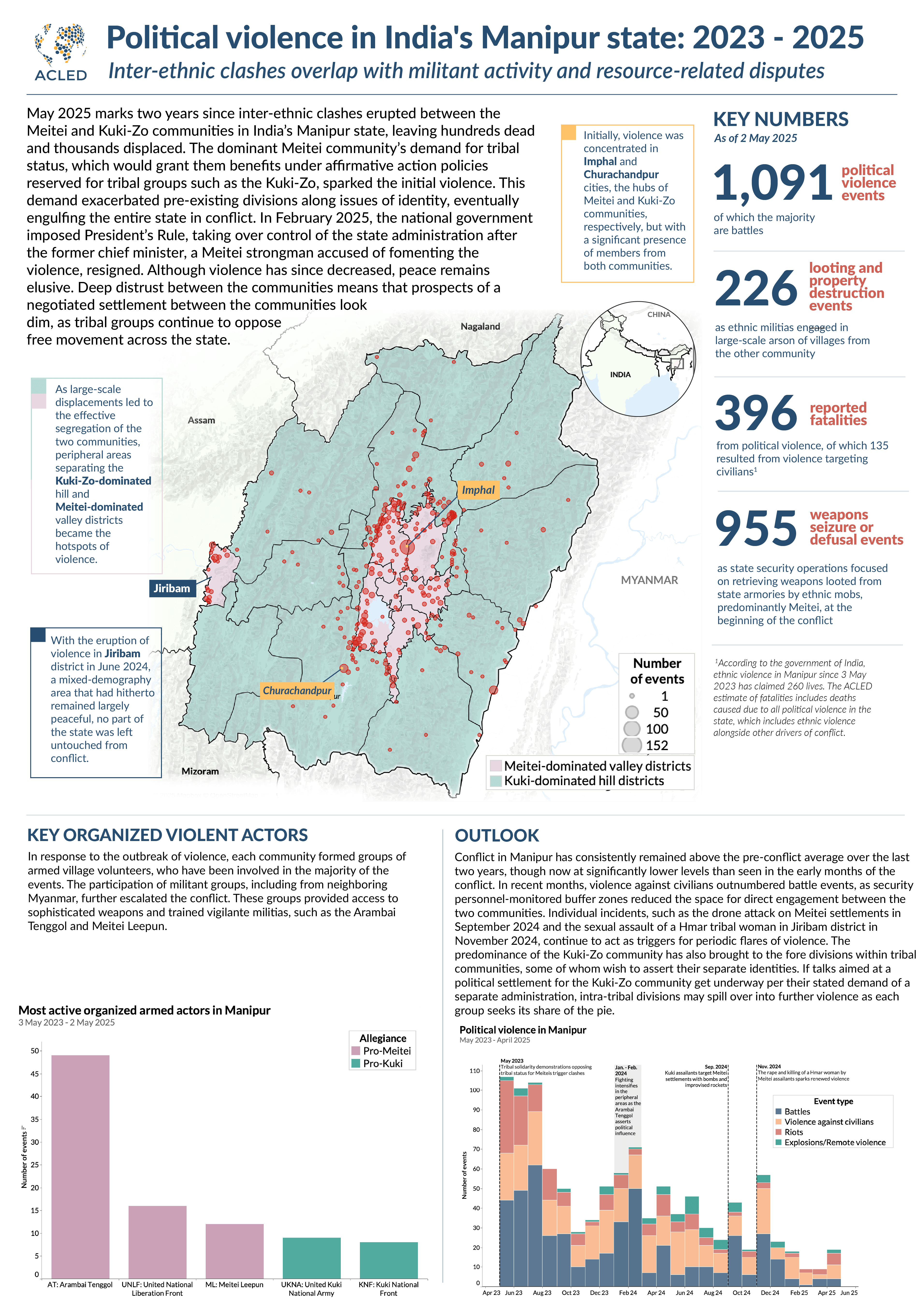
However, Manipur faced a new wave of violence in May 2023, rooted in tribal rights and the ethnic divide between Kukis and Meiteis.164Government of India, Ministry of Home Affairs, Annual Report 2023-24, paras 2.69–2.71; Government of India, Ministry of Home Affairs, Annual Report 2024-25, paras 2.71–2.73: International Crisis Group, ‘Finding a Way Out of Festering Conflict in India’s Manipur’, Report No. 346/Asia-Pacific, 14 February 2025. The Myanmar border conflict has increased tensions, leading to a surge of refugees and accusations from the regional government – then led by the Hindu nationalist Bharatiya Janata Party (BJP) – that the Kukis are facilitating illegal immigration and drug trafficking, even though other ethnic groups have also been involved in the illicit drug trade originating from Myanmar.165International Crisis Group, ‘Finding a Way Out of Festering Conflict in India’s Manipur’, Report No. 346/Asia-Pacific, 14 February 2025.
Violence erupted during a May 2023 march organized by the representatives of the Kukis, the Tribal Students Union of Manipur (ATSUM), to protest against a judicial decision that favoured the Meitei community’s claims to be recognized as a ‘Scheduled Tribe’, a status that allows Meiteis to benefit from privileged access to land, government jobs and education quotas.166International Crisis Group, ‘Finding a Way Out of Festering Conflict in India’s Manipur’, Report No. 346/Asia-Pacific, 14 February 2025; ‘At least five killed as ethnic violence flares in India’s Manipur’, Al Jazeera, 7 September 2024. The Kukis, primarily Christian and acknowledged as a tribal group, oppose this decision because they believe it would favour the predominantly Hindu Meiteis, who already dominate most of Manipur’s political and economic influence. Exacerbated by rumour and disinformation, clashes unfolded between Meiteis and some of the 60,000 protesters taking part in the march in early May, leading in the first days to several deaths and injuries,destruction of property, and vandalism.167K. Deb, ‘Manipur violence: Three dead in Churachandpur, two critical’, East Mojo, 4 May 2023; A. Hussain, ‘How Manipur violence unfolded: A timeline of events’, India Today, 4 May 2023; International Crisis Group, ‘Finding a Way Out of Festering Conflict in India’s Manipur’, Report No. 346/Asia-Pacific, 14 February 2025. The Meiteis, who had looted state armouries, initially dominated the fighting, with two-thirds of the deaths recorded within the Kuki community.168International Crisis Group, ‘Finding a Way Out of Festering Conflict in India’s Manipur’, Report No. 346/Asia-Pacific, 14 February 2025. A total of 71 deaths were reported in the first month alone, and by the end of July 2023, out of 181 reported deaths, 113 victims were Kukis and 62 were Meiteis.169J. P. Vallejo, ‘Manipur: a Genocide?’, Journal of International Humanitarian Legal Studies, Vol. 16, No. 1, 2025,pp 211-248. However, the Kukis struck back. In total, 6,000 arms, 600,000 rounds of ammunition and 28,000 explosives and bombs were looted from police stations and state armouries in the capital, Imphal, and surrounding hills.170T. Pandey, ‘Elusive peace: In India’s Manipur, bombs and mortars are civilian weapons’, Al Jazeera, 6 March 2025. Both sides repeatedly attacked each other’s villages, launching mortar fire and bombs, with inhabitants and security forces caught in the middle.171SATP/ICM, ‘Manipur – Major Incidents: 2023’; T. Pandey, ‘Elusive peace: In India’s Manipur, bombs and mortars are civilian weapons’, Al Jazeera, 6 March 2025. The death toll rose steadily throughout the first year of the crisis, and 157 individuals were killed during 2023.172SATP/ICM, ‘Datasheet – Manipur: Yearly Fatalities’; J. P. Vallejo, ‘Manipur: a Genocide?’, Journal of International Humanitarian Legal Studies, Vol. 16, No. 1, 2025,pp 211-248. Widespread sexual violence against women and girls was also reported.173International Crisis Group, ‘Finding a Way Out of Festering Conflict in India’s Manipur’, Report No. 346/Asia-Pacific, 14 February 2025. Throughout the first months of the crisis, at least one hundred women and girls, primarily from the Kuki-Zo ethnic minority, have reported being victims of sexual and gender-based violence.174Letter of the UN Special Rapporteurs, 29 August 2023.
Despite the deployment of 40,000 additional troops, the central government was unable to quell the fighting and ultimately divided the state between the Meiteis, who live in the valley, and the Kukis, who are settled in the surrounding hills, leaving them separated by a stretch of no-man’s land monitored by federal paramilitary forces.175‘At least five killed as ethnic violence flares in India’s Manipur’, Al Jazeera, 7 September 2024; International Crisis Group, ‘Finding a Way Out of Festering Conflict in India’s Manipur’, Report No. 346/Asia-Pacific, 14 February 2025.
Nevertheless, although fighting decreased, the violence did not stop, as incursions through the buffer zone from both sides continued to target their counterparts and to fight with security forces.176SATP/ICM, ‘Manipur – Major Incidents: 2024’; SATP/ICM, ‘Manipur – Major Incidents: 2025’; International Crisis Group, ‘Finding a Way Out of Festering Conflict in India’s Manipur’, Report No. 346/Asia-Pacific, 14 February 2025. More specifically, active fighting between the two groups reduced towards the end of 2024 and into 2025, but renewed afresh in early 2026.177‘Mindless killing: On Manipur, Meitei man’s killing’, The Hindu, 24 January 2026; G. Kuthar,’ Two children killed in Bishnupur as Manipur’s fragile peace shatters again’, Frontline, 8 April 2026;SATP/ICM, ‘Manipur (Insurgency North East): Timeline (Terrorist Activities)-2025’, 26 May 2026. A total of 173 fatalities were reported between 2024 and May 2026.178SATP/ICM, ‘Datasheet – Manipur: Yearly Fatalities’. Use of explosive drones, homemade rockets, grenades, mortars, IEDs, and automatic rifles by both sides has been reported.179‘At least five killed as ethnic violence flares in India’s Manipur’, Al Jazeera, 7 September 2024; T. Pandey, ‘Elusive peace: In India’s Manipur, bombs and mortars are civilian weapons’, Al Jazeera, 6 March 2025. The key road connecting Bishnupur to Kuki-dominated Churachandpur has also remained blocked for at least two weeks in April 2026.180 Y. Sharma, ‘Why is India’s Manipur burning for three years?v’, Al Jazeera, 22 April 2026. Both parties have smuggled more advanced weapons from Myanmar and Bangladesh, including sniper rifles and machine guns. They have also improvised weapons, with the Kukis making rockets and the Meiteis making wheeled mortars.181T. Pandey, ‘Elusive peace: In India’s Manipur, bombs and mortars are civilian weapons’, Al Jazeera, 6 March 2025.
As a result, by early 2025, more than 260 people were killed and 65,000 were displaced since the eruption of violence;182International Crisis Group, ‘Finding a Way Out of Festering Conflict in India’s Manipur’, Report No. 346/Asia-Pacific, 14 February 2025; T. Pandey, ‘Elusive peace: In India’s Manipur, bombs and mortars are civilian weapons’, Al Jazeera, 6 March 2025 and the total number of deaths rose to 396 by January 2026.183ACLED, ‘Political Violence in India’s Manipur State 2023-2025v’, 2 May 2025; R. Choudhury, ‘Tension Over Firing In Manipur’s Ukhrul, Kuki And Naga Tribes Trade Charges’, NDTV, 20 March 2026.
Two criteria need to be assessed in order to determine whether a situation of armed violence amounts to a NIAC:
- First, the level of armed violence must reach a certain degree of intensity that goes beyond internal disturbances and tensions.
- Second, in every NIAC, at least one side in the conflict must be a non-State armed group that exhibits a certain level of organization in order to qualify as a party to the NIAC. Government forces are presumed to satisfy the criteria of organization. 184ICTY, Prosecutor v Dusko Tadić, Appeals Chamber, Decision on the Defence Motion for Interlocutory Appeal on Jurisdiction, Case No IT-94-1-AR72, 2 October 1995, para 70; ICTY, Prosecutor v Dusko Tadić, Trial Chamber, Judgment, Case No IT-94-1-T, 7 May 1997, para 562.
Various indicative factors are used to assess whether a given situation has met the required intensity threshold, such as the number, duration, and intensity of individual confrontations; the types of weapons and military equipment used; the number of persons and types of forces participating in the fighting; the number of casualties; the extent of material destruction; the number of civilians fleeing; and the involvement of the UN Security Council.185 For a summary, see ICTY, Prosecutor v Ljube Boškoski and Johan Tarčulovski, Trial Chamber, Judgment, Case No IT-04-82-T, 10 July 2008, para 177.
A series of indicative factors are used to assess whether armed groups exhibit the required degree of organization, such as the existence of a command structure and disciplinary rules and mechanisms; the ability to procure, transport, and distribute arms; the ability to plan, coordinate, and carry out military operations; and the ability to negotiate and conclude agreements, e.g. ceasefire or peace agreements. If the minimum criterion for organization of the armed groups is not fulfilled, there is no armed conflict.186For a summary, see ICTY, Prosecutor v Ramush Haradinaj and others, Trial Chamber, Judgment, Case No IT-04-84-T, 3 April 2008, para 60.
As regards the motives of the organized armed group, ‘[t]he determination of the existence of an armed conflict is based solely on two criteria: the intensity of the conflict and organization of the parties, the purpose of the armed forces to engage in acts of violence or also achieve some further objective is, therefore, irrelevant.’187ICTY, Prosecutor v Fatmir Limaj et al., Judgment (Trial Chamber) (Case No. IT-03-66-T), 30 November 2005, para 170.] In other words, the motives – political or economic– of the armed actors have no bearing on whether the situation is classified as a NIAC.188C. Redaelli and C. Arévalo, ‘When Cartels Fight Back: El Mencho and the NIAC Question in Mexico’, Articles of War, 23 March 2026.
Non-international armed conflict between India and the Communist Party of India-Maoist (CPI-Maoist) (until March 2026 at the latest) Ended March 2026
Background
Despite its enhanced incentives for surrender and renewed pressure on Maoists (see above),between 2023 and early 2026, Indian security forces – mainly the Central Reserve Police Force (CRPF), notably the Commando Battalion for Resolute Action (CoBRA) and the Rapid Action Force (RAF)1Government of India, Ministry of Home Affairs, Annual Report 2022-23, paras 7.27, 7.31-2, 7.40-41, 7.43, 7.44, and 7.54-5. – continued to fight the CPI-Maoist. In its fight against the Maoist Insurgency, the Indian government was supported by the District Reserve Guard (DRG) since its establishment in 2008 (see above). After a decline in 2023, incidents of violence related to the Maoists significantly increased in 2024 and 2025 and accounted for the vast majority of violent incidents in the country. Likewise, related fatalities increased accordingly (see above). In early 2026, comparatively, fewer Maoist insurgency-related major incidents of violence (7) and fatalities (78) have been recorded so far.2SATP/ICM, ‘Datasheet – Maoist Insurgency: Yearly Fatalities’, 26 May 2026; SATP/ICM, ‘Datasheet – Maoist Insurgency: Major Incidents’, 26 May 2026.
Organization
The CPI-Maoist, including its formations and front organizations, acts as the main armed group fighting the Indian government. Even if it was seriously weakened (see above), it has remained the most potent armed group in India between 2023 and 2025,3Government of India, Ministry of Home Affairs, Annual Report 2024–25, para. 2.27. satisfying the organization criterion for most of it.
Founded in 2004 following the merger between the Maoist Communist Center of India (MCC) and the Communist Party of India (Marxist-Leninist) People’s War (also called the People’s War Group or PGW), it aims to carry on the ‘New Democratic Revolution’ as a part of the world proletarian revolution by throwing out the Indian central government.4SATP/ICM, ‘Communist Party of India-Maoist (CPI-Maoist) all its formations and front organizations – Maoist Insurgency’. According to reports, since its formation, the CPI-Maoist has maintained an extensive hierarchical command structure comprising a Central Committee, Regional Bureaus, Zonal or State Committees, District or Division Committees, and Squad Area Committees, with the upper tiers issuing orders and delegating tasks to subordinate groups and individuals. It also has an identified armed wing: the People’s Liberation Guerrilla Army (PLGA).5S. A. Prasanna, ‘Red Belt, Green Hunt, Grey Law: India’s Naxalite-Maoist Insurgency and the Law of Non-International Armed Conflict’, UCLA Law Review, Vol. 68 (2016), pp 517–18 and 523;SATP/ICM, ‘Communist Party of India-Maoist (CPI-Maoist) all its formations and front organizations – Maoist Insurgency’. Orders are issued by the Central Committee, which oversees all Maoist activities. To implement these orders and those from state and local Committees, a Central Military Commission has been set up to coordinate actions at the ground level. Commentators have noted that, although the Maoist command structure is complex, it grants significant operational autonomy to lower-level factions.6A. Sinha and M. Vaishnav, ‘The Naxalite Insurgency in India’, Carnegie Endowment for International Peace, 14 November 2012.
A decentralized nature may be seen as failing to meet the organizational requirement.7C. Redaelli and C. Arévalo, ‘When Cartels Fight Back: El Mencho and the NIAC Question in Mexico’, Articles of War, 23 March 2026. According to the International Committee of the Red Cross (ICRC), however, such decentralized armed groups, which consist of fluid alliances of small armed groups led by individual commanders who retain considerable decision-making power and responsibility over group members, and where there is loose internal coordination, including for planning and conduct of military operations, can be considered as sufficiently organized to become a party to a NIAC.8ICRC, The Roots of Restraint in War, 2018, pp 45-47. See also: C. Redaelli and C. Arévalo, ‘When Cartels Fight Back: El Mencho and the NIAC Question in Mexico’, Articles of War, 23 March 2026. This is notably the case when the group’s leadership, ‘while not relying on a centralized command structure, has the capacity to exercise operational command over its constitutive sub-units – ie, it has the authority to assign missions or tasks to subordinate commanders, to deploy units, to redistribute forces and to retain or delegate operational and/or tactical control.’9S. Vité and I. Gallino, ‘Decentralized armed groups: Can they be classified as parties to non-international armed conflicts?’, International Review of the Red Cross, No. 926 (August 2024), pp 938–39.
Likewise, even though the CPI-Maoist has lost considerable territorial control as well as support from the local population, and has mainly operated in Chhattisgarh and Jharkhand since 2023 (see above), it has remained able to plan, coordinate and carry out military operations, which have accounted for the vast majority of violent incidents within India between 2023 and May 2026 (see above).
Before the recent government crackdown on Maoists – marked by killings, arrests, surrenders, and recovery of weapons and camps (see above) – and following the merger of MCC and PWG, the CPI-Maoist was estimated to have between 6,500 and 7,000 cadres. They reportedly possessed over 5,500 firearms, including AKs, light machine guns, rifles, carbines, grenades, handguns, and landmines.10SATP/ICM, ‘Communist Party of India-Maoist (CPI-Maoist) all its formations and front organizations – Maoist Insurgency’. In addition to obtaining weapons through targeted attacks and battlefield victories,11‘Naxals amassing hi-tech weapons, Chhattisgarh Police worried’, The Economic Times, 13 September 2013. the CPI-Maoist has also possessed its own weapons factory, where it has produced 12-bore guns and ammunition, repaired weapons, and assembled grenades.12SATP/ICM, ‘Communist Party of India-Maoist (CPI-Maoist) all its formations and front organizations – Maoist Insurgency’. Yet, since the government crackdown, the Maoists have continued to target security forces and civilians and to use IEDs, even increasing their operations between 2024 and 2025 (see above). The continuation and relative increase in their activities provide evidence that, even if their military capacity was weakened, the Maoists have remained able to access weapons and other military equipment and to recruit and provide military training between 2024 and 2025.
Finally, the CPI-Maoist has defined on multiple occasions its unified military strategy. In particular, the Central Committee drafted five documents – ‘Hold High the Bright Red Banner of Marxism-Leninism-Maoism’, the ‘Party Programme’, ‘Strategy and Tactics of the Indian Revolution’, ‘the Political Resolution on the International and Domestic Situation’, and the ‘Party Constitution’ – were it laid down the objectives and strategy of the CPI-Maoist.13SATP/ICM, ‘Communist Party of India-Maoist (CPI-Maoist) all its formations and front organizations – Maoist Insurgency’. The CPI-Maoist also had an identified spokesperson, Mallojula Venugopal, who also served as a member of the Politburo, Central Committee and Central Military Commission, until his surrender in October 2025.14D. K. Nayak, ‘Maoist — The fall of an ideologue and the shrinking Maoist periphery’, Global Order, 16 October 2025.
However, as noted above, the Indian government’s pressure ultimately succeeded in decapitating the Maoist central leadership and disintegrating the CPI-Maoist by the end of March 2026 at the latest. Available evidence indicates that while the CPI-Maoist and its formations displayed a sufficient threshold of organization between 2023 and early 2026, they subsequently fell below that threshold and eventually disappeared as a party to the conflict by the end of March 2026.
Since only organized armed groups (in addition to States) can be parties to a NIAC,15ICTY, The Prosecutor v Dusko Tadic a/k/a “Dule”, Appeal Chamber, Decision on the Defence Motion for interlocutory appeal on jurisdiction, Case No. IT-94-1-AR72, 2 October 1995, para. 87. a group that no longer has a sufficient degree of organization cannot be a party to an armed conflict.
Intensity
Although some fighting and dozens of fatalities were recorded in early 2026 (see above), since the CPI-Maoist ceased to exist at the end of March 2026, the NIAC opposing India against the CPI-Maoist is deemed to have ended at that date.
- 1Government of India, Ministry of Home Affairs, Annual Report 2022-23, paras 7.27, 7.31-2, 7.40-41, 7.43, 7.44, and 7.54-5. ↩︎
- 2SATP/ICM, ‘Datasheet – Maoist Insurgency: Yearly Fatalities’, 26 May 2026; SATP/ICM, ‘Datasheet – Maoist Insurgency: Major Incidents’, 26 May 2026. ↩︎
- 3Government of India, Ministry of Home Affairs, Annual Report 2024–25, para. 2.27. ↩︎
- 4
- 5S. A. Prasanna, ‘Red Belt, Green Hunt, Grey Law: India’s Naxalite-Maoist Insurgency and the Law of Non-International Armed Conflict’, UCLA Law Review, Vol. 68 (2016), pp 517–18 and 523;SATP/ICM, ‘Communist Party of India-Maoist (CPI-Maoist) all its formations and front organizations – Maoist Insurgency’. ↩︎
- 6A. Sinha and M. Vaishnav, ‘The Naxalite Insurgency in India’, Carnegie Endowment for International Peace, 14 November 2012. ↩︎
- 7C. Redaelli and C. Arévalo, ‘When Cartels Fight Back: El Mencho and the NIAC Question in Mexico’, Articles of War, 23 March 2026. ↩︎
- 8ICRC, The Roots of Restraint in War, 2018, pp 45-47. See also: C. Redaelli and C. Arévalo, ‘When Cartels Fight Back: El Mencho and the NIAC Question in Mexico’, Articles of War, 23 March 2026. ↩︎
- 9S. Vité and I. Gallino, ‘Decentralized armed groups: Can they be classified as parties to non-international armed conflicts?’, International Review of the Red Cross, No. 926 (August 2024), pp 938–39. ↩︎
- 10
- 11‘Naxals amassing hi-tech weapons, Chhattisgarh Police worried’, The Economic Times, 13 September 2013. ↩︎
- 12
- 13
- 14D. K. Nayak, ‘Maoist — The fall of an ideologue and the shrinking Maoist periphery’, Global Order, 16 October 2025. ↩︎
- 15ICTY, The Prosecutor v Dusko Tadic a/k/a “Dule”, Appeal Chamber, Decision on the Defence Motion for interlocutory appeal on jurisdiction, Case No. IT-94-1-AR72, 2 October 1995, para. 87. ↩︎
Insurgency in North Eastern Region (NER) and Jammu & Kashmir (J&K)
As regards other insurgent groups operating in NER and J&K, the relatively low intensity of violence (see above) together with the lack of available information on their level of organization renders the classification of these situations as NIACs under IHL uncertain. In other words, although the organization criterion might be fulfilled individually by some of the remaining insurgent groups, the persisting uncertainty as to whether the intensity threshold has been independently reached, either with respect to the violence between them and the Indian State or, alternatively, among the groups themselves, does not allow us to conclude that NIACs have been ongoing between 2023 and May 2026. Furthermore, there is no evidence of existing coalitions among these actors that involve sufficient coordination to allow for the aggregation of intensity.
According to the ICRC, when several organized armed groups operate in a coalition and maintain a sufficient level of coordination within the coalition, ‘the intensity the intensity between each of them and an opposing party may be aggregated when considering whether the threshold of intensity has been reached’. However, ‘a shared ideology, similarities of political views or the mere existence of a common enemy would not be sufficient. Rather, factual indicators must be considered, including, inter alia, the establishment of a coordination structure, the sharing of operational tasks, the existence of common standard operating procedures and/or rules of engagement, the coordination of simultaneous attacks against the opposing party and the conduct of joint military operations.’189ICRC, How is the Term “Armed Conflict” Defined in International Humanitarian Law’, 2024, p 17.
Manipur crisis
Violence pitting the Meiteis against the Kukis since May 2023 would probably have met the intensity threshold. Indeed Manipur’s crisis has involved hundreds of deaths, the deployment of additional troops, and the use of IEDs as well as military-grade weapons, whether smuggled or improvised. It has also displaced over 65,000 persons and resulted in the territory being divided along ethnic lines (see above). However, uncertainty regarding the identity of the actors as well as their degree of organization prevents us from classifying the situation as a NIAC. Indeed, although the main armed groups reportedly involved, which include United Kuki National Army (UKNA) and the Kuki National Front (KNF) among the Kuki-Zo, and the Arambai Tenggol, Meitei Leepun, and the United National Liberation Front (UNLF) among the Meiteis,190ACLED, ‘Political Violence in India’s Manipur State 2023-2025’, 2 May 2025. might be sufficiently organized, attribution of specific incidents of violence to one particular armed group often remains unclear. News reports often attribute such incidents to ‘civilians trained by armed groups’,191T. Pandey, ‘Elusive peace: In India’s Manipur, bombs and mortars are civilian weapons’, Al Jazeera, 6 March 2025, ‘black shirts,’ ‘village volunteers,’ ‘rebel groups,’ ‘armed civilians,’ ‘militants,’ ‘armed miscreants,’ ‘extremists,’ and ‘gunmen’.J. P. Vallejo, ‘Manipur: a Genocide?’, Journal of International Humanitarian Legal Studies, Vol. 16, No. 1 (2025),pp 211–48.
Therefore, in the absence of information on the identity of the perpetrators and their possible affiliation to a specific organized armed group, as things stand, it remains uncertain whether the situation has amounted to a NIAC between May 2023 and May 2026.
State Parties
- India (until the end of March 2026)
Non-State parties
- Maoist-CPI (until the end of March 2026)
Other Non-State Actors
- Meitei armed groups
- Kuki/Kuki-Zo armed groups
- Northeastern armed groups
- Jammu and Kashmir’s armed groups
Foreign involvement
- Pakistan
- China
- Bangladesh
- Myanmar
- 1S. Sobhan, ‘India: 60 Years of Maoist insurgency and its human cost’, Deutsche Welle, 14 February 2025; S. Bagchi, ‘After decades of bloodshed, is India winning its war against Maoists?’, BBC, 28 May 2025; V. Tiwari, J. Purohit and A. Jain, ‘How India’s war against Maoists is affecting its people’, BBC Hindi, 27 September 2025; D. Tikekar and R. Mogul, ‘Some of the world’s last Maoist rebels are in India. Their decades-long rebellion is in its death throes’, CNN World, 2 June 2026. ↩︎
- 2S. Sobhan, ‘India: 60 Years of Maoist insurgency and its human cost’, Deutsche Welle, 14 February 2025; D. Tikekar and R. Mogul, ‘Some of the world’s last Maoist rebels are in India. Their decades-long rebellion is in its death throes’, CNN World, 2 June 2026. ↩︎
- 3D. Tikekar and R. Mogul, ‘Some of the world’s last Maoist rebels are in India. Their decades-long rebellion is in its death throes’, CNN World, 2 June 2026. ↩︎
- 4Government of India, Ministry of Home Affairs, Annual Report 2022–23, para 2.28; Government of India, Ministry of Home Affairs, ‘Left Wing Extremist Division’, 18 December 2025. ↩︎
- 5S. Bagchi, ‘After decades of bloodshed, is India winning its war against Maoists?’, BBC, 28 May 2025; Government of India, Ministry of Home Affairs, ‘Left Wing Extremist Division’, 18 December 2025. ↩︎
- 6S. Prasanna, ‘Red Belt, Green Hunt, Grey Law: India’s Naxalite-Maoist Insurgency and the Law of Non-International Armed Conflict’, UCLA Law Review, Vol. 63, 2016); D. Tikekar and R. Mogul, ‘Some of the world’s last Maoist rebels are in India. Their decades-long rebellion is in its death throes’, CNN World, 2 June 2026. ↩︎
- 7Government of India, Ministry of Home Affairs, Annual Report 2022–23, para 2.36; D. Tikekar and R. Mogul, ‘Some of the world’s last Maoist rebels are in India. Their decades-long rebellion is in its death throes’, CNN World, 2 June 2026. ↩︎
- 8S. Sobhan, ‘India: 60 Years of Maoist insurgency and its human cost’, Deutsche Welle, 14 February 2025; South Asia Terrorism Portal (SATP)/Institute for Conflict Management (ICM), ‘Datasheet – Maoist Insurgency: Yearly Fatalities’, 2 May 2026. ↩︎
- 9D. Tikekar and R. Mogul, ‘Some of the world’s last Maoist rebels are in India. Their decades-long rebellion is in its death throes’, CNN World, 2 June 2026. ↩︎
- 10‘Chhattisgarh ‘hostage’ crisis: Maoists kill 1 tribal, others allowed to return home’, The Indian Express, 10 May 2015. ↩︎
- 11Tikekar and R. Mogul, ‘Some of the world’s last Maoist rebels are in India. Their decades-long rebellion is in its death throes’, CNN World, 2 June 2026. ↩︎
- 12Norwegian Refugee Council (NRC)/Internal Displacement Monitoring Centre (IDMC), ‘Internal displacement in India (April 2015)’, 20 April 2015. See also: ‘No legal status: how India is ignoring its thousands of displaced citizens’, The Guardian, 11 August 2016. ↩︎
- 13IDMC, Global Internal Displacement Database (GIDD), 5 May 2026. ↩︎
- 14D. Tikekar and R. Mogul, ‘Some of the world’s last Maoist rebels are in India. Their decades-long rebellion is in its death throes’, CNN World, 2 June 2026. ↩︎
- 15D. Tikekar and R. Mogul, ‘Some of the world’s last Maoist rebels are in India. Their decades-long rebellion is in its death throes’, CNN World, 2 June 2026. ↩︎
- 16Government of India, Ministry of Home Affairs, Annual Report 2022-23, paras 1.21, 2.22, 2.33, 2.35-36 and 2.45; Government of India, Ministry of Home Affairs, Annual Report 2023–24, para 2.18; Government of India, Ministry of Home Affairs, ‘Left Wing Extremist Division’, 18 December 2025. ↩︎
- 17N. Sahoo and A. Ghosal’, ‘Combating Maoist Insurgency: A Spotlight on Chhattisgarh’s DRG Model’, Observer Research Foundation, 8 August 2025; V. Tiwari, J. Purohit and A. Jain, ‘How India’s war against Maoists is affecting its people’, BBC Hindi, 27 September 2025; D. Tikekar and R. Mogul, ‘Some of the world’s last Maoist rebels are in India. Their decades-long rebellion is in its death throes’, CNN World, 2 June 2026. ↩︎
- 18D. Tikekar and R. Mogul, ‘Some of the world’s last Maoist rebels are in India. Their decades-long rebellion is in its death throes’, CNN World, 2 June 2026. ↩︎
- 19Government of India, Ministry of Home Affairs, Annual Report 2022–23, para 2.19; Government of India, Ministry of Home Affairs, ‘Rajya Sabah: Starred question no. *58’, February 2026, p 2. ↩︎
- 20Government of India, Ministry of Home Affairs, ‘Left Wing Extremist Division’, 18 December 2025; Government of India, Ministry of Home Affairs, Annual Report 2022-23, paras 2.20, 7.27. ↩︎
- 21Government of India, Ministry of Home Affairs, ‘Left Wing Extremist Division’, 18 December 2025. ↩︎
- 22Government of India, Ministry of Home Affairs, Annual Report 2022–23, paras 2.20, 2.33, 2.35, 2.45 and 11.5; Government of India, Ministry of Home Affairs, Annual Report 2023–24, paras 2.18 and 2.31; Government of India, Ministry of Home Affairs, ‘Left Wing Extremist Division’, 18 December 2025. ↩︎
- 23Government of India, Ministry of Home Affairs, Annual Report 2022–23, para 2.34; Government of India, Ministry of Home Affairs, Annual Report 2023–24, para 2.32; Government of India, Ministry of Home Affairs, ‘Left Wing Extremist Division’, 18 December 2025. ↩︎
- 24Government of India, Ministry of Home Affairs, Annual Report 2022-23, para 2.32; Government of India, Ministry of Home Affairs, Annual Report 2023-24, paras 2.19 and 2.30; Government of India, Ministry of Home Affairs, ‘Left Wing Extremist Division’, 18 December 2025. ↩︎
- 25Government of India, Ministry of Home Affairs, Annual Report 2022–23, paras 2.21 and 2.35; Government of India, Ministry of Home Affairs, Annual Report 2023–24, paras 2.20 and 2.33; Government of India, Ministry of Home Affairs, ‘Left Wing Extremist Division’, 18 December 2025. ↩︎
- 26‘Cash, Training & A Fresh Start: Inside India’s Maoist Surrender Policy As Devuji Lays Down Arms’, News 18, 23 February 2026. ↩︎
- 27V. Tiwari, J. Purohit and A. Jain, ‘How India’s war against Maoists is affecting its people’, BBC Hindi, 27 September 2025. ↩︎
- 28Government of India, Ministry of Home Affairs, Annual Report 2022–23, para 7.44. ↩︎
- 29Government of India, Ministry of Home Affairs, ‘CPI (Maoist) included in list of terrorist organizations to avoid any ambiguity’, 22 June 2009; Government of India, Ministry of Home Affairs, Annual Report 2022-23, para 2.28. ↩︎
- 30R. Gaikwad, ‘Manmohan: naxalism the greatest internal threat’, The Hindu, 11 October 2009, updated on 17 November 2021; V. Tiwari, J. Purohit and A. Jain, ‘How India’s war against Maoists is affecting its people’, BBC Hindi, 27 September 2025; D. Tikekar and R. Mogul, ‘Some of the world’s last Maoist rebels are in India. Their decades-long rebellion is in its death throes’, CNN World, 2 June 2026. ↩︎
- 31Government of India, Ministry of Home Affairs, Annual Report 2022–23, paras 2.31, 7.32 and 7.41. ↩︎
- 32Government of India, Ministry of Home Affairs, Annual Report 2022–23, para 7.44. ↩︎
- 33Government of India, Ministry of Home Affairs, Annual Report 2022–23, para 2.23; Government of India, Ministry of Home Affairs, Annual Report 2023–24, paras 2.21–2.22. ↩︎
- 34SATP/ICM, ‘Jammu & Kashmir: Backgrounder’. ↩︎
- 35SATP/ICM, ‘Jammu & Kashmir: Backgrounder’. ↩︎
- 36SATP/ICM, ‘Jammu & Kashmir: Backgrounder’. ↩︎
- 37SATP/ICM, ‘Jammu & Kashmir: Backgrounder’. ↩︎
- 38SATP/ICM, ‘Jammu & Kashmir: Backgrounder’. ↩︎
- 39SATP/ICM, ‘Jammu & Kashmir: Backgrounder’. ↩︎
- 40SATP/ICM, ‘Jammu & Kashmir: Backgrounder’. ↩︎
- 41SATP/ICM, ‘Jammu & Kashmir: Backgrounder’. ↩︎
- 42SATP/ICM, ‘Jammu & Kashmir: Backgrounder’; Shankar IAS Parliament, ‘Ceasefire in Jammu and Kashmir’, 17 May 2018. ↩︎
- 43SATP/ICM, ‘Jammu & Kashmir: Backgrounder’. ↩︎
- 44SATP/ICM, ‘Jammu & Kashmir: Backgrounder’. ↩︎
- 45SATP/ICM, ‘Jammu & Kashmir: Backgrounder’. ↩︎
- 46SATP/ICM, ‘Jammu & Kashmir: Backgrounder’. ↩︎
- 47SATP/ICM, ‘Jammu & Kashmir: Backgrounder’. ↩︎
- 48SATP/ICM, ‘Jammu & Kashmir: Backgrounder’. ↩︎
- 49SATP/ICM, ‘Jammu & Kashmir: Backgrounder’. ↩︎
- 50SATP/ICM, ‘Jammu & Kashmir: Backgrounder’; Shankar IAS Parliament, ‘Ceasefire in Jammu and Kashmir’, 17 May 2018. ↩︎
- 51SATP/ICM, ‘Jammu & Kashmir: Backgrounder’. ↩︎
- 52SATP/ICM, ‘Datasheet – Jammu & Kashmir: Major incident’. ↩︎
- 53SATP/ICM, ‘Jaish-e-Mohammed (JeM): Jammu & Kashmir’. ↩︎
- 54SATP/ICM, ‘Jammu & Kashmir: Backgrounder’. ↩︎
- 55SATP/ICM, ‘Datasheet – Jammu & Kashmir: Yearly fatalities’. ↩︎
- 56
- 57SATP/ICM, ‘Datasheet – Jammu & Kashmir: Yearly fatalities’;SATP/ICM, ‘Jammu & Kashmir – Major incidents: 2022’. ↩︎
- 58‘41,000 deaths in 27 years: The anatomy of Kashmir militancy in numbers’, Hindustan Times, 25 September 2017. ↩︎
- 59SATP/ICM, ‘Jammu & Kashmir: Backgrounder; SATP/ICM, ‘Datasheet – Jammu & Kashmir: Yearly fatalities’;SATP/ICM, ‘Datasheet – Jammu & Kashmir: Fatalities in 1988–2000’. ↩︎
- 60SATP/ICM, ‘Datasheet – Jammu & Kashmir: Yearly fatalities. ↩︎
- 61S. Kumar, ‘The Origins and Causes of Insurgency in Northeast India’, The Geopolitics, 3 May 2018; European Foundation for South Asian Studies (EFSAS), ‘Ethnic Insurgencies and the Crime-Insurgency Nexus in India’s North Eastern Region’, 2021, p 2; Government of India, Ministry of Home Affairs, Annual Report 2022-23, para 2.37; Government of India, Ministry of Home Affairs, Annual Report 2023-24, para 2.35; International Crisis Group, ‘Finding a Way Out of Festering Conflict in India’s Manipur’, Report No. 346/Asia-Pacific, 14 February 2025. ↩︎
- 62S. Kumar, ‘The Origins and Causes of Insurgency in Northeast India’, The Geopolitics, 3 May 2018; SATP/ICM, ‘Insurgency North East: Backgrounder’; SATP/ICM, ‘National Socialist Council of Nagaland – Isak-Muivah (NSCN-IM): Nagaland’. ↩︎
- 63S. Kumar, ‘The Origins and Causes of Insurgency in Northeast India’, The Geopolitics, 3 May 2018; SATP/ICM, ‘Insurgency North East: Backgrounder’. ↩︎
- 64SATP/ICM, ‘Insurgency North East: Backgrounder’. ↩︎
- 65S. Kumar, ‘The Origins and Causes of Insurgency in Northeast India’, The Geopolitics, 3 May 2018;SATP/ICM, ‘Insurgency North East: Backgrounder’. ↩︎
- 66SATP/ICM, ‘Insurgency North East: Backgrounder’. ↩︎
- 67SATP/ICM, ‘Insurgency North East: Backgrounder’. ↩︎
- 68SATP/ICM, ‘Insurgency North East: Backgrounder’. ↩︎
- 69SATP/ICM, ‘Insurgency North East: Backgrounder’. ↩︎
- 70SATP/ICM, ‘Insurgency North East: Backgrounder’. ↩︎
- 71SATP/ICM, ‘Insurgency North East: Backgrounder. ↩︎
- 72SATP/ICM, ‘Insurgency North East: Backgrounder. ↩︎
- 73SATP/ICM, ‘Insurgency North East: Backgrounder; C. A. Athul, ‘Ethnic Conflict in Manipur: Historical Roots, Current Tensions, and the Challenge of Identity Politics’ 2 October 2025. ↩︎
- 74C. A. Athul, ‘Ethnic Conflict in Manipur: Historical Roots, Current Tensions, and the Challenge of Identity Politics’ 2 October 2025. ↩︎
- 75SATP/ICM, ‘Insurgency North East: Backgrounder. ↩︎
- 76SATP/ICM, ‘Insurgency North East: Backgrounder; C. A. Athul, ‘Ethnic Conflict in Manipur: Historical Roots, Current Tensions, and the Challenge of Identity Politics’ 2 October 2025. ↩︎
- 77C. A. Athul, ‘Ethnic Conflict in Manipur: Historical Roots, Current Tensions, and the Challenge of Identity Politics’ 2 October 2025. ↩︎
- 78Minority Rights Group, ‘Nagas in India’. ↩︎
- 79SATP/ICM, ‘Insurgency North East: Backgrounder; International Crisis Group, ‘Finding a Way Out of Festering Conflict in India’s Manipur’, Report No. 346/Asia-Pacific, 14 February 2025. ↩︎
- 80International Crisis Group, ‘Finding a Way Out of Festering Conflict in India’s Manipur’, Report No. 346/Asia-Pacific, 14 February 2025. ↩︎
- 81International Crisis Group, ‘Finding a Way Out of Festering Conflict in India’s Manipur’, Report No. 346/Asia-Pacific, 14 February 2025. ↩︎
- 82SATP/ICM, ‘Insurgency North East: Backgrounder. ↩︎
- 83SATP/ICM, ‘Insurgency North East: Backgrounder. ↩︎
- 84SATP/ICM, ‘Insurgency North East: Backgrounder. ↩︎
- 85SATP/ICM, ‘Insurgency North East: Backgrounder. ↩︎
- 86SATP/ICM, ‘Insurgency North East: Backgrounder. ↩︎
- 87SATP/ICM, ‘Insurgency North East: Backgrounder. ↩︎
- 88SATP/ICM, ‘Insurgency North East: Backgrounder. ↩︎
- 89SATP/ICM, ‘Insurgency North East: Backgrounder. ↩︎
- 90
- 91SATP/ICM, ‘Insurgency North East: Backgrounder. ↩︎
- 92SATP/ICM, ‘Insurgency North East: Backgrounder. ↩︎
- 93SATP/ICM, ‘Insurgency North East: Backgrounder. ↩︎
- 94SATP/ICM, ‘Insurgency North East: Backgrounder. ↩︎
- 95SATP/ICM, ‘Insurgency North East: Backgrounder. ↩︎
- 96SATP/ICM, ‘Insurgency North East: Backgrounder. ↩︎
- 97A Shaheen, ‘India: Meghalaya’s Contentious Path – Analysis’, Eurasia Review, 28 January 2025. ↩︎
- 98SATP/ICM, ‘Insurgency North East: Backgrounder; M. Chakravarti, ‘Insurgency in Tripura: Some Trends’, Economic and Political Weekly, Vol. 36, No. 25 (23–29 June 2001). ↩︎
- 99SATP/ICM, ‘Insurgency North East: Backgrounder; M. Chakravarti, ‘Insurgency in Tripura: Some Trends’, Economic and Political Weekly, Vol. 36, No. 25, 23-29 June 2001. ↩︎
- 100SATP/ICM, ‘Insurgency North East: Backgrounder; M. A. Singh, ‘Conflicts in Tripura’, National Institute of Advanced Studies, 2014, p 4. ↩︎
- 101B. Prasad Routray, ‘Growing Tentacles of Insurgency in Arunachal Pradesh’, Institute of Peace and Conflict Studies (IPCS), 3 July 2002. ↩︎
- 102Government of India, Ministry of Home Affairs, Annual Report 2022–23, paras 2.38–2.46; Government of India, Ministry of Home Affairs, Annual Report 2023–24, paras 2.36–2.44. ↩︎
- 103Government of India, Ministry of Home Affairs, Annual Report 2022–23, para 2.44. ↩︎
- 104Government of India, Ministry of Home Affairs, Annual Report 2022–23, para 1.22. ↩︎
- 105International Crisis Group, ‘Finding a Way Out of Festering Conflict in India’s Manipur’, Report No. 346/Asia-Pacific, 14 February 2025. ↩︎
- 106Government of India, Ministry of Home Affairs – North East Division, ‘Insurgency in North East’, March 2023. ↩︎
- 107Government of India, Ministry of Home Affairs, Annual Report 2022–23, para 2.47. ↩︎
- 108SATP/ICM, ‘Datasheet – Insurgency North East: Yearly fatalities’. ↩︎
- 109Government of India, Ministry of Home Affairs, Annual Report 2022–23, para 2.48. ↩︎
- 110Government of India, Ministry of Home Affairs, Annual Report 2022–23, para 2.50. ↩︎
- 111Government of India, Ministry of Home Affairs, Annual Report 2022-23, paras 2.51–2.71. ↩︎
- 112Government of India, Ministry of Home Affairs, Annual Report 2024-25, paras 2.20 and 2.28–2.36. ↩︎
- 113Government of India, Ministry of Home Affairs, ‘Guidelines for surrender-cum-rehabilitation of naxalites in the naxal affected States’, September 2022. ↩︎
- 114Government of India, Ministry of Home Affairs, ‘Guidelines for surrender-cum-rehabilitation of naxalites in the naxal affected States’, September 2022. ↩︎
- 115S. Sikdar, ‘Maoists offer to surrender by February 15 in letter to three CMs’, The Hindu, 24 November 2025; S. Sikdar, ‘In a letter to Chief Ministers of three States, Maoists offer to surrender by February, 15’. The Hindu, 25 November 2025. ↩︎
- 116
- 117S. Bagchi, ‘After decades of bloodshed, is India winning its war against Maoists?’, BBC, 28 May 2025; Government of India, Ministry of Home Affairs, ‘Rajya Sabah: Starred question no. *58’, February 2026, p 2. ↩︎
- 118‘Cash, Training & A Fresh Start: Inside India’s Maoist Surrender Policy As Devuji Lays Down Arms’, News 18, 23 February 2026; S. Choudhary, ‘The untold story of the collapse of the Maoist insurgency in India’, The News Minute, 13 May 2026. ↩︎
- 119Government of India, Ministry of Home Affairs, Annual Report 2023–24, paras 2.23–2.25 ; S. Choudhary, ‘The untold story of the collapse of the Maoist insurgency in India’, The News Minute, 13 May 2026. ↩︎
- 120Government of India, Ministry of Home Affairs, Annual Report 2024-25, paras 2.22 and 2.27. ↩︎
- 121Government of India, Ministry of Home Affairs, Annual Report 2023–24, para 2.22; S. Bagchi, ‘After decades of bloodshed, is India winning its war against Maoists?’, BBC, 28 May 2025. ↩︎
- 122Government of India, Ministry of Home Affairs, Annual Report 2024–25, para. 2.27. ↩︎
- 123S. Bagchi, ‘After decades of bloodshed, is India winning its war against Maoists?’, BBC, 28 May 2025 ↩︎
- 124Government of India, Ministry of Home Affairs, Annual Report 2023–24, para 2.25; Government of India, Ministry of Home Affairs, Annual Report 2024–25, para. 2.27. ↩︎
- 125SATP/ICM, ‘India – Major Incidents: 2023’;SATP/ICM, ‘India – Major Incidents: 2024’;SATP/ICM, ‘India – Major Incidents: 2025’;SATP/ICM, ‘India – Major Incidents: 2026’. ↩︎
- 126SATP/ICM, ‘Datasheet – Maoist Insurgency: Yearly Fatalities’, 2 May 2026. ↩︎
- 127SATP/ICM, ‘Datasheet – Maoist Insurgency: Yearly Fatalities’, 11 May 2026. ↩︎
- 128V. Tiwari, J. Purohit and A. Jain, ‘How India’s war against Maoists is affecting its people’, BBC Hindi, 27 September. ↩︎
- 129SATP/ICM, ‘India – Major Incidents: 2023’;SATP/ICM, ‘India – Major Incidents: 2024’;SATP/ICM, ‘India – Major Incidents: 2025’;SATP/ICM, ‘India – Major Incidents: 2026’;SATP/ICM, ‘India: Timeline (Terrorist Activities)-2023’, 11 May 2026;SATP/ICM, ‘India: Timeline (Terrorist Activities)-2024’, 11 May 2026;SATP/ICM, ‘India: Timeline (Terrorist Activities)-2025’, 11 May 2026;SATP/ICM, ‘India: Timeline (Terrorist Activities)-2026’, 11 May 2026;SATP/ICM, ‘Datasheet – Maoist Insurgency: Yearly Fatalities’, 11 May 2026. ↩︎
- 130S. Bagchi, ‘After decades of bloodshed, is India winning its war against Maoists?’, BBC, 28 May 2025; S. Bhattacharya, ‘India’s 59-Year Maoist Insurgency Collapses’, The Diplomat, 6 April 2026; S. Choudhary, ‘The untold story of the collapse of the Maoist insurgency in India’, The News Minute, 13 May 2026; D. Tikekar and R. Mogul, ‘Some of the world’s last Maoist rebels are in India. Their decades-long rebellion is in its death throes’, CNN World, 2 June 2026. ↩︎
- 131‘Cash, Training & A Fresh Start: Inside India’s Maoist Surrender Policy As Devuji Lays Down Arms’, News 18, 23 February 2026; ‘Chhattisgarh: Last active Maoist commander in Bastar region surrenders in Bijapur’, Scroll, 25 March 2026; S. Bhattacharya, ‘India’s 59-Year Maoist Insurgency Collapses’, The Diplomat, 6 April 2026; D. Tikekar and R. Mogul, ‘Some of the world’s last Maoist rebels are in India. Their decades-long rebellion is in its death throes’, CNN World, 2 June 2026. ↩︎
- 132S. Biswas, ‘India’s communists once ruled millions. What happened to them?’, BBC, 27 May 2026; D. Tikekar and R. Mogul, ‘Some of the world’s last Maoist rebels are in India. Their decades-long rebellion is in its death throes’, CNN World, 2 June 2026. ↩︎
- 133SATP/ICM, ‘Datasheet – Jammu & Kashmir: Yearly Fatalities’; SATP/ICM, ‘Datasheet – Jammu & Kashmir: Major Incidents’; SATP/ICM, ‘Datasheet – Jammu & Kashmir: Yearly Suicide Attacks’. ↩︎
- 134SATP/ICM, ‘India: Timeline (Terrorist Activities)-2023’, 11 May 2026;SATP/ICM, ‘Datasheet – Jammu and Kashmir: Yearly Explosions’;SATP/ICM, ‘Datasheet – Jammu & Kashmir: Yearly Arrest’; SATP/ICM, ‘Datasheet – Jammu & Kashmir: Yearly Surrender’;SATP/ICM, ‘Datasheet – Jammu & Kashmir: Yearly Arms Recovery’. ↩︎
- 135SATP/ICM, ‘India: Timeline (Terrorist Activities)-2023’, 11 May 2026;SATP/ICM, ‘India: Timeline (Terrorist Activities)-2024’, 11 May 2026;SATP/ICM, ‘India: Timeline (Terrorist Activities)-2025’, 11 May 2026;SATP/ICM, ‘India: Timeline (Terrorist Activities)-2026’, 11 May 2026. ↩︎
- 136SATP/ICM, ‘India – Major Incidents: 2023’; ‘2023 Rajouri Attack: Anti Terror Agency Chargesheets 3 Pak Nationals’, NDTV, 26 February 2024. ↩︎
- 137SATP/ICM, ‘India – Major Incidents: 2023’. ↩︎
- 138SATP/ICM, ‘Jaish-e-Mohammed (JeM): Jammu & Kashmir’. ↩︎
- 139SATP/ICM, ‘India: Timeline (Terrorist Activities)-2024’, 11 May 2026. ↩︎
- 140SATP/ICM, ‘India – Major Incidents: 2024’ ↩︎
- 141A. Hassan, ‘At least 26 tourists killed by suspected militants in Kashmir attack’, The Guardian, 22 April 2025;SATP/ICM, ‘India – Major Incidents: 2025’;SATP/ICM, ‘India: Timeline (Terrorist Activities)-2024’, 11 May 2026. ↩︎
- 142SATP/ICM, ‘India – Major Incidents: 2026’;SATP/ICM, ‘India: Timeline (Terrorist Activities)-2026’, 11 May 2026. ↩︎
- 143International Crisis Group, ‘Finding a Way Out of Festering Conflict in India’s Manipur’, Report No. 346/Asia-Pacific, 14 February 2025. ↩︎
- 144Government of India, Ministry of Home Affairs, Annual Report 2023–24, para 2.45; Government of India, Ministry of Home Affairs, Annual Report 2024–25, para. 2.47. ↩︎
- 145Government of India, Ministry of Home Affairs, Annual Report 2023– 24, para 2.46. ↩︎
- 146Government of India, Ministry of Home Affairs, Annual Report 2024–25, para. 2.48–2.49. ↩︎
- 147Government of India, Ministry of Home Affairs, Annual Report 2024–25, para. 2.48. ↩︎
- 148Government of India, Ministry of Home Affairs, Annual Report 2023–24, para 2.46; Government of India, Ministry of Home Affairs, Annual Report 2024–25, paras 2.44 and 2.48. ↩︎
- 149Government of India, Ministry of Home Affairs, Annual Report 2023–24, paras 2.45 and 2.48; Government of India, Ministry of Home Affairs, Annual Report 2024–25, paras 2.50–2.66 and 2.76. ↩︎
- 150Government of India, Ministry of Home Affairs, Annual Report 2024-25, para. 2.51. ↩︎
- 151Government of India, Ministry of Home Affairs, Annual Report 2023-24, paras 2.49–2.58; Government of India, Ministry of Home Affairs, Annual Report 2024-25, paras 2.51–2.59. ↩︎
- 152Government of India, Ministry of Home Affairs, Annual Report 2024-25, paras 2.63–2.64; Government of India, Ministry of Home Affairs, Annual Report 2024-25, paras 2.65–2.66. ↩︎
- 153Government of India, Ministry of Home Affairs, Annual Report 2023–24, paras 2.59–2.62; Government of India, Ministry of Home Affairs, Annual Report 2024–25, paras 2.60–2.64. ↩︎
- 154Government of India, Ministry of Home Affairs, Annual Report 2023–24, paras 2.67–2.68. ↩︎
- 155Government of India, Ministry of Home Affairs, Annual Report 2024–25, paras 2.69–2.70. ↩︎
- 156SATP/ICM, ‘India – Major Incidents: 2026’. ↩︎
- 157Government of India, Ministry of Home Affairs, Annual Report 2024–25, para. 2.67. ↩︎
- 158Government of India, Ministry of Home Affairs, Annual Report 2024–25, para. 2.68. ↩︎
- 159SATP/ICM, ‘India – Major Incidents: 2025’. ↩︎
- 160SATP/ICM, ‘India – Major Incidents: 2026’. ↩︎
- 161SATP/ICM, ‘Datasheet – Insurgency North East: Yearly Fatalities’; SATP/ICM, ‘Datasheet – Manipur: Yearly Fatalities’. ↩︎
- 162SATP/ICM, ‘Datasheet – Insurgency North East: Major incidents’. ↩︎
- 163Government of India, Ministry of Home Affairs, Annual Report 2023-24, paras 2.69–2.71; Government of India, Ministry of Home Affairs, Annual Report 2024-25, paras 2.71–2.73. ↩︎
- 164Government of India, Ministry of Home Affairs, Annual Report 2023-24, paras 2.69–2.71; Government of India, Ministry of Home Affairs, Annual Report 2024-25, paras 2.71–2.73: International Crisis Group, ‘Finding a Way Out of Festering Conflict in India’s Manipur’, Report No. 346/Asia-Pacific, 14 February 2025. ↩︎
- 165International Crisis Group, ‘Finding a Way Out of Festering Conflict in India’s Manipur’, Report No. 346/Asia-Pacific, 14 February 2025. ↩︎
- 166International Crisis Group, ‘Finding a Way Out of Festering Conflict in India’s Manipur’, Report No. 346/Asia-Pacific, 14 February 2025; ‘At least five killed as ethnic violence flares in India’s Manipur’, Al Jazeera, 7 September 2024. ↩︎
- 167K. Deb, ‘Manipur violence: Three dead in Churachandpur, two critical’, East Mojo, 4 May 2023; A. Hussain, ‘How Manipur violence unfolded: A timeline of events’, India Today, 4 May 2023; International Crisis Group, ‘Finding a Way Out of Festering Conflict in India’s Manipur’, Report No. 346/Asia-Pacific, 14 February 2025. ↩︎
- 168International Crisis Group, ‘Finding a Way Out of Festering Conflict in India’s Manipur’, Report No. 346/Asia-Pacific, 14 February 2025. ↩︎
- 169J. P. Vallejo, ‘Manipur: a Genocide?’, Journal of International Humanitarian Legal Studies, Vol. 16, No. 1, 2025,pp 211-248. ↩︎
- 170T. Pandey, ‘Elusive peace: In India’s Manipur, bombs and mortars are civilian weapons’, Al Jazeera, 6 March 2025. ↩︎
- 171SATP/ICM, ‘Manipur – Major Incidents: 2023’; T. Pandey, ‘Elusive peace: In India’s Manipur, bombs and mortars are civilian weapons’, Al Jazeera, 6 March 2025. ↩︎
- 172SATP/ICM, ‘Datasheet – Manipur: Yearly Fatalities’; J. P. Vallejo, ‘Manipur: a Genocide?’, Journal of International Humanitarian Legal Studies, Vol. 16, No. 1, 2025,pp 211-248. ↩︎
- 173International Crisis Group, ‘Finding a Way Out of Festering Conflict in India’s Manipur’, Report No. 346/Asia-Pacific, 14 February 2025. ↩︎
- 174Letter of the UN Special Rapporteurs, 29 August 2023. ↩︎
- 175‘At least five killed as ethnic violence flares in India’s Manipur’, Al Jazeera, 7 September 2024; International Crisis Group, ‘Finding a Way Out of Festering Conflict in India’s Manipur’, Report No. 346/Asia-Pacific, 14 February 2025. ↩︎
- 176SATP/ICM, ‘Manipur – Major Incidents: 2024’; SATP/ICM, ‘Manipur – Major Incidents: 2025’; International Crisis Group, ‘Finding a Way Out of Festering Conflict in India’s Manipur’, Report No. 346/Asia-Pacific, 14 February 2025. ↩︎
- 177‘Mindless killing: On Manipur, Meitei man’s killing’, The Hindu, 24 January 2026; G. Kuthar,’ Two children killed in Bishnupur as Manipur’s fragile peace shatters again’, Frontline, 8 April 2026;SATP/ICM, ‘Manipur (Insurgency North East): Timeline (Terrorist Activities)-2025’, 26 May 2026. ↩︎
- 178SATP/ICM, ‘Datasheet – Manipur: Yearly Fatalities’. ↩︎
- 179‘At least five killed as ethnic violence flares in India’s Manipur’, Al Jazeera, 7 September 2024; T. Pandey, ‘Elusive peace: In India’s Manipur, bombs and mortars are civilian weapons’, Al Jazeera, 6 March 2025. ↩︎
- 180Y. Sharma, ‘Why is India’s Manipur burning for three years?v’, Al Jazeera, 22 April 2026. ↩︎
- 181T. Pandey, ‘Elusive peace: In India’s Manipur, bombs and mortars are civilian weapons’, Al Jazeera, 6 March 2025. ↩︎
- 182International Crisis Group, ‘Finding a Way Out of Festering Conflict in India’s Manipur’, Report No. 346/Asia-Pacific, 14 February 2025; T. Pandey, ‘Elusive peace: In India’s Manipur, bombs and mortars are civilian weapons’, Al Jazeera, 6 March 2025 ↩︎
- 183ACLED, ‘Political Violence in India’s Manipur State 2023-2025v’, 2 May 2025; R. Choudhury, ‘Tension Over Firing In Manipur’s Ukhrul, Kuki And Naga Tribes Trade Charges’, NDTV, 20 March 2026. ↩︎
- 184ICTY, Prosecutor v Dusko Tadić, Appeals Chamber, Decision on the Defence Motion for Interlocutory Appeal on Jurisdiction, Case No IT-94-1-AR72, 2 October 1995, para 70; ICTY, Prosecutor v Dusko Tadić, Trial Chamber, Judgment, Case No IT-94-1-T, 7 May 1997, para 562. ↩︎
- 185For a summary, see ICTY, Prosecutor v Ljube Boškoski and Johan Tarčulovski, Trial Chamber, Judgment, Case No IT-04-82-T, 10 July 2008, para 177. ↩︎
- 186For a summary, see ICTY, Prosecutor v Ramush Haradinaj and others, Trial Chamber, Judgment, Case No IT-04-84-T, 3 April 2008, para 60. ↩︎
- 187ICTY, Prosecutor v Fatmir Limaj et al., Judgment (Trial Chamber) (Case No. IT-03-66-T), 30 November 2005, para 170.] ↩︎
- 188C. Redaelli and C. Arévalo, ‘When Cartels Fight Back: El Mencho and the NIAC Question in Mexico’, Articles of War, 23 March 2026. ↩︎
- 189
- 190ACLED, ‘Political Violence in India’s Manipur State 2023-2025’, 2 May 2025. ↩︎
- 191T. Pandey, ‘Elusive peace: In India’s Manipur, bombs and mortars are civilian weapons’, Al Jazeera, 6 March 2025, ‘black shirts,’ ‘village volunteers,’ ‘rebel groups,’ ‘armed civilians,’ ‘militants,’ ‘armed miscreants,’ ‘extremists,’ and ‘gunmen’.J. P. Vallejo, ‘Manipur: a Genocide?’, Journal of International Humanitarian Legal Studies, Vol. 16, No. 1 (2025),pp 211–48. ↩︎