Conflict Overview
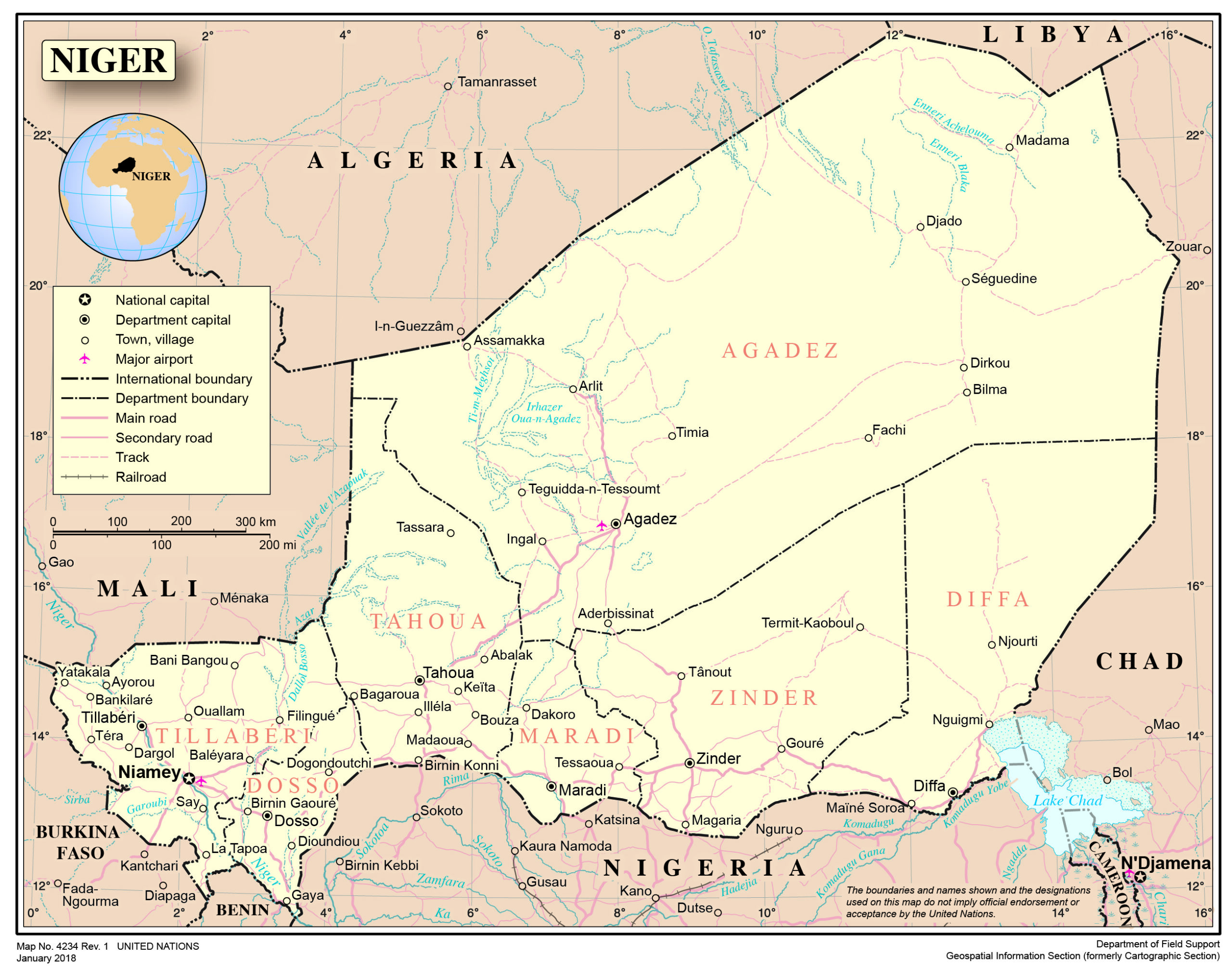
Niger has long suffered internal ethnic problems, especially from Tuareg rebellions. The ongoing conflict in Nigeria against Boko Haram that began in 2009 spilled over into southern Niger. Added to this, multiple coups d’état have been mounted by the military since independence. Since 2015, the border area between Burkina Faso, Mali, and Niger has been the focus of jihadist groups originating in Mali. In the south-west of the country in the tri-border area with Burkina Faso and Mali, the Islamic State in the Greater Sahara (now known as the Islamic State in the Sahel Province) has conducted persistent attacks while Islamic State West Africa Province (ISWAP) has established control in the south-east. The most recent coup, in 2023, has further destabilized the country.
Key events since July 2024
The period under review was marked by widespread insecurity, with civilians repeatedly caught in ongoing violence between non-State armed groups and the Nigerien Armed Forces. The non-State armed groups that are party to the two non-international armed conflicts in Niger – Jama’at Nasr al-Islam wal Muslimin (JNIM) and the Islamic State in the Sahel Province (ISSP) – increased coordinated attacks, resulting in widespread harm to civilians. In a single attack on 21 June 2025, ISSP fighters attacked civilians in a mosque in Manda village, killing more than seventy and injuring at least twenty others.1W. Muia and C Ewokor, ‘Niger Attacks: Jihadist Groups Executing Civilians and Burning Homes, HRW Warns’, BBC,10 September 2025. Violence by other non-State armed groups implanted in Nigeria, notably Boko Haram and ISWAP, also killed and injured civilians in Niger.2See the entry for Nigeria in this report. Overall, the increased level of civilian harm mainly reflected the ISSP’s consolidation of control over rural areas in the west of Niger, especially in the Tillabéri and Tahoua regions.3L. Karr, ‘Africa File Special Edition: One Year After Niger’s Coup’, Critical Threats, 23 July 2024; ‘Niger : recrudescence des attaques terroristes à Tillabéry’, Deutsche Welle, 18 September 2025.
The Humanitarian Situation
As a result, the humanitarian situation similarly continues to be troubling. Estimates suggest that by the end of June 2025, almost 460,000 peoplewere internally displaced in Niger.4‘UNICEF Niger Humanitarian Situation Report No. 1: January to June 2025’, Report, 2025, UNICEF, p 2. Additionally, the country hosted more than 430,000 refugees and asylum seekers, primarily from Nigeria and Mali.5‘Niger Crisis Response Plan 2025’, Global Crisis Response Platform, July 2025. Humanitarian organizations were compelled by the Nigerien authorities to cease working on the basis of a false allegation that they were supporting non-State armed groups.6International Committee of the Red Cross (ICRC), ‘FAQ : ICRC Forced to Suspend Humanitarian Activities in Support of Communities in Niger’, 10 June 2025. Overall, the situation, coupled with extreme climate events, rapid population growth, and chronic poverty, has precipitated acute food insecurity among Nigerien civilians.7UN Office for the Coordination of Humanitarian Affairs (OCHA), ‘Niger: Global Humanitarian Overview 2025’, Humanitarian Action Analysing Needs and Response, 4 December 2024.
Parallel to the worsening armed conflict environment, the contraction of civic freedoms persisted throughout the reporting period. Press freedom was eroded through successive suspensions of media channels in 2024 and 2025, including the BBC in November and Canal 3 TV in January 2025.8‘Niger: RSF Condemns the Suspension of Canal 3 TV and Calls for the Immediate Release of Its Editor-in-Chief Seyni Amadou’, RSF, 20 January 2025. Freedom of expression was significantly curtailed through arbitrary arrests, revocation of nationality, and intimidation of political opponents to the military government, media workers, and peaceful dissidents. This included the continued detention of the former president, Mohamed Bazoum, and his wife since the coup in July 2023, and the arrest of Moussa Tchangari, the secretary-general of the civil society organization Citizens’ Alternative Spaces in December 2024. On 10 October 2024, President Abdourahamane Tchiani revoked the citizenship of nine of Mr Bazoum’s allies, claiming they had conspired with hostile foreign powers.9‘Niger Strips Citizenship of Exiled Allies of Deposed President’, Africa Briefing, 11 October 2024.
Conflict Classification and Applicable Law
Two non-international armed conflicts (NIACs) in Niger continued throughout the review period:
- Niger v Islamic State Sahel Province (the ISSP)
- Niger v Jama’at Nusrat al-Islam wal-Muslimin (JNIM).
Both conflicts are regulated by Common Article 3 of the Geneva Conventions of 1949 and other rules of customary international humanitarian law (IHL). Niger is also a State Party to Additional Protocol II of 1977.10Protocol Additional to the Geneva Conventions of 12 August 1949, and relating to the Protection of Victims of Non-International Armed Conflicts; adopted at Geneva, 8 June 1977; entered into force, 7 December 1978. The two NIACs in Niger continue to meet the additional requirements of Article 1(1) of Additional Protocol II – specifically, the need for a level of territorial control that would enable the respective armed groups to sustain military operations and implement the Protocol – and this treaty is directly applicable to those conflicts.
Niger is a State Party to the Rome Statute of the International Criminal Court, having ratified it in 2002.11Rome Statute of the International Criminal Court; adopted at Rome, 17 July 1998; entered into force, 1 July 2002. Niger’s announced withdrawal from the Court on 22 September 2025 (along with Burkina Faso and Mali)12H. Sekulich, ‘Three West African countries to quit International Criminal Court’, BBC, 23 September 2025. was without legal effect at the time of writing, as it had not made a formal notification to the depositary of the Statute – the Secretary-General of the United Nations (UN). If and when it does so, the withdrawal will take effect one year after the notification. All events covered in this report therefore potentially fall within the material jurisdiction of the Court, although Niger is not a situation under preliminary examination by the Office of the Prosecutor.
Compliance with IHL
Overview
The period under review continued to see serious violations of the protection afforded by IHL to civilians and civilian infrastructure across the territory of Niger. Civilians continued to be subject to regular attacks. In June 2025 alone, attacks by non-State armed groups killed at least one hundred civilians.13‘UN Warns: Sahel Terror Surge Threatens Women, Girls’, Maghreb Insider, 8 August 2025. Particular concerns were recurring cases of deliberate attacks against civilians; the manner in which improvised explosive devices (IEDs) are being used; and instances of unlawful forced displacement.
Allegations persisted of arbitrary detention, inhuman treatment, and enforced disappearance, in particular by governmental forces, as a means to silence individuals expressing their concerns about the situation in the country. Widespread violations of IHL by the military through the destruction of homes, medical facilities, and schools were compounded by regular looting by non-State armed groups, involving especially the ISSP.
There was little progress to report on efforts by the government to investigate conflict-related atrocities, which have eroded public trust in the rule of law and risk perpetuating a cycle where abuses go unchecked. Niger’s announced withdrawal from the International Criminal Court on 22 September 2025 further exacerbates concerns about growing impunity gaps.14‘Sahel States’ ICC Withdrawal: A Step Back for Victims and Justice’, TRIAL International, 26 September 2025. Finally, the overall humanitarian situation has deteriorated due to the suspension of many humanitarian aid programmes amid funding cuts.15‘Niger: Global Humanitarian Overview 2025’.
Civilian Objects under Attack
Under customary IHL, attacks may only be directed against military objectives. Attacks must not be directed against civilian objects.16ICRC, Customary IHL Rule 7: ‘The Principle of Distinction between Civilian Objects and Military Objectives’. Civilian objects are all objects that are not military objectives17ICRC, Customary IHL Rule 9: ‘Definition of Civilian Objects’. and, as such, are protected against attack.18ICRC, Customary IHL Rule 10: ‘Civilian Objects’ Loss of Protection from Attack’. Military objectives are those objects which, by their nature, location, purpose or use, make an effective contribution to military action.19ICRC, Customary IHL Rule 8: ‘Definition of Military Objectives’. In addition, the object’s partial or total destruction, capture, or neutralisation must offer a definite military advantage in the prevailing circumstances.
Attacks directed against civilian objects
As part of its offensive to establish control over rural areas in the west of Niger, ISSP fighters frequently destroyed civilian infrastructure, firing upon and burning down homes and shops.20See eg: M. Matongbada and N. Adam, ‘Civilians Facing Insecurity in Niger’s Tillabéri Region’, Report, Center for Civilians in Conflict, 2023. This occurred, for example, when the ISSP attacked the mosque in the Fambita quarter of the border town of Kokorou on 21 March 2025, which was accompanied by the burning of people’s homes.21Human Rights Watch, ‘Niger: Islamist Armed Group Executes Civilians, Burns Homes’, 10 September 2025. Similar patterns of serious violations of IHL were seen in relation to ISSP attacks on other villages throughout the reporting period, especially in Tillabéri. Witness and victim testimony reports the ISSP attacking homes as a warning against collaborating with governmental forces.22Ibid.
Attacks against food convoys and humanitarian aid
ISSP fighters frequently attacked convoys transporting goods to supply the Nigerien population along the border with Burkina Faso. The Nigerien Armed Forces escort these convoys for security reasons.23‘Niger: un convoi de camions transportant des marchandises attaqué près de Téra’, RFI, 2 November 2024. On 1 December 2024, trucks were set on fire by a non-State armed group, allegedly the ISSP, and the fighters exchanged gunfire with the soldiers escorting the convoy.24Ibid. On 7 December, goods being transported from the market in Tera were attacked by the ISSP in the course of which twenty-one civilians were killed.25Africa Defense Forum (ADF), ‘Niger Junta Unable to Control Rising Extremist Violence’, Report, 28 January 2025. The Transport Workers’ Union has raised concerns about drivers being routinely under attack on these transport routes. As one employee described, however, ‘we have no choice since we need to provision our country.’26Ibid (author’s translation from the original French).
Under IHL, parties to armed conflicts are obliged to facilitate the delivery of impartial humanitarian assistance.27ICRC, Customary IHL Rule 55: ‘Access for Humanitarian Relief to Civilians in Need’. Moreover, although military personnel escorting a convoy may pose risks to civilians and humanitarian aid in terms of incidental harm during lawful attacks, they do not render a civilian convoy a military objective per se. This means that ISSP attacks against governmental forces must be proportionate28ICRC, Customary IHL Rule 14: ‘Proportionality in Attack’. and that all feasible precautions must be taken to avoid, or at least minimize, civilian harm during such operations.29ICRC, Customary IHL Rule 15: ‘Principle of Precaution in Attack’. The Nigerien Armed Forces are also required to take all feasible measures to protect civilians in fending off attacks.30ICRC, Customary IHL Rule 22, ‘Principle of Precautions against the Effects of Attacks’.
Attacks against medical facilities
Under IHL, medical units and transports must not be attacked and must be protected.31ICRC, Customary IHL Rule 28: ‘Medical Units’. Violations of these obligations may amount to war crimes.32ICRC, Customary IHL Rule 156: ‘Definition of War Crimes’. The reporting period saw regular attacks on medical facilities in Niger, particularly in Tillabéri.33Safeguarding Health in Conflict and Insecurity Insights, ‘Epidemic of Violence: Violence Against Health Care in Conflict 2024’, 2025, Report, p 97. Most of the incidents were attributed to ISSP fighters burning down or firing upon hospitals or other medical facilities.34Zagazola [@ZagazOlaMakama], ‘Terrorists Enforce Blockade on Torodi, Heightening Security Threat to Niamey. Armed Terrorist Groups Have Reportedly Imposed a Complete Blockade on the Town of Torodi, Niger Republic, Halting All Movement in and out of the Area and Heightening Concerns about Regional Security’, 19 April 2025; ‘Epidemic of Violence: Violence Against Health Care in Conflict 2024’, p 97. In October 2024, however, one incident was attributed to the Nigerien Armed Forces – a drone strike on a health facility in Tillabéri.35Ibid.
As is the case in neighbouring Burkina Faso, Niger is experiencing a rising negative sentiment towards the aid sector. The dissemination of false information through social media has played a role in this sentiment, leading to notable consequences.36For an overview of the situation during the period of October to December 2024 see: Insecurity Insights, ‘From Support to Distrust Social Media Narratives in Niger’, Report. An increasing number of humanitarian and health organizations have had to cease their activities based on government decisions.37M. Degbetchi, ‘Le Niger suspend l’ONG française ACTED et l’APBE’, Afrique Sur 7, 13 November 2024. This is worsening the already dramatic health crisis for the civilian population in Niger.38S. Sanderson, ‘Niger Red Cross Ban Comes amid “dire Humanitarian” Situation’, Deutsche Welle, 7 February 2025.
Attacks against religious property
Under customary law rules of IHL, cultural and religious property, including places of worship, holy sites, and objects of spiritual significance, is afforded special protection against attack.39ICRC, Customary IHL Rule 38: ‘Attacks Against Cultural Property’. On 21 March 2025, the ISSP attacked a mosque in the village of Kokorou in south-western Niger.40‘Niger Declares Three Days of Mourning after Mosque Attack Kills 44’, Al Jazeera, 22 March 2025. Individuals had gathered for prayer during the holy month of Ramadan when the attack on the mosque in the Fambita quarter of the town occurred.41Muia and Ewokor, ‘Niger Attacks: Jihadist Groups Executing Civilians and Burning Homes, HRW Warns’. Testimonies describe how fighters surrounded the mosque before attacking, killing forty-four civilians.42R. Connolly, ‘Niger: “Islamic State” Kills Dozens in Mosque Attack’, Deutsche Welle, 22 March 2025.
There is no evidence to suggest the mosque was being used to contribute to Niger’s military activities or that its armed forces were using the site for military operations against the ISSP (or indeed that they were about to do so). In the absence of such evidence, the attack is a serious violation of IHL – breaching both the fundamental principle of distinction and the rule affording special protection to religious property.
Civilians under Attack
Under customary IHL, civilians enjoy general protection from the effects of hostilities, unless and for such time as they directly participate in hostilities.43ICRC, Customary IHL Rule 6: ‘Civilians’ Loss of Protection from Attack’. Accordingly, parties to armed conflicts must at all times distinguish between combatants and civilians, and are prohibited from directing attacks against civilians.44ICRC, Customary IHL Rule 1: ‘The Principle of Distinction between Civilians and Combatants. In case of doubt, persons should be treated as civilians.45ICRC, Customary IHL Rule 6: ‘Civilians’ Loss of Protection from Attack’. The accompanying commentary states that in NIACs, ‘the issue of doubt has hardly been addressed in State practice, even though a clear rule on this subject would be desirable as it would enhance the protection of the civilian population against attack.’ One ‘cannot automatically attack anyone who might appear dubious….’ The same approach with respect to IACs ‘seems justified’ in NIACs. Civilians may be incidentally affected by attacks against lawful targets. However, such attacks must be proportionate, and the attacker must take all feasible precautions to avoid, or at the least to minimize, incidental civilian deaths and injuries to civilians (and damage to civilian objects).
Attacks directed against civilians
Civilians were deliberately targeted by the parties to the armed conflicts during the reporting period. Direct attacks against civilians, as well as acts of violence aimed at spreading terror among the civilian population, are strictly prohibited under IHL, and can constitute war crimes.46ICRC, Customary IHL Rule 2: ‘Violence Aimed at Spreading Terror among the Civilian Population’; and Rule 156: ‘Definition of War Crimes’. Where such acts form part of a widespread or systematic attack directed against any civilian population, with knowledge of the attack, they may also constitute crimes against humanity under international criminal law.47Art 7(1), ICC Statute.
Although the non-State armed groups involved in attacks on civilians in Niger have not always claimed responsibility, multiple testimonies show that most were perpetrated by the ISSP.48Human Rights Watch, ‘Niger: Islamist Armed Group Executes Civilians, Burns Homes’. Civilians in Tillabéri, a region bordering Burkina Faso, have been particularly affected. Between 12 and 14 December 2024, the ISSP conducted two coordinated attacks in Kokorou and Libiri, killing thirty-nine civilians, including several children.49‘In Niger, 39 Villagers Killed in a Double Attack by Suspected Jihadists near Burkina Faso’, Le Monde, 15 December 2024; E. Peltier, ‘After Military Took Power, Terrorist Attacks Only Got Worse’, The New York Times, 22 December 2024. There were no reports of government armed forces being involved, suggesting the ISSP attacks were deliberately targeting civilians.
Similar incidents continued to be reported in 2025. On 13 May, ISSP fighters attacked the village of Dani Fari and killed five men and two boys, also burning down at least a dozen homes. One local herder said,
The bodies were scattered … riddled with bullets. There wasn’t a single body out there that had fewer than three bullet holes. The bullets had hit people in the back, arms, head…. We found the bodies of the two children lying on their backs.50Human Rights Watch, ‘Niger: Islamist Armed Group Executes Civilians, Burns Homes’.
As described above, on 20 June, ISSP fighters attacked civilians in a mosque in Manda village, killing more than seventy and injuring at least twenty.51‘Niger: ce que l’on sait de l’attaque qui a fait des dizaines de morts à Manda’, Jeuneafrique, 24 June 2025. As the UN High Commissioner for Human Rights, Volker Türk, declared, the ISSP attacked the religious site in order to cause ‘as many civilian casualties as possible’.52‘Niger: Türk Says Egregious Mosque Attack Should Be Wake-up Call’, OHCHR, 25 March 2025. The attack followed the one on 21 March in Téra department in which fighters believed to belong to the ISSP killed forty-four civilians while they were praying in the local mosque.53‘Niger: ce que l’on sait de l’attaque qui a fait des dizaines de morts à Manda’.
Available evidence of the involvement of the Nigerien Armed Forces in the death or injury of civilians is scarce. One of the few incidents was in November, when the army are said to have killed a civilian in Tillabéri region they suspected of being an ISSP collaborator.54ACLED, ‘Data Export Tool’.
Potentially disproportionate attacks
In addition to the deliberate attacks on civilians in Niger, civilians were frequently killed or injured during clashes between State forces and non-State armed groups. On 10 December 2024, ISSP fighters surrounded a local market in Téra in which the Nigerien Armed Forces were present.55‘Niger: lourd bilan après une attaque jihadiste, la plus meurtrière dans le pays depuis six mois’, RFI, 11 December 2024; J. Le Bihan and M. Laplace, ‘Au Niger, au moins une centaine de soldats tués dans la région de Tillabéri’, Jeuneafrique, 11 December 2024. The ISSP fighters opened fire, reportedly killing ninety soldiers but also more than forty civilians.‘Niger: lourd bilan après une attaque jihadiste, la plus meurtrière dans le pays depuis six mois’. The government denied the attack had occurred and suspended BBC radio for three months for its reporting of the incidents.56‘In Niger, 39 Villagers Killed in a Double Attack by Suspected Jihadists near Burkina Faso’.
An incident involving the conduct of the State’s armed forces concerned airstrikes that targeted columns of non-State armed groups who had just attacked a military position in Tyawa near the Burkina Faso border, but which also killed several civilians.57Ibid. A resident in Tillabéri describes the population’s frustration:
We told [the military] that an attack was in the making, that we needed protection…. But they came when the hamlet had already been looted, houses burned, and people killed.58Human Rights Watch, ‘Niger: Islamist Armed Group Executes Civilians, Burns Homes’.
Attacks against medical personnel
Under IHL, medical personnel must not be attacked and must be protected.59ICRC, Customary IHL Rule 25: ‘Medical Personnel’. Violations of these obligations may amount to war crimes.60ICRC, Customary IHL Rule 156: ‘Definition of War Crimes’. An attack on medical personnel was reported during the ISSP attack on a health centre in Téra – two unarmed health workers were killed.61Safeguarding Health in Conflict and Insecurity Insights, ‘Epidemic of Violence: Violence Against Health Care in Conflict 2024’, Report, p 99. The incident should be viewed in the wider context of insecurity impacting medical units, personnel, and other humanitarian workers in Niger, with increasingly negative feelings being stirred up towards the aid sector by false information shared on social media.62For an overview of the situation during the period of October to December 2024 see: Insecurity Insights, ‘From Support to Distrust Social Media Narratives in Niger’.
Use of anti-personnel mines
Throughout the reporting period, landmines continued to pose a threat to civilians in Niger.63‘UNODC Supports Raising Community Awareness of the Risks Associated with Improvised Explosive Devices (IEDs) in Niger’, UN Office on Drugs and Crime (UNODC), April 2025. Continued use of anti-personnel mines of an improvised nature by non-State armed groups raise serious concern as to the compliance with IHL rules on the conduct of hostilities. As evidence shows, when deployed in populated areas or locations frequently accessed by civilians, these explosive devices may have indiscriminate effects.64ICRC, Customary IHL Rule 11: ‘Indiscriminate Attacks’; ICRC, Customary IHL Rule 12: ‘Definition of Indiscriminate Attacks’. If they are not directed at specific military objectives, this renders their use a violation of the principle of distinction. Where feasible precautions are not taken to limit their impact on civilians, this may also violate the principle of precautions in attack.
Niger is a State Party to the 1997 Anti-Personnel Mine Ban Convention, which prohibits its armed forces from using any anti-personnel mine, defined as a munition (including IEDs) that is designed or adapted to be activated by a person. This disarmament treaty does not bind non-State armed groups directly under international law. Nevertheless, these groups are subject to the customary IHL principles of distinction and proportionality in attack, underpinned by the duty to take precautions to protect civilians.
Moreover, Niger is also party to Amended Protocol II of 1996 to the Convention on Certain Conventional Weapons (Amended Protocol II), which binds all parties to an armed conflict, including non-State armed groups.65Art 1(2), Protocol on Prohibitions or Restrictions on the Use of Mines, Booby-Traps and Other Devices as amended on 3 May 1996 annexed to the Convention on Certain Conventional Weapons; adopted at Geneva, 3 May 1996; entered into force, 3 December 1998. Niger adhered to the Amended Protocol in 2007. Although the Amended Protocol II does not ban all use of anti-personnel mines, it specifically prohibits their indiscriminate use and requires that a party to an armed conflict take all feasible precautions to protect civilians from their effects.66Art 3(8) and (10), Amended Protocol II. Similarly, customary law mandates that ‘when landmines are used, particular care must be taken to minimize their indiscriminate effects.67‘ICRC, Customary IHL Rule 81: ‘Restrictions on the Use of Landmines’. While not an inherently indiscriminate weapon, anti-personnel mines, such as improvised devices used by non-State armed groups in Niger, all too often cause significant civilian harm.
In all cases, Niger is obligated by the Anti-Personnel Mine Ban Convention to clear and destroy all anti-personnel mines on its territory ‘as soon as possible’.68Art 5, Convention on the Prohibition of the Use, Stockpiling, Production and Transfer of Anti-Personnel Mines and on their Destruction; adopted at Oslo, 18 September 1997; entered into force, 1 March 1999. Yet, the government has shown limited progress in this field.69‘UNODC Supports Raising Community Awareness of the Risks Associated with Improvised Explosive Devices (IEDs) in Niger’. Mine Action Review, an annual assessment of clearance published by Norwegian People’s Aid, has expressed concern about the lack of monitoring of mined areas and the occurrence of incidents involving landmines or other explosive devices.70Mine Action Review, ‘Niger’ Report, Norwegian People’s Aid, 2025. No progress has been reported since 2020, raising serious doubts about Niger’s compliance with the 1997 Convention.71Ibid.
Forced displacement
Under customary IHL, in both IAC and NIAC, parties are prohibited from ordering the displacement of the civilian population in relation to the conflict unless it is required for their security or for imperative military reasons.72ICRC, Customary IHL 129: ‘The Act of Displacement’. Breaches of these prohibitions may be war crimes.73ICRC, Customary IHL Rule 156: ‘Definition of War Crimes’. Any displacement must be temporary, with all possible measures taken to ensure proper shelter, hygiene, health, safety and nutrition and that members of the same family are not separated.74ICRC, Customary IHL Rule 131: ‘Treatment of Displaced Persons’. The prohibition aims to protect civilian populations from arbitrary or punitive displacement and to uphold their rights to remain in or return to their homes.75ICRC, Customary IHL Rule 132: ‘Return of Displaced Persons’.
The two NIACs in Niger appear to have precipitated or maintained the displacement of many civilians. As of June 2025, almost 460,000 persons were displaced within the country,76‘UNICEF Niger Humanitarian Situation Report No 1: January to June 2025’, p 2. which also hosted more than 430,000 refugees and asylum seekers, primarily from Nigeria and Mali.77‘Niger Crisis Response Plan 2025’. Ongoing armed violence continues to be one of the major causes of displacement.78‘UNICEF Niger Humanitarian Situation Report No 1: January to June 2025’, p 2.
The destruction and looting of civilian property and widespread acts of violence have generated deep-seated fears among the population. Many have been forced to leave their homes and livelihoods in search of safety. Witnesses reported that members of non-State armed groups, whether the ISSP or JNIM, arrive in villages, kill the men, destroy homes, and seize belongings.79See the incidents recounted in Human Rights Watch, ‘Niger: Islamist Armed Group Executes Civilians, Burns Homes’. Women and their children, left with nothing, often have no choice but to seek protection elsewhere. In Tillabéri region, testimonies describe the decision to flee: ‘If they reached us, they could rape and kill us.’80P. Adeleye, ‘“Left at the Mercy of Jihadists”: Niger’s Junta Fails to Curb Surge in Violence’, The Guardian, 31 December 2024.
It is reasonable to conclude that displacement of civilians often occurred under duress or threats, and amid a generalized fear of violence. The cumulative effect of these actions, including the destruction of property and the violence against civilians, constitutes unlawful forced displacement within the meaning of IHL.81See eg: ‘Niger: nouvelle attaque contre une localité près de la frontière avec le Burkina Faso’, RFI, 12 December 2024. Accordingly, available evidence supports a finding that the ISSP and JNIM have committed serious violations of IHL in forcing civilian displacement.
Additional concerns arise from the Nigerien government’s woefully inadequate response to the growing number of internally displaced persons (IDPs) caused by the widespread violence.82Ahmadou Atafa [@AhmadouAtafa], ‘#Niger : Des ressortissants du #Gorouol dénoncent, dans une déclaration rendue publique à Niamey ce 29 juin, l’absence de réaction officielle après l’attaque meurtrière de Manda (71 morts). Ils appellent le CNSP à renforcer la sécurité et à secourir les victimes.’ Funding shortfalls, regular flooding, government requests to humanitarian organisations to leave,83‘Niger: The ICRC Forced to Suspend Humanitarian Activities on Behalf of Local Communities’, ICRC, 6 June 2025. and economic instability have further left many displaced households without safe shelter, food, or medical care.84‘UNICEF Niger Humanitarian Situation Report No 1: January to June 2025’, p 2. Some of these actions may violate IHL rules; all indicate violations of the duties under international human rights law to secure the right to food and to implement the rules prohibiting arbitrary deprivation of life and cruel, inhuman, or degrading treatment.85Art 11, International Covenant on Economic, Social and Cultural Rights; adopted at New York, 16 December 1966; entered into force, 3 January 1976; Arts 6 and 7, International Covenant on Civil and Political Rights; adopted at New York, 16 December 1966; entered into force, 23 March 1976.
Protection of Persons in the Power of the Enemy
Customary and treaty IHL provide fundamental guarantees for anyone in the power of a party to a conflict, prohibiting acts such as torture, inhuman or degrading treatment, collective punishments, sexual violence, enforced disappearance, and unfair trials. Special protection is afforded to civilians who face a specific risk of harm, such as women, children, refugees, and IDPs.86ICRC, Customary IHL Rules 134–138: ‘Chapter 39. Other Persons Afforded Specific Protection’.
Conflict-related sexual and gender-based violence
Rape and other forms of sexual violence committed in connection with armed conflict are war crimes.87ICRC, Customary IHL Rule 93: ‘Rape and Other forms of Sexual Violence’; and Rule 156: ‘Definition of War Crimes’. The conflicts in Niger have been marked by incidents of gender-based violence, with women and girls disproportionately exposed to harm. Extreme financial hardship has also led a growing number of young girls to marry men who belong to non-State armed groups.88‘Women’s Lives under Islamic State in Niger’s Tillabery’, Briefing No 200, International Crisis Group, 29 August 2024; BENUE info-pedia, ‘Hunger Driving Sexual Abuse in Niger State IDP Camps, Women Trade Sex For Survival’, Post of Facebook. Some have described their fear of being subjected to violence if they do not marry. One widow described how, after being asked why her daughter was not married, an ‘assailant took off her clothes and raped her.’89Adeleye Pius, ‘Niger’s Junta Fails to Defeat ISIS Jihadists’, Genocide Watch, 28 January 2025. As another woman recounted:
It happens that they ask girls for marriage, especially in the camps around the grazing areas. The marriage will happen if the girl says yes. They also pay the bride price. But people are scared, they don’t dare say no.90‘Women’s Lives under Islamic State in Niger’s Tillabery’.
Pillage
IHL prohibits pillage and unlawful destruction of property during all armed conflicts. Pillage consists of the systematic and violent appropriation by members of armed forces or armed groups of movable public or private property that belongs either to protected persons or to the adverse party to an armed conflict and constitutes a war crime.91ICRC, Customary IHL Rule 52: ‘Pillage’. Destruction of property not justified by military necessity is forbidden.92ICRC, Customary IHL Rule 50: ‘Destruction and Seizure of Property of an Adversary’.
Evidence indicates that the ISSP has failed to comply with these obligations. Reports show a consistent pattern of ISSP fighters burning civilian homes and looting civilian shops, personal belongings, and resources, such as livestock.93Human Rights Watch, ‘Niger: Islamist Armed Group Executes Civilians, Burns Homes’. As a resident in the Tillabéri Region described:
My hut, made of goat skin, and my shed had been burned…. My animals were gone, goats, sheep, donkeys. They took everything. There was nothing left in the hamlet. They looted homes, taking everything that was useful, including millet and rice.94Ibid.
In none of the above incidents did evidence indicate the measures taken were justified by imperative military necessity. The systematic nature of these violations created conditions that forced many civilians into flight to seek safety and shelter elsewhere.95CrisisWatch Database, ‘Niger’, International Crisis Group.
Arbitrary deprivation of liberty
Under IHL, any deprivation of liberty must be lawful, non-arbitrary, and carried out with appropriate legal safeguards.96ICRC, Customary IHL Rule 99: ‘Deprivation of Liberty’. Persons deprived of liberty must be treated humanely at all times, with absolute prohibitions on torture and other ill-treatment.97Common Article 3, Geneva Conventions; ICRC, Customary IHL Rule 90: ‘Torture and Cruel, Inhuman or Degrading Treatment’. Detaining authorities must ensure detainees have access to medical care; are held in humane conditions; and are protected from violence or reprisals.98Common Article 3, Geneva Conventions; ICRC, Customary IHL Rule 89: ‘Violence to Life’.
During the reporting period, persistent patterns of arbitrary detention, deprivation of liberty, and inhuman or degrading treatment of civilians by governmental forces were observed in Niger. The most prominent cases involve the former President Bazoum, several former ministers, and their close advisers, who remained detained as of January 2025 pending trial before military courts. The UN Working Group on Arbitrary Detention condemned the detention of former President Bazoum on 10 February 2025 and called for his immediate release, and NGOs similarly characterized the detentions as politically motivated and arbitrary.99Working Group on Arbitrary Detention, ‘Opinion No. 56/2024, concerning Mohamed Bazoum and Hadiza Bazoum (Niger)’, Opinions adopted by the Working Group at its 101st Session, 11–15 November 2024, UN Doc A/HRC/WGAD/2024/56, 17 December 2024; Human Rights Watch, ‘Niger: Two Years On, Ex-President Still Arbitrarily Detained’, 23 July 2025.
This is, however, just one incident amid a growing trend of arbitrary arrests and detention of political opponents to the government, media workers, and peaceful dissidents by government since the coup in July 2023. Another deeply concerning case involves the arrest in December 2024 of Moussa Tchangari, Secretary-General of the civil society organization Citizens’ Alternative Spaces. Upon returning from Nigeria, Mr Tchangari was forcibly taken from his home at night and transported to an undisclosed location. He was later charged with serious offences, including ‘criminal conspiracy in connection with a terrorist enterprise,’ ‘undermining national defence’, and ‘plotting against the authority of the state through intelligence with enemy powers’.100Amnesty International, ‘Niger: Six Month-Long Arbitrary Detention of Human Rights Defender Moussa Tchangari Must End’, 3 June 2025. Prior to his arrest, he had publicly criticized the government’s decision to ban humanitarian organizations from Nigerien territory.101Ibid.
Abductions and hostage-taking
In addition to government-perpetrated abuses, abductions and kidnappings by non-State armed groups remain widespread, particularly in conflict-affected areas. During the reporting period, there has been a discernible increase in targeted actions against foreign nationals, including an incident involving an Austrian woman on 11 January 2025 and a Swiss-Nigerien woman in April 2025, both of whom were abducted from their residences. These acts have been attributed to the ISSP.
Similar incidents also regularly occurred in the context of attacks by the ISSP against the Nigerien Armed Forces. For instance, on 18 January 2025, four Moroccan truck drivers delivering electrical equipment in the region were abducted before being freed three days later by ISSP fighters. On 1 February, two Chinese workers for a Petroleum Company in Diffa region were kidnapped while being escorted by soldiers by suspected ISSP fighters.102‘Unknown Militants Kidnap Two Chinese Citizens in Niger’, Regional Anti-Terrorist Structure of Shanghai Cooperation Organisation, 7 February 2025. On 25 April, the ISSP are reported to have abducted six Indian workers working on power lines near Kandadji dam. 103‘Five Indians Kidnapped in Attack in Niger’, Arab News, 30 April 2025. While some of those abducted were released, others were killed (or their whereabouts are unknown).104‘Proof of Life of Austrian Eva Gretzmacher, Held By ISIS-GS in Mali’, Hostage Aid Worldwide, 6 May 2025.
The shifting by the ISSP to targeting foreigners seems to aim at gaining higher ransom fees than is feasible for abductions of local civilians.105‘The Sahel: Is the Islamic State Sahel Province Kidnapping More Foreigners?’, ACLED, 26 March 2025. Where the abductions seek to compel the Nigerien Armed Forces to do or to abstain from doing any act, these amount to the violation of the prohibition of hostage-taking.106ICRC, Customary IHL Rule 96: ‘Hostage-Taking’. Even where the intent cannot be demonstrated, these acts would amount to arbitrary deprivation of liberty and potentially also inhuman and degrading treatment.107Common Article 3, Geneva Conventions; ICRC, Customary IHL Rule 99: ‘Deprivation of Liberty’; and Rule 90: ‘Torture and Cruel, Inhuman or Degrading Treatment’.
In many cases, the fate and whereabouts of detainees were concealed, amounting to violations of IHL provisions aimed at preventing enforced disappearance,108ICRC, Customary IHL Rule 98: ‘Enforced Disappearance’. including the obligation to register persons deprived of their liberty in NIAC.109ICRC, Customary IHL Rule 123: ‘Recording and Notification of Personal Details of Persons Deprived of their Liberty’. These acts may violate the IHL obligation to respect family life110ICRC, Customary IHL Rule 105: ‘Respect for Family Life’. and to take all feasible measures to account for persons reported missing as a result of armed conflict and to provide their family members with information held on their fate.111ICRC, Customary IHL Rule 117: ‘Accounting for Missing Persons’. Finally, where abduction is followed by death, it is likely also to constitute murder and torture or other ill-treatment.112Common Article 3, Geneva Conventions; ICRC, Customary IHL Rule 90: ‘Torture and Cruel, Inhuman or Degrading Treatment’; and Rule 89: ‘Violence to Life’.
Protection of children
Under IHL, children are afforded special protection in armed conflicts, recognizing their particular vulnerability. Core rules prohibit the recruitment and use of children under the age of fifteen years in hostilities, whether in State armed forces or non-State armed groups, and forbid their participation in combat.113ICRC, Customary IHL Rule 136: ‘Recruitment of Child Soldiers’. Children are entitled to general protection as civilians, including against direct attack, arbitrary detention, sexual violence, and ill-treatment. If detained, they must be held separately from adults (unless with their family) and treated in a manner appropriate to their age. Evacuation and reunification of separated children with their families are also prioritized.114ICRC, Customary IHL Rule 135: ‘Children’.
During the reporting period, children continued to be disproportionately affected by the ongoing hostilities in Niger. Incidents of recruitment and use of children; the killing and maiming of children; rape and other forms of sexual violence against children, and the abduction of children have been documented. In its report covering 2024, the United Nations reported on children being killed or maimed due to shootings, with most of the acts attributed to the ISSP.115‘Children and Armed Conflict: Report of the Secretary General’, UN Doc A/79/878-S/2025/247, 17 June 2025, para 297; J. Courtright, ‘Ethnic Killings by West African Armies Are Undermining Regional Security’, Foreign Policy, 2 October 2025.
Allegations of recruitment and use in hostilities of children by armed groups continued to emerge,116‘Children and Armed Conflict: Report of the Secretary General’, para 295. although the identity of the perpetrators could not be verified. Moreover, schools have continued to be attacked by the ISSP in particular.117Ibid, para 299. As part of the recurring threat of violence against schools, teachers and students, many schools remain closed, leaving many children without education.118‘Shoulder to Shoulder: Our Commitment to Protecting Education in Niger’, Teach For All, 9 September 2025.
- 1W. Muia and C Ewokor, ‘Niger Attacks: Jihadist Groups Executing Civilians and Burning Homes, HRW Warns’, BBC,10 September 2025.
- 2See the entry for Nigeria in this report.
- 3L. Karr, ‘Africa File Special Edition: One Year After Niger’s Coup’, Critical Threats, 23 July 2024; ‘Niger : recrudescence des attaques terroristes à Tillabéry’, Deutsche Welle, 18 September 2025.
- 4‘UNICEF Niger Humanitarian Situation Report No. 1: January to June 2025’, Report, 2025, UNICEF, p 2.
- 5‘Niger Crisis Response Plan 2025’, Global Crisis Response Platform, July 2025.
- 6International Committee of the Red Cross (ICRC), ‘FAQ : ICRC Forced to Suspend Humanitarian Activities in Support of Communities in Niger’, 10 June 2025.
- 7UN Office for the Coordination of Humanitarian Affairs (OCHA), ‘Niger: Global Humanitarian Overview 2025’, Humanitarian Action Analysing Needs and Response, 4 December 2024.
- 8
- 9‘Niger Strips Citizenship of Exiled Allies of Deposed President’, Africa Briefing, 11 October 2024.
- 10Protocol Additional to the Geneva Conventions of 12 August 1949, and relating to the Protection of Victims of Non-International Armed Conflicts; adopted at Geneva, 8 June 1977; entered into force, 7 December 1978.
- 11Rome Statute of the International Criminal Court; adopted at Rome, 17 July 1998; entered into force, 1 July 2002.
- 12H. Sekulich, ‘Three West African countries to quit International Criminal Court’, BBC, 23 September 2025.
- 13‘UN Warns: Sahel Terror Surge Threatens Women, Girls’, Maghreb Insider, 8 August 2025.
- 14‘Sahel States’ ICC Withdrawal: A Step Back for Victims and Justice’, TRIAL International, 26 September 2025.
- 15‘Niger: Global Humanitarian Overview 2025’.
- 16ICRC, Customary IHL Rule 7: ‘The Principle of Distinction between Civilian Objects and Military Objectives’.
- 17
- 18
- 19ICRC, Customary IHL Rule 8: ‘Definition of Military Objectives’. In addition, the object’s partial or total destruction, capture, or neutralisation must offer a definite military advantage in the prevailing circumstances.
- 20See eg: M. Matongbada and N. Adam, ‘Civilians Facing Insecurity in Niger’s Tillabéri Region’, Report, Center for Civilians in Conflict, 2023.
- 21Human Rights Watch, ‘Niger: Islamist Armed Group Executes Civilians, Burns Homes’, 10 September 2025.
- 22Ibid.
- 23‘Niger: un convoi de camions transportant des marchandises attaqué près de Téra’, RFI, 2 November 2024.
- 24Ibid.
- 25Africa Defense Forum (ADF), ‘Niger Junta Unable to Control Rising Extremist Violence’, Report, 28 January 2025.
- 26Ibid (author’s translation from the original French).
- 27
- 28
- 29
- 30
- 31
- 32
- 33Safeguarding Health in Conflict and Insecurity Insights, ‘Epidemic of Violence: Violence Against Health Care in Conflict 2024’, 2025, Report, p 97.
- 34Zagazola [@ZagazOlaMakama], ‘Terrorists Enforce Blockade on Torodi, Heightening Security Threat to Niamey. Armed Terrorist Groups Have Reportedly Imposed a Complete Blockade on the Town of Torodi, Niger Republic, Halting All Movement in and out of the Area and Heightening Concerns about Regional Security’, 19 April 2025; ‘Epidemic of Violence: Violence Against Health Care in Conflict 2024’, p 97.
- 35Ibid.
- 36For an overview of the situation during the period of October to December 2024 see: Insecurity Insights, ‘From Support to Distrust Social Media Narratives in Niger’, Report.
- 37M. Degbetchi, ‘Le Niger suspend l’ONG française ACTED et l’APBE’, Afrique Sur 7, 13 November 2024.
- 38S. Sanderson, ‘Niger Red Cross Ban Comes amid “dire Humanitarian” Situation’, Deutsche Welle, 7 February 2025.
- 39
- 40‘Niger Declares Three Days of Mourning after Mosque Attack Kills 44’, Al Jazeera, 22 March 2025.
- 41Muia and Ewokor, ‘Niger Attacks: Jihadist Groups Executing Civilians and Burning Homes, HRW Warns’.
- 42R. Connolly, ‘Niger: “Islamic State” Kills Dozens in Mosque Attack’, Deutsche Welle, 22 March 2025.
- 43
- 44
- 45ICRC, Customary IHL Rule 6: ‘Civilians’ Loss of Protection from Attack’. The accompanying commentary states that in NIACs, ‘the issue of doubt has hardly been addressed in State practice, even though a clear rule on this subject would be desirable as it would enhance the protection of the civilian population against attack.’ One ‘cannot automatically attack anyone who might appear dubious….’ The same approach with respect to IACs ‘seems justified’ in NIACs.
- 46ICRC, Customary IHL Rule 2: ‘Violence Aimed at Spreading Terror among the Civilian Population’; and Rule 156: ‘Definition of War Crimes’.
- 47Art 7(1), ICC Statute.
- 48Human Rights Watch, ‘Niger: Islamist Armed Group Executes Civilians, Burns Homes’.
- 49‘In Niger, 39 Villagers Killed in a Double Attack by Suspected Jihadists near Burkina Faso’, Le Monde, 15 December 2024; E. Peltier, ‘After Military Took Power, Terrorist Attacks Only Got Worse’, The New York Times, 22 December 2024.
- 50Human Rights Watch, ‘Niger: Islamist Armed Group Executes Civilians, Burns Homes’.
- 51‘Niger: ce que l’on sait de l’attaque qui a fait des dizaines de morts à Manda’, Jeuneafrique, 24 June 2025.
- 52‘Niger: Türk Says Egregious Mosque Attack Should Be Wake-up Call’, OHCHR, 25 March 2025.
- 53‘Niger: ce que l’on sait de l’attaque qui a fait des dizaines de morts à Manda’.
- 54ACLED, ‘Data Export Tool’.
- 55‘Niger: lourd bilan après une attaque jihadiste, la plus meurtrière dans le pays depuis six mois’, RFI, 11 December 2024; J. Le Bihan and M. Laplace, ‘Au Niger, au moins une centaine de soldats tués dans la région de Tillabéri’, Jeuneafrique, 11 December 2024.
- 56‘In Niger, 39 Villagers Killed in a Double Attack by Suspected Jihadists near Burkina Faso’.
- 57Ibid.
- 58Human Rights Watch, ‘Niger: Islamist Armed Group Executes Civilians, Burns Homes’.
- 59
- 60
- 61Safeguarding Health in Conflict and Insecurity Insights, ‘Epidemic of Violence: Violence Against Health Care in Conflict 2024’, Report, p 99.
- 62For an overview of the situation during the period of October to December 2024 see: Insecurity Insights, ‘From Support to Distrust Social Media Narratives in Niger’.
- 63‘UNODC Supports Raising Community Awareness of the Risks Associated with Improvised Explosive Devices (IEDs) in Niger’, UN Office on Drugs and Crime (UNODC), April 2025.
- 64ICRC, Customary IHL Rule 11: ‘Indiscriminate Attacks’; ICRC, Customary IHL Rule 12: ‘Definition of Indiscriminate Attacks’.
- 65Art 1(2), Protocol on Prohibitions or Restrictions on the Use of Mines, Booby-Traps and Other Devices as amended on 3 May 1996 annexed to the Convention on Certain Conventional Weapons; adopted at Geneva, 3 May 1996; entered into force, 3 December 1998. Niger adhered to the Amended Protocol in 2007.
- 66Art 3(8) and (10), Amended Protocol II.
- 67
- 68Art 5, Convention on the Prohibition of the Use, Stockpiling, Production and Transfer of Anti-Personnel Mines and on their Destruction; adopted at Oslo, 18 September 1997; entered into force, 1 March 1999.
- 69‘UNODC Supports Raising Community Awareness of the Risks Associated with Improvised Explosive Devices (IEDs) in Niger’.
- 70Mine Action Review, ‘Niger’ Report, Norwegian People’s Aid, 2025.
- 71Ibid.
- 72
- 73ICRC, Customary IHL Rule 156: ‘Definition of War Crimes’.
- 74
- 75
- 76‘UNICEF Niger Humanitarian Situation Report No 1: January to June 2025’, p 2.
- 77‘Niger Crisis Response Plan 2025’.
- 78‘UNICEF Niger Humanitarian Situation Report No 1: January to June 2025’, p 2.
- 79See the incidents recounted in Human Rights Watch, ‘Niger: Islamist Armed Group Executes Civilians, Burns Homes’.
- 80P. Adeleye, ‘“Left at the Mercy of Jihadists”: Niger’s Junta Fails to Curb Surge in Violence’, The Guardian, 31 December 2024.
- 81See eg: ‘Niger: nouvelle attaque contre une localité près de la frontière avec le Burkina Faso’, RFI, 12 December 2024.
- 82
- 83
- 84‘UNICEF Niger Humanitarian Situation Report No 1: January to June 2025’, p 2.
- 85Art 11, International Covenant on Economic, Social and Cultural Rights; adopted at New York, 16 December 1966; entered into force, 3 January 1976; Arts 6 and 7, International Covenant on Civil and Political Rights; adopted at New York, 16 December 1966; entered into force, 23 March 1976.
- 86
- 87ICRC, Customary IHL Rule 93: ‘Rape and Other forms of Sexual Violence’; and Rule 156: ‘Definition of War Crimes’.
- 88‘Women’s Lives under Islamic State in Niger’s Tillabery’, Briefing No 200, International Crisis Group, 29 August 2024; BENUE info-pedia, ‘Hunger Driving Sexual Abuse in Niger State IDP Camps, Women Trade Sex For Survival’, Post of Facebook.
- 89Adeleye Pius, ‘Niger’s Junta Fails to Defeat ISIS Jihadists’, Genocide Watch, 28 January 2025.
- 90‘Women’s Lives under Islamic State in Niger’s Tillabery’.
- 91
- 92
- 93Human Rights Watch, ‘Niger: Islamist Armed Group Executes Civilians, Burns Homes’.
- 94Ibid.
- 95CrisisWatch Database, ‘Niger’, International Crisis Group.
- 96
- 97Common Article 3, Geneva Conventions; ICRC, Customary IHL Rule 90: ‘Torture and Cruel, Inhuman or Degrading Treatment’.
- 98
- 99Working Group on Arbitrary Detention, ‘Opinion No. 56/2024, concerning Mohamed Bazoum and Hadiza Bazoum (Niger)’, Opinions adopted by the Working Group at its 101st Session, 11–15 November 2024, UN Doc A/HRC/WGAD/2024/56, 17 December 2024; Human Rights Watch, ‘Niger: Two Years On, Ex-President Still Arbitrarily Detained’, 23 July 2025.
- 100Amnesty International, ‘Niger: Six Month-Long Arbitrary Detention of Human Rights Defender Moussa Tchangari Must End’, 3 June 2025.
- 101Ibid.
- 102‘Unknown Militants Kidnap Two Chinese Citizens in Niger’, Regional Anti-Terrorist Structure of Shanghai Cooperation Organisation, 7 February 2025.
- 103‘Five Indians Kidnapped in Attack in Niger’, Arab News, 30 April 2025.
- 104‘Proof of Life of Austrian Eva Gretzmacher, Held By ISIS-GS in Mali’, Hostage Aid Worldwide, 6 May 2025.
- 105‘The Sahel: Is the Islamic State Sahel Province Kidnapping More Foreigners?’, ACLED, 26 March 2025.
- 106
- 107Common Article 3, Geneva Conventions; ICRC, Customary IHL Rule 99: ‘Deprivation of Liberty’; and Rule 90: ‘Torture and Cruel, Inhuman or Degrading Treatment’.
- 108
- 109ICRC, Customary IHL Rule 123: ‘Recording and Notification of Personal Details of Persons Deprived of their Liberty’.
- 110
- 111
- 112Common Article 3, Geneva Conventions; ICRC, Customary IHL Rule 90: ‘Torture and Cruel, Inhuman or Degrading Treatment’; and Rule 89: ‘Violence to Life’.
- 113
- 114
- 115‘Children and Armed Conflict: Report of the Secretary General’, UN Doc A/79/878-S/2025/247, 17 June 2025, para 297; J. Courtright, ‘Ethnic Killings by West African Armies Are Undermining Regional Security’, Foreign Policy, 2 October 2025.
- 116‘Children and Armed Conflict: Report of the Secretary General’, para 295.
- 117Ibid, para 299.
- 118‘Shoulder to Shoulder: Our Commitment to Protecting Education in Niger’, Teach For All, 9 September 2025.