Conflict Overview
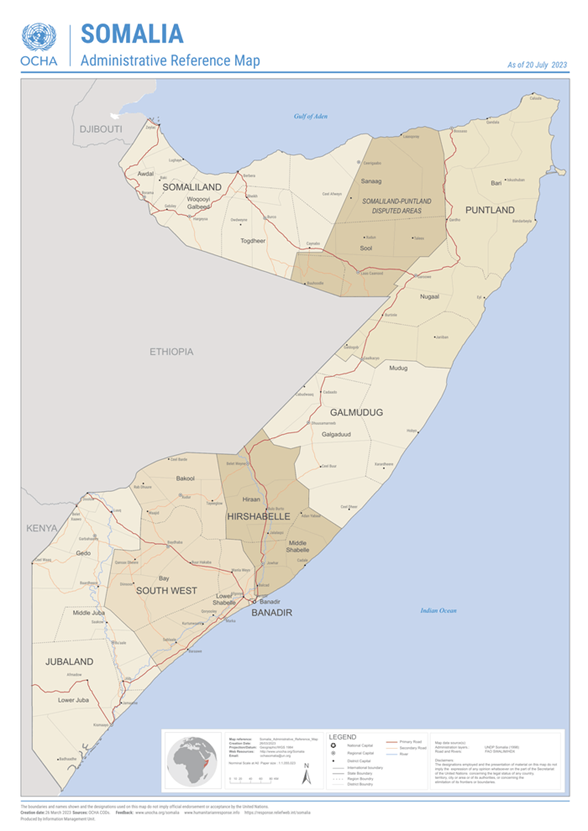
Somalia was engaged in two non-international armed conflicts (NIACs) during the reporting period: the existing armed conflict with Al-Shabaab and, since December 2024, a new NIAC with Islamic State Somalia (ISS). With 7,289 deaths attributed to non-State armed groups in 2024, Somalia has seen almost one third of all African fatalities from non-State parties to armed conflicts.1Africa Centre for Strategic Studies, ‘Africa Surpasses 150,000 Deaths Linked to Militant Islamist Groups in Past Decade’, 28 July 2025.
Somalia faced a multitude of violent power struggles and local armed conflicts between 1991 and 2004 due to an absence of effective government after President Mohamed Siad Barre was ousted. In the 1990s, the United Nations (UN) peacekeeping and peace enforcement missions including forces from Belgium, Canada, Italy and the United States (US) were deployed to try to address the dire security and humanitarian situation.2UN involvement in Somalia started with the UN Operation in Somalia (UNOSOM I), established on 24 April 1992 by UN Security Council Resolution 751. UNOSOM I was succeeded by the Unified Task Force (UNITAF), which, on 3 December 1992, was authorized by Resolution 794 to use ‘all necessary means’ to establish a secure environment for humanitarian operations in the country. On 9 December 1992, UNITAF forces landed in Mogadishu in full combat gear. An expanded UN Operation in Somalia (UNOSOM II) was established on 26 March 1993 under Resolution 814. In addition to disarming Somalis, it had ‘the ambitious mandate of re-establishing political structures in the country and nation building’. UNOSOM II’s mandate ended in March 1995. Peace was not restored and no viable and lasting structures were created ‘when disturbing information with regard to actions of the international forces started to surface’. ‘Situation of human rights in Somalia: Report of the Special Rapporteur, Ms. Mona Rishmawi’, UN Doc E/CN.4/1998/96, 16 January 1998, paras 100–01. With the breakdown of national governmental authority, questions of territory and authority were accentuated when Somaliland declared independence in 1991, and again when the region of Puntland declared autonomy in 1998.
Throughout the 1990s, Somalia remained without a central government while at least thirty clan- and region-based factions competed for control. Despite the establishment of a transitional government in 2004, violence and limited government control over national territory continued. During this period, Islamist armed groups formed, taking control of Mogadishu and other areas outside the capital in 2006, and prompting intervention by Ethiopia and the African Union (AU) in support of the government. The Islamist armed group Al-Shabaab, which had captured key towns during this period, aligned itself with Al-Qaeda and launched an offensive on the capital.
Somali government forces, supported by Kenya and the AU, wrested control of key towns back from Al-Shabaab, leading to the establishment of an internationally recognized federal government in 2012. Al-Shabaab continued its intense armed activities both across the border against Kenya and within Somalia against the government (supported by AU peacekeeping forces, Ethiopia, Kenya, and the United States). Inter-regional tensions within Somalia also sporadically erupted into violence. The UN Assistance Mission in Somalia (UNSOM) was deployed in 2013.3UN Political and Peacebuilding Affairs, ‘UNSOM’.
During the current reporting period, the NIAC between the Somali Armed Forces – supported by the African Union Transition Mission in Somalia (ATMIS), the United States, Ethiopia, Türkiye, and the United Arab Emirates (UAE) – and Al-Shabaab persisted. The African Union Support and Stabilization Mission in Somalia (AUSSOM) replaced ATMIS when the latter’s mandate expired at the end of 2024. The Federal Government of Somalia (FGS) has little presence in much of rural Somalia, often leaving Al-Shabaab as the only functioning authority.4A. Jackson, ‘Flailing State: The Resurgence of al-Shabaab in Somalia’, War on the Rocks, 3 June 2025. UNSOM was replaced at the beginning of November 2024 by the UN Transitional Assistance Mission in Somalia (UNTMIS).5In accordance with UN Security Council Resolution 2753. UN Political and Peacebuilding Affairs, ‘UNTMIS: UN Transitional Assistance Mission in Somalia’.
In the first half of 2025, Al-Shabaab negotiated a number of local power-sharing agreements, sometimes allowing clan fighters to keep their weapons in exchange for not contesting the group’s authority. Increasingly, Al-Shabaab has been encouraging residents to remain when areas come under its control, rather than forcibly displacing them as it did in the past.6Jackson, ‘Flailing State: The Resurgence of al-Shabaab in Somalia’.
While most of the violence has taken place on land, there have also been persistent piratical attacks. Some of those mounted by Al-Shabaab fighters fall within the scope of the armed conflict. Piracy is defined in international law as ‘any illegal acts of violence or detention, or any act of depredation, committed for private ends by the crew or the passengers of a private ship or a private aircraft, and directed … on the high seas, against another ship or aircraft, or against persons or property on board such ship or aircraft’.7 Art 101(a), UN Convention on the Law of the Sea; adopted at Montego Bay, 10 December 1982; entered into force, 16 November 1994. Somalia ratified UNCLOS in 1989. A piratical act can also be an act of hostilities governed by international humanitarian law (IHL) insofar as it is directed against civilians and within the context of Al-Shabaab’s military operations. Between November 2023 and July 2025, forty-seven piratical acts were logged in the Gulf of Aden and western Indian Ocean. Piracy by Al-Shabaab has greatly disrupted commercial shipping traffic through the Bab al Mandab Strait, causing billions of dollars in economic losses and increased transportation and other costs.8Africa Center for Strategic Studies, ‘Africa Surpasses 150,000 Deaths Linked to Militant Islamist Groups in Past Decade’.
In January 2023, a separate conflict between the government of Somaliland – a self-proclaimed independent region – and the Dhulbahante clan militias broke out in the long-disputed Sool, Sanaag, and Cayn (SSC) regions. This conflict ended following withdrawal of Somaliland forces and the establishment of the SSC-Khaatumo administration. Sporadic clashes in the region have, however, continued. A greater problem has come from violence in the northern autonomous region of Puntland, which stopped recognizing the Federal Government in November 2024.9European Union Agency for Asylum (EUAA), ‘Country of Origin Information Report – Somalia: Security Situation’, May 2025, p 18.
Clashes between the Somali Armed Forces (SAF) and its support forces and ISS in Puntland, initially infrequent and sporadic, escalated during December 2024. Military operations by SAF in north-east Puntland that month are said to have inflicted 200 casualties among ISS, enabling the armed forces to retake villages previously under the group’s control.10M. O. Hassan, ‘Somali government says attacks on bases repulsed, 130 militants killed’, Voice of America, 20 February 2025.Subsequent attacks included ISS drone strikes – for the first time – on Puntland security forces in January 2025.11P. van Ostaeyen and P. Wójcik, ‘The Islamic State in Puntland, Somalia’, Online article, Counter Extremism Project, 21 February 2025; International Crisis Group, ‘Africa: Somalia’; J. G. Birru, ‘Expert Comment: January saw the first use of drone strikes by IS Somalia’, Armed Conflict Location & Event Data (ACLED) project, 13 February 2025.
Since the capture of a key ISS base in Buqa Caleed by Puntland security forces in March 2025, ISS has been in retreat, with the Puntland authorities even claiming victory over the group at one point.12‘Islamic State Retreats as Puntland Captures Key Strongholds’, All Africa, accessed 15 September 2025. On 3 May, military forces successfully repelled an attack in the Dhasaan Sare area of Miraale Valley, reportedly killing ten ISS fighters. On 31 May, the military claimed to have secured the final ISS base in Miraale in the region.13International Crisis Group, ‘Africa: Somalia’; and Khadarow, ‘Puntland Forces Capture Final ISIS Stronghold in Miiraale’, Somalia National News Agency, 31 May 2025. Military operations shifted to the ISS stronghold of Togga Jecel Valley.14International Crisis Group, ‘Africa: Somalia’.
The United States, through its Africa Command (AFRICOM), supports the Somali government in its fight against Al-Shabaab and ISS. It estimates that Al-Shabaab has 7,000 to 12,000 fighters, stating that, since 2014, the group has killed more US citizens than any other Al-Qaeda affiliate, and that, as of 2025, it was Al-Qaeda’s wealthiest component.15US National Counterterrorism Center, ‘Terrorist Groups: AL-SHABAAB’, accessed 15 September 2025. From 1 July 2024 to 15 March 2025, a minimum of another eleven airstrikes were conducted by US AFRICOM in Somalia. From 15 March to 23 June 2025, a significant escalation in US military operations saw at least thirty AFRICOM airstrikes recorded.16International Crisis Group, ‘Africa: Somalia’; US Africa Command, ‘Press Releases’, accessed 15 September 2025. As the United States is operating in Somalia at the invitation of the Somali government, its involvement does not affect the classification of the two NIACs in which Somalia is engaged.
But while the United States has escalated airstrikes against ISS in Puntland, Al-Shabaab’s momentum in southern and central Somalia has been ‘largely unchecked’. On 20 July 2025, al-Shabaab recaptured the towns of Sabiid and Anole, located some forty kilometres south-west of Mogadishu. This followed an abrupt withdrawal of AU forces, primarily Ugandan troops, and SAF, which ceased defensive operations amid a wave of deadly Al-Shabaab assaults targeting the joint force.‘17Al-Shabaab’s 2025 Offensive and the Unraveling of Somalia’s Federal Counterinsurgency’, The Soufan Center, 24 July 2025.
At the time of writing, Al-Shabaab appeared to be seeking to encircle Mogadishu. While it is unclear whether it has the capability to seize the capital, the city’s isolation would further weaken the Federal Government. Al-Shabaab fighters have been setting up roadblocks and collecting taxes in Moqokori, indicating early efforts to establish a parallel governance structure and extract revenues. Moqokori is close to major highways connecting to Bulobarde, a government-held town in central Somalia defended by Djiboutian AU forces. Al-Shabaab’s renewed offensive has undone years of progress by the FGS in reclaiming territory, highlighting the group’s enduring strength.18Ibid. An improvised explosive device (IED) attack on the president’s motorcade in March 2025, and an attack on an army recruitment centre in Mogadishu two months later further eroded public confidence in the government and stoked fear of Al-Shabaab seizing power in the capital.19Jackson, ‘Flailing State: The Resurgence of al-Shabaab in Somalia’.
In contrast, concerns about possible international armed conflict between Ethiopia and Somalia appeared to have receded, at least for the time being. In December 2024, following talks in Türkiye, Ethiopia and Somalia agreed to end their bitter dispute over Ethiopian plans to build a port in Somaliland. Ethiopian Prime Minister Abiy Ahmed and Somali President Hassan Sheikh Mohamud agreed to respect one another’s sovereignty. The feud had begun on New Year’s Day 2024, when Prime Minister Abiy signed an agreement with Somaliland to lease a twenty-kilometre section of its coastline for fifty years in order to set up a naval base. In exchange, Ethiopia would recognize Somaliland’s independence, although the Ethiopian government never explicitly confirmed this. At the time, the FGS described it as an ‘act of aggression’.20K. Yibeltal and B. Rukanga, ‘Ethiopia and Somalia reach deal in Turkey to end Somaliland port feud’, BBC News, 12 December 2024.
Conflict Classification and Applicable Law
The ongoing armed conflict between Somalia (and supporting forces) and Al-Shabaab and the armed conflict since December 2024 between Somalia and Islamic State Somalia (ISS) are of a non-international character.
Somalia is a State Party to the four Geneva Conventions of 1949, which applies to the two conflicts, but not to Additional Protocol II of 1977.21Protocol Additional to the Geneva Conventions of 12 August 1949, and relating to the Protection of Victims of Non-International Armed Conflicts; adopted at Geneva, 8 June 1977; entered into force, 7 December 1978.Customary IHL applies to both NIACs.
Somalia is not a State Party to the Rome Statute of the International Criminal Court.22Rome Statute of the International Criminal Court; adopted at Rome, 17 July 1998; entered into force, 1 July 2002.
Compliance with IHL
Overview
During the reporting period, there were consistent reports of Al-Shabaab targeting civilians and civilian objects and perpetrating indiscriminate attacks. A prevalent means of warfare has been IEDs, some of which constitute anti-personnel mines. In the preamble to its Resolution 2776 (2025), which imposed sanctions and an arms embargo on Al-Shabaab, the UN Security Council strongly condemned the ‘reported targeting of civilians’ by the group ‘as well as its indiscriminate use of explosive weapons, in particular in densely populated areas, and the consequences for the civilian population’.23UN Security Council Resolution 2776, adopted by unanimous vote in favour on 3 March 2025, preambular para 7.
Civilian Objects under Attack
Both Al-Shabaab and ISS have regularly attacked civilian objects. Under customary IHL, attacks may only be directed against military objectives and must not be directed against civilian objects.24ICRC, Customary IHL Rule 7: ‘The Principle of Distinction between Civilian Objects and Military Objectives’. Military objectives are those objects which, by their nature, location, purpose or use, make an effective contribution to military action.25ICRC, Customary IHL Rule 8: ‘Definition of Military Objectives’. In addition, the object’s partial or total destruction, capture, or neutralisation must offer a definite military advantage in the prevailing circumstances. Civilian objects are all objects that are not military objectives.26ICRC, Customary IHL Rule 9: ‘Definition of Civilian Objects’. Special protection is afforded to medical units, such as hospitals and other medical facilities.27ICRC, Customary IHL Rule 28: ‘Medical Units’. Special care must also be taken in military operations to avoid damage to buildings dedicated to religion, art, science, education unless they are military objectives.28ICRC, Customary IHL Rule 38A: ‘Attacks Against Cultural Property‘.
For 2024, the UN Secretary-General reported UN verification of thirty-six attacks on schools and three attacks on hospitals. Of the total, twenty-eight were attributed to Al-Shabaab, with responsibility for most of the remainder ascribed to clan militias.29‘Children and Armed Conflict, Report of the UN Secretary-General’, UN Doc A/79/878-S/2025/247, 17 June 2025, para 164. In Mahas town and other districts of Hiraan region, hostilities in the first half of 2025 led to suspension of services in thirteen health facilities. Insecurity also forced temporary closure of one stabilization centre and seven community health sites.30UN Office for the Coordination of Humanitarian Affairs (OCHA), ‘Somalia: Conflict displacement in Hiraan and Gedo Regions: Flash Update No. 2, As of 3 August 2025’, 4 August 2025. The surge in fighting across the country has not only put additional strain on medical facilities treating the wounded but has also forced more than 100,000 people to flee their homes, placing more pressure on the dwindling humanitarian resources.31ICRC, ‘Somalia: Frontline hospitals under pressure as fighting escalates’, News release, 10 April 2025.
Civilians under Attack
The United Nations recorded 854 civilian casualties (295 killed, 559 injured) between January and September 2024. This represents a thirty-five per cent decrease from the almost 1,300 casualties recorded in 2023.32OCHA, ‘Humanitarian Needs and Response Plan Somalia 2025’, January 2025, p 9.
Individual attacks, however, caused major loss of civilian life. Al-Shabaab claimed responsibility for an attack on 2 August 2024 in which a suicide bombing was followed by a gun battle with security forces at the Lido Beach in Mogadishu. At least 37 people were killed and more than 200 injured, some critically. ‘Lido Beach is a popular place for Somalis to spend time with family and friends…. Targeting this location is an abhorrent act that warrants the firmest condemnation’, James Swan, Acting Special Representative of the UN Secretary-General for Somalia, declared.33V. Mishra, ‘UN condemns deadly suicide attack on Somalia beach’, UN News, 3 August 2024.
The attacks on civilians continued in 2025. In May, at the end of a visit to Somalia, the UN Special Rapporteur on the promotion and protection of human rights and fundamental freedoms while countering terrorism, Ben Saul, expressed his deep concern about the killing and maiming of children in the armed conflicts in Somalia.34OHCHR, ‘UN expert urges international community not to leave Somalia behind’, Press release, 21 May 2025.
ISS also uses violence to generate income, sometimes killing in order to do so. It has targeted pastoralists and businesses, although in July 2025, local pastoralists resisted the extra payment sought by the group, leading to clashes that resulted in deaths on both sides. Nevertheless, ISS is said to be one of Islamic State’s most profitable branches, serving as a financial hub for, and support to, its wider network in Africa and beyond.35L. Serwat, H. Nsaibia, M. Adah, P. Bofin, and Mohamed, ‘Q&A, The Islamic State’s pivot to Africa’, ACLED, 4 Sept 2025.
Attacks against humanitarian workers
Humanitarian workers have been particular targets as well as incidental victims of the fighting. According to the UN Office for the Coordination of Humanitarian Affairs (OCHA),violence against humanitarian personnel, assets, and facilities rose sharply, with sixty-seven recorded incidents in 2024, compared to forty-seven the previous year.36‘Report of the Secretary-General, Children in Armed Conflict’, 2024 Summary, June 2025. In addition, eight aid workers were abducted, though they were later released following clan negotiations. Seven vehicles affiliated with humanitarian organisations were carjacked, sometimes along with looting of humanitarian supplies. A number of incidents, however, involved clan-related violence rather than acts of a party to one of the armed conflicts.37OCHA, ‘Somalia: Humanitarian Access Snapshot (January–December 2024)’ 22 January 2025.
Humanitarian Outcomes similarly reported that in 2024, Somalia experienced the most individual incidents affecting aid workers in ten years, with nine killed, fourteen wounded, and seven kidnapped. The number of attacks attributed to Al-Shabaab was up eighteen per cent from 2023. Most of the victims were from national NGOs and the Somali Red Crescent Society, with the remainder UN and international NGO personnel.38Humanitarian Outcomes, ‘Annual Aid Worker Security Report 2025’, August 2025, pp 5, 7. In June 2025, the detonation of an IED hit a humanitarian convoy delivering food aid in Banadir, killing two humanitarian workers and injuring five security guards who were escorting it.‘Report of the Secretary-General, Children in Armed Conflict’, 2024 Summary. All of the victims were civilians protected against attack under IHL.
State counterterrorism laws have also obstructed the delivery of aid. In May 2025, the UN Special Rapporteur on human rights while countering terrorism warned of the dangers of overreach in counterterrorism financing laws that risked impeding the delivery of independent and impartial humanitarian relief to civilians in acute need.39OHCHR, ‘UN expert urges international community not to leave Somalia behind’, Press Release, 21 May 2025.
Use of improvised explosive devices
Most explosive incidents recorded by the United Nations between late September 2024 and late March 2025 continued to be perpetrated by Al-Shabaab using IEDs and indirect fire attacks.40‘Report of the Secretary-General on Somalia’, UN Doc S/2025/194, New York, 28 March 2025, para 11 In its Resolution 2776 of 3 March 2025, the UN Security Council decided that ‘all States shall, for the purposes of preventing Al-Shabaab and other actors intent on undermining peace and security in Somalia … take the necessary measures to prevent all deliveries of weapons, ammunition and military equipment’ to non-State actors in Somalia, as well as to ‘prevent the direct or indirect sale, supply or transfer’ of certain items where ‘a significant risk exists that they may be used, in the manufacture in Somalia of improvised explosive devices’.41UN Security Council Resolution 2776, operative paras 4 and 18.
Somalia is a State Party to the 1997 Anti-Personnel Mine Ban Convention, which prohibits its forces from using any anti-personnel mine – defined as an explosive munition placed under, on, or near the ground that is designed or adapted to be activated by a person. This disarmament treaty does not bind Al-Shabaab or ISS directly under international law, but the groups are subject to the customary IHL principles of distinction and proportionality in attack, underpinned by the duty to take precautions to protect civilians. Somalia is not a party to Amended Protocol II of 1996 to the Convention on Certain Conventional Weapons, which binds all parties to an armed conflict, including non-State armed groups.Art 1(2), Protocol on Prohibitions or Restrictions on the Use of Mines, Booby-Traps and Other Devices as amended on 3 May 1996 annexed to the Convention on Certain Conventional Weapons; adopted at Geneva, 3 May 1996; entered into force, 3 December 1998. Niger adhered to the Amended Protocol in 2007.
The effects of anti-personnel mines, including those of an improvised nature employed by the non-State armed groups in Somalia, are very often indiscriminate. Thus, customary IHL mandates that ‘when landmines are used, particular care must be taken to minimize their indiscriminate effects.’ Somalia is obligated by the Anti-Personnel Mine Ban Convention to clear and destroy all anti-personnel mines on its territory as soon as possible.42Art 5, Convention on the Prohibition of the Use, Stockpiling, Production and Transfer of Anti-Personnel Mines and on their Destruction; adopted at Oslo, 18 September 1997; entered into force, 1 March 1999.
Use of armed drones
In recent years, Somalia has been procuring Bayraktar TB2 armed drones from Türkiye. Civilian casualties continued to be recorded from their use against Al-Shabaab, with twenty-three reportedly killed in two strikes on the same day in March 2024.43Amnesty International, ‘Somalia: Death of 23 civilians in military strikes with Turkish drones may amount to war crimes – new investigation’, 7 May 2024.
The extent to which civilian casualties continue to result from multiple US drone strikes in the first three months of 2025 is not known.44C. Weiss, ‘Trump admin ups the tempo of airstrikes against jihadist groups in Somalia’, The Long War Journal, 30 March 2025. The United States reported that a single drone operation in February conducted with the UAE had killed 16 militants affiliated with ISS in northern Somalia. No civilian casualties were reported.45M. O. Hassan, ‘Somali officials: US airstrike against Islamic State kills 16 militants’, Voice of America, 17 February 2025. In its quarterly civilian harm assessment report for the period ending 31 March 2025, AFRICOM declared that it ‘did not receive any new reports of civilian harm, closed one assessment, and carried over one open report from previous quarters’.46AFRICOM, ‘U.S. Africa Command Quarterly Civilian Harm Assessment Report’, US Africa Command Public Affairs, Stuttgart, 14 August 2025.
As noted, in January 2025, ISS conducted drone strikes, its first recorded use of armed drones.47Birru, ‘Expert Comment: January saw the first use of drone strikes by IS Somalia’.
Protection of Persons in the Power of the Enemy
Murder of civilians
Violence against civilians by parties to the armed conflicts became even more widespread during the reporting period. There were numerous reports of the government or its agents perpetrating arbitrary or unlawful killings during the year. While reliable data were difficult to collect, UNSOM reported that State security personnel had killed 72 civilians between January and September 2024. Al-Shabaab, in some cases, conducted targeted killings of civilians. Extrajudicial killings of civilians by ATMIS peacekeepers also occurred.48US Department of State, ‘2024 Country Reports on Human Rights Practices: Somalia’, July 2025, §1, p 2.
Summary or arbitrary executions
The UN Secretary-General condemned the execution of four young people in Puntland in August 2024 ‘for alleged offences committed while associated with Al-Shabaab as children’ and ‘urgently’ called upon the FGS and Somali states to treat children associated with armed forces and armed groups ‘in line with international juvenile justice standards’.49Ibid. It is a violation of the right to life, including in a situation of armed conflict, to execute anyone for an offence committed when they were under eighteen years of age.50Art 6(5), International Covenant on Civil and Political Rights; adopted at New York, 16 December 1966; entered into force, 23 March 1976; Art 37(a), Convention on the Rights of the Child; adopted at New York, 20 November 1989; entered into force, 2 September 1990. Although not explicit in the ICRC’s study of customary IHL,51ICRC, Customary IHL Rule 135: ‘Children’. it is also a customary rule that is codified in Additional Protocol II of 1977.52Art 6(4), Additional Protocol II, a provision adopted by consensus in the 1977 diplomatic conference.
In July 2024 in Galgaduud region, five civilians were reportedly executed by Al-Shabaab following a ruling by a self-proclaimed Al-Shabaab ‘court’. The five were accused of espionage and collaboration with the Federal Government and other entities.53‘Al-Shabaab Executes 5 Men for Allegedly Spying for U.S., Somalia and Kenya’, Horn Observer, 15 July 2024. The lack of a fair trial is a serious violation of IHL and a war crime.54ICRC, Customary IHL Rule 100: ‘Fair Trial Guarantees’; and Rule 156: ‘Definition of War Crimes’.
In May 2025, UN Special Rapporteur, Ben Saul, warned that some terrorism offences in Somalia attract the death penalty even when they do not involve intentional killing, as required under international law. He was particularly concerned about the use of military courts to try terrorist suspects, given the lack sufficient independence and fair-trial safeguards.55UNHCR Somalia, Operational Update, June 2025.
Child recruitment
IHL sets the minimum age for recruitment at fifteen years of age.56ICRC, Customary IHL Rule 136: ‘Recruitment of Child Soldiers’; and Rule 156: ‘Definition of War Crimes’. In 2015, Somalia signed the 2000 Optional Protocol to the Convention on the Right of the Child on the Involvement of Children in Armed Conflict, which raises the age for use in hostilities under international human rights law to eighteen years. Somalia has not yet ratified the Optional Protocol. Moreover, the recruitment and use of children by both Al-Shabaab and pro-government forces continues to be documented, indicating persistent violations of the standards set forth in the Protocol.
For 2024, the UN verified the abduction of 887 children (731 boys, 156 girls), 850 of whom were taken by Al-Shabaab.57‘Children and Armed Conflict, Report of the UN Secretary-General’, 17 June 2025, para 165. Many were deliberately recruited to participate directly in hostilities. In this regard, the UN Secretary-General reported that 643 children were used by Al‑Shabaab in the armed conflict with SAF. Six children were recruited and used by the Somali National Army.58Ibid, para 160. The report does not detail how many of the recruited children were under 15 years of age.
In June 2025, however, despite the recruitment of a small number of children by SAF, the United Nations officially removed Somalia from its list of countries implicated in the recruitment and use of child soldiers, ‘marking a significant milestone in the country’s efforts to comply with international child protection standards’. The Ministry of Defense said in a statement: ‘The removal from the UN list reaffirms Somalia’s dedication to upholding the Constitution and international humanitarian law. The Somali child is not a soldier – they are the future of this nation.’59‘Somalia removed from UN child soldier list after reforms’, Hiiraan, 23 June 2025.
Nevertheless, children are still being detained by the authorities in connection with their alleged involvement with non-State armed groups. In June 2025, the UN Secretary-General expressed continuing concern at the many children detained for alleged association with armed groups in Somalia, and their prosecution in military courts.60‘Children and Armed Conflict, Report of the UN Secretary-General’, UN Doc A/79/878, para 170.
Conflict-related sexual and gender-based violence
The impact of the conflict also has a clear gender-specific element. In 2024, the United Nations recorded the perpetration of sexual violence against 120 children by Al-Shabaab. A further fourteen children suffered at the hands of different government security forces. In eleven of these cases, the Somali National Army was the responsible body.61Ibid, para 163. The UN Secretary-General further reported that in one incident, four women and two girls appeared before the first instance military court in Banaadir on 22 October on allegations of being affiliated with Al-Shabaab. Five of them, including one girl, were said to have been forced to marry fighters. UNTMIS facilitated the transfer of the two girls to child protection actors while awaiting the court’s decision.
Other incidents, at least some of which had a sufficient nexus to the armed conflict to amount to an IHL violation and a war crime, concerned the gang rape of an internally displaced woman, allegedly by members of the security forces in Banaadir region; the rape of two girls aged fourteen and seventeen years by unidentified armed men in Hiraan region; the attempted rape of two women by a member of a clan militia in Shabelle Hoose region; the gang rape of a displaced woman in Shabelle Hoose; and the rape of a fifteen-year-old by clan militia in Banaadir region. No arrests were made in connection with any of these crimes.62Report of the Secretary-General on Somalia, UN Doc S/2025/194, paras 46 and 47.
Persons with disabilities
It is not known how many people are living with disabilities in Somalia although the UN Development Programme (UNDP) suggested in 2025 that the figure is eleven per cent of the Somali population of 19 million.63UNDP, ‘Capacity Development and Empowerment for Persons with Disabilities (PWD) Project in Somalia’, Mogadishu, March 2025, p 1. In its National Disability Report 2024, the National Bureau of Statistics said that overall prevalence of disability in the adult population was 11.7 per cent, with women having a higher prevalence of disability (at 12.6 per cent) compared to men (10.5 per cent). With respect to children:
Many children with disabilities do not attend schools and are kept at home, out of sight. Children and adults with disabilities are stigmatized, segregated, and given derogatory and collective names. The conflict exacerbates the barriers that children with disabilities face, and girls and IDPs with disabilities are disproportionately affected.64Somalia National Bureau of Statistics, ‘National Disability Report 2024’, Report, Mogadishu, 2024, p 1, 4.
In its humanitarian needs and response plan for Somalia for 2025, OCHA notes that almost three quarters of persons with disabilities were unable to reach or use humanitarian assistance due to lack of information, physical inaccessibility, and fear of physical or verbal attacks.65OCHA, ‘Humanitarian Needs and Response Plan Somalia 2025’, p 14. The draft Disability Strategy for 2025–28 supported by the UN makes scant reference to armed conflicts and their consequences for disability, but does call for ‘an inclusive emergency preparedness and response plan’, and a ‘comprehensive emergency plan that specifically addresses the protection of persons with disabilities during armed conflict’.66UN Economic and Social Commission for Western Asia, ‘Validation Workshop for the Development of the National Disability Strategy in Somalia 2025–2028’, 12–13 June 2024, p 20.
As OCHA noted in January 2025, persons with disabilities are disproportionately impacted by armed conflict. Persons with disabilities are confronted with
social stigma, inaccessibility, marginalization, and discrimination. They have poorer health, lower educational attainment and fewer economic opportunities due to a lack of access to support services such as access to medical care, assistive devices and other essential services, contributing to a cycle of poverty and marginalization. … Women and girls with disabilities, particularly when from a minority group, are considered to be in most severe need. The type of disability, displacement status, gender, clan affiliation and family/community support networks shape needs at an individual level.67OCHA, ‘Humanitarian Needs and Response Plan Somalia 2025’, p 14.
- 1Africa Centre for Strategic Studies, ‘Africa Surpasses 150,000 Deaths Linked to Militant Islamist Groups in Past Decade’, 28 July 2025.
- 2UN involvement in Somalia started with the UN Operation in Somalia (UNOSOM I), established on 24 April 1992 by UN Security Council Resolution 751. UNOSOM I was succeeded by the Unified Task Force (UNITAF), which, on 3 December 1992, was authorized by Resolution 794 to use ‘all necessary means’ to establish a secure environment for humanitarian operations in the country. On 9 December 1992, UNITAF forces landed in Mogadishu in full combat gear. An expanded UN Operation in Somalia (UNOSOM II) was established on 26 March 1993 under Resolution 814. In addition to disarming Somalis, it had ‘the ambitious mandate of re-establishing political structures in the country and nation building’. UNOSOM II’s mandate ended in March 1995. Peace was not restored and no viable and lasting structures were created ‘when disturbing information with regard to actions of the international forces started to surface’. ‘Situation of human rights in Somalia: Report of the Special Rapporteur, Ms. Mona Rishmawi’, UN Doc E/CN.4/1998/96, 16 January 1998, paras 100–01.
- 3UN Political and Peacebuilding Affairs, ‘UNSOM’.
- 4A. Jackson, ‘Flailing State: The Resurgence of al-Shabaab in Somalia’, War on the Rocks, 3 June 2025.
- 5In accordance with UN Security Council Resolution 2753. UN Political and Peacebuilding Affairs, ‘UNTMIS: UN Transitional Assistance Mission in Somalia’.
- 6Jackson, ‘Flailing State: The Resurgence of al-Shabaab in Somalia’.
- 7Art 101(a), UN Convention on the Law of the Sea; adopted at Montego Bay, 10 December 1982; entered into force, 16 November 1994.
- 8Africa Center for Strategic Studies, ‘Africa Surpasses 150,000 Deaths Linked to Militant Islamist Groups in Past Decade’.
- 9European Union Agency for Asylum (EUAA), ‘Country of Origin Information Report – Somalia: Security Situation’, May 2025, p 18.
- 10M. O. Hassan, ‘Somali government says attacks on bases repulsed, 130 militants killed’, Voice of America, 20 February 2025.
- 11P. van Ostaeyen and P. Wójcik, ‘The Islamic State in Puntland, Somalia’, Online article, Counter Extremism Project, 21 February 2025; International Crisis Group, ‘Africa: Somalia’; J. G. Birru, ‘Expert Comment: January saw the first use of drone strikes by IS Somalia’, Armed Conflict Location & Event Data (ACLED) project, 13 February 2025.
- 12‘Islamic State Retreats as Puntland Captures Key Strongholds’, All Africa, accessed 15 September 2025.
- 13International Crisis Group, ‘Africa: Somalia’; and Khadarow, ‘Puntland Forces Capture Final ISIS Stronghold in Miiraale’, Somalia National News Agency, 31 May 2025.
- 14International Crisis Group, ‘Africa: Somalia’.
- 15US National Counterterrorism Center, ‘Terrorist Groups: AL-SHABAAB’, accessed 15 September 2025.
- 16International Crisis Group, ‘Africa: Somalia’; US Africa Command, ‘Press Releases’, accessed 15 September 2025.
- 17Al-Shabaab’s 2025 Offensive and the Unraveling of Somalia’s Federal Counterinsurgency’, The Soufan Center, 24 July 2025.
- 18Ibid.
- 19Jackson, ‘Flailing State: The Resurgence of al-Shabaab in Somalia’.
- 20K. Yibeltal and B. Rukanga, ‘Ethiopia and Somalia reach deal in Turkey to end Somaliland port feud’, BBC News, 12 December 2024.
- 21Protocol Additional to the Geneva Conventions of 12 August 1949, and relating to the Protection of Victims of Non-International Armed Conflicts; adopted at Geneva, 8 June 1977; entered into force, 7 December 1978.
- 22Rome Statute of the International Criminal Court; adopted at Rome, 17 July 1998; entered into force, 1 July 2002.
- 23UN Security Council Resolution 2776, adopted by unanimous vote in favour on 3 March 2025, preambular para 7.
- 24ICRC, Customary IHL Rule 7: ‘The Principle of Distinction between Civilian Objects and Military Objectives’.
- 25ICRC, Customary IHL Rule 8: ‘Definition of Military Objectives’. In addition, the object’s partial or total destruction, capture, or neutralisation must offer a definite military advantage in the prevailing circumstances.
- 26
- 27
- 28
- 29‘Children and Armed Conflict, Report of the UN Secretary-General’, UN Doc A/79/878-S/2025/247, 17 June 2025, para 164.
- 30UN Office for the Coordination of Humanitarian Affairs (OCHA), ‘Somalia: Conflict displacement in Hiraan and Gedo Regions: Flash Update No. 2, As of 3 August 2025’, 4 August 2025.
- 31ICRC, ‘Somalia: Frontline hospitals under pressure as fighting escalates’, News release, 10 April 2025.
- 32OCHA, ‘Humanitarian Needs and Response Plan Somalia 2025’, January 2025, p 9.
- 33V. Mishra, ‘UN condemns deadly suicide attack on Somalia beach’, UN News, 3 August 2024.
- 34OHCHR, ‘UN expert urges international community not to leave Somalia behind’, Press release, 21 May 2025.
- 35L. Serwat, H. Nsaibia, M. Adah, P. Bofin, and Mohamed, ‘Q&A, The Islamic State’s pivot to Africa’, ACLED, 4 Sept 2025.
- 36‘Report of the Secretary-General, Children in Armed Conflict’, 2024 Summary, June 2025.
- 37OCHA, ‘Somalia: Humanitarian Access Snapshot (January–December 2024)’ 22 January 2025.
- 38Humanitarian Outcomes, ‘Annual Aid Worker Security Report 2025’, August 2025, pp 5, 7.
- 39OHCHR, ‘UN expert urges international community not to leave Somalia behind’, Press Release, 21 May 2025.
- 40‘Report of the Secretary-General on Somalia’, UN Doc S/2025/194, New York, 28 March 2025, para 11
- 41UN Security Council Resolution 2776, operative paras 4 and 18.
- 42Art 5, Convention on the Prohibition of the Use, Stockpiling, Production and Transfer of Anti-Personnel Mines and on their Destruction; adopted at Oslo, 18 September 1997; entered into force, 1 March 1999.
- 43Amnesty International, ‘Somalia: Death of 23 civilians in military strikes with Turkish drones may amount to war crimes – new investigation’, 7 May 2024.
- 44C. Weiss, ‘Trump admin ups the tempo of airstrikes against jihadist groups in Somalia’, The Long War Journal, 30 March 2025.
- 45M. O. Hassan, ‘Somali officials: US airstrike against Islamic State kills 16 militants’, Voice of America, 17 February 2025.
- 46AFRICOM, ‘U.S. Africa Command Quarterly Civilian Harm Assessment Report’, US Africa Command Public Affairs, Stuttgart, 14 August 2025.
- 47Birru, ‘Expert Comment: January saw the first use of drone strikes by IS Somalia’.
- 48US Department of State, ‘2024 Country Reports on Human Rights Practices: Somalia’, July 2025, §1, p 2.
- 49Ibid.
- 50Art 6(5), International Covenant on Civil and Political Rights; adopted at New York, 16 December 1966; entered into force, 23 March 1976; Art 37(a), Convention on the Rights of the Child; adopted at New York, 20 November 1989; entered into force, 2 September 1990.
- 51
- 52Art 6(4), Additional Protocol II, a provision adopted by consensus in the 1977 diplomatic conference.
- 53‘Al-Shabaab Executes 5 Men for Allegedly Spying for U.S., Somalia and Kenya’, Horn Observer, 15 July 2024.
- 54
- 55UNHCR Somalia, Operational Update, June 2025.
- 56ICRC, Customary IHL Rule 136: ‘Recruitment of Child Soldiers’; and Rule 156: ‘Definition of War Crimes’.
- 57‘Children and Armed Conflict, Report of the UN Secretary-General’, 17 June 2025, para 165.
- 58Ibid, para 160.
- 59‘Somalia removed from UN child soldier list after reforms’, Hiiraan, 23 June 2025.
- 60‘Children and Armed Conflict, Report of the UN Secretary-General’, UN Doc A/79/878, para 170.
- 61Ibid, para 163.
- 62Report of the Secretary-General on Somalia, UN Doc S/2025/194, paras 46 and 47.
- 63UNDP, ‘Capacity Development and Empowerment for Persons with Disabilities (PWD) Project in Somalia’, Mogadishu, March 2025, p 1.
- 64Somalia National Bureau of Statistics, ‘National Disability Report 2024’, Report, Mogadishu, 2024, p 1, 4.
- 65
- 66UN Economic and Social Commission for Western Asia, ‘Validation Workshop for the Development of the National Disability Strategy in Somalia 2025–2028’, 12–13 June 2024, p 20.
- 67OCHA, ‘Humanitarian Needs and Response Plan Somalia 2025’, p 14.