Conflict Overview
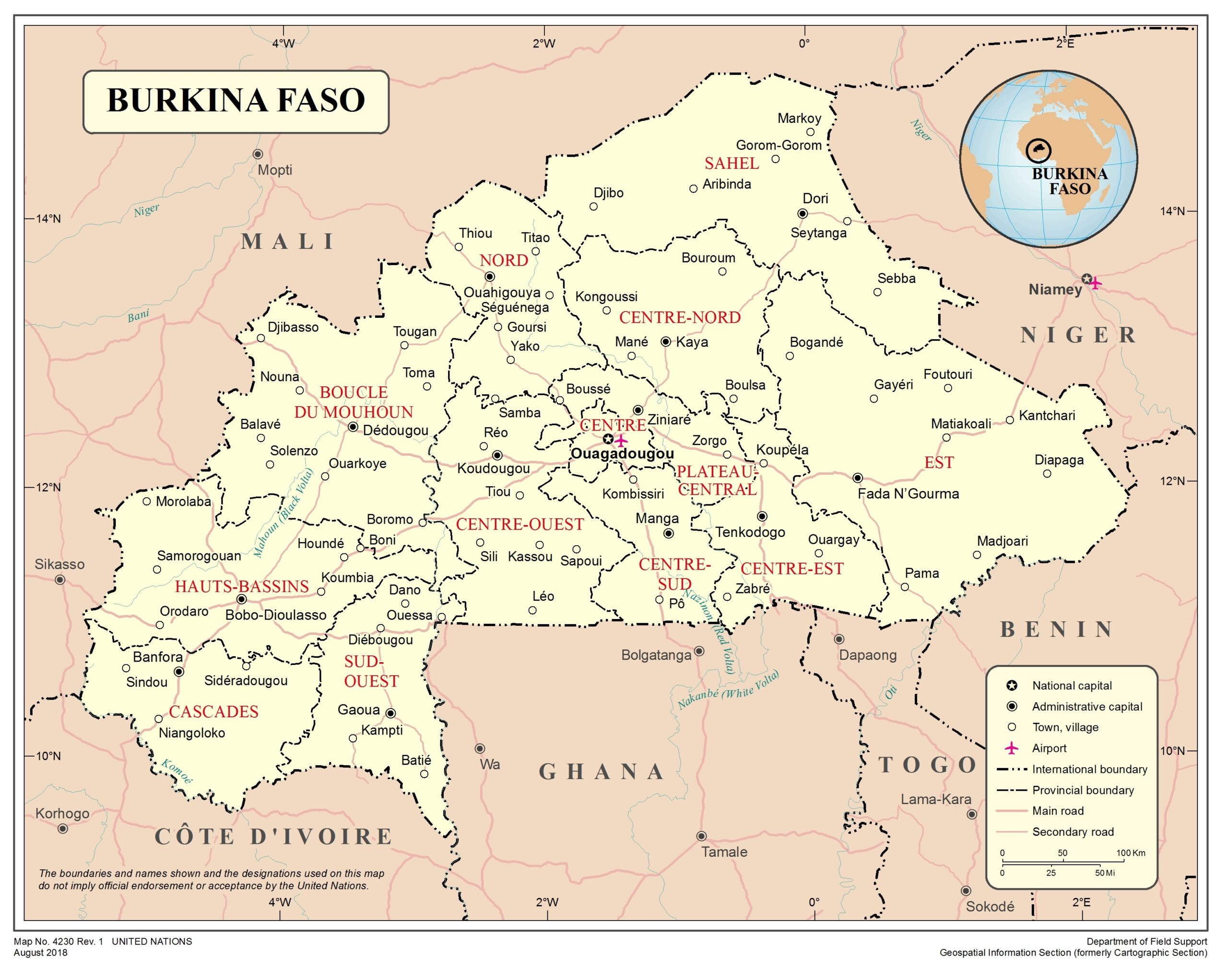
Burkina Faso has been affected since 2016 by insecurity stemming from neighbouring Mali. Thirty people were killed in terrorist attacks in the capital, Ouagadougou, signalling the start of an Islamist insurgency in northern and eastern Burkina Faso by jihadist groups. The installation of armed groups across its territory led to the outbreak of armed conflicts against the authorities beginning in 2019. Two military coups in 2022 led to the nation’s suspension from the African Union and its subsequent withdrawal from the Economic Community of West African States (ECOWAS) in January 2025. In 2023, the Burkinabe military had expelled the small French military force stationed in the country, accompanied by the announcement that they would develop links with Russia instead.1‘Burkina Faso country profile’, BBC, 26 February 2024. Since January 2024, Africa Corps has been deployed in Burkina, providing security and training, and patrolling in conflict-affected areas.2N. Princewill, ‘In Africa, Russia is swapping a ruthless paramilitary for a replica it can control. What’s Putin’s game plan?’, CNN, 25 August 2025; ‘Burkina Faso Opens Door for Russia’s Africa Corps’, Africa Defense Forum, 20 February 2024. Given that Africa Corps operates under the supervision from the Russian Ministry of Defence3S. Ritter, ‘The New “Africa Corps”: Russia’s Wagner Rebranding’, Energy Intelligence, 24 May 2024., its members may be considered as State agents.
Key events since July 2024
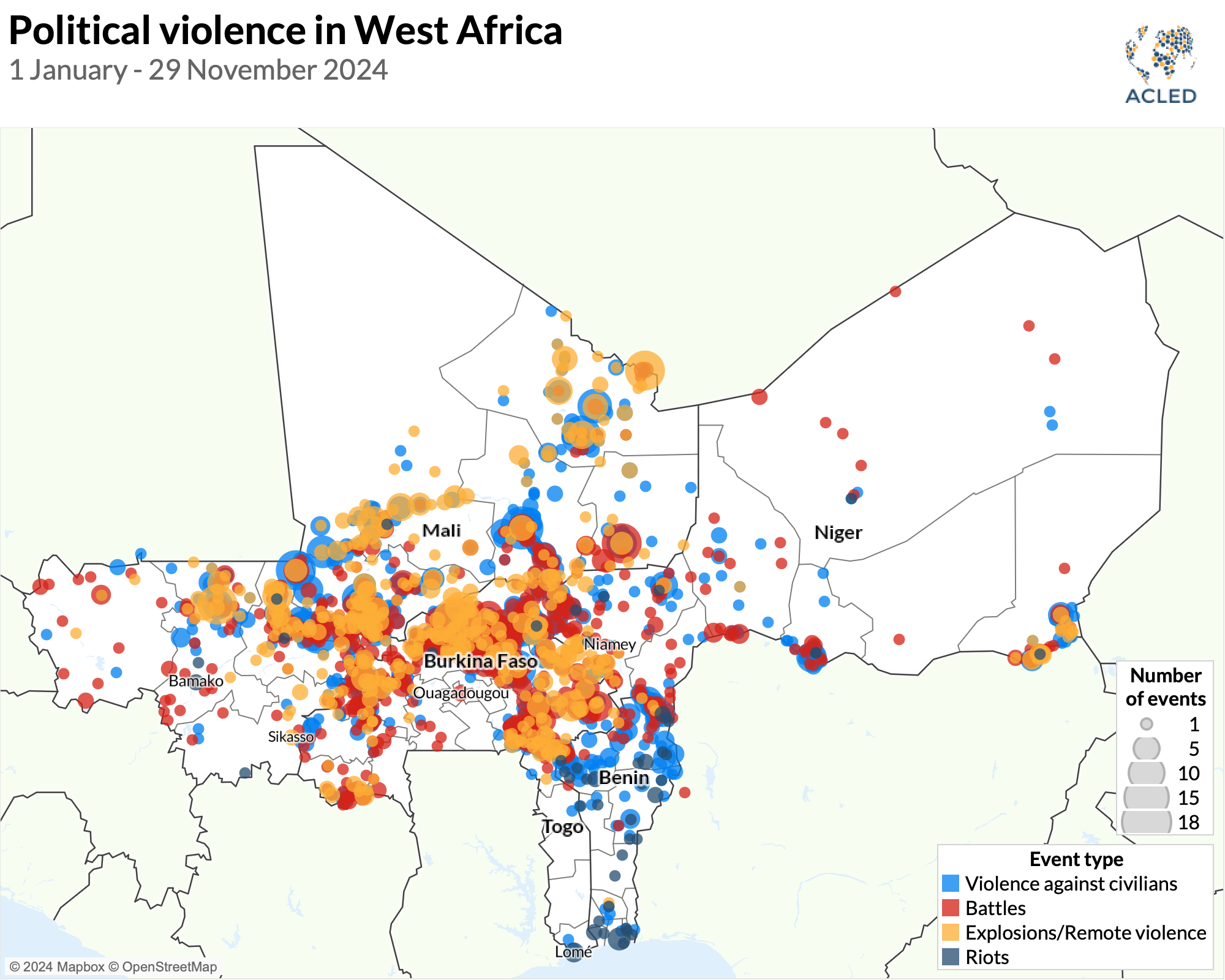
The period under review was characterized by a pervasive level of insecurity in Burkina Faso, with civilians trapped in a cycle of violence between non-State armed groups and State actors. The non-State armed groups that are party to the two non-international armed conflicts (NIACs) in the country – Jama’at Nasr al-Islam wal Muslimin (JNIM) and the Islamic State in the Sahel Province (ISSP) – intensified their assaults, causing significant civilian as well as military casualties. These included a number of massacres. In August 2024, for example, a JNIM offensive in the town of Barsalogho against the Burkina Faso Armed Forces (FABF) and the self-defence militia, the Volunteers for Defence of the Homeland (VDPs),4In French, ‘Les Volontaires pour la défense de la Patrie’. involved the mass killing of at least 100 civilians.5Human Rights Watch, ‘Burkina Faso: Islamist Armed Groups Massacre Civilians’, 15 September 2025.
In March 2025, State security forces fighting alongside VDP members were similarly implicated in massacres of civilians, particularly of ethnic Fulani (also known as Peul), in the town of Solenzo and neighbouring areas in Banwa province.6Human Rights Watch, ‘Burkina Faso: Government-Allied Militias Linked to Massacre’, 14 March 2025. Attacks appear to follow a similar pattern, with soldiers and VDPs entering Fulani villages after clashes with armed groups, accusing inhabitants of complicity, rounding up the men and then summarily executing them en masse. The Burkina Faso Army is said to have ‘led and participated in the massacre of more than 130, possibly many more, ethnic Fulani civilians by pro-government militias’ in the western Boucle du Mouhoun region.7Human Rights Watch, ‘Burkina Faso: Army Directs Ethnic Massacres’, 12 May 2025. A Fulani herder who fled the village of Pinpissi in Banwa province on 10 March said that, about two weeks before he left his village, ‘we noticed that the VDPs were holding many meetings’, and that he had been told that the VDPs ‘wanted to kill all Fulani, that for them ending terrorism means killing all Fulani people.’8Ibid. Incidents of civilian harm perpetrated by State actors are exploited by non-State armed groups to justify additional attacks on the military and fuelling a cycle of retaliatory violence.
The Humanitarian Situation
Parallel to the worsening violence, civil rights and freedoms continued to contract during the reporting period. Press freedom was eroded in successive media bans in 2024, including of the BBC and Voice of America in April, and of TV5 Monde in June.9J. Donati, ‘Burkina Faso Suspends BBC and Voice of America after They Covered a Report on Mass Killings’, Associated Press, 26 April 2024; ‘Burkina Faso Suspends French International Station TV5 for Six Months’, France 24, 19 June 2024. Freedom of expression was further curtailed through arbitrary arrest and widespread intimidation by State organs and agents of journalists, lawyers, and activists. The disbanding of the Association of Journalists of Burkina Faso and increased harassment of the media have disempowered civil society and provoked a widespread climate of fear.10‘Journalists Association of Burkina Faso Dissolved by Military Junta’, The Media Foundation for West Africa, 28 March 2025.
The humanitarian situation in Burkina Faso is serious and protracted. By the middle of 2025, up to five million people were internally displaced, while almost 42,000 additional refugees, primarily from Mali, had sought asylum in the country.11‘Operational Update – Burkina Faso – April–June 2025’, Operational Data Portal, Office of the United Nations High Commissioner for Refugees (UNHCR), 2 October 2025. Non-State armed groups, which effectively control at least forty per cent of national territory, routinely restrict humanitarian access and besiege or otherwise isolate nearly two million people.12‘Burkina Faso: Humanitarian Needs in Blockaded Areas’, ACAPS, 2025, Report, p 1. Frequent attacks on medical personnel and facilities in the Est and Sahel regions have compelled humanitarian organizations to cease operating on a meaningful basis.13Médecins Sans Frontières (MSF), ‘MSF Temporarily Suspends Activities in Djibo, Burkina Faso’, News release, 21 October 2024. These constraints, combined with spiralling inflation and declining agricultural production, have precipitated acute food insecurity in many regions, leaving millions at risk of starvation.14UNICEF, ‘Humanitarian Situation Burkina Faso’, UNICEF 2025, Report, p 2; ‘Burkina Faso: Humanitarian Needs in Blockaded Areas’. In 2024, and for the second year running, Burkina Faso headed the Norwegian Refugee Council (NRC)’s list of the world’s most neglected displacement crises.15NRC, ‘The forgotten crisis in Burkina Faso’, 2025.
Conflict Classification and Applicable Law
During the reporting period, two NIACs continued on the territory of Burkina Faso:
- Burkina Faso (supported by Africa Corps and, in certain instances, by VDP units) v JNIM.
- Burkina Faso (supported by Africa Corps) v Islamic State in the Sahel Province (ISSP).16The ISSP was previously known as Islamic State in the Greater Sahara (ISGS).
Burkina Faso’s armed forces are supported by multiple groups of VDPs. These community self-defence militia are composed of volunteers who are paid to serve the defence and security interests of their village or locality.17Art 2, Loi N° 002-2020/AN portant institution de volontaires pour la défense de la patrie; adopted by the National Assembly of Burkina Faso on 21 January 2020 (hereafter, Volunteers for the Defence of the Homeland Act 2020). Contracted by the State for this purpose, they report to the Ministry of Defence.18Art 15, Volunteers for the Defence of the Homeland Act 2020. When used in an offensive role, they are a militia belonging to the State of Burkina Faso and are bound by international humanitarian law (IHL).19International Committee of the Red Cross (ICRC), Commentary on Article 4 of Geneva Convention III, 2020, paras 1005–08. This provision pertains to international armed conflict but the principle remains relevant. ‘For purposes of the principle of distinction, it may also apply to State armed forces in non-international armed conflicts’. See ICRC, Customary IHL Rule 4: ‘Definition of Armed Forces’. Indeed the 2020 legislation governing the VDP explicitly requires that they comply with applicable IHL.20Art 15, Volunteers for the Defence of the Homeland Act 2020. In other instances, such as when they engage purely in self-defence or defence of their communities against attacks, their members remain civilians, unless and for such time as they directly participate in hostilities.21Art 13(3), Protocol Additional to the Geneva Conventions of 12 August 1949, and relating to the Protection of Victims of Non-International Armed Conflicts; adopted at Geneva, 8 June 1977; entered into force, 7 December 1978; ICRC, Customary IHL Rule 6: ‘Civilians’ Loss of Protection from Attack’. Everyone retains the individual right of self-defence and defence of others against unlawful violence, and such conduct does not make them a party to armed conflict.
Both armed conflicts are governed by Common Article 3 of the Geneva Conventions of 1949 and customary IHL. Burkina Faso is also a State Party to Additional Protocol II of 1977. The NIACs between Burkina Faso and JNIM and between Burkina Faso and the ISSP continue to meet the additional requirements of Article 1(1) of Additional Protocol II – specifically that they exercise a level of territorial control that would enable them to sustain military operations and implement the Protocol – and this treaty is also directly applicable.
Burkina Faso is a State Party to the Rome Statute of the International Criminal Court, having adhered in 2004.22Rome Statute of the International Criminal Court; adopted at Rome, 17 July 1998; entered into force, 1 July 2002. On 22 September 2025, the military junta running the country announced that Burkina Faso was withdrawing from the Court (along with Mali and Niger).23H. Sekulich, ‘Three West African countries to quit International Criminal Court’, BBC, 23 September 2025. This declaration was, however, without legal effect as, at the time of writing, it had not made a formal notification to the depositary of the Statute, the UN Secretary-General. If and when it does so, the withdrawal will take effect one year after such notification. All events covered in this report therefore potentially fall within the material jurisdiction of the Court, although Burkina Faso was not a situation under preliminary examination by the Office of the Prosecutor.
Compliance with IHL
Overview
The period under review saw continued violations across the territory of Burkina Faso of the protection to be afforded to civilians and civilian infrastructure under IHL. The conduct of hostilities in populated areas or in the vicinity of civilian infrastructure led to significant destruction of civilian objects, including medical units and schools.24Safeguarding Health in Conflict and Insecurity Insights, ‘Burkina Faso: La violence contre les services des soins de santé en temps de conflit, 2024’, April 2025. Civilians continued to be subject to regular attacks from armed State and non-State actors alike. Particular concerns included indiscriminate use of improvised explosive devices (IEDs), sieges mounted by non-State armed groups that disproportionately affected civilians, and unlawful forced displacement. The presence of IEDs significantly undermined the delivery of aid to people living in besieged areas.25‘Burkina Faso – European Civil Protection and Humanitarian Aid Operations’, European Commission, Brussels, 2025.
Allegations persisted of enforced disappearance, arbitrary detention, and ill-treatment in detention, in particular by governmental forces, as a means to silence individuals expressing their concern about the political and economic situation in the country. Looting and destruction of property were also frequently reported. The protection of children continued to be a major challenge with regular recruitment by armed groups, while more than 5,000 schools remain closed due to the violence, impacting on the right to education.26Ibid. Women and other at-risk groups faced sexual and physical abuse and discrimination. The humanitarian situation is exacerbated by greatly weakened healthcare services nationwide.27Ibid.
Overall, scant progress – or even effort – has been made by the authorities to investigate conflict-related atrocities.28Human Rights Watch, ‘Burkina Faso: Events of 2024’, World Report 2025. As a consequence, public trust in the rule of law has been undermined and the cycle of impunity perpetuated. Burkina Faso’s announced intent to withdraw from the International Criminal Court, although not formalized at the time of writing, further undermines the prospects for improvement.29O. A. Maunganidze, ‘Unity at Any Cost? AES States Jointly Leave the ICC’, ISS Africa, 3 October 2025.
Civilian Objects under Attack
Under customary IHL, attacks may only be directed against military objectives. Attacks must not be directed against civilian objects.30ICRC, Customary IHL Rule 7: ‘The Principle of Distinction between Civilian Objects and Military Objectives’. Military objectives are those objects which, by their nature, location, purpose or use, make an effective contribution to military action.31ICRC, Customary IHL Rule 8: ‘Definition of Military Objectives’. In addition, the object’s partial or total destruction, capture, or neutralisation must offer a definite military advantage in the prevailing circumstances. Civilian objects are all objects that are not military objectives32ICRC, Customary IHL Rule 9: ‘Definition of Civilian Objects’. and, as such, are protected against attack. Certain civilian objects are afforded specific protection due to their importance to the civilian population or their particular vulnerability to destruction and damage during times of armed conflict.
Evidence indicates that, in its efforts to extend its control across the country, JNIM in particular has devastated civilian infrastructure, frequently firing on or burning down homes, shops, and schools.33Human Rights Watch, ‘Burkina Faso: Islamist Armed Groups Massacre Civilians’. The continued attacks on schools by both the VDP and non-State armed groups have caused many to close.34‘Children and Armed Conflict: Report of the Special Representative of the Secretary-General for Children and Armed Conflict’, Report, UN Doc A/HRC/58/18, 8 January 2025, para 245; ‘Protecting Education from Attack: EiE Data in Burkina Faso’, International Institute for Educational Planning, 28 May 2024.
Attacks on medical units and transports
Under IHL, medical units and transports must not be attacked and must be protected.35ICRC, Customary IHL Rule 28: ‘Medical Units’. Violations of these obligations may amount to war crimes.36ICRC, Customary IHL Rule 156: ‘Definition of War Crimes’. Yet, during the reporting period, medical facilities and activities were regularly attacked across five regions, but particularly in the Est and Sahel regions of the country.37Safeguarding Health in Conflict and Insecurity Insights, ‘Burkina Faso: La violence contre les services des soins de santé en temps de conflit, 2024’, p 3. Most of the incidents involved JNIM fighters burning down or firing upon health infrastructure. On 17 July 2024, in Djibo, a city close to the borders of Burkina Faso with Niger and Mali, the offices of Médecins Sans Frontières (MSF) were repeatedly shot at by an armed group.38MSF Western & Central Africa, ‘#BurkinaFaso: Le bureau de #MSF a été la cible de tirs répétitifs le mercredi 17 juillet 2024 pendant une attaque de la ville de #Djibo qui s’est déroulée à l’aube’, @MSF_WestAfrica Post on X, 18 July 2024. The same day, a health entity was partially burned down and a medical centre was vandalized.39Ibid.
Due to the continued insecurity of its facilities and personnel in the region, MSF decided in October 2024 to temporarily suspend its humanitarian activities in Djibo.40MSF, ‘MSF Temporarily Suspends Activities in Djibo, Burkina Faso’. This is particularly concerning in an overall context where more than 420 health facilities had to close due to security and financial concerns, while another 309 are operating at minimal capacity, depriving up to four million people of access to healthcare.41UN Health Cluster and World Health Organization (WHO), ‘Bulletin No 11 du Cluster Santé – Novembre 2024 – Burkina Faso’, 2024. On 11 May 2025, during another major attack on Djibo, JNIM fighters again set fire to medical facilities and pharmacies.42M. Pellerin, ‘Major Jihadist Attack Exposes Military Failings in Burkina Faso’, International Crisis Group, 15 May 2025.
Civilians under Attack
Under customary IHL, civilians enjoy general protection from the effects of hostilities, unless and for such time as they directly participate in hostilities.43ICRC, Customary IHL Rule 6: ‘Civilians’ Loss of Protection from Attack’. Accordingly, parties to armed conflicts must at all times distinguish between combatants and civilians, and are prohibited from directing attacks against civilians.44ICRC, Customary IHL Rule 1: ‘The Principle of Distinction between Civilians and Combatants’. In case of doubt, persons should be treated as civilians.45ICRC, Customary IHL Rule 6: ‘Civilians’ Loss of Protection from Attack’. The accompanying commentary states that in NIACs, ‘the issue of doubt has hardly been addressed in State practice, even though a clear rule on this subject would be desirable as it would enhance the protection of the civilian population against attack.’ One ‘cannot automatically attack anyone who might appear dubious….’ The same approach with respect to IACs ‘seems justified’ in NIACs. Civilians may be incidentally affected by attacks against lawful targets. However, such attacks must be proportionate,46ICRC, Customary IHL Rule 14: ‘Proportionality in Attack’. and the attacker must take all feasible precautions to avoid or, in any event, to minimize incidental civilian deaths and injuries (and damage to civilian objects).47ICRC, Customary IHL Rule 15: ‘Principle of Precautions in Attack’.
Attacks directed against civilians
During the reporting period, civilians in Burkina Faso have been regularly killed or injured in the ongoing hostilities between State forces and JNIM and the ISSP. Data indicate that the number of civilian deaths has consistently increased over the past few years, with the greatest civilian harm occurring in the NIAC between Burkina Faso and JNIM.48‘Burkina Faso: Spike of Violence in Centre-Nord Region since January 2024’, ACAPS 2024, Report, p 3. Many incidents involved the targeting of civilians by the various parties to the two armed conflicts. Deliberate attacks on civilians are a serious violation of IHL and may constitute war crimes.49ICRC, Customary IHL Rule 156: ‘Definition of War Crimes’.
Evidence demonstrates that Burkina Faso’s armed forces and associated VDP fighters have pursued counterterrorism operations that have themselves been characterized by indiscriminate violence affecting civilians.50Human Rights Watch, ‘Burkina Faso: Government-Allied Militias Linked to Massacre’. Operations have also involved widespread reprisals against communities suspected of having collaborated with non-State armed groups. Fulani have been repeatedly singled out in those attacks, with multiple, independent reports corroborating the pattern of civilian targeting.51Matteo Maillard, ‘Au Burkina Faso, le « train de l’enfer a démarré » pour les Peuls’ JeuneAfrique.com, 16 March 2025; ‘Burkina Faso: de nombreux civils victimes de massacres dans l’ouest’, RFI, 12 March 2025.
Similar patterns of attacks on civilians saw JNIM assailing other communities it believed were collaborating with government forces, although officially the group claims to avoid targeting civilians.52K. Hummel, ‘Answers from the Sahel: Wassim Nasr, Journalist, France24, on His Interview with Deputy JNIM Leader Mohamed (Amadou) Koufa’, Combating Terrorism Center at West Point, 31 January 2025. In August 2025, JNIM’s Sharia Committee in Burkina Faso claimed to Human Rights Watch that ‘we have never targeted the Tamboura people. Our action is not based on any ethnic or racial considerations, but exclusively on the necessity to respond to those who have declared war on us’.53Human Rights Watch, ‘Burkina Faso: Islamist Armed Groups Massacre Civilians’. These claims are, however, contradicted by the evidence, with a series of incidents indicating that civilians have been deliberately targeted. JNIM reportedly killed at least 133 people in the town of Barsalogho in August 2024 after the security forces had forced community members to dig a trench around the town.54Y. van der Weide et al, ‘Barsalogho Massacre: How Defensive Trenches Became a Mass Grave’, Bellingcat, 4 September 2024. Sources report that JNIM labelled those they killed as members of the ‘Burkinabe military and affiliated militias’.55A. Kumar, ‘Jihadists Slit Throats of 26 Christians during Worship Service in Burkina Faso: Report’, Christian Post, 23 September 2024. Similar incidents continued to be reported in 2025. In April, JNIM killed 100 civilians in a rural commune in the west of the country after residents signed to join the VDP.56‘Burkina Faso: des attaques meurtrières menées contre trois villages de la province de Sourou’, RFI, 5 April 2025.
The scale and public nature of reprisals against civilians suspected of collaborating with the ‘enemy’ appear to indicate an intent to terrorize civilians. Acts of violence whose primary purpose is to spread terror among the civilian population are serious violations of IHL and possible war crimes.57ICRC, Customary IHL Rule 2: ‘Violence Aimed at Spreading Terror among the Civilian Population’; International Residual Mechanism for Criminal Tribunals, Prosecutor v Ratko Mladic, Judgment (Appeals Chamber) (Case No MICT-13–56-A), 8 June 2021, para 287.
Attacks against medical personnel
Under IHL, medical personnel must not be attacked and must be protected.58ICRC, Customary IHL Rule 25: ‘Medical Personnel’. Serious violations of these obligations may amount to war crimes.59ICRC, Customary IHL Rule 156: ‘Definition of War Crimes’. Attacks on medical personnel were reported on multiple occasions in the context of the NIAC between Burkina Faso and JNIM during the reporting period. In 2024, at least five medical personnel were murdered in four incidents in the regions of Boucle du Mouhoun, Est, and the Sahel. Sources indicate that certain killings were by State forces or the VPD for alleged collaboration with JNIM, while others involved JNIM fighters as perpetrators, such as a pharmacist kidnapped and killed by the group in the course of an attack on a public bus in the province of Gnagna in 2024.60Safeguarding Health in Conflict and Insecurity Insights, ‘Burkina Faso: La violence contre les services des soins de santé en temps de conflit, 2024’, p 4.
These attacks must be viewed within the broader context of insecurity facing medical personnel and other humanitarian aid workers in Burkina Faso. Evidence attests to a growing, negative sentiment towards medical professionals and aid workers. The spreading of false information on social media has contributed to this, with comments describing doctors as ‘terrorist accomplices’61‘Social Media Watch: Protecting the Humanitarian Space in Burkina Faso, July-September 2024’, Insecurity Insight, 2024, p 5. or in relation to MSF, the accusation that the NGO ‘buy[s] weapons to give to criminal terrorist groups’62Ibid, p 6. or that they use ‘taxpayers’ money to buy equipment that ends up with terrorists’.63Ibid.
Use of improvised explosive devices
Throughout the reporting period, IEDs continued to pose a grave and persistent threat to civilians across Burkina Faso. In 2024, 185 IED incidents were reported in which more than 180 civilians were killed, including many women and children.64OCHA, ‘Burkina Faso’, Humanitarian Action Analysing Needs and Response, 4 December 2024. In the first quarter of 2025 alone, 127 detonations were recorded, indicating a deteriorating trend. IEDs are said to cause more civilian than military victims.65I. Overton, ‘The War without Front Lines: How IEDs Are the Greatest Existential Threats to Some States in West Africa Today’, Action on Armed Violence, 9 May 2025.
Indeed, when deployed in populated areas or locations frequently accessed by civilians, IEDs are likely to have indiscriminate effects.66ICRC, Customary IHL Rule 11: ‘Indiscriminate Attacks’; and Rule 12: ‘Definition of Indiscriminate Attacks’. If they are not directed at specific military objectives, this violates the principle of distinction. Where measures are not taken to limit their impact on civilians, this may also violate the principles of proportionality and precautions in attack.67ICRC, Customary IHL Rule 15: ‘Principle of Precautions in Attack’. IEDs are deployed by the groups involved in the armed conflicts in Burkina Faso. Most notably, JNIM appears to often place devices along supply routes and in proximity to populated areas.68‘Improvised Explosive Devices (IEDs): Carnage in Mali and Burkina Faso’, West Africa Maps, 14 February 2025.
The types of IED deployed by armed groups range from victim-activated devices amounting to anti-personnel mines (or improvised anti-vehicle mines) to command-detonated and time-delay devices.69Ibid. JNIM has begun using armed drones with IEDs to carry out attacks in both Burkina Faso and neighbouring States.70L. Serwat, B. Ceccon, and J. G. Birru, ‘Africa Overview: April 2025’, Armed Conflict Location and Event Data project (ACLED), 5 April 2025; H. Kochavi, ‘The Escalating Drone Threat in Africa: From Surveillance to Strikes’, Sentrycs Counter Drone Solutions, 24 March 2025. In March 2025, at least six such attacks were reported in Burkina Faso.71Serwat, Ceccon, and Birru, ‘Africa Overview: April 2025’. As one Burkinabe civilian noted:
We used to see them coming from a distance…. But now, they come silently, like ghosts in the sky. We are powerless against such unseen threats.72R. Bociaga, ‘Drone Games in the Sahel: Extremist Actors Embrace Aerial Technology’, The Africa Report.
Burkina Faso is a State Party to the 1997 Anti-Personnel Mine Ban Convention, which prohibits its forces from using any anti-personnel mine – defined as an explosive munition placed under, on, or near the ground that is designed or adapted to be activated by a person. This disarmament treaty does not bind non-State armed groups directly under international law, but they remain subject to the customary IHL principles of distinction and proportionality in attack, underpinned by the duty to take feasible precautions to protect civilians. The effects of anti-personnel mines, including those of an improvised nature employed by non-State armed groups, are often indiscriminate.
Moreover, Burkina Faso is also party to Amended Protocol II of 1996 to the Convention on Certain Conventional Weapons, which binds all parties to an armed conflict, including non-State armed groups.73Art 1(2), Protocol on Prohibitions or Restrictions on the Use of Mines, Booby-Traps and Other Devices as amended on 3 May 1996 annexed to the Convention on Certain Conventional Weapons; adopted at Geneva, 3 May 1996; entered into force, 3 December 1998. Burkina Faso adhered to the Amended Protocol in 2003. Although the Protocol does not ban all use of anti-personnel mines, it specifically prohibits their indiscriminate use and requires each party to an armed conflict to take all feasible precautions to protect civilians from their effects.74Art 3(8) and (10), Amended Protocol II of 1996. Similarly, customary law mandates that ‘when landmines are used, particular care must be taken to minimize their indiscriminate effects’.75ICRC, Customary IHL Rule 81: ‘Restrictions on the Use of Landmines’.
Burkina Faso is obligated by the Anti-Personnel Mine Ban Convention to clear and destroy all anti-personnel mines on its territory as soon as possible, irrespective of who has used them.76Art 5, Convention on the Prohibition of the Use, Stockpiling, Production and Transfer of Anti-Personnel Mines and on their Destruction; adopted at Oslo, 18 September 1997; entered into force, 1 March 1999 (APMBC). On 30 April 2025, it formally requested, for the first time, an extension to its treaty clearance deadline, seeking a new date of 31 December 2028.77Burkina Faso APMBC Article 5 deadline Extension Request, July 2025. The request was granted at the Convention’s Twenty-Second Meeting of States Parties in early December 2025.78Final Report of the 22MSP of the Anti-Personnel Mine Ban Convention, APMBC Doc APLC/MSP.22/2025/, December 2025, para 57.
Sieges
During the reporting period, non-State armed groups, in particular JNIM, continued to employ siege tactics in manifold parts of national territory. Armed groups use sieges to consolidate control over territory, weaken military and civilian resistance (including members of VDPs), and impose their own governance, supplanting that of the State.79C. Werb, ‘🇲🇱|#Mali 🇧🇫|#BurkinaFaso: Mahmoud Barry, #JNIM’s Primary Spokesperson and High-Ranking Leader of Katiba Macina, Made a Speech in Front of Militants Claiming That “We Are Now Entering the Second Phase of the War. We Will Go and Get You in the Big Cities in Your Last Refuges.”’, Post on X, 26 November 2024. According to the Norwegian Refugee Council, by June 2024, up to two million civilians were trapped in thirty-nine besieged towns, many of which were cut off entirely from humanitarian assistance.80‘Operational Update – Burkina Faso – April–June 2025’. Towns in the Sahel and Boucle du Mouhoun regions were particularly affected.81‘Burkina Faso: Humanitarian Needs in Blockaded Areas’, p 1. Tactics include isolation of towns, restrictions on access to farmland, destruction of infrastructure, sabotage of telecommunications, and obstruction of essential services.82D. Blanco Paz, ‘JNIM In 2025: A Tactical Assessment’, Grey Dynamics, 25 June 2025; M. Gerth-Niculescu, ‘In Burkina Faso’s Blockaded Towns, War Crimes and Mutual Aid’, The New Humanitarian, 5 December 2023; ‘Focus on the Sahel: Terrorism, NGOs and the Fulani Communities’ France 24, 23 October 2024. As a consequence, those trapped in besieged areas report widespread and severe humanitarian consequences, including acute food shortages, the collapse of health services, and many deaths from treatable disease. The destruction of water systems and restrictions on agricultural access further exacerbates the humanitarian crisis. In Djibo, a town of some 60,000 inhabitants, the siege is said to have made farming and trade impossible.83P. Dashiell, ‘Humanitarian Aid Crisis in Enclaved Areas of Burkina Faso’, Refugees International, 22 October 2024.
Humanitarian aid is sporadically delivered by air, but remains insufficient to meet the needs. The difficulty of humanitarian access is exacerbated by armed groups targeting convoys that attempt to reach besieged areas. Most of the attacks were claimed by the ISSP. On 2 January 2025, for instance, the ISSP attacked a convoy escorted by government forces that was transporting civilians to Seytenga.84‘Burkina Faso: une attaque jihadiste a ciblé l’armée dans le Nord-Est’ Jeuneafrique, 16 January 2025. Similarly, on 28 July 2025, the ISSP attacked a civilian convoy bringing humanitarian aid to the besieged town of Gorom Gorom, a town in the north and the capital of Oudalan province.85Human Rights Watch, ‘Burkina Faso: Islamist Armed Groups Massacre Civilians’.
Siege tactics, while not outlawed by IHL, are severely constrained under both treaty and customary law. Of particular importance are the prohibition on the starvation of the civilian population as a method of warfare,86ICRC, Customary IHL Rule 53: ‘Starvation as a Method of Warfare’. the rules on humanitarian relief,87ICRC, Customary IHL Rule 55: ‘Access for Humanitarian Relief to Civilians in Need’. and the rules on the evacuation of civilians from the vicinity of military objectives.88ICRC, Customary IHL Rule 24: ‘Removal of Civilians and Civilian Objects from the Vicinity of Military Objectives’. The rule only ‘arguably’ applies in NIACs according to the ICRC’s customary law study. The extensive and systematic use of siege tactics against populated areas by JNIM and the ISSP appears to have violated multiple IHL rules. Moreover, since parties to armed conflicts are obliged to facilitate the delivery of impartial humanitarian assistance, although military escorts may pose risks to civilians and humanitarian aid, they do not render a civilian convoy as such a military objective. Even where soldiers may lawfully be targeted, IHL requires that such actions comply with the rule of proportionality in attack and with the duty to take all feasible precautions to minimize civilian harm.
Forced displacement
The armed conflicts in Burkina Faso have continued to generate very significant levels of displacement. Although official estimates for the number of internally displaced persons (IDPs) have not been updated since March 2023, recent calculations place it at between 3 million and 5 million.89‘U.N. Reports Child Abuse by Terrorists, Security Forces in Burkina Faso’, Africa Defense Forum, 9 September 2025. Around eighty per cent of the IDPs are women and children.90S. Blanchard, ‘Les femmes du Sahel sont prises entre deux feux’, Deutsche Welle, 3 July 2025. Furthermore, since the start of 2025, close to 230,000 people from more than 36,800 households are thought to have fled their homes as a consequence of the violence – a ninety-two per cent increase compared to the same period in 2024.91UNICEF, ‘Humanitarian Situation Burkina Faso’, p 2. Many displaced households are left without shelter, food, or medical care.92Dashiell, ‘Humanitarian Aid Crisis in Enclaved Areas of Burkina Faso’.
Under customary IHL, in both IAC and NIAC, parties are prohibited from ordering the displacement of the civilian population in relation to the conflict unless it is required for the population’s security or for imperative military reasons.93ICRC, Customary IHL 129: ‘The Act of Displacement’. To be lawful, displacement must also be temporary, with all possible measures taken to ensure proper shelter, hygiene, health, safety, and nutrition and with a view to preventing the separation of members of the same family.94ICRC, Customary IHL Rule 131: ‘Treatment of Displaced Persons’. The prohibition aims to protect civilian populations from arbitrary or punitive displacement and to uphold their rights to remain in or return to their homes.95ICRC, Customary IHL Rule 132: ‘Return of Displaced Persons’.
Multiple testimonies recount, however, how members of armed groups come to s, kill the men, seize civilian property, and order the women and children to leave.96M. Pronczuk, ‘They Fled from Extremists. Now the Government in Burkina Faso Tries to Hide Their Existence’, Associated Press, 6 January 2025; S. Ferguson and T. Su, ‘Aid Cuts Put Vulnerable Children at Further Risk in Burkina Faso’, UNICEF USA, 2 July 2025. Many people trapped within besieged cities seek every opportunity to escape these places; as one woman trying to flee the besieged town of Djibo said, she was ‘living in total hell’. She had lost her daughter ‘because of hunger, because of the blockade imposed by the jihadists’.97Human Rights Watch, ‘Burkina Faso: Islamist Armed Groups Massacre Civilians’. Another individual from the Fulani community describes how they live in a constant fear of being targeted by one or the other party to the armed conflicts on a simple accusation of being aligned with them. ‘You have to leave, because if you stay, someone will just come and kill you,’ he said.98Pronczuk, ‘They Fled from Extremists. Now the Government in Burkina Faso Tries to Hide Their Existence’.
Protection of Persons in the Power of the Enemy
Treaty and customary IHL offers fundamental guarantees of protection to anyone in the power of a party to a conflict, prohibiting murder, torture, other inhumane or degrading treatment, collective punishment, all forms of sexual violence, enforced disappearances, and unfair trials.
Murder of civilians
As noted above, a series of massacres of civilians occurred during the reporting period. The extent of these attacks may be such as to indicate the commission not only of war crimes but also of crimes against humanity. In one incident on 25 August 2024, JNIM forces stormed a Christian Evangelical church in Sanaba during Sunday service. Witnesses reported how fighters tied the hands of men attending the service before cutting their throats.99Kumar, ‘Jihadists Slit Throats of 26 Christians during Worship Service in Burkina Faso: Report’.
In other instances, civilians with perceived links to the government or its security forces were targeted.100‘Jihadist Attack Kills “several Dozen” in Burkina Faso’, France 24, 12 May 2025. A survivor of one attack recounts an exchange with a JNIM fighter before his brother was shot in his chest: ‘I’m here to avenge my father’s assassination. Your brother had denounced my father to the military, and the military killed him in your [blacksmith’s] forge.’101Human Rights Watch, ‘Burkina Faso: Islamist Armed Groups Massacre Civilians’. The man survived because he was not on the list of names of people thought to have denounced JNIM fighters to the government. Video footage was found showing a JNIM leader holding papers with a list of more than ninety handwritten names. Those listed are mainly ethnic Tamboura in Djibo, a community JNIM blames for having fled areas under their control or for joining the VDP.102Ibid.
Verified video footage of incidents on 10 and 11 March 2025 in and around the town of Solenzo depicts VDP fighters equipped with rifles and bladed weapons assaulting a large cart of men and women. The violence was accompanied by celebratory noises.103Ibid. Further scenes show fighters stepping over corpses and, in one instance, a severely wounded young woman is interrogated about her ‘jihadist commanders’ and threatened with execution in front of her two‑year‑old child – cruel treatment of a person in the power of the enemy. As a backdrop, members of the VDP appear on camera praising the ‘effective work’ being undertaken.104Edito, ‘La Lettre Hebdomadaire #170: Butin de guerre’, Afrique XXI, 28 March 2025; Human Rights Watch, ‘Burkina Faso: Islamist Armed Groups Massacre Civilians’.
As part of its assaults, often JNIM has instructed civilians not to cultivate certain crops, especially tall-growing crops such as millet or corn, as these hinder the fighters’ operations. Those not complying with these instructions fear they will be murdered.105Human Rights Watch, ‘Burkina Faso: Islamist Armed Groups Massacre Civilians’.
Pillage
IHL strictly prohibits pillage and unlawful destruction of civilian property during armed conflict in IAC and NIAC. Pillage is theft by members of armed forces or groups of private property and may constitute a war crime.106ICRC, Customary IHL Rule 52: ‘Pillage’; and Rule 156: ‘Definition of War Crimes’. Evidence indicates that both JNIM and VDP units breached this prohibition during the reporting period. Reports indicate, for instance, that, as part of its offensive to establish control over areas in Burkina Faso, JNIM forces have burned or looted shops, petrol stations, a pharmacy, and health facilities.107Human Rights Watch, ‘Burkina Faso: Islamist Armed Groups Massacre Civilians’. They have also pillaged medical supplies on multiple occasions at gunpoint.108Safeguarding Health in Conflict and Insecurity Insights, ‘Burkina Faso: La violence contre les services des soins de santé en temps de conflit, 2024’, p 4.
Allegations of looting livestock have also been made against the VDP.109T. Quidelleur, ‘Burkina Faso. La fabrique étatique de la violence’, Afrique XXI, 28 April 2025. Incidents are said to occur in operations aimed at re-establishing control over areas where armed groups previously held sway. Concerns voiced about the government’s handling of allegations of such conduct, which goes largely unpunished, are subsumed within a broader narrative of a ‘war on terrorism’.110Ibid.
Conflict-related sexual and gender-based violence
Rape and other forms of sexual violence in connection with armed conflict are prohibited and are serious violations of IHL.111ICRC, Customary IHL Rule 93: ‘Rape and Other forms of Sexual Violence’; ICRC, Customary IHL Rule 156: ‘Definition of War Crimes’. The armed conflicts in Burkina Faso have been marked by repeated incidents of sexual and gender-based violence against women and girls especially. The harm is exacerbated not only by the ongoing hostilities and related displacement but also by broader economic instability.
The number of women and girls abducted, often by non-State armed groups, is reported to have more than doubled in 2024 and into 2025.112‘Escalating Terrorism in West Africa, Sahel Hits Women Hardest, Speakers Tell Security Council’ , UN News, 7 August 2025. Testimonies described how the groups traded among each other captured women and girls, using them either as sex slaves or forcing them to engage in combat.113T. Naadi, ‘Ghana Jihadist Threat: Burkina Faso Use It as Hide-out and Smuggling Route’, BBC, 16 December 2024. The United Nations also attributed at least two instances of rape of girls to members of the VDP.114‘Children and Armed Conflict: Report of the Special Representative of the Secretary-General for Children and Armed Conflict’, para 244.
Unlawful deprivation of liberty, enforced disappearance, ill-treatment, and deaths in detention
Under IHL, any deprivation of liberty must not be arbitrary and must be conducted with respect for fundamental legal safeguards.115ICRC, Customary IHL Rule 99: ‘Deprivation of Liberty’. Persons in detention must thus be treated humanely at all times, with absolute prohibition s in place on torture or other ill-treatment.116Common Article 3, Geneva Conventions; ICRC, Customary IHL Rule 90: ‘Torture and Cruel, Inhuman or Degrading Treatment’. Authorities must also ensure that detainees have access to medical care and that they are protected against violence. The unlawful killing of a detainee is likely to constitute a war crime.117Common Article 3, Geneva Conventions; ICRC, Customary IHL Rule 89: ‘Violence to Life’. Enforced disappearance, which involves secret detention or the failure to disclose the fate or whereabouts of a detainee, violates IHL’s prohibition of the practice as well as the requirement to register detainees and the right of families to know the fate of their relatives.118ICRC, Customary IHL Rule 98: ‘Enforced Disappearance’; Rule 117: ‘Accounting for Missing Persons’; Rule 123: ‘Recording and Notification of Personal Details of Persons Deprived of their Liberty’; and Rule 125: ‘Correspondence of Persons Deprived of Their Liberty’.
The reporting period evidenced persistent patterns of unlawful deprivation of liberty and inhuman or degrading treatment of civilians by governmental forces. Many incidents occurred as part of one of the NIACs, with civilians often subject to unlawful arrest based on accusations of affiliation with armed groups. A cattle trader in the Fulani community from Djibo said: ‘They started arresting people, bringing them to the city, beating them, undressing them. It was humiliating.’119Pronczuk, ‘They Fled from Extremists. Now the Government in Burkina Faso Tries to Hide Their Existence’.
Of particular concern are the frequent arbitrary arrests and enforced disappearance by State forces of civil society actors, journalists, and magistrates who attempt to draw attention to the deteriorating security situation in Burkina Faso.120For a general overview see: ‘Analysis of the Impact of the Security Crisis on Freedom of Expression and the press in Burkina Faso’, Report, Media Foundation for West Africa, January 2025. The authorities use a general mobilization decree of April 2023 as the legal basis for forced recruitment,121Human Rights Watch, ‘Burkina Faso: Conscription Used to Punish Prosecutors, Judges’, Report, 21 August 2024. while publicly justifying arbitrary detention as the suppression of potential ‘terrorists’ or ‘anti-Muslimism’, or of those who act against the ‘interests of the nation’.122M. Le Cam, ‘Au Burkina Faso, la junte enrôle de force des magistrats récalcitrants sur le front antidjihadiste’, Le Monde, 16 August 2024. On 1 April 2025, the government published a list of people on social media it was actively searching in relation to their ‘criminal association in relation to a terrorist enterprise’.123‘Le Burkina recherche 32 personnes pour “association de malfaiteurs”’, Burkina Yawana, 1 April 2025. Among the names were not only those of JNIM leaders but also prominent journalists and activists who have criticized the government.
On 24 March 2025, three journalists were arrested by Burkina Faso’s security forces after having expressed their concerns about the systematic intimidation and kidnapping of journalists by the government.Committee to Protect Journalists,124 ‘In Burkina Faso, 3 Journalists Missing after Media Association Condemns Kidnaps’, 27 March 2025. After four months of enforced requisition to the military in Fada N’gourma, two were released in July.125‘Burkina Faso: libération de plusieurs journalistes arrêtés et détenus depuis plusieurs mois’, RFI, 24 July 2025. Considering the situation, many journalists have fled the country because: ‘When you don’t agree with [the government], you have the choice between exile, prison, or the front, and therefore death.’126M. Millard, ‘Newton Ahmed Barry: “Le Burkina Faso d’Ibrahim Traoré, c’est la Corée du Nord”’ Jeuneafrique, 15 February 2025. Repression has also occurred against members of the judiciary. In August 2024, five magistrates were detained and forcibly dispatched to the front to fight against armed groups.127Le Cam, ‘Au Burkina Faso, la junte enrôle de force des magistrats récalcitrants sur le front antidjihadiste’.
While some of the arrested individuals were released in July 2025, the fate of many others remained unknown at the time of writing.128Ibid. This amounts to violations of IHL provisions aimed at preventing enforced disappearance, including the obligation to register persons deprived of their liberty in NIAC.129ICRC, Customary IHL Rule 123: ‘Recording and Notification of Personal Details of Persons Deprived of their Liberty’. These acts may also violate the IHL obligation to respect family life130ICRC, Customary IHL Rule 105: ‘Respect for Family Life’. and to take all feasible measures to account for persons reported missing as a result of armed conflict and to provide their family members with information on their fate.131ICRC, Customary IHL Rule 117: ‘Accounting for Missing Persons’.
Protection of children
Under IHL, children are afforded special protection in armed conflicts, recognizing their particular vulnerability. Children are entitled to general protection as civilians, including against direct attack, arbitrary detention, sexual violence, and ill-treatment, as well as specific guarantees of access to food, medical care, and education.132ICRC, Customary IHL Rule 135: ‘Children’.
The killing and maiming of children, rape of and other forms of sexual violence against children, and child abductions have been widely documented. In January 2025, the United Nations listed Burkina Faso as being among the countries with the highest numbers of children being killed or maimed due to armed conflict.133‘Children and Armed Conflict: Report of the Special Representative of the Secretary-General for Children and Armed Conflict’, para 11; J. Courtright, ‘Ethnic Killings by West African Armies Are Undermining Regional Security’, Foreign Policy, 2 October 2025. These were attributed to each of the armed forces – the FABF and the VDP as well as JNIM and the ISSP.134‘Au Burkina Faso, les enfants sont les plus touchés par l’intensification du conflit armé’, ONU Info, 17 April 2025.
IHL explicitly prohibits the recruitment of children under the age of 15 years or their use in hostilities, whether in State armed forces or non-State armed groups.135ICRC, Customary IHL Rule 136: ‘Recruitment of Child Soldiers’. Violations of the prohibition amount to possible war crimes. Burkina Faso is a State Party to the Optional Protocol to the UN Convention of the Rights of the Child on the involvement of children in armed conflict, which raises the age for participation to eighteen years.136Optional Protocol to the Convention on the Rights of the Child on the involvement of children in armed conflict; adopted at New York, 25 May 2000; entered into force, 12 February 2002. Burkina Faso ratified the Protocol in 2007. Yet recruitment and use of children in combat, particularly (but not only) by non-State armed groups, continues to occur.137H. Gupta, ‘Disability and Poverty in Burkina Faso’, The Borgen Project, 5 August 2025. Testimonies suggest that children are trained to use weapons and explosives and are deployed in combat, including for suicide missions.138Naadi, ‘Ghana Jihadist Threat: Burkina Faso Use It as Hide-out and Smuggling Route’.
Treatment of the dead
IHL contains explicit provisions on the respectful treatment of the dead in armed conflict, aimed at preserving human dignity and alleviating suffering for families of the deceased. It requires parties to a conflict to search for, collect, and evacuate the dead without delay,139ICRC, Customary IHL Rule 112: ‘Search for and Collection of the Dead’. and to prevent their despoilment or mutilation.140ICRC, Customary IHL Rule 113: ‘Treatment of the Dead’. Bodies must be treated with respect and correctly identified whenever possible. IHL also obliges parties to record information on the dead and transmit it to the relevant authorities or agencies to help ensure families know the fate of their relatives.141ICRC, Customary IHL Rule 114: ‘Return of the Remains and Personal Effects of the Dead’. Burial or cremation must be conducted in a dignified manner, preferably according to the religious rites of the deceased, and graves must be respected and maintained.142ICRC, Customary IHL Rule 115: ‘Disposal of the Dead’.
During the reporting period, accusations emerged that members of the Burkina Faso Armed Forces had engaged in acts of cannibalism against the bodies of jihadist fighters. The shocking claim is supported, in part, by video recordings disseminated on social media that appear to show soldiers handling and consuming portions of the corpses of the alleged adversaries.143S. Vandoorne, N. Paton Walsh, and G. Mezzofiore, ‘Massacre in Burkina Faso Left 600 Dead, Double Previous Estimates, According to French Security Assessment’ CNN, 4 October 2024. The consumption of body parts of dead fighters is a serious breach of the rules governing the treatment of the deceased and, if substantiated, would amount to war crimes.144ICRC, Customary IHL Rule 156: ‘Definition of War Crimes’.
- 1‘Burkina Faso country profile’, BBC, 26 February 2024.
- 2N. Princewill, ‘In Africa, Russia is swapping a ruthless paramilitary for a replica it can control. What’s Putin’s game plan?’, CNN, 25 August 2025; ‘Burkina Faso Opens Door for Russia’s Africa Corps’, Africa Defense Forum, 20 February 2024.
- 3S. Ritter, ‘The New “Africa Corps”: Russia’s Wagner Rebranding’, Energy Intelligence, 24 May 2024.
- 4In French, ‘Les Volontaires pour la défense de la Patrie’.
- 5Human Rights Watch, ‘Burkina Faso: Islamist Armed Groups Massacre Civilians’, 15 September 2025.
- 6Human Rights Watch, ‘Burkina Faso: Government-Allied Militias Linked to Massacre’, 14 March 2025.
- 7Human Rights Watch, ‘Burkina Faso: Army Directs Ethnic Massacres’, 12 May 2025.
- 8Ibid.
- 9J. Donati, ‘Burkina Faso Suspends BBC and Voice of America after They Covered a Report on Mass Killings’, Associated Press, 26 April 2024; ‘Burkina Faso Suspends French International Station TV5 for Six Months’, France 24, 19 June 2024.
- 10‘Journalists Association of Burkina Faso Dissolved by Military Junta’, The Media Foundation for West Africa, 28 March 2025.
- 11‘Operational Update – Burkina Faso – April–June 2025’, Operational Data Portal, Office of the United Nations High Commissioner for Refugees (UNHCR), 2 October 2025.
- 12‘Burkina Faso: Humanitarian Needs in Blockaded Areas’, ACAPS, 2025, Report, p 1.
- 13Médecins Sans Frontières (MSF), ‘MSF Temporarily Suspends Activities in Djibo, Burkina Faso’, News release, 21 October 2024.
- 14UNICEF, ‘Humanitarian Situation Burkina Faso’, UNICEF 2025, Report, p 2; ‘Burkina Faso: Humanitarian Needs in Blockaded Areas’.
- 15NRC, ‘The forgotten crisis in Burkina Faso’, 2025.
- 16The ISSP was previously known as Islamic State in the Greater Sahara (ISGS).
- 17Art 2, Loi N° 002-2020/AN portant institution de volontaires pour la défense de la patrie; adopted by the National Assembly of Burkina Faso on 21 January 2020 (hereafter, Volunteers for the Defence of the Homeland Act 2020).
- 18Art 15, Volunteers for the Defence of the Homeland Act 2020.
- 19International Committee of the Red Cross (ICRC), Commentary on Article 4 of Geneva Convention III, 2020, paras 1005–08. This provision pertains to international armed conflict but the principle remains relevant. ‘For purposes of the principle of distinction, it may also apply to State armed forces in non-international armed conflicts’. See ICRC, Customary IHL Rule 4: ‘Definition of Armed Forces’.
- 20Art 15, Volunteers for the Defence of the Homeland Act 2020.
- 21Art 13(3), Protocol Additional to the Geneva Conventions of 12 August 1949, and relating to the Protection of Victims of Non-International Armed Conflicts; adopted at Geneva, 8 June 1977; entered into force, 7 December 1978; ICRC, Customary IHL Rule 6: ‘Civilians’ Loss of Protection from Attack’.
- 22Rome Statute of the International Criminal Court; adopted at Rome, 17 July 1998; entered into force, 1 July 2002.
- 23H. Sekulich, ‘Three West African countries to quit International Criminal Court’, BBC, 23 September 2025.
- 24Safeguarding Health in Conflict and Insecurity Insights, ‘Burkina Faso: La violence contre les services des soins de santé en temps de conflit, 2024’, April 2025.
- 25‘Burkina Faso – European Civil Protection and Humanitarian Aid Operations’, European Commission, Brussels, 2025.
- 26Ibid.
- 27Ibid.
- 28Human Rights Watch, ‘Burkina Faso: Events of 2024’, World Report 2025.
- 29O. A. Maunganidze, ‘Unity at Any Cost? AES States Jointly Leave the ICC’, ISS Africa, 3 October 2025.
- 30ICRC, Customary IHL Rule 7: ‘The Principle of Distinction between Civilian Objects and Military Objectives’.
- 31ICRC, Customary IHL Rule 8: ‘Definition of Military Objectives’. In addition, the object’s partial or total destruction, capture, or neutralisation must offer a definite military advantage in the prevailing circumstances.
- 32
- 33Human Rights Watch, ‘Burkina Faso: Islamist Armed Groups Massacre Civilians’.
- 34‘Children and Armed Conflict: Report of the Special Representative of the Secretary-General for Children and Armed Conflict’, Report, UN Doc A/HRC/58/18, 8 January 2025, para 245; ‘Protecting Education from Attack: EiE Data in Burkina Faso’, International Institute for Educational Planning, 28 May 2024.
- 35
- 36
- 37Safeguarding Health in Conflict and Insecurity Insights, ‘Burkina Faso: La violence contre les services des soins de santé en temps de conflit, 2024’, p 3.
- 38MSF Western & Central Africa, ‘#BurkinaFaso: Le bureau de #MSF a été la cible de tirs répétitifs le mercredi 17 juillet 2024 pendant une attaque de la ville de #Djibo qui s’est déroulée à l’aube’, @MSF_WestAfrica Post on X, 18 July 2024.
- 39Ibid.
- 40MSF, ‘MSF Temporarily Suspends Activities in Djibo, Burkina Faso’.
- 41UN Health Cluster and World Health Organization (WHO), ‘Bulletin No 11 du Cluster Santé – Novembre 2024 – Burkina Faso’, 2024.
- 42M. Pellerin, ‘Major Jihadist Attack Exposes Military Failings in Burkina Faso’, International Crisis Group, 15 May 2025.
- 43
- 44
- 45ICRC, Customary IHL Rule 6: ‘Civilians’ Loss of Protection from Attack’. The accompanying commentary states that in NIACs, ‘the issue of doubt has hardly been addressed in State practice, even though a clear rule on this subject would be desirable as it would enhance the protection of the civilian population against attack.’ One ‘cannot automatically attack anyone who might appear dubious….’ The same approach with respect to IACs ‘seems justified’ in NIACs.
- 46
- 47
- 48‘Burkina Faso: Spike of Violence in Centre-Nord Region since January 2024’, ACAPS 2024, Report, p 3.
- 49
- 50Human Rights Watch, ‘Burkina Faso: Government-Allied Militias Linked to Massacre’.
- 51Matteo Maillard, ‘Au Burkina Faso, le « train de l’enfer a démarré » pour les Peuls’ JeuneAfrique.com, 16 March 2025; ‘Burkina Faso: de nombreux civils victimes de massacres dans l’ouest’, RFI, 12 March 2025.
- 52K. Hummel, ‘Answers from the Sahel: Wassim Nasr, Journalist, France24, on His Interview with Deputy JNIM Leader Mohamed (Amadou) Koufa’, Combating Terrorism Center at West Point, 31 January 2025.
- 53Human Rights Watch, ‘Burkina Faso: Islamist Armed Groups Massacre Civilians’.
- 54Y. van der Weide et al, ‘Barsalogho Massacre: How Defensive Trenches Became a Mass Grave’, Bellingcat, 4 September 2024.
- 55A. Kumar, ‘Jihadists Slit Throats of 26 Christians during Worship Service in Burkina Faso: Report’, Christian Post, 23 September 2024.
- 56
- 57ICRC, Customary IHL Rule 2: ‘Violence Aimed at Spreading Terror among the Civilian Population’; International Residual Mechanism for Criminal Tribunals, Prosecutor v Ratko Mladic, Judgment (Appeals Chamber) (Case No MICT-13–56-A), 8 June 2021, para 287.
- 58
- 59ICRC, Customary IHL Rule 156: ‘Definition of War Crimes’.
- 60Safeguarding Health in Conflict and Insecurity Insights, ‘Burkina Faso: La violence contre les services des soins de santé en temps de conflit, 2024’, p 4.
- 61‘Social Media Watch: Protecting the Humanitarian Space in Burkina Faso, July-September 2024’, Insecurity Insight, 2024, p 5.
- 62Ibid, p 6.
- 63Ibid.
- 64OCHA, ‘Burkina Faso’, Humanitarian Action Analysing Needs and Response, 4 December 2024.
- 65I. Overton, ‘The War without Front Lines: How IEDs Are the Greatest Existential Threats to Some States in West Africa Today’, Action on Armed Violence, 9 May 2025.
- 66ICRC, Customary IHL Rule 11: ‘Indiscriminate Attacks’; and Rule 12: ‘Definition of Indiscriminate Attacks’.
- 67ICRC, Customary IHL Rule 15: ‘Principle of Precautions in Attack’.
- 68‘Improvised Explosive Devices (IEDs): Carnage in Mali and Burkina Faso’, West Africa Maps, 14 February 2025.
- 69Ibid.
- 70L. Serwat, B. Ceccon, and J. G. Birru, ‘Africa Overview: April 2025’, Armed Conflict Location and Event Data project (ACLED), 5 April 2025; H. Kochavi, ‘The Escalating Drone Threat in Africa: From Surveillance to Strikes’, Sentrycs Counter Drone Solutions, 24 March 2025.
- 71Serwat, Ceccon, and Birru, ‘Africa Overview: April 2025’.
- 72R. Bociaga, ‘Drone Games in the Sahel: Extremist Actors Embrace Aerial Technology’, The Africa Report.
- 73Art 1(2), Protocol on Prohibitions or Restrictions on the Use of Mines, Booby-Traps and Other Devices as amended on 3 May 1996 annexed to the Convention on Certain Conventional Weapons; adopted at Geneva, 3 May 1996; entered into force, 3 December 1998. Burkina Faso adhered to the Amended Protocol in 2003.
- 74Art 3(8) and (10), Amended Protocol II of 1996.
- 75
- 76Art 5, Convention on the Prohibition of the Use, Stockpiling, Production and Transfer of Anti-Personnel Mines and on their Destruction; adopted at Oslo, 18 September 1997; entered into force, 1 March 1999 (APMBC).
- 77
- 78Final Report of the 22MSP of the Anti-Personnel Mine Ban Convention, APMBC Doc APLC/MSP.22/2025/, December 2025, para 57.
- 79C. Werb, ‘🇲🇱|#Mali 🇧🇫|#BurkinaFaso: Mahmoud Barry, #JNIM’s Primary Spokesperson and High-Ranking Leader of Katiba Macina, Made a Speech in Front of Militants Claiming That “We Are Now Entering the Second Phase of the War. We Will Go and Get You in the Big Cities in Your Last Refuges.”’, Post on X, 26 November 2024.
- 80‘Operational Update – Burkina Faso – April–June 2025’.
- 81‘Burkina Faso: Humanitarian Needs in Blockaded Areas’, p 1.
- 82D. Blanco Paz, ‘JNIM In 2025: A Tactical Assessment’, Grey Dynamics, 25 June 2025; M. Gerth-Niculescu, ‘In Burkina Faso’s Blockaded Towns, War Crimes and Mutual Aid’, The New Humanitarian, 5 December 2023; ‘Focus on the Sahel: Terrorism, NGOs and the Fulani Communities’ France 24, 23 October 2024.
- 83P. Dashiell, ‘Humanitarian Aid Crisis in Enclaved Areas of Burkina Faso’, Refugees International, 22 October 2024.
- 84‘Burkina Faso: une attaque jihadiste a ciblé l’armée dans le Nord-Est’ Jeuneafrique, 16 January 2025.
- 85Human Rights Watch, ‘Burkina Faso: Islamist Armed Groups Massacre Civilians’.
- 86
- 87
- 88ICRC, Customary IHL Rule 24: ‘Removal of Civilians and Civilian Objects from the Vicinity of Military Objectives’. The rule only ‘arguably’ applies in NIACs according to the ICRC’s customary law study.
- 89‘U.N. Reports Child Abuse by Terrorists, Security Forces in Burkina Faso’, Africa Defense Forum, 9 September 2025.
- 90S. Blanchard, ‘Les femmes du Sahel sont prises entre deux feux’, Deutsche Welle, 3 July 2025.
- 91UNICEF, ‘Humanitarian Situation Burkina Faso’, p 2.
- 92Dashiell, ‘Humanitarian Aid Crisis in Enclaved Areas of Burkina Faso’.
- 93
- 94
- 95
- 96M. Pronczuk, ‘They Fled from Extremists. Now the Government in Burkina Faso Tries to Hide Their Existence’, Associated Press, 6 January 2025; S. Ferguson and T. Su, ‘Aid Cuts Put Vulnerable Children at Further Risk in Burkina Faso’, UNICEF USA, 2 July 2025.
- 97Human Rights Watch, ‘Burkina Faso: Islamist Armed Groups Massacre Civilians’.
- 98Pronczuk, ‘They Fled from Extremists. Now the Government in Burkina Faso Tries to Hide Their Existence’.
- 99Kumar, ‘Jihadists Slit Throats of 26 Christians during Worship Service in Burkina Faso: Report’.
- 100‘Jihadist Attack Kills “several Dozen” in Burkina Faso’, France 24, 12 May 2025.
- 101Human Rights Watch, ‘Burkina Faso: Islamist Armed Groups Massacre Civilians’.
- 102Ibid.
- 103Ibid.
- 104Edito, ‘La Lettre Hebdomadaire #170: Butin de guerre’, Afrique XXI, 28 March 2025; Human Rights Watch, ‘Burkina Faso: Islamist Armed Groups Massacre Civilians’.
- 105Human Rights Watch, ‘Burkina Faso: Islamist Armed Groups Massacre Civilians’.
- 106
- 107Human Rights Watch, ‘Burkina Faso: Islamist Armed Groups Massacre Civilians’.
- 108Safeguarding Health in Conflict and Insecurity Insights, ‘Burkina Faso: La violence contre les services des soins de santé en temps de conflit, 2024’, p 4.
- 109T. Quidelleur, ‘Burkina Faso. La fabrique étatique de la violence’, Afrique XXI, 28 April 2025.
- 110Ibid.
- 111ICRC, Customary IHL Rule 93: ‘Rape and Other forms of Sexual Violence’; ICRC, Customary IHL Rule 156: ‘Definition of War Crimes’.
- 112‘Escalating Terrorism in West Africa, Sahel Hits Women Hardest, Speakers Tell Security Council’ , UN News, 7 August 2025.
- 113T. Naadi, ‘Ghana Jihadist Threat: Burkina Faso Use It as Hide-out and Smuggling Route’, BBC, 16 December 2024.
- 114‘Children and Armed Conflict: Report of the Special Representative of the Secretary-General for Children and Armed Conflict’, para 244.
- 115
- 116Common Article 3, Geneva Conventions; ICRC, Customary IHL Rule 90: ‘Torture and Cruel, Inhuman or Degrading Treatment’.
- 117
- 118ICRC, Customary IHL Rule 98: ‘Enforced Disappearance’; Rule 117: ‘Accounting for Missing Persons’; Rule 123: ‘Recording and Notification of Personal Details of Persons Deprived of their Liberty’; and Rule 125: ‘Correspondence of Persons Deprived of Their Liberty’.
- 119Pronczuk, ‘They Fled from Extremists. Now the Government in Burkina Faso Tries to Hide Their Existence’.
- 120For a general overview see: ‘Analysis of the Impact of the Security Crisis on Freedom of Expression and the press in Burkina Faso’, Report, Media Foundation for West Africa, January 2025.
- 121Human Rights Watch, ‘Burkina Faso: Conscription Used to Punish Prosecutors, Judges’, Report, 21 August 2024.
- 122M. Le Cam, ‘Au Burkina Faso, la junte enrôle de force des magistrats récalcitrants sur le front antidjihadiste’, Le Monde, 16 August 2024.
- 123‘Le Burkina recherche 32 personnes pour “association de malfaiteurs”’, Burkina Yawana, 1 April 2025.
- 124
- 125
- 126M. Millard, ‘Newton Ahmed Barry: “Le Burkina Faso d’Ibrahim Traoré, c’est la Corée du Nord”’ Jeuneafrique, 15 February 2025.
- 127Le Cam, ‘Au Burkina Faso, la junte enrôle de force des magistrats récalcitrants sur le front antidjihadiste’.
- 128Ibid.
- 129ICRC, Customary IHL Rule 123: ‘Recording and Notification of Personal Details of Persons Deprived of their Liberty’.
- 130
- 131
- 132
- 133
- 134‘Au Burkina Faso, les enfants sont les plus touchés par l’intensification du conflit armé’, ONU Info, 17 April 2025.
- 135
- 136Optional Protocol to the Convention on the Rights of the Child on the involvement of children in armed conflict; adopted at New York, 25 May 2000; entered into force, 12 February 2002. Burkina Faso ratified the Protocol in 2007.
- 137H. Gupta, ‘Disability and Poverty in Burkina Faso’, The Borgen Project, 5 August 2025.
- 138Naadi, ‘Ghana Jihadist Threat: Burkina Faso Use It as Hide-out and Smuggling Route’.
- 139
- 140
- 141
- 142
- 143S. Vandoorne, N. Paton Walsh, and G. Mezzofiore, ‘Massacre in Burkina Faso Left 600 Dead, Double Previous Estimates, According to French Security Assessment’ CNN, 4 October 2024.
- 144ICRC, Customary IHL Rule 156: ‘Definition of War Crimes’.