Conflict Overview
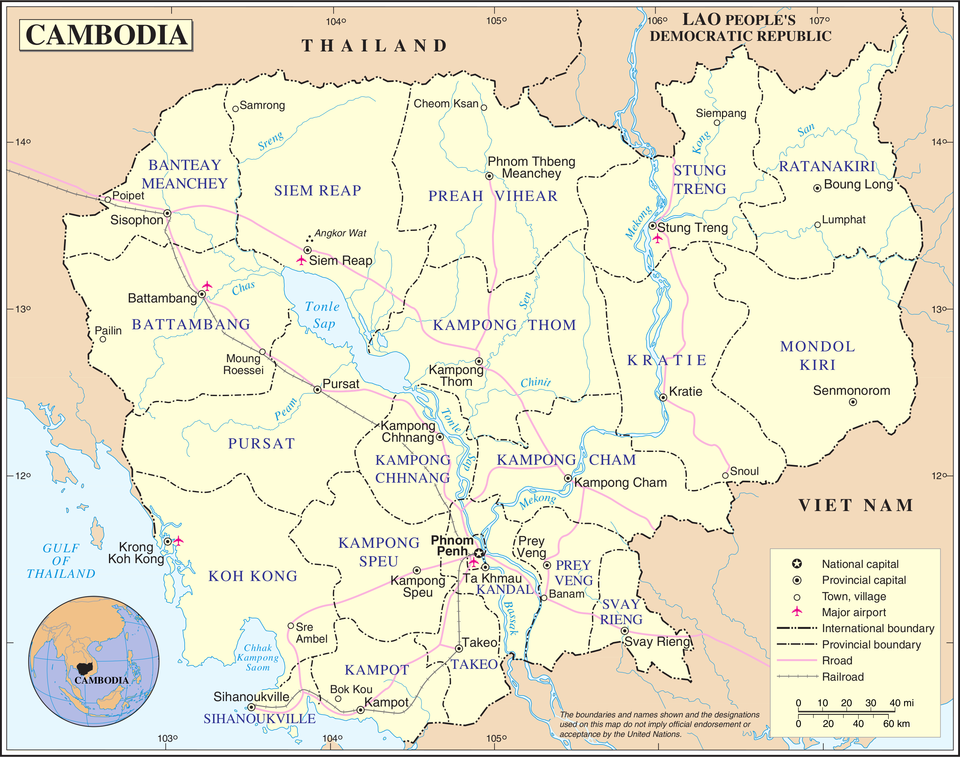
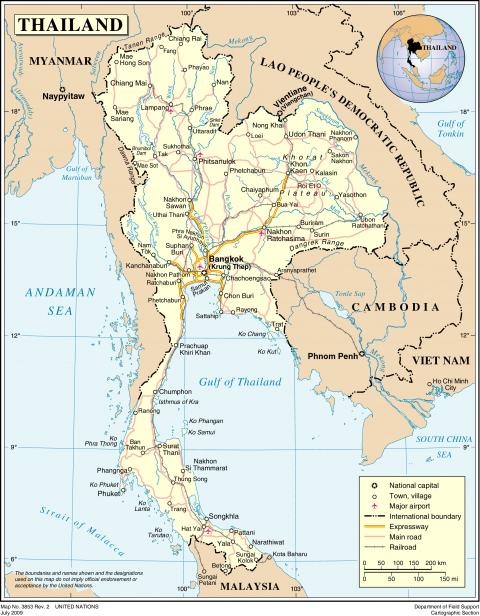
A new armed conflict between Cambodia and Thailand broke out in July 2025, reflecting a simmering border dispute between the two nations that dates back decades. The dispute pertains to undemarcated areas along the shared border of the two nations, which stretches for more than 800 kilometres, and concerns, in particular, claimed ownership of the temples of Prasat Ta Muen Thom (Ta Muen Thom in Khmer), Prasat Ta Khwai (Prasat Ta Krabey in Khmer), and Preah Vihear (which Thais call Phra Viharn). The border was drawn by French cartographers in 1907 when France was the colonial ruler in Cambodia.1J. Head, ‘Why Thailand and Cambodia are fighting again after Trump ceasefire’, BBC, 10 December 2025.
After Cambodia’s independence in 1953, Thai troops occupied the temple of Preah Vihear, leading to Cambodia taking the dispute to the International Court of Justice.2J. D. Ciorciari, ‘Thailand and Cambodia: The Battle for Preah Vihear’, Spice Digest, Fall 2009, Stanford University. In 1962, the Court ruled that the temple belonged to Cambodia,3International Court of Justice (ICJ), Case concerning the Temple of Preah Vihear (Cambodia v. Thailand), Judgment (Merits), 15 June 1962. but it left the status of the surrounding area unresolved. In 2011, clashes between Cambodian and Thai forces in the vicinity of Preah Vihear killed at least sixteen people. A further judgment by the International Court of Justice reaffirmed that the temple and also the surrounding area were in Cambodian territory.4ICJ, Request for Interpretation of the Judgment of 15 June 1962 in the Case Concerning the Temple of Preah Vihear (Cambodia v. Thailand), Judgment, 11 November 2013.
Key events since July 2024
On 28 May 2025, a skirmish near the temple killed one Cambodian soldier. Renewed hostilities between 24 and 28 July saw fighting spread to a dozen border sites, leaving at least forty-eight people dead and more than 300,000 civilians displaced. On 28 July, a ceasefire was agreed upon in Kuala Lumpur. The Kuala Lumpur peace framework involved US President Donald Trump and Malaysian Prime Minister Anwar Ibrahim. The two nations pledged to withdraw all heavy weapons from the border areas, clear all landmines, and resolve border claims.5‘Thailand and Cambodia agree on 72-hour ceasefire’, Nikkei Asia, 27 December 2025. The agreement did not hold. Hostilities in November escalated into major clashes along the border beginning on 7 December 2025.6T. Regencia, ‘Thailand launches new offensive as Cambodia halts all border crossings’, Al Jazeera, 14 December 2025.
On 18 December 2025, the United Nations (UN) High Commissioner for Human Rights, Volker Türk, said airstrikes and use of heavy weaponry in and around populated areas raised serious concerns regarding protection of the civilian population. In his statement he said, ‘I am alarmed by reports that areas around villages and cultural sites are being struck by fighter jets, drones, and artillery.’7Office of the UN High Commissioner for Human Rights (OHCHR), ‘Türk alarmed by spiralling Thai-Cambodia conflict and impact on civilians’, Press release, Geneva, 18 December 2025.
Cambodia and Thailand agreed upon a 72-hour ceasefire on 27 December 2025. The Thai Minister of Defence, General Natthaphon Narkphanit, said that the two sides had signed a joint statement committing to maintain current troop deployments without further movement but to withdraw all heavy weapons from border areas. After the ceasefire, an Association of Southeast Nations (ASEAN) Observer Team would observe the situation for a further seventy-two hours before all Thai villagers displaced since the start of fighting on 7 December returned to their homes.8‘Thailand and Cambodia agree on 72-hour ceasefire’.
The Non-International Armed Conflict in Southern Thailand
In the south of Thailand, a separate armed conflict, which is of a non-international character, continues between the Thai army and the Barisan Revolusi Nasional – the BRN. The armed group is committed to securing self-determination for Malay Muslims. As part of its armed struggle, the BRN has consistently targeted civilians, including Buddhist monks, teachers, police officers, older persons, and children.9Human Rights Watch, ‘Thailand: New Insurgent Attacks on Civilians Despite Pledge’, News release, 29 May 2025. Thai authorities have perpetrated widespread torture in repressing the rebellion that has been ongoing since 2004. More than 7,000 people have been killed in the violence and over 13,000 wounded. An emergency decree was imposed over the three southernmost provinces in 2005, allowing the security forces to detain suspects without charge for up to thirty days. It also gave security personnel immunity from prosecution for any actions they carried out in the line of duty.10International Crisis Group, ‘Southern Thailand: Insurgency, Not Jihad’, Asia-Pacific Report No 98, 18 May 2005; S. Casey-Maslen, The Prohibition of Torture and Ill-Treatment under International Law, Cambridge University Press, 2025, p 252.
Conflict Classification and Applicable Law
An international armed conflict (IAC) between Cambodia and Thailand that began during the reporting period was entering a ceasefire as 2025 came to a close. This IAC is regulated by customary international humanitarian law (IHL), in particular Hague Law rules governing the conduct of hostilities. Both States are party to the four Geneva Conventions of 1949. Cambodia, but not Thailand, is a State Party to Additional Protocol I of 1977.11Protocol Additional to the Geneva Conventions of 12 August 1949, and relating to the Protection of Victims of International Armed Conflicts; adopted at Geneva, 8 June 1977; entered into force, 7 December 1978.
A non-international armed conflict (NIAC) persisted in southern Thailand throughout the reporting period between Thailand and theBRN. Common Article 3 of the Geneva Conventions of 1949 and customary IHL applies to the NIAC. Thailand is not a State Party to Additional Protocol II of 1977.12Protocol Additional to the Geneva Conventions of 12 August 1949, and relating to the Protection of Victims of Non-International Armed Conflicts; adopted at Geneva, 8 June 1977; entered into force, 7 December 1978. Both Cambodia and Thailand are States Parties to the 1997 Anti-Personnel Mine Ban Convention.13Convention on the Prohibition of the Use, Stockpiling, Production and Transfer of Anti-Personnel Mines and on their Destruction; adopted at Oslo, 18 September 1997; entered into force, 1 March 1999 (1997 Anti-Personnel Mine Ban Convention). Neither State is party to the 2008 Convention on Cluster Munitions.14Convention on Cluster Munitions; adopted at Dublin, 30 May 2008; entered into force, 1 August 2010.
Cambodia is a State Party to the Rome Statute of the International Criminal Court.15Rome Statute of the International Criminal Court; adopted at Rome, 17 July 1998; entered into force, 1 July 2002. This means that acts by Cambodian nationals and acts on Cambodian territory, including by Thailand, potentially fall within the jurisdiction of the Court. Thailand has signed but not ratified the Rome Statute. Acts by the Thai armed forces and police in the NIAC in the south of Thailand do not fall within the jurisdiction of the Court.
Compliance with IHL
Overview
Both the IAC between Cambodia and Thailand and the NIAC in Thailand’s south saw violations of IHL by parties during the reporting period. On 8 December 2025, the UN Secretary-General expressed his concern at the renewed clashes between Cambodia and Thailand and urged the parties ‘to exercise restraint and avoid further escalation’. The border dispute had, he said, ‘already resulted in significant civilian casualties, damage to civilian infrastructure, and displacement on both sides of the border’. The Secretary-General stressed that both parties ‘must protect civilians and facilitate humanitarian relief’.16‘Concerned by Reports of Renewed Armed Clashes between Cambodia, Thailand, Secretary-General Urges Restraint, Dialogue to Resolve Border Dispute’, Press release, UN Doc SG/SM/22945, 8 December 2025.
Violations in the NIAC in the south of Thailand include attacks against civilians and the torture of detainees. The BRN has consistently targeted civilians – both Thai Buddhists and Malay Muslims – despite pledges not to do so, including during the reporting period.17See eg ‘BRN denies targeting civilians, calls for transparent investigation into Deep South violence’, The Nation, 6 May 2025. In May 2025, Elaine Pearson, Asia director at Human Rights Watch, said that ‘a pledge is not enough. The BRN needs to stop committing war crimes.’18Human Rights Watch, ‘Thailand: New Insurgent Attacks on Civilians Despite Pledge’.
Civilian Objects under Attack
Under customary IHL, attacks may only be directed against military objectives. Attacks must not be directed against civilian objects.19International Committee of the Red Cross (ICRC), Customary IHL Rule 7: ‘The Principle of Distinction between Civilian Objects and Military Objectives’. Civilian objects are all objects that are not military objectives20ICRC, Customary IHL Rule 9: ‘Definition of Civilian Objects’. and, as such, are protected against attack.21ICRC, Customary IHL Rule 10: ‘Civilian Objects’ Loss of Protection from Attack’. Military objectives are those objects which, by their nature, location, purpose or use, make an effective contribution to military action.22ICRC, Customary IHL Rule 8: ‘Definition of Military Objectives’. In addition, the object’s partial or total destruction, capture, or neutralisation must offer a definite military advantage in the prevailing circumstances.
Potentially indiscriminate attacks
On 24 July 2025, the Royal Cambodian Armed Forces launched volleys of unguided Grad rockets into four Thai provinces bordering Cambodia in what appears to have been an indiscriminate attack.23Fortify Rights, ‘U.N. Investigate Potential War Crimes in Thailand-Cambodia Border Conflict’, News release, 29 July 2025. Grad rockets are used for area attacks rather than to hit specific targets,24United States, ‘BM-21 Grad Russian 122mm Multiple Rocket Launcher (MRL)’, OE Data Integration Network (ODIN), 19 December 2024. meaning the risk to civilians in the area is particularly acute. All forty rockets from a single launcher can be fired in twenty seconds, either in a single salvo or in small bursts.25J. Grevatt, ‘Thailand-Cambodia conflict: Clashes intensify with heavy weapons and coastal battles’, Janes, 11 December 2025; P. Shukla, ‘What is the BM-21 Grad? The rocket Cambodia is using to wreak havoc in Thailand – how lethal is it?’, The Economic Times, 13 December 2025. The Thai army claimed that Cambodia launched further attacks within civilian areas in the Sao Thongchai subdistrict of Kantharalak district in Sisaket province on 13 December 2025.26F. Kelliher and U. Siddiqui, ‘Thailand-Cambodia updates: Renewed border clashes, fighting enters 2nd week’, Al Jazeera, 14 December 2025. Thai government spokesperson Siripong Angkasakulkiat said that the action was ‘cruel and inhumane’.27T. Macleod and J. Saksornchai, ‘Thailand says Cambodian rocket fire has caused its first civilian death in new border fighting’, Associated Press, 14 December 2025.
Civilians under Attack
Under customary IHL, civilians enjoy general protection from the effects of hostilities, unless and for such time as they directly participate in hostilities.28ICRC, Customary IHL Rule 6: ‘Civilians’ Loss of Protection from Attack’. Accordingly, parties to armed conflicts must at all times distinguish between combatants and civilians, and are prohibited from directing attacks against civilians.29ICRC, Customary IHL Rule 1: ‘The Principle of Distinction between Civilians and Combatants’. In case of doubt, persons should be treated as civilians.30ICRC, Customary IHL Rule 6: ‘Civilians’ Loss of Protection from Attack’. The accompanying commentary states that in NIACs, ‘the issue of doubt has hardly been addressed in State practice, even though a clear rule on this subject would be desirable as it would enhance the protection of the civilian population against attack.’ One ‘cannot automatically attack anyone who might appear dubious….’ The same approach with respect to IACs ‘seems justified’ in NIACs. Civilians may be incidentally affected by attacks against lawful targets. However, such attacks must not be disproportionate,31ICRC, Customary IHL Rule 14: ‘Proportionality in Attack’. and the attacker must take all feasible precautions to avoid or, in any event to minimize, incidental civilian impact.32ICRC, Customary IHL Rule 15: ‘Principle of Precautions in Attack’.
Thailand claims that on 24 July 2025, Cambodian soldiers ‘launched indiscriminate attacks on Thai territory across four provinces of Buriram, Surin, Si Sa Ket and Ubon Ratchathani.’ Later that day, ‘Phanom Dong Rak Hospital in Surin Province was struck by Cambodian artillery fire. … Civilian infrastructure, including a hospital and a school, also sustained significant damages. As of 25 July 2025 at 14:00 hrs., the attacks had resulted in 13 deaths and 46 injuries of civilians.’33Thailand Ministry of Foreign Affairs, ‘Statement Condemning Attacks on Civilian Targets’, 26 July 2025.
As of mid-December 2025, amid renewed hostilities between the two States, Thailand reported that at least one civilian had been killed along with fifteen of its soldiers, and that more than 400,000 people had been displaced. In Cambodia, it was reported that eleven civilians had been killed and at least seventy-five injured, with more than 100,000 people displaced.34F. Kelliher and U. Siddiqui, ‘Thailand-Cambodia updates: Renewed border clashes, fighting enters 2nd week’, Al Jazeera, 14 December 2025. On 10 December 2025, Cambodia had sent a letter to the president of the UN Security Council alleging that, in attacking its military positions, Thailand had ‘extended their attacks into non-combat, civilian zones’ in Banteay Meanchey province’ as well as into Pusat and Battambang provinces. The ‘ongoing aggressions’, Cambodia further alleged, ‘resulted in numerous deaths and injuries, including innocent civilians’.35Letter from H. E. Keo Chhea, Ambassador and Permanent Representative of Cambodia to the United Nations in New York to the President of the UN Security Council, New York, 10 December 2025. Cambodia described ‘Thailand’s deliberate and indiscriminate targeting of civilian areas’ as ‘a serious breach’ of IHL.36Ibid. The Cambodia government reported on 15 December that more than 300,000 Cambodian citizens had sought safety in IDP camps in border provinces, including in Banteay Meanchey and Mongkol Borey.37‘Video. More than 300,000 displaced in Cambodia near Thai border’, Euronews, 15 December 2025.
Cambodia further claimed targeting of civilians and civilian objects by Thailand on the morning of 15 December 2025. According to the Cambodian Minister of Information, the Thai military used F-16 combat aircraft to drop two bombs in Chong Kal and Srei Snam districts of Siem Reap province, near internally displaced person (IDP) camps, ‘penetrating more than 70 kilometres into Cambodian territory’. This, Cambodia alleged, amounted to a deliberate targeting of civilians and civilian infrastructure, declaring: ‘Thailand has violated international law by attacking civilians.’ Video footage, the Minister said, ‘shows students at a school in Srei Snam district fleeing after the Thai military dropped bombs near their school’.38Information provided by Neth Pheaktra, Cambodian Minister of Information, Post on social media site Facebook, 15 December 2025. It has not been possible to authenticate or verify the video.
In mid-January 2026, Nikkei Asia compiled a reported civilian toll from government social media and official websites, concluding that Cambodian deaths had exceeded 110 in the December conflict, of whom thirty-one were said by the Cambodian government to be civilians.39D. Keeton-Olsen and V. Phoung, ‘Cambodian deaths exceed 110 in December border conflict with Thailand’, Nikkei Asia, 13 January 2026.
Alleged use of anti-personnel mines by Cambodia
Thailand has accused Cambodia of using anti-personnel mines in violation of the 1997 Anti-Personnel Mine Ban Convention. Seven Thai soldiers were injured by landmines that the government says were newly emplaced by Cambodian soldiers.40J. Head and M. Spivey, ‘Cambodia shuts border crossings with Thailand as fighting continues’, BBC, 13 December 2025. Cambodia denies having used landmines.41‘UN Security Council, Cambodia-Thailand Border Clashes: Urgent Private Meeting’, Security Council Report, 25 July 2025. Any use of anti-personnel mines by a State Party to the Convention, whether during peacetime or armed conflict, is a serious violation of international law. That is so, even if soldiers, not civilians, are killed or injured as a result. At the time of writing, the Convention’s compliance mechanism was being engaged.42Final Report of the Twenty-Second Meeting of the States Parties to the Anti-Personnel Mine Ban Convention, APMBC Doc APLC/MSP.22/2025/CRP.1, 5 December 2025, para 30.
Use of cluster munitions by Thailand
Thailand has acknowledged using cluster munitions in Cambodia. A Royal Thai Army press release in July 2025 said the army uses cluster munitions to target military objectives and in compliance with the principle of proportionality.43Thai Armed Forces, ‘The Royal Thai Army Clarifies the Use of Cluster Munitions, Stating Consideration for Use as Necessary to Enhance Capabilities Against Military Targets Only’, Press statement, 28 July 2025. See also Amnesty International, ‘Cambodia/Thailand: Both sides must prevent further risk to civilians from renewed hostilities’, News release, 8 December 2025. Indeed, although Thailand is not a State Party to the 2008 Convention on Cluster Munitions, any use of cluster munitions must comply with the principles of distinction and proportionality in attack.
Despite claims to the contrary,44B. Lau, ‘Alleged Cluster Munition Remnant Kills Cambodian Boy’, Human Rights Watch, 4 November 2025. cluster munitions are not inherently indiscriminate weapons. They do, however, pose significant risks for civilians. In December 2025, Cambodia again accused Thailand of using cluster munitions.45‘Thai Military Uses Fighter Jets and Cluster Munitions as Civilians Are Killed and Over 400,000 Displaced’, Khmer Times, 14 December 2025.
NIAC in southern Thailand
There were fifty-seven recorded BRN attacks on civilians in April 2025 alone, resulting in eighteen dead and fifty injured among the Buddhist Thai and Malay Muslim populations in Narathiwat, Pattani, Songkhla, and Yala provinces. On 22 April, for instance, BRN fighters shot dead a sixteen-year-old Buddhist novice, and wounded a twelve-year-old, in an attack on a pick-up truck taking Buddhist monks and novices from Wat Kura temple to collect alms in Songkhla province’s Sabayoi district.46Human Rights Watch, ‘Thailand: New Insurgent Attacks on Civilians Despite Pledge’.
In addition to targeted attacks, children have been victims of indiscriminate shootings and bombings. In late April 2025, BRN fighters detonated a motorcycle bomb outside Khok Khean police station in Narathiwat province, as a pick-up truck with many students from an evening Quran study passed by. At least seven Muslim children were wounded, with one girl left in critical condition.47S. Phasuk, ‘Insurgents in Southern Thailand Kill 16-Year-Old Buddhist Novice’, 24 April 2025.
Protection of Persons in the Power of the Enemy
Under customary IHL, special protection is afforded to ‘protected persons’, including several categories of civilians who face a specific risk of harm, such as women, children, refugees, and IDPs.48ICRC, Customary IHL Rules 134–138: ‘Chapter 39. Other Persons Afforded Specific Protection’. IHL provides certain fundamental guarantees for anyone who is in the power of a party to a conflict, prohibiting torture, other inhumane or degrading treatment, all forms of sexual violence, enforced disappearance, and unfair trials.
Murder of civilians
On 25 June 2024, unidentified gunmen in Pattani province shot dead Roning Dolah, a prominent human rights defender who assisted ethnic Malay Muslim victims of arbitrary arrest and torture by Thai security forces.49Human Rights Watch, ‘Thailand: Events of 2024’, World Report 2025. There had been no progress in investigating his killing at the time of writing.50Amnesty International, ‘Thailand 2024’, 2025.
Rape
In November 2025, Thai soldiers were accused of gang-raping a Cambodian migrant worker. The alleged incident concerned an attack on an eighteen-year-old Cambodian who was attempting to cross the closed border between the two States and return home amid the hostilities. The woman was among a group of thirteen Cambodians who were making the journey, but according to the Cambodian Ministry of Labour and Vocational Training, they were confronted by Thai soldiers and physically attacked. The woman was separated from her travelling companions and subjected to an ‘abhorrent case of sexual violence perpetrated by seven Thai soldiers in black uniform’.51L. Hunt, ‘Thai soldiers accused of gang raping Cambodian girl’, Union of Catholic Asian News, 18 November 2025.
Torture and arbitrary deprivation of liberty
Thailand has engaged in arbitrary deprivation of liberty of individuals in the context of the NIAC in the south. Under the Executive Decree on Government Administration in Emergency Situations and under martial law, Thai security forces can arrest and hold suspected BRN members for up to thirty-seven days without effective judicial oversight. This has led to deaths in military custody in the past.52Human Rights Watch, ‘Thailand: New Insurgent Attacks on Civilians Despite Pledge’.
Thailand adopted the Prevention and Suppression of Torture and Enforced Disappearance Act in 2022, and it entered into force in February 2023. But there have been numerous cases related to counterinsurgency operations in the southern provinces in which police and military personnel tortured ethnic Malay Muslims in custody.53Human Rights Watch, ‘Thailand: Torture, Ill-Treatment, and Enforced Disappearances’, World Report 2024. Writing a year after the law was adopted, the International Commission of Jurists’ Regional Director for Asia and the Pacific declared:
Thailand has a poor track record when it comes to providing redress and accountability for victims of the crimes of torture and enforced disappearance, and this legislation was meant to correct this failure. Yet one year has passed and to our knowledge only a single case of alleged ill-treatment has reached the court, despite numerous allegations of abuse, with little information provided to the public.54International Commission of Jurists, ‘Thailand: One Year on, Authorities Have Fallen Short in Implementing the Landmark Anti-torture and Enforced Disappearance Act’, 22 February 2024.
Child recruitment and use in hostilities
In the past, the BRN has recruited children into its ranks, some as young as fourteen years of age.55Child Soldiers International, ‘Southern Thailand: Ongoing recruitment and use of children by armed groups’, January 2015. Recruiting children under fifteen is a war crime under customary law.56ICRC, Customary IHL Rule 156: ‘Definition of War Crimes’.
The 2000 Optional Protocol to the Convention on the Rights of the Child on the Involvement of Children in Armed Conflict prohibits all compulsory recruitment of children under 18 years of age and requires States Parties to take all feasible measures to ensure that they do not take a direct part in hostilities.57Arts 1 and 2, Optional Protocol to the Convention on the Rights of the Child on the Involvement of Children in Armed Conflict; adopted at New York, 25 May 2000; entered into force, 12 February 2002. Yemen acceded to the Protocol in 2007. Both Cambodia and Thailand are States Parties to the 2000 Optional Protocol. Cambodian law prohibits all recruitment of children into its armed forces.No Cambodian citizen, male or female, who is under the age of 18 years should be recruited into the armed forces.58 Art 42, Law on the General Status of Royal Cambodian Armed Forces, 1997. Thailand likewise sets eighteen years as the minimum age for recruitment.59Declaration of Thailand.
Prisoners of war
In the July 2025 hostilities, Thailand captured twenty Cambodian soldiers, eighteen of whom it continued to detain for the rest of the year.60Head, ‘Why Thailand and Cambodia are fighting again after Trump ceasefire’, BBC. The soldiers were prisoners of war under Geneva Convention III of 1949 who must be released and repatriated ‘without delay after the cessation of active hostilities’.61Art 118, Geneva Convention (III) relative to the Treatment of Prisoners of War; adopted at Geneva, 12 August 1949; entered into force, 21 October 1950. This obligation is tied to the ‘facts on the ground’, rather than to the formal end of an armed conflict or to an agreement between the Parties, though active hostilities must have ceased ‘with a sufficient degree of stability and permanence to activate the obligation’.62ICRC, Commentary on Art 118, Geneva Convention III, paras 4452, 4455.
Cambodia complained that Thailand had not returned the eighteen soldiers it had captured once the ceasefire came into effect.63J. Harmer and J. Saksornchai, ‘Thailand reports first civilian deaths in renewed border conflict with Cambodia’, ABC News, 11 December 2025. Although Thailand is not a State Party to Additional Protocol I, the International Committee of the Red Cross (ICRC) found that ‘unjustifiable delay in the repatriation of prisoners of war’ is a war crime under customary law.64ICRC, Customary IHL Rule 156: ‘Definition of War Crimes’. In late December 2025, the Thai Ministry of Foreign Affairs said it was considering releasing the soldiers if the ceasefire held. It called on Cambodia to return Thai citizens who had been captured along border areas.65G. Blair, ‘China muscles in on Thailand-Cambodia peace talks’, The Times, 29 December 2025. Thailand returned to Cambodia the eighteen soldiers it had held for five months as prisoners of war on the last day of the year.66Agence France-Presse, ‘Thailand releases 18 Cambodian soldiers captured in July as part of ceasefire’, Le Monde, 31 December 2025.
- 1J. Head, ‘Why Thailand and Cambodia are fighting again after Trump ceasefire’, BBC, 10 December 2025.
- 2J. D. Ciorciari, ‘Thailand and Cambodia: The Battle for Preah Vihear’, Spice Digest, Fall 2009, Stanford University.
- 3International Court of Justice (ICJ), Case concerning the Temple of Preah Vihear (Cambodia v. Thailand), Judgment (Merits), 15 June 1962.
- 4ICJ, Request for Interpretation of the Judgment of 15 June 1962 in the Case Concerning the Temple of Preah Vihear (Cambodia v. Thailand), Judgment, 11 November 2013.
- 5‘Thailand and Cambodia agree on 72-hour ceasefire’, Nikkei Asia, 27 December 2025.
- 6T. Regencia, ‘Thailand launches new offensive as Cambodia halts all border crossings’, Al Jazeera, 14 December 2025.
- 7Office of the UN High Commissioner for Human Rights (OHCHR), ‘Türk alarmed by spiralling Thai-Cambodia conflict and impact on civilians’, Press release, Geneva, 18 December 2025.
- 8‘Thailand and Cambodia agree on 72-hour ceasefire’.
- 9Human Rights Watch, ‘Thailand: New Insurgent Attacks on Civilians Despite Pledge’, News release, 29 May 2025.
- 10International Crisis Group, ‘Southern Thailand: Insurgency, Not Jihad’, Asia-Pacific Report No 98, 18 May 2005; S. Casey-Maslen, The Prohibition of Torture and Ill-Treatment under International Law, Cambridge University Press, 2025, p 252.
- 11Protocol Additional to the Geneva Conventions of 12 August 1949, and relating to the Protection of Victims of International Armed Conflicts; adopted at Geneva, 8 June 1977; entered into force, 7 December 1978.
- 12Protocol Additional to the Geneva Conventions of 12 August 1949, and relating to the Protection of Victims of Non-International Armed Conflicts; adopted at Geneva, 8 June 1977; entered into force, 7 December 1978.
- 13Convention on the Prohibition of the Use, Stockpiling, Production and Transfer of Anti-Personnel Mines and on their Destruction; adopted at Oslo, 18 September 1997; entered into force, 1 March 1999 (1997 Anti-Personnel Mine Ban Convention).
- 14Convention on Cluster Munitions; adopted at Dublin, 30 May 2008; entered into force, 1 August 2010.
- 15Rome Statute of the International Criminal Court; adopted at Rome, 17 July 1998; entered into force, 1 July 2002.
- 16‘Concerned by Reports of Renewed Armed Clashes between Cambodia, Thailand, Secretary-General Urges Restraint, Dialogue to Resolve Border Dispute’, Press release, UN Doc SG/SM/22945, 8 December 2025.
- 17See eg ‘BRN denies targeting civilians, calls for transparent investigation into Deep South violence’, The Nation, 6 May 2025.
- 18Human Rights Watch, ‘Thailand: New Insurgent Attacks on Civilians Despite Pledge’.
- 19International Committee of the Red Cross (ICRC), Customary IHL Rule 7: ‘The Principle of Distinction between Civilian Objects and Military Objectives’.
- 20
- 21
- 22ICRC, Customary IHL Rule 8: ‘Definition of Military Objectives’. In addition, the object’s partial or total destruction, capture, or neutralisation must offer a definite military advantage in the prevailing circumstances.
- 23Fortify Rights, ‘U.N. Investigate Potential War Crimes in Thailand-Cambodia Border Conflict’, News release, 29 July 2025.
- 24United States, ‘BM-21 Grad Russian 122mm Multiple Rocket Launcher (MRL)’, OE Data Integration Network (ODIN), 19 December 2024.
- 25J. Grevatt, ‘Thailand-Cambodia conflict: Clashes intensify with heavy weapons and coastal battles’, Janes, 11 December 2025; P. Shukla, ‘What is the BM-21 Grad? The rocket Cambodia is using to wreak havoc in Thailand – how lethal is it?’, The Economic Times, 13 December 2025.
- 26F. Kelliher and U. Siddiqui, ‘Thailand-Cambodia updates: Renewed border clashes, fighting enters 2nd week’, Al Jazeera, 14 December 2025.
- 27T. Macleod and J. Saksornchai, ‘Thailand says Cambodian rocket fire has caused its first civilian death in new border fighting’, Associated Press, 14 December 2025.
- 28
- 29
- 30ICRC, Customary IHL Rule 6: ‘Civilians’ Loss of Protection from Attack’. The accompanying commentary states that in NIACs, ‘the issue of doubt has hardly been addressed in State practice, even though a clear rule on this subject would be desirable as it would enhance the protection of the civilian population against attack.’ One ‘cannot automatically attack anyone who might appear dubious….’ The same approach with respect to IACs ‘seems justified’ in NIACs.
- 31ICRC, Customary IHL Rule 14: ‘Proportionality in Attack’.
- 32ICRC, Customary IHL Rule 15: ‘Principle of Precautions in Attack’.
- 33Thailand Ministry of Foreign Affairs, ‘Statement Condemning Attacks on Civilian Targets’, 26 July 2025.
- 34F. Kelliher and U. Siddiqui, ‘Thailand-Cambodia updates: Renewed border clashes, fighting enters 2nd week’, Al Jazeera, 14 December 2025.
- 35Letter from H. E. Keo Chhea, Ambassador and Permanent Representative of Cambodia to the United Nations in New York to the President of the UN Security Council, New York, 10 December 2025.
- 36Ibid.
- 37‘Video. More than 300,000 displaced in Cambodia near Thai border’, Euronews, 15 December 2025.
- 38Information provided by Neth Pheaktra, Cambodian Minister of Information, Post on social media site Facebook, 15 December 2025.
- 39D. Keeton-Olsen and V. Phoung, ‘Cambodian deaths exceed 110 in December border conflict with Thailand’, Nikkei Asia, 13 January 2026.
- 40J. Head and M. Spivey, ‘Cambodia shuts border crossings with Thailand as fighting continues’, BBC, 13 December 2025.
- 41‘UN Security Council, Cambodia-Thailand Border Clashes: Urgent Private Meeting’, Security Council Report, 25 July 2025.
- 42Final Report of the Twenty-Second Meeting of the States Parties to the Anti-Personnel Mine Ban Convention, APMBC Doc APLC/MSP.22/2025/CRP.1, 5 December 2025, para 30.
- 43Thai Armed Forces, ‘The Royal Thai Army Clarifies the Use of Cluster Munitions, Stating Consideration for Use as Necessary to Enhance Capabilities Against Military Targets Only’, Press statement, 28 July 2025. See also Amnesty International, ‘Cambodia/Thailand: Both sides must prevent further risk to civilians from renewed hostilities’, News release, 8 December 2025.
- 44B. Lau, ‘Alleged Cluster Munition Remnant Kills Cambodian Boy’, Human Rights Watch, 4 November 2025.
- 45‘Thai Military Uses Fighter Jets and Cluster Munitions as Civilians Are Killed and Over 400,000 Displaced’, Khmer Times, 14 December 2025.
- 46Human Rights Watch, ‘Thailand: New Insurgent Attacks on Civilians Despite Pledge’.
- 47S. Phasuk, ‘Insurgents in Southern Thailand Kill 16-Year-Old Buddhist Novice’, 24 April 2025.
- 48
- 49Human Rights Watch, ‘Thailand: Events of 2024’, World Report 2025.
- 50Amnesty International, ‘Thailand 2024’, 2025.
- 51L. Hunt, ‘Thai soldiers accused of gang raping Cambodian girl’, Union of Catholic Asian News, 18 November 2025.
- 52Human Rights Watch, ‘Thailand: New Insurgent Attacks on Civilians Despite Pledge’.
- 53Human Rights Watch, ‘Thailand: Torture, Ill-Treatment, and Enforced Disappearances’, World Report 2024.
- 54International Commission of Jurists, ‘Thailand: One Year on, Authorities Have Fallen Short in Implementing the Landmark Anti-torture and Enforced Disappearance Act’, 22 February 2024.
- 55Child Soldiers International, ‘Southern Thailand: Ongoing recruitment and use of children by armed groups’, January 2015.
- 56
- 57
- 58
- 59
- 60Head, ‘Why Thailand and Cambodia are fighting again after Trump ceasefire’, BBC.
- 61Art 118, Geneva Convention (III) relative to the Treatment of Prisoners of War; adopted at Geneva, 12 August 1949; entered into force, 21 October 1950.
- 62ICRC, Commentary on Art 118, Geneva Convention III, paras 4452, 4455.
- 63J. Harmer and J. Saksornchai, ‘Thailand reports first civilian deaths in renewed border conflict with Cambodia’, ABC News, 11 December 2025.
- 64ICRC, Customary IHL Rule 156: ‘Definition of War Crimes’.
- 65G. Blair, ‘China muscles in on Thailand-Cambodia peace talks’, The Times, 29 December 2025.
- 66Agence France-Presse, ‘Thailand releases 18 Cambodian soldiers captured in July as part of ceasefire’, Le Monde, 31 December 2025.