Conflict Overview
Violence in Haiti reached grave levels during the reporting period, with at least 1,642 people killed and 745 injured between January and March 2026 alone, according to the United Nations Integrated Office in Haiti (BINUH).1BINUH, Rapport trimestriel sur la situation des droits humains en Haïti (janvier–mars 2026), May 2026, via Rezo Nodwes, 12 May 2026. The Commission épiscopale Justice et Paix (CE-JILAP) documented 484 deaths in the Port-au-Prince metropolitan area in the first quarter of 2026, of which 172 were from drone strikes by security forces.2CE-JILAP data, reported in ‘Haïti: 484 morts recensés dans la zone métropolitaine de Port-au-Prince au premier trimestre 2026’, Rhinews, 10 May 2026. The Artibonite department, Haiti’s primary agricultural region, emerged as a major new front of violence, with gang activity resulting in a twenty-three per cent rise in the number of internally displaced persons (IDPs) in that department since September 2025.3OCHA, ‘Haïti: Aperçu des contraintes d’accès humanitaire de décembre 2025 à février 2026’, 6 March 2026.
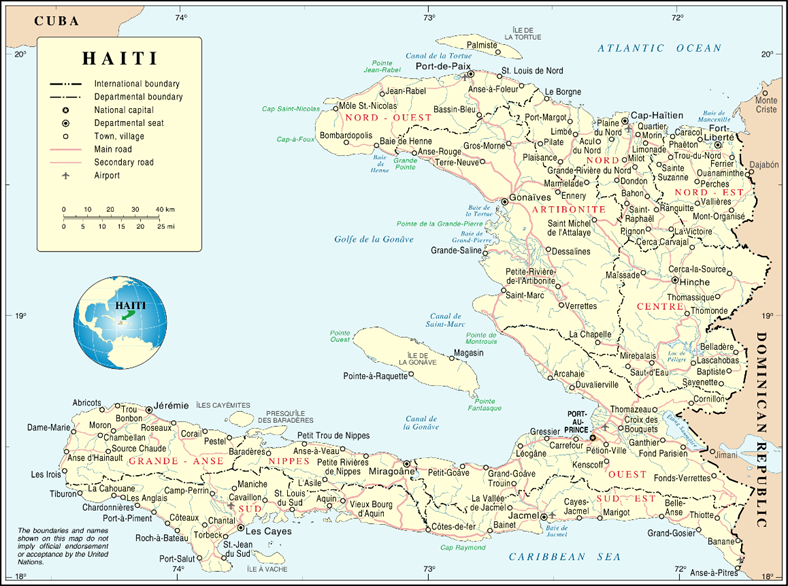
Figure 1: UN Map of Haiti © United Nations
The armed conflict between Haiti (supported by the United Nations-mandated Gang Suppression Force) and the Viv Ansanm coalition continued throughout the reporting period. As of April 2026, the coalition retained effective control of approximately seventy-two per cent of the Port-au-Prince metropolitan area, down from approximately ninety per cent at the peak of its expansion, following sustained security operations by the Haitian National Police (PNH), the Haitian Armed Forces (FAd’H), and their international partners.4‘Zapping Haïti du 11 avril 2026’, Haiti Libre, 11 April 2026. In early April 2026, PNH operations retook several gang-occupied premises, including the Faculté des Sciences Humaines (FASCH), UNITEC, and the Institut d’Études et de Recherches Africaines d’Haïti.5Ibid. On 2 April 2026, the government declared the Haitian military in a state of maximal emergency (‘Condition D’), applicable across the entire territory from 6 April.6ACLED, ‘CrisisWatch: March 2026 Trends and April 2026 Alerts’, April 2026.
The period saw the formal transition from the Multinational Security Support (MSS) mission to the Gang Suppression Force (GSF), authorised by UN Security Council Resolution 2793 of 30 September 2025. The GSF is tasked, in coordination with the PNH and FAd’H, with neutralising, isolating, and deterring gangs; providing security for critical infrastructure; and facilitating conditions for elections and humanitarian access. As of April 2026, the GSF comprised between 800 and 1000 personnel, comprising soldiers from Chad, El Salvador, and Guatemala. This is far below the authorized ceiling of 5,500 troops, although additional deployments were expected in the course of the year.7UN Security Council Resolution 2793, adopted on 30 September 2025, operative para 1; Jacques Vilus, ‘Haïti : Arrivée du chef de la Force de répression des gangs de l’ONU, le général Erdenebat Batsuuri’,17 May 2026; UN Security Council, ‘United Nations Integrated Office in Haiti: Report of the Secretary-General‘, UN Doc S/2026/325, 14 April 2026, para 43; J Blaise, ‘UN-appointed anti-gang force commander arrives in Haiti to lead expanded mission‘, Haitian Times, 15 May 2026.
Security operations were also conducted with the support of Vectus Global, a private military contractor linked to Blackwater founder Erik Prince, which the government engaged to operate both kamikaze and quadcopter drone strikes through a Task Force created by Prime Minister Alix Didier Fils-Aimé.8Human Rights Watch, ‘Haiti: Drone Strikes Put Residents at Risk’, 10 March 2026; Fondasyon Je Klere, ‘Liquidation de la souveraineté nationale via des contrats léonins’, March 2026, para 50; R Muggah, H Ziemer, D Da Rin and S Rutenbar, ‘What’s Behind the Use of Drones in Haiti’s Conflict?‘, Latin America Advisor, Inter-American Dialogue, 26 March 2026; ‘Kamikaze drones in Haiti: 1,243 dead in Prime Minister Fils-Aimé’s failed plan against criminal gangs‘, El País, 10 March 2026.
Viv Ansanm continued to drive violence, displacement, and humanitarian deprivation throughout the reporting period, though its internal dynamics became more complex. The coalition has no unitary command structure: as the International Crisis Group documented in December 2025, decisions affecting the entire alliance are taken through consultation among the leaders of all member gangs, with Jimmy Chérizier serving as spokesperson but not holding executive authority over the other leaders.9International Crisis Group, ‘Undoing Haiti’s Deadly Gang Alliance’, Latin American & Caribbean Report No.110, 15 December 2025. The UN Panel of Experts similarly confirmed that the coalition ‘has no single leader or structured chain of command’ and that each constituent gang ‘maintains its own chain of command and interests’.10UN Panel of Experts on Haiti established pursuant to Security Council Resolution 2653 (2022), ‘Letter dated 27 March 2026 from the Panel of Experts on Haiti addressed to the President of the Security Council’, UN Doc S/2026/241, Annex 4, pp 42–44.
Intra-coalition clashes erupted on multiple occasions during the reporting period: in March in the Village Renaissance area (Pierre 6 against Chen Mechan and Canaan); in mid-April in the Plaine du Cul-de-Sac, where Chen Mechan, Taliban, and 400 Mawozo launched a joint offensive against the Pierre 6 and Terre Noire gangs, displacing approximately 1,200 people;11International Crisis Group, Haiti Watch Page, April 2026; ‘The Fight to Raise the Minimum Wage’, Haiti Weekly, 6 May 2026. and over the weekend of 10–11 May in Cité Soleil and Croix-des-Bouquets. These episodes are best understood not as coalition dissolution but as internal competition and disciplinary violence against peripheral or non-aligned members – a dynamic which Haitian economist Réginald Surin has described as the coalition ‘consuming more violence toward its margins, to discipline non-aligned gangs and extend its grip’.12R Surin, ‘Dans la Plaine, la coalition se fissure’, Le Nouvelliste, 5 May 2026.
The political situation remained fragile throughout the reporting period. The mandate of the Transitional Presidential Council (TPC) expired on 7 February 2026, consolidating Prime Minister Fils-Aimé’s position as sole head of government, a consolidation that drew criticism from political actors concerned about the absence of effective checks on executive authority.13International Crisis Group, ‘CrisisWatch: February 2026 Trends and March 2026 Alerts’, March 2026. Elections are expected on 30 August 2026, with a potential runoff on 6 December — the first in a decade. The proximity of the electoral calendar heightens the risk of political instrumentalization of both armed groups and self-defence brigades.14ACLED, ‘Last Line of Defense’.
Organized civilian self-defence groups, operating variously under the name Bwa Kalé and through local brigades, continued operating across Port-au-Prince and the Artibonite during the reporting period. These groups have been a feature of the security landscape since April 2023 and range from brigades operating in documented coordination with State forces – including the Communal Brigade of Kenscoff (BRICK), formally integrated into PNH and Task Force operations15ACLED, ‘Last Line of Defense’. – to less formalized groups acting independently. A notable development during the current period was the establishment in January 2026 of a special security brigade in Port-de-Paix by the local government commissioner, explicitly modelled on the approach of Commissioner Jean Ernest Muscadin in Nippes, suggesting the pattern of para-institutional security actors is replicating across departments.16‘Port-de-Paix security brigade‘, Haitian Times, 18 January 2026; ACLED, ‘Last Line of Defense’ ( n15). With elections expected in August 2026, the risk of political instrumentalization of self-defence groups has sharpened.17ACLED, ‘Last Line of Defense’. Documented abuses by group members during the reporting period – including extrajudicial killings, arbitrary detention, violence against civilians, and extortion – raise serious concerns under international human rights law, an issue addressed in the Compliance section below.18ACLED, ‘Last Line of Defense’; ‘Brigadiers, milices ou gardiens? Les dérives des brigades de sécurité à Port-au-Prince‘, AyiboPost, March 2026.
Against this backdrop, humanitarian conditions continued to deteriorate. An estimated 6.4 million people – more than half of Haiti’s population – will require emergency humanitarian assistance in 2026, an increase of 6.7 per cent on the previous year.19OCHA, ‘Haiti: 2026 Humanitarian Needs and Response Plan – Executive Summary’, December 2025. Internal displacement reached 1.45 million people by the end of 2025, approximately one in eight of the population, with children constituting fifty-three per cent of all IDPs.20‘Situation of human rights in Haiti’, Report of the UN High Commissioner for Human Rights, UN Doc A/HRC/61/74, 23 March 2026; UNICEF, ‘Haiti Humanitarian Situation Report No 1’, 31 March 2026. The Artibonite department was particularly affected following the Jean-Denis massacre of 28–29 March 2026, in which at least ninety-five civilians were killed by the Gran Grif gang and more than 13,500 people were displaced across the surrounding communes.21Réseau National de Défense des Droits Humains (RNDDH), ‘Massacre à Jean Denis: le RNDDH dénonce la complaisance des autorités étatiques face aux attaques meurtrières des gangs armés’, 11 April 2026; IOM, ‘Haiti – Emergency Tracking Tool 88.2 – Updates on displacement following armed attacks in Petite Rivière de l’Artibonite and Dessalines (28 March – 6 April 2026)’, 6 April 2026. The UN Humanitarian Response Plan for 2026 sought $880 million to assist 4.2 million people.22OCHA, Haiti: 2026 Humanitarian Needs and Response Plan – Executive Summary.
Conflict Classification and Applicable law
There was one non-international armed conflict (NIAC) in Haiti during the reporting period:
Haiti (supported by the Gang Suppression Force, GSF) v Viv Ansanm coalition.
This armed conflict is regulated by Common Article 3 of the Geneva Conventions of 1949 and customary international humanitarian law (IHL). Haiti is also a State Party to Additional Protocol II of 1977.23Protocol Additional to the Geneva Conventions of 12 August 1949, and relating to the Protection of Victims of Non-International Armed Conflicts; adopted at Geneva, 8 June 1977; entered into force, 7 December 1978. The NIAC continues to meet the additional requirements of Article 1(1) of Additional Protocol II – in particular, that the organized armed group exercise a level of territorial control enabling it to sustain military operations and implement the Protocol – and accordingly the Protocol applies to the conflict.
The Viv Ansanm coalition encompasses twenty-three major constituent gangs (see Table 1 below), as documented by the International Crisis Group and confirmed by the UN Panel of Experts. The coalition operates across Port-au-Prince and its environs as well as in the Artibonite and Centre departments.24International Crisis Group, ‘Undoing Haiti’s Deadly Gang Alliance‘ ; UN Panel of Experts, UN Doc S/2026/241 , Annex 4, p 44. The coalition is governed through a decentralized structure in which no single leader holds formal authority over the others; decisions affecting the alliance as a whole are reached through consultation among gang leaders, with Jimmy Chérizier serving as spokesperson.25International Crisis Group, ‘Undoing Haiti’s Deadly Gang Alliance‘ . The UN Panel of Experts has confirmed that the coalition ‘has no single leader or structured chain of command’ and that ‘[e]ach gang composing the alliance maintains its own chain of command and interests’.26UN Panel of Experts, UN Doc S/2026/241 , Annex 4, pp 42–44. For IHL purposes, the coalition satisfies the organisation threshold notwithstanding this decentralized structure, given its sustained offensive capacity, territorial control, and ability to coordinate large-scale operations.27International Criminal Court, Prosecutor v Bosco Ntaganda, Judgment (Trial Chamber) (Case No ICC-01/04-02/06), 8 July 2019, para 716; International Criminal Tribunal for the former Yugoslavia, Prosecutor v Ljube Boškoski and Johan Tarčulovski, Judgment (Trial Chamber) (Case No IT-04-82-T), 10 July 2008, para 178.
During the reporting period, the Gran Grif gang – the largest criminal organization in the Artibonite department, operating under the leadership of Luckson Elan, and listed by the UN Security Council sanctions committee since September 202428UN Security Council, ‘Gran Grif‘, Haiti Sanctions List, n.d.; UN Security Council, ‘Luckson Elan‘, Haiti Sanctions List, 27 September 2024. – is treated in this report as a member of the Viv Ansanm coalition. Its acts accordingly engage the application of IHL within the existing NIAC framework. This represents a change from the previous reporting period, in which Gran Grif was not able to be assessed as party to a separate NIAC, nor as a coalition member engaging the application of IHL.
The weight of evidence accumulated during 2025 and early 2026 supports this reclassification. Gran Grif is listed as a full member of the Viv Ansanm alliance – under the designation HTe.001, led by Luckson Elan – in the UN Panel of Experts’ gang profiles table, compiled on the basis of interviews with residents of gang-controlled areas, gang and political analysts, foreign intelligence representatives, PNH officers, and government sources.29UN Panel of Experts on Haiti established pursuant to Security Council Resolution 2653 (2022), ‘Letter dated 27 March 2026 from the Panel of Experts on Haiti addressed to the President of the Security Council‘, UN Doc S/2026/241, 27 March 2026, Annex 4, p 44. The ICG December 2025 report similarly lists Gran Grif among Viv Ansanm’s constituent gangs and treats its operations in the Artibonite as part of the coalition’s broader franchise expansion.30International Crisis Group, ‘Undoing Haiti’s Deadly Gang Alliance‘ .
As the coalition operates without a unitary command – each member retaining its own chain of command and operational autonomy, with strategic decisions taken through collective consultation – membership is evidenced not by subordination to a central authority but by documented operational coordination and mutual support among member gangs.31International Crisis Group, ‘Undoing Haiti’s Deadly Gang Alliance‘ ; UN Panel of Experts, UN Doc S/2026/241 , Annex 4, p 44. In this regard, between September and December 2025, Gran Grif coordinated closely with fellow coalition members 400 Mawozo, Canaan, and 5 Segonn, including through the provision of personnel, weapons, and ammunition, and in some instances financial compensation.32Global Initiative Against Transnational Organised Crime, ‘Brokers and Patrons: Unstitching Gangs from Haiti’s Political Fabric’, March 2026. In February 2026, Gran Grif’s operational capacity, which had been weakened in early January, was reportedly reconstituted with the further support of the Canaan gang, which provided munitions and firearms.33BINUH Q1 2026.
Table 1: Viv Ansanm coalition member gangs
| Gang | Leader(s) | Primary territory |
| Delmas 6 | Jimmy Chérizier alias Barbeque (HTi.001) — Viv Ansanm spokesperson | Delmas 4–30, airport crossroad |
| Belekou | Bendy Verdado (following the killing of Iskar Andrice in 2023) | Belekou, Cité Soleil commune |
| Ti Bwa | Christ-Roi Chery alias Chrisla | Ti Bois, Fontamara, and Carrefour (excluding Mariani); approximately 13 cells in Carrefour |
| Krache Dife | Jean Gardy alias Pece Pim | Downtown Port-au-Prince |
| Gang de La Saline | Junior Bonheur alias Bout Janjan | La Saline, Aviation, Nan Charbon, part of Grand Rue |
| Gang de Pierre VI | alias Obama | Duvivier, Cité Soleil, Pierre VI |
| Simon Pelé | Stevenson Albert alias Djouma | Simon Pelé, Cité Soleil commune |
| Boston | Mathias Saintil | Boston and Carrefour Drouillard |
| Baz Pilate | Ezechiel Alexandre alias Ze | 1st and 2nd Avenues, Bolosse to Cité Eternel, 2nd and 3rd Ruelle Cité-Plus (3rd Circumscription), part of Carrefour-Feuilles |
| Chen Mechan | Claudy Célestin alias Stevenson Pierre alias Chen Mechan | Santo 1 to Santo 19, Marin, and Shadda districts, Croix-de-Mission commune and Butte Boyer, Tabarre commune; controls parts of RN1 |
| Fort Dimanche | Resan (current leader, following the killing of Mesidye) | Fort Dimanche |
| Gang de Tokyo | Wooddensley Saintilaire alias Chalé | Tokyo, Delmas 2 |
| Terre Noire | Jonel Catel | Terre Noire, Cité Soleil and Carrefour Drouillard |
| Les Argentins | Kempes Sanon | Haut Bel-Air, Fort National, Solino; attacks in Nazon, Christ-Roy and Delmas 30 |
| Kraze Baryè | Vitelhomme Innocent (HTi.005) | Tabarre commune (Torcel, Pernier and Haut Tabarre) |
| 5 Segond (Village-de-Dieu) | Johnson André alias Izo (HTi.002); Emmanuel Solomon alias Manno | Bicentennaire, Martissant, Village-de-Dieu, Bay of Port-au-Prince (port Lafito, Cimenterie, Les Moulins d’Haïti) |
| Grand Ravine | Bougoy; Killik; Tigress; Renel Destina alias Ti Lapli (HTi.003) | From 5th Avenue Bolosse via Martissant, habitation Le Clerc, Fort-St Clair, Route des Dalles, Grand Ravine RN2; Mariani 2 until entry of Léogane; Gressier commune, part of Carrefour Feuilles |
| 400 Mawozo | Wilson Joseph alias Lanmo San Jou (HTi.004); Germine Joly alias Yonyon | Croix-des-Bouquets (except Canaan), La Tremblay, Dargout, Cottard, Papaye, Meyer, Thomazeau, Lilavois; also along RN8 to the Dominican Republic border at Jimani |
| Canaan (also known as Taliban) | Jeff Larose alias Jeff | Canaan, Onaville, Jerusalem, Corail, Rosemberg, Lilavois, Bon Repos, Mirebalais, Saut-d’Eau, La Chapelle |
| Wharf Jérémie | Micanor Altés alias Monel Felix | Wharf Jérémie, La Saline, Fort Dimanche |
| Gran Grif (Savien gang — HTe.001) | Luckson Elan alias General Luckson | Petite Rivière de l’Artibonite, Savien, Liancourt, Pont Sondé, Carrefour Paye, Moreau Drouet, Hatte, Patchwal; controls part of RN1 and secondary road 11 from Pont Sondé to Mirebalais; Morne Pierre Paul and Chandelle, Liancourt commune |
| Kokorat San Ras* | Not identified in available sources | Artibonite department; joint presence with Gran Grif in Marchand-Dessalines from April 2026 |
| Mariani* | Not identified in available sources | Mariani |
Sources: UN Panel of Experts on Haiti, ‘Letter dated 27 March 2026 from the Panel of Experts on Haiti addressed to the President of the Security Council’, UN Doc S/2026/241, 27 March 2026, Annex 4, pp 42–44; International Crisis Group, ‘Undoing Haiti’s Deadly Gang Alliance’, Latin American & Caribbean Report N°110, 15 December 2025.
* Kokorat San Ras and Mariani are listed as Viv Ansanm members by the ICG (December 2025) but are not individually profiled in the UN Panel of Experts gang profiles table. Their inclusion reflects the ICG source.
Note: Gran Grif (HTe.001) is treated as a Viv Ansanm coalition member in this report for the reasons set out in the Classification section above. The UN Panel of Experts lists Gran Grif in its gang profiles table (Annex 4) as a coalition member. The table reflects coalition membership as documented as of March 2026.
During the 28–29 March 2026 offensive on Petite-Rivière de l’Artibonite, Gran Grif was supported by ‘allies of the Viv Ansanm coalition’, according to the Centre d’Analyse et de Recherche en Droits de l’Homme.34Centre d’Analyse et de Recherche en Droits de l’Homme (CARDH), ‘Massacre à Jean Denis: Nécessité d’un cadre juridique d’urgence et de nouvelles stratégies pour protéger la population‘, 1 April 2026. From April 2026, Gran Grif allied with Kokorat San Ras (both coalition members) intensified coordinated operations and established a joint presence in Marchand-Dessalines.35J Alcidor, ‘Artibonite: cohabitation inédite des gangs “Kokorat San Ras” et “Gran Grif” à Marchand-Dessalines‘, Ted Actu, 3 April 2026; H Noël, ‘“Gran-Grif” et “Kokorat san ras” envahissent la commune de Dessalines, la PNH reste introuvable‘, Rezo Nodwes, 2 April 2026.
An actor-classification question also arises in relation to organized self-defence groups, which operated across the metropolitan area and the Artibonite during the reporting period. The evidence points to a spectrum of relationships with the state: at one end, certain brigades – most notably BRICK in Kenscoff – were formally integrated into PNH and Task Force operations, with public endorsement from PNH leadership and police-facilitated access to weapons;36ACLED, ‘Last Line of Defense’. at the other, rural brigades in the Artibonite acted with substantial independence from state command and without direct state oversight.37ACLED, ‘Last Line of Defense’. Mere coordination with State forces is not sufficient to meet the threshold of belonging to a party under IHL.38International Court of Justice, Military and Paramilitary Activities in and against Nicaragua (Nicaragua v United States), Merits, Judgment, ICJ Reports 1986, para 115; International Criminal Tribunal for the former Yugoslavia, Prosecutor v Duško Tadić, Judgment (Appeals Chamber) (Case No IT-94-1-A), 15 July 1999, paras 131–37. Accordingly, only the most explicitly integrated brigades – those operating under a degree of direction and control that goes beyond coordination – are treated as State agents for the purposes of this entry, with their conduct thus attributable to Haiti. The conduct of less integrated groups, including the more autonomous Artibonite brigades, does not meet this threshold and is not attributed to a party to the NIAC. Where members of such groups were directly participating in hostilities at the time of the conduct in question, they may have lost their civilian immunity from attack,39Nils Melzer, Interpretive Guidance on the Notion of Direct Participation in Hostilities under International Humanitarian Law, ICRC, 2009, pp. 27–36. and acts committed in that context may engage individual criminal responsibility under international law.40Ibid., pp. 74–82; see also ICRC, ‘Rule 6: Civilians’ Loss of Protection from Attack‘, Customary IHL Database. Documented incidents involving self-defence groups that fall outside the attribution threshold are acknowledged in this entry but are not framed as violations by a party to the conflict.
Compliance with IHL
Overview
The reporting period saw serious violations by the Viv Ansanm coalition – including Gran Grif, treated herein as a coalition member – of the protection afforded by IHL to civilians and civilian infrastructure across Haiti. The bulk of the violence continued to be concentrated in the Port-au-Prince metropolitan area, where the coalition retained control of approximately seventy-two per cent of the city and its environs, and where the deliberate killings, systematic sexual violence, large-scale destruction of civilian property, and the obstruction of humanitarian access remained a daily reality for the civilian population.41‘Zapping Haïti du 11 avril 2026‘, Haiti Libre, 11 April 2026; OHCHR, ‘Situation of human rights in Haiti‘, Report of the UN High Commissioner for Human Rights, UN Doc A/HRC/61/74, 23 March 2026. A particularly significant development during this period was the dramatic intensification of gang violence in the Artibonite department – a region previously less affected – culminating in the Jean-Denis massacre of 28–31 March 2026, in which at least ninety-five civilians were killed and over 13,500 people displaced.42BINUH, ‘Rapport trimestriel sur la situation des droits humains en Haïti (janvier–mars 2026)‘, May 2026 ; RNDDH ; IOM ETT 88.2 .
Continued systematic attacks on health facilities, educational institutions, and media infrastructure across both the metropolitan area and the Artibonite are documented in detail in the sections below. The systematic obstruction of humanitarian access, through illegal checkpoints, toll extortion, road-blocking, and the sustained closure of Toussaint Louverture airport, remained a defining feature of the coalition’s conduct throughout the period, with an estimated 6.4 million people requiring emergency humanitarian assistance and the UN Secretary-General explicitly calling for ‘sustained humanitarian access’ in relation to Haiti as late as 8 May 2026.43OCHA, ‘Haiti: 2026 Humanitarian Needs and Response Plan – Executive Summary‘, December 2025; UN Secretary-General, noon briefing, 8 May 2026: https://www.un.org/sg/en/content/highlight/2026-05-08.html
Potential violations attributable to the State are also documented below. Security operations during the reporting period were conducted by a combination of the PNH, FAd’H, and the GSF — the latter operating alongside Haitian forces pursuant to its UN mandate — as well as by a Task Force operating with the support of the private military contractor Vectus Global. The increasing use of explosive kamikaze drones by this Task Force raises serious concerns under customary IHL Rules 14 and 15 concerning proportionality and precautions in attack, with Human Rights Watch documenting at least 1,243 people killed in 141 drone operations between March 2025 and January 2026, including at least seventeen children.44Human Rights Watch, ‘Haiti: Drone Strikes Put Residents at Risk’. Separately, allegations of sexual exploitation and abuse by Kenyan MSS personnel, substantiated by an investigation by the Office of the UN High Commissioner for Human Rights (OHCHR), are documented below under applicable international human rights law and UN accountability frameworks rather than as IHL violations, as they appear to have occurred outside the context of direct hostilities.45UN General Assembly, ‘Special measures for protection from sexual exploitation and abuse: Report of the Secretary-General‘, UN Doc A/80/644, 16 February 2026; K Moges, ‘Kenya disputes UN report on rape allegations against its Haiti personnel‘, BBC News, 9 April 2026.
Documented abuses by organized self-defence groups during the reporting period, including extrajudicial killings, arbitrary detention, physical violence against civilians, and systematic extortion across multiple Port-au-Prince neighbourhoods, are addressed below. Where such groups operated under sufficient State direction and control as to act as State agents, their conduct is assessed accordingly as an issue of State responsibility for a failure to respect international law; where this threshold is not met, their conduct is addressed under applicable international human rights law. In addition, where individual members of self-defence groups were directly participating in hostilities within the context of the NIAC, IHL obligations are directly applicable to their conduct during those acts.46ACLED, ‘Last Line of Defense’; ‘Brigadiers, milices ou gardiens? Les dérives des brigades de sécurité à Port-au-Prince‘, AyiboPost, March 2026. On the legal consequences of direct participation in hostilities, see N Melzer, Interpretive Guidance on the Notion of Direct Participation in Hostilities under International Humanitarian Law, ICRC, 2009, pp 70–73.
Civilian Objects under Attack
Under customary IHL, attacks may only be directed against military objectives. Attacks must not be directed against civilian objects.47ICRC, Customary IHL Rule 7: ‘The Principle of Distinction between Civilian Objects and Military Objectives’, https://bit.ly/3IJx66d. Civilian objects are all objects that are not military objectives48ICRC, Customary IHL Rule 9: ‘Definition of Civilian Objects’, https://bit.ly/4lUFYnV. and, as such, are protected against attack.49ICRC, Customary IHL Rule 10: ‘Civilian Objects’ Loss of Protection from Attack’, https://bit.ly/44OwfJ3. Military objectives are those objects which, by their nature, location, purpose or use, make an effective contribution to military action.50ICRC, Customary IHL Rule 8: ‘Definition of Military Objectives’, https://bit.ly/3ILMu1W. In addition, the object’s partial or total destruction, capture, or neutralisation must offer a definite military advantage in the prevailing circumstances.
Attacks against health facilities
By the time of the current reporting period, the deterioration of Haiti’s health infrastructure had reached critical levels: only approximately ten per cent of health facilities with hospitalization capacity were fully operational nationwide, and in the Port-au-Prince metropolitan area, the Hôpital universitaire la paix remained the only functioning hospital for advanced medical care.51BINUH SG Report, para 59.
On 6 January 2026, a Médecins Sans Frontières (MSF) health facility in the Bel Air neighbourhood of Port-au-Prince became a battlefield during intense fighting between armed groups and the PNH. There are reasonable grounds to attribute the armed groups involved to Viv Ansanm, given that Bel Air is controlled by Les Argentins, a coalition member whose leader, Kempes Sanon, is listed on the UN Security Council’s Haiti sanctions list.52UN Security Council, ‘Kempes Sanon‘, Haiti Sanctions List. Seven community health workers were trapped inside the facility for several hours before managing to escape. A former MSF community volunteer, seriously wounded in the fighting, arrived at the building minutes after the workers evacuated and died outside the gate from his injuries, unable to receive first aid. MSF was forced to suspend all activities in Bel Air on 8 January 2026.53MSF, ‘Civilians must be protected as violence forces suspension of activities in Bel Air, Haiti‘, 8 January 2026.
No public announcement of a resumption of operations had been made as of mid-May 2026, leaving the neighbourhood’s population without accessible healthcare for the duration of the reporting period.54Ibid. MSF’s January 2026 report, drawing on ten years of data from the Pran Men’m clinic in Port-au-Prince, documented a near-collapse of medical services across gang-controlled areas, with MSF frequently unable to refer survivors of sexual violence to shelters or financial support as a direct consequence of insecurity.55MSF, ‘Violences sexuelles et sexistes à Port-au-Prince, en Haïti‘, January 2026.
In the Artibonite department, Gran Grif extended its campaign of violence to health infrastructure in March 2026. On or around 19 March, gang members opened indiscriminate fire on the Pierre Payen hospital, partially destroying the facility and causing panic among the population.56‘Artibonite-Insécurité: le gang Gran Grif sème la terreur et menace d’incendier l’hôpital Albert Schweitzer‘, Rezo Nodwes, 19 March 2026. Gran Grif also threatened to burn down the Albert Schweitzer Hospital in the same region, sowing terror among the population and medical staff.57Ibid.
The most acute incident of the reporting period occurred during the night of 9–10 May 2026, when intense fighting erupted in Cité Soleil and Croix-des-Bouquets between Viv Ansanm member gangs. As the Haitian Times reported, ‘the violence involved the Duvivier and Pyè 6 gangs against armed groups based in Croix-des-Missions and Canaan, including factions tied to the Chen Mechan and Taliban gangs’, with the clashes appearing to ‘reflect growing tensions and rivalries over influence and revenue streams’ within the coalition.58‘Hundreds flee Haiti Cul-de-Sac plain gang clashes‘, Haitian Times, 12 May 2026; UN Panel of Experts, UN Doc S/2026/241 , Annex 4, p 44. By 15 May 2026, BINUH confirmed a provisional toll of at least seventy-eight dead and sixty-six wounded since 9 May, including ten civilians – five men, four women, and a young girl.59BINUH, provisional toll communicated to AFP, 15 May 2026, reported in ‘Haiti gang clashes kill at least 78 in Port-au-Prince suburbs, UN says‘, France 24, 15 May 2026.
Two hospitals serving Cité Soleil’s population were forced to evacuate on the night of 9–10 May due to that violence. The Centre Hospitalier de Fontaine in Duvivier evacuated first, transferring patients, including pregnant women who gave birth overnight, to the MSF hospital in Cité Soleil.60‘Haïti: MSF contrainte d’évacuer son hôpital de Cité Soleil et d’y suspendre temporairement ses activités‘, Rezo Nodwes, 11 May 2026; MSF, ‘Haiti: MSF forced to evacuate hospital in Cité Soleil‘, 11 May 2026. The MSF facility then found itself at the centre of the fighting: in twelve hours, MSF teams treated more than forty gunshot victims, while over 800 civilians sought refuge inside the compound. An MSF security guard was shot by a stray bullet inside the compound itself. As the situation continued to deteriorate, MSF was also forced to evacuate and suspend all operations. MSF Head of Mission Davina Hayles confirmed: ‘Currently, no hospital is open in the north of Cité Soleil.’61‘Affrontements entre gangs: le Centre Hospitalier de Fontaine à Cité Soleil évacué‘, Le Nouvelliste, 11 May 2026.
At the time of evacuation, the Centre Hospitalier de Fontaine was caring for eleven newborns, of whom seven depended on oxygen and five were already presenting complications, as well as ten maternity patients and two post-operative gunshot victims. A woman in active labour gave birth during the evacuation; her newborn required emergency resuscitation before being handed to the family. Medical staff transported oxygen-dependent newborns whose parents were absent to Hôpital Universitaire La Paix.62Ibid.
Attacks against transportation infrastructure
Attacks on transportation infrastructure continued during the reporting period, compounding severe restrictions on civilian movement that have accumulated since 2024. Toussaint Louverture International Airport – Haiti’s principal aviation hub, handling over 1.5 million passengers annually before the crisis – has been effectively closed to commercial traffic since November 2024, when gangs opened fire on three US commercial aircraft on 11 November 2024. A Spirit Airlines flight was struck by gunfire on final approach and forced to divert to the Dominican Republic; a JetBlue aircraft sustained a bullet strike discovered on post-flight inspection after departing Port-au-Prince; and an American Airlines aircraft was also confirmed to have been struck by gunfire, with the precise circumstances not publicly established.63‘FAA grounds all US flights to Haiti after three planes were struck by gunfire’, CNN, 12 November 2024; ‘Haiti could be “completely isolated” as gunfire closes main airport again’, Al Jazeera, 12 November 2024; ‘Un avion de ligne à destination d’Haïti touché par des tirs à Port-au-Prince’, France Info, 11 November 2024. That incident prompted the United States Federal Aviation Authority (FAA) to ban all US flights to Port-au-Prince and led Haitian authorities to suspend commercial operations.64‘Haiti’s international airport shut down after gangs opened fire at a commercial flight‘, CBC News, 12 November 2024; ‘FAA grounds all US flights to Haiti after three planes were struck by gunfire‘, CNN, 12 November 2024. A partial resumption of domestic flights in June 2025 proved short-lived: on 23 November 2025, Sunrise Airways again suspended all flights to and from Port-au-Prince following a further shooting incident on the tarmac.65‘Sunrise Airways suspends all flights to and from Port-au-Prince‘, Haitian Times, 23 November 2025.
The airport has remained closed to international commercial aviation throughout the entirety of the current reporting period – open only to military and diplomatic flights (including those supporting the GSF mission) and to intermittent limited domestic services – with the FAA ban extended repeatedly and remaining in force until at least September 2026.66‘FAA extends ban on US flights to Port-au-Prince, prolonging costly detours to Haiti‘, Haitian Times, 6 September 2025. With the capital effectively cut off from international air travel, travellers have been forced to route international journeys through Cap-Haïtien or Les Cayes (airports with a fraction of Toussaint Louverture’s capacity) at significantly greater cost and delay, with severe consequences for those requiring medical evacuation, family reunification, or business travel.67Ibid.
On 20 April 2026, gunfire from clashes between Viv Ansanm member gangs in the Plaine du Cul-de-Sac reached the airport perimeter, striking a window of the airport building and prompting Sunrise Airways to suspend its operations for the day.68‘Flash: Sunrise Airways suspends its flights to and from Port-au-Prince‘, Haiti Libre, 20 April 2026; ‘Port-au-Prince international airport: gunfire, clashes between armed groups‘, Haitian Times, 21 April 2026. The cumulative impact of gang territorial control on road access to the airport was further underscored in May 2026, when four major Haitian companies issued a joint communiqué denouncing the critical deterioration of surrounding routes and calling for urgent intervention, stating that ‘one cannot secure an airport while letting the roads that provide access and bypass to it deteriorate’.69‘Des entreprises haïtiennes dénoncent l’absence de réponse globale face à la dégradation des routes autour de l’aéroport Toussaint Louverture‘, Rhinews, 11 May 2026. Route nationale #1 had similarly remained inaccessible at Montrouis in early January 2026 as a direct result of gang activity, obstructing humanitarian access to communities in the Bas-Artibonite affected by late December attacks.70‘Haïti: attaques et déplacements de population à Montrouis‘, Haiti Libre, 11 January 2026. The broader pattern of systematic obstruction of civilian movement, through armed checkpoints, illegal tolls, and territorial control over major road arteries, is addressed further below under the obstruction of humanitarian access.
Attacks against schools and educational institutions
The assault on Haiti’s education system continued and deepened during the reporting period. As of the first quarter of 2026, 1,606 schools remained closed across Haiti as a result of armed violence, affecting some 243,000 students and 7,500 teachers. OCHA Crisis Response Director Edem Wosornu, visiting Haiti in March 2026, described this as a crisis ‘in a country that prizes education’.71UNICEF, ‘Haiti Humanitarian Situation Report No 1‘, 31 March 2026; OCHA, ‘Haïti: Aperçu des contraintes d’accès humanitaire de décembre 2025 à février 2026‘; ‘UN official visits Haiti to assess humanitarian situation‘, UN News, 10 April 2026.
The scale of the collapse in the Port-au-Prince metropolitan area was documented in a survey published in January 2026 by the Union des Parents d’Élèves Progressistes Haïtiens (UPEPH): more than 800 private schools had not reopened since February 2024 as a direct consequence of gang violence, leaving more than 20,000 teachers without employment.72‘Port-au-Prince: plus de 800 écoles relocalisées ou fermées en raison de la violence des gangs‘, Vant Bèf Info, 24 January 2026; ‘Crise scolaire en Haïti: plus de 800 écoles privées fermées et des milliers d’élèves livrés à eux-mêmes dans la zone métropolitaine de Port-au-Prince‘, Caribbean Television Network, 25 January 2026. The UPEPH further noted that a significant number of students from closed schools had joined armed groups operating in the metropolitan area, ‘underlining the direct link between insecurity, loss of schooling, and gang recruitment of young people’.73‘Crise scolaire en Haïti: plus de 800 écoles privées fermées et des milliers d’élèves livrés à eux-mêmes dans la zone métropolitaine de Port-au-Prince‘, Caribbean Television Network, 25 January 2026. Individual cases illustrate the cumulative destruction: the École nationale Victorine Latortue, formerly educating 1,600 students across twelve classrooms, had not a single enrolled student for the 2025–2026 school year; the École Nationale République du Brésil, formerly hosting more than 1,200 students, operated with only three classrooms and approximately 150 students.74‘Port-au-Prince: plus de 800 écoles relocalisées ou fermées en raison de la violence des gangs‘, Vant Bèf Info, 24 January 2026.
The nature of the violence against schools goes beyond physical destruction. In areas under Viv Ansanm control, armed groups condition the functioning of schools on the payment of taxes, or offer to cover school fees in exchange for children’s involvement in gang-related activities, making educational institutions a direct instrument of recruitment.75OHCHR and BINUH, ‘Children trafficked by gangs in Haiti: Rethinking the responses‘, 20 February 2026. Schools in displacement sites have been repurposed as emergency shelters: one site visited by OCHA in March 2026 normally hosted 400 students but was sheltering 2,800 displaced persons.76OCHA, ‘Haïti: Aperçu des contraintes d’accès humanitaire de décembre 2025 à février 2026‘. Viv Ansanm’s occupation of the Faculté des Sciences Humaines, UNITEC, and the Institut d’Études et de Recherches Africaines d’Haïti in Port-au-Prince, which was ended by PNH operations on 11 April 2026, illustrates the coalition’s systematic use of educational buildings for military purposes.77‘Zapping Haïti du 11 avril 2026‘, Haiti Libre, 11 April 2026.
The Collectif national des enseignants haïtiens pour une éducation de qualité (CONEHQ) issued a public alert on 30 March 2026, in the immediate aftermath of Gran Grif’s Jean-Denis offensive, warning that prolonged insecurity risked the progressive paralysis of the entire education system.78‘Insécurité en Haïti: le CONEHQ alerte sur une menace croissante pour le système éducatif‘, Vant Bèf Info, 30 March 2026.
Attacks against media and communications infrastructure
No new attacks on media buildings were confirmed during the reporting period. The major attacks on Radio Télévision Caraïbes, Radio Mélodie FM, and Télé Plurielc, all attributed to Viv Ansanm and documented in the previous entry, occurred in March 2025. Their consequences, however, continued to define Haiti’s media landscape throughout the current period, and the cumulative destruction of media infrastructure represents a lasting and deliberate assault on the public information environment.
Le Nouvelliste, Haiti’s oldest newspaper, which was founded in 1898 and is one of the oldest continuously published French-language newspapers in the Caribbean, has been operating exclusively online since April 2024, when armed gang members reinforced by escaped prisoners seized its downtown Port-au-Prince headquarters, looted and vandalised the building, and dismantled and carried away its printing press. As of April 2026, editor-in-chief Frantz Duval continued to operate from a temporary office in Pétion-Ville, one of the last areas of the capital still largely outside gang control, but which is unable to accommodate the paper’s full staff.79D Hernandez, ‘Haiti’s oldest newspaper fights to survive gang-fuelled violence‘, Christian Science Monitor, 22 April 2026. Radio Caraïbes, founded in 1949 and one of Haiti’s oldest stations, has been forced to relocate twice following attacks on its headquarters. Radio Magik 9, associated with Le Nouvelliste group, similarly had to vacate its premises.80Ibid.; ‘Gang-controlled streets, shuttered newsrooms: How violence is eroding Haiti’s media‘, UN News, 1 May 2026.
The manifold attacks on journalists – as distinct from attacks on media infrastructure – are documented below in the section on attacks against civilians. According to UNESCO, fourteen media workers have been killed in Haiti since 2021, and the Inter-American Press Association placed Haiti in its ‘high restriction’ category for press freedom, noting the failure of authorities to protect the press.81‘Journalists in Haiti face grave threats, says UN on World Press Freedom Day‘, UN News, 1 May 2026. UN News reported ahead of World Press Freedom Day on 3 May 2026 that journalists in Haiti operate in ‘a particularly harsh and restrictive environment characterised by security challenges’, with gang control over the majority of Port-au-Prince severely restricting freedom of movement and field access.82Ibid.
Attacks against homes and residential areas
Attacks on residential areas, which involve arson, looting, the deliberate burning of homes with civilians inside, and forced displacement, remained a constant feature of Viv Ansanm’s conduct throughout the reporting period, across both the Port-au-Prince metropolitan area and the Artibonite department. The harm inflicted on civilian populations took two distinct forms: active offensive attacks on new localities, and the ongoing consequences of territorial occupation in areas already under gang control. As Mayor Massillon Jean of Kenscoff observed in May 2026: ‘The bandits have not conquered new territories since February, but they continue to occupy those they already controlled – Nouvelle-Touraine, Bongard, Platon Fusillé, and part of Belle Fontaine.’83‘Kenscoff: deux morts et un disparu dans une nouvelle attaque armée‘, Le Nouvelliste, 1 May 2026. The reporting period also saw gang presence extend beyond the metropolitan area and the Artibonite: BINUH confirmed that gangs maintained a presence in Mirebalais and Saut-d’Eau in the Centre department, where at least one person was killed and nine others injured, while the majority of the population remained forcibly displaced in nearby communes.84BINUH SG Report, para 23. Under customary IHL, in addition to the prohibition of directing attacks against civilian objects, attacks aimed at spreading terror among the civilian population are strictly prohibited and can amount to war crimes.85ICRC, Customary IHL Rule 2: ‘Violence Aimed at Spreading Terror among the Civilian Population‘, and Rule 7: ‘The Principle of Distinction between Civilian Objects and Military Objectives‘.
In Port-au-Prince and the surrounding metropolitan area, Viv Ansanm continued the pattern of coordinated residential attack documented in the previous entry. In Kenscoff commune — a mountainous area south of the capital and an important route connecting Port-au-Prince to the southern departments — Viv Ansanm carried out a sustained campaign of attacks throughout the reporting period. In the early morning of 30 January 2026, heavily armed gang members attacked the Tèt Kajak locality, burning multiple houses, pillaging commercial establishments, and killing at least six people including one child and three members of a civilian self-defence brigade.86‘Attaque des gangs à Kenscoff: au moins sept morts‘, Juno7, 30 January 2026; ‘Zapping Haïti‘, Haiti Libre, 30 January 2026. BINUH confirmed that the attack was carried out by gangs based in Port-au-Prince expanding into the South-East Department – establishing Viv Ansanm attribution.87BINUH SG Report, para 23.
Further attacks between February and April targeted the farming communities of Nouvelle Touraine, the Sourcailles communal section, and the Gélin and Belle Fontaine localities: on 7 March, gang members destroyed more than 125 farmers’ houses and properties in Gélin, killing at least three civilians and abducting an unspecified number of farmers in an attack that Mayor Massillon Jean publicly attributed to the suspension of PNH operations in the area.88‘Zapping Haïti‘, Haiti Libre; ACLED event data. Across Kenscoff as a whole, at least twenty-nine people were killed and eighty-eight homes burned between January and March 2026 alone.89‘Haïti-Criminalité: Marigot en quête de renaissance après ses blessures‘, AlterPresse, 29 April 2026, citing UN partner data; BINUH SG Report, para 23. On 23 March, following a further attack on Nouvelle Touraine, coalition members established an illegal toll booth along the South road – a visible assertion of territorial control over civilian movement.90Radio Télé Galaxie, Facebook post, 23 March 2026. On 1 May 2026, Viv Ansanm attacked the Malong locality in the Soursailles section, killing two men and burning their bodies, and kidnapping three further people.91‘Kenscoff: deux morts et un disparu dans une nouvelle attaque armée‘, Le Nouvelliste, 1 May 2026.
The coalition also extended its assault to civilian cultural infrastructure. On 1 February 2026, members of the 400 Mawozo gang occupied and partially set fire to the Ranch de la Croix-des-Bouquets (also known as the Centre FIFA Goal), looting and vandalizing the complex. The facility, which has no military function, is a historically significant football development centre that has produced numerous Haitian international players. Its destruction was confirmed by the Ministry of Youth, Sports and Civic Action.92‘Le Ranch de la Croix-des-Bouquets pillé, vandalisé et partiellement incendié‘, Haiti Libre, 1 February 2026.
In the Artibonite department, Gran Grif’s campaign of residential destruction was at its most devastating during the coordinated offensive of late March 2026. Beginning in the early hours of 29 March, Gran Grif attacked at least eight towns across the Bas Coursin communal sections and surrounding areas of Petite-Rivière de l’Artibonite, including Jean-Denis, Pont Benoît, Koutet, Ti Tray, Akasya, and Megrielle, having pre-emptively blocked access routes to prevent police intervention. Gang members burned homes with people still inside, looted shops before setting them alight, and killed entire families. According to the Réseau National de Défense des Droits Humains (RNDDH), which conducted the most comprehensive investigation of the attack, at least twenty-three buildings were burned.93RNDDH . The attack had both a retaliatory dimension – a response to a local self-defence coalition having intercepted Gran Grif’s livestock and munitions – and a strategic one: CARDH documented that the violence was part of a broader strategy to control the main road connecting Saint-Marc to the North and to install a toll station at Carrefour Paye.94CARDH; ‘At least 70 people were killed and 30 wounded in a gang attack targeting Jean Denis and Pont Sondé‘, Drop Site News (X post), 30 March 2026.
Gran Grif and Kokorat San Ras subsequently extended their control to Marchand-Dessalines in early April, marching through the streets of the former Haitian capital in the absence of any police presence, and conducting further attacks characterised by looting and arson.95H Noël, ‘“Gran-Grif” et “Kokorat san ras” envahissent la commune de Dessalines, la PNH reste introuvable‘, Rezo Nodwes, 2 April 2026; J Alcidor, ‘Artibonite: cohabitation inédite des gangs “Kokorat San Ras” et “Gran Grif” à Marchand-Dessalines‘, Ted Actu, 3 April 2026. A joint attack by Gran Grif and Kokorat San Ras on Kapenyen in the Estère commune on 13 April, which involved shootings and the burning of homes, indicated a continuing logic of territorial expansion, displacing a further 2,581 people between 13 and 21 April.96Radio Télé Galaxie, post on X, 13 April 2026; IOM, ‘Haiti – Suivi des Urgences 90.1‘, 21 April 2026.
Civilians under Attack
Under customary IHL, civilians enjoy general protection from the effects of hostilities, unless and for such time as they directly participate in hostilities.97ICRC, Customary IHL Rule 6: ‘Civilians’ Loss of Protection from Attack’. Accordingly, parties to armed conflicts must at all times distinguish between combatants and civilians, and are prohibited from directing attacks against civilians.98ICRC, Customary IHL Rule 1: ‘The Principle of Distinction between Civilians and Combatants’. Acts or threats of violence the primary purpose of which is to spread terror among the civilian population are prohibited.99ICRC, Customary IHL Rule 2: ‘Violence Aimed at Spreading Terror among the Civilian Population’. Deliberate attacks against civilians constitute a war crime under customary IHL.100ICRC, Customary IHL Rule 156: ‘Definition of War Crimes’. Civilians may be incidentally affected by attacks against lawful military objectives. However, such attacks must not be disproportionate, and the attacker must take all feasible precautions to avoid, and in any event to minimize, incidental loss of civilian life, injury to civilians, and damage to civilian objects.101ICRC, Customary IHL Rule 14: ‘Proportionality in Attack’, and Rule 15: ‘Principle of Precautions in Attack’.
Attacks directed against civilians
The killing and maiming of civilians remained a defining feature of Viv Ansanm’s conduct throughout the reporting period. BINUH documented at least 1,642 people killed and 745 injured between January and March 2026 alone, with gang violence responsible for a significant proportion of those casualties.102BINUH, Quarterly report, May 2026, via ‘Haiti: plus de 1,600 morts en trois mois‘, Rezo Nodwes, 12 May 2026.
The Artibonite region was the site of the most devastating single episode of the period: the Jean-Denis massacre of 28–29 March 2026, in which Gran Grif attacked at least eight localities across Petite-Rivière de l’Artibonite in the early hours, forcing residents from their beds, shooting those who tried to flee, and burning homes with people still inside. The RNDDH, which conducted the most comprehensive investigation, identified fifty-three victims by name and documented at least thirty injured, including children; the BINUH Q1 2026 report gives a total death toll of ninety-five.103RNDDH ; H Hira, ‘Dozens killed in multi-day gang attack in Haiti‘, CNN, 31 March 2026; BINUH Q1 2026. Among the named victims was Yvan Joseph Michel, forty-five, a man with a hearing disability who was shot in his home, unable to hear the gunshots and flee in time; and Berlancia Dor, eight years old, shot in the chest as she fled with her family.104Ibid.
As announced on social media by a gang leader, these localities were targeted because they hosted self-defence groups that actively resisted the gangs’ criminal activities.105BINUH SG Report, para 23. The official toll provided by PNH and local authorities was at least sixteen dead and ten injured, a figure described by the RNDDH and Amnesty International as a significant undercount.106Amnesty International, ‘Haiti: nueva masacre demuestra crisis de desprotección general de la población‘, April 2026; D Charles, ‘Massacre à Jean-Denis: bilans contradictoires entre autorités locales et PNH‘, Juno7, 30 March 2026. On 9 May 2026, Gran Grif also attacked a locality in the Saint-Marc commune of the Artibonite region, resulting in at least eight deaths and three wounded.107P L Revange, ‘Nouvelle attaque meurtrière du gang Gran Grif à Saint-Marc: au moins 10 victimes‘, Signal FM Haiti, 9 May 2026; J Charles, ‘Fresh gang attacks frustrate Haiti businesses, hit charity hospital as residents flee‘, Miami Herald, 13 May 2026.
Beyond the Artibonite region, deliberate killings of civilians attributable to Viv Ansanm were documented across the West department and the broader metropolitan area in the reporting period. On 5 February, coalition members killed a man returning home from work in Arcahaie, accusing him of having photographed gang members for the police – an example of the targeted execution of individuals perceived as collaborating with State forces, a practice documented extensively in the OHCHR March 2026 report.108ACLED event data; OHCHR, UN Doc A/HRC/61/74. In Kenscoff, the attacks between January and May 2026 documented above killed at least twenty-nine people between January and March alone, with killings continuing into May.109‘Haïti-Criminalité: Marigot en quête de renaissance après ses blessures‘, AlterPresse, 29 April 2026; ‘Kenscoff: deux morts et un disparu dans une nouvelle attaque armée‘, Le Nouvelliste, 1 May 2026.
In the Carrefour and Gressier communes, at least forty-two people were killed and sixty-six others injured, including six children, by gang violence between January and March 2026, with eighty-four per cent of those victims civilian. BINUH attributed these attacks primarily to the Ti Bois and 103 Zombies gangs, both Viv Ansanm members.110BINUH Q1 2026. Intra-coalition violence in Cité Soleil and Croix-des-Bouquets was responsible for almost two thirds of all civilian casualties in the first quarter of 2026.
The OHCHR March 2026 report documented the systematic character of this violence: individuals suspected of cooperation with the police or of defying gang authority were executed, their bodies sometimes doused in petrol and burned; others were subjected to gang-organised ‘trials’, arbitrarily detained, and in some instances forced to pay fines for release.111OHCHR, UN Doc A/HRC/61/74. The UN Secretary-General’s April 2026 report on BINUH confirmed that ‘the disproportionate impact of gang violence, particularly on women, children and young people, including grave sexual and gender-based violence, shows no sign of receding’.112BINUH SG Report, para 14.
Kidnapping
The taking of hostages is prohibited under customary IHL and constitutes a war crime.113ICRC, Customary IHL Rule 96: ‘Hostage-Taking‘. Kidnapping served throughout the reporting period as a systematic instrument of Viv Ansanm’s territorial control, used to generate ransom revenue, to punish perceived opponents, and to spread terror among civilian communities.
OHCHR documented kidnapping as one of the primary tools through which gangs terrorized the population during the preceding period, with victims subjected to prolonged detention, physical abuse, and in some cases forced to pay substantial sums for release.114OHCHR, UN Doc A/HRC/61/74. The pattern continued and intensified during the current reporting period. CE-JILAP and BINUH both noted a significant resurgence of kidnappings for ransom in the Port-au-Prince metropolitan area in February 2026, with over ten cases recorded in two weeks in the Delmas area alone – across Delmas 19, 31, 32, 33, and 75.115Commission épiscopale nationale Justice et Paix (CE-JILAP), ‘Violence dans la zone métropolitaine de Port-au-Prince’, Q1 2026, cited in ‘Haïti: 484 morts recensés dans la zone métropolitaine de Port-au-Prince au premier trimestre 2026, dont 172 liés à des frappes de drones‘, Rhinews, 10 May 2026; ‘Insécurité: Hausse des cas de kidnapping à Delmas‘, Le National, 20 February 2026.
ACLED monitoring recorded further incidents in the metropolitan area: on 1 February, Viv Ansanm members abducted several people in the Fessard area of Pétion-Ville, and kidnapped a seventeen-year-old girl and a pregnant woman in the Do Pitimi area of Kenscoff; on 8 February, two people including a pregnant woman were kidnapped in the Morne Tranchant and Do Pitimi areas despite a police intervention.116ACLED, ‘Armed Conflict Location & Event Data Project‘, event data, Haiti, January–February 2026 (kidnapping incidents, Pétion-Ville and Kenscoff commune). On 7 March, Viv Ansanm abducted an unspecified number of farmers during the Gélin attack; their whereabouts remain unknown.117‘Zapping Haïti‘, Haiti Libre; ACLED event data. During the Jean-Denis offensive of 28–29 March, Gran Grif abducted an unknown number of residents; they too remained unaccounted for as of the time of writing.118RNDDH.
The kidnapping of journalists Osnel Espérance (Radio Uni FM) and Junior Célestin (Radio Télévision Mégastar) on 13 March 2026 is addressed below under attacks on journalists.
Attacks on journalists
The killing, kidnapping, and physical targeting of journalists continued during the reporting period, extending a pattern of deliberate violence against media workers documented in the previous entry. Journalists are civilians and as such enjoy protection against attack under customary IHL unless and for such time as they directly participate in hostilities.119ICRC, Customary IHL Rule 34: ‘Journalists‘.
On the night of 11–12 March 2026, at least seven armed men with 9mm pistols attempted to break into the home of veteran journalist and Radio Kiskeya director Marvel Dandin in the Soisson area of Thomassin, Pétion-Ville, for approximately forty-five minutes, firing shots and attempting to force through the door leading to his apartment. Dandin was unharmed. He stated: ‘I believe these individuals knew exactly where they were going. They knew whose home they were entering’, adding that the attack had ‘a major impact’ on him personally.120J Blaise, ‘Senior Haitian journalist targeted in attack on home‘, Haitian Times, 13 March 2026. Attribution to a specific armed group was not confirmed, though the attack corresponds with Viv Ansanm’s documented pattern of targeting media workers.
The following day, on 13 March, journalists Osnel Espérance of Radio Uni FM and Junior Célestin of Radio Télévision Mégastar were kidnapped in downtown Port-au-Prince by members of the Baz 5 Segond gang – a Viv Ansanm member group led by Johnson ‘Izo’ André, operating in Village-de-Dieu – while carrying out reporting duties near the Sylvio Cator stadium.121J Blaise; UN Panel of Experts on Haiti, UN Doc S/2026/241 , Annex 4, pp 42–44. The journalists had been intercepted on the Jean-Jacques Dessalines boulevard as they made their way to the city centre. Following an investigation including analysis of the victims’ mobile phone data, the Réseau national des journalistes haïtiens (RENAJOUH) confirmed on 29 March that both journalists had been executed on the evening of their abduction.122‘Le RENAJOUH confirme l’exécution des journalistes Osnel Espérance et Junior Célestin enlevés par Viv Ansanm‘, Rezo Nodwes, 29 March 2026; ‘SOS Journalistes dénonce la disparition présumée et l’assassinat de deux reporters à Port-au-Prince‘, Rhinews, 18 March 2026. The Haitian Ministry of Culture and Communications condemned the kidnappings and called for the journalists’ release – before news of their deaths was confirmed.123Ministère de la Culture et de la Communication, ‘Le Ministère de la Culture et de la Communication condamne l’enlèvement de deux journalistes‘, 17 March 2026.
The Committee to Protect Journalists documented nine journalists killed in Haiti since 2021, six in direct connection with their reporting.124J Blaise; Committee to Protect Journalists (CPJ), ‘2 Haitian journalists abducted amid intensifying violence in Port-au-Prince‘, 17 March 2026. UN human rights expert William O’Neill stated: ‘Journalists and human rights defenders in Haiti are under great risk. Haiti is one of the most dangerous places to be a journalist.’125Committee to Protect Journalists (CPJ). The Inter-American Commission on Human Rights (IACHR) Special Rapporteur on Freedom of Expression condemned both the attack on Dandin’s residence and the kidnapping of Espérance and Célestin, calling on Haitian authorities to investigate and ensure accountability for crimes against the press.126IACHR Special Rapporteur for Freedom of Expression, ‘IACHR Special Rapporteur condemns attacks against journalists in Haiti‘, 26 March 2026.
Attacks on humanitarian personnel
Under customary IHL, humanitarian personnel must be respected and protected. Attacks against personnel involved in humanitarian assistance constitute a violation of IHL where they are directed against individuals who are not taking a direct part in hostilities.127ICRC, Customary IHL Rule 31: ‘Humanitarian Relief Personnel‘; see also Rule 32: ‘Humanitarian Relief Objects‘. The reporting period saw two significant incidents involving attacks on humanitarian personnel and facilities, both in the Port-au-Prince metropolitan area.
On 6 January 2026, a former MSF community health worker was killed during fighting in the Bel Air neighbourhood. The worker arrived at the MSF facility in Bel Air seriously wounded after health workers had evacuated, and died outside the gate from his injuries, unable to receive first aid. Seven other community health workers were trapped inside the facility for several hours during the clashes. There are reasonable grounds to attribute the armed groups responsible to Viv Ansanm, given that Bel Air is controlled by Les Argentins, a coalition member gang.128MSF, ‘Civilians must be protected as violence forces suspension of activities in Bel Air, Haiti‘, 8 January 2026; UN Security Council, ‘Kempes Sanon‘, Haiti Sanctions List. MSF was subsequently forced to suspend all activities in Bel Air, with no public announcement of a resumption of operations confirmed as of mid-May 2026.129Ibid.
Systematic obstruction of humanitarian access
Under customary IHL, parties to a conflict must allow and facilitate the rapid and unimpeded passage of humanitarian relief for civilians in need. The wilful impeding of relief supplies is prohibited.130ICRC, Customary IHL Rule 55: ‘Access for Humanitarian Relief Personnel‘. Where humanitarian access is deliberately obstructed, it may violate the prohibition of the starvation of the civilian population as a method of warfare, and may constitute a war crime.131ICRC, Customary IHL Rule 53: ‘Prohibition of Starvation as a Method of Warfare‘.
The systematic obstruction of civilian movement and humanitarian access was a calculated feature of Viv Ansanm’s conduct throughout the reporting period. The coalition maintained control over all major access routes to Port-au-Prince, including maritime approaches, internal road networks, and the principal arteries connecting the capital to the north and south, enabling it to regulate movement with near impunity and to generate substantial revenue through extortion of commercial and humanitarian transport.132UNODC, ‘Explainer: Organized crime and gang violence in Haiti‘, 21 January 2026. OHCHR documented that gangs ‘fortified strategic corridors and maintained dominance over critical maritime and overland routes that sustain their financing and operational resilience’, while Human Rights Watch confirmed that gangs ‘continue to control major roads, severely disrupting the delivery of essential services and humanitarian assistance’.133OHCHR, UN Doc A/HRC/61/74; Human Rights Watch, ‘World Report 2026: Haiti‘, 2026. The ICG further described the coalition as having adopted a ‘scorched-earth approach’ that included ‘targeting schools, hospitals and public buildings’.134International Crisis Group, ‘Undoing Haiti’s Deadly Gang Alliance‘. As of the first quarter of 2026, an estimated 6.4 million people, more than half of Haiti’s population, required emergency humanitarian assistance, with 5.9 million projected to face acute food insecurity between March and June 2026.135OCHA, ‘Haiti: 2026 Humanitarian Needs and Response Plan – Executive Summary‘, December 2025; OCHA, ‘Haïti: Aperçu des contraintes d’accès humanitaire de décembre 2025 à février 2026‘, 6 March 2026; UN Secretary-General, noon briefing, 8 May 2026: https://www.un.org/sg/en/content/highlight/2026-05-08.html The UN Secretary-General’s office on 8 May 2026 called for ‘full respect for international humanitarian law and sustained humanitarian access’ in Haiti.136OCHA, ‘Haïti: Aperçu des contraintes d’accès humanitaire de décembre 2025 à février 2026‘ ; UN Secretary-General, noon briefing, 8 May 2026: https://www.un.org/sg/en/content/highlight/2026-05-08.html
In the Port-au-Prince metropolitan area, the effective closure of Toussaint Louverture International Airport to commercial aviation since November 2024 was a sustained impediment to the delivery of humanitarian supplies and the movement of humanitarian personnel. Route nationale #1 remained inaccessible at Montrouis in early January 2026 as a result of armed group activity, blocking humanitarian access to communities in the Bas-Artibonite affected by late December attacks. IOM and OCHA were monitoring the situation through existing Bas-Artibonite coordination mechanisms, but the delivery of humanitarian assistance remained severely hampered.137‘Haïti: attaques et déplacements de population à Montrouis‘, Haiti Libre, 11 January 2026; IOM, ‘Haiti – Suivi des Urgences 88‘, 30 March 2026. Throughout the reporting period, Viv Ansanm maintained illegal checkpoints and imposed systematic tolls on all movement through areas under its control, including humanitarian transport.
In the Artibonite department, Gran Grif’s deliberate pre-blocking of access routes ahead of the 28–29 March offensive on Petite-Rivière de l’Artibonite – digging large holes and erecting barricades to prevent police and humanitarian responders from reaching the area – constituted a direct and documented act of obstruction.138‘Massacre du gang Gran Grif à Jean-Denis: incendies, déplacements, morts et chaos‘, Le National, 31 March 2026; RNDDH ; ‘Marchand-Dessalines brûle mais Fils-Aimé s’envole pour aller voir le pape avec toute sa famille‘, Rezo Nodwes, May 2026. The resulting displacement of over 13,500 people across the affected communes severely compounded the pre-existing humanitarian access constraints in the department, where IDP figures had already risen by twenty-three per cent since September 2025. IOM activated emergency displacement tracking mechanisms, but access constraints hampered the delivery of assistance to those displaced.139IOM, ‘Haiti – Emergency Tracking Tool 88.2‘, 6 April 2026; OCHA, ‘Haïti: Aperçu des contraintes d’accès humanitaire de décembre 2025 à février 2026‘.
Forced displacement as a consequence of attacks
Under customary IHL, parties to a non-international armed conflict may not order the displacement of the civilian population for reasons related to the conflict unless the security of the civilians involved or imperative military reasons so demand.140ICRC, Customary IHL Rule 129: ‘The Act of Displacement‘. Where displacement is the deliberate result of attacks designed to drive civilians from their homes and communities, it constitutes a violation of IHL in its own right.
The displacement of civilians was a systematic and foreseeable consequence of Viv Ansanm’s campaign of unlawful attacks on civilians throughout the reporting period. By the end of 2025, internal displacement in Haiti had reached 1.45 million people (approximately twelve per cent of the total population), of whom fifty-three per cent were children.141OHCHR, UN Doc A/HRC/61/74; UNICEF, ‘Haiti Humanitarian Situation Report No 1‘, 31 March 2026. The number of IDPs continued to rise during the current reporting period as a direct result of the attacks documented above. In the Bas-Artibonite, approximately 1,120 people were displaced following the late December 2025 and early January 2026 attacks on the Piâtre locality in Montrouis commune, with displaced persons seeking refuge with host families in neighbouring localities and Saint-Marc.142‘Haïti: attaques et déplacements de population à Montrouis‘, Haiti Libre, 11 January 2026; IOM, ‘Haiti – Suivi des Urgences 88‘, 30 March 2026. In Kenscoff commune, sustained Viv Ansanm attacks between January and May 2026 drove repeated waves of displacement, with residents sheltering in the town hall, at the Ecole nationale de Furcy, and with host families in Pétion-Ville.143‘Kenscoff attaquée: récits poignants de témoins ayant vécu l’horreur‘, AyiboPost, February 2025; ‘Haïti-Criminalité: Marigot en quête de renaissance après ses blessures‘, AlterPresse, 29 April 2026.
Figure 2: Map showing origins and host locations of persons displaced following armed clashes in Cité Soleil (West Department), 10–15 May 2026.
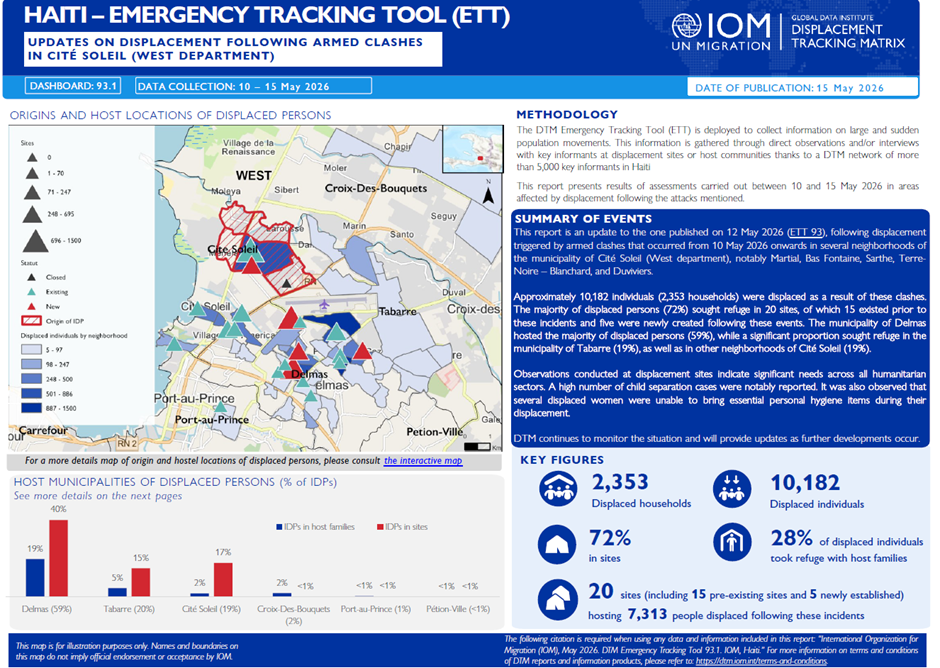
The cumulative displacement figures reflect what BINUH described as a pattern of ‘daily and untenable insecurity for a large part of the population’, in which armed group attacks on residential areas, combined with the deliberate obstruction of return routes and the economic strangulation of affected communities, rendered displacement protracted rather than temporary for a significant proportion of those forced to flee.144BINUH, quarterly report, May 2026, via ‘Haïti: plus de 1,600 morts en trois mois, la situation reste préoccupante selon le BINUH‘, Le Nouvelliste, May 2026.
Conduct of security force operations — potential violations of the prohibition of disproportionate attacks and the obligation to take precautions
Under customary IHL, parties to a conflict must take all feasible precautions in attack to avoid, and in any event to minimize civilian casualties and must refrain from attacks where the expected civilian harm would be excessive in relation to the anticipated military advantage.145ICRC, Customary IHL Rule 14: ‘Proportionality in Attack‘, and Rule 15: ‘Precautions in Attack‘. These obligations apply equally to State forces and non-State armed groups. The increasing use of kamikaze drones by the PNH’s Task Force (operating with the support of the private military contractor Vectus Global) raised serious concerns regarding compliance with both rules during the reporting period.
Between 1 March 2025 and 21 January 2026, Human Rights Watch documented at least 1,243 people killed in 141 drone operations, including at least forty-three apparently civilian adults and seventeen children among the dead, and 738 people injured including at least forty-nine with no apparent gang affiliation. The frequency of attacks escalated sharply: fifty-seven attacks were recorded between November 2025 and January 2026, compared to twenty-nine in the preceding three months. Human Rights Watch assessed that the deaths of civilians not participating in hostilities ‘could be disproportionate in comparison to the military advantage anticipated’.146Human Rights Watch, ‘Haiti: Drone Strikes Put Residents at Risk‘.
OHCHR documented that security force operations caused the death of 3,301 people including fifty-one children, and injured 1,691 including thirty-eight children, between March 2025 and January 2026. Of these, 196 deaths were suspected summary executions (see below under Treatment of persons accused of gang affiliation). Joint PNH and Vectus Global operations between 31 December 2025 and 15 January 2026 killed at least twenty-eight persons not involved in violence, including three children, and injured at least seventy others including five children, according to OHCHR.
Specific incidents during the reporting period illustrate the harm to civilians. On 7 January 2026, a drone strike by security forces in the Bel Air neighbourhood killed a thirteen-year-old girl. According to residents, while police had warned the population twenty-four hours in advance of the operation, no concrete measures were taken to assist civilians to flee.147F Pélissier and W Piercin, ‘Comment une attaque de drone a décimé une famille à Bel Air‘, AyiboPost, 21 January 2026. On 9 February, the Task Force launched two drone strikes against the Base 5 Secondes gang in Martissant; civilians were struck in the second strike while assisting those injured in the first.148ACLED, ‘Armed Conflict Location & Event Data Project‘, event data, Haiti, February–March 2026. On 7 March, a drone strike killed a young man on a motorcycle near Marché Salomon whose behaviour was deemed suspicious; he was subsequently identified as a young priest. His body was left on the roadway.149Ibid. On 11 March 2026, an explosive drone fell on a residential courtyard in Martissant, injuring two girls aged seven and nine. As a result of her injuries, one of the girls had her foot amputated.150BINUH Q1 2026
Human Rights Watch wrote to the Prime Minister, PNH, and Vectus Global requesting responses to its findings; none had responded at the time of reporting. The organization called on authorities to compensate affected families and to publicly clarify the command structure for drone operations and the role of private military companies in security operations.151Human Rights Watch, ‘Haiti: Drone Strikes Put Residents at Risk‘. Amnesty International raised further concerns in May 2026 regarding the use of explosive weapons in urban contexts, specifically highlighting the impact on children, including risks of death, disability, and long-term deterioration of mental health.152Amnesty International, ‘Haití: preocupación por uso de drones armados‘, 14 May 2026.
Allegations of sexual exploitation and abuse by MSS personnel
In February 2026, the UN Secretary-General’s report on special measures for the protection from sexual exploitation and abuse raised critical allegations involving Kenyan personnel from the MSS mission in Haiti during 2025. Although the allegations were disputed by Kenya’s Foreign Minister Mudavadi, investigation by OHCHR substantiated four allegations concerning girls aged twelve, sixteen, sixteen, and eighteen years.153UN General Assembly, ‘Special measures for protection from sexual exploitation and abuse: Report of the Secretary-General‘, UN Doc A/80/644, 16 February 2026; K Moges, ‘Kenya disputes UN report on rape allegations against its Haiti personnel‘, BBC News, 9 April 2026.
As noted in the Compliance Overview above, sexual exploitation and abuse by peacekeeping personnel in the prevailing context in Haiti at the time is primarily governed by international human rights law and UN accountability frameworks rather than IHL, as such acts typically occur without the requisite nexus to the conflict. The allegations are documented here as a grave concern under applicable international human rights law and UN conduct standards.154UN General Assembly, UN Doc A/80/644; UN Secretary-General, ‘Special measures for protection from sexual exploitation and sexual abuse’, UN Doc ST/SGB/2003/13, 9 October 2003 (establishing the UN accountability framework applicable to peacekeeping personnel).
Protection of Persons in the Power of the Enemy
Customary and treaty IHL provide fundamental guarantees for anyone in the power of a party to a conflict, prohibiting acts such as torture, inhumane or degrading treatment, collective punishments, sexual violence, enforced disappearance, and unfair trials. Special protection is afforded to civilians who face a specific risk of harm, such as women, children, refugees, and IDPs.155ICRC, Customary IHL Rules 134–138: ‘Chapter 39. Other Persons Afforded Specific Protection’, http://bit.ly/4mc9HIX.
Conflict-related sexual and gender-based violence
Under customary IHL, rape and other forms of sexual violence are prohibited.156ICRC, Customary IHL Rule 93: ‘Rape and Other Forms of Sexual Violence‘. Where it is committed as part of a widespread or systematic attack against a civilian population, sexual violence may constitute a crime against humanity. The use of sexual violence as a weapon of war – to punish, terrorize, or subjugate a civilian population – is among the gravest violations documented in Haiti during the reporting period.
The systematic use of sexual violence by Viv Ansanm was extensively documented in the period immediately preceding and overlapping with the current reporting period, providing essential context for the pattern that continued throughout January-May 2026. BINUH’s quarterly report published in January 2026 documented 1,753 cases of sexual violence committed by gangs across 2025; between October and November 2025 alone, 301 victims were recorded – 280 women, twenty girls, and one boy, some as young as ten years old – across Port-au-Prince and the Artibonite and Centre departments. At least five victims were killed after being raped.157BINUH, ‘Rapport trimestriel sur la situation des droits humains en Haïti (octobre–décembre 2025)’, January 2026, cited in ‘En Haïti, les survivantes de violences sexuelles face à l’indifférence et aux séquelles‘, Enquête Action, 3 March 2026. OHCHR’s March 2026 report, covering 1 March 2025 to 15 January 2026, confirmed that gangs ‘continued to use sexual violence to spread fear among the population, to subjugate and to punish’, documenting abuses of an ‘appalling scale’ and recording 1,571 women and girls as victims of sexual violence, including gang rapes, during the period.158OHCHR, UN Doc A/HRC/61/74; ‘Haïti droits de l’homme: plus de 5.500 morts, 1.571 femmes victimes de violences sexuelles‘, Rhinews, 25 March 2026.
MSF’s January 2026 report, drawing on ten years of data from the Pran Men’m clinic in Port-au-Prince, documents the sustained escalation of this pattern: monthly admissions to the clinic nearly tripled from an average of ninety-five in 2021 to over 250 in 2025, with MSF Head of Mission Diana Manilla Arroyo stating: ‘It is not only the numbers, but the severity.’159MSF, ‘Violences sexuelles et sexistes à Port-au-Prince, en Haïti‘. Since 2022, fifty-seven per cent of patients reported being attacked by armed group members, often in gang rapes; over 100 patients reported being assaulted by ten or more perpetrators in a single attack; and nearly twenty per cent had been assaulted on multiple occasions. The demographics of those attacked have shifted: prior to 2022, half of all patients were under eighteen, compared with twenty-four per cent at the time of the report, while the number of cases in the fifty-to-eighty age range had increased sevenfold — indicating that sexual violence is directed at an increasingly broad cross-section of the civilian population.160MSF, ‘Violences sexuelles et sexistes à Port-au-Prince, en Haïti‘; ‘Haiti faces sexual violence and abuse crisis as gang violence spreads, MSF says‘, Euronews, 28 January 2026. MSF confirmed that the abuse occurs specifically during kidnappings, territorial takeovers, and attempts to control humanitarian aid, characterising it as a deliberate instrument: ‘Armed groups are using sexual violence to terrorise, control and subjugate communities.’161Ibid.
The testimony collected by OHCHR and BINUH illustrates the human reality behind these figures. One survivor, Julia, was sexually exploited from the age of fifteen by the gang controlling the area where she lived; she described how they created an atmosphere of fear and became pregnant as a result of the violence. A fifty-three-year-old woman was beaten and raped by three gang members before they then raped her daughter; due to the severe stigmatisation of sexual violence in Haiti, her daughter refused to go to hospital or speak to anyone about what had happened.162OHCHR and BINUH. The high degree of stigmatisation suggests that reported figures significantly understate the true scale of the violence.
Access to care remains severely constrained by insecurity and stigma: only one third of victims reached the clinic within three days of the attack – the window for effective HIV prevention – and fifty-nine per cent arrived more than five days after the assault, beyond the window for emergency contraception.163MSF, ‘Violences sexuelles et sexistes à Port-au-Prince, en Haïti‘. The clinic struggles to find shelters willing to accept patients, with women who have children, are pregnant, or require medical care frequently rejected. MSF stated: ‘Without safe shelter or relocation options, MSF discharges its patients straight back into the nightmare they came from, just to see them return another day after being violated again.’ A further barrier to reporting is the risk of violence from self-defence groups: in gang-controlled neighbourhoods, all residents are automatically associated with the armed group by vigilante brigades — meaning that survivors who leave their neighbourhood to seek medical care risk being beaten or killed simply on the basis of where they live.164MSF, ‘Violences sexuelles et sexistes à Port-au-Prince, en Haïti‘; ‘Haiti faces sexual violence and abuse crisis as gang violence spreads, MSF says‘. Given the severity of these barriers, reported figures are likely to significantly understate the true scale of the violence.
Recruitment and use of children
The recruitment and use in hostilities of children under the age of fifteen is prohibited under customary IHL, as is their direct participation in hostilities.165ICRC, Customary IHL Rule 136: ‘Recruitment of Child Soldiers‘, and Rule 137: ‘Participation of Child Soldiers in Hostilities‘, . The interpretation of ‘using children to participate actively in hostilities’ encompasses not only direct combat but also activities linked to combat, including scouting, spying, sabotage, checkpoint duties, decoy functions, and courier roles.166ICRC, Customary IHL Rule 137: ‘Participation of Child Soldiers in Hostilities‘ . Haiti ratified the Convention on the Rights of the Child in 1995 and endorsed the Paris Principles and Guidelines on Children Associated with Armed Forces or Armed Groups, though it remains only a signatory to the Optional Protocol on the Involvement of Children in Armed Conflict.167ICRC, ‘Protocol Additional to the Geneva Conventions of 12 August 1949, and relating to the Protection of Victims of Non-International Armed Conflicts (Protocol II), 8 June 1977’, State Parties; ICRC, ‘Paris Commitments and Paris Principles on Children Associated with Armed Forces or Armed Groups‘, 2007.
The recruitment and use of children by armed groups reached alarming levels during the reporting period. UNICEF reported a two hundred per cent increase in child recruitment in Haiti in 2025.168UNICEF, ‘Child Recruitment in Haiti Surges Threefold in Just One Year‘, 12 February 2026. According to BINUH, half of all gang members are now children.169BINUH, ‘United Nations Integrated Office in Haiti: Report of the Secretary-General‘, UN Doc S/2026/31, 15 January 2026, para 74. Save the Children’s Operations Director in Haiti, Johny Cesar Etienne, told the UN Security Council in March 2026: ‘It is now a common sight to see children, some as young as ten, holding guns.170‘J C Etienne, ‘What I told members of the UN Security Council about the recruitment and use of children in Haiti and what we need to do next‘, Save the Children, 18 March 2026. In December 2025, the UN Special Representative for Children and Armed Conflict recorded a four hundred and ninety per cent rise in verified violations against children in Haiti — the third highest in the world.171Special Representative of the Secretary-General for Children and Armed Conflict, ‘Children and armed conflict: Report of the Special Representative of the Secretary-General for Children and Armed Conflict‘, UN Doc A/HRC/61/37, 23 December 2025.
The OHCHR and BINUH joint report of February 2026 identified the following Viv Ansanm constituent gangs as most heavily involved in child trafficking: 400 Mawozo, Belekou, Gran Grif, Gran Ravine (and its 103 Zombies cell), Ti Bwa, and Village de Dieu.172OHCHR and BINUH; The OHCHR/BINUH report refers to ‘Brooklyn Gran Grif’, which appears to be a territorial cell or local variant of the Gran Grif gang (HTe.001, Savien), rather than a distinct organisation. No authoritative source — including the UN Panel of Experts Annex 4 gang profiles, the ICG December 2025 report, or US sanctions designations — lists ‘Brooklyn Gran Grif’ as a separate entity. It is treated here as part of Gran Grif.
Children are recruited into gangs by a variety of means. Financial payments – ranging from US$100 to 700 for participation in major operations – serve as an enticement, as does the promise of a meal for children with no other means of subsistence.173J C Etienne; ‘Children make up half of Haiti’s gangs‘, CNN, 6 April 2026 (citing UN Panel of Experts data on payment ranges). Some gangs distribute drugs to children as young as ten to trap them in cycles of addiction and dependence.174OHCHR and BINUH. Social media plays a central role: the portrayal of gang leaders with wealth (the Village de Dieu leader ‘Izo’, often cited as an example) reinforces the perception of gang membership as desirable among vulnerable young people.175J C Etienne; OHCHR and BINUH. Coercion is widespread: the Panel of Experts on Haiti documented that recruitment and participation in combat are on the rise given the losses suffered by gangs, and that children in certain cases are required to undergo an initiation phase that can include acts of violence or collective rape — a practice documented by OHCHR and BINUH in relation to the 400 Mawozo, Belekou, Canaan, Grand Ravine, Kraze Baryè, La Saline, and Village de Dieu gangs.176UN Panel of Experts, UN Doc S/2026/241 . A fifteen-year-old Port-au-Prince gang member, interviewed for a French television documentary broadcast in March 2026, stated: ‘I had to become a gang member to get by. I know I am going to die, but I also know that it’s within the gang that I can get by.’177Enquête exclusive, ‘Haïti-République Dominicaine: à la frontière du paradis et de l’enfer‘, M6, 25 March 2026, timecode 15min22.
Figure 3: Video showing newly recruited gang members of the 400 Mawozo gang undergoing a ritual initiation ceremony, underscoring their young age. Stills from video shared with the UN Panel of Experts on 30 January 2026.
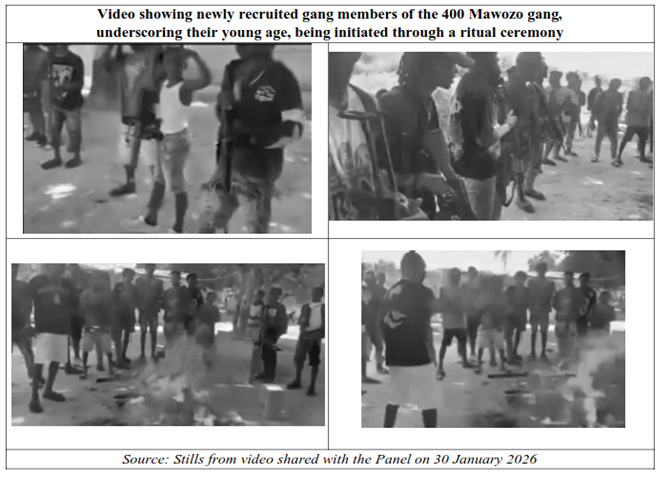
Source: UN Panel of Experts on Haiti, ‘Letter dated 5 September 2025 from the Panel of Experts on Haiti addressed to the President of the Security Council‘, UN Doc S/2025/597, September 2025.
The PNH high command confirmed the following patterns in terms of the tasks assigned to children: those aged eight to ten are used as lookouts; those aged eleven to fourteen are armed and deployed in front-line positions – a deliberate tactic by gang commanders that places police officers in an untenable moral dilemma during confrontations.178Direction de la Communication de la Police, ‘L’ONU s’alarme de l’utilisation d’enfants-soldats par les gangs terroristes‘, PNH (Facebook), 5 March 2026. The exploitation of children is also gendered: girls are forced or subjected to social pressure to become sexual partners (referred to in Creole as ‘konkibins’ or ‘Ti menaj’) of gang members, subjected to sexual violence and slavery from as young as twelve years of age.179OHCHR and BINUH. In areas controlled by gangs, some families perceive this arrangement as protective, believing that attachment to a specific gang member will shield a girl from rape by multiple perpetrators. These practices, which are often not recognised by victims and their families as a form of sexual violence, reflect deeply rooted power imbalances and gender inequalities.180Ibid.
While girls have historically been assigned domestic and support roles within gangs, OHCHR and BINUH documented in February 2026 that girls are increasingly being exploited in criminal activities typically assigned to boys, including ransacking homes and other buildings, and are now also seen participating in armed clashes alongside men, as documented specifically in relation to the 400 Mawozo and Team Asansè gangs. Girls and women in these roles carry firearms and have been trained in their use.181Ibid; J C Etienne.
The internal discipline exercised by gangs over children under their control was illustrated on 26 March 2026 by the killing of ‘Ti Lari’, a thirteen-year-old boy from Martissant working as a toutè (scout) for the Village de Dieu gang. While taking advantage of some free time, he flew a kite in the street, unaware that the gang had prohibited such activities in order to ensure that lookouts remained vigilant for drone surveillance. A member of his own gang killed him in the street for breaking this rule.182BINUH Q1 2026.
In May 2026, the Special Representative of the Secretary-General for Children and Armed Conflict, Vanessa Frazier, concluded her first visit to Haiti, stating that the challenges children face are ‘extraordinarily complex, multi-layered, and multi-dimensional’. She emphasized that children apprehended during security operations must be treated primarily as victims.183Office of the Special Representative of the Secretary-General for Children and Armed Conflict, ‘Special Representative of the Secretary-General for Children and Armed Conflict concludes first visit to Haiti‘, 17 May 2026.
Detention conditions
Under customary IHL, children deprived of their liberty in connection with an armed conflict must be held in quarters separate from those of adults.184ICRC, Customary IHL Rule 120: ‘Separation of Women and Men and of Children and Adults‘. Detainees must be provided with adequate food, water, and medical care, and must not be subjected to cruel, inhuman, or degrading treatment.185ICRC, Customary IHL Rule 118: ‘Provision of Food, Water and Clothing‘, Rule 119: ‘Medical Care for Persons Deprived of Their Liberty‘, and Rule 90: ‘Torture and Cruel, Inhuman or Degrading Treatment’. These obligations apply to the state party in relation to persons detained in connection with the NIAC.
The Centre for the Reintegration of Children in Conflict with the Law (CERMICOL) –the only operational detention facility for children in Port-au-Prince – continued to hold children in conditions that raise serious concerns under both IHL and IHRL during the reporting period. A significant proportion of CERMICOL’s child detainees were arrested during security operations against Viv Ansanm and Gran Grif, or on suspicion of association with those groups, establishing the requisite connection to the NIAC for the application of IHL detention obligations to their treatment.186OHCHR and BINUH, ‘Children trafficked by gangs in Haiti: Rethinking the responses‘; RNDDH, ‘Traitements cruels, inhumains et dégradants au CERMICOL: Le RNDDH presse les autorités d’agir‘, 9 March 2026. The extent to which all children held at CERMICOL were detained in connection with the NIAC (as opposed to unrelated criminal matters) cannot be determined on the basis of available information, as CERMICOL holds all children in conflict with the law in the metropolitan area regardless of the circumstances of their arrest; the conditions documented below are in any case equally prohibited under applicable human rights law.187OHCHR and BINUH, ‘Children trafficked by gangs in Haiti: Rethinking the responses‘; RNDDH, ‘Traitements cruels, inhumains et dégradants au CERMICOL: Le RNDDH presse les autorités d’agir‘, 9 March 2026.
As of December 2025, CERMICOL held 111 children (95 boys and 16 girls) alongside 581 adults (445 men and 136 women), for a total of 692 detainees against a maximum capacity of 100; by 5 March 2026, the population had risen further to 719, more than seven times the facility’s designed capacity.188OHCHR and BINUH, ‘Children trafficked by gangs in Haiti: Rethinking the responses‘; RNDDH, ‘Traitements cruels, inhumains et dégradants au CERMICOL: Le RNDDH presse les autorités d’agir‘, 9 March 2026. Note: the OHCHR/BINUH report gives a designed capacity of 93 while the RNDDH report gives 100; the latter figure is used here as the more recent and facility-specific source. While men and boys are held in separate cells, women and girls are detained together in the same space, a violation of the customary IHL and IHRL obligation to hold children separately from adults.189OHCHR and BINUH, ‘Children trafficked by gangs in Haiti: Rethinking the responses‘; RNDDH, ‘Traitements cruels, inhumains et dégradants au CERMICOL‘.
The overcrowding has been compounded by the transfer of adult detainees from the women’s prison in Cabaret and the men’s prisons in Port-au-Prince and Croix-des-Bouquets following gang attacks on those facilities in 2023 and 2024 – itself a consequence of Viv Ansanm’s systematic targeting of State infrastructure.190OHCHR and BINUH, ‘Children trafficked by gangs in Haiti: Rethinking the responses‘; RNDDH, ‘Traitements cruels, inhumains et dégradants au CERMICOL‘. Classrooms have been converted into cells, eliminating access to education for detained children. Children report limited access to healthcare, poor living conditions, inadequate food and drinking water, and the absence of rehabilitation or reintegration services. Most spend large parts of their adolescence in detention without being brought before a judge or having access to a lawyer.191OHCHR and BINUH, ‘Children trafficked by gangs in Haiti: Rethinking the responses‘; RNDDH, ‘Traitements cruels, inhumains et dégradants au CERMICOL‘.
The RNDDH, in its March 2026 report on CERMICOL, described the situation as constituting cruel, inhuman, and degrading treatment and called on authorities to act urgently.192RNDDH, ‘Traitements cruels, inhumains et dégradants au CERMICOL‘. The testimony of Louis, recruited into a gang at seventeen and still detained at CERMICOL as an adult five years later, illustrates the human cost of the absence of reintegration pathways: ‘I feel okay. I thank God for being locked up; I don’t want to die in clashes with other gangs or with the police. But life at CERMICOL is not a good life. One can be attacked at any moment by another inmate with anything. No access to healthcare, no access to good food.’193OHCHR and BINUH, ‘Children trafficked by gangs in Haiti: Rethinking the responses‘; RNDDH, ‘Traitements cruels, inhumains et dégradants au CERMICOL‘.
Despite the existence of a Protocol signed in October 2023 between the Government of Haiti and the United Nations – which recognizes children associated with gangs as victims rather than perpetrators and establishes referral pathways prioritising rehabilitation over detention – Haitian judicial authorities continue to prioritise criminal prosecution over the non-punishment principle applicable to trafficking victims. During the first quarter of 2026, BINUH, in cooperation with UNICEF, supported the Government in establishing a joint Task Force mandated to oversee implementation of the Protocol. In parallel, a rehabilitation centre in Les Cayes, with a capacity for over 600 children, was being refurbished ahead of GSF deployment in anticipation of an expected increase in child releases.194BINUH SG Report, para 55.
Treatment of persons accused of gang affiliation
Under customary IHL, no one may be convicted or sentenced except pursuant to a fair trial affording all essential judicial guarantees.195ICRC, Customary IHL Rule 100: ‘Fair Trial Guarantees‘. The arbitrary deprivation of life is prohibited under both IHL and international human rights law, as is the summary execution of persons in the power of a party to the conflict.196ICRC, Customary IHL Rule 89: ‘Violence to Life‘, and, Rule 99: ‘Deprivation of Liberty‘. These protections apply regardless of suspected gang affiliation.
The extrajudicial killing of persons suspected of gang membership or association – by both State security forces and organised self-defence groups – was a documented feature of the Haitian security landscape throughout the reporting period and the period immediately preceding it. BINUH recorded at least 106 persons killed by self-defence groups between December 2025 and February 2026 alone.197BINUH SG Report, para 21. OHCHR documented 247 instances of actual or attempted summary executions of suspected gang members or individuals believed to support gangs between 1 March 2025 and 15 January 2026, resulting in the deaths of 196 people and injuries to 51 others.198OHCHR, UN Doc A/HRC/61/74.
During the current reporting period, documented abuses by organized self-defence brigades across Port-au-Prince continued, and in some cases intensified. In January 2026, brigadiers from the Poste-Marchand brigade summarily executed a young man with no known gang affiliation who had gone shopping at a supermarket in Lalue that day.199‘Brigadiers, milices ou gardiens? Les dérives des brigades de sécurité à Port-au-Prince‘, AyiboPost, March 2026; ACLED, ‘Last Line of Defense’. In March 2026, journalist Arnold Junior Pierre was violently assaulted by brigadiers in Delmas 27 while photographing the area, narrowly escaping being killed – his press badge and identity card saving him.200‘Brigadiers, milices ou gardiens? Les dérives des brigades de sécurité à Port-au-Prince‘. On 15 March, schoolteacher Philippe Martial was beaten by Pacot brigadiers during a body search outside his home at 4 p.m., struck repeatedly on the head and left suffering dizziness and migraines for weeks afterward.201Ibid. Photographer Kenson Jean was intercepted by approximately ten brigadiers near Rue Casséus and beaten until his head was ‘cracked’ and his t-shirt bloodied, after objecting to being arbitrarily redirected to a longer route.202Ibid.
Systematic extortion was also documented during the reporting period: in Caradeux, residents protested against the local brigade for withholding identity documents until payment was made; in Delmas 60, residents were required to complete a form with full personal details – including photograph and tax identification number – to be allowed to live in their own neighbourhood; in Turgeau, a resident reported having a weapon pointed at his head during a body search at 4 p.m. next to the Natcom telecommunications building.203Ibid.
As noted in the Classification section above, the legal characterization of self-defence group conduct depends on the degree of State direction and control exercised over each group. Where self-defence brigades operate as State agents, as in the case of BRICK in Kenscoff, formally integrated into PNH and Task Force operations, their conduct is attributable to Haiti. In all such cases, the documented abuses – extrajudicial killings, arbitrary detention, physical violence, and extortion – constitute grave violations of the right to life, the prohibition of torture and cruel treatment, and the right to due process.204ACLED, ‘Last Line of Defense’; ‘Port-de-Paix security brigade‘, Haitian Times, 18 January 2026.
- 1BINUH, Rapport trimestriel sur la situation des droits humains en Haïti (janvier–mars 2026), May 2026, via Rezo Nodwes, 12 May 2026. ↩︎
- 2CE-JILAP data, reported in ‘Haïti: 484 morts recensés dans la zone métropolitaine de Port-au-Prince au premier trimestre 2026’, Rhinews, 10 May 2026. ↩︎
- 3OCHA, ‘Haïti: Aperçu des contraintes d’accès humanitaire de décembre 2025 à février 2026’, 6 March 2026. ↩︎
- 4‘Zapping Haïti du 11 avril 2026’, Haiti Libre, 11 April 2026. ↩︎
- 5Ibid. ↩︎
- 6ACLED, ‘CrisisWatch: March 2026 Trends and April 2026 Alerts’, April 2026. ↩︎
- 7UN Security Council Resolution 2793, adopted on 30 September 2025, operative para 1; Jacques Vilus, ‘Haïti : Arrivée du chef de la Force de répression des gangs de l’ONU, le général Erdenebat Batsuuri’,17 May 2026; UN Security Council, ‘United Nations Integrated Office in Haiti: Report of the Secretary-General‘, UN Doc S/2026/325, 14 April 2026, para 43; J Blaise, ‘UN-appointed anti-gang force commander arrives in Haiti to lead expanded mission‘, Haitian Times, 15 May 2026. ↩︎
- 8Human Rights Watch, ‘Haiti: Drone Strikes Put Residents at Risk’, 10 March 2026; Fondasyon Je Klere, ‘Liquidation de la souveraineté nationale via des contrats léonins’, March 2026, para 50; R Muggah, H Ziemer, D Da Rin and S Rutenbar, ‘What’s Behind the Use of Drones in Haiti’s Conflict?‘, Latin America Advisor, Inter-American Dialogue, 26 March 2026; ‘Kamikaze drones in Haiti: 1,243 dead in Prime Minister Fils-Aimé’s failed plan against criminal gangs‘, El País, 10 March 2026. ↩︎
- 9International Crisis Group, ‘Undoing Haiti’s Deadly Gang Alliance’, Latin American & Caribbean Report No.110, 15 December 2025. ↩︎
- 10UN Panel of Experts on Haiti established pursuant to Security Council Resolution 2653 (2022), ‘Letter dated 27 March 2026 from the Panel of Experts on Haiti addressed to the President of the Security Council’, UN Doc S/2026/241, Annex 4, pp 42–44. ↩︎
- 11International Crisis Group, Haiti Watch Page, April 2026; ‘The Fight to Raise the Minimum Wage’, Haiti Weekly, 6 May 2026. ↩︎
- 12R Surin, ‘Dans la Plaine, la coalition se fissure’, Le Nouvelliste, 5 May 2026. ↩︎
- 13International Crisis Group, ‘CrisisWatch: February 2026 Trends and March 2026 Alerts’, March 2026. ↩︎
- 14ACLED, ‘Last Line of Defense’. ↩︎
- 15ACLED, ‘Last Line of Defense’. ↩︎
- 16‘Port-de-Paix security brigade‘, Haitian Times, 18 January 2026; ACLED, ‘Last Line of Defense’ ( n15). ↩︎
- 17ACLED, ‘Last Line of Defense’. ↩︎
- 18ACLED, ‘Last Line of Defense’; ‘Brigadiers, milices ou gardiens? Les dérives des brigades de sécurité à Port-au-Prince‘, AyiboPost, March 2026. ↩︎
- 19
- 20‘Situation of human rights in Haiti’, Report of the UN High Commissioner for Human Rights, UN Doc A/HRC/61/74, 23 March 2026; UNICEF, ‘Haiti Humanitarian Situation Report No 1’, 31 March 2026. ↩︎
- 21Réseau National de Défense des Droits Humains (RNDDH), ‘Massacre à Jean Denis: le RNDDH dénonce la complaisance des autorités étatiques face aux attaques meurtrières des gangs armés’, 11 April 2026; IOM, ‘Haiti – Emergency Tracking Tool 88.2 – Updates on displacement following armed attacks in Petite Rivière de l’Artibonite and Dessalines (28 March – 6 April 2026)’, 6 April 2026. ↩︎
- 22OCHA, Haiti: 2026 Humanitarian Needs and Response Plan – Executive Summary. ↩︎
- 23Protocol Additional to the Geneva Conventions of 12 August 1949, and relating to the Protection of Victims of Non-International Armed Conflicts; adopted at Geneva, 8 June 1977; entered into force, 7 December 1978. ↩︎
- 24International Crisis Group, ‘Undoing Haiti’s Deadly Gang Alliance‘ ; UN Panel of Experts, UN Doc S/2026/241 , Annex 4, p 44. ↩︎
- 25International Crisis Group, ‘Undoing Haiti’s Deadly Gang Alliance‘ . ↩︎
- 26UN Panel of Experts, UN Doc S/2026/241 , Annex 4, pp 42–44. ↩︎
- 27International Criminal Court, Prosecutor v Bosco Ntaganda, Judgment (Trial Chamber) (Case No ICC-01/04-02/06), 8 July 2019, para 716; International Criminal Tribunal for the former Yugoslavia, Prosecutor v Ljube Boškoski and Johan Tarčulovski, Judgment (Trial Chamber) (Case No IT-04-82-T), 10 July 2008, para 178. ↩︎
- 28UN Security Council, ‘Gran Grif‘, Haiti Sanctions List, n.d.; UN Security Council, ‘Luckson Elan‘, Haiti Sanctions List, 27 September 2024. ↩︎
- 29UN Panel of Experts on Haiti established pursuant to Security Council Resolution 2653 (2022), ‘Letter dated 27 March 2026 from the Panel of Experts on Haiti addressed to the President of the Security Council‘, UN Doc S/2026/241, 27 March 2026, Annex 4, p 44. ↩︎
- 30International Crisis Group, ‘Undoing Haiti’s Deadly Gang Alliance‘ . ↩︎
- 31International Crisis Group, ‘Undoing Haiti’s Deadly Gang Alliance‘ ; UN Panel of Experts, UN Doc S/2026/241 , Annex 4, p 44. ↩︎
- 32Global Initiative Against Transnational Organised Crime, ‘Brokers and Patrons: Unstitching Gangs from Haiti’s Political Fabric’, March 2026. ↩︎
- 33BINUH Q1 2026. ↩︎
- 34Centre d’Analyse et de Recherche en Droits de l’Homme (CARDH), ‘Massacre à Jean Denis: Nécessité d’un cadre juridique d’urgence et de nouvelles stratégies pour protéger la population‘, 1 April 2026. ↩︎
- 35J Alcidor, ‘Artibonite: cohabitation inédite des gangs “Kokorat San Ras” et “Gran Grif” à Marchand-Dessalines‘, Ted Actu, 3 April 2026; H Noël, ‘“Gran-Grif” et “Kokorat san ras” envahissent la commune de Dessalines, la PNH reste introuvable‘, Rezo Nodwes, 2 April 2026. ↩︎
- 36ACLED, ‘Last Line of Defense’. ↩︎
- 37ACLED, ‘Last Line of Defense’. ↩︎
- 38International Court of Justice, Military and Paramilitary Activities in and against Nicaragua (Nicaragua v United States), Merits, Judgment, ICJ Reports 1986, para 115; International Criminal Tribunal for the former Yugoslavia, Prosecutor v Duško Tadić, Judgment (Appeals Chamber) (Case No IT-94-1-A), 15 July 1999, paras 131–37. ↩︎
- 39Nils Melzer, Interpretive Guidance on the Notion of Direct Participation in Hostilities under International Humanitarian Law, ICRC, 2009, pp. 27–36. ↩︎
- 40Ibid., pp. 74–82; see also ICRC, ‘Rule 6: Civilians’ Loss of Protection from Attack‘, Customary IHL Database. ↩︎
- 41‘Zapping Haïti du 11 avril 2026‘, Haiti Libre, 11 April 2026; OHCHR, ‘Situation of human rights in Haiti‘, Report of the UN High Commissioner for Human Rights, UN Doc A/HRC/61/74, 23 March 2026. ↩︎
- 42BINUH, ‘Rapport trimestriel sur la situation des droits humains en Haïti (janvier–mars 2026)‘, May 2026 ; RNDDH ; IOM ETT 88.2 . ↩︎
- 43OCHA, ‘Haiti: 2026 Humanitarian Needs and Response Plan – Executive Summary‘, December 2025; UN Secretary-General, noon briefing, 8 May 2026: https://www.un.org/sg/en/content/highlight/2026-05-08.html ↩︎
- 44Human Rights Watch, ‘Haiti: Drone Strikes Put Residents at Risk’. ↩︎
- 45UN General Assembly, ‘Special measures for protection from sexual exploitation and abuse: Report of the Secretary-General‘, UN Doc A/80/644, 16 February 2026; K Moges, ‘Kenya disputes UN report on rape allegations against its Haiti personnel‘, BBC News, 9 April 2026. ↩︎
- 46ACLED, ‘Last Line of Defense’; ‘Brigadiers, milices ou gardiens? Les dérives des brigades de sécurité à Port-au-Prince‘, AyiboPost, March 2026. On the legal consequences of direct participation in hostilities, see N Melzer, Interpretive Guidance on the Notion of Direct Participation in Hostilities under International Humanitarian Law, ICRC, 2009, pp 70–73. ↩︎
- 47ICRC, Customary IHL Rule 7: ‘The Principle of Distinction between Civilian Objects and Military Objectives’, https://bit.ly/3IJx66d. ↩︎
- 48
- 49ICRC, Customary IHL Rule 10: ‘Civilian Objects’ Loss of Protection from Attack’, https://bit.ly/44OwfJ3. ↩︎
- 50ICRC, Customary IHL Rule 8: ‘Definition of Military Objectives’, https://bit.ly/3ILMu1W. In addition, the object’s partial or total destruction, capture, or neutralisation must offer a definite military advantage in the prevailing circumstances. ↩︎
- 51BINUH SG Report, para 59. ↩︎
- 52UN Security Council, ‘Kempes Sanon‘, Haiti Sanctions List. ↩︎
- 53MSF, ‘Civilians must be protected as violence forces suspension of activities in Bel Air, Haiti‘, 8 January 2026. ↩︎
- 54Ibid. ↩︎
- 55MSF, ‘Violences sexuelles et sexistes à Port-au-Prince, en Haïti‘, January 2026. ↩︎
- 56‘Artibonite-Insécurité: le gang Gran Grif sème la terreur et menace d’incendier l’hôpital Albert Schweitzer‘, Rezo Nodwes, 19 March 2026. ↩︎
- 57Ibid. ↩︎
- 58‘Hundreds flee Haiti Cul-de-Sac plain gang clashes‘, Haitian Times, 12 May 2026; UN Panel of Experts, UN Doc S/2026/241 , Annex 4, p 44. ↩︎
- 59BINUH, provisional toll communicated to AFP, 15 May 2026, reported in ‘Haiti gang clashes kill at least 78 in Port-au-Prince suburbs, UN says‘, France 24, 15 May 2026. ↩︎
- 60‘Haïti: MSF contrainte d’évacuer son hôpital de Cité Soleil et d’y suspendre temporairement ses activités‘, Rezo Nodwes, 11 May 2026; MSF, ‘Haiti: MSF forced to evacuate hospital in Cité Soleil‘, 11 May 2026. ↩︎
- 61‘Affrontements entre gangs: le Centre Hospitalier de Fontaine à Cité Soleil évacué‘, Le Nouvelliste, 11 May 2026. ↩︎
- 62Ibid. ↩︎
- 63‘FAA grounds all US flights to Haiti after three planes were struck by gunfire’, CNN, 12 November 2024; ‘Haiti could be “completely isolated” as gunfire closes main airport again’, Al Jazeera, 12 November 2024; ‘Un avion de ligne à destination d’Haïti touché par des tirs à Port-au-Prince’, France Info, 11 November 2024. ↩︎
- 64‘Haiti’s international airport shut down after gangs opened fire at a commercial flight‘, CBC News, 12 November 2024; ‘FAA grounds all US flights to Haiti after three planes were struck by gunfire‘, CNN, 12 November 2024. ↩︎
- 65‘Sunrise Airways suspends all flights to and from Port-au-Prince‘, Haitian Times, 23 November 2025. ↩︎
- 66‘FAA extends ban on US flights to Port-au-Prince, prolonging costly detours to Haiti‘, Haitian Times, 6 September 2025. ↩︎
- 67Ibid. ↩︎
- 68‘Flash: Sunrise Airways suspends its flights to and from Port-au-Prince‘, Haiti Libre, 20 April 2026; ‘Port-au-Prince international airport: gunfire, clashes between armed groups‘, Haitian Times, 21 April 2026. ↩︎
- 69
- 70‘Haïti: attaques et déplacements de population à Montrouis‘, Haiti Libre, 11 January 2026. ↩︎
- 71UNICEF, ‘Haiti Humanitarian Situation Report No 1‘, 31 March 2026; OCHA, ‘Haïti: Aperçu des contraintes d’accès humanitaire de décembre 2025 à février 2026‘; ‘UN official visits Haiti to assess humanitarian situation‘, UN News, 10 April 2026. ↩︎
- 72‘Port-au-Prince: plus de 800 écoles relocalisées ou fermées en raison de la violence des gangs‘, Vant Bèf Info, 24 January 2026; ‘Crise scolaire en Haïti: plus de 800 écoles privées fermées et des milliers d’élèves livrés à eux-mêmes dans la zone métropolitaine de Port-au-Prince‘, Caribbean Television Network, 25 January 2026. ↩︎
- 73‘Crise scolaire en Haïti: plus de 800 écoles privées fermées et des milliers d’élèves livrés à eux-mêmes dans la zone métropolitaine de Port-au-Prince‘, Caribbean Television Network, 25 January 2026. ↩︎
- 74‘Port-au-Prince: plus de 800 écoles relocalisées ou fermées en raison de la violence des gangs‘, Vant Bèf Info, 24 January 2026. ↩︎
- 75OHCHR and BINUH, ‘Children trafficked by gangs in Haiti: Rethinking the responses‘, 20 February 2026. ↩︎
- 76
- 77‘Zapping Haïti du 11 avril 2026‘, Haiti Libre, 11 April 2026. ↩︎
- 78‘Insécurité en Haïti: le CONEHQ alerte sur une menace croissante pour le système éducatif‘, Vant Bèf Info, 30 March 2026. ↩︎
- 79D Hernandez, ‘Haiti’s oldest newspaper fights to survive gang-fuelled violence‘, Christian Science Monitor, 22 April 2026. ↩︎
- 80Ibid.; ‘Gang-controlled streets, shuttered newsrooms: How violence is eroding Haiti’s media‘, UN News, 1 May 2026. ↩︎
- 81‘Journalists in Haiti face grave threats, says UN on World Press Freedom Day‘, UN News, 1 May 2026. ↩︎
- 82Ibid. ↩︎
- 83‘Kenscoff: deux morts et un disparu dans une nouvelle attaque armée‘, Le Nouvelliste, 1 May 2026. ↩︎
- 84BINUH SG Report, para 23. ↩︎
- 85
- 86‘Attaque des gangs à Kenscoff: au moins sept morts‘, Juno7, 30 January 2026; ‘Zapping Haïti‘, Haiti Libre, 30 January 2026. ↩︎
- 87BINUH SG Report, para 23. ↩︎
- 88‘Zapping Haïti‘, Haiti Libre; ACLED event data. ↩︎
- 89‘Haïti-Criminalité: Marigot en quête de renaissance après ses blessures‘, AlterPresse, 29 April 2026, citing UN partner data; BINUH SG Report, para 23. ↩︎
- 90Radio Télé Galaxie, Facebook post, 23 March 2026. ↩︎
- 91‘Kenscoff: deux morts et un disparu dans une nouvelle attaque armée‘, Le Nouvelliste, 1 May 2026. ↩︎
- 92‘Le Ranch de la Croix-des-Bouquets pillé, vandalisé et partiellement incendié‘, Haiti Libre, 1 February 2026. ↩︎
- 93RNDDH . ↩︎
- 94CARDH; ‘At least 70 people were killed and 30 wounded in a gang attack targeting Jean Denis and Pont Sondé‘, Drop Site News (X post), 30 March 2026. ↩︎
- 95H Noël, ‘“Gran-Grif” et “Kokorat san ras” envahissent la commune de Dessalines, la PNH reste introuvable‘, Rezo Nodwes, 2 April 2026; J Alcidor, ‘Artibonite: cohabitation inédite des gangs “Kokorat San Ras” et “Gran Grif” à Marchand-Dessalines‘, Ted Actu, 3 April 2026. ↩︎
- 96Radio Télé Galaxie, post on X, 13 April 2026; IOM, ‘Haiti – Suivi des Urgences 90.1‘, 21 April 2026. ↩︎
- 97
- 98
- 99
- 100
- 101ICRC, Customary IHL Rule 14: ‘Proportionality in Attack’, and Rule 15: ‘Principle of Precautions in Attack’. ↩︎
- 102BINUH, Quarterly report, May 2026, via ‘Haiti: plus de 1,600 morts en trois mois‘, Rezo Nodwes, 12 May 2026. ↩︎
- 103RNDDH ; H Hira, ‘Dozens killed in multi-day gang attack in Haiti‘, CNN, 31 March 2026; BINUH Q1 2026. ↩︎
- 104Ibid. ↩︎
- 105BINUH SG Report, para 23. ↩︎
- 106Amnesty International, ‘Haiti: nueva masacre demuestra crisis de desprotección general de la población‘, April 2026; D Charles, ‘Massacre à Jean-Denis: bilans contradictoires entre autorités locales et PNH‘, Juno7, 30 March 2026. ↩︎
- 107P L Revange, ‘Nouvelle attaque meurtrière du gang Gran Grif à Saint-Marc: au moins 10 victimes‘, Signal FM Haiti, 9 May 2026; J Charles, ‘Fresh gang attacks frustrate Haiti businesses, hit charity hospital as residents flee‘, Miami Herald, 13 May 2026. ↩︎
- 108ACLED event data; OHCHR, UN Doc A/HRC/61/74. ↩︎
- 109‘Haïti-Criminalité: Marigot en quête de renaissance après ses blessures‘, AlterPresse, 29 April 2026; ‘Kenscoff: deux morts et un disparu dans une nouvelle attaque armée‘, Le Nouvelliste, 1 May 2026. ↩︎
- 110BINUH Q1 2026. ↩︎
- 111OHCHR, UN Doc A/HRC/61/74. ↩︎
- 112BINUH SG Report, para 14. ↩︎
- 113
- 114OHCHR, UN Doc A/HRC/61/74. ↩︎
- 115Commission épiscopale nationale Justice et Paix (CE-JILAP), ‘Violence dans la zone métropolitaine de Port-au-Prince’, Q1 2026, cited in ‘Haïti: 484 morts recensés dans la zone métropolitaine de Port-au-Prince au premier trimestre 2026, dont 172 liés à des frappes de drones‘, Rhinews, 10 May 2026; ‘Insécurité: Hausse des cas de kidnapping à Delmas‘, Le National, 20 February 2026. ↩︎
- 116ACLED, ‘Armed Conflict Location & Event Data Project‘, event data, Haiti, January–February 2026 (kidnapping incidents, Pétion-Ville and Kenscoff commune). ↩︎
- 117‘Zapping Haïti‘, Haiti Libre; ACLED event data. ↩︎
- 118RNDDH. ↩︎
- 119
- 120J Blaise, ‘Senior Haitian journalist targeted in attack on home‘, Haitian Times, 13 March 2026. ↩︎
- 121J Blaise; UN Panel of Experts on Haiti, UN Doc S/2026/241 , Annex 4, pp 42–44. ↩︎
- 122‘Le RENAJOUH confirme l’exécution des journalistes Osnel Espérance et Junior Célestin enlevés par Viv Ansanm‘, Rezo Nodwes, 29 March 2026; ‘SOS Journalistes dénonce la disparition présumée et l’assassinat de deux reporters à Port-au-Prince‘, Rhinews, 18 March 2026. ↩︎
- 123Ministère de la Culture et de la Communication, ‘Le Ministère de la Culture et de la Communication condamne l’enlèvement de deux journalistes‘, 17 March 2026. ↩︎
- 124J Blaise; Committee to Protect Journalists (CPJ), ‘2 Haitian journalists abducted amid intensifying violence in Port-au-Prince‘, 17 March 2026. ↩︎
- 125Committee to Protect Journalists (CPJ). ↩︎
- 126IACHR Special Rapporteur for Freedom of Expression, ‘IACHR Special Rapporteur condemns attacks against journalists in Haiti‘, 26 March 2026. ↩︎
- 127ICRC, Customary IHL Rule 31: ‘Humanitarian Relief Personnel‘; see also Rule 32: ‘Humanitarian Relief Objects‘. ↩︎
- 128MSF, ‘Civilians must be protected as violence forces suspension of activities in Bel Air, Haiti‘, 8 January 2026; UN Security Council, ‘Kempes Sanon‘, Haiti Sanctions List. ↩︎
- 129Ibid. ↩︎
- 130
- 131
- 132UNODC, ‘Explainer: Organized crime and gang violence in Haiti‘, 21 January 2026. ↩︎
- 133
- 134International Crisis Group, ‘Undoing Haiti’s Deadly Gang Alliance‘. ↩︎
- 135OCHA, ‘Haiti: 2026 Humanitarian Needs and Response Plan – Executive Summary‘, December 2025; OCHA, ‘Haïti: Aperçu des contraintes d’accès humanitaire de décembre 2025 à février 2026‘, 6 March 2026; UN Secretary-General, noon briefing, 8 May 2026: https://www.un.org/sg/en/content/highlight/2026-05-08.html ↩︎
- 136OCHA, ‘Haïti: Aperçu des contraintes d’accès humanitaire de décembre 2025 à février 2026‘ ; UN Secretary-General, noon briefing, 8 May 2026: https://www.un.org/sg/en/content/highlight/2026-05-08.html ↩︎
- 137‘Haïti: attaques et déplacements de population à Montrouis‘, Haiti Libre, 11 January 2026; IOM, ‘Haiti – Suivi des Urgences 88‘, 30 March 2026. ↩︎
- 138‘Massacre du gang Gran Grif à Jean-Denis: incendies, déplacements, morts et chaos‘, Le National, 31 March 2026; RNDDH ; ‘Marchand-Dessalines brûle mais Fils-Aimé s’envole pour aller voir le pape avec toute sa famille‘, Rezo Nodwes, May 2026. ↩︎
- 139IOM, ‘Haiti – Emergency Tracking Tool 88.2‘, 6 April 2026; OCHA, ‘Haïti: Aperçu des contraintes d’accès humanitaire de décembre 2025 à février 2026‘. ↩︎
- 140
- 141
- 142‘Haïti: attaques et déplacements de population à Montrouis‘, Haiti Libre, 11 January 2026; IOM, ‘Haiti – Suivi des Urgences 88‘, 30 March 2026. ↩︎
- 143‘Kenscoff attaquée: récits poignants de témoins ayant vécu l’horreur‘, AyiboPost, February 2025; ‘Haïti-Criminalité: Marigot en quête de renaissance après ses blessures‘, AlterPresse, 29 April 2026. ↩︎
- 144BINUH, quarterly report, May 2026, via ‘Haïti: plus de 1,600 morts en trois mois, la situation reste préoccupante selon le BINUH‘, Le Nouvelliste, May 2026. ↩︎
- 145
- 146Human Rights Watch, ‘Haiti: Drone Strikes Put Residents at Risk‘. ↩︎
- 147F Pélissier and W Piercin, ‘Comment une attaque de drone a décimé une famille à Bel Air‘, AyiboPost, 21 January 2026. ↩︎
- 148ACLED, ‘Armed Conflict Location & Event Data Project‘, event data, Haiti, February–March 2026. ↩︎
- 149Ibid. ↩︎
- 150BINUH Q1 2026 ↩︎
- 151Human Rights Watch, ‘Haiti: Drone Strikes Put Residents at Risk‘. ↩︎
- 152Amnesty International, ‘Haití: preocupación por uso de drones armados‘, 14 May 2026. ↩︎
- 153UN General Assembly, ‘Special measures for protection from sexual exploitation and abuse: Report of the Secretary-General‘, UN Doc A/80/644, 16 February 2026; K Moges, ‘Kenya disputes UN report on rape allegations against its Haiti personnel‘, BBC News, 9 April 2026. ↩︎
- 154UN General Assembly, UN Doc A/80/644; UN Secretary-General, ‘Special measures for protection from sexual exploitation and sexual abuse’, UN Doc ST/SGB/2003/13, 9 October 2003 (establishing the UN accountability framework applicable to peacekeeping personnel). ↩︎
- 155ICRC, Customary IHL Rules 134–138: ‘Chapter 39. Other Persons Afforded Specific Protection’, http://bit.ly/4mc9HIX. ↩︎
- 156
- 157BINUH, ‘Rapport trimestriel sur la situation des droits humains en Haïti (octobre–décembre 2025)’, January 2026, cited in ‘En Haïti, les survivantes de violences sexuelles face à l’indifférence et aux séquelles‘, Enquête Action, 3 March 2026. ↩︎
- 158OHCHR, UN Doc A/HRC/61/74; ‘Haïti droits de l’homme: plus de 5.500 morts, 1.571 femmes victimes de violences sexuelles‘, Rhinews, 25 March 2026. ↩︎
- 159
- 160MSF, ‘Violences sexuelles et sexistes à Port-au-Prince, en Haïti‘; ‘Haiti faces sexual violence and abuse crisis as gang violence spreads, MSF says‘, Euronews, 28 January 2026. ↩︎
- 161Ibid. ↩︎
- 162OHCHR and BINUH. ↩︎
- 163
- 164
- 165ICRC, Customary IHL Rule 136: ‘Recruitment of Child Soldiers‘, and Rule 137: ‘Participation of Child Soldiers in Hostilities‘, . ↩︎
- 166
- 167ICRC, ‘Protocol Additional to the Geneva Conventions of 12 August 1949, and relating to the Protection of Victims of Non-International Armed Conflicts (Protocol II), 8 June 1977’, State Parties; ICRC, ‘Paris Commitments and Paris Principles on Children Associated with Armed Forces or Armed Groups‘, 2007. ↩︎
- 168
- 169BINUH, ‘United Nations Integrated Office in Haiti: Report of the Secretary-General‘, UN Doc S/2026/31, 15 January 2026, para 74. ↩︎
- 170‘J C Etienne, ‘What I told members of the UN Security Council about the recruitment and use of children in Haiti and what we need to do next‘, Save the Children, 18 March 2026. ↩︎
- 171Special Representative of the Secretary-General for Children and Armed Conflict, ‘Children and armed conflict: Report of the Special Representative of the Secretary-General for Children and Armed Conflict‘, UN Doc A/HRC/61/37, 23 December 2025. ↩︎
- 172OHCHR and BINUH; The OHCHR/BINUH report refers to ‘Brooklyn Gran Grif’, which appears to be a territorial cell or local variant of the Gran Grif gang (HTe.001, Savien), rather than a distinct organisation. No authoritative source — including the UN Panel of Experts Annex 4 gang profiles, the ICG December 2025 report, or US sanctions designations — lists ‘Brooklyn Gran Grif’ as a separate entity. It is treated here as part of Gran Grif. ↩︎
- 173J C Etienne; ‘Children make up half of Haiti’s gangs‘, CNN, 6 April 2026 (citing UN Panel of Experts data on payment ranges). ↩︎
- 174OHCHR and BINUH. ↩︎
- 175J C Etienne; OHCHR and BINUH. ↩︎
- 176UN Panel of Experts, UN Doc S/2026/241 . ↩︎
- 177Enquête exclusive, ‘Haïti-République Dominicaine: à la frontière du paradis et de l’enfer‘, M6, 25 March 2026, timecode 15min22. ↩︎
- 178Direction de la Communication de la Police, ‘L’ONU s’alarme de l’utilisation d’enfants-soldats par les gangs terroristes‘, PNH (Facebook), 5 March 2026. ↩︎
- 179OHCHR and BINUH. ↩︎
- 180Ibid. ↩︎
- 181Ibid; J C Etienne. ↩︎
- 182BINUH Q1 2026. ↩︎
- 183Office of the Special Representative of the Secretary-General for Children and Armed Conflict, ‘Special Representative of the Secretary-General for Children and Armed Conflict concludes first visit to Haiti‘, 17 May 2026. ↩︎
- 184
- 185
- 186OHCHR and BINUH, ‘Children trafficked by gangs in Haiti: Rethinking the responses‘; RNDDH, ‘Traitements cruels, inhumains et dégradants au CERMICOL: Le RNDDH presse les autorités d’agir‘, 9 March 2026. ↩︎
- 187OHCHR and BINUH, ‘Children trafficked by gangs in Haiti: Rethinking the responses‘; RNDDH, ‘Traitements cruels, inhumains et dégradants au CERMICOL: Le RNDDH presse les autorités d’agir‘, 9 March 2026. ↩︎
- 188OHCHR and BINUH, ‘Children trafficked by gangs in Haiti: Rethinking the responses‘; RNDDH, ‘Traitements cruels, inhumains et dégradants au CERMICOL: Le RNDDH presse les autorités d’agir‘, 9 March 2026. Note: the OHCHR/BINUH report gives a designed capacity of 93 while the RNDDH report gives 100; the latter figure is used here as the more recent and facility-specific source. ↩︎
- 189OHCHR and BINUH, ‘Children trafficked by gangs in Haiti: Rethinking the responses‘; RNDDH, ‘Traitements cruels, inhumains et dégradants au CERMICOL‘. ↩︎
- 190OHCHR and BINUH, ‘Children trafficked by gangs in Haiti: Rethinking the responses‘; RNDDH, ‘Traitements cruels, inhumains et dégradants au CERMICOL‘. ↩︎
- 191OHCHR and BINUH, ‘Children trafficked by gangs in Haiti: Rethinking the responses‘; RNDDH, ‘Traitements cruels, inhumains et dégradants au CERMICOL‘. ↩︎
- 192
- 193OHCHR and BINUH, ‘Children trafficked by gangs in Haiti: Rethinking the responses‘; RNDDH, ‘Traitements cruels, inhumains et dégradants au CERMICOL‘. ↩︎
- 194BINUH SG Report, para 55. ↩︎
- 195
- 196
- 197BINUH SG Report, para 21. ↩︎
- 198OHCHR, UN Doc A/HRC/61/74. ↩︎
- 199‘Brigadiers, milices ou gardiens? Les dérives des brigades de sécurité à Port-au-Prince‘, AyiboPost, March 2026; ACLED, ‘Last Line of Defense’. ↩︎
- 200
- 201Ibid. ↩︎
- 202Ibid. ↩︎
- 203Ibid. ↩︎
- 204ACLED, ‘Last Line of Defense’; ‘Port-de-Paix security brigade‘, Haitian Times, 18 January 2026. ↩︎