Conflict Overview
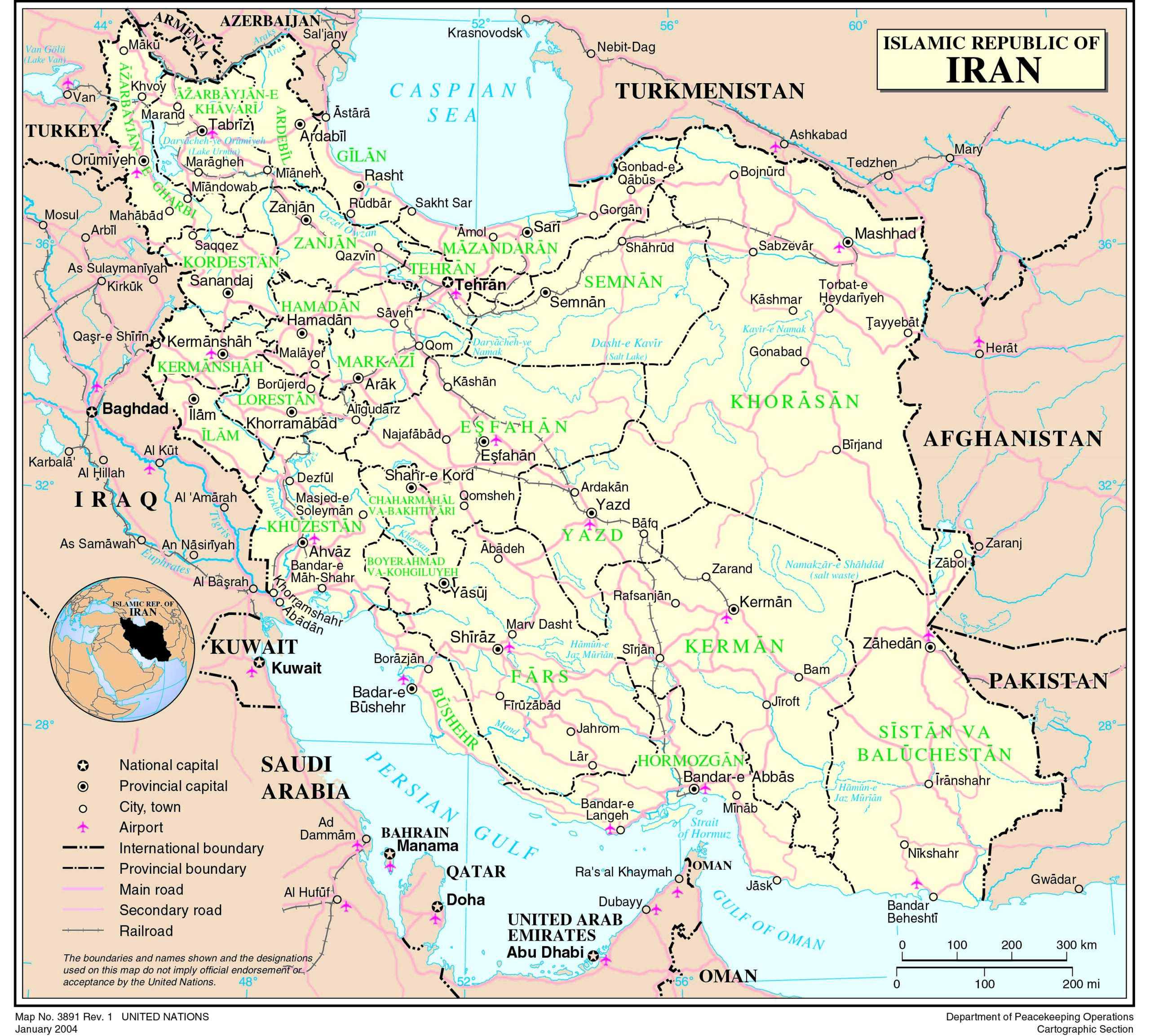
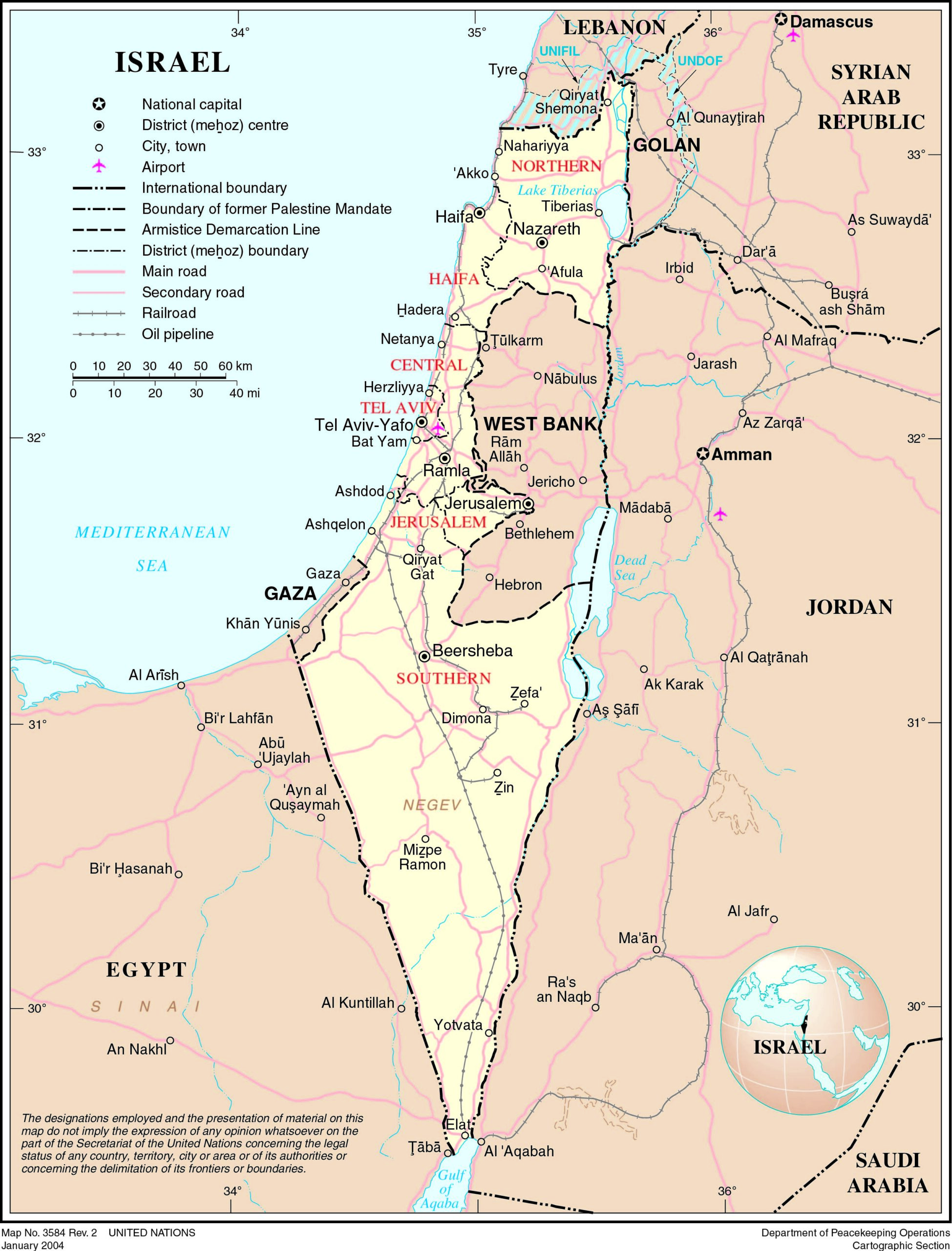
The armed conflicts between Israel and Iran represent a significant escalation in long-standing enmity between the two nations that dates back to the 1979 Islamic Revolution in Iran. Israel has long alleged that Iran is developing nuclear weapons, whereas Iran has argued that its nuclear programme is purely peaceful in nature.
The Joint Comprehensive Plan of Action (JCPOA), concluded on 14 July 2015 by China, France, Germany, the Russian Federation, the United Kingdom, the United States, the High Representative of the European Union (the E3/EU+3), and Iran,1Annex to the letter dated 16 July 2015 from the Permanent Representative of the United States to the United Nations addressed to the President of the UN Security Council, UN Doc S/2015/544, 16 July 2015. was endorsed by the United Nations (UN) Security Council a few days later as a peaceful alternative to the use of force.2UN Security Council Resolution 2231, adopted by unanimous vote in favour, 20 July 2015, operative para 1. The United States unilaterally repudiated the agreement in 2018.3The White House, ‘President Donald J. Trump is Ending United States Participation in an Unacceptable Iran Deal’, Fact Sheet, Foreign Policy, 8 May 2018.
Key events since July 2024
There were two international armed conflicts (IACs) between Iran and Israel in the reporting period – the first in October 2024 and then a second, more intense IAC between the two States from 13 to 24 June 2025 which is the focus of this entry. Hostilities between Iran and the United States in a separate IAC in June 2025 are then addressed.
On 1 October 2024, Iran launched more than 180 ballistic missiles at Israel in retaliation for Israel’s assassination of Hezbollah leaders in Lebanon. On 27 October, Israel responded to that attack by striking a missile defence system in the Iranian region of Isfahan. Following these tit-for-tat attacks on each other’s territory, tensions surrounding Iran’s nuclear activities erupted into an intensive IAC in June 2025.
On 12 June 2025, the Board of Governors of the International Atomic Energy Agency (IAEA) adopted a resolution on Iran’s failure to comply with its nuclear safeguards obligations.4‘NPT Safeguards Agreement with the Islamic Republic of Iran’, IAEA Board of Governors Resolution GOV/2025/38, Vienna, 12 June 2025. This was the first time in twenty years that the Board of Governors had formally declared Iran to be in breach of its nuclear non-proliferation obligations. The same day, the Israel Defence Forces (IDF) told people in Tehran’s District 18, which includes both military facilities and residential neighbourhoods, to evacuate the area.
On 13 June, at about 3:30 am local time in Tehran, Iranian state television reported a first volley of strikes, with residential areas in the capital said to have been hit. The attacks on 13 June marked the beginning of the IAC between Iran and Israel that lasted for twelve days. Israeli Prime Minister Benjamin Netanyahu declared the strikes ‘a targeted military operation to roll back the Iranian threat to Israel’s very survival’.5L. Lam, S. Ferreira Santos, J. Lukiv, and N. Williams, ‘Israel-Iran: How did latest conflict start and where could it lead’, BBC, 19 June 2025.
On 24 June, a ceasefire was agreed between the two States (reportedly with support from the United States). Israel said that Iran had fired missiles after the ceasefire had taken effect, and that the Israeli military had retaliated by striking a radar system near Tehran. Iran’s military denied violating the ceasefire, and a statement from Israel’s prime minister indicated that Israel’s retaliation was limited. Iranian president, Masoud Pezeshkian, later issued a statement acknowledging the ceasefire with Israel, saying that the conflict had been ‘imposed’ on Iran by Israel’s ‘adventurism’ and claiming that the ‘people of Iran’ had determined the end of the twelve-day war.
In August 2025, Mohammad Reza Aref, Iran’s First Vice-President, said that war with Israel could resume: ‘We are not even in a ceasefire; we are in a cessation of hostilities.’6S. Al-Atrush, ‘Iran: We had old missiles when Israel attacked – not any more’, The Times, 21 August 2025. In November 2025, Abbas Araghchi, the Iranian foreign minister, said that Tehran was willing to restart nuclear talks with Washington as long as it is treated with ‘dignity and respect’. He claimed that Iran did not have any undeclared nuclear sites, but that IAEA inspectors could not yet visit bombed nuclear sites ‘for security reasons’.7P. Wintour, ‘Iran says it could rejoin US nuclear talks if treated with “dignity and respect”’, The Guardian, 16 November 2025.
Conflict Classification and Applicable Law
There was a short-lived international armed conflict between Iran and Israel in October 2024 and then another between the two States on 13–24 June 2025. The use of force by Israel in Operation Rising Lion, which began on 13 June 2025, involved attacks on nuclear and military sites in Iran. It could be argued that the IAC in June was a continuation of the hostilities between Iran and Israel in October 2024. No actual hostilities had, however, occurred for more than six months after those exchanges.8M. Zwanenburg, ‘Select IHL Issues Arising from the Israel-Iran Conflict’, Articles of War, Lieber Institute, 19 June 2025. The better view is that the hostilities in June 2025 constituted a distinct armed conflict.
Both Iran and Israel are party to the four Geneva Conventions of 1949, but neither is a State Party to Additional Protocol I of 1977 (though Iran has signed it). Customary international humanitarian law (IHL) on the conduct of hostilities applied in full to the IACs between the two States.
Neither Iran nor Israel is a State Party to the Rome Statute of the International Criminal Court. Although both have signed the Statute, Israel subsequently notified the depositary (the UN Secretary-General) that it did not intend to ratify it.9Notification of Israel, 28 August 2002.
Compliance with IHL
Overview
Israeli officials claimed that Iran deliberately targeted civilians during the conflict.10‘In first, Israel reportedly strikes Iran’s critical infrastructure, hitting major gas field’, Ynetnews.com, 14 June 2025. The deliberate targeting of civilians is a serious violation of IHL and a likely war crime.11ICRC, Customary IHL Rule 1: ‘The Principle of Distinction between Civilians and Combatants’; and Rule 156: ‘Definition of War Crimes’. It was reported that a total oftwenty-eight Israelis, including children, were killed by Iranian attacks and a further 1,472 were injured (15 seriously).12UNWatch, ‘Israeli Casualties and Damage Caused by Iranian Missiles’, data updated as of 24 June 2025. In Iran, 436 civilians were killed and a further 2,071 injured, according to one report. In addition, 319 individuals whose civilian/military status was unknown were killed and 2,148 injured.13‘Twelve Days Under Fire: A Comprehensive Report on the Iran-Israel War’, Human Rights Activists News Agency (HRANA), 28 June 2025.
Both parties to the IAC in June 2025 appear to have directed attacks against civilian objects. Such attacks constitute a serious violation of IHL.14ICRC, Customary IHL Rule 7: ‘The Principle of Distinction between Civilian Objects and Military Objectives’; and Rule 156: ‘Definition of War Crimes’. Israel’s targeting of Evin prison, discussed below, was unquestionably an example of this. Israel also targeted Iran’s nuclear facilities, which are civilian objects. ‘Overall’, an expert with the Armed Conflict Location & Event Data project (ACLED) suggested, Israeli strikes ‘remained targeted and precise’, even though thousands of civilians were killed or injured in Iran. He observed that this was ‘a stark reminder that even so-called precision warfare carries a heavy human toll’.15A. Mehvar, ‘Twelve days that shook the region: Inside the Iran-Israel war’, Q&A, ACLED, 4 July 2025. Furthermore, Israeli use of precision-guided munitions means that strikes on civilians or civilian objects cannot be readily dismissed as innocent mistakes.
Iran launched indiscriminate attacks against multiple urban areas in Israel, particularly Tel Aviv. This included a strike that hit Soroka hospital in Beersheba in southern Israel and another that hit the Aleh School for Special Needs Children in Tel Aviv’s Bnei Brak suburb. Each of these attacks constituted a serious violation of IHL.
Civilian Objects under Attack
Under customary IHL, attacks may only be directed against military objectives. Attacks must not be directed against civilian objects.16ICRC, Customary IHL Rule 7: ‘The Principle of Distinction between Civilian Objects and Military Objectives’. Civilian objects are all objects that are not military objectives17ICRC, Customary IHL Rule 9: ‘Definition of Civilian Objects’. and, as such, are protected against attack.18ICRC, Customary IHL Rule 10: ‘Civilian Objects’ Loss of Protection from Attack’. Military objectives are those objects which, by their nature, location, purpose or use, make an effective contribution to military action.19ICRC, Customary IHL Rule 8: ‘Definition of Military Objectives’. In addition, the object’s partial or total destruction, capture, or neutralisation must offer a definite military advantage in the prevailing circumstances.
In Israel, military bases20P. Nuki and B. Butcher, ‘Iran struck five Israeli military bases during 12-day war’, Daily Telegraph, 5 July 2025. as well as key population centres came under sustained missile attacks from the Islamic Revolutionary Guard Corps (IRGC). Iran mainly targeted Tel Aviv and areas around it. Targets included the Israeli Military Intelligence School, the Ministry of Interior in Haifa, the Weizmann Institute of Science, and an oil refinery and power plants.21A. Chughtai, ‘Visualising 12 days of the Israel-Iran conflict’, Al Jazeera, 26 June 2025. One of the most significant impacts was on the Soroka Medical Centre, with a strike injuring at least eighty people.22D. Bletter, ‘After devastating Iran strike, Soroka hospital closes to new patients, clears out wards’, Times of Israel, 20 June 2025. ACLED recorded at least thirty-six direct hits (excluding those that landed in open areas) that killed at least twenty-eight people, all but one of whom were civilians.
It is suggested that hits in civilian areas might be the result of the ‘limited accuracy’ of Iran’s ballistic missiles.23Mehvar, ‘Twelve days that shook the region: Inside the Iran-Israel war’. This raises significant concern about Iran’s use of potentially indiscriminate weapons and its conduct of indiscriminate attacks. Indiscriminate attacks, which are prohibited under treaty and customary IHL,24ICRC, Customary IHL Rule 11: ‘Indiscriminate Attacks’. are those which do not target a specific military objective or which use a weapon that cannot be targeted with sufficient accuracy.25ICRC, Customary IHL Rule 12: ‘Definition of Indiscriminate Attacks’. Based on an amicus curiae brief by a number of leading international lawyers with annexed opinions by military experts, the IHL in Focus project considers any medium or long-range weapon that cannot reliably fire or drop its munitions within a 400-metre radius of its target to be indiscriminate.26International Criminal Tribunal for the former Yugoslavia (ICTY), Prosecutor v Gotovina (Appeals Chamber) (Case No IT-06-90-A), ‘Application and Proposed Amicus Curiae Brief Concerning the 15 April 2011 Trial Chamber Judgment and Requesting that the Appeals Chamber Reconsider the Findings of Unlawful Artillery Attacks during Operation Storm’. Indiscriminate attacks are a serious violation of IHL and a possible war crime.27ICRC, Customary IHL Rule 156: ‘Definition of War Crimes’.
Attacks against medical facilities
Insecurity Insight identified twenty-seven strikes as having impacted healthcare facilities in Iran in some manner between 13 and 24 June 2025.In total,medical facilities were said to have been damaged on fourteen occasions, in the course of which sixteen health workers were killed and three othersinjured. Incidents were documented in towns and cities across westernIran, with most occurring in Tehran.
Hospitals, including a children’s facility, health centres, and an emergency health building,were damaged by explosive weapons launched by Israeli forces.Damaged facilities included Farabi hospital in Kermanshah city, which was hit by a blast waveand explosive fragments from an airstrike on 15 June. Patients were said to have been injured, and specialized wards as well as the intensive care unit were damaged.28Insecurity Insight, ‘Attacks on Health Care in Iran and Israel During 11 Days of Hostilities, 13–24 June 2025’, June 2025. According to the Human Rights Activists News Agency (HRANA), during the conflict a total of six emergency medical bases and two maternal-child health centres in Iran were either destroyed or severely damaged.29‘Twelve Days Under Fire: A Comprehensive Report on the Iran-Israel War’, HRANA, 28 June 2025.
On 19 June, amid a wave of missiles launched by Iran overnight, Soroka hospital in Beersheba in southern Israel was hit. Iranian State media said the strike had targeted a military site next to the hospital and not the facility itself. The Islamic Republic News Agency (IRNA) said on Telegram that the ‘main target’ of the missile attack had been ‘the large [Israeli army] Command and Intelligence (IDF C4I) headquarters and the military intelligence camp in the Gav-Yam Technology Park’. It said that this facility was located ‘beside’ Soroka hospital.
In a post on the social media site X, the Iranian Minister of Foreign Affairs shared a map that purported to show two Israeli military targets right next to Soroka hospital. But an investigation by Euronews journalists concluded that the map was ‘fake’. The street names and topography, they found, ‘do not correspond to the area, and major sites, including the Gav-Yam Negev technology park, are misspelt’. Users of social media platform X ‘have also misleadingly claimed that a video of an Iranian strike hitting the Israeli city of Tel Aviv on Thursday shows an impact on the Gav-Yam Negev park.’30M. Gwyn Jones, ‘Verifying conflicting narratives about Iran’s strike on an Israeli hospital’, Euronews, 20 June 2025. The exact site of the IDF C4I headquarters is classified information and cannot be verified. An IDF technology campus is at the Gav-Yam Technology park, which is located around 1.5 kilometres to the north-east of the site of the strike.31Ibid.
IRNA claimed that the hospital suffered only minor damage from the shockwave of the missile attack. ‘The military infrastructure was a precise and direct target’, it claimed. Reporting from the hospital, however, BBC correspondents described the damage as extensive, with debris and plumes of smoke floating through the air long after the blast. Several wards were completely destroyed as fire spread through one of the buildings, causing windows to smash and ceilings to collapse, hospital authorities said. Professor Shlomi Codish, the hospital’s chief executive, said that around 200 patients would be transferred to other hospitals.32R. Comerford, ‘Israeli hospital hit by Iranian missile strike’, BBC, 19 June 2025. The precise number of casualties was not publicly confirmed, although the hospital authorities said at the time that at least eighty people had been injured.33Bletter, ‘After devastating Iran strike, Soroka hospital closes to new patients, clears out wards’. In condemning the attack, Prime Minister Netanyahu promised a response, saying: ‘We will exact the full price from the tyrants in Tehran.’34‘Iran launches missile attacks as Israel strikes nuclear sites’, Al Jazeera, 19 June 2025. Israel’s Minister of Defence described the attack as a ‘war crime’.35Gwyn Jones, ‘Verifying conflicting narratives about Iran’s strike on an Israeli hospital’.
Despite the claims by Israeli leaders and the extensive damage inflicted on the hospital, there is insufficient information to conclude that the strike was targeted at the hospital. It is, however, likely to have been either an indiscriminate attack or, more likely, a disproportionate attack, both of which are war crimes under customary law.36ICRC, Customary IHL Rule 156: ‘Definition of War Crimes’. The risk of hitting the hospital should have been considered in a proportionality assessment and appropriate precautions taken in the choice of munitions to minimize that risk.
Attacks against schools
On 16 June 2025, an Iranian missile hit the Aleh School for Special Needs Children in Tel Aviv’s Bnei Brak suburb, killing one elderly man in a neighbouring building. The school is Israel’s most advanced educational and therapeutic centre for children and teens with severe disabilities.37‘Missile from Iran destroys ALEH’s campus for disabled children’, 7 Israel National News, 16 June 2025. Dozens of people in the school narrowly escaped after fleeing moments before the building collapsed.38S. Freid, ‘“Aleh” special education center heavily damaged in Iranian missile strike’, Ynetnews.com, 17 June 2025. The target of the strike is not known, but there was no evidence of a nearby military objective and this appears to have been an indiscriminate attack.
Attacks against scientific research facilities
At dawn on 15 June 2025, an Iranian missile hit the Weizmann Institute of Science in Rehovot, south of Tel Aviv.39A. Hamdan, ‘Iranian strike hits Israel’s most important scientific centre. What do we know about the Weizmann Institute?’, Euronews, 15 June 2025. The Institute, said to be one of Israel’s most prominent scientific centres, is known for its technological support to the Israeli military in the fields of artificial intelligence (AI) for data analysis and combat guidance, drone technologies and autonomous systems, advanced electronic tracking and jamming tools, and alternative GPS navigation systems.40Ibid. But unless it was producing weapons or otherwise qualified as a military objective under IHL, the Institute was a civilian object.41Y. Dinstein, ‘Legitimate Military Objectives Under The Current Jus In Bello’, International Law Studies, Vol 78 (2002), 139–72, at p 147. The ICRC affirms in its 2009 Interpretive Guidance on the notion of Direct Participation in Hostilities under International Humanitarian Law that ‘examples of indirect participation include scientific research and design’.42N. Melzer, Interpretive Guidance on Direct Participation in Hostilities under International Humanitarian Law, ICRC, Geneva, 2009, p 51. No injuries were reported by the Institute as having resulted from the attack.43E. Kintisch, ‘Iranian missile strike devastates two buildings at Israel’s Weizmann Institute’, Science, 17 June 2025.
Many students at the facility were pursuing master’s and doctoral programmes in mathematics, physics, biology, chemistry, and computer science.44Hamdan, ‘Iranian strike hits Israel’s most important scientific centre. What do we know about the Weizmann Institute?’. According to Milko van der Boom, Dean of the Faculty of Chemistry, around forty-five chemical laboratories sustained serious damage. More than 200 international students and postdoctoral fellows who lived in housing at the university had been relocated off campus, while 70 had left Israel as of 20 June.45R. Trager, ‘Major Israeli research institute loses around 45 labs to Iranian missile strike’, Chemistry World, 23 June 2025. Initially, Israeli media did not show pictures or share details on the extent of the damage to the Institute facilities. This is in accordance with instructions from the IDF that prevent the disclosure of damage to sensitive facilities.46Hamdan, ‘Iranian strike hits Israel’s most important scientific centre. What do we know about the Weizmann Institute?’. But other media sources provided photographs on damage to parts of the University.47Trager, ‘Major Israeli research institute loses around 45 labs to Iranian missile strike’.
Strikes against nuclear facilities
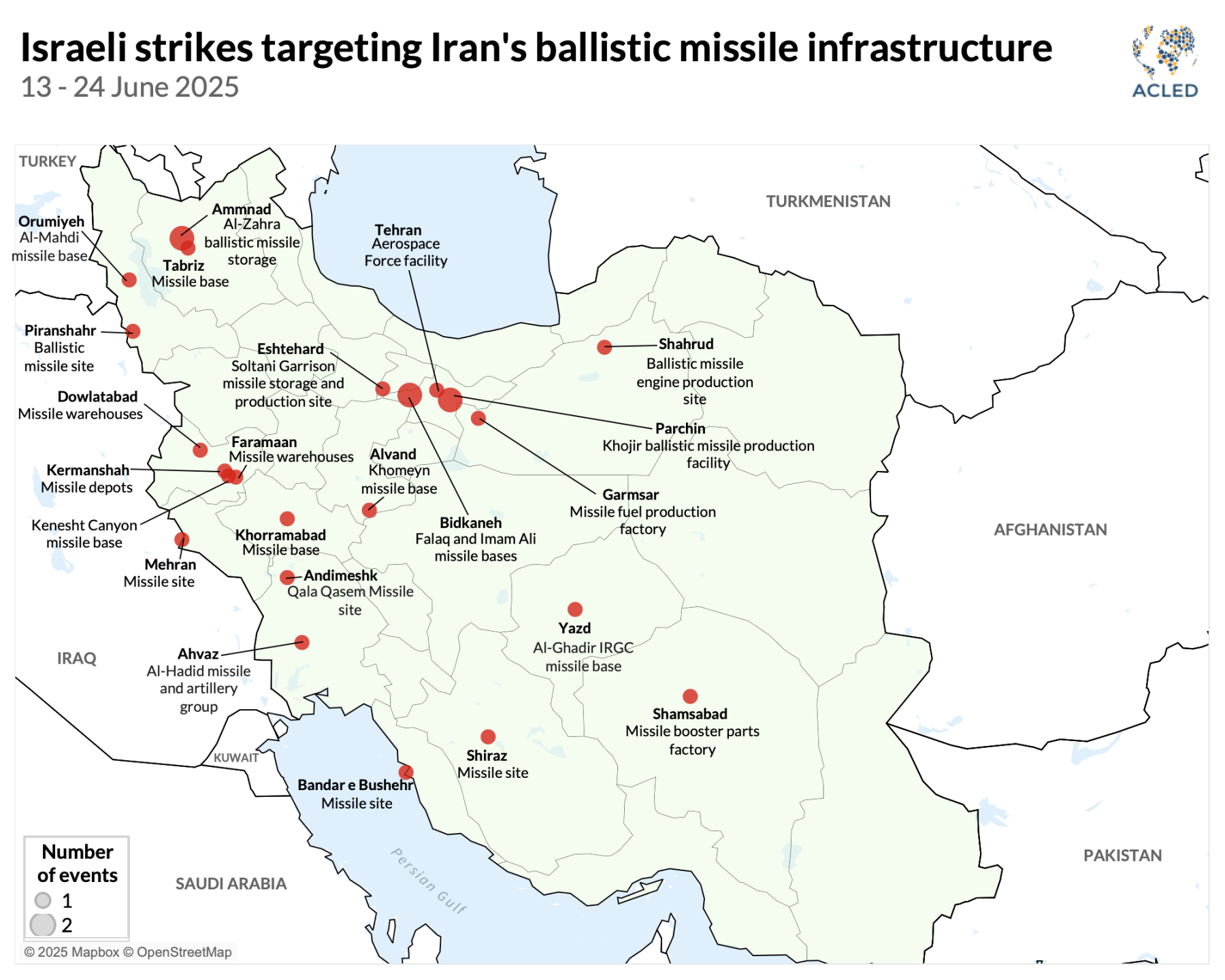
A range of nuclear facilities in Iran were struck by Israeli bombs and missiles during the armed conflict in June. There was an underground uranium enrichment section at Natanz, the main enrichment facility, which was impacted. Following the first wave of attacks, the IDF said that it had damaged the site’s underground structures, including a multi-storey enrichment hall with centrifuges, electrical rooms, and additional supporting infrastructure. It also stated that ‘vital infrastructure at the site that allows for its continuous functioning and the continued advancement of the Iranian regime’s project to obtain nuclear weapons was attacked’.48F. Marsi, ‘Israel kills nuclear scientists, strikes sites in Iran: Who did it target?’, Al Jazeera, 13 June 2025. In the IAEA’s assessment, prior to the US attacks on 22 June 2025, Israel did not damage Iran’s other uranium enrichment plant at Fordow, which is buried inside a mountain and was similarly enriching uranium to sixty per cent purity. 49J. T. Psaropoulos, ‘Did Trump approve Israel’s attack on Iran, and is the US preparing for war?’, Al Jazeera, 18 June 2025.
On 13 June 2025, Rafael Grossi, Director-General of the IAEA, issued astatement on the situation in Iran in which he described the attacks by Israel on Iranian nuclear facilities as a ‘deeply concerning’ development. He said: ‘I have repeatedly stated that nuclear facilities must never be attacked, regardless of the context or circumstances, as it could harm both people and the environment.’50IAEA, ‘Statement on the Situation in Iran – by IAEA Director General Rafael Mariano Grossi’, 13 June 2025. The Director-General noted that the IAEA had ‘consistently underlined that “armed attacks on nuclear facilities could result in radioactive releases with grave consequences within and beyond the boundaries of the State which has been attacked”.’51Ibid, citing IAEA Resolution GC(XXXIV)/RES/533. A number of UN human rights experts issued a statement in which they endorsed the IAEA’s view that military action against or near nuclear facilities poses unacceptable risks to regional and international security, with the potential for catastrophic humanitarian and ecological impacts.52Office of the UN High Commissioner for Human Rights (OHCHR), ‘Special Procedures, UN experts condemn Israeli attack on Iran and urge end to hostilities’, Press release, 20 June 2025.
Under IHL, a treaty obligation specifically protects nuclear installations. Article 56 of Additional Protocol I of 1977 provides that ‘works or installations containing dangerous forces, namely dams, dykes and nuclear electrical generating stations, shall not be made the object of attack’. Although Israel is not a party to the Protocol, it is a customary rule that: ‘Particular care must be taken if works and installations containing dangerous forces, namely dams, dykes and nuclear electrical generating stations, and other installations located at or in their vicinity are attacked, in order to avoid the release of dangerous forces and consequent severe losses among the civilian population’.53ICRC, Customary IHL Rule 42: ‘Works and Installations Containing Dangerous Forces’.
The reference to ‘nuclear electrical generating stations’, however, indicates that other nuclear facilities that do not generate electrical power fall outside its scope of application. This is evidenced by the text of the provision, which uses the term ‘namely’ rather than ‘such as’.54M. Zwanenburg, ‘Select IHL Issues Arising from the Israel-Iran Conflict’, Articles of War, Lieber Institute, 19 June 2025. Hence, nuclear facilities other than nuclear power plants fall outside the scope of the rule.55Ibid, citing G. Corn and S. Watts, ‘Protection of Nuclear Facilities in Warfare under International Law’, Joint PIJIP/TLS Research Paper Series, American University Washington College of Law, December 2024. Nevertheless, customary IHL rules of targeting – distinction and proportionality in attack, underpinned by the duty to take all feasible precautions in attack – still applied to any attack by Israel, including on a nuclear site. For Iran’s nuclear facilities to constitute a lawful military objective, it would need to be clear that they were being used to develop weapons – in this case a nuclear explosive device. That evidence is lacking, even though considerable suspicion surrounds Iran’s nuclear programme, as the IAEA confirmed in its resolution of 12 June.
Even if the nuclear facilities targeted by Israel constituted legitimate military objectives, the principle of proportionality would be a significant constraint. As Marten Zwanenburg has argued: ‘In terms of proportionality, it can be argued that neutralizing the construction of nuclear weapons offers a significant military advantage. On the other hand, the potential for serious civilian harm arising from radiological release must be considered in considering the expected civilian harm. It was reported that Israel did not strike Iran’s Fordo nuclear site for fear of triggering radiological fallout.’56Zwanenburg, ‘Select IHL Issues Arising from the Israel-Iran Conflict’, citing ‘Risk of radiological disaster: Key Iran nuclear site Israel didn’t strike – possibly on purpose’, Ynetnews.com, 14 June 2025. In fact, Israel did subsequently attack the Fordow (an alternative spelling) nuclear site, where uranium enrichment was being undertaken, but only after it had been hit by the United States. The US attack is discussed below.
Strikes against cultural and religious property
An Iranian strike in downtown Haifa on 20 June 2025 damaged at least two places of worship. An Iranian missile struck an abandoned building in the port city of Haifa, Israel’s third-largest city. The blast damaged several surrounding buildings, including a mosque and a church. Clerics were present at the mosque at the time of the strike, Israel’s Ministry of Interior said in a statement. The Church of Our Lady and the House of Grace, a halfway house associated with the church, were also damaged by the blast, according to Jamal Shehade, the director of the halfway house. Mr Shehade described the damage to the church building, which was erected in 1862, as not being severe, but said the coloured-glass windows had been shattered. A nearby government building that houses the Ministry of Interior was also partially damaged, according to photos and videos taken after the blast.57E. Shao and J. Lee, ‘An Iranian strike in downtown Haifa damaged at least two places of worship’, The New York Times, 20 June 2025.
Strikes against media facilities
On 17 June, Israeli aircraft hit the headquarters of Iran’s State broadcaster in Tehran, after the Israeli military told residents to evacuate the area of the capital where the headquarters is located. A live broadcast on IRINN, Iran Broadcasting’s television news channel, was briefly interrupted after blasts were heard and the studio lights went out. Iranian media reported that one staff member at least was killed. The IDF said it had targeted a ‘communications centre of the Iranian regime’. The Iranian Ministry of Foreign Affairs said the strike was a ‘war crime’.58D. Gritten, ‘Israel bombs Iran state TV during live broadcast’, BBC, 17 June 2025.
Attacking a TV station purely because it supports the regime in power and broadcasts propaganda is unlawful.59S. Casey-Maslen with S. Haines, Hague Law Interpreted, Hart, Oxford, 2018, 104. One of the incidents for which Dragomir Milošević, the commander of the Bosnian Serb forces above Sarajevo from August 1994, was convicted of war crimes, was an attack on a TV building in Sarajevo. Commander Milošević had written in a letter: ‘Our artillery forces are responding with precision to the Muslim artillery attacks. In one such response on 28 June they hit the BH Radio and Television Centre, the centre of media lies against the just struggle of the Serbian people’.60ICTY, Prosecutor v Dragomir Milošević, Judgment (Trial Chamber III) (Case No IT-98-29/1-T), 12 December 2007, para 836. Two days later, Colonel Meille, the acting sector commander of the UN Protection Force (UNPROFOR) in Sarajevo, wrote to the accused to protest with about the shelling of civilian objects in Sarajevo, in particular, the shelling of the television building.61Ibid, para 852. According to the ICRC, indirect participation in hostilities, which does not lead to loss of civilian immunity from attack, encompasses war-sustaining actions, such as ‘political propaganda’.62Melzer, Interpretive Guidance on Direct Participation in Hostilities under International Humanitarian Law, p 51.
In contrast, when a broadcasting station is used for military command and control, it becomes a military objective. Journalists working as such, however, remain civilians protected from attack. In the case of the attack on the TV building in Tehran, the Israeli military spokesperson, Brigadier General Effie Defrin, said that the IDF had targeted ‘a communications centre of the Iranian regime, which served Iran’s armed forces’. He added: ‘According to our intelligence, the centre was used by military forces to advance operational activity under the cover of civilian assets and infrastructure’. This would mean that the building was a lawful military objective. In contrast, Israel’s Minister of Defence, Israel Katz, called the TV channel the ‘propaganda and incitement broadcasting authority of the Iranian regime’.63Gritten, ‘Israel bombs Iran state TV during live broadcast’. If it were targeted on this basis, the attack would have been directed against a civilian object and a serious violation of IHL.
Strikes against detention centres
In one strike on 23 June, Israel hit Evin prison in Tehran, which holds many political detainees, damaging parts of the facility.64Ibid. The strike hit the medical ward as well as other areas of the prison.65F. Fassihi, P. Behrooz, and L. Nikounazar, ‘Israel’s Deadly Assault on Iran Prison Incites Fury, Even Among Dissidents’, The New York Times, 6 July 2025 (Updated 9 July 2025). In total, the attack killed more than seventy people – staff, inmates, and visiting family members.66Mehvar, ‘Twelve days that shook the region: Inside the Iran-Israel war’. Minister of Defence Katz said it had hit ‘regime targets and agencies of government repression’ across Tehran, including Evin while the Iranian judiciary’s Mizan news agency claimed that the attack violated international law.67Ibid. The spokesperson of the Office of the UN High Commissioner for Human Rights (OHCHR) told media that the prison was not a military objective according to the laws of war and that its targeting constituted ‘a grave breach’ of IHL.68OHCHR, ‘Iran-Israel war: UN rights office concerned over strike on Tehran prison, reported espionage arrests’, Press release, Geneva, 24 June 2025.
Indeed, while the prison was a site where serious human rights violations were perpetrated by the Iranian regime,69According to The New York Times: ‘For five decades, Iran’s rulers, from the shah to the clerics, have used Evin as the place to punish dissent with detention, interrogation, torture and execution.’ F. Fassihi, P. Behrooz, and L. Nikounazar, ‘Israel’s Deadly Assault on Iran Prison Incites Fury, Even Among Dissidents’, The New York Times, 6 July 2025 (Updated 9 July 2025). it was not a lawful military objective under IHL. Its nature, location, purpose, or use did not make an effective contribution to military action. It was therefore a civilian object protected as such, and Israel’s deliberate attack on it amounted to a serious violation of IHL. Michael Page, the deputy Middle East director of Human Rights Watch, declared: ‘Israel’s strikes on Evin prison on June 23 killed and injured scores of civilians without any evident military target in violation of the laws of war and is an apparent war crime’.70Human Rights Watch, ‘Iran: Israeli Attack on Evin Prison an Apparent War Crime’, 14 August 2025.
In a post on social media, Israel’s Minister of Foreign Affairs, Gideon Saar, suggested the attack was both retaliation for Iranian missile strikes on civilian structures and somehow an act of liberation.71Cited in Fassihi et al, ‘Israel’s Deadly Assault on Iran Prison Incites Fury, Even Among Dissidents’. But as Saeedeh Fathi, a journalist and activist imprisoned in Evin during the 2022 Woman, Life, Freedom protests (now living in exile) declared:
I had once hoped that the great iron gate of Evin would fall – not from an airstrike, but opened by the people. That light would pour through it, not smoke. That the fall of that gate would be a celebration, not a mourning.72S. Fathi, ‘I had hoped that the gate of Iran’s Evin prison would be opened by the people’, The New Humanitarian, 28 July 2025.
Civilians under Attack
HRANA said that the Israeli airstrikes on Iranian soil that began on 13 June resulted in at least 5,665 casualties (1,190 killed and 4,475 injured), a figure that includes both military personnel and civilians. The attacks, which affected twenty-eight provinces across the country, caused severe damage to critical military, civilian, medical, and emergency infrastructure, and posed a serious threat to the safety of Iranians nationwide. During that period, 1,596 individuals were also arrested by the Iranian regime’s security forces, according to HRANA’s research. Their report further found that a total of 436 civilians were killed and a further 2,071 injured, while 435 military personnel were killed and 256 were injured. In addition, 319 individuals whose civilian/military status was unknown were killed and 2,148 were injured.73‘Twelve Days Under Fire: A Comprehensive Report on the Iran-Israel War’, HRANA.
According to the report of The New York Times on the Israeli attack of 23 June 2025 on Evin prison it appears – based on information from Iranian media, activists and rights groups – that the dead and wounded included visiting family members of prisoners, social workers, a lawyer, physicians and nurses, a five-year-old child, teenage soldiers guarding the doors as part of mandatory military service, administrative staff, and residents of the area.74Fassihi et al, ‘Israel’s Deadly Assault on Iran Prison Incites Fury, Even Among Dissidents’. An unknown number of inmates – also protected civilians under IHL – were harmed. Only the soldiers present at the facility could have been lawful military objectives. Moreover, the timing of the attack, at noon during a working day, meant that the prison had been full of visitors, lawyers, and medical and administrative staff. This may also violate the duty to take all feasible precautions in attack.75Ibid.
Attacks against medical personnel
At least 16 health workers were killed in five incidents between 13 and 16 June 2025 in Iran. Nine victims worked for the Iranian Red Crescent Society and were killed while responding to victims of previous bombings. In one instance, two Iranian Red Crescent Society paramedics were killed when their ambulance was hit and destroyed by an Israeli airstrike in Tehran province on 16 June. Two health workers were killed in hospital bombings, including a doctor at Evin Prison who was killed when Israeli airstrikes hit and destroyed the infirmary. Two doctors and a dentist were killed in three separate incidents when their homes in Tehran were hit by Israel airstrikes. Patients’ access to healthcare services was disrupted by the conflict, such as Ameneh Infant Care Centre in Tehran to where infants and children were evacuated after an Israeli warning to clear the district.76Insecurity Insight, ‘Attacks on Health Care in Iran and Israel During 11 Days of Hostilities’.
HRANA claimed that, over the course of the conflict, five doctors and four aid workers were killed and at least forty-nine others injured. Nine ambulances and seven hospitals were hit or damaged by shrapnel. Six ambulances and a Red Crescent Society helicopter were also impacted.77‘Twelve Days Under Fire: A Comprehensive Report on the Iran-Israel War’, HRANA. Not enough is known about the circumstances of these incidents to determine whether IHL was complied with in each instance.
Attacks against nuclear scientists
The extent to which Iranian nuclear scientists were lawfully targeted during the armed conflict is highly debatable. Israel stated that during the IDF strikes at the onset of Operation Rising Lion, ‘nine senior scientists and experts who advanced the Iranian regime’s nuclear weapons program, were eliminated. (…) All of the eliminated scientists and experts served as significant knowledge centres in the Iranian nuclear project and possessed decades of accumulated experience in the development of nuclear weapons.’78IDF, ‘The IDF Eliminated Nine Senior Scientists and Experts in the Iranian Nuclear Project’, Press release, 14 June 2025.
It is clear that if the scientists were members of Iran’s armed forces, they were combatants and could lawfully be targeted. But civilian scientists – as with other civilians – may not be targeted unless and for such time as they are directly participating in hostilities.79ICRC Customary IHL Rule 6: ‘Civilians’ Loss of Protection from Attack’. The ICRC’s 2009 Interpretive Guidance on Direct Participation in Hostilities thus states that nuclear scientists generally do not lose their protection from attack as the requirement of ‘direct causation’ would not be met.80Melzer, Interpretive Guidance on Direct Participation in Hostilities under International Humanitarian Law, p 49.
The issue was specifically addressed by a number of experts during one of the ICRC expert meetings that led to the ICRC’s issuance of its guidance. During that meeting in 2006, one expert asked whether ‘civilian specialists possessing expertise on decisive new means or method of warfare’ could be considered to be directly participating in hostilities. In response, ‘several experts insisted that there has been a consensus since the Second World War that neither armament industry employees, nor nuclear weapons experts, were considered to be directly participating in hostilities regardless of their value to the war effort’.81ICRC, ‘Fourth Expert Meeting on the Notion of Direct Participation in Hostilities, Geneva, 27–28 November 2006’, Summary Report, p 49.
During the same discussion, another expert agreed with the principle that a civilian weapons expert should not lose protection against direct attack, but doubted whether this assessment could be maintained in extreme situations where the expertise of a particular individual was of very exceptional and decisive value for the outcome of an armed conflict. For example, in the case of nuclear weapons experts during the Second World War, the enormous importance of the individual contribution to the war effort could perhaps have led to a conclusion deviating from the general rule.82Ibid.
As Zwanenburg observes, based on this exchange, it appears that the majority view of the legal experts consulted by the ICRC was that (civilian) nuclear scientists would not lose protection from attack. With regard to the statement of the expert who referred to the case of the Second World War, arguably, ‘the contribution of individual scientists in the current day is not comparable to the contribution of, for example, Robert Oppenheimer some 80 years ago’.83Zwanenburg, ‘Select IHL Issues Arising from the Israel-Iran Conflict’. In case of doubt, Additional Protocol I of 1977 states that a person’s civilian status is to be presumed.84Art 50(1), Additional Protocol 1. This rule has crystallized as customary IHL.
Use of unguided bombs and missiles
IHL does not generally prohibit the use of unguided bombs or missiles, nor does it require the use of precision-guided munitions.85US Department of Defense, Law of War Manual, Washington, DC, 2015 (Updated July 2023) para 5.2.3.2. A similar position is taken in the military manuals of Australia, Canada and Germany. See also Y. Dinstein, The Conduct of Hostilities under the Law of International Armed Conflict, 3rd edn, Cambridge University Press, 2016, p 170, para 454; and G. D. Solis, The Law of Armed Conflict: International Humanitarian Law in War, 2nd edn, Cambridge University Press, 2016, p 294. That said, in its 2015 Law of War Manual, the US Department of Defense agreed that ‘under certain circumstances, it may be advantageous to use … precision-guided munitions to minimize the risk of incidental harm’. Furthermore, the German Manual on the Law of Armed Conflict has stated that: ‘There may however be situations in which the obligation to discriminate between military targets and civilians/civilian objects or the obligation to avoid or minimise collateral damage cannot be fulfilled without the use of such weapons.’86German Ministry of Defence, Manual on the Law of Armed Conflict, Joint Service Regulation (ZDv) 15/2, Berlin, 2013, p 162, para 1117. The risk of harm to civilians and damage to civilian objects when munitions are used in populated areas is particularly acute.87Political Declaration on Strengthening the Protection of Civilians from the Humanitarian Consequences arising from the Use of Explosive Weapons in Populated Areas, 2022, paras 1.2 and 1.3. As of November 2025, 90 states had endorsed the Declaration. Neither Iran nor Israel has done so. See the updated list here.
Iran’s use of unguided missiles likely involved a number of inherently indiscriminate weapons. At the very least, those incapable of consistently landing within 400 metres of the intended target may be deemed to be indiscriminate weapons. During the October 2024 attack on Israel, Iran’s medium-range ballistic missiles ‘demonstrated limited accuracy, restricting their value in counterforce roles’. The same missiles were reportedly used in the June 2025 conflict.88F. Hinz, ‘Israel’s attack and the limits of Iran’s missile strategy’, IISS, London, 18 June 2025. The Institute for the Study of War stated that Iran’s inability to accurately strike military or energy infrastructure highlighted ‘the limited accuracy of its ballistic missiles’. The stated and publicly known circular error probable (CEP) of Iranian medium-range ballistic missiles (MRBMs) used in the conflict are between 20 and 500 metres.89A. Borens, B. Schmida, B. Rezaei, R. Reddy, K. Campa, J. Moore, C. Moorman, A. Parry, and B. Carter, ‘Iran Update Special Report’, Report, Institute for the Study of War, 24 June 2025, 13. Thus, 3 CEP of the missiles (the area within which ninety-five per cent of missiles fired at a single point would be expected to fall) would be as high as 1.5 kilometres, meaning that several missiles could miss by this much – a clear example of an indiscriminate attack.
Cluster munitions
On at least three occasions, Iran fired cluster munitions at urban centres.90B. Peleg, O. Yaron, and E. Solomon, ‘How Three Iranian Cluster Missiles Hit Seven Israeli Cities’, Haaretz, 4 July 2025. Although these are not inherently indiscriminate weapons – and neither State is party to the 2008 Convention on Cluster Munitions that comprehensively prohibits them91Convention on Cluster Munitions; adopted at Dublin, 30 May 2008; entered into force, 1 August 2010. – cluster munitions are designed to spread over a wide area, significantly increasing the risk of harm to civilians when used in populated areas. The Appeals Chamber of the ICTY held in the Martić case that an attack on Zagreb in May 1995 using submunitions fired from an M-87 Orkan, and whose dispersion error was about 1,000 metres in each direction, was an indiscriminate attack.92ICTY, Prosecutor v Milan Martić, Judgment (Appeals Chamber) (Case No IT-95–11-A), 8 October 2008, para 250. The area of dispersion of the submunitions on the ground is about 20,000 metres. In that case, given its findings on the nature of the M-87 Orkan, the Appeals Chamber ‘could disregard the presence of military targets in Zagreb’ in holding that the attack was indiscriminate. Ibid, para 251. The nature and characteristics of the munitions fired by Iran are not known.
Protection of Persons in the Power of the Enemy
There were no reported detentions of combatants in the armed forces of either party to the conflict. But, as noted before, during and in the aftermath of the conflict, Iran detained hundreds of individuals on suspicion of spying for Israel, while Israel detained dozens of individuals on suspicion of spying for Iran.
Anyone detained in connection with an armed conflict must be treated humanely, in accordance with IHL and international human rights law, and accorded fundamental fair-trial guarantees.93ICRC, Customary IHL Rule 156: ‘Definition of War Crimes’. The right to a fair trial in any death penalty case is a non-derogable right.94Human Rights Committee, General Comment No. 36 – Article 6: right to life, UN Doc CCPR/C/GC/36, 3 September 2019, paras 41, 45, 67. Both Iran and Israel are States Parties to the 1966 International Covenant on Civil and Political Rights.95International Covenant on Civil and Political Rights; adopted 16 December 1966, entered into force, 23 March 1976 (ICCPR). The Covenant prohibits extrajudicial, summary or arbitrary executions, torture and other ill-treatment, and arbitrary detention.96Arts 6, 7, 10, ICCPR. Enforced disappearances connected with an armed conflict are a war crime97ICRC, Customary IHL Rule 156: ‘Definition of War Crimes’. as well as a violation of the right to life.98Human Rights Committee, General Comment No. 36 – Article 6’, paras 57, 58.
In Iran, there were reports of summary executions, enforced disappearances, and mass arrests, with at least six individuals, including three Kurdish men, reportedly executed for ‘espionage for Israel’. Hundreds of individuals, including social media users, journalists, human rights defenders, foreign nationals – particularly Afghans – and members of ethnic and religious minorities such as Baha’is, Kurds, Balouchis and Ahwazi Arabs, have been detained on accusations of ‘collaboration’ or ‘espionage’.99OHCHR, ‘UN experts urge Iran to choose protection over repression after ceasefire’, Press release, Geneva, 4 July 2025. In early August 2025, Iran executed by hanging Rouzbeh Vadi, an alleged spy who was accused of helping Israel to assassinate one of Iran’s nuclear scientists.100‘Iran executes alleged spy who helped Israel assassinate nuclear scientist’, The Times, 6 August 2025, at: https://bit.ly/4fCoVoN (subscription required).
UN experts had earlier expressed alarm at official statements announcing expedited trials on accusations of espionage, putting individuals at heightened risk of summary execution or punishment without adequate due process. Furthermore, Iran’s Parliament was considering new legislation that would classify intelligence or espionage activities conducted for ‘hostile Governments’ as ‘corruption on earth’ – an offence punishable by death.101OHCHR, ‘UN experts urge Iran to choose protection over repression after ceasefire’.
Israel also detained individuals suspected of spying for Iran. Among those charged with espionage are Russian-Israeli soldiers from the Haifa suburbs, a Haredi man from Bnei Brak, a West Bank settler, and an Arab Israeli college student. The growing number of alleged Iranian agents even prompted Israel to open up a new wing for them in Haifa’s Damon prison.102C. Summers, ‘Luring in Israelis of all types, Iran casts about in hopes of snagging “quality” spies’, Times of Israel, 16 July 2025. There were no details at the time of writing of their treatment in detention.
- 1
- 2UN Security Council Resolution 2231, adopted by unanimous vote in favour, 20 July 2015, operative para 1.
- 3The White House, ‘President Donald J. Trump is Ending United States Participation in an Unacceptable Iran Deal’, Fact Sheet, Foreign Policy, 8 May 2018.
- 4‘NPT Safeguards Agreement with the Islamic Republic of Iran’, IAEA Board of Governors Resolution GOV/2025/38, Vienna, 12 June 2025.
- 5L. Lam, S. Ferreira Santos, J. Lukiv, and N. Williams, ‘Israel-Iran: How did latest conflict start and where could it lead’, BBC, 19 June 2025.
- 6S. Al-Atrush, ‘Iran: We had old missiles when Israel attacked – not any more’, The Times, 21 August 2025.
- 7P. Wintour, ‘Iran says it could rejoin US nuclear talks if treated with “dignity and respect”’, The Guardian, 16 November 2025.
- 8M. Zwanenburg, ‘Select IHL Issues Arising from the Israel-Iran Conflict’, Articles of War, Lieber Institute, 19 June 2025.
- 9Notification of Israel, 28 August 2002.
- 10‘In first, Israel reportedly strikes Iran’s critical infrastructure, hitting major gas field’, Ynetnews.com, 14 June 2025.
- 11ICRC, Customary IHL Rule 1: ‘The Principle of Distinction between Civilians and Combatants’; and Rule 156: ‘Definition of War Crimes’.
- 12UNWatch, ‘Israeli Casualties and Damage Caused by Iranian Missiles’, data updated as of 24 June 2025.
- 13‘Twelve Days Under Fire: A Comprehensive Report on the Iran-Israel War’, Human Rights Activists News Agency (HRANA), 28 June 2025.
- 14ICRC, Customary IHL Rule 7: ‘The Principle of Distinction between Civilian Objects and Military Objectives’; and Rule 156: ‘Definition of War Crimes’.
- 15A. Mehvar, ‘Twelve days that shook the region: Inside the Iran-Israel war’, Q&A, ACLED, 4 July 2025.
- 16ICRC, Customary IHL Rule 7: ‘The Principle of Distinction between Civilian Objects and Military Objectives’.
- 17
- 18
- 19ICRC, Customary IHL Rule 8: ‘Definition of Military Objectives’. In addition, the object’s partial or total destruction, capture, or neutralisation must offer a definite military advantage in the prevailing circumstances.
- 20P. Nuki and B. Butcher, ‘Iran struck five Israeli military bases during 12-day war’, Daily Telegraph, 5 July 2025.
- 21A. Chughtai, ‘Visualising 12 days of the Israel-Iran conflict’, Al Jazeera, 26 June 2025.
- 22D. Bletter, ‘After devastating Iran strike, Soroka hospital closes to new patients, clears out wards’, Times of Israel, 20 June 2025.
- 23Mehvar, ‘Twelve days that shook the region: Inside the Iran-Israel war’.
- 24
- 25
- 26International Criminal Tribunal for the former Yugoslavia (ICTY), Prosecutor v Gotovina (Appeals Chamber) (Case No IT-06-90-A), ‘Application and Proposed Amicus Curiae Brief Concerning the 15 April 2011 Trial Chamber Judgment and Requesting that the Appeals Chamber Reconsider the Findings of Unlawful Artillery Attacks during Operation Storm’.
- 27ICRC, Customary IHL Rule 156: ‘Definition of War Crimes’.
- 28Insecurity Insight, ‘Attacks on Health Care in Iran and Israel During 11 Days of Hostilities, 13–24 June 2025’, June 2025.
- 29‘Twelve Days Under Fire: A Comprehensive Report on the Iran-Israel War’, HRANA, 28 June 2025.
- 30M. Gwyn Jones, ‘Verifying conflicting narratives about Iran’s strike on an Israeli hospital’, Euronews, 20 June 2025.
- 31Ibid.
- 32R. Comerford, ‘Israeli hospital hit by Iranian missile strike’, BBC, 19 June 2025.
- 33Bletter, ‘After devastating Iran strike, Soroka hospital closes to new patients, clears out wards’.
- 34‘Iran launches missile attacks as Israel strikes nuclear sites’, Al Jazeera, 19 June 2025.
- 35Gwyn Jones, ‘Verifying conflicting narratives about Iran’s strike on an Israeli hospital’.
- 36ICRC, Customary IHL Rule 156: ‘Definition of War Crimes’.
- 37‘Missile from Iran destroys ALEH’s campus for disabled children’, 7 Israel National News, 16 June 2025.
- 38S. Freid, ‘“Aleh” special education center heavily damaged in Iranian missile strike’, Ynetnews.com, 17 June 2025.
- 39A. Hamdan, ‘Iranian strike hits Israel’s most important scientific centre. What do we know about the Weizmann Institute?’, Euronews, 15 June 2025.
- 40Ibid.
- 41Y. Dinstein, ‘Legitimate Military Objectives Under The Current Jus In Bello’, International Law Studies, Vol 78 (2002), 139–72, at p 147.
- 42N. Melzer, Interpretive Guidance on Direct Participation in Hostilities under International Humanitarian Law, ICRC, Geneva, 2009, p 51.
- 43E. Kintisch, ‘Iranian missile strike devastates two buildings at Israel’s Weizmann Institute’, Science, 17 June 2025.
- 44Hamdan, ‘Iranian strike hits Israel’s most important scientific centre. What do we know about the Weizmann Institute?’.
- 45R. Trager, ‘Major Israeli research institute loses around 45 labs to Iranian missile strike’, Chemistry World, 23 June 2025.
- 46Hamdan, ‘Iranian strike hits Israel’s most important scientific centre. What do we know about the Weizmann Institute?’.
- 47Trager, ‘Major Israeli research institute loses around 45 labs to Iranian missile strike’.
- 48F. Marsi, ‘Israel kills nuclear scientists, strikes sites in Iran: Who did it target?’, Al Jazeera, 13 June 2025.
- 49J. T. Psaropoulos, ‘Did Trump approve Israel’s attack on Iran, and is the US preparing for war?’, Al Jazeera, 18 June 2025.
- 50
- 51Ibid, citing IAEA Resolution GC(XXXIV)/RES/533.
- 52Office of the UN High Commissioner for Human Rights (OHCHR), ‘Special Procedures, UN experts condemn Israeli attack on Iran and urge end to hostilities’, Press release, 20 June 2025.
- 53
- 54M. Zwanenburg, ‘Select IHL Issues Arising from the Israel-Iran Conflict’, Articles of War, Lieber Institute, 19 June 2025.
- 55Ibid, citing G. Corn and S. Watts, ‘Protection of Nuclear Facilities in Warfare under International Law’, Joint PIJIP/TLS Research Paper Series, American University Washington College of Law, December 2024.
- 56Zwanenburg, ‘Select IHL Issues Arising from the Israel-Iran Conflict’, citing ‘Risk of radiological disaster: Key Iran nuclear site Israel didn’t strike – possibly on purpose’, Ynetnews.com, 14 June 2025.
- 57E. Shao and J. Lee, ‘An Iranian strike in downtown Haifa damaged at least two places of worship’, The New York Times, 20 June 2025.
- 58D. Gritten, ‘Israel bombs Iran state TV during live broadcast’, BBC, 17 June 2025.
- 59S. Casey-Maslen with S. Haines, Hague Law Interpreted, Hart, Oxford, 2018, 104.
- 60ICTY, Prosecutor v Dragomir Milošević, Judgment (Trial Chamber III) (Case No IT-98-29/1-T), 12 December 2007, para 836.
- 61Ibid, para 852.
- 62Melzer, Interpretive Guidance on Direct Participation in Hostilities under International Humanitarian Law, p 51.
- 63Gritten, ‘Israel bombs Iran state TV during live broadcast’.
- 64Ibid.
- 65F. Fassihi, P. Behrooz, and L. Nikounazar, ‘Israel’s Deadly Assault on Iran Prison Incites Fury, Even Among Dissidents’, The New York Times, 6 July 2025 (Updated 9 July 2025).
- 66Mehvar, ‘Twelve days that shook the region: Inside the Iran-Israel war’.
- 67Ibid.
- 68OHCHR, ‘Iran-Israel war: UN rights office concerned over strike on Tehran prison, reported espionage arrests’, Press release, Geneva, 24 June 2025.
- 69According to The New York Times: ‘For five decades, Iran’s rulers, from the shah to the clerics, have used Evin as the place to punish dissent with detention, interrogation, torture and execution.’ F. Fassihi, P. Behrooz, and L. Nikounazar, ‘Israel’s Deadly Assault on Iran Prison Incites Fury, Even Among Dissidents’, The New York Times, 6 July 2025 (Updated 9 July 2025).
- 70Human Rights Watch, ‘Iran: Israeli Attack on Evin Prison an Apparent War Crime’, 14 August 2025.
- 71Cited in Fassihi et al, ‘Israel’s Deadly Assault on Iran Prison Incites Fury, Even Among Dissidents’.
- 72S. Fathi, ‘I had hoped that the gate of Iran’s Evin prison would be opened by the people’, The New Humanitarian, 28 July 2025.
- 73‘Twelve Days Under Fire: A Comprehensive Report on the Iran-Israel War’, HRANA.
- 74Fassihi et al, ‘Israel’s Deadly Assault on Iran Prison Incites Fury, Even Among Dissidents’.
- 75Ibid.
- 76Insecurity Insight, ‘Attacks on Health Care in Iran and Israel During 11 Days of Hostilities’.
- 77‘Twelve Days Under Fire: A Comprehensive Report on the Iran-Israel War’, HRANA.
- 78IDF, ‘The IDF Eliminated Nine Senior Scientists and Experts in the Iranian Nuclear Project’, Press release, 14 June 2025.
- 79
- 80Melzer, Interpretive Guidance on Direct Participation in Hostilities under International Humanitarian Law, p 49.
- 81ICRC, ‘Fourth Expert Meeting on the Notion of Direct Participation in Hostilities, Geneva, 27–28 November 2006’, Summary Report, p 49.
- 82Ibid.
- 83Zwanenburg, ‘Select IHL Issues Arising from the Israel-Iran Conflict’.
- 84Art 50(1), Additional Protocol 1.
- 85US Department of Defense, Law of War Manual, Washington, DC, 2015 (Updated July 2023) para 5.2.3.2. A similar position is taken in the military manuals of Australia, Canada and Germany. See also Y. Dinstein, The Conduct of Hostilities under the Law of International Armed Conflict, 3rd edn, Cambridge University Press, 2016, p 170, para 454; and G. D. Solis, The Law of Armed Conflict: International Humanitarian Law in War, 2nd edn, Cambridge University Press, 2016, p 294.
- 86German Ministry of Defence, Manual on the Law of Armed Conflict, Joint Service Regulation (ZDv) 15/2, Berlin, 2013, p 162, para 1117.
- 87Political Declaration on Strengthening the Protection of Civilians from the Humanitarian Consequences arising from the Use of Explosive Weapons in Populated Areas, 2022, paras 1.2 and 1.3. As of November 2025, 90 states had endorsed the Declaration. Neither Iran nor Israel has done so. See the updated list here.
- 88F. Hinz, ‘Israel’s attack and the limits of Iran’s missile strategy’, IISS, London, 18 June 2025.
- 89A. Borens, B. Schmida, B. Rezaei, R. Reddy, K. Campa, J. Moore, C. Moorman, A. Parry, and B. Carter, ‘Iran Update Special Report’, Report, Institute for the Study of War, 24 June 2025, 13.
- 90B. Peleg, O. Yaron, and E. Solomon, ‘How Three Iranian Cluster Missiles Hit Seven Israeli Cities’, Haaretz, 4 July 2025.
- 91Convention on Cluster Munitions; adopted at Dublin, 30 May 2008; entered into force, 1 August 2010.
- 92ICTY, Prosecutor v Milan Martić, Judgment (Appeals Chamber) (Case No IT-95–11-A), 8 October 2008, para 250. The area of dispersion of the submunitions on the ground is about 20,000 metres. In that case, given its findings on the nature of the M-87 Orkan, the Appeals Chamber ‘could disregard the presence of military targets in Zagreb’ in holding that the attack was indiscriminate. Ibid, para 251.
- 93ICRC, Customary IHL Rule 156: ‘Definition of War Crimes’.
- 94Human Rights Committee, General Comment No. 36 – Article 6: right to life, UN Doc CCPR/C/GC/36, 3 September 2019, paras 41, 45, 67.
- 95International Covenant on Civil and Political Rights; adopted 16 December 1966, entered into force, 23 March 1976 (ICCPR).
- 96Arts 6, 7, 10, ICCPR.
- 97ICRC, Customary IHL Rule 156: ‘Definition of War Crimes’.
- 98Human Rights Committee, General Comment No. 36 – Article 6’, paras 57, 58.
- 99OHCHR, ‘UN experts urge Iran to choose protection over repression after ceasefire’, Press release, Geneva, 4 July 2025.
- 100‘Iran executes alleged spy who helped Israel assassinate nuclear scientist’, The Times, 6 August 2025, at: https://bit.ly/4fCoVoN (subscription required).
- 101OHCHR, ‘UN experts urge Iran to choose protection over repression after ceasefire’.
- 102C. Summers, ‘Luring in Israelis of all types, Iran casts about in hopes of snagging “quality” spies’, Times of Israel, 16 July 2025.