Conflict Overview
Key Events in Gaza Since 1 July 2024
The armed conflict between Israel and Hamas, as well as the conflict between Israel and Palestinian Islamic Jihad in the Gaza Strip, continued at a very high intensity during the reporting period. All parties continued to perpetrate war crimes and crimes against humanity. On 21 November 2024, the International Criminal Court issued arrest warrants for Israeli Prime Minister Benjamin Netanyahu and former Minister of Defence Yoav Gallant for the war crimes of directing an attack against the civilian population and starvation as a method of warfare; and the crimes against humanity of murder, persecution, and other inhumane acts.1ICC, ‘Situation in the State of Palestine: ICC Pre-Trial Chamber I rejects the State of Israel’s challenges to jurisdiction and issues warrants of arrest for Benjamin Netanyahu and Yoav Gallant’, Press release, 21 November 2024. The senior Hamas officials whose indictment the ICC Prosecutor had also sought were all killed before they could face justice.2ICC, ‘Situation in the State of Palestine: ICC Pre-Trial Chamber I issues warrant of arrest for Mohammed Diab Ibrahim Al-Masri (Deif)’, 21 November 2024.
On 16 September 2025, the United Nations Commission of Inquiry on Palestine and Israel issued a report stating that Israel has committed genocide against Palestinians in the Gaza Strip. The Commission concluded ‘on reasonable grounds’ that Israel was committing genocide by killing and by causing serious bodily and mental harm to the Palestinians as a group, and by inflicting conditions of life calculated to bring about their physical destruction and imposing measures intended to prevent births in the group.3UN Independent International Commission of Inquiry on the Occupied Palestinian Territory, including East Jerusalem, and Israel (hereafter, UN Commission of Inquiry on Palestine and Israel), ‘Legal analysis of the conduct of Israel in Gaza pursuant to the Convention on the Prevention and Punishment of the Crime of Genocide’, Conference Room Paper, UN Doc A/HRC/60/CRP.3, 16 September 2025, para 252. It identified statements by Israeli authorities as direct evidence of genocidal intent and concluded that Israel’s pattern of conduct was circumstantial evidence of genocidal intent – ‘the only reasonable inference that could be drawn from the totality of the evidence’.4Ibid, para 254.
The case brought by South Africa against Israel before the International Court of Justice under the 1948 Genocide Convention has not yet been decided on the merits, but in an Order of 24 May 2024, the Court directed Israel, in conformity with its obligations under the Convention, to: ‘Immediately halt its military offensive, … which may inflict on the Palestinian group in Gaza conditions of life that could bring about its physical destruction in whole or in part’.5International Court of Justice (ICJ), Application of the Convention on the Prevention and Punishment of the Crime of Genocide in the Gaza Strip (South Africa v Israel), Order (Request for the Modification of the Order of 28 March 2024), 24 May 2024, para 57, dispositive 2. On 22 October 2025, the International Court of Justice issued an Advisory Opinion in which it declared that Israel, as Occupying Power, was required to fulfil its obligations under international humanitarian law, including ‘to ensure that the population of the Occupied Palestinian Territory has the essential supplies of daily life, including food, water, clothing, bedding, shelter, fuel, medical supplies and services’ and to respect the prohibition on starvation of civilians as a method of warfare.6ICJ, Obligations of Israel in relation to the Presence and Activities of the United Nations, Other International Organizations and Third States in and in relation to the Occupied Palestinian Territory, Advisory Opinion, 22 October 2025, para 223(3)(a) and (f).
Between July and October 2024, Israel killed senior Hamas members in Gaza and abroad responsible for the 7 October 2023 attacks, including Mohammed Deif (Hamas’s military commander), Rafa Salama (the Khan Yunis brigade commander), Ismail Haniyeh (the group’s political leader), and Yahya Sinwar (Hamas’ chief in Gaza since 2017 and overall leader of the movement after Mr Haniyeh’s death).7N. Al-Mughrabi and M. Lubell, ‘Mohammed Deif: Hamas military leader and Oct 7 mastermind was killed in Gaza airstrike, Israel says’, Reuters, 1 August 2024; ‘Israeli military says Hamas Khan Younis brigade commander killed in Gaza’, Reuters, 14 July 2024; Staff and agencies, ‘Israel confirms it killed Hamas political chief Ismail Haniyeh in Iran in July’, The Guardian, 24 December 2024; B. McKernan, ‘Hamas leader Yahya Sinwar killed in surprise encounter with Israeli forces’, The Guardian, 17 October 2024. On 15 January 2025, Israel and Hamas agreed upon a ceasefire and hostage-exchange deal, to be implemented in three phases.8‘Text of the hostage-ceasefire agreement reached between Israel and Hamas’, The Times of Israel, 16 January 2025; The White House, ‘Remarks by President Biden on Reaching a Ceasefire and Hostage Deal’, 19 January 2025. After the first phase, however, the ceasefire collapsed, with Israel halting the supply of humanitarian aid and fuel to Gaza in March 2025,9J. Borger, ‘Israel cuts off humanitarian supplies to Gaza as it seeks to change ceasefire deal’, The Guardian, 2 March 2025; L. Berman, ‘Israel stops electricity supply to Gaza to ratchet up pressure on Hamas’, The Times of Israel, 9 March 2025. and then resuming its airstrikes and military ground operations.10M. Fisher and E. Nader, ‘Israel resumes ground operations in Gaza after deadly air strikes’, BBC, 19 March 2025. On 18 May, the Israel Defence Forces (IDF) announced the launch of Operation Gideon’s Chariots – a large-scale offensive involving extensive ground operations across northern and southern Gaza.11E. Fabian, ‘IDF says it has begun “broad” ground operations as it expands new Gaza offensive’, The Times of Israel, 18 May 2025.
On 9 October 2025, a ceasefire was agreed upon between Israel and Hamas which, it was hoped, would end the conflict in the Gaza Strip. The agreement involved a series of phases beginning with an IDF withdrawal to an agreed point – the ‘yellow line’ – and the release of all forty-eight remaining Israeli hostages in Gaza (of whom twenty were still alive). Israel published a list of 250 Palestinian prisoners it would release. It was also required to allow unconditional aid to enter Gaza.12‘Palestinians begin returning to Gaza’s north as Netanyahu thanks Trump for securing ceasefire’, BBC, 9 October 2025.
All twenty living Israeli hostages were released soon after the ceasefire took effect on 10 October in exchange for 250 Palestinian prisoners and 1,718 detainees from Gaza. By late October 2025, Hamas had returned sixteen of the twenty-eight bodies of Israelis and foreigners it was holding before the ceasefire.13D. Gritten, ‘Israel receives body Hamas says belongs to Gaza hostage’, BBC, 27 October 2025. As the year ended, only one body had not been returned.14D. Smith and J. Burke,‘Hamas will have “hell to pay” if it fails to disarm, Trump warns after Netanyahu meeting’, The Guardian, 30 December 2025.
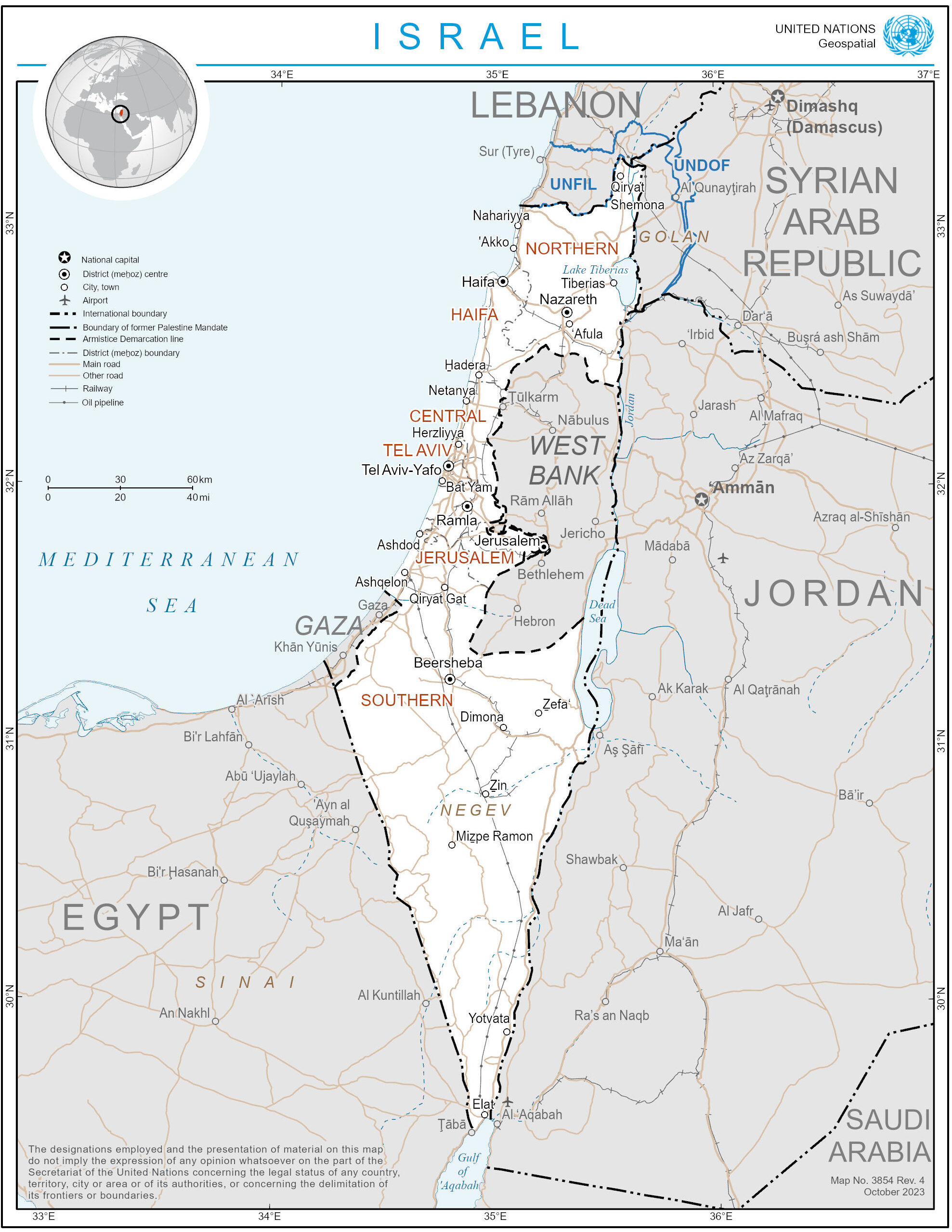
The Humanitarian Situation in Gaza
The level of physical destruction in Gaza was staggering, with eighty-three per cent of all buildings destroyed as of October 2025.15M. Saber, ‘With 83% of its buildings destroyed, Gaza needs more than money to rebuild’, The Conversation, 16 October 2025. Israel has systematically attacked healthcare facilities, often claiming that they were being used by Hamas for military purposes. In addition to the massive damage from Israeli bombings, data from the UN Satellite Centre (UNOSAT) show that the IDF conducted extensive demolitions of civilian infrastructure in these areas, damaging or destroying more than ninety per cent of all structures in the Netzarim and Philadelphi corridors in the Gaza Strip as well as in an Israeli buffer zone.16Report of the UN Commission of Inquiry on Palestine and Israel, UN Doc A/80/337, paras 19–20.
As of the end of July 2024, only 203 health facilities from a reported pre-war total of 572 had remained functional.17WHO, ‘Health Cluster – Occupied Palestinian Territory – Health Attacks’, Last updated 17 August 2025. The establishment of the Gaza Humanitarian Foundation (GHF) coupled with the total blockade between March and May 2025 had a profound impact on food security for Gazans. By late December 2025, only 74 intensive care beds remained functioning in the Gaza Strip. At least 1,722 health-care workers are believed to have been killed during the war – about on in ten of the workforce. About eighty who were arrested are thought to remain in Israeli jails.18‘Just 74 intensive-care beds remain in Gaza’, The Economist, 27 December 2025.
The Situation in the West Bank
In the West Bank, the period following the attacks on Israel of 7 October 2023 was marked by increased movement restrictions for Palestinians and a surge in counterterrorism operations.19UN Office for the Coordination of Humanitarian Affairs (OCHA), ‘Movement and Access in the West Bank – September 2024’, 25 September 2024; Report of the UN Commission of Inquiry on Palestine and Israel, UN Doc A/HRC/56/26, 14 June 2024, paras 62–63. Between August and September 2024, the IDF conducted a security operation in Jenin and other cities in the northern West Bank codenamed ‘Operation Summer Camps’. The operation, which targeted Palestinian armed groups, ostensibly involved cutting water and electricity services and digging up roads, but it also killed an unknown number of civilians, including children, and damaged civilian objects.20A. Sawafta, ‘Israeli forces pull out of Jenin leaving a trail of destruction’, Reuters, 6 September 2024; B. McKernan and S. Taha, ‘“We are all Jenin together”: West Bank city seeks normality after IDF’s deadly raids’, The Guardian, 10 September 2024.
In early January 2025, the IDF conducted another counterterrorism operation in Jenin that lasted for several days.21J. Mackenzie and A. Sawafta, ‘Israel launches “significant” military operation in West Bank, at least 9 Palestinians killed’, Reuters, 21 January 2025; N. Ebrahim, N. Bashir and K. Khadder, ‘Residents say they were forced to flee Jenin refugee camp as Israel’s West Bank military operation intensifies’, CNN, 24 January 2025. On 23 February 2025, after a series of bus explosions near Tel Aviv, the IDF deployed tanks in Jenin for the first time since 2002. Israel’s Minister of Defence declared that operations in the West Bank were expanding and that troops would remain ‘for the coming year’.22B. McKernan, ‘Israel says West Bank operation will last for a year as it sends tanks to Jenin’, The Guardian, 23 February 2025; and E. Fabian, ‘IDF deploys tanks in West Bank for first time since 2002, sending 3 to Jenin as it expands op’, The Times of Israel, 23 February 2025.
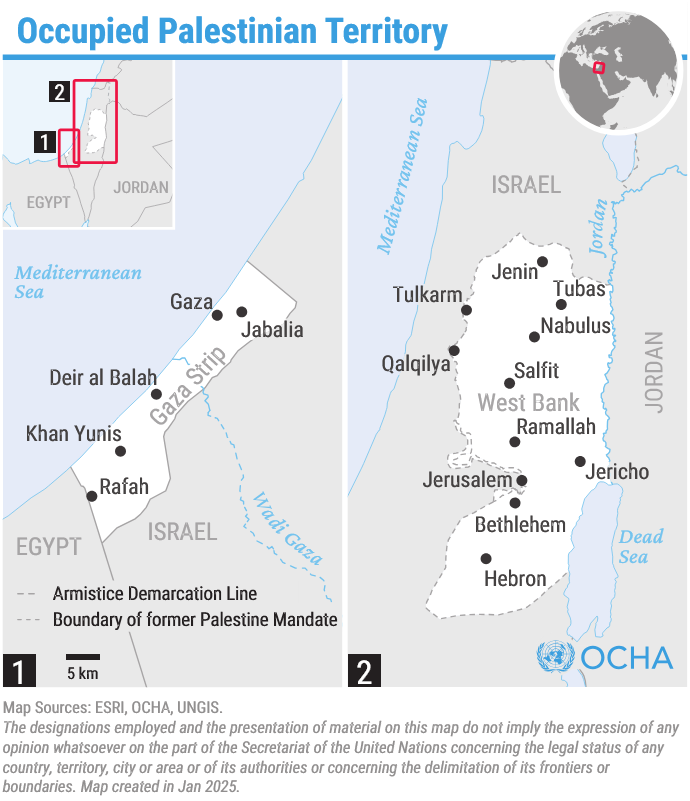
Conflict Classification and Applicable Law
There were three armed conflicts involving Palestine and Israel during the reporting period. An international armed conflict between Israel and Palestine involved active hostilities between the two parties and the belligerent occupation of Palestinian territory by Israel. A second major armed conflict was non-international in character (a NIAC) between Israel and Hamas, in particular its Izz al-Din al-Qassam Brigades, the group’s armed wing. A separate NIAC of lesser intensity occurred between Israel and the al-Quds Brigades – the armed wing of the Palestinian Islamic Jihad.23Other armed groups participated in the attack on Israeli civilians and military on 7 October 2023, specifically the Al-Aqsa Martyrs’ Brigades, the Popular Front for the Liberation of Palestine, the Democratic Front for the Liberation of Palestine, the Popular Resistance Committees, and the Palestinian Mujahideen Movement. UN Commission of Inquiry on Palestine and Israel, ‘Detailed findings on attacks carried out on and after 7 October 2023 in Israel’, UN Doc A/HRC/56/CRP.3, 10 June 2024, para 236.
Palestine – both Gaza and the West Bank – remains under Israeli occupation – a form of IAC. An active IAC between Israel and Palestine involved Israeli attacks on the territory of Palestine (Gaza and the West Bank). In its 2024 Advisory Opinion on the legal consequences arising from Israel’s policies and practices in Palestine, the International Court of Justice reaffirmed that the West Bank was under belligerent occupation by Israel, and that Israel’s obligations remained ‘commensurate with the degree of its effective control over the Gaza Strip’.24ICJ, Legal Consequences Arising from the Policies and Practices of Israel in the Occupied Palestinian Territory, Including East Jerusalem, Advisory Opinion, 19 July 2024, paras 87 and 94. By July 2025, Israel had taken physical control of three quarters of the Strip.25A. Mehvar and N. Khdour, ‘Gaza after two years: As Israel expands control and sows chaos, Hamas adapts to survive’, Armed Conflict Location and Event Data project (ACLED), 17 September 2025; Report of the UN Commission of Inquiry on Palestine and Israel, UN Doc A/80/337, 14 August 2025, para 15. In its Advisory Opinion of October 2025, the Court reaffirmed that Israel’s obligations resulting from this greater extent of effective control ‘include the obligations under the law of occupation’.26ICJ, Obligations of Israel in Relation to the Presence and Activities of the United Nations, Other International Organizations and Third States in and in relation to the Occupied Palestinian Territory, Advisory Opinion, 22 October 2025, para 86.
The IAC between Israel and Palestine is governed by the Geneva Conventions of 1949 and customary IHL, including the rules on military occupation from the Hague Conventions of 1899 and 1907. Palestine, but not Israel, is a State Party to Additional Protocol I of 1977,27 Protocol Additional to the Geneva Conventions of 12 August 1949, and relating to the Protection of Victims of International Armed Conflicts; adopted at Geneva, 8 June 1977; entered into force, 7 December 1978. meaning that this instrument is not directly applicable to the armed conflict between the two States.
The two NIACs were governed by Common Article 3 of the Geneva Conventions and customary IHL.
Palestine but not Israel is a State Party to the Rome Statute of the International Criminal Court. Although Israel has signed the Statute, it subsequently notified the depositary – the UN Secretary-General – that it did not intend to become a party to it.28Notification of Israel, 28 August 2002.
Compliance with IHL
Overview
During the reporting period, serious violations of IHL continued to be committed on a massive scale in the course of the multiple armed conflicts. Figures from a classified IDF database named 8,900 Palestinian fighters as dead or probably dead as of May 2025, when the overall death toll among Palestinians in Gaza had reached 53,000.29E. Graham-Harrison and Y. Abraham, ‘Revealed: Israeli military’s own data indicates civilian death rate of 83% in Gaza war’, The Guardian, 21 August 2025. By the time the ceasefire came into effect in late October 2025, 68,500 Palestinians had been killed in the Gaza Strip, according to the Gazan Ministry of Health managed by Hamas.30‘Palestinians begin returning to Gaza’s north as Netanyahu thanks Trump for securing ceasefire’, BBC.
Civilian Objects under Attack
A wide range of civilian objects were attacked by Israel during the reporting period, including medical facilities, religious and cultural property, and schools and universities. Civilian objects were also struck in indiscriminate and disproportionate attacks. Hamas and the Palestinian Islamic Jihad continued to fire rockets into Israel that appeared to be indiscriminate weapons or attacks. At the beginning of October 2025, for instance, on Yom Kippur, Hamas fired five rockets from Gaza, triggering sirens in Ashdod, the sixth-largest city in Israel, located on the Mediterranean coast 32 kilometres south of Tel Aviv.31E. Fabian, ‘Hamas fires 5 rockets from Gaza on Yom Kippur, triggering sirens in Ashdod; no injuries’, The Times of Israel, 2 October 2025.
Attacks against medical facilities
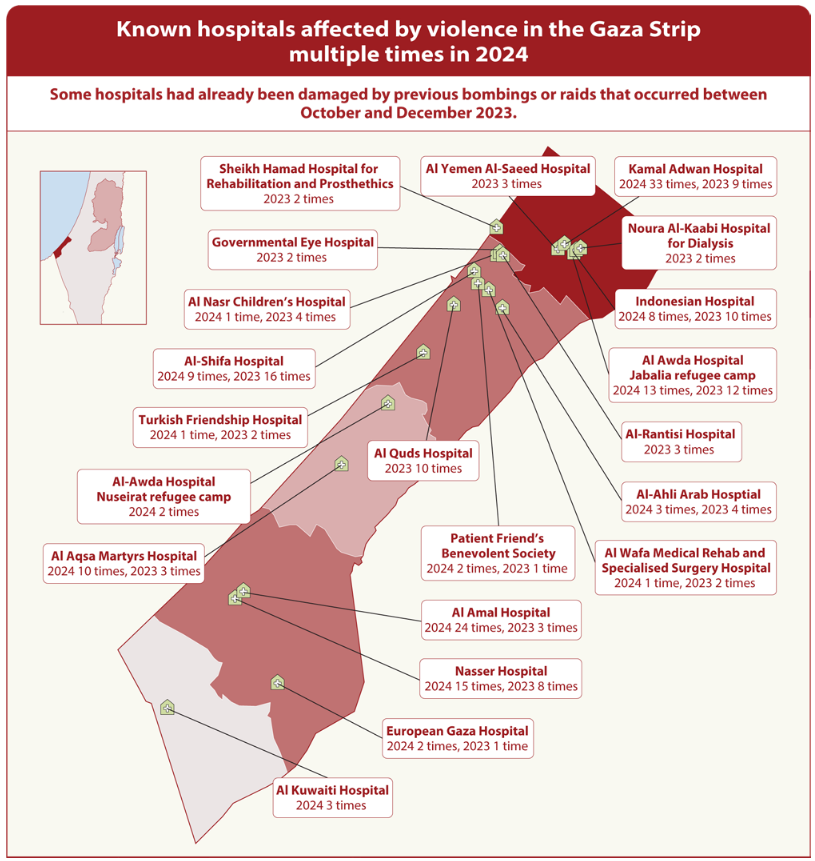
All parties to armed conflicts are obligated to respect and protect medical personnel and units in all circumstances.32Arts 19(1) and 24, Geneva Convention I; Arts 18(1) and 20(1), Geneva Convention IV; ICRC, Customary IHL Rule 25: ‘Medical Personnel’, and Rule 28: ‘Medical Units’. By mid-August 2025, the World Health Organization (WHO) had documented 772 Israeli attacks against healthcare facilities since the beginning of military operations in the Gaza Strip in October 2023. Of these, 115 occurred between 1 January and 10 August 2025 (with the highest number recorded in May). The attacks killed fifty people and injured a further 119.33OCHA, ‘Humanitarian Situation Update #315: Gaza Strip’, 21 August 2025. Attacks in WHO data refer not only to the use of force, but also obstructions and searches. WHO, ‘Health Cluster – Occupied Palestinian Territory – Health Attacks’, Last updated 17 August 2025. WHO’s Health Cluster also listed 210 attacks impacting medical vehicles since the beginning of hostilities in the Gaza Strip through to the middle of August 2025.34WHO, ‘Health Cluster – Occupied Palestinian Territory – Health Attacks’, Last updated 17 August 2025.
On multiple occasions, Israel has accused Hamas of placing command-and-control centres, weapons, and tunnels in and beneath hospitals and other medical facilities, and of using those structures to hide hostages.35IDF, ‘From inpatient wards to the hospital basements: This is how Hamas turned Gaza hospitals into terror centers’, Report, accessed 28 October 2025. On 15 February 2024, the IDF claimed that ‘over 85% of major medical facilities in Gaza have been used by Hamas for terror operations’, that the latter were ‘likely hiding behind injured civilians’, and that they were keeping hostages in the Nasser Hospital (as per hostages’ testimony).36IDF, Post on social media site X, 15 February 2024. A month earlier, the IDF had released the interrogation video of an individual (a janitor, but also allegedly a member of Hamas’s elite Nukhba force) who had been captured during the raid on Kamal Adwan hospital in northern Gaza in December 2024. He testified that Hamas was using the facility as a shelter and a distribution point for weapons. It was unclear if the statement was made under duress and if it was confirmed by other detainees.37IDF, ‘Hamas Terrorist Apprehended at Kamal Adwan Hospital’, Press release, 7 January 2025; E. Fabian, ‘Hamas member tells IDF interrogators that gunmen operated in Kamal Adwan Hospital’, The Times of Israel, 7 January 2025; E. Livni, ‘In Israeli Video, Detainee Says Hamas Operates Out of Gaza Hospital’, The New York Times, 7 January 2025.
In June 2025, the IDF claimed to have retrieved the bodies of Mohammed Sinwar and Mohammad Sabaneh, the commander of Hamas’s Rafah Brigade, in a tunnel directly beneath the emergency department of the European Hospital in the southern Gazan city of Khan Yunis. They denounced this as ‘another example of the cynical use by Hamas, using civilians as human shields, using civilian infrastructure, hospitals, again and again’.38P. Kingsley, ‘The Tunnel That Leads Underneath a Hospital in Southern Gaza’, The New York Times, 8 June 2025; R. Zvulun, ‘Israel reveals tunnel under Gaza hospital, says body of Sinwar’s brother found there’, Reuters, 8 June 2025; and A. Phillips and S. Usher, ‘Israel says Hamas Gaza chief Sinwar’s body identified’, BBC, 8 June 2025. In its earlier reporting, the UN Commission of Inquiry on Palestine and Israel called upon the Government of Palestine and Hamas to ‘ensure that civilians are not used as human shields, in strict compliance with international humanitarian law’.39Report of the UN Commission of Inquiry on Palestine and Israel, UN Doc A/79/232, 11 September 2024, paras 29 and 114(c).
In December 2024, the Office of the UN High Commissioner for Human Rights (OHCHR) described Israeli evidence on use by Palestinian armed groups of hospitals and medical centres for military purposes as ‘vague’.40D. Gritten, ‘UN says Israeli attacks pushing Gaza healthcare towards total collapse’, BBC, 31 December 2024. In January 2025, however, the UN High Commissioner for Human Rights, Volker Türk, told the UN Security Council that ‘Hamas and other armed groups continue to reportedly operate behind civilian infrastructure, including health facilities, exposing them to attacks’.41UN, ‘Security Council Debates Israeli Attacks on Hospitals Allegedly Misused by Hamas, as UN Rights Chief Urges Independent Probes’, Press release, UN Doc SC/15959, 3 January 2025. If the Israeli claims are accurate, this would be a serious violation by Palestinian armed groups of the duty to respect medical facilities and not to make them military objectives.42International Committee of the Red Cross (ICRC), Customary IHL Rule 28: ‘Medical Units’.
Nevertheless, numerous Israeli attacks on health facilities in the Gaza Strip would still have violated IHL.43See eg, Report of the UN Commission of Inquiry on Palestine and Israel, UN Doc A/79/232, esp paras 18–26; UN, ‘Secretary-General “Deeply Alarmed” by Israeli Strikes on Al-Ahli Arab Hospital in Gaza, Dealing Severe Blow to Strip’s Already Devastated Healthcare System’, Press release, UN Doc SG/SM/22625, 14 April 2025; Statement by the UN High Commissioner for Human Rights before the UN Security Council, reported in UN, ‘Security Council Debates Israeli Attacks on Hospitals Allegedly Misused by Hamas’. The alleged behaviour of Hamas would not automatically end a hospital’s protection against attack even if it were used for acts harmful to the enemy. For instance, on 13 May 2025, an IDF drone struck the burns unit of the Nasser Medical Complex, killing two patients and injuring twelve others, and destroying part of the hospital.44UN Commission of Inquiry on Palestine and Israel, ‘Legal analysis of the conduct of Israel in Gaza pursuant to the Convention on the Prevention and Punishment of the Crime of Genocide’, para 95. The attack killed Hassan Eslayeh,45Palestinian Centre for Human Rights, ‘Israeli Strike Targets and Kills Journalist Esleih While Receiving Treatment at Nasser Medical Complex’, Press release, 13 May 2025. a Palestinian photo-journalist and patient in the hospital. The attack was a violation of the IHL rules protecting hospitals and civilian objects. Mr Eslayeh had been targeted by the IDF a month earlier during an attack in Khan Yunis on a tent with ten journalists inside that was disproportionate in character. He was accused by Israel of being ‘a terrorist operative’ in Hamas’ Khan Yunis Brigade and of having taken part in the 7 October 2023 attacks ‘during which he documented and published acts of looting, arson, and killing on social networks’.46IDF, Post on X, 7 April 2025; M. Bashir and M. Fayez, ‘Israel aimed to kill photojournalist Hassan Eslaih in airstrike on press workers’ tent’, Mada, 7 April 2025; R. Michaelson, ‘Israeli strike on hospital camp used by Gaza journalists kills 10 people’, The Guardian, 7 April 2025. But taking photographs – if this is what he did – does not amount to direct participation in hostilities under IHL as it does not meet the threshold of harm necessary.
Several months earlier, the IDF had carried out an airstrike on the same Nasser hospital in an operation on 23 March 2025 that targeted and killed Ismail Barhoum, a member of Hamas’s political office who was being treated for wounds he had sustained in a previous attack.47L. Tondo, ‘Israeli strike at Gaza hospital kills five, including senior Hamas figure’, The Guardian, 24 March 2025. Despite Israel’s claim that the strike had involved precision-guided munitions to minimize harm, a number of other patients were reportedly killed and injured.48Ibid; and UN Commission of Inquiry on Palestine and Israel, ‘Legal analysis of the conduct of Israel in Gaza pursuant to the Convention on the Prevention and Punishment of the Crime of Genocide’, para 103. Leaving aside the question as to whether Mr Barhoum was a lawful target under IHL, individuals can never be lawfully attacked while hors de combat.49Common Article 3, Geneva Conventions; ICRC, Customary IHL Rule 47: ‘Attacks against Persons Hors de Combat’. Moreover, treating wounded fighters is not an act harmful to the enemy that threatens the special protection provided to hospitals under IHL.50Art 19(2) Geneva Convention IV; ICRC, Customary IHL Rule 28: ‘Medical Units’.
In mid-May 2025, the IDF targeted the European Gaza Hospital with a series of airstrikes, killing a reported nineteen people, including five women and girls, and injuring more than forty.51OCHA, ‘Humanitarian Situation Update #288: Gaza Strip’, 14 May 2025. The strikes closed the hospital, cutting off vital services ‘including neurosurgery, cardiac care, and cancer treatment – all unavailable elsewhere in Gaza’.52WHO, ‘Health system at breaking point as hostilities further intensify in Gaza, WHO warns’, News release, 22 May 2025. While media reports indicated that the strikes had targeted Mohammed Sinwar, the IDF initially said it had targeted a Hamas command-and-control centre they said was located beneath the hospital.53J. Burke, ‘Israeli bombing wave kills dozens in Gaza including at least 22 children, say reports’, The Guardian, 14 May 2025. However, the UN Commission of Inquiry on Palestine and Israel, which reviewed the aerial footage released by the IDF to ground its claim and subjected it to geolocation analysis, concluded that the European Gaza hospital was misidentified in the video.54UN Commission of Inquiry on Palestine and Israel, ‘Legal analysis of the conduct of Israel in Gaza pursuant to the Convention on the Prevention and Punishment of the Crime of Genocide’, UN Doc A/HRC/60/CRP.3, para 95. The IDF acknowledged the error a few days after the strike.55M. Doran, ‘Israel concedes error in video claiming to show Hamas tunnels under Gaza hospital’, ABC News, 15 May 2025.
An attack on 21 March 2025 destroyed central Gaza’s Turkish-Palestinian Friendship Hospital, the only facility in Gaza offering specialized cancer treatment. The attack was conducted on the basis of an alleged Hamas presence.56‘Israeli military blows up Gaza’s Turkish hospital and medical school’, Al Jazeera, 21 March 2025; Palestinian Centre for Human Rights, ‘Blowing Up Gaza’s “Turkish-Palestinian Friendship” Hospital: A War Crime and Perpetuation of Genocide’, 22 March 2025. But when they are used to commit acts harmful to the enemy, the special protection afforded to hospitals by IHL may only be discontinued ‘after due warning has been given, naming, in all appropriate cases, a reasonable time limit, and after such warning has remained unheeded’.57Art 19(1), Geneva Convention IV; ICRC, Customary IHL Rule 28: ‘Medical Units’. In addition, should the hospital also exceptionally become a military objective due to its use and effective contribution to military action, along with the fact that its destruction would offer a definite military advantage in the circumstances ruling at the time, the attack must comply with the rule of proportionality in attack.58Université Laval and ICRC, ‘The Principle of Proportionality in the Rules Governing the Conduct of Hostilities under International Humanitarian Law’, Report of the International Expert Meeting, 22–23 June 2016, p 45.
Under customary law, there is a specific duty to take all feasible precautions in the choice of weapons with a view to avoiding, and in any event to minimizing, incidental civilian harm.59ICRC, Customary IHL Rule 17: ‘Choice of Means and Methods of Warfare’. As the UN High Commissioner for Human Rights told the UN Security Council in January 2025, use of heavy weapons against hospitals ‘is difficult to reconcile’ with the principle that military operations must always distinguish between military targets and civilians.60UN, ‘Security Council Debates Israeli Attacks on Hospitals Allegedly Misused by Hamas’.
Hospitals and health facilities in the Gaza Strip have also been affected in ways that go beyond being attacked. On several occasions, the International Committee of the Red Cross (ICRC) expressed alarm over the consequences on the healthcare system of the intensification of hostilities in the Gaza Strip. Repeated, widespread evacuation orders by the IDF ‘affect the ability of patients and medical staff to access healthcare facilities and severely compromise these facilities’ abilities to function properly, while overwhelming the already overstretched healthcare centres located outside of evacuation areas’.61ICRC, ‘Israel and the occupied territories: ICRC alarmed by intensification of Gaza hostilities amid decimated healthcare system’, 2 July 2025. Stray bullets regularly wounded medical personnel and disrupted medical treatment.62ICRC, Post on X, 4 July 2025. Moreover, predictably, certain categories of civilians have borne the consequences of these attacks more than others – notably children, women in labour, and people with chronic ailments.
Civilians under Attack
Under customary IHL, civilians enjoy general protection from the effects of hostilities, unless and for such time as they directly participate in hostilities.64ICRC, Customary IHL Rule 6: ‘Civilians’ Loss of Protection from Attack’. Accordingly, parties to armed conflicts must at all times distinguish between combatants and civilians, and are prohibited from directing attacks against civilians.65ICRC, Customary IHL Rule 1: ‘The Principle of Distinction between Civilians and Combatants’. Civilians may be incidentally affected by attacks against lawful military objectives. However, such attacks must not be disproportionate, and the attacker must take all feasible precautions to avoid, or at the least to minimize, incidental loss of civilian life and injury to civilians (and damage to civilian objects).66ICRC, Customary IHL Rule 14: ‘Proportionality in Attack’; and Rule 15: ‘Principle of Precautions in Attack’.
In April 2025, the UN Secretary-General described the Gaza Strip as ‘a killing field’ with civilians ‘in an endless death loop’.67UN, ‘Secretary-General’s Press Encounter on Gaza’, Press release, 8 April 2025. The Gazan Ministry of Health (which lists only people whose bodies have been recovered) reported that at least 56,156 Palestinians were killed and 132,239 injured between 7 October 2023 and 25 June 2025. Of this total, 5,833 were killed and 20,198 injured following the re-escalation of hostilities on 18 March 2025.68OCHA, ‘Humanitarian Situation Update #300: Gaza Strip’, 26 June 2025.
Of the total reported Palestinian fatalities as of mid-June 2025 (55,202), the Ministry of Health recorded the deaths of 17,121 children (31 per cent), 24,818 men (45 per cent), 9,126 women (17 per cent), and 4,137 older persons (7 per cent).69Ibid. Although the data from the Ministry do not distinguish between fighters and civilians, other calculations suggest even higher numbers of casualties,70Z. Jamaluddine, H. Abukmail, S. Aly, O. M. R. Campbell, and F. Checchi, ‘Traumatic injury mortality in the Gaza Strip from Oct 7, 2023, to June 30, 2024: a capture–recapture analysis’, The Lancet, Vol 405 (2025), 469–77, suggesting that the Palestinian Ministry of Health ‘under-reported mortality by 41%’ in the period under review. See further ‘Gaza death toll 40% higher than official number, Lancet study finds’, The Guardian, 10 January 2025. and in any case exceptionally high ratios of civilian casualties (reaching as high as 83%).71Graham-Harrison and Abraham, ‘Revealed: Israeli military’s own data indicates civilian death rate of 83% in Gaza war’; N. Crawford, ‘Gaza: civilian death toll outpaces other modern wars’, The Conversation, 27 August 2025.
Israeli officials consistently denied claims that its troops were targeting civilians,72See eg: Israeli Prime Minister’s Office, ‘PM Netanyahu’s Address to a Joint Meeting of the US Congress’, 24 July 2024; ‘Israeli deputy foreign minister: IDF “do not target civilians in Gaza”’, Sky News, 1 July 2025. See also O. Goldschmidt, ‘Israel never targets innocents intentionally’, The Guardian, 4 July 2024. highlighting instead IDF efforts to minimize civilian harm during military operations in Gaza. These measures included warnings to civilians of impending attacks by means of messages, calls, leaflets, and, at least in the early stages of the conflicts, so-called ‘roof-knocking’ (where small- or no-yield munitions were dropped before a far larger attack).73Y. Gelb, ‘Debunking the myth: Inside the IDF’s efforts to minimize civilian casualties’, Ynet News, 31 August 2024. At a press conference in September 2024, Prime Minister Netanyahu claimed that despite the challenges of operating in a densely populated urban environment, the IDF had achieved the ‘lowest ratio of civilian to combatant deaths in the history of modern urban warfare — it’s 1 to 1’.74J. Magid, ‘Netanyahu lashes foreign press for “false” reporting regarding Gaza humanitarian situation’, The Times of Israel, 4 September 2024. This claim is not credible given the overwhelming evidence to the contrary.
Attacks directed against civilians
Testimonies by numerous Israeli soldiers attest to the fact that Palestinian civilians were deliberately targeted during operations in the Gaza Strip. IDF soldiers disclosed to the media instances where their units were ordered to shoot at anyone entering areas bound by ‘imaginary lines’, irrespective of whether the targets posed a threat.75A. Rossi, O. Halpern and C. Alkhaldi, ‘Israeli soldier describes arbitrary killing of civilians in Gaza’, Sky News, 7 July 2025; and Graham-Harrison and Abraham, ‘Revealed: Israeli military’s own data indicates civilian death rate of 83% in Gaza war’. In April 2025, OHCHR stated that in 36 strikes about which it had corroborated information, ‘the fatalities recorded so far were only women and children’.76OHCHR, ‘Gaza: Increasing Israeli “evacuation orders” lead to forcible transfer of Palestinians’, Press release, 11 April 2025. The UN Commission of Inquiry on Palestine and Israel documented in its reports multiple occasions where the IDF targeted civilians ‘along evacuation routes and in safe zones’.77UN Commission of Inquiry on Palestine and Israel, ‘Legal analysis of the conduct of Israel in Gaza pursuant to the Convention on the Prevention and Punishment of the Crime of Genocide’, paras 24–28.
Israel also killed and injured Palestinian civilians as they sought to reach food distribution sites managed by the GHF.78Médecins Sans Frontières (MSF), ‘This is not aid. This is orchestrated killing’, Press release, 7 August 2025; K. Ahmed, A. L. González Paz, L. Swan and G. Blight, ‘Eleven-minute race for food: how aid points in Gaza became “death traps” – a visual story’, The Guardian, 22 July 2025. In early July 2025, the ICRC reported that, following the launch of the new food distribution system, its field hospital in Rafah had recorded an unprecedented influx of weapon-wounded patients; these included toddlers, teenagers, elderly, mothers, but also ‘and overwhelmingly, young men and boys [who] were simply trying to get food or aid for their families’.79ICRC, ‘“I want to heal and go home”: Red Cross Field Hospital in Gaza grapples with unprecedented wave of mass casualty incidents’, Press release, 5 July 2025; and ‘Israel and the occupied territories: Red Cross Field Hospital receives unprecedented influx of war wounded in Gaza’, 2 June 2025.
As of end-July 2025, OHCHR found that ‘since 27 May, at least 1,373 Palestinians have been killed while seeking food; 859 in the vicinity of the GHF sites and 514 along the routes of food convoys’.80OHCHR, Killings of Palestinians seeking food in Gaza continue as starvation deepens, Press release, 31 July 2025. OHCHR reported that most of the victims appeared to be young men and boys, but that there was ‘no information that these Palestinians were directly participating in hostilities or posed any threat for Israeli security forces or other individuals’.81Ibid. OHCHR attributed most of the killings to the Israeli military.82Ibid. See also Human Rights Watch, ‘Gaza: Israeli Killings of Palestinians Seeking Food Are War Crimes’, 1 August 2025, which investigates the use of force by private companies operating the GHF-managed distribution sites against Palestinian civilians seeking food, including through live fire.
According to newspaper reports, Israeli soldiers received orders to shoot at unarmed Gazans if they were waiting at distribution sites outside opening hours.83N. Hasson, Y. Kubovich and B. Peleg, ‘“It’s a Killing Field”: IDF Soldiers Ordered to Shoot Deliberately at Unarmed Gazans Waiting for Humanitarian Aid’, Haaretz, 27 June 2025. Israeli officials denied these accounts, 84Reuters, ‘IDF, Netanyahu reject report on killing of Gazans at aid sites in alleged war crime’, The Jerusalem Post, 27 June 2025; A. Batrawy, ‘Israel’s leaders slam a news report on a Gaza “killing field” near food sites’, NPR, 28 June 2025.but the IDF subsequently acknowledged ‘incidents in which harm to civilians who arrived at distribution facilities was reported’.85H. Goller, ‘Israel acknowledges Palestinian civilians harmed at Gaza aid sites, says “lessons learned”’, Reuters, 30 June 2025; I. Wells, ‘Israeli military investigates “reports of harm to civilians” after hundreds killed near Gaza aid sites’, BBC, 30 June 2025. The IDF also admitted to at least three ‘tragic’ incidents in which it fired ‘inaccurate’ artillery rounds towards areas near the aid sites, causing up to forty casualties, several of whom were killed.86E. Fabian, ‘IDF admits killing several Gazan civilians near aid hubs, says Hamas tolls exaggerated’, The Times of Israel, 30 June 2025. Also regularly attacked by the IDF were journalists,87For an updated list of casualties among journalists, see Committee to Protect Journalists, ‘Journalist casualties in the Israel-Gaza war’. healthcare professionals, and humanitarian workers.88UN Commission of Inquiry on Palestine and Israel, ‘Legal analysis of the conduct of Israel in Gaza pursuant to the Convention on the Prevention and Punishment of the Crime of Genocide’, para 31.
Attacks against journalists
The UN Human Rights Office in the Occupied Palestinian Territory verified the killing of 227 Palestinian journalists in Gaza between 7 October 2023 and early June 2025 – 197 men and 30 women.89UN, ‘UN Human Rights Office condemns targeting journalists and attacks on hospitals’, Press release, 6 June 2025. In June 2024, an investigation by journalists working for The Guardian found that one in three of the journalists killed had been working for media outlets affiliated with or closely tied to Hamas. IDF officials were reported to have argued privately that there was ‘no difference’ between working for the media outlet ‘and belonging to Hamas’s armed wing’.90H. Davies, M. Ganguly, D. Pegg, H. Osman, Y. Abraham and B. McKernan, ‘“The grey zone”: how IDF views some journalists in Gaza as legitimate targets’, The Guardian, 25 June 2024. The IDF denied the reports, saying ‘the IDF does not see Hamas’ media networks, or journalists, as such, as members of Hamas military wing’. It further stated that the targeting of ‘certain Al-Aqsa network employees, including some who work or describe themselves as journalists’, had been conducted on the basis of identification as members of Hamas’ military wing or as directly participating in hostilities.91IDF, ‘IDF Clarification Regarding Claims on Targeting Journalists’, 25 June 2024.
The UN Special Rapporteur on freedom of opinion and expression, Irene Khan, and the international NGO Reporters Without Borders criticized Israel for the targeted killing in July 2024 of Al Jazeera journalists Ismail al-Ghoul and Rami al-Rifi.92OHCHR, ‘Expert denounces killing of two more journalists in Gaza and demands full accountability’, Press release, 6 August 2024; Reporters Without Borders, ‘Ismail al-Ghoul’s killing: targeted and discredited, Palestinian journalists suffer double punishment in Gaza’, 30 August 2024. See also Y. Serhan, ‘How International Press Groups Are Reacting to Israel’s Labeling Six Gaza Journalists as “Terrorists”’, Time Magazine, 26 October 2024. In accepting responsibility for the attack, the IDF claimed to have targeted Mr al-Ghoul as an Hamas military operative and member of the Nukhba Unit who ‘instructed other operatives on how to record operations and was actively involved in recording and publicizing attacks against IDF troops’.93IDF, ‘ELIMINATED: Ismail al-Ghoul, a Hamas Military Wing Operative and Nukhba Terrorist’, 1 August 2024. Reporters Without Borders contested the strength and reliability of the IDF’s evidence underpinning its allegations.94Reporters Without Borders, ‘Ismail al-Ghoul’s killing: targeted and discredited, Palestinian journalists suffer double punishment in Gaza’. In July 2025, the UN Special Rapporteur on freedom of opinion and expression noted ‘growing evidence that journalists in Gaza have been targeted and killed by the Israeli army on the basis of unsubstantiated claims that they were Hamas terrorists’.95 UN, ‘Gaza: UN expert denounces serious threats by Israeli army against Al Jazeera correspondent’, Press release, 31 July 2025.
Attacks against medical personnel
The Gaza Ministry of Health has reported that ‘at least’ 1,581 healthcare workers were killed in Gaza between 7 October 2023 and the middle of July 2025.96UN, ‘Killing of medical professionals in Gaza – UN Human Rights in Occupied Palestinian Territory’, 16 July 2025. In September 2024, the UN Commission of Inquiry on Palestine and Israel reported its documenting of ‘direct attacks on medical convoys operated by the ICRC, the United Nations, the Palestine Red Crescent Society and non-governmental organizations’.97Report of the UN Commission of Inquiry on Palestine and Israel, UN Doc A/79/232, para 10. In a subsequent report, the Commission investigated in detail two incidents on 23 March 2025 in Tal as-Sultan in the Rafah area of the Gaza Strip, which involved the killing of fifteen emergency and aid workers – eight from the Palestinian Red Cross Society, six from the Palestinian Civil Defence, and a UN Relief and Works Agency (UNRWA) employee.98UN Commission of Inquiry on Palestine and Israel, ‘Legal analysis of the conduct of Israel in Gaza pursuant to the Convention on the Prevention and Punishment of the Crime of Genocide’, paras 35–44; and ICRC, ‘Israel and the occupied territories: ICRC appalled by killing of PRCS medics and first responders’, 30 March 2025.
The IDF initially claimed the operation had targeted operatives from Hamas and Palestinian Islamic Jihad and that the vehicles were advancing suspiciously without headlights or emergency signals.99UN Commission of Inquiry on Palestine and Israel, ‘Legal analysis of the conduct of Israel in Gaza pursuant to the Convention on the Prevention and Punishment of the Crime of Genocide’, paras 37–38; J. Mackenzie, ‘Israeli military changes initial account of Gaza aid worker killings’, Reuters, 6 April 2025; ‘Israeli military says killing of 15 aid workers in Gaza caused by “sense of threat”’, Reuters, 8 April 2025. This claim was refuted by video evidence retrieved from the scene and published by the Palestinian Red Cross Society, which also showed that ‘there were no shots fired from the convoy before they were attacked, and throughout the ordeal’.100UN Commission of Inquiry on Palestine and Israel, ‘Legal analysis of the conduct of Israel in Gaza pursuant to the Convention on the Prevention and Punishment of the Crime of Genocide’, para 39. Later, an IDF investigation determined that ‘a number of professional errors and deviations from the orders were discovered, along with a failure to fully report the incident’.101Ibid, para 43. The UN Commission of Inquiry on Palestine and Israel found that the Israeli response was ‘lacking, erroneous and misrepresentative’, noting that the medical units were clearly identifiable and that the soldiers’ conduct was consistent with instructions from commanders.102Ibid, para 44.
Other incidents raise further serious concerns about Israel’s respect for the special protection afforded to medical personnel by IHL.103ICRC, Customary IHL Rule 25: ‘Medical Personnel’. This is the case for ‘double-tap’ attacks, ie, those directed at the site of an earlier attack. These would breach IHL if the second attack were directed at anyone who was hors de combat, such as a person already seriously wounded,104ICRC, Customary IHL Rule 47: ‘Attacks against Persons Hors de Combat’. or at medical personnel responding to reports of injured persons (a claim denied by the IDF).105Y. Abraham, ‘“Double tap” airstrikes: How Israel targets Gaza rescue efforts’, +972 Magazine, 24 July 2025.
In the aftermath of the airstrike that killed Mohammed Deif and Rafa Salama in July 2024, as emergency service workers were responding, a second missile ‘exploded directly in front of two vehicles clearly marked as belonging to Gaza Civil Defence, an emergency services agency, spraying them with shrapnel and apparently killing and injuring first responders’.106R. Mellen, ‘Israel Struck Twice in Its Attack on Al-Mawasi, Videos and Photos Show’, The New York Times, 14 July 2024. According to the testimony of a rescuer from Gaza Civil Defence at the scene, ‘a missile fired by an [Israeli] Air Force drone hit the ambulance behind him, killing four rescue personnel’.107Abraham, ‘“Double tap” airstrikes: How Israel targets Gaza rescue efforts’.
Disproportionate attacks
Other incidents and practices raise serious concerns regarding compliance with the fundamental IHL rule on proportionality in attack. It has been claimed that, in the initial phases of the Gaza campaign, the IDF loosened its rules of engagement, allowing for a greater ratio of civilian victims compared to a military target (twenty for each strike, and even one hundred in case of Hamas leaders).108P. Kingsley, N. Odenheimer, B. Shbair, R. Bergman, J. Ismay, S. Frenkel and A. Sella, ‘Israel Loosened Its Rules to Bomb Hamas Fighters, Killing Many More Civilians’, The New York Times, 26 December 2024. Although the rules of engagement were tightened by November 2023, they were reportedly ‘still far looser than they were before October 7’.109Ibid. The IDF offered detailed answers and rectifications to the claims.110IDF, ‘Response to the New York Times Article Concerning IDF Operations during the First Weeks of the Hamas-Israel War’, 26 January 2025.
The Israeli airstrike that killed Mohammed Deif and Rafa Salama reportedly killed another ninety people and injured three hundred.111R. Bergman, P. Kingsley and A. Rasgon, ‘Israel Launches Major Attack Against a Senior Hamas Commander’, The New York Times, 13 July 2024; R. Bergman and P. Kingsley, ‘Close Surveillance Led to Israeli Attack on Hamas Compound’, The New York Times, 14 July 2024; A. Rasgon and A. Boxerman, ‘Muhammad Deif, a Top Hamas Commander, Is Dead, Israel Says’, The New York Times, 1 August 2024. While the status and activity of these other casualties is not clear, the fact that around half of those killed were reportedly women and children is a strong indicator they were civilians.112A. Salman, I. Dahman, N. Kennedy, B. Brown, S. Tanno, M. Al Sawalhi, A. Goodwin and J. Diamond, ‘At least 90 Palestinians reported killed in Israeli strike targeting Hamas military chief’, CNN, 14 July 2024. Although the two targets played a fundamental role in Hamas’s military structure,113J. Burke, ‘Who is the Hamas military chief Mohammed Deif?’, The Guardian, 13 July 2024. the level of civilian harm is exceptionally high.
The strike on Al-Baqa cafeteria on the seafront of Gaza City on 30 June 2025114J. Burke and M. A. Tantesh, ‘Witnesses describe grim aftermath of Israeli strike on busy Gaza cafe’, The Guardian, 1 July 2025; K. Khadder and L. Kent, ‘Israeli strike on waterfront cafe in Gaza City kills dozens, hospital official says’, CNN, 1 July 2025. also raises significant concerns about compliance with the IHL rule of proportionality in attack. The IDF claimed to have hit at least three Hamas operatives, including a man it identified as the commander of Hamas’ naval forces in northern Gaza and two members of the group’s mortar unit. It did not provide evidence of their affiliation.115B. Shbair, V. Yee, I. Abuheweila, and A. Harouda, ‘A Seaside Refuge in Gaza, Torn Apart by an Israeli Strike’, The New York Times, 30 July 2025. The IDF claimed that prior to the strike, steps were taken to mitigate the risk of harming civilians using aerial surveillance,116R. Abualouf and W. Davies, ‘Israeli strike on Gaza seafront cafe kills at least 20 Palestinians, witnesses and rescuers say’, BBC, 1 July 2025. and it was later confirmed that the strike took place outside the café’s busiest hours and hit a section of the café where staff said few people were at the time.117A. Cuddy, ‘Israel’s strike on bustling Gaza cafe killed a Hamas operative – but dozens more people were killed’, BBC, 4 July 2025. Nevertheless, the attack is said to have killed more than forty people and injured more than seventy, including many women, children, and older persons, as well as café staff.118Cuddy, ‘Israel’s strike on bustling Gaza cafe killed a Hamas operative – but dozens more people were killed’; Shbair, Yee, Abuheweila and Harouda, ‘A Seaside Refuge in Gaza, Torn Apart by an Israeli Strike’. Moreover, the weapon used to conduct the strike was reported as being a 230 kilogram bomb, which generates a huge blast wave ‘and scatters shrapnel over a wide area’.119J. Burke and E. Tantesh, ‘Israeli military used 500lb bomb in strike on Gaza cafe, fragments reveal’, The Guardian, 2 July 2025.
Starvation as a method of warfare
Israel’s military operations in the Gaza Strip have resulted in massive destruction of objects indispensable to the survival of the civilian population. Satellite imagery published in early August 2025 by UNOSAT calculated that more than 192,000 structures in the Gaza Strip (around seventy-eight per cent of the total), and including an estimated 282,000 homes, had been destroyed or damaged since October 2023.120UN Institute for Training and Research (UNITAR) and UNOSAT, ‘UNOSAT Gaza Strip Comprehensive Damage Assessment’, 5 August 2025.
The UN Food and Agriculture Organization (FAO) estimated that, as of July 2025, more than eighty-six per cent of all the cropland in Gaza had been damaged, and that only 1.5 per cent was accessible.121FAO, ‘Land available for cultivation in the Gaza Strip as of 28 July 2025’, 2025. As of April 2025, 83 per cent of agricultural wells and 71 per cent of greenhouses in Gaza had been damaged.122OCHA, ‘Reported impact snapshot: Gaza Strip’, 13 August 2025. Furthermore, as a result of repeated targeting of water facilities, wells, pipelines, desalination units, and sewage systems, 89 per cent of Gaza’s water and sanitation infrastructure had been destroyed or damaged, leaving more than nine in ten households ‘water insecure’.123OHCHR, ‘“Thirst as a weapon”: UN experts condemn Israel’s deliberate dehydration and starvation of the Palestinian people’, Press release, 29 July 2025.
The UN Commission of Inquiry on Palestine and Israel has repeatedly stressed that ‘the Israeli security forces have deliberately deprived Palestinians in Gaza of resources indispensable for their survival, including food, agricultural lands and fisheries, sewage pumping and wastewater treatment’.124Report of the UN Commission of Inquiry on Palestine and Israel, UN Doc A/80/337, para 76; and ‘Legal analysis of the conduct of Israel in Gaza pursuant to the Convention on the Prevention and Punishment of the Crime of Genocide’, para 140. In the corridors and buffer zones alone, the Commission also noted a significant increase in damage to agricultural land crucial for local food production, and that wells, sewage pumping stations and wastewater treatment plants had been razed.125Report of the UN Commission of Inquiry on Palestine and Israel, UN Doc A/80/337, paras 20–21.
By the end of July 2025, the Integrated Food Security Phase Classification (IPC) Famine Review Committee found for the first time that famine (IPC Phase 5) was already occurring in Gaza Governorate, and projected that famine thresholds would be crossed in Deir al-Balah and Khan Yunis governorates ‘in the coming weeks’.126IPC, ‘Famine Review Committee: Gaza Strip, August 2025 – Conclusions and Recommendations’, 22 August 2025, p 2. Critical infrastructure essential to sustain life, including health, water, sanitation, and hygiene facilities, was ‘largely damaged, destroyed or otherwise inoperable or inaccessible’. The Committee declared that the food system had ‘collapsed as assets required for food production, such as croplands, greenhouses, and fishing’ had been dismantled, while ‘logistical infrastructure, including roads and warehouses are heavily damaged’.127Ibid, p 6.
Under customary IHL, it is prohibited to attack, destroy, remove or render useless objects indispensable to the survival of the civilian population. This notion includes (but is not limited to) foodstuffs, agricultural areas for the production of foodstuffs, crops, livestock, drinking water installations and supplies, and irrigation works.128ICRC, Customary IHL Rule 54: ‘Attacks against Objects Indispensable to the Survival of the Civilian Population’, Commentary. This rule is a key element of the prohibition on using starvation of the civilian population as a method of warfare.129ICRC, Customary IHL Rule 53: ‘Starvation as a Method of Warfare’.
Israel’s attacks on water resources have also been well documented. In July 2024, alone, the IDF blew up more than 30 water wells in Gaza, bringing to 700 the toll of wells and desalination plants destroyed since hostilities began in October 2023.130H. Khaled, ‘Destruction of Gaza water wells deepens Palestinian misery’, Reuters, 31 July 2024; Euro-Med Human Rights Monitor, ‘Israel uses water as a weapon of its genocide in Gaza’, 5 July 2024. In July 2024, a desalination plant in the Al-Zaytoun neighbourhood, south of Gaza City, which provided services to at least 50,000 people in nearby residential neighbourhoods, was badly damaged after being hit by an IDF missile.131Euro-Med Human Rights Monitor, ‘Israel uses water as a weapon of its genocide in Gaza’. In April 2025, Israel struck the Ghabayen water desalination plant in Al-Tuffah neighbourhood, east of Gaza City,132N. M. A. Abuaisha, H. Nedim and I. Kouachi, ‘Israel kills 23 Palestinians, destroys water desalination plant in Gaza’, Anadolu Ajansi, 4 April 2025. and in July, an airstrike struck a water desalination plant in the al-Rimal neighbourhood of Gaza City, killing at least five and wounding several others.133‘Five Palestinian civilians, including woman, killed in Israeli strike on Gaza water desalination plant’, WAFA News Agency, 21 July 2025.
The special protection IHL affords to objects indispensable to the survival of the civilian population may only be lost when they are being used as sustenance solely for military personnel.134ICRC, Customary IHL Rule 54: ‘Attacks against Objects Indispensable to the Survival of the Civilian Population’, Commentary. Even in such a case, military action cannot be lawful when – as is the case here – it is likely to cause starvation among the civilian population.135Ibid. A study by academics at Harvard University published in April 2024 involved spatial statistical analysis that suggested widespread damage to critical civilian infrastructure that was protected under IHL.136Y. Asi, D. Mills, P. G. Greenough, et al, ‘“Nowhere and no one is safe”: spatial analysis of damage to critical civilian infrastructure in the Gaza Strip during the first phase of the Israeli military campaign, 7 October to 22 November 2023’, Conflict Health Vol 18, Art No 24 (2024). The lead author declared that, based on the data they gathered, ‘health, education, and water facilities in Gaza were not damaged in a random pattern, but rather that damage was highly clustered on these facilities’.137FXB Center for Health and Human Rights at Harvard University, ‘New Study of Satellite Data Shows: Israel’s assault on hospitals, schools, and water infrastructure in the Gaza Strip was not “random”’, Press release, 9 April 2024. The authors of the study concluded that the findings ‘raise serious allegations of Israeli military violations of IHL’.138Asi, Mills, Greenough, et al, ‘“Nowhere and no one is safe”’, p 11.
Forced displacement
The risk of starvation was enhanced by the relentless forced displacement of the civilian population of the Gaza Strip. According to UN data, by the end of June 2025, at least 1.9 million people across the Strip – about 90 per cent of the population – had been displaced during the conflicts, and many had been repeatedly displaced, some ten times or even more.139UNRWA, ‘Situation Report #177 on the Humanitarian Crisis in the Gaza Strip and the West Bank, including East Jerusalem’, 27 June 2025. On 20 July 2025, the UN Office for the Coordination of Humanitarian Affairs (OCHA) regretted that, with the latest ‘evacuation order’ issued by the IDF that day, ‘the area of Gaza under displacement orders or within Israeli-militarized zones has risen to 87.8 per cent, leaving 2.1 million civilians squeezed into a fragmented 12 per cent of the Strip’.140OCHA, ‘Gaza: OCHA warns mass displacement order yet another blow to fragile lifelines’, Press release, 20 July 2025. OCHA also reported that between 18 March and early July 2025 only, the IDF issued 50 ‘displacement’ orders, causing more than 714,000 Palestinians in Gaza to be displaced.141OCHA, ‘Humanitarian Situation Update #302: Gaza Strip’, 2 July 2025.
The IDF considers such measures as part of the precautions that it takes before launching attacks, as a way to ‘temporarily evacuate areas where more intense hostilities were expected’.142IDF, ‘Response to the New York Times Article Concerning IDF Operations during the First Weeks of the Hamas-Israel War’. IHL does allow parties to an armed conflict to order partial or total evacuation of a given area if the security of the civilian population or imperative military reasons so demand.143ICRC, Customary IHL Rule 129: ‘The Act of Displacement’. But it also demands guarantees which Israel wilfully failed to provide. In particular, Israel did not take all possible measures to ensure the displaced received shelter, food and water, hygiene, health, and protection.144ICRC, Customary IHL Rule 131: ‘Treatment of Displaced Persons’. Indeed, as OHCHR observed, the ‘evacuation’ orders led Gazans into ‘ever shrinking spaces where they have little or no access to life-saving services, including water, food and shelter’.145Spokesperson for the UN High Commissioner for Human Rights, Ravina Shamdasani, ‘Gaza: Increasing Israeli “evacuation orders” lead to forcible transfer of Palestinians’, OHCHR, 11 April 2025. Moreover, those who do not heed such an evacuation order remain protected as civilians under IHL.
Second, the property rights of displaced persons must be respected.146ICRC, Customary IHL Rule 133: ‘Property Rights of Displaced Persons’. Evacuating an area cannot be a first step that leads to an unlawful attack on, or destruction (other than in case of imperative military necessity) of, a civilian object. Third, evacuations must be temporary measures – evacuees have the right to choose to return as soon as the reasons for their displacement cease to exist.147ICRC, Customary IHL Rule 132: ‘Return of Displaced Persons’; ICRC, Commentary on Geneva Convention IV, 1958, p 280; and Commentary on Geneva Convention IV, 1958, paras 3202–08. Instead, the nature and scope of Israel’s evacuation orders raised serious concerns that it intended, in the words of the spokesperson for the UN High Commissioner for Human Rights, ‘permanently to remove the civilian population from these areas in order to create a “buffer zone”’.148Spokesperson for the UN High Commissioner for Human Rights, Ravina Shamdasani, ‘Gaza: Increasing Israeli “evacuation orders” lead to forcible transfer of Palestinians’.
Humanitarian Aid
Added to the impediments to basic food security, Israel placed huge obstacles to the delivery of humanitarian aid in the Gaza Strip. Between 2 March and 18 May 2025, Israel even prevented the entry into the Gaza Strip of all humanitarian goods and supplies, including food, medicine, fuel and shelter equipment.149Israeli Prime Minister’s Office, ‘Prime Minister’s Office Announcement’, 2 March 2025. A few days later, a directive from the Israel’s Minister for Energy instructed the Israel Electric Corporation to stop the transfer of electricity to Gaza.150I. Eichner and E. Halabi, ‘Israel orders immediate cutoff of electricity to Gaza amid stalled talks’, Ynet News, 9 March 2025. These decisions, which caused the longest period of total siege on Gaza since hostilities began, had huge consequences for the civilian population.151UN Commission of Inquiry on Palestine and Israel, ‘Legal analysis of the conduct of Israel in Gaza pursuant to the Convention on the Prevention and Punishment of the Crime of Genocide’, paras 117–22; N. Jafarnia, ‘Israel Again Blocks Gaza Aid, Further Risking Lives’, Human Rights Watch, 5 March 2025.
By early April 2025, the twenty-five bakeries supported by the World Food Programme (WFP) had all closed due to lack of flour and the unavailability of cooking gas,152UN, ‘Gaza/WFP Bakeries’, Press release, 1 April 2025; OCHA, ‘Gaza Humanitarian Response Update: 16–29 March 2025’, 3 April 2025. and WFP food parcels distributed to families containing two weeks of food rations were exhausted.153WFP, ‘WFP runs out of food stocks in Gaza as border crossings remain closed’, 25 April 2025. By the end of the month, WFP delivered its last remaining food stocks to hot-meal kitchens in Gaza, which for weeks had been the only consistent source of food assistance for people in the Strip.154WFP, ‘WFP runs out of food stocks in Gaza as border crossings remain closed’. On 2 May, the ICRC, which had previously described the situation in Gaza as ‘hell on earth’,155O. Le Poidevin, ‘Gaza “hell on earth” as hospital supplies running out, warns head of Red Cross’, Reuters, 11 April 2025. warned that without an ‘immediate’ resumption of aid deliveries, it could not sustain many of its humanitarian programmes there.156ICRC, ‘Israel and the occupied territories: After two months of aid blockage, humanitarian response in Gaza on verge of total collapse’, Press release, 2 May 2025; and ‘Israel and the occupied territories: ICRC warns of worsening humanitarian crisis in Gaza’, Press release, 10 March 2025.
The humanitarian situation improved slightly later that month. On 18 May, the Israeli Prime Minister’s Office announced that, ‘on the recommendation of the IDF … Israel will allow a basic quantity of food to be brought in for the population in order to make certain that no starvation crisis develops in the Gaza Strip’.157Israeli Ministry of Foreign Affairs, ‘Prime Minister’s Office announcement’, 18 May 2025. The United Nations welcomed the move but stressed that the scale of the aid admitted was ‘a drop in the ocean of what is urgently needed’,158UN, ‘UN relief chief welcomes limited Gaza aid resumption – but it’s a “drop in the ocean”’, Press release, 19 May 2025. recalling that many more supplies were ready to be delivered.159UN, ‘UN life-saving aid allowed to trickle into Gaza as needs mount’, 20 May 2025. On 26 May, however, Israel launched a new food distribution system, sidelining the United Nations on the grounds that its aid was being diverted to Hamas. Instead, it entrusted operations to the US-led Gaza Humanitarian Foundation.160P. Kingsley, R. Bergman and N. Odenheimer, ‘New Gaza Aid Plan, Bypassing U.N. and Billed as Neutral, Originated in Israel’, The New York Times, 24 May 2025; A. Boxerman, ‘U.N. Condemns Israel’s New Aid Program in Gaza, After Chaotic Start’, The New York Times, 28 May 2025. The initiative was boycotted by the UN,161See eg: ‘UN blasts US-backed Gaza aid system after distribution chaos, slams “distraction from atrocities”’, France 24, 28 May 2025; OHCHR, ‘UN experts call for immediate dismantling of Gaza Humanitarian Foundation’, Press release, 5 August 2025; Spokesperson for the UN High Commissioner for Human Rights, Thameen Al-Kheetan, ‘Gaza: Palestinians seeking food continue to be killed by Israeli military’, Press release, OHCHR, 24 June 2025; UN Commission of Inquiry on Palestine and Israel, ‘Legal analysis of the conduct of Israel in Gaza pursuant to the Convention on the Prevention and Punishment of the Crime of Genocide’, para 125. and heavily criticized by leading aid groups and dozens of States worldwide.162See ‘Leading Aid and Human Rights Organisations Condemn the Gaza Humanitarian Foundation as a Dangerous, Politicised Sham’, ReliefWeb, 19 May 2025; Amnesty International, ‘Israel and US-backed Gaza Humanitarian Foundation is an illegitimate and inhumane aid scheme that risks violating international law’, 29 May 2025; UK Foreign, Commonwealth & Development Office and Fergus Eckersley, UK Minister Counsellor, ‘The Gaza Humanitarian Foundation’s operations are leading to mass casualties: UK statement at the UN Security Council’, 30 June 2025; ‘Occupied Palestinian Territories: joint statement, 21 July 2025’, 21 July 2025; Oxfam, ‘GAZA: Starvation or gunfire — not a humanitarian response’, 1 July 2025; and ‘As mass starvation spreads across Gaza, our colleagues and those we serve are wasting away’, 23 July 2025.
Israel wilfully failed to comply with the rules in IHL governing humanitarian relief. As Occupying Power, Israel was obligated, to ‘the fullest extent of the means available to it’ to ensure ‘the food and medical supplies of the population’.163Art 55(1), Geneva Convention IV; ICRC, Customary IHL Rule 55: ‘Access for Humanitarian Relief to Civilians in Need’. In particular, when the resources of occupied territory are inadequate, it has the duty to ‘bring in the necessary foodstuffs, medical stores and other articles’.164Ibid. If the civilian population remains inadequately supplied, the Occupying Power has the obligation to ‘agree to relief schemes on behalf of the said population, and … facilitate them by all the means at its disposal’, subject to its right of searching and controlling the relief consignments and of controlling their distribution.165Art 59(1)–(4), Geneva Convention IV. The International Court of Justice reaffirmed these obligations in its 2024 Advisory Opinion and in its orders for provisional measures in the genocide case brought by South Africa.166ICJ, Policies and Practices of Israel in the Occupied Palestinian Territory, para 125; ICJ, Application of the Convention on the Prevention and Punishment of the Crime of Genocide in the Gaza Strip, Order of 26 January 2024, paras 80 and 86(4); Order of 28 March 2024, paras 35–40, 45, and 51(2)(a); and Order of 24 May 2024, paras 28, 52, and 57(2)(b).
Attacks against civilians in the West Bank, including East Jerusalem
Military operations by Israeli security forces in the West Bank have also caused significant numbers of civilian casualties. According to the UN Commission of Inquiry on Palestine and Israel, Israeli forces killed seventy-four Palestinians, including twelve children and three women, during ‘Operation Iron Wall’ in Jenin, Tulkarm and Nur Shams camps, principally during the first forty days of the operation.167Report of the UN Commission of Inquiry on Palestine and Israel, UN Doc A/80/337, para 42. The human rights NGO, B’Tselem, documented a marked increase in Israeli airstrikes in the West Bank – and resultant casualties – after 7 October 2023.168B’Tselem, ‘Airstrikes have become routine in the West Bank’, Press release; A. Sawafta, ‘Deadly Israeli strike in West Bank shows how war is spreading’, Reuters, 4 October 2024. In an attack on 3 October 2024, Israel bombed a residential building in Tulkarm refugee camp. Three missiles destroyed a café and home on the ground floor, killing everyone inside.169B’Tselem, ‘Airstrikes have become routine in the West Bank’. The IDF claimed the operation had targeted a Hamas commander who was planning to execute an attack as well as another eleven members of Hamas and Palestinian Islamic Jihad.170Y. Barnea, ‘IAF kills 12 terrorists in Tulkarm strike including Hamas commander’, The Jerusalem Post, 3 October 2024. The strike also killed six unarmed civilians, three of whom were children.171B’Tselem, ‘Airstrikes have become routine in the West Bank’.
The escalating hostilities in the West Bank in the first three months of 2025 provoked the greatest displacement of civilians in that region since 1967.172Oxfam, ‘Largest forced displacement in the West Bank since 1967 – Oxfam’, Press release, 25 February 2025. At the time of writing, more than 30,000 people were believed to be still internally displaced in Jenin, Tubas, and Tulkarm. OCHA stated that October 2025 saw the highest recorded monthly number of Israeli settler attacks since it began documenting such incidents in 2006, with more than 260 attacks resulting in casualties or property damage or both. One in every five Palestinians killed by Israeli forces in 2025 until the end of October across the West Bank, including East Jerusalem, was a child.173OCHA, ‘Humanitarian Situation Update #337 – West Bank’, 6 November 2025.
Protection of Persons in the Power of the Enemy
Hostage-taking by Palestinian armed groups and torture and ill-treatment
As of the end of July 2025, Palestinian armed groups in the Gaza Strip (principally Hamas and the Palestinian Islamic Jihad) were believed to be still holding fifty hostages.174J. Magid, L. Berman, J. Sharon, N. Yohanan, and E. Fabian, ‘Israel said to warn Hamas it will annex parts of Gaza if no hostage deal reached’, The Times of Israel, 30 July 2025. Twenty hostages were believed to be still alive and the other thirty were dead.175R. Abualouf, ‘Gaza ceasefire talks on verge of collapse, Palestinian officials say’, BBC, 12 July 2025. Civilians and members of Israeli security forces were abducted on 7 October 2023 and taken to Gaza in order to be used as hostages.176Report of the UN Commission of Inquiry on Palestine and Israel, UN Doc A/HRC/56/26, paras 76 and 92. This is prohibited by Common Article 3 of the Geneva Conventions irrespective of the status of the person abducted, and is a war crime.177Common Article 3, Geneva Conventions; ICRC, Customary IHL Rule 96: ‘Hostage-Taking’.
Once in Gaza, the UN Commission of Inquiry on Palestine and Israel found that hostages ‘were intentionally mistreated in order to inflict physical pain and severe mental suffering’, including through ‘physical violence, abuse, sexual violence, forced isolation, limited access to hygiene facilities, water and food, threats and humiliation’, as well as through forced participation in videos ‘with the intent of inflicting psychological torture on the families of hostages in order to achieve political aims’.178Report of the UN Commission of Inquiry on Palestine and Israel, UN Doc A/79/232, para 111. These actions are violations of the IHL rules demanding humane treatment of persons taking no active part in the hostilities and also amount to war crimes.179Common Article 3, Geneva Conventions; ICRC, Customary IHL Rule 87: ‘Humane Treatment’; Report of the UN Commission of Inquiry on Palestine and Israel, UN Doc A/HRC/56/26, para 76; ICRC, ‘Israel and the Occupied Territories: ICRC appalled by harrowing videos of Israeli hostages in Gaza’, Press release, 3 August 2025.
Arbitrary detention, torture, and ill-treatment of Palestinian detainees
Palestinian detainees held in Israel were also widely mistreated. Israel subjected Palestinians to ‘consistently harsh conditions of detention’, including severe food restrictions causing hunger and malnutrition, poor hygiene and health conditions, and exposure to cold temperatures.180OHCHR, ‘Thematic Report: Detention in the context of the escalation of hostilities in Gaza (October 2023–June 2024)’, 31 July 2024, para 34. Conditions in military-run detention facilities were worse, with ‘widespread ill-treatment’ and ‘physical assaults and beatings’ of detainees.181Ibid, paras 38–41. In September 2024, the UN Commission of Inquiry on Palestine and Israel determined that detention of Palestinians in Israel was characterized by ‘widespread and systematic abuse, physical and psychological violence, sexual and gender-based violence, and death in detention’ whose frequency and severity had increased since 7 October 2023.182Report of the UN Commission of Inquiry on Palestine and Israel, UN Doc A/79/232, para 101.
A report in August 2025 by B’Tselem revealed ‘frequent acts of severe, arbitrary violence; sexual assault; humiliation and degradation; deliberate starvation; forced unhygienic conditions; sleep deprivation; prohibition on, and punitive measures for, religious worship; confiscation of all communal and personal belongings; and denial of adequate medical treatment’.183B’Tselem, ‘“Welcome to Hell”: The Israeli Prison System as a Network of Torture Camps’, August 2024, p 5. See also Amnesty International, ‘Israel must end mass incommunicado detention and torture of Palestinians from Gaza’, 18 July 2024. Sometimes the mistreatment had a fatal outcome. According to data published by the UN Human Rights Office in Palestine, at least seventy-five Palestinians (forty-nine from Gaza, twenty-four from the West Bank, and two Palestinian citizens of Israel) died during detention between 7 October 2023 and 31 August 2025.184OHCHR, ‘At least 75 Palestinians have died in Israeli detention since 7 October 2023’, Press release, 17 September 2025.
The ICRC was not allowed to visit any Palestinian detainees held in Israeli detention facilities after 7 October 2023185ICRC, ‘Israel and the occupied territories: Addressing misconceptions and false information’; and ‘Israel and the Occupied Territories: Key Facts and Figures (7 October 2023–31 July 2025)’, 11 August 2025. and the detainees were prevented from having any contact with their families.186Diakonia International Humanitarian Law Centre Jerusalem, ‘Unlawful Incarceration: An International Law Based Assessment of the Legality of the Military Detention Regime that Israel Applies to Palestinians’, August 2024, p 24. Although Israel sought to justify these actions as a response to Hamas’s refusal to allow ICRC visits to its hostages,187Agence France-Presse, ‘Facing flak, Red Cross defends its role in Israel-Hamas war’, The Times of Israel, 1 February 2025. reprisals against persons protected by Geneva Convention IV are prohibited.188Art 33(3), Geneva Convention IV; ICRC, Customary IHL Rule 146: ‘Reprisals against Protected Persons’.
Violations of IHL against detainees are confirmed by the few investigations mounted by Israel. In February 2025, a military court sentenced an IDF soldier who had admitted to ‘aggravated abuse’ of Palestinian detainees from Gaza at the Sde Teiman military detention centre to seven months in prison. He had punched detainees and used his weapon ‘while they were handcuffed and blindfolded’.189D. Gritten,‘Israeli soldier jailed for abusing Palestinian detainees from Gaza’, BBC, 6 February 2025. This was said to be the first conviction of an IDF soldier for abusing Gazan detainees since military operations against Hamas began in October 2023.190B. Peleg, ‘In First Since Start of War, Israeli Soldier Convicted of Abusing Gazan Detainees’, Haaretz, 6 February 2025; IDF, ‘Addressing Alleged Misconduct in the Context of the War in Gaza’, 24 February 2024. Israeli military prosecutors later indicted five members of a Military Police reserve unit on charges of causing severe injury to and aggravated assault of a Palestinian detainee, again at Sde Teiman detention facility.191E. Fabian and J. Sharon,‘5 IDF reservists indicted for severe abuse of Palestinian detainee at Sde Teiman’, The Times of Israel, 19 February 2025.
Conflict-related sexual and gender-based violence
In its report of September 2025, the UN Commission of Inquiry on Palestine and Israel found that Israeli security forces committed torture, rape, and other forms of sexual violence and ill-treatment against Palestinian detainees that resulted in ‘severe bodily and mental harm to the victims’.192UN Commission of Inquiry on Palestine and Israel, ‘Legal analysis of the conduct of Israel in Gaza pursuant to the Convention on the Prevention and Punishment of the Crime of Genocide’, para 73. The Commission of Inquiry’s March 2025 report documented cases of sexual and gender-based violence against male and female inmates during detention in more than ten military and Israel Prison Service facilities.193‘“More than a human can bear”: Israel’s systematic use of sexual, reproductive and other forms of gender-based violence since 7 October 2023’, UN Doc A/HRC/58/CRP.6, 13 March 2025, paras 115–27.
In an earlier report, the Commission had documented multiple incidents of forced public nudity, forced stripping and sexual humiliation, and abuse and harassment, mostly of Palestinian men and boys, but also of women and girls. These acts occurred during arrest or evacuations.194Ibid, paras 93–114. The IDF says that: ‘Due to the militants’ tactics of concealing explosives and other weapons under civilian clothing and the need to ensure they do not pose an immediate threat to the ground force, there may be a need to search them, including by partial removal of clothing’. It clarified that undressing detainees is only permitted on security or health-related grounds; that detainees are allowed to dress again at the first opportunity available; and that only female soldiers search female detainees.195The State of Israel, ‘Response to Communication AL ISR 10/2024 by the Special Rapporteur on Torture and Other Cruel, Inhuman or Degrading Treatment or Punishment Dated 16 May 2024’, 10 December 2024, para 17. While not excluding the possibility of forced stripping for security reasons, the Commission found that in certain incidents, ‘the motivation from the outset appeared to have been retribution and a desire to humiliate’, while in other cases, even if a security rationale existed, the acts were not conducted according to acceptable standards and in a dignified manner’.196UN Commission of Inquiry on Palestine and Israel, ‘“More than a human can bear”, para 103.
- 1
- 2
- 3UN Independent International Commission of Inquiry on the Occupied Palestinian Territory, including East Jerusalem, and Israel (hereafter, UN Commission of Inquiry on Palestine and Israel), ‘Legal analysis of the conduct of Israel in Gaza pursuant to the Convention on the Prevention and Punishment of the Crime of Genocide’, Conference Room Paper, UN Doc A/HRC/60/CRP.3, 16 September 2025, para 252.
- 4Ibid, para 254.
- 5International Court of Justice (ICJ), Application of the Convention on the Prevention and Punishment of the Crime of Genocide in the Gaza Strip (South Africa v Israel), Order (Request for the Modification of the Order of 28 March 2024), 24 May 2024, para 57, dispositive 2.
- 6ICJ, Obligations of Israel in relation to the Presence and Activities of the United Nations, Other International Organizations and Third States in and in relation to the Occupied Palestinian Territory, Advisory Opinion, 22 October 2025, para 223(3)(a) and (f).
- 7N. Al-Mughrabi and M. Lubell, ‘Mohammed Deif: Hamas military leader and Oct 7 mastermind was killed in Gaza airstrike, Israel says’, Reuters, 1 August 2024; ‘Israeli military says Hamas Khan Younis brigade commander killed in Gaza’, Reuters, 14 July 2024; Staff and agencies, ‘Israel confirms it killed Hamas political chief Ismail Haniyeh in Iran in July’, The Guardian, 24 December 2024; B. McKernan, ‘Hamas leader Yahya Sinwar killed in surprise encounter with Israeli forces’, The Guardian, 17 October 2024.
- 8‘Text of the hostage-ceasefire agreement reached between Israel and Hamas’, The Times of Israel, 16 January 2025; The White House, ‘Remarks by President Biden on Reaching a Ceasefire and Hostage Deal’, 19 January 2025.
- 9J. Borger, ‘Israel cuts off humanitarian supplies to Gaza as it seeks to change ceasefire deal’, The Guardian, 2 March 2025; L. Berman, ‘Israel stops electricity supply to Gaza to ratchet up pressure on Hamas’, The Times of Israel, 9 March 2025.
- 10M. Fisher and E. Nader, ‘Israel resumes ground operations in Gaza after deadly air strikes’, BBC, 19 March 2025.
- 11E. Fabian, ‘IDF says it has begun “broad” ground operations as it expands new Gaza offensive’, The Times of Israel, 18 May 2025.
- 12
- 13D. Gritten, ‘Israel receives body Hamas says belongs to Gaza hostage’, BBC, 27 October 2025.
- 14D. Smith and J. Burke,‘Hamas will have “hell to pay” if it fails to disarm, Trump warns after Netanyahu meeting’, The Guardian, 30 December 2025.
- 15M. Saber, ‘With 83% of its buildings destroyed, Gaza needs more than money to rebuild’, The Conversation, 16 October 2025.
- 16Report of the UN Commission of Inquiry on Palestine and Israel, UN Doc A/80/337, paras 19–20.
- 17WHO, ‘Health Cluster – Occupied Palestinian Territory – Health Attacks’, Last updated 17 August 2025.
- 18‘Just 74 intensive-care beds remain in Gaza’, The Economist, 27 December 2025.
- 19UN Office for the Coordination of Humanitarian Affairs (OCHA), ‘Movement and Access in the West Bank – September 2024’, 25 September 2024; Report of the UN Commission of Inquiry on Palestine and Israel, UN Doc A/HRC/56/26, 14 June 2024, paras 62–63.
- 20A. Sawafta, ‘Israeli forces pull out of Jenin leaving a trail of destruction’, Reuters, 6 September 2024; B. McKernan and S. Taha, ‘“We are all Jenin together”: West Bank city seeks normality after IDF’s deadly raids’, The Guardian, 10 September 2024.
- 21J. Mackenzie and A. Sawafta, ‘Israel launches “significant” military operation in West Bank, at least 9 Palestinians killed’, Reuters, 21 January 2025; N. Ebrahim, N. Bashir and K. Khadder, ‘Residents say they were forced to flee Jenin refugee camp as Israel’s West Bank military operation intensifies’, CNN, 24 January 2025.
- 22B. McKernan, ‘Israel says West Bank operation will last for a year as it sends tanks to Jenin’, The Guardian, 23 February 2025; and E. Fabian, ‘IDF deploys tanks in West Bank for first time since 2002, sending 3 to Jenin as it expands op’, The Times of Israel, 23 February 2025.
- 23Other armed groups participated in the attack on Israeli civilians and military on 7 October 2023, specifically the Al-Aqsa Martyrs’ Brigades, the Popular Front for the Liberation of Palestine, the Democratic Front for the Liberation of Palestine, the Popular Resistance Committees, and the Palestinian Mujahideen Movement. UN Commission of Inquiry on Palestine and Israel, ‘Detailed findings on attacks carried out on and after 7 October 2023 in Israel’, UN Doc A/HRC/56/CRP.3, 10 June 2024, para 236.
- 24ICJ, Legal Consequences Arising from the Policies and Practices of Israel in the Occupied Palestinian Territory, Including East Jerusalem, Advisory Opinion, 19 July 2024, paras 87 and 94.
- 25A. Mehvar and N. Khdour, ‘Gaza after two years: As Israel expands control and sows chaos, Hamas adapts to survive’, Armed Conflict Location and Event Data project (ACLED), 17 September 2025; Report of the UN Commission of Inquiry on Palestine and Israel, UN Doc A/80/337, 14 August 2025, para 15.
- 26ICJ, Obligations of Israel in Relation to the Presence and Activities of the United Nations, Other International Organizations and Third States in and in relation to the Occupied Palestinian Territory, Advisory Opinion, 22 October 2025, para 86.
- 27Protocol Additional to the Geneva Conventions of 12 August 1949, and relating to the Protection of Victims of International Armed Conflicts; adopted at Geneva, 8 June 1977; entered into force, 7 December 1978.
- 28Notification of Israel, 28 August 2002.
- 29E. Graham-Harrison and Y. Abraham, ‘Revealed: Israeli military’s own data indicates civilian death rate of 83% in Gaza war’, The Guardian, 21 August 2025.
- 30‘Palestinians begin returning to Gaza’s north as Netanyahu thanks Trump for securing ceasefire’, BBC.
- 31E. Fabian, ‘Hamas fires 5 rockets from Gaza on Yom Kippur, triggering sirens in Ashdod; no injuries’, The Times of Israel, 2 October 2025.
- 32Arts 19(1) and 24, Geneva Convention I; Arts 18(1) and 20(1), Geneva Convention IV; ICRC, Customary IHL Rule 25: ‘Medical Personnel’, and Rule 28: ‘Medical Units’.
- 33OCHA, ‘Humanitarian Situation Update #315: Gaza Strip’, 21 August 2025. Attacks in WHO data refer not only to the use of force, but also obstructions and searches. WHO, ‘Health Cluster – Occupied Palestinian Territory – Health Attacks’, Last updated 17 August 2025.
- 34WHO, ‘Health Cluster – Occupied Palestinian Territory – Health Attacks’, Last updated 17 August 2025.
- 35IDF, ‘From inpatient wards to the hospital basements: This is how Hamas turned Gaza hospitals into terror centers’, Report, accessed 28 October 2025.
- 36IDF, Post on social media site X, 15 February 2024.
- 37IDF, ‘Hamas Terrorist Apprehended at Kamal Adwan Hospital’, Press release, 7 January 2025; E. Fabian, ‘Hamas member tells IDF interrogators that gunmen operated in Kamal Adwan Hospital’, The Times of Israel, 7 January 2025; E. Livni, ‘In Israeli Video, Detainee Says Hamas Operates Out of Gaza Hospital’, The New York Times, 7 January 2025.
- 38P. Kingsley, ‘The Tunnel That Leads Underneath a Hospital in Southern Gaza’, The New York Times, 8 June 2025; R. Zvulun, ‘Israel reveals tunnel under Gaza hospital, says body of Sinwar’s brother found there’, Reuters, 8 June 2025; and A. Phillips and S. Usher, ‘Israel says Hamas Gaza chief Sinwar’s body identified’, BBC, 8 June 2025.
- 39Report of the UN Commission of Inquiry on Palestine and Israel, UN Doc A/79/232, 11 September 2024, paras 29 and 114(c).
- 40D. Gritten, ‘UN says Israeli attacks pushing Gaza healthcare towards total collapse’, BBC, 31 December 2024.
- 41UN, ‘Security Council Debates Israeli Attacks on Hospitals Allegedly Misused by Hamas, as UN Rights Chief Urges Independent Probes’, Press release, UN Doc SC/15959, 3 January 2025.
- 42
- 43See eg, Report of the UN Commission of Inquiry on Palestine and Israel, UN Doc A/79/232, esp paras 18–26; UN, ‘Secretary-General “Deeply Alarmed” by Israeli Strikes on Al-Ahli Arab Hospital in Gaza, Dealing Severe Blow to Strip’s Already Devastated Healthcare System’, Press release, UN Doc SG/SM/22625, 14 April 2025; Statement by the UN High Commissioner for Human Rights before the UN Security Council, reported in UN, ‘Security Council Debates Israeli Attacks on Hospitals Allegedly Misused by Hamas’.
- 44UN Commission of Inquiry on Palestine and Israel, ‘Legal analysis of the conduct of Israel in Gaza pursuant to the Convention on the Prevention and Punishment of the Crime of Genocide’, para 95.
- 45Palestinian Centre for Human Rights, ‘Israeli Strike Targets and Kills Journalist Esleih While Receiving Treatment at Nasser Medical Complex’, Press release, 13 May 2025.
- 46IDF, Post on X, 7 April 2025; M. Bashir and M. Fayez, ‘Israel aimed to kill photojournalist Hassan Eslaih in airstrike on press workers’ tent’, Mada, 7 April 2025; R. Michaelson, ‘Israeli strike on hospital camp used by Gaza journalists kills 10 people’, The Guardian, 7 April 2025.
- 47L. Tondo, ‘Israeli strike at Gaza hospital kills five, including senior Hamas figure’, The Guardian, 24 March 2025.
- 48Ibid; and UN Commission of Inquiry on Palestine and Israel, ‘Legal analysis of the conduct of Israel in Gaza pursuant to the Convention on the Prevention and Punishment of the Crime of Genocide’, para 103.
- 49Common Article 3, Geneva Conventions; ICRC, Customary IHL Rule 47: ‘Attacks against Persons Hors de Combat’.
- 50
- 51OCHA, ‘Humanitarian Situation Update #288: Gaza Strip’, 14 May 2025.
- 52WHO, ‘Health system at breaking point as hostilities further intensify in Gaza, WHO warns’, News release, 22 May 2025.
- 53J. Burke, ‘Israeli bombing wave kills dozens in Gaza including at least 22 children, say reports’, The Guardian, 14 May 2025.
- 54UN Commission of Inquiry on Palestine and Israel, ‘Legal analysis of the conduct of Israel in Gaza pursuant to the Convention on the Prevention and Punishment of the Crime of Genocide’, UN Doc A/HRC/60/CRP.3, para 95.
- 55M. Doran, ‘Israel concedes error in video claiming to show Hamas tunnels under Gaza hospital’, ABC News, 15 May 2025.
- 56‘Israeli military blows up Gaza’s Turkish hospital and medical school’, Al Jazeera, 21 March 2025; Palestinian Centre for Human Rights, ‘Blowing Up Gaza’s “Turkish-Palestinian Friendship” Hospital: A War Crime and Perpetuation of Genocide’, 22 March 2025.
- 57
- 58
- 59
- 60UN, ‘Security Council Debates Israeli Attacks on Hospitals Allegedly Misused by Hamas’.
- 61
- 62ICRC, Post on X, 4 July 2025.
- 63Safeguarding Health in Conflict Coalition (SHCC), 18 June 2025.
- 64
- 65ICRC, Customary IHL Rule 1: ‘The Principle of Distinction between Civilians and Combatants’.
- 66ICRC, Customary IHL Rule 14: ‘Proportionality in Attack’; and Rule 15: ‘Principle of Precautions in Attack’.
- 67UN, ‘Secretary-General’s Press Encounter on Gaza’, Press release, 8 April 2025.
- 68OCHA, ‘Humanitarian Situation Update #300: Gaza Strip’, 26 June 2025.
- 69Ibid.
- 70Z. Jamaluddine, H. Abukmail, S. Aly, O. M. R. Campbell, and F. Checchi, ‘Traumatic injury mortality in the Gaza Strip from Oct 7, 2023, to June 30, 2024: a capture–recapture analysis’, The Lancet, Vol 405 (2025), 469–77, suggesting that the Palestinian Ministry of Health ‘under-reported mortality by 41%’ in the period under review. See further ‘Gaza death toll 40% higher than official number, Lancet study finds’, The Guardian, 10 January 2025.
- 71Graham-Harrison and Abraham, ‘Revealed: Israeli military’s own data indicates civilian death rate of 83% in Gaza war’; N. Crawford, ‘Gaza: civilian death toll outpaces other modern wars’, The Conversation, 27 August 2025.
- 72See eg: Israeli Prime Minister’s Office, ‘PM Netanyahu’s Address to a Joint Meeting of the US Congress’, 24 July 2024; ‘Israeli deputy foreign minister: IDF “do not target civilians in Gaza”’, Sky News, 1 July 2025. See also O. Goldschmidt, ‘Israel never targets innocents intentionally’, The Guardian, 4 July 2024.
- 73Y. Gelb, ‘Debunking the myth: Inside the IDF’s efforts to minimize civilian casualties’, Ynet News, 31 August 2024.
- 74J. Magid, ‘Netanyahu lashes foreign press for “false” reporting regarding Gaza humanitarian situation’, The Times of Israel, 4 September 2024.
- 75A. Rossi, O. Halpern and C. Alkhaldi, ‘Israeli soldier describes arbitrary killing of civilians in Gaza’, Sky News, 7 July 2025; and Graham-Harrison and Abraham, ‘Revealed: Israeli military’s own data indicates civilian death rate of 83% in Gaza war’.
- 76OHCHR, ‘Gaza: Increasing Israeli “evacuation orders” lead to forcible transfer of Palestinians’, Press release, 11 April 2025.
- 77UN Commission of Inquiry on Palestine and Israel, ‘Legal analysis of the conduct of Israel in Gaza pursuant to the Convention on the Prevention and Punishment of the Crime of Genocide’, paras 24–28.
- 78Médecins Sans Frontières (MSF), ‘This is not aid. This is orchestrated killing’, Press release, 7 August 2025; K. Ahmed, A. L. González Paz, L. Swan and G. Blight, ‘Eleven-minute race for food: how aid points in Gaza became “death traps” – a visual story’, The Guardian, 22 July 2025.
- 79ICRC, ‘“I want to heal and go home”: Red Cross Field Hospital in Gaza grapples with unprecedented wave of mass casualty incidents’, Press release, 5 July 2025; and ‘Israel and the occupied territories: Red Cross Field Hospital receives unprecedented influx of war wounded in Gaza’, 2 June 2025.
- 80OHCHR, Killings of Palestinians seeking food in Gaza continue as starvation deepens, Press release, 31 July 2025.
- 81Ibid.
- 82Ibid. See also Human Rights Watch, ‘Gaza: Israeli Killings of Palestinians Seeking Food Are War Crimes’, 1 August 2025, which investigates the use of force by private companies operating the GHF-managed distribution sites against Palestinian civilians seeking food, including through live fire.
- 83N. Hasson, Y. Kubovich and B. Peleg, ‘“It’s a Killing Field”: IDF Soldiers Ordered to Shoot Deliberately at Unarmed Gazans Waiting for Humanitarian Aid’, Haaretz, 27 June 2025.
- 84Reuters, ‘IDF, Netanyahu reject report on killing of Gazans at aid sites in alleged war crime’, The Jerusalem Post, 27 June 2025; A. Batrawy, ‘Israel’s leaders slam a news report on a Gaza “killing field” near food sites’, NPR, 28 June 2025.
- 85H. Goller, ‘Israel acknowledges Palestinian civilians harmed at Gaza aid sites, says “lessons learned”’, Reuters, 30 June 2025; I. Wells, ‘Israeli military investigates “reports of harm to civilians” after hundreds killed near Gaza aid sites’, BBC, 30 June 2025.
- 86E. Fabian, ‘IDF admits killing several Gazan civilians near aid hubs, says Hamas tolls exaggerated’, The Times of Israel, 30 June 2025.
- 87For an updated list of casualties among journalists, see Committee to Protect Journalists, ‘Journalist casualties in the Israel-Gaza war’.
- 88UN Commission of Inquiry on Palestine and Israel, ‘Legal analysis of the conduct of Israel in Gaza pursuant to the Convention on the Prevention and Punishment of the Crime of Genocide’, para 31.
- 89UN, ‘UN Human Rights Office condemns targeting journalists and attacks on hospitals’, Press release, 6 June 2025.
- 90H. Davies, M. Ganguly, D. Pegg, H. Osman, Y. Abraham and B. McKernan, ‘“The grey zone”: how IDF views some journalists in Gaza as legitimate targets’, The Guardian, 25 June 2024.
- 91IDF, ‘IDF Clarification Regarding Claims on Targeting Journalists’, 25 June 2024.
- 92OHCHR, ‘Expert denounces killing of two more journalists in Gaza and demands full accountability’, Press release, 6 August 2024; Reporters Without Borders, ‘Ismail al-Ghoul’s killing: targeted and discredited, Palestinian journalists suffer double punishment in Gaza’, 30 August 2024. See also Y. Serhan, ‘How International Press Groups Are Reacting to Israel’s Labeling Six Gaza Journalists as “Terrorists”’, Time Magazine, 26 October 2024.
- 93IDF, ‘ELIMINATED: Ismail al-Ghoul, a Hamas Military Wing Operative and Nukhba Terrorist’, 1 August 2024.
- 94Reporters Without Borders, ‘Ismail al-Ghoul’s killing: targeted and discredited, Palestinian journalists suffer double punishment in Gaza’.
- 95UN, ‘Gaza: UN expert denounces serious threats by Israeli army against Al Jazeera correspondent’, Press release, 31 July 2025.
- 96
- 97Report of the UN Commission of Inquiry on Palestine and Israel, UN Doc A/79/232, para 10.
- 98UN Commission of Inquiry on Palestine and Israel, ‘Legal analysis of the conduct of Israel in Gaza pursuant to the Convention on the Prevention and Punishment of the Crime of Genocide’, paras 35–44; and ICRC, ‘Israel and the occupied territories: ICRC appalled by killing of PRCS medics and first responders’, 30 March 2025.
- 99UN Commission of Inquiry on Palestine and Israel, ‘Legal analysis of the conduct of Israel in Gaza pursuant to the Convention on the Prevention and Punishment of the Crime of Genocide’, paras 37–38; J. Mackenzie, ‘Israeli military changes initial account of Gaza aid worker killings’, Reuters, 6 April 2025; ‘Israeli military says killing of 15 aid workers in Gaza caused by “sense of threat”’, Reuters, 8 April 2025.
- 100UN Commission of Inquiry on Palestine and Israel, ‘Legal analysis of the conduct of Israel in Gaza pursuant to the Convention on the Prevention and Punishment of the Crime of Genocide’, para 39.
- 101Ibid, para 43.
- 102Ibid, para 44.
- 103ICRC, Customary IHL Rule 25: ‘Medical Personnel’.
- 104ICRC, Customary IHL Rule 47: ‘Attacks against Persons Hors de Combat’.
- 105Y. Abraham, ‘“Double tap” airstrikes: How Israel targets Gaza rescue efforts’, +972 Magazine, 24 July 2025.
- 106R. Mellen, ‘Israel Struck Twice in Its Attack on Al-Mawasi, Videos and Photos Show’, The New York Times, 14 July 2024.
- 107Abraham, ‘“Double tap” airstrikes: How Israel targets Gaza rescue efforts’.
- 108P. Kingsley, N. Odenheimer, B. Shbair, R. Bergman, J. Ismay, S. Frenkel and A. Sella, ‘Israel Loosened Its Rules to Bomb Hamas Fighters, Killing Many More Civilians’, The New York Times, 26 December 2024.
- 109Ibid.
- 110
- 111R. Bergman, P. Kingsley and A. Rasgon, ‘Israel Launches Major Attack Against a Senior Hamas Commander’, The New York Times, 13 July 2024; R. Bergman and P. Kingsley, ‘Close Surveillance Led to Israeli Attack on Hamas Compound’, The New York Times, 14 July 2024; A. Rasgon and A. Boxerman, ‘Muhammad Deif, a Top Hamas Commander, Is Dead, Israel Says’, The New York Times, 1 August 2024.
- 112A. Salman, I. Dahman, N. Kennedy, B. Brown, S. Tanno, M. Al Sawalhi, A. Goodwin and J. Diamond, ‘At least 90 Palestinians reported killed in Israeli strike targeting Hamas military chief’, CNN, 14 July 2024.
- 113J. Burke, ‘Who is the Hamas military chief Mohammed Deif?’, The Guardian, 13 July 2024.
- 114J. Burke and M. A. Tantesh, ‘Witnesses describe grim aftermath of Israeli strike on busy Gaza cafe’, The Guardian, 1 July 2025; K. Khadder and L. Kent, ‘Israeli strike on waterfront cafe in Gaza City kills dozens, hospital official says’, CNN, 1 July 2025.
- 115B. Shbair, V. Yee, I. Abuheweila, and A. Harouda, ‘A Seaside Refuge in Gaza, Torn Apart by an Israeli Strike’, The New York Times, 30 July 2025.
- 116R. Abualouf and W. Davies, ‘Israeli strike on Gaza seafront cafe kills at least 20 Palestinians, witnesses and rescuers say’, BBC, 1 July 2025.
- 117A. Cuddy, ‘Israel’s strike on bustling Gaza cafe killed a Hamas operative – but dozens more people were killed’, BBC, 4 July 2025.
- 118Cuddy, ‘Israel’s strike on bustling Gaza cafe killed a Hamas operative – but dozens more people were killed’; Shbair, Yee, Abuheweila and Harouda, ‘A Seaside Refuge in Gaza, Torn Apart by an Israeli Strike’.
- 119J. Burke and E. Tantesh, ‘Israeli military used 500lb bomb in strike on Gaza cafe, fragments reveal’, The Guardian, 2 July 2025.
- 120UN Institute for Training and Research (UNITAR) and UNOSAT, ‘UNOSAT Gaza Strip Comprehensive Damage Assessment’, 5 August 2025.
- 121
- 122OCHA, ‘Reported impact snapshot: Gaza Strip’, 13 August 2025.
- 123OHCHR, ‘“Thirst as a weapon”: UN experts condemn Israel’s deliberate dehydration and starvation of the Palestinian people’, Press release, 29 July 2025.
- 124Report of the UN Commission of Inquiry on Palestine and Israel, UN Doc A/80/337, para 76; and ‘Legal analysis of the conduct of Israel in Gaza pursuant to the Convention on the Prevention and Punishment of the Crime of Genocide’, para 140.
- 125Report of the UN Commission of Inquiry on Palestine and Israel, UN Doc A/80/337, paras 20–21.
- 126IPC, ‘Famine Review Committee: Gaza Strip, August 2025 – Conclusions and Recommendations’, 22 August 2025, p 2.
- 127Ibid, p 6.
- 128ICRC, Customary IHL Rule 54: ‘Attacks against Objects Indispensable to the Survival of the Civilian Population’, Commentary.
- 129
- 130H. Khaled, ‘Destruction of Gaza water wells deepens Palestinian misery’, Reuters, 31 July 2024; Euro-Med Human Rights Monitor, ‘Israel uses water as a weapon of its genocide in Gaza’, 5 July 2024.
- 131Euro-Med Human Rights Monitor, ‘Israel uses water as a weapon of its genocide in Gaza’.
- 132N. M. A. Abuaisha, H. Nedim and I. Kouachi, ‘Israel kills 23 Palestinians, destroys water desalination plant in Gaza’, Anadolu Ajansi, 4 April 2025.
- 133‘Five Palestinian civilians, including woman, killed in Israeli strike on Gaza water desalination plant’, WAFA News Agency, 21 July 2025.
- 134ICRC, Customary IHL Rule 54: ‘Attacks against Objects Indispensable to the Survival of the Civilian Population’, Commentary.
- 135Ibid.
- 136Y. Asi, D. Mills, P. G. Greenough, et al, ‘“Nowhere and no one is safe”: spatial analysis of damage to critical civilian infrastructure in the Gaza Strip during the first phase of the Israeli military campaign, 7 October to 22 November 2023’, Conflict Health Vol 18, Art No 24 (2024).
- 137FXB Center for Health and Human Rights at Harvard University, ‘New Study of Satellite Data Shows: Israel’s assault on hospitals, schools, and water infrastructure in the Gaza Strip was not “random”’, Press release, 9 April 2024.
- 138Asi, Mills, Greenough, et al, ‘“Nowhere and no one is safe”’, p 11.
- 139
- 140OCHA, ‘Gaza: OCHA warns mass displacement order yet another blow to fragile lifelines’, Press release, 20 July 2025.
- 141OCHA, ‘Humanitarian Situation Update #302: Gaza Strip’, 2 July 2025.
- 142IDF, ‘Response to the New York Times Article Concerning IDF Operations during the First Weeks of the Hamas-Israel War’.
- 143
- 144
- 145Spokesperson for the UN High Commissioner for Human Rights, Ravina Shamdasani, ‘Gaza: Increasing Israeli “evacuation orders” lead to forcible transfer of Palestinians’, OHCHR, 11 April 2025.
- 146
- 147ICRC, Customary IHL Rule 132: ‘Return of Displaced Persons’; ICRC, Commentary on Geneva Convention IV, 1958, p 280; and Commentary on Geneva Convention IV, 1958, paras 3202–08.
- 148Spokesperson for the UN High Commissioner for Human Rights, Ravina Shamdasani, ‘Gaza: Increasing Israeli “evacuation orders” lead to forcible transfer of Palestinians’.
- 149Israeli Prime Minister’s Office, ‘Prime Minister’s Office Announcement’, 2 March 2025.
- 150I. Eichner and E. Halabi, ‘Israel orders immediate cutoff of electricity to Gaza amid stalled talks’, Ynet News, 9 March 2025.
- 151UN Commission of Inquiry on Palestine and Israel, ‘Legal analysis of the conduct of Israel in Gaza pursuant to the Convention on the Prevention and Punishment of the Crime of Genocide’, paras 117–22; N. Jafarnia, ‘Israel Again Blocks Gaza Aid, Further Risking Lives’, Human Rights Watch, 5 March 2025.
- 152UN, ‘Gaza/WFP Bakeries’, Press release, 1 April 2025; OCHA, ‘Gaza Humanitarian Response Update: 16–29 March 2025’, 3 April 2025.
- 153WFP, ‘WFP runs out of food stocks in Gaza as border crossings remain closed’, 25 April 2025.
- 154WFP, ‘WFP runs out of food stocks in Gaza as border crossings remain closed’.
- 155O. Le Poidevin, ‘Gaza “hell on earth” as hospital supplies running out, warns head of Red Cross’, Reuters, 11 April 2025.
- 156ICRC, ‘Israel and the occupied territories: After two months of aid blockage, humanitarian response in Gaza on verge of total collapse’, Press release, 2 May 2025; and ‘Israel and the occupied territories: ICRC warns of worsening humanitarian crisis in Gaza’, Press release, 10 March 2025.
- 157Israeli Ministry of Foreign Affairs, ‘Prime Minister’s Office announcement’, 18 May 2025.
- 158UN, ‘UN relief chief welcomes limited Gaza aid resumption – but it’s a “drop in the ocean”’, Press release, 19 May 2025.
- 159UN, ‘UN life-saving aid allowed to trickle into Gaza as needs mount’, 20 May 2025.
- 160P. Kingsley, R. Bergman and N. Odenheimer, ‘New Gaza Aid Plan, Bypassing U.N. and Billed as Neutral, Originated in Israel’, The New York Times, 24 May 2025; A. Boxerman, ‘U.N. Condemns Israel’s New Aid Program in Gaza, After Chaotic Start’, The New York Times, 28 May 2025.
- 161See eg: ‘UN blasts US-backed Gaza aid system after distribution chaos, slams “distraction from atrocities”’, France 24, 28 May 2025; OHCHR, ‘UN experts call for immediate dismantling of Gaza Humanitarian Foundation’, Press release, 5 August 2025; Spokesperson for the UN High Commissioner for Human Rights, Thameen Al-Kheetan, ‘Gaza: Palestinians seeking food continue to be killed by Israeli military’, Press release, OHCHR, 24 June 2025; UN Commission of Inquiry on Palestine and Israel, ‘Legal analysis of the conduct of Israel in Gaza pursuant to the Convention on the Prevention and Punishment of the Crime of Genocide’, para 125.
- 162See ‘Leading Aid and Human Rights Organisations Condemn the Gaza Humanitarian Foundation as a Dangerous, Politicised Sham’, ReliefWeb, 19 May 2025; Amnesty International, ‘Israel and US-backed Gaza Humanitarian Foundation is an illegitimate and inhumane aid scheme that risks violating international law’, 29 May 2025; UK Foreign, Commonwealth & Development Office and Fergus Eckersley, UK Minister Counsellor, ‘The Gaza Humanitarian Foundation’s operations are leading to mass casualties: UK statement at the UN Security Council’, 30 June 2025; ‘Occupied Palestinian Territories: joint statement, 21 July 2025’, 21 July 2025; Oxfam, ‘GAZA: Starvation or gunfire — not a humanitarian response’, 1 July 2025; and ‘As mass starvation spreads across Gaza, our colleagues and those we serve are wasting away’, 23 July 2025.
- 163Art 55(1), Geneva Convention IV; ICRC, Customary IHL Rule 55: ‘Access for Humanitarian Relief to Civilians in Need’.
- 164Ibid.
- 165Art 59(1)–(4), Geneva Convention IV.
- 166ICJ, Policies and Practices of Israel in the Occupied Palestinian Territory, para 125; ICJ, Application of the Convention on the Prevention and Punishment of the Crime of Genocide in the Gaza Strip, Order of 26 January 2024, paras 80 and 86(4); Order of 28 March 2024, paras 35–40, 45, and 51(2)(a); and Order of 24 May 2024, paras 28, 52, and 57(2)(b).
- 167Report of the UN Commission of Inquiry on Palestine and Israel, UN Doc A/80/337, para 42.
- 168B’Tselem, ‘Airstrikes have become routine in the West Bank’, Press release; A. Sawafta, ‘Deadly Israeli strike in West Bank shows how war is spreading’, Reuters, 4 October 2024.
- 169B’Tselem, ‘Airstrikes have become routine in the West Bank’.
- 170Y. Barnea, ‘IAF kills 12 terrorists in Tulkarm strike including Hamas commander’, The Jerusalem Post, 3 October 2024.
- 171B’Tselem, ‘Airstrikes have become routine in the West Bank’.
- 172Oxfam, ‘Largest forced displacement in the West Bank since 1967 – Oxfam’, Press release, 25 February 2025.
- 173OCHA, ‘Humanitarian Situation Update #337 – West Bank’, 6 November 2025.
- 174J. Magid, L. Berman, J. Sharon, N. Yohanan, and E. Fabian, ‘Israel said to warn Hamas it will annex parts of Gaza if no hostage deal reached’, The Times of Israel, 30 July 2025.
- 175R. Abualouf, ‘Gaza ceasefire talks on verge of collapse, Palestinian officials say’, BBC, 12 July 2025.
- 176Report of the UN Commission of Inquiry on Palestine and Israel, UN Doc A/HRC/56/26, paras 76 and 92.
- 177
- 178Report of the UN Commission of Inquiry on Palestine and Israel, UN Doc A/79/232, para 111.
- 179Common Article 3, Geneva Conventions; ICRC, Customary IHL Rule 87: ‘Humane Treatment’; Report of the UN Commission of Inquiry on Palestine and Israel, UN Doc A/HRC/56/26, para 76; ICRC, ‘Israel and the Occupied Territories: ICRC appalled by harrowing videos of Israeli hostages in Gaza’, Press release, 3 August 2025.
- 180OHCHR, ‘Thematic Report: Detention in the context of the escalation of hostilities in Gaza (October 2023–June 2024)’, 31 July 2024, para 34.
- 181Ibid, paras 38–41.
- 182Report of the UN Commission of Inquiry on Palestine and Israel, UN Doc A/79/232, para 101.
- 183B’Tselem, ‘“Welcome to Hell”: The Israeli Prison System as a Network of Torture Camps’, August 2024, p 5. See also Amnesty International, ‘Israel must end mass incommunicado detention and torture of Palestinians from Gaza’, 18 July 2024.
- 184OHCHR, ‘At least 75 Palestinians have died in Israeli detention since 7 October 2023’, Press release, 17 September 2025.
- 185
- 186Diakonia International Humanitarian Law Centre Jerusalem, ‘Unlawful Incarceration: An International Law Based Assessment of the Legality of the Military Detention Regime that Israel Applies to Palestinians’, August 2024, p 24.
- 187Agence France-Presse, ‘Facing flak, Red Cross defends its role in Israel-Hamas war’, The Times of Israel, 1 February 2025.
- 188Art 33(3), Geneva Convention IV; ICRC, Customary IHL Rule 146: ‘Reprisals against Protected Persons’.
- 189D. Gritten,‘Israeli soldier jailed for abusing Palestinian detainees from Gaza’, BBC, 6 February 2025.
- 190B. Peleg, ‘In First Since Start of War, Israeli Soldier Convicted of Abusing Gazan Detainees’, Haaretz, 6 February 2025; IDF, ‘Addressing Alleged Misconduct in the Context of the War in Gaza’, 24 February 2024.
- 191E. Fabian and J. Sharon,‘5 IDF reservists indicted for severe abuse of Palestinian detainee at Sde Teiman’, The Times of Israel, 19 February 2025.
- 192UN Commission of Inquiry on Palestine and Israel, ‘Legal analysis of the conduct of Israel in Gaza pursuant to the Convention on the Prevention and Punishment of the Crime of Genocide’, para 73.
- 193‘“More than a human can bear”: Israel’s systematic use of sexual, reproductive and other forms of gender-based violence since 7 October 2023’, UN Doc A/HRC/58/CRP.6, 13 March 2025, paras 115–27.
- 194Ibid, paras 93–114.
- 195The State of Israel, ‘Response to Communication AL ISR 10/2024 by the Special Rapporteur on Torture and Other Cruel, Inhuman or Degrading Treatment or Punishment Dated 16 May 2024’, 10 December 2024, para 17.
- 196UN Commission of Inquiry on Palestine and Israel, ‘“More than a human can bear”, para 103.