Conflict Overview
Conflict History
Since Lebanon’s independence in 1943 after two decades under French rule, the country has been marked by armed conflict. Since the Six-Day War of 1967, the Israel Defence Forces (IDF) have occupied the Shebaa Farms – a small portion of territory that Israel considers part of the Golan Heights, but which is also claimed by Lebanon. The Lebanese civil war of 1975–90 was another watershed moment in the nation’s history. That conflict also led to the establishment of the United Nations (UN) Interim Force in Lebanon (UNIFIL) in 1978 – a peacekeeping mission whose mandate has evolved over time to reflect the volatile situation in southern Lebanon, but which will leave the country definitively in the course of 2027.
Syrian forces deployed to Lebanon in 1976 and withdrew in 2005. Military intervention by Israel on two occasions (briefly in 1978, but again in 1982 for a prolonged period) led to the occupation of a security zone in southern Lebanon which lasted until 2000 – a period during which Hezbollah came into being and launched guerrilla warfare against the IDF. In the summer of 2006, an armed conflict between Hezbollah and Israel led to a further ground invasion of southern Lebanon by the IDF as well as to an aerial and maritime blockade of Lebanon. Israel withdrew from south Lebanon following a ceasefire brokered by the UN, but clashes ensued with Hezbollah in the following years.
In the 2010s, Lebanon was plagued by instability due to political crises and the impact of the armed conflicts in Syria. Renewed hostilities between Israel and Hezbollah that followed the outbreak of the Gaza conflict in October 2023 led to an increase in military operations on the border between Lebanon and Israel. Hezbollah launched thousands of rockets into Israel, which responded with airstrikes and artillery fire in southern Lebanon before expanding its operations. The conflict led to significant internal displacement, with tens of thousands of civilians from both Israel and Lebanon forced to flee their homes due to sustained rocket, missile, and drone strikes. By June 2024, approximately 60,000 residents from the northern border in Israel and more than 90,000 Lebanese in the south of Lebanon had fled their homes.
Subsequently, the armed conflict between Israel and Hezbollah intensified significantly, with each party firing thousands of munitions against the other. On 30 July 2024, an Israeli airstrike killed Fuad Shukr, Hezbollah’s most senior military commander.1IDF, ‘The IDF eliminated Hezbollah’s most senior military commander and head of its Strategic Unit, Fuad Shukr “Sayyid Muhsan”’, IDF Announcement, 30 July 2024; E. Fabian, ‘IDF kills top Hezbollah commander in Beirut in response to deadly Majdal Shams attack’, The Times of Israel, 30 July 2024. Hezbollah retaliated by launching volleys of rockets and drones at Israel, some of which hit Tel Aviv.2E. Fabian and L. Berman, ‘IDF hits Hezbollah launch sites in Lebanon to thwart major attack on central, north Israel’, The Times of Israel, 25 August 2024; I. Nasser, D. Karni, H. Regan and S. Tanno, ‘Israel intercepts Hezbollah ballistic missile near Tel Aviv in first such attack’, CNN, 25 September 2024. On 17 and 18 September, thousands of explosive-filled electronic pagers intended for use by Hezbollah members and affiliates, but which appear to have been remotely controlled by Mossad, were detonated by Israel, killing at least 32 people and injuring a further 3,250 – 200 of them critically.3L. Bassam, ‘Hezbollah vows to punish Israel after pager explosions across Lebanon’, Reuters, 18 September 2024; Office of the UN High Commissioner for Human Rights (OHCHR), ‘Exploding pagers and radios: A terrifying violation of international law, say UN experts’, Press release, 19 September 2024; M. Gebeily, J. Pearson, and D. Gauthier-Villars, ‘How Israel’s bulky pager fooled Hezbollah’, Reuters, 16 October 2024. See the legal analysis in the IHL in Focus report for July 2024–December 2025, pp 237–38.
On 27 September 2024, Israel killed Hezbollah’s Secretary General, Hassan Nasrallah, in an airstrike on the group’s command centre in Beirut.4‘Nasrallah led Hezbollah to become regional force’, Reuters, 28 September 2024; M. Lubell and M. Gebeily, ‘Israel kills Hezbollah leader Nasrallah in airstrike’, Reuters, 29 September 2024. Three days later, the IDF launched a ground invasion of southern Lebanon.5G. Wright and M. Moench, ‘Israel launches ground invasion in Lebanon’, BBC, 1 October 2024; P. Beaumont, A. Roth, and M. Christou, ‘Israeli military says it is carrying out “limited” ground operation targeting Hezbollah in Lebanon’, Reuters, 1 October 2024. Over the course of the following weeks, Israel intensified its air campaign, killing other senior Hezbollah figures, including Mr Nasrallah’s presumed successor, Hashem Safieddine, and the deputy commander of the group’s elite Radwan forces. Hezbollah continued firing rockets and mortar shells at Israeli territory. One strike in the north-central town of Caesarea hit the home of Israeli prime minister Benjamin Netanyahu.6A. Mehvar, L. Nevola, S. H. Ali, N. Khdour, and A. R. Taha, ‘Middle East Overview: October 2024’, Armed Conflict Location and Event Data Project (ACLED), 7 November 2024; A. Mehvar, M. Shamy, N. Khdour, L. Nevola, and S. H. Ali, ‘Middle East Overview: November 2024’, ACLED, 6 December 2024.
A ceasefire agreement on 26 November 2024 sought to end the non-international armed conflict between Israel and Hezbollah that had begun in November 2023. The agreement required Hezbollah to withdraw north of the Litani river and the Lebanese Armed Forces to deploy in the area between the river and the Blue Line – the demarcation line dividing Lebanon from Israel and the Golan Heights drawn by the United Nations on 7 June 2000. In turn, Israel undertook to withdraw from all Lebanese territory within sixty days of the agreement coming into force.7J. Deeb, ‘Full text of the ceasefire agreement between Israel and Lebanon’, Middle East Eye, 27 November 2024.
Hostilities continued, however, albeit at a reduced level. On 17 February 2025, the IDF announced it was ‘temporarily’ deploying in five locations across the border in southern Lebanon, claiming that Hezbollah had not complied with its obligations under the ceasefire agreement.8P. Kingsley and E. Ward, ‘Israel Says It Will Keep Troops “Temporarily” in 5 Points in Lebanon’, The New York Times, 17 February 2025. See also ‘Israeli troops “staying indefinitely” in Lebanon border buffer zone, defence minister says’, France 24, 27 February 2025. In March, the IDF resumed airstrikes on both Beirut and southern Lebanon.9See, e.g., H. Bachega and M. Moench, ‘Israel conducts first strike on Beirut since Hezbollah ceasefire’, BBC, 28 March 2025. By early June 2025, Lebanese authorities claimed that Israeli attacks had killed about 4,000 people, many of whom were civilians, and displaced over 1.2 million. Israel claimed that ‘more than eighty’ of its soldiers and forty-seven Israeli civilians had been killed in the fighting, with 60,000 Israelis displaced from northern Israel.10R. Comerford, ‘Israel strikes southern Beirut on eve of religious holiday’, BBC, 6 June 2025.
By the end of the month, the situation had reached a stalemate, with Israel vowing to strike Lebanon until Hezbollah disarmed, and Hezbollah refusing to disarm until Israel ended its airstrikes and withdrew from southern Lebanon.11Agence France-Presse, ‘Israel will continue Lebanon strikes if Hezbollah not disarmed, warns Katz’, L’Orient-Le Jour, 6 June 2025. ‘Hezbollah chief says won’t disarm until Israel leaves southern Lebanon’, Al Jazeera, 6 July 2025. In August 2025, Lebanon’s government approved a proposal by the United States that combined disarmament of Hezbollah with a complete Israeli military withdrawal from southern Lebanon.12G. Blackburn, ‘Lebanon backs US proposal for Hezbollah to disarm and IDF to withdraw from south’, Euronews, 7 August 2025. The same month, the UN Security Council decided that UNIFIL would conduct an ‘orderly and safe withdrawal’ of its 10,800 peacekeepers from Lebanon. The withdrawal was set to begin in December 2026 and was expected to take one year to complete.13UN Security Council Resolution 2790, adopted by unanimous vote in favour on 28 August 2025, operative para 1.
A year on from the ceasefire agreement between Lebanon and Israel in November 2024, drone flights by the IDF continued to occur over Lebanese territory in violation of Israeli undertakings.14G. Mavris, ‘Rubble and drones: in the no-go zone between Lebanon and Israel’, Swissinfo, 20 November 2025. More seriously, the IDF was continuing to bomb Lebanon using armed drones and fighters. In October 2025, UN experts urged all parties ‘to fully adhere to the cessation of hostilities agreement’ and called for independent investigations and accountability for all violations of international law.15OHCHR, ‘UN experts warn against continued violations of ceasefire in Lebanon and urge protection of civilians’, Press release, Geneva, 17 October 2025.
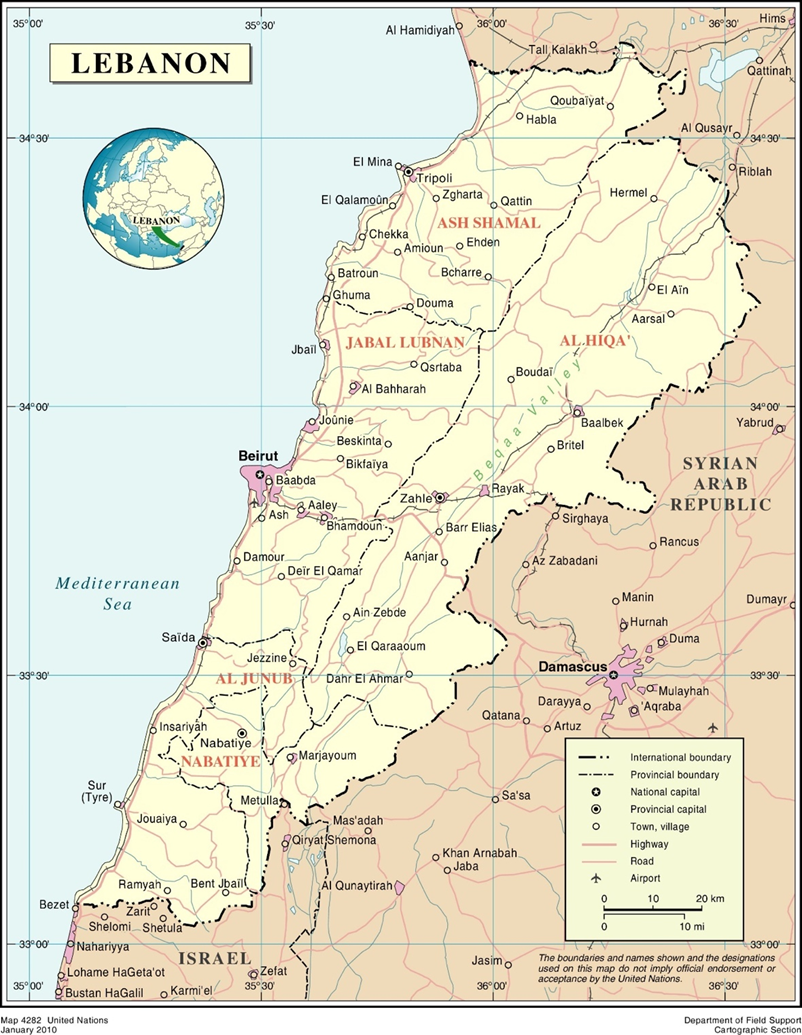
Key Events in 2026
Following the US-Israeli attack on Iran that began at the end of February 2026, hostilities resumed between Hezbollah and Israel in March, with Hezbollah attacks met by Israeli airstrikes and a ground invasion that seized parts of southern Lebanon south of the Litani and displaced around one million people. Despite a temporary ceasefire agreed in April and renewed in May, Israeli airstrikes continued, with Israel declaring that it would not withdraw from the territory it had seized. A further ceasefire was agreed upon on 17 June, brokered by the United States, but in August eleven people were killed, including three children, and nineteen injured in two Israeli airstrikes on southern Lebanon. IDF spokesperson, Ella Waweya, said that Israel had attacked ‘Hezbollah infrastructure’ in the Ansar and Nabatiyeh area in response to the group’s fighters attacking soldiers in Ali Taher. Ali Taher is a hill where the Israeli military says large underground Hezbollah command and control centres are located, and it has been shelling the area for months.16W. Christou, ‘Israeli strikes on southern Lebanon kill 11 in worst toll since June truce’, The Guardian, 15 August 2026.
Two days later, and despite the passage of UN Security Council Resolution 2790 a year earlier, Lebanese President Joseph Aoun said that the government’s preference was for a reversal of the Council’s decision on UNIFIL, or, failing that, the creation of a new international force.17‘UNIFIL: Aoun seeks mandate extension as “first option”, alternative international force if not’, L’Orient Today, 17 August 2026. European States, notably France and Italy, said they would be prepared to contribute to such a force. The UN Secretary-General has published three options for a UN force to succeed UNIFIL.18‘Letter dated 1 June 2026 from the Secretary-General addressed to the President of the Security Council’, UN Doc S/2026/453, 1 June 2026. Any such UN peacekeeping mission will, however, require a new mandate from the UN Security Council.19P. Loft, ‘Lebanon and the end of UN Interim Force in Lebanon’s mandate in 2026’, House of Commons Research Briefing, 24 September 2026.
In September, further Israeli strikes in southern Lebanon killed at least eleven people as a campaign against Hezbollah intensified despite the US-brokered ceasefire. The deaths included two children who were killed when an Israeli bomb struck a residential building in the southern town of Kfar Rumman, Lebanese State media reported. Separately, two medics were killed when a missile launched from a drone hit their car.20G. Weiniger and S. Al-Atrush, ‘Israeli strikes kill 11 in Lebanon as campaign against Hezbollah escalates’, The Times, 7 September 2026.
The attack came a day after strikes killed seven people amid a surge in violence after Israel claimed to have seized control of the Ali Taher ridge. Israel said the ridge and its underground network, which is less than ten miles from the Israeli border, had been ‘funded and planned’ by Iran over the past two decades to launch attacks against Israel. Hezbollah stored its weapons, including rockets and drones, in tunnels, with its main command centre underneath the ridge, Israeli military sources claimed. The office of President Aoun called the strikes ‘a dangerous escalation’ that targeted ‘purely civilian administrations and health centres’.21Ibid.
The Humanitarian Situation
By April 2026, between 1.1 and 1.2 million individuals had been displaced across Lebanon following the escalating hostilities, particularly in the south.22UNICEF, ‘Lebanon Humanitarian Flash Update No. 7 (Escalation of Hostilities)’, 9 April 2026. Displacement has occurred across vast geographic areas and in successive waves linked to expanding evacuation orders. Under Geneva Convention IV of 194923Art 49(2), Convention (IV) relative to the Protection of Civilian Persons in Time of War; adopted at Geneva, 12 August 1949; entered into force, 21 October 1950. and customary IHL,24International Committee of the Red Cross (ICRC), Customary IHL Rule 129: ‘The Act of Displacement’. displacement is permitted only where required for the security of the civilian population or imperative military necessity.
On 2 March 2026, the IDF ordered civilians in southern Lebanon to ‘move immediately to areas north of the Litani River’, affecting approximately eight per cent of Lebanese territory and hundreds of thousands of people.25International Commission of Jurists, ‘Lebanon: Israel Must Immediately Stop Using Unlawful Mass Displacement Orders and Inflicting Terror on Civilians’, Press release, 20 March 2026. On 3 March, this order was extended to more than 100 towns and villages in southern Lebanon and to areas in the Bekaa Valley. On 12 March, a further order encompassed the entire area south of the Zahrani River, bringing approximately fourteen per cent of Lebanon’s total land area under displacement directives.26Ibid. UN experts observed that ‘within days, tens of thousands of civilians have once again been forced to flee their homes, many with nothing but the clothes they were wearing’.27OHCHR, ‘Amid Protection Crisis in Lebanon, UN Warns Bombing Civilians to Force Displacement is Unlawful’, 13 March 2026.
In August 2026, firefighters and residents of south Lebanon accused the IDF of lighting wildfires in the region, as forested areas burned down in blazes sparked by Israeli bombing. The IDF reportedly dropped flares in a wooded area outside Khiam in the south, causing further fires to break out. When firefighters attempted to extinguish the flames, a munition fired from a drone detonated close by, forcing them to withdraw, the head of Lebanese civil defence in the Nabatiyeh region, Hussein Fakih, said. The fires across south Lebanon, in particular in olive groves and on agricultural land, have sometimes been started by the use of white phosphorus.28W. Christou, ‘Israel deliberately starting wildfires in southern Lebanon, firefighters say’, The Guardian, 12 August 2026.
On 1 August, displaced residents of the border village of Yaroun found their olive and fruit groves, as well as their homes, had been set ablaze by occupying Israeli troops. Hafez Ghasham, the mayor of Yaroun, said:
Many of these trees, most of them, in fact, were inherited from our grandparents and parents. They have enormous sentimental value. The trees were also an important source of income for the people of the village. … They are trying to make the land uninhabitable. They are erasing our entire history, our entire culture, all our memories. Maybe the idea is that after some time, it will look as though nobody had ever lived here.29Ibid.
Conflict Classification and Applicable Law
International Humanitarian Law
As of 1 October 2026, the international armed conflict between Israel and Lebanon (resulting from Israel’s belligerent occupation of Lebanese territory) and the non-international armed conflict between Israel and Hezbollah resulting from the hostilities between the two were both continuing.
The Geneva Conventions of 1949 and the rules of customary IHL apply to the international armed conflict. Additional Protocol I of 1977 does not apply because although Lebanon is a party, Israel is not.30Art 96(2), Protocol Additional to the Geneva Conventions of 12 August 1949, and relating to the Protection of Victims of International Armed Conflicts (Protocol I); adopted at Geneva, 8 June 1977; entered into force, 7 December 1978. Both Israel and Lebanon are States Parties to the Hague Convention for the Protection of Cultural Property of 1954,31Convention for the Protection of Cultural Property in the Event of Armed Conflict of 1954; adopted at The Hague, 14 May 1954; entered into force, 7 August 1956 (Hague Convention of 1954). as well as to its First Protocol of 1954,32Protocol to the Convention for the Protection of Cultural Property in the Event of Armed Conflict; adopted at The Hague, 14 May 1954; entered into force, 7 August 1956. both of which apply to the international armed conflict between the two States.
Common Article 3 of the Geneva Conventions and the rules of customary IHL govern the non-international armed conflict between Israel and Hezbollah. Thus, any detainees held by the enemy in connection with the conflict must be treated humanely. The principles of distinction and proportionality in attack, underpinned by the duties to take precautions in attack and defence, all apply to the conduct of hostilities as a matter of customary law. Israel is not party to the Second Protocol to the Hague Convention for the Protection of Cultural Property of 1999, which means that this treaty does not apply to the non-international armed conflict.33Art 3(2), Second Protocol to the Hague Convention of 1954 for the Protection of Cultural Property in the Event of Armed Conflict; adopted at The Hague, 26 March 1999; entered into force, 9 March 2004.
International Disarmament Law
Lebanon is a State Party to the Arms Trade Treaty.34Arms Trade Treaty; adopted at New York, 2 April 2013; entered into force, 24 December 2014. Israel is a signatory State with the attendant obligation to refrain from acts which would defeat the treaty’s object and purpose.35Art 18(a), Vienna Convention on the Law of Treaties; adopted at Vienna, 23 May 1969; entered into force, 27 January 1980 (VCLT). Neither Israel nor Lebanon is a State Party to the VCLT, but the rule is reflected in customary international law. Based on its conduct in the armed conflicts in Lebanon, the Geneva Academy’s Arms TRACK website has assessed that the IDF present a high risk of illegal use of any weapons that may be supplied to them. The risk of misuse by Lebanese Armed Forces is elevated.
In any event, Lebanon and its armed forces should not be supplied with anti-personnel mines by anyone. Lebanon, but not Israel, is a State Party to the 1997 Anti-Personnel Mine Ban Convention (APMBC), having adhered to that treaty in May 2026. As a State Party, importation of any anti-personnel mines is unlawful.36Convention on the Prohibition of the Use, Stockpiling, Production and Transfer of Anti-Personnel Mines and on their Destruction; adopted at Oslo, 18 September 1997; entered into force, 1 March 1999. There is already a significant landmine problem across much of southern Lebanon, largely the result of use of mines by Israel and its former proxy, the South Lebanon Army, over previous decades.
Explosive ordnance contamination from the conflict continues to claim lives and limbs in both Israel and Lebanon. In October 2026, one Israeli teenager was killed and nineteen others were wounded after an unexploded shell detonated near Israel’s border with Lebanon. Emergency services said that several of the wounded, part of a high-school trip, were in a serious condition. The IDF said that its forces were at the scene to provide assistance and that the circumstances of the incident were being investigated.37A. Hashmonai, ‘12 Wounded After Unexploded Shell Detonates Near Israel’s Border With Lebanon’, Haaretz, 12 October 2026. Neither State is party to Protocol V on Explosive Remnants of War to the Convention on Certain Conventional Weapons, which requires clearance of unexploded ordnance ‘as soon as feasible’ after the cessation of active hostilities,38Art 3(2), Protocol on Explosive Remnants of War to the Convention on Prohibitions or Restrictions on the Use of Certain Conventional Weapons which may be deemed to be Excessively Injurious or to have Indiscriminate Effects (Protocol V); adopted at Geneva, 28 November 2003; entered into force, 12 November 2006. although both are party to the chapeau Convention itself.
Lebanon, but not Israel, is a State Party to the 2008 Convention on Cluster Munitions.39Convention on Cluster Munitions; adopted at Dublin, 30 May 2008; entered into force, 1 August 2010. Lebanon is still contaminated with cluster munition remnants, particularly unexploded submunitions, as a result of very substantial Israeli use in the 2006 war. More recently, new contamination has resulted from the detonation of hidden Hezbollah stockpiles by Israeli artillery fire or airstrikes.40Mine Action Review, ‘Lebanon’, Clearing Cluster Munition Remnants 2026, Norwegian People’s Aid, 2026, pp 78–79.
Lebanon is a State Party to the 1992 Chemical Weapons Convention.41Convention on the Prohibition of the Development, Production, Stockpiling and Use of Chemical Weapons and on their Destruction; adopted at Geneva, 3 September 1992; entered into force, 29 April 1997. Israel is one of only four States not party to the Convention, although it has signed the Convention. Its obligation to refrain from acts which would defeat the treaty’s object and purpose, and its duties under customary IHL, means that it may not use chemical weapons in the armed conflict.42Art. 1, Chemical Weapons Convention; ICRC, Customary IHL Rule 74: ‘Chemical Weapons’.
International Criminal Law and Accountability
Neither Israel nor Lebanon is a State Party to the Rome Statute of the International Criminal Court.43Rome Statute of the International Criminal Court; adopted at Rome, 17 July 1998; entered into force, 1 July 2002. As such, the Court does not have jurisdiction over any of the acts committed in the two armed conflicts. Israel is a signatory to the Statute, but it subsequently notified the depositary – the UN Secretary-General – that it did not intend to become a party to it.44Notification of Israel, 28 August 2002.
Compliance with IHL
Overview
Israel has committed serious violations of IHL, including through indiscriminate attacks in residential areas of Lebanon, and its targeting of journalists and medical personnel and facilities. The IDF claims to operate in accordance with IHL and says that it does not allow the destruction of property unless there is an imperative military necessity. It also claims, but without providing evidence, that Hezbollah has embedded military infrastructure within civilian objects and areas.45E. Pengelly, M. Thomas and B. Metzler, ‘Satellite images reveal scale of Israeli demolitions as Lebanese villages destroyed’, BBC Verify, 16 April 2026.
Civilian Objects under Attack
Under customary IHL, attacks may only be directed against military objectives. Attacks must not be directed against civilian objects.46ICRC, Customary IHL Rule 7: ‘The Principle of Distinction between Civilian Objects and Military Objectives’. Civilian objects are all objects that are not military objectives,47ICRC, Customary IHL Rule 9: ‘Definition of Civilian Objects’. and, as such, are protected against attack.48ICRC, Customary IHL Rule 10: ‘Civilian Objects’ Loss of Protection from Attack’. Military objectives are those objects which, by their nature, location, purpose or use, make an effective contribution to military action.49ICRC, Customary IHL Rule 8: ‘Definition of Military Objectives’. In addition, the object’s partial or total destruction, capture, or neutralisation must offer a definite military advantage in the prevailing circumstances.
Attacks on homes and residential neighbourhoods
In March and April 2026, Israeli airstrikes repeatedly struck densely populated residential areas across Lebanon, severely damaging both civilian infrastructure and residential buildings. Satellite imagery analysis by BBC Verify indicated that more than 1,400 buildings were destroyed between 2 March and 16 April alone. Israel’s levelling of those structures came after Israeli Minister for Defence Israel Katz gave the order on 22 March 2026 to ‘accelerate the destruction of Lebanese homes’ near the Israeli border based on the ‘model in Gaza’ as part of its campaign against Hezbollah. The systematic demolition of these towns and villages is a prima facie war crime.50Pengelly et al, ‘Satellite images reveal scale of Israeli demolitions as Lebanese villages destroyed’.
On 8 March 2026, an Israeli strike is said to have killed at least thirteen civilians when a multi-storey building was struck in Sir el Gharbiyeh in Nabatiyeh governorate. The next day, an Israeli airstrike hit a residential area in Al‑Namiriya, also in Nabatiyeh, resulting in the death of a further seven civilians. On 12 March, a residential building in Arkey (Saida) was hit by the IDF, an attack that killed nine civilians, including seven members of the same family. An attack on a residential building on 18 March killed six members of the same family in the outskirts of the town of Sha’at, near the town of Yunin.51OHCHR Regional Office for the Middle East and North Africa (ROMENA), ‘Deaths and Displacement in Lebanon – Update on the Human Rights Situation in Lebanon’, Report, 24 April 2026. These are only some of the instances of apparent targeting of civilian objects or at the least indiscriminate attacks.
Attacks on cultural property
Cultural property receives special protection under IHL. It may only be attacked if it is a military objective and if its destruction is warranted by imperative military necessity.52ICRC, Customary IHL Rule 38: ‘Attacks Against Cultural Property’. On 23 March 2026, Israel attacked and destroyed the minaret of a mosque in Khiam.53‘Israeli Forces Blow up Mosque Minaret in Southern Lebanon’, Al Jazeera, 24 March 2026. In April, a 400-year-old Great Mosque in the historic centre of the city of Bint Jbeil was destroyed. The mosque is a key element of the city’s cultural heritage.54‘Mapping the destruction: How Israel “wiped out” Lebanon’s Bint Jbeil’, Al Jazeera, 28 April 2026. The Israeli military framed its operations in Bint Jbeil, which occurred in the context of ‘Operation Northern Arrows’, as aiming to dismantle Hezbollah’s subterranean and surface infrastructure.55‘Ibid. No evidence was, however, offered that either the Great Mosque in Bint Jbeil or the minaret in Khiam were being used for military purposes at the time of their destruction.
Use of white phosphorus
As mentioned, Israel has widely used white phosphorus in southern Lebanon, seemingly as a form of herbicide. White phosphorus is generally classified as an incendiary weapon, although it is formally excluded from the scope of Protocol III of the Convention on Certain Conventional Weapons.56Convention on Prohibitions or Restrictions on the Use of Certain Conventional Weapons which may be deemed to be Excessively Injurious or to have Indiscriminate Effects; adopted at Geneva, 10 October 1980; entered into force, 2 December 1983. In any event, although Lebanon is party to the Protocol, Israel is not, meaning that it is not applicable to the conflict.57Art 7(1), Convention on Certain Conventional Weapons.
In July 2026, a number of UN special procedures mandate holders wrote to Israel about the impacts of the ongoing hostilities in Lebanon. One of the issues they raised was on the use of white phosphorus over southern Lebanon:
It has also been reported that on 3 March 2026, the Israeli military used artillery-fired white phosphorus munitions over homes in the southern Lebanese town of Yohmor, including in residential parts of the town. Eight images showing airburst white phosphorus munitions being deployed and civil defence workers responding to fires in at least two homes and one car in that area have been allegedly verified and geolocated. Studies indicate a correlation between the use of white phosphorus and an increase in birth defects in children born to mothers exposed to it during pregnancy.58Letter from the mandates of the UN Special Rapporteur on violence against women and girls, its causes and consequences; the Special Rapporteur on extrajudicial, summary or arbitrary executions; the Special Rapporteur on adequate housing as a component of the right to an adequate standard of living, and on the right to non-discrimination in this context; the Special Rapporteur on the human rights of internally displaced persons; the Independent expert on the promotion of a democratic and equitable international order and the Special Rapporteur on the promotion and protection of human rights and fundamental freedoms while countering terrorism, Ref.: AL ISR 10/2026, 16 July 2026, p 2.
As is the case with all munitions fired in the conduct of hostilities, a military objective as defined in IHL must be targeted, otherwise the attack is indiscriminate in nature. The UN experts further wrote:
‘The allegations concerning the use of artillery-fired white phosphorus munitions over residential areas are particularly alarming given the risk of severe burns, respiratory injuries and death of persons exposed, as well as in light of their possible additional impact on the health of expecting mothers and children, including girls.’59Ibid, p 4.
Civilians under Attack
Under customary IHL, civilians enjoy general protection from the effects of hostilities, unless and for such time as they directly participate in hostilities.60ICRC, Customary IHL Rule 6: ‘Civilians’ Loss of Protection from Attack’. Accordingly, parties to any armed conflict must at all times distinguish between combatants and civilians, and are prohibited from directing attacks against civilians.61ICRC, Customary IHL Rule 1: ‘The Principle of Distinction between Civilians and Combatants’. In case of doubt, persons should be treated as civilians.62ICRC, Customary IHL Rule 6: ‘Civilians’ Loss of Protection from Attack’. Civilians may be incidentally affected by attacks against lawful targets. However, such attacks must not be disproportionate,63ICRC, Customary IHL Rule 14: ‘Proportionality in Attack’. and the attacker must take all feasible precautions to avoid or, in any event to minimize, incidental civilian impact.64ICRC, Customary IHL Rule 15: ‘Principle of Precautions in Attack’.
Attacks against journalists
Israel has killed numerous journalists in its conduct of hostilities against Hezbollah, including in the course of 2026, and often in circumstances that seem to constitute war crimes. According to the Office of the United Nations High Commissioner for Human Rights (OHCHR), as of April, Israel had killed at least fourteen journalists in Lebanon since 2023.65OHCHR, ‘Lebanon: UN experts call for international independent investigation into Israel’s killing of journalists’, Press release, 2 April 2026. That month, the targeted killing of three Lebanese journalists earlier that year was denounced by three UN special rapporteurs66The UN Special Rapporteur on the promotion and protection of the right to freedom of opinion and expression; the UN Special Rapporteur on extrajudicial, summary or arbitrary executions; and the UN Special Rapporteur on the promotion and protection of human rights and fundamental freedoms while countering terrorism. as ‘another egregious attack on press freedom by Israeli forces’ that ‘must be promptly, fully and independently investigated by an international body’. In a written statement, they said: ‘We denounce strongly what has now become a standard, dangerous practice of Israel to target and kill journalists and then claim, without providing any credible evidence, that they were involved with armed groups.’67Ibid.
A further Israeli strike killed Lebanese journalist Amal Khalil and injured her colleague Zeinab Faraj on 22 April, with reports indicating that Israel delayed Lebanese ambulances from reaching the two journalists for hours – at one pointing dropping stun grenades on Lebanese Red Cross workers and firing on their ambulances. The delay in rescue may have been a casual factor in Ms Khalil’s death, as hospital reports indicate she might still have been alive hours after an Israeli strike toppled a building on top of her and Ms Faraj. ‘The evidence is clear that the Israeli military knew, or should have, that Faraj and Khalil were civilians, but attacked them anyway, and then prevented paramedics from rescuing them for hours’, Ramzi Kaiss, Lebanon researcher at Human Rights Watch, declared. Amnesty International, Human Rights Watch, and Legal Agenda each concluded in September on the basis of separate, detailed investigations that Israel deliberately and directly attacked Ms Khalil and Ms Faraj and called for the IDF actions to be investigated as war crimes.68W. Christou, ‘Israeli strike that killed journalist in Lebanon was war crime, say rights groups’, The Guardian, 6 August 2026.
Attacks against medical personnel
Medical personnel (and medical facilities) have special protection under customary IHL. Medical Units have to be protected at all times,69ICRC, Customary IHL, Rule 28: ‘Medical Units’. as do medical personnel70ICRC, Customary IHL, Rule 25: ‘Medical Personnel’. and medical transports.71ICRC, Customary IHL, Rule 29: ‘Medical Transports’. Multiple attacks by Israeli forces are believed to have been directed at both medical facilities and medical personnel. According to the World Health Organization (WHO), attacks on healthcare during the first half of the year occurred daily, closing six hospitals and damaging fifteen others following 2 March. The attacks have resulted in the death of 100 healthcare workers.72WHO, ‘Lebanon Health Emergency: Situation Update #20’, 17 April 2026.
On 8 March 2026, an Israeli attack destroyed an Islamic Health Association (IHA) emergency response centre in the southern town of Zifta, which killed two medical personnel.73W. Christou and A. Abdelkarim, ‘Israel deliberately targeting medical facilities in south Lebanon, say health workers’, The Guardian, 21 March 2026. An attack in Sawana village on 13 March hit two medical facilities, killing two paramedics.74ROMENA, ‘Deaths and Displacement in Lebanon – Update on the Human Rights Situation in Lebanon’. On 31 March, Jabal Amel University Hospital in Tyre in south Lebanon was struck by Israel – the fifth time this had occurred.75J. Salhani, ‘How Israel is destroying healthcare infrastructure in southern Lebanon’, Al Jazeera, 3 April 2026.
Israeli forces have on several occasions launched an initial strike and then paused the attack, meaning that medical first responders were on site, whereupon additional strikes are launched on the same location.76Christou and Abdelkarim, ‘Israel deliberately targeting medical facilities in south Lebanon, say health workers’. An incident in the southern Lebanon village of Mayfadoun, which was covered by the BBC, is one example. On 15 April, when a team of IHA paramedics responded to an initial Israeli airstrike, they were hit by a second strike. When a second team of IHA paramedics arrived to evacuate the wounded colleagues, they too were hit. Two ambulances from the Risala Scout Association and the Nabatiyeh Ambulance Service, which had also deployed to the site, were subsequently attacked.77H. Bachega, ‘Israeli triple-tap strike kills three paramedics in Lebanon, officials say’, BBC News, 15 April 2026.
A further double-tap attack occurred on 28 April in the town of Majdal Zoun. Two successive Israeli airstrikes on a building killed nine people in total, including three members of Lebanese Civil Defence, a State-run emergency service. The three had been dispatched to rescue those wounded in the first strike and were trapped under the rubble caused by the second. Lebanon’s Prime Minister described the attack as a war crime. The IDF claimed to have hit a Hezbollah commander operating in the vicinity of Israeli soldiers, but provided no evidence to support the claim. They noted that the incident was under review.78H. Bachega, ‘Israeli double-tap strike kills three rescue workers in Lebanon, officials say’, BBC News, 29 April 2026.
While Israel asserts that the ambulances and other medical facilities are used for military purposes, evidence has not been provided to underpin the accusation.79Amnesty International, ‘Lebanon: Israel must halt attacks on healthcare workers, medical facilities and first responders’, 19 March 2026; Christou and Abdelkarim, ‘Israel deliberately targeting medical facilities in south Lebanon, say health workers’. Kristine Beckerle, Deputy Regional Director for the Middle East and North Africa at Amnesty International, said: ‘Throwing out’ claims that healthcare facilities and ambulances are being used for military purposes without providing any evidence ‘does not justify treating hospitals, medical facilities or medical transport as battlefields or treating doctors and paramedics as targets’.80Amnesty International, ‘Lebanon: Israel must halt attacks on healthcare workers, medical facilities and first responders’.
Protection of Persons in the Power of the Enemy
Under customary IHL, special protection is afforded to several categories of civilians or persons hors de combat who face a specific risk of harm, such as women, children, refugees, and IDPs.81ICRC, Customary IHL Rules 134 to 138: ‘Chapter 39. Other Persons Afforded Specific Protection’. IHL provides fundamental guarantees for anyone who is in the power of a party to a conflict, prohibiting torture and other inhumane or degrading treatment, arbitrary detention, and unfair trials.
Arbitrary deprivation of liberty
On 9 June 2026, Israeli sources reported that National Security Minister Itamar Ben-Gvir proposed thinking ‘outside the box about Hezbollah’ and ‘arresting their women and youth and taking them to terrorist prisons’. As UN special procedures mandate holders observed in a letter to Israel: ‘Such remarks are particularly concerning in light of longstanding allegations by United Nations mechanisms and human rights organizations documenting sexual violence and other forms of ill-treatment committed against women and girls held in Israeli detention facilities.’82Letter from the mandates of UN Special Rapporteurs, Ref.: AL ISR 10/2026, 16 July 2026, p 4. The document to which the UN experts referred was the report of the UN Secretary-General on conflict-related sexual violence, published in April 2026.83‘Conflict-related sexual violence: Report of the Secretary-General’, UN Doc S/2026/321, 21 April 2026, paras 35–37.
In September 2026, the International Committee of the Red Cross, at the request of the relevant parties, reported that it had facilitated the transfer to Lebanon of five individuals released from Israeli detention.84ICRC, ‘Lebanon: ICRC facilitates transfer to Lebanon of 5 people detained by Israel’, News release, Geneva, 4 September 2026. One of those released was Malik Kamal Razi, who had been held in Israeli detention for nearly eleven months. Earlier described by official Israeli media as a ‘Hezbollah operative’, Israel ultimately admitted that there was no evidence linking him to any group. The office of Israeli Prime Minister Benjamin Netanyahu said an investigation showed he and others released at the same time ‘do not belong to any terrorist organization, have not engaged in terrorism, and there is no justification for their continued detention’.85S. Rady and S. Dincel, ‘Release of Lebanese national detained without charge highlights Israel’s admission of arbitrary detentions’, AA, 4 September 2026. The arbitrary deprivation of liberty of anyone in connection with an armed conflict is prohibited by IHL.86ICRC, Customary IHL Rule 99: ‘Deprivation of Liberty’.
The ICRC further reported that many families in Lebanon were still waiting for answers about the fate of loved ones who may be detained, deceased, or otherwise unaccounted for. But since October 2023, the organization ‘has not had access to detainees held in Israeli places of detention, including Lebanese nationals’.87ICRC, ‘Lebanon: ICRC facilitates transfer to Lebanon of 5 people detained by Israel’. The ICRC reiterated ‘the requirement to receive information on conflict-related detainees and to be granted access to them’. It was, it said ‘continuing its dialogue with the Israeli authorities to immediately resume its work in detention’.88Ibid.
Transitional Justice
There is no transitional justice programme in place in Lebanon. As the International Centre for Transitional Justice (ICTJ) has observed, a past absence of accountability ‘has shaped Lebanon’s political landscape, weakening State institutions and undermining their ability to govern effectively and provide security’. In the absence of an effective and trusted State, political, sectarian, and armed actors, including Hezbollah, increasingly gained control over territory and communities as the sole provider of security, services, and protection. Following the civil war, many former militia leaders entered politics and took influential positions in government, while Hezbollah maintained both an armed and political role. Over time, reliance on these actors further diminished State institutions, blurring the line between State and non-State authority.89F. BouZeineddine, ‘Lebanon’s Accountability Crisis’, ICTJ, 2 June 2026.
An ICTJ expert calls for meaningful steps to be taken to end impunity and to ensure that both domestic and external actors are held accountable for past and present violations. ‘Internally’, he says, this requires ‘confronting a system that has undermined State institutions, entrenched fragmented and sectarian forms of governance, and denied justice to victims’. Externally, it requires ‘credible measures to hold the Israeli State accountable for violations committed on Lebanese territory, and broader international efforts to prevent conflict’. Without accountability, Lebanon ‘will remain trapped in recurring violence, and impunity will continue to define political and everyday life’.90Ibid.
- 1IDF, ‘The IDF eliminated Hezbollah’s most senior military commander and head of its Strategic Unit, Fuad Shukr “Sayyid Muhsan”’, IDF Announcement, 30 July 2024; E. Fabian, ‘IDF kills top Hezbollah commander in Beirut in response to deadly Majdal Shams attack’, The Times of Israel, 30 July 2024. ↩︎
- 2E. Fabian and L. Berman, ‘IDF hits Hezbollah launch sites in Lebanon to thwart major attack on central, north Israel’, The Times of Israel, 25 August 2024; I. Nasser, D. Karni, H. Regan and S. Tanno, ‘Israel intercepts Hezbollah ballistic missile near Tel Aviv in first such attack’, CNN, 25 September 2024. ↩︎
- 3L. Bassam, ‘Hezbollah vows to punish Israel after pager explosions across Lebanon’, Reuters, 18 September 2024; Office of the UN High Commissioner for Human Rights (OHCHR), ‘Exploding pagers and radios: A terrifying violation of international law, say UN experts’, Press release, 19 September 2024; M. Gebeily, J. Pearson, and D. Gauthier-Villars, ‘How Israel’s bulky pager fooled Hezbollah’, Reuters, 16 October 2024. See the legal analysis in the IHL in Focus report for July 2024–December 2025, pp 237–38. ↩︎
- 4‘Nasrallah led Hezbollah to become regional force’, Reuters, 28 September 2024; M. Lubell and M. Gebeily, ‘Israel kills Hezbollah leader Nasrallah in airstrike’, Reuters, 29 September 2024. ↩︎
- 5G. Wright and M. Moench, ‘Israel launches ground invasion in Lebanon’, BBC, 1 October 2024; P. Beaumont, A. Roth, and M. Christou, ‘Israeli military says it is carrying out “limited” ground operation targeting Hezbollah in Lebanon’, Reuters, 1 October 2024. ↩︎
- 6A. Mehvar, L. Nevola, S. H. Ali, N. Khdour, and A. R. Taha, ‘Middle East Overview: October 2024’, Armed Conflict Location and Event Data Project (ACLED), 7 November 2024; A. Mehvar, M. Shamy, N. Khdour, L. Nevola, and S. H. Ali, ‘Middle East Overview: November 2024’, ACLED, 6 December 2024. ↩︎
- 7J. Deeb, ‘Full text of the ceasefire agreement between Israel and Lebanon’, Middle East Eye, 27 November 2024. ↩︎
- 8P. Kingsley and E. Ward, ‘Israel Says It Will Keep Troops “Temporarily” in 5 Points in Lebanon’, The New York Times, 17 February 2025. See also ‘Israeli troops “staying indefinitely” in Lebanon border buffer zone, defence minister says’, France 24, 27 February 2025. ↩︎
- 9See, e.g., H. Bachega and M. Moench, ‘Israel conducts first strike on Beirut since Hezbollah ceasefire’, BBC, 28 March 2025. ↩︎
- 10R. Comerford, ‘Israel strikes southern Beirut on eve of religious holiday’, BBC, 6 June 2025. ↩︎
- 11Agence France-Presse, ‘Israel will continue Lebanon strikes if Hezbollah not disarmed, warns Katz’, L’Orient-Le Jour, 6 June 2025. ‘Hezbollah chief says won’t disarm until Israel leaves southern Lebanon’, Al Jazeera, 6 July 2025. ↩︎
- 12G. Blackburn, ‘Lebanon backs US proposal for Hezbollah to disarm and IDF to withdraw from south’, Euronews, 7 August 2025. ↩︎
- 13UN Security Council Resolution 2790, adopted by unanimous vote in favour on 28 August 2025, operative para 1. ↩︎
- 14G. Mavris, ‘Rubble and drones: in the no-go zone between Lebanon and Israel’, Swissinfo, 20 November 2025. ↩︎
- 15OHCHR, ‘UN experts warn against continued violations of ceasefire in Lebanon and urge protection of civilians’, Press release, Geneva, 17 October 2025. ↩︎
- 16W. Christou, ‘Israeli strikes on southern Lebanon kill 11 in worst toll since June truce’, The Guardian, 15 August 2026. ↩︎
- 17‘UNIFIL: Aoun seeks mandate extension as “first option”, alternative international force if not’, L’Orient Today, 17 August 2026. ↩︎
- 18‘Letter dated 1 June 2026 from the Secretary-General addressed to the President of the Security Council’, UN Doc S/2026/453, 1 June 2026. ↩︎
- 19P. Loft, ‘Lebanon and the end of UN Interim Force in Lebanon’s mandate in 2026’, House of Commons Research Briefing, 24 September 2026. ↩︎
- 20G. Weiniger and S. Al-Atrush, ‘Israeli strikes kill 11 in Lebanon as campaign against Hezbollah escalates’, The Times, 7 September 2026. ↩︎
- 21Ibid. ↩︎
- 22
- 23Art 49(2), Convention (IV) relative to the Protection of Civilian Persons in Time of War; adopted at Geneva, 12 August 1949; entered into force, 21 October 1950. ↩︎
- 24International Committee of the Red Cross (ICRC), Customary IHL Rule 129: ‘The Act of Displacement’. ↩︎
- 25International Commission of Jurists, ‘Lebanon: Israel Must Immediately Stop Using Unlawful Mass Displacement Orders and Inflicting Terror on Civilians’, Press release, 20 March 2026. ↩︎
- 26Ibid. ↩︎
- 27OHCHR, ‘Amid Protection Crisis in Lebanon, UN Warns Bombing Civilians to Force Displacement is Unlawful’, 13 March 2026. ↩︎
- 28W. Christou, ‘Israel deliberately starting wildfires in southern Lebanon, firefighters say’, The Guardian, 12 August 2026. ↩︎
- 29Ibid. ↩︎
- 30Art 96(2), Protocol Additional to the Geneva Conventions of 12 August 1949, and relating to the Protection of Victims of International Armed Conflicts (Protocol I); adopted at Geneva, 8 June 1977; entered into force, 7 December 1978. ↩︎
- 31Convention for the Protection of Cultural Property in the Event of Armed Conflict of 1954; adopted at The Hague, 14 May 1954; entered into force, 7 August 1956 (Hague Convention of 1954). ↩︎
- 32Protocol to the Convention for the Protection of Cultural Property in the Event of Armed Conflict; adopted at The Hague, 14 May 1954; entered into force, 7 August 1956. ↩︎
- 33Art 3(2), Second Protocol to the Hague Convention of 1954 for the Protection of Cultural Property in the Event of Armed Conflict; adopted at The Hague, 26 March 1999; entered into force, 9 March 2004. ↩︎
- 34Arms Trade Treaty; adopted at New York, 2 April 2013; entered into force, 24 December 2014. ↩︎
- 35Art 18(a), Vienna Convention on the Law of Treaties; adopted at Vienna, 23 May 1969; entered into force, 27 January 1980 (VCLT). Neither Israel nor Lebanon is a State Party to the VCLT, but the rule is reflected in customary international law. ↩︎
- 36Convention on the Prohibition of the Use, Stockpiling, Production and Transfer of Anti-Personnel Mines and on their Destruction; adopted at Oslo, 18 September 1997; entered into force, 1 March 1999. ↩︎
- 37A. Hashmonai, ‘12 Wounded After Unexploded Shell Detonates Near Israel’s Border With Lebanon’, Haaretz, 12 October 2026. ↩︎
- 38Art 3(2), Protocol on Explosive Remnants of War to the Convention on Prohibitions or Restrictions on the Use of Certain Conventional Weapons which may be deemed to be Excessively Injurious or to have Indiscriminate Effects (Protocol V); adopted at Geneva, 28 November 2003; entered into force, 12 November 2006. ↩︎
- 39Convention on Cluster Munitions; adopted at Dublin, 30 May 2008; entered into force, 1 August 2010. ↩︎
- 40Mine Action Review, ‘Lebanon’, Clearing Cluster Munition Remnants 2026, Norwegian People’s Aid, 2026, pp 78–79. ↩︎
- 41Convention on the Prohibition of the Development, Production, Stockpiling and Use of Chemical Weapons and on their Destruction; adopted at Geneva, 3 September 1992; entered into force, 29 April 1997. ↩︎
- 42
- 43Rome Statute of the International Criminal Court; adopted at Rome, 17 July 1998; entered into force, 1 July 2002. ↩︎
- 44Notification of Israel, 28 August 2002. ↩︎
- 45E. Pengelly, M. Thomas and B. Metzler, ‘Satellite images reveal scale of Israeli demolitions as Lebanese villages destroyed’, BBC Verify, 16 April 2026. ↩︎
- 46ICRC, Customary IHL Rule 7: ‘The Principle of Distinction between Civilian Objects and Military Objectives’. ↩︎
- 47
- 48
- 49ICRC, Customary IHL Rule 8: ‘Definition of Military Objectives’. In addition, the object’s partial or total destruction, capture, or neutralisation must offer a definite military advantage in the prevailing circumstances. ↩︎
- 50
- 51OHCHR Regional Office for the Middle East and North Africa (ROMENA), ‘Deaths and Displacement in Lebanon – Update on the Human Rights Situation in Lebanon’, Report, 24 April 2026. ↩︎
- 52
- 53‘Israeli Forces Blow up Mosque Minaret in Southern Lebanon’, Al Jazeera, 24 March 2026. ↩︎
- 54‘Mapping the destruction: How Israel “wiped out” Lebanon’s Bint Jbeil’, Al Jazeera, 28 April 2026. ↩︎
- 55‘Ibid. ↩︎
- 56Convention on Prohibitions or Restrictions on the Use of Certain Conventional Weapons which may be deemed to be Excessively Injurious or to have Indiscriminate Effects; adopted at Geneva, 10 October 1980; entered into force, 2 December 1983. ↩︎
- 57Art 7(1), Convention on Certain Conventional Weapons. ↩︎
- 58Letter from the mandates of the UN Special Rapporteur on violence against women and girls, its causes and consequences; the Special Rapporteur on extrajudicial, summary or arbitrary executions; the Special Rapporteur on adequate housing as a component of the right to an adequate standard of living, and on the right to non-discrimination in this context; the Special Rapporteur on the human rights of internally displaced persons; the Independent expert on the promotion of a democratic and equitable international order and the Special Rapporteur on the promotion and protection of human rights and fundamental freedoms while countering terrorism, Ref.: AL ISR 10/2026, 16 July 2026, p 2. ↩︎
- 59Ibid, p 4. ↩︎
- 60
- 61
- 62
- 63
- 64
- 65OHCHR, ‘Lebanon: UN experts call for international independent investigation into Israel’s killing of journalists’, Press release, 2 April 2026. ↩︎
- 66The UN Special Rapporteur on the promotion and protection of the right to freedom of opinion and expression; the UN Special Rapporteur on extrajudicial, summary or arbitrary executions; and the UN Special Rapporteur on the promotion and protection of human rights and fundamental freedoms while countering terrorism. ↩︎
- 67Ibid. ↩︎
- 68W. Christou, ‘Israeli strike that killed journalist in Lebanon was war crime, say rights groups’, The Guardian, 6 August 2026. ↩︎
- 69
- 70
- 71
- 72
- 73W. Christou and A. Abdelkarim, ‘Israel deliberately targeting medical facilities in south Lebanon, say health workers’, The Guardian, 21 March 2026. ↩︎
- 74ROMENA, ‘Deaths and Displacement in Lebanon – Update on the Human Rights Situation in Lebanon’. ↩︎
- 75J. Salhani, ‘How Israel is destroying healthcare infrastructure in southern Lebanon’, Al Jazeera, 3 April 2026. ↩︎
- 76Christou and Abdelkarim, ‘Israel deliberately targeting medical facilities in south Lebanon, say health workers’. ↩︎
- 77H. Bachega, ‘Israeli triple-tap strike kills three paramedics in Lebanon, officials say’, BBC News, 15 April 2026. ↩︎
- 78H. Bachega, ‘Israeli double-tap strike kills three rescue workers in Lebanon, officials say’, BBC News, 29 April 2026. ↩︎
- 79Amnesty International, ‘Lebanon: Israel must halt attacks on healthcare workers, medical facilities and first responders’, 19 March 2026; Christou and Abdelkarim, ‘Israel deliberately targeting medical facilities in south Lebanon, say health workers’. ↩︎
- 80Amnesty International, ‘Lebanon: Israel must halt attacks on healthcare workers, medical facilities and first responders’. ↩︎
- 81
- 82Letter from the mandates of UN Special Rapporteurs, Ref.: AL ISR 10/2026, 16 July 2026, p 4. ↩︎
- 83‘Conflict-related sexual violence: Report of the Secretary-General’, UN Doc S/2026/321, 21 April 2026, paras 35–37. ↩︎
- 84ICRC, ‘Lebanon: ICRC facilitates transfer to Lebanon of 5 people detained by Israel’, News release, Geneva, 4 September 2026. ↩︎
- 85S. Rady and S. Dincel, ‘Release of Lebanese national detained without charge highlights Israel’s admission of arbitrary detentions’, AA, 4 September 2026. ↩︎
- 86
- 87
- 88Ibid. ↩︎
- 89F. BouZeineddine, ‘Lebanon’s Accountability Crisis’, ICTJ, 2 June 2026. ↩︎
- 90Ibid. ↩︎