Conflict Overview
Conflict History
For more than a decade, Mali has been engaged in multiple armed conflicts against non-State armed groups operating on its territory. As in other Sahelian countries, the roots of the armed conflicts lie in a combination of ethnic tensions, fragile State institutions, and limited government control over peripheral regions.1M. DeAngelo, ‘Counterterrorism Shortcomings in Mali, Burkina Faso, and Niger’, Foreign Policy Research Institute, 3 March 2025. There have been recurrent conflicts with Tuareg separatist armed groups in the north; with an al-Qaeda affiliate, the Group for the Support of Islam and Muslims (Jama’at Nusrat al-Islam wa al-Muslimeen, JNIM); and the Islamic State in the Sahel (ISSP), previously known as Islamic State in the Greater Sahara (ISGS). Other instances of armed violence involving armed groups did not amount to armed conflicts, either because the group was not sufficiently organized or, more often, because the violence was not of a sufficiently repeated and intense nature.
JNIM, the largest jihadist coalition in Mali, is led by Iyad Ag Ghali, a Tuareg who once served as a Malian diplomat. Ghali previously played a prominent role in the 2012 Tuareg uprising against the government, seeking to establish an independent homeland (‘Azawad’) in the north.2P. Sippy and J. Boswall, ‘How an al-Qaeda offshoot became one of Africa’s deadliest militant groups’, BBC, 7 July 2025. The influx of extremists into northern Mali following the collapse of the Libyan government reignited the dormant Tuareg rebellion which had previously surfaced in 1963, 1990, and 2006.3Council on Foreign Relations, ‘Violent Extremism in the Sahel’, updated 29 July 2026. For background on the earlier Tuareg rebellions see S.Pezard and M. Shurkin, ‘Achieving Peace in Northern Mali: Past Agreements, Local Conflicts, and the Prospects for a Durable Settlement’ RAND Corporation Research Report, 1 May 2015. Representing only ten per cent of the Malian population, the Tuareg people, organized under the National Movement for the Liberation of Azawad (MNLA), sought an autonomous state and aligned themselves with multiple Islamist groups, including al-Qaeda in the Islamic Maghreb (AQIM), the Movement for Unity and Jihad in West Africa (MUJAO), and Ansar Dine to push government forces out of the north. In March 2012, the army, disapproving of the government’s failure to put down the rebellion, deposed then President Amadou Toumani Touré in a coup.
A little more than a year later, Mali transitioned back to a civilian-led government under Ibrahim Boubacar Keïta. Between 2014 and 2015, pro-government armed groups formed the Plateforme des mouvements du 14 juin 2014 d’Alger (Platform), while separatist armed groups established the Coordination des Mouvements de l’Azawad (CMA). In 2015, these two coalitions engaged in peace talks with the Malian government, which led to the conclusion of the Agreement for Peace and Reconciliation in Mali – the Algiers Accords – on 20 June 2015. The separatist coalition excluded Islamist organizations, which quickly took advantage of the agreement to expand their control, spreading further into central Mali and neighbouring Burkina Faso and Niger.4Council on Foreign Relations, ‘Violent Extremism in the Sahel’, updated 29 July 2026.
JNIM was formed in 2017 by the merger of five jihadist organizations operating in the Sahel, including Ansar Dine and Al-Mourabitoun. This coalition emerged after French-led operations in 2012 had temporarily pushed back the separatist and jihadist groups that had seized control of the north of Mali. Since its formation, JNIM has pursued an agenda of rejecting the authority of Sahelian governments while imposing its strict interpretation of Islamic law on populations under its influence.5‘Mali: Enabling Dialogue with the Jihadist Coalition JNIM’, International Crisis Group, 10 December 2021.
After two further coups in 2020 and 2021, General Assimi Goïta expelled French and UN forces, and has strengthened ties with Russia. Since 2021, the junta has relied on the Russia-linked Wagner Group, and subsequently Africa Corps which is placed under the authority of the Russian Ministry of Defence, making them an agent of Russia under international law.6Human Rights Watch ‘Mali: Grave Abuses Amid Renewed Fighting’, 28 June 2026. In 2024, the junta publicly announced their withdrawal from the Algiers Accords brokered in 2015,7T. Diallo, ‘Mali junta ends 2015 peace deal with separatist rebels’, Reuters, 25 January 2024. leading to an upsurge in violence in the conflict with Tuareg separatists now predominantly fighting as the Front de Libération de l’Azawad (FLA).
Key Events Since 1 January 2026
In December 2025, the Alliance des États du Sahel (AES) stood up a 6,000-strong joint military element, the Unified Force, headquartered in Niamey, Niger. It replaces the Multinational Joint Task Force to secure the Liptako-Gourma region announced in January 2017, and the G5 Sahel Joint Force established in July 2017.8L. Saïdou Daoura and R. Leïla Salia, ‘Will the AES Unified Force succeed where the G5 Sahel failed?’ Institute for Security Studies, 4 March 2026. Since the AES States withdrew from the G5 process, and more recently from the Economic Community of West African States (ECOWAS), previous iterations of this joint force had become unworkable.
Following JNIM’s December 2025 statement designating fuel distributors as priority targets, the group burned five fuel tankers between December 2025 and January 2026 in Diboli and Kayes and destroyed three industrial facilities in the Kayes region. In response, the Mali armed forces (FAMa) intensified counter-terrorism efforts between 29 January and 26 February, reportedly killing 20 alleged fighters in the Menaka, Ségou and Mopti regions. Further operations in March against JNIM bases in Medina reportedly killed 40 alleged terrorists and led to the rescue of 12 hostages.9Report of the Secretary-General on the activities of the United Nations Office for West Africa and the Sahel, UN Doc S/2026/537, 30 June 2026, para 27.
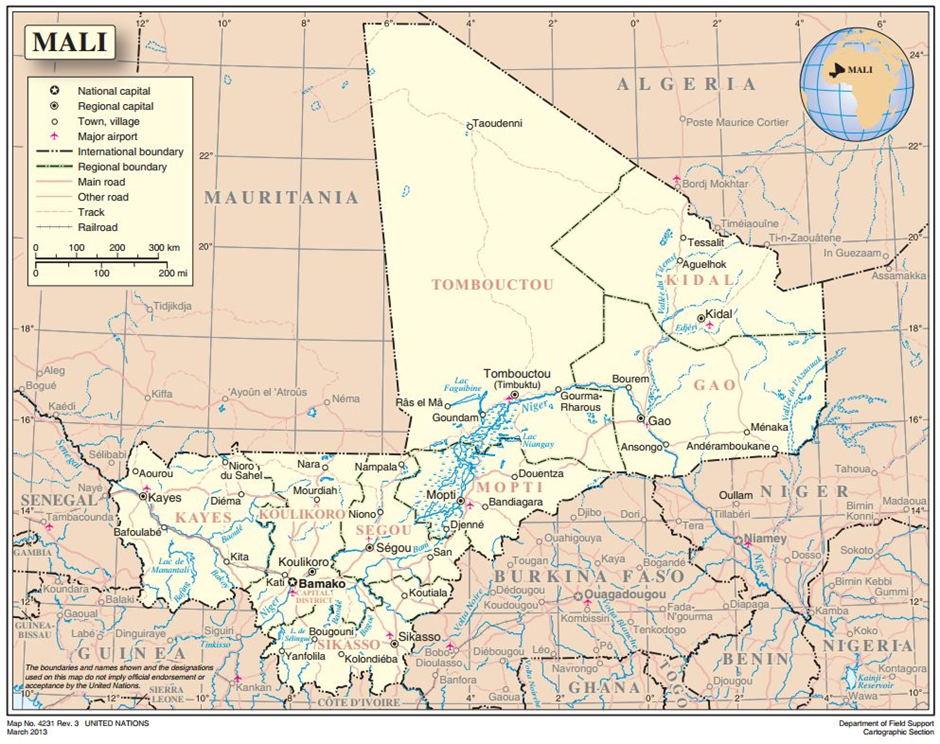
On 25 April 2026, JNIM and FLA launched simultaneous and coordinated attacks against strategic targets in Bamako, Kati, Kidal, Gao, Mopti and Sévaré. The attacks resulted in civilian and military casualties, including the killing of the Minister of Defence, General Sadio Camara.10Ibid, para 28. See also Human Rights Watch ‘Mali: Grave Abuses Amid Renewed Fighting’, 28 June 2026. After two days of fighting, Russian fighters from Africa Corps withdrew from Kidal after reaching a deal with JNIM and the FLA, leaving the town under insurgent control. About 200 Malian soldiers were left behind in Kidal and taken prisoner. Insurgents also captured the northern towns of Tessalit and Tessit. In Bamako, JNIM attacked a military airbase near the airport and attempted to advance toward the presidential palace, but Malian forces and Russian fighters repelled the attack.11Human Rights Watch ‘Mali: Grave Abuses Amid Renewed Fighting’, 28 June 2026. In a national address on 28 April, the transitional President, Assimi Goïta, vowed to continue operations ‘until the total neutralization’ of all groups involved, even as JNIM maintained a partial blockade of key supply routes into Bamako.12Report of the Secretary-General on the activities of the United Nations Office for West Africa and the Sahel, UN Doc S/2026/537, 30 June 2026, para 28.
After these attacks, the AES Unified Force – whose number had increased to 15,000 earlier in April – began intense air campaigns in Malian territory. A spokesperson for the FLA, Mohamed Elmaouloud Ramadane, had called on Burkina Faso and Niger ‘to stay out of the events underway in Mali’ a few hours after the attacks began.13AFP ‘Alliance of Sahel States confirms joint airstrikes in Mali’ AfricaNews, 1 May 2026
In May, Malian forced launched an intense air campaign around Kidal, but have not succeeded in re-taking the territory. In the month after the April attacks, hundreds of civilians have died, mostly in attacks against villages in the Mopti region, claimed by JNIM. Some of the dead have included members of pro-government self-defence forces. A spokesperson for JNIM said the villages had been targeted after breaking agreements made with the group to offer support and to avoid any cooperation with Mali’s authorities.14J. Burke ‘Mali’s forces target rebel alliance in junta’s fight to keep power’ Guardian, 15 May 2026. In the aftermath of the attack on Kidal, it was reported that Africa Corps was actively scaling back its physical presence, stretched out over extensive territory, and focused on keeping its personnel nearer to its main base in Bamako and using air power to provide support to Malian forces.15ADF ‘Africa Corps Shifts Tactics in Mali’, 16 June 2026.
The closer alliance between the FLA and JNIM has both transformed the dynamics of the conflict and raised broader concerns across the region about the possibility for military cooperation between a nationalist separatist movement and an al-Qaeda affiliate.16O. Alsharif ‘Why Mali’s northern conflict has entered a dangerous new phase’, Al Jazeera, 27 July 2026. There have been a number of smaller but still significant subsequent coordinated attacks, including an ambush near Anefis in July which was jointly claimed by the FLA and JNIM, which struck a convey of the FAMa and Africa Corps, killing more than fifty Malian soldiers.17M. Aliyu ‘How armed group alliances are reshaping Mali’s conflict and the wider Sahel’, Al Jazeera, 22 July 2026. The alleged war crime of summary executions by JNIM fighters of soldiers who had surrendered following this joint attack is discussed below. The attack was seemingly coordinated with other attacks in Aguelhok, Gao, and Sévaré.18‘Mali: des localités dans le nord et une prison dans le sud visées par des attaques coordonnées’, Radio France Internationale, 4 July 2026.
The Humanitarian Situation
The Lake Chad Basin crisis is among the worst humanitarian disasters in the world, combining the severe harm of climate change with very weak governance in rural areas. Temperatures in the Sahel are rising 1.5 times faster than the global average, and dwindling land and water resources have led to increasingly frequent clashes between herding, farming, and fishing communities. Armed groups have not only worsened humanitarian conditions, including by targeting humanitarian workers, but have also exploited the insecure conditions to recruit and control populations across the Sahel.19Council on Foreign Relations, ‘Violent Extremism in the Sahel’, updated 29 July 2026.
The sweeping fuel and transport embargo JNIM enacted from the end of 2025 was part of coordinated offensives spanning Kayes, Koulikoro, Mopti, Segou, and Sikasso. As a regional analyst for the Armed Conflict Location & Event Data Project (ACLED) noted: ‘The blockade disrupted trade and transport routes linking Bamako and the surrounding regions, resulting in fuel shortages and nationwide price hikes. It was part of a deliberate effort to paralyze the economy, undermine government authority, and destabilize the military regime.’20H. Nsaibia ‘Economic warfare escalates as militants expand beyond the Sahel’,ACLED, 11 December 2025.
The ability of international organisations to monitor or assist with the various humanitarian challenges in Mali has been substantially reduced by the shuttering of the United Nations Multidimensional Integrated Stabilization Mission in Mali (MINUSMA) (established by Security Council resolution 2100 of 25 April 2013).
Conflict Classification and Applicable Law
Three non-international armed conflicts (NIACs) are ongoing in parallel between State forces and non-State armed groups in Mali.
- Mali (supported by Russia through Africa Corps and by the two other members of the Alliance of Sahel Forces) v Jama’a Nusra al-Islam wa al-Muslimin (JNIM).
- Mali (supported by Russia through Africa Corps and by the two other members of the Alliance of Sahel Forces) v Islamic State in the Sahel Province (ISSP).
- Mali (supported by Russia through Africa Corps and by the two other members of the Alliance of Sahel Forces) v the Front de Libération de l’Azawad (FLA).
All three NIACs are governed by Common Article 3 of the Geneva Conventions of 1949 and customary international humanitarian law (IHL). Mali is also a State Party to Additional Protocol II of 1977. The NIAC with JNIM meets the additional requirements of Article 1(1) of the Protocol – specifically that the group exercised territorial control that would enable it to sustain military operations and implement the Protocol – and this treaty is directly applicable to that armed conflict. At the end of 2025, the NIAC with the ISSP had also become governed by the Protocol given the group’s control of territory. The conditions for the application of the Protocol continue to be unmet with respect to the NIAC with the FLA.
Russia became a party to all three NIACs in 2025, as former Wagner Group elements were reintegrated into Africa Corps formations that are directly under the control of the Russian Ministry of Defence.
Applicable International Criminal Law and Accountability Mechanisms
Mali was still a State Party to the Rome Statute of the International Criminal Court at the time of writing. In September 2025, the government had announced its intention to withdraw from the Court’s jurisdiction but it did not formally notify the depository.21H. Sekulich, ‘Three West African countries to quit International Criminal Court’, BBC, 23 September 2025. In June 2026, a formal notification of withdrawal was received at the United Nations in New York, alongside those of Burkina Faso and Niger.22T. Aburamadan, ‘Sahel Countries’ Withdrawal From ICC Betrays Victims’ Human Rights Watch, 2 July 2026. The withdrawal will only take effect one year after the notification, on 24 June 2027. All events covered in this report therefore fall within the material jurisdiction of the Court.
In April 2026, the Trial Chamber X delivered its reparations order for more than 65,000 victims identified in the Al Hassan case (which had already convicted Al Hassan of war crimes and crimes against humanity perpetrated in Timbuktu between April 2012 and January 2013, while the territory was controlled by Ansar Dine and AQIM).23ICC ‘Al Hassan case: ICC Trial Chamber X orders reparations for victims’, 28 April 2026.
The mandate of the Independent Expert on the situation of human rights in Mali was established relatively early in the conflict, in 2013.24Human Rights Council Resolution 22/18, 10 April 2013, para 9. In his most recent report (from February 2026), the Independent Expert regretted that ‘no significant progress has been made in prosecuting the alleged perpetrators of multiple violations and abuses of human rights and violations of international humanitarian law attributed to violent extremist groups, militias and community-based self-defence groups, and Malian forces.’25Report of the Independent Expert on the situation of human rights in Mali, Eduardo Gonzalez, A/HRC/61/76, 12 February 2026, para 23
A group of three NGOs – TRIAL, PALU and FIDH – have submitted a case against Mali to the African Court of Human and People’s Rights, seeking to establish Mali’s responsibility both for human rights violations allegedly committed on its territory and for its failure to prevent violations, protect civilians, and investigate, prosecute, and sanction those responsible, and to ensure a remedy to the victims. Supported by documentation from the Berkeley Human Rights Center and INPACT – All Eyes on Wagner, the filing relates to two massacres in 2022, in Hombori and Moura, both in central Mali. More than 500 civilians were killed in those operations allegedly conducted by FAMa and the Wagner Group, while others were tortured, arbitrarily detained, raped, and forcibly disappeared.26FIDH ‘Landmark case filed before African Court on Human and Peoples’ Rights over alleged violations in Mali involving armed forces and Wagner Group’ 20 April 2026.
Applicable International Disarmament Law
Mali is a State Party to the Arms Trade Treaty.27Arms Trade Treaty; adopted at New York, 2 April 2013; entered into force, 24 December 2014. Based on its conduct in the various NIACs, the Arms TRACK website of the Geneva Academy has assessed that the Malian Armed Forces present an elevated risk of illegal use of any weapons that may be supplied to them.
Mali is a State Party to the 2008 Convention on Cluster Munitions (CCM).28Convention on Cluster Munitions; adopted at Dublin, 30 May 2008; entered into force, 1 August 2010. It has used, either directly or through its agent, Africa Corps, cluster munitions in airstrikes in May 2026. This is a serious violation of the Convention, the first in the CCM’s history (see below).
Mali is also a State Party to the 1997 Anti-Personnel Mine Ban Convention (APMBC).29Convention on the Prohibition of the Use, Stockpiling, Production and Transfer of Anti-Personnel Mines and on their Destruction; adopted at Oslo, 18 September 1997; entered into force, 1 March 1999. At the Fifth Review Conference of the APMBC in 2024, Mali acknowledged for the first time, in a joint statement by the AES, that it was affected by improvised AP mines. These mines must be cleared by the authorities as soon as possible in order to comply with their obligations under the APMBC.
Mali is also a State Party to the 1992 Chemical Weapons Convention.30Convention on the Prohibition of the Development, Production, Stockpiling and Use of Chemical Weapons and on their Destruction; adopted at Geneva, 3 September 1992; entered into force, 29 April 1997.
Compliance with IHL
Overview
To varying degrees, the different armed groups involved in the different NIACs in Mali purport to be independent governance actors, constructing their own political relationships with civilian populations, but this ‘governance’ is largely predicated on brutal violence and fear. Meanwhile the government’s withdrawal from mechanisms of international accountability is indicative of an attempt to reassert territorial control through sheer force. Along with its Russian security partners, its approach to counterinsurgency remains blunt and discriminatory, frequently identifying support for Islamist groups by ethnic profiling.
Civilian Objects Under Attack
Under customary IHL, attacks may only be directed against military objectives. Attacks must not be directed against civilian objects.31ICRC, Customary IHL Rule 7: ‘The Principle of Distinction between Civilian Objects and Military Objectives’. Civilian objects are all objects that are not military objectives32ICRC, Customary IHL Rule 9: ‘Definition of Civilian Objects’. and, as such, are protected against attack.33ICRC, Customary IHL Rule 10: ‘Civilian Objects’ Loss of Protection from Attack’. Military objectives are those objects which, by their nature, location, purpose or use, make an effective contribution to military action.34ICRC, Customary IHL Rule 8: ‘Definition of Military Objectives’. In addition, the object’s partial or total destruction, capture, or neutralisation must offer a definite military advantage in the prevailing circumstances.
Attacks directed against civilian objects
As part of the blockade discussed above and below, JNIM have launched several attacks directed at civilian traffic. On 9 May, JNIM burned at least forty civilian vehicles, including cars, buses, and trucks, in the village of Zambougou. ‘They ordered us to get off and said we should continue on foot because they had decreed an embargo on Bamako’, one traveller said. Another witness described seeing at least thirty-five vehicles burned, mostly buses. She also described a tractor-trailer carrying sheep in which the animals were burning inside. Human Rights Watch geolocated a series of four videos shared online to Zambougou, in which at least sixteen burning or burnt buses and trucks can be seen.35Human Rights Watch ‘Mali: Grave Abuses Amid Renewed Fighting’, 28 June 2026.
Prohibited weapons
Mali has been a party to the Convention on Cluster Munitions since 2010, meaning that it is obligated never to use, produce, transfer, or stockpile these weapons. Mali has previously reported that it never possessed or used cluster munitions.36Cluster Munition Monitor, ‘Mali: Cluster Munition Ban Policy’, Last updated 9 July 2025. In May and June 2026, however, a variety of sources documented and verified use of Russian-made RBK-500 cluster bombs with ShOAB-0.5 submunitions in at least two air strikes in Kidal and Tombouctou regions.37S. Vandermeersch ‘Banned Russian Submunitions Found After Mali’s Military Announces Airstrikes’, Bellingcat, 26 May 2026. The Malian authorities have claimed responsibility for the strikes in which cluster munitions were seemingly used, while denying any use of cluster munitions.38‘Témoignages. Au Mali, l’armée accusée d’avoir utilisé des bombes à sous-munitions, interdites depuis 2010’, TV5 Monde Info, 20 May 2026.
Whether this was an instance of use by the Malian Air Force or Africa Corps does not affect the responsibility of Mali under international law, as Africa Corps has been contracted by the Malian government to use force against armed groups and is thus an agent of Mali as well as of Russia.39Article 5: ‘Conduct of persons or entities exercising elements of governmental authority’, International Law Commission, Draft Articles on Responsibility of States for Internationally Wrongful Acts, 2001. This amounts to the first confirmed use of cluster munitions by a State Party since the Convention entered into force in 2010.40Cluster Munitions Coalition ‘Statement on Alleged Use of Cluster Munitions in Mali’, 21 May 2026
Civilians Under Attack
Under customary IHL, civilians enjoy general protection from the effects of hostilities, unless and for such time as they directly participate in hostilities.41ICRC, Customary IHL Rule 6: ‘Civilians’ Loss of Protection from Attack’. Accordingly, parties to any armed conflict must at all times distinguish between combatants and civilians, and are prohibited from directing attacks against civilians.42ICRC, Customary IHL Rule 1: ‘The Principle of Distinction between Civilians and Combatants’. In case of doubt, persons should be treated as civilians.43ICRC, Customary IHL Rule 6: ‘Civilians’ Loss of Protection from Attack’, and see the associated commentary. Civilians may be incidentally affected by attacks against lawful targets. However, such attacks must not be disproportionate,44ICRC, Customary IHL Rule 14: ‘Proportionality in Attack’. and the attacker must take all feasible precautions to avoid or, in any event to minimize, incidental civilian impact.45ICRC, Customary IHL Rule 15: ‘Principle of Precautions in Attack’.
Attacks directed against civilians
In addition to the attacks on civilian objects as part of the blockade, JNIM also directly attacked civilian drivers, especially of fuel trucks. In January 2026, they summarily executed ten long-haul truck drivers and two teenage apprentices after attacking a military-escorted fuel convoy of at least forty trucks enroute to the city of Kayes. The victims’ bodies were recovered two weeks later, blindfolded, with their hands tied behind their backs and their throats slit.46Human Rights Watch ‘Mali: Armed Islamist Group Executes Truck Drivers’, 10 March 2026.
On 14 May, dozens of Malian soldiers in trucks, accompanied by Dozo militiamen on about twenty motorbikes, entered Sarkala Werè village and fired on civilians trying to flee or hide. They killed at least 31 Fulani civilians, including 23 children and one woman, burned homes, and looted up to 700 animals. Two survivors said that while JNIM operates around the village, no fighters were there before or during the attack, which they believe targeted residents solely because they were Fulani.47Human Rights Watch ‘Mali: Grave Abuses Amid Renewed Fighting’, 28 June 2026.
Witnesses said that before coming into the village, the soldiers split into two groups, with one positioning itself in a nearby forest. Residents said Fulani civilians routinely flee into the forest when the army approaches because of repeated abuses against their community. They believed the soldiers anticipated their escape to coordinate an attack against them as they fled.48Ibid. Witnesses also said the military and the militia burned at least ten straw huts, and looted livestock. Satellite imagery from 20 May 2026 that Human Rights Watch analysed shows at least twenty-five burned straw huts in the village. Human Rights Watch received a list compiled by residents with the names of the thirty-one victims, including twenty-three children from the age of two, and a forty-year-old woman.49Ibid.
Malian authorities and allied ethnic militias have repeatedly equated Fulani civilians with Islamist fighters to justify killings and other serious abuses. The Dozo (‘traditional hunting societies’), composed largely of ethnic Bambara, have operated as self-defence militias in the Ségou and Mopti regions since 2014. Human Rights Watch has documented repeated abuses by Dozo members against Fulani civilians, as well as cases in which Dozo and other militias acted as proxies of FAMa.
Potentially indiscriminate attacks
In May 2026, at least ten civilians were killed in drone strikes on a wedding procession in Tene in the central region of San, when villagers were preparing for a traditional collective wedding, and a convoy of motorbikes presumably drew the attention of the drone operators.50‘Mali drone strikes kill at least 10 civilians at wedding’, Al Jazeera, 18 May 2026. This appears to have been an indiscriminate attack without the necessary precautions having been taken to verify whether the targets were lawful military objectives.
In a separate case, Human Rights Watch conducted an investigation into airstrikes in Kyrnia, in the Mopti region on 15 June 2026 that killed eight civilians. According to its investigation, an aircraft identified by two Malian military sources as a Sukhoi Su-24 dropped at least two munitions.51Human Rights Watch ‘Mali: Russia’s ‘Africa Corps’ Airstrikes Kill Civilians’, 31 July 2026. Based on media reports and satellite imagery, Africa Corps has deployed Su-24 aircraft in Mali since at least April 2025 in support of the Malian military.52G. Maurice, ‘New Russian bomber spotted in Mali as Wagner Group leaves the country’ France 24, 11 June 2025. These aircraft can carry an array of heavy munitions, which are consistent with the damage caused by those that struck Kyrnia.53Human Rights Watch ‘Mali: Russia’s ‘Africa Corps’ Airstrikes Kill Civilians’, 31 July 2026. Africa Corps subsequently publicised via its social media channels that it had carried out a successful airstrike on a ‘gathering place of terrorist groups’ in Mopti region, killing several ‘field commanders’. It published a video of the strikes and their aftermath.54Ibid.
Witnesses said about 100 JNIM fighters were in the village at the time of the strikes, most at the mosque, about 150 metres from the strike sites. One witness said that at the mosque, some JNIM fighters were on motorcycles. ‘They were armed with automatic weapons and dressed in military uniforms or boubous [robes], with their faces covered with turbans’, he said. He also said that numerous JNIM fighters and a prominent commander were in or outside the village chief’s shop, located at the cattle market struck by the second munition.
The strikes, however, occurred on a market day, when Kyrnia was crowded with traders, buyers, and villagers. Residents said that since JNIM took control of the area, Kyrnia has become a commercial hub with a large livestock market. Residents said that JNIM purchased supplies, including fuel and food, from Kyrnia’s market. They said airstrikes may have targeted the village chief’s residence because his pick-up truck, similar to those used by JNIM, was parked outside. They also said three of the chief’s sons are JNIM fighters, but were not in Kyrnia during the attack.55Ibid. While JNIM fighters were seemingly present, the attack is concerning because of a potential lack of required precautions and because it appears to have been indiscriminate.
JNIM has also mounted potentially indiscriminate attacks, for example those following the coordinated April assaults, in the villages of Korokori and Gomossogou in Mopti region. At least thirty people were killed. Local journalists believe that the attacks may have been retaliation for acts committed by the Dan Nan Ambassagou militia, the best-known of the self-defence groups (dozos). The Government had ordered that militia to disband after a particularly deadly massacre it perpetrated in 2019. ‘The victims are mostly militiamen. But there are also teenagers and children’, a source told Agence France-Presse.56‘Twin jihadist-claimed attacks kill more than 30 in Mali’, France24, 7 May 2026. See also W. Muia ‘Des dizaines de morts dans des attaques djihadistes contre des villages du centre du Mali’, BBC, 8 May 2026, ‘Armed fighters kill at least 30 people in attacks in central Mali’ Al Jazeera, 7 May 2026.
Siege tactics against civilian populations
JNIM’s campaign of economic warfare throughout the first half of the year caused significant harm to the civilian population. Since September 2025, JNIM cut off fuel supplies into Mali, blocking and attacking tanker truck convoys from neighbouring countries and killing truck drivers, triggering severe shortages that have halted transport, disrupted education and electricity, and paralyzed daily life.57Human Rights Watch ‘Mali: Grave Abuses Amid Renewed Fighting’, 28 June 2026. Human Rights Watch has noted that: ‘While the laws of war do not prohibit sieges, warring parties must take all feasible precautions to avoid harming civilians and comply with the principles of distinction and proportionality. Siege tactics that prevent civilians getting access to items essential for their survival are prohibited.’58Ibid.
FAMa has been providing ad hoc support to initiatives to relieve the impact of the blockade on civilian populations, for example by accompanying convoys, such as the relief sent to the town of Diafarabé, near Ténenkou, in the Mopti region, which was finally relieved in July, after more than a year of blockade. But such ad hoc missions cannot keep up with the humanitarian need.59D. Baché ‘Mali: des vivres arrivent enfin à Diafarabé, sous blocus jihadiste depuis plus d’un an, mais en trop faible quantité’, Radio France Internationale, 30 July 2026.
Attacks against humanitarian workers
Insecurity Insight’s annual report showed that 2025 was a year in which nineteen health workers were kidnapped in ten different incidents. It was noted that the problem of violence against health workers was likely under-reported, and that cuts to US aid delivery meant that overall levels of healthcare provision had reduced across the country.60Insecurity Insight ‘Mali | Violence Against Health Care in Conflict | 2025’, April 2026.
Protection of Persons in the Power of the Ennemy
Under customary IHL, special protection is afforded to several categories of civilians or persons hors de combat who face a specific risk of harm, such as women, children, refugees, and IDPs.61ICRC, Customary IHL Rules 134 to 138: ‘Chapter 39. Other Persons Afforded Specific Protection’. IHL provides certain fundamental guarantees for anyone who is in the power of a party to a conflict, prohibiting torture and other inhumane or degrading treatment, arbitrary detention, and unfair trials.
Murder of civilians and persons hors de combat
On 21 May 2026, two JNIM fighters abducted Abdoul Salam Maïga, an ethnic Songhoy Quranic teacher, while he was speaking with friends near Tonka’s market. About one hour later, they brought him back blindfolded to the central square and executed him in front of terrified residents. Mr Maïga had denounced the jihadists as deviating from Islam, according to one friend. Other residents believe his killing may be linked to longstanding tensions between Songhoy and Bella communities in Tonka. In November 2025, also in Tonka, JNIM fighters had abducted and later publicly executed Mariam Cissé, a Songhoy social media influencer, accusing her of collaborating with the Malian army.62Human Rights Watch ‘Mali: Grave Abuses Amid Renewed Fighting’, 28 June 2026.
Following an ambush on 18 July 2026 in the area of Tabrichat, videos circulated via social media showed JNIM fighters summarily executing a group of at least nineteen Malian soldiers. Having reviewed the footage, Ousmane Diallo, Senior Researcher at Amnesty International, said it was ‘clear that the soldiers were hors de combat before being subjected to ill-treatment and killed in execution style…. The evidence of war crimes is irrefutable.’63Amnesty International ‘Mali: Evidence of war crimes by armed groups in Gao region’, 29 July 2026. In a statement dated 18 July, the FLA claimed responsibility for the ambush in Tabrichat of Malian soldiers and allied Russian fighters from Africa Corps but stated that its forces had not been intermingled with those of JNIM, and that it was only JNIM who had executed ‘their’ prisoners.64D. Baché ‘Mali: les jihadistes du Jnim exécutent des soldats maliens prisonniers’, Radio France Internationale, 20 July 2026. On 23 July, the UN High Commissioner for Human Rights issued a statement deploring the torture and killing of the surrendering Malian soldiers, and called for accountability for the crimes.65OHCHR ‘UN Human Rights deplores torture and killing of surrendering Malian soldiers, calls for accountability’, 23 July 2026.
There have also been several reports of extrajudicial killings by Government troops, or those fighting alongside them. On 23 June 2026, a patrol of Malian soldiers and Africa Corps mercenaries passed through the village of Zarho between the Tombouctou and Gao regions and killed two Tuareg herders, and then mutilated one of their bodies, leaving the body-parts arranged in the form of a swastika for locals subsequently to discover.66D Baché ‘Mali: l’armée et l’Africa Corps russe dessinent une croix gammée avec un cadavre démembré près de Tombouctou’, Radio France Internationale, 24 June 2026. See also ‘Africa Corps Accused of Atrocities in Mali’ ADF Magazine, 28 July 2026. The herders had no known ties to terrorist groups and nothing suggests this was not another case of summary execution. In addition to this, the mutilation of the corpse amounts to a separate war crime of outrages upon personal dignity, in particular humiliating and degrading treatment.67Art 8(2)(c)(ii), ICC Statute. The corresponding elements of crime notes that for this crime, ‘“persons” can include dead persons. It is understood that the victim need not personally be aware of the existence of the humiliation or degradation or other violation. This element takes into account relevant aspects of the cultural background of the victim.’, Elements of Crime, note 57. See also ICRC, Customary IHL Rule 113: ‘Treatment of the Dead’.
On 10 July, more than 100 Africa Corps fighters, accompanied by four Malian soldiers, acting largely as interpreters, stormed Bombori village in Mopti region in pick-up trucks and motorbikes. Targeting the ethnic Fulani neighbourhood, they dragged people from their homes, rounded up at least eighty men and boys under a tree, where they beat them, interrogated them about alleged links to Islamist armed groups, and threatened to kill them if they withheld information.68Human Rights Watch ‘Mali: Russia’s ‘Africa Corps’ Massacres Villagers’, 20 August 2026. The Africa Corps fighters shot and killed six civilians who tried to flee, and detained and later executed three others, one of whom they beheaded. These acts involve multiple war crimes.
The three men who were detained were described by locals as having assisted JNIM in collecting zakat, but as not being fighters.69Ibid. Bombori has been controlled by JNIM for several years, but all of the JNIM fighters left the village the night before the attack – as one local observed, ‘They don’t protect us in case of an army attack.’70Ibid. A witness reported that of the three men taken away, ‘one had been beheaded, his head exposed in the middle of the village … the two others had their throats slit and hands tied behind their back’.71Ibid.
Kidnapping and Hostage-Taking
Abductions and hostage-taking (for ransom) has long been a tactic of many of the armed groups operating in the Sahel. However, there has been a significant increase in the number of incidents in 2025, continuing into 2026.72J. Boswall ‘Kidnapping of foreigners soars in Africa’s lawless Sahel region’, BBC, 2 March 2026.
In addition to the direct financial benefits, Héni Nsaibia, ACLED’s West Africa analyst, has noted that the campaign of kidnapping, especially of overseas workers, is part of a broader campaign of economic warfare. Chinese workers are a particular target for JNIM, both to deprive the regime of resources and to undermine its ties with China (with respect to mining sites, industry, construction). Mr Nsaibia has suggested that the militants’ ultimate aim is to make it too costly and dangerous for foreign companies to invest in Mali.73Ibid.
But the financial benefit also leads to further violations. In August 2026, the Analytical Support and Sanctions Monitoring Team submitted its periodic report to the UN Security Council, documenting that the US$50 million JNIM received by virtue of a ransom payment in 2025 played a significant part in allowing it to undertake the complex organisation required ahead of its April attack, distributing the funds among its various katibas.74Thirty-eighth report of the Analytical Support and Sanctions Monitoring Team submitted pursuant to resolution 2734 (2024) concerning ISIL (Da’esh), Al-Qaida and associated individuals and entities, UN Doc S/2026/651, 10 August 2026, para 16. Also see D. Lewis, ‘A $50 million hostage ransom funded al Qaeda’s Mali offensive, UN says’, Reuters, 15 August 2026. It noted that the organisation’s principal strength was its ability to command, control, and coordinate operations across its katibas, enabling complex and geographically dispersed attacks. This capability was increasingly supported by the widespread use of commercial satellite communication systems.75Thirty-eighth report of the Analytical Support and Sanctions Monitoring Team submitted pursuant to resolution 2734 (2024) concerning ISIL (Da’esh), Al-Qaida and associated individuals and entities, S/2026/651, 10 August 2026, para 17.
However, the armed groups are not the only perpetrators of armed abduction. In the aftermath of the April 2026 JNIM/FLA attacks, several political opponents and critics were abducted in disturbing circumstances. Three political figures were abducted in Bamako by armed and hooded men travelling in unregistered vehicles between 2 and 5 May 2026: Mr Mountaga Tall, a lawyer and a leading figure in Mali’s democratic struggle; Moussa Djiré, known as Abba, president of the Yiriba 223 movement; and Youssouf Daba Diawara, former head of the Coordination of Movements, Associations and Supporters of Imam Mahmoud Dicko, former head of the Coordination of Movements, Associations and Supporters of Imam Mahmoud Dicko (CMAS).76FIDH ‘Mali: The government must respect fundamental rights’, 7 May 2026.
Earlier in the year, the Independent Expert on the situation of human rights in Mali and the Working Group on Enforced and Involuntary Disappearances called again upon the Government of Mali to disclose information concerning the fate and whereabouts of Amadou Diarra and his father Samakono Diarra who were kidnapped separately from their home in the Kanadjiguila neighbourhood of Bamako in November 2024 and October 2025. According to information received by the experts, the enforced disappearances of the Diarras were reprisals against the family of Bina Diarra, one of the spokespersons for JNIM. Bina is the younger brother and son of the two disappeared men.77‘Mali: UN experts demand release of forcibly disappeared persons’, 11 February 2026.
Wanton destruction of private property and pillage
Witnesses to the attack on Sarkala Werè village, documented above, also said the military and the militia burned at least ten straw huts, and stole livestock, an instance of pillage. Satellite imagery from 20 May analysed by Human Rights Watch shows at least twenty-five burned straw huts in the village.78Human Rights Watch ‘Mali: Grave Abuses Amid Renewed Fighting’, 28 June 2026. During the attack on Bombori, discussed above, Africa Corps fighters were also reported to have looted the houses of the Fulani neighbourhood.79Human Rights Watch ‘Mali: Russia’s ‘Africa Corps’ Massacres Villagers’, 20 August 2026.
Incitement to violence and enforced disappearance
Aside from the security situation, there continue to be significant restrictions on civic space and the suppression of dissent with respect to the military regime. This has been accompanied by instances of hate speech and incitement to violence from government officials. At the funeral of Defence Minister, Gen. Sadio Camara, Aboubacar Sidiki Fomba, a member of the National Transitional Council (CNT), publicly called for dissidents living abroad to be ‘killed’ and ‘stripped of their nationality’. Human rights groups have expressed alarm over the increase in hate speech and calls for violence circulated on social media by activists close to military authorities. Human rights defenders in exile and journalists and their families are being subjected to death threats, smear campaigns, harassment, and calls for the revocation of their citizenship.80FIDH ‘Mali: The government must respect fundamental rights’, 7 May 2026.
In the aftermath of the April attacks, the military regime also moved aggressively against perceived critics, including some former allies, sometimes with allegation that they had been involved. For example, prominent lawyer and government critic Mountaga Tall was abducted in early May 2026. Malian authorities have neither acknowledged holding Tall nor provided any information about his location, legal status, or health.81I. Allegrozzi ‘Outspoken Critic of Mali’s Junta Still Missing a Month On’, Human Rights Watch, 1 June 2026. Tall is a former government minister who served between 2014 and 2017. Though once aligned with Mali’s military rulers, he became an outspoken critic of the junta, opposing the dissolution of political parties and has served as legal counsel to former Prime Minister Moussa Mara.82Ibid.
Protection of children
The UN Secretary-General’s report on children and armed conflict, published in June 2026, documented 859 grave violations against 701 children in 2025, including more than half of which were children recruited and used by JNIM.83Report of the Secretary General on Children and Armed Conflict, UN Doc S/2026/357, 16 June 2026, paras 126–27.
Sexual and gender-based violence
Reporting based on interviewing refugees in Mauritania has provided graphic detail of sexual assaults and rape perpetrated by Africa Corps fighters, commonly referred to by Malians as the ‘white men’. But other combatants in Mali have also been blamed for sexual assaults: the head of a women’s health clinic in the Mopti area told reporters that it had treated twenty-eight women in a six-month period who said they had been assaulted by JNIM militants. ‘Men, women and children have been sexually assaulted by all sides during Mali’s decade-long conflict … with reports of gang rape and sexual slavery. But the real toll is hidden by a veil of shame that makes it difficult for women from conservative, patriarchal societies to seek help.’84M. Pronczuk and C. Kelly, ‘Girls and women fleeing Mali describe sexual violence by Russian forces’, Associated Press, 14 December 2025.
- 1M. DeAngelo, ‘Counterterrorism Shortcomings in Mali, Burkina Faso, and Niger’, Foreign Policy Research Institute, 3 March 2025. ↩︎
- 2P. Sippy and J. Boswall, ‘How an al-Qaeda offshoot became one of Africa’s deadliest militant groups’, BBC, 7 July 2025. ↩︎
- 3Council on Foreign Relations, ‘Violent Extremism in the Sahel’, updated 29 July 2026. For background on the earlier Tuareg rebellions see S.Pezard and M. Shurkin, ‘Achieving Peace in Northern Mali: Past Agreements, Local Conflicts, and the Prospects for a Durable Settlement’ RAND Corporation Research Report, 1 May 2015. ↩︎
- 4Council on Foreign Relations, ‘Violent Extremism in the Sahel’, updated 29 July 2026. ↩︎
- 5‘Mali: Enabling Dialogue with the Jihadist Coalition JNIM’, International Crisis Group, 10 December 2021. ↩︎
- 6Human Rights Watch ‘Mali: Grave Abuses Amid Renewed Fighting’, 28 June 2026. ↩︎
- 7T. Diallo, ‘Mali junta ends 2015 peace deal with separatist rebels’, Reuters, 25 January 2024. ↩︎
- 8L. Saïdou Daoura and R. Leïla Salia, ‘Will the AES Unified Force succeed where the G5 Sahel failed?’ Institute for Security Studies, 4 March 2026. ↩︎
- 9Report of the Secretary-General on the activities of the United Nations Office for West Africa and the Sahel, UN Doc S/2026/537, 30 June 2026, para 27. ↩︎
- 10Ibid, para 28. See also Human Rights Watch ‘Mali: Grave Abuses Amid Renewed Fighting’, 28 June 2026. ↩︎
- 11Human Rights Watch ‘Mali: Grave Abuses Amid Renewed Fighting’, 28 June 2026. ↩︎
- 12Report of the Secretary-General on the activities of the United Nations Office for West Africa and the Sahel, UN Doc S/2026/537, 30 June 2026, para 28. ↩︎
- 13AFP ‘Alliance of Sahel States confirms joint airstrikes in Mali’ AfricaNews, 1 May 2026 ↩︎
- 14J. Burke ‘Mali’s forces target rebel alliance in junta’s fight to keep power’ Guardian, 15 May 2026. ↩︎
- 15ADF ‘Africa Corps Shifts Tactics in Mali’, 16 June 2026. ↩︎
- 16O. Alsharif ‘Why Mali’s northern conflict has entered a dangerous new phase’, Al Jazeera, 27 July 2026. ↩︎
- 17M. Aliyu ‘How armed group alliances are reshaping Mali’s conflict and the wider Sahel’, Al Jazeera, 22 July 2026. ↩︎
- 18‘Mali: des localités dans le nord et une prison dans le sud visées par des attaques coordonnées’, Radio France Internationale, 4 July 2026. ↩︎
- 19Council on Foreign Relations, ‘Violent Extremism in the Sahel’, updated 29 July 2026. ↩︎
- 20H. Nsaibia ‘Economic warfare escalates as militants expand beyond the Sahel’,ACLED, 11 December 2025. ↩︎
- 21H. Sekulich, ‘Three West African countries to quit International Criminal Court’, BBC, 23 September 2025. ↩︎
- 22T. Aburamadan, ‘Sahel Countries’ Withdrawal From ICC Betrays Victims’ Human Rights Watch, 2 July 2026. ↩︎
- 23
- 24Human Rights Council Resolution 22/18, 10 April 2013, para 9. ↩︎
- 25Report of the Independent Expert on the situation of human rights in Mali, Eduardo Gonzalez, A/HRC/61/76, 12 February 2026, para 23 ↩︎
- 26
- 27Arms Trade Treaty; adopted at New York, 2 April 2013; entered into force, 24 December 2014. ↩︎
- 28Convention on Cluster Munitions; adopted at Dublin, 30 May 2008; entered into force, 1 August 2010. ↩︎
- 29Convention on the Prohibition of the Use, Stockpiling, Production and Transfer of Anti-Personnel Mines and on their Destruction; adopted at Oslo, 18 September 1997; entered into force, 1 March 1999. ↩︎
- 30Convention on the Prohibition of the Development, Production, Stockpiling and Use of Chemical Weapons and on their Destruction; adopted at Geneva, 3 September 1992; entered into force, 29 April 1997. ↩︎
- 31ICRC, Customary IHL Rule 7: ‘The Principle of Distinction between Civilian Objects and Military Objectives’. ↩︎
- 32
- 33
- 34ICRC, Customary IHL Rule 8: ‘Definition of Military Objectives’. In addition, the object’s partial or total destruction, capture, or neutralisation must offer a definite military advantage in the prevailing circumstances. ↩︎
- 35Human Rights Watch ‘Mali: Grave Abuses Amid Renewed Fighting’, 28 June 2026. ↩︎
- 36Cluster Munition Monitor, ‘Mali: Cluster Munition Ban Policy’, Last updated 9 July 2025. ↩︎
- 37S. Vandermeersch ‘Banned Russian Submunitions Found After Mali’s Military Announces Airstrikes’, Bellingcat, 26 May 2026. ↩︎
- 38‘Témoignages. Au Mali, l’armée accusée d’avoir utilisé des bombes à sous-munitions, interdites depuis 2010’, TV5 Monde Info, 20 May 2026. ↩︎
- 39Article 5: ‘Conduct of persons or entities exercising elements of governmental authority’, International Law Commission, Draft Articles on Responsibility of States for Internationally Wrongful Acts, 2001. ↩︎
- 40Cluster Munitions Coalition ‘Statement on Alleged Use of Cluster Munitions in Mali’, 21 May 2026 ↩︎
- 41
- 42
- 43ICRC, Customary IHL Rule 6: ‘Civilians’ Loss of Protection from Attack’, and see the associated commentary. ↩︎
- 44
- 45
- 46Human Rights Watch ‘Mali: Armed Islamist Group Executes Truck Drivers’, 10 March 2026. ↩︎
- 47Human Rights Watch ‘Mali: Grave Abuses Amid Renewed Fighting’, 28 June 2026. ↩︎
- 48Ibid. ↩︎
- 49Ibid. ↩︎
- 50‘Mali drone strikes kill at least 10 civilians at wedding’, Al Jazeera, 18 May 2026. ↩︎
- 51Human Rights Watch ‘Mali: Russia’s ‘Africa Corps’ Airstrikes Kill Civilians’, 31 July 2026. ↩︎
- 52G. Maurice, ‘New Russian bomber spotted in Mali as Wagner Group leaves the country’ France 24, 11 June 2025. ↩︎
- 53Human Rights Watch ‘Mali: Russia’s ‘Africa Corps’ Airstrikes Kill Civilians’, 31 July 2026. ↩︎
- 54Ibid. ↩︎
- 55Ibid. ↩︎
- 56‘Twin jihadist-claimed attacks kill more than 30 in Mali’, France24, 7 May 2026. See also W. Muia ‘Des dizaines de morts dans des attaques djihadistes contre des villages du centre du Mali’, BBC, 8 May 2026, ‘Armed fighters kill at least 30 people in attacks in central Mali’ Al Jazeera, 7 May 2026. ↩︎
- 57Human Rights Watch ‘Mali: Grave Abuses Amid Renewed Fighting’, 28 June 2026. ↩︎
- 58Ibid. ↩︎
- 59D. Baché ‘Mali: des vivres arrivent enfin à Diafarabé, sous blocus jihadiste depuis plus d’un an, mais en trop faible quantité’, Radio France Internationale, 30 July 2026. ↩︎
- 60Insecurity Insight ‘Mali | Violence Against Health Care in Conflict | 2025’, April 2026. ↩︎
- 61
- 62Human Rights Watch ‘Mali: Grave Abuses Amid Renewed Fighting’, 28 June 2026. ↩︎
- 63Amnesty International ‘Mali: Evidence of war crimes by armed groups in Gao region’, 29 July 2026. ↩︎
- 64D. Baché ‘Mali: les jihadistes du Jnim exécutent des soldats maliens prisonniers’, Radio France Internationale, 20 July 2026. ↩︎
- 65
- 66D Baché ‘Mali: l’armée et l’Africa Corps russe dessinent une croix gammée avec un cadavre démembré près de Tombouctou’, Radio France Internationale, 24 June 2026. See also ‘Africa Corps Accused of Atrocities in Mali’ ADF Magazine, 28 July 2026. ↩︎
- 67Art 8(2)(c)(ii), ICC Statute. The corresponding elements of crime notes that for this crime, ‘“persons” can include dead persons. It is understood that the victim need not personally be aware of the existence of the humiliation or degradation or other violation. This element takes into account relevant aspects of the cultural background of the victim.’, Elements of Crime, note 57. See also ICRC, Customary IHL Rule 113: ‘Treatment of the Dead’. ↩︎
- 68Human Rights Watch ‘Mali: Russia’s ‘Africa Corps’ Massacres Villagers’, 20 August 2026. ↩︎
- 69Ibid. ↩︎
- 70Ibid. ↩︎
- 71Ibid. ↩︎
- 72J. Boswall ‘Kidnapping of foreigners soars in Africa’s lawless Sahel region’, BBC, 2 March 2026. ↩︎
- 73Ibid. ↩︎
- 74Thirty-eighth report of the Analytical Support and Sanctions Monitoring Team submitted pursuant to resolution 2734 (2024) concerning ISIL (Da’esh), Al-Qaida and associated individuals and entities, UN Doc S/2026/651, 10 August 2026, para 16. Also see D. Lewis, ‘A $50 million hostage ransom funded al Qaeda’s Mali offensive, UN says’, Reuters, 15 August 2026. ↩︎
- 75
- 76FIDH ‘Mali: The government must respect fundamental rights’, 7 May 2026. ↩︎
- 77‘Mali: UN experts demand release of forcibly disappeared persons’, 11 February 2026. ↩︎
- 78Human Rights Watch ‘Mali: Grave Abuses Amid Renewed Fighting’, 28 June 2026. ↩︎
- 79Human Rights Watch ‘Mali: Russia’s ‘Africa Corps’ Massacres Villagers’, 20 August 2026. ↩︎
- 80FIDH ‘Mali: The government must respect fundamental rights’, 7 May 2026. ↩︎
- 81I. Allegrozzi ‘Outspoken Critic of Mali’s Junta Still Missing a Month On’, Human Rights Watch, 1 June 2026. ↩︎
- 82Ibid. ↩︎
- 83Report of the Secretary General on Children and Armed Conflict, UN Doc S/2026/357, 16 June 2026, paras 126–27. ↩︎
- 84M. Pronczuk and C. Kelly, ‘Girls and women fleeing Mali describe sexual violence by Russian forces’, Associated Press, 14 December 2025. ↩︎