Conflict Overview
Conflict History
Over the past decades, the Government of Mexico has sought to suppress drug-related violence by numerous cartels using both its law enforcement agencies and its armed forces. The criminal landscape in Mexico used to be dominated by a small number of large organizations that operated in different regions in relative cooperation with each other under the overall leadership of Miguel Ángel Félix Gallardo, the head of the Guadalajara organization.1‘The Felix Gallardo organization (Guadalajara OCG)’, Wilson Center, undated but accessed 8 March 2026; C. Redaelli, ‘Engaging with drug lords: protecting civilians in Colombia, Mexico, and Honduras’, in A. Bellal (ed.), The War Report: Armed Conflict in 2014, Oxford University Press, 2015, pp 521–22. Following his arrest in 1989, however, the major cartels fragmentated over time into smaller, more volatile groups that have diversified their activities, using extreme violence in an effort to control parts of Mexican territory.2E. G. Brun and G. Kotarska, ‘The Kingpin Strategy: More Violence, No Peace’, Royal United Services Institute (RUSI), 17 November 2022; ‘The Felix Gallardo organization (Guadalajara OCG)’, Wilson Center; P. Asmann, ‘Mexico’s Zetas: From Criminal Powerhouse to Fragmented Remnants’, InSight Crime, 6 April 2018; P. Asmann, ‘Fragmentation: The Violent Tailspin of Mexico’s Dominant Cartels’, InSight Crime, 16 January 2019.
Mexico’s battles with the cartels have amounted, in certain instances, to non-international armed conflicts (NIACs), notably with the Sinaloa Cartel and Los Zetas in the early 2010s.3S. Casey-Maslen, ‘Armed conflicts in Mexico’, in S. Casey-Maslen (ed.), The War Report: Armed Conflict in 2013, Oxford University Press, 2014, pp 156–62. Towards the end of the decade, the Jalisco New Generation Cartel (Cartel Jalisco Nueva Generación, CJNG) became party to a distinct NIAC with the authorities, a conflict that has persisted to the present day.4‘Mexico’s most powerful cartel has also been safest from prosecution’, Mexico News Daily, 17 September 2018; International Crisis Group, Tracking Conflict Worldwide: Mexico (January 2018-December 2021). The Rule of Law in Armed Conflict (RULAC) Project determined that the CJNG was involved, in parallel, in a NIAC against the Sinaloa Cartel.
In 2022, although the level of violence remained high, increasing difficulty in attributing violent incidents to specific, organized armed actors – the result of their increased splintering – resulted in the RULAC Project being unable to conclude that the intensity of violence requirement continued to be met and therefore declassifying the various armed conflicts.5RULAC, ‘Mexico: Declassification of the Three Armed Conflicts Involving Drug Cartels on RULAC’, 12 December 2022. In fact, available evidence now indicates that the NIAC between Mexico and the CJNG has remained ongoing.
Jalisco New Generation Cartel (CJNG)
The CJNG was co-founded and headed by a former police officer – Nemesio Rubén Oseguera Cervantes, alias ‘El Mencho’ – from the state of Jalisco in western Mexico.6United States (US) Drug Enforcement Administration (DEA), ‘The Jalisco New Generation Cartel’, Command & Control: Cartels, undated but accessed 8 March 2026; ‘Jalisco Cartel New Generation (CJNG)’, InSight Crime, 23 February 2026. El Mencho was CJNG’s leader until he was killed on 22 February 2026 in the course of a law enforcement operation that involved Mexico’s army, backed by National Guard military police, special forces, military aircraft, and six helicopters.7‘Jalisco Cartel New Generation (CJNG)’, InSight Crime; ‘Who was El Mencho, the former police officer who co-founded an ultraviolent cartel in Mexico?’, The Guardian, 23 February 2026; ‘Key events in Mexican operation to capture cartel leader “El Mencho”’, Reuters, 23 February 2026; ‘El Mencho: Mexico officials say 25 soldiers killed after cartel raid’, Al Jazeera, 23 February 2026. The cartel has been notorious for its violence, which is underpinned by military-grade firepower, as well as its capacity to infiltrate state authorities. Following its emergence in 2010, the number of homicides and enforced disappearances, along with mass graves containing dismembered bodies, increased drastically across the state.8J. Tuckman, ‘Mexico declares all-out war after rising drug cartel downs military helicopter’, The Guardian, 5 May 2015; T. Phillips and A. Nuño, ‘“An atmosphere of terror”: the bloody rise of Mexico’s top cartel’, The Guardian, 2 April 2021; ‘Jalisco Cartel New Generation (CJNG)’, InSight Crime.
The CJNG has been described as ‘one of the most aggressive in its attacks on the military – including on helicopters – and … a pioneer in launching explosives from drones.’9‘Mexico declares all-out war after rising drug cartel downs military helicopter’, The Guardian; ‘Who was El Mencho, the former police officer who co-founded an ultraviolent cartel in Mexico?’, The Guardian. Considered by the US Drug Enforcement Administration (DEA) to be as powerful as the Sinaloa Cartel, the CJNG has established a presence in more than forty nations around the world, including, in the continental United States, across almost every US state. It has positioned itself as a major supplier of cocaine, while also generating billions of dollars from the production and trafficking of fentanyl and methamphetamine.10DEA, ‘The Jalisco New Generation Cartel’, Command & Control: Cartels; ‘Who was El Mencho, the former police officer who co-founded an ultraviolent cartel in Mexico?’, The Guardian. Although the CJNG is today considered as the main rival of the Sinaloa Cartel, at times the two groups collaborate in drug supply chains, notably by sharing suppliers of precursors used in the production of fentanyl and methamphetamine.11‘Sinaloa Cartel’, InSight Crime, 19 May 2025 (updated 19 February 2026). The CJNG was designated a Foreign Terrorist Organization by the United States (US) Department of State in February 2025.12US Department of State, ‘Foreign Terrorist Organization Designations of Tren de Aragua, Mara Salvatrucha, Cartel de Sinaloa, Cartel de Jalisco Nueva Generacion, Carteles Unidos, Cartel del Noreste, Cartel del Golfo, and La Nueva Familia Michoacana’, Federal Register: The Daily Journal of the United States Government, 2 February 2025.
Cartel de Santa Rosa de Lima (CSRL)
The Cartel de Santa Rosa de Lima (CSRL) was established in 2014 in the state of Guanajuato in the Bajío region of central Mexico by local criminal actors who united to resist incursions by the CJNG and Los Zetas. Initially involved in fuel theft, the group later expanded into extortion and methamphetamine trafficking. Founded by David Rogel Figuerora, a former Los Zetas operative, José Antonio Yépez Ortiz (alias ‘El Marro’), became the cartel’s leader, following Mr Figueroa’s unexplained disappearance.
After El Marro’s capture in August 2020, the CSRL lost its hierarchical structure, evolving into a horizontal network of cells led by regional leaders coordinating criminal activities across the state of Guanajuato.13‘Cartel de Santa Rosa de Lima (CSRL)’, InSight Crime, 19 September 2025. Named after Santa Rosa de Lima, the town that initially served as its base, the group developed strongholds in towns across the state, including the town of Juventino Rosas where El Marro was captured in 2020. 14Ibid.; and C. Dalby, ‘Three Takeaways from the Capture of ‘El Marro’ in Mexico’, InSight Crime, 5 August 2020. In December 2025, the US Department of the Treasury’s Office of Foreign Assets Control (OFAC) sanctioned the cartel.15US Department of the Treasury, ‘Secretary Bessent Orders Sanctions Against Violent Mexican Cartel’, Press release, Washington, DC, 17 December 2025.
Rising Tension between the CJNG and the CSRL
Tensions escalated between the CJNG and the CSRL following failed negotiations and the CSRL’s murder of the nephew of ‘El Mencho’ in a coffee shop in 2017. The CSRL released a video in which its leader, El Marro, surrounded by heavily armed men, declared war on the CJNG. Since then, violence has drastically increased in Guanajuato, which has risen to become one of Mexico’s most violent states, with the CJNG and the CSRL carrying out violent acts against each other, ordinary civilians, political leaders, and the security forces, resulting in rapidly rising death tolls.16‘Cartel de Santa Rosa de Lima (CSRL)’, InSight Crime. As a result, the Mexican government under President Andrés Manuel Lõpez Obrado made the neutralization of the CSRL a top security priority. This led to mass arrests of CSRL operatives and members of El Marro’s family in 2019, and to El Marro’s capture in August 2020.
Guanajuato has become Mexico’s most violent state in recent years. Authorities blame much of the violence on the conflict between the Santa Rosa de Lima Cartel and the Jalisco New Generation Cartel. Government figures show Guanajuato recorded more than 3,000 homicides in 2024, the highest in the country, and 1,435 homicides in the state through the first five months of 2025, more than double any other state.17‘Gunmen kill 11 at religious festival in Mexico’s Guanajuato state’, Al Jazeera, 25 June 2025. In May 2025, investigators found seventeen bodies in an abandoned house in Guanajuato.18‘17 bodies found in house during missing persons investigation in Mexican state plagued by cartel violence’, CBS News, 27 May 2025. Just days earlier, seven people were killed, including children, in a shooting by CSRL personnel who attacked a party organized by the Catholic Church in San Felipe.19‘Gunmen kill 7 people, including children, in central Mexico; cartel messages left at crime scene’, CBS News, Updated 20 May 2025.
In the view of one authority, the CSRL ‘has primarily been defined by its war with the CJNG’.20Ibid. To help identify targets to kill, the CSRL dyed their methamphetamine blue, while the CJNG sold a white product. Street dealers selling the wrong product in the wrong place were frequently murdered. Conflict between the groups for local drug markets focused on tyre repair shops, which were used by both to sell methamphetamine. More than 200 people were killed in such attacks in Guanajuato between 2013 and 2023.21‘Cartel de Santa Rosa de Lima (CSRL)’, InSight Crime. But despite the ongoing violence, the CJNG has taken a seemingly decisive advantage over the CSRL, whose control was said to have dwindled ‘to a few municipalities’.22‘Jalisco Cartel New Generation (CJNG)’, InSight Crime; A. Torres, ‘The Slow Death of Mexico’s Santa Rosa de Lima Cartel’, InSight Crime, 1 May 2020.
Key Events in 2026
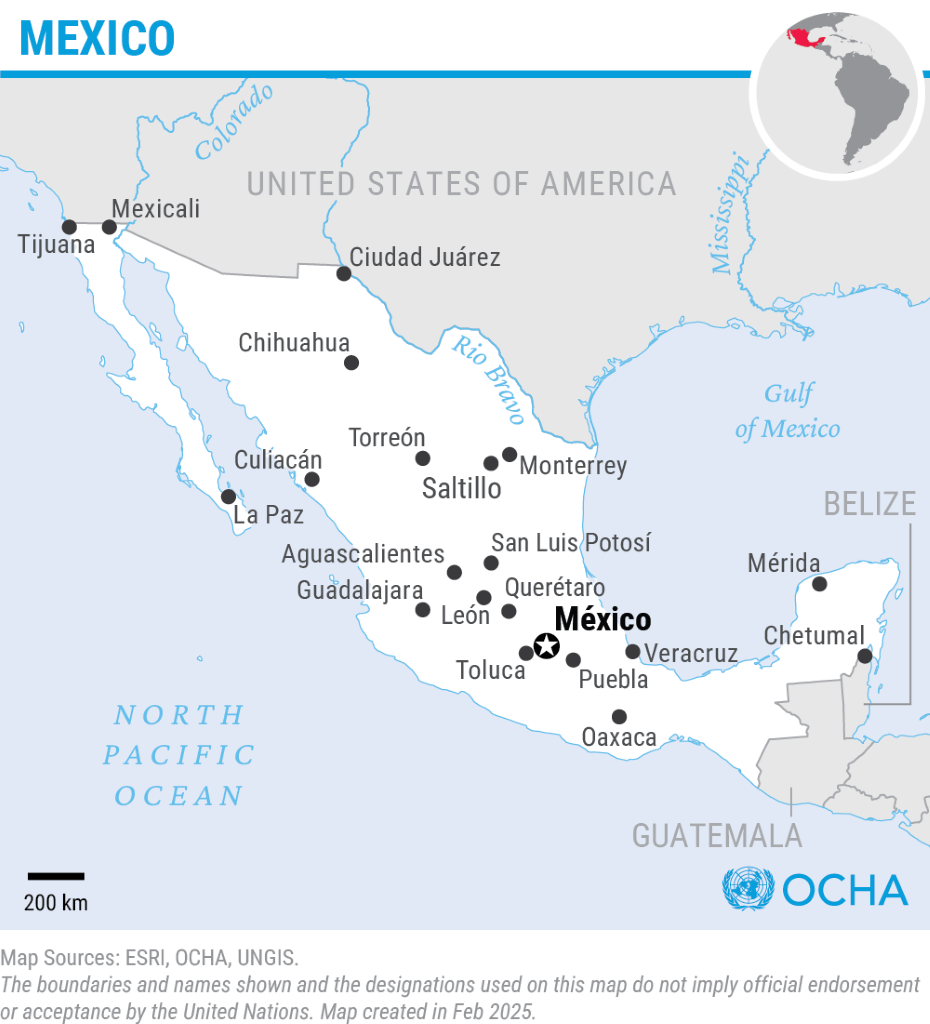
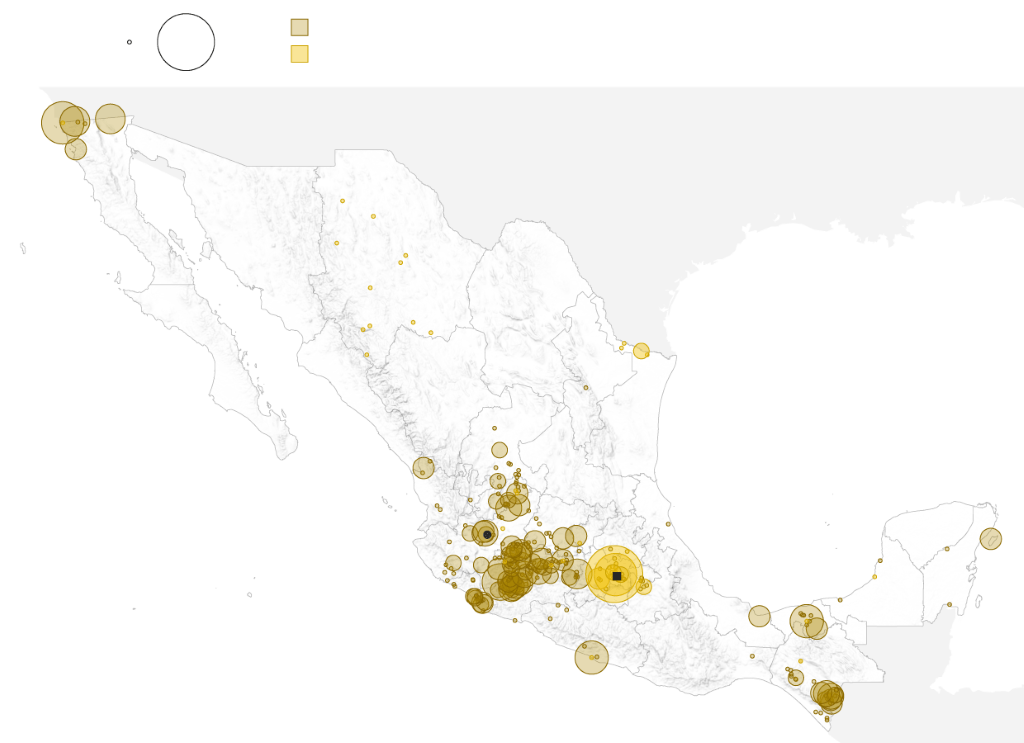
From 1 January to mid-February 2026, thousands of violent incidents across Mexico, largely concentrated in Jalisco, were attributed to the CJNG (and groups affiliated to it).23O. Holmes et al., ‘Violence in Mexico after military kills notorious drug cartel boss – a visual guide’, The Guardian, 23 February 2026. Following the killing of El Mencho and several of his accomplices on 22 February 2026, the CJNG launched retaliatory attacks, including through the reported use of explosive-laden drones.24S. Pellegrini, ‘Mexico: El Mencho’s killing triggers nationwide escalation — Expert comment’, ACLED, 23 February 2026. Indeed, his killing led to outbreaks of further, significant violence across Mexico. More than 40 suspected gang members, 25 National Guard troops, and a bystander – a pregnant woman — were killed in the violence that followed the raid. Cartel members erected hundreds of roadblocks and set vehicles, stalls, and businesses, including petrol stations, ablaze, as well as, reportedly, also a number of people.25R. Cortes, A. Pelaez-Fernandez, and S. Morland, ‘Romantic tryst led to Mexican cartel leader’s capture, death’, Reuters, 23 February 2026; ‘El Mencho: Mexico officials say 25 soldiers killed after cartel raid’, Al Jazeera; Holmes et al., ‘Violence in Mexico after military kills notorious drug cartel boss – a visual guide’; J. Wrate and L. Saul, ‘Fear is the Message: How the Jalisco New Generation Cartel Weaponized Algorithms to Paralyze Mexico’, Organized Crime and Corruption Reporting Project (OCCRP), 27 February 2026; L. Callaghan, ‘A cartel boss is dead, but normal Mexicans always pay the price’, The Times, 28 February 2026. Several airlines cancelled flights to Puerto Vallarta, a Pacific resort city in Jalisco state, where tourists filmed plumes of smoke rising into the sky.26‘Key events in Mexican operation to capture cartel leader “El Mencho”’, Reuters.
Conflict Classification and Applicable Law
There are ongoing non-international armed conflicts between Mexico and the Jalisco New Generation Cartel (CJNG) and between the CJNG and the Cartel de Santa Rosa de Lima (CSRL). The force used by the parties meets the test set out in the decision by the Appeals Chamber of the International Criminal Tribunal for the former Yugoslavia (ICTY) in the Tadić case on the criteria for the existence of a non-international armed conflict: organization of the armed groups and intensity and regularity of violence with the authorities or between organized armed groups.27ICTY, Prosecutor v Dusko Tadić,Decision on the Defence Motion for Interlocutory Appeal on Jurisdiction, (Appeals Chamber) (Case No IT-94-1-AR72), 2 October 1995, para 70. See also ICRC, ‘How is the term “armed conflict” defined in international humanitarian law?’, Opinion Paper, 2024, pp 14–15.
The non-international armed conflicts are regulated by Common Article 3 of the four Geneva Conventions of 1949 and by customary international humanitarian law (IHL), including Hague Law rules governing the conduct of hostilities. Mexico is not a State Party to Additional Protocol II of 1977.28Protocol Additional to the Geneva Conventions of 12 August 1949, and relating to the Protection of Victims of Non-International Armed Conflicts; adopted at Geneva, 8 June 1977; entered into force, 7 December 1978.
Mexico is a State Party to the 1997 Anti-Personnel Mine Ban Convention, the 2008 Convention on Cluster Munitions, and the 2013 Arms Trade Treaty.
Mexico is a State Party to the Rome Statute of the International Criminal Court.29Rome Statute of the International Criminal Court; adopted at Rome, 17 July 1998; entered into force, 1 July 2002 (ICC Statute). This means that acts by Mexican nationals and conduct on the territory of Mexico, including by foreign States, potentially fall within the jurisdiction of the Court.
Compliance with IHL
Civilian Objects Under Attack
Under customary IHL, attacks may only be directed against military objectives. Attacks must not be directed against civilian objects.30International Committee of the Red Cross (ICRC), Customary IHL Rule 7: ‘The Principle of Distinction between Civilian Objects and Military Objectives’. Civilian objects are all objects that are not military objectives31ICRC, Customary IHL Rule 9: ‘Definition of Civilian Objects’. and, as such, are protected against attack.32ICRC, Customary IHL Rule 10: ‘Civilian Objects’ Loss of Protection from Attack’. Military objectives are those objects which, by their nature, location, purpose or use, make an effective contribution to military action.33ICRC, Customary IHL Rule 8: ‘Definition of Military Objectives’. In addition, the object’s partial or total destruction, capture, or neutralisation must offer a definite military advantage in the prevailing circumstances.
The setting on fire of vehicles, stalls, and businesses, including petrol stations, are all prima facie unlawful attacks on civilian objects.
Civilians Under Attack
Under customary IHL, civilians enjoy general protection from the effects of hostilities, unless and for such time as they directly participate in hostilities.34ICRC, Customary IHL Rule 6: ‘Civilians’ Loss of Protection from Attack’. Accordingly, parties to any armed conflicts must at all times distinguish between combatants and civilians, and are prohibited from directing attacks against civilians.35ICRC, Customary IHL Rule 1: ‘The Principle of Distinction between Civilians and Combatants. In case of doubt, persons should be treated as civilians.36ICRC, Customary IHL Rule 6: ‘Civilians’ Loss of Protection from Attack’. Civilians may be incidentally affected by attacks against lawful targets. However, such attacks must not be disproportionate,37ICRC, Customary IHL Rule 14: ‘Proportionality in Attack’. and the attacker must take all feasible precautions to avoid or, in any event to minimize, incidental civilian impact.38ICRC, Customary IHL Rule 15: ‘Principle of Precautions in Attack’.
In the current reporting period, there have also been attacks directed against civilians who were not directly participating in hostilities. At least eleven people were killed and another dozen injured when gunmen opened fire on local people who had gathered at a football pitch in the city of Salamanca in Guanajuato in January 2026. Witnesses said armed men arrived at the grounds in several vehicles and shot at those gathered there, seemingly indiscriminately. Many families had stayed behind to socialise after a match between local clubs. At least one woman and one child were among those killed.39V. Buschschlüter, ‘Gunmen storm Mexico football pitch and kill at least 11 people’, BBC, 26 January 2026. It is not known whether the killers belonged to the CJNG or the CSRL.40P. Ferri, ‘Un ataque a balazos en un campo de fútbol en Salamanca, México, deja 11 muertos y seis heridos’, El Pais, 26 January 2026. The state registered the highest number of murders in the whole of Mexico in 2025.41Buschschlüter, ‘Gunmen storm Mexico football pitch and kill at least 11 people’.
Improvised mines and other explosive devices
The CJNG has been described as ‘a pioneer in launching explosives from drones and installing mines’,42‘Who was El Mencho, the former police officer who co-founded an ultraviolent cartel in Mexico?’, The Guardian. but was rapidly followed by its rivals.43V. Traeder, ‘Minas antipersonales: la silenciosa guerra entre cárteles’, Deutsche Welle, 28 August 2025. Although the use of improvised explosive devices (IED) across Mexico is relatively recent, since 2022, criminal groups, including the CJNG, have used drones rigged with explosives and other improvised explosive devices (IEDs), including those that amount to anti-personnel mines.44Ibid. IEDs, including landmines, are laid by the cartels in rural areas to prevent incursions from rivals and military forces into the zones under their control. As a result, agricultural workers are increasingly exposed to dangers resulting from such devices.45Ibid.
Protection of Persons in the Power of the Enemy
Under customary IHL, special protection is afforded to several categories of civilians or persons hors de combat who face a specific risk of harm or who have particular needs, such as women, children, refugees, and IDPs.46ICRC, Customary IHL Rules 134–138: ‘Chapter 39. Other Persons Afforded Specific Protection’. IHL provides certain fundamental guarantees for anyone who is in the power of a party to a conflict, prohibiting torture and other inhumane or degrading treatment, arbitrary detention, and unfair trials.
The incidents described below, notably those concerning forced recruitment or more broadly linked to extortion schemes and manpower of the cartel, raise issues as to whether they have the required nexus to fall within IHL. In accordance with jurisprudence in the ICTY, unlawful conduct is considered sufficiently related to the armed conflict when the existence of the conflict has played a substantial part in the perpetrator’s decision or ability to engage in that conduct, the manner in which the act was committed, or the purpose for which it was committed.47ICTY, Prosecutor v Kunarac et al, Judgment (Appeals Chamber) (Case Nos IT-96-23 and IT-96-23/1-A), 12 June 2002, para 58. Even though they are not strictly linked to the ongoing conflicts, this conduct nevertheless contributes to supporting the group’s other activities, including those related to ongoing armed conflicts. Moreover, some other acts of violence are directly linked to ongoing NIACs, especially CJNG’s retaliatory acts undertaken because of suspicion of collaboration with the CSRL or in reaction to operations conducted by Mexican authorities.
Murder of civilians and forced recruitment
The CJNG has repeatedly murdered civilians in the course of its NIAC with the authorities and the CSRL. This includes those burnt to death in the course of the violence that followed the killing of El Mencho.48J. Tuckman, ‘Mexico declares all-out war after rising drug cartel downs military helicopter’, The Guardian, 5 May 2015; ‘An atmosphere of terror’: the bloody rise of Mexico’s top cartel’, The Guardian; ‘Jalisco Cartel New Generation (CJNG)’, InSight Crime, 23 February 2026.
In the past, the CJNG reportedly run dozens of paramilitary-style training camps, notably in the Sierra de Ahuisculco, a mountain range in Jalisco, where people were lured with promises of legitimate jobs and then forced, under threats and ill-treatment, to train with firearms, join the cartel, and kill and cremate fellow recruits (particularly those who resist or are deemed to be of no use).49‘Desmantelan campo de reclutamiento de narcos’, El Universal, 22 July 2017 (updated 23 July 2017); A. Guillén and D. Petersen, ‘El regreso del infierno; los desaparecidos que están vivos’, Quinto Elemento Lab, 4 February 2019; ‘“An atmosphere of terror”: the bloody rise of Mexico’s top cartel’, The Guardian; M. Fernández, ‘Killing Camp in Mexico Shows Horrors of CJNG Forced Recruitment’, InSight Crime. 25 March 2025. This practice continued in 2025, as evidenced by the discovery in early March of an ‘extermination and forced labour camp and the related arrest of CJNG member identified under his alias ‘El Comandante Lastra’. The site, located at Rancho Izaguirre in Teuchitlàn (Jalisco), was uncovered by a civil society collective – Guerreros Buscadores – which was searching for missing relatives. It contained human remains, 200 pairs of shoes, hundreds of items of clothing, and, reportedly, children’s toys.50W. Grant, ‘Ovens and bone fragments – BBC visits Mexican cartel “extermination” site’, BBC, 15 March 2025; Fernández, ‘Killing Camp in Mexico Shows Horrors of CJNG Forced Recruitment’. Several ovens and bone fragments, as well as military training installations, such as shooting ranges and obstacle courses were also found.51Fiscalia de Estado de Mexico, ‘Informa Fiscalía del Estado sobre nuevos indicios de la investigación en el rancho Izaguirre’, 12 March 2025; W. Grant, ‘Ovens and bone fragments – BBC visits Mexican cartel ‘extermination’ site’, BBC, 15 March 2025; Fernández, ‘Killing Camp in Mexico Shows Horrors of CJNG Forced Recruitment’.
According to the activists, the site was used for forced recruitment and para-military training, as well as for torturing and cremating victims.52Grant, ‘Ovens and bone fragments – BBC visits Mexican cartel “extermination” site’, BBC. The site was previously raided by local police in September 2024. During this operation, ten individuals were arrested, two hostages were released, and one dead body was found, but the local forces did not discover or reveal the magnitude of the atrocities taking place in the site, raising criticism and suspicion of complicity for the families of the victims. As a result, the Mexican president, Claudia Sheinbaum, subsequently ordered federal investigators to take the lead of the case.53Ibid; Fernández, ‘Killing Camp in Mexico Shows Horrors of CJNG Forced Recruitment’. Additionally, individuals detained in the course of the September 2024 operation were each sentenced to 141 years and three months prison for one count of homicide and two counts of kidnapping in July 2025.54‘Mexican cartel gunmen sentenced to 141 years in prison’, France 24, 9 July 2025. Since then, fifteen people, including one mayor and several police officers, have been arrested in connection with the investigation.55‘Disparus du Jalisco au Mexique : 141 ans de prison pour les dix responsables de meurtres dans un ranch’, LeParisien, 9 July 2025.
Arbitrary deprivation of liberty
Arbitrary deprivation of liberty is prohibited under IHL, as it is under international human rights law.56ICRC, Customary IHL Rule 99: ‘Deprivation of liberty’. Among other fundamental rights, the International Covenant on Civil and Political Rights, to which Mexico is a party, protects the right of anyone in detention to habeas corpus57Human Rights Committee, ‘General Comment No 35: Article 9 (Liberty and security of person)’, UN Doc CCPR/C/GC/35, 16 December 2014, para 40. – the right to challenge the legality of one’s detention.58Art 9(4), International Covenant on Civil and Political Rights; adopted 16 December 1966, entered into force, 23 March 1976. At least seventy people were arrested in seven states following the killing of El Mencho in February 2026.59‘Key events in Mexican operation to capture cartel leader “El Mencho”’, Reuters. Their current status and whereabouts is not known.
Mexico has been repeatedly criticized by human rights organizations for lengthy pretrial detention. For instance, in June 2024, Brenda Quevedo, accused of kidnapping and homicide, was released after fifteen years in preventive detention without trial.60US Department of State, 2024 Country Reports on Human Rights Practices: Mexico, p 16.
As described above, individuals held in CJNG para-military camps had been reportedly either kidnapped or lured and then forced to train and join the Cartel.61Fernández, ‘Killing Camp in Mexico Shows Horrors of CJNG Forced Recruitment’. Deception, intimidation, and coercion, including threats against family members, are said to have been frequently used by the CJNG since 2021 to recruit people against their will.62Ibid.
In addition to other violations analysed under this section, deprivation of liberty by the CJNG was arbitrary in nature63ICRC, Customary IHL Rule 99: ‘Deprivation of Liberty’. and would amount to hostage-taking when conducted to obtain ransom or to compel specific action.64ICRC, Customary IHL Rule 96: ‘Hostage-Taking’.
Torture and ill-treatment
Despite progress in recent times,65OHCHR, ‘Mexico: UN torture prevention experts recognise progress, but urge strengthening of torture prevention measures’, Press release, 6 February 2026. Mexican authorities have been accused of abusing detainees on multiple occasions, with the practice of torture said to be generalized.66US Department of State, 2024 Country Reports on Human Rights Practices: Mexico, p 16.
Since its emergence in 2010, the CJNG has been notorious for its extreme use of violence, including torture and ill-treatment.67US District Court of Colombia, United States of America v. Nemesio Oseguera Cervantes, also known as “Mencho” and “Ruben Oseguera Cervantes”, Second Superseding Indictment, 6 December 2019; ‘“An atmosphere of terror”: the bloody rise of Mexico’s top cartel’, The Guardian; ‘Jalisco Cartel New Generation (CJNG)’, InSight Crime; Z. Raziel, ‘The Jalisco New Generation Cartel, a criminal enterprise with a turbulent rise’, El País, 23 February 2026; C. Flores, ‘Will Mexico’s Jalisco cartel’s violent biz model survive El Mencho’s death?, Al Jazeera, 25 February 2026. Such violence has primarily targeted rivals and included, for instance, strapping dynamite to their bodies to blow them up while alive.68Raziel, ‘The Jalisco New Generation Cartel, a criminal enterprise with a turbulent rise’. Moreover, forced recruitment conducted by the CJNG has also often involved torture and ill-treatment as part of the training, and forced recruits have been frequently ordered at gunpoint to carry out cruel acts of violence and murders, including against other fellow recruits.69A. Guillén and D. Petersen, ‘El regreso del infierno; los desaparecidos que están vivos’, Quinto Elemento Lab, 4 February 2019; ‘’An atmosphere of terror’: the bloody rise of Mexico’s top cartel’, The Guardian; V. Buschschlüter, ‘Mexico crime: Suspect held over young men’s kidnapping’, BBC, 3 October 2023.
Enforced disappearance
Enforced disappearance, prohibited under customary IHL applicable to NIACs,70ICRC, Customary IHL Rule 98: ‘Enforced Disappearance’. have been a long-standing and worsening issue in Mexico. Around 132,000 people have been officially recorded as missing or disappeared as of early March 2026, representing an increase of more than 200 per cent over the past decade.71‘La crisis de los desaparecidos en México crece a pesar del discurso oficial de seguridad’, Cambio, 27 January 2026; O. Lopez, ‘Disappearances in Mexico surge by 200% over 10 years’, The Guardian, 16 February 2026; Mexico, Comisión Nacional de Búsqueda, Versión Estadística del Registro Nacional de Personas Desaparecidas y No Localizadas, 10 March 2026.
Jalisco state is particularly affected, with 2,000 bodies discovered in 186 clandestine mass graves between December 2018 and February 202572Fernández, ‘Killing Camp in Mexico Shows Horrors of CJNG Forced Recruitment’. and over 12,500 officially recorded as missing.73Mexico, Comisión Nacional de Busqueda, Versión Estadística del Registro Nacional de Personas Desaparecidas y No Localizadas, 10 March 2026. In the area, a surge of instances of enforced disappearance has been recorded since 2021. This pattern has been linked to the CJNG’s recruitment methods described above.74Fernández, ‘Killing Camp in Mexico Shows Horrors of CJNG Forced Recruitment’; W. Grant, ‘Threat of further violence looms after Mexican cartel rampage’, BBC, 25 February 2026. Among other incidents, in 2024, thirty young people reportedly disappeared after attending fake job interviews in San Pedro Tlaquepaque (Jalisco).75Fernández, ‘Killing Camp in Mexico Shows Horrors of CJNG Forced Recruitment’.
Civil society and relatives of missing persons have repeatedly expressed their despair at the alleged inaction and delays on the part of the authorities when addressing enforced disappearances,76See eg: ‘“An atmosphere of terror”: the bloody rise of Mexico’s top cartel’, The Guardian; E. Cortez, ‘El panorama para las personas desaparecidas en 2026’, Instituto Mexicano de Derechos Humanos y Democracia (IMDHD)/Red Lupa, 9 January 2026; ‘La crisis de los desaparecidos en México crece a pesar del discurso oficial de seguridad’, Cambio, 27 January 2026; O. Lopez, ‘Disappearances in Mexico surge by 200% over 10 years’, The Guardian, 16 February 2026. with more than 96 per cent of cases remaining unsolved in 2022.77UNODC, Country/Organisation: Mexico – Agora’. Recent amendment to Mexico’s General Law on Disappearance seeks to respond to the ongoing crisis and dissatisfaction by requiring that an investigative file be opened whenever a person is reported missing, recording both the steps taken by the authorities and information provided by the families. In this context, the International Committee of the Red Cross (ICRC) has launched the Carpetas Vivas (‘living files’) campaign, highlighting the importance of investigations and offering a checklist of the steps that need to be taken to investigate disappearances and search for the missing.78ICRC, ‘Mexico: Investigative files crucial to tracing missing people’, 29 January 2026.
Forced recruitment
According to local accounts, individuals lured or forced in CJNG’s training camps (see above) were then sent across Mexico to form part of CJNG hit squads.79Fernández, ‘Killing Camp in Mexico Shows Horrors of CJNG Forced Recruitment’. The brutality of the conflict between rival cartels and their respective territorial expansion have prompted criminal groups, especially the CJNG, to resort to forced recruitment to replace and expand their ranks.80Buschschlüter, ‘Mexico crime: Suspect held over young men’s kidnapping’, BBC; Fernández, ‘Killing Camp in Mexico Shows Horrors of CJNG Forced Recruitment. Specialists suspect that a broader network of CJNG training camps exist in Tapalpa, Puerto Vallarta, and Lagos de Moreno (Jalisco), where civilians, but also former military personnel, are often forcibly recruited and trained.81Fernández, ‘Killing Camp in Mexico Shows Horrors of CJNG Forced Recruitment’. As well as amounting to arbitrary detention and sometimes enforced disappearance depending on the facts, forced recruitment is covered by the prohibition of uncompensated or abusive forced labour under IHL applicable to NIACs.82ICRC, Customary IHL Rule 95: ‘Forced Labour’.
Treatment of the dead
Forced recruitment and related killings carried out by cartels, notably by the CJNG, also violate the rules on the treatment of the dead when corpses are burnt to ash, dismembered, dissolved in acid or buried in unmarked graves to conceal murders.83O. Lopez, ‘Disappearances in Mexico surge by 200% over 10 years’, The Guardian, 16 February 2026. Similarly, desecration of the dead, in breach of the customary prohibition of mutilating dead bodies,84ICRC, Customary IHL Rule 113: ‘Treatment of the Dead’ http://bit.ly/3JNTb4n. has also been observed within the conflict between the CJNG and the CSRL. For instance, thirty-two dismembered bodies were found by Mexican authorities in an abandoned house near the city of Irapuato (Guanajuato) in early August 2025. Human remains were found in plastic bags in a shallow grave on the property and only fifteen of them were reportedly officially identified. A few months earlier, seventeen other bodies were found under similar circumstances in the same city. According to media, the recent increase of violence in the area is due to the ongoing conflict between the CJNG and the CSRL.85‘32 dismembered bodies discovered in abandoned house in Mexico’, FOX 11 Los Angeles.
- 1‘The Felix Gallardo organization (Guadalajara OCG)’, Wilson Center, undated but accessed 8 March 2026; C. Redaelli, ‘Engaging with drug lords: protecting civilians in Colombia, Mexico, and Honduras’, in A. Bellal (ed.), The War Report: Armed Conflict in 2014, Oxford University Press, 2015, pp 521–22.
- 2E. G. Brun and G. Kotarska, ‘The Kingpin Strategy: More Violence, No Peace’, Royal United Services Institute (RUSI), 17 November 2022; ‘The Felix Gallardo organization (Guadalajara OCG)’, Wilson Center; P. Asmann, ‘Mexico’s Zetas: From Criminal Powerhouse to Fragmented Remnants’, InSight Crime, 6 April 2018; P. Asmann, ‘Fragmentation: The Violent Tailspin of Mexico’s Dominant Cartels’, InSight Crime, 16 January 2019.
- 3S. Casey-Maslen, ‘Armed conflicts in Mexico’, in S. Casey-Maslen (ed.), The War Report: Armed Conflict in 2013, Oxford University Press, 2014, pp 156–62.
- 4‘Mexico’s most powerful cartel has also been safest from prosecution’, Mexico News Daily, 17 September 2018; International Crisis Group, Tracking Conflict Worldwide: Mexico (January 2018-December 2021).
- 5RULAC, ‘Mexico: Declassification of the Three Armed Conflicts Involving Drug Cartels on RULAC’, 12 December 2022.
- 6United States (US) Drug Enforcement Administration (DEA), ‘The Jalisco New Generation Cartel’, Command & Control: Cartels, undated but accessed 8 March 2026; ‘Jalisco Cartel New Generation (CJNG)’, InSight Crime, 23 February 2026.
- 7‘Jalisco Cartel New Generation (CJNG)’, InSight Crime; ‘Who was El Mencho, the former police officer who co-founded an ultraviolent cartel in Mexico?’, The Guardian, 23 February 2026; ‘Key events in Mexican operation to capture cartel leader “El Mencho”’, Reuters, 23 February 2026; ‘El Mencho: Mexico officials say 25 soldiers killed after cartel raid’, Al Jazeera, 23 February 2026.
- 8J. Tuckman, ‘Mexico declares all-out war after rising drug cartel downs military helicopter’, The Guardian, 5 May 2015; T. Phillips and A. Nuño, ‘“An atmosphere of terror”: the bloody rise of Mexico’s top cartel’, The Guardian, 2 April 2021; ‘Jalisco Cartel New Generation (CJNG)’, InSight Crime.
- 9‘Mexico declares all-out war after rising drug cartel downs military helicopter’, The Guardian; ‘Who was El Mencho, the former police officer who co-founded an ultraviolent cartel in Mexico?’, The Guardian.
- 10DEA, ‘The Jalisco New Generation Cartel’, Command & Control: Cartels; ‘Who was El Mencho, the former police officer who co-founded an ultraviolent cartel in Mexico?’, The Guardian.
- 11‘Sinaloa Cartel’, InSight Crime, 19 May 2025 (updated 19 February 2026).
- 12US Department of State, ‘Foreign Terrorist Organization Designations of Tren de Aragua, Mara Salvatrucha, Cartel de Sinaloa, Cartel de Jalisco Nueva Generacion, Carteles Unidos, Cartel del Noreste, Cartel del Golfo, and La Nueva Familia Michoacana’, Federal Register: The Daily Journal of the United States Government, 2 February 2025.
- 13‘Cartel de Santa Rosa de Lima (CSRL)’, InSight Crime, 19 September 2025.
- 14Ibid.; and C. Dalby, ‘Three Takeaways from the Capture of ‘El Marro’ in Mexico’, InSight Crime, 5 August 2020.
- 15US Department of the Treasury, ‘Secretary Bessent Orders Sanctions Against Violent Mexican Cartel’, Press release, Washington, DC, 17 December 2025.
- 16‘Cartel de Santa Rosa de Lima (CSRL)’, InSight Crime.
- 17‘Gunmen kill 11 at religious festival in Mexico’s Guanajuato state’, Al Jazeera, 25 June 2025.
- 18
- 19‘Gunmen kill 7 people, including children, in central Mexico; cartel messages left at crime scene’, CBS News, Updated 20 May 2025.
- 20Ibid.
- 21‘Cartel de Santa Rosa de Lima (CSRL)’, InSight Crime.
- 22‘Jalisco Cartel New Generation (CJNG)’, InSight Crime; A. Torres, ‘The Slow Death of Mexico’s Santa Rosa de Lima Cartel’, InSight Crime, 1 May 2020.
- 23O. Holmes et al., ‘Violence in Mexico after military kills notorious drug cartel boss – a visual guide’, The Guardian, 23 February 2026.
- 24S. Pellegrini, ‘Mexico: El Mencho’s killing triggers nationwide escalation — Expert comment’, ACLED, 23 February 2026
- 25R. Cortes, A. Pelaez-Fernandez, and S. Morland, ‘Romantic tryst led to Mexican cartel leader’s capture, death’, Reuters, 23 February 2026; ‘El Mencho: Mexico officials say 25 soldiers killed after cartel raid’, Al Jazeera; Holmes et al., ‘Violence in Mexico after military kills notorious drug cartel boss – a visual guide’; J. Wrate and L. Saul, ‘Fear is the Message: How the Jalisco New Generation Cartel Weaponized Algorithms to Paralyze Mexico’, Organized Crime and Corruption Reporting Project (OCCRP), 27 February 2026; L. Callaghan, ‘A cartel boss is dead, but normal Mexicans always pay the price’, The Times, 28 February 2026.
- 26‘Key events in Mexican operation to capture cartel leader “El Mencho”’, Reuters.
- 27ICTY, Prosecutor v Dusko Tadić,Decision on the Defence Motion for Interlocutory Appeal on Jurisdiction, (Appeals Chamber) (Case No IT-94-1-AR72), 2 October 1995, para 70. See also ICRC, ‘How is the term “armed conflict” defined in international humanitarian law?’, Opinion Paper, 2024, pp 14–15.
- 28Protocol Additional to the Geneva Conventions of 12 August 1949, and relating to the Protection of Victims of Non-International Armed Conflicts; adopted at Geneva, 8 June 1977; entered into force, 7 December 1978.
- 29Rome Statute of the International Criminal Court; adopted at Rome, 17 July 1998; entered into force, 1 July 2002 (ICC Statute).
- 30International Committee of the Red Cross (ICRC), Customary IHL Rule 7: ‘The Principle of Distinction between Civilian Objects and Military Objectives’.
- 31
- 32
- 33ICRC, Customary IHL Rule 8: ‘Definition of Military Objectives’. In addition, the object’s partial or total destruction, capture, or neutralisation must offer a definite military advantage in the prevailing circumstances.
- 34
- 35
- 36ICRC, Customary IHL Rule 6: ‘Civilians’ Loss of Protection from Attack’.
- 37ICRC, Customary IHL Rule 14: ‘Proportionality in Attack’.
- 38
- 39V. Buschschlüter, ‘Gunmen storm Mexico football pitch and kill at least 11 people’, BBC, 26 January 2026.
- 40P. Ferri, ‘Un ataque a balazos en un campo de fútbol en Salamanca, México, deja 11 muertos y seis heridos’, El Pais, 26 January 2026.
- 41Buschschlüter, ‘Gunmen storm Mexico football pitch and kill at least 11 people’.
- 42‘Who was El Mencho, the former police officer who co-founded an ultraviolent cartel in Mexico?’, The Guardian.
- 43V. Traeder, ‘Minas antipersonales: la silenciosa guerra entre cárteles’, Deutsche Welle, 28 August 2025.
- 44Ibid.
- 45Ibid.
- 46
- 47ICTY, Prosecutor v Kunarac et al, Judgment (Appeals Chamber) (Case Nos IT-96-23 and IT-96-23/1-A), 12 June 2002, para 58.
- 48J. Tuckman, ‘Mexico declares all-out war after rising drug cartel downs military helicopter’, The Guardian, 5 May 2015; ‘An atmosphere of terror’: the bloody rise of Mexico’s top cartel’, The Guardian; ‘Jalisco Cartel New Generation (CJNG)’, InSight Crime, 23 February 2026.
- 49‘Desmantelan campo de reclutamiento de narcos’, El Universal, 22 July 2017 (updated 23 July 2017); A. Guillén and D. Petersen, ‘El regreso del infierno; los desaparecidos que están vivos’, Quinto Elemento Lab, 4 February 2019; ‘“An atmosphere of terror”: the bloody rise of Mexico’s top cartel’, The Guardian; M. Fernández, ‘Killing Camp in Mexico Shows Horrors of CJNG Forced Recruitment’, InSight Crime. 25 March 2025.
- 50W. Grant, ‘Ovens and bone fragments – BBC visits Mexican cartel “extermination” site’, BBC, 15 March 2025; Fernández, ‘Killing Camp in Mexico Shows Horrors of CJNG Forced Recruitment’.
- 51Fiscalia de Estado de Mexico, ‘Informa Fiscalía del Estado sobre nuevos indicios de la investigación en el rancho Izaguirre’, 12 March 2025; W. Grant, ‘Ovens and bone fragments – BBC visits Mexican cartel ‘extermination’ site’, BBC, 15 March 2025; Fernández, ‘Killing Camp in Mexico Shows Horrors of CJNG Forced Recruitment’.
- 52Grant, ‘Ovens and bone fragments – BBC visits Mexican cartel “extermination” site’, BBC.
- 53Ibid; Fernández, ‘Killing Camp in Mexico Shows Horrors of CJNG Forced Recruitment’.
- 54‘Mexican cartel gunmen sentenced to 141 years in prison’, France 24, 9 July 2025.
- 55‘Disparus du Jalisco au Mexique : 141 ans de prison pour les dix responsables de meurtres dans un ranch’, LeParisien, 9 July 2025.
- 56
- 57Human Rights Committee, ‘General Comment No 35: Article 9 (Liberty and security of person)’, UN Doc CCPR/C/GC/35, 16 December 2014, para 40.
- 58Art 9(4), International Covenant on Civil and Political Rights; adopted 16 December 1966, entered into force, 23 March 1976.
- 59‘Key events in Mexican operation to capture cartel leader “El Mencho”’, Reuters.
- 60US Department of State, 2024 Country Reports on Human Rights Practices: Mexico, p 16.
- 61Fernández, ‘Killing Camp in Mexico Shows Horrors of CJNG Forced Recruitment’.
- 62Ibid.
- 63
- 64
- 65OHCHR, ‘Mexico: UN torture prevention experts recognise progress, but urge strengthening of torture prevention measures’, Press release, 6 February 2026.
- 66US Department of State, 2024 Country Reports on Human Rights Practices: Mexico, p 16.
- 67US District Court of Colombia, United States of America v. Nemesio Oseguera Cervantes, also known as “Mencho” and “Ruben Oseguera Cervantes”, Second Superseding Indictment, 6 December 2019; ‘“An atmosphere of terror”: the bloody rise of Mexico’s top cartel’, The Guardian; ‘Jalisco Cartel New Generation (CJNG)’, InSight Crime; Z. Raziel, ‘The Jalisco New Generation Cartel, a criminal enterprise with a turbulent rise’, El País, 23 February 2026; C. Flores, ‘Will Mexico’s Jalisco cartel’s violent biz model survive El Mencho’s death?, Al Jazeera, 25 February 2026.
- 68Raziel, ‘The Jalisco New Generation Cartel, a criminal enterprise with a turbulent rise’.
- 69A. Guillén and D. Petersen, ‘El regreso del infierno; los desaparecidos que están vivos’, Quinto Elemento Lab, 4 February 2019; ‘’An atmosphere of terror’: the bloody rise of Mexico’s top cartel’, The Guardian; V. Buschschlüter, ‘Mexico crime: Suspect held over young men’s kidnapping’, BBC, 3 October 2023.
- 70
- 71‘La crisis de los desaparecidos en México crece a pesar del discurso oficial de seguridad’, Cambio, 27 January 2026; O. Lopez, ‘Disappearances in Mexico surge by 200% over 10 years’, The Guardian, 16 February 2026; Mexico, Comisión Nacional de Búsqueda, Versión Estadística del Registro Nacional de Personas Desaparecidas y No Localizadas, 10 March 2026.
- 72Fernández, ‘Killing Camp in Mexico Shows Horrors of CJNG Forced Recruitment’.
- 73
- 74Fernández, ‘Killing Camp in Mexico Shows Horrors of CJNG Forced Recruitment’; W. Grant, ‘Threat of further violence looms after Mexican cartel rampage’, BBC, 25 February 2026.
- 75Fernández, ‘Killing Camp in Mexico Shows Horrors of CJNG Forced Recruitment’.
- 76See eg: ‘“An atmosphere of terror”: the bloody rise of Mexico’s top cartel’, The Guardian; E. Cortez, ‘El panorama para las personas desaparecidas en 2026’, Instituto Mexicano de Derechos Humanos y Democracia (IMDHD)/Red Lupa, 9 January 2026; ‘La crisis de los desaparecidos en México crece a pesar del discurso oficial de seguridad’, Cambio, 27 January 2026; O. Lopez, ‘Disappearances in Mexico surge by 200% over 10 years’, The Guardian, 16 February 2026.
- 77UNODC, Country/Organisation: Mexico – Agora’.
- 78ICRC, ‘Mexico: Investigative files crucial to tracing missing people’, 29 January 2026.
- 79Fernández, ‘Killing Camp in Mexico Shows Horrors of CJNG Forced Recruitment’.
- 80Buschschlüter, ‘Mexico crime: Suspect held over young men’s kidnapping’, BBC; Fernández, ‘Killing Camp in Mexico Shows Horrors of CJNG Forced Recruitment.
- 81Fernández, ‘Killing Camp in Mexico Shows Horrors of CJNG Forced Recruitment’.
- 82
- 83O. Lopez, ‘Disappearances in Mexico surge by 200% over 10 years’, The Guardian, 16 February 2026.
- 84
- 85‘32 dismembered bodies discovered in abandoned house in Mexico’, FOX 11 Los Angeles.
- 86Holmes et al., ‘Violence in Mexico after military kills notorious drug cartel boss – a visual guide’, The Guardian.