Conflict Overview
Conflict History
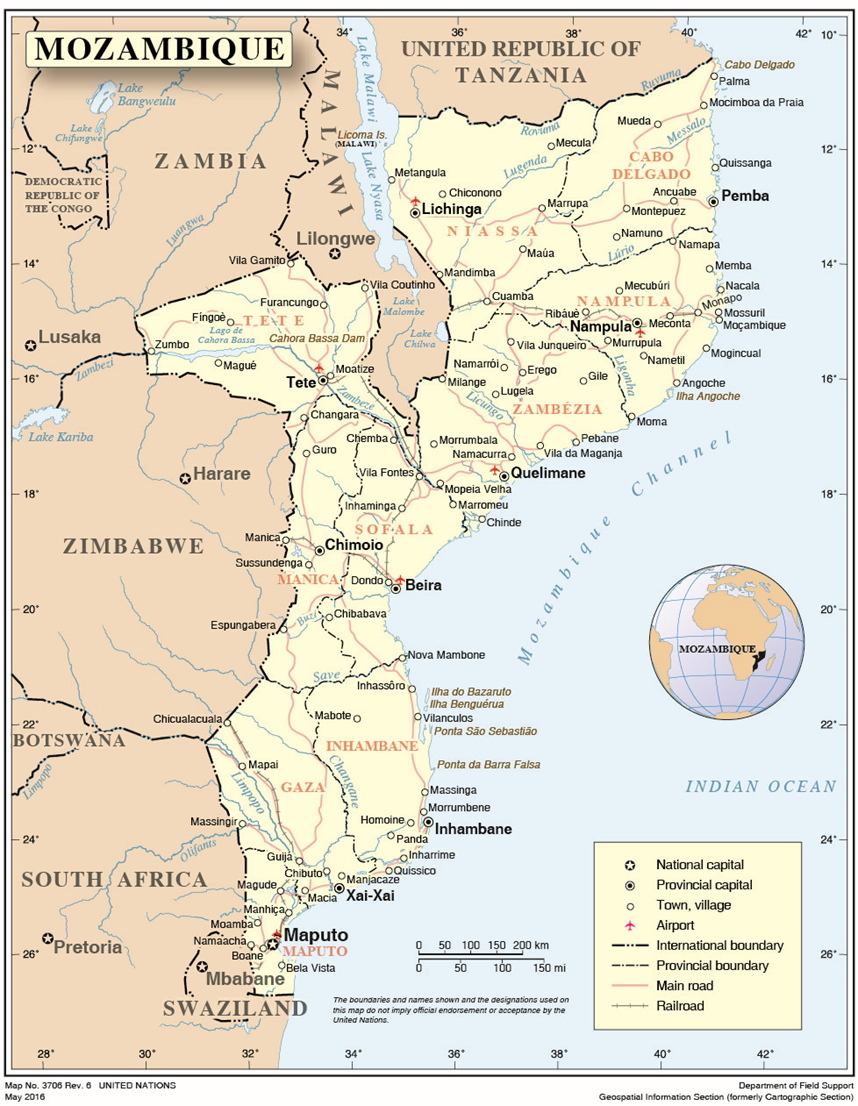
The armed conflict in Cabo Delgado, Mozambique’s northernmost province, started in 2017 following an encounter between local law enforcement and affiliates of an Islamist group designated locally as ‘Al-Shabaab’, which had launched attacks on police stations and briefly occupied the port town of Mocímboa da Praia. Today, the Mozambican Armed Forces (FADM) are supported by troops from Rwanda and Tanzania in their operations against Islamic State Mozambique (ISM), also known as Ahlu Sunna Wal-Jama. Authorized communal militias – Forças Locais (‘Local Forces’) – that are nominally under the Ministry of Defence,1Council of Ministers Decree No 15/2023, 14 April 2023. and comprise mainly demobilized soldiers, fight sporadically against ISM.2T. Queface, ‘A Glance at the Decree Governing Local Forces’, Zitamar News, 24 August 2023; ‘Mozambique: Local forces kill five insurgents in confronts’, Club of Mozambique, 14 November 2025.
The origins of the conflict are the subject of competing narratives, with ISM playing up the existence of an ethnic struggle between local Mwani people in Cabo Delgado and the Makonde that typify the executive in Maputo.3P. Bofin, ‘Preaching, coercion, and sectarianism: How the Islamic State is building a stronghold in Mozambique’, Report, ACLED, 26 June 2026. Certainly the finding of rubies and natural gas deposits in the region, as well as the manner in which those resources have been governed, are contributing factors in the escalation of violence.4T. de Almeida, ‘7 years into the conflict, solutions to displacement in Cabo Delgado remain elusive’, Internal Displacement Monitoring Centre, 10 October 2024. The Mozambican government invited foreign military assistance following a peak of violence during attacks on the town of Palma in 2021.5J. Ambrose, ‘UK pulls $1.15bn support for Mozambique gas project after climate and terror concerns’, The Guardian, 1 December 2025; Armed Conflict Location & Event Data Project (ACLED), ‘9 April 2024 Update: New fatality estimate for the 2021 attack on Palma, Mozambique’, 9 April 2024. It subsequently received support from Rwanda and the Southern African Development Community’s Mission in Mozambique (SAMIM), although most SAMIM forces, including those of South Africa, withdrew in 2024 (see the report on War WATCH).6Netherlands Institute of International Relations – Clingendael ‘Human rights violations by Mozambican security forces in Cabo Delgado in the context of the Mozambique LNG project’, The Clingendael Institute, November 2025. The European Union is supporting FADM training, but is not engaged in hostilities.7In May 2026, the mandate was extended to 31 December 2026. ‘EU military training will continue until year-end in Mozambique’, DefenceWeb, 18 May 2026.
In total, more than 6,600 people have been killed in the violence since 2017, and tens of thousands more seriously injured.8ACLED, ‘Mozambique Conflict Monitor Update: 17 June 2026’, 17 June 2026. Although the violence is centred on Cabo Delgado, fighting has spread into neighbouring Niassa province and lately also Nampula.9B. Nhamirre, ‘Cabo Delgado insurgency persists amid failed military strategy’, ISS Today, 7 October 2025. Attacks against civilians and civilian objects by ISM amounting to war crimes and crimes against humanity have typified the conflict despite a certain reduction in violence in their stronghold areas in recent times. The group is estimated by the United Nations to count between 400 and 500 fighters.10‘Mozambique: UN reports up to 500 insurgents in Cabo Delgado, names four leaders’, Club of Mozambique, 18 August 2026.
In 2025, TotalEnergies announced its intention to restart operations at the US$20 billion liquified natural gas (LNG) project in the Afungi peninsula in the east of the province, which by then had lain dormant for four years. A deadly ISM attack on Palma in 2021 led to the suspension of the project sited nearby.11C. Howe, ‘WGC TotalEnergies CEO aims to lift force majeure on Mozambique LNG project’, Reuters, 20 May 2025. The company has pledged to ensure the safety of the personnel working at the Afungi site and to respect local community rights.12TotalEnergies, ‘Mozambique LNG: Clarification by TotalEnergies’, News release, 20 November 2025.
Key Events in 2026
At the end of January 2026, TotalEnergies announced the ‘full restart’ of its LNG project.13TotalEnergies, ‘Mozambique LNG announces the full restart of all its activities onshore and offshore in Mozambique’, 29 January 2026; ‘Mozambique LNG restarts onshore, offshore activities after force majeure lift’, World Oil, 29 January 2026. Local business owners fear that security restrictions will hinder supply by local services to the project.14LUSA, ‘Mozambique: Cabo Delgado businesses fear being left out of TotalEnergies’ project’, Club of Mozambique, 4 August 2025. According to TotalEnergies, however, the LNG project will bring significant economic benefits to Mozambique during its development phase, generating up to 7,000 direct jobs for Mozambicans during construction, while contracts awarded to Mozambican companies are ‘expected to amount to more than US$4 billion’.15TotalEnergies, ‘Mozambique LNG announces the full restart of all its activities onshore and offshore in Mozambique’. The Mozambican government predicts State revenues from LNG will exceed US$101 million in 2029, the year the TotalEnergies project is expected to restart production.16LUSA, ‘Mozambique forecasts State LNG revenues of US$101m in 2029’, Club of Mozambique, 18 August 2026.
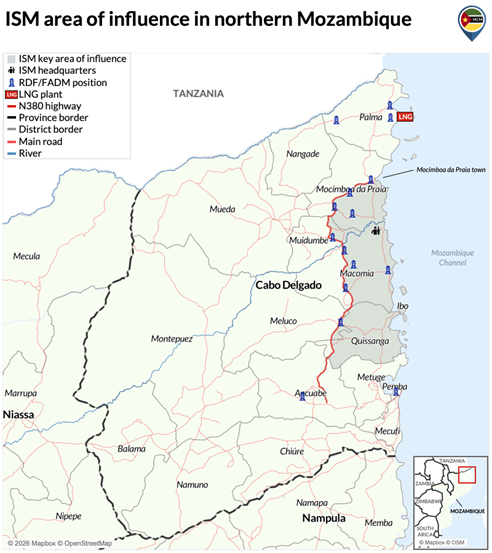
Fighting in Catupa forest, a remote woodland located in the coastal zone of Macomia district where ISM has its central base, intensified in February 2026.17ACLED, ‘Mozambique Conflict Monitor Update: 11 February 2026’, 11 February 2026; ACLED, ‘Mozambique Conflict Monitor Update: 25 February 2026’, 25 February 2026. The Armed Conflict Location & Event Data Project (ACLED)’s Regional Expert noted that the primary task of the Rwandan troops is to protect the LNG project. ‘The risk the project faces is that resentment that people feel, caused by the project getting better security than they do, erodes the companies’ social license to operate, undermining already weak state legitimacy and ensuring that some will continue to think it “better to come across insurgents than soldiers.”’18Bofin, ‘Preaching, coercion, and sectarianism: How the Islamic State is building a stronghold in Mozambique’.
In August 2026, Ben Saul, the United Nations (UN) Special Rapporteur on the promotion and protection of human rights and fundamental freedoms while countering terrorism, conducted an official visit to Mozambique. He expressed grave concern about serious violations of international humanitarian law (IHL) and human rights committed during the conflict, particularly against women and children, noting reports of killings, maiming, forced recruitment, and sexual and gender-based violence, attributed to ISM. He also expressed serious concern about the conduct of State security actors, and called for effective control, discipline, and training of the Forças Locais.19Office of the UN High Commissioner for Human Rights (OHCHR), ‘UN expert urges Mozambique and partners to protect civilians while countering terrorism’, Press release, 14 August 2026. The Local Forces, who act with a degree of autonomy, have sometimes felt that they have been sacrificed or betrayed by the authorities.20A. Bote, ‘Cabo Delgado: Dez membros da Força Local mortos em Macomia’, Zumbo FM, 31 March 2026.
The Humanitarian Situation
The UN Office for the Coordination of Humanitarian Affairs (OCHA) notes that the violence in Cabo Delgado – to which must be added the impact of three major cyclones combined with El Niño-induced droughts – have left hundreds of thousands in need of life-saving assistance. Communities endure severe food insecurity, have limited access to health care and education, and women, girls, and boys in particular face heightened protection risks. ‘Repeated shocks eroded resilience and deepened vulnerabilities’, OCHA says.21OCHA, ‘Mozambique’, accessed 1 September 2026.
As part of these vulnerabilities are the huge internal displacement provoked by the violence. More than 100,000 people were displaced in 2025 alone, adding to the 1.3 million who have already fled from their homes.22S. Lawal, ‘Why northern Mozambique’s surging violence is worsening displacement crisis’, Explainer, Al Jazeera, 26 August 2026. Humanitarian access was severely disrupted by insecurity, airstrip closures, and mandatory military escorts. Limited humanitarian aid resumed in 2026, but remains constrained by precarious access.23OCHA, ‘Mozambique’. While awaiting the benefits of its gas windfall, Mozambique ranks 182nd of 193 States on the UN Development Programme (UNDP) Human Development Index (HDI) – between Afghanistan and Madagascar.24UNDP, ‘Human Development Index (HDI)’, 2026.
Conflict Classification and Applicable Law
International Humanitarian Law
A non-international armed conflict (NIAC) was ongoing in Mozambique in 2026, pitting the Mozambican Armed Forces (supported by ‘Local Forces’ and the armed forces of Rwanda and Tanzania) againstIslamic State Mozambique.
Common Article 3 to the Geneva Conventions and other customary IHL applies to this NIAC. Mozambique is also a State Party to Additional Protocol II of 1977,25Protocol Additional to the Geneva Conventions of 12 August 1949, and relating to the Protection of Victims of Non-International Armed Conflicts (Protocol II); adopted at Geneva, 8 June 1977; entered into force, 7 December 1978 (hereafter, Additional Protocol II of 1977). which, given ISM’s control of certain territory in Cabo Delgado, also applies as treaty law to the conflict. In this regard, as of early 2026, ISM maintained control over Catupa forest (its base) and Quiterajo town.26ACLED, ‘Mozambique Conflict Monitor Update: 14: January 2026’, 14 January 2026; ACLED, ‘Mozambique Conflict Monitor Update: 28 January 2026’, 28 January 2026. By June, an expert with ACLED was describing ISM as controlling ‘an emerging enclave’ on the Cabo Delgado coast.27Bofin, ‘Preaching, coercion, and sectarianism: How the Islamic State is building a stronghold in Mozambique’. ISM is active in 16 of the province’s 17 districts and has expanded into the provinces of Nampula and Niassa. The provincial capital, Pemba, remains the only location not to have been attacked by ISM.28Nhamirre, ‘Cabo Delgado insurgency persists amid failed military strategy’.
There has also been sporadic violence between a paramilitary group and the authorities. The Naparama emerged in the 1980s during the civil war in Mozambique. They mobilized during 2022 to fight ISM in Cabo Delgado but more recently they also participated in anti-government protests. On 6 February 2025, it was reported that Mozambican security forces had killed seven Naparama members near Angoche city in Nampula during protests over the high cost of living.29‘Africa: Mozambique’, International Crisis Group.
Further clashes between the Naparama militias and Mozambican police occurred in March 2025 at Mutuali in Nampula province’s Malema district. Local sources suggested that wounded Naparama fighters were not assisted and even that some were summarily executed.30P. Fauvet, ‘At least five Naparamas killed in clash’, Agência de Informação de Moçambique, 21 March 2025. In July 2025, in Nivenevene village in Cabo Delgado’s Chiúre district, Naparama militias are said to have tortured two policemen to death, later burning their bodies.31P. Fauvet, ‘Naparamas murder policemen in Chiúre’, Agência de Informação de Moçambique, 30 July 2025. The violence between Naparama and the authorities continues to be monitored closely by War WATCH as it might evolve into armed conflict.
International Disarmament Law
Mozambique is a State Party to the Arms Trade Treaty.32Arms Trade Treaty; adopted at New York, 2 April 2013; entered into force, 24 December 2014. Based primarily on its conduct in Cabo Delgado, but also on its actions in the course of law enforcement, the Arms TRACK website of the Geneva Academy has assessed that the Mozambican Armed Forces present an elevated risk of illegal use of any weapons that may be supplied to them.
Mozambique is a State Party to the 1997 Anti-Personnel Mine Ban Convention (APMBC).33Convention on the Prohibition of the Use, Stockpiling, Production and Transfer of Anti-Personnel Mines and on their Destruction; adopted at Oslo, 18 September 1997; entered into force, 1 March 1999. ISM has been emplacing improvised explosive devices, some of which fall within the definition of anti-personnel mines. These must be cleared by the authorities as soon as possible in order to comply with their obligations under the APMBC. At the time of writing, however, most of the devices employed by ISM appear to be either command detonated or improvised anti-vehicle mines, neither of which falls within the scope of the Convention.34See on this issue ACLED, ‘Mozambique Conflict Monitor Update: 17 June 2026’, pp 3, 4, 6.
Mozambique is also a State Party to the 2008 Convention on Cluster Munitions35Convention on Cluster Munitions; adopted at Dublin, 30 May 2008; entered into force, 1 August 2010. and the 1992 Chemical Weapons Convention.36Convention on the Prohibition of the Development, Production, Stockpiling and Use of Chemical Weapons and on their Destruction; adopted at Geneva, 3 September 1992; entered into force, 29 April 1997.
International Criminal Law and Accountability
Mozambique is obligated to prosecute war crimes committed by its nationals or on its territory, in particular in the NIAC with ISM.37International Committee of the Red Cross (ICRC), Customary IHL Rule 158: ‘Prosecution of War Crimes’. Mozambique is a signatory but not a State Party to the Rome Statute of the International Criminal Court.38Rome Statute of the International Criminal Court; adopted at Rome, 17 July 1998; entered into force, 1 July 2002. As a signatory, it is obliged to refrain from acts which would defeat the object and purpose of the Statute.39Art 18(a), Vienna Convention on the Law of Treaties; adopted at Vienna, 23 May 1969; entered into force, 27 January 1980 (VCLT). The rule is of a customary nature but Mozambique is a State party to the VCLT. This would encompass the granting of impunity for international crimes within the material jurisdiction of the International Criminal Court. In August 2026, the UN Special Rapporteur declared he was ‘disturbed by prevailing impunity for serious violations of human rights by security forces since the conflict began’.40OHCHR, ‘UN expert urges Mozambique and partners to protect civilians while countering terrorism’.
No criminal prosecutions have been mounted inside Mozambique for war crimes or crimes against humanity committed in the course of the armed conflict. In his end of mission statement, the Special Rapporteur noted that Article 92 of the Penal Code contains ‘a limited number of war crimes’. He called on the authorities to amend it to incorporate all war crimes under customary international humanitarian law (IHL).41OHCHR, ‘Country Visit to Mozambique: End of Mission Statement’, Statement, 14 August 2026. He did, however, welcome the National Criminal Investigation Service (SERNIC)’s investigation of the killing of thirteen fishermen in March 2026, allegedly by the Mozambican Navy (see below).42Ibid.
Outside Mozambique, TotalEnergies faces a potential criminal case for its conduct during the 2021 Palma attack.43A. Michel, ‘TotalEnergies accused of “complicity in war crimes” in Mozambique’, Le Monde, 18 November 2025. In March 2021, during its attack on Palma, ISM killed or kidnapped more than 1,500 civilians living next to the plant. Local community members who sought help from the forces at the TotalEnergies facility were accused of aiding ISM. Men were separated from the group by force and held in shipping containers. The exact number of civilians subsequently killed by Mozambican forces providing security for Total is not clear.44A. Harding, ‘Total faces war crimes allegations over Mozambique massacre’, BBC, 18 November 2025. On 14 March 2025, French prosecutors opened an investigation into the company over alleged neglect of contractor safety. Later that year, a complaint was filed with French prosecutorial authorities by the European Center for Constitutional and Human Rights, accusing TotalEnergies of complicity in war crimes.45ECCHR, ‘The Price of Gas in Mozambique’, 2026; and International Crisis Group, Crisis Watch Database, March 2025. TotalEnergies continues to deny any wrongdoing.46TotalEnergies, ‘Mozambique LNG: Clarification by TotalEnergies’, News release, 20 November 2025.
Compliance with IHL
Overview
ISM and the Mozambican Armed Forces have both been accused of war crimes.47War WATCH would like to thank Ms Riccarda Léonie Heepen for her background research for this report. ISM continues to kill and ill-treat civilians – although it has tempered some of these attacks in its strongholds in recent years – and engages in hostage-taking and pillage to raise funds for its military operations. The FADM has continued to target civilian fishermen, typically in the mistaken belief they are ISM fighters. There have also been reports of FADM forces targeting civilians in ISM strongholds on the basis of mere suspicion of support for the group. In March 2026, a coastal villager in Mocímboa da Praia district told a journalist that ‘when you come across the military, your heart is in your mouth. It’s better to come across insurgents than soldiers’.48A. Fernando, ‘Cabo Delgado: HRW exige investigação a morte de pescadores’, Deutsche Welle, 31 March 2026.
ACLED’s Regional Expert, Peter Bofin, thus argues that in recent years, ISM has been taking a less violent approach to coastal communities in Cabo Delgado province. It is attempting to carve out ‘a distinct area of influence, marked by the N380 highway and the sea to the west and east, and between Mocímboa da Praia town in the north and Quissanga district to the south’ (see below).49Bofin, ‘Preaching, coercion, and sectarianism: How the Islamic State is building a stronghold in Mozambique’.
Civilian Objects under Attack
Under customary IHL, attacks may only be directed against military objectives. Attacks must not be directed against civilian objects.50ICRC, Customary IHL Rule 7: ‘The Principle of Distinction between Civilian Objects and Military Objectives’. Civilian objects are all objects that are not military objectives51ICRC, Customary IHL Rule 9: ‘Definition of Civilian Objects’. and, as such, are protected against attack.52ICRC, Customary IHL Rule 10: ‘Civilian Objects’ Loss of Protection from Attack’. Military objectives are those objects which, by their nature, location, purpose or use, make an effective contribution to military action.53ICRC, Customary IHL Rule 8: ‘Definition of Military Objectives’. In addition, the object’s partial or total destruction, capture, or neutralisation must offer a definite military advantage in the prevailing circumstances.
There has been a growing interest by ISM in gold, as global prices have risen. Indeed, raids on artisanal mines more broadly have become a pattern of ISM conduct, providing a significant source of income for the group.54ACLED, ‘Mozambique Conflict Monitor Update: 8 April 2026’, 8 April 2026. The success of ISM attacks have also prompted criminals who are not linked to the conflict to act as ‘fake terrorists’ and attack villages near a large ruby mine in Montepuez with a view to perpetrating robberies.55L. Muhambe, ‘Mineradora alerta para ameaças combinadas de insurgência e mineração ilegal em Cabo Delgado’, Evidencias, 1 July 2026.
Civilians under Attack
Under customary IHL, civilians enjoy general protection from the effects of hostilities, unless and for such time as they directly participate in hostilities.56ICRC, Customary IHL Rule 6: ‘Civilians’ Loss of Protection from Attack’. Accordingly, parties to any armed conflict must at all times distinguish between combatants and civilians, and are prohibited from directing attacks against civilians.57ICRC, Customary IHL Rule 1: ‘The Principle of Distinction between Civilians and Combatants’. In case of doubt, persons should be treated as civilians.58ICRC, Customary IHL Rule 6: ‘Civilians’ Loss of Protection from Attack’ and see associated commentary. Civilians may be incidentally affected by attacks against lawful targets. However, such attacks must not be disproportionate,59ICRC, Customary IHL Rule 14: ‘Proportionality in Attack’. and the attacker must take all feasible precautions to avoid or, in any event to minimize, incidental civilian impact.60ICRC, Customary IHL Rule 15: ‘Principle of Precautions in Attack’.
The Mozambican Navy has continued to target fishermen on the Cabo Delgado coast, alleging they are members of ISM. The FADM is reported to have killed seventy fishermen over the last few years, many of whom continued fishing despite restrictions due to lack of alternatives to sustain themselves and their families.61Human Rights Watch, ‘Mozambique: Navy Linked to Killing of Fishermen’, Report, 30 March 2026. The restrictions were imposed because ISM fighters have been using coastal routes to transport goods and personnel, disguised as civilian fishermen.62Ibid.
In one example, on 15 March 2026, the Mozambican Navy fired on six fishing boats in Mocímboa da Praia district, reportedly killing thirteen civilians and injuring several others. Residents told Human Rights Watch that the naval personnel first calmly approached the fishermen, but then abruptly opened fire. ‘When the military arrived, they first greeted and asked the fishermen where they were coming from’, a local witness said. ‘Then the navy left, but about fifty metres later they returned violently.’63Ibid.
A party to armed conflict is required to take precautions before attacking any object or person, notably by doing everything feasible to verify that targets are military objectives.64ICRC, Customary IHL Rule 16: ‘Target Verification’. This duty underpins the principle of distinction.65Art. 13(2), Additional Protocol II of 1977. As mentioned above, in case of doubt, persons should be treated as civilians.66ICRC, Customary IHL Rule 6: ‘Civilians’ Loss of Protection from Attack’, and see associated commentary.
In April and May 2026, ISM fired on passenger buses of a particular company, Estamos Juntos, in Mueda district twice in less than two weeks. The Tanzania-bound bus was coming from Mueda town when it was fired upon close to Nanga village, between Mueda and the Negomano border crossing. Two of the attackers were captured. It is suggested that the company had not made a requested extortion payment.67ACLED, ‘Mozambique Conflict Monitor Update: 6 May 2026’, 6 May 2026; Bofin, ‘Preaching, coercion, and sectarianism: How the Islamic State is building a stronghold in Mozambique’.
Protection of Persons in the Power of the Enemy
Under customary IHL, special protection is afforded to several categories of civilians or persons hors de combat who face a specific risk of harm, such as women, children, refugees, and IDPs.68ICRC, Customary IHL Rules 134 to 138: ‘Chapter 39. Other Persons Afforded Specific Protection’. IHL provides certain fundamental guarantees for anyone who is in the power of a party to a conflict, prohibiting torture and other inhumane or degrading treatment, arbitrary detention, and unfair trials.
On 30 and 31 March 2026, ISM visited several gold mines in Meluco district, extorting the miners for gold and money, as they have on many occasions before.69ACLED, ‘Mozambique Conflict Monitor Update: 8 April 2026’, 8 April 2026. These are acts of pillage – serious violations of IHL.70ICRC, Customary IHL Rule 52: ‘Pillage’. Between 1 and 4 June, ISM fighters were active in and around at least four villages in the Mesa area of Ancuabe district. Mpene to the west is a known ruby mining site, while there is an informal gold mine at N’naua to the east. At N’naua, ISM kidnapped an unknown number of people. According to one source, the victims were children. Another said the victims were miners and were released for a ransom of 10,000 meticais each.71ACLED, ‘Mozambique Conflict Monitor Update: 17 June 2026’, 17 June 2026. Hostage-taking is a serious violation of IHL and a war crime.72ICRC, Customary IHL Rule 96: ‘Hostage-Taking’ and Rule 156: ‘Definition of War Crimes’. ISM has also detained fishermen, sometimes for ransom. On 12 January 2026, a group of ISM fighters held 27 fishermen hostage in Palma district. The men were released five days later at various locations along the coast without having been physically harmed.73ACLED, ‘Mozambique Conflict Monitor Update: 28 January 2026’, 28 January 2026. It is not known if a ransom was paid for their release.
In the province’s southern districts, ISM’s brutal approach to civilians remains, although their focus is said to be more on exercising control over informal mining operations and bringing in recruits from Nampula. They have also threatened some of Cabo Delgado’s strategic infrastructure. Between April and June 2026, ISM threatened large-scale commercial and informal mining sites in the Ancuabe and Montepuez districts.74Bofin, ‘Preaching, coercion, and sectarianism: How the Islamic State is building a stronghold in Mozambique’.
Transitional Justice
There is no transitional justice programme in place in Mozambique nor is one yet planned. At the end of his visit in August 2026, the UN Special Rapporteur on human rights while countering terrorism urged Mozambique to formally establish and transparently regulate rehabilitation and reintegration programmes for individuals disengaging from terrorism. In his end-of-mission statement, he welcomed the endorsement of disengagement, deradicalization, rehabilitation and reintegration (DDRR) in the National Strategy for the Prevention and Combating of Terrorism and Violent Extremism.75Council of Ministers Resolution No. 3/2025, 24 March 2025. He added, however, that ‘there appear to have been few formal DDRR measures thus far, with the emphasis on military and criminal justice responses, and 2024 plans for rehabilitation and reintegration centres for those who voluntarily abandoned the NSAG have not materialized’.76OHCHR, ‘Country Visit to Mozambique: End of Mission Statement’, Statement, 14 August 2026.
The Special Rapporteur also encouraged the Government to explore possibilities for a negotiated resolution of the conflict, given that a purely military solution ‘appeared to be unlikely’.77OHCHR, ‘UN expert urges Mozambique and partners to protect civilians while countering terrorism’. Writing in October 2025, security studies researcher, Borges Nhamirre, similarly argued: ‘If the country maintains its exclusively military approach, the insurgency could last for decades, like al-Shabaab and Boko Haram have in East and West Africa. This would further erode human security in Cabo Delgado, with the potential to spread to other provinces and neighbouring countries.’78Nhamirre, ‘Cabo Delgado insurgency persists amid failed military strategy’.
- 1Council of Ministers Decree No 15/2023, 14 April 2023. ↩︎
- 2T. Queface, ‘A Glance at the Decree Governing Local Forces’, Zitamar News, 24 August 2023; ‘Mozambique: Local forces kill five insurgents in confronts’, Club of Mozambique, 14 November 2025. ↩︎
- 3P. Bofin, ‘Preaching, coercion, and sectarianism: How the Islamic State is building a stronghold in Mozambique’, Report, ACLED, 26 June 2026. ↩︎
- 4T. de Almeida, ‘7 years into the conflict, solutions to displacement in Cabo Delgado remain elusive’, Internal Displacement Monitoring Centre, 10 October 2024. ↩︎
- 5J. Ambrose, ‘UK pulls $1.15bn support for Mozambique gas project after climate and terror concerns’, The Guardian, 1 December 2025; Armed Conflict Location & Event Data Project (ACLED), ‘9 April 2024 Update: New fatality estimate for the 2021 attack on Palma, Mozambique’, 9 April 2024. ↩︎
- 6Netherlands Institute of International Relations – Clingendael ‘Human rights violations by Mozambican security forces in Cabo Delgado in the context of the Mozambique LNG project’, The Clingendael Institute, November 2025. ↩︎
- 7In May 2026, the mandate was extended to 31 December 2026. ‘EU military training will continue until year-end in Mozambique’, DefenceWeb, 18 May 2026. ↩︎
- 8ACLED, ‘Mozambique Conflict Monitor Update: 17 June 2026’, 17 June 2026. ↩︎
- 9B. Nhamirre, ‘Cabo Delgado insurgency persists amid failed military strategy’, ISS Today, 7 October 2025. ↩︎
- 10‘Mozambique: UN reports up to 500 insurgents in Cabo Delgado, names four leaders’, Club of Mozambique, 18 August 2026. ↩︎
- 11C. Howe, ‘WGC TotalEnergies CEO aims to lift force majeure on Mozambique LNG project’, Reuters, 20 May 2025. ↩︎
- 12TotalEnergies, ‘Mozambique LNG: Clarification by TotalEnergies’, News release, 20 November 2025. ↩︎
- 13TotalEnergies, ‘Mozambique LNG announces the full restart of all its activities onshore and offshore in Mozambique’, 29 January 2026; ‘Mozambique LNG restarts onshore, offshore activities after force majeure lift’, World Oil, 29 January 2026. ↩︎
- 14LUSA, ‘Mozambique: Cabo Delgado businesses fear being left out of TotalEnergies’ project’, Club of Mozambique, 4 August 2025. ↩︎
- 15
- 16LUSA, ‘Mozambique forecasts State LNG revenues of US$101m in 2029’, Club of Mozambique, 18 August 2026. ↩︎
- 17ACLED, ‘Mozambique Conflict Monitor Update: 11 February 2026’, 11 February 2026; ACLED, ‘Mozambique Conflict Monitor Update: 25 February 2026’, 25 February 2026. ↩︎
- 18
- 19Office of the UN High Commissioner for Human Rights (OHCHR), ‘UN expert urges Mozambique and partners to protect civilians while countering terrorism’, Press release, 14 August 2026. ↩︎
- 20A. Bote, ‘Cabo Delgado: Dez membros da Força Local mortos em Macomia’, Zumbo FM, 31 March 2026. ↩︎
- 21
- 22S. Lawal, ‘Why northern Mozambique’s surging violence is worsening displacement crisis’, Explainer, Al Jazeera, 26 August 2026. ↩︎
- 23OCHA, ‘Mozambique’. ↩︎
- 24UNDP, ‘Human Development Index (HDI)’, 2026. ↩︎
- 25Protocol Additional to the Geneva Conventions of 12 August 1949, and relating to the Protection of Victims of Non-International Armed Conflicts (Protocol II); adopted at Geneva, 8 June 1977; entered into force, 7 December 1978 (hereafter, Additional Protocol II of 1977). ↩︎
- 26ACLED, ‘Mozambique Conflict Monitor Update: 14: January 2026’, 14 January 2026; ACLED, ‘Mozambique Conflict Monitor Update: 28 January 2026’, 28 January 2026. ↩︎
- 27
- 28
- 29‘Africa: Mozambique’, International Crisis Group. ↩︎
- 30P. Fauvet, ‘At least five Naparamas killed in clash’, Agência de Informação de Moçambique, 21 March 2025. ↩︎
- 31P. Fauvet, ‘Naparamas murder policemen in Chiúre’, Agência de Informação de Moçambique, 30 July 2025. ↩︎
- 32Arms Trade Treaty; adopted at New York, 2 April 2013; entered into force, 24 December 2014. ↩︎
- 33Convention on the Prohibition of the Use, Stockpiling, Production and Transfer of Anti-Personnel Mines and on their Destruction; adopted at Oslo, 18 September 1997; entered into force, 1 March 1999. ↩︎
- 34See on this issue ACLED, ‘Mozambique Conflict Monitor Update: 17 June 2026’, pp 3, 4, 6. ↩︎
- 35Convention on Cluster Munitions; adopted at Dublin, 30 May 2008; entered into force, 1 August 2010. ↩︎
- 36Convention on the Prohibition of the Development, Production, Stockpiling and Use of Chemical Weapons and on their Destruction; adopted at Geneva, 3 September 1992; entered into force, 29 April 1997. ↩︎
- 37International Committee of the Red Cross (ICRC), Customary IHL Rule 158: ‘Prosecution of War Crimes’. ↩︎
- 38Rome Statute of the International Criminal Court; adopted at Rome, 17 July 1998; entered into force, 1 July 2002. ↩︎
- 39Art 18(a), Vienna Convention on the Law of Treaties; adopted at Vienna, 23 May 1969; entered into force, 27 January 1980 (VCLT). The rule is of a customary nature but Mozambique is a State party to the VCLT. ↩︎
- 40
- 41
- 42Ibid. ↩︎
- 43A. Michel, ‘TotalEnergies accused of “complicity in war crimes” in Mozambique’, Le Monde, 18 November 2025. ↩︎
- 44A. Harding, ‘Total faces war crimes allegations over Mozambique massacre’, BBC, 18 November 2025. ↩︎
- 45ECCHR, ‘The Price of Gas in Mozambique’, 2026; and International Crisis Group, Crisis Watch Database, March 2025. ↩︎
- 46TotalEnergies, ‘Mozambique LNG: Clarification by TotalEnergies’, News release, 20 November 2025. ↩︎
- 47War WATCH would like to thank Ms Riccarda Léonie Heepen for her background research for this report. ↩︎
- 48A. Fernando, ‘Cabo Delgado: HRW exige investigação a morte de pescadores’, Deutsche Welle, 31 March 2026. ↩︎
- 49
- 50ICRC, Customary IHL Rule 7: ‘The Principle of Distinction between Civilian Objects and Military Objectives’. ↩︎
- 51
- 52
- 53ICRC, Customary IHL Rule 8: ‘Definition of Military Objectives’. In addition, the object’s partial or total destruction, capture, or neutralisation must offer a definite military advantage in the prevailing circumstances. ↩︎
- 54ACLED, ‘Mozambique Conflict Monitor Update: 8 April 2026’, 8 April 2026. ↩︎
- 55L. Muhambe, ‘Mineradora alerta para ameaças combinadas de insurgência e mineração ilegal em Cabo Delgado’, Evidencias, 1 July 2026. ↩︎
- 56
- 57
- 58ICRC, Customary IHL Rule 6: ‘Civilians’ Loss of Protection from Attack’ and see associated commentary. ↩︎
- 59
- 60
- 61Human Rights Watch, ‘Mozambique: Navy Linked to Killing of Fishermen’, Report, 30 March 2026. ↩︎
- 62Ibid. ↩︎
- 63Ibid. ↩︎
- 64
- 65Art. 13(2), Additional Protocol II of 1977. ↩︎
- 66ICRC, Customary IHL Rule 6: ‘Civilians’ Loss of Protection from Attack’, and see associated commentary. ↩︎
- 67ACLED, ‘Mozambique Conflict Monitor Update: 6 May 2026’, 6 May 2026; Bofin, ‘Preaching, coercion, and sectarianism: How the Islamic State is building a stronghold in Mozambique’. ↩︎
- 68
- 69ACLED, ‘Mozambique Conflict Monitor Update: 8 April 2026’, 8 April 2026. ↩︎
- 70
- 71ACLED, ‘Mozambique Conflict Monitor Update: 17 June 2026’, 17 June 2026. ↩︎
- 72
- 73ACLED, ‘Mozambique Conflict Monitor Update: 28 January 2026’, 28 January 2026. ↩︎
- 74
- 75Council of Ministers Resolution No. 3/2025, 24 March 2025. ↩︎
- 76
- 77
- 78