Conflict Overview
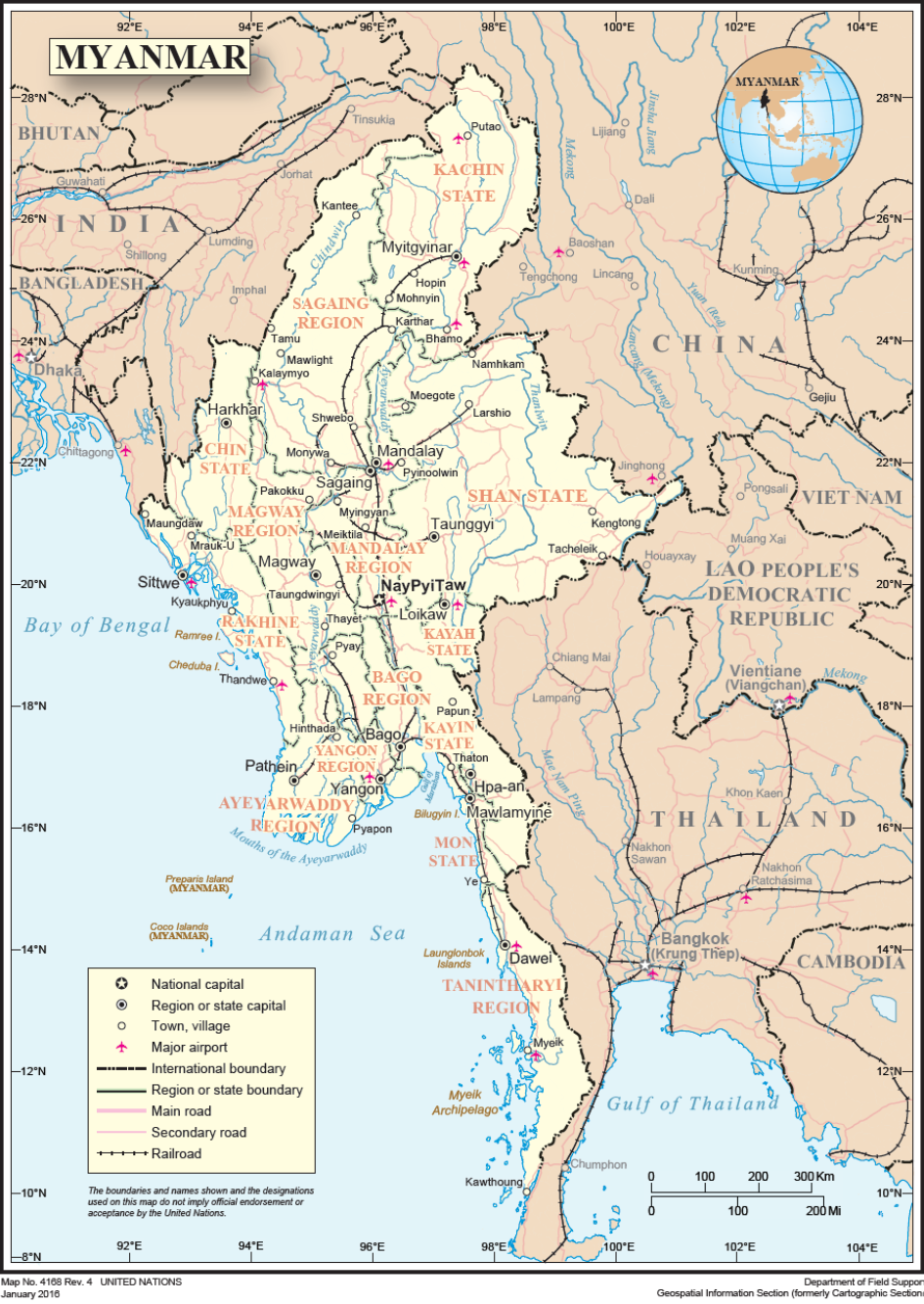
The armed conflicts taking place in Myanmar for decades intensified dramatically following the military coup of February 2021. The violent crackdown on nationwide protests ultimately led to intensified violence with both long-established and newly formed non-State armed groups, often with an ethnic dimension. Fighting has taken place across the country, including in the Bamar heartland straddling Sagaing, Mandalay and Magway where many ‘People’s Defence Forces’ (PDFs) emerged – citizen militia formed to combat the military dictatorship which came to power after the 2021 coup. While some PDFs are under the control of the government-in-exile – the National Unity Government – many operate in concert with other armed groups.
In October 2023, a coalition of armed groups (notably three ethnic armed organisations: the Arakan Army, the Myanmar National Democratic Alliance Army, and the Ta’ang National Liberation Army) launched ‘Operation 10/27’. The military campaign saw them make substantial territorial gains against the Myanmar Armed Forces (the Tatmadaw), especially in Rakhine and Shan states, but also in Kachin, Karen, and Kayenni states and in Sagaing region. The Tatmadaw, whose capacity to re-take territory through ground offensives has diminished, often conducted airstrikes on opposition-controlled territory, in attacks that were frequently indiscriminate.
While the situation for the State armed forces appeared dire at the end of 2024, recruitment drives have since increased the Tatmadaw’s strength, while use of drones appears to have secured a tactical advantage in some confrontations. China, after appearing to tacitly accept Operation 10/27, is said to have strongly pressured armed groups to reach peace agreements with the military, and even sometimes to return territory previously taken.1International Crisis Group, ‘Myanmar’s Dangerous Drift: Conflict, Elections and Looming Regional Détente’, Asia Briefing No 184, Bangkok/Brussels, 18 July 2025, pp 2 and 4–7. Nevertheless, at the time of writing, almost all of Rakhine state remained under the control of the Arakan Army, and many other areas of Chin, Kachin, Kayah, Kayin, and Shan states were firmly under the control of armed groups.
The case bought by The Gambia before the International Court of Justice in 2019, alleging that Myanmar has committed genocide against the Rohingya community, is proceeding. Eleven States are now intervening, with the Court finding in July 2025 that declarations of intervention by Belgium, the Democratic Republic of Congo, Ireland, and Slovenia were admissible.2International Court of Justice, Application of the Convention on the Prevention and Punishment of the Crime of Genocide (The Gambia v. Myanmar).
Conflict Classification and Applicable Law
During the reporting period, Myanmar was engaged in six non-international armed conflicts (NIACs) on its territory:
- Myanmar v Arakan Army
- Myanmar v Chin National Defence Force (CNDF)3The CNDF is the armed wing of the Chin National Organization, which emerged in 2021 as a civilian response to the coup, and is a key member of the Chin Brotherhood alliance. L. Lovett, ‘“Inch by inch”: Myanmar rebels close in on key military base in Chin State’, Al Jazeera, 15 March 2025. The CNDF captured the last junta base in Chin state in early April 2025. ‘Chin Brotherhood takes over last junta base in Chin State town’, Myanmar Now, 5 April 2025.
- Myanmar v Kachin Independence Army (KIA)
- Myanmar v Karen National Liberation Army (KNLA)
- Myanmar v Myanmar National Democratic Alliance Army (MNDAA)
- Myanmar v Ta’ang National Liberation Army (TNLA)
These armed conflicts are all governed by Common Article 3 of the Geneva Conventions of 1949 and customary international humanitarian law (IHL). Myanmar is not a State Party to Additional Protocol II of 1977.4Protocol Additional to the Geneva Conventions of 12 August 1949, and relating to the Protection of Victims of Non-International Armed Conflicts; adopted at Geneva, 8 June 1977; entered into force, 7 December 1978.
Certain PDFs are subsumed within armed groups, notably in Karen state where some operate under the KNLA umbrella and others under the aegis of the KIA. Where a PDF is part of a KNLA unit, the commander will be from the KNLA and the deputy from the PDF, and there are joint coalition committees at the brigade level.5A. Nachemson, ‘How the Karen became crucial to Myanmar’s anti-coup resistance’, Al Jazeera, 6 May 2022. In Kachin state, the Kachin People’s Defence Force (KPDF) operates under the command of the KIA (as is the case with other PDFs in Kachin).6V. Berezini, ‘A Scalable Typology of People’s Defence Forces in Myanmar’, Research Report, Centre on Armed Groups, March 2025, p 4. PDFs active in areas in which the KIA operates are subsumed within its command structure.7Ibid, p 13.
Myanmar is not a State Party to the Rome Statute of the International Criminal Court.8Rome Statute of the International Criminal Court; adopted at Rome, 17 July 1998; entered into force, 1 July 2002 (ICC Statute). But as described below, investigations into the situation in Bangladesh/Myanmar by the Office of the Prosecutor of the International Criminal Court started in November 2019. Bangladesh ratified the Statute in 2010.
The Independent Investigative Mechanism for Myanmar (IIMM) has been collecting evidence of international crimes in Myanmar since its established by the UN Human Rights Council in 2018.9IIMM homepage. The IIMM has been sharing evidence with the International Criminal Court and the International Court of Justice, though looming budget cuts were placing in jeopardy its future work as of December 2025.10Z. Peter, ‘UN cuts put Myanmar war crimes probe at risk’, The New Humanitarian, 3 December 2025.
Compliance with IHL
Overview
Civilians were killed and injured and civilian objects destroyed in two main circumstances in hostilities in Myanmar during the reporting period: aerial bombardments and the burning of villages in the course of ground offensives. Areas with a concentration of civilians – whether in residential neighbourhoods or internally displaced person (IDP) camps – have frequently been struck. Sometimes civilians have been targeted while other attacks have been indiscriminate in nature, and others still have been directed against a military objective but in circumstances that amount to a disproportionate attack. The vast majority of the IHL violations are attributable to the Tatmadaw, although credible reports exist also of killings of civilians by non-State armed groups, in particular the Arakan Army. The intensity of the attacks and the scale of resultant civilian harm have appreciably increased compared to previous years.11Assistance Association for Political Prisoners, ‘The People’s Plight Under Airstrikes’, Online article, 1 July 2025; ‘Situation of human rights of Rohingya Muslims and other minorities in Myanmar, Report of the United Nations High Commissioner for Human Rights’, UN Doc A/HRC/60/20, 29 August 2025, para 8.
Civilian Objects under Attack
Under customary IHL, attacks may only be directed against military objectives. Attacks must not be directed against civilian objects.12ICRC, Customary IHL Rule 7: ‘The Principle of Distinction between Civilian Objects and Military Objectives’. Military objectives are those objects which, by their nature, location, purpose or use, make an effective contribution to military action.13ICRC, Customary IHL Rule 8: ‘Definition of Military Objectives’. In addition, the object’s partial or total destruction, capture, or neutralisation must offer a definite military advantage in the prevailing circumstances. Civilian objects are all objects that are not military objectives14ICRC, Customary IHL Rule 9: ‘Definition of Civilian Objects’. and, as such, are protected against attack.
The strikes described below were conducted by the Tatmadaw against areas under the control of opposition armed groups. On 8 January 2025, with the Arakan Army making territorial advances in Rakhine state, combat aircraft of the Tatmadaw bombed Kyauk Ni Maw village in Ramree township. The attack killed at least twenty-six civilians, and, according to analysis of satellite imagery by the Office of the United Nations High Commissioner for Human Rights (OHCHR), also destroyed 362 dwellings and other structures. The Myanmar military acknowledged mounting the attack, but justified it on the basis that its pilots had ‘observed fire flashes from the target area’s building, confirming the presence of military activity’.15See OHCHR, ‘Situation of human rights of Rohingya Muslims and other minorities in Myanmar’, para 35; ‘Airstrike on village in western Myanmar kills at least 40 people, groups say’, Associated Press, 9 January 2025. In contrast, the Arakan Army claimed that the attack struck areas away from their positions, with an emergency responder asserting that ‘they targeted crowded civilian areas’.16‘Junta airstrikes kill 41, injure 50 in Rakhine State’s Ramree Township’, Myanmar Now, 9 January 2025. Even assuming the presence of Arakan Army fighters within the village, the massive and widespread destruction of civilian buildings and areas, and killing of more than two dozen civilians, indicates that the attack was at least disproportionate.
On 8 May 2025, fifteen IDPs who had taken shelter in Kanna Yeiktha monastery from ongoing combat in the town of Bhamo in Kachin state were killed and another thirty were injured. The combat aircraft involved in the attack dropped up to eight bombs on the monastery before strafing the site. In this instance, KIA forces were reportedly present and fighting from the monastery. The KIA claimed to have been making every effort to evacuate the monastery of civilians once their forces came under attack.17‘At Least 15 Civilians Killed in Myanmar Junta Airstrike on Bhamo Monastery amid Ongoing Battle’, Mizzima, 10 May 2025; ‘Airstrike on Monastery in Kachin State’s Bhamo Township Kills 15’, Myanmar Now, 11 May 2025. The circumstances of this attack indicate that it may have been disproportionate, with an attendant failure to take all feasible precautions to avoid, and in any event to minimize, incidental harm to civilians and civilian objects.
Attacks against schools
Schools were also struck from the air during the reporting period. On the morning of 12 May 2025, in one of the worst losses of life during the reporting period, a combat aircraft dropped bombs on a school in Oe Htein Kwin village, Depayin township, in Sagaing region. Twenty students and two teachers were reportedly killed and fifty students injured. The aircraft allegedly circled over the school before dropping its payload.18‘Myanmar Junta Airstrike on School Kills 22, Including 20 Students’, Radio Free Asia, 12 May 2025.
A Tatmadaw-affiliated news source, the Global New Light of Myanmar, asserted that reports of the incident were ‘fake news’, but without denying the air force had conducted the bombing or offering a justification for the attack.19‘False airstrike reports spread by malicious media’, Myanmar News Agency, 31 May 2025; ‘Myanmar Airstrike on School in Resistance Stronghold Kills Dozens, Including Children’, Associated Press, 12 May 2025. Claims circulated in military-allied social media that the school was a bomb-making facility are not supported by evidence, and open-source imagery confirms that the damage to the school was caused by unguided air-delivered munitions of types used by the Myanmar Air Force.20Myanmar Witness, ‘Conflicting claims: An analysis of the Tabayin school airstrike’, 16 May 2025. A National Unity Government spokesperson denied the presence of resistance fighters at the school, while witnesses rejected the notion of recent fighting in the area.21G. Peck, ‘An Airstrike in Central Myanmar Kills up to 22 People at a Bombed School, Reports Say’, Associated Press, 12 May 2025. This was, at the very least, an indiscriminate attack, and possibly even an attack directed against civilians.
Schools have, however, been used by both fighters in non-State armed groups and the Tatmadaw, which potentially transforms at least the salient part of the premises into a military objective.UN Special Rapporteur on human rights in Myanmar reported 320 cases of schools being used by non-State armed groups between February 2021 and March 2022.22 ‘Losing a generation: how the military junta is devastating Myanmar’s children and undermining Myanmar’s future, Conference room paper of the Special Rapporteur on the situation of human rights in Myanmar’, UN Doc A/HRC/50/CRP.1, 14 June 2022, para 101. Although such use is not per se an IHL violation, the use of schools by armed forces and groups and attacks against them have a devastating and long-term effect on access to education. An aerial attack on 26 January 2025 on a school in Singut in Mandalay region killed twelve fighters and six civilians, indicating substantial use by a non-State armed group.23‘Myanmar junta airstrikes on school and hospital leave dozens dead, injured’, Myanmar Now, 27 January 2025 (referring to the fighters as being from the ‘Myingyan Township People’s Defence Team’ and the ‘village defence team’). See generally Global Coalition to Protect Education from Attack, ‘The Impacts of Attacks on Education and Military Use in Myanmar’, September 2022. Myanmar Witness earlier reported that, as of 10 July 2024, 174 attacks had been mounted against educational institutions since early 2021.24Myanmar Witness, ‘Schools caught in the crossfire’, 10 July 2024.
Attacks against medical facilities
Health clinics and hospitals have been subjected to repeated airstrikes. The single largest loss of life came in an attack on a clinic in Hnan Khar village in Gangaw Township (Magway region) on the morning of 22 March 2025. Eleven civilians were killed, including a doctor and nurse (who were husband and wife), their five-year-old son, and several patients. The clinic was in the middle of a village of nearly 1,000 households and the purpose of attacking it is unknown.25‘Junta airstrike hits a clinic in central Myanmar, killing 11, including children’, Radio Free Asia, 24 March 2025; ‘Myanmar June Airstrikes Leave 100 Dead this Month’, The Irrawaddy, 28 March 2025; ‘11 civilians killed in Myanmar junta airstrikes on village clinic in norther Magway Region’, Myanmar Now, 24 March 2025.
In Kachin, airstrikes hit a medical clinic providing healthcare to IDPs on 22, 24, and 26 April 2025, apparently as part of a Tatmadaw offensive against the KIA.26‘Myanmar regime bombs Kachin “jungle hospital” three times in one week’, Myanmar Now, 2 May 2025. A hospital in Kyaukme in northern Shan state, which had been under the control of the TNLA since August 2024, was bombed on 25 January 2025, killing two nurses and a patient and injuring twenty other healthcare workers and patients.27‘Myanmar junta airstrikes on school and hospital leave dozens dead, injured’, Myanmar Now, 27 January 2025. A hospital in Laukkai, a city seized by the MNDAA in January 2024, was reportedly bombed in early August, killing ten civilians.28‘Myanmar air strikes on border hospital near China kill 10: local media’, The Straits Times, 2 August 2024. Medical units and personnel are specially protected under IHL, and such attacks appear to constitute serious violations.29ICRC Customary IHL Rule 28: ‘Medical Units’; Rule 25: ‘Medical personnel’; and Rule 156: ‘Definition of War Crimes’.
Attacks against cultural property
Reports indicate that cultural property has been severely damaged by Tatmadaw airstrikes. According to data gathered by Radio Free Asia as at 8 September 2023, nearly 200 religious buildings – including Buddhist monasteries, Christian churches, and mosques – have been destroyed since the military coup in 2021. Chin state has been the most affected, with eighty-five ethnic Chin Christian churches destroyed. Sagaing has also been significantly impacted, with forty Buddhist monasteries, six churches, and three mosques damaged.30‘Churches, Temples and Monasteries Regularly Hit by Airstrikes in Myanmar, Activists Say’, Associated Press, 23 January 2024. According to data from the National Unity Government, between 1 January and 12 May 2025, 435 religious buildings were destroyed by Tatmadaw airstrikes.31‘Myanmar Military Airstrikes Destroy 435 Religious Buildings: NUG’, Mizzima, 18 May 2025.
Assessing the scale of the destruction of religious buildings in the conduct of hostilities is complicated by the earthquake that occurred on 28 March 2025, which destroyed or damaged many structures. Nevertheless, there is specific evidence of continuing destruction of religious and cultural sites in the course of attacks. This includes a 12 April 2025 airstrike on a monastery in Tabayin township in Sagaing that killed five.32‘At Least 14 Civilians Killed by Airstrikes in Sagaing Region Since Ceasefire’, DVB English, 17 April 2025. The following day, an airstrike destroyed several buildings, including the Myoma Baptist Church in Mindat township in Chin state.33‘Myanmar Junta Bombs Civilians During Ceasefire, Hits Earthquake Zones’, Fortify Rights, 2 May 2025; ‘Myanmar Junta Bombs Monastery as It Blames Quake for Religious Devastation’, Radio Free Asia, 14 April 2025. On 8 May 2025, the Tatmadaw conducted an airstrike on Kanna Yeiktha monastery, killing fifteen civilians.34‘Airstrike on Monastery in Kachin State’s Bhamo Township Kills 15’, Myanmar Now, 11 May 2025.
Civilians under Attack
Under customary IHL, civilians enjoy general protection from the effects of hostilities, unless and for such time as they directly participate in hostilities.35ICRC, Customary IHL Rule 6: ‘Civilians’ Loss of Protection from Attack’. Accordingly, parties to armed conflicts must at all times distinguish between soldiers/fighters and civilians, and are prohibited from directing attacks against civilians.36ICRC, Customary IHL Rule 1: ‘The Principle of Distinction between Civilians and Combatants’. In case of doubt, persons should be treated as civilians.37ICRC, Customary IHL Rule 6: ‘Civilians’ Loss of Protection from Attack’. The accompanying commentary states that in NIACs, ‘the issue of doubt has hardly been addressed in State practice, even though a clear rule on this subject would be desirable as it would enhance the protection of the civilian population against attack.’ One ‘cannot automatically attack anyone who might appear dubious….’ The same approach with respect to IACs ‘seems justified’ in NIACs. Civilians may be incidentally affected by attacks against lawful targets without the law being violated. Such attacks must, however, respect the rule of proportionality in attack38ICRC, Customary IHL Rule 14: ‘Proportionality in Attack’. and the attacker must take all feasible precautions to avoid or, in any event, to minimize incidental civilian deaths and injuries to civilians (and damage to civilian objects).39ICRC, Customary IHL Rule 15: ‘Principle of Precautions in Attack’.
Attacks directed against civilians
Airstrikes have often been indiscriminate in nature or have targeted civilians deliberately. On 5 September 2024, at around 9.15 pm, an IDP camp housing more than 600 civilians near La Ei village of Pekon township in Shan state, was attacked with two 500-pound bombs dropped by combat aircraft of the Myanmar Air Force. Nine civilians were reportedly killed and a further thirty were wounded. The numbers would have been higher, but many people sleep in underground bunkers as a precaution. In the immediate aftermath of the bombing, the village was strafed with gunfire.40‘Situation of human rights of Rohingya Muslims and other minorities in Myanmar’, para 21.
OHCHR reported finding ‘no discernible military objective, reported fighting or the presence of anti-military armed groups in the vicinity to justify the attacks.’41Ibid, para 20. Even if there were any such fighters, dropping bombs of that yield on a densely packed area of shacks housing IDPs amounts to an indiscriminate or at least disproportionate attack, and arguably of an intention to target civilians. Subsequent aerial strikes were carried out on the same IDP camp on 18 November 2024 and 14 May 2025, by which time most of its residents had fled.42C. Quinley, ‘The Myanmar junta’s desperate campaign of terror’, The Spectator, 22 September 2024; ‘New report names 22 junta commanders linked to deadly airstrikes on civilians’, Fortify Rights, 4 September 2025; ‘Situation of human rights of Rohingya Muslims and other minorities in Myanmar’, para 22.
On 14 March 2025, at around 6 pm, at least twenty-seven civilians were killed and thirty injured by two 500 lb bombs dropped on a crowded market in Let Pan Hla village in Singu Township, in Mandalay region. This was the deadliest attack on the area since its seizure by the Mandalay People’s Defence Forces (‘MDY-PDF’) in July 2024. Although some MDY-PDF fighters were identified as having been present at checkpoints in the general vicinity of Let Pan Hla, the location on which the bombs were dropped was easily identifiable as civilian in character.’43‘Myanmar Children, Monks Among Dozens Killed in Heavy Airstrikes’, Radio Free Asia, 17 March 2025; Nay Min Ni, ‘Ongoing airstrikes in Singu Township kill 35, including women and children’, Myanmar Now, 19 March 2019.
The Myanmar military did not respond to OHCHR’s requests for an explanation or otherwise comment on the attack, but witnesses reported that the attacking jet circled the area before dropping its payload. Many witnesses also believed that the pattern of attacks on civilian areas through air power was part of a ‘long-established pattern of the military’s use of air power against civilian targets as a means of engendering fear and breaking the morale of those resisting the military’s superior firepower.’44‘Situation of human rights of Rohingya Muslims and other minorities in Myanmar’, para 16. Even assuming that a military objective was being targeted by the attack, dropping two 500 lb bombs on a location manifestly crowded with civilians is strongly indicative of an indiscriminate or at least a disproportionate attack.
As mentioned above, aerial bombardments by the Myanmar military continued in the weeks immediately following the earthquake of 28 March 2025, in particular in the severely affected areas of Sagaing and Mandalay. Thirty-seven civilians were reportedly killed by air attacks on 9 April 2025 alone, including twenty-five killed and twenty-four injured in Nan Khan village, Wuntho township, in Sagaing region. Photographic and satellite imagery confirm reports that the deaths resulted from two bombing raids, one at 3 pm and a second at 6 pm. Reports suggest that a PDF checkpoint was located at or near the site of the attack, but the extent of damage to structures suggests that large bombs were used, explaining the many civilian casualties,45Myanmar Witness, ‘Airstrikes continued to hit earthquake-stricken Myanmar despite SAC ceasefire’, 29 April 2025; ‘Junta Airstrikes in Myanmar’s Northwest Kill Dozens in a Single Night’, Radio Free Asia, 10 April 2025; ‘Airstrikes Kill 30 Civilians in Sagaing Region; UN Special Envoy on Myanmar Visits Naypyidaw to Discuss Earthquake’, Democratic Voice of Burma, 11 April 2025. and raising significant concerns about compliance with the rule of proportionality in attack.
Twelve civilians were also killed in two separate aerial bombardments in Chin state that day: in Saizang village, Tedim township, and in Hpwi village, Mindat township. In the former case, six members of the same family were killed, while in the latter, the victims included a pastor and a disabled person. Both attacks reportedly involved 500 lb bombs, which is consistent with photographs of the damage.46‘Airstrikes kill dozens as Myanmar junta continues to target civilians in conflict zones’, Myanmar Now, 10 April 2025. On 17 and 19 April 2025, Leik Kya and Yae Htwet, two villages in Thabeikkyin township, Mandalay, were struck with large bombs, reportedly killing a total of fifty civilians.47Myanmar Peace Monitor, ‘The Junta’s Deceptive Ceasefire and Ongoing Aerial Threats to Civilians’, 30 April 2025.
Use of anti-personnel mines
Myanmar is not a State Party to the 1997 Anti-Personnel Mine Ban Convention, which prohibits any use of anti-personnel mines by any such State actor. Myanmar is also not a State Party to the Convention on Certain Conventional Weapons and its protocols restricting the use of landmines, including for non-State actors pursuant to Amended Protocol II.48Protocol on Prohibitions or Restrictions on the Use of Mines, Booby-Traps and Other Devices as amended on 3 May 1996 annexed to the Convention on Prohibitions or Restrictions on the Use of Certain Conventional Weapons which may be deemed to be Excessively Injurious or to have Indiscriminate Effects; adopted at Geneva, 3 May 1996; entered into force, 3 December 1998. Nonetheless, as with any other weapon, the use of mines is subject to the general rules of IHL governing the conduct of hostilities, including the principles of distinction and proportionality in attack. The risk of an indiscriminate attack is especially acute if mines are used in areas frequented by civilians.
The Tatmadaw continue to use anti-personnel mines on a regular basis. There are specific reports that as it lost territory, in particular in Rakhine state, it emplaced mines in and around villages and military camps from which it was retreating, as well as in forests and on mountain paths.49R. Ni, ‘Rakhine residents urge Arakan Army to clear landmines as civilian casualties mount’, Myanmar Now, 8 April 2025; International Campaign to Ban Landmines (ICBL), Landmine Monitor Report 2024, November 2024, p 17. While such reports are difficult to verify given current circumstances, emplacing mines in and around villages without any specific or sufficient military objective is likely to constitute an indiscriminate attack.
The effects of past and ongoing mine use continue to be felt throughout Myanmar. During the first three months of 2025, a total of 227 mine casualties were reported nationwide, roughly the same level as reported in 2024.50UNICEF, ‘Myanmar Landmine and Explosive Ordnance Incidents Information’, July 2025 (last accessed 19 September 2025). In 2023, Myanmar emerged as the nation with the world’s highest mine casualties,51ICBL, Landmine Monitor Report 2024, p 42. a situation set to continue.
Use of gravity ordnance
As described above, many airstrikes causing substantial civilian casualties involve the use of unguided bombs – gravity ordnance – dropped from combat aircraft. When dropped into densely populated areas, the effects on civilians are likely to be disproportionate, even if the bomb does hit a military objective. The Myanmar Air Force possesses a variety of aircraft capable of delivering heavy unguided bombs.52Myanmar Witness, ‘K-8’, 23 October 2024; ‘Myanmar’s Junta Receives Su-30 Fighter Jets and Attack Helicopters from Russia in Major Military Boost’, The Asia Live, 19 May 2025; ‘China-Made Y-12 Aircraft Increasingly Deployed by Air Force in Recent Bombing Raids Across Several Combat Zones’, Burma News International, 21 December 2023. Bombs of up to 500 lb have been dropped, which, as seen in the incidents recounted above, can kill many and cause substantial damage to civilian structures within a wide radius.
Use of armed drones
Armed drones are not unlawful per se. But the Arakan Army in particular has been accused of using them to target Rohingya civilians as they fled its territorial advances in Rakhine state. On 5 and 6 August 2024, thousands of displaced Rohingya had congregated near Maungdaw town on the bank of the river Naf with the intention of fleeing to Bangladesh. They came under attack from drones emanating from areas under Arakan Army control. One interviewee who was on a boat that was attacked by a drone said that thirty-eight civilians, including four children, were killed.53Situation of human rights of Rohingya Muslims and other minorities in Myanmar, para 43; K. Ahmed, ‘Thousands flee after Myanmar rebels use drones to bomb Rohingya villagers’, The Guardian, 22 August 2024. Sources suggest that as many as 200 civilians in total may have been killed by drone strikes and shelling as they fled Maungdaw town.54Human Rights Watch, ‘Myanmar: New Atrocities Against Rohingya’, 22 August 2024.
Forced displacement
As of March 2025, an estimated five million people in total have been displaced as a result of the armed conflicts in Myanmar, of whom 3.5 million are IDPs.55UNHCR, ‘UNHCR Myanmar Situation Regional Update #1 (January–March 2025)’, 24 April 2025; Situation of human rights of Rohingya Muslims and other minorities in Myanmar, para 48. Most are in Kayin and Rakhine states and Magway and Sagaing regions.56UNHCR, ‘Myanmar UNHCR displacement overview’, 31 March 2025. Approximately 1.5 million people have been displaced to and sought refuge in neighbouring States, primarily Bangladesh, India, Indonesia, Malaysia, and Thailand.57UNHCR, ‘Myanmar Situation Regional Update #1 (January–March 2025)’. Only 15 per cent of the displaced are in formal camps, with most living in informal shelters with limited access to food, water, and healthcare.58UN Office for the Coordination of Humanitarian Affairs (OCHA), ‘Global Humanitarian Overview 2025’, December 2024.
Under IHL, parties to a NIAC are prohibited from ordering displacement of the civilian population in relation to the armed conflict, except to ensure the safety of civilians or for imperative military reasons.59ICRC, Customary IHL 129: ‘The Act of Displacement’. Forced displacement may also be caused by unlawful attacks on civilians. In Chauk township, starting on 25 October 2024, the Myanmar military targeted one town after another with artillery fire and airstrikes, followed by looting, the torching of homes, unlawful killings, arbitrary detention of civilians, and the use of civilians as human shields.60‘Battle intense in Chauk Township and junta army advances using air force and tanks, tens of thousands of civilians from more than 30 villages flee for safety’, Pann Taing, 28 October 2024; H. Htoo Zan, ‘Myanmar Junta Airstrike Kills 14 in Magwe’, The Irrawaddy, 30 October 2024.
The Arakan Army, which has control of much of Rakhine state, is suspected of mistreating Rohingya civilians. The United Nations estimates that nearly 350,000 Rohingya have been displaced from the state as well as from the bordering Paletwa township in Chin state since the intensification of fighting between the Arakan Army and the Myanmar military in November 2023.61‘Situation of human rights of Rohingya Muslims and other minorities in Myanmar’, para 38.
Investigations into the situation in Bangladesh/Myanmar by the Office of the Prosecutor of the International Criminal Court started in November 2019.62ICC; ‘Decision Pursuant to Article 15 of the Rome Statute on the Authorisation of an Investigation into the Situation in the People’s Republic of Bangladesh/Republic of the Union of Myanmar’, 14 November 2019. For the Court to have jurisdiction, crimes must, at a minimum, have occurred within the territory of Bangladesh, a State Party to the Rome Statute, and in connection with the violent events in Rakhine state, Myanmar, in 2016 and 2017, or be a crime perpetrated since 9 October 2016 and closely linked to those events.
On 27 November 2024, the Prosecutor of the International Criminal Court announced the issuance of an arrest warrant for Min Aung Hlaing, the Commander-in-Chief of the Myanmar Defence Services, for crimes against humanity related to the deportation and persecution of the Rohingya. The Prosecutor said that further applications of this nature would follow. The Prosecutor alleges that the Tatmadaw committed these crimes between 25 August and 31 December 2017, with support from the police and non-Rohingya civilians.63ICC, ‘Statement of ICC Prosecutor Karim A.A. Khan KC: Application for an arrest warrant in the situation in Bangladesh/Myanmar’, 27 November 2024.
Humanitarian aid
The humanitarian needs of the civilian population in Myanmar were significantly worsened by Typhoon Yagi which hit the country on 8 September 2024, and then a 7.7 magnitude earthquake on 28 March 2025, which caused substantial damage in Mandalay and Sagaing. The typhoon killed 440 people, displaced more than 631,000, and damaged or destroyed 141,000 buildings. The earthquake killed 3,800 people, injured more than 51,000, and displaced 207,000. Already 15.2 million people were facing acute food insecurity before the earthquake, reflecting the precarity of the humanitarian situation in much of Myanmar.64OCHA, ‘Myanmar Earthquake: One Month After’, 28 April 2025; OCHA, ‘Myanmar Humanitarian Needs and Response Plan 2025 (December 2024)’, December 2024.
Despite requesting international humanitarian aid in the wake of these disasters, the Tatmadaw has systematically impeded the flow of humanitarian supplies to areas outside its control. Humanitarian workers were instructed by the military not to assist in areas perceived as aligned with anti-government forces, both after the typhoon65‘Myanmar junta blocks aid to thousands impacted by Typhoon Yagi’, Radio Free Asia, 19 September 2024; ‘Junta accused of obstructing flood relief efforts in central Myanmar’, Myanmar Now, 17 September 2024. and the earthquake,66G. Butler, ‘How aid becomes a weapon in Myanmar’s war zone’, BBC, 2 April 2025; Human Rights Watch, ‘Myanmar – Events in 2024’, 6 September 2024; ‘Myanmar civil society groups warn of weaponisation of aid as earthquake response intensifies’, Myanmar Now, 31 March 2025. in an attempt to cut off supplies to opposition forces or to punish the population for its perceived support of those opposition forces.
Furthermore, despite the declaration of ceasefires in the immediate aftermath of the earthquake by the Tatmadaw and various armed groups, none ceased military operations in practice. The Myanmar Air Force, in particular, launched numerous airstrikes in April, about two thirds of which were in areas affected by the earthquake. A number of the attacks were manifestly indiscriminate and killed civilians, as well as impeding humanitarian assistance in areas where the attacks took place.67P. Chaudhuri, ‘Open Sources Show Myanmar Junta Airstrike Damages Despite Post-Earthquake Ceasefire’, Bellingcat, 29 April 2025; Myanmar Witness, ‘Airstrikes Continued to Hit Earthquake-Stricken Myanmar Despite SAC Ceasefire’, 28 April 2025; OHCHR, ‘Comment by UN Human Rights Office spokesperson Ravina Shamdasani on continued attacks in Myanmar amid rescue efforts’, Press release, 11 April 2025; D. Ghoshal et al, ‘Exclusive: Myanmar junta defies quake ceasefire to continue deadly attacks, data shows’, Reuters, 25 April 2025; and ‘Myanmar junta extends ceasefire to support earthquake relief, state media says’, Reuters, 22 April 2025.
Protection of Persons in the Power of the Enemy
Treaty and customary IHL offers fundamental guarantees of protection to anyone in the power of a party to a conflict, prohibiting murder, torture, other inhumane or degrading treatment, all forms of sexual violence, and enforced disappearances. As noted above, a series of attacks involving the murder of civilians occurred during the reporting period.
Murder of civilians
There have been many grave instances of the murder of civilians during the reporting period, perpetrated by both the Tatmadaw and non-State armed groups. On 2 March 2025, a Myanmar military column raided Myay Sun Taw village in Magway, executing eleven civilians, including nine older persons, by a shot to the head. The bodies were discovered by villagers upon their return to the area.68‘Regime forces accused of killing 17 civilians and one People’s Defense Force member in Magway Region’, Democratic Voice of Burma, 19 March 2025; ‘Myanmar junta troops massacre 11 villagers, most too old to flee’, Radio Free Asia, 10 March 2025. On 10 March 2025, the military attacked Kya Pin village, captured seven villagers, and tortured and then killed four of them. Their bodies were found in a toilet pit covered in garbage, with their hands tied behind their backs and slash wounds on their necks and other parts of their bodies. Villagers also discovered electro-shock devices set up by the military, possibly to torture the victims before they were killed.69‘Four locals killed by junta troops in Salin’s Kya Pin village (North)’,Myanmar Peace Monitor, 24 March 2025; ‘Junta Soldiers Torture and Kill Four Villagers in Salin Township’, Burma News International, 25 March 2025; ‘Junta airstrike hits a clinic in central Myanmar, killing 11, including children’,Radio Free Asia, 24 March 2025.
Similar events have occurred elsewhere in Myanmar. By March 2025, the Arakan Army had seized control of 14 of the 17 townships of Rakhine state, with only Kyaukphyu, Manaung, and Sittwe remaining under the effective control of the Myanmar military. Reports have emerged of Rohingya civilians being executed en masse by the Arakan Army, and of mutilation, including beheadings.70‘International Criminal Court: Investigate Arakan Army War Crimes Against Rohingya’, Fortify Rights, 23 July 2025; Situation of human rights of Rohingya Muslims and other minorities in Myanmar, paras 39–42. Severe abuses of Rohingya during detention have also been documented, including acts of torture.71‘International Criminal Court: Investigate Arakan Army War Crimes Against Rohingya’.
Civil servants and local politicians who are protected civilians under IHL have also been the object of targeted assassinations by armed groups during the reporting period, continuing a trend since early 2021. At least 136 assassinations occurred during the reporting period, sometimes for the victims’ alleged involvement in abducting locals to be used as porters and for aiding or participating in the military conscription of civilians.
Acts of terrorism against the civilian population
While individual massacres of civilians are all war crimes of murder, a series of events indicate that the Tatmadaw is also responsible for acts of terrorism perpetrated against the civilian population. For instance, after suffering substantial losses due to enemy ambushes in September 2024 in Budalin township in Sagaing, the Myanmar military responded with a brutal counterinsurgency campaign. On 11–12 October, they raided a part of Budalin town and Myauk Kyi villages, murdering thirteen civilians.72‘Two-day offensive by the Myanmar military in Budalin Township kills 13 civilians, including women and children’, Mizzima, 16 October 2024; ‘Junta Troops Allegedly Raid Grocery Store Owner’s House in Budalin, Killing Five Family Members Midnight’, Myanmar Press Photo Agency, 13 October 2024; ‘Myanmar Junta and Allied Militia Maraud Through Saigang’s Budalin’, The Irrawaddy, 15 October 2024. In the early hours of 17 October, they seized control of Si Par village, four miles north of Budalin town. When villagers returned the next day after Tatmadaw forces had withdrawn, they discovered three dead bodies at the entrance to the village, with gunshot wounds and dismembered limbs, and, in the centre of the village, three beheaded, burned and dismembered bodies, with their heads placed on a fence.73 ‘Hell in a Sagaing Region village’, Myanmar Now, 25 October 2024; ‘Myanmar Junta Soldiers beheaded and mutilated civilians in Apparent War Crimes in Sagaing Region’, Fortify Rights, 4 February 2024; ‘The Si Par Incident And Mass Killings Across Myanmar’, Myanmar Peace Monitor, 30 October 2024. After leaving Si Par village, the military reportedly raided the nearby village of Se Wa, killing two more men, with the body of one found with severed limbs.74‘Hell in a Sagaing Region village’, Myanmar Now.
The Myanmar military acknowledged that it had been present in Si Par village at the time, but asserted that the civilians had been killed by returning insurgent groups as ‘punishment for being alleged informers to security forces’.75‘Situation of human rights of Rohingya Muslims and other minorities in Myanmar’, para 13; ‘Myanmar Junta Soldiers beheaded and mutilated civilians in Apparent War Crimes in Sagaing Region’. However, media and NGO reports of the incident, based on testimony by multiple eyewitnesses, reject this account. Body parts were found ‘all over the village’ when the residents returned; one witness noted that heads and limbs had been severed and that ‘they also opened their stomachs. The heart was put on a plate.’ One of the victims is reported to have been in his eighties.76Ibid
This event is just one recent example in a long-running pattern of cruel treatment and mutilation by the Myanmar military in Sagaing, going back to events in Tar Taing in March 2023. Notably, the annual reports of the Independent Investigation Mechanism for Myanmar from 2023 and 2024 both reported ‘credible information’ of the ‘mutilation’ of victims killed in detention by ‘soldiers in civilian or military attire and/or military-affiliated militias’.77M. Shwe Wah, ‘In Myanmar’s heartland, new horrors form a junta struggling for control’, Myanmar Now, 11 March 2023; Report of the IIMM, UN Doc A/HRC/54/19, 30 June 2023, paras 28, 31; Report of the IIMM, UN Doc A/HRC/57/18, 11 July 2024, para 26.
As of October 2024, more than 105,000 incidents of the burning of homes have been reported since February 2021, which may also amount to terrorizing the civilian population. Sagaing region was disproportionately impacted by arson attacks, accounting for nearly 64,000 of all reported incidents. According to Data for Myanmar, almost 23,500 structures were burnt in the first ten months of 2024, with Rakhine state seeing the largest number of incidents (9,571), followed by Sagaing 4,792) and Mandalay (3,622).78Institute for Strategy and Policy – Myanmar (ISP Myanmar), ‘Increased Arson Cases in Rakhine State and Mandalay Region (February 2021–October 2024)’, November 2024. Arson is often accompanied by other violations, including murder, pillage, and forced conscription. 79Ibid. The use of arson in conjunction with other IHL violations continues a trend from previous reporting periods.80Centre for Information Resilience, Myanmar on fire, 8 August 2023; Myanmar Witness, ‘Civilian harm: an investigation into the impact of military operations in NorthWest Myanmar’, 14 September 2022.
The offensives in the ‘Dry Zone’ of Magwe, Mandalay, and Sagaing have been systematically accompanied by mass arson of homes. Although reports vary concerning the extent to which Si Par was destroyed, OHCHR estimated that ‘up to 1,000 houses’ were burned in a single day of this particular offensive in Budalin township.81OHCHR, ‘Update on the Human Rights Situation in Myanmar: Overview of developments in 2024’; ‘Myanmar Junta Troops Blaze Trail of Destruction on Magwe-Sagaing Border’, The Irrawaddy, 12 March 2025; Human Rights Watch, ‘Myanmar: “Scorched Earth” Tactics Intensify’, 16 January 2025.
Conflict-related sexual and gender-based violence
Rape and other forms of sexual violence in connection with armed conflict are prohibited and constitute serious violations of IHL and war crimes.82Common Article 3, Geneva Conventions; ICRC, Customary IHL Rule 93: ‘Rape and Other forms of Sexual Violence’; and Rule 156: ‘Definition of War Crimes’. The scale of sexual violence related to armed conflict in Myanmar is difficult to assess due to ongoing conflict and stigma associated with coming forward as a survivor of such a crime. Nonetheless, during the reporting period, the Independent Investigative Mechanism for Myanmar has reported finding evidence of ‘rape (including with objects and gang rape), sexual slavery, sexualized torture, sexual mutilation, sexual assault at military checkpoints and forced nudity’.83Report of the IIMM, UN Doc A/HRC/60/18, 14 July 2025, para 14. The UN Special Representative of the Secretary-General on Sexual Violence in Conflict also noted in 2025 the ‘persistent and alarming reports about the continued use by Myanmar security forces of sexual violence during ground operations, village raids, at checkpoints, and in detention settings.’84‘UN Special Representative Patten Condemns the Continued Use of Sexual Violence Against Civilians as a Tactic of War and Political Repression in Myanmar and Calls for Renewed Attention and Urgent Action’, Press release, 4 February 2025.
Among the most alarming public reports is the rape of more than fifty women at a single detention centre in Sagaing run by the Myanmar military and an allied militia.85H. Htoo Zan, ‘Myanmar Junta Soldiers Perpetrating Mass Rape at Sagaing Monastery: Reports’, The Irrawaddy, 5 November 2024. In another case, a thity-year-old woman residing at a monastery in Bago Region was gang-raped and severely beaten by three Tatmadaw soldiers, according to residents and an official of the PDF Battalion 3801 in Tharyawady District.86‘Myanmar Military Accused of War Crimes in Magway Region’, Mizzima, 4 September 2024. A video has circulated on social media of Pyu Saw Htee fighters, aligned with the military, goading each other to rape civilian ‘girls’ during an attack on a village.87‘Myanmar junta forces seen encouraging each other to commit rape in online video’, 2 September 2024.
There are also credible reports of sexual violence being committed against many of the thousands of prisoners who have been detained for long periods based on charges of opposition to the Myanmar military. These include individuals detained in specific relation to the armed conflict.88Report of the IIMM, para 17.
Arbitrary deprivation of liberty
OHCHR reported in January 2025 that since the military coup in February 2021, more than 28,000 individuals were arrested. The victims of the arrests are activists, journalists, humanitarian workers, lawyers, and religious leaders.89OHCHR, ‘Update on the Human Rights Situation in Myanmar, Overview of developments in 2024’, p 2; ‘Myanmar military stepping up civilian killings and arrests, says UN report’, Reuters, 17 September 2024. The number of charges brought under counterterrorism legislation has significantly increased, particularly against individuals accused of associating with anti-military groups, even where such involvement consisted of providing humanitarian aid. For example, aid workers have been arrested for supporting the armed opposition in Mon state.90‘Aid workers arrested, killed amid junta crackdown in Myanmar’, Radio Free Asia, 22 October 2024; ‘Five Social Aid Workers Arrested in Thanbyuzayat Town, Mon State’, Burma News International, 20 September 2024. The military administration has also arbitrarily detained the relatives and associates of activists, including their children, as a means of coercion and collective punishment.91Human Rights Watch, ‘World Report 2025: Myanmar’; Amnesty International, ‘Myanmar: Two activists at grave risk of torture after arrests’, 10 October 2024; ‘Myanmar junta authorities arrest prominent protest leader’, Myanmar Now, 11 October 2024; ‘Young strike leaders in Yangon severely interrogated by Myanmar junta’, Mizzima, 17 October 2024.
Forced recruitment
The Myanmar military and various armed groups have been accused of engaging in forced recruitment. While it is not, in general, unlawful for State armed forces to engage in conscription, the manner of such conscription may violate other rules, including the prohibitions of arbitrary deprivation of liberty. In this regard, many individuals are said to have been abducted from the street to serve in the military, or identified for military service based on their particular ethnic affiliation or other discriminatory grounds.92OHCHR, Situation of human rights of Rohingya Muslims and other minorities in Myanmar, paras 26–28 and 36. Some armed groups are said to have required each household in areas under their control to provide someone to serve in the armed group.93Ibid, para 29.
Protection of children
Under IHL, children are afforded special protection in armed conflicts, recognizing their particular vulnerability. Unless and for such time as they participate in hostilities, children are entitled to protection as civilians, including against direct attack, arbitrary detention, sexual violence, and ill-treatment, as well as specific guarantees of access to food, medical care, and education.94ICRC, Customary IHL Rule 135: ‘Children’. For 2024, the United Nations identified and verified 2,138 grave violations against children (1,248 boys, 499 girls, 15 sex unknown). The killing (262) and maiming (999) of 1,261 children (767 boys, 480 girls, 14 sex unknown) was attributed mostly to the Tatmadaw, including related forces and affiliated militias (840).95‘Children and armed conflict, Report of the Secretary-General’, UN Doc A/79/878-S/2025/247, 17 June 2025, paras 143, 146.
IHL explicitly prohibits the recruitment of children under the age of fifteen years or their use in hostilities, whether in State armed forces or non-State armed groups.96ICRC, Customary IHL Rule 136: ‘Recruitment of Child Soldiers’. Violations of the prohibition amount to possible war crimes. Yet the recruitment and use of children in combat, particularly by non-State armed groups, continues to occur. In the course of 2024, the United Nations verified the recruitment and use of 482 children (467 boys, 15 girls), most by the Tatmadaw, including related forces and affiliated militias (400).97Children and armed conflict, Report of the Secretary-General, para 144.
- 1International Crisis Group, ‘Myanmar’s Dangerous Drift: Conflict, Elections and Looming Regional Détente’, Asia Briefing No 184, Bangkok/Brussels, 18 July 2025, pp 2 and 4–7.
- 2International Court of Justice, Application of the Convention on the Prevention and Punishment of the Crime of Genocide (The Gambia v. Myanmar).
- 3The CNDF is the armed wing of the Chin National Organization, which emerged in 2021 as a civilian response to the coup, and is a key member of the Chin Brotherhood alliance. L. Lovett, ‘“Inch by inch”: Myanmar rebels close in on key military base in Chin State’, Al Jazeera, 15 March 2025. The CNDF captured the last junta base in Chin state in early April 2025. ‘Chin Brotherhood takes over last junta base in Chin State town’, Myanmar Now, 5 April 2025.
- 4Protocol Additional to the Geneva Conventions of 12 August 1949, and relating to the Protection of Victims of Non-International Armed Conflicts; adopted at Geneva, 8 June 1977; entered into force, 7 December 1978.
- 5A. Nachemson, ‘How the Karen became crucial to Myanmar’s anti-coup resistance’, Al Jazeera, 6 May 2022.
- 6V. Berezini, ‘A Scalable Typology of People’s Defence Forces in Myanmar’, Research Report, Centre on Armed Groups, March 2025, p 4.
- 7Ibid, p 13.
- 8Rome Statute of the International Criminal Court; adopted at Rome, 17 July 1998; entered into force, 1 July 2002 (ICC Statute).
- 9
- 10Z. Peter, ‘UN cuts put Myanmar war crimes probe at risk’, The New Humanitarian, 3 December 2025.
- 11Assistance Association for Political Prisoners, ‘The People’s Plight Under Airstrikes’, Online article, 1 July 2025; ‘Situation of human rights of Rohingya Muslims and other minorities in Myanmar, Report of the United Nations High Commissioner for Human Rights’, UN Doc A/HRC/60/20, 29 August 2025, para 8.
- 12ICRC, Customary IHL Rule 7: ‘The Principle of Distinction between Civilian Objects and Military Objectives’.
- 13ICRC, Customary IHL Rule 8: ‘Definition of Military Objectives’. In addition, the object’s partial or total destruction, capture, or neutralisation must offer a definite military advantage in the prevailing circumstances.
- 14
- 15See OHCHR, ‘Situation of human rights of Rohingya Muslims and other minorities in Myanmar’, para 35; ‘Airstrike on village in western Myanmar kills at least 40 people, groups say’, Associated Press, 9 January 2025.
- 16‘Junta airstrikes kill 41, injure 50 in Rakhine State’s Ramree Township’, Myanmar Now, 9 January 2025.
- 17‘At Least 15 Civilians Killed in Myanmar Junta Airstrike on Bhamo Monastery amid Ongoing Battle’, Mizzima, 10 May 2025; ‘Airstrike on Monastery in Kachin State’s Bhamo Township Kills 15’, Myanmar Now, 11 May 2025.
- 18‘Myanmar Junta Airstrike on School Kills 22, Including 20 Students’, Radio Free Asia, 12 May 2025.
- 19‘False airstrike reports spread by malicious media’, Myanmar News Agency, 31 May 2025; ‘Myanmar Airstrike on School in Resistance Stronghold Kills Dozens, Including Children’, Associated Press, 12 May 2025.
- 20Myanmar Witness, ‘Conflicting claims: An analysis of the Tabayin school airstrike’, 16 May 2025
- 21G. Peck, ‘An Airstrike in Central Myanmar Kills up to 22 People at a Bombed School, Reports Say’, Associated Press, 12 May 2025.
- 22
- 23‘Myanmar junta airstrikes on school and hospital leave dozens dead, injured’, Myanmar Now, 27 January 2025 (referring to the fighters as being from the ‘Myingyan Township People’s Defence Team’ and the ‘village defence team’). See generally Global Coalition to Protect Education from Attack, ‘The Impacts of Attacks on Education and Military Use in Myanmar’, September 2022.
- 24Myanmar Witness, ‘Schools caught in the crossfire’, 10 July 2024.
- 25‘Junta airstrike hits a clinic in central Myanmar, killing 11, including children’, Radio Free Asia, 24 March 2025; ‘Myanmar June Airstrikes Leave 100 Dead this Month’, The Irrawaddy, 28 March 2025; ‘11 civilians killed in Myanmar junta airstrikes on village clinic in norther Magway Region’, Myanmar Now, 24 March 2025.
- 26‘Myanmar regime bombs Kachin “jungle hospital” three times in one week’, Myanmar Now, 2 May 2025.
- 27‘Myanmar junta airstrikes on school and hospital leave dozens dead, injured’, Myanmar Now, 27 January 2025.
- 28‘Myanmar air strikes on border hospital near China kill 10: local media’, The Straits Times, 2 August 2024.
- 29ICRC Customary IHL Rule 28: ‘Medical Units’; Rule 25: ‘Medical personnel’; and Rule 156: ‘Definition of War Crimes’.
- 30‘Churches, Temples and Monasteries Regularly Hit by Airstrikes in Myanmar, Activists Say’, Associated Press, 23 January 2024.
- 31‘Myanmar Military Airstrikes Destroy 435 Religious Buildings: NUG’, Mizzima, 18 May 2025.
- 32‘At Least 14 Civilians Killed by Airstrikes in Sagaing Region Since Ceasefire’, DVB English, 17 April 2025.
- 33‘Myanmar Junta Bombs Civilians During Ceasefire, Hits Earthquake Zones’, Fortify Rights, 2 May 2025; ‘Myanmar Junta Bombs Monastery as It Blames Quake for Religious Devastation’, Radio Free Asia, 14 April 2025.
- 34‘Airstrike on Monastery in Kachin State’s Bhamo Township Kills 15’, Myanmar Now, 11 May 2025.
- 35
- 36
- 37ICRC, Customary IHL Rule 6: ‘Civilians’ Loss of Protection from Attack’. The accompanying commentary states that in NIACs, ‘the issue of doubt has hardly been addressed in State practice, even though a clear rule on this subject would be desirable as it would enhance the protection of the civilian population against attack.’ One ‘cannot automatically attack anyone who might appear dubious….’ The same approach with respect to IACs ‘seems justified’ in NIACs.
- 38
- 39
- 40‘Situation of human rights of Rohingya Muslims and other minorities in Myanmar’, para 21.
- 41Ibid, para 20.
- 42C. Quinley, ‘The Myanmar junta’s desperate campaign of terror’, The Spectator, 22 September 2024; ‘New report names 22 junta commanders linked to deadly airstrikes on civilians’, Fortify Rights, 4 September 2025; ‘Situation of human rights of Rohingya Muslims and other minorities in Myanmar’, para 22.
- 43‘Myanmar Children, Monks Among Dozens Killed in Heavy Airstrikes’, Radio Free Asia, 17 March 2025; Nay Min Ni, ‘Ongoing airstrikes in Singu Township kill 35, including women and children’, Myanmar Now, 19 March 2019.
- 44‘Situation of human rights of Rohingya Muslims and other minorities in Myanmar’, para 16.
- 45Myanmar Witness, ‘Airstrikes continued to hit earthquake-stricken Myanmar despite SAC ceasefire’, 29 April 2025; ‘Junta Airstrikes in Myanmar’s Northwest Kill Dozens in a Single Night’, Radio Free Asia, 10 April 2025; ‘Airstrikes Kill 30 Civilians in Sagaing Region; UN Special Envoy on Myanmar Visits Naypyidaw to Discuss Earthquake’, Democratic Voice of Burma, 11 April 2025.
- 46‘Airstrikes kill dozens as Myanmar junta continues to target civilians in conflict zones’, Myanmar Now, 10 April 2025.
- 47Myanmar Peace Monitor, ‘The Junta’s Deceptive Ceasefire and Ongoing Aerial Threats to Civilians’, 30 April 2025.
- 48Protocol on Prohibitions or Restrictions on the Use of Mines, Booby-Traps and Other Devices as amended on 3 May 1996 annexed to the Convention on Prohibitions or Restrictions on the Use of Certain Conventional Weapons which may be deemed to be Excessively Injurious or to have Indiscriminate Effects; adopted at Geneva, 3 May 1996; entered into force, 3 December 1998.
- 49R. Ni, ‘Rakhine residents urge Arakan Army to clear landmines as civilian casualties mount’, Myanmar Now, 8 April 2025; International Campaign to Ban Landmines (ICBL), Landmine Monitor Report 2024, November 2024, p 17.
- 50UNICEF, ‘Myanmar Landmine and Explosive Ordnance Incidents Information’, July 2025 (last accessed 19 September 2025).
- 51ICBL, Landmine Monitor Report 2024, p 42.
- 52Myanmar Witness, ‘K-8’, 23 October 2024; ‘Myanmar’s Junta Receives Su-30 Fighter Jets and Attack Helicopters from Russia in Major Military Boost’, The Asia Live, 19 May 2025; ‘China-Made Y-12 Aircraft Increasingly Deployed by Air Force in Recent Bombing Raids Across Several Combat Zones’, Burma News International, 21 December 2023.
- 53Situation of human rights of Rohingya Muslims and other minorities in Myanmar, para 43; K. Ahmed, ‘Thousands flee after Myanmar rebels use drones to bomb Rohingya villagers’, The Guardian, 22 August 2024.
- 54Human Rights Watch, ‘Myanmar: New Atrocities Against Rohingya’, 22 August 2024.
- 55UNHCR, ‘UNHCR Myanmar Situation Regional Update #1 (January–March 2025)’, 24 April 2025; Situation of human rights of Rohingya Muslims and other minorities in Myanmar, para 48.
- 56UNHCR, ‘Myanmar UNHCR displacement overview’, 31 March 2025.
- 57UNHCR, ‘Myanmar Situation Regional Update #1 (January–March 2025)’.
- 58UN Office for the Coordination of Humanitarian Affairs (OCHA), ‘Global Humanitarian Overview 2025’, December 2024.
- 59
- 60‘Battle intense in Chauk Township and junta army advances using air force and tanks, tens of thousands of civilians from more than 30 villages flee for safety’, Pann Taing, 28 October 2024; H. Htoo Zan, ‘Myanmar Junta Airstrike Kills 14 in Magwe’, The Irrawaddy, 30 October 2024.
- 61‘Situation of human rights of Rohingya Muslims and other minorities in Myanmar’, para 38.
- 62
- 63
- 64OCHA, ‘Myanmar Earthquake: One Month After’, 28 April 2025; OCHA, ‘Myanmar Humanitarian Needs and Response Plan 2025 (December 2024)’, December 2024.
- 65‘Myanmar junta blocks aid to thousands impacted by Typhoon Yagi’, Radio Free Asia, 19 September 2024; ‘Junta accused of obstructing flood relief efforts in central Myanmar’, Myanmar Now, 17 September 2024.
- 66G. Butler, ‘How aid becomes a weapon in Myanmar’s war zone’, BBC, 2 April 2025; Human Rights Watch, ‘Myanmar – Events in 2024’, 6 September 2024; ‘Myanmar civil society groups warn of weaponisation of aid as earthquake response intensifies’, Myanmar Now, 31 March 2025.
- 67P. Chaudhuri, ‘Open Sources Show Myanmar Junta Airstrike Damages Despite Post-Earthquake Ceasefire’, Bellingcat, 29 April 2025; Myanmar Witness, ‘Airstrikes Continued to Hit Earthquake-Stricken Myanmar Despite SAC Ceasefire’, 28 April 2025; OHCHR, ‘Comment by UN Human Rights Office spokesperson Ravina Shamdasani on continued attacks in Myanmar amid rescue efforts’, Press release, 11 April 2025; D. Ghoshal et al, ‘Exclusive: Myanmar junta defies quake ceasefire to continue deadly attacks, data shows’, Reuters, 25 April 2025; and ‘Myanmar junta extends ceasefire to support earthquake relief, state media says’, Reuters, 22 April 2025.
- 68‘Regime forces accused of killing 17 civilians and one People’s Defense Force member in Magway Region’, Democratic Voice of Burma, 19 March 2025; ‘Myanmar junta troops massacre 11 villagers, most too old to flee’, Radio Free Asia, 10 March 2025.
- 69‘Four locals killed by junta troops in Salin’s Kya Pin village (North)’,Myanmar Peace Monitor, 24 March 2025; ‘Junta Soldiers Torture and Kill Four Villagers in Salin Township’, Burma News International, 25 March 2025; ‘Junta airstrike hits a clinic in central Myanmar, killing 11, including children’,Radio Free Asia, 24 March 2025.
- 70‘International Criminal Court: Investigate Arakan Army War Crimes Against Rohingya’, Fortify Rights, 23 July 2025; Situation of human rights of Rohingya Muslims and other minorities in Myanmar, paras 39–42.
- 71‘International Criminal Court: Investigate Arakan Army War Crimes Against Rohingya’.
- 72‘Two-day offensive by the Myanmar military in Budalin Township kills 13 civilians, including women and children’, Mizzima, 16 October 2024; ‘Junta Troops Allegedly Raid Grocery Store Owner’s House in Budalin, Killing Five Family Members Midnight’, Myanmar Press Photo Agency, 13 October 2024; ‘Myanmar Junta and Allied Militia Maraud Through Saigang’s Budalin’, The Irrawaddy, 15 October 2024.
- 73‘Hell in a Sagaing Region village’, Myanmar Now, 25 October 2024; ‘Myanmar Junta Soldiers beheaded and mutilated civilians in Apparent War Crimes in Sagaing Region’, Fortify Rights, 4 February 2024; ‘The Si Par Incident And Mass Killings Across Myanmar’, Myanmar Peace Monitor, 30 October 2024.
- 74‘Hell in a Sagaing Region village’, Myanmar Now.
- 75‘Situation of human rights of Rohingya Muslims and other minorities in Myanmar’, para 13; ‘Myanmar Junta Soldiers beheaded and mutilated civilians in Apparent War Crimes in Sagaing Region’.
- 76Ibid
- 77M. Shwe Wah, ‘In Myanmar’s heartland, new horrors form a junta struggling for control’, Myanmar Now, 11 March 2023; Report of the IIMM, UN Doc A/HRC/54/19, 30 June 2023, paras 28, 31; Report of the IIMM, UN Doc A/HRC/57/18, 11 July 2024, para 26.
- 78Institute for Strategy and Policy – Myanmar (ISP Myanmar), ‘Increased Arson Cases in Rakhine State and Mandalay Region (February 2021–October 2024)’, November 2024.
- 79Ibid.
- 80Centre for Information Resilience, Myanmar on fire, 8 August 2023; Myanmar Witness, ‘Civilian harm: an investigation into the impact of military operations in NorthWest Myanmar’, 14 September 2022.
- 81OHCHR, ‘Update on the Human Rights Situation in Myanmar: Overview of developments in 2024’; ‘Myanmar Junta Troops Blaze Trail of Destruction on Magwe-Sagaing Border’, The Irrawaddy, 12 March 2025; Human Rights Watch, ‘Myanmar: “Scorched Earth” Tactics Intensify’, 16 January 2025.
- 82Common Article 3, Geneva Conventions; ICRC, Customary IHL Rule 93: ‘Rape and Other forms of Sexual Violence’; and Rule 156: ‘Definition of War Crimes’.
- 83Report of the IIMM, UN Doc A/HRC/60/18, 14 July 2025, para 14.
- 84
- 85H. Htoo Zan, ‘Myanmar Junta Soldiers Perpetrating Mass Rape at Sagaing Monastery: Reports’, The Irrawaddy, 5 November 2024.
- 86‘Myanmar Military Accused of War Crimes in Magway Region’, Mizzima, 4 September 2024.
- 87
- 88Report of the IIMM, para 17.
- 89OHCHR, ‘Update on the Human Rights Situation in Myanmar, Overview of developments in 2024’, p 2; ‘Myanmar military stepping up civilian killings and arrests, says UN report’, Reuters, 17 September 2024.
- 90‘Aid workers arrested, killed amid junta crackdown in Myanmar’, Radio Free Asia, 22 October 2024; ‘Five Social Aid Workers Arrested in Thanbyuzayat Town, Mon State’, Burma News International, 20 September 2024.
- 91Human Rights Watch, ‘World Report 2025: Myanmar’; Amnesty International, ‘Myanmar: Two activists at grave risk of torture after arrests’, 10 October 2024; ‘Myanmar junta authorities arrest prominent protest leader’, Myanmar Now, 11 October 2024; ‘Young strike leaders in Yangon severely interrogated by Myanmar junta’, Mizzima, 17 October 2024.
- 92OHCHR, Situation of human rights of Rohingya Muslims and other minorities in Myanmar, paras 26–28 and 36.
- 93Ibid, para 29.
- 94
- 95‘Children and armed conflict, Report of the Secretary-General’, UN Doc A/79/878-S/2025/247, 17 June 2025, paras 143, 146.
- 96
- 97Children and armed conflict, Report of the Secretary-General, para 144.