Conflict Overview
Conflict History
The 2015 victory by the National League for Democracy (NLD), unofficially led by Aung San Suu Kyi, in the first competitive elections for more than twenty-five years, were heralded as an auspicious turning point for a country long-mired in authoritarian military rule. However, tensions between Buddhist and Muslim communities in Rakhine State escalated after several Rohingya militant attacks on military and police outputs in October 2016 and August 2017, led by the Arakan Rohingya Salvation Army. The military responded with crackdowns on Rohingya villages, killing at least 6,700 people between August and September 2017 and forcing more than 700,000 others to flee across the border to Bangladesh. Widespread reports indicate indiscriminate killings and burning of Rohingya villages, with the UN Human Rights Commissioner calling the situation in Rakhine State ‘a textbook example of ethnic cleansing’.1‘UN human rights chief points to “textbook example of ethnic cleansing” in Myanmar’ UN News, 11 September 2017. See also Council on Foreign Relations ‘Civil War in Myanmar’ updated 29 January 2026. The continued killing of Rohingya by the Myanmar Armed Forces (the Tatmadaw) was subsequently characterized as genocide,2‘Report of the independent international fact-finding mission on Myanmar’, UN Doc A/HRC/39/64, 12 September 2018, paras 84–87. with a case brought by The Gambia against Myanmar ongoing before the International Court of Justice.
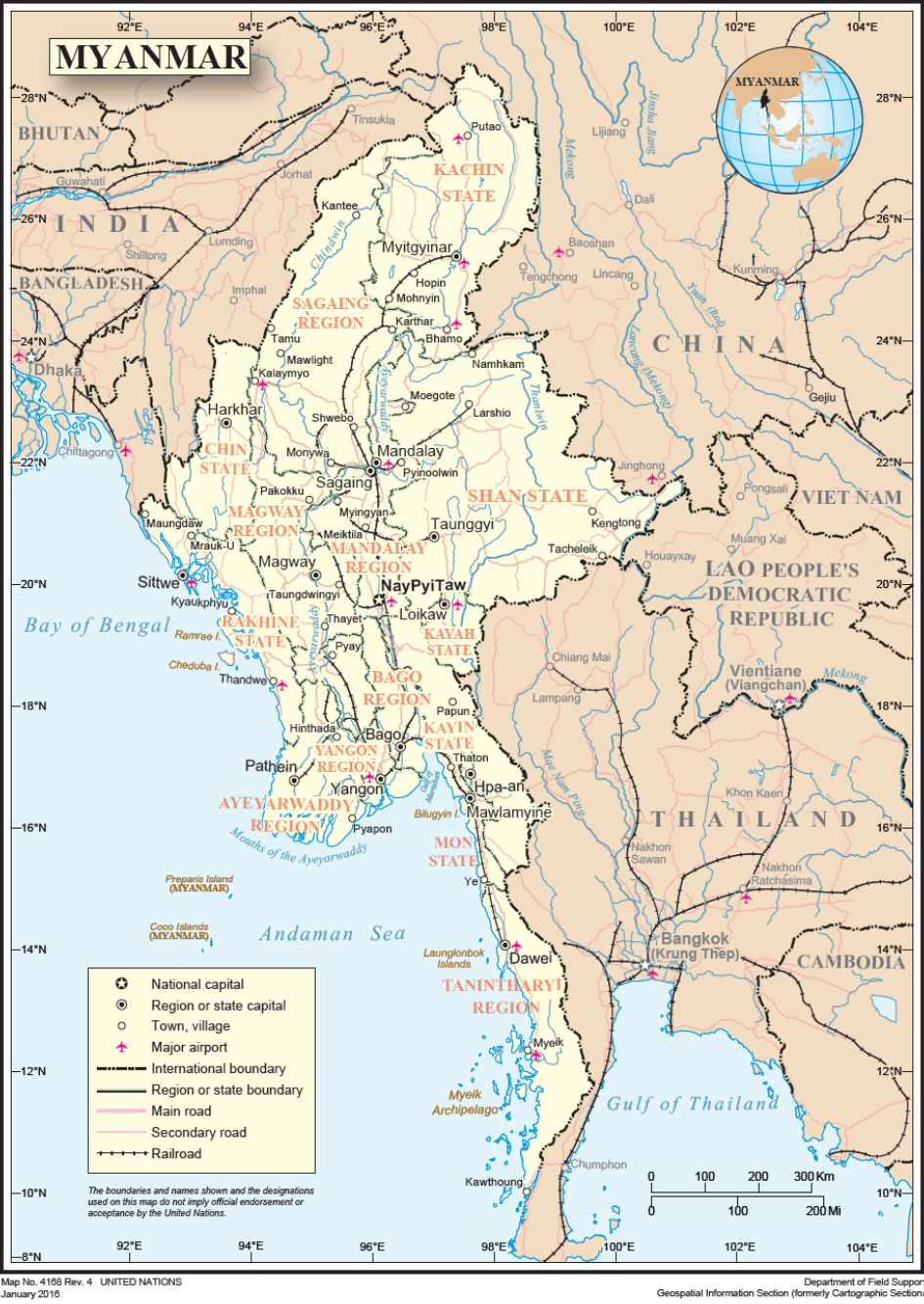
Notwithstanding the loss of international respect on account of her government’s policies in Rakhine, Ms Suu Kyi was re-elected in a landslide in November 2020. The military, sensing a significant threat from the continued democratic success of the NLD, launched a coup in February 2021 and proclaimed a national state of emergency. Protests immediately broke out in the capital, Naypyidaw, to which security forces responded with lethal force, killing more than six hundred people. This violent crackdown ultimately led to intensified violence with both long-established and newly formed non-State armed groups, often with an ethnic dimension. In response to escalating State violence, the mass political protests and acts of civil disobedience evolved into further support for organized armed resistance.3J. Curtis et al, ‘Myanmar’s civil war’, House of Commons Library, 9 April 2025. Fighting has taken place across the country, including in the Bamar heartland straddling Magway, Mandalay, and Sagaing, where many citizen militias have formed. While some of these militias are under the control of a government-in-exile – the National Unity Government – several operate in concert with other armed groups.
In October 2023, a coalition of armed groups (notably three ethnic armed organisations: the Arakan Army, the Myanmar National Democratic Alliance Army, and the Ta’ang National Liberation Army) launched ‘Operation 10/27’. The military campaign saw them make substantial territorial gains against the Tatmadaw, especially in Rakhine and Shan States, but also in Kachin, Kayenni, and Karen states and in Sagaing region. The Tatmadaw, whose capacity to re-take territory through ground offensives has diminished, often conducted airstrikes on opposition-controlled territory, in attacks that were frequently indiscriminate.
Key Events Since 1 January 2026
General elections were held in Myanmar in three phases, beginning on 28 December 2025 and ending on 25 January 2026, but were widely noted by international observers to have been neither free nor fair. As one observer commented, ‘from the outset, the main purpose of the elections was not political participation but an authoritarian-led transition from military rule to a “civilian” government’.4F. Heiduk ‘Sham Elections amid the War in Myanmar’ Stiftung Wissenschaft und Politik Comment 2026/C 09, 20 February 2026. Within the country, more than 200 election critics, including opposition politicians, journalists and artists, were detained during the election campaign under the new Election Protection Act.5Ibid. The elections delivered the expected result: a decisive parliamentary majority for the military-backed Union Solidarity and Development Party (USDP) providing a procedural basis for a return to governance under the military-drafted 2008 constitution. The USDP won 339 of the 420 contested seats. Given that the 2008 constitution reserves 25 per cent of parliamentary seats for military appointees, military-friendly lawmakers make up over 86 per cent of the new parliament.6International Crisis Group, ‘Myanmar’s New Administration: Military Consolidation, Not Transition’, 3 June 2026.
In April 2026, General Min Aung Hlaing, who launched the original coup against the Government in February 2021, was chosen by the new parliament to become president. He had already stepped down from his role as commander of the armed forces, as required by the Constitution, but observers view this as ‘civilian rule in name only’ with his staunch ally General Ye Win Oo, a hardliner with a reputation for brutality, appointed to replace him as the head of the army.7J. Head, ‘Myanmar’s coup leader who set off a brutal civil war becomes president’ BBC, 2 April 2026.
Shortly after the new Government was formed, about 4,000 political prisoners were freed under an amnesty, and the government announced that Aung San Suu Kyi would have her sentence reduced and be moved to house arrest. However, Amnesty International’s Myanmar researcher, Joe Freeman, commented that those moves amounted to the regime trying to manage its reputation rather than true transformation: ‘The junta is trying to emerge as a real civilian political force, but it’s the same people in charge.’8A. Howlett, ‘Tortured, humiliated and killed: the women who disappear into Myanmar’s prisons’ The Guardian, 11 June 2026.
In April 2026, the new government announced a 100-day roadmap inviting resistance groups to enter peace talks and to surrender, but it was not widely accepted.9Data Friendly Space ‘Myanmar Crisis Situation Analysis (Period: 25/05/26 – 31/05/26)’, 9 June 2026. The Karen National Union (KNU), All Burma Student’s Democratic Front (ABSDF), and the Chin National Front (CNF) quickly rejected the offer, with the KNU stating it has no intention of negotiating under frameworks linked to military rule.10Ibid. Nevertheless, regional diplomatic efforts continue to attempt engagement with both the military regime and the Steering Council for the Emergence of a Federal Democratic Union.11‘Myanmar civil war nears a rare opening for talks as diplomacy gains ground’ Reuters, 5 August 2026.
In February 2026, Myanmar and Russia signed a five-year security pact. Details have not been widely publicized, but the use of Russian-made jets has had a significant impact in holding back surging territorial advances by various armed groups.12‘Myanmar, Russia Agree New Military Alliance’, The Defense Post, 3 February 2026. Separately, Chinese intervention and the acquisition of Chinese-made drones and aerial warfare technologies is reported to have enabled the Tatmadaw to retake numerous towns in the first half of 2026.13‘Resistance-held towns lost amid weakening unity among revolutionary forces: analysts’, Development Media Group, 12 May 2026. In April, the BBC reported that, with Chinese and Russian help, the junta has now recaptured some of the ground lost over the past two years.14J. Head ‘Myanmar’s coup leader who set off a brutal civil war becomes president’ BBC, 2 April 2026.
The Humanitarian Situation
According to OCHA, nearly one third of Myanmar’s population now require humanitarian assistance and more than 12 million people face acute hunger. More than 3.6 million people have been displaced.15V. Mishra ‘Myanmar at a ‘crossroads’: The world must not forsake civilians there, urges UN expert’, UN News, 13 March 2026. The scale of displacement has been exacerbated by the earthquake that struck Sagaing region in March 2025. Runaway inflation had already collapsed living standards and been compounded by fuel shortages caused by the conflicts in the Middle East. Petrol and diesel have been rationed, and prices have risen sharply.16J. Head ‘Myanmar’s coup leader who set off a brutal civil war becomes president’, BBC, 2 April 2026.
Humanitarian organisations had reached some 6.3 million people at the end of 2025, but access constraints – including roadblocks, landmines, telecommunications blackouts, and the blockade of trade routes int0 Rakhine state by the Myanmar military,17‘Myanmar Military Tightens Blockade on Rakhine After Seizing Magwe Junction’, The Irrawaddy, 28 April 2026. affecting 600,000 IDPs – force reliance on low-profile, community-led delivery. The World Food Programme (WFP) warns that hunger has reached ‘unacceptable’ levels, with more than 400,000 young children and mothers surviving on nutrient-poor diets of rice or watery porridge.18Data Friendly Space ‘Myanmar Crisis Situation Analysis (Period: 25/05/26 – 31/05/26)’, 9 June 2026.
Conflict Classification and Applicable Law
International Humanitarian Law
In 2026, Myanmar was engaged in four non-international armed conflicts (NIACs) on its territory:
- Myanmar v Arakan Army
- Myanmar v Chin National Defence Force (CNDF)
- Myanmar v Kachin Independence Army (KIA)
- Myanmar v Karen National Liberation Army (KNLA).
These armed conflicts are all governed by Common Article 3 of the Geneva Conventions of 1949 and customary international humanitarian law (IHL). Myanmar is not a State Party to Additional Protocol II of 1977.19Protocol Additional to the Geneva Conventions of 12 August 1949 and relating to the protection of victims of non-international armed conflicts (Protocol II); adopted at Geneva, 8 June 1977; entered into force, 7 December 1978. Certain ‘Peoples’ Defence Forces’ (‘PDFs’ – citizen militias formed in the aftermath of the 2021 coup) have been subsumed within existing ethnic armed groups, notably in Karen state where some operate under the KNLA umbrella and others under the aegis of the KIA. As the War WATCH classification entry describes in detailed, where a PDF is part of a KNLA unit, the commander is from the KNLA and the deputy from the PDF, with joint coalition committees operating at the brigade level.20A. Nachemson, ‘How the Karen became crucial to Myanmar’s anti-coup resistance’, Al Jazeera, 6 May 2022. In Kachin state, the Kachin People’s Defence Force operates under the command of the KIA (as is the case with other PDFs in Kachin).21V. Berezini, ‘A Scalable Typology of People’s Defence Forces in Myanmar’, Research Report, Centre on Armed Groups, March 2025, p 4.
Two armed conflicts that were ongoing in 2025, involving the Myanmar National Democratic Alliance Army (MNDAA) and the Ta’ang National Liberation Army (TNLA), have been declassified on account of lack of intensity. No relevant violence has been documented following the ceasefire agreement of April 2025 (in the case of the MNDAA), or of October 2025 (in the case of the TNLA).
International Disarmament Law
Myanmar is not a State Party to the Arms Trade Treaty.22Arms Trade Treaty; adopted at New York, 2 April 2013; entered into force, 24 December 2014. Based on its conduct in the four NIACS, the Arms TRACK website of the Geneva Academy has assessed that the Tatmadaw present a high risk of illegal use of any weapons that may be supplied to them.
Myanmar is also not a State Party to the 1997 Anti-Personnel Mine Ban Convention (APMBC).23Convention on the Prohibition of the Use, Stockpiling, Production and Transfer of Anti-Personnel Mines and on their Destruction; adopted at Oslo, 18 September 1997; entered into force, 1 March 1999. It has made extensive use of anti-personnel mines, often in an indiscriminate manner. The Landmine Monitor found evidence that, in 2025 and in previous years, the Myanmar Army ‘forced civilians to serve as “guides” to walk in front of its units in mine-affected areas, effectively to detonate landmines. The military also required civilians to conduct forced labour in mine clearance’. Mines have also been used by the PDFs and by various other non-State armed groups engaged in the NIACs in Myanmar.24Landmine Monitor, ‘Mine Ban Policy’, Last updated 13 November 2025.
Myanmar is also not a State Party to the 2008 Convention on Cluster Munitions.25Convention on Cluster Munitions; adopted at Dublin, 30 May 2008; entered into force, 1 August 2010. There have been reports that Myanmar has used cluster munitions in bombardments of villages and other civilian objects.26Cluster Munition Monitor, ‘Cluster Munition Ban Policy’, Last updated 4 August 2025.
Myanmar is a State Party to the 1992 Chemical Weapons Convention.27Convention on the Prohibition of the Development, Production, Stockpiling and Use of Chemical Weapons and on their Destruction; adopted at Geneva, 3 September 1992; entered into force, 29 April 1997.
International Criminal Law and Accountability
Myanmar is not a State Party to the Rome Statute of the International Criminal Court (ICC). However, as a result of the displacement of refugees into neighbouring Bangladesh – which is a State Party – the Office of the Prosecutor of the International Criminal Court commenced an investigation into international crimes that at least partly take place in the territory of Bangladesh.28ICC, ‘Decision Pursuant to Article 15 of the Rome Statute on the Authorisation of an Investigation into the Situation in the People’s Republic of Bangladesh/Republic of the Union of Myanmar’, ICC Doc ICC-01/19-27, 14 November 2019. In November 2024, the Prosecutor filed an application for an arrest warrant for General Min Aung Hlaing – chosen to become president in April 2026, as mentioned above – for the crimes against humanity of forced deportation and persecution of the Rohingya.29‘Statement of ICC Prosecutor Karim A.A. Khan KC: Application for an arrest warrant in the situation in Bangladesh/Myanmar’, 27 November 2024. The warrant has not been executed.
The Independent Investigative Mechanism for Myanmar (IIMM) has been collecting evidence of international crimes in Myanmar since its establishment by the UN Human Rights Council in 2018.30The mechanism was established by UN Human Rights Council Resolution 39/2, 27 September 2018, following the conclusion of the work of an Independent International Fact-Finding Mission on Myanmar which had conducted a fifteen-month investigation before that focused on the situation in Kachin, Rakhine, and Shan states since 2011, see Report of the independent international fact-finding mission on Myanmar, UN Doc A/39/64, 12 September 2018. The IIMM has been sharing evidence with the International Criminal Court, the International Court of Justice, and with a number of national jurisdictions. In May 2026, the IIMM announced that it had concluded a convention on judicial cooperation with France, allowing information from French courts to be shared with the mechanism.31‘France and the Mechanism conclude Convention on judicial cooperation’ 28 May 2026. In its July 2026 report, the IIMM drew attention to the impact of reduced extrabudgetary funding across the United Nations on its resources and capacity.32Report of the Independent Investigative Mechanism for Myanmar, A/HRC/63/19, 13 July 2026, paras.81-82.
In January 2026, the International Court of Justice held public hearings on the merits in the case of The Gambia v Myanmar, concerning the application of the 1948 Genocide Convention to the situation. The case was filed by The Gambia on behalf of 57 members of the Organisation of Islamic Cooperation in 2019.33ICJ, Application of the Convention on the Prevention and Punishment of the Crime of Genocide (The Gambia v. Myanmar: 11 States intervening). This was possible on the basis of the erga omnes character of the peremptory rules enshrined in the Convention, applying the jurisdictional clause set forth in Article IX.34Art IX, Convention on the Prevention and Punishment of the Crime of Genocide; adopted at Paris, 9 December 1948; entered into force, 12 January 1951.
Two universal jurisdiction investigations are ongoing: in early February 2026, a prosecutor was appointed in Timor-Leste to examine alleged war crimes and crimes against humanity committed by Myanmar’s military against the Chin population after the 2021 coup. Having only joined the Association of Southeast Asian Nations (ASEAN) four months earlier, Timor-Leste’s investigations into this case represent the first time one ASEAN Member State has initiated such proceedings against another.35E. Palmer, ‘With international law at a ‘breaking point’, a tiny country goes after Myanmar’s junta on its own’, The Conversation, 6 February 2026; ‘Timor Leste Opens Unprecedented Legal Proceedings Against Myanmar Junta’, Myanmar Accountability Project, 2 February 2026. Shortly thereafter, Indonesian authorities accepted a criminal complaint filed against Min Aung Hlaing on 6 April 2026, accusing him of genocide and other international crimes against the Rohingya population during the 2016 and 2017 military operations in Rakhine state.36‘Myanmar’s new president Min Aung Hlaing faces genocide complaint in Indonesia’, Reuters, 6 April 2026; ‘Rights group files ‘genocide’ complaint against Myanmar president-elect: Indonesian AG’, IndoPremier News, 6 April 2026; ‘Indonesian court accepts genocide complaint against Myanmar’s new president’, Mizzima, 9 April 2026; ‘Asia-Pacific: Myanmar’, International Crisis Group, April 2026. The international community established a dedicated special procedure mechanism on the human rights situation in Myanmar in the early 1990s.37UN Commission on Human Rights Resolution 1992/58, 3 March 1992, para 3. In 2014, its mandate was broadened to report on the electoral process and reform in the run-up to the 2015 election.38UN Human Rights Council Resolution 25/26, 28 March 2014, para 14. In February 2021, the Human Rights Council held a special session to deplore the coup and call for the release of those arbitrarily detained and for safe humanitarian access.39UN Human Rights Council Resolution S-29, 12 February 2021. During 2026, a new UN Special Rapporteur, Kelly Currie, took over the mandate from Thomas Andrews. Her first report was due to be presented in October 2026.
Compliance with IHL
Overview
Since the military regime has ceded control of large areas of the country, it has responded by unleashing its air power on opposition-controlled villages with indiscriminate attacks that have destroyed schools, homes, and hospitals. This is a long-standing tactic in Myanmar, known as ‘the four cuts’, alleged to be intended to devastate communities that support insurgent groups.40Jonathan Head ‘Myanmar’s coup leader who set off a brutal civil war becomes president’ BBC, 2 April 2026. The United Nations High Commissioner for Human Rights has documented that ‘the military’s “four cuts” policy has been used to cut off non-State armed groups from access to food, finances, intelligence and recruits by using scorched-earth tactics that punish and kill civilians, including the burning of entire villages and the displacement of local communities’.41Report of the United Nations High Commissioner for Human Rights, Situation of human rights in Myanmar since 1 February 2022, UN Doc A/HRC/52/21, 2 March 2023, para 2.
Civilian Objects under Attack
Under customary IHL, attacks may only be directed against military objectives. Attacks must not be directed against civilian objects.42ICRC, Customary IHL Rule 7: ‘The Principle of Distinction between Civilian Objects and Military Objectives’. Military objectives are those objects which, by their nature, location, purpose or use, make an effective contribution to military action.43ICRC, Customary IHL Rule 8: ‘Definition of Military Objectives’. In addition, the object’s partial or total destruction, capture, or neutralisation must offer a definite military advantage in the prevailing circumstances.
Attacks directed against civilian objects
The IIMM’s investigations ‘reveal a pattern of aerial attacks deliberately targeting civilian objects, including villages, schools, religious and cultural buildings, camps for internally displaced persons, and medical facilities. Many of these attacks hit civilian structures in areas with no targets of military value’.44Report of the Independent Investigative Mechanism for Myanmar, A/HRC/63/19, 13 July 2026, para 13. There have also been a multitude of indiscriminate attacks by the Tatmadaw.
On 5 February 2026, the Myanmar military conducted an airstrike on a monastery located in Taze township, Sagaing region. Six people were killed by the shrapnel and several more sustained severe injuries.45‘Myanmar junta airstrike in Taze Township kills six, including four novices’, Mizzima, 7 February 2026. Another monastery located in Sagaing Region was targeted a month later, killing seventeen civilians and injuring twenty others.46‘Airstrikes kill 17 at monastery in Sagaing Region; Who will be the next UN Special Rapporteur on Myanmar’, DVB, 23 March 2026. Sites dedicated to religious worship are specially protected objects under customary IHL.47ICRC, Customary IHL Rule 38: ‘Attacks against Cultural Property’. An aid worker also reported that the attack destroyed essential medicines to treat those injured in the attack, likely resulting in further harm. It seems probable that the facility was targeted for its use as a displacement shelter, where more than 100 people were seeking refuge after being forced to flee their homes as a result of the fighting between the Kachin Independence Army and the Tatmadaw.
The clearest ‘scorched earth’ tactic of the Myanmar military is a campaign of arson against civilian homes. In April 2026, Data for Myanmar published a report documenting that since the coup in 2021, the military or its affiliates had been responsible for the destruction of more than 121,000 homes. On 16 January 2026, for instance, Myanmar military forces launched ‘clearance’ operations along the Ayeyarwady River in Myingyan township. On 18 January, they burned civilian homes in Nat Hnyun village, and on 20 January continued operations into Pat Tar village, where further homes were set on fire. An estimated 355 houses in Patta village were destroyed during these incidents.48Data for Myanmar, ‘Report No. 35 Documenting the Monthly Impact No.1 of Arson Attacks on Civilian Homes’, April 2026. Intentional destruction of civilian objects in the absence of military necessity is a serious violation of IHL.49International Committee of the Red Cross (ICRC), Customary IHL Rule 50: ‘Destruction and Seizure of Property of an Adversary’; and Rule 156: ‘Definition of War Crimes’.
Over a five-day period between 4 and 8 February 2026, the Tatmadaw systematically burned at least seventeen villages in Myingyan and Natogyi townships, Mandalay Region, forcing tens of thousands of civilians to flee under conditions of acute deprivation, without access to food or shelter. Field reporting by local humanitarian organisations confirmed that no active clashes were occurring in the area at the time of the attack.50‘Myanmar junta forces torch seventeen villages and intensify airstrikes across Mandalay Region’, Mizzima, 12 February 2026. On 15 February 2026, in Thamantapo village, Yesagyo township, Magway region, approximately 100 junta soldiers destroyed 34 houses and set the Thamantapo village ablaze after firing heavy artillery.51‘Myanmar junta troops torch 34 houses in Yaesagyo Township as residents flee advancing column’ Myanmar (CRPH) Support Group Norway, 20 February 2026.
Civilians under Attack
Under customary IHL, civilians enjoy general protection from the effects of hostilities, unless and for such time as they directly participate in hostilities.52ICRC, Customary IHL Rule 6: ‘Civilians’ Loss of Protection from Attack’. Accordingly, parties to armed conflicts must at all times distinguish between soldiers/fighters and civilians, and are prohibited from directing attacks against civilians.53ICRC, Customary IHL Rule 1: ‘The Principle of Distinction between Civilians and Combatants’. In case of doubt, persons should be treated as civilians.54ICRC, Customary IHL Rule 6: ‘Civilians’ Loss of Protection from Attack’. The accompanying commentary states that in NIACs, ‘the issue of doubt has hardly been addressed in State practice, even though a clear rule on this subject would be desirable as it would enhance the protection of the civilian population against attack.’ One ‘cannot automatically attack anyone who might appear dubious….’ The same approach with respect to IACs ‘seems justified’ in NIACs. Civilians may be incidentally affected by attacks against lawful targets. However, such attacks must not be disproportionate,55ICRC, Customary IHL Rule 14: ‘Proportionality in Attack’. and the attacker must take all feasible precautions to avoid or, in any event to minimize, incidental civilian impact.56ICRC, Customary IHL Rule 15: ‘Principle of Precautions in Attack’.
Attacks directed against civilians
According to data from the Armed Conflict Location & Event Data Project (ACLED), junta airstrikes on civilians have increased each year since the coup. There were nine such attacks in 2021, 139 in 2022, 290 in 2023, 810 in 2024, and 1,140 in 2025. More than 4,000 people have died in these attacks, according to ACLED’s records.57Cited in Report of the UN Special Rapporteur on the situation of human rights in Myanmar, Thomas H. Andrews, UN Doc A/HRC/61/58, 4 March 2026, para 45. The Tatmadaw launched ninety-five airstrikes on civilians in December 2025 and 104 in January 2026. The United Nations reported that at least 170 civilians were killed by airstrikes during the election period.58Ibid, para 46.
As mentioned, on 5 February 2026, two jet fighters from Tada-U Airbase dropped four 300-pound bombs and fired rockets at a Buddhist monastery in Thit Say Gone village, Taze township, Shwebo district, where internally displaced persons had taken refuge. Approximately fifteen minutes later, a third aircraft conducted a follow-up attack on the same location. The strikes claimed six lives, among them a fifteen-year-old child.59‘Myanmar junta airstrike in Taze Township kills six, including four novices’, Mizzima, 7 February 2026. See also Permanent Mission of the Republic of the Union of Myanmar to the United Nations, ‘Bi-weekly update on the current situation in Myanmar (01-02-2025 to 15-02-2025)’, 3 March 2026. The deliberate targeting of a monastery sheltering already-displaced civilians, confirmed by the deployment of a third aircraft for a follow-up strike fifteen minutes later, constitutes a serious violation of IHL.
In May 2026, an airstrike killed at least five children between the ages of five months and 10 years at a village playground in Chin state. This incident follows multiple airstrikes across the country which have killed or injured children in the past year, including attacks on villages in Mandalay, Bago Region and Rakhine State (March and April 2026) and a church in Tanintharyi Region (March 2026).60IIMM, ‘One year after deadly school attack, Myanmar children continue to be the victims of the military’s air campaign’, Press release, 12 May 2026.
A July 2026 report by ACLED noted that the military’s ‘ongoing terror strategy includes a focus on civilian infrastructure and social gatherings, such as weddings and religious festivals, to maximize psychological impact. Schools, hospitals, churches, and monasteries – frequently used as IDP shelters – remain targets.’61S. Mon, ‘State repression increases under the Myanmar military’s new leadership’ ACLED, 27 July 2026.
Attacks on persons hors de combat
The Myanmar military has regularly targeted detention facilities controlled by the Arakan Army in Rakhine state, with most of victims former soldiers along with their families.62‘Junta Airstrike on AA Prison Kills Captured Regime Troops, Relatives in Rakhine’, The Irrawaddy, 22 January 2026; ‘Regime Troops in Arakan Army Detention Killed by Airstrikes in Rakhine State’, DVB, 22 January 2026; ‘Junta Airstrike Kills Its Own Troops and Families Detained by AA in Kyauktaw’, Burma News International, 23 January 2026. The IIMM has also identified ‘an increasing number’ of such attacks, see Report of the Independent Investigative Mechanism for Myanmar, A/HRC/63/19, 13 July 2026, para 21. On 20 January 2026, four bombs were dropped on a facility located in Kyauktaw township, destroying two dormitories where prisoners were being held and a clinic where wounded soldiers were actively being treated.63‘Junta Airstrike Kills Its Own Troops and Families Detained by AA in Kyauktaw’, Burma News International, 23 January 2026. The strike killed at least twenty-one people and injured thirty others, including several women and children.
In another attack on 8 March 2026, the Myanmar Air Force reportedly targeted an Arakan Army detention camp in Ann township, killing at least 116 prisoners and injuring 32 others.64‘Military Momentum Builds Across Central Myanmar’ Myanmar Peace Monitor, 6 February 2026. Among those killed were said to be high-ranking military officials, medical personnel, and women and children, many of whom were trapped inside prison wards and burned alive.65Mizzima, ‘Arakan Army Says Myanmar Airstrike Killed 116 Prisoners Held in Rakhine’, Facebook, 18 March 2026. A prisoner and survivor of the attack, General Thaun Htun, called the incident a ‘calculated and ruthless act,’ given that the military was ‘fully aware’ of their location after having conducted multiple reconnaissance flights before the attack.66‘High-Ranking Myanmar Junta Officers Killed in ‘Ruthless’ Airstrike on Prisoners of War Camp in Rakhine State’, Mizzima, 14 March 2026.
Attacks against medical facilities and personnel
On 4 January 2026, the Myanmar military targeted a hospital in Sagaing region, reportedly with a gyrocopter, killing three hospital staff, including the hospital’s head physician.67‘Myanmar: Junta Increases Attacks on Civilians Using Paramotors and Gyrocopters’, Fortify Rights, 26 January 2026. The following day, the Myanmar military returned to bomb the cemetery where the physician was scheduled to be buried.68Ibid. The hospital has been the target of multiple strikes, as the facility is staffed by medical professionals associated with the Civil Disobedience Movement (CDM), a peaceful, anti-junta campaign comprised of medical professionals, teachers, and other public sector workers who receive support from the National Unity Government (NUG).69Independent Research Network ‘Myanmar’s Civil Disobedience Movement: An analysis of the present situation and a framework for supporting future action’, October 2022.
Insecurity Insight’s annual report showed that 2025 was the fifth consecutive year in which more than 30 healthcare professionals were killed in Myanmar. It also documented an increasing proportion of incidents involving explosive weapons, and indeed aircraft-delivered strikes.70Insecurity Insight, ‘Myanmar | Care in the Crosshairs: Violence Against Health Care in Conflict | 2025’, April 2026.
Human shields
There have been allegations that the Tatmadaw have effectively used civilians to try to protect themselves from attack. The UN Special Rapporteur thus stated: ‘Junta forces have used civilians as human shields, set up bases in displacement camps, and destroyed or confiscated humanitarian aid.’71Report of the UN Special Rapporteur on the situation of human rights in Myanmar, Thomas H. Andrews, UN Doc A/HRC/61/58, 4 March 2026, para 67. In March 2026, the Myanmar army raided several villages in Kyaukkyi township and arrested members of the local population. According to a representative of the local Emergency Rescue Committee, the Tatmadaw took positions in villages such as Yaetwinkone and Kyaungkone on the west bank of the Sittaung river, where they held around 300 villagers as human shields. The KNLA is said to have liberated the villages five days later.72Network Media Group, ‘Resistance forces rescue over 300 villagers detained as human shields in Nyaunglebin District’, 13 March 2026.
Protection of Persons in the Power of the Enemy
Under customary IHL, special protection is afforded to several categories of civilians or persons hors de combat who face a specific risk of harm, such as women, children, refugees, and IDPs.73ICRC, Customary IHL Rules 134 to 138: ‘Chapter 39. Other Persons Afforded Specific Protection’. IHL provides certain fundamental guarantees for anyone who is in the power of a party to a conflict, prohibiting torture and other inhumane or degrading treatment, arbitrary detention, and unfair trials.
Protection of children
The Secretary General’s report on children and armed conflict, published in June 2026, documented 2,203 grave violations against 1,746 children in 2025, including 284 cases of child recruitment, both by the State armed forces and by NSAGs.74Report of the Secretary General on Children and Armed Conflict, UN Doc S/2026/357, 16 June 2026, paras 141–42. The report also identified 124 attacks on schools, and 38 instances of schools being used by military forces. In 120 cases, armed drones were used in the attack.75Ibid, paras 146–47.
Sexual and gender-based violence
More than a fifth of the political prisoners documented as having been arrested since the coup are women, and civil society reporting has documented widespread sexual violence perpetrated against them, including sexual abuse at the hands of prison guards, invasive searches and intrusive surveillance.76A. Howlett ‘Tortured, humiliated and killed: the women who disappear into Myanmar’s prisons’, The Guardian, 11 June 2026; AAPP, The Women Behind the Prison Walls, March 2026. In April 2026 it was reported that the military regime was expanding its ban on the distribution of period products, claiming that they were being used to treat wounded resistance fighters. There has been no official communication from the government, but the blockade – part of the broader ‘four cuts’ strategy – began in August 2025 in opposition-controlled areas. Transporting pads across the bridge that connects Sagaing with Mandalay, Myanmar’s second city, is illegal.77R. Root ‘Myanmar military regime widens sanitary towel ban, claiming rebels use them for first aid’, The Guardian, 20 April 2026.
- 1‘UN human rights chief points to “textbook example of ethnic cleansing” in Myanmar’ UN News, 11 September 2017. See also Council on Foreign Relations ‘Civil War in Myanmar’ updated 29 January 2026. ↩︎
- 2‘Report of the independent international fact-finding mission on Myanmar’, UN Doc A/HRC/39/64, 12 September 2018, paras 84–87. ↩︎
- 3J. Curtis et al, ‘Myanmar’s civil war’, House of Commons Library, 9 April 2025. ↩︎
- 4F. Heiduk ‘Sham Elections amid the War in Myanmar’ Stiftung Wissenschaft und Politik Comment 2026/C 09, 20 February 2026. ↩︎
- 5Ibid. ↩︎
- 6International Crisis Group, ‘Myanmar’s New Administration: Military Consolidation, Not Transition’, 3 June 2026. ↩︎
- 7J. Head, ‘Myanmar’s coup leader who set off a brutal civil war becomes president’ BBC, 2 April 2026. ↩︎
- 8A. Howlett, ‘Tortured, humiliated and killed: the women who disappear into Myanmar’s prisons’ The Guardian, 11 June 2026. ↩︎
- 9Data Friendly Space ‘Myanmar Crisis Situation Analysis (Period: 25/05/26 – 31/05/26)’, 9 June 2026. ↩︎
- 10Ibid. ↩︎
- 11‘Myanmar civil war nears a rare opening for talks as diplomacy gains ground’ Reuters, 5 August 2026. ↩︎
- 12‘Myanmar, Russia Agree New Military Alliance’, The Defense Post, 3 February 2026. ↩︎
- 13‘Resistance-held towns lost amid weakening unity among revolutionary forces: analysts’, Development Media Group, 12 May 2026. ↩︎
- 14J. Head ‘Myanmar’s coup leader who set off a brutal civil war becomes president’ BBC, 2 April 2026. ↩︎
- 15V. Mishra ‘Myanmar at a ‘crossroads’: The world must not forsake civilians there, urges UN expert’, UN News, 13 March 2026. ↩︎
- 16J. Head ‘Myanmar’s coup leader who set off a brutal civil war becomes president’, BBC, 2 April 2026. ↩︎
- 17‘Myanmar Military Tightens Blockade on Rakhine After Seizing Magwe Junction’, The Irrawaddy, 28 April 2026. ↩︎
- 18Data Friendly Space ‘Myanmar Crisis Situation Analysis (Period: 25/05/26 – 31/05/26)’, 9 June 2026. ↩︎
- 19Protocol Additional to the Geneva Conventions of 12 August 1949 and relating to the protection of victims of non-international armed conflicts (Protocol II); adopted at Geneva, 8 June 1977; entered into force, 7 December 1978. ↩︎
- 20A. Nachemson, ‘How the Karen became crucial to Myanmar’s anti-coup resistance’, Al Jazeera, 6 May 2022. ↩︎
- 21V. Berezini, ‘A Scalable Typology of People’s Defence Forces in Myanmar’, Research Report, Centre on Armed Groups, March 2025, p 4. ↩︎
- 22Arms Trade Treaty; adopted at New York, 2 April 2013; entered into force, 24 December 2014. ↩︎
- 23Convention on the Prohibition of the Use, Stockpiling, Production and Transfer of Anti-Personnel Mines and on their Destruction; adopted at Oslo, 18 September 1997; entered into force, 1 March 1999. ↩︎
- 24Landmine Monitor, ‘Mine Ban Policy’, Last updated 13 November 2025. ↩︎
- 25Convention on Cluster Munitions; adopted at Dublin, 30 May 2008; entered into force, 1 August 2010. ↩︎
- 26Cluster Munition Monitor, ‘Cluster Munition Ban Policy’, Last updated 4 August 2025. ↩︎
- 27Convention on the Prohibition of the Development, Production, Stockpiling and Use of Chemical Weapons and on their Destruction; adopted at Geneva, 3 September 1992; entered into force, 29 April 1997. ↩︎
- 28ICC, ‘Decision Pursuant to Article 15 of the Rome Statute on the Authorisation of an Investigation into the Situation in the People’s Republic of Bangladesh/Republic of the Union of Myanmar’, ICC Doc ICC-01/19-27, 14 November 2019. ↩︎
- 29
- 30The mechanism was established by UN Human Rights Council Resolution 39/2, 27 September 2018, following the conclusion of the work of an Independent International Fact-Finding Mission on Myanmar which had conducted a fifteen-month investigation before that focused on the situation in Kachin, Rakhine, and Shan states since 2011, see Report of the independent international fact-finding mission on Myanmar, UN Doc A/39/64, 12 September 2018. ↩︎
- 31
- 32Report of the Independent Investigative Mechanism for Myanmar, A/HRC/63/19, 13 July 2026, paras.81-82. ↩︎
- 33
- 34Art IX, Convention on the Prevention and Punishment of the Crime of Genocide; adopted at Paris, 9 December 1948; entered into force, 12 January 1951. ↩︎
- 35E. Palmer, ‘With international law at a ‘breaking point’, a tiny country goes after Myanmar’s junta on its own’, The Conversation, 6 February 2026; ‘Timor Leste Opens Unprecedented Legal Proceedings Against Myanmar Junta’, Myanmar Accountability Project, 2 February 2026. ↩︎
- 36‘Myanmar’s new president Min Aung Hlaing faces genocide complaint in Indonesia’, Reuters, 6 April 2026; ‘Rights group files ‘genocide’ complaint against Myanmar president-elect: Indonesian AG’, IndoPremier News, 6 April 2026; ‘Indonesian court accepts genocide complaint against Myanmar’s new president’, Mizzima, 9 April 2026; ‘Asia-Pacific: Myanmar’, International Crisis Group, April 2026. ↩︎
- 37UN Commission on Human Rights Resolution 1992/58, 3 March 1992, para 3. ↩︎
- 38UN Human Rights Council Resolution 25/26, 28 March 2014, para 14. ↩︎
- 39UN Human Rights Council Resolution S-29, 12 February 2021. ↩︎
- 40Jonathan Head ‘Myanmar’s coup leader who set off a brutal civil war becomes president’ BBC, 2 April 2026. ↩︎
- 41Report of the United Nations High Commissioner for Human Rights, Situation of human rights in Myanmar since 1 February 2022, UN Doc A/HRC/52/21, 2 March 2023, para 2. ↩︎
- 42ICRC, Customary IHL Rule 7: ‘The Principle of Distinction between Civilian Objects and Military Objectives’. ↩︎
- 43ICRC, Customary IHL Rule 8: ‘Definition of Military Objectives’. In addition, the object’s partial or total destruction, capture, or neutralisation must offer a definite military advantage in the prevailing circumstances. ↩︎
- 44Report of the Independent Investigative Mechanism for Myanmar, A/HRC/63/19, 13 July 2026, para 13. ↩︎
- 45‘Myanmar junta airstrike in Taze Township kills six, including four novices’, Mizzima, 7 February 2026. ↩︎
- 46
- 47
- 48Data for Myanmar, ‘Report No. 35 Documenting the Monthly Impact No.1 of Arson Attacks on Civilian Homes’, April 2026. ↩︎
- 49International Committee of the Red Cross (ICRC), Customary IHL Rule 50: ‘Destruction and Seizure of Property of an Adversary’; and Rule 156: ‘Definition of War Crimes’. ↩︎
- 50‘Myanmar junta forces torch seventeen villages and intensify airstrikes across Mandalay Region’, Mizzima, 12 February 2026. ↩︎
- 51‘Myanmar junta troops torch 34 houses in Yaesagyo Township as residents flee advancing column’ Myanmar (CRPH) Support Group Norway, 20 February 2026. ↩︎
- 52
- 53
- 54ICRC, Customary IHL Rule 6: ‘Civilians’ Loss of Protection from Attack’. The accompanying commentary states that in NIACs, ‘the issue of doubt has hardly been addressed in State practice, even though a clear rule on this subject would be desirable as it would enhance the protection of the civilian population against attack.’ One ‘cannot automatically attack anyone who might appear dubious….’ The same approach with respect to IACs ‘seems justified’ in NIACs. ↩︎
- 55
- 56
- 57Cited in Report of the UN Special Rapporteur on the situation of human rights in Myanmar, Thomas H. Andrews, UN Doc A/HRC/61/58, 4 March 2026, para 45. ↩︎
- 58Ibid, para 46. ↩︎
- 59‘Myanmar junta airstrike in Taze Township kills six, including four novices’, Mizzima, 7 February 2026. See also Permanent Mission of the Republic of the Union of Myanmar to the United Nations, ‘Bi-weekly update on the current situation in Myanmar (01-02-2025 to 15-02-2025)’, 3 March 2026. ↩︎
- 60IIMM, ‘One year after deadly school attack, Myanmar children continue to be the victims of the military’s air campaign’, Press release, 12 May 2026. ↩︎
- 61S. Mon, ‘State repression increases under the Myanmar military’s new leadership’ ACLED, 27 July 2026. ↩︎
- 62‘Junta Airstrike on AA Prison Kills Captured Regime Troops, Relatives in Rakhine’, The Irrawaddy, 22 January 2026; ‘Regime Troops in Arakan Army Detention Killed by Airstrikes in Rakhine State’, DVB, 22 January 2026; ‘Junta Airstrike Kills Its Own Troops and Families Detained by AA in Kyauktaw’, Burma News International, 23 January 2026. The IIMM has also identified ‘an increasing number’ of such attacks, see Report of the Independent Investigative Mechanism for Myanmar, A/HRC/63/19, 13 July 2026, para 21. ↩︎
- 63‘Junta Airstrike Kills Its Own Troops and Families Detained by AA in Kyauktaw’, Burma News International, 23 January 2026. ↩︎
- 64‘Military Momentum Builds Across Central Myanmar’ Myanmar Peace Monitor, 6 February 2026. ↩︎
- 65Mizzima, ‘Arakan Army Says Myanmar Airstrike Killed 116 Prisoners Held in Rakhine’, Facebook, 18 March 2026. ↩︎
- 66‘High-Ranking Myanmar Junta Officers Killed in ‘Ruthless’ Airstrike on Prisoners of War Camp in Rakhine State’, Mizzima, 14 March 2026. ↩︎
- 67‘Myanmar: Junta Increases Attacks on Civilians Using Paramotors and Gyrocopters’, Fortify Rights, 26 January 2026. ↩︎
- 68Ibid. ↩︎
- 69Independent Research Network ‘Myanmar’s Civil Disobedience Movement: An analysis of the present situation and a framework for supporting future action’, October 2022. ↩︎
- 70Insecurity Insight, ‘Myanmar | Care in the Crosshairs: Violence Against Health Care in Conflict | 2025’, April 2026. ↩︎
- 71Report of the UN Special Rapporteur on the situation of human rights in Myanmar, Thomas H. Andrews, UN Doc A/HRC/61/58, 4 March 2026, para 67. ↩︎
- 72Network Media Group, ‘Resistance forces rescue over 300 villagers detained as human shields in Nyaunglebin District’, 13 March 2026. ↩︎
- 73
- 74Report of the Secretary General on Children and Armed Conflict, UN Doc S/2026/357, 16 June 2026, paras 141–42. ↩︎
- 75Ibid, paras 146–47. ↩︎
- 76A. Howlett ‘Tortured, humiliated and killed: the women who disappear into Myanmar’s prisons’, The Guardian, 11 June 2026; AAPP, The Women Behind the Prison Walls, March 2026. ↩︎
- 77R. Root ‘Myanmar military regime widens sanitary towel ban, claiming rebels use them for first aid’, The Guardian, 20 April 2026. ↩︎