Conflict Overview
Conflict History
Niger has long suffered internal ethnic problems, especially from Tuareg rebellions. The ongoing conflict in Nigeria against Boko Haram that began in 2009 spilled over into southern Niger. Added to this, multiple coups d’état have been mounted by the military since Niger’s independence from France in 1960.
Since 2015, the border area between Burkina Faso, Mali, and Niger has been the focus of jihadist groups originating in Mali. In the south-west of the country in the tri-border area with Burkina Faso and Mali, the Islamic State in the Greater Sahara (now known as the Islamic State in the Sahel Province – ISSP) has conducted repeated attacks, while Islamic State West Africa Province (ISWAP) has established control in the south-east.
In 2017, another jihadist group, Jama’at Nusrat al-Islam wal-Muslimin (JNIM) was formed in Mali but quickly spread into Burkina Faso and Niger and has now become the dominant jihadist group in the central Sahel. While its primary targets are State forces in the countries where it operates (and foreign contingents supporting them – initially French forces and United Nations peacekeepers, and now Russian paramilitaries), JNIM also directs its attacks at those civilians whom it accuses of collaborating with central authorities or resisting its activities.1International Crisis Group, ‘Understanding JNIM’s Expansion Beyond the Sahel’, 20 February 2026.
The situation was further destabilised in July 2023 when factions of the Nigerien military, including the Presidential Guard, launched a coup and placed President Mohamad Bazoum under house arrest. The president’s plans to install new military leaders, including by replacing General Abdourahmane Tchiani as head of the presidential guard, seem to have triggered the coup. The following day the army announced support for the new junta in a bid to ‘avoid a deadly confrontation between the various forces that could … lead to a bloodbath.2’International Institute for Strategic Studies, ‘The coup in Niger’, Strategic Comment, August 2023. General Tchiani justified his actions on the basis of growing insecurity and harsh economic conditions in the country and what he described as excessive influence from Western powers, particularly the country’s former colonial ruler, France. Unlike previous military takeovers, this one seemed to enjoy public support, with many citizens taking to the streets to show their support for the military leaders.3A. T. Domena, ‘What has changed in Niger two years after the coup?’, Deutsche Welle, 26 July 2025.
In August 2023, the African Union suspended Niger from all of its institutions and processes, following its policy on unconstitutional changes of government. In early 2024, Niger, along with Mali and Burkina Faso, announced its withdrawal from the Economic Community of West African States (ECOWAS). The move marked a major shift in the region, deepening the divide between the military-led governments and the bloc pushing for a return to civilian rule.4Ibid.
In March 2025, General Tchiani, was sworn in for a five-year term as president under a new charter that replaced the State’s constitution. Almost immediately, Niger withdrew from the Multi-National Joint Task Force (MNJTF) in which it had been allied with Cameroon, Chad, and Nigeria in fighting Boko Haram and its splinter factions since 2015.5E. Egbejule, ‘Niger’s junta withdraws from Lake Chad anti-Islamist force’, The Guardian, 1 April 2025. Nonetheless, the Nigerien military claimed a major success when in August 2025 they announced the death of Boko Haram leader Bakura Doro in a drone strike targeting a camp on an island of Lake Chad.6J. Zenn, ‘Brief: Boko Haram Leader Allegedly Killed in Nigerien Airstrike’, Jamestown Terrorism Monitor, Vol. 23, Issue 6 (20 September 2025).
Key Events in 2026
In December 2025, the Alliance des États du Sahel (AES) stood up a 6,000-strong joint military element, the Unified Force, headquartered in Niamey. It replaces the MNJTF to secure the Liptako-Gourma region announced in January 2017, and the G5 Sahel Joint Force established in July 2017.7L. Saïdou Daoura and R. Leïla Salia, ‘Will the AES Unified Force succeed where the G5 Sahel failed?’, Institute for Security Studies, 4 March 2026. Since the AES States withdrew from the G5 process, and more recently from ECOWAS, previous iterations of this joint force had become unworkable.
On 29 January 2026, militants attacked Diori Hamani International Airport in Niamey, along with an adjacent military airfield, Base 101. ISSP claimed the attack, marking their first major operation in the capital. Twenty of their fighters were killed while four soldiers were injured, according to figures released by the Ministry of Defence. The attack indicated a move by ISSP to follow their rival group, JNIM, in expanding operations beyond the west of the country and shifting focus to urban targets.8S. Ambrose, ‘ISSP Claims Responsibility for Attack on Airport in Niamey, Niger’, Bloomsbury Intelligence & Security Institute, 16 February 2026. Some reports suggest that ISSP used mortars and RPGs during the attack, but others detailed that explosives may have been delivered by drone. If so, this would be the first time ISSP used armed drones in Niger.9L. Serwat, ‘Reported drone use in the Niamey airport attack is the first-ever by ISSP in Niger’, Expert Comment, Armed Conflict Location & Event Data Project (ACLED), 2 February 2026. Serwat suggests that, based on the language spoken in some videos of the attack, ISSP may have had assistance from more experienced drone operators from ISWAP.
While making unsubstantiated claims of foreign governments’ involvement in sponsoring the attack, General Tchiani thanked Russian troops who had been stationed at the airport for ‘defending their sector’.10‘Niger military ruler accuses France, Benin, Ivory Coast of sponsoring airport attack’, Reuters, 29 January 2026. See also ‘Moscow confirms Russian forces helped repel ISIL attack on Niger airport’, Al Jazeera, 3 February 2026. The airport has been a frequent flashpoint throughout the year, at least partly because it is where the regime has been storing large quantities of uranium yellowcake (estimated to be around 1,000 metric tons) that it seized when it nationalized a mine formerly controlled by French nuclear group Orano in 2025.11‘Niger military ruler accuses France, Benin, Ivory Coast of sponsoring airport attack’, Reuters.
Armed groups continued to attack strategic military targets. In February, JNIM fighters overran a Nigerien military position in Makalondi, killing at least thirty-six soldiers and injuring several others. JNIM also captured twelve military vehicles with mounted machine guns.12L. Abdulmalik, ‘36 soldiers killed in coordinated jihadist assault on Niger–Burkina border town’, The Star, 6 February 2026. In March, ISSP launched a coordinated assault on Tahoua Airport and the adjacent Air Base 401 in the north-west of the country, an attack seemingly aimed at degrading the Air Force’s drone infrastructure, including hangars housing the Bayraktar TB2 drones possessed by Niger.13‘Coordinated Attack on Tahoua Airport and Air Base 401 Targets Niger’s Drone Surveillance Capability’, African Security Analysis, 10 March 2026. In May, JNIM claimed responsibility for an attack on a military engineers’ base in Garbougna, near the border with Mali (an area that historically has been an ISSP area of operations). The military engineers had been engaged in building a bridge, in a project also involving civilian contractors. The attack killed more than sixty people, including several civilians.14‘Niger : attaque d’une base militaire à Garbougna, au moins 60 personnes tuées’, LSI Africa, 17 May 2026.
The pattern of rival jihadist groups mounting attacks to ‘outdo’ each other continued through the summer. In June, ISSP attacked a military camp near Inates, close to the border with Mali, killing fifty-one soldiers and twelve civilians. Another attack at Banibangou killed thirty-four soldiers.15‘Terror Rivalry Fuels Chaos in Niger’, Africa Defence Forum, 28 July 2026. Shortly afterwards, JNIM launched their own attack on the airport in Niamey, with fighters, including suicide bombers, attempting to access the airport in taxis, and ultimately being repelled at an outer security check-point.16‘Armed attack on airport in Niger’s capital kills 11 soldiers, 2 civilians’ Al Jazeera, 18 June 2026.
In July, at least sixteen soldiers were killed in an ambush near Doungourou in the Tillabéri region, with media suggesting the death toll may have been significantly higher (at least forty-seven killed and another fifty injured).17‘Niger: de nombreux militaires tués dans une attaque «terroriste» dans l’ouest du pays’, Radio France Internationale, 20 July 2026. In August, a Toubou rebel group, the Patriotic Movement for Freedom and Justice (MPLJ), attacked two Nigerien military positions in Séguédine, killing at least fifteen soldiers. According to security sources, the barracks were looted and set on fire, with attackers making off with military vehicles, weapons, and ammunition. The MPLJ claims it is fighting to restore the institutional order, and demands the release of the former president, Mohamad Bazoum.18A. Tricaud, ‘Niger: 15 soldiers killed by rebel group’, Maghrebi.org, 18 August 2026.
Later in August, a group of soldiers launched a mutiny by attacking the airport and the presidency buildings in Niamey, briefly knocking State radio and television off the air. In addition to troops from the military airbase near Niamey, Base 101, the mutineers’ operation also involved soldiers from the south-west localities of Dosso, Ouallam, and Téra . Troops in that area had sustained heavy casualties in battles with both non-State armed groups: analysts and security sources report frustration with the government mounting within frontline units.19‘Rival factions stand off in Niger capital after mutineers attack airport, presidency’, Reuters, 29 August 2026. Other loyalist troops in the capital, alongside Africa Corps cadres, were able to suppress the mutinous forces and retake the strategic sites within a few hours.20‘Niger: après la mutinerie à Niamey, les raisons de la colère dans les rangs de l’armée’, Radio France Internationale, 1 September 2026. Russia’s ambassador to Niger subsequently confirmed that Russian forces had helped the government regain control, reportedly by using kamikaze drones to attack the mutineers. This involvement marks a significant development beyond providing equipment and training for a counterterrorism mission toward providing regime security.21‘Niger replaces military chief after Russian kamikaze drones help crush 24-hour mutiny’, Business Insider, 14 September 2026. See also: ‘Niger mutiny puts Russia’s expanding role in the Sahel to the test’, Al Jazeera, 31 August 2026.
In September, two ambushes of Nigerien armed forces in two regions on the same day, reportedly both orchestrated by ISSP, killed more than fifty soldiers, one near Abala in the Tillabéri region, and one at Dabagu in the Konni region.22B. Roger, ‘Au Niger, l’organisation Etat islamique de plus en plus puissante’, Le Monde, 25 September 2026. See also: ‘More than 50 members of Niger’s security forces killed in attacks, sources say’, Reuters, 28 September 2026.
Alongside the dire military and humanitarian situation, the contraction of civic freedoms persisted throughout the reporting period. In May 2026, the National Observatory of Communication, a body established by the military authorities, ordered the immediate suspension of nine international media outlets, including France 24, Radio France International, Agence France Presse, TV5 Monde, Jeune Afrique, Mediapart, LSI Africa, and TF1 Info.23Article 19, ‘Niger: Lift the ban on international media and protect freedom expression’ Press release, 12 May 2026. In the aftermath of the attempted coup in August, a prominent journalist Moussa Kaka was disappeared by the regime.24‘“Absolutely nothing” justifies arrest of Niger journalist, rights expert tells RFI’, Radio France Internationale, 1 October 2026. After urgent appeals both to the African Commission on Human and Peoples’ Rights and the UN Working Group on Enforced or Involuntary Disappearances, it was confirmed in early October that he was alive and being detained by the authorities.25Reporters Without Borders, ‘Moussa Kaka is alive and being held by Nigerien authorities, says justice minister — a completely arbitrary detention’, Press release, 6 October 2026
The Humanitarian Situation
With four-fifths of Niger’s population living in rural areas, soil degradation and lack of access to water are major drivers of food insecurity. The World Food Programme (WFP) estimates that 2.4 million people are acutely food insecure in Niger, with 400,000 children suffering from severe acute malnutrition.26WFP, ‘Niger Country Brief’, September 2026.
In addition to the significant internal population displacement common across the region, Niger also hosts nearly 450,000 refugees and asylum seekers, more than double the number in Mauritania, Mali or Nigeria.27‘Report of the Secretary-General on the activities of the United Nations Office for West Africa and the Sahel’, UN Doc S/2026/537, 30 June 2026, para 47. Moreover, WFP estimates that in January to August 2026, more than 289,000 people were newly displaced, a 100 per cent increase on the same period in 2025.28WFP, ‘Niger Country Brief’, September 2026.
Intercommunal violence has also long been a problem in Niger, for example between farmers and herders. In June 2026, eight months of dialogue and negotiation facilitated by the Centre for Humanitarian Dialogue brought about an accord between the Fulani, Tuareg, and Hausa communities in the region of Madaroufna.29M. Saley, ‘Au Niger, un accord de paix entre agriculteurs et éleveurs’, Deutsche Welle, 10 June 2026.
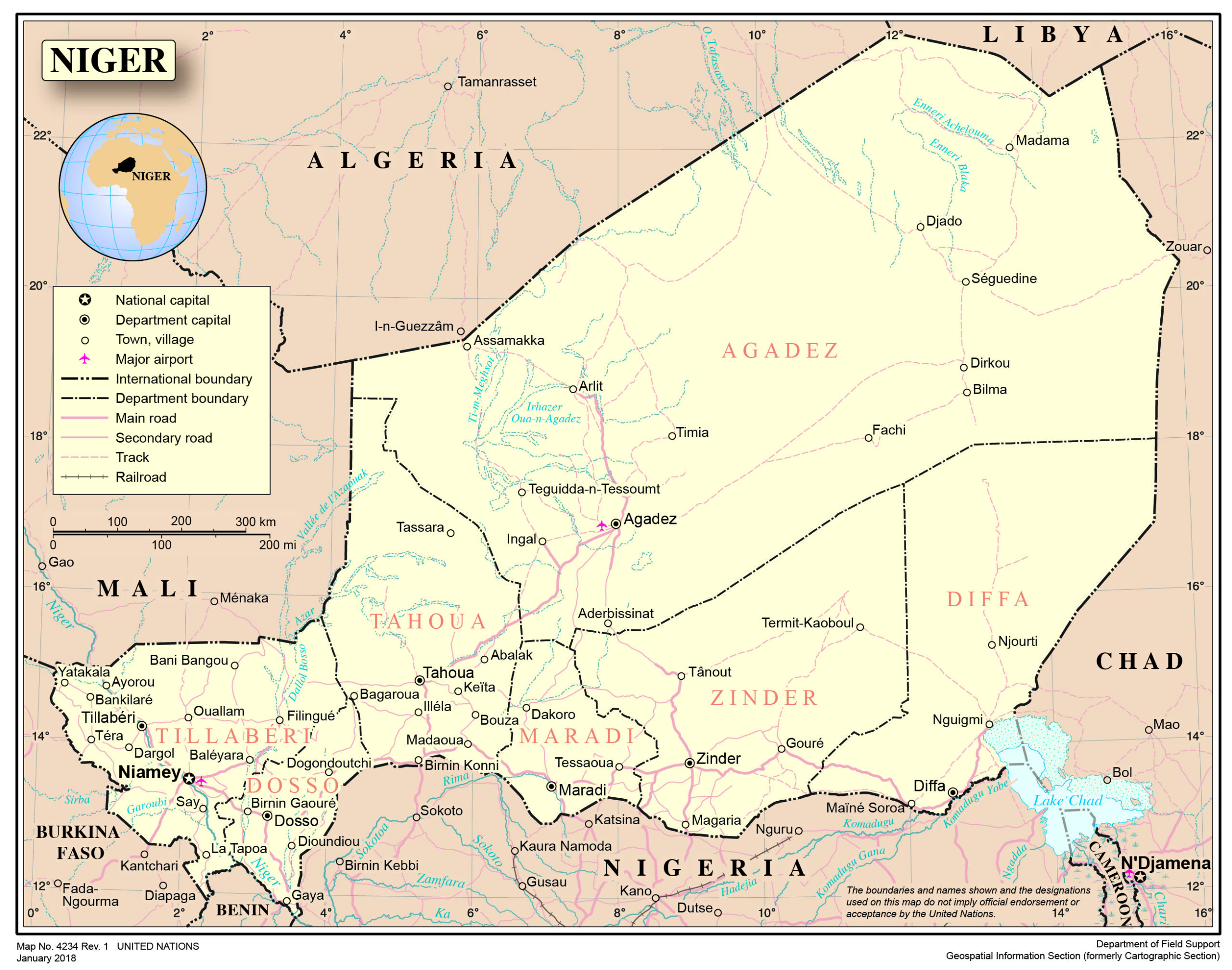
Conflict Classification and Applicable Law
International Humanitarian Law
As of 1 October 2026, two non-international armed conflict (NIACs) continued in Niger:
- Niger (supported by Russia through Africa Corps and by the two other members of the Alliance of Sahel Forces) v Islamic State Sahel Province (ISSP)
- Niger (supported by Russia through Africa Corps and by the two other members of the Alliance of Sahel Forces) v Jama’at Nusrat al-Islam wal-Muslimin (JNIM).
Common Article 3 to the Geneva Conventions, Additional Protocol II of 1977,30Protocol Additional to the Geneva Conventions of 12 August 1949, and relating to the Protection of Victims of Non-International Armed Conflicts (Protocol II); adopted at Geneva, 8 June 1977; entered into force, 7 December 1978. Niger ratified Additional Protocol II in 1979. and the rules of customary international humanitarian law (IHL) apply to these NIACs.
Until its withdrawal from the MNJTF in 2025, Niger was also party to the NIAC between Nigeria and Boko Haram, but that armed group does not control territory in Niger, and its occasional attacks, concentrated in the south-eastern Diffa region, do not rise to the level of an armed conflict.31‘Lake Chad Basin’s counter-terrorism must adapt to defeat Boko Haram’, Institute for Security Studies, PSC Report, 14 May 2026. It should be noted that Boko Haram attacks in Diffa continue to claim lives – for example, in late July ten Nigerien soldiers were killed in an attack near N’Guigmi. See ‘Nigerien soldiers reported killed in Boko Haram attack’, Vanguard, 1 August 2026.
In March 2026, the authorities formalized a general mobilization that had been announced the previous year, with the creation of local self-defence units known as Domol Leydi, or Volontaires pour la Défense du Niger. This amounts to a move toward more institutionalized community-based auxiliary security, similar to Burkina Faso’s Volontaires pour la Défense de la Patrie.32‘Niger: Tahoua Airport Attack Signals Expanding Pressure on Niger’s Security Architecture’, African Security Analysis, 8 May 2026. Regarding the December 2025 ‘general mobilization’, see ‘Niger’s military rulers order ‘general mobilisation’ against armed groups’, Al Jazeera, 28 December 2025. As noted with respect to those groups, when used in an offensive role, they are a militia belonging to the State and are bound by IHL. In other instances, such as when they engage purely in self-defence or defence of their communities against attacks, their members remain civilians, unless and for such time as they directly participate in hostilities.33Art 13(3), Additional Protocol II; ICRC, Customary IHL Rule 6: ‘Civilians’ Loss of Protection from Attack’. Everyone retains the individual right of self-defence and defence of others against unlawful violence, and such conduct does not make them a party to armed conflict.
International Disarmament Law
Niger is a State Party to the Arms Trade Treaty.34Arms Trade Treaty; adopted at New York, 2 April 2013; entered into force, 24 December 2014. Niger ratified the treaty in 2015, becoming a State Party in late October 2015. Based on its conduct in the NIACs against JNIM and ISSP, the Arms TRACK website of the Geneva Academy has assessed that the Nigerien Armed Forces present an elevated risk of illegal use of any weapons that may be supplied to them.
Since adhering to the ATT, Niger has only submitted one annual report – in 2021 – and asked for it to be restricted from public access. In August 2026, Algeria announced a donation of four military helicopters to Niger, as it moved geopolitically closer to the Russia-aligned AES block.35O. Okebiourun, ‘Algeria arms Niger with 4 military helicopters as North African power moves closer to Russia-backed Sahel bloc’, Africa Business Insider, 9 August 2026.
Niger is a State Party to the 1997 Anti-Personnel Mine Ban Convention (APMBC).36Convention on the Prohibition of the Use, Stockpiling, Production and Transfer of Anti-Personnel Mines and on their Destruction; adopted at Oslo, 18 September 1997; entered into force, 1 March 1999. Niger ratified the treaty in 1999. Its extended deadline for clearance of all mined areas containing anti-personnel mines is 1 January 2030. The extension was to clear legacy contamination of conventional AP mines at the Madama military base, in the Agadez region (bordering Libya). The non-State armed groups in Niger have also used improvised explosive devices (IEDs), some of which meet the definition of an anti-personnel mine. In its provisional action plan for 2022–26, Niger noted that ‘an enormous amount of work remains to be done in the regions of Diffa, Tahoua and Tillabéri to determine the hazardous areas and the type of devices and activation modes.’37Mine Action Review, ‘Niger’, Clearing the Mines 2025, Report, 2025. The UN Secretary-General documented more than sixty cases of children injured or killed as a result of IEDs, and called upon the transitional government to prioritize explosive ordnance clearance, mine risk education, and victim assistance programmes.38‘Report of the Secretary-General on Children and Armed Conflict’, UN Doc S/2026/357, 16 June 2026, paras 297 and 303.
Niger is also a State Party to the 2008 Convention on Cluster Munitions (CCM).39Convention on Cluster Munitions; adopted at Dublin, 30 May 2008; entered into force, 1 August 2010. Niger ratified the treaty in 2009, becoming a State Party on 1 August 2010. It has no stockpiles and is not believed to be affected by cluster munition remnants. Niger is also a State Party to the 1992 Chemical Weapons Convention.40Convention on the Prohibition of the Development, Production, Stockpiling and Use of Chemical Weapons and on their Destruction; adopted at Geneva, 3 September 1992; entered into force, 29 April 1997. Niger ratified the Convention in 1997.
International Criminal Law and Accountability
Niger has been a State Party to the Rome Statute of the International Criminal Court since 1 July 2002, the date of the Court’s establishment.41Rome Statute of the International Criminal Court; adopted at Rome, 17 July 1998; entered into force, 1 July 2002. As such, the Court has had jurisdiction over the acts committed in the armed conflict inside Niger and by its nationals anywhere from that date onwards.
On 18 June 2026, however, Niger was the first of a number of Sahel States that formally notified their withdrawal from the Rome Statute.42Niger notification of withdrawal from the Rome Statute, 18 June 2026. The withdrawal will take effect on 18 June 2027. Until then, the ICC has jurisdiction over war crimes and crimes against humanity being perpetrated in Niger, including by Africa Corps. All the events covered in this report therefore potentially fall within the Court’s material jurisdiction.
Compliance with IHL
Overview
Although some commentators perceive a change in tactics from ISSP away from attacking civilians and toward strategic targeting of military and security forces, it remains the case that both ISSP and JNIM are perpetrating serious violations of IHL as part of a campaign to coerce and control civilian populations, especially in the Tillabéri and Tahoua regions. This includes killings and pillage, along with the wanton destruction of property. Civilians have also been killed as a result of indiscriminate or disproportionate attacks by the Nigerien Armed Forces. All parties to the conflicts have perpetrated sexual violence, often as a means of punishing local communities. Nigerien authorities have not taken adequate steps to investigate any of these violations.
Civilian Objects under Attack
Under customary IHL, attacks may only be directed against military objectives. Attacks must not be directed against civilian objects.43ICRC, Customary IHL Rule 7: ‘The Principle of Distinction between Civilian Objects and Military Objectives’. Civilian objects are all objects that are not military objectives44ICRC, Customary IHL Rule 9: ‘Definition of Civilian Objects’. and, as such, are protected against attack.45ICRC, Customary IHL Rule 10: ‘Civilian Objects’ Loss of Protection from Attack’. Military objectives are those objects which, by their nature, location, purpose or use, make an effective contribution to military action.46ICRC, Customary IHL Rule 8: ‘Definition of Military Objectives’. In addition, the object’s partial or total destruction, capture, or neutralisation must offer a definite military advantage in the prevailing circumstances.
Attacks directed against civilian objects
Diori Hamani International Airport in Niamey has come under attack on three separate occasions and by three separate groups. Two of the attacks were by the non-State armed groups involved in the NIACs in the country, while the third was as part of a mutiny within the Nigerien Armed Forces. Notwithstanding the proximity of the military base – Air Base 101 – the airport as a whole remains a civilian object, and attacks against it are generally unlawful.
During the attack in January by ISSP, at least three civilian aircraft were damaged,47E. Egbejule, ‘Niger’s military ruler vows retaliation after gunfire and explosions heard in capital’, The Guardian, 30 January 2026. although it seems that military planes were the main focus of the attack, which resulted in the destruction of five surveillance aircraft.48G. Martin, ‘Multiple aircraft destroyed by Islamic State during brazen attack on Nigerien air base’, DefenceWeb, 4 February 2026. In June, JNIM fighters, some of whom were suicide bombers, attempted to infiltrate the airport aboard taxis and trucks early in the morning. Nigerien security forces at an outer checkpoint repelled the gunmen after several hours of fighting, which resulted in the deaths of at least eleven soldiers and two civilians.49L. Karr and A. Colas des Francs, ‘Al Qaeda and IS Run Rampant in Niger’, Critical Threats Africa File, 25 June 2026.
Civilians under Attack
Under customary IHL, civilians enjoy general protection from the effects of hostilities, unless and for such time as they directly participate in hostilities.50ICRC, Customary IHL Rule 6: ‘Civilians’ Loss of Protection from Attack’. Accordingly, parties to armed conflicts must at all times distinguish between combatants and civilians, and are prohibited from directing attacks against civilians.51ICRC, Customary IHL Rule 1: ‘The Principle of Distinction between Civilians and Combatants. In case of doubt, persons should be treated as civilians.52ICRC, Customary IHL Rule 6: ‘Civilians’ Loss of Protection from Attack’. The accompanying commentary states that in NIACs, ‘the issue of doubt has hardly been addressed in State practice, even though a clear rule on this subject would be desirable as it would enhance the protection of the civilian population against attack.’ One ‘cannot automatically attack anyone who might appear dubious….’ The same approach with respect to IACs ‘seems justified’ in NIACs. Civilians may be incidentally affected by attacks against lawful targets. However, such attacks must be proportionate, and the attacker must take all feasible precautions to avoid, or at the least to minimize, incidental civilian deaths and injuries to civilians (and damage to civilian objects).
Attacks directed against civilians
Niger’s western Tillabéri region has emerged as the deadliest area in the central Sahel for civilians due to an uptick in attacks by terrorist groups such as ISSP and JNIM – among the 1,939 deaths recorded in ACLED data for Niger in 2025, more than 1,200 were in Tillabéri.53‘Violence Against Civilians Surges in Niger’s Tillabéri Region’, Africa Defence Forum, 7 April 2026.
In March 2026, the African Commission on Human and Peoples’ Rights expressed its concern at reports of the killing of at least twenty-five members of a self-defence group in the Anzourou district of Tillabéri region in February.54African Commission on Human and Peoples’ Rights, ‘Press release on deadly attacks in the Tillabéri region (Republic of Niger)’, 3 March 2026. The perpetrator was not identified. Another source placed the events in the context of the ‘general mobilization’ announced in December 2025, in which the regime requisitioned both people and property so as better to fight the Islamist threat.55Agence France-Presse, ‘Locals in Niger Say ‘Terrorists’ Killed 25 Near Mali’, The Defense Post, 28 February 2026. As mentioned, this was formalized in March with the creation of the Domol Leydi, but when members of such a group are merely defending their communities their civilian status is unchanged. Elsewhere, and also in March, attacks against Dolé, Tsougougi, and Zata, in Tahoua region, reportedly killed at least thirty-three civilians and involved the looting of livestock.56‘Niger: Tahoua Airport Attack Signals Expanding Pressure on Niger’s Security Architecture’, African Security Analysis, 8 May 2026.
The Critical Threats Project, using data from the Armed Conflict Location & Event Data Project (ACLED), has assessed that in 2026, ISSP was shifting its operational focus away from the civilian population and focusing on security forces in the Tahoua and Tillabéri regions. However, attacks on civilians remain prevalent: nearly half of ISSP attacks in 2026 through to June were directed against civilians (compared to nearly two thirds in 2025). Critical Threats note that this likely reflects the reality that the group has subjugated the civilian population in the area and is now seeking to expel overstretched security forces.57L. Karr and A. Colas des Francs, ‘Al Qaeda and IS Run Rampant in Niger’, Critical Threats Africa File, 25 June 2026.
Disproportionate attacks
In January 2026, at least seventeen civilians were killed by an apparent military drone strike on a crowded market in the village of Kokoloko in the Tillabéri region. Witnesses reported seeing a drone flying over Kokoloko twice during the late morning, and then dropping a munition on the village at about 13:30, when hundreds of people packed the market. Residents said that many of the victims’ bodies were torn apart and burned by the force of the blast. Residents have said that ISSP fighters have been active in the area for several years, and that three fighters were killed in this attack.58Human Rights Watch, ‘Niger: Military Drone Strike Kills 17 Civilians’, News release, 9 February 2026. This indicates at the least a disproportionate attack, and a possible war crime. At the time of writing, there was no evidence of the Nigerien authorities having initiated an investigation into the legality of the strike.
The attack follows earlier indiscriminate drone strikes, such as that on the market in Injar village, also in Tillabéri region, in September 2025, which killed more than thirty civilians.59Ibid.
Protection of Persons in the Power of the Enemy
Customary and treaty IHL provide fundamental guarantees for anyone in the power of a party to a conflict, prohibiting acts such as torture, inhuman or degrading treatment, collective punishments, sexual violence, enforced disappearance, and unfair trials. Special protection is afforded to civilians who face a specific risk of harm, such as women, children, refugees, and IDPs.60ICRC, Customary IHL Rules 134–138: ‘Chapter 39. Other Persons Afforded Specific Protection’.
Murder of civilians and persons hors de combat
In January 2026, fighters believed to have been from ISSP rounded up and executed thirty-one men and boys in the village of Bossieye, in the Tillabéri region, in apparent retribution for the village’s refusal to pay the zakat (alms required of all Muslims as one of the five pillars of Islam).61Human Rights Watch, ‘Niger: Islamist Armed Group Massacres Villagers in West’, News release, 12 February 2026. The following week, in Alfaga Daweyzé Koira village, ISSP fighters killed four men and wounded five others who were attempting to protect a villager accused of collaborating with the military.62Ibid. ISSP did not claim either attack, but witnesses believe the perpetrators were from that group based on their distinctive turbans.
Pillage
IHL prohibits pillage and unlawful destruction of property during all armed conflicts. Pillage consists of the systematic and violent appropriation by members of armed forces or armed groups of movable public or private property that belongs either to protected persons or to the adverse party to an armed conflict, and constitutes a war crime.63 ICRC, Customary IHL Rule 52: ‘Pillage’. Destruction of property not justified by military necessity is forbidden.64ICRC, Customary IHL Rule 50: ‘Destruction and Seizure of Property of an Adversary’.
Evidence indicates the ISSP has continued to violate these rules. Reports show a consistent pattern of ISSP fighters burning civilian homes and looting civilian shops, personal belongings, and resources, such as livestock.65With respect to a pattern escalating since March 2025, see Human Rights Watch, ‘Niger: Islamist Armed Group Executes Civilians, Burns Homes’, News release, 10 September 2025. During the March 2026 attacks in Dolé, Tsougougi, and Zata discussed above, in addition to killing civilians, the militants also looted cattle. African Security Analysis noted that the theft of livestock ‘is not incidental. It is a form of economic warfare. It deprives communities of wealth, mobility, and survival capacity while financing armed actors and forcing local populations into dependence, displacement, or negotiated coexistence with extremist groups.’66‘Niger: Tahoua Airport Attack Signals Expanding Pressure on Niger’s Security Architecture’, African Security Analysis, 8 May 2026.
Kidnapping and hostage-taking
In April 2026, the Russian Ministry of Defence announced that an operation by Africa Corps personnel in Mali had led to the release of two hostages captured by JNIM from a Russian geological exploration company in Niger in July 2024.67‘Russia says its Africa Corps has freed Russian and Ukrainian citizens abducted in Niger’, Associated Press, 22 April 2026. In August 2026, an American missionary who had been kidnapped in Niamey in October 2025, and was believed to have been held by JNIM elements in Mali, was also released.68‘US missionary kidnapped in Niger released after nine months in captivity’, Al Jazeera, 14 August 2026.
In many cases, the fate and whereabouts of detainees were concealed, amounting to violations of IHL provisions aimed at preventing enforced disappearance,69ICRC, Customary IHL Rule 98: ‘Enforced Disappearance’. including the obligation to register persons deprived of their liberty in NIAC.70ICRC, Customary IHL Rule 123: ‘Recording and Notification of Personal Details of Persons Deprived of their Liberty’. Where abduction is followed by death, it is likely also to constitute murder and/or torture or other ill-treatment.71Common Article 3, Geneva Conventions; ICRC, Customary IHL Rule 90: ‘Torture and Cruel, Inhuman or Degrading Treatment’; and Rule 89: ‘Violence to Life’.
Arbitrary deprivation of liberty and fair-trial rights
In July 2026, it was reported that, according to data provided by the Public Prosecutor’s office, the High Court in Niamey had processed more than 400 case files in June, of which the leading category was criminal conspiracy linked to a terrorist enterprise (eighty cases), and dozens more involving support or financing for terrorism. These figures, covering only Niamey, were viewed by experts as presenting a deteriorating situation. It was noted that of the 600 individuals referred to the prosecutor’s office, more than half had their case dismissed, indicating either inadequate capacity for initial investigations or a pattern of wrongful arrests.72‘Niger: le tribunal de Niamey affirmé avoir traité plus de 100 cas de terrorisme en juin’, Radio France Internationale, 18 July 2026.
Former President Mohamed Bazoum has continued to be held, along with his wife, in a wing of the Presidential Palace, without having been brought before a magistrate. Months after the coup in 2023, the military leaders announced their intent to put him on trial, but no case has publicly been opened. He refused to resign as president (though his term would have ended in April 2026) and international authorities have expressed concern that he is being arbitrarily detained. In September 2026, the Nigerien regime rejected a recommendation made during the Universal Periodic Review of Niger earlier in the year concerning Bazoum’s continued detention. This had previously been found to be unlawful by both the ECOWAS Court of Justice (in December 2023) and the UN Working Group on Arbitrary Detention (in February 2025).73I. Allegrozzi, ‘Niger Rejects Key Rights Recommendations at UN Review’, Dispatch, Human Rights Watch, 25 September 2026.
Protection of children
The UN verified 466 grave violations against children in 2025, including fifty-one instances of recruitment and use of children by ISSP.74‘Report of the Secretary-General on Children and Armed Conflict’, UN Doc S/2026/357, 16 June 2026, paras 295–96. Across the country, some 224 children were abducted, either for recruitment and use or for ransom.75Ibid, para 300. Further to the adoption in 2025 of a disarmament, demobilisation, and reintegration (DDR) strategy, which included a protocol for the handover of children associated with armed groups, the UN Secretary-General welcomed the handover of forty-nine children.76Ibid, para 302.
Sexual and gender-based violence
In May 2026, the German Institute for International Affairs published a policy brief based on interviews conducted in Niger over previous years, arguing that, despite knowing that the problem exists, local, national, and international actors have a strategic interest in not declaring conflict-related sexual and gender-based violence to be an issue that demands a policy response.77L. Tschörner, ‘Overlooked or Muted? Conflict-Related Sexual Violence in Niger’, Megatrends Policy Brief No. 48, Stiftung Wissenschaft und Politik, 12 May 2026, p 1. One of the reasons is said to be the belief that members of the security forces may have been the perpetrators. The report also related claims that rape is being used as a form of punishment for households refusing to pay zakat, and abduction of women and girls by armed groups is leading to sexual slavery and forced marriage.78Ibid, p 4. Women and girls are also targeted in the context of armed actors giving ultimatums to leave certain areas, suggesting that sexual violence or the threat of sexual violence is used as a tool of forced displacement.79Ibid.
Interviews conducted with State officials for the same study suggest that law enforcement agencies are failing in their duty to investigate effectively allegations of sexual violence. A police officer noted that while many cases are reported in the Tillabéri region, in most cases it is impossible to establish the ‘nature of the aggression’ because authorities expect the victim to cover the cost of the necessary forensic testing.80Ibid, p 7.
Transitional Justice
A transitional justice plan was elaborated by the International Organization for Migration (IOM) in 2024 and presented to concerned government ministries. It has not, however, been implemented. Instead, Niger has shifted away from transitional justice mechanisms under its military-led government. Thus, when announcing its decision to withdraw from the ICC, in a joint statement with Burkina Faso and Mali, Niger described the International Criminal Court as an ‘instrument of neocolonial repression’ and accused the judicial body of ‘selective justice’. The three States said they wanted to create ‘indigenous mechanisms for the consolidation of peace and justice’.81‘Military-Run Niger, Mali and Burkina Faso Announce Joint ICC Withdrawal’, Al Jazeera, 23 September 2025.
- 1International Crisis Group, ‘Understanding JNIM’s Expansion Beyond the Sahel’, 20 February 2026. ↩︎
- 2’International Institute for Strategic Studies, ‘The coup in Niger’, Strategic Comment, August 2023. ↩︎
- 3A. T. Domena, ‘What has changed in Niger two years after the coup?’, Deutsche Welle, 26 July 2025. ↩︎
- 4Ibid. ↩︎
- 5E. Egbejule, ‘Niger’s junta withdraws from Lake Chad anti-Islamist force’, The Guardian, 1 April 2025. ↩︎
- 6J. Zenn, ‘Brief: Boko Haram Leader Allegedly Killed in Nigerien Airstrike’, Jamestown Terrorism Monitor, Vol. 23, Issue 6 (20 September 2025). ↩︎
- 7L. Saïdou Daoura and R. Leïla Salia, ‘Will the AES Unified Force succeed where the G5 Sahel failed?’, Institute for Security Studies, 4 March 2026. ↩︎
- 8S. Ambrose, ‘ISSP Claims Responsibility for Attack on Airport in Niamey, Niger’, Bloomsbury Intelligence & Security Institute, 16 February 2026. ↩︎
- 9L. Serwat, ‘Reported drone use in the Niamey airport attack is the first-ever by ISSP in Niger’, Expert Comment, Armed Conflict Location & Event Data Project (ACLED), 2 February 2026. Serwat suggests that, based on the language spoken in some videos of the attack, ISSP may have had assistance from more experienced drone operators from ISWAP. ↩︎
- 10‘Niger military ruler accuses France, Benin, Ivory Coast of sponsoring airport attack’, Reuters, 29 January 2026. See also ‘Moscow confirms Russian forces helped repel ISIL attack on Niger airport’, Al Jazeera, 3 February 2026. ↩︎
- 11
- 12L. Abdulmalik, ‘36 soldiers killed in coordinated jihadist assault on Niger–Burkina border town’, The Star, 6 February 2026. ↩︎
- 13‘Coordinated Attack on Tahoua Airport and Air Base 401 Targets Niger’s Drone Surveillance Capability’, African Security Analysis, 10 March 2026. ↩︎
- 14‘Niger : attaque d’une base militaire à Garbougna, au moins 60 personnes tuées’, LSI Africa, 17 May 2026. ↩︎
- 15‘Terror Rivalry Fuels Chaos in Niger’, Africa Defence Forum, 28 July 2026. ↩︎
- 16‘Armed attack on airport in Niger’s capital kills 11 soldiers, 2 civilians’ Al Jazeera, 18 June 2026. ↩︎
- 17‘Niger: de nombreux militaires tués dans une attaque «terroriste» dans l’ouest du pays’, Radio France Internationale, 20 July 2026. ↩︎
- 18A. Tricaud, ‘Niger: 15 soldiers killed by rebel group’, Maghrebi.org, 18 August 2026. ↩︎
- 19‘Rival factions stand off in Niger capital after mutineers attack airport, presidency’, Reuters, 29 August 2026. ↩︎
- 20‘Niger: après la mutinerie à Niamey, les raisons de la colère dans les rangs de l’armée’, Radio France Internationale, 1 September 2026. ↩︎
- 21‘Niger replaces military chief after Russian kamikaze drones help crush 24-hour mutiny’, Business Insider, 14 September 2026. See also: ‘Niger mutiny puts Russia’s expanding role in the Sahel to the test’, Al Jazeera, 31 August 2026. ↩︎
- 22B. Roger, ‘Au Niger, l’organisation Etat islamique de plus en plus puissante’, Le Monde, 25 September 2026. See also: ‘More than 50 members of Niger’s security forces killed in attacks, sources say’, Reuters, 28 September 2026. ↩︎
- 23Article 19, ‘Niger: Lift the ban on international media and protect freedom expression’ Press release, 12 May 2026. ↩︎
- 24‘“Absolutely nothing” justifies arrest of Niger journalist, rights expert tells RFI’, Radio France Internationale, 1 October 2026. ↩︎
- 25Reporters Without Borders, ‘Moussa Kaka is alive and being held by Nigerien authorities, says justice minister — a completely arbitrary detention’, Press release, 6 October 2026 ↩︎
- 26WFP, ‘Niger Country Brief’, September 2026. ↩︎
- 27‘Report of the Secretary-General on the activities of the United Nations Office for West Africa and the Sahel’, UN Doc S/2026/537, 30 June 2026, para 47. ↩︎
- 28WFP, ‘Niger Country Brief’, September 2026. ↩︎
- 29M. Saley, ‘Au Niger, un accord de paix entre agriculteurs et éleveurs’, Deutsche Welle, 10 June 2026. ↩︎
- 30Protocol Additional to the Geneva Conventions of 12 August 1949, and relating to the Protection of Victims of Non-International Armed Conflicts (Protocol II); adopted at Geneva, 8 June 1977; entered into force, 7 December 1978. Niger ratified Additional Protocol II in 1979. ↩︎
- 31‘Lake Chad Basin’s counter-terrorism must adapt to defeat Boko Haram’, Institute for Security Studies, PSC Report, 14 May 2026. It should be noted that Boko Haram attacks in Diffa continue to claim lives – for example, in late July ten Nigerien soldiers were killed in an attack near N’Guigmi. See ‘Nigerien soldiers reported killed in Boko Haram attack’, Vanguard, 1 August 2026. ↩︎
- 32‘Niger: Tahoua Airport Attack Signals Expanding Pressure on Niger’s Security Architecture’, African Security Analysis, 8 May 2026. Regarding the December 2025 ‘general mobilization’, see ‘Niger’s military rulers order ‘general mobilisation’ against armed groups’, Al Jazeera, 28 December 2025. ↩︎
- 33Art 13(3), Additional Protocol II; ICRC, Customary IHL Rule 6: ‘Civilians’ Loss of Protection from Attack’. ↩︎
- 34Arms Trade Treaty; adopted at New York, 2 April 2013; entered into force, 24 December 2014. Niger ratified the treaty in 2015, becoming a State Party in late October 2015. ↩︎
- 35O. Okebiourun, ‘Algeria arms Niger with 4 military helicopters as North African power moves closer to Russia-backed Sahel bloc’, Africa Business Insider, 9 August 2026. ↩︎
- 36Convention on the Prohibition of the Use, Stockpiling, Production and Transfer of Anti-Personnel Mines and on their Destruction; adopted at Oslo, 18 September 1997; entered into force, 1 March 1999. Niger ratified the treaty in 1999. ↩︎
- 37Mine Action Review, ‘Niger’, Clearing the Mines 2025, Report, 2025. ↩︎
- 38‘Report of the Secretary-General on Children and Armed Conflict’, UN Doc S/2026/357, 16 June 2026, paras 297 and 303. ↩︎
- 39Convention on Cluster Munitions; adopted at Dublin, 30 May 2008; entered into force, 1 August 2010. Niger ratified the treaty in 2009, becoming a State Party on 1 August 2010. ↩︎
- 40Convention on the Prohibition of the Development, Production, Stockpiling and Use of Chemical Weapons and on their Destruction; adopted at Geneva, 3 September 1992; entered into force, 29 April 1997. Niger ratified the Convention in 1997. ↩︎
- 41Rome Statute of the International Criminal Court; adopted at Rome, 17 July 1998; entered into force, 1 July 2002. ↩︎
- 42Niger notification of withdrawal from the Rome Statute, 18 June 2026. ↩︎
- 43ICRC, Customary IHL Rule 7: ‘The Principle of Distinction between Civilian Objects and Military Objectives’. ↩︎
- 44
- 45
- 46ICRC, Customary IHL Rule 8: ‘Definition of Military Objectives’. In addition, the object’s partial or total destruction, capture, or neutralisation must offer a definite military advantage in the prevailing circumstances. ↩︎
- 47E. Egbejule, ‘Niger’s military ruler vows retaliation after gunfire and explosions heard in capital’, The Guardian, 30 January 2026. ↩︎
- 48G. Martin, ‘Multiple aircraft destroyed by Islamic State during brazen attack on Nigerien air base’, DefenceWeb, 4 February 2026. ↩︎
- 49L. Karr and A. Colas des Francs, ‘Al Qaeda and IS Run Rampant in Niger’, Critical Threats Africa File, 25 June 2026. ↩︎
- 50
- 51
- 52ICRC, Customary IHL Rule 6: ‘Civilians’ Loss of Protection from Attack’. The accompanying commentary states that in NIACs, ‘the issue of doubt has hardly been addressed in State practice, even though a clear rule on this subject would be desirable as it would enhance the protection of the civilian population against attack.’ One ‘cannot automatically attack anyone who might appear dubious….’ The same approach with respect to IACs ‘seems justified’ in NIACs. ↩︎
- 53‘Violence Against Civilians Surges in Niger’s Tillabéri Region’, Africa Defence Forum, 7 April 2026. ↩︎
- 54African Commission on Human and Peoples’ Rights, ‘Press release on deadly attacks in the Tillabéri region (Republic of Niger)’, 3 March 2026. ↩︎
- 55Agence France-Presse, ‘Locals in Niger Say ‘Terrorists’ Killed 25 Near Mali’, The Defense Post, 28 February 2026. ↩︎
- 56‘Niger: Tahoua Airport Attack Signals Expanding Pressure on Niger’s Security Architecture’, African Security Analysis, 8 May 2026. ↩︎
- 57L. Karr and A. Colas des Francs, ‘Al Qaeda and IS Run Rampant in Niger’, Critical Threats Africa File, 25 June 2026. ↩︎
- 58Human Rights Watch, ‘Niger: Military Drone Strike Kills 17 Civilians’, News release, 9 February 2026. ↩︎
- 59Ibid. ↩︎
- 60
- 61Human Rights Watch, ‘Niger: Islamist Armed Group Massacres Villagers in West’, News release, 12 February 2026. ↩︎
- 62Ibid. ↩︎
- 63
- 64
- 65With respect to a pattern escalating since March 2025, see Human Rights Watch, ‘Niger: Islamist Armed Group Executes Civilians, Burns Homes’, News release, 10 September 2025. ↩︎
- 66‘Niger: Tahoua Airport Attack Signals Expanding Pressure on Niger’s Security Architecture’, African Security Analysis, 8 May 2026. ↩︎
- 67‘Russia says its Africa Corps has freed Russian and Ukrainian citizens abducted in Niger’, Associated Press, 22 April 2026. ↩︎
- 68‘US missionary kidnapped in Niger released after nine months in captivity’, Al Jazeera, 14 August 2026. ↩︎
- 69
- 70ICRC, Customary IHL Rule 123: ‘Recording and Notification of Personal Details of Persons Deprived of their Liberty’. ↩︎
- 71Common Article 3, Geneva Conventions; ICRC, Customary IHL Rule 90: ‘Torture and Cruel, Inhuman or Degrading Treatment’; and Rule 89: ‘Violence to Life’. ↩︎
- 72‘Niger: le tribunal de Niamey affirmé avoir traité plus de 100 cas de terrorisme en juin’, Radio France Internationale, 18 July 2026. ↩︎
- 73I. Allegrozzi, ‘Niger Rejects Key Rights Recommendations at UN Review’, Dispatch, Human Rights Watch, 25 September 2026. ↩︎
- 74‘Report of the Secretary-General on Children and Armed Conflict’, UN Doc S/2026/357, 16 June 2026, paras 295–96. ↩︎
- 75Ibid, para 300. ↩︎
- 76Ibid, para 302. ↩︎
- 77L. Tschörner, ‘Overlooked or Muted? Conflict-Related Sexual Violence in Niger’, Megatrends Policy Brief No. 48, Stiftung Wissenschaft und Politik, 12 May 2026, p 1. ↩︎
- 78Ibid, p 4. ↩︎
- 79Ibid. ↩︎
- 80Ibid, p 7. ↩︎
- 81‘Military-Run Niger, Mali and Burkina Faso Announce Joint ICC Withdrawal’, Al Jazeera, 23 September 2025. ↩︎