Conflict Overview
Conflict History
Somalia remains engaged in two armed conflicts not of an international character – one with Al-Shabaab and a second against Islamic State Somalia. These conflicts are the result of long-standing insecurity and violence dating back several decades. Somalia faced a multitude of violent power struggles and localized armed conflicts between 1991 and 2004 due to an absence of effective government after President Mohamed Siad Barre was ousted on 26 January 1991 – forced to flee his palace in Mogadishu during an armed uprising led by clan-based armed groups.
In the 1990s, the United Nations (UN) peacekeeping and peace enforcement missions, which included forces from Belgium, Canada, Italy, and the United States (US) among others, were deployed with a view to addressing the dire security and humanitarian situation.1UN involvement in Somalia started with the UN Operation in Somalia (UNOSOM I), established on 24 April 1992 by UN Security Council Resolution 751. UNOSOM I was succeeded by the Unified Task Force (UNITAF), which, on 3 December 1992, was authorized by Resolution 794 to use ‘all necessary means’ to establish a secure environment for humanitarian operations in the country. On 9 December 1992, UNITAF forces landed in Mogadishu in full combat gear. An expanded UN Operation in Somalia (UNOSOM II) was established on 26 March 1993 under Resolution 814. In addition to disarming Somalis, it had ‘the ambitious mandate of re-establishing political structures in the country and nation building’. UNOSOM II’s mandate ended in March 1995. Peace was not restored and no viable and lasting structures were created ‘when disturbing information with regard to actions of the international forces started to surface’. ‘Situation of human rights in Somalia: Report of the Special Rapporteur, Ms. Mona Rishmawi’, UN Doc E/CN.4/1998/96, 16 January 1998, paras 100–01. With the breakdown of national governmental authority, questions of territory and authority were accentuated when Somaliland declared independence in 1991, and again when the region of Puntland declared autonomy in 1998.
Throughout the 1990s, Somalia remained without a central government while at least thirty clan- and region-based factions competed for control. Despite the establishment of a transitional government in 2004, violence and limited government control over national territory continued. During this period, Islamist armed groups formed, taking control of Mogadishu and other areas outside the capital in 2006, and prompting intervention by Ethiopia and the African Union (AU) in support of the government. The AU Mission in Somalia (AMISOM) was deployed from March 2007.2Communiqué of the 69th Meeting of the AU Peace and Security Council, PSC/PR/Comm(LXIX), 19 January 2007. The Islamist armed group Al-Shabaab, which had captured key towns and launched an offensive on the capital during this period, has been sanctioned by the Security Council since 2010 and aligned itself with al-Qaeda in 2012.3‘Visit to Somalia: Report of the Special Rapporteur on the promotion and protection of human rights and fundamental freedoms while countering terrorism, Ben Saul’, UN Doc A/HRC/61/52/Add.2, 30 January 2026, para 6.
Somali government forces, supported by Kenya and the African Union, wrested back control of key towns from Al-Shabaab, leading to the establishment of an internationally recognized federal government in 2012. Al-Shabaab continued its intense armed activities both across the border against Kenya and within Somalia against the government (which was supported by AU peacekeeping forces, Ethiopia, Kenya, and the United States). The UN Assistance Mission in Somalia (UNSOM) was deployed in 2013. Its mandate ended on 31 October 2024, subsumed into the UN Transitional Assistance Mission in Somalia (UNTMIS), which started operations on 1 November 2024.4UN Political and Peacebuilding Affairs, ‘UNSOM’, accessed 6 October 2026. In parallel, AMISOM transitioned into the AU Transition Mission in Somalia (ATMIS) on 1 April 2022, and at the end of 2024, ATMIS was succeeded by the AU Support and Stabilization Mission in Somalia (AUSSOM) which continues today.5AUSSOM, ‘About AUSSOM’, accessed 6 October 2026.
President Hassan Sheikh Mohamud returned to power in elections in 2022. In 2022–23, Somali security forces, supported by local clan militias known locally as the ‘macawisley’, managed to push Al‑Shabaab out from several areas of central Somalia. However, it proved challenging for the federal government to hold on to those successes. Starting in February 2025, Al‑Shabaab launched counter-offensives on multiple fronts, retaking control of territory in Middle Shabelle and key areas in Hiraan, and less successfully in Lower Shabelle.6International Crisis Group, ‘New Chapter, Same Stalemate: Somalia’s War with Al-Shabaab’, Briefing No. 212, 30 June 2026.
An improvised explosive device (IED) attack on the president’s motorcade in March 2025, and an attack on an army recruitment centre in Mogadishu two months later, further eroded public confidence in the government.7A. Jackson, ‘Flailing State: The Resurgence of al-Shabaab in Somalia’, War on the Rocks, 3 June 2025. In July 2025, Al-Shabaab recaptured several towns, sometimes largely unopposed as AU forces, Somali security forces, and allied clan militias withdrew following a wave of deadly Al-Shabaab assaults. This led to the group securing positions close to Mogadishu, and stoking fear of Al-Shabaab seizing power in the capital.8‘Al-Shabaab’s 2025 Offensive and the Unraveling of Somalia’s Federal Counterinsurgency’, The Soufan Center, 24 July 2025.
Clashes between the Somali Armed Forces (SAF) and its support forces with ISS in Puntland, which were initially infrequent and sporadic, escalated in December 2024, inflicting a reported 200 casualties among ISS, and enabling the armed forces to retake villages previously under the group’s control.9M. O. Hassan, ‘Somali government says attacks on bases repulsed; 130 militants killed’, Voice of America, 20 February 2025. ISS conducted drone strikes for the first time against Puntland security forces in January 2025.10P. van Ostaeyen and P. Wójcik, ‘The Islamic State in Puntland, Somalia’, Counter Extremism Project, 21 February 2025; J. G. Birru, ‘Expert Comment: January saw the first use of drone strikes by IS Somalia’, Armed Conflict Location & Event Data Project (ACLED), 13 February 2025. After securing the final ISS base in the Miraale valley, SAF operations shifted to the ISS stronghold of Togga Jecel valley, and to clearing Balaade valley of ISS fighters who had fled there from Miraale. Heavy clashes continued throughout 2025. US Africa Command (AFRICOM) supported SAF operations with regular airstrikes.11CrisisWatch, ‘Africa: Somalia’, entries for May to December 2025, International Crisis Group; K. Aweis, ‘Puntland Forces Capture Final ISIS Stronghold in Miiraale’, Somalia National News Agency, 31 May 2025.
Inter-regional tensions within Somalia ‘hampered coordination, weakening the effectiveness of joint counterterrorism operations’,12‘Al-Shabaab’s 2025 Offensive and the Unraveling of Somalia’s Federal Counterinsurgency’, The Soufan Center, 24 July 2025. sometimes also resulting in violence. In January 2023, a separate conflict between the government of Somaliland – a self-proclaimed independent region – and Dhulbahante clan militias broke out in the long-disputed Sool, Sanaag, and Cayn (SSC) regions. This conflict ended following the withdrawal of Somaliland forces and the establishment of the SSC-Khaatumo administration.13See WAR Watch, ‘Somalia’, updated on 18 December 2025. However, captured fighters remain in detention on both sides; their treatment is subject to the protection of international humanitarian law (IHL), as recognized by a Human Rights Council resolution of October 2025.14Human Rights Council Resolution 60/28: ‘Assistance to Somalia in the field of human rights’, 8 October 2025, operative para 8.
Another problem came from violence in the northern autonomous region of Puntland, which ceased recognizing the Federal Government of Somalia (FGS) in March 2024.15‘Puntland withdraws recognition of the Federal Government of Somalia’, Garowe Online, 31 March 2024. Jubaland also suspended ties with the FGS in November 2024.16‘Somalia’s Jubbaland government suspends ties with federal administration’, Reuters, 28 November 2024. Added to the risk of renewed armed conflict were rising tensions between Ethiopia and Somalia in the second half of 2024, although these later receded – in December 2024, following talks in Türkiye, Ethiopia and Somalia agreed to end their bitter dispute over Ethiopian plans to build a port in Somaliland.17In January 2024, Ethiopia and Somaliland signed a memorandum of understanding which would give Ethiopia access to the Red Sea in exchange for a possible recognition of Somaliland. However, widespread condemnation led to a renegotiation. See J. Holleis, ‘Why is Egypt bolstering ties with Somalia now?’, Deutsche Welle, 14 February 2026; K. Yibeltal and B. Rukanga, ‘Ethiopia and Somalia reach deal in Turkey to end Somaliland port feud’, BBC, 12 December 2024. On 26 December 2025, however, Israel explicitly recognized Somaliland as an independent State. Somalia’s government condemned the move as an ‘unlawful step’ and a ‘deliberate attack’ on its sovereignty.18United Nations, ‘Israel’s Recognition of Somaliland Triggers Sharp Divides, as Security Council Speakers Warn Move Threatens Stability in Horn of Africa’, Press release, UN Doc SC/16270, 29 December 2025; ‘Israel criticised after becoming first country to formally recognise Somaliland as independent nation’, Sky News, 27 December 2025.
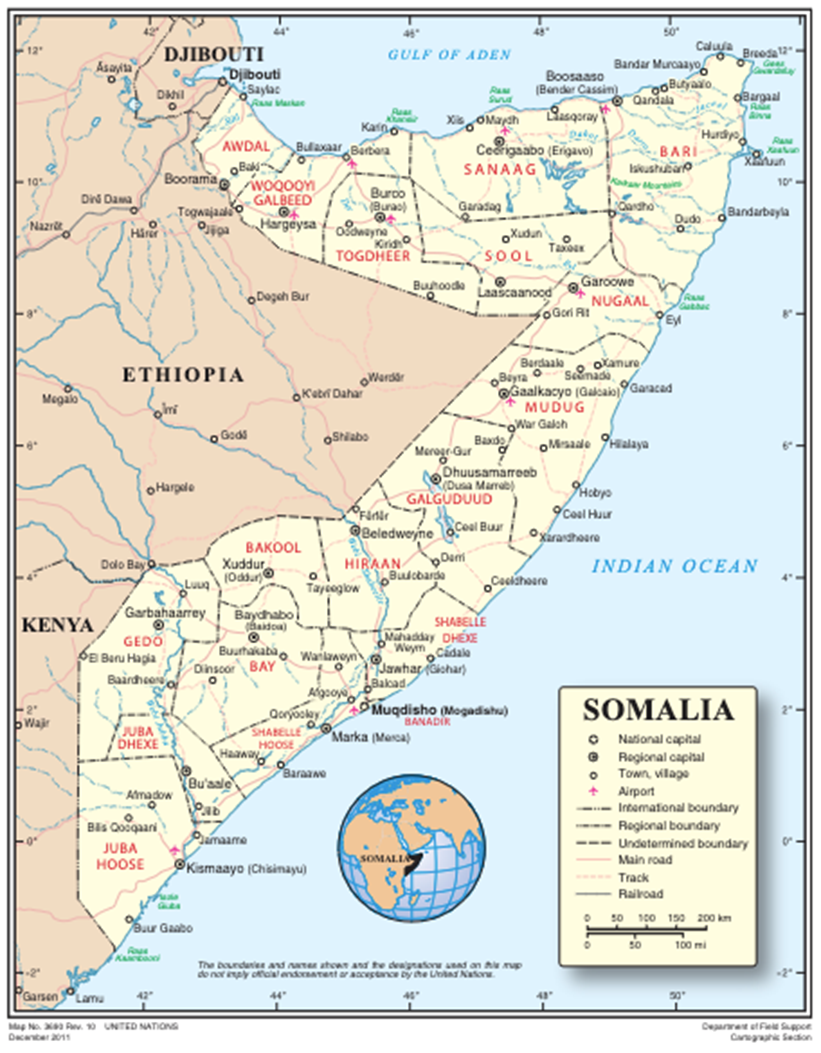
Key Events in 2026
In 2026, Somalia continued to be engaged in two non-international armed conflicts (NIACs): one against Al-Shabaab, and since December 2024, another against ISS. The overall security situation remained fragile, and Somalia remained deeply fractured along regional lines, with a major dispute about election processes still deadlocked despite Turkish-mediated talks in July. Geopolitical tensions related to the US war with Iran; disputes related to the Hormuz and Bab al-Mandab straits; and positioning of certain countries in the Middle East, were another key influence.
Al-Shabaab has remained a significant threat, and has continued to control significant but predominantly rural areas in southern and central Somalia. The government maintained control in most urban centres, albeit still reliant on the support of peacekeeping forces and other foreign support. Commentators argue that neither the FGS nor Al‑Shabaab appears capable of a decisive victory as things stand.19International Crisis Group, ‘New Chapter, Same Stalemate: Somalia’s War with Al-Shabaab’; and ‘Somalia Awaits a New Security Order as Mission Drawdown Looms’, 18 September 2026. While the conflict against Al-Shabaab persisted, it was thus described as a ‘stalemate’.20International Crisis Group, ‘New Chapter, Same Stalemate: Somalia’s War with Al-Shabaab’. Although its relationship with the civilian population in areas under its control remains difficult, Al-Shabaab has been changing its tactics in some places to focus its attacks on military targets rather than seeking to inflict mass casualties among the civilian population.21Thirty-seventh report of the Analytical Support and Sanctions Monitoring Team submitted pursuant to resolution 2734 (2024) concerning ISIL (Da’esh), Al-Qaida and associated individuals and entities, UN Doc S/2026/44, 4 February 2026, para 38. In January 2026, the group announced the formation of a committee to coordinate drought relief efforts, something it had previously blocked.22International Crisis Group, ‘New Chapter, Same Stalemate: Somalia’s War with Al-Shabaab’.
The relationship between the Houthis in Yemen and Al-Shabaab expanded, described by some authorities as ‘limited but deepening, transactional but increasingly organized’, and ‘raising alarm’ about regional security including maritime traffic risks.23T. Ali Ahmad, ‘Analysis: Houthi and Al-Shabab ties raise alarm over widening threat to Red Sea shipping’, Arab News, 1 October 2026. See also P. Salisbury, N. Al-Dawsari, and J. Bahadur, ‘From Spoke to Hub: The Houthis in Africa’, Report, Century International, 24 August 2026. The engagement between the two groups involves alleged arms sales, military training of an estimated 1,500 Al-Shabaab and other fighters in Yemen (where some died in fighting),24‘Al-Shabab fighters found dead among Houthi casualties, Yemeni forces say’, Shabelle Media Network, 8 September 2026. and visits of Houthi members to Somalia to provide instruction about improvised explosive devices and drones.25T. Ali Ahmad, ‘Analysis: Houthi and Al-Shabab ties raise alarm over widening threat to Red Sea shipping’, Arab News, 1 October 2026. Commentators have also suggested Houthi links behind increasing Somali piracy occurring further from Somalia than previously.26A. Aziz Aluwaisheg, ‘How the Houthis helped revive Somali piracy’, Arab News, 31 July 2026. Indeed, acts of piracy emanating from Somalia surged again in 2026, albeit not to the levels of the height of piracy around 2011.27B. Plett Usher, ‘Somali piracy surges as the impact of the US-Iran war ripples outwards’, BBC, 31 August 2026. As at 31 August 2026, at least thirteen ships had been attacked in the course of the year.
The Somali National Army, backed by regional forces and international partners, targeted Al-Shabaab bases in large-scale operations seeking to reassert control by pushing back the group’s positions, inspecting locations suspected as its hideouts, and destroying sites used by the group for shelter, as well as seeking to block Al-Shabaab’s logistical and infiltration routes toward the capital. This included ground operations in South West, Jubaland, and Hirshabelle states, and an escalation of AFRICOM airstrikes. In January 2026, Somali and Jubaland forces, supported by international partners, repelled an Al-Shabaab attack on the island town Kudhaa (Lower Juba region). The Ministry stated that more than 130 fighters were killed.28M. Wambui, ‘Somali forces kill 130 Al-Shabaab militants as they recapture Kudhaa Island‘, The Eastleigh Voice, 22 February 2026; Abdullahi, ‘Somali National Army and Partners Annihilate Over 130 Militants in Kudhaa Counter-Offensive’, SONNA, 22 January 2026. February saw an intensification of efforts with operations in Middle Shabelle (Hirshabelle) and Middle Juba (Jubaland), continuing in March in Lower Shabelle (South West) and Middle Shabelle (Hirshabelle). Pressure was maintained in mid-2026, with raids and drone strikes in Hiraan, Lower Shabelle, and Middle Shabelle. While Al-Shabaab attacks were fewer in July, the group made its first territorial gain for 2026 in August in seizing Teedaan town in Hirshabelle. In September, the government reclaimed Ceelgub area (Middle Shabelle).29‘Africa: Somalia’, CrisisWatch entries for January to September 2026; K. Aweis, ‘Somali National Army Conducts Major Operations in Lower Shabelle’, SONNA, 30 March 2026; Abdullahi, ‘Somali National Army Executes Precise Tactical Ambush Against Khawaarij Militants in Hiiraan Region’, SONNA, 3 April 2026. See also ‘Assistance to Somalia in the field of human rights: Report of the Office of the United Nations High Commissioner for Human Rights’, UN Doc A/HRC/63/77, 19 August 2026, para 17.
AFRICOM had carried out at least eighty airstrikes in Somalia against Al-Shabaab as well as ISS as at late September. There was, however, an unexplained pause between 6 May and 7 August when no US airstrikes were mounted.30D. Sterman, ‘AFRICOM Confirms 63 Strikes in Somalia in 2026’, New America, 29 May 2026; D. Sterman, ‘Three Months Without a Strike Against the Islamic State in Somalia’, New America, 6 August 2026; ‘The War in Somalia’, New America, accessed 19 September 2026; AFRICOM, ‘Strikes’, accessed 2 October 2026. In September, AFRICOM, in coordination with the Puntland authorities, undertook a rare airstrike against Al-Shabaab in northern Somalia in the Al-Madow mountains, targeting Al-Shabaab weapons and ammunition stores.31‘Somalia: Puntland, US confirm operation targeting Al-Shabaab weapons depot’, Garowe Online, 17 September 2026. In August 2026, AFRICOM signed an agreement with the president of Puntland, Said Abdullahi Deni, to extend its military base in the northern city of Bosaso.32‘Puntland, U.S. Sign Security Deal to Expand American Base in Bosaso’, Shabelle Media Network, 2 August 2026.
Kenya had announced it would reopen two border crossings with Somalia in April 2026, almost fifteen years after the border was closed because of Al-Shabaab attacks in Kenya. However, fighting near the border between SAF and Jubaland regional security forces, which started in December 2024 and flared again in 2025 and into 2026,33Reuters, ‘Officials: Fighting breaks out between Somalia’s Jubbaland region and federal government’, Voice of America, 11 December 2026; ‘Federal Government is Preparing New Military Offensive Against Jubaland’, Wardheer News, 18 August 2026. saw this proposal scrapped in May 2026.34Earlier attacks within Kenya have included those on Westgate Mall and Garissa University. R. Kagoe, ‘Kenya’s border with Somalia set to re-open after almost 15 years’, BBC News, 13 February 2026; A. Hajir, ‘President Ruto: Why Kenya-Somalia Border May Not Reopen Soon’, Dawan Africa, 15 May 2026. In July, Al-Shabaab claimed responsibility for killing five members of the Kenyan Special Operations Group patrol, an elite police counterterrorism unit, in an attack near the Kenyan border near Wantey Dam, close to Lafey police station in Mandera county.35F. Ali, ‘Al-Shabab kills five Kenyan security personnel in ambush’, Al Jazeera, 29 July 2026.
Change is on the horizon regarding the multilateral missions that have supported Somalia in its fight against Al-Shabaab for many years. AUSSOM suffers from funding deficiencies, and at 12,000 troops is far smaller than the 22,000-strong force of fifteen years ago. It tended to protect urban areas rather than undertake offensive operations in more remote areas controlled by Al-Shabaab. The AU Mission relies on the UN Support Office in Somalia (UNSOS) for necessary logistical support. The United States announced it would not back a continuation of UNSOS after the end of 2026. In September, however, it granted a twelve-month reprieve that will help keep UNSOS, and therefore also African Union operations, functional while alternative support is sought.36International Crisis Group, ‘Somalia Awaits a New Security Order as Mission Drawdown Looms’; J. Barigaba, ‘Renewed hope for Somalia peace mission as US softens stance on UN support unit’, The East African, 15 September 2026; International Crisis Group, ‘New Chapter, Same Stalemate: Somalia’s War with Al-Shabaab’.
As fighting broke out again in Tigray, unconfirmed reports in early October suggested that Ethiopia was preparing to withdraw 3,000 troops from Somalia to reinforce its forces at home. It was unclear whether the withdrawals would include troops serving within AUSSOM and/or those deployed under a bilateral arrangement.37‘Renewed Fighting in Ethiopia Could Reshape Its Military Role in Somalia’, Garowe Online, 1 October 2026. This adds pressure to existing challenges for the transition in security support and the urgency of Somalia planning with its international partners for new security arrangements.
In that vein, Somalia has been working to strengthen the capabilities of its armed forces, although the country’s internal political and security issues have remained a challenge.38International Crisis Group, ‘Somalia Awaits a New Security Order as Mission Drawdown Looms’; International Crisis Group, ‘New Chapter, Same Stalemate: Somalia’s War with Al-Shabaab’. On the one hand, related to the United Arab Emirates (UAE) investment in Somaliland, and broader Gulf rivalries, Somalia announced in January that it was withdrawing from all security cooperation agreements with the UAE.39‘Somalia says UAE halts security support after agreements scrapped’, Garowe Online, 17 February 2026; D. Gamba, ‘Horn Of Africa Becoming ‘Battleground’ For Rival Gulf Monarchies’, Barron’s, 5 February 2026. In a January 2026 interview with Al Jazeera, Somalia’s Minister of Foreign Affairs, Ali Omar, stressed the sovereign unity of Somalia, reaffirming that States must deal directly with the federal government in Mogadishu and not its regional states.40‘Foreign influence & Somalia’s fight for unity’, Centre Stage, Al Jazeera, 19 January 2026. In response to Somaliland offering the United States access to Berbera port and airport as well as to minerals in exchange for diplomatic recognition, Somalia offered the United States access to the same infrastructure and assets and more, reminding the United States that the appropriate channel for such agreements was Mogadishu (although the federal government does not have physical control over Somaliland).41J. Loucks, ‘What Washington Agreed to Last Month’, African Arguments, 2 October 2026.
While Somalia’s relations with the UAE cooled, Somalia deepened security cooperation including with Ankara, Doha and Riyadh.42‘Qatari Military Cargo Plane Lands in Mogadishu Amid Shifting Horn of Africa Alliances’, Garowe Online, 16 February 2026; Agence France-Presse (AFP), ‘Turkey, now a major power in Somalia, dragged into internal conflicts’, Garowe Online, 30 September 2026; ‘Somalia, Saudi Arabia sign agreement on military cooperation’, Al Jazeera, 10 February 2026. In February, the Minister of Defence announced that Türkiye had deployed an undisclosed number of F-16 jets to support Somalia’s counterterrorism operations, deepening Türkiye’s existing military assistance, training, and advisory activities.43‘Turkey Deploys F-16 Fighter Jets to Support Somali Army, Defense Minister Says’, Garowe Online, 4 February 2026; ‘Turkey boosts air, ground military support to back Somalia’s war on terror’, Garowe Online, 5 February 2026. Somalia also held talks with Pakistan in September 2026 regarding possible strengthening of defence cooperation, particularly in relation to Somali Air Force capabilities.44‘Somalia, Pakistan Discuss Building Somali Air Force Capabilities’, Shabelle Media Network, 23 September 2026.
Political deadlock between the FGS and member states of Somalia has led to significant bouts of violence. In February, late March, late August to early September, and again in late September (this time featuring combat aircraft and armed drones), clashes between federal forces and regional militias loyal to the South West State’s political opposition took place in the regional capital, Baidoa.45International Crisis Group, ‘Africa: Somalia’, February 2026; ‘Somali army clashes with rebel forces for control of key city Baidoa’, Al Jazeera, 17 August 2026; AFP, ‘Somalia repels armed assault on Baidoa amid regional political tensions’, Al Jazeera, 3 September 2026; AFP, ‘Somali army clashes with local forces for control of Baidoa’, Al Jazeera, 28 September 2026. An expert with the International Crisis Group explained that rather than accept Mogadishu’s new elections plan, ousted South West State president Abdiaziz Laftagareen attempted to secure another term by organizing his own regional re-election on 28 March. Federal military troops were sent into Buur Hakeba, a town near Baidoa where militias opposed to Laftagareen had been mobilizing and entered the city of Baidoa on 30 March. The forces loyal to Laftagareen opted to stand down rather than fight, and Laftagareen announced his resignation and left for Nairobi, resolving the issue.46O. Mahmood, ‘Somali Government Topples State Leader as Electoral Dispute Escalates’, International Crisis Group, 31 March 2026. The fighting in March nevertheless injured dozens, and killed a ten-year-old girl caught in the crossfire, while displacing at least 45,000 people.47Facebook post by MSF Somalia/Dhakhaatiirta Aan Xuduuda Lahayn Soomaaliya, 1 April 2026; UNHCR, ‘Flash Alert #12: Over 50000 People Displaced Following Political Escalation in Baidoa South-West State’, Operational Data Portal, 1 April 2026.
In further violence in mid-August, Laftagareen’s forces attacked federal forces again. Somalia’s Ministry of Defence accused them of using vehicles laden with explosives and said they were repelled after federal forces killed thirty attackers. Residents described hearing blasts, gunfire, and artillery fire, and said homes and buildings were damaged. In early September, gunfire and explosions could be heard in different parts of the town for several hours.48AFP, ‘Somalia repels armed assault on Baidoa amid regional political tensions’. Baidoa’s Bay Regional Hospital and Médecins Sans Frontières reported four deaths and ninety-four injured in August (including twenty-nine women and twenty children); one death and seventy-one injured in early September (including fifteen women and twelve children); and a further sixty-nine treated in late September (including five children). The hospital and its medical personnel and patients were also severely impacted by an explosion during the September political violence. A curfew was put in place in the city.49‘Somali army clashes with rebel forces for control of key city Baidoa’, Al Jazeera, 18 August 2026; AFP, ‘Somali army clashes with local forces for control of Baidoa’, Al Jazeera, 28 September 2026; Every Casualty Counts and Casualty Recorders Network members IHRO, KAHRDO, and SASDO, ‘Briefing for 63rd Regular Human Rights Council Session: Somalia – conflict fatalities’, 1 October 2026, p 1; ‘Somalia’s Southwest State imposes curfew in tense Baidoa’, Garowe Online, 1 October 2026.
In similar but less severe violence, the capital experienced the worst clashes seen in years when fighting erupted between federal Somali forces and opposition-allied militias loyal to former Prime Minister Hassan Ali Khaire and former President Sharif Sheikh Ahmed in the Howl Wadaag district of Mogadishu on 3–5 June 2026, prior to the opposition’s planned protests against the extension of incumbent President Mohamud’s term.50F. Ali, ‘Why Mogadishu clashes are deepening Somalia’s political crisis again‘, Al Jazeera, 5 June 2026; M. Gabobe, ‘Civilians flee as Somali troops and opposition-allied militias trade fire in Mogadishu’, The Guardian, 4 June 2026. Clan elders managed to negotiate a temporary truce. The unrest in Mogadishu involved gunfire and explosions across two days. Residential buildings were impacted and 13 people were killed and 189 injured.51F. Ali, ‘Somalia declares order restored after two days of fighting in Mogadishu’,Al Jazeera, 5 June 2026.
In August, Puntland forces launched a successful fifteen-hour operation to take control of a military camp near the airport in northern Galkayo city, reportedly leaving nineteen people dead and one hundred government soldiers captured. The camp housed troops formerly aligned with the Puntland authorities but whose commanders had more recently pledged allegiance to Mogadishu.52AFP, ‘Puntland forces seize government-held camp in Somalia’s Galkayo’, Al Jazeera, 5 August 2026. See also ACLED, ‘What caused a single city in #Somalia to explode into a 15-hour battle, leaving 19 dead and over 100 soldiers captured?’, Video posted on Facebook, 8 August 2026.
The Humanitarian Situation
Somalia is one of the world’s least developed countries, and has suffered armed conflict, terrorism, inter-clan fighting, and political disfunction for decades. The challenges are compounded by the effects of climate change and natural disasters, including drought, due to multiple consecutive failed rainy seasons, which has devastated livelihoods. In 2026, 4.8 million people were estimated to be in extreme need of urgent humanitarian assistance and protection, including 3.3 million internally displaced people, with needs in food, water, adequate shelter and access to essential health services.
As 2026 began, an estimated six million people – nearly one third of the population – were facing acute hunger, of which around 1.85 million children under five were at risk of acute malnutrition.53UN Office for the Coordination of Humanitarian Affairs (OCHA), Somalia Humanitarian Needs and Response Plan 2026, January 2026, p 4; European Commission, ‘European Civil Protection and Humanitarian Aid Operations: Somalia’, 26 February 2026. By March, 6.5 million were facing crisis levels of hunger.54Office of the UN High Commissioner for Refugees (UNHCR), ‘Somalia: Operational Update March 2026’, 4 May 2026, p 1. Beyond the physical needs, Somalis were said to suffer from the highest rate of mental illness in the world.55The Somalia Disability Empowerment Network, ‘Submission for Somalia’s 4th Cycle UPR, 52nd session (4-15 May 2026)’, October 2025, para 38. The reduction in humanitarian assistance to Somalia in 2025, including the suspension of US aid, is likely to prove devastating.
Displacement in 2026 was driven by both drought and conflict.56UNHCR, ‘Somalia: Protection and Solutions Monitoring Network (PSMN) Quarterly Report: January–March 2026’, 25 June 2026; UNHCR, ‘Somalia: Protection and Solutions Monitoring Network (PSMN) Quarterly Report: April–June 2026’, 23 July 2026. For example, in early March, more than 2,300 people (about 400 households) were displaced from Lower Shabelle to Banadir (closer to Mogadishu) due to fighting between the SAF and Al-Shabaab. Overall, the Office of the UN High Commissioner for Refugees (UNHCR) estimates that more than three million Somalia are internally displaced, of whom one third are in Banadir, along with a further 953,000 Somali refugees in neighbouring States, primarily Ethiopia and Kenya.57UNHCR, ‘Somalia’, Operational Data Portal, as at 31 August 2026; UNHCR Regional Bureau for Eastern and Southern Africa, ‘Somalia Situation: Population of Concern to UNHCR’, 31 August 2026. Somalia also hosts approximately 34,000 refugees or asylum seekers, most coming from Ethiopia.58Ibid.
Conflict Classification and Applicable Law
International Humanitarian Law
The ongoing non-international armed conflicts (NIACs) between Somalia (and supporting forces) and Al-Shabaab, and between Somalia and Islamic State Somalia (ISS) are both of a non-international character.59As the United States as well as other States supporting Somalia are operating in the country at the invitation of the FGS, their involvement does not affect the classification of the two NIACs in which Somalia is engaged.
Somalia is a State Party to the four Geneva Conventions of 1949. Common Article 3 to the Geneva Conventions and customary IHL applies to the two ongoing NIACs. Somalia is not a State Party to Additional Protocol II of 1977.60Protocol Additional to the Geneva Conventions of 12 August 1949, and relating to the Protection of Victims of Non-International Armed Conflicts; adopted at Geneva on 8 June 1977; entered into force, 7 December 1978.
Common Article 3 and customary IHL also continue to apply to those detained in the context of the earlier NIAC between Somaliland and the Dhulbahante clan militias in the Sool, Sanaag, and Cayn (SSC) regions (see further below the section, ‘International criminal law and accountability’).
International Disarmament Law
Somalia is not a State Party to the Arms Trade Treaty.61Arms Trade Treaty; adopted at New York, 2 April 2013; entered into force, 24 December 2014. Based on the conduct of Somalia’s security forces in armed conflict, but also on their actions during law enforcement operations, the Arms TRACK website of the Geneva Academy has assessed that Somalia presents a high risk of illegal use of any weapons that may be supplied to them.
Somalia is a State Party to the 1997 Anti-Personnel Mine Ban Convention (APMBC).62Convention on the Prohibition of the Use, Stockpiling, Production and Transfer of Anti-Personnel Mines and on their Destruction; adopted at Oslo, 18 September 1997; entered into force, 1 March 1999. Somalia acceded to the Convention in April 2012, becoming a State Party on 1 October 2012. In June 2026, Somalia submitted its second Article 5 deadline extension request, seeking a five-year extension from its current deadline of October 2027 through to October 2032. Chronic underfunding continues to be a primary challenge to effective implementation of mine clearance.63Mine Action Review, Clearing the Mines 2026, Norwegian People’s Aid. While Somalia has reported that it does not stockpile anti-personnel mines, several non-State armed groups possess or improvise landmines.64See Landmine and Cluster Munition Monitor, Somalia: Mine Ban Policy, 16 October 2020. That said, several factions have signed the Deed of Commitment of Geneva Call, pledging never to use anti-personnel mines and to cooperate in demining.65Geneva Call, ‘Geneva Call’s mission visits mine affected areas in Somalia’, 8 October 2004.
Somalia is also a State Party to the 2008 Convention on Cluster Munitions66Convention on Cluster Munitions; adopted at Dublin, 30 May 2008; entered into force, 1 August 2010. Somalia ratified the Convention on 30 September 2015, becoming a State Party on 1 March 2016. and the 1992 Chemical Weapons Convention.67Convention on the Prohibition of the Development, Production, Stockpiling and Use of Chemical Weapons and on their Destruction; adopted at Geneva, 3 September 1992; entered into force, 29 April 1997. Somalia acceded to the Convention on 29 May 2013, becoming a State Party on 28 June 2013.
International Criminal Law and Accountability
Somalia is not a party to the Rome Statute of the International Criminal Court.68Rome Statute of the International Criminal Court (ICC Statute); adopted at Rome, 17 July 1998; entered into force, 1 July 2002.
No criminal prosecutions, as such, have been mounted for war crimes committed in the course of the armed conflicts inside Somalia. When criminal prosecutions occur, suspected Al-Shabaab fighters tend to be tried in military tribunals under counterterrorism legislation, focusing on charges of terrorism, murder, treason, and/or rebellion. Allegations made against members of the SAF are similarly routed through military discipline structures.69See, e.g., O. M. Stern, ‘Accountability for Al-Shabaab’s Crimes in Somalia’, TOAEP Policy Brief Series No. 191 2025; Human Rights Watch, ‘The Courts of “Absolute Power”: Fair Trial Violations by Somalia’s Military Court’, 21 May 2014.
In July 2026, Somalia’s North Eastern state parliament resolved to refer for prosecution detainees accused of mass killings. This refers to people held in Las Anod in relation to the earlier NIAC between Somaliland and the Dhulbahante clan militias in the SSC. It represents a shift from previous efforts, which concentrated on negotiating prisoner swaps.70H. Askar, ‘Somalia’s North Eastern State Orders Trials for Somaliland Fighters Held in Las Anod’, Horseed Media, 27 July 2026. IHL encourages amnesties for ‘mere’ participation in NIAC, but requires prosecution of war crimes.71ICRC, Customary IHL Rule 159: ‘Amnesty’.
In Somaliland, collaborative initiatives involving the Somaliland War Crimes Investigation Commission and the Center for Justice and Accountability focus on the preservation of mass graves in Hargeisa, forensic identification of victims, and the investigation of Barre-era (pre-1991) human rights abuses.72‘Transitional Justice in Somaliland: Exhuming Mass Gravesites’, The Center for Justice and Accountability, accessed 5 October 2026.
The UN Human Rights Council has called for accountability for all those responsible for violations of IHL and human rights law in Somalia, including those committed against women and children (and girls in particular). This includes the unlawful recruitment and use of children in hostilities; and acts of killing, maiming, rape, and other sexual and gender-based violence.73Human Rights Council Resolution 60/28, operative para 3. Human rights reporting describes impunity for serious conflict-related violations as a major problem.74See, e.g., US Department of State, ‘Somalia 2024 Human Rights Report’, 12 August 2025; Coalition of Somalia Human Rights Defenders, ‘Somalia: Annual Human Rights Report 2025’, January 2026. Investigations into allegations of civilian harm are not routinely conducted, especially if they involve the SAF.75Every Casualty Counts and Casualty Recorders Network members IHRO, KAHRDO, and SASDO, ‘Briefing for 63rd Regular Human Rights Council Session: Somalia – conflict fatalities’, 1 October 2026, p 2. Civil society has repeatedly called for the establishment of effective, transparent national casualty recording mechanisms, and the prompt, independent, and impartial investigation of all reported civilian harm.76See, for example, Every Casualty Counts and Casualty Recorders Network members IHRO, KAHRDO, and SASDO, ‘Briefing for 63rd Regular Human Rights Council Session: Somalia – conflict fatalities’, 1 October 2026. See also ‘Assistance to Somalia in the field of human rights: Report of the Office of the United Nations High Commissioner for Human Rights’, UN Doc A/HRC/63/77, para 70(b).
In April 2026, Somalia adopted a National Civilian Protection Policy. The intention of this landmark document is to reduce protection risks to civilians in conflict-affected and frontline areas, to create mechanisms to monitor civilian harm, and to hold armed actors accountable. The new framework promotes adherence to IHL and human rights law,77‘Assistance to Somalia in the field of human rights: Report of the Office of the United Nations High Commissioner for Human Rights’, UN Doc A/HRC/63/77, para 16. and ‘introduces early warning and risk communication systems’, strengthening safeguards for the displaced and other especially-at-risk populations, and enhancing protection for humanitarian personnel. Oversight mechanisms are to be established ‘to promote transparency and accountability within security institutions’.78Center for Civilians in Armed Conflict, ‘Somalia Adopts Landmark Policy to Strengthen Civilian Protection’, 2 April 2026.
The policy’s development was led by the Somali Ministry of Defence, in collaboration with relevant federal government institutions, and supported by Somalia’s Office of the Special Envoy for Stabilization and Civilian Protection and the US-headquartered Center for Civilians in Conflict (CIVIC). The policy needs to be followed by a Civilian Protection Implementation Plan, but initial steps towards its operationalization have already been taken by federal government institutions, including the Ministry of Defence.79‘Assistance to Somalia in the field of human rights: Report of the Office of the United Nations High Commissioner for Human Rights’, UN Doc A/HRC/63/77, para 16.
Compliance with IHL
Overview
Civilians and civilian objects continue to be targeted by parties to the armed conflicts occurring in Somalia. Local civil society organization IHRO has reported attacks apparently targeting residential areas and killing civilians, through use of armed drones, attack helicopters, and mortar attacks.80Every Casualty Counts and Casualty Recorders Network members IHRO, KAHRDO, and SASDO, ‘Briefing for 63rd Regular Human Rights Council Session: Somalia – conflict fatalities’, 1 October 2026, pp 1–2. Al-Shabaab reportedly employed suicide attacks and improvised explosive devices (IEDs), including vehicle-borne explosives.81‘Assistance to Somalia in the field of human rights: Report of the Office of the United Nations High Commissioner for Human Rights’, UN Doc A/HRC/63/77, para 17. The United Nations noted that while Al-Shabaab continues to be the primary perpetrator of serious violations, ongoing military operations and clashes between federal forces and regional states also involve violations of IHL and international human rights law.82‘Assistance to Somalia in the field of human rights: Report of the Office of the United Nations High Commissioner for Human Rights’, UN Doc A/HRC/63/77. See also ‘UN sounds alarm over human rights situation in Somalia’, Somali Stream, 3 October 2026. The UN Human Rights Council has thus expressed ‘deep concern’ at the ‘increasing risk’ to civilians resulting from operations against Al-Shabaab.83Human Rights Council Resolution 60/28, operative para 6.
Civil society and the United Nations noted the lack of reliable information as to the circumstances of civilian harm, and therefore general under-reporting and a limited number of documented cases, especially in incidents in remote areas. This is due to access restrictions for investigators, fear of reprisals among witnesses, weak reporting systems, and limited institutional capacity.84Every Casualty Counts and Casualty Recorders Network members IHRO, KAHRDO, and SASDO, ‘Briefing for 63rd Regular Human Rights Council Session: Somalia – conflict fatalities’, 1 October 2026, p 2; ‘Assistance to Somalia in the field of human rights: Report of the Office of the United Nations High Commissioner for Human Rights’, UN Doc A/HRC/63/77, para 31; ‘Four civilians killed in northeastern Somalia airstrike as civilian toll rises from protracted air war’, Somali Guardian, 27 May 2026. In parallel, international funding cuts reduced the presence and activities of humanitarian actors.85Every Casualty Counts and Casualty Recorders Network members IHRO, KAHRDO, and SASDO, ‘Briefing for 63rd Regular Human Rights Council Session: Somalia – conflict fatalities’, 1 October 2026, p 2.
The lack of accurate casualty data is also due to AFRICOM no longer publishing detailed casualty figures.86Mark Townsend, ‘Why is the US bombing Somalia – and who are the airstrikes killing?’, The Guardian, 16 June 2026. Indeed, the number of civilian casualties from US strikes is disputed. AFRICOM has acknowledged causing six civilian deaths while Airwars, an NGO, estimates the number at between 85 and 162 since 2007.87Airwars, ‘U.S. Forces in Somalia’, accessed 2 October 2026. See also New America, ‘The War in Somalia’, 30 September 2026. One media source alleged that the government’s counterinsurgency campaign has killed more than 100 civilians this year, in particular through the use of armed drones.88‘Four civilians killed in northeastern Somalia airstrike as civilian toll rises from protracted air war’, Somali Guardian, 27 May 2026. Allegations about Turkish-operated drones harming civilians, which human rights organizations have been making for several years,89See, e.g., Amnesty International, ‘Somalia: Death of 23 civilians in military strikes with Turkish drones may amount to war crimes – new investigation’, News release, 7 May 2024; Human Rights Watch, World Report 2026: Somalia Events of 2025. continued in 2026.
Civilian Objects under Attack
Under customary IHL, attacks may only be directed against military objectives. Attacks must not be directed against civilian objects.90ICRC, Customary IHL Rule 7: ‘The Principle of Distinction between Civilian Objects and Military Objectives’. Civilian objects are all objects that are not military objectives91ICRC, Customary IHL Rule 9: ‘Definition of Civilian Objects’. and, as such, are protected against attack.92ICRC, Customary IHL Rule 10: ‘Civilian Objects’ Loss of Protection from Attack’. Military objectives are those objects which, by their nature, location, purpose or use, make an effective contribution to military action.93ICRC, Customary IHL Rule 8: ‘Definition of Military Objectives’. In addition, the object’s partial or total destruction, capture, or neutralisation must offer a definite military advantage in the prevailing circumstances.
Attacks on schools
Thirty-two schools were attacked in 2025, with the attacks predominantly attributed to Al-Shabaab.94Children and armed conflict: Report of the Secretary-General, UN Doc A/80/723-S/2026/357, 16 June 2026, paras 163 and 170. The UN Human Rights Council has called on Somalia to implement the Safe Schools Declaration, which the Federal Government formally endorsed in October 2015.95Human Rights Council Resolution 60/28, para 16(i).
Civilians under Attack
Under customary IHL, civilians enjoy general protection from the effects of hostilities, unless and for such time as they directly participate in hostilities.96ICRC, Customary IHL Rule 6: ‘Civilians’ Loss of Protection from Attack’. Accordingly, parties to any armed conflict must at all times distinguish between combatants and civilians, and are prohibited from directing attacks against civilians.97ICRC, Customary IHL Rule 1: ‘The Principle of Distinction between Civilians and Combatants’. In case of doubt, persons should be treated as civilians.98ICRC, Customary IHL Rule 6: ‘Civilians’ Loss of Protection from Attack’, and associated commentary. Civilians may be incidentally affected by attacks against lawful targets. However, such attacks must not be disproportionate,99ICRC, Customary IHL Rule 14: ‘Proportionality in Attack’. and the attacker must take all feasible precautions to avoid or, in any event to minimize, incidental civilian impact.100ICRC, Customary IHL Rule 15: ‘Principle of Precautions in Attack’.
Somali media reported at least twelve civilians killed on 31 January 2026 in the village of Maxaa Siciid (Middle Shabelle region) when a drone strike, allegedly conducted by Türkiye, hit a local mosque during Asr (afternoon) prayers. Ten civilians are said to have been killed instantly, with two others dying later from their injuries. An official statement from Somalia’s National Intelligence and Security Agency (NISA) confirmed the airstrike, but denied targeting civilians, maintaining that the operation successfully targeted and killed Al-Shabaab fighters.101‘Turkish Drone Strike Kills at Least 12 Civilians in Middle Shabelle Somalia’, Kaab TV, 2 February 2026.
The UNHCR-led Protection & Solutions Monitoring Network reported seven civilians killed and five injured on 4 March 2026 during armed clashes between government forces and Al-Shabaab in the Lower Shabelle region (Mubarak and Darusalam villages).102UNHCR, ‘Flash Alert #9 2026_Clashes in Mubarak and Darusalaam Villages in Lower Shabelle Displace Nearly 2400 Civilians’, Operational Data Portal, 16 March 2026. While detailed information about the circumstances is not available, they reportedly occurred towards the end of an offensive by Somali government forces, supported by Ugandan troops under AUSSOM, to retake control from Al-Shabaab of the two strategically-located towns described as ‘strongholds and safe havens’.103‘Somali army seizes key Al-Shabab strongholds in Lower Shabelle region’, Hiraan Online, 2 March 2026.
An airstrike on 21 May reportedly killed one woman and her three daughters near the town of Qandala, in the semi-autonomous Puntland region.104‘Four civilians killed in northeastern Somalia airstrike as civilian toll rises from protracted air war’, Somali Guardian, 27 May 2026. While the actor responsible for the strike remained unconfirmed, the United States reportedly denied that it was an AFRICOM operation.105D. Sterman, ‘AFRICOM Confirms 63 Strikes in Somalia in 2026’, New America, 29 May 2026.
In an act of piracy, in which the Cameroon-flagged ship, the MV Lutuf, was hijacked off the coast of Puntland on 17 August, drone strikes were conducted during the ten-day joint Turkey-Somalia rescue operation, killing at least thirteen of the hijackers and destroying four of their boats.106A. Saxena, ‘Turkish, Somali forces free pirate-seized vessel in Somalia’, Deutsche Welle, 29 August 2026. Families claimed, though, that some of the dead were innocent locals. Puntland leadership alleged that Turkish strikes along its coastline on 18 and 20 August had killed fourteen people and destroyed fishing boats, decrying possibly unlawful strikes.107‘Puntland accuses Türkiye of deadly strike off Nugaal coast after pirates seize M/V Lutuf’, Hiraan Online, 27 August 2026; I. H. Warsame, ‘Whose Piracy, Whose Sea? Puntland Cries Foul As Turkey Strikes Without Coordination – OpEd’, Eurasia Review, 31 August 2026; ‘Puntland Submits Demands to UN Security Council Over Somalia’s Political and Security Crisis’, Garowe Online, 24 September 2026; ‘Puntland demands answers after warship shelling targeted fishermen off its coast’, Hiraan Online, 22 August 2026. Some of the piratical attacks mounted by Al-Shabaab fighters fall within the scope of the armed conflict.108Piracy is defined in international law as ‘any illegal acts of violence or detention, or any act of depredation, committed for private ends by the crew or the passengers of a private ship or a private aircraft, and directed … on the high seas, against another ship or aircraft, or against persons or property on board such ship or aircraft’. Art 101(a), UN Convention on the Law of the Sea (UNCLOS); adopted at Montego Bay, 10 December 1982; entered into force, 16 November 1994. Somalia ratified UNCLOS in 1989. A piratical act can also be an act of hostilities governed by IHL insofar as it is directed against civilians and associated with a party’s military operations. Available information does not allow a definitive assessment of whether this was the case here.
Protection of Persons in the Power of the Enemy
Under customary IHL, special protection is afforded to several categories of civilians or persons hors de combat who face a specific risk of harm, such as women, children, refugees, and IDPs.109ICRC, Customary IHL Rules 134 to 138: ‘Chapter 39. Other Persons Afforded Specific Protection’. IHL provides certain fundamental guarantees for anyone who is in the power of a party to a conflict, prohibiting torture and other inhumane or degrading treatment, arbitrary detention, and unfair trials.
Murder
Five crew members (three Pakistani nationals, one Indian and one national of Myanmar) of an oil tanker, the MT Honour 25, seized off the coast of Somalia in April, were killed before local security forces retook the vessel.110N. Osman, ‘Somali pirates killed oil tanker crew before rescue, official tells BBC’, BBC Somali, 30 September 2026. While the identity of the perpetrators and circumstances of their deaths is unknown, it is possible the hijacking was carried out by Al-Shabaab, and if so, as set out above, there is a possibility it could be considered as an unlawful act in the conduct of hostilities.
Children
In the UN Secretary-General’s 2026 report on children and armed conflict (covering 2025), Somalia featured among the countries with the highest number of verified grave violations against children.111Children and armed conflict: Report of the Secretary-General, A/80/723-S/2026/357, 16 June 2026, para 7. See also generally Children and armed conflict in Somalia: Report of the Secretary-General, S/2025/735, 12 November 2025, which covers the period from 1 October 2021 to 31 December 2024. The United Nations verified that 701 children (679 boys, 22 girls) were recruited and used as fighters and in support roles, the large majority by Al-Shabaab (560), but also by clan militias (100), the Somali National Army (6), and other security forces.112Ibid, para 159. Others were abducted, largely for recruitment and use (407), but also in retaliation for alleged association with Somali security forces (110) and for the purpose of rape and other forms of sexual violence.113Ibid, para 165. The Human Rights Council called for the strengthening of Somalia’s reintegration programmes for children formerly associated with armed groups.114Human Rights Council Resolution 60/28, operative para 4.
OHCHR reported that most child casualties were caused by armed violence, including crossfire between Al-Shabaab and security forces, and the use of indirect fire and improvised explosive devices.115‘Assistance to Somalia in the field of human rights: Report of the Office of the United Nations High Commissioner for Human Rights’, UN Doc A/HRC/63/77, para 36. The United Nations documented the killing (161) and maiming (312) of 473 children (324 boys, 149 girls) caused by shelling with mortars and hand grenades (155), crossfire and stray bullets (119) and small arms (98).116Ibid., para 161.
Sexual and gender-based violence
The United Nations reported that 201 girls suffered sexual violence including forced marriage (96), gang rape (44), or rape (33), the vast majority (132) attributed to Al-Shabaab, but with 18 incidents attributed to the State security forces.117Ibid., para 162. OHCHR supported high-level consultations in December 2025 and February 2026 with the Somalia Ministry of Defence on preventing and responding to conflict-related sexual violence.118Ibid., para 55.
Humanitarian funding reductions included cuts to specialized sexual and gender-based violence services, which contributed to the deteriorating protection environment for women and girls. It was reported that of the 120 registered gender-based violence facilities across Somalia, sixty-six facilities (fifty-five per cent) were closed or non-operational, including Women and Girls’ Safe Spaces and One-Stop Centres.119The UN Population Fund (UNFPA), ‘Gender Based Violence Situation Ist Quarter 2026’, 12 April 2026, p 5. Stigma, and fear of reprisals from perpetrators, family members, or others in the community continued to create other barriers to accessing services.120European Union Agency for Asylum, Country Guidance: Somalia, October 2025, s. 3.11.1.
Women and girls in internally displaced person (IDP) settlements continued to be at heightened risk of sexual and gender-based violence.121UNFPA, ‘Gender Based Violence Situation Ist Quarter 2026’, 12 April 2026, p 6. Reported instances have been highest in Lower Shabelle, a fact explained by primarily by the extent of military operations and clan violence.122Ibid., p 3. See also ‘Assistance to Somalia in the field of human rights: Report of the Office of the United Nations High Commissioner for Human Rights’, UN Doc A/HRC/63/77, para 32.
Transitional Justice
Transitional justice efforts in Somalia are based on national institutional ownership, localized social reconciliation, and community-led precursors rather than centralized, formal mechanisms like international tribunals or state reparations. Because the federal government is still building its authority and dealing with ongoing conflict, current initiatives primarily blend State frameworks with civil society and traditional justice systems.123See F. Mohamud, ‘Enabling Popular Participation in Transitional Justice in Somalia’, Centre for the Study of Violence and Reconciliation and Somali Public Agenda, 2024. But as the Independent Expert on the situation of human rights in Somalia has said: ‘prioritizing military response over determined reconciliation has not resulted in the protection of civilians, nor in the advancement of peace and security’.124‘Assistance to Somalia in the field of human rights: Report of the Office of the United Nations High Commissioner for Human Rights’, UN Doc A/HRC/63/77, para 20.
Officially launched in April 2024, the primary State mechanism is the National Reconciliation Framework. It seeks to integrate traditional Somali customary law (xeer) and Islamic law with constitutional State justice, though its nationwide execution remains a challenge.125Ibid. Ground-up fora also have an important role, such as the civil society-driven Peacebuilding Dialogue Forum whichemphasizes popular participation to ensure victims and survivors have agency over historical documentation and conflict resolution.126Ibid. Some civil society-supported programmes have also focused on the importance of mental health and psychosocial support (MHPSS) as part of peacebuilding and transitional justice to address trauma from decades of violence.127Interpeace, ‘Miisaan: Social Cohesion and Legitimate Governance Through Transitional Justice (2021-2025)’, accessed 5 October 2026.
The FGS has been working on State-led institutional reforms and global integration by expanding legal instruments and mechanisms to strengthen the rule-of-law, for example, in relation to juvenile justice, disability, and civilian protection.128‘Assistance to Somalia in the field of human rights: Report of the Office of the United Nations High Commissioner for Human Rights’, UN Doc A/HRC/63/77. Structural changes to the human rights architecture have occurred: in 2026, the UN Human Rights Council ended the mandate of the Independent Expert on the situation of human rights in Somalia, which had been in place since 1993, and endorsed ‘a nationally owned action plan’, led by the FGS through the Independent National Human Rights Commission and the national mechanism for reporting and follow-up, together with human rights technical assistance and direct monitoring by Office of the UN High Commissioner for Human Rights (OHCHR).129Human Rights Council Resolution 60/28, operative paras 24, 26. A Host Country Agreement was signed between OHCHR and the Somali government on 6 May 2026.130N. Aden, ‘UN welcomes Somalia’s human rights progress as country presents first report in decades’, TRT Afrika, 3 October 2026.
In her final briefing to the UN General Assembly, outgoing Independent Expert, Isha Dyfan, described Somalia as standing at a ‘fragile and decisive moment’. While commending the operationalization of the National Independent Human Rights Commission and the adoption of the Juvenile Justice Bill, she warned that violent attacks by Al-Shabaab and restrictions on civic space risk undermining these hard-won legislative gains.131OHCHR, ‘Somalia: UN expert calls for action to safeguard fragile human rights gains’, Press release, 10 November 2025. These themes were picked up in OHCHR’s first formal comprehensive report on Somalia. At the UN General Assembly in October 2026, OHCHR stressed the centrality of accountability, stressing that all ongoing political and security responses in Somalia ‘must continue to place civilian protection, accountability, and civic space at their centre’.132N. Aden, ‘UN welcomes Somalia’s human rights progress as country presents first report in decades’, TRT Afrika, 3 October 2026. With UNTMIS scheduled to wind down by late 2026, UN experts expressed concern over whether Somali institutions have the resources and absolute independence required to investigate abuses independently and stop the cycle of impunity.133‘UN sounds alarm over human rights situation in Somalia’, Somali Stream, 3 October 2026.
- 1UN involvement in Somalia started with the UN Operation in Somalia (UNOSOM I), established on 24 April 1992 by UN Security Council Resolution 751. UNOSOM I was succeeded by the Unified Task Force (UNITAF), which, on 3 December 1992, was authorized by Resolution 794 to use ‘all necessary means’ to establish a secure environment for humanitarian operations in the country. On 9 December 1992, UNITAF forces landed in Mogadishu in full combat gear. An expanded UN Operation in Somalia (UNOSOM II) was established on 26 March 1993 under Resolution 814. In addition to disarming Somalis, it had ‘the ambitious mandate of re-establishing political structures in the country and nation building’. UNOSOM II’s mandate ended in March 1995. Peace was not restored and no viable and lasting structures were created ‘when disturbing information with regard to actions of the international forces started to surface’. ‘Situation of human rights in Somalia: Report of the Special Rapporteur, Ms. Mona Rishmawi’, UN Doc E/CN.4/1998/96, 16 January 1998, paras 100–01. ↩︎
- 2Communiqué of the 69th Meeting of the AU Peace and Security Council, PSC/PR/Comm(LXIX), 19 January 2007. ↩︎
- 3‘Visit to Somalia: Report of the Special Rapporteur on the promotion and protection of human rights and fundamental freedoms while countering terrorism, Ben Saul’, UN Doc A/HRC/61/52/Add.2, 30 January 2026, para 6. ↩︎
- 4
- 5AUSSOM, ‘About AUSSOM’, accessed 6 October 2026. ↩︎
- 6International Crisis Group, ‘New Chapter, Same Stalemate: Somalia’s War with Al-Shabaab’, Briefing No. 212, 30 June 2026. ↩︎
- 7A. Jackson, ‘Flailing State: The Resurgence of al-Shabaab in Somalia’, War on the Rocks, 3 June 2025. ↩︎
- 8‘Al-Shabaab’s 2025 Offensive and the Unraveling of Somalia’s Federal Counterinsurgency’, The Soufan Center, 24 July 2025. ↩︎
- 9M. O. Hassan, ‘Somali government says attacks on bases repulsed; 130 militants killed’, Voice of America, 20 February 2025. ↩︎
- 10P. van Ostaeyen and P. Wójcik, ‘The Islamic State in Puntland, Somalia’, Counter Extremism Project, 21 February 2025; J. G. Birru, ‘Expert Comment: January saw the first use of drone strikes by IS Somalia’, Armed Conflict Location & Event Data Project (ACLED), 13 February 2025. ↩︎
- 11CrisisWatch, ‘Africa: Somalia’, entries for May to December 2025, International Crisis Group; K. Aweis, ‘Puntland Forces Capture Final ISIS Stronghold in Miiraale’, Somalia National News Agency, 31 May 2025. ↩︎
- 12‘Al-Shabaab’s 2025 Offensive and the Unraveling of Somalia’s Federal Counterinsurgency’, The Soufan Center, 24 July 2025. ↩︎
- 13
- 14Human Rights Council Resolution 60/28: ‘Assistance to Somalia in the field of human rights’, 8 October 2025, operative para 8. ↩︎
- 15‘Puntland withdraws recognition of the Federal Government of Somalia’, Garowe Online, 31 March 2024. ↩︎
- 16‘Somalia’s Jubbaland government suspends ties with federal administration’, Reuters, 28 November 2024. ↩︎
- 17In January 2024, Ethiopia and Somaliland signed a memorandum of understanding which would give Ethiopia access to the Red Sea in exchange for a possible recognition of Somaliland. However, widespread condemnation led to a renegotiation. See J. Holleis, ‘Why is Egypt bolstering ties with Somalia now?’, Deutsche Welle, 14 February 2026; K. Yibeltal and B. Rukanga, ‘Ethiopia and Somalia reach deal in Turkey to end Somaliland port feud’, BBC, 12 December 2024. ↩︎
- 18United Nations, ‘Israel’s Recognition of Somaliland Triggers Sharp Divides, as Security Council Speakers Warn Move Threatens Stability in Horn of Africa’, Press release, UN Doc SC/16270, 29 December 2025; ‘Israel criticised after becoming first country to formally recognise Somaliland as independent nation’, Sky News, 27 December 2025. ↩︎
- 19International Crisis Group, ‘New Chapter, Same Stalemate: Somalia’s War with Al-Shabaab’; and ‘Somalia Awaits a New Security Order as Mission Drawdown Looms’, 18 September 2026. ↩︎
- 20International Crisis Group, ‘New Chapter, Same Stalemate: Somalia’s War with Al-Shabaab’. ↩︎
- 21Thirty-seventh report of the Analytical Support and Sanctions Monitoring Team submitted pursuant to resolution 2734 (2024) concerning ISIL (Da’esh), Al-Qaida and associated individuals and entities, UN Doc S/2026/44, 4 February 2026, para 38. ↩︎
- 22International Crisis Group, ‘New Chapter, Same Stalemate: Somalia’s War with Al-Shabaab’. ↩︎
- 23T. Ali Ahmad, ‘Analysis: Houthi and Al-Shabab ties raise alarm over widening threat to Red Sea shipping’, Arab News, 1 October 2026. See also P. Salisbury, N. Al-Dawsari, and J. Bahadur, ‘From Spoke to Hub: The Houthis in Africa’, Report, Century International, 24 August 2026. ↩︎
- 24‘Al-Shabab fighters found dead among Houthi casualties, Yemeni forces say’, Shabelle Media Network, 8 September 2026. ↩︎
- 25T. Ali Ahmad, ‘Analysis: Houthi and Al-Shabab ties raise alarm over widening threat to Red Sea shipping’, Arab News, 1 October 2026. ↩︎
- 26A. Aziz Aluwaisheg, ‘How the Houthis helped revive Somali piracy’, Arab News, 31 July 2026. ↩︎
- 27B. Plett Usher, ‘Somali piracy surges as the impact of the US-Iran war ripples outwards’, BBC, 31 August 2026. ↩︎
- 28M. Wambui, ‘Somali forces kill 130 Al-Shabaab militants as they recapture Kudhaa Island‘, The Eastleigh Voice, 22 February 2026; Abdullahi, ‘Somali National Army and Partners Annihilate Over 130 Militants in Kudhaa Counter-Offensive’, SONNA, 22 January 2026. ↩︎
- 29‘Africa: Somalia’, CrisisWatch entries for January to September 2026; K. Aweis, ‘Somali National Army Conducts Major Operations in Lower Shabelle’, SONNA, 30 March 2026; Abdullahi, ‘Somali National Army Executes Precise Tactical Ambush Against Khawaarij Militants in Hiiraan Region’, SONNA, 3 April 2026. See also ‘Assistance to Somalia in the field of human rights: Report of the Office of the United Nations High Commissioner for Human Rights’, UN Doc A/HRC/63/77, 19 August 2026, para 17. ↩︎
- 30D. Sterman, ‘AFRICOM Confirms 63 Strikes in Somalia in 2026’, New America, 29 May 2026; D. Sterman, ‘Three Months Without a Strike Against the Islamic State in Somalia’, New America, 6 August 2026; ‘The War in Somalia’, New America, accessed 19 September 2026; AFRICOM, ‘Strikes’, accessed 2 October 2026. ↩︎
- 31‘Somalia: Puntland, US confirm operation targeting Al-Shabaab weapons depot’, Garowe Online, 17 September 2026. ↩︎
- 32‘Puntland, U.S. Sign Security Deal to Expand American Base in Bosaso’, Shabelle Media Network, 2 August 2026. ↩︎
- 33Reuters, ‘Officials: Fighting breaks out between Somalia’s Jubbaland region and federal government’, Voice of America, 11 December 2026; ‘Federal Government is Preparing New Military Offensive Against Jubaland’, Wardheer News, 18 August 2026. ↩︎
- 34Earlier attacks within Kenya have included those on Westgate Mall and Garissa University. R. Kagoe, ‘Kenya’s border with Somalia set to re-open after almost 15 years’, BBC News, 13 February 2026; A. Hajir, ‘President Ruto: Why Kenya-Somalia Border May Not Reopen Soon’, Dawan Africa, 15 May 2026. ↩︎
- 35F. Ali, ‘Al-Shabab kills five Kenyan security personnel in ambush’, Al Jazeera, 29 July 2026. ↩︎
- 36International Crisis Group, ‘Somalia Awaits a New Security Order as Mission Drawdown Looms’; J. Barigaba, ‘Renewed hope for Somalia peace mission as US softens stance on UN support unit’, The East African, 15 September 2026; International Crisis Group, ‘New Chapter, Same Stalemate: Somalia’s War with Al-Shabaab’. ↩︎
- 37‘Renewed Fighting in Ethiopia Could Reshape Its Military Role in Somalia’, Garowe Online, 1 October 2026. ↩︎
- 38International Crisis Group, ‘Somalia Awaits a New Security Order as Mission Drawdown Looms’; International Crisis Group, ‘New Chapter, Same Stalemate: Somalia’s War with Al-Shabaab’. ↩︎
- 39‘Somalia says UAE halts security support after agreements scrapped’, Garowe Online, 17 February 2026; D. Gamba, ‘Horn Of Africa Becoming ‘Battleground’ For Rival Gulf Monarchies’, Barron’s, 5 February 2026. ↩︎
- 40‘Foreign influence & Somalia’s fight for unity’, Centre Stage, Al Jazeera, 19 January 2026. ↩︎
- 41J. Loucks, ‘What Washington Agreed to Last Month’, African Arguments, 2 October 2026. ↩︎
- 42‘Qatari Military Cargo Plane Lands in Mogadishu Amid Shifting Horn of Africa Alliances’, Garowe Online, 16 February 2026; Agence France-Presse (AFP), ‘Turkey, now a major power in Somalia, dragged into internal conflicts’, Garowe Online, 30 September 2026; ‘Somalia, Saudi Arabia sign agreement on military cooperation’, Al Jazeera, 10 February 2026. ↩︎
- 43‘Turkey Deploys F-16 Fighter Jets to Support Somali Army, Defense Minister Says’, Garowe Online, 4 February 2026; ‘Turkey boosts air, ground military support to back Somalia’s war on terror’, Garowe Online, 5 February 2026. ↩︎
- 44‘Somalia, Pakistan Discuss Building Somali Air Force Capabilities’, Shabelle Media Network, 23 September 2026. ↩︎
- 45International Crisis Group, ‘Africa: Somalia’, February 2026; ‘Somali army clashes with rebel forces for control of key city Baidoa’, Al Jazeera, 17 August 2026; AFP, ‘Somalia repels armed assault on Baidoa amid regional political tensions’, Al Jazeera, 3 September 2026; AFP, ‘Somali army clashes with local forces for control of Baidoa’, Al Jazeera, 28 September 2026. ↩︎
- 46O. Mahmood, ‘Somali Government Topples State Leader as Electoral Dispute Escalates’, International Crisis Group, 31 March 2026. ↩︎
- 47Facebook post by MSF Somalia/Dhakhaatiirta Aan Xuduuda Lahayn Soomaaliya, 1 April 2026; UNHCR, ‘Flash Alert #12: Over 50000 People Displaced Following Political Escalation in Baidoa South-West State’, Operational Data Portal, 1 April 2026. ↩︎
- 48
- 49‘Somali army clashes with rebel forces for control of key city Baidoa’, Al Jazeera, 18 August 2026; AFP, ‘Somali army clashes with local forces for control of Baidoa’, Al Jazeera, 28 September 2026; Every Casualty Counts and Casualty Recorders Network members IHRO, KAHRDO, and SASDO, ‘Briefing for 63rd Regular Human Rights Council Session: Somalia – conflict fatalities’, 1 October 2026, p 1; ‘Somalia’s Southwest State imposes curfew in tense Baidoa’, Garowe Online, 1 October 2026. ↩︎
- 50F. Ali, ‘Why Mogadishu clashes are deepening Somalia’s political crisis again‘, Al Jazeera, 5 June 2026; M. Gabobe, ‘Civilians flee as Somali troops and opposition-allied militias trade fire in Mogadishu’, The Guardian, 4 June 2026. ↩︎
- 51F. Ali, ‘Somalia declares order restored after two days of fighting in Mogadishu’,Al Jazeera, 5 June 2026. ↩︎
- 52AFP, ‘Puntland forces seize government-held camp in Somalia’s Galkayo’, Al Jazeera, 5 August 2026. See also ACLED, ‘What caused a single city in #Somalia to explode into a 15-hour battle, leaving 19 dead and over 100 soldiers captured?’, Video posted on Facebook, 8 August 2026. ↩︎
- 53UN Office for the Coordination of Humanitarian Affairs (OCHA), Somalia Humanitarian Needs and Response Plan 2026, January 2026, p 4; European Commission, ‘European Civil Protection and Humanitarian Aid Operations: Somalia’, 26 February 2026. ↩︎
- 54Office of the UN High Commissioner for Refugees (UNHCR), ‘Somalia: Operational Update March 2026’, 4 May 2026, p 1. ↩︎
- 55The Somalia Disability Empowerment Network, ‘Submission for Somalia’s 4th Cycle UPR, 52nd session (4-15 May 2026)’, October 2025, para 38. ↩︎
- 56UNHCR, ‘Somalia: Protection and Solutions Monitoring Network (PSMN) Quarterly Report: January–March 2026’, 25 June 2026; UNHCR, ‘Somalia: Protection and Solutions Monitoring Network (PSMN) Quarterly Report: April–June 2026’, 23 July 2026. ↩︎
- 57UNHCR, ‘Somalia’, Operational Data Portal, as at 31 August 2026; UNHCR Regional Bureau for Eastern and Southern Africa, ‘Somalia Situation: Population of Concern to UNHCR’, 31 August 2026. ↩︎
- 58Ibid. ↩︎
- 59As the United States as well as other States supporting Somalia are operating in the country at the invitation of the FGS, their involvement does not affect the classification of the two NIACs in which Somalia is engaged. ↩︎
- 60Protocol Additional to the Geneva Conventions of 12 August 1949, and relating to the Protection of Victims of Non-International Armed Conflicts; adopted at Geneva on 8 June 1977; entered into force, 7 December 1978. ↩︎
- 61Arms Trade Treaty; adopted at New York, 2 April 2013; entered into force, 24 December 2014. ↩︎
- 62Convention on the Prohibition of the Use, Stockpiling, Production and Transfer of Anti-Personnel Mines and on their Destruction; adopted at Oslo, 18 September 1997; entered into force, 1 March 1999. Somalia acceded to the Convention in April 2012, becoming a State Party on 1 October 2012. ↩︎
- 63Mine Action Review, Clearing the Mines 2026, Norwegian People’s Aid. ↩︎
- 64See Landmine and Cluster Munition Monitor, Somalia: Mine Ban Policy, 16 October 2020. ↩︎
- 65Geneva Call, ‘Geneva Call’s mission visits mine affected areas in Somalia’, 8 October 2004. ↩︎
- 66Convention on Cluster Munitions; adopted at Dublin, 30 May 2008; entered into force, 1 August 2010. Somalia ratified the Convention on 30 September 2015, becoming a State Party on 1 March 2016. ↩︎
- 67Convention on the Prohibition of the Development, Production, Stockpiling and Use of Chemical Weapons and on their Destruction; adopted at Geneva, 3 September 1992; entered into force, 29 April 1997. Somalia acceded to the Convention on 29 May 2013, becoming a State Party on 28 June 2013. ↩︎
- 68Rome Statute of the International Criminal Court (ICC Statute); adopted at Rome, 17 July 1998; entered into force, 1 July 2002. ↩︎
- 69See, e.g., O. M. Stern, ‘Accountability for Al-Shabaab’s Crimes in Somalia’, TOAEP Policy Brief Series No. 191 2025; Human Rights Watch, ‘The Courts of “Absolute Power”: Fair Trial Violations by Somalia’s Military Court’, 21 May 2014. ↩︎
- 70H. Askar, ‘Somalia’s North Eastern State Orders Trials for Somaliland Fighters Held in Las Anod’, Horseed Media, 27 July 2026. ↩︎
- 71
- 72‘Transitional Justice in Somaliland: Exhuming Mass Gravesites’, The Center for Justice and Accountability, accessed 5 October 2026. ↩︎
- 73Human Rights Council Resolution 60/28, operative para 3. ↩︎
- 74See, e.g., US Department of State, ‘Somalia 2024 Human Rights Report’, 12 August 2025; Coalition of Somalia Human Rights Defenders, ‘Somalia: Annual Human Rights Report 2025’, January 2026. ↩︎
- 75Every Casualty Counts and Casualty Recorders Network members IHRO, KAHRDO, and SASDO, ‘Briefing for 63rd Regular Human Rights Council Session: Somalia – conflict fatalities’, 1 October 2026, p 2. ↩︎
- 76See, for example, Every Casualty Counts and Casualty Recorders Network members IHRO, KAHRDO, and SASDO, ‘Briefing for 63rd Regular Human Rights Council Session: Somalia – conflict fatalities’, 1 October 2026. See also ‘Assistance to Somalia in the field of human rights: Report of the Office of the United Nations High Commissioner for Human Rights’, UN Doc A/HRC/63/77, para 70(b). ↩︎
- 77‘Assistance to Somalia in the field of human rights: Report of the Office of the United Nations High Commissioner for Human Rights’, UN Doc A/HRC/63/77, para 16. ↩︎
- 78Center for Civilians in Armed Conflict, ‘Somalia Adopts Landmark Policy to Strengthen Civilian Protection’, 2 April 2026. ↩︎
- 79‘Assistance to Somalia in the field of human rights: Report of the Office of the United Nations High Commissioner for Human Rights’, UN Doc A/HRC/63/77, para 16. ↩︎
- 80
- 81‘Assistance to Somalia in the field of human rights: Report of the Office of the United Nations High Commissioner for Human Rights’, UN Doc A/HRC/63/77, para 17. ↩︎
- 82‘Assistance to Somalia in the field of human rights: Report of the Office of the United Nations High Commissioner for Human Rights’, UN Doc A/HRC/63/77. See also ‘UN sounds alarm over human rights situation in Somalia’, Somali Stream, 3 October 2026. ↩︎
- 83Human Rights Council Resolution 60/28, operative para 6. ↩︎
- 84Every Casualty Counts and Casualty Recorders Network members IHRO, KAHRDO, and SASDO, ‘Briefing for 63rd Regular Human Rights Council Session: Somalia – conflict fatalities’, 1 October 2026, p 2; ‘Assistance to Somalia in the field of human rights: Report of the Office of the United Nations High Commissioner for Human Rights’, UN Doc A/HRC/63/77, para 31; ‘Four civilians killed in northeastern Somalia airstrike as civilian toll rises from protracted air war’, Somali Guardian, 27 May 2026. ↩︎
- 85Every Casualty Counts and Casualty Recorders Network members IHRO, KAHRDO, and SASDO, ‘Briefing for 63rd Regular Human Rights Council Session: Somalia – conflict fatalities’, 1 October 2026, p 2. ↩︎
- 86Mark Townsend, ‘Why is the US bombing Somalia – and who are the airstrikes killing?’, The Guardian, 16 June 2026. ↩︎
- 87Airwars, ‘U.S. Forces in Somalia’, accessed 2 October 2026. See also New America, ‘The War in Somalia’, 30 September 2026. ↩︎
- 88‘Four civilians killed in northeastern Somalia airstrike as civilian toll rises from protracted air war’, Somali Guardian, 27 May 2026. ↩︎
- 89See, e.g., Amnesty International, ‘Somalia: Death of 23 civilians in military strikes with Turkish drones may amount to war crimes – new investigation’, News release, 7 May 2024; Human Rights Watch, World Report 2026: Somalia Events of 2025. ↩︎
- 90ICRC, Customary IHL Rule 7: ‘The Principle of Distinction between Civilian Objects and Military Objectives’. ↩︎
- 91
- 92
- 93ICRC, Customary IHL Rule 8: ‘Definition of Military Objectives’. In addition, the object’s partial or total destruction, capture, or neutralisation must offer a definite military advantage in the prevailing circumstances. ↩︎
- 94Children and armed conflict: Report of the Secretary-General, UN Doc A/80/723-S/2026/357, 16 June 2026, paras 163 and 170. ↩︎
- 95Human Rights Council Resolution 60/28, para 16(i). ↩︎
- 96
- 97
- 98ICRC, Customary IHL Rule 6: ‘Civilians’ Loss of Protection from Attack’, and associated commentary. ↩︎
- 99
- 100
- 101‘Turkish Drone Strike Kills at Least 12 Civilians in Middle Shabelle Somalia’, Kaab TV, 2 February 2026. ↩︎
- 102UNHCR, ‘Flash Alert #9 2026_Clashes in Mubarak and Darusalaam Villages in Lower Shabelle Displace Nearly 2400 Civilians’, Operational Data Portal, 16 March 2026. ↩︎
- 103‘Somali army seizes key Al-Shabab strongholds in Lower Shabelle region’, Hiraan Online, 2 March 2026. ↩︎
- 104‘Four civilians killed in northeastern Somalia airstrike as civilian toll rises from protracted air war’, Somali Guardian, 27 May 2026. ↩︎
- 105D. Sterman, ‘AFRICOM Confirms 63 Strikes in Somalia in 2026’, New America, 29 May 2026. ↩︎
- 106A. Saxena, ‘Turkish, Somali forces free pirate-seized vessel in Somalia’, Deutsche Welle, 29 August 2026. ↩︎
- 107‘Puntland accuses Türkiye of deadly strike off Nugaal coast after pirates seize M/V Lutuf’, Hiraan Online, 27 August 2026; I. H. Warsame, ‘Whose Piracy, Whose Sea? Puntland Cries Foul As Turkey Strikes Without Coordination – OpEd’, Eurasia Review, 31 August 2026; ‘Puntland Submits Demands to UN Security Council Over Somalia’s Political and Security Crisis’, Garowe Online, 24 September 2026; ‘Puntland demands answers after warship shelling targeted fishermen off its coast’, Hiraan Online, 22 August 2026. ↩︎
- 108Piracy is defined in international law as ‘any illegal acts of violence or detention, or any act of depredation, committed for private ends by the crew or the passengers of a private ship or a private aircraft, and directed … on the high seas, against another ship or aircraft, or against persons or property on board such ship or aircraft’. Art 101(a), UN Convention on the Law of the Sea (UNCLOS); adopted at Montego Bay, 10 December 1982; entered into force, 16 November 1994. Somalia ratified UNCLOS in 1989. ↩︎
- 109
- 110N. Osman, ‘Somali pirates killed oil tanker crew before rescue, official tells BBC’, BBC Somali, 30 September 2026. ↩︎
- 111Children and armed conflict: Report of the Secretary-General, A/80/723-S/2026/357, 16 June 2026, para 7. See also generally Children and armed conflict in Somalia: Report of the Secretary-General, S/2025/735, 12 November 2025, which covers the period from 1 October 2021 to 31 December 2024. ↩︎
- 112Ibid, para 159. ↩︎
- 113Ibid, para 165. ↩︎
- 114Human Rights Council Resolution 60/28, operative para 4. ↩︎
- 115‘Assistance to Somalia in the field of human rights: Report of the Office of the United Nations High Commissioner for Human Rights’, UN Doc A/HRC/63/77, para 36. ↩︎
- 116Ibid., para 161. ↩︎
- 117Ibid., para 162. ↩︎
- 118Ibid., para 55. ↩︎
- 119The UN Population Fund (UNFPA), ‘Gender Based Violence Situation Ist Quarter 2026’, 12 April 2026, p 5. ↩︎
- 120European Union Agency for Asylum, Country Guidance: Somalia, October 2025, s. 3.11.1. ↩︎
- 121UNFPA, ‘Gender Based Violence Situation Ist Quarter 2026’, 12 April 2026, p 6. ↩︎
- 122Ibid., p 3. See also ‘Assistance to Somalia in the field of human rights: Report of the Office of the United Nations High Commissioner for Human Rights’, UN Doc A/HRC/63/77, para 32. ↩︎
- 123See F. Mohamud, ‘Enabling Popular Participation in Transitional Justice in Somalia’, Centre for the Study of Violence and Reconciliation and Somali Public Agenda, 2024. ↩︎
- 124‘Assistance to Somalia in the field of human rights: Report of the Office of the United Nations High Commissioner for Human Rights’, UN Doc A/HRC/63/77, para 20. ↩︎
- 125Ibid. ↩︎
- 126Ibid. ↩︎
- 127Interpeace, ‘Miisaan: Social Cohesion and Legitimate Governance Through Transitional Justice (2021-2025)’, accessed 5 October 2026. ↩︎
- 128‘Assistance to Somalia in the field of human rights: Report of the Office of the United Nations High Commissioner for Human Rights’, UN Doc A/HRC/63/77. ↩︎
- 129Human Rights Council Resolution 60/28, operative paras 24, 26. ↩︎
- 130N. Aden, ‘UN welcomes Somalia’s human rights progress as country presents first report in decades’, TRT Afrika, 3 October 2026. ↩︎
- 131OHCHR, ‘Somalia: UN expert calls for action to safeguard fragile human rights gains’, Press release, 10 November 2025. ↩︎
- 132N. Aden, ‘UN welcomes Somalia’s human rights progress as country presents first report in decades’, TRT Afrika, 3 October 2026. ↩︎
- 133‘UN sounds alarm over human rights situation in Somalia’, Somali Stream, 3 October 2026. ↩︎