Conflict Overview
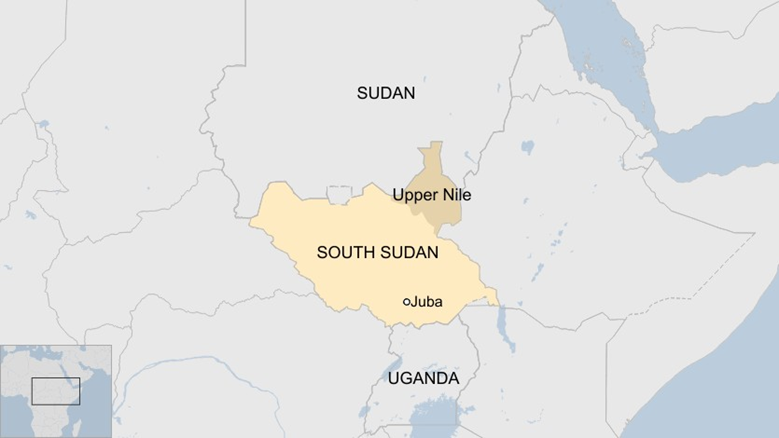
In South Sudan, the reporting period was characterized by an intensification of the existing armed conflicts amid growing political instability. Despite an extension of the transitional period foreseen under the 2018 peace accord, along with a reshuffle of the security sector by South Sudanese President Salva Kiir, the so-called ‘Tumaini talks’ with exiled opposition leaders stalled. As intercommunal violence persisted in multiple states across the country, tensions with Uganda over its use of force in South Sudan increased, while the armed conflict in Sudan spilled over into its southern neighbour.
From the beginning of 2025, resurgent political tensions between President Kiir and Vice-President Riek Machar led to an escalation in fighting between the South Sudan People’s Defence Forces (SSPDF) and the Sudan People’s Liberation Movement/Army-in-Opposition (SPLM/A-IO) under Vice-President Machar. The National Salvation Front continued its military operations against the South Sudanese government, while ethnic Nuer militia known as the White Army, which are believed to have loose ties with the SPLM/A-IO, became more prominent.1J. Falzetta, ‘Who is the White Army, the militia at the centre of renewed conflict in South Sudan?’, The New Humanitarian, 17 September 2025; J. Pospisil, ‘Violence in South Sudan is rising again: what’s different this time, and how to avoid civil war’, The Conversation, 19 March 2025. Pospisil argues that Mr Machar ‘has tried but never succeeded to command all Nuer militias, including the White Army’ and that its attacks ‘appear to be motivated by a series of provocations rather than any centralised political directive’. The intervention by the Uganda People’s Defence Force (UPDF) in March 2025 in support of President Kiir involved aerial bombing that appeared to mark a turning point in the conflict.
In May 2025, the United Nations (UN) Security Council renewed the mandate of the UN Mission in South Sudan (UNMISS) for a further twelve months, while ‘strongly condemning past and ongoing human rights violations and abuses and violations of international humanitarian law by all parties, including by armed groups and national security forces’. 2UN Security Council Resolution 2779, adopted on 8 May 2025 by twelve votes to nil with three abstentions (China, Pakistan, and Russia), operative para 1 and twelfth preambular para. The Security Council also extended the sanctions regime on South Sudan, although the resolution passed with only the minimum nine votes necessary for its adoption.3UN Security Council Resolution 2781, adopted on 30 May 2025 by nine votes to nil with six abstentions (Algeria, China, Pakistan, Russia, Sierra Leone, and Somalia).
Conflict Classification and Applicable Law
Two non-international armed conflicts (NIACs) in South Sudan continued throughout the period under review:
South Sudan (supported from March 2025 by the UPDF) v SPLM/A-IO.
South Sudan v National Salvation Front (the NAS).
The conflicts are regulated by Common Article 3 of the Geneva Conventions of 1949 and customary international humanitarian law (IHL).
South Sudan is also a State Party to Additional Protocol II of 1977.4Protocol Additional to the Geneva Conventions of 12 August 1949, and relating to the Protection of Victims of Non-International Armed Conflicts; adopted at Geneva, 8 June 1977; entered into force, 7 December 1978. Clashes between the SSPDF and the SPLM/A-IO underwent a marked escalation in the first half of 2025. Despite several offensives by the SSPDF, the SPLM/A-IO retained control of most of its strongholds. The NIAC between the two parties thus continued also to be governed by the Protocol.
Clashes between the SSPDF and the NAS, albeit not frequent, continued throughout the reporting period. While sufficiently organized to be party to a NIAC, the NAS has wielded only temporary – and unstable – military control over territory, insufficient for the application of Additional Protocol II.
Fighting has also occurred on a number of occasions between the SSPDF and the White Army.5The UN Panel of Experts on South Sudan has stated that the SSPDF ‘has frequently alleged that these militia forces are under the control of SPLA-IO, who refute this claim’. Final report of the Panel of Experts on South Sudan submitted pursuant to resolution 2731 (2024), UN Doc S/2025/442, 2 July 2025, para 60 and Annex 10. In 2025, however, the intensity and regularity of the clashes did not reach the threshold required for a NIAC to come into existence.
South Sudan is not a party to the Rome Statute of the International Criminal Court.6Rome Statute of the International Criminal Court; adopted at Rome, 17 July 1998; entered into force, 1 July 2002.
Compliance with IHL
Overview
The period under review continued to see manifold serious violations of IHL rules protecting civilians and civilian infrastructure across South Sudan. Civilians, including humanitarian workers and medical personnel, continued to be regularly attacked in serious violation of IHL. Incendiary barrel bombs were used in populated areas in an indiscriminate manner.
Civilian Objects under Attack
Under customary IHL, attacks may only be directed against military objectives. Attacks must not be directed against civilian objects.7International Committee of the Red Cross (ICRC), Customary IHL Rule 7: ‘The Principle of Distinction between Civilian Objects and Military Objectives’. Civilian objects are all objects that are not military objectives8ICRC, Customary IHL Rule 9: ‘Definition of Civilian Objects’. and, as such, are protected against attack.9ICRC, Customary IHL Rule 10: ‘Civilian Objects’ Loss of Protection from Attack’. Military objectives are those objects which, by their nature, location, purpose or use, make an effective contribution to military action.10ICRC, Customary IHL Rule 8: ‘Definition of Military Objectives’. In addition, the object’s partial or total destruction, capture, or neutralisation must offer a definite military advantage in the prevailing circumstances.
Attacks against Medical Facilities
Under IHL, medical units and transports must not be attacked and must be protected.11ICRC, Customary IHL Rule 28: ‘Medical Units’. Violations of these obligations may amount to war crimes.12ICRC, Customary IHL Rule 156: ‘Definition of War Crimes’. UNMISS has verified several instances where hospitals and medical units were attacked by the SSPDF or used for military purposes.13‘Situation in South Sudan, Report of the Secretary-General’, UN Doc S/2024/776, 25 October 2024, para 69; ‘UN Doc S/2025/211, 7 April 2025, paras 73–74; and UN Doc S/2025/504, 7 August 2025, para 72.
On 3 May 2025, two helicopter gunships bombed the Médecins Sans Frontières (MSF) hospital at Old Fangak in Jonglei state; this was the only major medical facility in the area, serving more than 40,000 people. The strike killed at least seven civilians and injured many more, including medical staff; it also destroyed the hospital pharmacy and all the medicines held there.14MSF, ‘South Sudan: MSF strongly condemns the deliberate bombing of our hospital in Old Fangak, Jonglei state’, 4 May 2025; Office of the UN High Commissioner for Human Rights (OHCHR), ‘Targeting of MSF hospital may constitute a war crime, says UN Commission, urges immediate halt to hostilities in South Sudan’, Press release, 6 May 2025. In condemning the ‘calculated, unlawful attack on a protected medical facility’, the UN Commission on Human Rights in South Sudan noted that the operation followed a public statement by the SSPDF that it would carry out ‘punitive’ aerial and riverine operations if the SPLM/A-IO did not immediately release certain vessels allegedly hijacked at Adok Port in Leer County.15OHCHR, ‘Targeting of MSF hospital may constitute a war crime, says UN Commission, urges immediate halt to hostilities in South Sudan’. See also Radio Tamazuj, ‘SSPDF Chief orders SPLA-IO to release detained barges, boats’, 2 May 2025. The Commission on Human Rights in South Sudan is an independent body mandated by the UN Human Rights Council that was established in 2016.
In the absence of evidence the hospital was being used to commit hostile acts, the attack appears to have been a serious violation of the principle of distinction and of the special protection afforded by IHL to medical facilities.16Art 11, Additional Protocol II; ICRC, Customary IHL Rule 7: ‘The Principle of Distinction between Civilian Objects and Military Objectives’; and Rule 28: ‘Medical Units’. MSF confirmed that the geolocations of all its facilities in South Sudan had been shared with the parties to the armed conflicts, excluding the possibility of an innocent mistake in targeting.17MSF, ‘South Sudan: MSF strongly condemns the deliberate bombing of our hospital in Old Fangak, Jonglei state’. The UN Commission on Human Rights in South Sudan described the attack as a possible war crime.18OHCHR, ‘Targeting of MSF hospital may constitute a war crime, says UN Commission, urges immediate halt to hostilities in South Sudan’.
Civilians under Attack
Under customary IHL, civilians enjoy general protection from the effects of hostilities,19ICRC, Customary IHL Rule 1: ‘The Principle of Distinction between Civilians and Combatants‘. unless and for such time as they directly participate in hostilities.20ICRC, Customary IHL Rule 6: ‘Civilians’ Loss of Protection from Attack’. Accordingly, parties to armed conflicts must at all times distinguish between combatants and civilians, and are prohibited from directing attacks against civilians. In case of doubt, persons should be treated as civilians.21Ibid. The accompanying commentary to Rule 6 states that in NIACs, ‘the issue of doubt has hardly been addressed in State practice, even though a clear rule on this subject would be desirable as it would enhance the protection of the civilian population against attack.’ One ‘cannot automatically attack anyone who might appear dubious….’ The same approach with respect to IACs ‘seems justified’ in NIACs. Civilians may be incidentally affected by attacks against lawful targets. However, such attacks must not be disproportionate, and the attacker must take all feasible precautions to avoid, or at the least to minimize, incidental civilian deaths and injuries to civilians (and damage to civilian objects).22ICRC, Customary IHL Rule 14: ‘Proportionality in Attack’; and Rule 15: ‘Principle of Precautions in Attack’.
Attacks directed against Civilians
Civilians were deliberately targeted by the parties to the armed conflicts during the reporting period. Indeed, the first quarter of 2025 and – albeit to a lesser extent – the second quarter as well saw the highest number of civilian victims that UNMISS had documented since 2020. The number of both violent incidents and victims (dead and injured) increased significantly.23UNMISS Human Rights Division, ‘Brief on Violence Affecting Civilians: January–March 2025’, p 1; and ‘Brief on Violence Affecting Civilians: April–June 2025’, p 1. Despite the fact that most of the casualties continued to result from acts by community militia or civil defence groups, the incidents and victims attributable to unlawful acts by parties to the two armed conflicts also increased considerably.24UNMISS Human Rights Division, ‘Brief on Violence Affecting Civilians: April–June 2025’, p 5. The UN Secretary-General listed South Sudan among those countries where ‘civilian death and injury were prominent’ in his May 2025 report to the UN Security Council on the protection of civilians in armed conflict.25‘Protection of civilians in armed conflict, Report of the Secretary-General’, 15 May 2025, para 4.
Air-dropped Barrel Bombs
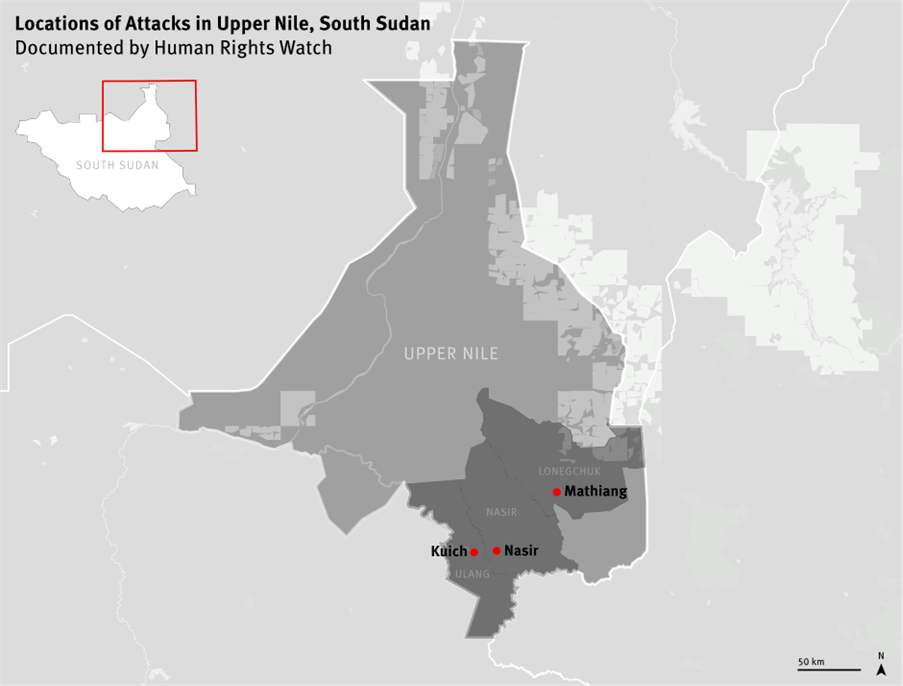
The use of barrel bombs in aerial attacks on several locations in Nasir county in Upper Nile state has been widely reported. The Special Representative of the UN Secretary-General and Head of UNMISS, Nicholas Haysom, has criticized the ‘persistent aerial bombardment using devices, barrel bombs, allegedly containing a highly flammable liquid that acts as an accelerant on explosion, … causing significant casualties and horrific injuries, especially burns, including to women and children’.26UN Peacekeeping, Post on X, 24 March 2025. Similarly, the EU delegation expressed deep concern at reports of attacks ‘potentially using highly flammable substances, inflicting horror on civilians’.27Radio Tamazuj, ‘EU offers to facilitate dialogue between Kiir and Machar’, 21 March 2025.
Despite early reports qualifying these weapons as cluster bombs, subsequent investigations determined that the substance used was ethyl acetate, described by multiple sources as ‘a highly flammable chemical compound’.28T. M. Machier, ‘Chemical firestorm in Nasir as gov’t uses ethyl acetate in deadly attack’, Sudans Post, 18 March 2025; W. Muia, ‘UN fears war as barrel bombs dropped in South Sudan’, BBC News, 25 March 2025. The Government of South Sudan has acknowledged mounting military operations in the areas affected by the airstrikes, but has not admitted use of this type of weapon. Uganda agreed that it was supporting the SSPDF in Upper Nile state at the time of the attacks,29Parliament of Uganda, ‘Parliament approves UPDF deployment in South Sudan’, 21 March 2025. but strongly denies dropping barrel bombs.30UPDF, ‘UPDF Refutes Alleged Use of Chemical Weapons in South Sudan’, 28 March 2025.
That the bombs appear to have been dropped from high altitude,31Radio Tamazuj, ‘EU offers to facilitate dialogue between Kiir and Machar’. coupled with the fact that the ethyl acetate vapour can spread rapidly along the ground ‘intensifying fires’,32Machier, ‘Chemical firestorm in Nasir as gov’t uses ethyl acetate in deadly attack’. indicates the attacks were indiscriminate and thus a serious violation of IHL.33ICRC, Customary IHL Rule 71: ‘Weapons That Are by Nature Indiscriminate’.
The bombs appear to amount to ‘improvised air-dropped incendiary weapons’,34Human Rights Watch, ‘South Sudan: Incendiary Bombs Kill, Burn Civilians’, Report, 9 April 2025. See also A. Passilly and M. Abraham, ‘Army barrel bombs spark exodus as South Sudan peace deal crumbles’, The New Humanitarian, 20 May 2025. indicating they would also fall under the specific IHL provisions set forth in Protocol III to the UN Convention on Conventional Weapons. Incendiary weapons are defined under the Protocol as ‘any weapon or munition which is primarily designed to set fire to objects or to cause burn injury to persons through the action of flame, heat, or combination thereof, produced by a chemical reaction of a substance delivered on the target’.35Art 1(1), Protocol III on Prohibitions or Restrictions on the Use of Incendiary Weapons, annexed to the Convention on Prohibitions or Restrictions on the Use of Certain Conventional Weapons which may be deemed to be Excessively Injurious or to have Indiscriminate Effects; adopted at Geneva, 10 October 1980; entered into force, 2 December 1983 (CCW Protocol III). The Protocol prohibits the use of air-dropped incendiary weapons in any area with a ‘concentration of civilians’, irrespective of whether military objectives are being targeted.36Art 2, CCW Protocol III. Uganda is a State Party to the Protocol, but South Sudan is not. The treaty rules reflect customary law, even though the International Committee of the Red Cross (ICRC)’s 2005 study of customary IHL did not include such a rule at the time.37ICRC, Customary IHL Rule 84: ‘The Protection of Civilians and Civilian Objects from the Effects of Incendiary Weapons’. In its 2005 commentary on the rule, the ICRC declared that ‘it is more difficult to conclude that the detailed rules in Article 2(2)–(4) of Protocol III are also customary international law’, but this was a time when fewer than half of all States were party to it. These days almost two thirds are party to Protocol III, including all five permanent members of the UN Security Council and major military powers India and Pakistan. The United States has made a reservation to the Protocol whereby it ‘reserves the right to use incendiary weapons against military objectives located in concentrations of civilians where it is judged that such use would cause fewer casualties and/or less collateral damage than alternative weapons’. Sixteen States have objected to this reservation, all but one of which considering it as being contrary to the object and purpose of the treaty and thus invalid. UN Treaty Collection webpage for the CCW and its Protocol III. See eg: ‘The Regulation of Incendiary Weapons under International Humanitarian Law’, Report, UN Office for Disarmament Affairs, Geneva, 2024, pp 34–36. UN Treaty Collection webpage for the CCW and its Protocol III.
Even if the barrel bombs did not qualify as incendiary weapons, their use would still appear to be unlawful insofar as they did not target a lawful military objective. Only in one instance – an attack on an airstrip in Nasir town – may an attack have met the criteria set by IHL under the principle of distinction.38World Without War, ‘Government Chemical Incendiary Attacks on Civilians are Crimes’, Press release, 24 March 2025. In all other recorded cases, the areas and objects struck by the barrel bombs appear to be civilian, with at least some of the attacks taking place at night making accuracy even harder. Human Rights Watch declared that the use of these weapons in populated areas by the Government of South Sudan may amount to war crimes. A forty-year-old woman who witnessed the attacks said she woke up feeling ‘the earth shaking’ and ran outside to see the village ‘on fire’. She later saw the charred bodies of her neighbours, including two children under ten years of age.39Human Rights Watch, ‘South Sudan: Incendiary Bombs Kill, Burn Civilians’.
Attacks against Humanitarian Workers
Under IHL, humanitarian personnel must not be attacked and must be protected.40ICRC, Customary IHL Rule 31: ‘Humanitarian Relief Personnel’. Violations of these obligations may amount to war crimes.41ICRC, Customary IHL Rule 156: ‘Definition of War Crimes’. But as the UN Commission on Human Rights in South Sudan has recalled, the country continues to be ‘extremely dangerous for aid workers’.42Report of the Commission on Human Rights in South Sudan, UN Doc A/HRC/58/27, 21 February 2025, para 53. Both State and non-State parties to the two armed conflicts have attacked, and made threats against, humanitarian workers.43Ibid. See also UN, ‘South Sudan at “Turning Point” Amid Worsening Violence, Humanitarian Crisis, Speakers Tell Security Council, Urging Renewed Dialogue, End to Fighting’, Press release, UN Doc SC/16146, 18 August 2025.
As a consequence, agencies often felt obliged to pause operations in certain areas despite the overwhelming humanitarian need. The Integrated Food Security Phase Classification (IPC) declared in June 2025 that 7.7 million people in South Sudan – fifty-seven per cent of the country’s population – were expected to face acute food insecurity (at Phase 3 or above) between April and July of that year. Of these, 83,000 would likely experience catastrophic food insecurity (Phase 5) in four counties in the Greater Pibor Administrative Area and Upper Nile state, with Luakpiny/Nasir and Ulang potentially at risk of famine.44IPC, ‘South Sudan: IPC Acute Food Insecurity and Malnutrition Snapshot: April–July 2025’, 12 June 2025; see also ‘Situation in South Sudan, Report of the Secretary-General’, UN Doc S/2025/504, para 34.
In addition to direct attacks, humanitarian workers have sometimes been abducted with a view to obtaining ransom. Both the United Nations and the media have pointed to a marked increase in kidnapping of humanitarian workers in South Sudan, with figures for the first eight months of 2025 already more than twice the number of incidents recorded for the whole of 2024.45J. Falzetta, ‘As fighting escalates, kidnappings of aid workers surge in South Sudan’, The Independent, 11 September 2025; OCHA, ‘South Sudan: Humanitarian Access Snapshot (July 2025)’, July 2025. While the perpetrators cannot always be identified,46Falzetta, ‘As fighting escalates, kidnappings of aid workers surge in South Sudan’. the surge in incidents certainly coincides with the escalation in the hostilities between the parties to the two armed conflicts. The UN Secretary-General noted that in just five weeks during the second quarter of 2025, four instances of abduction of humanitarian workers took place in Yei county in Central Equatoria state.47‘Situation in South Sudan, Report of the Secretary-General’, UN Doc S/2025/504, para. 41. See also Report of the Commission on Human Rights in South Sudan, UN Doc A/HRC/58/27, para 53.
Forced Displacement
Under customary IHL applicable to all armed conflicts, parties are prohibited from ordering the displacement of the civilian population in relation to the conflict unless it is required for the security of civilians or for imperative military reasons.48ICRC, Customary IHL 129: ‘The Act of Displacement’. Breaches of these prohibitions are serious violations of IHL.49ICRC, Customary IHL Rule 156: ‘Definition of War Crimes’. Such displacement must be temporary, with all possible measures taken to ensure proper shelter, hygiene, health, safety and nutrition and that members of the same family are not separated.50ICRC, Customary IHL Rule 131: ‘Treatment of Displaced Persons’. The prohibition aims to protect civilian populations from arbitrary or punitive displacement and to uphold their rights to remain in or return to their homes.51ICRC, Customary IHL Rule 132: ‘Return of Displaced Persons’.
The escalating violence in South Sudan has caused or maintained massive displacement of civilians, both within and outside the country. The number of internally displaced persons (IDPs) has reportedly reached two million, while more than 300,000 South Sudanese have fled the country, in large part because of the increasing violence.52OHCHR, ‘South Sudan: UN Commission urges AU and UN Security Council to act decisively as crisis deepens, demanding urgent action and renewed commitment to peace, accountability and a credible transition’, Press release, 13 October 2025; ‘Situation in South Sudan, Report of the Secretary-General’, UN Doc S/2025/504, para 36. In the areas most affected by the surge in violence in early 2025 (Baliet, Nasir, and Ulang counties), an estimated 63,500 people had been displaced by April.53‘Situation in South Sudan, Report of the Secretary-General’, UN Doc S/2025/211, para 34. To the extent it is provoked by unlawful acts, the displacement of the civilian population may breach IHL.54ICRC, Customary IHL Rule 129: ‘The Act of Displacement’.
Protection of Persons in the Power of the Enemy
Customary and treaty IHL provides fundamental guarantees for anyone in the power of a party to a conflict, prohibiting acts such as torture, inhumane or degrading treatment, sexual violence, enforced disappearance, and unfair trials. Special protection is afforded to civilians at specific risk of harm, such as women, children, refugees, and IDPs.55ICRC, Customary IHL Rules 134–138: ‘Chapter 39. Other Persons Afforded Specific Protection’.
Murder and Torture of Civilians
International bodies have denounced the killing of civilians in the power of the enemy in South Sudan. On the night of 9 October 2024, armed men in military uniform raided a village in Wonduruba in Central Equatoria state and, having abducted several male youths, killed at least twenty-seven and wounded four others with machetes (firearms may also have been used).56A. Hawari, ‘19 killed in separate attacks in Central Equatoria: Govt’, EyeRadio, 11 October 2024; UNMISS, ‘UNMISS alarmed by violent attacks in Juba county, calls for investigation and accountability’, 11 October 2024. While the NAS was widely blamed,57Radio Tamazuj, ‘Peace monitors “blocked” from probing Wonduruba killings’, 25 October 2024. the group accused forces loyal to the SSPDF of being responsible for the atrocity.58NAS, ‘NAS condemns SSPDF-linked massacre of civilians in Wonduruba’, Press release, 13 October 2024. The team entrusted by the Ceasefire and Transitional Security Arrangements Monitoring and Verification Mechanism (CTSAMVM) to investigate the incident was repeatedly denied access to the area.59Radio Tamazuj, ‘Peace monitors “blocked” from probing Wonduruba killings’.
The UN Secretary-General has since reported that: ‘On 8 February [2025], two civilians were arbitrarily arrested and later killed, when they allegedly witnessed government forces burning and looting civilian homes, including a healthcare facility, in Nagero town’.60‘Situation in South Sudan, Report of the Secretary-General’, UN Doc S/2025/211, para 27.
Conflict-related Sexual and Gender-based Violence
Rape and other forms of sexual violence in connection with armed conflict are prohibited and constitute serious violations of IHL.61ICRC, Customary IHL Rule 93: ‘Rape and Other forms of Sexual Violence’; and Rule 156: ‘Definition of War Crimes’. International bodies have highlighted the continued and widespread perpetration of sexual violence in South Sudan, including in many instances in acts with sufficient nexus to one of the two NIACs.62‘Protection of civilians in armed conflict, Report of the Secretary-General’, UN Doc S/2025/271, para 4. The ICRC has noted that: ‘Over a decade of conflict and intercommunal violence has led to the normalization of sexual violence among weapon bearers as well as among civilians’.63ICRC, ‘Addressing Sexual Violence in South Sudan – Highlights from 2024’, March 2025, p 1. The violence has taken multiple forms – from rape and gang rape to sexual slavery and forced marriage.64‘Conflict-related Sexual Violence, Report of the Secretary-General’, UN Doc S/2025/389, para 55.
The UN Commission on Human Rights in South Sudan has found that conflict-related sexual violence by members of the SSPDF ‘remains widespread in many areas with a significant presence of soldiers’.65Report of the Commission on Human Rights in South Sudan, 21 February 2025, UN Doc A/HRC/58/27, para 58. The phenomenon affects especially (but not only) women and girls and is hugely under-reported. UNMISS has documented that, among the victims of all incidents of conflict-related sexual violence it verified in South Sudan in 2024, 150 acts of sexual violence were against women and 101 were against girls, while seven were against men and two were against boys.66‘Conflict-related Sexual Violence, Report of the Secretary-General’, UN Doc S/2025/389, para 55. See also ‘Situation in South Sudan, Report of the Secretary-General’, UN Doc S/2024/776, para 69; and UN Doc S/2025/211, para 73. In several cases, victims were abducted before being sexually assaulted.67‘Situation in South Sudan, Report of the Secretary-General’, UN Doc S/2025/504,para 70; Report of the Commission on Human Rights in South Sudan, UN Doc A/HRC/58/27, para 58.
The Government of South Sudan has replied to international criticism concerning its failure to adequately tackle the phenomenon, stressing that despite challenges from the limited number of investigators at its disposal, it has prosecuted dozens of cases of sexual violence through mobile courts, General Courts-Martial, and the Gender-based Violence and Juvenile courts.68Ministry of Justice and Constitutional Affairs of South Sudan, ‘Response of the Government of the Republic of South Sudan to the UNMISS-Human Rights Division of the Annual Brief on Violence Affecting Civilians from January to December, 2024’, 4 April 2025, p 2. While acknowledging these efforts and noting its support to various initiatives aimed at bolstering accountability for conflict-related sexual violence (including two cases resulting in convictions for rape committed by SSPDF personnel), the UN Secretary-General has regretted the fact that: ‘Limited resources and insufficient coordination among relevant authorities persisted’.69‘Conflict-related sexual violence, Report of the Secretary-General’, UN Doc S/2025/389, para 56.
Arbitrary Deprivation of Liberty
Under IHL, any deprivation of liberty must be lawful, non-arbitrary, and carried out with appropriate legal safeguards.70ICRC, Customary IHL Rule 99: ‘Deprivation of Liberty’. Persons deprived of their liberty must be treated humanely at all times, with absolute prohibitions on torture and other ill-treatment.71Common Article 3, Geneva Conventions; ICRC, Customary IHL Rule 90: ‘Torture and Cruel, Inhuman or Degrading Treatment’. Detaining authorities must ensure detainees have access to medical care, are held in humane conditions, and are protected from violence or reprisals.72Common Article 3, Geneva Conventions; ICRC, Customary IHL Rule 89: ‘Violence to Life’.
The UN Commission on Human Rights in South Sudan has found that parties to the armed conflicts in South Sudan, including the SSPDF and non-State armed groups, were responsible for frequent acts of arbitrary detention.73Report of the Commission on Human Rights in South Sudan, UN Doc A/HRC/58/27, para 51. The present reporting period saw several cases where opposition leaders were detained arbitrarily or incommunicado, even sometimes being subjected to enforced disappearance.
Since early March 2025, an escalation in fighting in Nasir county in Upper Nile has led to a wave of arrests of high-ranking officers and senior political figures affiliated with the SPLM/A-IO. This included the SSPDF Deputy Chief of Defence Forces, the Minister for Petroleum, the Minister of Peacebuilding, the Minister of Animal Resources and Fisheries, Vice-President Riek Machar himself and his wife, Angelina Teny, the Minister of the Interior, as well as their bodyguards, family and staff members.74‘Tensions rise in Juba following arrest of top SPLA-IO officers’, Radio Tamazuj, 4 March 2025; ‘South Sudan MP Gatwech Lam arrested’, 12 March 2025; and ‘Unity state minister arrested in Juba’, 21 March 2025; ‘Detained Lakes deputy governor to be tried in court over “inciting” remarks: govt’, EyeRadio, 25 March 2025; ‘South Sudan opposition decries arrests, strike as US urges talks’, Arab News, 25 March 2025; W. Muia and A. Lime, ‘VP’s arrest ends South Sudan peace deal, his party says’, BBC News, 27 March 2025; A. L. Dahir, ‘South Sudan’s Vice President Has Been Placed Under House Arrest, Party Says’, The New York Times, 27 March 2025. OHCHR has reported that, in three weeks in the month of March 2025, ‘at least 55 high-ranking government officials affiliated with the SPLM-IO were arrested across the country.75OHCHR, ‘South Sudan: UN human rights chief decries escalating hostilities, arbitrary arrests and hate speech’, 23 May 2025.
South Sudanese officials have sought to justify their actions by alleging that those arrested have committed crimes against the State and conspired against the Government. After arrests in early March, the National Security Service’s Director of Public Relations said that the detainees had ‘verified links to the escalating military confrontation in Nasir, Ulang, and surrounding areas’, and that they had ‘been fuelling the ongoing conflict’ in those areas.76‘National Security vows more arrests over Nasir unrest’, Radio Tamazuj, 8 March 2025.
Following the placing of Vice-President Machar and Minister Teny under house arrest, South Sudan’s Information Minister stated that Mr Machar was being detained for ‘agitating [SPLM/A-IO politicians and commanders] to rebel against the Government with the aim of disrupting peace so that elections are not held and South Sudan goes back to war’, and for directing SPLA-IO forces to ‘attack their colleagues’.77E. J. Akile and L. Memo, ‘Makuei explains reasons behind FVP Machar’s house arrest’, EyeRadio, 28 March 2025; ‘South Sudan says arrested VP Machar tried to stir rebellion’, Reuters, 28 March 2025. In September 2025, Riek Machar and several SPLM/A-IO colleagues were charged with murder, treason, and crimes against humanity in relation to a March 2025 attack by the White Army in Nasir county.78J. Winter and N. Mandil, ‘South Sudan vice-president charged with murder and treason’, BBC News, 12 September 2025.
As of July 2025, two detained officials from Western Bahr el Ghazal state were still being held incommunicado, without access to their families.79‘Family of Jur River commissioner wants him presented in court or released’, Radio Tamazuj, 23 July 2025; Human Rights Watch, ‘South Sudan: Ensure Due Process, Fair Trials of Opposition’, 15 September 2025. Human Rights Watch found that the fate and whereabouts of several other individuals arrested since March 2025 remained unknown.80Human Rights Watch, ‘South Sudan: Opposition Leaders, Others, Detained’; and ‘South Sudan: Ensure Due Process, Fair Trials of Opposition’. It was said that the arrestees had not been brought before a judge for a long time following their initial detention, despite South Sudan’s constitution requiring that this occur within twenty-four hours.81‘Family of Jur River commissioner wants him presented in court or released’, Radio Tamazuj.
Protection of Children
Under IHL, children are afforded special protection in armed conflicts, recognizing their particular vulnerability. Core rules prohibit the recruitment and use in hostilities of children under the age of fifteen years, whether in State armed forces or non-State armed groups, and these rules further forbid their participation in combat.82ICRC, Customary IHL Rule 136: ‘Recruitment of Child Soldiers’. Children are also entitled to general protection as civilians, including against direct attack, arbitrary detention, sexual violence, and ill-treatment, as well as specific guarantees such as access to food, medical care, and education. If detained, they must be held separately from adults (unless with their family) and treated in a manner appropriate to their age. Evacuation and reunification of separated children with their families are also prioritized.83ICRC, Customary IHL Rule 135: ‘Children’.
South Sudan has acceded to several human rights treaties which cover the protection of children, including specifically in situations of armed conflict. These include the UN Convention on the Rights of the Child (in 2015) and its Optional Protocol on the Involvement of Children in Armed Conflict (in 2018). This latter instrument precludes South Sudan from compulsorily recruiting anyone under eighteen years of years into its armed forces.84Art 2, 2000 Optional Protocol to the Convention on the Rights of the Child on the Involvement of Children in Armed Conflict. When acceding to the Protocol, South Sudan deposited a binding declaration under Article 3 whereby the minimum age for voluntary recruitment of volunteers in its armed forces would be eighteen years.85South Sudan, Declaration upon accession of 27 November 2018.
Despite these obligations, UNMISS has documented several cases of recruitment and use in hostilities of children (girls as well as boys), including as a result of abductions.86‘Situation in South Sudan, Report of the Secretary-General’, UN Doc S/2024/776, para 69; UN Doc S/2025/211, paras 73–74; and UN Doc S/2025/504, paras 69–71. In some cases, recruitment resulted in the child being injured or even killed in combat.87‘Situation in South Sudan, Report of the Secretary-General’, UN Doc S/2025/504, para 70. The UN Commission on Human Rights in South Sudan has found that abductions, recruitment, and use of children remain ‘[t]he most common violations’ against children in South Sudan, and that they have been perpetrated both by the SSPDF and by non-State actors (notably the NAS) in many parts of South Sudan.88Report of the Commission on Human Rights in South Sudan, UN Doc A/HRC/58/27, paras 67–70. The Committee on the Rights of the Child has reached similar findings, stating in 2025 that sixty-eight children (fifty-nine boys and nine girls) had been recruited and used by forces that comprised of, among others, the SSPDF, the South Sudan National Police Service, the SPLM/A-IO, and the NAS.89‘Children and armed conflict, Report of the Secretary-General’, 17 June 2025, UN Doc A/79/878–S/2025/247, paras 175–76.
- 1J. Falzetta, ‘Who is the White Army, the militia at the centre of renewed conflict in South Sudan?’, The New Humanitarian, 17 September 2025; J. Pospisil, ‘Violence in South Sudan is rising again: what’s different this time, and how to avoid civil war’, The Conversation, 19 March 2025. Pospisil argues that Mr Machar ‘has tried but never succeeded to command all Nuer militias, including the White Army’ and that its attacks ‘appear to be motivated by a series of provocations rather than any centralised political directive’.
- 2UN Security Council Resolution 2779, adopted on 8 May 2025 by twelve votes to nil with three abstentions (China, Pakistan, and Russia), operative para 1 and twelfth preambular para.
- 3
- 4Protocol Additional to the Geneva Conventions of 12 August 1949, and relating to the Protection of Victims of Non-International Armed Conflicts; adopted at Geneva, 8 June 1977; entered into force, 7 December 1978.
- 5The UN Panel of Experts on South Sudan has stated that the SSPDF ‘has frequently alleged that these militia forces are under the control of SPLA-IO, who refute this claim’. Final report of the Panel of Experts on South Sudan submitted pursuant to resolution 2731 (2024), UN Doc S/2025/442, 2 July 2025, para 60 and Annex 10.
- 6Rome Statute of the International Criminal Court; adopted at Rome, 17 July 1998; entered into force, 1 July 2002.
- 7International Committee of the Red Cross (ICRC), Customary IHL Rule 7: ‘The Principle of Distinction between Civilian Objects and Military Objectives’.
- 8
- 9
- 10ICRC, Customary IHL Rule 8: ‘Definition of Military Objectives’. In addition, the object’s partial or total destruction, capture, or neutralisation must offer a definite military advantage in the prevailing circumstances.
- 11
- 12
- 13‘Situation in South Sudan, Report of the Secretary-General’, UN Doc S/2024/776, 25 October 2024, para 69; ‘UN Doc S/2025/211, 7 April 2025, paras 73–74; and UN Doc S/2025/504, 7 August 2025, para 72.
- 14MSF, ‘South Sudan: MSF strongly condemns the deliberate bombing of our hospital in Old Fangak, Jonglei state’, 4 May 2025; Office of the UN High Commissioner for Human Rights (OHCHR), ‘Targeting of MSF hospital may constitute a war crime, says UN Commission, urges immediate halt to hostilities in South Sudan’, Press release, 6 May 2025.
- 15OHCHR, ‘Targeting of MSF hospital may constitute a war crime, says UN Commission, urges immediate halt to hostilities in South Sudan’. See also Radio Tamazuj, ‘SSPDF Chief orders SPLA-IO to release detained barges, boats’, 2 May 2025. The Commission on Human Rights in South Sudan is an independent body mandated by the UN Human Rights Council that was established in 2016.
- 16Art 11, Additional Protocol II; ICRC, Customary IHL Rule 7: ‘The Principle of Distinction between Civilian Objects and Military Objectives’; and Rule 28: ‘Medical Units’.
- 17MSF, ‘South Sudan: MSF strongly condemns the deliberate bombing of our hospital in Old Fangak, Jonglei state’.
- 18OHCHR, ‘Targeting of MSF hospital may constitute a war crime, says UN Commission, urges immediate halt to hostilities in South Sudan’.
- 19
- 20
- 21Ibid. The accompanying commentary to Rule 6 states that in NIACs, ‘the issue of doubt has hardly been addressed in State practice, even though a clear rule on this subject would be desirable as it would enhance the protection of the civilian population against attack.’ One ‘cannot automatically attack anyone who might appear dubious….’ The same approach with respect to IACs ‘seems justified’ in NIACs.
- 22ICRC, Customary IHL Rule 14: ‘Proportionality in Attack’; and Rule 15: ‘Principle of Precautions in Attack’.
- 23UNMISS Human Rights Division, ‘Brief on Violence Affecting Civilians: January–March 2025’, p 1; and ‘Brief on Violence Affecting Civilians: April–June 2025’, p 1.
- 24UNMISS Human Rights Division, ‘Brief on Violence Affecting Civilians: April–June 2025’, p 5.
- 25‘Protection of civilians in armed conflict, Report of the Secretary-General’, 15 May 2025, para 4.
- 26UN Peacekeeping, Post on X, 24 March 2025.
- 27Radio Tamazuj, ‘EU offers to facilitate dialogue between Kiir and Machar’, 21 March 2025.
- 28T. M. Machier, ‘Chemical firestorm in Nasir as gov’t uses ethyl acetate in deadly attack’, Sudans Post, 18 March 2025; W. Muia, ‘UN fears war as barrel bombs dropped in South Sudan’, BBC News, 25 March 2025.
- 29Parliament of Uganda, ‘Parliament approves UPDF deployment in South Sudan’, 21 March 2025.
- 30UPDF, ‘UPDF Refutes Alleged Use of Chemical Weapons in South Sudan’, 28 March 2025.
- 31Radio Tamazuj, ‘EU offers to facilitate dialogue between Kiir and Machar’.
- 32Machier, ‘Chemical firestorm in Nasir as gov’t uses ethyl acetate in deadly attack’.
- 33
- 34Human Rights Watch, ‘South Sudan: Incendiary Bombs Kill, Burn Civilians’, Report, 9 April 2025. See also A. Passilly and M. Abraham, ‘Army barrel bombs spark exodus as South Sudan peace deal crumbles’, The New Humanitarian, 20 May 2025.
- 35Art 1(1), Protocol III on Prohibitions or Restrictions on the Use of Incendiary Weapons, annexed to the Convention on Prohibitions or Restrictions on the Use of Certain Conventional Weapons which may be deemed to be Excessively Injurious or to have Indiscriminate Effects; adopted at Geneva, 10 October 1980; entered into force, 2 December 1983 (CCW Protocol III).
- 36Art 2, CCW Protocol III.
- 37ICRC, Customary IHL Rule 84: ‘The Protection of Civilians and Civilian Objects from the Effects of Incendiary Weapons’. In its 2005 commentary on the rule, the ICRC declared that ‘it is more difficult to conclude that the detailed rules in Article 2(2)–(4) of Protocol III are also customary international law’, but this was a time when fewer than half of all States were party to it. These days almost two thirds are party to Protocol III, including all five permanent members of the UN Security Council and major military powers India and Pakistan. The United States has made a reservation to the Protocol whereby it ‘reserves the right to use incendiary weapons against military objectives located in concentrations of civilians where it is judged that such use would cause fewer casualties and/or less collateral damage than alternative weapons’. Sixteen States have objected to this reservation, all but one of which considering it as being contrary to the object and purpose of the treaty and thus invalid. UN Treaty Collection webpage for the CCW and its Protocol III. See eg: ‘The Regulation of Incendiary Weapons under International Humanitarian Law’, Report, UN Office for Disarmament Affairs, Geneva, 2024, pp 34–36. UN Treaty Collection webpage for the CCW and its Protocol III.
- 38World Without War, ‘Government Chemical Incendiary Attacks on Civilians are Crimes’, Press release, 24 March 2025.
- 39Human Rights Watch, ‘South Sudan: Incendiary Bombs Kill, Burn Civilians’.
- 40
- 41ICRC, Customary IHL Rule 156: ‘Definition of War Crimes’.
- 42Report of the Commission on Human Rights in South Sudan, UN Doc A/HRC/58/27, 21 February 2025, para 53.
- 43Ibid. See also UN, ‘South Sudan at “Turning Point” Amid Worsening Violence, Humanitarian Crisis, Speakers Tell Security Council, Urging Renewed Dialogue, End to Fighting’, Press release, UN Doc SC/16146, 18 August 2025.
- 44IPC, ‘South Sudan: IPC Acute Food Insecurity and Malnutrition Snapshot: April–July 2025’, 12 June 2025; see also ‘Situation in South Sudan, Report of the Secretary-General’, UN Doc S/2025/504, para 34.
- 45J. Falzetta, ‘As fighting escalates, kidnappings of aid workers surge in South Sudan’, The Independent, 11 September 2025; OCHA, ‘South Sudan: Humanitarian Access Snapshot (July 2025)’, July 2025.
- 46Falzetta, ‘As fighting escalates, kidnappings of aid workers surge in South Sudan’.
- 47‘Situation in South Sudan, Report of the Secretary-General’, UN Doc S/2025/504, para. 41. See also Report of the Commission on Human Rights in South Sudan, UN Doc A/HRC/58/27, para 53.
- 48
- 49ICRC, Customary IHL Rule 156: ‘Definition of War Crimes’.
- 50
- 51
- 52OHCHR, ‘South Sudan: UN Commission urges AU and UN Security Council to act decisively as crisis deepens, demanding urgent action and renewed commitment to peace, accountability and a credible transition’, Press release, 13 October 2025; ‘Situation in South Sudan, Report of the Secretary-General’, UN Doc S/2025/504, para 36.
- 53‘Situation in South Sudan, Report of the Secretary-General’, UN Doc S/2025/211, para 34.
- 54ICRC, Customary IHL Rule 129: ‘The Act of Displacement’.
- 55
- 56A. Hawari, ‘19 killed in separate attacks in Central Equatoria: Govt’, EyeRadio, 11 October 2024; UNMISS, ‘UNMISS alarmed by violent attacks in Juba county, calls for investigation and accountability’, 11 October 2024.
- 57Radio Tamazuj, ‘Peace monitors “blocked” from probing Wonduruba killings’, 25 October 2024.
- 58NAS, ‘NAS condemns SSPDF-linked massacre of civilians in Wonduruba’, Press release, 13 October 2024.
- 59Radio Tamazuj, ‘Peace monitors “blocked” from probing Wonduruba killings’.
- 60‘Situation in South Sudan, Report of the Secretary-General’, UN Doc S/2025/211, para 27.
- 61ICRC, Customary IHL Rule 93: ‘Rape and Other forms of Sexual Violence’; and Rule 156: ‘Definition of War Crimes’.
- 62‘Protection of civilians in armed conflict, Report of the Secretary-General’, UN Doc S/2025/271, para 4.
- 63ICRC, ‘Addressing Sexual Violence in South Sudan – Highlights from 2024’, March 2025, p 1.
- 64‘Conflict-related Sexual Violence, Report of the Secretary-General’, UN Doc S/2025/389, para 55.
- 65Report of the Commission on Human Rights in South Sudan, 21 February 2025, UN Doc A/HRC/58/27, para 58.
- 66‘Conflict-related Sexual Violence, Report of the Secretary-General’, UN Doc S/2025/389, para 55. See also ‘Situation in South Sudan, Report of the Secretary-General’, UN Doc S/2024/776, para 69; and UN Doc S/2025/211, para 73.
- 67‘Situation in South Sudan, Report of the Secretary-General’, UN Doc S/2025/504,para 70; Report of the Commission on Human Rights in South Sudan, UN Doc A/HRC/58/27, para 58.
- 68Ministry of Justice and Constitutional Affairs of South Sudan, ‘Response of the Government of the Republic of South Sudan to the UNMISS-Human Rights Division of the Annual Brief on Violence Affecting Civilians from January to December, 2024’, 4 April 2025, p 2.
- 69‘Conflict-related sexual violence, Report of the Secretary-General’, UN Doc S/2025/389, para 56.
- 70
- 71Common Article 3, Geneva Conventions; ICRC, Customary IHL Rule 90: ‘Torture and Cruel, Inhuman or Degrading Treatment’.
- 72
- 73Report of the Commission on Human Rights in South Sudan, UN Doc A/HRC/58/27, para 51.
- 74‘Tensions rise in Juba following arrest of top SPLA-IO officers’, Radio Tamazuj, 4 March 2025; ‘South Sudan MP Gatwech Lam arrested’, 12 March 2025; and ‘Unity state minister arrested in Juba’, 21 March 2025; ‘Detained Lakes deputy governor to be tried in court over “inciting” remarks: govt’, EyeRadio, 25 March 2025; ‘South Sudan opposition decries arrests, strike as US urges talks’, Arab News, 25 March 2025; W. Muia and A. Lime, ‘VP’s arrest ends South Sudan peace deal, his party says’, BBC News, 27 March 2025; A. L. Dahir, ‘South Sudan’s Vice President Has Been Placed Under House Arrest, Party Says’, The New York Times, 27 March 2025.
- 75
- 76‘National Security vows more arrests over Nasir unrest’, Radio Tamazuj, 8 March 2025.
- 77E. J. Akile and L. Memo, ‘Makuei explains reasons behind FVP Machar’s house arrest’, EyeRadio, 28 March 2025; ‘South Sudan says arrested VP Machar tried to stir rebellion’, Reuters, 28 March 2025.
- 78J. Winter and N. Mandil, ‘South Sudan vice-president charged with murder and treason’, BBC News, 12 September 2025.
- 79‘Family of Jur River commissioner wants him presented in court or released’, Radio Tamazuj, 23 July 2025; Human Rights Watch, ‘South Sudan: Ensure Due Process, Fair Trials of Opposition’, 15 September 2025.
- 80Human Rights Watch, ‘South Sudan: Opposition Leaders, Others, Detained’; and ‘South Sudan: Ensure Due Process, Fair Trials of Opposition’.
- 81‘Family of Jur River commissioner wants him presented in court or released’, Radio Tamazuj.
- 82
- 83
- 84Art 2, 2000 Optional Protocol to the Convention on the Rights of the Child on the Involvement of Children in Armed Conflict.
- 85South Sudan, Declaration upon accession of 27 November 2018.
- 86‘Situation in South Sudan, Report of the Secretary-General’, UN Doc S/2024/776, para 69; UN Doc S/2025/211, paras 73–74; and UN Doc S/2025/504, paras 69–71.
- 87‘Situation in South Sudan, Report of the Secretary-General’, UN Doc S/2025/504, para 70.
- 88Report of the Commission on Human Rights in South Sudan, UN Doc A/HRC/58/27, paras 67–70.
- 89‘Children and armed conflict, Report of the Secretary-General’, 17 June 2025, UN Doc A/79/878–S/2025/247, paras 175–76.