Conflict Overview
Conflict History
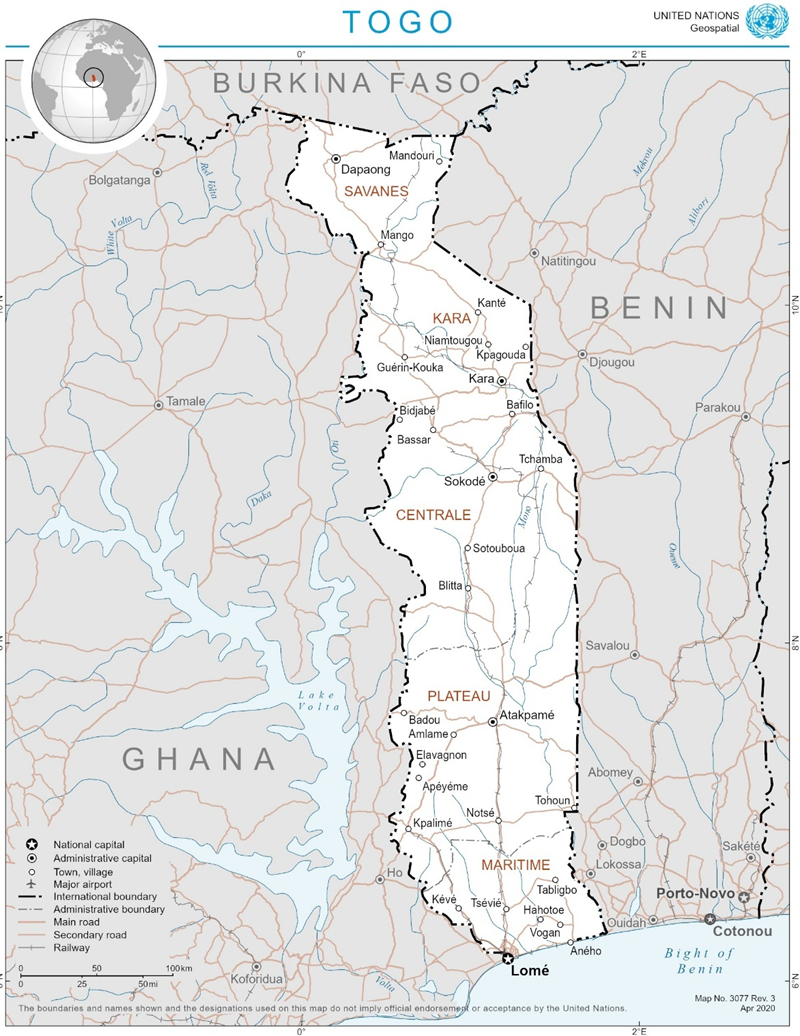
While Togo was spared jihadist violence during the first phase of the security crisis of the Sahel during the 2010s, two States it borders to its north, Benin and Burkina Faso, have been engaged in non-international armed conflicts (NIACs) against a variety of non-State armed groups. Two of these groups in particular – Jama’at Nusrat al-Islam wal-Muslimin (JNIM) and Islamic State Sahel Province (ISSP) – have been dominant in the conflicts in neighbouring Burkina Faso, and are in competition over territory as they tussle for supremacy across the Sahel.1H. Nsaibia, ‘New frontlines: Jihadist expansion is reshaping the Benin, Niger, and Nigeria borderlands’, Armed Conflict Location & Event Data Project (ACLED), 27 March 2025. Although small by comparison, Togo exerts an outsized role in the region by virtue of the critical port of Lomé, upon which several of its landlocked neighbours rely for access to global markets.
Togo reported an early JNIM attack between 9 and 10 November 2021 in the village of Sanloaga in Kpendjal prefecture, although it did not result in casualties.2R. K. Douti, ‘“No Peace, No Bread”: Northern Togo in the Grip of a Three-year State of Emergency’, Afrique XXI, 31 July 2025. In a statement, the Minister of Security and Civil Protection confirmed that following the attack, Togolese security forces had been deployed in the region.3Ibid. Six months after the first incursion, on 10 and 11 May 2022, JNIM executed a coordinated attack on the Togolese military outpost in Kpinkankandi, Kpendjal prefecture, resulting in the deaths of eight soldiers and injuries to a further thirteen, as well as significant material damage. In 2023, Togo recorded a total of twenty-one attacks that resulted in thirty-one deaths and twenty-nine injured.4Ibid. In 2024, four separate attacks were attributed to JNIM with fifty-two people killed in total.
In 2025, JNIM escalated military operations against the armed forces, including with a drone attack on a Togolese military position in Djignandjoaga in April.5‘Activities of the United Nations Office for West Africa and the Sahel, Report of the Secretary-General’, UN Doc S/2025/495, 31 July 2025, para 31. There was also a ground incursion by JNIM into Togo from Burkina Faso on 8 June into the village of Kpinkankandi in the prefecture of Kpendjal. The attack was repelled by the Togolese Armed Forces, and weapons and motorcycles were seized by the military.6‘Nord-Togo: les FAT tiennent bon face aux djihadistes’, République Togolaise, 9 June 2025. In total, between January and July 2025, at least fifty-four civilians and eight soldiers were killed.7‘Analyst: West Africa a Potential “Powder Keg” Due to Spreading Sahel Terrorism’, African Defense Forum, 14 October 2025. Consequently, JNIM attacks in Togo are now considered a ‘strategic expansion rather than spill-over’8H. Nsaibia, ‘Conflict intensifies and instability spreads beyond Burkina Faso, Mali, and Niger’, ACLED, 12 December 2024. on the basis they are no longer limited to the border area with Burkina Faso.9Douti, ‘“No Peace, No Bread”: Northern Togo in the Grip of a Three-year State of Emergency’.
The Togolese government has suggested that ISSP has contributed to some of the attacks on its territory, but has not provided evidence to support the allegation.10‘Terror attacks increase in Togo as Sahel extremists encroach’, DefenceWeb, 11 October 2024. Thus, it is unclear if ISSP is indeed conducting hostilities in Togo independent of an occasional spill-over from the conflict in Burkina Faso.
While this conflict has been ongoing, in 2025 Togo also underwent a significant political crisis as long-time President and now Prime Minister (‘President of the Council’) Faure Gnassingbé consolidated his family’s rule that has lasted for six decades. He holds the premiership because his Union pour la République (Unir) party dominates the national assembly, and will continue to do so for the foreseeable future, thanks to a constituency map gerrymandered to over-represent its northern heartlands and understate the voting weight of the pro-opposition coastal south.11P. Melly, ‘Furious protests at move to cement Togo ruling family’s grip on power’ BBC, 24 July 2025. The legislative and regional elections held on 29 April 2025, which were marred by allegations of irregularities and a partial opposition boycott, further inflamed tensions and triggered a wave of protests that were met with violent repression. Between August and October 2025, a series of incidents were documented highlighting an alarming shrinking of civic space.12Article 19, ‘Togo: Shrinking civic space alarming as political crisis continues’, 13 October 2025.
Key events since July 2026
In February 2026, the government extended the State of Emergency declaration covering the Savanes region that has been in place since 2022. Opposition parliamentarians attempted to use the debate to compel the Government to provide more details about what was happening in the region, but without success. The prime minister paid tribute to those soldiers killed during the operation (sometimes known as Operation Koundjoaré), without giving their number.13‘Togo: des opposants exigent des clarifications sur une prorogation de l’état d’urgence dans la région des Savanes’, Radio France Internationale, 3 March 2026.
In 2025, Togo announced that it was contemplating leaving the Economic Community of West African States (ECOWAS) and joining the Confederation of Sahel States (AES). This did not occur, though examples of closer collaboration with the AES include a joint military exercise called Tarha Nakal 2 with Chad between May and June 2025. In April 2026, the Togolese Foreign Minister, Robert Dussey announced its new strategy for its regional posture, a desire to ‘serve as a bridge’ between the Confederation and the international community, including bilaterally with France.14‘Le Togo veut « servir de pont » entre le Sahel et la communauté internationale’, JeuneAfrique, 18 April 2026.
Also in April 2026, French Foreign Minister Jean-Noël Barrot visited Lomé, the first visit at such level in ten years. The purpose was to emphasize the need to continue to counter terrorism in the region, as the threat moves south (which followed Burkina Faso, Mali, and Niger forcing the withdrawal of French forces from their countries). Togo remains a rare ally of Paris in the region, even as it too forges closer ties with Russia.15‘French foreign minister Barrot voices concern about “terrorist threat” in the Sahel’ France 24, 24 April 2026.
High-profile attacks have helped JNIM recruit some new members, but it now numbers only a few thousand – enough to terrorize rural communities, but not to control a city or province.16‘JNIM presses into coastal states’, Africa Defense Forum, 24 March 2026. This may be deliberate: one analyst suggests that JNIM’s strategy is for gradual penetration rather than rapid territorial conquest – embedding group members in communities, establishing supply routes, and exploiting governance gaps.17S. A. Salam, ‘Southward Creep: The Sahel Insurgency Reaches Coastal West Africa’, Henry L. Stimson Center, 7 May 2026. The International Crisis Group has noted that expansion ‘is not the main priority for the group, whose leaders are concerned that pushing outward too fast could fragment the movement’s ranks’.18International Crisis Group, ‘Understanding JNIM’s Expansion Beyond the Sahel’, 20 February 2026. So far, JNIM’s leaders have viewed coastal nations as secondary to their domain in the Sahel, but local fighters are eager to expand. The difference in attitude between JNIM’s leadership and the rank and file is creating tension within the group.19International Crisis Group ‘Understanding JNIM’s Expansion Beyond the Sahel’, 20 February 2026. See also ‘JNIM presses into coastal states’ Africa Defence Forum, 24 March 2026.
It was reported in May 2026 that Togo expected to receive four Embraer A-29 Super Tucano light attack aircraft in a deal worth $82 million (including pilot training and technical maintenance assistance). The aircraft, known for their effectiveness in counterinsurgency operations in difficult terrain, will operate mainly out of the northern Niamtougou Fighter Base to increase surveillance and firepower in an area of savannahs and forests where insurgents hide.20‘Super Tucano Aircraft to Help Togo Address Terror Threats’ Africa Defence Forum, 19 May 2026. See also ‘Super Tucano Acquisition and the Deepening Counter-Insurgency Transition in the Savanes Region’ Africa Security Analysis, 28 April 2026. The same month, it was announced that Togo had received a donation of military equipment, including helmets, tactical vests, protective plates, and other equipment intended for specialized counterterrorism units from the Islamic Military Counter Terrorism Coalition, an initiative established by Saudi Arabia in 2015.21‘Togo receives Saudi military support for counterterrorism efforts’ Togo First, 13 May 2026.
The Humanitarian Situation
The economic and humanitarian situation in Togo remains difficult. As the jihadist threat persists along the northern border, public authorities have launched several initiatives and projects with the support of technical and financial partners to strengthen community resilience. The government has introduced a ‘social shield’ worth several billion CFA francs. This strategy includes the Emergency Programme for Strengthening Resilience in the Savanes Region (PURS) and the Social Cohesion of the Northern Regions of the Gulf of Guinea (COSO) project, funded by the World Bank. Total funding has been increased to $83 million (about 50 billion CFA francs), following an extension dedicated to refugee management. The project aims to reduce social divisions in vulnerable areas.22‘WANEP-Togo reports security gains in 2025 despite rising incidents’ Togo First, 6 February 2026.
In July 2026, food security conditions in Kpendjal and Kpendjal-Ouest prefectures have deteriorated to Crisis (IPC Phase 3). The Integrated Food Security Phase Classification of Phase 3 is a situation of crisis where households either have food consumption gaps reflected by ‘high or above-usual acute malnutrition’ or ‘are marginally able to meet minimum food needs but only by depleting essential livelihood assets or through crisis-coping strategies’.23‘Togo – Key Message Update: Crisis (IPC Phase 3) outcomes persist in the Kpendjals at the peak of lean season, July 2026–January 2027’, 28 August 2026. In August 2026, the African Development Bank approved a grant to support humanitarian programming in the Savanes region, which it noted was at that time hosting more than 55,000 refugees and 16,000 internally displaced persons. It estimated that 1.9 million people were directly or indirectly affected.24African Development Bank Group, ‘Togo: US$1 Million Grant to Address the Humanitarian Emergency in the Savanes Region’, 4 August 2026.
Conflict Classification and Applicable Law
International Humanitarian Law
As of 1 September 2026, one non-international armed conflict (NIAC) was ongoing in Togo:
- Togo v Jama’a Nusra al-Islam wa al-Muslimin (JNIM).
This NIAC is governed by Common Article 3 of the Geneva Conventions of 1949 and customary international humanitarian law (IHL).
Togo is also a State Party to Additional Protocol II of 1977,25Protocol Additional to the Geneva Conventions of 12 August 1949, and relating to the Protection of Victims of Non-International Armed Conflicts (Protocol II); adopted at Geneva, 8 June 1977; entered into force, 7 December 1978 (hereafter, Additional Protocol II of 1977). but the conflict does not satisfy the requirement in Article 1(1) of the Additional Protocol that the group exercise a level of territorial control in Togo that would enable it to conduct sustained military operations and implement the obligations in the Protocol and thus it does not formally apply.
It should, however, be noted that in other areas of the Sahel where it is more firmly entrenched (Burkina Faso, Mali, and Niger in particular), JNIM has developed governance mechanisms that increasingly allow it to position itself as an alternative to State authorities. In these locations, the group has established a three-tier administrative hierarchy comprising a central leadership (the shura council); an intermediate level organised into administrative regions (mantiqa) and battalions (katiba); and a local level built on small military units known as markaz and saryat. Where it is most deeply established, JNIM imposes strict social control – drawn from its interpretation of sharia – on the population, dispenses justice and levies various taxes.26International Crisis Group ‘Understanding JNIM’s Expansion Beyond the Sahel’, 20 February 2026. See also ‘JNIM presses into coastal states’ Africa Defence Forum, 24 March 2026.
International Disarmament Law
Togo is a State Party to the Arms Trade Treaty.27Arms Trade Treaty; adopted at New York, 2 April 2013; entered into force, 24 December 2014. Based on its conduct in the NIAC against JNIM, the Arms TRACK website of the Geneva Academy has assessed that the Togolese Armed Forces present an elevated risk of illegal use of any weapons that may be supplied to them.
Togo is a State Party to the 1997 Anti-Personnel Mine Ban Convention (APMBC).28Convention on the Prohibition of the Use, Stockpiling, Production and Transfer of Anti-Personnel Mines and on their Destruction; adopted at Oslo, 18 September 1997; entered into force, 1 March 1999. At the time of writing, there was little indication that improvised explosive devices (IEDs) employed by JNIMACLED, 29‘Togo: JNIM militants launch the first insurgent drone attack in Savanes’, in ‘Africa Overview: May 2025’, 9 May 2025. fell within the scope of the Convention and harmed civilians.
Togo is a State Party to the 2008 Convention on Cluster Munitions.30Convention on Cluster Munitions; adopted at Dublin, 30 May 2008; entered into force, 1 August 2010. There is no evidence of cluster munition remnants (CMR) contamination in Togo.
Togo is a State Party to the 1992 Chemical Weapons Convention.31Convention on the Prohibition of the Development, Production, Stockpiling and Use of Chemical Weapons and on their Destruction; adopted at Geneva, 3 September 1992; entered into force, 29 April 1997.
International Criminal Law and Accountability
Togo is not a State Party to the Rome Statute of the International Criminal Court.32Rome Statute of the International Criminal Court; adopted at Rome, 17 July 1998; entered into force, 1 July 2002. As such, the ICC does not have jurisdiction over the acts committed in the armed conflicts in the country. No criminal prosecutions are believed to have been mounted for war crimes committed by the Togolese Armed Forces or JNIM in the course of the ongoing armed conflicts.
Togo is subject to the jurisdiction of the ECOWAS Community Court of Justice, which in 2026 delivered judgments both on the illegitimacy of the new constitutional dispensation and the use of force by security forces during operations from 2019.33See ECOWAS Community Court of Justice, Ligue Togolaise des Droits de l’Homme & 12 others v Togo, Judgment, ECW/CCJ/JUD/01/26, 29 January 2026; and Ayivigan Dede Naomi v Togo, Judgment, ECW/CCJ/JUD/03/26, 29 January 2026.
Although Togo was not a focus country of its April 2026 report on Terrorism and Counter-Terrorism in West Africa, the UN Counter-Terrorism Committee Executive Directorate (CTED) undertook a country visit to Togo in March 2026. The delegation commended Togo for the significant progress it had made since the 2019 Counter-Terrorism Committee visit, implementing a strategy addressing conditions conducive to terrorism and enhancing security at its borders.34‘Counter-Terrorism Committee conducts follow-up assessment visit to the Republic of Togo’, March 2026. See also CTED, Civil Society Perspectives: Terrorism and Counter-Terrorism in West Africa, April 2026.
Compliance with IHL
There is little information available on compliance with IHL by either the Togolese Armed Forces or JNIM in Togo. No major JNIM attacks were reported in 2026 as of 1 September, but more than sixty people, of whom fifty-four were civilians, were killed in fifteen terror incidents between 1 January and 30 July 2025.35‘Super Tucano Aircraft to Help Togo Address Terror Threats’ Africa Defence Forum. IHL in Focus continues to seek reliable data or evidence of compliance or violations.
The UN Secretary-General did not focus on Togo in his annual report on conflict-related sexual violence, although he did note the prevalence of rape and other sexual violence perpetrated by JNIM elsewhere in the Sahel, including in Mali and Burkina Faso.36‘Report of the Secretary-General on Conflict-related sexual violence’, UN Doc S/2026/321, 21 April 2026, paras 10, 46. In fact, a December 2025 report by the Cross-Border Conflict Evidence, Policy and Trends (XCEPT) research programme on Fulani women’s lives under JNIM in Central Sahel countries noted that some credit the group with reducing levels of domestic violence, both by proactive messaging to men and by providing access to justice through the Sharia based justice system. That said, others accused JNIM fighters of threatening rape should women refuse to respect behavioural dictates, and many accused the group of forced marriage of adolescent girls, women, and widows.37C. Dufka, N. Milnes, and R. Lyammouri, ‘Peuhl women’s lives under JNIM in the Central Sahel’, Report, XCEPT, December 2025 (reissued March 2026), p. 31 ff.
Transitional Justice
There is no formal transitional justice programme in place in Togo.
- 1H. Nsaibia, ‘New frontlines: Jihadist expansion is reshaping the Benin, Niger, and Nigeria borderlands’, Armed Conflict Location & Event Data Project (ACLED), 27 March 2025. ↩︎
- 2R. K. Douti, ‘“No Peace, No Bread”: Northern Togo in the Grip of a Three-year State of Emergency’, Afrique XXI, 31 July 2025. ↩︎
- 3Ibid. ↩︎
- 4Ibid. ↩︎
- 5‘Activities of the United Nations Office for West Africa and the Sahel, Report of the Secretary-General’, UN Doc S/2025/495, 31 July 2025, para 31. ↩︎
- 6‘Nord-Togo: les FAT tiennent bon face aux djihadistes’, République Togolaise, 9 June 2025. ↩︎
- 7‘Analyst: West Africa a Potential “Powder Keg” Due to Spreading Sahel Terrorism’, African Defense Forum, 14 October 2025. ↩︎
- 8H. Nsaibia, ‘Conflict intensifies and instability spreads beyond Burkina Faso, Mali, and Niger’, ACLED, 12 December 2024. ↩︎
- 9
- 10‘Terror attacks increase in Togo as Sahel extremists encroach’, DefenceWeb, 11 October 2024. ↩︎
- 11P. Melly, ‘Furious protests at move to cement Togo ruling family’s grip on power’ BBC, 24 July 2025. ↩︎
- 12Article 19, ‘Togo: Shrinking civic space alarming as political crisis continues’, 13 October 2025. ↩︎
- 13‘Togo: des opposants exigent des clarifications sur une prorogation de l’état d’urgence dans la région des Savanes’, Radio France Internationale, 3 March 2026. ↩︎
- 14‘Le Togo veut « servir de pont » entre le Sahel et la communauté internationale’, JeuneAfrique, 18 April 2026. ↩︎
- 15‘French foreign minister Barrot voices concern about “terrorist threat” in the Sahel’ France 24, 24 April 2026. ↩︎
- 16‘JNIM presses into coastal states’, Africa Defense Forum, 24 March 2026. ↩︎
- 17S. A. Salam, ‘Southward Creep: The Sahel Insurgency Reaches Coastal West Africa’, Henry L. Stimson Center, 7 May 2026. ↩︎
- 18International Crisis Group, ‘Understanding JNIM’s Expansion Beyond the Sahel’, 20 February 2026. ↩︎
- 19International Crisis Group ‘Understanding JNIM’s Expansion Beyond the Sahel’, 20 February 2026. See also ‘JNIM presses into coastal states’ Africa Defence Forum, 24 March 2026. ↩︎
- 20‘Super Tucano Aircraft to Help Togo Address Terror Threats’ Africa Defence Forum, 19 May 2026. See also ‘Super Tucano Acquisition and the Deepening Counter-Insurgency Transition in the Savanes Region’ Africa Security Analysis, 28 April 2026. ↩︎
- 21‘Togo receives Saudi military support for counterterrorism efforts’ Togo First, 13 May 2026. ↩︎
- 22‘WANEP-Togo reports security gains in 2025 despite rising incidents’ Togo First, 6 February 2026. ↩︎
- 23
- 24African Development Bank Group, ‘Togo: US$1 Million Grant to Address the Humanitarian Emergency in the Savanes Region’, 4 August 2026. ↩︎
- 25Protocol Additional to the Geneva Conventions of 12 August 1949, and relating to the Protection of Victims of Non-International Armed Conflicts (Protocol II); adopted at Geneva, 8 June 1977; entered into force, 7 December 1978 (hereafter, Additional Protocol II of 1977). ↩︎
- 26International Crisis Group ‘Understanding JNIM’s Expansion Beyond the Sahel’, 20 February 2026. See also ‘JNIM presses into coastal states’ Africa Defence Forum, 24 March 2026. ↩︎
- 27Arms Trade Treaty; adopted at New York, 2 April 2013; entered into force, 24 December 2014. ↩︎
- 28Convention on the Prohibition of the Use, Stockpiling, Production and Transfer of Anti-Personnel Mines and on their Destruction; adopted at Oslo, 18 September 1997; entered into force, 1 March 1999. ↩︎
- 29‘Togo: JNIM militants launch the first insurgent drone attack in Savanes’, in ‘Africa Overview: May 2025’, 9 May 2025. ↩︎
- 30Convention on Cluster Munitions; adopted at Dublin, 30 May 2008; entered into force, 1 August 2010. ↩︎
- 31Convention on the Prohibition of the Development, Production, Stockpiling and Use of Chemical Weapons and on their Destruction; adopted at Geneva, 3 September 1992; entered into force, 29 April 1997. ↩︎
- 32Rome Statute of the International Criminal Court; adopted at Rome, 17 July 1998; entered into force, 1 July 2002. ↩︎
- 33See ECOWAS Community Court of Justice, Ligue Togolaise des Droits de l’Homme & 12 others v Togo, Judgment, ECW/CCJ/JUD/01/26, 29 January 2026; and Ayivigan Dede Naomi v Togo, Judgment, ECW/CCJ/JUD/03/26, 29 January 2026. ↩︎
- 34‘Counter-Terrorism Committee conducts follow-up assessment visit to the Republic of Togo’, March 2026. See also CTED, Civil Society Perspectives: Terrorism and Counter-Terrorism in West Africa, April 2026. ↩︎
- 35‘Super Tucano Aircraft to Help Togo Address Terror Threats’ Africa Defence Forum. ↩︎
- 36‘Report of the Secretary-General on Conflict-related sexual violence’, UN Doc S/2026/321, 21 April 2026, paras 10, 46. ↩︎
- 37C. Dufka, N. Milnes, and R. Lyammouri, ‘Peuhl women’s lives under JNIM in the Central Sahel’, Report, XCEPT, December 2025 (reissued March 2026), p. 31 ff. ↩︎