Conflict Overview
The widespread and systematic commission of war crimes and crimes against humanity continued to characterize the conduct of Russian forces in Ukraine during the reporting period. The latest phase of Russian aggression began with its large-scale invasion of Ukraine on 24 February 2022. Three days earlier, Russian President Vladimir Putin had announced his decision to formally recognize the ‘independence and sovereignty’ of the Donetsk People’s Republic (DPR) and the Luhansk People’s Republic (LPR).1President of Russia, ‘Address by the President of the Russian Federation’, 21 February 2022. On 22 February 2022, Russia concluded ‘Treaties on Friendship, Cooperation and Mutual Assistance’ with the DPR and LPR, respectively.2International Court of Justice (ICJ), Allegations of Genocide under the Convention on the Prevention and Punishment of the Crime of Genocide (Ukraine v Russia), Judgment (Preliminary Objections), 2 February 2024, para 31.
On 24 February, President Putin announced his decision to conduct a ‘special military operation’ in Ukraine, in response to ‘requests for assistance’ from the authorities of these two entities.3Address by the President of the Russian Federation, in Annex to the letter dated 24 February 2022 from the Permanent Representative of the Russian Federation to the United Nations addressed to the UN Secretary-General, UN Doc S/2022/154, 24 February 2022. The same day, Russian forces entered Ukraine from both Russia and Belarus and began their advance with the apparent purpose of extending full control over Ukraine. This was the worst act of aggression on European soil since the Second World War. The unlawful occupation of Ukrainian territory continues, with Russian forces having extended the areas they control in Ukraine at time of writing.4‘Ukraine in maps: Tracking the war with Russia’, BBC News, 10 September 2025.
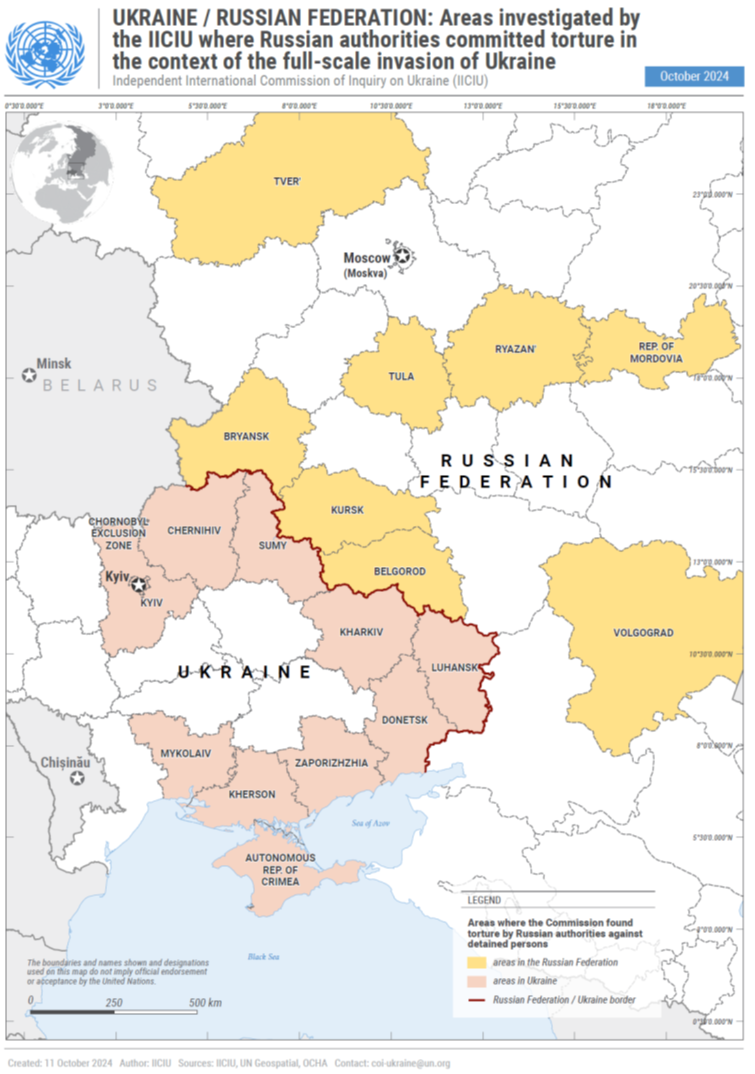
On 6 August 2024, a Ukrainian counteroffensive in the Kursk region of Russia saw, for the first time, ground combat occurring on Russian territory. The operation resulted in Ukraine taking control of a substantial part of the regions of Kursk and Belgorod.5O. Harmash and T. Balmforth, ‘Ukraine opens military office in occupied Kursk region, says it is still advancing’, Reuters, 15 August 2024. The Ukrainian action can be deemed to meet the requirements of necessity and proportionality in self-defence under the customary rules of jus ad bellum. The ICJ confirmed the application of these principles in Military and Paramilitary Activities in and against Nicaragua (Nicaragua v United States), Judgment (Merits), 27 June 1986, para 194; and Oil Platforms (Iran v United States), Judgment (Merits), 6 November 2003, paras 43 and 51. Russian efforts to regain control over the region intensified in late 2024 and early 2025. On 26 April 2025, Valery Gerasimov, the Chief of the General Staff of the Russian Armed Forces, reported to President Putin that Russian forces had re-established authority over the last populated area in Kursk occupied by Ukrainian forces and that a ‘security zone’ had been created in the Sumy region of Ukraine.6President of Russia, ‘Meeting with Chief of the General Staff of the Russian Armed Forces Valery Gerasimov’, 26 April 2025.
From October 2024, troops from the Democratic People’s Republic of Korea (North Korea) sent to Kursk were undergoing training before deployment on the battlefield. A number of videos on social media showed North Korean soldiers in Russian uniforms. In December 2024, reports of the capture of North Korean soldiers by Ukraine confirmed their combat role.7Agence France-Presse, ‘Ukraine Captured North Korean Soldier Fighting Alongside Russia, South Korea Says’, The Moscow Times, 27 December 2024; ‘What we know about North Korean troops fighting Russia’s war’, BBC, 24 December 2024. On 26 April 2025, in a meeting with President Putin, General Gerasimov underlined the role played in Kursk by North Korean troops.8President of Russia, ‘Meeting with Chief of the General Staff of the Russian Armed Forces Valery Gerasimov’, 26 April 2025. A report from the State-run North Korean Central News Agency the same day confirmed this.9Cited in N. Pasko, ‘Why Did Pyongyang and Moscow Finally Admit North Koreans Are Fighting in the Russia-Ukraine War?’, The Diplomat, 8 May 2025.
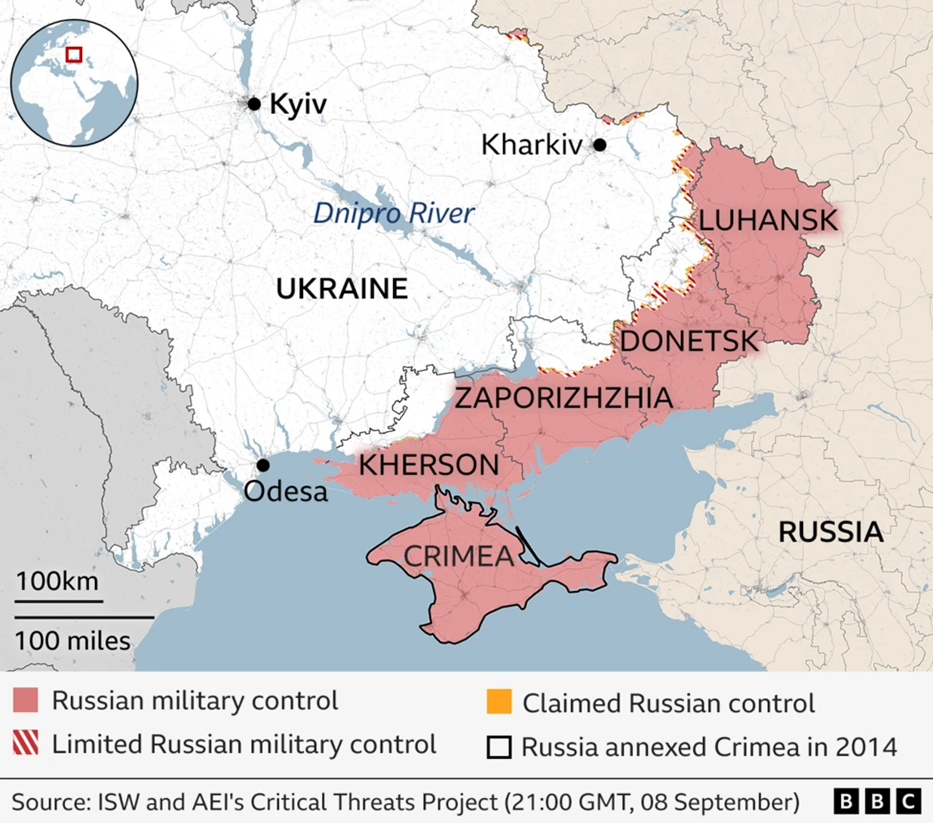
Already in 2014, Russia had been responsible for aggression against Ukraine for its seizure of Crimea and areas of the Donbas under separatist control. The European Court of Human Rights has held that Russia was directing separatist operations in Ukraine, and that, from 11 May onwards, those areas were under its effective control.10European Court of Human Rights, Ukraine and the Netherlands v Russia, Admissibility Decision (Grand Chamber), 30 November 2022, paras 693, 695; and Ukraine and the Netherlands v Russia, Judgment (Grand Chamber), 9 July 2025, para 331. This means Russia bears responsibility under international law for violations of international law perpetrated by its agents and organs in separatist regions of Ukraine.
Conflict Classification and Applicable Law
The armed conflict between Ukraine and the Russian Federation (supported by North Korea) is of an international character. The direct involvement of significant numbers of North Korean troops in the conflict is of a nature to make North Korea a co-belligerent alongside Russia. As noted, the sending of those troops to assist Russia has been acknowledged by both Russia and North Korea.
Each of the three States involved in the international armed conflict (IAC) is party to the four Geneva Conventions of 1949 and Additional Protocol I of 1977. All of these international humanitarian law (IHL) treaties apply to the IAC. Customary IHL also applies. This includes the two instances of belligerent occupation – Russia’s ongoing occupation of part of Ukraine, and, from August 2024 until April 2025, Ukraine’s occupation of part of Russia.11For a contrary view on the status of Ukraine’s military presence in Russia in the early stages of its operation, see M. W. Meier, ‘Ukraine Symposium – Is Ukraine Occupying Territory in Russia?’, Articles of War, Lieber Institute West Point, 26 August 2024.
Both Russia and Ukraine are party to the 1992 Chemical Weapons Convention.12Convention on the Prohibition of the Development, Production, Stockpiling, and Use of Chemical Weapons and on their Destruction; adopted at Geneva, 3 September 1992; entered into force, 29 April 1997 (1992 Chemical Weapons Convention). Russia is known to have used Novichok in the United Kingdom in 2018. ‘Statement by the Delegation of the United Kingdom of Great Britain and Northern Ireland to the OPCW at the Twenty-Fifth Session of the Conference of the States Parties under Agenda Item 9(D)’, OPCW, The Hague, 20 April 2021. North Korea is one of four States not party to the Chemical Weapons Convention.13North Korea is ‘known’ to have had a chemical weapons programme in the past and is said to possess adamsite (diphenylaminechlorarsine), a prohibited vomiting agent. James Martin Center for Nonproliferation Studies, ‘Chemical and Biological Weapons: Possession and Programs Past and Present’, Last updated March 2008, Monterey Institute of International Studies. Ukraine, but neither North Korea nor Russia, is a State Party to the 1997 Anti-Personnel Mine Ban Convention.14Convention on the Prohibition of the Use, Stockpiling, Production and Transfer of Anti-Personnel Mines and on their Destruction; adopted at Oslo, 18 September 1997; entered into force, 1 March 1999 (hereafter, 1997 Anti-Personnel Mine Ban Convention). Ukraine has attempted to illegally suspend its implementation of the 1997 Convention, an issue discussed below. None of the three States is a State Party to the 2008 Convention on Cluster Munitions.15Convention on Cluster Munitions; adopted at Dublin, 30 May 2008; entered into force, 1 August 2010.
Compliance with IHL
Overview
Widespread and systematic violations of IHL by Russia continued during the reporting period in the armed conflict with Ukraine. Aerial attacks on densely populated Ukrainian cities and towns, which sharply increased towards the middle of 2025, regularly violated the principle of distinction or at least the principle of proportionality in attack. Some of the attacks were indiscriminate while others involved precision weapons where the only reasonable conclusion is that the civilians and/or civilian objects were deliberately targeted. This is so, for instance, in the case of drone attacks in and around Kherson, discussed below.
Prisoners of war (POWs) continue to be the victims of war crimes. More than 106 Ukrainian soldiers were executed during the reporting period while in the hands of Russian forces.16Office of the UN High Commissioner for Human Rights (OHCHR), ‘Report on the Human Rights Situation in Ukraine, 1 December 2024–31 May 2025’, 30 June 2025, para 39. Others were summarily executed, or were tortured, subjected to sexual violence, and detained in inhumane conditions. POW status has been wrongfully denied to foreign nationals who were members of the Ukrainian Armed Forces. Some Ukrainian soldiers were prosecuted before Russian courts for participating in hostilities – in violation of combatants’ privilege under customary IHL – and invariably defendants were denied fundamental fair-trial rights.
Substantial and widespread violations of the laws of occupation continue to be committed by the Russian administration in occupied Ukraine. Large-scale expropriation is underway of homes purportedly ‘abandoned’ by Ukrainians who have fled occupied territory, which is typically the result of unlawful forced displacement.17International Committee of the Red Cross (ICRC), Customary IHL Rule 129A: ‘The Act of Displacement’. The houses are being allocated to Russian citizens to encourage them to move into the occupied territory, also a violation of IHL as States ‘may not deport or transfer parts of their own civilian population into a territory they occupy’.18ICRC, Customary IHL Rule 130: ‘Transfer of Own Civilian Population into Occupied Territory’. Ukrainians are being coerced into enlisting in the Russian Armed Forces.
Civilian Objects under Attack
Russia has systematically attacked civilian objects in Ukraine. Under customary IHL, attacks may only be directed against military objectives and must not be directed against civilian objects.19ICRC, Customary IHL Rule 7: ‘The Principle of Distinction between Civilian Objects and Military Objectives’. Special protection is afforded to medical units, such as hospitals and other medical facilities.20ICRC, Customary IHL Rule 28: ‘Medical Units’. Military objectives are those objects which, by their nature, location, purpose or use, make an effective contribution to military action.21ICRC, Customary IHL Rule 8: ‘Definition of Military Objectives’. In addition, the object’s partial or total destruction, capture, or neutralisation must offer a definite military advantage in the prevailing circumstances. Civilian objects are all objects that are not military objectives.22ICRC, Customary IHL Rule 9: ‘Definition of Civilian Objects’.
Attacks against civilian homes
Russian armed forces continued to fire explosive weapons into residential areas of Ukraine, using missiles and glide bombs23Glide bombs weighing 500 kg or 1,500 kg are said to be used ‘most often’. They carry sufficient explosive material to make a crater 15 metres across. Some larger bombs weigh 3,000 kg with at least 1,000 kg of high explosives, and can level a building with a single strike. S. Cranny-Evans, ‘Blood and dust: The rise of Russia’s glide bombs’, European Security and Defence, 15 July 2025; J. Hardie, ‘What we know about Russia’s new 3-ton glide bomb’, Long War Journal, Foundation for Defense of Democracies, 19 July 2024. as well as short-range unmanned aerial vehicles (armed drones). Glide bombs started to be used against the city of Zaporizhzhia in the summer of 2024, causing many civilian casualties, including eight who died after their apartment building was struck on 7 November 2024.24Donbas.Realities, ‘How Ukrainian Cities Were Wiped Out By Russian Glide Bombs And Artillery’, RFE/RL, 25 April 2025; OHCHR, ‘Report on the Human Rights Situation in Ukraine, 1 September–30 November 2024, 31 December 2024’, December 2024, para 25. Residential areas in Ukrainian cities far from the front lines were also subjected to heavy aerial attacks. Some of the deadliest incidents occurred on 8 July 2024, when Russian forces launched airstrikes on Kyiv, Dnipro, and Kryviy Rih, killing at least 43 civilians.25Office for Democratic Institutions and Human Rights of the Organization for Security and Co-operation in Europe (OSCE ODIHR), ‘Sixth Interim Report on Reported Violations of International Humanitarian Law and International Human Rights Law in Ukraine’, 13 December 2024, paras 24–25. The Russian military generally did not seek to justify the attacks as having targeted lawful military objectives.
On 4 September 2024, a Russian airstrike on Lviv is said to have killed seven people and damaged more than fifty civilian objects, including residential buildings, educational and medical facilities, and objects of cultural heritage. Lviv Mayor Andryi Sadovyi reported on Telegram that four members of the same family were among the dead: a 43-year-old mother and her three daughters aged seven, eighteen, and twenty-one years. Only their father survived.26Human Rights Watch, ‘Deadly Russian Attacks on Lviv’s Historic District’, 5 September 2024. On 1 February 2025, a Russian KH-22 missile hit an apartment building in Poltava, some 240 kilometres from the frontline, killing fifteen civilians. The missile is said to be accurate to within about 200 metres.27‘Russia is using its newest and oldest missiles indiscriminately against Ukraine’, Business Insider, 31 July 2022. This is the figure for 3 CEP, which is three times the ‘circular error probable’ of a weapon – the radius within which 95 per cent of munitions aimed at the same point are expected to land. 1 CEP is the radius in which around half of munitions aimed at the same point are expected to land. The Russian authorities claimed to be targeting energy infrastructure, but Human Rights Watch could identify no such targets, and the nearest conceivable military objective was said to be 700 metres away.28Human Rights Watch, ‘Ukraine: Escalating Russian Attacks on Civilians’, 22 May 2025. At the very least, munitions landing more than 400 metres away from a lawful military objective may be deemed to be indiscriminate attacks.29International Criminal Tribunal for the former Yugoslavia (ICTY), Prosecutor v Gotovina (Appeals Chamber) (Case No IT-06-90-A), ‘Application and Proposed Amicus Curiae Brief Concerning the 15 April 2011 Trial Chamber Judgment and Requesting that the Appeals Chamber Reconsider the Findings of Unlawful Artillery Attacks during Operation Storm’.
On 24 April 2025, Russian armed forces carried out one of the largest attacks on the Ukrainian capital since July 2024.30Human Rights Watch, ‘Ukraine: Escalating Russian Attacks on Civilians’. The combined attack, involving ballistic missiles and armed drones, targeted at least five residential neighbourhoods of Kyiv and caused severe damage to civilian infrastructure, killing at least twelve civilians and injuring ninety others.31OHCHR, ‘Ukraine: Protection of Civilians in Armed Conflict, April 2025’, 8 May 2025. On 17 June 2025, a Russian missile and drone attack killed 29 civilians and injured at least 152, with a direct strike on an apartment block in Kyiv causing the building to collapse.32OHCHR, ‘Ukraine: Protection of Civilians in Armed Conflict, June 2025 update’, p 2; S. Walker, P. Wintour and P. Sauer, ‘Russian missile and drone attack on Kyiv kills at least 16 people’, The Guardian, 17 June 2025.
Attacks against medical facilities
In IHL, medical facilities – whether civilian or military – are afforded a high level of protection against attack.33ICRC, Customary IHL Rule 28: ‘Medical Units’. On 8 July 2024, two civilians were killed and a further eighteen injured in Kyiv after a KH-101 cruise missile struck Okhmatdyt children’s hospital. Russian authorities sometimes accuse Ukraine of placing anti-missile defences and other military facilities in residential areas, but in this case, they claimed the damage to the hospital was caused by debris from Ukrainian anti-missile defence systems.34‘Russian military launched a group strike on Ukrainian targets’, RIA Novosti, 8 July 2024; Russian Ministry of Foreign Affairs, ‘Commentary by Russian Foreign Ministry Spokesperson M. V. Zakharova on Attempts by the Kiev Regime to Accuse Russia of Deliberate Attacks on Ukrainian Civilian Objects’, 9 July 2024. The day after the multiple strikes on Ukraine, Russian Foreign Ministry Spokesperson M. V. Zakharova thus declared that:
The Russian Armed Forces have launched a group strike with long-range precision weapons against military facilities in Ukraine. … The Kiev junta has long been using purely civilian enterprises for military purposes, turning them either into workshops for the assembly and repair of military equipment or into warehouses for the storage of Western military equipment. In addition, the Ukrainian armed forces are covering themselves with civilians and civilian facilities.35‘Commentary by Russian Foreign Ministry Spokesperson M. V. Zakharova on Attempts by the Kiev Regime to Accuse Russia of Deliberate Attacks on Ukrainian Civilian Objects’.
Although not every claim regarding the location of military facilities in residential areas can be confirmed – particularly in light of Ukrainian legislation prohibiting reporting on such matters36‘Zelensky Signs Law Restricting Distribution of Ukrainian Military Information’, Radio Free Europe, 28 March 2022. – this has certainly occurred in certain instances. That said, the Office of the UN High Commissioner for Human Rights (OHCHR) reported in this instance that based on ‘an immediate in-depth assessment of the impact site, witness accounts and videos, including footage of the missile hitting the hospital’, the strike on Okhmatdyt hospital ‘was likely due to a direct hit from a missile, and not from falling debris resulting from an air defense interception.’37OHCHR, ‘Report on the Human Rights Situation in Ukraine, 1 June–31 August 2024’, 1 October 2024, paras 84–86. The KH-101 cruise missile is said to be accurate to within twenty metres of its designated target.38Federation of American Scientists, ‘Kh-65/Kh-SD Kh-101’; Missile Threat, ‘Kh-101/Kh-102’, Last updated 23 April 2024, Center for International & Strategic Studies. The strikes of 8 July also significantly damaged the Center for Children’s Cardiology and Cardiac Surgery as well as a medical centre with two clinics in Kyiv, and a private medical clinic in Kryvyi Rih.39OHCHR, ‘Report on the Human Rights Situation in Ukraine, 1 June–31 August 2024’, para 86. These strikes would appear to constitute war crimes.
On 19 March 2025, a hospital in Krasnopillia, Sumy region, was targeted by Russian forces using loitering munitions (a form of autonomous weapons system) on five successive occasions, which is highly suggestive of deliberate targeting of a hospital, again indicating that a war crime may have been committed.40OHCHR, ‘Report on the Human Rights Situation in Ukraine, 1 December 2024–31 May 2025’, para 25. Direct criminal responsibility would potentially lie both with the commander who directed the attack and any weapons programmer who included a hospital as a possible target.
Attacks against power plants
Russia has made the targeting of Ukrainian electricity-generating plants a feature of its warfare. Some are being used to generate power for the Ukrainian military, which means they are a lawful object of attack, but in such cases, the principle of proportionality in attack demands that the expected civilian harm not be excessive when compared to the anticipated military advantage.41ICRC, Customary IHL Rule 14: ‘Proportionality in Attack’. More broadly, the destruction of objects indispensable to the survival of the civilian population is unlawful.42ICRC, Customary IHL Rule 54: ‘Attacks against Objects Indispensable to the Survival of the Civilian Population’.
Continued Russian attacks on Ukraine’s energy infrastructure have disrupted access to services indispensable to the survival of the civilian population especially during the winter. In December 2024 to May 2025, OHCHR recorded 115 attacks on energy infrastructure, with 91 directed at territory controlled by Ukraine.43OHCHR, ‘Report on the Human Rights Situation in Ukraine, 1 December 2024–31 May 2025’, para 27. On 26 August 2024, more than 100 missiles and munitions fired from drones damaged at least twenty-five energy facilities across fifteen Ukrainian regions, including the Kyiv Hydroelectric Power Plant.This attack, which killed seven civilians and injured twenty-three others, led to nationwide blackouts.44A. Kryzhnyi,‘Russians Hit Kyiv Hydroelectric Power Plant, Damage Reported’, Ukrainska Pravda, 26 August 2024; OSCE ODIHR, ‘Sixth Interim Report on Reported Violations of International Humanitarian Law and International Human Rights Law in Ukraine’, para 27. Attacks on dams are specifically restricted under IHL, which requires that particular care be taken to avoid the release of dangerous forces and consequent severe losses among the civilian population.45Arts 56(1) and (3), Additional Protocol I of 1977; ICRC, Customary IHL Rule 42: ‘Works and Installations Containing Dangerous Forces’.
On 17 November 2024, Russian forces conducted widespread attacks on energy infrastructure in multiple regions of Ukraine, some of which endangered nuclear safety.46International Atomic Energy Agency (IAEA), ‘Update 260 – IAEA Director General Statement on Situation in Ukraine’, 17 November 2024. A further attack on 28 November caused widespread emergency power outages, leaving millions of households without electricity.47S. Walker and P. Sauer, ‘Putin threatens Ukraine’s “decision-making centres” with new ballistic missile’,The Guardian, 28 November 2024. Further attacks involving multiple locations throughout Ukraine took place on 13 and 25 December, 15 January, and 7 March 2025.48OHCHR, ‘Report on the Human Rights Situation in Ukraine, 1 December 2024–31 May 2025’, para 28.
In March 2025, discussions concerning a potential ‘energy ceasefire’ were initiated, with an informal moratorium on attacks coming into effect on 25 March 2025.49‘Ukraine accuses Russia of attacking its energy infrastructure 30 times since March’, Reuters, 16 April 2025. These agreements do not affect the binding obligations of the parties under the Geneva Conventions and Additional Protocol I, which prohibits attacks against objects indispensable to the survival of the civilian population. Following the ‘energy ceasefire’, both sides accused the other of breaching the arrangement.50‘Russia and Ukraine trade new accusations on breaches of energy truce’, Reuters, 2 April 2025; ‘Russia and Ukraine accuse each other of failing to pause strikes after US envoy leaves Moscow’, Associated Press, 13 April 2025.
The International Criminal Court (ICC) has issued warrants of arrest in relation to earlier attacks against energy infrastructure. On 5 March 2024, warrants were issued for Sergei Ivanovich Kobylash, a Lieutenant General in the Russian Armed Forces who at the relevant time was the Commander of the Long-Range Aviation of the Aerospace Force, and Viktor Nikolayevich Sokolov, an admiral in the Russian Navy, who was the Commander of the Black Sea Fleet. An ICC Pre-Trial Chamber found reasonable grounds to believe that each bears responsibility for the war crimes of directing attacks at civilian objects and of causing excessive incidental harm to civilians or damage to civilian objects, as well as for the crime against humanity of inhumane acts.51ICC, ‘Ukraine: Situation in Ukraine’, accessed 20 September 2025 at http://bit.ly/3Ix1uB0. The Pre-Trial Chamber stated that the two suspects could bear responsibility for missile strikes carried out by the forces under their command against the Ukrainian electric infrastructure from at least 10 October 2022 until at least 9 March 2023. During this time-frame, there was an alleged campaign of strikes against numerous electric power plants and sub-stations, which were carried out by the Russian armed forces in multiple locations in Ukraine.52ICC, ‘Situation in Ukraine: ICC judges issue arrest warrants against Sergei Ivanovich Kobylash and Viktor Nikolayevich Sokolov’, Press release, 5 March 2024.
Ukraine has also targeted Russian energy supplies and infrastructure on Russian territory and was ramping up these attacks at time of writing. Strikes have seemingly targeted fuel supply for civilian use rather than diesel production, which is predominantly used by the Russian military. This would indicate a violation of the IHL principle of distinction, or at least of the principle of proportionality in attack. It was reported in October 2025 that 21 of Russia’s 38 large refineries had been hit since January, with successful attacks said to be 48 per cent higher than the whole of 2024.53O. Robinson, M. Murphy, and Y. Kiryukhina, ‘Surge in Ukrainian attacks on oil refineries sparks Russian fuel shortages’, BBC News, 2 October 2025.
Ukrainian President Volodymyr Zelensky has said while Kyiv is not seeking to kill ordinary Russians, they ‘must understand the price’ of Putin’s war. These comments, which came the day before a series of Ukrainian attacks on Russian energy plants and resources, indicated a deliberate targeting of civilian infrastructure according to Memorial, a Russian human rights group banned by the Kremlin.54M. Bennetts, ‘Russian civilian deaths mount as Putin’s war in Ukraine hits home’, The Times, 12 October 2025.
Attacks against cultural property
Cultural property, and sites of national significance, continued to be severely damaged and destroyed by Russian armed forces during the reporting period. As of 25 June 2025, the United Nations Educational, Scientific and Cultural Organization (UNESCO) had verified damage to 501 sites of cultural importance since 24 February 2022.55UNESCO, ‘Damaged cultural sites in Ukraine verified by UNESCO’, 16 April 2025. Among these are ‘149 religious sites, 257 buildings of historical and/or artistic interest, 34 museums, 33 monuments, 18 libraries, 1 archive and 2 archaeological sites’. On 29 October 2024, the historic building of Derzhprom in Kharkiv56UNESCO, ‘Derzhprom (the State Industry Building)’. The building is on the ‘Tentative List’ provided by Ukraine.– the first modern skyscraper in the Soviet Union upon its completion in 1928 – was struck with an FAB-500 (500 kg) bomb, prompting the launch of a UNESCO special monitoring mechanism.57L. Harding, ‘Kharkiv residents describe “pure horror” after Russian attack on historic building’, The Guardian, 29 October 2024; UNESCO, ‘Damaged cultural sites in Ukraine verified by UNESCO’, 16 April 2025. In Odesa, strikes on 14 November 2024 and 31 January 2025 involving ballistic missiles severely damaged many buildings within the UNESCO heritage area.58‘Russian Missile Attack Seriously Damages Historic Centre of Ukraine’s Odesa’, Reuters, 1 February 2025; UNESCO, ‘Odesa: UNESCO Condemns Strikes on World Heritage Site’, 18 November 2024. These attacks appear to violate the prohibition of attacks against cultural objects and places of worship in Additional Protocol I,59Art 53(a), Additional Protocol I. the Hague Convention on the Protection of Cultural Property of 1956,60Art 4(1), Convention for the Protection of Cultural Property in the Event of Armed Conflict; adopted at The Hague, 14 May 1954; entered into force, 7 August 1956. Both Russia and Ukraine are party to the 1954 Convention. and customary IHL.61ICRC, Customary IHL Rule 38: ‘Attacks Against Cultural Property’.
Civilians under Attack
OHCHR recorded that between 1 July 2024 and 30 June 2025, at least 2,245 Ukrainian civilians were killed and 11,353 injured in the armed conflict, most as a result of Russian aerial attacks.62OHCHR, ‘Report on the Human Rights Situation in Ukraine, 1 December 2024–31 May 2025’, p 4; OHCHR, ‘Ukraine: Protection of civilians in armed conflict, June 2025 update’, p 1. This is a significant increase in the number of recorded casualties from the previous reporting period, in which 1,828 civilian deaths and 6,634 injuries were recorded.63OHCHR, ‘Report on the Human Rights Situation in Ukraine, 1 December 2024–31 May 2025’, p 4. The month of June 2025 marked a substantial intensification of attacks, resulting in the highest recorded total of civilian deaths in a single month – 232 – since the opening months of the war.64OHCHR, ‘Ukraine: Protection of civilians in armed conflict, June 2025 update’, p 1.
Russian authorities have reported Ukrainian attacks resulting in civilian casualties in both occupied Ukraine and Russia, which amounted to five per cent of total civilian deaths in the war during the period from December 2024 to May 2025.65OHCHR, ‘Report on the Human Rights Situation in Ukraine, 1 December 2024–31 May 2025’, para 11; OSCE ODIHR, ‘Sixth Interim Report on Reported Violations of International Humanitarian Law and International Human Rights Law in Ukraine’, paras 30–31. Most of the reported incidents were linked to the Ukrainian operation in Kursk. Between 6 and 24 August 2024, Russian authorities claimed twelve civilian deaths were caused by Ukrainian forces, and by early October 2024, this number had increased to seventy.66OHCHR, ‘Report on the Human Rights Situation in Ukraine, 1 June–31 August 2024’, para 76; OSCE ODIHR, ‘Sixth Interim Report on Reported Violations of International Humanitarian Law and International Human Rights Law in Ukraine’, para 32. The Office for Democratic Institutions and Human Rights of the Organization for Security and Co-operation in Europe (OSCE ODIHR) said it was unable to verify reported casualty figures from incidents in Kursk region.67OSCE ODIHR, ‘Sixth Interim Report on Reported Violations of International Humanitarian Law and International Human Rights Law in Ukraine’, para 30, note 57. Outside Kursk, Russian authorities reported five civilians killed and forty-six injured in an aerial attack on the city of Belgorod in Russia.68The governor of the Belgorod region, Vyacheslav Gladkov, claimed that ‘the Ukrainian armed forces fired cluster munitions from Vampire MLRS’, ‘Death toll in AFU attack on Belgorod rises to five’, TASS, 30 August 2024. Some ostensibly reliable Ukrainian sources published reports on the incident, acknowledging the deaths of five civilians. See eg: ‘In the Russian city of Belgorod, as a result of the shelling, five people died, 37 people were injured – official’, Radio Liberty, 30 August 2024. On 13 August 2024, Russian sources reported that the shelling of a bus in Russian-controlled Lysychansk in Luhansk region had killed two civilians and injured thirty-one others.69OSCE ODIHR, ‘Sixth Interim Report on Reported Violations of International Humanitarian Law and International Human Rights Law in Ukraine’, paras 30–31.
Attacks against medical personnel
First responders were killed on a number of occasions as a result of ‘double tap’ attacks, in which an attack takes place after medical personnel and others rendering assistance arrive at the scene of an initial attack. One research group identified thirty-six such attacks by Russian forces in 2024.70Truth Hounds, ‘Cruelty Cascade: Examining the Pattern of Russian Double-Tap Strikes in Ukraine’, 17 December 2024: ‘confirmation of the strike location, an interval of at least five minutes to several hours between strikes in the same area – depending on the context of the attack – and verification of the arrival of first responders’.
In addition to the hospital incident in Sumy described above, on 13 July 2024, an initial 9M723 ‘Iskander’ missile strike on railway infrastructure in Budy, Kharkiv region, was followed by a second missile strike, killing a rescuer and a police officer and injuring twenty-five other civilians.71OHCHR, ‘Ukraine: Protection of Civilians in Armed Conflict, July 2024’, 9 August 2025; OHCHR, ‘Treatment of Prisoners of War and Update on the Human Rights Situation in Ukraine, 1 June–31 August 2024’, paras 87–88. On 6 June, a series of Russian airstrikes injured twenty-four emergency workers, in addition to killing six civilians and injuring twenty-nine others.72OHCHR, ‘Ukraine: Protection of Civilians in Armed Conflict, June 2025 update’. See also T. Peter, A Voitenko, and A. Malenko, ’Six killed, 80 wounded in intense Russian air attacks on Ukraine’, Reuters, 7 June 2025. The sequencing of attacks indicates an attempt to target persons rendering assistance, including medical personnel, or those who are hors de combat, both of which are serious violations of IHL.73Art 50, Geneva Convention I; Art 147, Geneva Convention IV; Art 85(3)(e), Additional Protocol I; ICRC, Customary IHL Rule 156: ‘Definition of War Crimes’.
Clearly-marked ambulances were targeted by drones in Kherson in circumstances where the operators could not have failed to appreciate the nature of the target. Some ambulances were destroyed. These attacks, and the near-constant threat of drone deployment in Kherson, made it difficult for ambulances to promptly assist seriously wounded civilians.Independent International Commission of Inquiry on Ukraine (UN Commission of Inquiry on Ukraine), 74‘“They are hunting us”: systematic drone attacks targeting civilians in Kherson’, Report, UN Doc A/HRC/59/CRP.2, 28 May 2025, paras 36–40. There is thus prima facie evidence that Russia has violated the special protections to which these objects and their personnel are entitled under IHL.
Russian use of chemical weapons
Russia has used prohibited chemical weapons in the conduct of hostilities against Ukraine. During the reporting period, three consecutive technical assistance reports by the Organisation for the Prohibition of Chemical Weapons (OPCW) confirmed the presence of CS gas75The active ingredient in CS gas is 2-2-Chlorobenzalmalononitrile. – a riot-control agent whose use is prohibited as a method of warfare under the 1992 Chemical Weapons Convention76Art I(5), 1992 Chemical Weapons Convention. See also ICRC, Customary IHL Rule 75: ‘Riot Control Agents’. – in multiple battlefield samples in Ukraine.77OPCW Technical Secretariat, ‘Report of the OPCW Technical Assistance Visit on the Activities Carried out in Support of a Request by Ukraine (Technical Assistance Visit TAV/04/24)’, Note S/2338/2024, 18 November 2024; ‘Report of the OPCW Technical Assistance Visit on the Activities Carried out in Support of a Request by Ukraine (Technical Assistance Visit TAV/05/24 and TAV/01/25)’, Note S/2370/2025, 14 February 2025; and ‘Report of the OPCW Technical Assistance Visit on the Activities Carried out in Support of a Request by Ukraine (Technical Assistance Visit TAV/02/25 and TAV/03/25)’, Note S/2415/2025, 20 June 2025. While the OPCW does not attribute responsibility, the circumstances clearly indicate these chemical agents were deployed by Russian forces. Ukraine has accused Russia of using tear gas to clear trenches and has reported more than one thousand such incidents since the beginning of the invasion.78‘Ukraine says Russia steps up illegal use of tear gas to clear trenches’, Reuters, 17 April 2024.
There have also been credible – but as yet unconfirmed – allegations that Russian forces have used a toxic chemical, chloropicrin, as a method of warfare.79‘Russian use of chemical weapons against Ukraine “widespread”, Dutch defence minister says’, Reuters, 4 July 2025. Chloropicrin is a pesticide that was used as a chemical weapon in World War I as a vomiting agent.80‘Chloropicrin’, Science Direct, accessed 21 September 2025. Listed in Schedule 3 of the 1992 Chemical Weapons Convention,81OPCW, ‘Annex on Chemicals: Schedule 3 its use is comprehensively prohibited in warfare. Moreover, if confirmed, its use by any armed force in the conduct of hostilities would be a war crime.82ICRC, Customary IHL Rule 74: ‘Chemical Weapons’; and Customary IHL Rule 156: ‘Definition of War Crimes’; Art 8(2)(b)(xviii), Rome Statute of the International Criminal Court; adopted at Rome, 17 July 1998; entered into force, 1 July 2002.
Use of armed drones
Armed drones are subject to the ordinary rules on targeting under IHL. There has been a significant increase in the use of aerial drones targeting Ukrainian civilians, killing 207 and injuring 1,365 between December 2024 and May 2025.83OHCHR, Report on the Human Rights Situation in Ukraine, 1 December 2024–31 May 2025, para 27. Around 70 per cent of these casualties occurred in Kherson.84OHCHR, ‘Report on the Human Rights Situation in Ukraine, 1 September to 30 November 2024’, 31 December 2024, para 26. The circumstances of the attacks leave no doubt that their operators knew the targets they fired upon were civilian: many of the drones are equipped with cameras permitting target sighting in real time, and video footage from these cameras has been widely disseminated online by the perpetrators, especially on social media site Telegram.85UN Commission of Inquiry on Ukraine, ‘“They are hunting us”’, para 18. Russians involved in these operations boast on social media that their targets are ‘anyone or anything that moves’.86Ibid, paras 11, 19-20; E. Graham-Harrison and A. Mazhulin, ‘Small and lethal: adapted drones carrying explosives ‘hunt’ civilians in Kherson’, The Guardian, 18 October 2024; C. Miller, S. Joiner, and I. de la Torre Arenas, ‘Russia uses civilians as “target practice” for killer drones’, Financial Times, 4 December 2024.
The videos confirm eyewitness reports that civilians are ‘hunted’ and targeted deliberately, whether in vehicles (such as cars, buses, ambulances, fire trucks, or in humanitarian convoys) or just standing or walking outside.87UN Commission of Inquiry on Ukraine, ‘“They are hunting us”’, paras 8–40; Centre for Information Resilience, ‘Russia Escalates Drone-Dropped Munitions Use in Kherson, Ukraine, July to 21 October 2024’, Report, 3 December 2024, pp 5–14. Civilians reported feeling terrorized, often staying indoors out of fear of these attacks. Indeed, residents appear to be fleeing from Kherson as a result.88Miller, Joiner, and de la Torre Arenas, ‘Russia uses civilians as “target practice” for killer drones’; UN Commission of Inquiry on Ukraine, ‘“They are hunting us”’, paras 13, 47–48, 57.
These incidents are indicative of deliberate and systematic targeting of the civilian population of Kherson, of individual civilians, of medical personnel and humanitarian workers, and of civilian objects, all serious violations of IHL. The persistent nature of these attacks strongly indicates that their primary purpose is to spread terror among the civilian population, which is also a serious violation of IHL.89Art 51(2), Additional Protocol I. The International Criminal Tribunal for the former Yugoslavia (ICTY) determined that a serious violation of this rule is a war crime under customary international law.90ICTY, Prosecutor v Galić, Judgment (Appeals Chamber) (Case No IT-98–29-A), 30 November 2006, paras 86–98. See similarly, eg, International Residual Mechanism for Criminal Tribunals, Prosecutor v Ratko Mladic, Judgment (Appeals Chamber) (Case No MICT-13–56-A), 8 June 2021, para 287. In addition, some of the videos, and especially their graphic nature, combined with taunting or threatening remarks by those posting them, violate the IHL prohibition against outrages upon personal dignity.91UN Commission of Inquiry on Ukraine, ‘“They are hunting us”’, paras 54–57. ICRC, Customary IHL Rule 87: ‘Humane Treatment’; and Rule 90: ‘Torture and Cruel, Inhuman or Degrading Treatment’; Art 75(2), Additional Protocol I; Art 27, Geneva Convention IV. Similar – albeit less systematic – Russian drone attacks targeting civilians occurred in other regions of Ukraine during the reporting period, particularly in areas close to the frontlines in the regions of Donetsk, Kharkiv, Sumy, and Zaporizhzhia. Attacks included a drone strike on a convoy evacuating civilians near Kostyantynivka in Donetsk on Easter Sunday 2025, followed by a strike on the same convoy by a drone equipped with rocket-propelled grenades. On 23 April 2025, a drone strike on a shuttle bus in Marhanets, Dnipropetrovsk region killed nine civilians employed at the Marhanets Mining and Processing Plant. On 17 May 2025, a drone strike on a minibus evacuating civilians from Bilopillia, Sumy region killed nine.92United Nations Ukraine, ‘Sustained large-scale attacks by Russian armed forces kill and injure civilians across Ukraine in April’, Press release, 24 April 2025; Reuters, ‘Russia Drone Strike Kills Nine in Wave of Attacks on Ukraine’s Infrastructure’, The Guardian, 23 April, 2025; P. Beaumont, ‘Zelenskyy calls for tougher Moscow sanctions after deadly Russian strike on bus’, The Guardian, 17 May 2025; J. Lukiv, ‘Nine killed in Russian strike on civilian bus in Ukraine’, BBC, 17 May 2025. None of these strikes is believed to have targeted a lawful military objective.
Use of cluster munitions
As noted, neither Russia nor Ukraine is a State Party to the 2008 Convention on Cluster Munitions and use of the weapons is not prohibited under customary IHL. Nevertheless, use of cluster munitions may violate the prohibition against indiscriminate attacks, especially when fired or dropped into populated areas. Several instances of use of cluster munitions in urban areas were documented during the reporting period.93The ACLED dataset categorized 16 incidents between 1 July 2024 and 2 May 2025 as involving use of cluster munitions. ACLED also lists 10 incidents of alleged use of cluster munition by Ukrainian forces, which caused harm to civilians, but these include reports by the Russian state news agency TASS and the press service of the so-called ‘Donetsk People’s Republic’ Armed Forces. On 7 March 2025, Russian forces targeted Dobropillia in Donetsk region with a range of munitions, including rockets from a multiple-rocket launch system carrying cluster munitions. OHCHR further concluded that the attack as a whole (including other unitary munitions) killed eleven civilians and injured forty-seven.94OHCHR, ‘Report on the Human Rights Situation in Ukraine, 1 December 2024–31 May 2025’, para 39. The attack may well have been indiscriminate in nature.
A Russian attack on Kryvyi Rih on 4 April 2025, which killed at least twenty people, including nine children, is similarly thought to have involved cluster munitions. The bombing caused the largest verified killing of children in a single attack since 24 February 2022.95OHCHR, ‘Sustained Large-Scale Attacks by Russian Armed Forces Kill and Injure Civilians across Ukraine in April’, 24 April 2025. The Russian military asserted that Ukrainian commanders were meeting with western military advisors in the restaurant at the time.96‘The Ukrainian Armed Forces lost up to 85 military personnel and foreign officers in the attack on Kryvyi Rih’, TASS,4 April 2025. No independent reporting confirms this claim; on the contrary, contemporaneous reporting and video footage does not suggest a large number – or perhaps any – combatants were present among the many civilians in the restaurant at that time.97G. Cragg, ‘Frappe russe sur la ville natale de Zelensky : des images contredisent la version de Moscou’, France 24, 7 April 2025; Human Rights Watch, ‘Ukraine: Escalating Russian Attacks on Civilians,’ 22 May 2025. Two weeks later, an attack on Kharkiv, which seemingly involved cluster munitions delivered from a ground-launched cruise missile (the Iskander 9M727),98On this munition, see eg ‘Not a Shahed but a 9M727 Iskander Cruise Missile Strikes Ukraine’s Cabinet of Ministers Building’, Defense Express, 9 September 2025. killed one civilian and injured more than one hundred others.99V. Melkozerova, ‘Russia wounds over 100 with new cluster supersonic missile on Ukraine’s Kharkiv’, Politico, 18 April 2025.
Use of anti-personnel mines
Ukraine is a State Party to the 1997 Anti-Personnel Mine Ban Convention, which prohibits its forces from using anti-personnel mines ‘under any circumstances’ – even when confronted with aggression.100Art 1, 1997 Anti-Personnel Mine Ban Convention. S. Casey-Maslen, The Anti-Personnel Mine Ban Convention: A Commentary, Third Edn, Oxford University Press, Oxford, 2023, para 1.10. Since the summer of 2022, however, Ukraine has been frequently using anti-personnel mines.101Ukraine entry in Mine Action Review, Clearing the Mines 2025, Norwegian People’s Aid, London, November 2025, pp 427, 434. In November 2024, Ukraine made it known that it would be importing anti-personnel mines from the United States – another serious violation of this disarmament treaty.102Human Rights Watch, ‘Q&A: US Antipersonnel Landmine Transfers’, 13 December 2024; Post by President Zelensky on ‘X’, 20 November 2024; B. de Vries, ‘Anti-personnel landmines in Ukraine: A worrying escalation’, EJIL: Talk!, 5 December 2024. In July 2025, Ukraine informed the depositary of the Convention (the UN Secretary-General) that it had ‘decided, as of July 17, 2025, to suspend the operation’ of the Anti-Personnel Mine Ban Convention.103Communication by the Government of Ukraine, UN Doc C.N.385.2025.TREATIES-XXVI-5 of 21 July 2025, at: https://bit.ly/3J7ZD5D. This is a disguised reservation to the 1997 Convention’s application to Ukraine but, as all reservations to its provisions are prohibited,104Art 19, 1997 Anti-Personnel Mine Ban Convention. the claimed suspension of the Convention was and remains without valid effect under international law.105‘Nullity of an invalid reservation’, para 4.5.1, in International Law Commission (ILC), ‘Guide to Practice on Reservations to Treaties’, adopted by the ILC at its sixty-third session, in 2011, and submitted to the UN General Assembly, UN Doc A/66/10, 2011.
Following the declaration of suspension, the President of the Twenty-Second Meeting of States Parties of the Convention, Ambassador Tomiko Ichikawa of Japan, issued a statement, declaring: ‘Taking into account the special circumstances surrounding Ukraine, I will continue my engagement to clarify the situation in relation to the relevant provisions of the Convention and other rules of international law relevant to this matter.’106‘Treaty President on the Statement by Ukraine to “suspend” operation of the Convention’, 31 July 2025. The issue was addressed at the Twenty-Second Meeting of States Parties of the Convention, whose final report stated that: ‘The Meeting affirmed that the Convention does not allow the suspension of its operation and consequently its obligations. The Meeting called upon Ukraine, as a State Party, to further engage within the framework of the Convention.’107Final Report of the 22MSP of the Anti-Personnel Mine Ban Convention, APMBC Doc APLC/MSP.22/2025/, December 2025, para 50. Previously, at least four States Parties to the APMBC – Austria, Belgium, Norway, and Switzerland – had submitted formal objections to Ukraine’s attempted suspension to the UN Secretary-General. In addition, France submitted a declaration on the topic. Ukraine entry in Mine Action Review, Clearing the Mines 2025, p 463. Ukraine thus remains in serious violation of the Anti-Personnel Mine Ban Convention.
Russia, which is not a State Party to the 1997 Convention, has made massive use of anti-personnel mines, making Ukraine one of the world’s most heavily mined nations.108Ibid, p 430. As of December 2024, according to Ukraine’s Ministry of Health, at least 50,000 Ukrainians – soldiers and civilians – had lost limbs since the February 2022 invasion. Many of the tens of thousands of amputations among Ukrainians have been caused by landmines (although gunshot wounds and bombings would also be a frequent cause). Olga Rudnieva, the head and co-founder of the ‘Superhumans Center’, said: ‘Some people have double, triple, quadruple amputations. All these people will need prosthetics, or some will use wheelchairs.’ Many amputations are the result of delays in evacuation from the battlefield with incoming fire often so intense that it may take many hours to get a wounded soldier to hospital. With more than one million people on the front line, Ms Rudnieva said that Ukraine will become ‘the country of people with disabilities’.109Z. Bezpiatchuk and A. Gribanova, ‘The woman helping amputees rebuild their lives in war-torn Ukraine’, BBC, 10 December 2024.
Protection of Persons in the Power of the Enemy
Treatment of prisoners of war
Ukrainian prisoners of war have been systematically violated and abused by Russian forces. Many have been murdered. OHCHR recorded credible allegations of the execution of 106 Ukrainian soldiers captured by Russian forces between late August 2024 and May 2025.110OHCHR, ‘Report on the Human Rights Situation in Ukraine, 1 December 2024–31 May 2025’, paras 39–40; OHCHR, ‘Ukraine: Alarming Rise in Executions of Captured Ukrainian Military Personnel’, 3 February 2025; OSCE ODIHR, ‘Sixth Interim Report on Reported Violations of International Humanitarian Law and International Human Rights Law in Ukraine’, para 92. The most notorious incident was recorded on video and verified by multiple independent analysts. It involved ten captured Ukrainian soldiers lined up and executed by automatic rifle fire by their Russian captors in September 2024 near Mykolaivka village in Donetsk.111OHCHR,‘41st Periodic Report on the Human Rights Situation in Ukraine, 1 September–30 November 2024’, 31 December 2024, para 49. These exactions coincided with express exhortations on Telegram to execute prisoners by former Russian President Dmitry Medvedev (‘They have no right to live. Execute, execute, execute’)112http://bit.ly/492vPSP. and Chechen leader Ramzan Kadyrov (‘Today, I instructed frontline commanders to take no prisoners’).113http://bit.ly/4qgs0zW. Russian soldiers also reportedly received orders to take no prisoners.114UN Commission of Inquiry on Ukraine, ‘Report of the Independent International Commission of Inquiry on Ukraine’, UN Doc A/HRC/58/67, 11 March 2025, paras 60–63. Orders to deny quarter are serious violations of IHL and war crimes under customary law.115Art 40, Additional Protocol I; ICRC, Customary IHL Rule 46:‘Orders or Threats that No Quarter Will Be Given’; and Rule 156: ‘Definition of War Crimes’.
OHCHR recorded one credible allegation of execution of a Russian POW by Ukrainian forces during the reporting period.116OHCHR, ‘Report on the Human Rights Situation in Ukraine, 1 December 2024–31 May 2025’, para 47.
Combatants have also been targeted while hors de combat. Multiple reports document cases of manifestly incapacitated and unarmed Russian and Ukrainian soldiers being targeted by drone strikes or shot at close range. Videos of these incidents are then shared on social media platforms – usually Telegram – glorifying the conduct, often edited with music and accompanied by discriminatory commentary.117UN Commission of Inquiry on Ukraine, ‘Report of the Independent International Commission of Inquiry on Ukraine’, UN Doc A/HRC/58/67, paras 64–68; OHCHR, ‘41st Periodic Report on the Human Rights Situation in Ukraine, 1 September–30 November 2024’, para 42; ‘Moscow investigates Ukrainian video showing shooting of wounded Russian soldier’, Reuters, 16 July 2024. Deliberately attacking a person who is hors de combat is a serious violation of IHL. The videos may also constitute outrages upon personal dignity.118Art 12, Geneva Convention I; Arts 41 and 85(3)(e), Additional Protocol I; ICRC, Customary IHL Rule 47: ‘Attacks against Persons Hors de Combat’; Art 75(2), Additional Protocol I; ICRC, Customary IHL Rule 90: ‘Torture and Cruel, Inhuman or Degrading Treatment’.
Torture and inhumane treatment
Torture and inhumane treatment continue to be systematically inflicted on Ukrainian POWs and other Ukrainian detainees by Russian authorities. The forms of torture, which have been extensively described by those subsequently released from Russian custody, include sexual violence, electric shocks, suffocation, strangulation, sleep deprivation, ‘welcome beatings’ (‘priyomka’), and extended periods in stress positions, excessively intense physical exercise, dog attacks, threats of violence or death, and mock executions. Deaths arising from this torture and deprivation of medical treatment have been reported.
The purposes of torture include extracting strategic or military intelligence, punishing those loyal to Ukraine or who are Ukrainian, and warning and instilling fear among Ukrainians. The extent and systematic nature of torture leads to the conclusion that it is being applied as a matter of State policy, a reality consistent with certain statements by Russian officials.119OSCE ODIHR, ‘Sixth Interim Report on Reported Violations of International Humanitarian Law and International Human Rights Law in Ukraine’, paras 72–74; A. Edwards, ‘I’ve Seen How Russia is Torturing Prisoners of War, and it’s Horrifying’, The New York Times, 7 August 2025; ‘Report of the Independent International Commission of Inquiry on Ukraine’, UN Doc A/79/549, 29 October 2024, paras 74–78; T. Grove, ‘Be Cruel’: Inside Russia’s Torture System for Ukrainian POWs’, The Wall Street Journal, 10 February 2025. The commission of acts of terror against persons within the power of a party to an armed conflict is a serious violation of IHL and a war crime.120Special Court for Sierra Leone, Prosecutor v Charles Ghankay Taylor, Judgment (Trial Chamber) (Case No SCSL-03–01-T), 18 May 2012, para 402 and note 994.
Credible reports record instances of rape, threats of rape and castration, electric shocks on genitals, forced nudity, and beatings while nude. Both male and female POWs are affected. Female POWs were subjected to degrading treatment in the form of forced nudity and acts of humiliation.Sexual violence against POWs is explicitly prohibited under IHL, with special protection afforded to female POWs.121OHCHR, 41st Periodic Report on the Human Rights Situation in Ukraine, 1 September–30 November 2024, paras 47-48; Art 14, Geneva Convention III; Art 76(1), Additional Protocol I; ICRC, Customary IHL Rule 93: ‘Rape and Other forms of Sexual Violence’; ICRC, Customary IHL Rule 156: ‘Definition of War Crimes’.
Degrading treatment is commonplace, including being forced to recite the Russian national anthem and being subjected to insults and derogatory remarks about Ukraine. Furthermore, Russia has permitted and at times facilitated access to detention facilities by interrogators and media personnel to create and subsequently disseminate videos of POWs giving statements under duress.122OSCE ODIHR, ‘Sixth Interim Report on Reported Violations of International Humanitarian Law and International Human Rights Law in Ukraine’, paras 78–90. These videos were then shared with the public, thereby exposing POWs to public curiosity – another IHL violation. IHL protects not only the physical integrity of POWs but also their dignity. Humiliation or degrading treatment of detainees is a violation of IHL.123Art 13(2) Geneva Convention III.
Russian POWs in Ukrainian custody have also reportedly suffered mistreatment, usually at frontline transit sites during so-called ‘admission procedures’, which involved beatings, dousing with cold water, and dog attacks. In at least one confirmed case, the torture led to the death of a Russian POW. Several survivors also described sexual violence, including electric shocks to the genitals. Ukrainian authorities have announced criminal investigations into these allegations. While the UN Committee against Torture noted in April 2025 that roughly 240 Russian POWs had filed torture complaints since February 2022, it also praised measures taken by Ukraine to prevent further abuse of POWs, such as clear transfer procedures and specialized training for military personnel.124OHCHR, 41st Periodic Report on the Human Rights Situation in Ukraine, 1 September–30 November 2024, paras 56–58; United Nations, ‘Experts of the Committee against Torture Praise Measures to Prevent Torture in Ukraine, Ask about Alleged Torture of Russian Prisoners of War and Reports of Corruption and Torture in Prisons’, press release, 25 April 2025.
Denial of combatant immunity and fair-trial rights to PoWs
According to survivor testimonies, Russian authorities have prosecuted Ukrainian POWs in sham trials for crimes they did not commit, as well as for acts that do not constitute crimes. Confessions were extracted using torture, threats, and psychological manipulation. POWs were accused, tried, and convicted not only for the alleged unlawful killing of civilians, but also for terrorism and the so-called ‘seizure of State power’, under Russian domestic counterterrorism legislation. For example, on 26 March 2025, the Southern District Military Court in Rostov-on-Don convicted several Ukrainian POWs on terrorism charges and sentenced them to prison terms ranging from twelve to twenty-four years in maximum-security penal colonies.125‘Captured Ukrainians convicted on terrorism charges by Russia in what Kyiv called a sham trial’, Associated Press, 26 March 2025.
While the detaining power can prosecute POWs for international crimes, the Russian proceedings are so manifestly unfair and intermingled with domestic offences criminalizing participation in hostilities as to amount to a denial of these PoWs’ combatant immunity, as well as their right to a fair and regular trial. These actions constitute a grave breach of Geneva Convention III and customary IHL.126OHCHR, ‘41st Periodic Report on the Human Rights Situation in Ukraine, 1 September–30 November 2024’, paras 51–55; OSCE ODIHR, ‘Sixth Interim Report on Reported Violations of International Humanitarian Law and International Human Rights Law in Ukraine’, para 74; Arts 84–88, 99–108, and 130 Geneva Convention III; Art 43(2), Additional Protocol I; ICRC, Customary IHL Rule 156: ‘Definition of War Crimes’.
Russian authorities continued to prosecute and convict foreign nationals who had voluntarily joined the Ukrainian Armed Forces, designating them as ‘mercenaries’ and denying them the protections to which they are entitled as POWs. For example, in May 2025, Australian citizen Oskar Jenkins was sentenced to thirteen years in a maximum-security prison following a seemingly sham trial at the so-called Supreme Court of the self-proclaimed Luhansk People’s Republic. Two months earlier, a Russian military court in Kursk sentenced British citizen James Scott Rhys Anderson to nineteen years in prison for ‘mercenary activities’ and terrorism. While mercenaries do not have a right to POW status under IHL, foreign nationals who lawfully enlist in the Ukrainian Armed Forces are not mercenaries under IHL. As members of a State’s armed forces, they are combatants authorized to participate directly in hostilities and become prisoners of war, protected as such, if they fall into the power of the enemy.127Statement of the Australian Minister for Foreign Affairs, 17 May 2025; P. Sauer, ‘Briton captured while fighting for Ukraine jailed for 19 years in Russia’, The Guardian, 5 March 2025. See Arts 4(A)(1) and 5, Geneva Convention III; Art 47, Additional Protocol I.
Arbitrary deprivation of liberty and enforced disappearance in occupied territory
Reports indicate detention of thousands of civilians by the Russian occupying authorities based on their actual or perceived support of the Ukrainian armed forces, or for having relatives associated with the Ukrainian armed forces. Many are detained for long periods without charge. These detentions are arbitrary in light of the frequent failure to provide information about the nature of the charges, the denial of legal representation, and the absence of any administrative or judicial review of detention or the grounds of detention.128One estimate is that the number of detainees is now 2,246: Media Initiative for Human Rights, ‘Russia holds at least 2,246 Ukrainian civilians, at least 286 of whom received illegal sentences’; OSCE ODIHR, ‘Sixth Interim Report on Reported Violations of International Humanitarian Law and International Human Rights Law in Ukraine’, paras 45, 50: ‘as of the end of November [2024], as many as several thousand individuals remained arbitrarily detained’. On the law applicable, see eg: ICRC, Customary IHL Rule 99: ‘Deprivation of Liberty’; and Rule 100: ‘Fair Trial Guarantees’. ‘Unlawful confinement of protected persons’ and ‘wilfully depriving a protected person of the rights of fair and regular trial’ are grave breaches of Geneva Convention IV (Art 147).
Russia appears to be applying a ‘coordinated policy’ of holding detainees incommunicado for long periods, denying the fact of their detention, and then transferring them for detention in Russia without notice. Family members seeking information about their whereabouts are sometimes threatened or even detained or beaten themselves. These practices are violations of the rules of occupation, or general rules of treatment of civilians under IHL, and would amount to enforced disappearance.129OHCHR, ‘41st Periodic Report on the Human Rights Situation in Ukraine, 1 September–30 November 2024’, paras 60–66; ‘Report of the Independent International Commission of Inquiry on Ukraine’, UN Doc A/HRC/58/67, paras 8–9 and 31–50; OSCE ODIHR, ‘Sixth Interim Report on Reported Violations of International Humanitarian Law and International Human Rights Law in Ukraine’, paras 28, 40. ICRC, Customary IHL Rule 98: ‘Enforced Disappearance’.
Systematic persecution in the occupied Crimea continued during the reporting period, with 223 civilians detained, of whom 133 were Crimean Tatars. As elsewhere in occupied territory, torture and psychological pressure are commonly used by Russian authorities to elicit confessions from detainees, who are then convicted in the courts of Crimea or Russia based on false confessions and manifestly deficient proceedings.130OSCE ODIHR, ‘Sixth Interim Report on Reported Violations of International Humanitarian Law and International Human Rights Law in Ukraine’, paras 50, 54, 122.
Death and ill-treatment of civilians in custody
Civilian detainees in the hands of Russian occupation authorities are systematically subjected to torture, sexual violence, and other forms of ill-treatment. Some have died in custody, including during this latest reporting period. One of the most shocking cases involved Ukrainian journalist Viktoriia Roshchyna, who was detained by Russian authorities in occupied Zaporizhzhia region, and died while being transferred for detention in Russia. Her body was later returned by Russian authorities with signs of torture and with some internal organs missing, namely the brain, eyes, and larynx.131OHCHR, ‘41st Periodic Report on the Human Rights Situation in Ukraine, 1 September–30 November 2024’, para 61; OSCE ODIHR, ‘Sixth Interim Report on Reported Violations of International Humanitarian Law and International Human Rights Law in Ukraine’, paras 50–51; ‘Report of the Independent International Commission of Inquiry on Ukraine’, UN Doc A/HRC/58/67, para 18; J Garside, S. Walker, M. Ganguly, P. Sauer, T. Nikolayenko, A Naumliuk, and A. Mazhulin, ‘Numerous signs of torture: a Ukrainian journalist’s detention and death in Russian prison’, The Guardian,29 April 2025. Art 147, Geneva Convention IV.
Compulsory military service by the occupying power
IHL prohibits an occupying power from conducting forced conscriptions of protected persons, and such a practice may amount to a grave breach of Geneva Convention IV. Reports from both the previous and the current reporting period raise concerns about a Russian practice of forced conscription of Ukrainian nationals in occupied territories into the Russian armed forces. This violation is closely related to the prohibition on compelling individuals to swear allegiance to the hostile power – for example by means of forced adoption of Russian citizenship – since reports indicate that Ukrainians who received a Russian passport were subsequently conscripted.132OSCE ODIHR, ‘Sixth Interim Report on Reported Violations of International Humanitarian Law and International Human Rights Law in Ukraine’, paras 115–19; Arts. 51(1), 147, Geneva Convention IV; Art 8(2)(a)(v), Rome Statute of the International Criminal Court.
Individuals who refused to join the Russian armed forces reportedly faced prosecution. In Crimea, for example, the Russian occupying authorities use criminal prosecution for evasion of service in its armed forces under Article 328 of the Criminal Code of the Russian Federation. As of April 2025, at least 23 such cases had been heard in the courts in Crimea. In addition to the prohibition of compelling protected persons to serve in the Occupying Power’s armed forces, this practice is a violation of the prohibition on the Occupying Power imposing its laws in the occupied territory.133OSCE ODIHR, ‘Sixth Interim Report on Reported Violations of International Humanitarian Law and International Human Rights Law in Ukraine’, para 177; Kharkiv Human Rights Protection Group,‘Russia escalates ‘mobilization terror’ on occupied territory to get Ukrainians to fight its war against Ukraine’, 21 May 2025. See Art 64, Geneva Convention IV.
Occupation of Russian territory by Ukrainian Forces
The taking of control over Sudzha, a town with approximately 5,000 residents in Russia’s Kursk region, along with some smaller settlements, was the first instance in which Ukraine assumed the status of an Occupying Power under IHL. Ukraine established a military administration in the part of Kursk region under its control with the stated aim to provide humanitarian aid and restore public order and safety. The Ukrainian Ministry of Foreign Affairs subsequently issued an official statement inviting the United Nations and the International Committee of the Red Cross to join the humanitarian response mission in Kursk. Access to the area was, however, subject to the consent of the Russian Federation, which was not granted.134A. Kurmanaev, H. Willis, E. Bodyagina, O. Matsnev, and D. Khavin, ‘Ukraine Invaded Russia. Here’s What It Was like for Civilians’, The New York Times, 27 October 2024; ‘Interview with the UN Humanitarian Coordinator in Ukraine, Matthias Schmale’, Interfax, 23 February 2025; Ministry of Foreign Affairs of Ukraine, ‘Statement by the Ministry of Foreign Affairs on ensuring humanitarian response in the areas of the Kursk region’, 16 September 2024. On 28 April 2025, the Russian Investigative Committee reported that ‘191 civilians were killed by the Ukrainian armed forces in Kursk region during the occupation’.135‘Investigative Committee of Russia: 191 civilians have died in the Kursk region during the occupation’, Kommersant, 28 April 2025.
- 1President of Russia, ‘Address by the President of the Russian Federation’, 21 February 2022.
- 2International Court of Justice (ICJ), Allegations of Genocide under the Convention on the Prevention and Punishment of the Crime of Genocide (Ukraine v Russia), Judgment (Preliminary Objections), 2 February 2024, para 31.
- 3
- 4‘Ukraine in maps: Tracking the war with Russia’, BBC News, 10 September 2025.
- 5O. Harmash and T. Balmforth, ‘Ukraine opens military office in occupied Kursk region, says it is still advancing’, Reuters, 15 August 2024. The Ukrainian action can be deemed to meet the requirements of necessity and proportionality in self-defence under the customary rules of jus ad bellum. The ICJ confirmed the application of these principles in Military and Paramilitary Activities in and against Nicaragua (Nicaragua v United States), Judgment (Merits), 27 June 1986, para 194; and Oil Platforms (Iran v United States), Judgment (Merits), 6 November 2003, paras 43 and 51.
- 6President of Russia, ‘Meeting with Chief of the General Staff of the Russian Armed Forces Valery Gerasimov’, 26 April 2025.
- 7Agence France-Presse, ‘Ukraine Captured North Korean Soldier Fighting Alongside Russia, South Korea Says’, The Moscow Times, 27 December 2024; ‘What we know about North Korean troops fighting Russia’s war’, BBC, 24 December 2024.
- 8President of Russia,
- 9Cited in N. Pasko, ‘Why Did Pyongyang and Moscow Finally Admit North Koreans Are Fighting in the Russia-Ukraine War?’, The Diplomat, 8 May 2025.
- 10European Court of Human Rights, Ukraine and the Netherlands v Russia, Admissibility Decision (Grand Chamber), 30 November 2022, paras 693, 695; and Ukraine and the Netherlands v Russia, Judgment (Grand Chamber), 9 July 2025, para 331.
- 11For a contrary view on the status of Ukraine’s military presence in Russia in the early stages of its operation, see M. W. Meier, ‘Ukraine Symposium – Is Ukraine Occupying Territory in Russia?’, Articles of War, Lieber Institute West Point, 26 August 2024.
- 12Convention on the Prohibition of the Development, Production, Stockpiling, and Use of Chemical Weapons and on their Destruction; adopted at Geneva, 3 September 1992; entered into force, 29 April 1997 (1992 Chemical Weapons Convention). Russia is known to have used Novichok in the United Kingdom in 2018. ‘Statement by the Delegation of the United Kingdom of Great Britain and Northern Ireland to the OPCW at the Twenty-Fifth Session of the Conference of the States Parties under Agenda Item 9(D)’, OPCW, The Hague, 20 April 2021.
- 13North Korea is ‘known’ to have had a chemical weapons programme in the past and is said to possess adamsite (diphenylaminechlorarsine), a prohibited vomiting agent. James Martin Center for Nonproliferation Studies, ‘Chemical and Biological Weapons: Possession and Programs Past and Present’, Last updated March 2008, Monterey Institute of International Studies.
- 14Convention on the Prohibition of the Use, Stockpiling, Production and Transfer of Anti-Personnel Mines and on their Destruction; adopted at Oslo, 18 September 1997; entered into force, 1 March 1999 (hereafter, 1997 Anti-Personnel Mine Ban Convention).
- 15Convention on Cluster Munitions; adopted at Dublin, 30 May 2008; entered into force, 1 August 2010.
- 16Office of the UN High Commissioner for Human Rights (OHCHR), ‘Report on the Human Rights Situation in Ukraine, 1 December 2024–31 May 2025’, 30 June 2025, para 39.
- 17International Committee of the Red Cross (ICRC), Customary IHL Rule 129A: ‘The Act of Displacement’.
- 18
- 19ICRC, Customary IHL Rule 7: ‘The Principle of Distinction between Civilian Objects and Military Objectives’.
- 20
- 21ICRC, Customary IHL Rule 8: ‘Definition of Military Objectives’. In addition, the object’s partial or total destruction, capture, or neutralisation must offer a definite military advantage in the prevailing circumstances.
- 22
- 23Glide bombs weighing 500 kg or 1,500 kg are said to be used ‘most often’. They carry sufficient explosive material to make a crater 15 metres across. Some larger bombs weigh 3,000 kg with at least 1,000 kg of high explosives, and can level a building with a single strike. S. Cranny-Evans, ‘Blood and dust: The rise of Russia’s glide bombs’, European Security and Defence, 15 July 2025; J. Hardie, ‘What we know about Russia’s new 3-ton glide bomb’, Long War Journal, Foundation for Defense of Democracies, 19 July 2024.
- 24Donbas.Realities, ‘How Ukrainian Cities Were Wiped Out By Russian Glide Bombs And Artillery’, RFE/RL, 25 April 2025; OHCHR, ‘Report on the Human Rights Situation in Ukraine, 1 September–30 November 2024, 31 December 2024’, December 2024, para 25.
- 25Office for Democratic Institutions and Human Rights of the Organization for Security and Co-operation in Europe (OSCE ODIHR), ‘Sixth Interim Report on Reported Violations of International Humanitarian Law and International Human Rights Law in Ukraine’, 13 December 2024, paras 24–25.
- 26Human Rights Watch, ‘Deadly Russian Attacks on Lviv’s Historic District’, 5 September 2024.
- 27‘Russia is using its newest and oldest missiles indiscriminately against Ukraine’, Business Insider, 31 July 2022.
- 28Human Rights Watch, ‘Ukraine: Escalating Russian Attacks on Civilians’, 22 May 2025.
- 29International Criminal Tribunal for the former Yugoslavia (ICTY), Prosecutor v Gotovina (Appeals Chamber) (Case No IT-06-90-A), ‘Application and Proposed Amicus Curiae Brief Concerning the 15 April 2011 Trial Chamber Judgment and Requesting that the Appeals Chamber Reconsider the Findings of Unlawful Artillery Attacks during Operation Storm’.
- 30Human Rights Watch, ‘Ukraine: Escalating Russian Attacks on Civilians’.
- 31OHCHR, ‘Ukraine: Protection of Civilians in Armed Conflict, April 2025’, 8 May 2025.
- 32OHCHR, ‘Ukraine: Protection of Civilians in Armed Conflict, June 2025 update’, p 2; S. Walker, P. Wintour and P. Sauer, ‘Russian missile and drone attack on Kyiv kills at least 16 people’, The Guardian, 17 June 2025.
- 33
- 34‘Russian military launched a group strike on Ukrainian targets’, RIA Novosti, 8 July 2024; Russian Ministry of Foreign Affairs, ‘Commentary by Russian Foreign Ministry Spokesperson M. V. Zakharova on Attempts by the Kiev Regime to Accuse Russia of Deliberate Attacks on Ukrainian Civilian Objects’, 9 July 2024.
- 35‘Commentary by Russian Foreign Ministry Spokesperson M. V. Zakharova on Attempts by the Kiev Regime to Accuse Russia of Deliberate Attacks on Ukrainian Civilian Objects’.
- 36‘Zelensky Signs Law Restricting Distribution of Ukrainian Military Information’, Radio Free Europe, 28 March 2022.
- 37OHCHR, ‘Report on the Human Rights Situation in Ukraine, 1 June–31 August 2024’, 1 October 2024, paras 84–86.
- 38Federation of American Scientists, ‘Kh-65/Kh-SD Kh-101’; Missile Threat, ‘Kh-101/Kh-102’, Last updated 23 April 2024, Center for International & Strategic Studies.
- 39OHCHR, ‘Report on the Human Rights Situation in Ukraine, 1 June–31 August 2024’, para 86.
- 40OHCHR, ‘Report on the Human Rights Situation in Ukraine, 1 December 2024–31 May 2025’, para 25.
- 41
- 42ICRC, Customary IHL Rule 54: ‘Attacks against Objects Indispensable to the Survival of the Civilian Population’.
- 43OHCHR, ‘Report on the Human Rights Situation in Ukraine, 1 December 2024–31 May 2025’, para 27.
- 44A. Kryzhnyi,‘Russians Hit Kyiv Hydroelectric Power Plant, Damage Reported’, Ukrainska Pravda, 26 August 2024; OSCE ODIHR, ‘Sixth Interim Report on Reported Violations of International Humanitarian Law and International Human Rights Law in Ukraine’, para 27.
- 45Arts 56(1) and (3), Additional Protocol I of 1977; ICRC, Customary IHL Rule 42: ‘Works and Installations Containing Dangerous Forces’.
- 46International Atomic Energy Agency (IAEA), ‘Update 260 – IAEA Director General Statement on Situation in Ukraine’, 17 November 2024.
- 47S. Walker and P. Sauer, ‘Putin threatens Ukraine’s “decision-making centres” with new ballistic missile’,The Guardian, 28 November 2024.
- 48OHCHR, ‘Report on the Human Rights Situation in Ukraine, 1 December 2024–31 May 2025’, para 28.
- 49‘Ukraine accuses Russia of attacking its energy infrastructure 30 times since March’, Reuters, 16 April 2025.
- 50‘Russia and Ukraine trade new accusations on breaches of energy truce’, Reuters, 2 April 2025; ‘Russia and Ukraine accuse each other of failing to pause strikes after US envoy leaves Moscow’, Associated Press, 13 April 2025.
- 51ICC, ‘Ukraine: Situation in Ukraine’, accessed 20 September 2025 at http://bit.ly/3Ix1uB0.
- 52ICC, ‘Situation in Ukraine: ICC judges issue arrest warrants against Sergei Ivanovich Kobylash and Viktor Nikolayevich Sokolov’, Press release, 5 March 2024.
- 53O. Robinson, M. Murphy, and Y. Kiryukhina, ‘Surge in Ukrainian attacks on oil refineries sparks Russian fuel shortages’, BBC News, 2 October 2025.
- 54M. Bennetts, ‘Russian civilian deaths mount as Putin’s war in Ukraine hits home’, The Times, 12 October 2025.
- 55UNESCO, ‘Damaged cultural sites in Ukraine verified by UNESCO’, 16 April 2025. Among these are ‘149 religious sites, 257 buildings of historical and/or artistic interest, 34 museums, 33 monuments, 18 libraries, 1 archive and 2 archaeological sites’.
- 56UNESCO, ‘Derzhprom (the State Industry Building)’. The building is on the ‘Tentative List’ provided by Ukraine.
- 57L. Harding, ‘Kharkiv residents describe “pure horror” after Russian attack on historic building’, The Guardian, 29 October 2024; UNESCO, ‘Damaged cultural sites in Ukraine verified by UNESCO’, 16 April 2025.
- 58‘Russian Missile Attack Seriously Damages Historic Centre of Ukraine’s Odesa’, Reuters, 1 February 2025; UNESCO, ‘Odesa: UNESCO Condemns Strikes on World Heritage Site’, 18 November 2024.
- 59Art 53(a), Additional Protocol I.
- 60Art 4(1), Convention for the Protection of Cultural Property in the Event of Armed Conflict; adopted at The Hague, 14 May 1954; entered into force, 7 August 1956. Both Russia and Ukraine are party to the 1954 Convention.
- 61
- 62OHCHR, ‘Report on the Human Rights Situation in Ukraine, 1 December 2024–31 May 2025’, p 4; OHCHR, ‘Ukraine: Protection of civilians in armed conflict, June 2025 update’, p 1.
- 63OHCHR, ‘Report on the Human Rights Situation in Ukraine, 1 December 2024–31 May 2025’, p 4.
- 64OHCHR, ‘Ukraine: Protection of civilians in armed conflict, June 2025 update’, p 1.
- 65OHCHR, ‘Report on the Human Rights Situation in Ukraine, 1 December 2024–31 May 2025’, para 11; OSCE ODIHR, ‘Sixth Interim Report on Reported Violations of International Humanitarian Law and International Human Rights Law in Ukraine’, paras 30–31.
- 66OHCHR, ‘Report on the Human Rights Situation in Ukraine, 1 June–31 August 2024’, para 76; OSCE ODIHR, ‘Sixth Interim Report on Reported Violations of International Humanitarian Law and International Human Rights Law in Ukraine’, para 32.
- 67OSCE ODIHR, ‘Sixth Interim Report on Reported Violations of International Humanitarian Law and International Human Rights Law in Ukraine’, para 30, note 57.
- 68The governor of the Belgorod region, Vyacheslav Gladkov, claimed that ‘the Ukrainian armed forces fired cluster munitions from Vampire MLRS’, ‘Death toll in AFU attack on Belgorod rises to five’, TASS, 30 August 2024. Some ostensibly reliable Ukrainian sources published reports on the incident, acknowledging the deaths of five civilians. See eg: ‘In the Russian city of Belgorod, as a result of the shelling, five people died, 37 people were injured – official’, Radio Liberty, 30 August 2024.
- 69OSCE ODIHR, ‘Sixth Interim Report on Reported Violations of International Humanitarian Law and International Human Rights Law in Ukraine’, paras 30–31.
- 70Truth Hounds, ‘Cruelty Cascade: Examining the Pattern of Russian Double-Tap Strikes in Ukraine’, 17 December 2024: ‘confirmation of the strike location, an interval of at least five minutes to several hours between strikes in the same area – depending on the context of the attack – and verification of the arrival of first responders’.
- 71OHCHR, ‘Ukraine: Protection of Civilians in Armed Conflict, July 2024’, 9 August 2025; OHCHR, ‘Treatment of Prisoners of War and Update on the Human Rights Situation in Ukraine, 1 June–31 August 2024’, paras 87–88.
- 72OHCHR, ‘Ukraine: Protection of Civilians in Armed Conflict, June 2025 update’. See also T. Peter, A Voitenko, and A. Malenko, ’Six killed, 80 wounded in intense Russian air attacks on Ukraine’, Reuters, 7 June 2025.
- 73Art 50, Geneva Convention I; Art 147, Geneva Convention IV; Art 85(3)(e), Additional Protocol I; ICRC, Customary IHL Rule 156: ‘Definition of War Crimes’.
- 74‘“They are hunting us”: systematic drone attacks targeting civilians in Kherson’, Report, UN Doc A/HRC/59/CRP.2, 28 May 2025, paras 36–40.
- 75The active ingredient in CS gas is 2-2-Chlorobenzalmalononitrile.
- 76Art I(5), 1992 Chemical Weapons Convention. See also ICRC, Customary IHL Rule 75: ‘Riot Control Agents’.
- 77OPCW Technical Secretariat, ‘Report of the OPCW Technical Assistance Visit on the Activities Carried out in Support of a Request by Ukraine (Technical Assistance Visit TAV/04/24)’, Note S/2338/2024, 18 November 2024; ‘Report of the OPCW Technical Assistance Visit on the Activities Carried out in Support of a Request by Ukraine (Technical Assistance Visit TAV/05/24 and TAV/01/25)’, Note S/2370/2025, 14 February 2025; and ‘Report of the OPCW Technical Assistance Visit on the Activities Carried out in Support of a Request by Ukraine (Technical Assistance Visit TAV/02/25 and TAV/03/25)’, Note S/2415/2025, 20 June 2025.
- 78‘Ukraine says Russia steps up illegal use of tear gas to clear trenches’, Reuters, 17 April 2024.
- 79‘Russian use of chemical weapons against Ukraine “widespread”, Dutch defence minister says’, Reuters, 4 July 2025.
- 80‘Chloropicrin’, Science Direct, accessed 21 September 2025.
- 81
- 82ICRC, Customary IHL Rule 74: ‘Chemical Weapons’; and Customary IHL Rule 156: ‘Definition of War Crimes’; Art 8(2)(b)(xviii), Rome Statute of the International Criminal Court; adopted at Rome, 17 July 1998; entered into force, 1 July 2002.
- 83OHCHR, Report on the Human Rights Situation in Ukraine, 1 December 2024–31 May 2025, para 27.
- 84OHCHR, ‘Report on the Human Rights Situation in Ukraine, 1 September to 30 November 2024’, 31 December 2024, para 26.
- 85UN Commission of Inquiry on Ukraine, ‘“They are hunting us”’, para 18.
- 86Ibid, paras 11, 19-20; E. Graham-Harrison and A. Mazhulin, ‘Small and lethal: adapted drones carrying explosives ‘hunt’ civilians in Kherson’, The Guardian, 18 October 2024; C. Miller, S. Joiner, and I. de la Torre Arenas, ‘Russia uses civilians as “target practice” for killer drones’, Financial Times, 4 December 2024.
- 87UN Commission of Inquiry on Ukraine, ‘“They are hunting us”’, paras 8–40; Centre for Information Resilience, ‘Russia Escalates Drone-Dropped Munitions Use in Kherson, Ukraine, July to 21 October 2024’, Report, 3 December 2024, pp 5–14.
- 88Miller, Joiner, and de la Torre Arenas, ‘Russia uses civilians as “target practice” for killer drones’; UN Commission of Inquiry on Ukraine, ‘“They are hunting us”’, paras 13, 47–48, 57.
- 89Art 51(2), Additional Protocol I.
- 90ICTY, Prosecutor v Galić, Judgment (Appeals Chamber) (Case No IT-98–29-A), 30 November 2006, paras 86–98. See similarly, eg, International Residual Mechanism for Criminal Tribunals, Prosecutor v Ratko Mladic, Judgment (Appeals Chamber) (Case No MICT-13–56-A), 8 June 2021, para 287.
- 91UN Commission of Inquiry on Ukraine, ‘“They are hunting us”’, paras 54–57. ICRC, Customary IHL Rule 87: ‘Humane Treatment’; and Rule 90: ‘Torture and Cruel, Inhuman or Degrading Treatment’; Art 75(2), Additional Protocol I; Art 27, Geneva Convention IV.
- 92United Nations Ukraine, ‘Sustained large-scale attacks by Russian armed forces kill and injure civilians across Ukraine in April’, Press release, 24 April 2025; Reuters, ‘Russia Drone Strike Kills Nine in Wave of Attacks on Ukraine’s Infrastructure’, The Guardian, 23 April, 2025; P. Beaumont, ‘Zelenskyy calls for tougher Moscow sanctions after deadly Russian strike on bus’, The Guardian, 17 May 2025; J. Lukiv, ‘Nine killed in Russian strike on civilian bus in Ukraine’, BBC, 17 May 2025.
- 93The ACLED dataset categorized 16 incidents between 1 July 2024 and 2 May 2025 as involving use of cluster munitions. ACLED also lists 10 incidents of alleged use of cluster munition by Ukrainian forces, which caused harm to civilians, but these include reports by the Russian state news agency TASS and the press service of the so-called ‘Donetsk People’s Republic’ Armed Forces.
- 94OHCHR, ‘Report on the Human Rights Situation in Ukraine, 1 December 2024–31 May 2025’, para 39.
- 95
- 96
- 97G. Cragg, ‘Frappe russe sur la ville natale de Zelensky : des images contredisent la version de Moscou’, France 24, 7 April 2025; Human Rights Watch, ‘Ukraine: Escalating Russian Attacks on Civilians,’ 22 May 2025.
- 98On this munition, see eg ‘Not a Shahed but a 9M727 Iskander Cruise Missile Strikes Ukraine’s Cabinet of Ministers Building’, Defense Express, 9 September 2025.
- 99V. Melkozerova, ‘Russia wounds over 100 with new cluster supersonic missile on Ukraine’s Kharkiv’, Politico, 18 April 2025.
- 100Art 1, 1997 Anti-Personnel Mine Ban Convention. S. Casey-Maslen, The Anti-Personnel Mine Ban Convention: A Commentary, Third Edn, Oxford University Press, Oxford, 2023, para 1.10.
- 101Ukraine entry in Mine Action Review, Clearing the Mines 2025, Norwegian People’s Aid, London, November 2025, pp 427, 434.
- 102Human Rights Watch, ‘Q&A: US Antipersonnel Landmine Transfers’, 13 December 2024; Post by President Zelensky on ‘X’, 20 November 2024; B. de Vries, ‘Anti-personnel landmines in Ukraine: A worrying escalation’, EJIL: Talk!, 5 December 2024.
- 103Communication by the Government of Ukraine, UN Doc C.N.385.2025.TREATIES-XXVI-5 of 21 July 2025, at: https://bit.ly/3J7ZD5D.
- 104Art 19, 1997 Anti-Personnel Mine Ban Convention.
- 105‘Nullity of an invalid reservation’, para 4.5.1, in International Law Commission (ILC), ‘Guide to Practice on Reservations to Treaties’, adopted by the ILC at its sixty-third session, in 2011, and submitted to the UN General Assembly, UN Doc A/66/10, 2011.
- 106
- 107Final Report of the 22MSP of the Anti-Personnel Mine Ban Convention, APMBC Doc APLC/MSP.22/2025/, December 2025, para 50. Previously, at least four States Parties to the APMBC – Austria, Belgium, Norway, and Switzerland – had submitted formal objections to Ukraine’s attempted suspension to the UN Secretary-General. In addition, France submitted a declaration on the topic. Ukraine entry in Mine Action Review, Clearing the Mines 2025, p 463.
- 108Ibid, p 430.
- 109Z. Bezpiatchuk and A. Gribanova, ‘The woman helping amputees rebuild their lives in war-torn Ukraine’, BBC, 10 December 2024.
- 110OHCHR, ‘Report on the Human Rights Situation in Ukraine, 1 December 2024–31 May 2025’, paras 39–40; OHCHR, ‘Ukraine: Alarming Rise in Executions of Captured Ukrainian Military Personnel’, 3 February 2025; OSCE ODIHR, ‘Sixth Interim Report on Reported Violations of International Humanitarian Law and International Human Rights Law in Ukraine’, para 92.
- 111OHCHR,‘41st Periodic Report on the Human Rights Situation in Ukraine, 1 September–30 November 2024’, 31 December 2024, para 49.
- 112http://bit.ly/492vPSP.
- 113http://bit.ly/4qgs0zW.
- 114UN Commission of Inquiry on Ukraine, ‘Report of the Independent International Commission of Inquiry on Ukraine’, UN Doc A/HRC/58/67, 11 March 2025, paras 60–63.
- 115Art 40, Additional Protocol I; ICRC, Customary IHL Rule 46:‘Orders or Threats that No Quarter Will Be Given’; and Rule 156: ‘Definition of War Crimes’.
- 116OHCHR, ‘Report on the Human Rights Situation in Ukraine, 1 December 2024–31 May 2025’, para 47.
- 117UN Commission of Inquiry on Ukraine, ‘Report of the Independent International Commission of Inquiry on Ukraine’, UN Doc A/HRC/58/67, paras 64–68; OHCHR, ‘41st Periodic Report on the Human Rights Situation in Ukraine, 1 September–30 November 2024’, para 42; ‘Moscow investigates Ukrainian video showing shooting of wounded Russian soldier’, Reuters, 16 July 2024.
- 118Art 12, Geneva Convention I; Arts 41 and 85(3)(e), Additional Protocol I; ICRC, Customary IHL Rule 47: ‘Attacks against Persons Hors de Combat’; Art 75(2), Additional Protocol I; ICRC, Customary IHL Rule 90: ‘Torture and Cruel, Inhuman or Degrading Treatment’.
- 119OSCE ODIHR, ‘Sixth Interim Report on Reported Violations of International Humanitarian Law and International Human Rights Law in Ukraine’, paras 72–74; A. Edwards, ‘I’ve Seen How Russia is Torturing Prisoners of War, and it’s Horrifying’, The New York Times, 7 August 2025; ‘Report of the Independent International Commission of Inquiry on Ukraine’, UN Doc A/79/549, 29 October 2024, paras 74–78; T. Grove, ‘Be Cruel’: Inside Russia’s Torture System for Ukrainian POWs’, The Wall Street Journal, 10 February 2025.
- 120Special Court for Sierra Leone, Prosecutor v Charles Ghankay Taylor, Judgment (Trial Chamber) (Case No SCSL-03–01-T), 18 May 2012, para 402 and note 994.
- 121OHCHR, 41st Periodic Report on the Human Rights Situation in Ukraine, 1 September–30 November 2024, paras 47-48; Art 14, Geneva Convention III; Art 76(1), Additional Protocol I; ICRC, Customary IHL Rule 93: ‘Rape and Other forms of Sexual Violence’; ICRC, Customary IHL Rule 156: ‘Definition of War Crimes’.
- 122OSCE ODIHR, ‘Sixth Interim Report on Reported Violations of International Humanitarian Law and International Human Rights Law in Ukraine’, paras 78–90.
- 123Art 13(2) Geneva Convention III.
- 124OHCHR, 41st Periodic Report on the Human Rights Situation in Ukraine, 1 September–30 November 2024, paras 56–58; United Nations, ‘Experts of the Committee against Torture Praise Measures to Prevent Torture in Ukraine, Ask about Alleged Torture of Russian Prisoners of War and Reports of Corruption and Torture in Prisons’, press release, 25 April 2025.
- 125‘Captured Ukrainians convicted on terrorism charges by Russia in what Kyiv called a sham trial’, Associated Press, 26 March 2025.
- 126OHCHR, ‘41st Periodic Report on the Human Rights Situation in Ukraine, 1 September–30 November 2024’, paras 51–55; OSCE ODIHR, ‘Sixth Interim Report on Reported Violations of International Humanitarian Law and International Human Rights Law in Ukraine’, para 74; Arts 84–88, 99–108, and 130 Geneva Convention III; Art 43(2), Additional Protocol I; ICRC, Customary IHL Rule 156: ‘Definition of War Crimes’.
- 127Statement of the Australian Minister for Foreign Affairs, 17 May 2025; P. Sauer, ‘Briton captured while fighting for Ukraine jailed for 19 years in Russia’, The Guardian, 5 March 2025. See Arts 4(A)(1) and 5, Geneva Convention III; Art 47, Additional Protocol I.
- 128One estimate is that the number of detainees is now 2,246: Media Initiative for Human Rights, ‘Russia holds at least 2,246 Ukrainian civilians, at least 286 of whom received illegal sentences’; OSCE ODIHR, ‘Sixth Interim Report on Reported Violations of International Humanitarian Law and International Human Rights Law in Ukraine’, paras 45, 50: ‘as of the end of November [2024], as many as several thousand individuals remained arbitrarily detained’. On the law applicable, see eg: ICRC, Customary IHL Rule 99: ‘Deprivation of Liberty’; and Rule 100: ‘Fair Trial Guarantees’. ‘Unlawful confinement of protected persons’ and ‘wilfully depriving a protected person of the rights of fair and regular trial’ are grave breaches of Geneva Convention IV (Art 147).
- 129OHCHR, ‘41st Periodic Report on the Human Rights Situation in Ukraine, 1 September–30 November 2024’, paras 60–66; ‘Report of the Independent International Commission of Inquiry on Ukraine’, UN Doc A/HRC/58/67, paras 8–9 and 31–50; OSCE ODIHR, ‘Sixth Interim Report on Reported Violations of International Humanitarian Law and International Human Rights Law in Ukraine’, paras 28, 40. ICRC, Customary IHL Rule 98: ‘Enforced Disappearance’.
- 130OSCE ODIHR, ‘Sixth Interim Report on Reported Violations of International Humanitarian Law and International Human Rights Law in Ukraine’, paras 50, 54, 122.
- 131OHCHR, ‘41st Periodic Report on the Human Rights Situation in Ukraine, 1 September–30 November 2024’, para 61; OSCE ODIHR, ‘Sixth Interim Report on Reported Violations of International Humanitarian Law and International Human Rights Law in Ukraine’, paras 50–51; ‘Report of the Independent International Commission of Inquiry on Ukraine’, UN Doc A/HRC/58/67, para 18; J Garside, S. Walker, M. Ganguly, P. Sauer, T. Nikolayenko, A Naumliuk, and A. Mazhulin, ‘Numerous signs of torture: a Ukrainian journalist’s detention and death in Russian prison’, The Guardian,29 April 2025. Art 147, Geneva Convention IV.
- 132OSCE ODIHR, ‘Sixth Interim Report on Reported Violations of International Humanitarian Law and International Human Rights Law in Ukraine’, paras 115–19; Arts. 51(1), 147, Geneva Convention IV; Art 8(2)(a)(v), Rome Statute of the International Criminal Court.
- 133OSCE ODIHR, ‘Sixth Interim Report on Reported Violations of International Humanitarian Law and International Human Rights Law in Ukraine’, para 177; Kharkiv Human Rights Protection Group,‘Russia escalates ‘mobilization terror’ on occupied territory to get Ukrainians to fight its war against Ukraine’, 21 May 2025. See Art 64, Geneva Convention IV.
- 134A. Kurmanaev, H. Willis, E. Bodyagina, O. Matsnev, and D. Khavin, ‘Ukraine Invaded Russia. Here’s What It Was like for Civilians’, The New York Times, 27 October 2024; ‘Interview with the UN Humanitarian Coordinator in Ukraine, Matthias Schmale’, Interfax, 23 February 2025; Ministry of Foreign Affairs of Ukraine, ‘Statement by the Ministry of Foreign Affairs on ensuring humanitarian response in the areas of the Kursk region’, 16 September 2024.
- 135‘Investigative Committee of Russia: 191 civilians have died in the Kursk region during the occupation’, Kommersant, 28 April 2025.