Conflict Overview
Conflict History
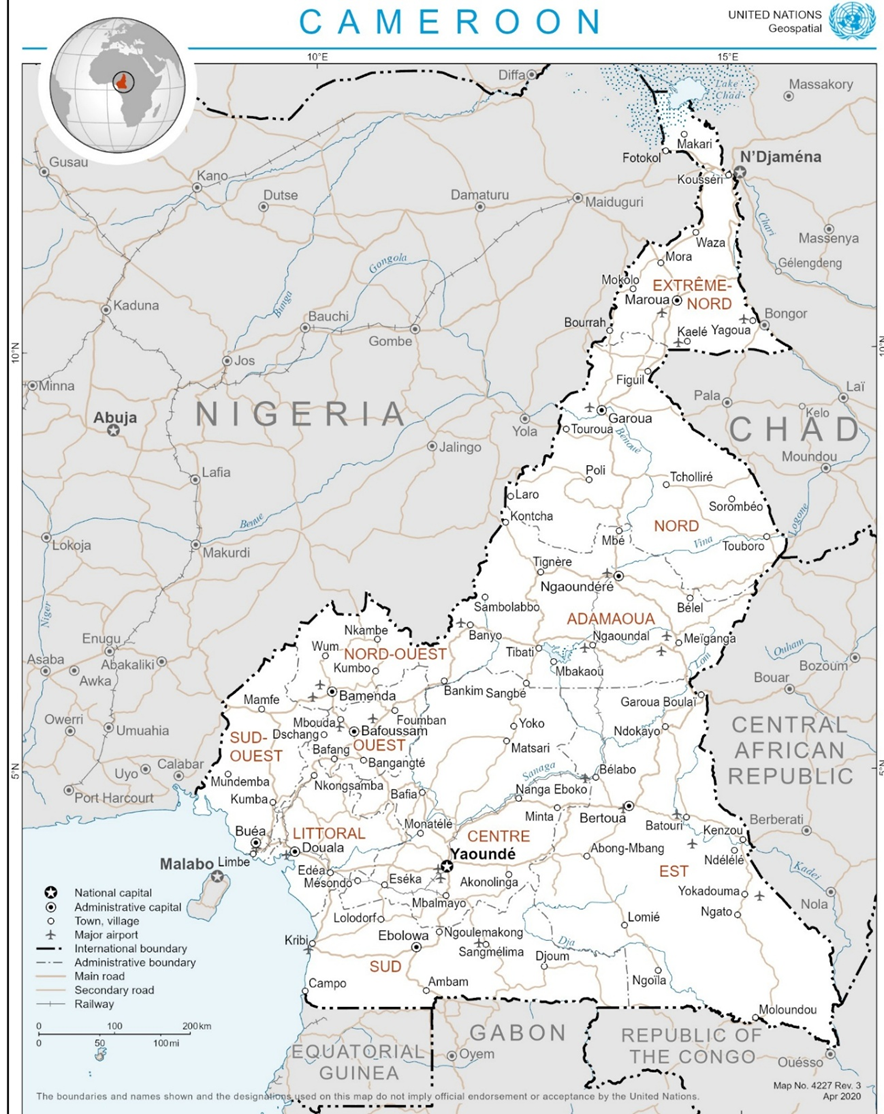
Three non-international armed conflicts (NIACs) are ongoing in Cameroon, one pitting the Republic of Cameroon’s armed and security forces against Ambazonian Separatist groups, a second, long-standing conflict against Boko Haram, and, since March 2026, a third with Islamic State West Africa Province (ISWAP). Cameroon borders the Central African Republic, Chad, Equatorial Guinea, Gabon, Nigeria, and the Republic of Congo. Its geographic location has made it subject to jihadist violence with the NIACs in neighbouring Chad and Nigeria having spread to Cameroonian territory.
The primary threat is from Boko Haram, with which Cameroon has been engaged in a NIAC over the past two decades.1African Union Peace and Security Council, ‘Report of the Chairperson of the African Union Commission on the Multinational Joint Task Force Against Boko Haram and the Renewal of its Mandate’, AU Doc PSC/PR/RPT.1254 (2025), 13 January 2025, para 5. Increasingly there is also violence involving ISWAP), which has now met the criterion of intensity under IHL for the existence of an armed conflict. As of June 2026, ISWAP was gaining control of territory in the Far North region.2C. Delanga, ‘ISWAP’s next frontier: Darak in northern Cameroon’, Institute for Security Studies (ISS), 15 June 2026.
Boko Haram’s expanded geographical footprint led to the African Union (AU) Peace and Security Council to re-activate the Multinational Joint Task Force (MNJTF) on 29 January 2025.3‘MNJTF Mandate’, Multinational Joint Task Force to counter Boko Haram activities. ‘About the Force’, Multinational Joint Task Force. Indeed, in 2025, according to the Armed Conflict Location & Event Data Project (ACLED) the highest number of incidents involving Boko Haram occurred in Cameroon’s Far North region, compared to the seven other Lake Chad Basin regions affected: Nigeria’s Adamawa, Borno, and Yobe states; Lac and Hadjer Lamis provinces in Chad; Cameroon’s North region; and Diffa in Niger.4C. Delanga, ‘Boko Haram’s Cameroonian commanders are extending the group’s reach’, ISS, 3 August 2026. The MNJTF was composed of members of the armed forces of Benin, Cameroon, Chad, Niger, and Nigeria until Niger withdrew in March 2025.5‘The Islamic State West Africa Province’s Tactical Evolution Fuels Worsening Conflict in Nigeria’s Northeast’, The Soufan Center, 21 May 2025; and ‘About the Force’, Multinational Joint Task Force. The MNJTF, with its four remaining contributing forces, remains active in Cameroon. The conflict with Boko Haram, centred in the Far North, has killed more than 3,000 Cameroonians, displaced about 250,000 people, and triggered the creation of vigilante self-defence groups.6International Crisis Group, ‘Cameroon’, undated but accessed 1 October 2026.
The Anglophone conflict is rooted in Cameroon’s colonial history and post-colonial State formation. After the First World War, Cameroon was divided between Britain and France under mandates granted by the League of Nations. Four fifths of the territory was administered by France, while the remainder, known as ‘British Cameroons’, was governed as part of Nigeria. ‘This division led to the emergence of distinct political, legal, and educational systems, which later formed the basis of Anglophone and Francophone identities’,7O. R. Bojesen, ‘Anglophone Conflict in Cameroon’, EPIS Insight, 30 April 2026. as Oliver Bojesen explains.
On 1 October 2017, a coalition of ‘Ambazonian Separatist’ groups declared the independence of the English-speaking parts of Cameroon in the north and south-west of the country, terming the area ‘Ambazonia’.8‘Cameroon country profile’, BBC, 9 March 2023. Following increasingly intense and regular violence, a NIAC between Cameroon and the Ambazonian Separatists ignited in late 2017.9A. Cascais, ‘5 years of violent civil war in Cameroon’, Deutsche Welle, 1 October 2021. The separatist groups use rifles, including hunting rifles, in combat.10‘Ambazonia Defense Forces (ADF)’, Ambazonia Governing Council; L Serwat and E. Beevor, ‘Non-State Armed Groups and Illicit Economies in West Africa: Anglophone Separatists’, ACLED, September 2024, p 10. Some are taken from the soldiers they have killed.11D. Atanagana, ‘Rights Group Urges Investigations After Soldiers Execute Teacher in Ngoketujia’, Mimi Mefo Info, 19 November 2024; D. Atangana, ‘Separatists Kill Two Cameroonian Soldiers in Mbingo’, Mimi Mefo Info, 10 October 2024. Their use of improvised explosive devices (IEDs) significantly increased in the course of 2025 with at least 131 such incidents reported.12Global Centre for the Responsibility to Protect, ‘Cameroon’, 16 March 2026. To date, the NIAC with the Ambazonian Separatists has caused at least 6,500 casualties.13Ibid. Moreover, as deaths are often under-reported, the true toll is likely higher still.
Key Events in 2026
Violence involving Ambazonian Separatists has continued in 2026. On 6 January, at least eleven separatist fighters were killed in an ambush by the military in Ntabah. One soldier was injured in the operation.14Xinhua, ‘11 separatist fighters killed in Cameroon military ambush’, english.news.cn, 7 January 2026. Then on 14 January, at least fourteen civilians were killed and fourteen others injured, including women and children, in a suspected separatist attack in Mbandfung, Ndu, in Donga-Mantung department.15Xinhua, ‘14 civilians killed, 14 wounded in suspected separatist attack in Cameroon’, english.news.cn, 15 January 2026. Writing in March 2026, the Global Centre for the Responsibility to Protect said that civilians in the Anglophone regions of Cameroon were at imminent risk of atrocity crimes due to the continued violence.16Global Centre for the Responsibility to Protect, ‘Cameroon’, 16 March 2026.
On 3 March, Belgium’s Federal Prosecutor’s Office announced the arrest of four individuals as part of an investigation into alleged war crimes and crimes against humanity by the separatists. The investigation focuses on individuals in Belgium suspected of holding leadership roles in the Ambazonia Defence Forces, the armed wing of the Ambazonia Governing Council.17I. Allegrozzi, ‘Cameroonian Separatist Leaders Arrested in Belgium’, Human Rights Watch, 6 March 2026. On 19 March, the Supreme Court of Cameroon annulled the life sentences of ten separatist leaders from the Interim Government of Ambazonia (the so-called ‘Nera 10’), and ordered a retrial.18International Crisis Group, ‘CrisisWatch – March 2026’. In April, the separatists declared a three-day ceasefire to mark a papal visit to Cameroon. In a statement sent to Reuters, the group said its forces had been instructed to ensure a secure environment for civilians, pilgrims, visiting dignitaries, and the Holy Father and his entourage.19A. B. Atabong, ‘Cameroon separatists declare three-day ceasefire for papal visit’, Reuters, 13 April 2026.
On 7 September, separatists began enforcing a week-long lockdown to disrupt the new school year, with armed clashes reported in several towns.20Xinhua, ‘Separatists enforce weeklong lockdown in Cameroon’s Anglophone regions’, english.news.cn, 7 September 2026. At the end of the month, a group of young men, said to be repentant separatist fighters, were presented to Cameroon Prime Minister Joseph Dion Ngute. The presentation came as the prime minister engaged community members on the ongoing conflict and efforts towards peace and reconciliation in the region.21‘Repentant Ambazonia separatist fighters presented to PM Dion Ngute in Southwest Cameroon’, The Post (Cameroon), post on Facebook, 30 September 2026. Yet, in October 2026, writing for the Independent Catholic News website, one commentator claimed that the government of 93-year-old president Paul Biya, the second-longest-ruling president in Africa, ‘refuses to consider credible inclusive talks. Nor are Biya’s likely successors open to charting a road map offering all Cameroonians a stake in the future.’22S. Banyongen, ‘Cameroon: why should we care?’, Independent Catholic News, 5 October 2026.
Meanwhile, Boko Haram has been expanding its violent action in Cameroon, particularly in the Far North. In August 2026, the Institute for Security Studies (ISS) thus reported that Boko Haram’s growing reliance on its Cameroonian leaders was ‘fuelling attacks in the country and strengthening the group’s resilience’. Fighters of Cameroonian origin are reportedly given a share of power ‘to enable the targeting of people and property in Cameroonian territory’. ISS research shows that under these leaders, 714 reported Boko Haram attacks were carried out in 2025, and a further 227 between January and June 2026. In addition, ISWAP has tasked Abu Zara, a Cameroonian from Mayo-Sava, with establishing a cell near Waza National Park in the Far North. This, the ISS says, is a significant threat that could lead to the government losing territorial control, increased vulnerability of border corridors, and further population displacement.23Delanga, ‘Boko Haram’s Cameroonian commanders are extending the group’s reach’.
The Humanitarian Situation
The Office of the UN High Commissioner for Refugees (UNHCR) estimated that by April 2025 at least 969,000 people were internally displaced in Cameroon,24UNHCR, ‘Cameroon’, undated but accessed 1 October 2026. of which the Ambazonian conflict remains a major driver. The United Nations Children’s Fund (UNICEF) has reported that more than 3.3 million people needed humanitarian assistance in Cameroon as of the end of 2025.25‘Cameroon’, UNICEF, 5 February 2026. This is due to a combination of factors that comprise not only the ongoing NIACs, but also flooding and outbreaks of infectious diseases.26‘Cameroon: Humanitarian Dashboard (as of 31 December 2025)’, ReliefWeb, 5 February 2026, updated 12 March 2026; ‘Mpox outbreak in Cameroon with 22 confirmed cases linked to enhanced transmission subvariants’, Beacon, 20 February 2026.
In August 2024, Cameroon experienced heavy rainfall, which caused severe flooding in four different regions. This had catastrophic effects on people in the far north and west of the State.27‘Cameroon: Floods – Aug 2024’, ReliefWeb. On 5 November 2024, in the west of the country, heavy rainfall triggered a landslide which destroyed property and roads, leading to numerous persons being reported missing28Ibid. An estimated 500,000 people were severely affected by the flooding.[6] The same month, in part provoked by the floods, Cameroon’s Ministry of Health declared an outbreak of cholera, followed by an outbreak of other health emergencies affecting the population in 2025, including polio, measles, and Mpox.29International Crisis Group, CrisisWatch Database, November 2024; ‘Cameroon’, UNICEF, 25 July 2025, 2.
Conflict Classification and Applicable Law
International Humanitarian Law
As of 1 October 2026, two non-international armed conflicts (NIACs) were ongoing in Cameroon:
- Cameroon v Ambazonian Separatists
- Cameroon v Boko Haram
Cameroon is a State Party to the Geneva Conventions of 1949. Common Article 3 to the Geneva Conventions and customary international humanitarian law (IHL) apply to the two NIACs. Cameroon is also a State Party to Additional Protocol II of 1977,30Protocol Additional to the Geneva Conventions of 12 August 1949, and relating to the Protection of Victims of Non-International Armed Conflicts (Protocol II); adopted at Geneva, 8 June 1977; entered into force, 7 December 1978 (hereafter, Additional Protocol II of 1977). but this treaty does not apply to either NIAC to which it is a party as Article 1(1) requires the non-State armed group in question to have territorial control enabling them to carry out sustained and concerted military operations.31‘Report: MNJTF Must Evolve to Contain Terror Threat’, Africa Defense Forum, 9 June 2026. This criterion was not met during the reporting period.
International Disarmament Law
Cameroon is a State Party to the Arms Trade Treaty.32Arms Trade Treaty; adopted at New York, 2 April 2013; entered into force, 24 December 2014. Cameroon ratified the treaty in 2018. Based on its conduct in the two NIACs, the Arms TRACK website of the Geneva Academy has assessed that the Cameroonian Armed Forces present a high risk of illegal use of weapons that may be supplied to them.
This is especially the case with the Armed Forces’ Rapid Intervention Battalion (BIR). In the past, Amnesty International has accused the BIR of torturing detainees. The organization reported in 2017 that the detainees were primarily men of military age, Muslim, and of Kanuri ethnicity, but that women and children have also been held.33Amnesty International, ‘Secret Torture Chambers in Cameroon’, Report, 20 July 2017. The BIR reports directly to the President of Cameroon rather than the standard military chain of command.34Bojesen, ‘Anglophone Conflict in Cameroon’.
Cameroon is a State Party to the 1997 Anti-Personnel Mine Ban Convention (APMBC).35Convention on the Prohibition of the Use, Stockpiling, Production and Transfer of Anti-Personnel Mines and on their Destruction; adopted at Oslo, 18 September 1997; entered into force, 1 March 1999. Cameroon ratified the treaty in 2002, becoming a State Party on 1 March 2003. Its deadline for clearance of all mined areas containing anti-personnel (AP) mines expired on 1 March 2013. Cameroon submitted an Article 7 transparency report in 2025 (covering calendar year 2023), reiterating its position that no mined areas have been identified on its territory. It did, however, acknowledge that, since 2014, IEDs emplaced by non-State armed groups have caused casualties, particularly in its Far North region bordering Nigeria and the Anglophone regions. This includes several instances of use of victim-activated devices that fall within the APMBC definition of an anti-personnel mine.36Mine Action Review, ‘Cameroon’, Clearing the Mines 2026, Report, October 2026.
Cameroon is also a State Party to the 2008 Convention on Cluster Munitions (CCM)37Convention on Cluster Munitions; adopted at Dublin, 30 May 2008; entered into force, 1 August 2010. Cameroon ratified the treaty in 2012. and to the 1992 Chemical Weapons Convention.38Convention on the Prohibition of the Development, Production, Stockpiling and Use of Chemical Weapons and on their Destruction; adopted at Geneva, 3 September 1992; entered into force, 29 April 1997.
International Criminal Law and Accountability
Cameroon is a signatory but not a State Party to the Rome Statute of the International Criminal Court.39Rome Statute of the International Criminal Court; adopted at Rome, 17 July 1998; entered into force, 1 July 2002. As such, the ICC does not have jurisdiction over the acts committed in the armed conflict inside Cameroon and by its nationals anywhere.
In April 2025, a grand jury in the United States issued an indictment against Eric Tataw, a Cameroonian living in the United States. Mr Tataw is charged with offenses including threatening violence against civilians in the Anglophone regions. In September 2024, Norwegian police arrested Lucas Cho Ayaba, leader of the Ambazonia Governing Council, on suspicion of inciting crimes against humanity in Cameroon.40Allegrozzi, ‘Cameroonian Separatist Leaders Arrested in Belgium’.
Efforts to hold government forces accountable have been weak. On 15 January 2026, a military court in Yaoundé convicted three government soldiers of murder, arson, and destruction of property, in addition to charges related to disobeying orders over the February 2020 massacre of at least twenty-one civilians in Ngarbuh village, Donga-Mantung division, in Cameroon’s Anglophone north-west region. Security forces and members of local vigilance groups had conducted an operation in the village on the night of 13 February 2020 and soldiers had tried to conceal the killings of civilians by setting houses on fire and filing a false report.41‘Cameroon: Massacre Trial Short on Justice’, Human Rights Watch, 24 February 2026; T. Jacques, ‘Cameroun: Verdict Ngarbuh – La justice camerounaise face à ses responsabilités militaires’, All Africa, 16 January 2026; ‘Africa: Cameroon’, International Crisis Group, January 2026.
But a February 2026 ruling by a Cameroonian military court saw the three soldiers convicted of the killing of twenty-one civilians only issued lenient sentences and ‘neither investigated those who ordered the attack nor provided reparations to victims’ families’.42Allegrozzi, ‘Cameroonian Separatist Leaders Arrested in Belgium’. The court handed down sentences of between five and ten years in prison and modest fines. As Human Rights Watch reported:
The trial, which lasted more than five years, was marred by serious shortcomings. Authorities never arrested or charged senior officers who authorized and oversaw the operation. Seventeen ethnic Fulani militiamen accused of murder remain at large. Victims’ families had only limited access to and participation in the proceedings, key evidence was excluded, and the court rejected claims for compensation.43Human Rights Watch, ‘Cameroon: Massacre Trial Short on Justice’, News release, 24 February 2026.
Compliance with IHL
Overview
All parties to the Anglophone crisis and the conflict with Boko Haram have committed serious violations of IHL. That is the case, even though information on specific unlawful attacks by the armed and security forces and armed groups involved in the two armed conflicts in Cameroon has been relatively limited. According to Human Rights Watch, Cameroon’s security forces have been implicated in grave abuses, including extrajudicial killings, the burning of homes, arbitrary arrests, and torture of suspected separatists.
Civilian Objects under Attack
Under customary IHL, attacks may only be directed against military objectives. Attacks must not be directed against civilian objects.44ICRC, Customary IHL Rule 7: ‘The Principle of Distinction between Civilian Objects and Military Objectives’. Civilian objects are all objects that are not military objectives45ICRC, Customary IHL Rule 9: ‘Definition of Civilian Objects’. and, as such, are protected against attack.46ICRC, Customary IHL Rule 10: ‘Civilian Objects’ Loss of Protection from Attack’. Military objectives are those objects which, by their nature, location, purpose or use, make an effective contribution to military action.47ICRC, Customary IHL Rule 8: ‘Definition of Military Objectives’. In addition, the object’s partial or total destruction, capture, or neutralisation must offer a definite military advantage in the prevailing circumstances.
Boko Haram has attacked villages on numerous occasions as have Ambazonian separatists. Between 14 and 19 April, Boko Haram attacked several localities in Mayo-Tsanaga and Mayo-Sava divisions, killing at least one civilian in Kolofata town and kidnapping two children.48International Crisis Group, ‘CrisisWatch – April 2026’. On the night of 9 to 10 May 2026, in a rare incursion into the Francophone West region, separatists attacked Koumengba village, Bangourain commune, killing one civilian and abducting thirteen.49International Crisis Group, ‘CrisisWatch – May 2026’.
Civilians under Attack
Under customary IHL, civilians enjoy general protection from the effects of hostilities, unless and for such time as they directly participate in hostilities.50ICRC, Customary IHL Rule 6: ‘Civilians’ Loss of Protection from Attack’. Accordingly, parties to any armed conflict must at all times distinguish between combatants and civilians, and are prohibited from directing attacks against civilians.51ICRC, Customary IHL Rule 1: ‘The Principle of Distinction between Civilians and Combatants’. In case of doubt, persons should be treated as civilians.52ICRC, Customary IHL Rule 6: ‘Civilians’ Loss of Protection from Attack’, and see associated commentary. Civilians may be incidentally affected by attacks against lawful targets. However, such attacks must not be disproportionate,53ICRC, Customary IHL Rule 14: ‘Proportionality in Attack’. and the attacker must take all feasible precautions to avoid or, in any event to minimize, incidental civilian impact.54ICRC, Customary IHL Rule 15: ‘Principle of Precautions in Attack’.
In the North-West and South-West regions, Ambazonian separatist groups have increasingly been targeting security forces and civilians with IEDs over the last few years. Many incidents have involved devices emplaced on roads targeting security forces and their vehicles, although IEDs have also targeted civilians and have been placed in populated areas.55Mine Action Review, ‘Cameroon’, Clearing the Mines 2026, Report, October 2026.
On the night of 16 to 17 September 2026, suspected Boko Haram fighters killed at least fifteen civilians in Madegwa village, Logone-et-Chari division, and prompting thousands to flee.56International Crisis Group, ‘CrisisWatch – Cameroon’, September 2026. Prima facie, these killings amount to war crimes.
Protection of Persons in the Power of the Enemy
Under customary IHL, special protection is afforded to several categories of civilians or persons hors de combat who face a specific risk of harm, such as women, children, refugees, and IDPs.57ICRC, Customary IHL Rules 134 to 138: ‘Chapter 39. Other Persons Afforded Specific Protection’. IHL provides fundamental guarantees for anyone in the power of a party to a conflict, prohibiting murder, torture and other inhumane or degrading treatment, arbitrary detention, hostage-taking, and unfair trials.
Although information on specific incidents has proved difficult to secure and confirm, the Ambazonian Defence Forces have continued to killed civilians and abducted them for ransom. Cameroonian defence and security forces, including the BIR, are said to have committed murders, burnt villages, made arbitrary arrests, and engaged in acts of sexual violence against local populations in separatist areas.58Human Rights Watch, ‘Cameroon’; Bojesen, ‘Anglophone Conflict in Cameroon’. Repeated Boko Haram attacks have caused disruption to healthcare provision in these areas where, according to the UN Population Fund, patients and health workers feared for their safety.59Amnesty International, ‘Cameroon 2025’.
Transitional Justice
Cameroon has made minimal efforts at transitional justice in recent years. Dr Valery has described the Anglophone crisis as having had devastating effects on the country, ‘and over its bloody course, has been considered the most neglected conflict in the world’. In a 2023 online article, he noted that judicial independence – sadly lacking in Cameroon – is an essential component of transitional justice. ‘In the context of Cameroon’s Anglophone crisis, the success of any potential transitional justice process is dependent on the independence and effectiveness of the judicial institutions charged with implementing and engineering the much-needed social transformation.’60B. Jr Valery, ‘Judicial Independence and Transitional Justice in Cameroon: A Pathway to Sustainable Peace in the ongoing Anglophone Crisis’, Post, AfricLaw, 10 May 2023.
Writing two years later, Wemba Miracle agreed that it was essential for the Cameroonian government to prioritize the establishment of independent judicial bodies to investigate and prosecute individuals responsible for human rights violations. ‘This would involve strengthening existing institutions and ensuring they are not politically compromised’, she wrote. She also called for a ‘more robust, inclusive, and transparent truth-telling process’ that would give victims and marginalized groups a platform to share their stories, possibly through the creation of a ‘dedicated truth commission that addresses both the Anglophone crisis and other historical grievances’.61W. Miracle, ‘An Appraisal of the Efforts Made by Cameroon Towards Achieving Transitional Justice’, Studies in Law and Justice, Vol. 4, No. 1 (February 2025) 1–18, at 16–17.
- 1African Union Peace and Security Council, ‘Report of the Chairperson of the African Union Commission on the Multinational Joint Task Force Against Boko Haram and the Renewal of its Mandate’, AU Doc PSC/PR/RPT.1254 (2025), 13 January 2025, para 5. ↩︎
- 2C. Delanga, ‘ISWAP’s next frontier: Darak in northern Cameroon’, Institute for Security Studies (ISS), 15 June 2026. ↩︎
- 3‘MNJTF Mandate’, Multinational Joint Task Force to counter Boko Haram activities. ‘About the Force’, Multinational Joint Task Force. ↩︎
- 4C. Delanga, ‘Boko Haram’s Cameroonian commanders are extending the group’s reach’, ISS, 3 August 2026. ↩︎
- 5‘The Islamic State West Africa Province’s Tactical Evolution Fuels Worsening Conflict in Nigeria’s Northeast’, The Soufan Center, 21 May 2025; and ‘About the Force’, Multinational Joint Task Force. ↩︎
- 6
- 7O. R. Bojesen, ‘Anglophone Conflict in Cameroon’, EPIS Insight, 30 April 2026. ↩︎
- 8‘Cameroon country profile’, BBC, 9 March 2023. ↩︎
- 9A. Cascais, ‘5 years of violent civil war in Cameroon’, Deutsche Welle, 1 October 2021. ↩︎
- 10‘Ambazonia Defense Forces (ADF)’, Ambazonia Governing Council; L Serwat and E. Beevor, ‘Non-State Armed Groups and Illicit Economies in West Africa: Anglophone Separatists’, ACLED, September 2024, p 10. ↩︎
- 11D. Atanagana, ‘Rights Group Urges Investigations After Soldiers Execute Teacher in Ngoketujia’, Mimi Mefo Info, 19 November 2024; D. Atangana, ‘Separatists Kill Two Cameroonian Soldiers in Mbingo’, Mimi Mefo Info, 10 October 2024. ↩︎
- 12
- 13Ibid. ↩︎
- 14Xinhua, ‘11 separatist fighters killed in Cameroon military ambush’, english.news.cn, 7 January 2026. ↩︎
- 15Xinhua, ‘14 civilians killed, 14 wounded in suspected separatist attack in Cameroon’, english.news.cn, 15 January 2026. ↩︎
- 16
- 17I. Allegrozzi, ‘Cameroonian Separatist Leaders Arrested in Belgium’, Human Rights Watch, 6 March 2026. ↩︎
- 18International Crisis Group, ‘CrisisWatch – March 2026’. ↩︎
- 19A. B. Atabong, ‘Cameroon separatists declare three-day ceasefire for papal visit’, Reuters, 13 April 2026. ↩︎
- 20Xinhua, ‘Separatists enforce weeklong lockdown in Cameroon’s Anglophone regions’, english.news.cn, 7 September 2026. ↩︎
- 21‘Repentant Ambazonia separatist fighters presented to PM Dion Ngute in Southwest Cameroon’, The Post (Cameroon), post on Facebook, 30 September 2026. ↩︎
- 22S. Banyongen, ‘Cameroon: why should we care?’, Independent Catholic News, 5 October 2026. ↩︎
- 23
- 24
- 25
- 26‘Cameroon: Humanitarian Dashboard (as of 31 December 2025)’, ReliefWeb, 5 February 2026, updated 12 March 2026; ‘Mpox outbreak in Cameroon with 22 confirmed cases linked to enhanced transmission subvariants’, Beacon, 20 February 2026. ↩︎
- 27‘Cameroon: Floods – Aug 2024’, ReliefWeb. ↩︎
- 28Ibid. ↩︎
- 29International Crisis Group, CrisisWatch Database, November 2024; ‘Cameroon’, UNICEF, 25 July 2025, 2. ↩︎
- 30Protocol Additional to the Geneva Conventions of 12 August 1949, and relating to the Protection of Victims of Non-International Armed Conflicts (Protocol II); adopted at Geneva, 8 June 1977; entered into force, 7 December 1978 (hereafter, Additional Protocol II of 1977). ↩︎
- 31‘Report: MNJTF Must Evolve to Contain Terror Threat’, Africa Defense Forum, 9 June 2026. ↩︎
- 32Arms Trade Treaty; adopted at New York, 2 April 2013; entered into force, 24 December 2014. Cameroon ratified the treaty in 2018. ↩︎
- 33Amnesty International, ‘Secret Torture Chambers in Cameroon’, Report, 20 July 2017. ↩︎
- 34Bojesen, ‘Anglophone Conflict in Cameroon’. ↩︎
- 35Convention on the Prohibition of the Use, Stockpiling, Production and Transfer of Anti-Personnel Mines and on their Destruction; adopted at Oslo, 18 September 1997; entered into force, 1 March 1999. Cameroon ratified the treaty in 2002, becoming a State Party on 1 March 2003. ↩︎
- 36Mine Action Review, ‘Cameroon’, Clearing the Mines 2026, Report, October 2026. ↩︎
- 37Convention on Cluster Munitions; adopted at Dublin, 30 May 2008; entered into force, 1 August 2010. Cameroon ratified the treaty in 2012. ↩︎
- 38Convention on the Prohibition of the Development, Production, Stockpiling and Use of Chemical Weapons and on their Destruction; adopted at Geneva, 3 September 1992; entered into force, 29 April 1997. ↩︎
- 39Rome Statute of the International Criminal Court; adopted at Rome, 17 July 1998; entered into force, 1 July 2002. ↩︎
- 40Allegrozzi, ‘Cameroonian Separatist Leaders Arrested in Belgium’. ↩︎
- 41‘Cameroon: Massacre Trial Short on Justice’, Human Rights Watch, 24 February 2026; T. Jacques, ‘Cameroun: Verdict Ngarbuh – La justice camerounaise face à ses responsabilités militaires’, All Africa, 16 January 2026; ‘Africa: Cameroon’, International Crisis Group, January 2026. ↩︎
- 42Allegrozzi, ‘Cameroonian Separatist Leaders Arrested in Belgium’. ↩︎
- 43Human Rights Watch, ‘Cameroon: Massacre Trial Short on Justice’, News release, 24 February 2026. ↩︎
- 44ICRC, Customary IHL Rule 7: ‘The Principle of Distinction between Civilian Objects and Military Objectives’. ↩︎
- 45
- 46
- 47ICRC, Customary IHL Rule 8: ‘Definition of Military Objectives’. In addition, the object’s partial or total destruction, capture, or neutralisation must offer a definite military advantage in the prevailing circumstances. ↩︎
- 48International Crisis Group, ‘CrisisWatch – April 2026’. ↩︎
- 49International Crisis Group, ‘CrisisWatch – May 2026’. ↩︎
- 50
- 51
- 52ICRC, Customary IHL Rule 6: ‘Civilians’ Loss of Protection from Attack’, and see associated commentary. ↩︎
- 53
- 54
- 55Mine Action Review, ‘Cameroon’, Clearing the Mines 2026, Report, October 2026. ↩︎
- 56International Crisis Group, ‘CrisisWatch – Cameroon’, September 2026. ↩︎
- 57
- 58
- 59Amnesty International, ‘Cameroon 2025’. ↩︎
- 60B. Jr Valery, ‘Judicial Independence and Transitional Justice in Cameroon: A Pathway to Sustainable Peace in the ongoing Anglophone Crisis’, Post, AfricLaw, 10 May 2023. ↩︎
- 61W. Miracle, ‘An Appraisal of the Efforts Made by Cameroon Towards Achieving Transitional Justice’, Studies in Law and Justice, Vol. 4, No. 1 (February 2025) 1–18, at 16–17. ↩︎