Conflict Overview
Conflict History
Colombia is currently involved in eleven armed conflicts, all non-international in character. These armed conflicts trace their origins to the 1960s and the rise of Marxist campesino and student guerilla groups in response to unequal land distribution and ownership in the Colombian countryside. Two guerrilla movements emerged in a struggle with the armed forces – the Fuerzas Armadas Revolucionarias de Colombia-Ejército del Pueblo (FARC-EP) and the Ejército de Liberación Nacional (ELN).1C. Klobucista and D. Renwick, ‘Colombia’s Civil Conflict’, Council on Foreign Relations, 11 January 2017. In the 1980s, right-wing paramilitary groups emerged to combat these organizations. The Autodefensas Unidas de Colombia (AUC) was the largest of these groups.2Ibid.
Although the AUC collectively demobilized between 2004 and 2006,3Comisión para el Esclarecimiento de la Verdad, la Convivencia y la No Repetición, ‘La Desmovilización de las AUC’, accessed 1 September 2026. seeking to fill a power vacuum, former members of the paramilitaries created new armed groups, among them the Ejército Gaitanista de Colombia (EGC, also known as the Gulf Clan), which remains a party to multiple non-international armed conflicts (NIACs) today.
The FARC-EP and the ELN rely not only on violence, but also on abduction and extortion to raise revenue and gain leverage over their adversaries; the groups are estimated to have kidnapped more than 25,000 people between 1970 and 2010.4C. Klobucista and D. Renwick, ‘Colombia’s Civil Conflict’, Council on Foreign Relations, 11 January 2017. Historically, the illicit drugs trade has been a seminal driver of conflict: at the start of the twenty-first century, Colombia was the source of up to ninety per cent of global cocaine production, and competition among non-State armed groups over territory with coca cultivation and trafficking corridors has sustained the violence.5‘United States Department of State Bureau for International Narcotics and Law Enforcement Affairs: International Narcotics Control Strategy Report, Volume 1: Drug and Chemical Control’, US Department of State, March 2025, p 168; ‘Colombia: Events of 2024’, World Report 2025. All of Colombia’s many armed conflicts have been characterized by widespread violations of international humanitarian law (IHL) by each of the parties, with Indigenous and Afro-descendant communities disproportionately affected.6Historical Memory Group, ‘Basta Ya! Colombia: Memories of War and Dignity, General Report Historical Memory Group’, 2016, p 36 ff.
A watershed in Colombia’s history occurred on 24 November 2016, when the government and the FARC-EP – then the largest non-State armed group in the country – signed a peace agreement after protracted negotiations in Havana. This led to more than 13,000 FARC-EP members laying down their weapons.7European Union, ‘An Historical Peace Agreement in Colombia’, 23 April 2021. However, dissident factions rejected the accord and continued to attack both the authorities and rival armed groups. The post-2016 landscape became increasingly fragmented: disputes and alliances between armed groups have shifted over time as they compete for territorial control of areas previously occupied by the FARC-EP, giving rise to the Estado Mayor Central (EMC), the Estado Mayor de los Bloques y el Frente (EMBF), and Segunda Marquetalia as the principal dissident structures, alongside the ELN and the EGC. Fragmentation was compounded by the rollback of significant elements of the 2016 accord under President Iván Duque in 2018, which saw many former fighters return to armed groups.8‘Peace Plan Has Caused More Conflict, Says Thinktank’, Bogotá Post, 13 February 2026.
In November 2022, following the election of Colombia’s first left-wing president, Gustavo Petro, the government launched its ‘Total Peace’ (‘Paz Total’) strategy, seeking to negotiate simultaneously with all major armed groups.9Colombian Ministry of Justice, ‘Marco Jurídico Para la Paz Total’, 9 October 2025; see also: Human Rights Watch ‘World Report 2026: Colombia’, 4 February 2026. Initial results were promising – during a ceasefire with the ELN, clashes between the group and the security forces plummeted to historic lows; and during a three-month ceasefire with the EMC, violent events dropped from nearly one hundred to only nine.10T. Breda, ‘Total Peace Paradox in Colombia: Petro’s Policy Reduced Violence, but Armed Groups Grew Stronger’, Armed Conflict Location & Event Data Project (ACLED), 2025. But the strategy progressively unravelled. In March 2024, Petro suspended the bilateral ceasefire with the EMC in Cauca, Nariño, and Valle del Cauca departments, following violence against Indigenous communities. This deepened internal EMC divisions: Iván Mordisco refused to countenance further negotiations while a rival faction led by Calarcá Córdoba opted to continue talks — a fracture that led to the EMBF operating as a separate negotiating entity, while the EMC under Mr Mordisco returned to full armed operations.11‘Criminal Disputes and Divisions Undermine Colombia’s Peace Efforts’, InSight Crime, 17 April 2025.
In August 2024, negotiations with the ELN also broke down after the group rejected renewal of its bilateral ceasefire.12S. B. Velez, ‘Colombia Suspends Peace Talks with the ELN Guerrilla Group’, Latin America Reports, 19 September 2024. Armed groups took advantage of successive ceasefire periods to consolidate territorial control and expand their membership, nearly doubling in size – from 15,120 members in December 2022 to 28,802 in July 2026, according to data compiled by the Fundación Ideas para la Paz, a Colombian peace and security think-tank.13‘Con De la Espriella finaliza la paz total de Petro’, Diario de Cuba, 8 August 2026. By 2026, the number of fighters in non-State armed groups had returned to levels last seen in 2011, reversing the post-accord low of 12,800 recorded in 2018.14‘Peace Plan Has Caused More Conflict, Says Thinktank’, Bogotá Post, 13 February 2026. Territorial disputes doubled over the same period, from seven active zones of contestation in 2022 to fourteen by the middle of 2026, with armed groups exercising influence in at least 646 municipalities (of the 1,104 municipalities – ‘municipios’ – in total).15‘El costo de negociar mal’, Fundación Ideas para la Paz, August 2026. Across the four years of the policy, only ninety-nine fighters demobilized in total.16‘Was it a mistake for 99 Colombia guerrillas to lay down their arms? ’ The Guardian, 26 August 2026.
The defining humanitarian event of 2025 began on 16 January, when the ELN launched a major offensive in the Catatumbo region of Norte de Santander amid clashes with the 33rd Front of the EMBF. More than 64,700 people were displaced, over 12,900 were forcibly confined, and 117 were killed between January and April 2025, according to the Defensoría del Pueblo (Ombudsman).17Defensoría del Pueblo, ‘El Catatumbo padece la emergencia humanitaria más grande desde que hay registro en Colombia a causa del conflicto armado’, 2025. Catatumbo is the main enclave for coca cultivation in the north of the country and a strategic corridor for armed groups operating along the Venezuelan border, where Colombia’s major guerrilla groups have established a safe haven. The offensive led President Petro to suspend peace talks with the ELN indefinitely.
The Catatumbo crisis was not an isolated event but the most serious manifestation of a broader pattern of deterioration across the country. Armed confrontations over territorial control of illicit economies intensified across hotspots identified by the Defensoría del Pueblo, including Antioquia, Arauca, Cauca, Chocó, Guaviare, Meta, Nariño, Putumayo, and Valle del Cauca. As negotiations with the government opened internal fractures within the EMC, Segunda Marquetalia and the ELN, the constituent fronts, which operate with significant autonomy, forged fragile alliances, intensifying competition over territory and provoking significant humanitarian consequences.18‘Gamechangers 2025: Colombia’s Total Peace in Pieces’, InSight Crime, 2026.
Talks with the EMBF – the EMC faction that had remained at the negotiating table – produced a six-point agreement in November 2025, with Ireland, Norway, Switzerland and Venezuela as guarantors, but progress remained limited.19‘Total Peace Talks Reach New Agreements between Government and EMBF’, Justice for Colombia, 21 November 2025. Peace negotiations with the EGC opened in Qatar in September 2025, but had collapsed by March 2026 after the group failed to relocate to the designated Temporary Location Zones and the government reactivated arrest warrants against its leaders.20‘AGC Peace Talks Timeline’ ABColombia, 2026.
As the International Committee of the Red Cross (ICRC) has observed, Colombia experienced in 2025 ‘the worst humanitarian consequences of armed conflict over the past decade’ – a deterioration explained not only by an intensification of hostilities but also by the manner in which civilians were treated, in a context marked by a wilful failure to comply with international humanitarian law (IHL).21‘Colombia 2025: A Humanitarian Crisis Beyond Numbers’, Report, ICRC, May 2026.
Key Events in 2026
By the start of 2026, none of the principal armed groups was engaged in an active ceasefire arrangement with the State. Between January and June 2026, an estimated 769,800 people were affected by violence.22World Food Programme (WFP), ‘Colombia Country Brief’, July 2026. The year through to the end of August spans the final months of the Petro government’s collapsed peace strategy and the first weeks of the de la Espriella administration, at a moment of acute structural vulnerability. As of 1 September 2026, the United Nations Office for the Coordination of Humanitarian Affairs (OCHA) was estimating that seventy-eight per cent of the rural population was living under the influence of at least one non-State armed group.23OCHA, ‘Colombia’, 2026. Against this backdrop, the violations documented below reflect not merely an increase in the level of hostilities but also a systematic failure by all parties to respect the basic rules of IHL.
On 7 August 2026, right-wing lawyer Abelardo de la Espriella was inaugurated as president of Colombia, having defeated left-wing candidate Iván Cepeda in a run-off.24‘Abelardo de la Espriella jura como presidente de Colombia’ CNN, 7 August 2026. President de la Espriella immediately announced the end of negotiated peace, issued a one-month ultimatum to armed groups to surrender to the authorities, and replaced the peace negotiation framework with a strategy of direct military confrontation, declaring that ‘the option of dialogue is completely exhausted’.25‘De la Espriella entierra la paz y alista a Colombia para una guerra sin cuartel’, Escambray, 8 August 2026. He has also criticized the ‘Jurisdicción Especial para la Paz’ (JEP) – the transitional justice tribunal established under the 2016 Peace Accord – indicating his intention to reform or even to dismantle it (although constitutional constraints limit his ability to do so unilaterally).26‘Abelardo de la Espriella cambia la paz total de Petro por una política de mano dura en Colombia’, Expansión, 15 August 2026. The transition marks a decisive break with the negotiated peace framework of the previous four years, with potent implications for the extent of armed violence and the protection of civilians.
The Humanitarian Situation
The World Food Programme (WFP) has stated that, despite being an upper-middle-income country, Colombia continues to face a ‘complex humanitarian and food security crisis’. WFP’s food security assessment in Colombia’s fifteen most vulnerable departments found that more than one third of households – around seven million people – were experiencing moderate or severe food insecurity. Nationally, food insecurity remains at approximately twenty-five per cent of households, with Atlántico, La Guajira, and Sucre reporting the highest prevalence of severe food insecurity.27WFP, ‘Colombia Country Brief’, July 2026.
OCHA projected that 10.4 million people in Colombia would need humanitarian assistance in 2026 – a thirty per cent increase on the previous year.28OCHA, ‘Colombia’, accessed 1 September 2026. At the same time, the extent of humanitarian access decreased significantly in 2026: on 18 March, the EMC formally restricted access to areas under its control for the UN Verification Mission, the Organization of American States (OAS) Mission to Support the Peace Process in Colombia (MAPP), and the Defensoría del Pueblo,. A total of 289,500 people were left without humanitarian assistance due to restrictions on access.29Security Council Report, ‘Colombia’, UN Security Council Monthly Forecast, April 2026.
More broadly, Colombia faces one of the largest and most protracted internal displacement situations associated with conflict and violence in the world. The Internal Displacement Monitoring Centre (IDMC) observes that displacement triggers have shifted significantly in recent years – from fighting between non-State armed groups and the armed forces, to clashes involving mostly armed and criminal groups. Civilians continue to be targeted in attacks, while also suffering kidnapping, confinement, and forced recruitment. Around 7.2 million people were displaced inside or outside Colombia at the end of 2025, the second-highest figure in the world (but similar to the situation in the country a year earlier).30IDMC, ‘Country Profile – Colombia’, 2026.
Conflict Classification and Applicable Law
International Humanitarian Law
As of 1 September 2026, eleven non-international armed conflicts (NIACs) were ongoing in Colombia. Common Article 3 to the Geneva Conventions and other customary IHL applies to all eleven conflicts.
Colombia is a State Party to Additional Protocol II of 197731Protocol Additional to the Geneva Conventions of 12 August 1949, and relating to the Protection of Victims of Non-International Armed Conflicts (Protocol II); adopted at Geneva, 8 June 1977; entered into force, 7 December 1978 (hereafter, Additional Protocol II of 1977). (having adhered in 1995), which applies to the four NIACs that involve the Colombian Armed Forces fighting a non-State armed group. The criterion that the armed group must exercise such territorial control as to be able to sustain military operations and to implement the Protocol was met during the reporting period in each instance.
- Colombia v National Liberation Army (ELN)
- Colombia v Ejército Gaitanista de Colombia (EGC) (formerly, the Autodefensas Gaitanistas de Colombia, AGC)
- Colombia v Estado Mayor Central (EMC), a dissident FARC-EP group32The EMC sprang from an original group of approximately sixty FARC-EP members who did not adhere to the 2016 peace process. In 2024, after disagreements between EMC membership on the desirability of new peace negotiations with the Colombian government, the EMBF was formed as a splinter group. The EMBF is a party to two NIACs classified in the reporting period that involve only non-State armed groups as parties: the ELN v Frente 33 (EMBF) and the EMC v EMBF. See further J. P. Contreras Ríos, ‘Así nació el grupo que se separó de Mordisco y que ahora negocia la paz con Petro’, El Espectador, 4 December 2024.
- Colombia v Comandos de la Frontera (CDF), a dissident FARC-EP group.
Seven other NIACs involved two non-State armed groups fighting each other:
- ELN v EGC
- ELN v EMC
- ELN v Frente 33 of the Estado Mayor de los Bloques y el Frente (EMBF)
- EMC v Frente 57 Yair Bermúdez
- EMC v EGC
- EMC v Segunda Marquetalia
- EMC v EMBF
These NIACs are thus regulated by Common Article 3 and customary IHL. Although the requirement for territorial control could be met in each case,33As of June 2024, according to Human Rights Watch, the EGC was present in 392 municipalities, the ELN in 232, and dissident FARC-EP groups in 299. Human Rights Watch, ‘Colombia: Events of 2024’, World Report 2025. for Additional Protocol II to apply one of the parties must be the armed forces of the State.34The material jurisdiction of the Protocol is limited to armed conflicts ‘which take place in the territory of a High Contracting Party between its armed forces and dissident armed forces or other organized armed groups…’: Art 1(1), Additional Protocol II of 1977 [emphasis added].
International Disarmament Law
Colombia is a State Party to the Arms Trade Treaty.35Arms Trade Treaty; adopted at New York, 2 April 2013; entered into force, 24 December 2014. Based on its conduct in the multiple NIACs, but also on its actions in the course of law enforcement, the Arms TRACK website of the Geneva Academy has assessed that the Colombian Armed Forces present an elevated risk of illegal use of any weapons that may be supplied to them.
Colombia is a State Party to the 1997 Anti-Personnel Mine Ban Convention (APMBC).36Convention on the Prohibition of the Use, Stockpiling, Production and Transfer of Anti-Personnel Mines and on their Destruction; adopted at Oslo, 18 September 1997; entered into force, 1 March 1999. Many improvised explosive devices (IEDs) employed by non-State armed groups fall within the scope of the Convention. Colombia has a new extended deadline for clearance under the APMBC of 31 December 2030. According to Mine Action Review, however, Colombia will not achieve clearance by then. Indeed, the precise extent of AP mined area remains unknown, and current estimates based on survey data are only partial.37Mine Action Review, ‘Colombia’, Clearing the Mines 2026, Report, 2026. At the time of writing, the national infrastructure established in Colombia was believed to be being dismantled by the incoming de la Espriella administration, further endangering civilians.
Colombia is also a State Party to the 2008 Convention on Cluster Munitions.38Convention on Cluster Munitions; adopted at Dublin, 30 May 2008; entered into force, 1 August 2010. Colombia completed clearance of the cluster munitions used by its Air Force in 2017.39Mine Action Review, ‘Colombia’, Clearing Cluster Munition Remnants 2026, Report, 2026, p 5. There is no evidence that cluster munitions have been used in recent years by either the Colombian Armed Forces or non-State armed groups. Colombia is also a State Party to the 1992 Chemical Weapons Convention.40Convention on the Prohibition of the Development, Production, Stockpiling and Use of Chemical Weapons and on their Destruction; adopted at Geneva, 3 September 1992; entered into force, 29 April 1997.
International Criminal Law and Accountability
Colombia is a State Party to the Rome Statute of the International Criminal Court, having ratified it in August 2002.41Rome Statute of the International Criminal Court; adopted at Rome, 17 July 1998; entered into force, 1 July 2002. As such, the ICC has had jurisdiction over the acts committed in the armed conflicts in the country since 1 November 2002.
The situation in Colombia was under preliminary examination from June 2004 to October 2021. In 2020, the Office of the Prosecutor of the ICC confirmed it had a reasonable basis to believe that crimes against humanity under Article 7 of the Rome Statute had been committed in Colombia ‘by different actors’, since 1 November 2002. These included murder, forcible transfer of population, severe deprivation of physical liberty, torture, and rape and other forms of sexual violence. There was also a reasonable basis to believe that since 1 November 2009, war crimes had been committed in the context of the NIACs then ongoing in the country. The crimes were murder, attacks against civilians, torture and cruel treatment, outrages upon personal dignity, the taking of hostages, rape and other forms of sexual violence, and conscripting, enlisting and using children to participate actively in hostilities.42Office of the Prosecutor (OTP), ‘Report on Preliminary Examination Activities 2020’, 14 December 2020, paras 109, 110.
On 28 October 2021, however, the Office of the Prosecutor concluded there was not a reasonable basis to believe that potential cases arising from its investigations would be admissible before the ICC. This was because the national authorities of Colombia ‘could not be characterized as inactive, unwilling, or unable to genuinely investigate and prosecute’ Rome Statute crimes. Accordingly, the Prosecutor decided to close the Office’s preliminary examination, although it stated that the decision could be reconsidered ‘upon a significant change of circumstances’.43ICC, ‘Preliminary Examination – Colombia’, accessed 11 September 2026.
When ratifying the Rome Statute in 2002, Colombia stated that none of its provisions concerning the ICC’s exercise of jurisdiction would ‘prevent the Colombian State from granting amnesties, reprieves or judicial pardons for political crimes, provided that they are granted in conformity with the Constitution and with the principles and norms of international law accepted by Colombia’.44‘Declaration of Colombia’, 5 August 2002. No criminal prosecutions are known to have been mounted for war crimes or crimes against humanity committed by the Colombian Armed Forces in the course of the armed conflicts in which it is involved.
Compliance with IHL
Overview
All parties to the eleven ongoing armed conflicts have been accused of perpetrating war crimes. The alleged violations affected civilians across the country, with Indigenous and Afro-descendant communities disproportionately affected. The ICRC has documented a progressive worsening of the humanitarian situation since 2018, recording 845 alleged IHL violations in 2025 alone – more than double the 382 recorded in 2024.45‘ICRC Report: Failure to Respect Rules of War Deepened Humanitarian Crisis in Colombia in 2025’, ICRC, 12 May 2026. The violations documented below for the period 1 January to 1 September 2026 are consistent with this downward spiral.
That said, the character of armed group control over civilian populations has shifted in ways that shape the violations described below. Fundación Ideas para la Paz observes that armed groups have progressively moved away from massacres and the killing of social leaders as their principal instrument of territorial control – responding to State operations that prioritize action against the most lethal and visible forms of violence – towards threats, extortion, confinement, and forced displacement.46‘El costo de negociar mal’, Fundación Ideas para la Paz, August 2026. Control is exercised not only through visible armed presence but through personnel sent into communities to enforce compliance with the rules the groups seek to impose.47‘Peace Plan Has Caused More Conflict, Says Thinktank’, Bogotá Post, 13 February 2026.
Civilian Objects under Attack
Under customary IHL, attacks may only be directed against military objectives. Attacks must not be directed against civilian objects.48ICRC, Customary IHL Rule 7: ‘The Principle of Distinction between Civilian Objects and Military Objectives’. Civilian objects are all objects that are not military objectives49ICRC, Customary IHL Rule 9: ‘Definition of Civilian Objects’. and, as such, are protected against attack.50ICRC, Customary IHL Rule 10: ‘Civilian Objects’ Loss of Protection from Attack’. Military objectives are those objects which, by their nature, location, purpose or use, make an effective contribution to military action.51ICRC, Customary IHL Rule 8: ‘Definition of Military Objectives’. In addition, the object’s partial or total destruction, capture, or neutralisation must offer a definite military advantage in the prevailing circumstances.
Three patterns emerged during the reporting period. First, civilian objects were damaged as a consequence of attacks directed at military or police targets located in populated areas, raising questions of precaution and proportionality in attack. Second, essential service infrastructure, in particular electricity transmission networks, was attacked deliberately, with reverberating effects impacting well beyond the immediate target. Third, medical facilities and educational institutions were impacted with a frequency that suggests not only indiscriminate or disproportionate attacks but also deliberate targeting. Cauca, Chocó, and Norte de Santander were the most affected departments in this regard.
Attacks on medical facilities
Medical facilities, personnel, and transports must be respected and protected in all circumstances, losing that protection only if they are used to commit acts harmful to the enemy. The incidents recorded during 2026 fall into two distinct categories, with different implications for compliance.
Certain medical facilities sustained incidental damage resulting from attacks against nearby military objectives. When FARC dissidents attacked the police station in Cajibío, Cauca, with drone-delivered munitions on 18 January 2026, the resulting explosions damaged dozens of civilian homes, electrical infrastructure, and the local hospital.52‘Ataque con drones en Cajibío deja afectaciones en viviendas y hospital’, El País (Colombia), 18 January 2026. No casualties were recorded, but the incident illustrates a recurring feature of the drone campaign: the delivery of improvised munitions against targets embedded in populated areas the effects of which can rarely be limited to the objective.
On 5 June 2026, the ELN’s Ernesto Che Guevara Front opened fire with rifles, machine guns, and grenades on naval units escorting the hospital ship Benkos Biohó near Palestina on the River San Juan in Chocó. The vessel was conducting a medical assistance mission for riverine communities of the Pacific coast, with medical personnel and patients on board. Although the attack was directed at the military escort and caused no casualties, both the Colombian Navy and the Ministry of Health characterized it as a violation of IHL, the Ministry emphasizing that the vessel provides the only regular access to health care for populations with no alternative provision.53‘Armada Nacional denuncia ataque del ELN contra buque hospital en el río San Juan, Chocó’, Buenaventura en Línea, 5 June 2026; ‘Minsalud condenó ataque del ELN con ráfagas de fusil, ametralladoras y granadas a misión médica en Chocó’, El Heraldo, 6 June 2026. However, targeting objects that are by nature military, even when engaged in a humanitarian mission, does not necessarily violate IHL.
Less frequently, medical facilities were deliberately attacked. A serious incident occurred on 15–16 August 2026 in Ábrego, Norte de Santander. Following an attack on the army using at least nine armed drones, the ELN’s Carlos Armando Cacua Guerrero Front threatened to attack the hospital to which wounded soldiers had been evacuated, flying armed drones overhead and preventing the transfer of the patients to another facility. Medical personnel had to shelter inside the building while hostilities continued outside.54‘Gobierno condena amenazas del ELN contra hospital en Ábrego’, La Opinión, 16 August 2026.
Schools and other educational facilities
The scale of interference with education during 2026 through to September is better captured by aggregate data than by individual incidents. Norwegian Refugee Council documented sixty-one ‘attacks’ on education (understood broadly) across seven departments between January and June – an average of one every three days – affecting almost 12,000 children, teachers, and other school staff. Significantly, six in ten of the attacks occurred in classrooms or on school grounds, and four in ten were on the routes children use to reach school. The three most affected departments were Cauca, Norte de Santander, and Valle del Cauca.55Norwegian Refugee Council, ‘Colombia: Armed Groups’ Attacks on Education Affect over 12,000 Students and Teachers’, Press release, 21 July 2026. A strike on the Puerto Barco school in Puerto Las Palmas, Tibú, Norte de Santander, on 26 May 2026, in which explosives were dropped from a drone, caused significant structural damage during clashes between armed groups.56‘Denuncian ataque con explosivos contra escuela del Catatumbo’, Caracol Radio, 26 May 2026.
Electricity infrastructure
Attacks on electricity transmission infrastructure form the clearest category of deliberate targeting of civilian objects recorded during 2026. Unlike the incidents affecting medical and educational facilities, where damage frequently arose incidentally from attacks on nearby military objectives, these attacks were repeatedly directed at the infrastructure itself.
Two attacks in Cauca in the opening months of the year are illustrative of this pattern. On 23 January 2026, the EMC’s Dagoberto Ramos Front detonated explosives against a high-voltage transmission tower in the Concepción vereda of Santander de Quilichao.57‘Con explosivos, disidentes de las Farc derribaron una torre de energia en zona rural de Santander de Quilichao, Cauca’, El País (Colombia), 23 January 2026. On 21 February, FARC dissidents destroyed four power poles on the San Bernardino to Santander de Quilichao line in Cajibío, cutting supply to three municipalities.58‘Por ataque en Cajibío, tres municipios se quedaron sin energía en Cauca’, El Espectador, 23 February 2026. Beyond Cauca, on 8 May, an explosive device destroyed Tower 185 on the Alférez to Tesalia circuits in Planadas, Tolima, prompting the Procuraduría General de la Nación to later issue a formal preventive requirement to departmental authorities and the security forces to reinforce protection of transmission infrastructure.59‘Procuraduría pide reforzar seguridad tras atentado contra torre eléctrica en Planadas’, El Tiempo, 19 August 2026. A further attack was prevented in Candelaria, Valle del Cauca, on 26 May, when security forces recovered three kilogrammes of explosives camouflaged near a transmission tower – an operation attributed to the EMC’s Jaime Martínez Front.60‘Ejército frustró el atentado contra una torre de energía en Candelaria, Valle del Cauca’, El País (Colombia), 26 May 2026.
The significance of these attacks lies in their downstream effects as well as in the physical damage they inflict. The Ministry of Mines and Energy, issuing a formal alert in January 2026 on attacks in Cauca and Nariño, observed that sabotage of towers, substations, and transmission lines are an attack on many communities, affecting hospitals, schools, homes, and the regional economy.61‘Colombia: Ministerio emite alerta por atentados a infraestructura eléctrica’, Rumbo Minero, 26 January 2026. A single attack can endanger water systems that depend on that electrical supply, extending the humanitarian consequences considerably beyond the site of the detonation.
Transport infrastructure
Roads and bridges used by the civilian population are prima facie civilian objects protected as such under IHL. In any event, their destruction in rural areas where alternative routes are limited restricts access to markets, health care, and education for extended periods. Two incidents illustrate a broad trend. On 27 April 2026, suspected FARC dissidents detonated an explosive device on the Río Mayo bridge on the Cauca and Nariño border, partially damaging the structure and closing the road.62‘Un puente en la vía Panamericana, entre Nariño y Cauca estuvo a punto de ser volado por un grupo armado ilegal’, Periódico Virtual, 27 April 2026. On 2 August, a vehicle loaded with explosives destroyed a toll booth under construction on the Panamericana highway in Santander de Quilichao, Cauca, injuring two security guards.63‘Nuevo Gobierno de Colombia inicia con varios ataques con explosivos en diferentes regiones’, Proceso Digital, 2 August 2026.
The Panamericana highway warrants particular attention. As the principal transport corridor connecting Cauca and Valle del Cauca to the south of the country, it was targeted repeatedly throughout the reporting period, most seriously on 25 April at El Túnel in Cajibío, where the detonation of an explosive device killed at least twenty civilians. Those incidents are further addressed in the section below, ‘Civilians under Attack’, but their concentration on a single civilian transport corridor is significant: the cumulative effect was to render a route on which several departments depend a site of recurrent danger to the movement of civilians, impacting markets and access to food and therefore people’s lives and livelihoods.
Civilians under Attack
Under customary IHL, civilians enjoy general protection from the effects of hostilities, unless and for such time as they directly participate in hostilities.64ICRC, Customary IHL Rule 6: ‘Civilians’ Loss of Protection from Attack’. Accordingly, parties to any armed conflict must at all times distinguish between combatants and civilians, and are prohibited from directing attacks against civilians.65ICRC, Customary IHL Rule 1: ‘The Principle of Distinction between Civilians and Combatants’. In case of doubt, persons should be treated as civilians.66ICRC, Customary IHL Rule 6: ‘Civilians’ Loss of Protection from Attack’, and see associated commentary. Civilians may be incidentally affected by attacks against lawful targets. However, such attacks must not be disproportionate,67ICRC, Customary IHL Rule 14: ‘Proportionality in Attack’. and the attacker must take all feasible precautions to avoid or, in any event to minimize, incidental civilian impact.68ICRC, Customary IHL Rule 15: ‘Principle of Precautions in Attack’.
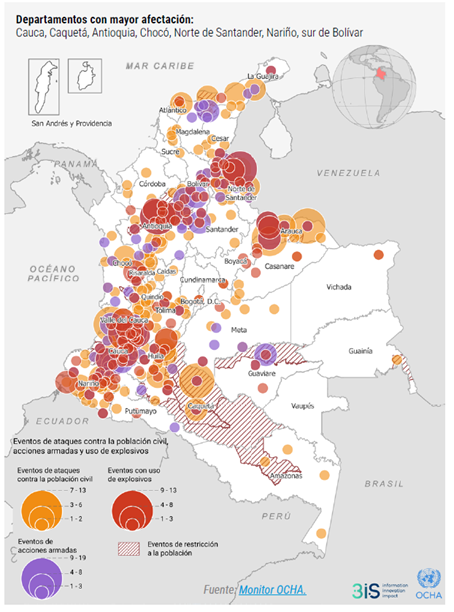
Civilians were killed and injured in 2026 by anti-personnel mines and other IEDs, armed drones, and in targeted killings. OCHA recorded more than 630,000 people affected by conflict and generalized violence in the first four months of 2026 alone, with a displacement or confinement emergency occurring on average once every two days (see Figure 2).69‘Informe de Situación Humanitaria 2026: Entre enero y abril de 2026’, Report, OCHA Colombia, 19 June 2026.
Use of improvised explosive devices (IEDs)
Explosive violence intensified sharply during the reporting period. OCHA recorded 276 events involving explosive devices in the first four months of 2026, affecting 7,742 people, an increase of ninety-six per cent on the same period in 2025.70‘Colombia: Informe de Situación Humanitaria 2026, datos acumulados entre enero y abril de 2026’, OCHA Colombia, 19 June 2026. By early September, the national count stood at over 200 explosive attacks for the year, of which the ELN was deemed responsible for around three quarters.71‘El país completa 204 atentados con explosivos en 2026’, El Tiempo, 2 September 2026. This covers command-detonated and remotely triggered devices, whose use is governed by the general rules of IHL governing the conduct of hostilities – distinction and proportionality in attack, underpinned by the duty to take precautions. These rules bind all parties to NIAC, including organized non-State armed groups. Victim-activated devices are addressed under anti-personnel mines, and drone-delivered devices under armed drones.
The single deadliest incident of the reporting period took place on 25 April, when members of the EMC’s Jaime Martínez and Dagoberto Ramos fronts detonated a high-powered device on the Panamericana Highway at the El Túnel sector of Cajibío, Cauca, killing at least twenty civilians and damaging fifteen vehicles.72‘Ataque con explosivos en Colombia deja al menos 20 muertos’, CNN, 25 April 2026. Witnesses reported that the perpetrators blocked the road with a bus and a dump truck immediately before detonation. That sequence is significant for characterization: if the perpetrators were aware they were halting civilian traffic at the moment of detonation, the incident would be a direct attack on civilians.
El Túnel was not an isolated event. The same day, a device struck a chiva (bus) carrying forty-five passengers from the Sath Tama Kiwe Indigenous territory at Pan de Azúcar, Mercaderes, injuring six Indigenous civilians including one child. A device thrown at a service station in Rozo, Valle del Cauca, injured six people aboard a bus at the site.‘73Atentado con explosivo en la vía Panamericana dejó al menos seis civiles heridos, incluido un menor, en Mercaderes, Cauca’, Infobae, 25 April 2026. The Defensoría del Pueblo (Ombudsman) characterized the day’s events as a coordinated escalation against the civilian population and called for protection measures along the corridor.74‘Escalada de ataques con artefactos explosivos y acciones armadas en Cauca y Valle del Cauca demanda medidas de protección para la población civil’, Defensoría del Pueblo, 26 April 2026. The corridor had already seen an attack on a police patrol between Timbío and Rosas on 23 March, which injured ten civilians alongside the security forces targeted, and remained active afterwards, with EMC dissidents destroying the Mondomo toll installation at kilometre 60 on 8 August.75‘Ataque con explosivos a una patrulla de la policía dejó un uniformado muerto y varios heridos en la vía Panamericana’, Infobae, 24 March 2026; ACLED recorded event, Cachimbal, Santander de Quilichao, 8 August 2026.
Read together, these incidents describe a corridor where command-detonated devices were repeatedly placed on a route carrying scheduled civilian passenger traffic. Even accepting security forces as the intended target in most cases, the recurring choice of this corridor, and the direct targeting of civilian passenger vehicles on 25 April, raise concern under the principles of distinction and proportionality in attack.
Vehicle-borne devices were used against police installations inside towns, most gravely on 1 August, when the ELN detonated a truck carrying fifteen devices outside a police command in Cúcuta, injuring eleven police officers and three civilians and damaging six houses.76‘Atentado en la ciudad colombiana de Cúcuta deja al menos 11 personas heridas’, CNN, 1 August 2026. The police are a lawful military objective if they are directly participating in hostilities; otherwise, they are considered civilians under IHL, protected as such.
Use of anti-personnel mines
Colombia remains among the countries most severely affected by anti-personnel mines worldwide. According to the Acción Integral Contra Minas Antipersonal (AICMA), 12,673 people have been recorded as victims of mines and unexploded ordnance since 1990, and accidents have been registered in 499 of the country’s 1,103 municipalities. Forty-one per cent of all recorded victims are said to be civilians and around one in ten are children.77‘Colombia promedia 352 víctimas al año por minas antipersonal y munición sin explotar desde que tiene registro’, Radio Nacional de Colombia, 4 April 2026.
As noted above, Colombia is a State Party to the APMBC, but as a disarmament treaty this binds directly only State actors and not the armed groups operating in Colombia. Colombia is, however, also party to the Convention on Certain Conventional Weapons and its Amended Protocol II of 1996, an IHL treaty that applies to all parties to an armed conflict, including non-State actors in a NIAC.78Protocol on Prohibitions or Restrictions on the Use of Mines, Booby-Traps and Other Devices as amended on 3 May 1996 (Protocol II as amended on 3 May 1996) annexed to the Convention on Prohibitions or Restrictions on the Use of Certain Conventional Weapons which May Be deemed to Be Excessively Injurious or to Have Indiscriminate Effects; adopted at Geneva, 3 May 1996; entered into force, 3 December 1998 (hereafter, 1996 Amended Protocol II). Colombia adhered to the Protocol in 2000. Although the Protocol does not prohibit all use of anti-personnel mines, it specifically prohibits the targeting of civilians and civilian objects as well as their indiscriminate use and requires that parties take all feasible precautions to protect civilians from their effects.79Art 3(7) and (8), 1996 Amended Protocol II. Customary IHL – and the Protocol – require that particular care be taken to minimize the effects of landmines on civilians.80Art 3(10), 1996 Amended Protocol II; and ICRC, Customary IHL Rule 15: ‘Principle of Precautions in Attack’.
Three features of mine use during 2026 are analytically significant. First, the victims were almost without exception civilians engaged in ordinary activity: working their land, travelling to school, or maintaining public utilities. Second, several devices were emplaced in close proximity to schools, homes, and roads connecting rural communities, in circumstances that make it difficult to characterize the resulting civilian risk as incidental. Third, contamination has extended into territory that had previously been certified as, or was thought to be, clear.
Nineteen civilian casualties were recorded across the first eight months of 2026, of whom two died. In each case, the victim was engaged in routine civilian activity at the time of detonation. The heaviest concentration of casualties was in the Catatumbo region of Norte de Santander, where at least eight civilians were killed or injured.81‘Monitor’, OCHA Colombia, 2026; ‘Menor de edad que cayó en campo minado resultó gravemente herido en el Catatumbo’, Caracol Radio, 23 January 2026; ‘El Tarra, Norte de Santander: en campo minado, por poco pierden la vida dos labriegos; el Ejercito intervino’, Semana, 31 January 2026. On 13 February 2026, a woman and her two children were injured by an anti-personnel mine while travelling to a meeting about the deterioration of their school building in Miramontes vereda. The Ministry of Education issued a statement recalling that schools and emergency teaching spaces must remain protected as civilian objects.82‘Comunicado’, Ministerio de Educación Nacional, 13 February 2026.
Other victims included electrical workers and contractors maintaining the electrical network, reflecting the pattern of attacks on that infrastructure, as documented above.83‘Entre muerte y explosiones, horas de terror azotan a Tibú’, La Opinión, 19 June 2026; ‘¡Cr1min@les! Humilde trabajador herido por mina antipersonal’, TVCUCUTA, 18 June 2026; ‘Farmer injured by landmines in Catatumbo: Consternation grows in the region’, Area Cucuta, 23 June 2026; ‘Otro contratista de CENS resultó herido tras caer en un campo minado en el Catatumbo’, La Opinión, 28 July 2026; ‘¡Qué dolor! Abuelito perdió una pierna tras pisar una mina antipersonal en Tibú, Norte de Santander’, Chicanoticias, 13 August 2026; ‘Adulto Mayor en Tibú Herido Tras Caer en Campo Minado’, Área Cúcuta, 13 August 2026; and ‘Defensoría alerta amenazas y nuevos ataques contra la población civil en el Catatumbo’, La Opinión, 15 August 2026. Elsewhere, victims were predominantly farmers and children, including five Indigenous Nasa farmers injured on 31 March by an explosive device concealed among coffee crops in El Trapiche, Toribío, Cauca, and four children who were severely injured after stepping on a mine while playing in La Laguna, Olaya Herrera.84‘Artefacto explosivo deja cinco heridos en actividad comunitaria de la vereda El Trapiche, Tacueyó’, Consejo Regional Indigena del Cauca, 1 April 2026; ‘Cuatro niños fueron víctimas de una mina antipersonal cuando jugaban en zona rural de Nariño’, El Espectador, 19 April 2026; ‘Cuatro niños heridos al caer en campo de minas antipersonales en Nariño’, Bluradio, 19 April 2026; ‘Cuatro menores resultan heridos tras caer en campo minado en Nariño’, El Heraldo, 20 April 2026; ‘Campesino murió tras activar accidentalmente una mina antipersonal en el corregimiento de El Plateado, Argelia’, El País, 6 May 2026; and ‘Campesino murió al activar una mina antipersonal en zona rural de El Tambo, Cauca’, El País, 11 June 2026.
Roads linking rural communities were repeatedly mined. Five devices attributed to the 28th FARC dissident front were defuzed along a road connecting several villages in Sacama and Támara, Casanare, in May. On 4 August, two mines and four other explosive devices configured for radio frequency and pressure activation were removed from the Panamericana highway in Taminango, Nariño. The emplacement of the devices was attributed to the Franco Benavides Front.85‘Ejército destruyó 39 minas antipersonales instaladas por disidencias en Casanare’, La Voz del Cinaruco, 13 May 2026; ‘Operación militar en la vía Panamericana: destruyen área minada en límites de Cauca y Nariño’, El País, 5 August 2026; ‘Un área minada impidió el paso de vehículos en la vía Panamericana entre Cauca y Nariño: alrededor de tres horas se mantuvo cerrada’, El Tiempo, 4 August 2026.
Contamination during the reporting period extended into areas previously considered clear. Támara in Casanare department had been declared free of the suspicion of mine contamination, but on 26 April, a thirty-four-year-old man was gravely injured while inspecting a coffee crop in Agua Blanca vereda. He required helicopter evacuation to Yopal.86‘Campesino cayó en campo minado y así lo rescató el Ejército en Casanare’, Semana, 27 April 2026. A local resident interviewed after the incident observed that the community had been told the municipality was believed free of mine contamination, but no one had warned residents which paths were safe to work their farms.87‘Crónica de un campesino de Támara Casanare, que vuelve a sentir el horror de vivir, literalmente, en un campo minado’, CasanareOnline, 28 April 2026.
Use of armed drones
The use of armed drones expanded sharply during 2026. The Colombian armed forces recorded 277 drone attacks in 2025, more than double the 119 recorded the year before.88Fundación Ideas para la Paz, ‘27.000 combatientes y récord en disputas: el deterioro de la seguridad marca el inicio de 2026’, 30 January 2026. During the first months of 2026, monitoring groups counted at least sixty-six further attacks, with EMC structures linked to Iván Mordisco responsible for most of them.89‘Cada 48 horas se registra un ataque con dron cargado con explosivos en Colombia’, El Tiempo, 6 April 2026. The core problem recurs across every region: commercially available drones deliver improvised, imprecise munitions, so the risk of indiscriminate harm is inherent to the method rather than incidental to any single attack.
The EMC’s Jaime Martínez, Carlos Patiño, and Dagoberto Ramos fronts conducted repeated drone strikes against police and military positions across Cauca and Valle del Cauca, with civilian harm a repeatedly recurring outcome rather than the exception. One clear example is the Carlos Patiño Front’s strike in El Plateado on 27 January, while a protest was underway nearby, which killed one civilian and injured eleven others, including several children. The presence of bystanders at the moment of the strike means the group either knew civilians were present or failed to verify.90‘Violento ataque con explosivos lanzados desde drones: reportan un muerto y más de 15 heridos en El Plateado, Cauca’, Infobae, 27 January 2026. The pattern repeated at scale in Playa Rica on 1 June, where ACLED recorded munitions dropped from aerial drones injuring eight civilians, six of them children, during overnight clashes. A drone strike on 18 January also damaged a hospital and civilian homes in Cajibío.91‘Noche de miedo por ataque con explosivos y drones en Cajibío, Cauca’, El Tiempo, 18 January 2026; ‘Colombia registró el primer ataque con enjambre de drones contra el Ejército en Valle del Cauca’, Infobae, 13 April 2026. On 11 to 12 April, the Jaime Martínez front launched what was reported as Colombia’s first drone swarm, roughly fifteen devices simultaneously, against military forces in Timba.92Ibid. Whatever the intended target, a swarm of that size launched in an inhabited area multiplies the number of simultaneous detonations to which civilians are exposed and correspondingly makes compliance with precaution obligations more challenging.
Catatumbo evidences a different pattern from Cauca: at least six incidents between January and June struck residential structures directly rather than causing incidental harm to bystanders near a military target, culminating in a farmer being killed in his home in Puerto Catatumbo on 2 June and a social leader’s house destroyed in El Tarra in April. In that case, the occupants escaped only because they saw the drone approaching.93‘Ataque con drones en el Catatumbo deja un adulto mayor muerto y otra persona más herida’, Caracol Radio, 3 June 2026; ‘Ataque con dron en El Tarra deja un muerto y agrava crisis humanitaria en Catatumbo: Defensoría alerta 784 desplazados’, Infobae, 2 June 2026. A school was also struck in Puerto Las Palmas on 26 May.94‘Denuncian ataque con explosivos contra escuela del Catatumbo’, Caracol Radio, 26 May 2026.
The concentration of such incidents in one department over a few months reads as a pattern of attacks directed against civilian objects – a serious violation of IHL – rather than a series of unconnected targeting errors. The pattern shows no sign of easing: Catatumbo recorded eighteen drone attacks and thirty-nine casualties (status unknown) for 2026 as of early August by one monitor’s count.95‘Catatumbo vive una nueva amenaza: 18 ataques con drones explosivos dejan 39 víctimas en 2026’, Vanguardia, 1 August 2026; ‘Nuevo ataque con drones contra tropas en El Carmen, Catatumbo, deja un suboficial asesinado y cuatro soldados heridos’, El Tiempo, 14 August 2026.
The deadliest single civilian incident of the reporting period occurred in Segovia, Antioquia, on 25 February, when drone-delivered munitions struck a family home, killing a woman and her two sons, one a community leader, with no apparent military objective at the site.96‘Ataque con dron en Antioquia mató a una madre y sus dos hijos en su propia casa: Ministerio de Defensa ofrece millonaria recompensa por los culpables’, Infobae, 27 Febrero 2026. The incident is difficult to characterize other than as a direct attack on civilians. In Bolívar, an ELN drone strike destroyed a home and injured two civilians in Arenal on 29 March.97‘Ataque con drones explosivos deja civil herida y destruye varias viviendas en Arenal del Sur (Bolívar)’, El Tiempo, 30 March 2026; ‘Ataque con drones explosivos contra estación de Policía en Bolívar dejó dos civiles heridos y daños en viviendas cercanas’, Infobae, 30 March 2026.
Human shields
Reports indicate that armed groups continued to use civilians as human shields during armed confrontations, often in connection with the confinement of communities. Under IHL, use of human shields, the placing or moving of civilians to seek to prevent certain locations or forces from being targeted, is strictly prohibited and a war crime.98ICRC, Customary IHL Rule 97: ‘Human Shields’; and Rule 156; ‘Definition of War Crimes’. Using civilians to protect members of armed groups against attacks also violates the duty to separate civilians from military objectives whenever it is feasible to do so.99ICRC, Customary IHL Rule 23: ‘Location of Military Objectives outside Densely Populated Areas’; and Rule 24: ‘Removal of Civilians and Civilian Objects from the Vicinity of Military Objectives’. The rules are ‘arguably’ applicable in NIAC according to the ICRC.
Practices of this kind were reported in Cauca during 2026. Members of the Carlos Patiño front of the EMC were said to have carried children towards troop positions during confrontations in Argelia in July.100‘Disidencias usan a menores como escudos y presionan a la población para atacar al Ejército en Cauca’, Noticias RCN, 16 July 2026.
Forced displacement
Forced displacement remained the principal driver of humanitarian emergencies in Colombia, although its pattern changed. In the first half of 2026, the Defensoría del Pueblo recorded eighty-three mass displacement events affecting 15,960 people, compared with fifty-four events affecting 82,538 in the same period of 2025.101‘Más de 15.000 personas se han desplazado en Colombia durante 2026, según la Defensoría’, El Espectador, 23 July 2026. The fall in the number of people affected reflects the absence of an event on the scale of the January 2025 Catatumbo emergency. Indigenous and Afro-descendant communities remained disproportionately affected, comprising thirty-six per cent and seventeen per cent, respectively, of those affected by conflict emergencies between January and April.102OCHA Colombia, ‘Informe de Situación Humanitaria 2026, datos acumulados entre enero y abril de 2026’, Report, 19 June 2026. From the middle of June, the Bajo Cauca and Nordeste subregions of Antioquia became the principal locus of displacement, driven by clashes between the EGC and the 4th, 36th, and 5th fronts of FARC dissident structures, in which explosives were dropped from drones.103‘Integrantes del ‘clan del Golfo’ señalados como responsables de desplazamientos en El Bagre, Antioquia, fueron capturados’, El Tiempo, 25 June 2026; ‘Crisis humanitaria en El Bagre: combates entre grupos armados provocan el desplazamiento de 131 familias’, La FM, 18 June 2026.
Indigenous communities and rural populations were displaced from their own territories in several departments. In Nariño, following a killing in the Tortugaña Telembí reserve on 16 March and subsequent threats and increased social control exercised over the community by armed groups, twenty-three Awá families moved to Ricaurte and a further fourteen to Barbacoas.104‘En cuatro municipios de Nariño ni la Semana Santa la pueden celebrar en paz; se registra el desplazamiento de 81 familias indígenas y campesinas’, El Tiempo, 1 April 2026.
Under IHL applicable in NIACs, forced displacement of civilians for reasons related to the conflict is prohibited unless the security of the civilians involved or imperative military reasons so demand.105ICRC, Customary IHL Rule 129: ‘The Act of Displacement’. While certain instances may fall within those narrow exceptions, and civilians may choose to flee, many displacements recorded during the reporting period involved civilians being driven out by threats and attacks on their homes rather than evacuations for their protection.
Humanitarian relief
Humanitarian access restrictions persisted in the areas most affected by hostilities. Under IHL, parties to a NIAC must allow and facilitate the rapid and unimpeded passage of humanitarian relief for civilians in need, which is impartial in character and conducted without any adverse distinction, subject to their right of control.106ICRC, Customary IHL Rule 55: ‘Access for Humanitarian Relief to Civilians in Need’. While humanitarian relief is subject to the consent of the parties concerned, that consent cannot be withheld arbitrarily. Between January and April 2026, OCHA recorded 152 events restricting movement and access affecting more than 561,600 people, of whom 289,500 were left without receiving humanitarian assistance.107OCHA Colombia, ‘Informe de Situación Humanitaria 2026, datos acumulados entre enero y abril de 2026’, 19 June 2026. Of these, ninety-four events affecting 94,900 people involved restrictions placed directly on humanitarian organizations. Restrictions included threats against the organizations, the suspension of missions on security grounds, armed strikes lasting between three and seventeen days, and incidents against the medical mission. These were concentrated in Caquetá, Cauca, Chocó, Norte de Santander, and Valle del Cauca. The extension of these restrictions into departments not previously affected was itself noted as a concern. In its review of conditions in Norte de Santander during 2025, OCHA had already identified armed control along the Tibú to El Tarra axis as severely restricting humanitarian access, noting that the growing use of drones to drop explosive devices was increasing risk for humanitarian actors as well as for civilians.108OCHA, ‘Colombia: Briefing Departamental, Norte de Santander, enero a diciembre de 2025’, 22 April 2026.
As noted, the myriad of constraints operated against rising need. The number of people in severe humanitarian need was projected to reach 6.9 million in 2026 – an increase of twenty-five per cent on 2025.109European Commission Directorate-General for European Civil Protection and Humanitarian Aid Operations (ECHO), ‘Colombia’, 2026. No comparable access data was published for the period after April 2026, and the figures above therefore cover only the first four months of the reporting period.
Protection of Persons in the Power of the Enemy
Under customary IHL, special protection is afforded to several categories of civilians or persons hors de combat who face a specific risk of harm, such as women, children, refugees, and IDPs.110ICRC, Customary IHL Rules 134 to 138: ‘Chapter 39. Other Persons Afforded Specific Protection’. IHL provides certain fundamental guarantees for anyone in the power of a party to a conflict, prohibiting murder, torture and other inhumane or degrading treatment, arbitrary detention, and unfair trials. Persons in the power of the enemy – including civilians detained by armed groups, demobilized fighters, and others under armed group control – were subjected to serious violations of IHL across the reporting period in Colombia. These included murder, enforced disappearance, sexual violence, forced recruitment of children, and arbitrary deprivation of liberty.
Murder of civilians, social leaders, and former fighters
Killings of community leaders and human rights defenders continued in 2026. According to INDEPAZ, eighty-eight social leaders and human rights defenders were killed between January and early August – approximately one every two days.111INDEPAZ, ‘Líderes sociales asesinados en Colombia 2026’, News release, August 2026. The Defensoría del Pueblo identified ninety victims between 1 January and 31 July (seventy-one men and nineteen women).112‘Líderes sociales, defensores de DD.HH y firmantes de acuerdo asesinados’, INDEPAZ, 3 August 2026; ‘Defensoría: 90 líderes sociales han sido asesinados en 2026’, La Silla Vacía, 26 August 2026. These figures are a reduction compared with 2025, when INDEPAZ recorded 121 killings over the same months.113‘Asesinatos de líderes sociales golpean a 432 municipios de Colombia, según Indepaz’, El Universal, 3 August 2026. In the same period in 2026, however, seventy massacres were perpetrated in the course of which a total of 278 civilians were murdered.114Ibid. Killings are concentrated in the departments where territorial contestation is most intense, with Cauca recording at least fourteen and Antioquia twelve across at least a dozen municipalities each, and Arauca seven. The Defensoría del Pueblo has described this as a territorial pattern in which risk persists where illegal economies, armed disputes, and institutional weakness coincide, affecting especially community and Indigenous leaderships.115‘El asesinato de tres defensores en Arauca refleja el inicio de otro año crítico para los líderes sociales en Colombia’, Mongabay, 12 February 2026. Where two parties contest the same territory, suspicion of collaboration with either becomes a basis for victimization by the other, and civilians are exposed from both directions rather than one.
Former fighters demobilized under the 2016 accord are civilians for the purposes of IHL.116ICRC, Customary IHL Rule 5: ‘Definition of Civilians’. Six signatories of the peace accord were killed in 2026 through to August across Caquetá, Cauca, Huila, Norte de Santander, and Putumayo.117‘Líderes sociales, defensores de DD.HH y firmantes de acuerdo asesinados’, INDEPAZ, 3 August 2026. The killings were said to have been perpetrated by armed groups, specifically the EGC and the ELN, and in particular fronts of the EMC and EMBF.
Enforced disappearances
Enforced disappearance continued to be recorded throughout 2026. Between January and July, the ICRC documented ninety-nine disappearances connected to the armed conflicts across fourteen departments, while the Defensoría del Pueblo received 244 declarations of enforced disappearance, reflecting testimonies that also concerned earlier disappearances, since the offence continues for as long as the fate or whereabouts of the victim has not been clarified.118‘Al menos una persona desaparece cada dos días por los conflictos armados en Colombia’, El Espectador, 30 August 2026.
Enforced disappearance is prohibited under customary IHL in all armed conflict, and parties to a conflict are required to take all feasible measures to account for persons reported missing and to provide their families with any information they have on their fate.119ICRC, Customary IHL Rule 98: ‘Enforced Disappearance’; and Rule 117: ‘Accounting for Missing Persons’. Indigenous and Afro-descendant communities remain disproportionately exposed, their vulnerability compounded by movement restrictions, territorial control exercised by armed actors, and difficulties in obtaining a State response. The pattern is illustrated by the case of Herman Arturo Guerrero Burbano, a leader of the Awá El Porvenir reserve, who was intercepted by armed men at a service station in the Junín police inspection in Barbacoas, Nariño, on 17 July 2026, and forced into a vehicle which left in the direction of Pasto. No group claimed responsibility and no demand was communicated to his family, and his whereabouts remains unknown.120‘Denuncian desaparición de líder indígena Awá en Nariño: habría sido interceptado por hombres armados’, El Espectador, 21 July 2026; ‘Piden la liberación de líder y empresario que habría sido secuestrado en el municipio de Barbacoas’, Diario del Sur, 21 July 2026.
Child recruitment
The recruitment and use of children by armed groups continued throughout the reporting period. Recruiting children under fifteen years of age into armed forces or groups, and using them to participate actively in hostilities, are acts prohibited under IHL in any armed conflict.121ICRC, Customary IHL Rule 136: ‘Recruitment of Child Soldiers’; and Rule 137: ‘Participation of Child Soldiers in Hostilities’. Fundación Ideas para la Paz identifies child recruitment as one of the drivers of the growth of armed groups, whose combined membership rose from around 15,120 in December 2022 to some 28,802 by July 2026.122Fundación Ideas para la Paz, ‘El costo de negociar mal: 29.000 integrantes de grupos armados entre disputas y gobernanzas criminales’, August 2026.
Between 1 January and 31 July 2026, the Defensoría del Pueblo identified ninety-seven cases, bringing the total known to the institution since the beginning of 2024 to 1,173.123‘Reducción en cifras de reclutamiento no implica menos casos, sino más subregistro’, Defensoría del Pueblo, 1 September 2026. The figure is lower than the 684 cases recorded in 2024 and the 428 recorded in 2025, but the Defensoría has cautioned that the fall reflects increased under-registration rather than reduced recruitment, since families frequently do not report out of fear, distrust of institutions, or normalization of the practice, and some children enter the records only after dying in hostilities or military operations.124‘Defensoría registra 97 casos de reclutamiento de menores en Colombia durante 2026’, El Espectador, 31 August 2026.
Cauca has long accounted for the greatest share of cases nationally, close to fifty-seven per cent, with approximately two-thirds attributed to former FARC dissident factions. Indigenous children bear a disproportionate share of the harm (half of all reported cases while making up only around four per cent of the population), and girls account for roughly forty per cent of those recruited, a proportion that grew between 2021 and 2025.125Human Rights Watch, ‘“I Thought I’d Never See My Mom Again”: Recruitment and Use of Children by Colombian Armed Groups’, Report, August 2026.
Recruitment is increasingly conducted online. Armed groups maintain accounts promoting armed life, advertising false employment, and circulating images of what appear to be children in uniform bearing weapons, and social media platforms have in some instances amplified that material rather than suppressing it.126Ibid. The Committee on the Rights of the Child, in its February 2026 Concluding Observations on Colombia, expressed concern at the increasing and systematic use of digital platforms by armed groups for recruitment and sexual exploitation, alongside the disproportionate impact on Indigenous and Afro-Colombian children and sexual violence against recruited girls.127Committee on the Rights of the Child, Concluding Observations on the Combined Sixth and Seventh Periodic Reports of Colombia, UN Doc CRC/C/COL/CO/6-7, 5 February 2026.
Children are commonly moved away from their home regions after recruitment, which severs contact with family and community and makes escape harder. Once within the group, they gather intelligence, operate drones, and take part in fighting, and girls face additional exposure to sexual violence, including coerced relationships with commanders.128Human Rights Watch, ‘ “I Thought I’d Never See My Mom Again”‘, August 2026. Both patterns are visible in the deaths in January of four children, three girls and a boy, among the victims of fighting between the EMC and the EMBF in El Retorno, Guaviare: the four were Indigenous Nasa from Cauca.129‘Medicina Legal anunció que hay cuatro menores de edad muertos en guerra entre disidencias en Guaviare’, El Tiempo, 21 January 2026. In May, after video circulated showing two adolescents operating a drone adapted to carry explosives, the army stated that 161 children had been recovered from armed groups during the year to that date.130‘Ejército Nacional alerta por incremento de reclutamiento de menores tras difusión de video con dron acondicionado con explosivos’, Radio Nacional de Colombia, 14 May 2026.
Accountability for unlawful recruitment remains rare. Human Rights Watch identified a single ruling against a commander accused of ordering unlawful recruitment, alongside a small number of sentences against low-level perpetrators, and attributed the shortfall to limited prosecutorial capacity, security constraints on justice officials, obstacles to reporting, and the difficulty of investigating recruitment carried out online.131Human Rights Watch, ‘“I Thought I’d Never See My Mom Again”’, August 2026.
Proceedings before the Special Jurisdiction for Peace concern historical conduct: on 28 April 2026, within Case 07, it called on twenty former members of the FARC-EP to acknowledge responsibility as those most responsible at the regional level for the recruitment and use of children, and completed its investigation regarding 18,677 victims recruited between 1971 and 2016.132‘JEP llamó a 20 exFarc para que reconozcan su responsabilidad por reclutamiento de menores’, Infobae, 28 April 2026.
Conflict-related sexual and gender-based violence
Rape and other forms of sexual violence are prohibited under IHL applicable in NIACs, including sexual slavery, enforced prostitution, forced pregnancy, and enforced sterilization.133ICRC, Customary IHL Rule 93: ‘Rape and Other Forms of Sexual Violence’; Common Article 3 to the Geneva Conventions of 1949; and Article 4(2)(e) and (f), Additional Protocol II. Sexual violence in Colombia is not incidental to hostilities but a means by which armed groups exercise territorial and social control, with the Defensoría del Pueblo describing the bodies of women, girls, adolescents, and gender-diverse persons as being used as instruments of that control.134Defensoría del Pueblo, cited in MESECVI, ‘Final communiqué: Catatumbo mission (February 2026)’, OAS, February 2026.
The most recent verified figures cover 2025, a year during which the United Nations recorded cases of sexual violence against twenty-two women and three girls. In contrast, the National Victims’ Unit recorded conflict-related cases affecting 4,113 people, of which 753 occurred during 2025, and the National Public Health Surveillance System registered 276 alleged conflict-related cases, half against children under fourteen, with forensic evidence collected in fewer than ten per cent of cases.135UN Secretary-General, ‘Conflict-related sexual violence’, Report, UN Doc S/2026/321, 21 April 2026. In more than half of reported cases, no perpetrator was identified; guerrilla groups were identified in 27.4 per cent of recorded cases. Under-reporting persists through fear of reprisals and mistrust of institutions, compounded by linguistic and accessibility barriers affecting Indigenous women and children, and women with disabilities in particular.
Sexual violence operates as a driver of displacement and not only as a consequence of it. Women leaders in Catatumbo have reported coercion in explicit terms, including threats that a woman submit or be killed, and threats made to parents concerning their daughters, with flight frequently the only available protection.136MESECVI, ‘Final communiqué: Catatumbo mission (February 2026)’, February 2026. Where displacement results from threats of sexual violence, or where such threats are used to empty territory, this is a serious violation of IHL. Armed groups have compounded this by separating families during displacement, sending women and children to urban areas while men remain behind, and severing contact through surveillance and interception of communications, which strips women and children of the family and community networks that afford some protection. Displaced women are then exposed to further forced recruitment, trafficking, and sexual abuse, and the absence of reproductive health services has produced a forty per cent rise in unintended pregnancies among displaced women, adolescents, and girls aged thirteen to forty-nine.137Ibid. Girls recruited by armed groups are assigned roles combining domestic labour with sexual exploitation, and as mentioned above, Human Rights Watch found that girls face particular exposure to sexual violence including coerced relationships with commanders.138Human Rights Watch, ‘“I Thought I’d Never See My Mom Again”’, August 2026. Where sexual violence is perpetrated against recruited children it engages both the prohibition on recruitment and the prohibition on sexual violence, and serious violations of either amount to war crimes. The Committee on the Rights of the Child expressed concern in February 2026 at sexual violence against recruited girls and at the systematic use of digital platforms by armed groups for recruitment and sexual exploitation.139Committee on the Rights of the Child, Concluding Observations on the Combined Sixth and Seventh Periodic Reports of Colombia, UN Doc CRC/C/COL/CO/6-7, 5 February 2026. The burden falls unevenly. Although Black, Afro-Colombian, and Indigenous peoples constitute around fifteen per cent of the population, they account for thirty-one per cent of recorded violations.140United Nations Secretary-General, UN Doc S/2026/321, 21 April 2026.
Venezuelan migrant women face heightened trafficking risk aggravated by irregular status, since reporting abuse may expose them to detention or deportation. LGBTIQ+ persons are targeted as part of the same logic of social regulation, with armed groups treating departures from expected gender norms as a challenge to the order they impose, and subjecting transgender women and gay men to extortion, displacement, sexual violence, and coercion into illicit tasks.141Ibid. Women with disabilities experience a compounded invisibility: of 278,958 women with disabilities recognized as victims of the conflict, 5,078 have been recorded as victims of sexual violence.142Ibid.
Impunity remains near-total. Of 12,062 women registered as victims of conflict-related sexual violence between January 2020 and March 2025, 110 had received compensation.143‘Defensoría conmemora Día Nacional por la Dignidad de las Mujeres Víctimas de Violencia Sexual en el Marco del Conflicto Armado’, Defensoría del Pueblo, 2026. In 2025, the Special Jurisdiction for Peace delivered three convictions for command responsibility for sexual violence in Macro Case 1 and continued investigations across eight macro cases, while in Macro Case 11 on conflict-related sexual and gender-based violence, 938 women and 104 men were accredited as victims. Threats were issued against women-led organizations supporting victims.144Report of the UN Secretary-General, UN Doc S/2026/321, 21 April 2026.
Arbitrary deprivation of liberty
Arbitrary deprivation of liberty and hostage-taking, referred to domestically as secuestro, continued to be used by armed groups for financing and for political or military leverage. In the first two months of 2026 the Ministry of Defence registered fifty-six cases, a slight increase from the previous two years.145‘Aumentan los secuestros en Colombia en este inicio de 2026’, El Nuevo Siglo, 31 March 2026. Not all recorded cases are linked to the armed conflict. When the requisite nexus exists, such actions breach the prohibition of arbitrary deprivation of liberty and, where money or other action is required for the safety and/or safe release of the captive, of hostage-taking.146ICRC, Customary IHL Rule 99: ‘Deprivation of Liberty’; Common Article 3 to the Geneva Conventions. Under IHL, hostage-taking amounts to a war crime in all armed conflicts.147ICRC, Customary IHL Rule 96: ‘Hostage-Taking’.
Confinement
Confinement of civilians, where civilians are prevented from leaving their communities or homes, results from armed confrontations and the presence of explosive devices, as well as from threats, curfews, and conduct rules imposed on residents by armed groups. In the first quarter of 2026, 39,807 civilians were confined in twenty-six events, an increase compared with the same period of 2025.148‘Confinamiento en Colombia sigue en aumento: alertan que subió un 63 %’, El Universal, 23 April 2026. By 31 July, 72,827 civilians had been confined across fifty-one ‘events’.149‘Defensoría: 17.892 personas fueron desplazadas en Colombia entre enero y julio de 2026’, El Espectador, 22 August 2026. The ELN, FARC dissident structures, and the EGC (among others) were accused of being responsible.150‘Van 40 desplazamientos masivos y más de 39.000 personas confinadas en lo que va del 2026, según la Defensoría’, El Colombiano, 30 April 2026
Confined civilians are prevented from accessing food, health care, and education, and are at heightened risk of forced recruitment and of gender-based violence.151Norwegian Refugee Council, ‘Colombia: trapped in their own territory’, Press release, March 2026. Of the twenty-six events recorded in the first quarter of 2026, seventeen affected ethnic communities and nine campesino populations.152‘Confinamiento en Colombia sigue en aumento: alertan que subió un 63 %’, El Universal, 23 April 2026. The Defensoría described this as evidencing disproportionate impacts on populations holding special constitutional protection.153‘Confinamiento y desplazamiento en Colombia 2026: cifras de Defensoría, departamentos afectados y grupos armados responsables’, El Espectador, 2 May 2026. Cauca was the most affected department in the first quarter, with 9,395 civilians confined. By 31 July, cumulative figures placed Chocó (13,896), Putumayo (12,646), and Caquetá (11,641) above Cauca (10,672).154Ibid; and ‘Defensoría: 17.892 personas fueron desplazadas en Colombia entre enero y julio de 2026’, El Espectador, 22 August 2026.
Transitional Justice
There is a formal transitional justice programme in place in Colombia, but the incoming government has intervened to stop certain aspects of the programme. Mr de la Espriella took office on 7 August 2026 having campaigned on ending his predecessor’s paz total policy of simultaneous negotiation with guerrilla groups, FARC dissident structures, successor paramilitary organizations, and urban gangs, and on its replacement with a military-led response.
Interviewed shortly before the inauguration, a commander of the ELN’s Western War Front stated that the group would go on the offensive where it was able to.155‘Colombia on the brink: ELN guerrilla group prepares for return to war’, The Guardian, 7 August 2026. On 31 August, the new government terminated the negotiating processes with the Estado Mayor de Bloques y Frentes, the Coordinadora Nacional Ejército Bolivariano, and the Autodefensas Conquistadoras de la Sierra Nevada, revoking the credentials of government negotiators and the recognition extended to the groups’ delegates, on the stated basis that no real and verifiable willingness for peace existed.156‘Colombia Ends Endless Peace Talks as Armed Groups Keep Growing’, Latin American Post, 31 August 2026.
The International Crisis Group, assessing the shift, estimated that the combined membership of armed and criminal organizations had grown from around 15,132 to approximately 27,000 between 2022 and 2025, and cautioned that military-led campaigns conducted alone have historically produced cycles of violence rather than ending them.157International Crisis Group, ‘From “Total Peace” to Iron Fist: Colombia’s Risky Turn to Hard Security’, Briefing 56, 7 August 2026. Ninety-nine members of a structure linked to the Coordinadora Nacional Ejército Bolivariano laid down their arms three days before the presidential run-off and entered a government-controlled temporary transition zone, where they remained as at the end of August 2026 without a decision on their legal status or on the reintegration process they had been promised.158‘They laid down arms. Now ex-guerrillas in Colombia fear fate under new hardline president’, The Guardian, 29 August 2026.
- 1C. Klobucista and D. Renwick, ‘Colombia’s Civil Conflict’, Council on Foreign Relations, 11 January 2017. ↩︎
- 2Ibid. ↩︎
- 3Comisión para el Esclarecimiento de la Verdad, la Convivencia y la No Repetición, ‘La Desmovilización de las AUC’, accessed 1 September 2026. ↩︎
- 4C. Klobucista and D. Renwick, ‘Colombia’s Civil Conflict’, Council on Foreign Relations, 11 January 2017. ↩︎
- 5‘United States Department of State Bureau for International Narcotics and Law Enforcement Affairs: International Narcotics Control Strategy Report, Volume 1: Drug and Chemical Control’, US Department of State, March 2025, p 168; ‘Colombia: Events of 2024’, World Report 2025. ↩︎
- 6Historical Memory Group, ‘Basta Ya! Colombia: Memories of War and Dignity, General Report Historical Memory Group’, 2016, p 36 ff. ↩︎
- 7European Union, ‘An Historical Peace Agreement in Colombia’, 23 April 2021. ↩︎
- 8‘Peace Plan Has Caused More Conflict, Says Thinktank’, Bogotá Post, 13 February 2026. ↩︎
- 9Colombian Ministry of Justice, ‘Marco Jurídico Para la Paz Total’, 9 October 2025; see also: Human Rights Watch ‘World Report 2026: Colombia’, 4 February 2026. ↩︎
- 10T. Breda, ‘Total Peace Paradox in Colombia: Petro’s Policy Reduced Violence, but Armed Groups Grew Stronger’, Armed Conflict Location & Event Data Project (ACLED), 2025. ↩︎
- 11‘Criminal Disputes and Divisions Undermine Colombia’s Peace Efforts’, InSight Crime, 17 April 2025. ↩︎
- 12S. B. Velez, ‘Colombia Suspends Peace Talks with the ELN Guerrilla Group’, Latin America Reports, 19 September 2024. ↩︎
- 13‘Con De la Espriella finaliza la paz total de Petro’, Diario de Cuba, 8 August 2026. ↩︎
- 14‘Peace Plan Has Caused More Conflict, Says Thinktank’, Bogotá Post, 13 February 2026. ↩︎
- 15‘El costo de negociar mal’, Fundación Ideas para la Paz, August 2026. ↩︎
- 16‘Was it a mistake for 99 Colombia guerrillas to lay down their arms? ’ The Guardian, 26 August 2026. ↩︎
- 17Defensoría del Pueblo, ‘El Catatumbo padece la emergencia humanitaria más grande desde que hay registro en Colombia a causa del conflicto armado’, 2025. ↩︎
- 18‘Gamechangers 2025: Colombia’s Total Peace in Pieces’, InSight Crime, 2026. ↩︎
- 19‘Total Peace Talks Reach New Agreements between Government and EMBF’, Justice for Colombia, 21 November 2025. ↩︎
- 20‘AGC Peace Talks Timeline’ ABColombia, 2026. ↩︎
- 21
- 22World Food Programme (WFP), ‘Colombia Country Brief’, July 2026. ↩︎
- 23
- 24‘Abelardo de la Espriella jura como presidente de Colombia’ CNN, 7 August 2026. ↩︎
- 25‘De la Espriella entierra la paz y alista a Colombia para una guerra sin cuartel’, Escambray, 8 August 2026. ↩︎
- 26‘Abelardo de la Espriella cambia la paz total de Petro por una política de mano dura en Colombia’, Expansión, 15 August 2026. ↩︎
- 27WFP, ‘Colombia Country Brief’, July 2026. ↩︎
- 28
- 29
- 30IDMC, ‘Country Profile – Colombia’, 2026. ↩︎
- 31Protocol Additional to the Geneva Conventions of 12 August 1949, and relating to the Protection of Victims of Non-International Armed Conflicts (Protocol II); adopted at Geneva, 8 June 1977; entered into force, 7 December 1978 (hereafter, Additional Protocol II of 1977). ↩︎
- 32The EMC sprang from an original group of approximately sixty FARC-EP members who did not adhere to the 2016 peace process. In 2024, after disagreements between EMC membership on the desirability of new peace negotiations with the Colombian government, the EMBF was formed as a splinter group. The EMBF is a party to two NIACs classified in the reporting period that involve only non-State armed groups as parties: the ELN v Frente 33 (EMBF) and the EMC v EMBF. See further J. P. Contreras Ríos, ‘Así nació el grupo que se separó de Mordisco y que ahora negocia la paz con Petro’, El Espectador, 4 December 2024. ↩︎
- 33As of June 2024, according to Human Rights Watch, the EGC was present in 392 municipalities, the ELN in 232, and dissident FARC-EP groups in 299. Human Rights Watch, ‘Colombia: Events of 2024’, World Report 2025. ↩︎
- 34The material jurisdiction of the Protocol is limited to armed conflicts ‘which take place in the territory of a High Contracting Party between its armed forces and dissident armed forces or other organized armed groups…’: Art 1(1), Additional Protocol II of 1977 [emphasis added]. ↩︎
- 35Arms Trade Treaty; adopted at New York, 2 April 2013; entered into force, 24 December 2014. ↩︎
- 36Convention on the Prohibition of the Use, Stockpiling, Production and Transfer of Anti-Personnel Mines and on their Destruction; adopted at Oslo, 18 September 1997; entered into force, 1 March 1999. ↩︎
- 37
- 38Convention on Cluster Munitions; adopted at Dublin, 30 May 2008; entered into force, 1 August 2010. ↩︎
- 39
- 40Convention on the Prohibition of the Development, Production, Stockpiling and Use of Chemical Weapons and on their Destruction; adopted at Geneva, 3 September 1992; entered into force, 29 April 1997. ↩︎
- 41Rome Statute of the International Criminal Court; adopted at Rome, 17 July 1998; entered into force, 1 July 2002. ↩︎
- 42Office of the Prosecutor (OTP), ‘Report on Preliminary Examination Activities 2020’, 14 December 2020, paras 109, 110. ↩︎
- 43
- 44‘Declaration of Colombia’, 5 August 2002. ↩︎
- 45
- 46‘El costo de negociar mal’, Fundación Ideas para la Paz, August 2026. ↩︎
- 47‘Peace Plan Has Caused More Conflict, Says Thinktank’, Bogotá Post, 13 February 2026. ↩︎
- 48ICRC, Customary IHL Rule 7: ‘The Principle of Distinction between Civilian Objects and Military Objectives’. ↩︎
- 49
- 50
- 51ICRC, Customary IHL Rule 8: ‘Definition of Military Objectives’. In addition, the object’s partial or total destruction, capture, or neutralisation must offer a definite military advantage in the prevailing circumstances. ↩︎
- 52‘Ataque con drones en Cajibío deja afectaciones en viviendas y hospital’, El País (Colombia), 18 January 2026. ↩︎
- 53‘Armada Nacional denuncia ataque del ELN contra buque hospital en el río San Juan, Chocó’, Buenaventura en Línea, 5 June 2026; ‘Minsalud condenó ataque del ELN con ráfagas de fusil, ametralladoras y granadas a misión médica en Chocó’, El Heraldo, 6 June 2026. ↩︎
- 54‘Gobierno condena amenazas del ELN contra hospital en Ábrego’, La Opinión, 16 August 2026. ↩︎
- 55Norwegian Refugee Council, ‘Colombia: Armed Groups’ Attacks on Education Affect over 12,000 Students and Teachers’, Press release, 21 July 2026. ↩︎
- 56‘Denuncian ataque con explosivos contra escuela del Catatumbo’, Caracol Radio, 26 May 2026. ↩︎
- 57‘Con explosivos, disidentes de las Farc derribaron una torre de energia en zona rural de Santander de Quilichao, Cauca’, El País (Colombia), 23 January 2026. ↩︎
- 58‘Por ataque en Cajibío, tres municipios se quedaron sin energía en Cauca’, El Espectador, 23 February 2026. ↩︎
- 59‘Procuraduría pide reforzar seguridad tras atentado contra torre eléctrica en Planadas’, El Tiempo, 19 August 2026. ↩︎
- 60‘Ejército frustró el atentado contra una torre de energía en Candelaria, Valle del Cauca’, El País (Colombia), 26 May 2026. ↩︎
- 61‘Colombia: Ministerio emite alerta por atentados a infraestructura eléctrica’, Rumbo Minero, 26 January 2026. ↩︎
- 62‘Un puente en la vía Panamericana, entre Nariño y Cauca estuvo a punto de ser volado por un grupo armado ilegal’, Periódico Virtual, 27 April 2026. ↩︎
- 63‘Nuevo Gobierno de Colombia inicia con varios ataques con explosivos en diferentes regiones’, Proceso Digital, 2 August 2026. ↩︎
- 64
- 65
- 66ICRC, Customary IHL Rule 6: ‘Civilians’ Loss of Protection from Attack’, and see associated commentary. ↩︎
- 67
- 68
- 69‘Informe de Situación Humanitaria 2026: Entre enero y abril de 2026’, Report, OCHA Colombia, 19 June 2026. ↩︎
- 70‘Colombia: Informe de Situación Humanitaria 2026, datos acumulados entre enero y abril de 2026’, OCHA Colombia, 19 June 2026. ↩︎
- 71‘El país completa 204 atentados con explosivos en 2026’, El Tiempo, 2 September 2026. ↩︎
- 72‘Ataque con explosivos en Colombia deja al menos 20 muertos’, CNN, 25 April 2026. ↩︎
- 73
- 74‘Escalada de ataques con artefactos explosivos y acciones armadas en Cauca y Valle del Cauca demanda medidas de protección para la población civil’, Defensoría del Pueblo, 26 April 2026. ↩︎
- 75‘Ataque con explosivos a una patrulla de la policía dejó un uniformado muerto y varios heridos en la vía Panamericana’, Infobae, 24 March 2026; ACLED recorded event, Cachimbal, Santander de Quilichao, 8 August 2026. ↩︎
- 76‘Atentado en la ciudad colombiana de Cúcuta deja al menos 11 personas heridas’, CNN, 1 August 2026. ↩︎
- 77‘Colombia promedia 352 víctimas al año por minas antipersonal y munición sin explotar desde que tiene registro’, Radio Nacional de Colombia, 4 April 2026. ↩︎
- 78Protocol on Prohibitions or Restrictions on the Use of Mines, Booby-Traps and Other Devices as amended on 3 May 1996 (Protocol II as amended on 3 May 1996) annexed to the Convention on Prohibitions or Restrictions on the Use of Certain Conventional Weapons which May Be deemed to Be Excessively Injurious or to Have Indiscriminate Effects; adopted at Geneva, 3 May 1996; entered into force, 3 December 1998 (hereafter, 1996 Amended Protocol II). Colombia adhered to the Protocol in 2000. ↩︎
- 79Art 3(7) and (8), 1996 Amended Protocol II. ↩︎
- 80Art 3(10), 1996 Amended Protocol II; and ICRC, Customary IHL Rule 15: ‘Principle of Precautions in Attack’. ↩︎
- 81‘Monitor’, OCHA Colombia, 2026; ‘Menor de edad que cayó en campo minado resultó gravemente herido en el Catatumbo’, Caracol Radio, 23 January 2026; ‘El Tarra, Norte de Santander: en campo minado, por poco pierden la vida dos labriegos; el Ejercito intervino’, Semana, 31 January 2026. ↩︎
- 82‘Comunicado’, Ministerio de Educación Nacional, 13 February 2026. ↩︎
- 83‘Entre muerte y explosiones, horas de terror azotan a Tibú’, La Opinión, 19 June 2026; ‘¡Cr1min@les! Humilde trabajador herido por mina antipersonal’, TVCUCUTA, 18 June 2026; ‘Farmer injured by landmines in Catatumbo: Consternation grows in the region’, Area Cucuta, 23 June 2026; ‘Otro contratista de CENS resultó herido tras caer en un campo minado en el Catatumbo’, La Opinión, 28 July 2026; ‘¡Qué dolor! Abuelito perdió una pierna tras pisar una mina antipersonal en Tibú, Norte de Santander’, Chicanoticias, 13 August 2026; ‘Adulto Mayor en Tibú Herido Tras Caer en Campo Minado’, Área Cúcuta, 13 August 2026; and ‘Defensoría alerta amenazas y nuevos ataques contra la población civil en el Catatumbo’, La Opinión, 15 August 2026. ↩︎
- 84‘Artefacto explosivo deja cinco heridos en actividad comunitaria de la vereda El Trapiche, Tacueyó’, Consejo Regional Indigena del Cauca, 1 April 2026; ‘Cuatro niños fueron víctimas de una mina antipersonal cuando jugaban en zona rural de Nariño’, El Espectador, 19 April 2026; ‘Cuatro niños heridos al caer en campo de minas antipersonales en Nariño’, Bluradio, 19 April 2026; ‘Cuatro menores resultan heridos tras caer en campo minado en Nariño’, El Heraldo, 20 April 2026; ‘Campesino murió tras activar accidentalmente una mina antipersonal en el corregimiento de El Plateado, Argelia’, El País, 6 May 2026; and ‘Campesino murió al activar una mina antipersonal en zona rural de El Tambo, Cauca’, El País, 11 June 2026. ↩︎
- 85‘Ejército destruyó 39 minas antipersonales instaladas por disidencias en Casanare’, La Voz del Cinaruco, 13 May 2026; ‘Operación militar en la vía Panamericana: destruyen área minada en límites de Cauca y Nariño’, El País, 5 August 2026; ‘Un área minada impidió el paso de vehículos en la vía Panamericana entre Cauca y Nariño: alrededor de tres horas se mantuvo cerrada’, El Tiempo, 4 August 2026. ↩︎
- 86‘Campesino cayó en campo minado y así lo rescató el Ejército en Casanare’, Semana, 27 April 2026. ↩︎
- 87‘Crónica de un campesino de Támara Casanare, que vuelve a sentir el horror de vivir, literalmente, en un campo minado’, CasanareOnline, 28 April 2026. ↩︎
- 88Fundación Ideas para la Paz, ‘27.000 combatientes y récord en disputas: el deterioro de la seguridad marca el inicio de 2026’, 30 January 2026. ↩︎
- 89‘Cada 48 horas se registra un ataque con dron cargado con explosivos en Colombia’, El Tiempo, 6 April 2026. ↩︎
- 90‘Violento ataque con explosivos lanzados desde drones: reportan un muerto y más de 15 heridos en El Plateado, Cauca’, Infobae, 27 January 2026. ↩︎
- 91‘Noche de miedo por ataque con explosivos y drones en Cajibío, Cauca’, El Tiempo, 18 January 2026; ‘Colombia registró el primer ataque con enjambre de drones contra el Ejército en Valle del Cauca’, Infobae, 13 April 2026. ↩︎
- 92Ibid. ↩︎
- 93‘Ataque con drones en el Catatumbo deja un adulto mayor muerto y otra persona más herida’, Caracol Radio, 3 June 2026; ‘Ataque con dron en El Tarra deja un muerto y agrava crisis humanitaria en Catatumbo: Defensoría alerta 784 desplazados’, Infobae, 2 June 2026. ↩︎
- 94‘Denuncian ataque con explosivos contra escuela del Catatumbo’, Caracol Radio, 26 May 2026. ↩︎
- 95‘Catatumbo vive una nueva amenaza: 18 ataques con drones explosivos dejan 39 víctimas en 2026’, Vanguardia, 1 August 2026; ‘Nuevo ataque con drones contra tropas en El Carmen, Catatumbo, deja un suboficial asesinado y cuatro soldados heridos’, El Tiempo, 14 August 2026. ↩︎
- 96
- 97‘Ataque con drones explosivos deja civil herida y destruye varias viviendas en Arenal del Sur (Bolívar)’, El Tiempo, 30 March 2026; ‘Ataque con drones explosivos contra estación de Policía en Bolívar dejó dos civiles heridos y daños en viviendas cercanas’, Infobae, 30 March 2026. ↩︎
- 98
- 99ICRC, Customary IHL Rule 23: ‘Location of Military Objectives outside Densely Populated Areas’; and Rule 24: ‘Removal of Civilians and Civilian Objects from the Vicinity of Military Objectives’. The rules are ‘arguably’ applicable in NIAC according to the ICRC. ↩︎
- 100‘Disidencias usan a menores como escudos y presionan a la población para atacar al Ejército en Cauca’, Noticias RCN, 16 July 2026. ↩︎
- 101‘Más de 15.000 personas se han desplazado en Colombia durante 2026, según la Defensoría’, El Espectador, 23 July 2026. ↩︎
- 102OCHA Colombia, ‘Informe de Situación Humanitaria 2026, datos acumulados entre enero y abril de 2026’, Report, 19 June 2026. ↩︎
- 103
- 104
- 105
- 106
- 107OCHA Colombia, ‘Informe de Situación Humanitaria 2026, datos acumulados entre enero y abril de 2026’, 19 June 2026. ↩︎
- 108OCHA, ‘Colombia: Briefing Departamental, Norte de Santander, enero a diciembre de 2025’, 22 April 2026. ↩︎
- 109
- 110
- 111INDEPAZ, ‘Líderes sociales asesinados en Colombia 2026’, News release, August 2026. ↩︎
- 112‘Líderes sociales, defensores de DD.HH y firmantes de acuerdo asesinados’, INDEPAZ, 3 August 2026; ‘Defensoría: 90 líderes sociales han sido asesinados en 2026’, La Silla Vacía, 26 August 2026. ↩︎
- 113‘Asesinatos de líderes sociales golpean a 432 municipios de Colombia, según Indepaz’, El Universal, 3 August 2026. ↩︎
- 114Ibid. ↩︎
- 115‘El asesinato de tres defensores en Arauca refleja el inicio de otro año crítico para los líderes sociales en Colombia’, Mongabay, 12 February 2026. ↩︎
- 116
- 117‘Líderes sociales, defensores de DD.HH y firmantes de acuerdo asesinados’, INDEPAZ, 3 August 2026. ↩︎
- 118‘Al menos una persona desaparece cada dos días por los conflictos armados en Colombia’, El Espectador, 30 August 2026. ↩︎
- 119ICRC, Customary IHL Rule 98: ‘Enforced Disappearance’; and Rule 117: ‘Accounting for Missing Persons’. ↩︎
- 120‘Denuncian desaparición de líder indígena Awá en Nariño: habría sido interceptado por hombres armados’, El Espectador, 21 July 2026; ‘Piden la liberación de líder y empresario que habría sido secuestrado en el municipio de Barbacoas’, Diario del Sur, 21 July 2026. ↩︎
- 121ICRC, Customary IHL Rule 136: ‘Recruitment of Child Soldiers’; and Rule 137: ‘Participation of Child Soldiers in Hostilities’. ↩︎
- 122Fundación Ideas para la Paz, ‘El costo de negociar mal: 29.000 integrantes de grupos armados entre disputas y gobernanzas criminales’, August 2026. ↩︎
- 123‘Reducción en cifras de reclutamiento no implica menos casos, sino más subregistro’, Defensoría del Pueblo, 1 September 2026. ↩︎
- 124‘Defensoría registra 97 casos de reclutamiento de menores en Colombia durante 2026’, El Espectador, 31 August 2026. ↩︎
- 125Human Rights Watch, ‘“I Thought I’d Never See My Mom Again”: Recruitment and Use of Children by Colombian Armed Groups’, Report, August 2026. ↩︎
- 126Ibid. ↩︎
- 127Committee on the Rights of the Child, Concluding Observations on the Combined Sixth and Seventh Periodic Reports of Colombia, UN Doc CRC/C/COL/CO/6-7, 5 February 2026. ↩︎
- 128Human Rights Watch, ‘ “I Thought I’d Never See My Mom Again”‘, August 2026. ↩︎
- 129‘Medicina Legal anunció que hay cuatro menores de edad muertos en guerra entre disidencias en Guaviare’, El Tiempo, 21 January 2026. ↩︎
- 130‘Ejército Nacional alerta por incremento de reclutamiento de menores tras difusión de video con dron acondicionado con explosivos’, Radio Nacional de Colombia, 14 May 2026. ↩︎
- 131Human Rights Watch, ‘“I Thought I’d Never See My Mom Again”’, August 2026. ↩︎
- 132‘JEP llamó a 20 exFarc para que reconozcan su responsabilidad por reclutamiento de menores’, Infobae, 28 April 2026. ↩︎
- 133ICRC, Customary IHL Rule 93: ‘Rape and Other Forms of Sexual Violence’; Common Article 3 to the Geneva Conventions of 1949; and Article 4(2)(e) and (f), Additional Protocol II. ↩︎
- 134Defensoría del Pueblo, cited in MESECVI, ‘Final communiqué: Catatumbo mission (February 2026)’, OAS, February 2026. ↩︎
- 135UN Secretary-General, ‘Conflict-related sexual violence’, Report, UN Doc S/2026/321, 21 April 2026. ↩︎
- 136MESECVI, ‘Final communiqué: Catatumbo mission (February 2026)’, February 2026. ↩︎
- 137Ibid. ↩︎
- 138Human Rights Watch, ‘“I Thought I’d Never See My Mom Again”’, August 2026. ↩︎
- 139Committee on the Rights of the Child, Concluding Observations on the Combined Sixth and Seventh Periodic Reports of Colombia, UN Doc CRC/C/COL/CO/6-7, 5 February 2026. ↩︎
- 140United Nations Secretary-General, UN Doc S/2026/321, 21 April 2026. ↩︎
- 141Ibid. ↩︎
- 142Ibid. ↩︎
- 143‘Defensoría conmemora Día Nacional por la Dignidad de las Mujeres Víctimas de Violencia Sexual en el Marco del Conflicto Armado’, Defensoría del Pueblo, 2026. ↩︎
- 144Report of the UN Secretary-General, UN Doc S/2026/321, 21 April 2026. ↩︎
- 145‘Aumentan los secuestros en Colombia en este inicio de 2026’, El Nuevo Siglo, 31 March 2026. ↩︎
- 146ICRC, Customary IHL Rule 99: ‘Deprivation of Liberty’; Common Article 3 to the Geneva Conventions. ↩︎
- 147
- 148‘Confinamiento en Colombia sigue en aumento: alertan que subió un 63 %’, El Universal, 23 April 2026. ↩︎
- 149‘Defensoría: 17.892 personas fueron desplazadas en Colombia entre enero y julio de 2026’, El Espectador, 22 August 2026. ↩︎
- 150‘Van 40 desplazamientos masivos y más de 39.000 personas confinadas en lo que va del 2026, según la Defensoría’, El Colombiano, 30 April 2026 ↩︎
- 151Norwegian Refugee Council, ‘Colombia: trapped in their own territory’, Press release, March 2026. ↩︎
- 152‘Confinamiento en Colombia sigue en aumento: alertan que subió un 63 %’, El Universal, 23 April 2026. ↩︎
- 153
- 154Ibid; and ‘Defensoría: 17.892 personas fueron desplazadas en Colombia entre enero y julio de 2026’, El Espectador, 22 August 2026. ↩︎
- 155‘Colombia on the brink: ELN guerrilla group prepares for return to war’, The Guardian, 7 August 2026. ↩︎
- 156‘Colombia Ends Endless Peace Talks as Armed Groups Keep Growing’, Latin American Post, 31 August 2026. ↩︎
- 157International Crisis Group, ‘From “Total Peace” to Iron Fist: Colombia’s Risky Turn to Hard Security’, Briefing 56, 7 August 2026. ↩︎
- 158‘They laid down arms. Now ex-guerrillas in Colombia fear fate under new hardline president’, The Guardian, 29 August 2026. ↩︎