Conflict Overview
Conflict History
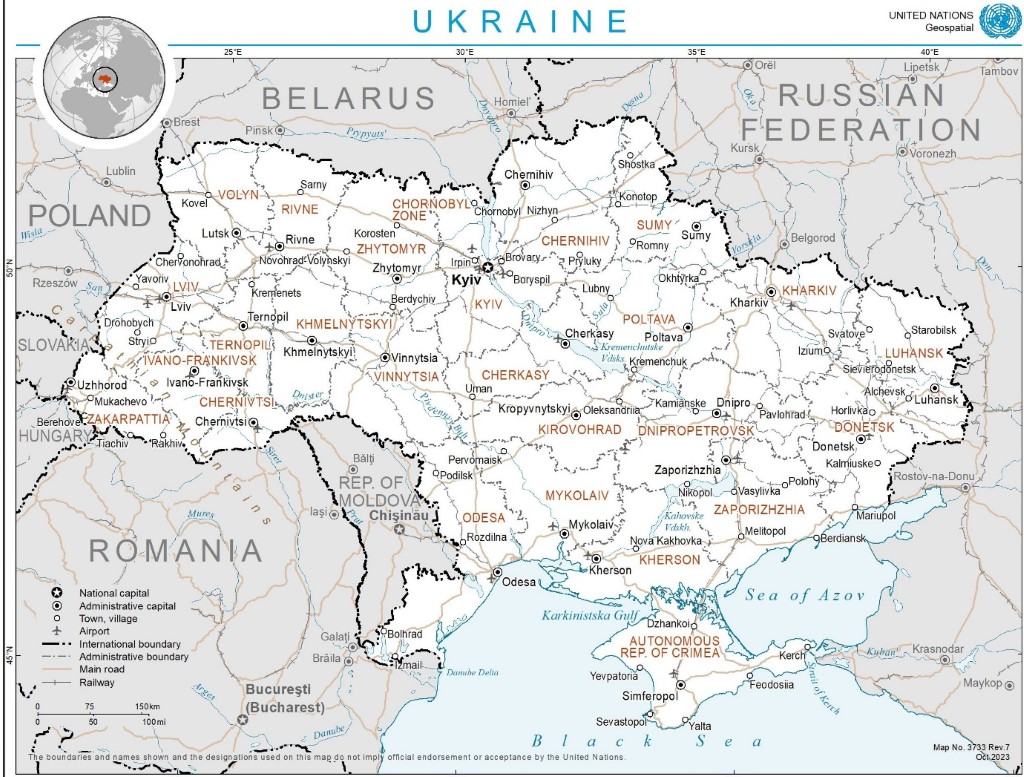
The ongoing hostilities between Russia and Ukraine are the largest confrontation on European soil since the Second World War. In 2014, in a first phase of its war of aggression against Ukraine,1Art 3(a), ‘Definition of Aggression’, Annex to UN General Assembly Resolution 3314 (XXIX): ‘Definition of Aggression’, adopted by consensus on 14 December 1974 (UN Definition of Aggression). the armed forces of the Russian Federation seized Crimea and initiated rebellions against the government in Kyiv in the eastern Donbas. Russia is a permanent member of the United Nations Security Council charged with the maintenance of international peace and security under the UN Charter.2Art 24(1), Charter of the United Nations; adopted at San Francisco, 26 June 1945; entered into force, 24 October 1945. The second phase of Russia’s aggression began with its large-scale invasion of Ukraine on 24 February 2022. Russia’s unlawful occupation of Crimea and swathes of the Donbas continues.
Belarus allowed its territory to be used for the 2022 invasion, making it complicit in Russian aggression.3Art 3(f), UN Definition of Aggression. But thus far, its armed forces have not participated in combat. Since late 2024, however, Russia has been supported in its military operations against Ukraine – on Russian soil only – by around thirteen thousand soldiers from the armed forces of the Democratic People’s Republic of Korea.4Q. Sommerville, ‘Why a fresh wave of North Korean soldiers may fight in Russia’s war in Ukraine’, BBC, 13 September 2026. North Korea is thus a co-belligerent with Russia in the ongoing war against Ukraine.5Arts 3(a) and 5(2), UN Definition of Aggression.
In August 2024, a Ukrainian counteroffensive in the Kursk region saw ground combat taking place on Russian territory for the first time. The operation led to Ukraine taking control of a substantial part of the regions of Kursk and Belgorod for several months.6O. Harmash and T. Balmforth, ‘Ukraine opens military office in occupied Kursk region, says it is still advancing’, Reuters, 15 August 2024. On 26 April 2025, Valery Gerasimov, the Chief of the General Staff of the Russian Armed Forces, reported to President Vladimir Putin that Russian forces had re-established authority over the last populated area in Kursk occupied by Ukrainian forces and that a ‘security zone’ had been created in the Sumy region of Ukraine.7President of Russia, ‘Meeting with Chief of the General Staff of the Russian Armed Forces Valery Gerasimov’, 26 April 2025.
Key Events in 2026
In the conduct of hostilities, Russian missiles have continued to hit Ukrainian cities and towns daily during 2026, while Ukrainian missile and drone attacks struck Russian territory, including, on occasion, Moscow. In June, long-range missiles and drones were once again the leading cause of civilian casualties in Ukraine, accounting for forty-five per cent of the total of 126 killed and 907 injured. Most of the civilian casualties occurred far from the frontline in urban centres such as Kyiv and Dnipro.8Office of the UN High Commissioner for Human Rights (OHCHR), ‘Ukraine – Protection of Civilians: June Update’, Report, July 2026, p 2.
In August, 600 drones were aimed at the Russian capital, and a warehouse belonging to Russian online retailer Wildberries was hit.9D. Johnson and T. Yeung, ‘Russia says at least seven killed in largest Ukrainian attack of 2026’, BBC, 16 August 2026. In September, Ukraine targeted its largest drone attack on the Moscow region, hitting the city’s main oil refinery and a residential building. Moscow Mayor Sergei Sobyanin said 450 drones heading for the capital had been shot down in what he called ‘the most massive’ attack. The region’s governor said that at least two people were killed and twenty injured. President Volodymyr Zelenskyy confirmed that Ukrainian forces had hit a ‘key’ Russian oil facility and a logistics site in the region with drones and missiles, representing ‘billions of dollars that sustain the war machine’.10J. Lukivand and D. Jordan, ‘Largest attack on Moscow sees Ukraine fire hundreds of drones, mayor says’, BBC, 20 September 2026.
The drone attacks and artillery fire on the front lines make assaults on enemy positions by soldiers and armour incredibly hazardous. Cluster munitions, remotely delivered landmines, thermite munitions, and thermobaric weapons are just some of the weapons that have been used by the parties against combatants. In addition, Russia has continued to use riot-control agents on Ukrainian positions in violation of its obligations under the Chemical Weapons Convention and customary international humanitarian law (IHL).11Art. 1(5), Convention on the Prohibition of the Development, Production, Stockpiling and Use of Chemical Weapons and on their Destruction; adopted at Geneva, 3 September 1992; entered into force, 29 April 1997; International Committee of the Red Cross (ICRC), Customary IHL Rule 75: ‘Riot Control Agents’. Russian forces have used gas grenades and improvised devices containing chemical irritants with a view to forcing Ukrainian troops out from shelters in order to expose them to conventional fire.12V. Novikova, ‘Russian Military Uses Chemical Agents as a Standard Battlefield Tactic’, Eurasia Daily Monitor, Jamestown Foundation, 5 October 2026. In October 2026, the head of the Organization for the Prohibition of Chemical Weapons (OPCW) reported to the Executive Council (the OPCW’s governing body) allegations of new use and confirmed the presence of CS gas on the front lines while carefully noting that it was not conclusive evidence of use of a riot-control agent in the course of the hostilities. ‘Opening Statement by the Director-General to the 113th Session of the Executive Council’, Delivered by Sabrina Dallafior, 6 October 2026.
It is not known precisely how many munitions were fired by the two States in the first nine months of the year, but the total far exceeds one million. Increasingly Russia is using jet-propelled drones against Ukraine, seeking to evade or overwhelm their depleted air defences. In July, it launched a reported 1,500 jet-propelled drones at targets across Ukraine. In August, the figure rose to 2,850, while in the course of September, approximately 3,200 jet drones were deployed.13M. Bielieskov, ‘Jet drones are Putin’s secret weapon as he seeks to break Ukraine’, Atlantic Council, 6 October 2026. The main target of jet-propelled armed drones is Kyiv. In the second half of 2026, the Ukrainian capital has been the target of almost incessant airstrikes, hitting schools, hospitals, residential buildings, and supermarkets, among civilian objects. According to one authority, whereas previous Russian bombardments typically took place overnight, jet drone attacks are timed to run throughout the day. This creates an additional layer of fear and disruption, with schools, businesses, shops, restaurants, and public transport unable to operate.14Ibid. Ukraine reported in late September that its military had shot down 220,000 fixed-wing drones and 100,000 multirotor unmanned aerial vehicles (UAVs) since the start of 2026.15E. M. Encarnacion, ‘Ukraine Says It Has Taken Down Over 350,000 Russian Drones in 2026’, The Drone Front, 23 September 2026.
Total casualties among Russian and Ukrainian forces are – and will likely remain – unknown, but Ukrainian estimates as at October 2026 suggest that more than 1.5 million Russian soldiers have been killed or seriously injured since the invasion of end-February 2022.16Ministry of Defence of Ukraine, ‘Total Russian combat losses in Ukraine as of October 6, 2026’, 6 October 2026. The United Kingdom reported in May 2026 that their intelligence services had calculated that almost 500,000 Russian soldiers had been killed,17F. Gardner and H. Moore, ‘Almost 500,000 Russian soldiers killed in Ukraine war, GCHQ says’, BBC, 27 May 2026. which is broadly consistent with Ukrainian estimates of total Russian casualties.18Working in tandem with the BBC, Mediazona calculated that confirmed at least 258,989 Russian military deaths from 24 February 2022 to 14 September 2026. Mediazona, ‘Russian losses in the war with Ukraine’, 21 September 2026 (accessed 7 October 2026). ‘The list is built from publicly available, verifiable sources, such as social media posts by relatives, reports in local media, and statements from regional authorities. Of course, this list is not exhaustive, as not every death is publicly reported.’ Ukraine’s reports of its own dead of 55,000 soldiers since 2022 – disclosed by President Zelenskyy in February19Gardner and Moore, ‘Almost 500,000 Russian soldiers killed in Ukraine war, GCHQ says’. – are thought to significantly understate the true total. In September, Zelenskyy claimed that North Korea was preparing to deploy another 10,000 troops to Russia with military manpower in the Russian Armed Forces coming under increasing pressure.20‘Ukraine’s Zelenskiy says North Korea prepares to deploy another 10,000 troops to Russia’, Reuters, 29 September 2026.
In August, a North Korean missile unit was reported to have begun deployment to western Russia. Andrii Cherniak of Ukraine’s Directorate of Intelligence said that Russia planned to base the missile unit of around ninety North Korean personnel in the western region of Voronezh. North Korea is believed to have already supplied millions of artillery shells to Russia. North Korea’s KN-23 and KN-24 missiles have a greater range and larger payload than Russia’s equivalent, the Iskander, but, according to Ukrainian military sources, are much less accurate and have been linked to strikes with high civilian death tolls.21T. Balmforth, ‘North Korean missile unit deploys in Russia for Ukraine war, Kyiv says’, Reuters, 5 August 2026. Other commentators, however, suggest that the two missiles may have a similar circular error probable (CEP) to the Iskander, depending on the guidance system used.22Global Defense News, ‘KN-23 Hwasong-11Ga’, 1 August 2026; Missile Threat, ‘KN-24’, Last updated 23 April 2024, Center for Strategic and International Studies (CSIS). Even at the higher range of claimed inaccuracy, the missiles would not be inherently indiscriminate.
In early September, a Russian general suspected by Kyiv of orchestrating a 2024 attack on a children’s hospital was reportedly shot in the head. Major-General Nikolai Varpakhovich was struck twice by an unknown assailant on a motorbike in a village in south-western Russia, according to Telegram channels with connections to Russian security services. Major-General Varpakhovich had been accused of directing a deadly attack on Ukraine’s largest children’s hospital, the Okhmatdyt hospital in Kyiv, on 8 July 2024. Most of the 600 people inside were evacuated when an air raid alarm sounded shortly before the attack. But some patients were unable to leave because they were in surgery at the time. The strike killed three, including a child and a doctor, and injured dozens more. Ukraine’s security service had charged Major-General Varpakhovich in absentia with ‘war crimes resulting in loss of life’ over his alleged role in the attack after their investigation had found that he gave the ‘combat order’.23B. Stockton, ‘Russian general who “ordered attack on children’s hospital” shot in head’, Daily Telegraph, 3 September 2026.
On 7 October 2026, Russia launched a massive missile and jet-propelled drone attack on Ukraine. Missiles flew in low in large groups in order to overwhelm Ukrainian air defences. Targets included Kremenchuk, whose hydro-electric energy plant supplies critical infrastructure in Ukraine with electricity.24‘Russia Kills 11 in Overnight Missile Strikes on Ukraine, Collapses Apartment Building in Pryluky’, Kyiv Post, 7 October 2026. The following day, at least thirty people were reportedly killed in a Russian glide bomb attack on two civilian buses in the eastern front line city of Kramatorsk and another eighteen people were wounded.25O. Ireland and T. Luckhurst, ‘Russian strike on buses kills at least 30, say officials, as deadly attacks on Ukraine surge’, BBC, 8 October 2026. President Zelenskyy promised a response. In a post on social media site Telegram, he said: ‘Russia is trying to destroy all life in Donbas, and the world needs to react to this. React harshly – exactly as the Russians deserve for all the deaths they have caused.’26Ibid. On 9 October 2026, aircraft, including the presidential plane thought to have been transporting Vladimir Putin, were forced to circle in the sky as Ukrainian drones targeted the airports in and around Moscow. The aircraft were returning from a summit President Putin had attended in Turkmenistan.27A. Snow, M. Barker, and G. Corfield, ‘Drone attack stops Russian government planes landing in Moscow’, Daily Telegraph, 9 October 2026.
In mid-October, US President Donald Trump announced that agreement had been reached between Russia and Ukraine not to target oil refineries and other energy facilities. This appeared to come as a surprise to both States. He also announced the United States was buying diesel from Russia with a view to reducing the prices American consumers were paying at the pump. The Ukrainian president, Volodymyr Zelenskyy, initially agreed to the energy truce but Russia effectively ignored the proposal, saying that its scope had never been determined but that work was ongoing to do so. On 14 October, Ukraine struck a Russian oil refinery after President Zelenskyy declared that Kyiv was abandoning the ceasefire covering energy sites. The Ukrainian leader criticized President Trump’s willingness to strike deals with Moscow. By walking away from the demand that Ukraine halt attacks on Russian refineries and by openly criticizing the US leader, Zelenskiy risked deepening the biggest rift between Kyiv and Washington since Russia’s invasion of Ukraine in 2022.28D. Flynn and M. Hunder, ‘Ukraine hits Russian refinery as Zelenskiy says “we’re done” with Trump’s energy truce’, Reuters, 15 October 2026.
The dispute with President Trump over the targeting of energy facilities also led to the United States limiting access to Starlink and Starshield, Elon Musk’s satellite system that allows Ukraine to track and intercept Russian jet-propelled drones. This resulted in civilian casualties across Ukraine, including in Kyiv, that could otherwise have been prevented.29D. Sabbagh, ‘In Ukraine, civilian casualties were already rising. Restrictions on Starlink will only worsen the death toll’, The Guardian, 14 October 2026. Mr Musk sought to put all the responsibility onto The White House, writing on his social media site X: ‘Starshield systems are owned and controlled by the US government. Any limits on speed or usage are decided by the US military and ultimately POTUS’, he wrote.30Ibid. It was alleged elsewhere, however, that he had originally proposed the idea to senior officials in The White House – and even to President Trump directly.31J. Barnes, ‘Exclusive: Musk approached Trump to slow down Starlink in Ukraine’, Daily Telegraph, 16 October 2026.
The Humanitarian Situation
The fighting since 2022 has displaced millions of Ukrainians and left a legacy of explosive ordnance contamination that will last for decades, even were a peace deal to be hammered out in the near future. In October 2026, Khaled Khiari, UN Assistant Secretary-General in the Departments of Political and Peacebuilding Affairs and Peace Operations, warned that Russian attacks had reached ‘a new horrifying level’, with more than 100 civilians killed and at least 429 injured during the preceding week. Mr Khiari also voiced concern over rising civilian casualties from Ukrainian attacks inside Russia, where the Office of the UN High Commissioner for Human Rights (OHCHR) recorded a reported 496 civilians killed and 3,394 injured between January and September 2026.32United Nations, ‘Russian Strikes against Ukraine Have Reached “New Horrifying Level”, Top United Nations Peacebuilding Official Warns Security Council, amid Calls for Immediate Ceasefire’, Press release, UN Doc SC/16472, 9 October 2026.
As of February 2026, the Office of the UN High Commissioner for Refugees (UNHCR) had reported 3.7 million displaced persons within Ukraine and 5.9 million Ukrainian refugees outside the country. Approximately 10.8 million Ukrainians had needed humanitarian assistance during the 2025–26 winter.33UNHCR, ‘Ukraine Emergency’, accessed 10 October 2026. Russia’s strategy of targeting energy facilities inflicts further misery on the civilian population during the coming winter. In October 2026, the UN Office for the Coordination of Humanitarian Affairs (OCHA) thus observed that repeated attacks on essential infrastructure threatened ‘to turn an already dire situation into something far worse. (…) Scheduled and emergency power cuts due to attacks on energy infrastructure have already returned, including in Kyiv. As temperatures fall, damage to electricity, heating, and water systems will have consequences far beyond the moment of impact.’34OCHA, ‘Repeated attacks in Ukraine are testing civilians’ ability to adapt, OCHA tells Security Council’, Briefing to the UN Security Council on the humanitarian situation in Ukraine by Gemma Connell, Director of the Crisis Response Division, on behalf of Tom Fletcher, Under-Secretary-General for Humanitarian Affairs and Emergency Relief Coordinator, New York, 9 October 2026.
The same month, Reuters reported that residents of the Russian-occupied town of Oleshky in southern Ukraine were forced by impending starvation to risk their lives to travel for hours by foot and bicycle along mine-strewn roads to get food and water. The main route out of the town, lying near the front line east of the Dnipro River, heads deeper into Russian-controlled areas. It is littered with burned-out cars and charred by blasts, with armed drones prowling overhead. Residents say the last food deliveries to a local store took place in May. Russia has acknowledged critical problems with food and medical supplies in Oleshky and said its military was working to resolve them. It blamed Ukraine for the crisis, saying it was obstructing supplies reaching the town.35Y. Dysa, ‘People in Russian-occupied Ukrainian town risk “road of death” to get food’, Reuters, 8 October 2026.
Conflict Classification and Applicable Law
International Humanitarian Law
As of 1 October 2026, the international armed conflict between Russia (supported by North Korea) and Ukraine was continuing. This involved both the conduct of hostilities between Russian and Ukrainian armed forces and Russia’s belligerent occupation of Ukraine. The Geneva Conventions of 1949, Additional Protocol I of 1977,36Protocol Additional to the Geneva Conventions of 12 August 1949, and relating to the Protection of Victims of International Armed Conflicts (Protocol I); adopted at Geneva, 8 June 1977; entered into force, 7 December 1978 (Additional Protocol I). and the rules of customary IHL all apply to the conflict.
International Disarmament Law
Russia and Ukraine, along with North Korea, are all States not party to the Arms Trade Treaty.37Arms Trade Treaty; adopted at New York, 2 April 2013; entered into force, 24 December 2014. Ukraine, however, is a signatory State with the attendant obligation to refrain from acts which would defeat the treaty’s object and purpose.38Art 18(a), Vienna Convention on the Law of Treaties; adopted at Vienna, 23 May 1969; entered into force, 27 January 1980 (VCLT). Both Russia and Ukraine are States Parties to the VCLT, though in any event the rule is reflected in customary international law. Based on its conduct in the IAC, the Geneva Academy’s Arms TRACK website has assessed that the Russian Armed Forces present a high risk of illegal use of any weapons that may be supplied to them. The risk of misuse by Ukraine is elevated.
In any event, Ukraine and its armed forces should not be supplied with anti-personnel mines by anyone. Ukraine, but not Russia, is a State Party to the 1997 Anti-Personnel Mine Ban Convention (APMBC), precluding its importation of any anti-personnel mines.39Convention on the Prohibition of the Use, Stockpiling, Production and Transfer of Anti-Personnel Mines and on their Destruction; adopted at Oslo, 18 September 1997; entered into force, 1 March 1999. In 2025, Ukraine attempted to illegally suspend its implementation of the Convention, but this was rejected by the other States Parties as being unlawful.40Final Report of the Twenty-Second Meeting of States Parties to the Anti-Personnel Mine Ban Convention, Doc APLC/MSP.22/2025/15, December 2025, para 50. Into 2026, Ukraine continues to commit the most serious violations in the history of the APMBC through its use, production (including through 3D printing), and stockpiling of anti-personnel mines.41Mine Action Review, ‘Ukraine’, Clearing the Mines 2026, Norwegian People’s Aid, 2026. There is already a massive landmine problem across much of eastern Ukraine, largely the result of use of mines by Russia.
Neither Russia, nor North Korea, nor Ukraine is a State Party to the 2008 Convention on Cluster Munitions.42Convention on Cluster Munitions; adopted at Dublin, 30 May 2008; entered into force, 1 August 2010. Both Russia and Ukraine are contaminated with cluster munition remnants, particularly unexploded submunitions, as a result of the armed conflict between them.43Mine Action Review, ‘Ukraine’, Clearing Cluster Munition Remnants 2026, Norwegian People’s Aid, 2026, pp 1, 240, 241, 243.
Both Russia and Ukraine are States Parties to the 1992 Chemical Weapons Convention. North Korea is one of only four States not party to the Convention. As mentioned, Russia has continued to use prohibited chemical weapons in its hostilities against Ukraine (see further the subsection below, ‘Attacks against civilians’).
International Criminal Law and Accountability
Proceedings before the International Criminal Court
Ukraine is a State Party to the Rome Statute of the International Criminal Court.44Rome Statute of the International Criminal Court; adopted at Rome, 17 July 1998; entered into force, 1 July 2002 (hereafter, Rome Statute). As such, the Court has jurisdiction over the acts committed in the international armed conflict on its territory as well as acts by Ukrainian nationals on Russian territory. Russia is a signatory to the Statute, but on 30 November 2016, it informed the depositary – the UN Secretary-General – that it did not intend to become a party to it.45Declaration of Russia, 30 November 2016.
Four Russian nationals, including President Putin, have been indicted for war crimes for their actions in the war with Ukraine.46ICC, ‘Situation in Ukraine: ICC judges issue arrest warrants against Vladimir Vladimirovich Putin and Maria Alekseyevna Lvova-Belova’, Press release, 17 March 2023; and ‘Situation in Ukraine: ICC judges issue arrest warrants against Sergei Ivanovich Kobylash and Viktor Nikolayevich Sokolov’, Press release, 5 March 2024.
In October 2026, Russia asked the Netherlands to hand over nine International Criminal Court officials who had been convicted in a Russian domestic court in absentia in 2025 for having ‘ordered the issuance of obviously illegal arrest warrants despite having no legal grounds to do so’.47‘Russia demands arrest of ICC chief Akane and former president’, The Asahi Shimbun, 9 October 2026. The prosecutor’s office in Moscow requested the extradition of the court’s president, Tomoko Akane, and other staff members for their involvement in the arrest warrant of Vladimir Putin for his alleged involvement in the war crime of unlawful deportation of children from occupied Ukraine.48‘Russia wants NL to hand over ICC judges’, Dutch News, 9 October 2026. The request was refused by the Netherlands and the subject of a strong protest by Japan.
The Nord Stream trials
On 14 October 2026, a war crimes trial opened in Germany before the Hanseatic Higher Regional Court in Hamburg. Serhii Kuznetsov, a Ukrainian national, is accused of leading a group of Ukrainian agents, including divers and an explosives expert, that in September 2022 blew up Nord Stream – Russia’s largest gas pipeline to Europe.49The bombings severed three of the Nord Stream project’s four underwater pipelines that had been constructed to transport natural gas from Russia to Germany. Owing to tensions over the war in Ukraine, none of the pipelines was delivering gas at the time of the bombing, although they did contain natural gas. C. Danner, ‘Who Really Blew Up the Nord Stream Pipeline? New clues keep surfacing, and the most recent appear to implicate Ukraine’, Intelligencer, New York Magazine, Updated 15 June 2023. This act in bello is said to have been ‘one of the biggest infrastructure sabotage operations of modern times’.50M. Murray, ‘Nord Stream may have been lawful target, argue lawyers for Ukrainian accused of bombing’, Reuters, 14 October 2026. Mr Kuznetsov is formally charged with directing ‘an attack by military means against civilian objects’ as a war crime under Germany’s code of crimes against international law.51S. 11(1)(2), Code of Crimes against International Law of 26 June 2002, Federal Law Gazette I, p 2254, as last amended by Article 1 of the Act of 30 July 2024 (official translation). See further J. Parker and P. Kirby, ‘Germany puts Ukrainian on trial accused of blowing up Nord Stream pipelines’, BBC, 14 October 2026. He has denied any involvement in the explosions that ruptured the 1,200-kilometre-long Baltic Sea pipeline.
In the indictment against Mr Kuznetsov, the prosecution alleges that the saboteurs conceived the plot ‘acting by order of Ukrainian state agencies’. Lawyers for the Ukrainian former military officer have sought to argue that ‘an aggressor’s infrastructure’ would have been a lawful target. Defence lawyer Nicola Canestrini even argued that the pipeline, which provided half of Germany’s imports of natural gas before the 2022 invasion of Ukraine, was a ‘Russian weapon’.52Murray, ‘Nord Stream may have been lawful target, argue lawyers for Ukrainian accused of bombing’.
A year earlier, Volodymyr Zhuravlov, a diver also alleged to have been involved in the bombing, had been the subject of an extradition warrant submitted to Poland by Germany. But a Warsaw District Court rejected the request, with the presiding judge ruling that the attack on the pipelines should be understood as a military action in a ‘just war’. The judge further ruled that in any event the defendant had immunity from prosecution. ‘The person being prosecuted, if he was the perpetrator, is entitled to functional immunity, which covers an act committed in connection with his activities for the Ukrainian State. … If Ukraine was indeed the organiser of this act of aggression, then only Ukraine can be held responsible for this event.’53M. Strzelecki and A. Koper, ‘Polish court rules against sending Ukrainian Nord Stream suspect to Germany’, Reuters, 17 October 2025. This ruling confuses the rules of jus ad bellum and jus in bello. Judge Dariusz Lubowski also questioned German jurisdiction on another basis – that the explosions had occurred in international waters.54C. Ciobanu, ‘Polish court blocks extradition and frees Ukrainian suspected in Nord Stream pipeline blasts’, Associated Press, 25 October 2025.
Mr Zhuravlov was subsequently arrested in Croatia, where a court approved his extradition to Germany in September 2026. At the time of writing, he was planning to appeal the ruling.55‘Croatian court approves extradition of Nord Stream blast suspect to Germany’, Associated Press, 24 September 2026.
Prisoners of war, in the sense of the Geneva Convention III, include members of the armed forces of a Party to an international armed conflict who have fallen into the power of the enemy.56Art 4(A)(1), Convention (III) relative to the Treatment of Prisoners of War; adopted at Geneva, 12 August 1949; entered into force, 21 October 1950. In their indictment against Mr Kuznetsov, German prosecutors allege that, at the time of the attack in 2022 Mr Kuznetsov was a serving officer in the Ukrainian army.57Parker and Kirby, ‘Germany puts Ukrainian on trial accused of blowing up Nord Stream pipelines’. This would mean he was entitled to prisoner of war status and combatant’s privilege if detained by an enemy (namely Russia). Of course, Germany was and is an ally of Ukraine, not an enemy. Those accused of involvement are therefore not entitled to prisoner of war status and consequently combatant’s privilege. In any event, this would not preclude a trial and conviction for a war crime.
The claim that the gas pipeline was a lawful military target is unpersuasive.58E. A. Santos, ‘Nord Stream Trial: Is Blowing Up a Gas Pipeline a War Crime?’, Blog post, Diplomacy and Law, 13 October 2026. Under IHL, military objectives are those objects which, by their nature, location, purpose or use, make an effective contribution to military action. In addition, the object’s partial or total destruction, capture, or neutralisation must offer a definite military advantage in the prevailing circumstances.59ICRC, Customary IHL Rule 8: ‘Definition of Military Objectives’. The pipeline did not do either of these two things – indeed it was not even carrying gas at the time. ‘Intentionally directing attacks against civilian objects, that is, objects which are not military objectives’ is a war crime under the Rome Statute.60Art 8(2)(b)(ii), Rome Statute.
Indeed, one of the warrants of arrest for senior Russian military figures issued by the International Criminal Court concerns alleged responsibility for the war crimes of directing attacks at civilian objects and causing excessive incidental harm to civilians or damage to civilian objects. The arrest warrants against Sergei Shoigu and Valery Gerasimov were issued on the basis that the court had ‘reasonable grounds to believe that the two suspects bear responsibility for missile strikes carried out by the forces under their command against the Ukrainian energy infrastructure from at least 10 October 2022 until at least 9 March 2023. During this timeframe, there was an alleged campaign of strikes against numerous electric power plants and sub-stations, which were carried out by the Russian armed forces in multiple locations in Ukraine’.61ICC, ‘Situation in Ukraine: ICC judges issue arrest warrants against Sergei Ivanovich Kobylash and Viktor Nikolayevich Sokolov’, Press release, 5 March 2024. See further, e.g., Amnesty International, ‘Russia/Ukraine: ICC arrest warrants for senior Russian officials ‘a crucial step towards justice’, News release, 25 June 2024. If functioning power plants in the Ukraine war, were civilian objects, a fortiori the Nord Stream gas pipeline would have been also a civilian object at the time.
Bombings with purely economic impacts also ostensibly fall within the prohibition of terrorist bombings under the 1997 Terrorist Bombings Convention to which Ukraine has been a party since 2002.62Art 2(1), International Convention for the Suppression of Terrorist Bombings; adopted at New York, 15 December 1997; entered into force, 23 May 2001 (1997 Terrorist Bombings Convention). Croatia, Germany, and Italy are also States Parties to the Convention. In the case of the Nord Stream pipelines, this concerns a detonation against a State infrastructure facility with the intent to cause extensive destruction likely to result in major economic loss.63Art 2(1)(b), 1997 Terrorist Bombings Convention. There is an exemption in the application of the Convention for the ‘activities of armed forces during an armed conflict, as those terms are understood under international humanitarian law, which are governed by that law’ as well as for ‘the activities undertaken by military forces of a State in the exercise of their official duties, inasmuch as they are governed by other rules of international law’.64Art 19(2), 1997 Terrorist Bombings Convention. Hence, if it transpires that the armed forces of Ukraine were responsible for the bombing, the exemption in the 1997 Terrorist Bombings Convention will apply. If, conversely, those responsible were not members of the Ukrainian armed forces at the time of the bombing, they would be civilians directly participating in hostilities and thus not excluded from the application of the Convention.65B. Saul, ‘From conflict to complementarity: Reconciling international counterterrorism law and international humanitarian law’, International Review of the Red Cross, Vol 103, Nos 916 and 917 (February 2022), 157–202, at p 186. Obligations include the duty to prosecute offenders.66Art 6(1) and (2), 1997 Terrorist Bombings Convention.
Compliance with IHL
Overview
Russia has continued to perpetrate international crimes in its conduct of hostilities and treatment of detainees on a systematic basis. In addition to the international crime of aggression, Russian forces have committed manifold war crimes and crimes against humanity in the ongoing armed conflict. In the words of one expert, Russia appears to have abandoned any pretence of limiting its attacks to military targets. The UN Human Rights Monitoring Mission in Ukraine stated that recorded civilian casualties in the first half of 2026 were 37 per cent higher than the same period in 2025, and 114 per cent higher than in the same period in 2024. The cause, it said, was the increased use of ‘powerful weapons that are particularly deadly when used in densely populated urban areas’. Strikes against Ukrainian cities are the leading cause of civilian deaths, amounting to forty-five per cent of recorded casualties.67OHCHR, ‘Civilian Casualties Soar in Ukraine in the First Half of 2026 Amid Escalating Attacks and Intensifying Use of Deadly Weapons, UN Human Rights Monitors Say’, Press release, 14 July 2026.
For its part, Ukraine has been targeting Russian oil facilities, ports, merchant vessels, and other ostensibly civilian targets in a strategy that appears designed to impose costs on Russia beyond the battlefield.68M. Schmitt, ‘When Civilian Infrastructure Becomes a Lawful Target’, Just Security, 23 July 2026. Ukraine has argued that targeting these objects on land and at sea is legitimate as they sustain Russia’s war economy.
Civilian Objects under Attack
Under customary IHL, attacks may only be directed against military objectives. Attacks must not be directed against civilian objects.69ICRC, Customary IHL Rule 7: ‘The Principle of Distinction between Civilian Objects and Military Objectives’. Civilian objects are all objects that are not military objectives,70ICRC, Customary IHL Rule 9: ‘Definition of Civilian Objects’. and, as such, are protected against attack.71ICRC, Customary IHL Rule 10: ‘Civilian Objects’ Loss of Protection from Attack’. Military objectives are those objects which, by their nature, location, purpose or use, make an effective contribution to military action.72ICRC, Customary IHL Rule 8: ‘Definition of Military Objectives’.
Terror attacks
Significant numbers of Russian attacks have targeted civilian objects in Ukraine, some of which amount to terror attacks. On 21 August 2026, at least sixteen people were killed in a ‘double-tap’ Russian drone strike on a shopping centre in Kryvyi Rih in the centre of Ukraine. More than one hundred and thirty others, of whom twenty-two were children, were wounded in the strikes, which hit in two waves. The second wave occurred thirty minutes after the first, seemingly targeting emergency workers tackling the fire and assisting those injured in the first strike.73E. Smith, ‘Russian “double-tap” strike on Ukrainian shopping centre kills 16’, Daily Telegraph, Updated 22 August 2026. At the time, the UN Human Rights Monitoring Mission in Ukraine (HRMMU) declared only that the attack ‘appears’ to have violated IHL, but noting that all of those the HRMMU interviewed said that they had seen no military personnel, equipment, or activity at or near the shopping mall.74OHCHR, ‘Russian attack strikes shopping centre full of civilians – UN human rights monitors’, Posted on 22 August 2026. In fact, available evidence indicates the prima facie commission of the war crimes of intentionally directing attacks against civilian objects and intentionally directing attacks against the civilian population as such.75Art 8(2)(b)(i) and (ii), Rome Statute; Art 85(3)(a), Additional Protocol I. In addition, acts or threats of violence whose primary purpose is to spread terror among the civilian population are war crimes under customary law, and this appears to have been just such a terror attack.76International Criminal Tribunal for the former Yugoslavia (ICTY), Prosecutor v Stanislav Galić, Judgment (Appeals Chamber) (Case No IT-98-29-A), 30 November 2006, paras 87 and 93–98. The European Union’s High Representative for Foreign Affairs and Security Policy, Kaja Kallas, condemned the attack as ‘terror by design’, declaring on social media site X that it showed the ‘absolute and utter depravity of Moscow’s war’, which ‘wants to make Ukrainian cities unliveable’.77Agence France-Presse, ‘Attack on Ukraine shopping centre that killed 16 is “terror by design”, says EU foreign policy chief’, The Guardian, 22 August 2026.
Use of cluster munitions
Russia used cluster munitions contained in at least one ballistic missile in an attack on Kyiv on 5 August 2026, according to Human Rights Watch analysis, in what the organization said should be investigated as a possible war crime. The attack is said to have killed three people at a sorting centre belonging to Nova Poshta, Ukraine’s largest private courier and mail service. Nova Poshta is a civilian object protected against attack.
In two photos verified by Human Rights Watch as having been taken at the site, a missile remnant is visible. Researchers at the organization confirmed that the item is the nose cone of a 9M720 series Iskander-M ballistic missile, equipped with a cluster munition warhead. The missile can deploy as many as fifty-four high explosive fragmentation 9N730 submunitions.78Human Rights Watch, ‘Russia: Cluster Munition Attack on Kyiv a Potential War Crime’, News release, 13 August 2026. Human Rights Watch associate researcher Kseniya Kvitka said: ‘There can be no justification for using cluster munitions near homes, schools, and hospitals, and it shows Russia’s utter disregard for civilians and the international law designed to protect them.’79Human Rights Watch incorrectly claimed in their news release that cluster munitions are ‘an inherently indiscriminate weapon.’ This would mean that the weapons could never be used in the conduct of hostilities, even against combatants, which is not the case. The missile system, designated SS-26 ‘Stone’ by NATO, achieves a CEP – the radius within which around half of missiles targeted are expected to strike – of between five and thirty metres (depending on the guidance mode used),80Missile Threat, ‘9K720 Iskander (SS-26)’, Last updated 23 April 2024, CSIS. meaning a targeting mistake is unlikely.
Ukraine has also continued to use cluster munitions, although following the announcements in 2023 and 2024 that the United States would transfer cluster munitions to Ukraine,81Cluster Munition Monitor, ‘Cluster Munition Ban Policy – Ukraine’, Last updated 20 August 2025. it committed not to use cluster munitions in urban areas, but only ‘in the fields where there is a concentration of Russian military’ and also to record where the munitions were used and conduct clearance activities there once able.82Human Rights Watch, ‘Russia: Cluster Munition Attack on Kyiv a Potential War Crime’.
Attacks directed against civilian objects
The Russia-Ukraine conflict has seen widespread targeting of so-called ‘war-sustaining’ objects – those that generally do not meet the definition of a military objective under IHL, but which contribute to the economy of one of the parties. Targeting such objects violates IHL as ‘the military advantage anticipated from destroying a revenue-generating facility is not only remote, but sometimes far from “definite,” as it is subject to markets, national budgets, procurement decisions, and a myriad of other factors that may never materialize during the conflict at hand’.83Schmitt, ‘When Civilian Infrastructure Becomes a Lawful Target’.
On 18 July 2026, reports emerged that Ukrainian long-range drones had struck two Wildberries warehouses in Russia. Wildberries is Russia’s largest online retailer, often described as the country’s equivalent to Amazon. The attacks killed eight warehouse employees and injured many others.84M. Luxmoore, ‘Ukraine Escalates Air War With Deadly Strikes on Russia’s “Amazon”’, The Wall Street Journal, Last updated 18 July 2026. As Michael Schmitt has written, given that both warehouses were located far from the front (one only 30 miles from Moscow),
the strikes brought the war home to Russian citizens in a very real sense. So too did the fact that they were civilian facilities with no apparent connection to the conflict. It seemed plausible, at least based on the initial information available, that Ukraine had adopted Russia’s tactic of direct attacks on the civilian population in order to sow terror.85Schmitt, ‘When Civilian Infrastructure Becomes a Lawful Target’.
The Ukrainian authorities, however, said that they were targeting logistics hubs used by Russians to buy military equipment and disrupting supplies to the Russian army.86Johnson and Yeung, ‘Russia says at least seven killed in largest Ukrainian attack of 2026’. President Zelenskyy stated that Wildberries warehouses were being used to supply components for drone production and navigation equipment. If true, that use makes an effective contribution to Russia’s military action, and thus the warehouses were military objectives when struck. That said, as Schmitt further observes, each warehouse has to be assessed individually on the facts. Thus, a finding that one warehouse forwards on drone components has ‘no determinative legal bearing’ on whether other Wildberries facilities might also qualify as military objectives under IHL.87Schmitt, ‘When Civilian Infrastructure Becomes a Lawful Target’.
Precautions in defence
In late August 2026, a Russian strike on an ammunition storage area that was ‘dangerously close’ to civilian objects, including a nursing home, killed at least thirty-seven people, many of them older persons. The victims were killed both by the initial strike but also by the even more powerful secondary explosions that followed. The huge detonations were caused by stocks of Ukrainian munitions, including shells, mines, and drones, that were ‘improperly stored’ in a busy civilian area, President Zelensky said in a video address. The depot ‘definitely shouldn’t have been there’, President Zelenskyy declared, adding that the situation was ‘horrific’ and ‘a terrible display of negligence on the part of those who stored explosive materials so close to people’. A criminal investigation was underway into the management of the warehouse, he said.88S. O’Grady and Y. Shyvala, ‘37 Killed After Russian Strike on Weapons Depot as Ukraine Blames Negligence’, The New York Times, 29 August 2026. Under treaty and customary IHL, each party to an armed conflict ‘must, to the extent feasible, avoid locating military objectives within or near densely populated areas’.89ICRC, Customary IHL Rule 23: ‘Location of Military Objectives outside Densely Populated Areas’.
Civilians under Attack
Under customary IHL, civilians enjoy general protection from the effects of hostilities, unless and for such time as they directly participate in hostilities.90ICRC, Customary IHL Rule 6: ‘Civilians’ Loss of Protection from Attack’. Accordingly, parties to any armed conflict must at all times distinguish between combatants and civilians, and are prohibited from directing attacks against civilians.91ICRC, Customary IHL Rule 1: ‘The Principle of Distinction between Civilians and Combatants’. In case of doubt, persons should be treated as civilians.92ICRC, Customary IHL Rule 6: ‘Civilians’ Loss of Protection from Attack’. Civilians may be incidentally affected by attacks against lawful targets. However, such attacks must not be disproportionate,93ICRC, Customary IHL Rule 14: ‘Proportionality in Attack’. and the attacker must take all feasible precautions to avoid or, in any event to minimize, incidental civilian impact.94ICRC, Customary IHL Rule 15: ‘Principle of Precautions in Attack’.
Use of armed drones
In June 2026, OHCHR reported that civilian casualties near the frontline caused by short-range drones reached their highest monthly level since 24 February 2022 – 89 killed and 588 injured.95OHCHR, ‘Ukraine – Protection of Civilians: June Update’, Report, July 2026, p 2. In many if not most of these instances, Russian forces and Russian nationals have continued to target civilians in circumstances where they would certainly have known of the civilian status of the victims. OHCHR cited the experience of an older woman who had recently evacuated from the frontline village of Preobrazhenka in Zaporizhzhia region: ‘There were drones everywhere. Everything was flying overhead. I did not know where to hide. There is terrible fear out there. They are shooting and striking day and night.’96Ibid, p 3. These are also examples of terror attacks.
In one incident in August 2026 that was filmed on video, a drone was used to chase and wound a vegetable seller in the southern Ukrainian city of Kherson. Footage released by Ukrainian police shows the drone pursuing a man around a van being used as a street stand before exploding as he dives for cover behind the vehicle. Police said that the man in his fifties survived, but suffered shock and shrapnel injuries. President Zelenskyy wrote on X that: ‘Today, many were shocked by yet another video of the drone “safari” Russians are carrying out against civilians in Kherson’, saying that ‘Russia has gone mad’.97‘Ukraine accuses Russia of war crime after video shows drone attacking vegetable seller in Kherson’, Reuters, 4 August 2026. The targeting of the vegetable seller was a manifest war crime against a civilian protected as such.
Use of chemical weapons
Ukraine has made highly credible accusations that Russia has used CS (‘tear’) gas to clear trenches and has reported more than 1,200 such incidents since the beginning of the invasion in 2022. As mentioned, the use of riot-control agents is explicitly prohibited as a method of warfare under the Chemical Weapons Convention98Art 1(5), 1992 Chemical Weapons Convention. and customary IHL.99ICRC, Customary IHL Rule 75: ‘Riot-control agents’. That said, it is not settled whether the use of riot-control agents such as tear gas is also a war crime. The Rome Statute makes ‘employing asphyxiating, poisonous or other gases, and all analogous liquids, materials or devices’ in armed conflict a war crime under its jurisdiction.100Art 8(2)(b)(xviii), Rome Statute. But the relevant elements of crime stipulate that the gas ‘was such that it causes death or serious damage to health in the ordinary course of events, through its asphyxiating or toxic properties’.101Elements of crime for Article 8(2)(b)(xviii) of the Rome Statute, in Official Records of the Assembly of States Parties to the Rome Statute of the International Criminal Court, First session, New York, 3–10 September 2002. In contrast, tear gas is defined in the Chemical Weapons Convention as: ‘Any chemical not listed in a Schedule, which can produce rapidly in humans sensory irritation or disabling physical effects which disappear within a short time following termination of exposure.’102Art II(7), 1992 Chemical Weapons Convention.
There have also, however, been highly credible – but still unconfirmed – allegations that Russian forces have used a toxic chemical, chloropicrin, as a method of warfare.103‘Russian use of chemical weapons against Ukraine “widespread”, Dutch defence minister says’, Reuters, 4 July 2025. Chloropicrin is a pesticide that was used as a chemical weapon in World War I as a vomiting agent.104‘Chloropicrin’, Science Direct, accessed 21 September 2025. Listed in Schedule 3 of the 1992 Chemical Weapons Convention,105OPCW, ‘Annex on Chemicals: Schedule 3’. its use is comprehensively prohibited in warfare. Moreover, if confirmed, its use by any armed force in the conduct of hostilities would certainly be a war crime.106ICRC, Customary IHL Rule 74: ‘Chemical Weapons’; and Rule 156: ‘Definition of War Crimes’. In March 2026, the Netherlands reiterated to the Executive Council of the OPCW – the organization’s governing body that – in a joint publication with Germany the previous July – it had presented compelling evidence of Russian use of chloropicrin on the frontlines in Ukraine.107Statement of the Netherlands, Executive Council’s 111th Session, Agenda item 6(f), The Hague, March 2026. Russia has denied the allegations.
Use of anti-personnel mines
Russia is not prohibited by treaty or customary law from using anti-personnel mines against lawful military objectives, but is constrained by the IHL rule of proportionality in attack. In addition, it is obligated to comply with the additional obligations set forth in 1996 Amended Protocol II to the Convention on Certain Conventional Weapons, an instrument to which it is party.108Protocol on Prohibitions or Restrictions on the Use of Mines, Booby-Traps and Other Devices as amended on 3 May 1996 (Protocol II, as amended on 3 May 1996) annexed to the Convention on Prohibitions or Restrictions on the Use of Certain Conventional Weapons which may be deemed to be Excessively Injurious or to have Indiscriminate Effects; adopted at Geneva, 3 May 1996; entered into force, 3 December 1998. These include, in particular, the duty to ensure that remotely-delivered anti-personnel mines comply with the provisions on self-destruction and self-deactivation contained in the Protocol’s legally binding technical annex.109Art 6(2), 1996 Amended Protocol II. These dictate that no more than one in one thousand remotely-delivered anti-personnel mines that have been ‘activated’ remain functional 120 days after their use.110Art 3(a), Technical Annex to 1996 Amended Protocol II. In September 2026, a technical mine action expert, Séan Moorhouse wrote that
On 14 August, a number of bright pink PFM-1 scatterable mines and their cassette were found in a cornfield near Hoholiv, in the Brovary district of Kyiv region, Ukraine. They appear to have been dropped by a UAV. … PFM-1 mines are not produced in bright pink, or any other shade of pink, for that matter. PFM-1 mines are produced in colours that make them blend into the ground they are dropped onto. So, we can be confident that these mines have been 3D-printed, with the colour being deliberately chosen. They have no military utility. … These mines were produced to make them visible. The only reason I can think of for doing this is to make them attractive.111Post by Séan Moorhouse on LinkedIn, September 2026.

That the mines appeared to be functional would alone breach the obligation in Article 5 of Amended Protocol II. But the colouring (see figure above) would seem to indicate a desire to make the mines attractive to children. If so, this would be a war crime.
Ukraine remains, as mentioned, in serious violation of the Anti-Personnel Mine Ban Convention for its continued use of anti-personnel mines. It is also a State Party to 1996 Amended Protocol II, which it may also have violated. In August 2026, Moorhouse posted on LinkedIn that Russian engineers had found another new type of scatterable mine that seems to have been remotely delivered by Ukraine. He noted that (at the time of writing) there was no designation or name for the mines, but stated that they are 3D-printed anti-personnel blast mines, which are activated by pressure. The mines are transported below UAVs in purpose-designed containers and then scattered over the target location. Moorhouse concluded that: ‘The future ramifications for humanitarian mine action is that scatterable mines can be found in areas where no conflict has taken place, significantly complicating survey, prioritisation and clearance efforts. The lack of batteries means that these devices will continue to be dangerous for many years to come.’112Post by Séan Moorhouse on LinkedIn, August 2026. The mines had not self-destructed and without a self-deactivation feature would violate 1996 Amended Protocol II.
Protection of Persons in the Power of the Enemy
Under customary IHL, special protection is afforded to several categories of civilians or persons hors de combat who face a specific risk of harm, such as women, children, refugees, and IDPs.113ICRC, Customary IHL Rules 134 to 138: ‘Chapter 39. Other Persons Afforded Specific Protection’. IHL provides certain fundamental guarantees for anyone who is in the power of a party to a conflict, prohibiting torture and other inhumane or degrading treatment, arbitrary detention, and unfair trials.
Conflict-related sexual violence
In a report on sexual violence related to the armed conflict between Russia and Ukraine covering more than four years, OHCHR documented 1,004 cases of sexual violence perpetrated in both detention and non-detention contexts. The Office further noted that their findings, ‘while representative’, were ‘not intended as a comprehensive account of sexual violence, which in Ukraine, as in other contexts, is under-reported.’ OHCHR concluded that sexual violence has been used as a method of torture and other ill-treatment or punishment against both prisoners of war and civilians.114OHCHR, ‘Sexual Violence in the Context of the Russian Federation Full-Scale Armed Attack Against Ukraine, 24 February 2022–31 July 2026’, Report, p 3, para 2.
The overwhelming majority of the cases it had verified – eighty-nine per cent of the total – were attributed to Russia, including members of the Russian Armed Forces, the Federal Penitentiary Service (FSIN), and the Federal Security Service (FSB). The remaining eleven per cent were attributed to Ukraine, including members of the Ukrainian Armed Forces, the State Penitentiary Service, and the Security Service.115Ibid, p 3, para 3.
In occupied Ukraine and in Russia itself, the Russian authorities perpetrated acts of sexual violence on Ukrainian prisoners of war, detained military medics, and Ukrainian civilians (both men and women) ‘on a widespread basis’. Violations, OHCHR reported, ‘included gang rape, rape, attempted rape, genital mutilation, sexual assault, electric shocks to genitals, beating of genitals, forced nudity, electric shocks or beatings to the body while nude, degrading treatment of a sexual nature, threats of sexual violence, and other forms of sexual violence.’116Ibid, pp 3–4, para 4. The application of electric shocks to genitals with a ‘tapik’ (a Soviet era military field telephone designed for communications over wire) or a Taser was said to be a common form of sexual violence used against Ukrainian prisoners of war.117Ibid, p 7, para 19.
Sexual violence against men included rape, and being forced to commit sexual assault and to witness rape and other forms of sexual violence against loved ones. A particularly horrific incident against civilians in the power of Russian soldiers recounted by OHCHR concerns acts in 2022:
In March 2022, in Kyiv region, two Russian soldiers broke into a home and forced a man to watch as they gang raped his wife, who was menstruating, orally and vaginally. Following the gang rape, the soldiers forced the husband to expose his genitals, making jokes about their size, and then to lick his wife’s genitals while they watched and laughed. One of the soldiers undressed and orally raped the couple’s four-year-old daughter in an adjacent room, from where she had viewed the violence against her parents.118Ibid, p 13, para 45.
Almost half of the violations by Ukrainian authorities against Russian and third-State national prisoners of war and other conflict-related detainees comprised exclusively threats of sexual violence. But violations also included ‘attempted rape, sexual assault, electric shocks to genitals, beating of genitals, forced nudity, electric shocks or beatings to the body while nude, and degrading treatment of a sexual nature, largely perpetrated during the initial stages of captivity’.119Ibid, p 4, para 6.
Repatriation of North Korean prisoners of war
On 23 September 2026, President Zelenskyy told the UN General Assembly that Ukraine had ‘recently’ transferred two captured North Korean soldiers to South Korea. The announcement prompted the South Korean government to express its regret that the move had been disclosed publicly despite an agreement to keep it private. Ukraine is said to have captured the two North Koreans in Russia’s Kursk region in January 2025. They were the first North Korean soldiers to be captured alive since the country joined the war in 2024.120T. Balmforth and B. Goh, ‘Ukraine sent two captured North Korean soldiers to South Korea, Zelenskiy says’, Reuters, 24 September 2026.
Like their comrades who chose suicide over capture, neither man intended to be taken alive. One of the men told a South Korean Munhwa Broadcasting Corporation (MBC) documentary crew: ‘For Joseon [North Korean] soldiers, becoming a prisoner of war itself is a crime. That just isn’t an option. We can’t become POWs’. He had lain wounded from a drone strike for four days before being captured. He was tricked into surrendering when he mistook Ukrainian soldiers for his Russian allies.121Sommerville, ‘Why a fresh wave of North Korean soldiers may fight in Russia’s war in Ukraine’.
Under Geneva Convention III, release and repatriation of healthy prisoners of war are only obligated to occur ‘without delay after the cessation of active hostilities’.122Art 118, Convention (III) relative to the Treatment of Prisoners of War; adopted at Geneva, 12 August 1949; entered into force, 21 October 1950 (Geneva Convention III). Parties to the conflict are also bound to return ‘to their own country’ ‘seriously wounded and seriously sick’ prisoners of war, once they have cared for them until they are fit to travel.123Art 109, Geneva Convention III. Under Additional Protocol I of 1977 (but not the Rome Statute), ‘unjustifiable delay in the repatriation of prisoners of war or civilians’ is a war crime.124Art 85(4)(b), Additional Protocol I. That said, no sick or injured prisoner of war who is eligible for repatriation ‘may be repatriated against his will during hostilities’.125Art 109, Geneva Convention III. South Korean media reported that the two captured soldiers had expressed their desire to defect to South Korea.126Balmforth and Goh, ‘Ukraine sent two captured North Korean soldiers to South Korea, Zelenskiy says’.
At the time of capture of the two soldiers, President Zelenskyy had said that he would hand them over to North Korean leader Kim Jong Un if he could facilitate their exchange for Ukrainians held captive in Russia. Human rights groups, however, had urged him to send them to South Korea, citing the risks of punishment the soldiers faced.127Ibid.
Indeed, the customary international human rights rule of non-refoulement – arguably even a peremptory norm128ICC, Prosecutor v Germain Katanga, Decision on the application for the interim release of detained witnesses (Trial Chamber II) (Case No. ICC-01/04-01/07), 1 October 2013, para 30. See also International Law Commission (ILC), ‘Fourth report on peremptory norms of general international law (jus cogens) by Dire Tladi, Special Rapporteur’, UN Doc A/CN.4/727, 31 January 2019, paras 131–33. – would preclude their return to North Korea, given the consequences for themselves and their families. As the International Committee of the Red Cross (ICRC) has stated:
While there is no explicit exception in Article 118, the obligation to repatriate must be understood as subject to an exception where the prisoners face a real risk of a violation of fundamental rights by their own country. This interpretation is reflected in State practice and statements made by the UN and other international bodies. … It also accords with the principle of non-refoulement under international law. … According to this principle, States may not transfer a person within their control to another State if there are substantial grounds for believing that the person would be in danger of suffering the violation of certain fundamental rights in the jurisdiction of the latter State.129ICRC commentary on Article 118 of Geneva Convention III, 2020, para 4469 [footnotes omitted].
Transitional Justice
There is no transitional justice programme in place in Ukraine, nor is one likely in the foreseeable future.
- 1Art 3(a), ‘Definition of Aggression’, Annex to UN General Assembly Resolution 3314 (XXIX): ‘Definition of Aggression’, adopted by consensus on 14 December 1974 (UN Definition of Aggression). ↩︎
- 2Art 24(1), Charter of the United Nations; adopted at San Francisco, 26 June 1945; entered into force, 24 October 1945. ↩︎
- 3Art 3(f), UN Definition of Aggression. ↩︎
- 4Q. Sommerville, ‘Why a fresh wave of North Korean soldiers may fight in Russia’s war in Ukraine’, BBC, 13 September 2026. ↩︎
- 5Arts 3(a) and 5(2), UN Definition of Aggression. ↩︎
- 6O. Harmash and T. Balmforth, ‘Ukraine opens military office in occupied Kursk region, says it is still advancing’, Reuters, 15 August 2024. ↩︎
- 7President of Russia, ‘Meeting with Chief of the General Staff of the Russian Armed Forces Valery Gerasimov’, 26 April 2025. ↩︎
- 8Office of the UN High Commissioner for Human Rights (OHCHR), ‘Ukraine – Protection of Civilians: June Update’, Report, July 2026, p 2. ↩︎
- 9D. Johnson and T. Yeung, ‘Russia says at least seven killed in largest Ukrainian attack of 2026’, BBC, 16 August 2026. ↩︎
- 10J. Lukivand and D. Jordan, ‘Largest attack on Moscow sees Ukraine fire hundreds of drones, mayor says’, BBC, 20 September 2026. ↩︎
- 11Art. 1(5), Convention on the Prohibition of the Development, Production, Stockpiling and Use of Chemical Weapons and on their Destruction; adopted at Geneva, 3 September 1992; entered into force, 29 April 1997; International Committee of the Red Cross (ICRC), Customary IHL Rule 75: ‘Riot Control Agents’. ↩︎
- 12V. Novikova, ‘Russian Military Uses Chemical Agents as a Standard Battlefield Tactic’, Eurasia Daily Monitor, Jamestown Foundation, 5 October 2026. In October 2026, the head of the Organization for the Prohibition of Chemical Weapons (OPCW) reported to the Executive Council (the OPCW’s governing body) allegations of new use and confirmed the presence of CS gas on the front lines while carefully noting that it was not conclusive evidence of use of a riot-control agent in the course of the hostilities. ‘Opening Statement by the Director-General to the 113th Session of the Executive Council’, Delivered by Sabrina Dallafior, 6 October 2026. ↩︎
- 13M. Bielieskov, ‘Jet drones are Putin’s secret weapon as he seeks to break Ukraine’, Atlantic Council, 6 October 2026. ↩︎
- 14Ibid. ↩︎
- 15E. M. Encarnacion, ‘Ukraine Says It Has Taken Down Over 350,000 Russian Drones in 2026’, The Drone Front, 23 September 2026. ↩︎
- 16Ministry of Defence of Ukraine, ‘Total Russian combat losses in Ukraine as of October 6, 2026’, 6 October 2026. ↩︎
- 17F. Gardner and H. Moore, ‘Almost 500,000 Russian soldiers killed in Ukraine war, GCHQ says’, BBC, 27 May 2026. ↩︎
- 18Working in tandem with the BBC, Mediazona calculated that confirmed at least 258,989 Russian military deaths from 24 February 2022 to 14 September 2026. Mediazona, ‘Russian losses in the war with Ukraine’, 21 September 2026 (accessed 7 October 2026). ‘The list is built from publicly available, verifiable sources, such as social media posts by relatives, reports in local media, and statements from regional authorities. Of course, this list is not exhaustive, as not every death is publicly reported.’ ↩︎
- 19Gardner and Moore, ‘Almost 500,000 Russian soldiers killed in Ukraine war, GCHQ says’. ↩︎
- 20‘Ukraine’s Zelenskiy says North Korea prepares to deploy another 10,000 troops to Russia’, Reuters, 29 September 2026. ↩︎
- 21T. Balmforth, ‘North Korean missile unit deploys in Russia for Ukraine war, Kyiv says’, Reuters, 5 August 2026. ↩︎
- 22Global Defense News, ‘KN-23 Hwasong-11Ga’, 1 August 2026; Missile Threat, ‘KN-24’, Last updated 23 April 2024, Center for Strategic and International Studies (CSIS). ↩︎
- 23B. Stockton, ‘Russian general who “ordered attack on children’s hospital” shot in head’, Daily Telegraph, 3 September 2026. ↩︎
- 24‘Russia Kills 11 in Overnight Missile Strikes on Ukraine, Collapses Apartment Building in Pryluky’, Kyiv Post, 7 October 2026. ↩︎
- 25O. Ireland and T. Luckhurst, ‘Russian strike on buses kills at least 30, say officials, as deadly attacks on Ukraine surge’, BBC, 8 October 2026. ↩︎
- 26Ibid. ↩︎
- 27A. Snow, M. Barker, and G. Corfield, ‘Drone attack stops Russian government planes landing in Moscow’, Daily Telegraph, 9 October 2026. ↩︎
- 28D. Flynn and M. Hunder, ‘Ukraine hits Russian refinery as Zelenskiy says “we’re done” with Trump’s energy truce’, Reuters, 15 October 2026. ↩︎
- 29D. Sabbagh, ‘In Ukraine, civilian casualties were already rising. Restrictions on Starlink will only worsen the death toll’, The Guardian, 14 October 2026. ↩︎
- 30Ibid. ↩︎
- 31J. Barnes, ‘Exclusive: Musk approached Trump to slow down Starlink in Ukraine’, Daily Telegraph, 16 October 2026. ↩︎
- 32United Nations, ‘Russian Strikes against Ukraine Have Reached “New Horrifying Level”, Top United Nations Peacebuilding Official Warns Security Council, amid Calls for Immediate Ceasefire’, Press release, UN Doc SC/16472, 9 October 2026. ↩︎
- 33
- 34OCHA, ‘Repeated attacks in Ukraine are testing civilians’ ability to adapt, OCHA tells Security Council’, Briefing to the UN Security Council on the humanitarian situation in Ukraine by Gemma Connell, Director of the Crisis Response Division, on behalf of Tom Fletcher, Under-Secretary-General for Humanitarian Affairs and Emergency Relief Coordinator, New York, 9 October 2026. ↩︎
- 35Y. Dysa, ‘People in Russian-occupied Ukrainian town risk “road of death” to get food’, Reuters, 8 October 2026. ↩︎
- 36Protocol Additional to the Geneva Conventions of 12 August 1949, and relating to the Protection of Victims of International Armed Conflicts (Protocol I); adopted at Geneva, 8 June 1977; entered into force, 7 December 1978 (Additional Protocol I). ↩︎
- 37Arms Trade Treaty; adopted at New York, 2 April 2013; entered into force, 24 December 2014. ↩︎
- 38Art 18(a), Vienna Convention on the Law of Treaties; adopted at Vienna, 23 May 1969; entered into force, 27 January 1980 (VCLT). Both Russia and Ukraine are States Parties to the VCLT, though in any event the rule is reflected in customary international law. ↩︎
- 39Convention on the Prohibition of the Use, Stockpiling, Production and Transfer of Anti-Personnel Mines and on their Destruction; adopted at Oslo, 18 September 1997; entered into force, 1 March 1999. ↩︎
- 40Final Report of the Twenty-Second Meeting of States Parties to the Anti-Personnel Mine Ban Convention, Doc APLC/MSP.22/2025/15, December 2025, para 50. ↩︎
- 41Mine Action Review, ‘Ukraine’, Clearing the Mines 2026, Norwegian People’s Aid, 2026. ↩︎
- 42Convention on Cluster Munitions; adopted at Dublin, 30 May 2008; entered into force, 1 August 2010. ↩︎
- 43Mine Action Review, ‘Ukraine’, Clearing Cluster Munition Remnants 2026, Norwegian People’s Aid, 2026, pp 1, 240, 241, 243. ↩︎
- 44Rome Statute of the International Criminal Court; adopted at Rome, 17 July 1998; entered into force, 1 July 2002 (hereafter, Rome Statute). ↩︎
- 45Declaration of Russia, 30 November 2016. ↩︎
- 46ICC, ‘Situation in Ukraine: ICC judges issue arrest warrants against Vladimir Vladimirovich Putin and Maria Alekseyevna Lvova-Belova’, Press release, 17 March 2023; and ‘Situation in Ukraine: ICC judges issue arrest warrants against Sergei Ivanovich Kobylash and Viktor Nikolayevich Sokolov’, Press release, 5 March 2024. ↩︎
- 47‘Russia demands arrest of ICC chief Akane and former president’, The Asahi Shimbun, 9 October 2026. ↩︎
- 48‘Russia wants NL to hand over ICC judges’, Dutch News, 9 October 2026. ↩︎
- 49The bombings severed three of the Nord Stream project’s four underwater pipelines that had been constructed to transport natural gas from Russia to Germany. Owing to tensions over the war in Ukraine, none of the pipelines was delivering gas at the time of the bombing, although they did contain natural gas. C. Danner, ‘Who Really Blew Up the Nord Stream Pipeline? New clues keep surfacing, and the most recent appear to implicate Ukraine’, Intelligencer, New York Magazine, Updated 15 June 2023. ↩︎
- 50M. Murray, ‘Nord Stream may have been lawful target, argue lawyers for Ukrainian accused of bombing’, Reuters, 14 October 2026. ↩︎
- 51S. 11(1)(2), Code of Crimes against International Law of 26 June 2002, Federal Law Gazette I, p 2254, as last amended by Article 1 of the Act of 30 July 2024 (official translation). See further J. Parker and P. Kirby, ‘Germany puts Ukrainian on trial accused of blowing up Nord Stream pipelines’, BBC, 14 October 2026. ↩︎
- 52
- 53M. Strzelecki and A. Koper, ‘Polish court rules against sending Ukrainian Nord Stream suspect to Germany’, Reuters, 17 October 2025. ↩︎
- 54C. Ciobanu, ‘Polish court blocks extradition and frees Ukrainian suspected in Nord Stream pipeline blasts’, Associated Press, 25 October 2025. ↩︎
- 55‘Croatian court approves extradition of Nord Stream blast suspect to Germany’, Associated Press, 24 September 2026. ↩︎
- 56Art 4(A)(1), Convention (III) relative to the Treatment of Prisoners of War; adopted at Geneva, 12 August 1949; entered into force, 21 October 1950. ↩︎
- 57Parker and Kirby, ‘Germany puts Ukrainian on trial accused of blowing up Nord Stream pipelines’. ↩︎
- 58E. A. Santos, ‘Nord Stream Trial: Is Blowing Up a Gas Pipeline a War Crime?’, Blog post, Diplomacy and Law, 13 October 2026. ↩︎
- 59
- 60Art 8(2)(b)(ii), Rome Statute. ↩︎
- 61ICC, ‘Situation in Ukraine: ICC judges issue arrest warrants against Sergei Ivanovich Kobylash and Viktor Nikolayevich Sokolov’, Press release, 5 March 2024. See further, e.g., Amnesty International, ‘Russia/Ukraine: ICC arrest warrants for senior Russian officials ‘a crucial step towards justice’, News release, 25 June 2024. ↩︎
- 62Art 2(1), International Convention for the Suppression of Terrorist Bombings; adopted at New York, 15 December 1997; entered into force, 23 May 2001 (1997 Terrorist Bombings Convention). Croatia, Germany, and Italy are also States Parties to the Convention. ↩︎
- 63Art 2(1)(b), 1997 Terrorist Bombings Convention. ↩︎
- 64Art 19(2), 1997 Terrorist Bombings Convention. ↩︎
- 65B. Saul, ‘From conflict to complementarity: Reconciling international counterterrorism law and international humanitarian law’, International Review of the Red Cross, Vol 103, Nos 916 and 917 (February 2022), 157–202, at p 186. ↩︎
- 66Art 6(1) and (2), 1997 Terrorist Bombings Convention. ↩︎
- 67OHCHR, ‘Civilian Casualties Soar in Ukraine in the First Half of 2026 Amid Escalating Attacks and Intensifying Use of Deadly Weapons, UN Human Rights Monitors Say’, Press release, 14 July 2026. ↩︎
- 68M. Schmitt, ‘When Civilian Infrastructure Becomes a Lawful Target’, Just Security, 23 July 2026. ↩︎
- 69ICRC, Customary IHL Rule 7: ‘The Principle of Distinction between Civilian Objects and Military Objectives’. ↩︎
- 70
- 71
- 72
- 73E. Smith, ‘Russian “double-tap” strike on Ukrainian shopping centre kills 16’, Daily Telegraph, Updated 22 August 2026. ↩︎
- 74OHCHR, ‘Russian attack strikes shopping centre full of civilians – UN human rights monitors’, Posted on 22 August 2026. ↩︎
- 75Art 8(2)(b)(i) and (ii), Rome Statute; Art 85(3)(a), Additional Protocol I. ↩︎
- 76International Criminal Tribunal for the former Yugoslavia (ICTY), Prosecutor v Stanislav Galić, Judgment (Appeals Chamber) (Case No IT-98-29-A), 30 November 2006, paras 87 and 93–98. ↩︎
- 77Agence France-Presse, ‘Attack on Ukraine shopping centre that killed 16 is “terror by design”, says EU foreign policy chief’, The Guardian, 22 August 2026. ↩︎
- 78Human Rights Watch, ‘Russia: Cluster Munition Attack on Kyiv a Potential War Crime’, News release, 13 August 2026. ↩︎
- 79Human Rights Watch incorrectly claimed in their news release that cluster munitions are ‘an inherently indiscriminate weapon.’ This would mean that the weapons could never be used in the conduct of hostilities, even against combatants, which is not the case. ↩︎
- 80Missile Threat, ‘9K720 Iskander (SS-26)’, Last updated 23 April 2024, CSIS. ↩︎
- 81Cluster Munition Monitor, ‘Cluster Munition Ban Policy – Ukraine’, Last updated 20 August 2025. ↩︎
- 82Human Rights Watch, ‘Russia: Cluster Munition Attack on Kyiv a Potential War Crime’. ↩︎
- 83
- 84M. Luxmoore, ‘Ukraine Escalates Air War With Deadly Strikes on Russia’s “Amazon”’, The Wall Street Journal, Last updated 18 July 2026. ↩︎
- 85
- 86Johnson and Yeung, ‘Russia says at least seven killed in largest Ukrainian attack of 2026’. ↩︎
- 87
- 88S. O’Grady and Y. Shyvala, ‘37 Killed After Russian Strike on Weapons Depot as Ukraine Blames Negligence’, The New York Times, 29 August 2026. ↩︎
- 89
- 90
- 91
- 92
- 93
- 94
- 95
- 96Ibid, p 3. ↩︎
- 97‘Ukraine accuses Russia of war crime after video shows drone attacking vegetable seller in Kherson’, Reuters, 4 August 2026. ↩︎
- 98Art 1(5), 1992 Chemical Weapons Convention. ↩︎
- 99
- 100Art 8(2)(b)(xviii), Rome Statute. ↩︎
- 101Elements of crime for Article 8(2)(b)(xviii) of the Rome Statute, in Official Records of the Assembly of States Parties to the Rome Statute of the International Criminal Court, First session, New York, 3–10 September 2002. ↩︎
- 102Art II(7), 1992 Chemical Weapons Convention. ↩︎
- 103‘Russian use of chemical weapons against Ukraine “widespread”, Dutch defence minister says’, Reuters, 4 July 2025. ↩︎
- 104‘Chloropicrin’, Science Direct, accessed 21 September 2025. ↩︎
- 105OPCW, ‘Annex on Chemicals: Schedule 3’. ↩︎
- 106
- 107Statement of the Netherlands, Executive Council’s 111th Session, Agenda item 6(f), The Hague, March 2026. ↩︎
- 108Protocol on Prohibitions or Restrictions on the Use of Mines, Booby-Traps and Other Devices as amended on 3 May 1996 (Protocol II, as amended on 3 May 1996) annexed to the Convention on Prohibitions or Restrictions on the Use of Certain Conventional Weapons which may be deemed to be Excessively Injurious or to have Indiscriminate Effects; adopted at Geneva, 3 May 1996; entered into force, 3 December 1998. ↩︎
- 109Art 6(2), 1996 Amended Protocol II. ↩︎
- 110Art 3(a), Technical Annex to 1996 Amended Protocol II. ↩︎
- 111Post by Séan Moorhouse on LinkedIn, September 2026. ↩︎
- 112Post by Séan Moorhouse on LinkedIn, August 2026. ↩︎
- 113
- 114
- 115Ibid, p 3, para 3. ↩︎
- 116Ibid, pp 3–4, para 4. ↩︎
- 117Ibid, p 7, para 19. ↩︎
- 118Ibid, p 13, para 45. ↩︎
- 119Ibid, p 4, para 6. ↩︎
- 120T. Balmforth and B. Goh, ‘Ukraine sent two captured North Korean soldiers to South Korea, Zelenskiy says’, Reuters, 24 September 2026. ↩︎
- 121
- 122Art 118, Convention (III) relative to the Treatment of Prisoners of War; adopted at Geneva, 12 August 1949; entered into force, 21 October 1950 (Geneva Convention III). ↩︎
- 123Art 109, Geneva Convention III. ↩︎
- 124Art 85(4)(b), Additional Protocol I. ↩︎
- 125Art 109, Geneva Convention III. ↩︎
- 126Balmforth and Goh, ‘Ukraine sent two captured North Korean soldiers to South Korea, Zelenskiy says’. ↩︎
- 127Ibid. ↩︎
- 128ICC, Prosecutor v Germain Katanga, Decision on the application for the interim release of detained witnesses (Trial Chamber II) (Case No. ICC-01/04-01/07), 1 October 2013, para 30. See also International Law Commission (ILC), ‘Fourth report on peremptory norms of general international law (jus cogens) by Dire Tladi, Special Rapporteur’, UN Doc A/CN.4/727, 31 January 2019, paras 131–33. ↩︎
- 129ICRC commentary on Article 118 of Geneva Convention III, 2020, para 4469 [footnotes omitted]. ↩︎